





Introduction
Numerous cross-national studies have underscored the significant impact of contextual factors on individuals’ propensity to engage in philanthropic acts (Enjolras, Reference Enjolras2021; Krawczyk et al., Reference Krawczyk, Ezeonu and Mac-Ikemenjima2023; Ruiter & De Graaf, Reference Ruiter and De Graaf2006). Other studies have also revealed that individual-level factors can vary in their influence on philanthropic behavior, contingent upon the cultural and institutional context (Einolf, Reference Einolf2017; Hustinx et al., Reference Hustinx, Cnaan and Handy2010). Despite this recognition, most empirical studies remain focused on the Global North, limiting our understanding of global giving patterns (Wiepking, Reference Wiepking2021). Even though, recently, crucial steps have been taken to advance knowledge on philanthropy in Majority World countries (Krawczyk et al., Reference Krawczyk, Ezeonu and Mac-Ikemenjima2023; Wiepking & Handy, Reference Wiepking and Handy2015), the Arab region remains underexplored.
Existing scholarship nevertheless points to two distinct contextual factors shaping philanthropic behavior in Arab societies across the Middle East and North Africa (MENA) region: the predominance of the Muslim identity and the nature of state-society relations. First, being Muslim-majority countries, philanthropic actions are largely informed by Islamic standards. The ethics of charitable giving in the Quran, whether required or encouraged, are deeply respected by Muslims. These values have also shaped the institutional structures of the countries, contributing to both a more encompassing (voluntary and compulsory) and more institutionally embedded (and even regulated) conception of philanthropy compared to states with other religious traditions (Alkadi et al., Reference Alkadi, Jiang and Aldamer2019; Hasan, Reference Hasan and Hasan2015; Siddiqui, Reference Siddiqui2022).
Second, philanthropic behavior in Arab states is influenced by the specific nature and dynamics of citizens’ relations with, and attitudes toward, the state (Haddad, Reference Haddad2015; Herrold, Reference Herrold2020). Widespread public disillusionment with government institutions is theorized to constrain civic engagement and, consequently, philanthropic participation (Haddad, Reference Haddad2017). Given these conditions, scholars have emphasized the need for more empirical inquiry into philanthropic giving, on all fronts, in the MENA region, particularly research that moves beyond qualitative or single-country evidence (Farouky, Reference Farouky2016; Siddiqui et al., Reference Siddiqui, Wasif and Hughes2024; United Nations Volunteers, 2019; Wiepking, Reference Wiepking2021).
This study contributes to this goal by utilizing a unique cross-national dataset, the fifth wave (2018–2019) of the Arab Barometer (AB), to advance an empirically grounded model of individual philanthropy in the MENA region. The AB dataset allows us to test context-specific, along with globally comparable, indicators on two manifestations of individual philanthropy as dependent variables: formal volunteering and voluntary monetary donations. The study analyzes both behaviors using multilevel binary logistic regression modeling on a sample of 18,818 Muslim respondents systematically selected from 208 governorates (an administrative division, like a province or state, typical to the Arab region) across 11 Arab countries.
In the remainder of this article, we first delve into the theories informing the set-up of our study. Next, we present our hypotheses, delineated from the literature on the effects of the Muslim identity, citizen-state relations, and the gendered experience on the voluntary giving of time and money among Muslims in the MENA region. Finally, we demonstrate our analyses and discuss the implications of the results. Our findings suggest religious norms are more strongly associated with voluntary monetary giving, whereas attitudes toward the state more closely influence the volunteering of time. Still, both forms of philanthropy are most strongly influenced by the individual’s level of education. Altogether, these results underscore the importance of disaggregating forms of philanthropy and situating them within diverse social contexts. In conclusion, we therefore present a new analytical tool to capture both religious and civic influences operating at structural and cultural levels in shaping voluntary philanthropic behavior by Muslims in Arab countries.
Arab philanthropy: At the intersection of global philanthropy and Muslim philanthropy
To fully comprehend philanthropy in the Arab world, we argue that a conceptual bridge needs to be built between the frameworks of global philanthropy (Wiepking, Reference Wiepking2021) and Muslim philanthropy (Siddiqui, Reference Siddiqui2022; Siddiqui et al., Reference Siddiqui, Wasif and Hughes2024). Both frameworks formulate a sharp critique of the hegemonic nature of North American and Eurocentric definitions and geographic orientation of existing scholarship, most notably its narrow focus on formal, monetary, and vertical philanthropic acts. But whereas the global philanthropy framework mainly aims to sensitize toward different institutional contexts and still accords with the definition of “voluntary action for the public good” (Wiepking, Reference Wiepking2021), Siddiqui (Reference Siddiqui2022) has very firmly delineated a distinct model of Muslim philanthropy that is exclusively “grounded in Islamic faith, tradition and cultural practice (p.341).” It consequently not only includes voluntary but also compulsory forms of philanthropy, and in this sense, deviates from the dominant definition of philanthropy.
Distinguishing Muslim philanthropy from other traditions of philanthropy is not to cast doubt on the ontology of the concept, but to avoid the privileging of one definition over another (Siddiqui, Reference Siddiqui2022), especially when there is evidence that normative institutional context is crucial when analyzing individual giving (Wiepking, Reference Wiepking2021). Therefore, it is important to recognize that Muslim philanthropy can take many forms: from the obligatory yearly alms-giving, zakat, to institutionalized endowments, waqf , or through contributing to the general welfare of the community, takaful , or even as a voluntary (in)action of pure intention, sadaqa (El Daly, Reference El Daly2022; Siddiqui, Reference Siddiqui2022). Each form of charity is an act of piety, with the intention to do public good in the name of God. Arguably, this plurality in form and motivation demonstrates a more expansive conceptualization of philanthropy than the mainstream definition, which prioritizes voluntarism and selflessness when giving (Siddiqui, Reference Siddiqui2022).
Similarly, other religious traditions practiced in the MENA region also require forms of obligatory philanthropy similar to zakat (i.e., the payment of tithe, ushour, by Christians) (El Daly & Khalil, Reference El Daly and Khalil2017). The general salience of religion (not only Islam) in the private and public domains of the Arab world further corroborates why philanthropy in the Arab world should consider both obligatory and voluntary acts of giving as philanthropic (El Daly & Khalil, Reference El Daly and Khalil2017). Due to these defining characteristics that diverge from the mainstream, we are inspired by other perspectives on philanthropy in the Majority World (Moyo & Ramsamy, Reference Moyo and Ramsamy2014) and suggest using the term Arab philanthropy for the following reasons.
While we consider Siddiqui’s framework as necessary for understanding philanthropy by (Arab) Muslims, we do not consider it sufficient for encapsulating the voluntary acts of Arab philanthropy. In our view, it provides a rigorous Weberian ideal type for “philanthropy by Muslims in Muslim societies/communities” (Siddiqui, Reference Siddiqui2022, p. 341), but empirically, it does not exist in such a pure form. Across Muslim majority countries, Islam has no monopoly over its political (except arguably in the cases of Afghanistan, Iran, and Saudi Arabia), social, and cultural institutions. As all global citizens do, Muslims also experience non-faith-based reasons to give, in particular to voluntary giving. Consequently, we posit that the Muslim philanthropy model should be complemented with the global philanthropy framework to also include non-religious institutional contexts that influence individuals’ propensity to give. Moreover, the latter framework has demonstrated empirically significant cross-national variation in these philanthropic infrastructures (albeit with underwhelming attention to normative contexts and scant consideration of the MENA).
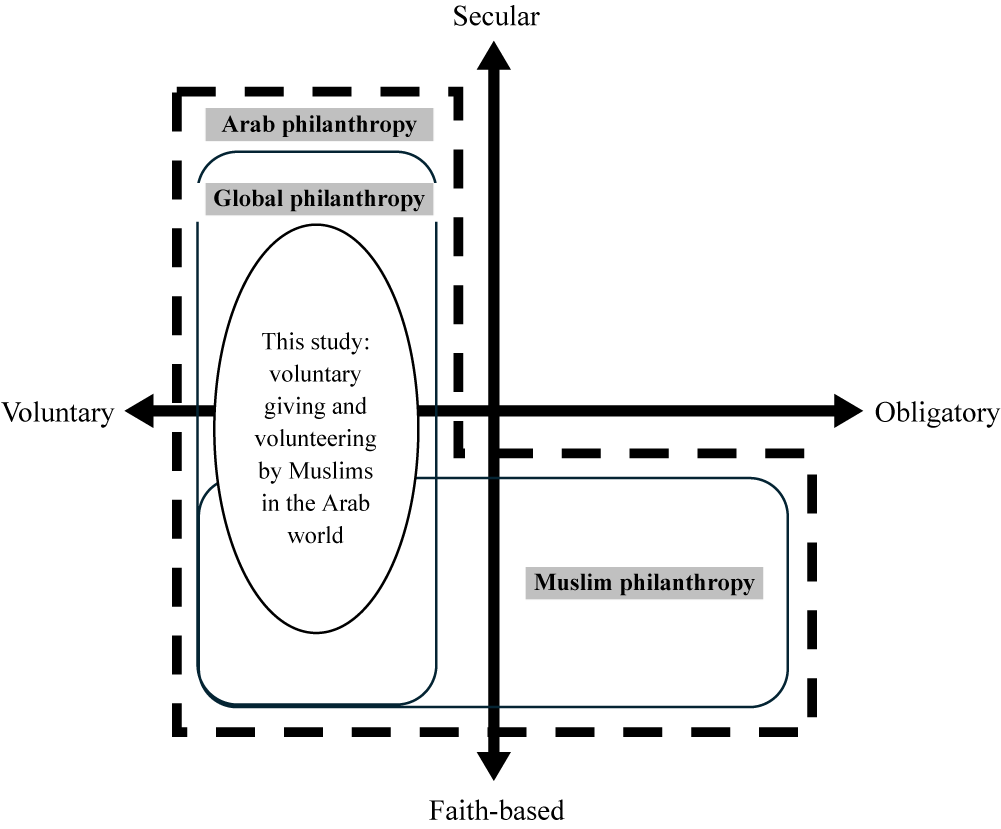
In Figure 1, we therefore position Arab philanthropy as encompassing the principles of both global philanthropy and Muslim philanthropy. Our study, however, will only investigate the voluntary acts of giving, specifically in the forms of formal volunteering and monetary donations, since obligatory acts of Arab philanthropy only have a faith-based component, indicating little to no margin for direct influence from secular factors. This focus also makes our findings more compatible for comparability with other cross-national research on philanthropy.
Positioning our study within the broader frameworks of philanthropy.

Fig. 1. Long description
The diagram is structured on two intersecting perpendicular axes. The vertical Y axis ranges from Secular at the top to Faith-based at the bottom. The horizontal X axis ranges from Voluntary on the left to Obligatory on the right.
At the center of the left-hand side is a white vertical oval labeled This study: voluntary giving and volunteering by Muslims in the Arab world. This oval is positioned entirely within the Voluntary half of the diagram, spanning both Secular and Faith-based quadrants.
Moving outward, the oval is contained within a larger vertical rectangle with rounded corners and a diagonal hatched pattern labeled Global philanthropy. This region covers the majority of the top-left Secular-Voluntary quadrant and extends slightly into the bottom-left Faith-based-Voluntary quadrant.
To the right and overlapping with the bottom of the Global philanthropy region is a horizontal rounded rectangle with a different diagonal hatched pattern labeled Muslim philanthropy. This region occupies the bottom-left Faith-based-Voluntary quadrant and extends across the Y axis into the bottom-right Faith-based-Obligatory quadrant.
Encompassing all these elements is a large L-shaped area defined by a thick dashed black border. A label at the top of this border reads Arab philanthropy. This outermost boundary contains the entirety of the study's focal oval, the Global philanthropy region, and the Muslim philanthropy region, covering parts of three quadrants while leaving the top-right Secular-Obligatory quadrant empty.
Contextual and individual determinants of voluntary giving in Arab countries
Religion and religious behavior
You will not attain true piety until you voluntarily give of that which you love and whatever you give, God knows of it. (Qur’an 3:86)
Drawing from the Islamic holy book, the Quran, as well as the practices and teachings of the Prophet Muhammad, the sunnah and the hadiths, Islamic philosophy on charitable giving privileges intention more so than the action and its degree of discretion. Fundamentally, charitable giving in the Islamic tradition is a practice of truthfulness, sincerity, benevolence, and devotion to God, Allah (Siddiqui et al., Reference Siddiqui, Wasif and Hughes2024).
Islamic societies have historically relied on institutionalized forms of philanthropy (in the form of waqf) as a steady sponsor of humanitarian and economic aid for their community. However, the rise of the modern state has greatly reformed the rules and regulations for civil society, leaving monetary giving, primarily given informally and to kinship by way of zakat and sadaqa, as the foremost practice of Islamic giving (El Daly, Reference El Daly2022).
Given the predominance of Muslims and the historical presence of Islam in the region, its traditions remain deeply ingrained within both the state and the citizens. While Muslims are not a monolithic group, and not all Arabs belong to the Islamic faith, the religious tradition shapes life in Arab society to a large extent. Particularly, the normative aspects of government institutions have been deeply influenced by the religious values of Islam (Wiepking, Reference Wiepking2021). In terms of charitable giving, for example, some states have institutionalized the collection and distribution of zakat , albeit to different extents and with varying regulations (Hasan, Reference Hasan and Hasan2015). Nevertheless, the formalization of zakat can foster a broader national culture of generosity that extends beyond religious duty to voluntary acts of giving money and time. We hypothesize as follows:
H1: Individuals living in a country with a higher degree of institutionalized Islamic giving are more likely to donate and volunteer.
At the meso-level, where the social factors (Grönlund & Pessi, Reference Grönlund and Pessi2015) lie, the same reinforced mechanisms come to play where networks, norms, and traditions positively influence philanthropic engagement. Expressed in two mechanisms, the value of charity is enhanced by one’s subjective religiosity, as well as through the effects of social networks generated by frequent participation in public religious practices, further promoting charitable engagement (von Essen et al., Reference von Essen, Hustinx, Haers, Mels, von Essen, Hustinx, Haers and Mels2015). For example, in a comparison of religiosity and volunteering across 53 countries, Ruiter and De Graaf (Reference Ruiter and De Graaf2006) found that individuals in more religious contexts are more likely to volunteer, regardless of their own level of religiosity. These conclusions were disputed by the comparative analysis of 21 countries by Wiepking et al. (Reference Wiepking, Bekkers and Osili2014), where their results showed subjective religiosity to have a greater influence on odds of volunteering than the strength of the religious context. An individual-level study in Turkey, a Muslim-majority country, also could not provide a definitive answer on the effect of subjective religiosity on informal giving (Campbell & Çarkoğlu, Reference Campbell and Çarkoğlu2019). Informed by the theoretical arguments, we have created the following hypotheses:
H2: Individuals with greater subjective religiosity are more likely to donate and volunteer.
H3: Individuals who attend public prayers more frequently are more likely to donate and volunteer.
H4: Individuals living in governorates with higher rates of public prayer attendance are more likely to donate and volunteer.
State and civic attitudes
Wiepking et al. (Reference Wiepking, Handy, Park, Neumayr, Bekkers, Breeze, de Wit, Einolf, Gricevic, Scaife, Bethmann, Breen, Kang, Katz, Krasnopolskaya, Layton, Mersianova, Lo, Osili and Yang2021) argued that the structural effects of institutionalization of philanthropy, by way of fiscal incentives, professionalization of philanthropy, or freedom and ease of government registration for philanthropic organizations, are key factors in influencing engagement with charitable giving. In the case of Arab countries, however, studies show varying degrees of success with these strategies.
For instance, philanthropy in the United Arab Emirates has achieved great successes since its codification in 2018 in federal law, when tax deductions were introduced for third-sector organizations (Kaabi et al., Reference Kaabi, Yaaqeib and Touq2023). Nonetheless, evidence from other Arab countries demonstrates that favorable legal frameworks do not consistently lead to more charitable giving. Such as in Lebanon, where fiscal incentives to donate were found to have no impact on behavior, simply because they were not considered rewarding enough (AbouAssi, Reference AbouAssi2015). Similarly, a study on philanthropy in Egypt revealed that donating money is considered a pious Islamic obligation by most, something private between the giver and Allah, diminishing the expected effects of advantageous tax exemptions that would require a public declaration of giving (Herrold, Reference Herrold2015).
These country studies demonstrate how the effects of the formal institutionalization of philanthropy are not clear-cut. They are perhaps mediated by economic and political conditions of the state or even overpowered by the enduring religious prescriptions and norms of Islam. Based on these explanations, we derive the following hypothesis:
H5: Individuals who favor religious norms rather than government policies to help those in need are more likely to donate and volunteer.
Paired with the faith-based aspects of Arab philanthropy, citizenship and politics are equally identifying features of the act. Throughout the history of Arab Muslim societies, acts of philanthropy have been products and byproducts of complex social, economic, and cultural interactions (Singer, Reference Singer2018). Particularly, historians studying the formation of Muslim endowments recall an undeniable gain in political power for the founder after establishment because of its potential to transform the nearby community (Singer, Reference Singer2018). Similar to the establishment of waqfs, modern-day third-sector organizations demonstrate the embeddedness of governance and ideology in benevolence (El Daly, Reference El Daly2022; Kandil, Reference Kandil, Anheier, Fowler, Holloway and Kandil2011; Singer, Reference Singer2018).
As modern states have sought to monopolize power, recent Arab rulers have endorsed a limited (or limiting) legal framework to enable independent third-sector organizations to flourish (El Daly, Reference El Daly2022). By greatly impeding civil liberties, the governments diminish the resonance and capability for citizens to formally engage in volunteering and giving (Enjolras, Reference Enjolras2021). When questioning the scarcity of volunteering in Lebanon, Haddad (Reference Haddad2015) argues that the absence of governmental support for democratic processes is detrimental to civic engagement. She contends that Arab political culture is deeply intertwined with civic action through acts of social solidarity requiring voluntary work. Consequently, the current hybrid regimes of the Arab MENA region have, for a long time, opposed and hindered the formalization of civic engagement because of its potential to lead to social development and political reformation. Overall, many voluntary organizations, especially non-faith-based ones, are seen as suspicious by the political elite and threatening to their power (Kandil, Reference Kandil2004; Karajah, Reference Karajah2006). Lately, however, in an attempt at nation-building, Arab governments have started initiating their own third-sector programs, fulfilling the need for civic organizations but diluting the possibility for empowered citizenry (Haddad, Reference Haddad2015). As a consequence, at the micro-level, organizational participation becomes selectively shaped by political attitudes, attracting pro-government constituents and discouraging those who are more distrustful of state involvement.
With a strong arm overseeing charitable and civil society organizations that stimulate volunteering in society, Arab states often only allow depoliticized or pro-government volunteering opportunities to exist (Milner, Reference Milner2018). In this setting, philanthropic organizations tend to opt for more neutral practices and missions, folding to complicity with repressive political structures, ultimately leading to mission drift (Zencirci & Herrold, Reference Zencirci and Herrold2022). This evolution leaves a small pool of formal opportunities to give to and volunteer for, appealing strongly to pro-government citizens or citizens who remain loyal to and view the country and its institutions as democratic. Altogether, we expect both the objective democratic conditions of the state, as well as the citizens’ evaluation of the functioning of the government, to influence individuals’ likelihood to engage with volunteering and voluntary giving.
H6: Individuals with a positive evaluation of democratic governance are more likely to donate and volunteer.
H7: Individuals living in more democratic countries are more likely to donate and volunteer.
H8: Individuals with a positive evaluation of economic governance are more likely to donate and volunteer.
H9: Individuals with a positive evaluation of charitable organizations are more likely to donate and volunteer.
Gender
Finally, although charitable giving is informed by various cultural traditions and dependent on individuals’ worldviews, effects of social and demographic characteristics have proven to retain a degree of ubiquity as mediators of giving (Bekkers & Wiepking, Reference Bekkers and Wiepking2011; Wiepking & Bekkers, Reference Wiepking and Bekkers2012). Such characteristics include, but are not limited to, age, level of education, and level of income. These factors can account for a significant proportion of variation in philanthropic behavior and must be controlled for in models predicting individual-level behavior.
However, there is the question of the effects of gender on donating and volunteering behavior in the Arab region. Political and socioeconomic inequalities between men and women are steadfast in the region, creating a strong gendered experience of participatory behavior (Glas et al., Reference Glas, Spierings and Scheepers2018). From the Islamic prescriptions on giving, all believers are equally obligated and encouraged to engage with all forms of charity (El Daly, Reference El Daly2022). Yet most scholarship on philanthropy from the Arab world acknowledges that gender plays a significant mediating role, although the effect is not always certain.
For example, Alkadi et al. (Reference Alkadi, Jiang and Aldamer2019) conducted a study on motivations for volunteering in Saudi Arabia using a sample of students at an all-male university. Another study from Bahrain was interested in the motivations of young women volunteers (Sengupta & Al-Khalifa, Reference Sengupta and Al-Khalifa2022). Remarkably, both studies found their respondents engaged in voluntary work because it boosts their self-esteem and is seen as an opportunity to strengthen their CV for a job. Neither study, however, felt confident to generalize their findings to the opposite gender. Results from a study conducted in the United Arab Emirates were able to make the conclusion that while motivations to volunteer were not significantly influenced by gender, women were more likely to volunteer than men (Awofeso et al., Reference Awofeso, Guleid and Bamidele2017). This contradicts the common expectation that patriarchal norms of Arab society inhibit women from volunteering, favoring male participation in the public space (Brik, Reference Brik2024). Regarding non-obligatory donating behavior, gender disparities are expected to subside, although the differences shift away from the incidence of donating to the cause donated to (El Daly, Reference El Daly2022). Due to the varying findings of existing literature, our hypothesis is as follows:
H10a: Men and women do not differ in their likelihood of donating.
H10b: Men are more likely to volunteer than women.
Methods
Data
To study the Arab population, we selected data from the AB. The AB has the largest repository of public opinion surveys inquiring into social, political, and economic attitudes of citizens in the MENA region (Arab Barometer, 2025). The standardized questionnaire is curated by a close collaboration between North American, European, and Arab research institutions. It is then distributed for systematic data collection by local research bureaus in the participating Arab states. By including Arab partners throughout all stages of data collection, the organization has adapted its questionnaire more closely to Arab culture than other large cross-national data sources have been able to (Tessler, Reference Tessler and Sadiki2020). The survey was given to the respondents in Arabic.
The fifth wave (2018–2019) was chosen for analysis as it was the only wave to contain measures of philanthropic behavior at the time of writing. Only inquiring about the incidence of donating and volunteering, the AB does not probe into amounts given or specific motivations, which is similar to the scope of other major public opinion surveys’ consideration of charitable giving (Wiepking, Reference Wiepking2021). Although this limits the operationalization of “Muslim philanthropy,” the available measures remain relevant and enable an initial analysis of charitable giving within the Arab region (Siddiqui et al., Reference Siddiqui, Wasif and Hughes2024).
In this wave, the survey was administered in 12 Arab countries: Algeria, Egypt, Iraq, Jordan, Kuwait, Lebanon, Libya, Morocco, Palestine, Sudan, Tunisia, and Yemen. All respondents from Kuwait (N = 1376) were removed from the analysis as they were systematically missing information on necessary items measuring religion, subjective religiosity, and prayer attendance. Moreover, all non-Muslim respondents (N = 1749) were removed from the dataset because the distribution was otherwise extremely skewed, both in terms of group sizes and in geographical residence. This left a total of 11 countries, 208 governorates, and a decrease in sample size from 26,780 to 18,818 after cases with missing information from at least one of the variables included in our explanatory model were also omitted. Variables measuring attitudes and perspectives on governance and institutions yielded the most missing cases, which reflects the expected cultural response to the sensitive nature of the questions. Robustness checks on the individual level, such as comparing the included with the excluded cases per country and demographic predictors, showed some levels of distortion across the cases (i.e., respondents from Morocco had a notably lower proportion of valid cases left after deletion). Still, it is unlikely to have led to meaningful selection bias after listwise deletion, particularly because the sample size remains relatively large.
Variables
Outcome variables
Prosocial behavior manifests in different forms, yet the actions tend to complement each other because they often stem from a common set of values (Einolf, Reference Einolf2017; Krawczyk et al., Reference Krawczyk, Ezeonu and Mac-Ikemenjima2023). Due to the survey data available, we use volunteering, the offering of time and effort without financial compensation, and voluntary donating of money, as indicators of philanthropy in our analysis, like a recent study similarly did (Krawczyk et al., Reference Krawczyk, Ezeonu and Mac-Ikemenjima2023).
The incidence of donating was posed in the questionnaire as, “In a typical month, do you donate money to a charity or those in need?Footnote 1” By framing it as monthly giving, there is deliberately no conflation with paying zakat, which is done only once a year. While giving zakat is a significant portion of charitable giving for Muslims, the available measure enables an analysis of the effects of religion on entirely voluntary giving.
Meanwhile, the incidence of volunteering was asked as, “Have you volunteered for any local group or organization regardless of your status of membership?Footnote 2” Importantly, the timeframe expanded to having ever volunteered. Moreover, the question loosely prioritizes formal volunteering for a group or organization but explicitly states that membership in the group is unnecessary. The AB opts for a broader, more locally adapted definition of voluntary work than other global surveys (Salamon et al., Reference Salamon, Sokolowski and Haddock2011; Wiepking, Reference Wiepking2021).
Overall, 18.8% of respondents indicated having volunteered before, while 53.0% indicated donating money monthly. To validate the plausibility of these proportions, we searched for a data source with comparable measures and a similar Arab sample. This was only available in the 2025 Charities Aid Foundation (CAF) World Giving Report. The CAF report described generally higher proportions of engagement with giving money (66%) and volunteering (35.7%) based on data from seven overlapping countries (CAF, 2025). The discrepancy in the rate of volunteering is likely attributed to the inclusion of informal volunteering in the CAF measure.
Among the 11 countries in the AB sample, Sudan represents the highest frequency of respondents who have volunteered (41.5%), and Egypt has the highest positive response of respondents who donate monthly (69.3%). Meanwhile, Lebanon has both the fewest respondents who have volunteered (6.0%) and those who donate regularly (23.9%).
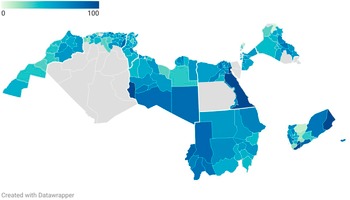
There is notable heterogeneity between the governorates of the countries. The percentage of respondents per governorate across all countries of the dataset that have ever volunteered or donated monthly are depicted in Figures 2 and 3. Remarkably, Yemeni governorates have the largest proportions of inhabitants who volunteer or donate monthly across the sample. For example, despite being neighboring governorates in Yemen, Abyan and Lahij have one of the highest and lowest rates of volunteering across all governorates in the dataset, with 63.8% and 2.5%, respectively. Simultaneously, inhabitants of Lahij reported one of the highest rates of donating, with 98.7% of respondents answering positively to the measure, and Al Jawf, a northern Yemeni governorate, showed only 10% of inhabitants engaged in regular donating. These discrepancies within a single country demonstrate our expectations for contextual effects in philanthropic engagement to hold stakes at a governorate level rather than only at the national level.
Percentage of respondents per governorate who donate monthly.

Fig. 2. Long description
A choropleth map with a color scale in the top-left corner ranging from light green at 0 to dark blue at 100.
* In the West, Morocco and northern Algeria show moderate blue shades, while southern Algeria and Mauritania are light grey, indicating no data or low values.
* In the Central region, Libya and Egypt show high density in the North with dark blue coastal areas. Sudan displays a gradient of medium to dark blue across its southern and western regions.
* In the East, the Levant and Arabian Peninsula show high variation. The eastern coast of the Red Sea and the southern tip of the Arabian Peninsula (Yemen and Oman) feature deep blue clusters, indicating high donation percentages.
* Several inland areas in the East and North Africa are shaded in light grey.
Percentage of respondents per governorate who have volunteered.

Fig. 3. Long description
A choropleth map displays data across various governorates. A legend in the top-left corner shows a color gradient from light green representing 0 to dark blue representing 100.
* In the West, Morocco and Algeria show a mix of light green and medium teal governorates, with large inland areas of Algeria and Mauritania shaded in grey, indicating missing data.
* In the North, Tunisia and coastal Libya feature light green to teal shades.
* In the Central region, Southern Libya and parts of Sudan show higher concentrations of darker blue, indicating higher volunteer percentages. Egypt is mostly light green with a teal cluster near the Nile Delta.
* In the East, the Levant region and Iraq are predominantly light green.
* In the Southeast, the Arabian Peninsula shows varied data. Yemen has several dark blue governorates in the South and West, while Oman and Saudi Arabia are mostly light green or teal.
* Several large regions in the center and North are shaded grey.
Predictor variables
Individual level. Key descriptive statistics at the individual level are displayed in Table 1. To assess our hypotheses on religiosity, we include a measure of subjective religiosity and a measure of religious behavior. The latter variable is based on the respondent’s frequency of Friday prayer attendance at a mosque. Overall, Sudan and Egypt have the highest average scores on religious service attendance, while the largest group of self-identified religious respondents resides in Iraq. Notably, our model does not account for the effects of denomination. Although the information was available in the dataset, the groups were few, sizes small, and dispersion heavily skewed—representative of the true population, but unsuitable for unbiased analysis. Additionally, we opted to omit denominations from the model because there is little to no discussion in the literature suggesting varying effects stemming purely from denominational philosophies.
Descriptive statistics of the independent variables

Table 1. Long description
The table is divided into three main sections based on the level of analysis.
1. Individual level variables (N = 18,818):
* Subjective religiosity: Religious (35.8%), Somewhat religious (52.9%), Not religious (11.4%).
* Frequency of Friday prayer attendance: Range 0 to 4, Mean 1.97 (S D 1.69).
* Evaluate economic governance effectiveness: Range 0 to 10, Mean 2.63 (S D 2.22).
* Evaluate democratic governance: Range 0 to 10, Mean 4.16 (S D 2.79).
* Charitable organizations provide necessary services: Agree (65.6%), Disagree (34.4%).
* Best way to reduce poverty: Sadaqa or both strategies (57.1%), Taxes (12.6%), Neither (30.3%).
* Sex: Male (51.6%), Female (48.4%).
* Highest education level: Primary (36.2%), Secondary (26.3%), Tertiary (37.5%).
* Age groups: 17 to 25 (25.6%), 26 to 35 (26.6%), 36 to 59 (38.3%), 60 to 110 (9.4%).
2. Governorate level variables (N = 208):
* Average Friday prayer attendance: Range 0 to 4, Mean 1.94 (S D 0.56).
* Percent living below national median income: Range 0 to 100, Mean 49.50 (S D 22.13).
3. Country level variables (N = 11):
* Zakat institution: Mandatory (27.3%), Formal (25.3%), Informal (47.4%).
* V-Dem Liberal Democracy Index: Range 0 to 1, Mean 0.23 (S D 0.15).
Four measures are included to test our hypotheses on civic attitudes toward the state and institutions. The first is a sum scale based on the following three evaluations of government policies on: (1) creating job opportunities, (2) narrowing the gap between the rich and poor, and (3) keeping prices down, each connected by one common latent factor: evaluating economic governance effectiveness. The second measure is based on the question, “to what extent do you believe your country is a democracy?” Third, we include a measure of the evaluation of charitable social organizations on staying true to their charitable mandate. In all three measures, higher values indicate a more positive sentiment. Fourth and final, we include an indicator juxtaposing taxes, a compulsory government-regulated contribution, to sadaqa, a voluntary charitable contribution. More specifically, respondents were asked if they preferred to increase sadaqa or taxes as a strategy to reduce poverty in their country. Remarkably, 57.1% of the sample wanted an increase in sadaqa or a combination of both strategies, while only 12.6% viewed an obligation of taxes as the preferred strategy to diminish poverty. The remainder indicated either an inability or unwillingness to commit to either strategy.
The sex of the respondents is also accounted for in the model. An explicit aim of the AB is to achieve a balance between the two sexes in our sample, which is achieved with 51.6% men and 48.4% women. Both in terms of having ever volunteered or regularly donated, men outperform women in the sample.
To ensure internal validity of the model, we included two control variables at the individual level: age and level of education. We recoded the metric measure of respondents’ age into four categories, roughly outlining four key life stages. The categories of educational attainment are also reduced to three broad distinctions. The original variable distinguished between elementary education and basic education, as well as tertiary education, bachelor’s and master’s diplomas. These were combined into primary education (or less) and tertiary education, respectively, after initial single-level bivariate analyses showed no significant differences amongst the original groups. The number of respondents with a tertiary education is the largest (37.5%) due to the high number of bachelor’s degree graduates (22.6%).
Governorate level. At the governorate level, we test the effects of contextual religious behavior. The scale of religious behavior is based on the average frequency of going to Friday prayers at a mosque by inhabitants per governorate. It is an aggregate measure. At the same time, we controlled for possible effects of income inequality. We do so using a scale of income that calculates the average percentage of governorate inhabitants living below the national median income level, where higher values indicate a greater proportion of inhabitants living in less economically prosperous conditions.
Country level. A measure of zakat institutionalization (Hasan, Reference Hasan and Hasan2015) is included at the country level. For some countries in the sample, the Islamic tradition of compulsory charity is legally mandated (i.e., Libya, Sudan, and Yemen); for others, it is formalized and partially facilitated by the government (i.e., Egypt, Jordan, and Lebanon), while for most it is informally organized (i.e., Algeria, Iraq, Morocco, Palestine, and Tunisia). Finally, the 2018 V-Dem Liberal Democracy Index is included to measure the objective democratic conditions of the countries. Tunisia outperformed the other states, scoring 0.621 on the scale, well above the second-highest score of 0.290 awarded to Iraq (Lührmann et al., Reference Lührmann, Dahlum, Lindberg, Maxwell, Mechkova, Olin, Pillai, Petrarca, Sigman and Stepanova2018).
Design
To study the extent of the expected influences on Arab Muslim’s engagement with philanthropic acts, we run separate binary logistic regression analyses on two forms of giving: volunteering time and voluntarily donating money. Additionally, since we are interested in both individual and contextual effects, we employ multilevel techniques.
Whereas other similar studies employing hierarchical modeling tend to place only countries as the higher-level grouping variable, our analysis will create a three-level model. When studying the MENA region, there is evidence that individuals across smaller geographical regions within national borders can experience starkly different lived environments (Spierings, Reference Spierings2019). Whether it is the distribution of religious or tribal enclaves, the economic opportunities, or varying military instability—grouping Arab individuals only by country may overlook finer differences. Hence, our study selects two higher-level units—countries and governorates, otherwise known as administrative regions, as the Level 3 and Level 2 grouping variables.
Table 2 shows the higher-level variance, the pseudo-variance partitioning coefficient (VPC), and the outcome of Wald’s test of significance for the model build-up at four stages for both outcome variables of philanthropy. The initial model (null model) establishes whether a multilevel model is necessary for analysis. The following three models demonstrate the addition of predictors at each level of analysis.
Higher level variance

Table 2. Long description
The table consists of six columns and five rows. The columns are: Outcome variable, Level description, Null (0) model, Model (1) with lev. 1 predictors, Model (2) with lev. 1 and lev. 2 predictors, and Model (3) with lev. 1, lev. 2 and lev. 3 predictors.
For the outcome variable Donate monthly:
- Lev. 3 var. and pseudo-V P C: Null model is 0.223* (6.35%); Model 1 is 0.169 (4.89%); Model 2 is 0.302* (8.41%); Model 3 is 0.246* (6.96%).
- Lev. 2 var. and pseudo-V P C: Null model is 0.478*** (12.69%); Model 1 is 0.512*** (13.47%); Model 2 is 0.455*** (12.15%); Model 3 is 0.451*** (12.06%).
For the outcome variable Have volunteered:
- Lev. 3 var. and pseudo-V P C: Null model is 0.586* (15.12%); Model 1 is 0.465* (12.38%); Model 2 is 0.315* (8.74%); Model 3 is 0.121 (3.55%).
- Lev. 2 var. and pseudo-V P C: Null model is 0.339*** (9.34%); Model 1 is 0.311*** (8.64%); Model 2 is 0.295*** (8.23%); Model 3 is 0.295*** (8.23%).
Note: lev. 1 is individual-level, lev. 2 is governorate-level, lev. 3 is country-level. Significance levels are indicated by asterisks: *** p < 0.001, ** p < 0.01, * p < 0.05.
Note: lev. 1 is individual-level, lev. 2 is governorate-level, lev. 3 is country-level. ***p < 0.001, **p < 0.01, *p < 0.05.
For the outcome donate monthly, the null model calculates a pseudo-VPC of 6.35% at the country level and 12.69% at the governorate level. In contrast, the null model for have volunteered showed more variance at the country level (pseudo-VPC = 15.12%) and less at the governorate level (pseudo-VPC = 9.34%). The higher-level variances of both null models are statistically significant and large enough to motivate multilevel analysis.
In the final model of donate monthly, when predictors at all levels are included, the country- and governorate-level variances remained similar to the null model, indicating the predictors could not account for much contextual-level differences. Comparatively, the predictors included in the final model of have volunteered did account for a substantial decrease in the country-level variance, and a smaller decrease in the governorate-level variance. Despite the lack of difference in context-level variance explained in the final donate monthly model, multilevel techniques remain appropriate for analysis due to the clustering of data by governorate and country, both meaningful contextual units.
Results
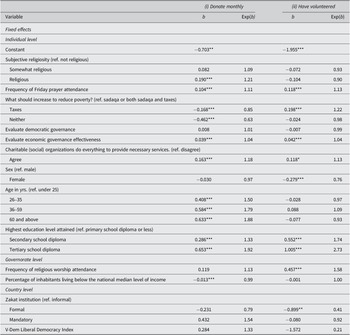
The coefficient estimates of the final models of the two outcomes are shown in Table 3. Denoted as exp(b) in the table, the results are described in terms of odds ratios (OR). The first model tested the odds of donating in a typical month, whereas the second model tested the odds of having ever volunteered.
Parameter estimates in the individual-, governorate-, and country-level model for incidence of (i) donate monthly and (ii) have volunteered

Table 3. Long description
A table with six columns. The first two columns list variables and their reference categories. The next four columns are grouped into two outcomes: (i) Donate monthly and (ii) Have volunteered, each with sub-columns for coefficient b and Exp(b).
Individual level fixed effects:
- Constant: b is minus 0.703 for donating and minus 1.955 for volunteering.
- Subjective religiosity (ref. not religious): For ‘Religious’, b is 0.190 for donating and minus 0.104 for volunteering.
- Frequency of Friday prayer attendance: b is 0.104 for donating and 0.118 for volunteering.
- Poverty reduction view (ref. sadaqa or both): For ‘Taxes’, b is minus 0.168 for donating and 0.198 for volunteering.
- Economic governance effectiveness: b is 0.039 for donating and 0.042 for volunteering.
- Sex (ref. male): For ‘Female’, b is minus 0.030 for donating and minus 0.279 for volunteering.
- Age (ref. under 25): For ‘60 and above’, b is 0.633 for donating and minus 0.077 for volunteering.
- Education (ref. primary or less): For ‘Tertiary school diploma’, b is 0.653 for donating and 1.005 for volunteering.
Governorate level:
- Frequency of religious worship attendance: b is 0.119 for donating and 0.457 for volunteering.
- Percentage below national median income: b is minus 0.013 for donating and minus 0.001 for volunteering.
Country level:
- Zakat institution (ref. informal): For ‘Formal’, b is minus 0.231 for donating and minus 0.899 for volunteering.
- V-Dem Liberal Democracy Index: b is 0.284 for donating and minus 1.572 for volunteering.
Statistical significance is indicated by asterisks: three for p < 0.001, two for p < 0.01, and one for p < 0.05.
Note: ***p < 0.001, **p < 0.01, *p < 0.05.
Regarding subjective religiosity, we found that religious people have greater odds of donating monthly than non-religious people (OR = 1.21). There were, however, no significant differences between the groups of subjective religiosity and their odds of having ever volunteered.
Individuals attending public worship more frequently have a greater odds of having volunteered (OR = 1.13) and donating (OR = 1.11).
Furthermore, if an individual prefers increasing taxes, a government-centered initiative, as a strategy to combat poverty in the country, they have a lower odds (OR = 0.85) to donate money monthly compared to the individuals who believe in the alternative strategy of increasing sadaqa or both sadaqa and taxes. In terms of having ever volunteered, however, there is the opposite effect. Individuals who prefer an increase in taxes to combat poverty have a higher odds (OR = 1.22) of having volunteered relative to the reference group.
Concerning civic values, favorable evaluations of democratic governance showed no significant effect on engaging with philanthropy. However, having a more positive evaluation of economic governance effectiveness led to statistically significant, slightly larger odds of having ever volunteered (OR = 1.04) or donated monthly (OR = 1.04). A favorable perception of charitable institutions compared to a negative perception also increases the odds of both acts of philanthropy. Those with a positive evaluation had an OR of 1.18 and 1.13 times larger than those with negative evaluations to donate and have volunteered, respectively.
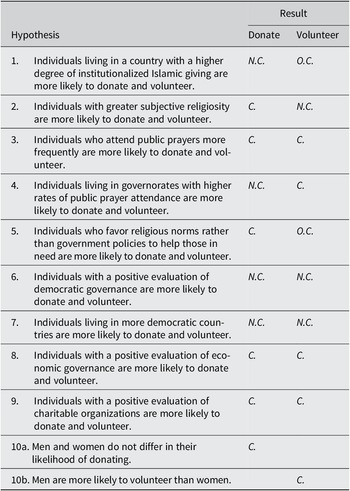
Men and women do not differ significantly in their odds of donating monthly. But in terms of volunteering, women have lower odds of having ever volunteered than men (0.76). A concise overview of the hypotheses and corresponding conclusions can be found in Table 4.
Recapitulation of hypotheses and results

Table 4. Long description
The table consists of three columns: Hypothesis, Result for Donate, and Result for Volunteer. Results are coded as C. for confirmed, N. C. for not confirmed, and O. C. for opposite confirmed.
* Hypothesis 1: Higher degree of institutionalized Islamic giving. Donate: N. C. Volunteer: O. C.
* Hypothesis 2: Greater subjective religiosity. Donate: C. Volunteer: N. C.
* Hypothesis 3: Frequent public prayer attendance. Donate: C. Volunteer: C.
* Hypothesis 4: Governorates with higher public prayer rates. Donate: N. C. Volunteer: C.
* Hypothesis 5: Favoring religious norms over government policies. Donate: C. Volunteer: O. C.
* Hypothesis 6: Positive evaluation of democratic governance. Donate: N. C. Volunteer: N. C.
* Hypothesis 7: Living in more democratic countries. Donate: N. C. Volunteer: N. C.
* Hypothesis 8: Positive evaluation of economic governance. Donate: C. Volunteer: C.
* Hypothesis 9: Positive evaluation of charitable organizations. Donate: C. Volunteer: C.
* Hypothesis 10a: Men and women do not differ in donating. Donate: C.
* Hypothesis 10b: Men are more likely to volunteer than women. Volunteer: C.
Note: N.C. = not confirmed, C. = confirmed, O.C. = opposite confirmed.
The coefficients of the control variables, age level, and education level, were notably large. Relative to Arabs under the age of 25, each older age group subsequently had significantly greater odds of donating monthly, but did not differ for the outcome of volunteering. The oldest age group, 60 years old and above, had 1.88 times greater odds of donating monthly than the young reference group.
An individual who attained a secondary school diploma had a larger OR to have ever volunteered (1.74) as well as donate monthly (1.33), compared to someone with at most a primary school diploma. The effect is larger for those with a tertiary diploma, where the odds of having volunteered were 2.73 times greater and 1.92 times greater to donate than the reference group.
Individuals living in governorates where the average frequency of religious worship attendance is higher only saw a significant effect on having volunteered (OR = 1.58). Simultaneously, individuals of governorates with a higher proportion of inhabitants living below the national median level of income showed marginally lower odds of donating monthly (OR = 0.99).
Finally, at the country level, the degree of zakat institutionalization did not affect the odds of donating monthly. On the contrary, inhabitants living in countries with formal zakat regimes compared to informal regimes display significantly lower odds of having ever volunteered (OR = 0.45). Lastly, objective democratic conditions showed no significant effect on either outcome.
Discussion
This study aimed to explain variation in the voluntary acts of giving money and time by Muslims across 11 Arab countries in the MENA region. Our theorization on determinants of voluntary forms of Arab philanthropy was grounded in the premise that the theoretical framework of Muslim philanthropy lacks thorough recognition of the prominent politics of benevolence existent in the Arab world. At the same time, the global philanthropy framework departs from a Eurocentric definition of philanthropy that insufficiently considers the normative effects of religious institutions still salient in many societies across the world, such as in the Arab region.
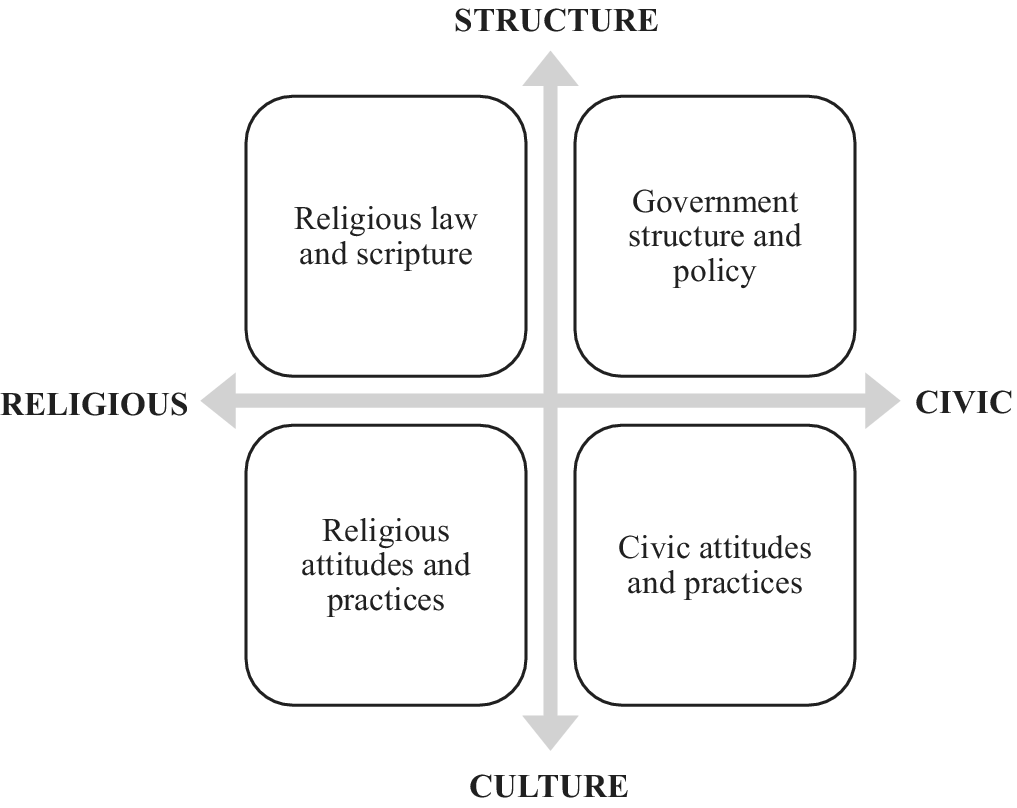
In an effort to address this dilemma, and based on our empirical findings, we propose a new analytical tool (Figure 4) that situates Arab philanthropy on a religious-civic nexus as the two most prominent and competing spheres of influence, while accounting for their different mechanisms at the structural and cultural levels. Each quadrant has a key role in determining Arab philanthropy, but the extent of influence can vary according to the nature of the philanthropic act.
Spheres of influence on Arab philanthropy.

Applying the tool to our findings, it becomes evident that the philanthropic act of donating money, in contrast to formal volunteering, is more strongly informed by the indicators from the religious sphere. Although the framework of Muslim philanthropy condones a broad array of actions to be philanthropic, our findings revealed no significant connection between subjective religiosity and formal volunteering. One reason for this divergence can be that the core Islamic principle of charitable giving remains focused on monetary giving in the form of zakat, thus implying other forms are somewhat less consequential. This plausibly leads to a spillover effect for Muslims, where voluntary charitable giving more easily manifests in donating money compared to other non-monetary acts.
It must be reiterated that giving money is a largely private act in the Arab world. It is often done without an audience, in utmost discretion and with minimal interference from a regulatory body (Hartnell, Reference Hartnell2018; Herrold, Reference Herrold2015). These attributes coincide with the cherished principles of giving outlined in Islamic scripture (El Daly, Reference El Daly2022). We connect this to the gendered experience under the dominant patriarchal traditions of the Arab world, revealing a possible clarification for the lack of gendered difference in odds to donate, but a stark distinction in odds to volunteer. While donating can be done privately, formal volunteering tends to be done in the public eye, an arena where men are more present than women (Brik, Reference Brik2024; Nyhagen et al., Reference Nyhagen, Halsaa, Nyhagen and Halsaa2016). Also, donating money is oftentimes a familial decision. Given the pooling of household income and expenses, all household members may report participation even if a single individual drove the decision.
The opposing effect of preferring an increase in taxes to an increase in sadaqa to combat poverty in the country further confirms the assumption that donating money is informed more by religious considerations, while formal volunteering is more deeply influenced by civic considerations. Arabs preferring the first strategy were more likely to have volunteered, while simultaneously being less likely to donate monthly. This result can be distilled to the opposing connotations associated with the two premises and the two acts of giving. More concretely, formal volunteering is (to an extent) regulated by the state and its approval of organizations, whereas donating can be done informally without government control. Hence, those who view the state as a reliable organ for wealth redistribution will be more likely to volunteer with programs deemed eligible by the same governing body they have demonstrated to trust (Zencirci & Herrold, Reference Zencirci and Herrold2022). As a result, the civic profiles of volunteers become greatly limited to apolitical citizens or citizens with a greater affinity toward the government (Khouri & Lopez, Reference Khouri and Lopez2011). Contrastingly, in Arab societies, donating money is highly fragmentary, informal, and decentralized, in part due to the Islamic principles of giving, but also because of great skepticism and dissatisfaction in the management of the establishment (Hartnell, Reference Hartnell2018; Zencirci & Herrold, Reference Zencirci and Herrold2022).
Finally, despite the significant effects of religious and civic factors, age and level of education emerged as key predictors of volunteering and giving in the Arab world. Respectively, individuals of older age had significantly greater odds of donating, while more highly educated individuals significantly improved the odds of both donating money monthly and engaging in formal volunteering. In a practical sense, older individuals are likely to have more disposable income or savings, but also more social and religious expectations to donate regularly (Bekkers & Wiepking, Reference Bekkers and Wiepking2011).
Theoretically more challenging, however, are the considerable disparities between educational groups, indicating a theoretically overlooked issue of social inequality in Arab society. This is most concerning in the prediction of formal volunteering, where we believe two explanations are plausible. On the one hand, the results of our model mirror Wilson and Musick’s (Reference Wilson and Musick1997) classic resource theory, where formal volunteering is positively associated with human capital due to the competence, confidence, and social resources necessary to engage with organizations. On the other hand, the result is also a reflection of a common government policy in the Arab world targeted at students. In an effort to foster nation-building, Arab governments have taken to mandate volunteering at schools and universities, capitalizing on the large student bodies (Awofeso et al., Reference Awofeso, Guleid and Bamidele2017; Haddad, Reference Haddad2015). We attach greater salience to this latter explanation of the influence of education, which attests to the civic-structural sphere of influence on Arab philanthropy in Figure 4.
Limitations and future avenues for research
This study leverages a unique cross-national dataset of several Arab countries to assess individual- and context-level variation in two voluntary philanthropic acts. Along with the meaningful results produced, the study is nevertheless subject to notable limitations as well.
First, multilevel techniques were employed to analyze the data for two important reasons: our aim to produce globally comparative findings similar to existing cross-country analyses, but also because of the inherent geographical clustering structure of the sample. Unfortunately, with just 11 countries in the sample, the results of the Level 3 effects must be interpreted cautiously. Even though this was compensated for by the decision to include governorates as a Level 2 clustering variable, only aggregate measures from the respondents’ data could be operationalized. Thus, an analysis of context-level effects is limited, in part due to the few suitable measures at the governorate level, but also due to the small number of country units. This likely inhibited the model’s capacity to explain variance at the context levels, which still requires further investigation. Future researchers from the MENA region could take a similar approach to the contributors of the Individual International Philanthropy Database (IIPD) and collaborate to create a harmonious dataset reflecting Arab philanthropy.
Second, our data only allowed for an analysis of two conventional philanthropic acts. While formal volunteering and donating money remain globally comparative indicators of philanthropy, we know that acts of Arab philanthropy, like other Majority World traditions, consist of far more than these two actions. While the survey took caution to carefully describe the considerations needed for both measures, other popular forms of giving, such as informal volunteering (i.e., without a facilitating organization), informal help, or non-monetary donations, were left unmeasured.
Additionally, religious prescriptions on discretion, along with the convoluted civil-state dynamics, potentially discouraged respondents from declaring their engagement with the measured forms of philanthropy (El Daly & Khalil, Reference El Daly and Khalil2017; Kuttab & Johnson, Reference Kuttab and Johnson2011). In this sense, the proportion of engagement might be skewed and underestimate the true levels of participation. The possibility of other preferable forms of giving demonstrates a need for multifaceted measurements of philanthropy. We suspect that an inquiry into other unique forms of giving might also result in a better explanation for the stark effects of the sociodemographic variables such as gender, educational level, and age.
Conclusion
This study set out to analyze the determinants of voluntary giving of time and money among Muslims in the MENA region. Situating our analysis within the broader framework of global philanthropy and at the cross-section with Muslim philanthropy, we show that a dialogue between both frameworks is needed to fully understand philanthropy in the Arab world due to its distinct religious, cultural, and political traditions. Drawing on these combined conceptualizations along with findings from scholars on and from the region, we developed and tested a regionally grounded model of Arab philanthropy in the forms of voluntary donations and formal volunteering.
Our findings underscore the importance of both religious and civic influences operating at structural and cultural levels in shaping individual engagement in philanthropic behavior. In doing so, this study not only contributes new empirical evidence from a large-scale cross-national dataset but also demonstrates the value of expanding philanthropy research beyond Global-North-centered frameworks. By foregrounding the interplay between institutionalized religious norms and civic attitudes, the analysis advances a more context-sensitive understanding of voluntary giving in the MENA region and enriches the comparative study of philanthropy globally.
Competing interests
The authors declared no potential conflicts of interest with respect to the research, authorship, and/or publication of this article.
Ethical standards
The authors declare no conflict of interest.




 Open access

