





Introduction
The study of elite political polarization has traditionally focused on ideological divides between parties (eg Dalton Reference Dalton2008; McCarty, Poole and Rosenthal Reference McCarty, Poole and Rosenthal2006). However, recent research has highlighted the importance of affective polarization – the tendency for individuals to hold strong positive feelings toward their own party and co-partisans and negative feelings toward political opponents, separate from policy disagreements (Iyengar, Sood and Lelkes Reference Iyengar, Sood and Lelkes2012; Mason Reference Mason2015). While this literature has focused on affective polarization among the mass public, such identity-based conflict can also exist among political elites (Banda and Cluverius Reference Banda and Cluverius2018; Enders Reference Enders2021; Lucas and Sheffer Reference Lucas and Sheffer2025).
In addition to the possible consequences for mass affective polarization (Huddy and Yair Reference Huddy and Yair2021), elite affective attitudes may also have implications for the functioning of democratic institutions (Bäck and Carroll Reference Bäck and Carroll2018). The identity-based conflicts that drive affective polarization may make it more difficult for political elites to formally cooperate to form governing coalitions in parliamentary democracies, beyond the effects of policy disagreements. This paper contributes to the emerging literature on elite affective polarization and its consequences by examining how affective attitudes among political elites influence the formation of coalition governments.
In parliamentary systems, the formation of a government requires political parties to engage in negotiations and reach compromises to form a stable governing coalition, with parties that are ideologically proximate being more likely to form coalitions (Laver and Shepsle Reference Laver and Shepsle1996; Laver and Schofield Reference Laver and Schofield1998; Martin and Stevenson Reference Martin and Stevenson2001; Warwick Reference Warwick1996). However, other factors beyond policy preferences have been shown to influence coalition bargaining, such as familiarity from governing experience (Ecker and Meyer Reference Ecker and Meyer2020; Franklin and Mackie Reference Franklin and Mackie1983), and the exclusion of some parties that are seen as ‘pariahs’ (De Lange Reference De Lange2012; Downs Reference Downs2001; Strøm, Budge and Laver Reference Strøm, Budge and Laver1994).
Recent literature has highlighted how affective dimensions of elite attitudes influence interparty relationships (Calvo, Bäck and Carroll Reference Calvo, Bäck and Carroll2024; Lucas and Sheffer Reference Lucas and Sheffer2025; Öhberg and Cassel Reference Öhberg and Cassel2023; Skytte Reference Skytte2021). Despite the potential implications of elite affective polarization for government formation in parliamentary systems, the consequences for coalition politics remain understudied. This paper addresses this gap by examining how elite affective polarization influences the composition of government coalitions, thereby contributing to our understanding of the consequences for the stability and effectiveness of parliamentary democracies.
Affective polarization implies identity-based attachments that produce strong in-group favoritism towards partisan allies and out-group hostility towards opposing partisans, potentially separate from policy disagreements (Huddy, Bankert and Davies Reference Huddy, Bankert and Davies2018; Iyengar, Sood and Lelkes Reference Iyengar, Sood and Lelkes2012; Mason Reference Mason2018). Among political elites, these attachments can be even stronger and lead to intergroup conflict distinct from policy disagreement (Enders Reference Enders2021). We argue that affective polarization undermines the foundations necessary for cooperation in coalition agreements, particularly the need for trust in bargaining and negotiation (Kramer and Carnevale Reference Kramer, Carnevale, Brown and Gaertner2003; Kong, Dirks and Ferrin Reference Kong, Dirks and Ferrin2014).
When political elites are highly polarized along identity lines, the resulting distrust should influence perceptions of the credibility of potential negotiating partners, separate from policy compatibility. Affective distance among elites can mean perceiving partners as threatening not only for potentially violating coalition agreements but also for exploiting political circumstances more broadly. While policy differences can be addressed through compromise and exchange, trust deficits lead to commitment problems that are more difficult to overcome. Therefore, we argue that, holding ideological differences constant, potential coalitions with greater affective distance are less likely to form because the perceived costs of reaching and maintaining agreements increase.
To examine this question, we draw on unique survey data collected among council members and data on local government formation in the 290 Swedish municipalities (Karlsson Reference Karlsson2017; Karlsson and Gilljam Reference Karlsson and Gilljam2014). We create a measure of partisan animosity by using ‘like-dislike’ scores from legislators rating parties at the local level, analogous to those typically used to gauge levels of partisan affect at the mass level. While politicians’ public actions, such as campaigns and speeches, may involve strategic efforts to signal positions or stoke voters’ own social identities, these anonymous survey responses potentially offer a window into elites’ individual feelings toward other parties. Combining politicians’ anonymous party ratings with their self-reported policy positions from the same surveys allows us to examine whether partisan affect influences coalition formation beyond the effects of ideological disagreement. We use these survey data to gauge the impact of affective polarization on coalition formation in Swedish municipal governments, a context which allows us to hold constant many of the contextual factors that might confound this relationship at the national level.
Our results show that potential coalitions with greater affective distance between parties are significantly less likely to form, even when controlling for policy distances on the left-right and multiculturalism dimensions. Moreover, the relative effect sizes estimated for affective distance are substantively large compared to the effects of policy-based ideological differences. These results hold across various measures and model specifications, including models that control for the inclusion of the radical populist right. Overall, our analysis suggests that affective polarization is likely to be an impediment to the formation of coalition governments in parliamentary democracies.
Theoretical framework
Affective polarization and identity-based conflicts between partisans
Ideological polarization among political elites has been well-documented in both the United States (Barber and McCarty Reference Barber, McCarty, Mansbridge and Martin2016; Hetherington Reference Hetherington2009; Layman, Carsey and Horowitz Reference Layman, Carsey and Horowitz2006; McCarty, Poole and Rosenthal Reference McCarty, Poole and Rosenthal2006) and Europe (Bakker, de Vries, Edwards et al. Reference Bakker, de Vries, Edwards, Hooghe, Jolly, Marks, Polk, Rovny, Steenbergen and Vachudova2015; Dalton Reference Dalton2008; Klingemann, Volkens, Bara et al. Reference Klingemann, Volkens, Bara, Budge and McDonald2006), often viewing party conflict through the lens of policy differences. Studies of the mass attitudes, meanwhile, have increasingly emphasized the importance of identity-based conflict and ‘affective polarization’ (Gidron, Adams and Horne Reference Gidron, Adams and Horne2020; Iyengar, Sood and Lelkes Reference Iyengar, Sood and Lelkes2012; Mason Reference Mason2015). Grounded in social identity theory (Tajfel and Turner 1979, Reference Tajfel, Turner, Worchel and Austin1986), affective polarization is characterized by a strong sense of in-group favoritism and out-group hostility based on partisan identity (Iyengar and Westwood Reference Iyengar and Westwood2015), even in the absence of ideological disagreements.
Affective polarization has been found to influence various aspects of political behavior, such as voting, political participation, and political trust (Hetherington and Rudolph Reference Hetherington and Rudolph2015; Reiljan Reference Reiljan2020). Partisan identities can bias fundamental social judgments like trust based on partisan stereotypes (Carlin and Love Reference Carlin and Love2013), leading to in-group favoritism toward co-partisans and hostility toward rival partisans (Iyengar and Westwood Reference Iyengar and Westwood2015). The ‘us vs them’ dynamic may be based on a partisan identity (Greene 1999, Reference Greene2004) or, in multi-party contexts, may be associated with divisions between groups of parties (eg blocs) characterizing core cultural divides (Gidron, Adams and Horne Reference Gidron, Adams and Horne2020; Kekkonen and Ylä-Anttila Reference Kekkonen and Ylä-Anttila2021; Renström, Bäck and Schmeisser Reference Renström, Bäck, Schmeisser, Andersson, Carlander and Öhberg2020). These group biases can influence political elites (Banda and Cluverius Reference Banda and Cluverius2018; Calvo, Bäck and Carroll Reference Calvo, Bäck and Carroll2024; Enders Reference Enders2021; Öhberg and Cassel Reference Öhberg and Cassel2023) and may have important consequences for elite cooperation and the functioning of democratic institutions (Bäck and Carroll Reference Bäck and Carroll2018; Öhberg and Cassel Reference Öhberg and Cassel2023), including coalition formation. While ideological disagreements and affective polarization may be related in general, with policy conflicts potentially influencing partisan animosity (eg Webster and Abramowitz Reference Webster and Abramowitz2017), we argue that these constitute distinct phenomena in terms of their impact on coalition formation.
Coalition formation in parliamentary democracies
The study of coalition formation in parliamentary democracies has mainly focused on the role of policy preferences and ideological distances between parties in shaping viable governing coalitions (eg Laver and Schofield Reference Laver and Schofield1998; Laver and Shepsle Reference Laver and Shepsle1996; Martin and Stevenson Reference Martin and Stevenson2001), with more ideologically compact coalitions expected to be more likely to form (Axelrod Reference Axelrod1970; De Swaan Reference De Swaan1973; Diermeier and Merlo Reference Diermeier and Merlo2000; Laver and Shepsle Reference Laver and Shepsle1996).Footnote 1 However, some work has gone beyond ideological factors to incorporate other aspects of elite relationships.
First, scholars have stressed the importance of familiarity and previous experience of governing together as an explanation for why incumbent cabinets are favored in coalition negotiations (eg Franklin and Mackie Reference Franklin and Mackie1983; Martin and Stevenson Reference Martin and Stevenson2010; Warwick Reference Warwick1996), since parties that have an experience of governing together reinforce the trust that can arise between political actors. Along these lines, Ecker and Meyer (Reference Ecker and Meyer2020: 266) argue that familiarity affects coalition formation because it ‘fosters mutual trust, knowledge about each other’s preferences, and an understanding of the constraints parties face’. Consistent with this reasoning, there is also evidence that parties who have broken agreements in previous governing experience are less likely to be included in the future (Tavits Reference Tavits2008).
Second, the literature on the exclusion of ‘pariah parties’ focuses on negative bias among political elites toward particular parties, which constrains coalition options beyond policy disagreements (eg Downs Reference Downs2001). These parties, mainly radical right-wing populist parties, are often systematically excluded from coalition bargaining by mainstream parties through explicit anti-pacts or a ‘cordon sanitaire’ (Akkerman, de Lange and Rooduijn Reference Akkerman, de Lange and Rooduijn2016; De Lange Reference De Lange2012; Geys, Heyndels and Vermeir Reference Geys, Heyndels and Vermeir2006; Strøm, Budge and Laver Reference Strøm, Budge and Laver1994), which can limit the set of viable potential coalition partners, overriding considerations of policy compatibility (Van Spanje and Van der Brug Reference Van Spanje and Van der Brug2007).
The phenomena of familiarity and pariah status in coalition politics each underscore the importance of attitudes that go beyond policy differences influencing relationship dynamics among political elites. Elite affective polarization can be seen as generalizing the role of such attitudes in interparty relations that can broadly influence the foundations for government cooperation in ways that traditional policy-focused models may not fully capture.
Elite affective polarization and government formation
Drawing on the literature described above, we argue that elites’ affective attitudes create barriers to cooperation by fostering interparty mistrust and hostility, beyond ideological differences. Elite affective polarization is distinct from affective polarization among the mass public (Banda and Cluverius Reference Banda and Cluverius2018) and can be even more pronounced (Enders Reference Enders2021). While high levels of elite polarization have been shown to fuel mass affective polarization (Hetherington and Rudolph Reference Hetherington and Rudolph2015; Huddy and Yair Reference Huddy and Yair2021), it may also have significant direct consequences for elite-level politics itself. When political elites are strongly divided along affective lines, the identity-based conflicts at the core of this type of polarization can create substantial barriers to cooperation and compromise.
In interpersonal contexts, trust – ‘an individual’s belief in and willingness to act on the basis of the words, actions, and decisions of another’ (McAllister Reference McAllister1995: 25) – has been shown to be shaped by group identities, including partisan affiliations (Carlin and Love 2013, Reference Carlin and Love2018) and to generally facilitate bargaining outcomes (see eg Kramer and Carnevale Reference Kramer, Carnevale, Brown and Gaertner2003). In the context of interparty cooperation, scholars examining bargaining delays have stressed the role of trust in parliamentary contexts. Ecker and Meyer (Reference Ecker and Meyer2020), for example, explain how low familiarity between party leaders can delay coalition formation, arguing that this may be due to low trust and high uncertainty in the bargaining situation.
When political elites are divided along affective lines, the resulting identity-based conflicts can create substantial barriers to forming relationships and ultimately compromise, even when parties’ policy positions may not be irreconcilable. A high degree of affective distance among party leaders involved in coalition bargaining is likely to lead to distrust between these actors. The distrust fostered by affective polarization therefore has the potential to diminish willingness to make concessions and carry out compromises necessary for governing coalitions and to trust partners to do so. Hence, parties may find bargaining over government formation to reach an agreement more difficult, since a high degree of distrust may result in a higher degree of uncertainty, regardless of ideological compatibility.
Distrust and heightened uncertainty have proximate effects on coalition behavior similar to those of party unfamiliarity (Franklin and Mackie Reference Franklin and Mackie1983) and the exclusion of ‘pariah parties’ from coalition bargaining by mainstream parties (Downs Reference Downs2001). Elite affective distance can thus be seen as a generalization of the mechanisms influencing interparty trust, potentially influencing elite coalition behavior and the range of viable governing alliances, separate from the parties’ policy positions.
In the context of coalition formation, partisan affect can act as a distinct and potentially powerful factor in shaping the coalition formation process. Even when parties are relatively compatible in terms of policy, this affective distance between parties can hinder cooperation. As a result, potential coalitions characterized by higher levels of affective distance among prospective partners will be less likely to form, holding constant ideological differences, as the parties involved may fail to overcome identity-based divisions. In line with this argument, we hypothesize that,
H1. Higher affective distance between parties in potential coalitions will reduce the likelihood of government formation.
Data and methods
A study of affective distance and government formation in Swedish municipalities
Our study focuses on the relationships between potential coalition partners, specifically the factors that influence whether combinations of parties cooperate. Accordingly, while affective polarization is sometimes conceptualized as a system-wide phenomenon, our specific focus is on the degree of affective distance between specific sets of parties that could potentially form a government. We draw on municipal-level elite survey data from Sweden to test our hypothesis that affective distance among political elites can pose an additional barrier to cooperation, beyond policy-based disagreements. These data allow us to directly measure elite attitudes and examine their influence on the coalition formation processes, while holding constant many factors that vary across national contexts (Bäck 2003, Reference Bäck2008).
In line with previous research on government formation analyzing subnational contexts (eg Bäck 2003, Reference Bäck2008; Gross and Debus Reference Gross and Debus2018), we identify the Swedish local level of government as functionally equivalent to a parliamentary system regarding government formation. The Swedish municipal model shares key institutional features with national parliamentary systems. Municipal councils – the local parliaments – are elected every four years using proportional representation with a lower threshold (2–3%) than the national parliament’s (4%). Councils consist of members from national and local parties, with independents being rare due to the impossibility of election outside party lists.
Swedish local government has been characterized as a ‘quasi-parliamentary’ system that makes it a valuable setting for studying coalition dynamics (eg Bäck Reference Bäck, Bäck and Johansson2000; Bäck, Johansson and Larsen Reference Bäck, Johansson, Larsen, Gabriel, Hoffman-Martinot and Savitch2000). Although the formal executive (the board) is appointed by a proportional representation rule, a majority coalition controls the appointment of committee leaders and full-time posts, and previous research has shown that the coalitions forming around these posts can be considered equivalent to government coalitions (see eg Bäck Reference Bäck2003, Reference Bäck2008).Footnote 2 This makes Swedish municipalities functionally comparable to parliamentary settings in which coalition bargaining over office is routine, allowing us to study the role of affective distance in a context that closely mirrors many proportional, multi-party systems while holding national-level institutional variation constant.
The data on local politicians comes from the 2012 and 2017 waves of the Swedish Local and Regional Council Survey (KOLFU, Karlsson and Gilljam Reference Karlsson and Gilljam2014; Karlsson Reference Karlsson2017). This comprehensive survey collects data from all elected politicians in Sweden’s 290 municipal councils, with a response rate of 79% in the 2012 wave and 66% in the 2017 wave. The only notable individual pattern in response rates relating to party affiliation is that the Sweden Democrat (SD) councilors are less likely to respond than councilors from other parties (Karlsson and Gilljam Reference Karlsson and Gilljam2014; Karlsson Reference Karlsson2017; see also Table A3 below). Older councilors are also more likely to respond than younger councilors (Karlsson and Gilljam Reference Karlsson and Gilljam2014; Karlsson Reference Karlsson2017).Footnote 3
A key advantage of these data is that it includes the same survey questions that have typically been used among voters to measure affective polarization, the ‘like-dislike’ ratings that politicians assign to different political parties (Gidron, Sheffer and Mor Reference Gidron, Sheffer and Mor2022). These like-dislike ratings are similar to the thermometer ratings widely used to measure affective polarization in the US mass public (eg Druckman and Levendusky Reference Druckman and Levendusky2019; Iyengar, Lelkes, Levendusky et al. Reference Iyengar, Lelkes, Levendusky, Malhotra and Westwood2019; Iyengar and Westwood Reference Iyengar and Westwood2015; Levendusky Reference Levendusky2018), in European and other contexts (eg Boxell, Gentzkow and Shapiro Reference Boxell, Gentzkow and Shapiro2024; Gidron, Adams and Horne Reference Gidron, Adams and Horne2020; Lauka, McCoy and Firat Reference Lauka, McCoy and Firat2018; Reiljan Reference Reiljan2020; Wagner Reference Wagner2021), and specifically in Sweden (Bäck and Kokkonen Reference Bäck, Kokkonen, Öhberg, Oscarsson and Ahlbom2022; Oscarsson, Bergman, Bergström et al. Reference Oscarsson, Bergman, Bergström and Hellström2021; Reiljan and Ryan Reference Reiljan and Ryan2021). Recent research has provided evidence supporting the use of such ratings to capture affective polarization in multi-party contexts. Gidron, Sheffer and Mor (Reference Gidron, Sheffer and Mor2022) find that thermometer ratings assigned to political parties were closely linked with more direct measures of partisan affect, such as expressed sentiments toward party supporters and preferences for social distance and discrimination. Druckman and Levendusky (Reference Druckman and Levendusky2019) demonstrate that survey items measuring feelings toward other parties, in general, primarily capture affect toward party elites and strongly correlate with other manifestations and measurements of partisan affective polarization.
We measure the self-reported policy positions of politicians to account for the ideological distances between parties. These include left-right placements as well as positions on multiculturalism. The multicultural dimension taps into cultural value divides that have been shown to be important sources of affective polarization in many European countries (eg Gidron, Adams and Horne Reference Gidron, Adams and Horne2023; Harteveld Reference Harteveld2021). By including this measure, we account for the effects of substantive policy disagreements between parties beyond the economic policies usually captured by the left-right dimension. Controlling for these ideological measures allows us to better interpret the remaining variance attributed to the like-dislike measure as capturing affective attitudes that are not directly a function of policy disagreement.
Descriptive patterns of elite affective polarization in the Swedish municipalities
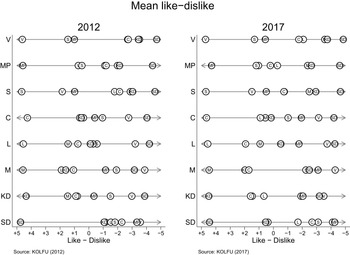
We start out by describing the overall patterns of elite affective polarization in the municipalities analyzed here. Figure 1 presents descriptive patterns in like-dislike drawing on the 2012 and 2017 KOLFU surveys. In this graph, we show how the average councilor from a party feels about each other party in their municipality, focusing on the parties represented in the Swedish parliament, the Riksdag.Footnote 4
Mean affect among municipality councilors in 2012 and 2017.
Note: The abbreviations of the Swedish party names are shown to the left. In order from the top, these are as follows: C = Centre Party (Centerpartiet); KD = Christian Democrats (Kristdemokraterna); L = Liberals (Liberalerna); M = Moderate Unity Party (Moderata samlingspartiet) a.k.a. Moderates; MP = Green Party (Miljöpartiet de gröna); S = Social Democratic Party (Socialdemokratiska arbetarepartiet); SD = Sweden Democrats (Sverigedemokraterna); V = Left Party (Vänsterpartiet). Note that for the SD evaluations, only MP is visible in the figure, but both V and MP are similarly most disliked.

The patterns we find here mirror results found in surveys performed among voters (Reiljan and Ryan Reference Reiljan and Ryan2021) and Riksdag members (Bäck and Kokkonen Reference Bäck, Kokkonen, Öhberg, Oscarsson and Ahlbom2022). Studies have shown that both representatives from mainstream parties and their supporters have been especially biased against and negative towards the SDs. In Figure 1, we can see that the most disliked party for all parties’ council members is the (SDs, except for the Moderate Party (M) councilors, who, on average, place the Left Party (V) as their most disliked party. The Christian Democrat representatives (KD) also make little difference in terms of like-dislike between SD and V. This aligns with the finding that the Moderates and Christian Democrats were the first to signal openness to some cooperation with the SDs at the national level (see eg Calvo, Bäck and Carroll Reference Calvo, Bäck and Carroll2024).
Although patterns of like-dislike vary across municipalities, in most cases mainstream party councilors tend to dislike SD the most. The conservative Moderate Party and the Christian Democratic Party became more favorable towards the SD in the later period, mirroring patterns among voters (eg Reiljan and Ryan Reference Reiljan and Ryan2021; Renström, Bäck and Schmeisser Reference Renström, Bäck, Schmeisser, Andersson, Carlander and Öhberg2020). In line with results found in voter- and elite-level surveys, SD party representatives dislike the Left Party (V) and the Green Party (MP) the most (eg Bäck and Kokkonen Reference Bäck, Kokkonen, Öhberg, Oscarsson and Ahlbom2022; Renström, Bäck and Schmeisser Reference Renström, Bäck, Schmeisser, Andersson, Carlander and Öhberg2020).
Statistical model and variables
We test our hypothesis by studying coalition formation in Swedish municipalities in the 2014 and 2018 Swedish local elections. We model government formation as a discrete choice where the central idea is that political parties, following local elections, face a menu of possible governing coalitions. From this set of alternatives, one coalition is ultimately selected. To model this process, we draw on McFadden’s (Reference McFadden1974) conditional logit model, the model that has become standard in the empirical analysis of coalition formation (see, eg Bäck and Dumont Reference Bäck and Dumont2008; Bowler, McElroy and Müller Reference Bowler, McElroy and Müller2022; Martin and Stevenson Reference Martin and Stevenson2001, Reference Martin and Stevenson2010).Footnote 5 Specifically, when bargaining over government, political parties face a collective choice: which government to form at each formation opportunity. Theoretically, for each government formation opportunity, there are 2n 2013; 1 potential combinations of political parties (including single-party governments) or ‘potential governments’, where n denotes the number of political parties. Thus, the parties select one government from a set of ‘potential governments’, each with differing attributes of the parties involved. The probability that a given potential government is chosen depends on its characteristics, such as the elite affective polarization and ideological proximity of the parties involved.
Our choice dataset covers all 290 municipalities in Sweden across two election cycles (2014 and 2018), yielding about 68,400 potential governments across 417 formation opportunities, with each formation opportunity corresponding to the post-electoral bargaining process in a single municipality.Footnote 6 We exclude 163 cases (28% formation opportunities) where one or several members of the government that formed are missing in the underlying KOLFU data, or when their responses are incomplete with regard to constructing our main independent variables.Footnote 7 We construct a complete set of potential governments in a municipality after an election, along with the observed outcome – the actual government formed. Estimation proceeds via maximum likelihood, comparing alternatives within the same choice occasion, that is, government formation opportunity.
More formally, our conditional logit model can be expressed in the following way: let i index municipalities and t elections (2014, 2018). For each municipality-election pair, the set of potential governments is denoted by ${{\cal J}_{it}}$
, consisting of all party combinations that could theoretically form a government. The probability that coalition
${{\cal J}_{it}}$
, consisting of all party combinations that could theoretically form a government. The probability that coalition $j \in {{\cal J}_{it}}$
is chosen is modeled as:
$j \in {{\cal J}_{it}}$
is chosen is modeled as: ${P_{ijt}} = {{{\rm{exp}}\left( {{X_{ijt}}\beta } \right)} \over {\sum\nolimits_{k \in {J_{it}}} {{\rm{exp}}} \left( {{X_{ikt}}\beta } \right)}}$
This approach provides a systematic way to compare coalition choices across municipalities and highlights the role of coalition-specific attributes in shaping outcomes.
As described above, our measure of affective polarization utilizes a like-dislike thermometer rating derived from a KOLFU survey item answered by elected council members. In the KOLFU surveys, the like-dislike question mirrors that used in many European election surveys and asks council members to what degree they like or dislike other political parties represented in the same municipality. This is intended to capture the overall positive or negative feelings towards parties among elites analogous to the survey item widely used in the literature on affective polarization (Druckman and Levendusky Reference Druckman and Levendusky2019; Gidron, Sheffer and Mor Reference Gidron, Sheffer and Mor2022;Wagner Reference Wagner2021).
We use the like-dislike survey item to measure the overall affective distance among political parties for each potential government (eg Ezrow, Tavits and Homola Reference Ezrow, Tavits and Homola2014; Wagner Reference Wagner2021; Ward and Tavits Reference Ward and Tavits2019). Two methods exist for calculating affective polarization from like-dislike scores – average affective distance from the most liked party and spread or standard deviation of scores. Wagner (Reference Wagner2021) argues that the latter is more suitable for multi-party contexts, since it better captures affective patterns in multi-party systems and opposition between party blocs and coalitions. This approach is appropriate for Sweden in the 2010s, characterized by a weakening bipolar system with two traditional blocs and the isolated SDs (Hellström and Lindahl Reference Hellström, Lindahl, Bergman, Bäck and Hellström2021). Therefore, we employ the spread-of-scores method.Footnote 8 This score is calculated using the set of respondents belonging to parties that formed each individual potential government.Footnote 9 Following Wagner’s suggestion, we only include respondents with a recorded affect towards at least two parties in the choice set when calculating the affect measures.
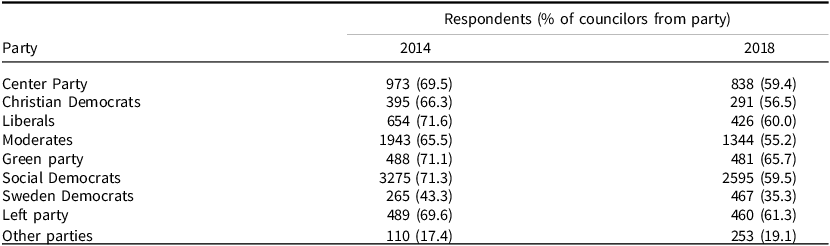
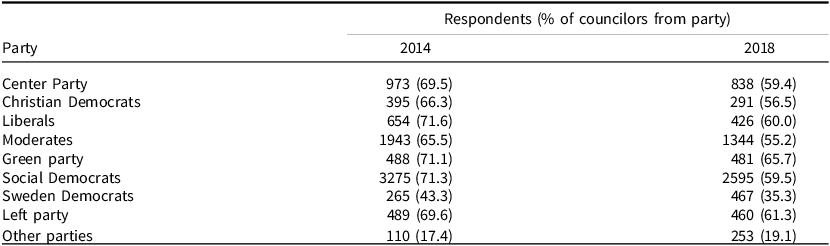
Across all potential governments, an approximate 65.5% of possible respondents per party are included when calculating the measures, which is close to the response rate of the survey as a whole. In Table A3 in the Appendix below, we note how many and what percentage of respondents were used to construct the measure per party for both the 2014 and 2018 government formations.Footnote 10
In addition to our main independent variable, we include structural attributes, as well as ideological and size-related characteristics, as control variables in our analysis. These variables are standard in empirical studies on government formation using discrete choice modeling (eg Kayser, Orlowski and Rehmert Reference Kayser, Orlowski and Rehmert2023; Martin and Stevenson Reference Martin and Stevenson2001, Reference Martin and Stevenson2010). Most importantly, we add measurements of ideological positions of parties using survey items on respondents’ self-assessed general left-right positions and self-assessed positions of multiculturalism (in the 2017 survey wave). We use the standard deviation of positions for each potential government to create variables of the ideological division in a potential government (eg Dalton Reference Dalton2008; Dodd Reference Dodd1976; Taylor and Herman Reference Taylor and Herman1971).Footnote 11 Here, ‘ideological division’ refers to the spread of policy positions within a potential government.Footnote 12
In addition, we construct several control variables drawing on data on party composition of local governments from the Swedish Association of Local Authorities and Regions (2024), and party seat share at the municipal level, which are retrieved from the Swedish Election Agency (2010, 2014, 2018).
We include several dummy variables for the type of government. These include whether the potential government is a minority cabinet; whether it is a coalition cabinet; and whether it is a minimal winning coalition (with surplus majority governments as the reference category). We expect that parties would prefer majority governments to minority governments, single-party governments to coalitions, and minimal winning coalitions to surplus majority governments (see eg Martin and Stevenson Reference Martin and Stevenson2001). In addition, we include a dummy variable indicating whether a potential government is a minimal winning cabinet with the fewest parties (MWC, minimum parties), as parties in minimal winning governments are likely to aim to distribute their spoils as narrowly as possible (eg Riker Reference Riker1962). We also control for the number of parties in the cabinet, as potential governments are more likely to form when they contain fewer parties (eg Martin and Stevenson Reference Martin and Stevenson2001).
We include a variable indicating if the potential government includes the largest party (in terms of seats) in the council, which is often necessary to form majority governments (eg Döring and Hellström Reference Döring and Hellström2013). Further, we include a variable for the inclusion of the median legislative party, which refers to the party that occupies the council’s ideological median position. Theoretically, the median legislator is expected to play a critical role in determining legislative outcomes as their position is majority-preferred to any other outcome (eg Martin and Vanberg Reference Martin and Vanberg2014). Finally, we include a dummy indicating if the potential government is the same as the incumbent government, to account for previous collaboration or familiarity between potential partners (eg Bäck and Dumont Reference Bäck and Dumont2007).Footnote 13
Empirical analysis
Analyzing the impact of affective distance when controlling for ideology
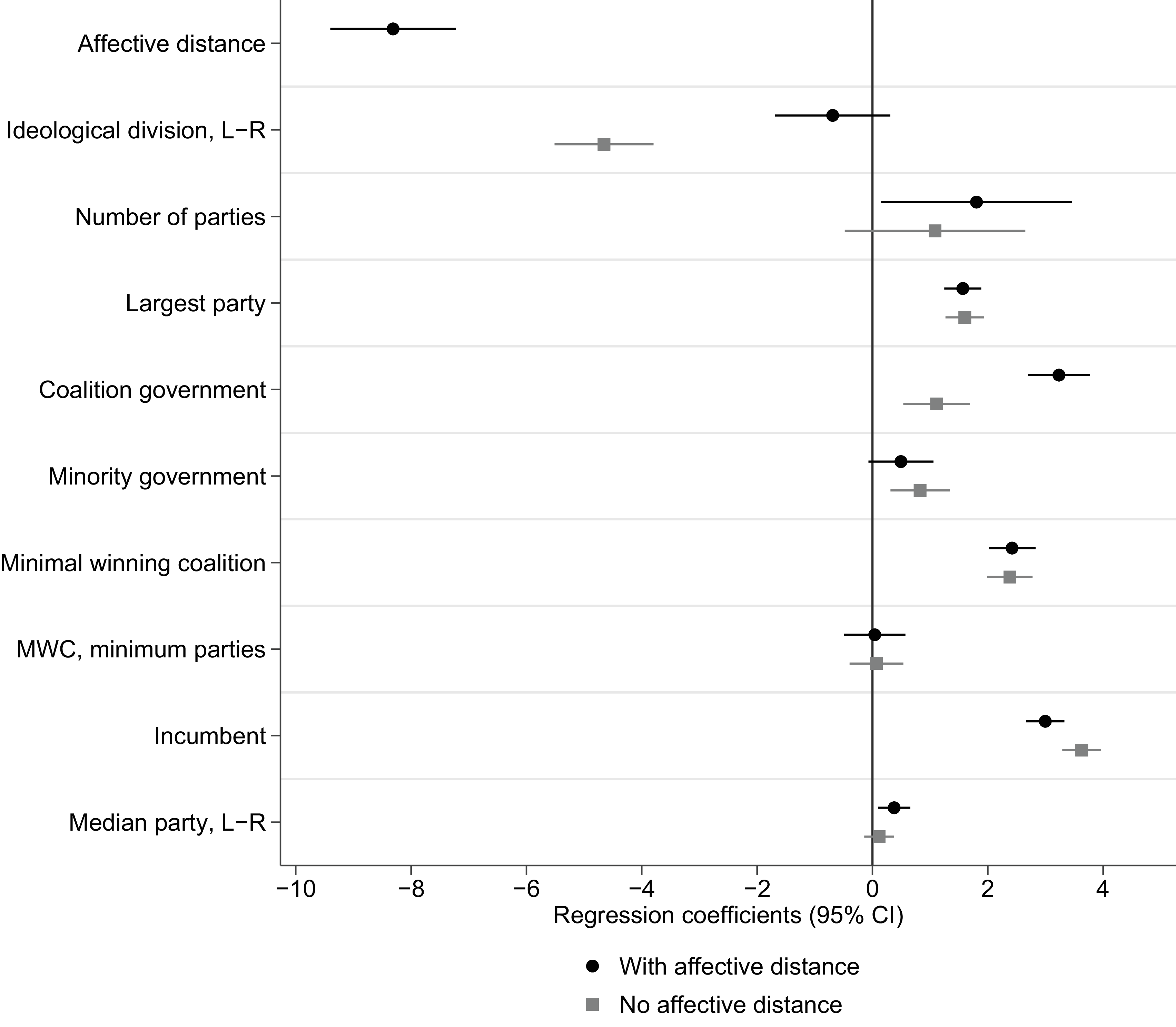
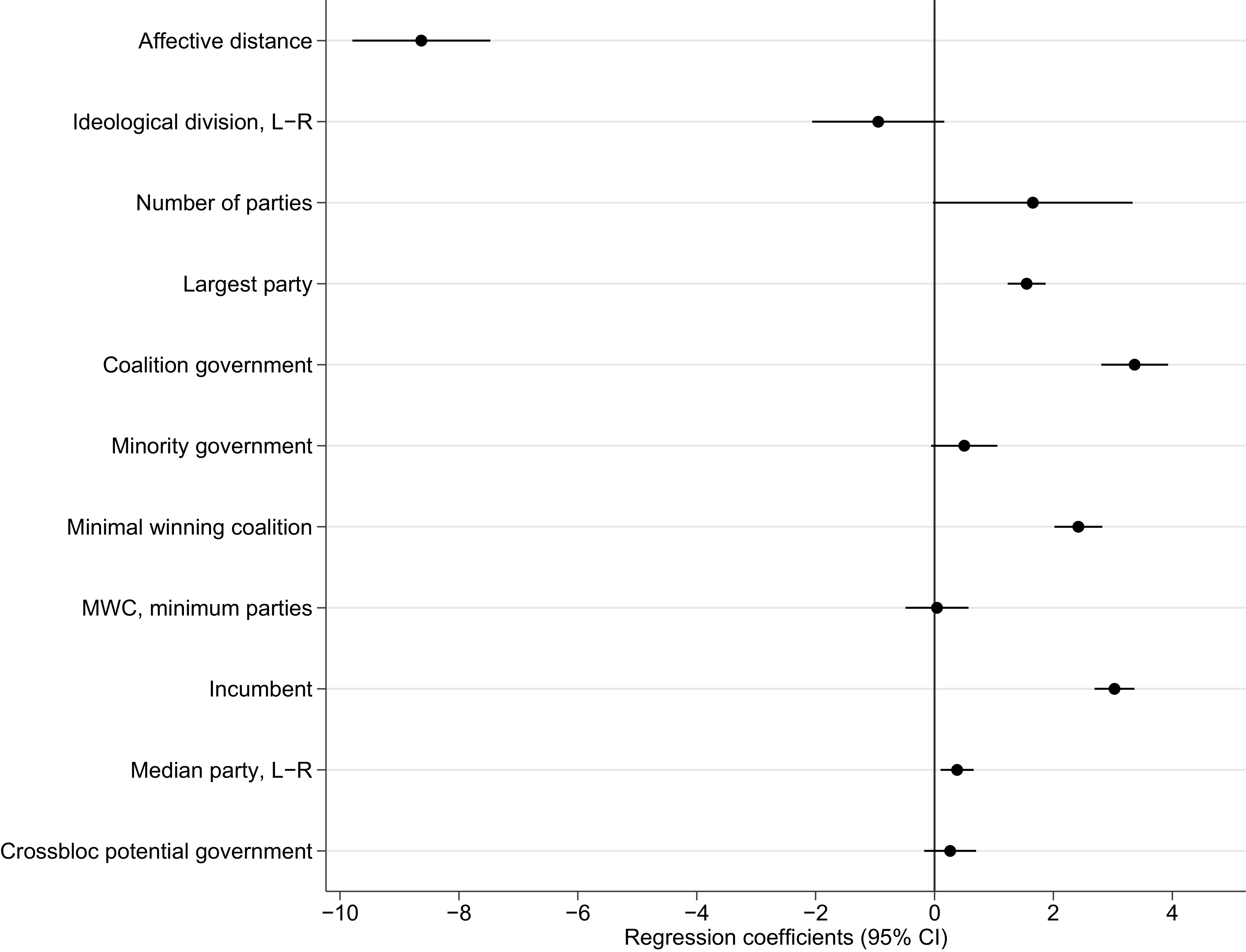
We now turn to evaluating our hypothesis, examining whether affective polarization in a potential coalition makes it less likely that parties will form a governing coalition. Specifically, we examine whether affective distance has an independent effect separated from ideological division in a potential government. In the figures below, we present estimates of the coefficients derived from the conditional logit model, along with its confidence intervals. The signs of these coefficients indicate the direction of the corresponding substantive effects. A positive coefficient associated with a coalition characteristic implies that if a coalition has more of that characteristic, its likelihood of forming increases, while the odds of other coalitions forming decrease.Footnote 14 We show the results from two sets of empirical models in each figure. The first model considers only the general left-right ideological division and excludes our measure of affective distance. This baseline model serves as a reference for comparison with our second model in each figure, which adds our measure of affective distance.
Figure 2 presents two estimated models: one incorporating only left-right ideological division (gray symbols) and another incorporating left-right ideology and affective distance (black symbols). In the model without affective distance, left-right ideology, and most control variables, the coefficients are in the expected directions. Ideological division among potential partners significantly impedes coalition formation, such that greater ideological division among parties in the potential government makes coalition formation less likely.Footnote 15 In the second model, affective distance exhibits a statistically significant negative effect on coalition formation, aligning with our expectations. That is, a high degree of affective distance in a potential government makes it significantly less likely to form.Footnote 16
Affective distance, left-right division (pooled model) as predictors of coalition formation.
Note: Affective distance and left-right ideological division have been rescaled to a range of 0–1 to make direct comparisons with the dummy variables easier. Analysis is based on data on government formation opportunities in 2014 and 2018. Number of formation opportunities: 417. Number of potential governments: 68,399.
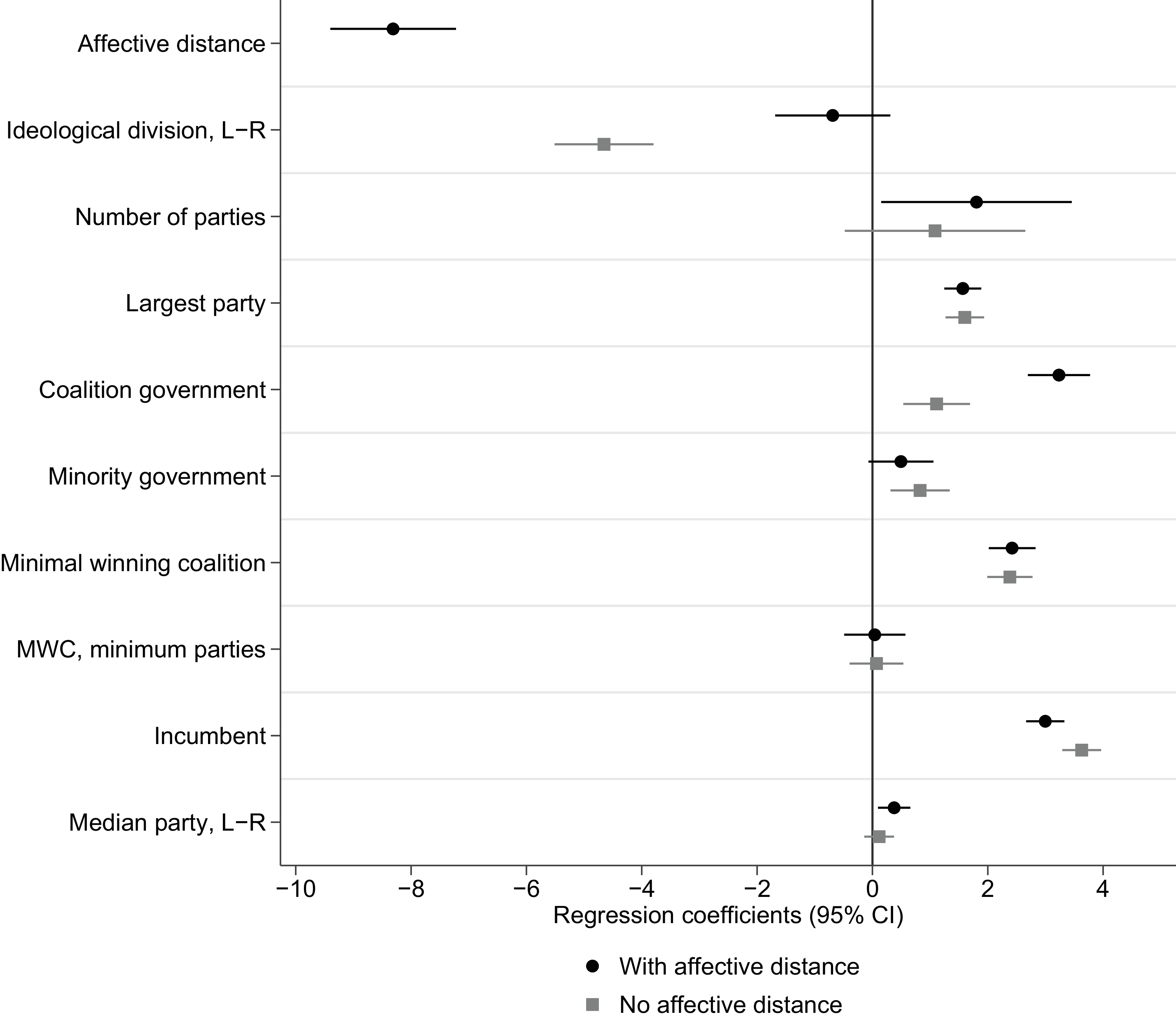
Moreover, the inclusion of our affective distance measure substantially reduces the magnitude of the coefficient for left-right ideological division, which is no longer statistically significant.Footnote 17 This suggests that the effects of ideological division may be mediated by affective distance, and that affective distance captures variance not attributable to ideological division alone. This pattern also holds consistently when examining the data for 2014 and 2018 separately.Footnote 18
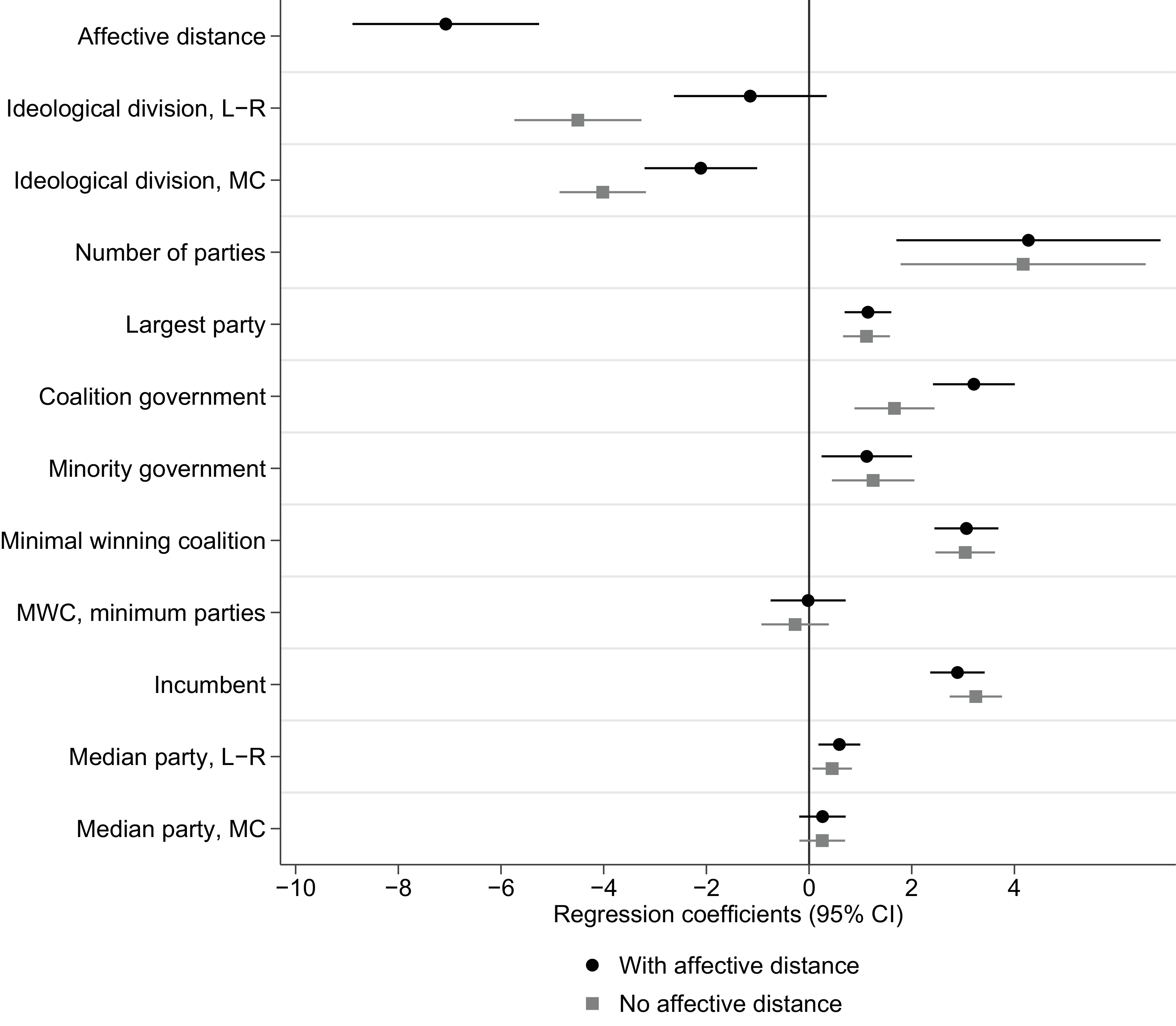
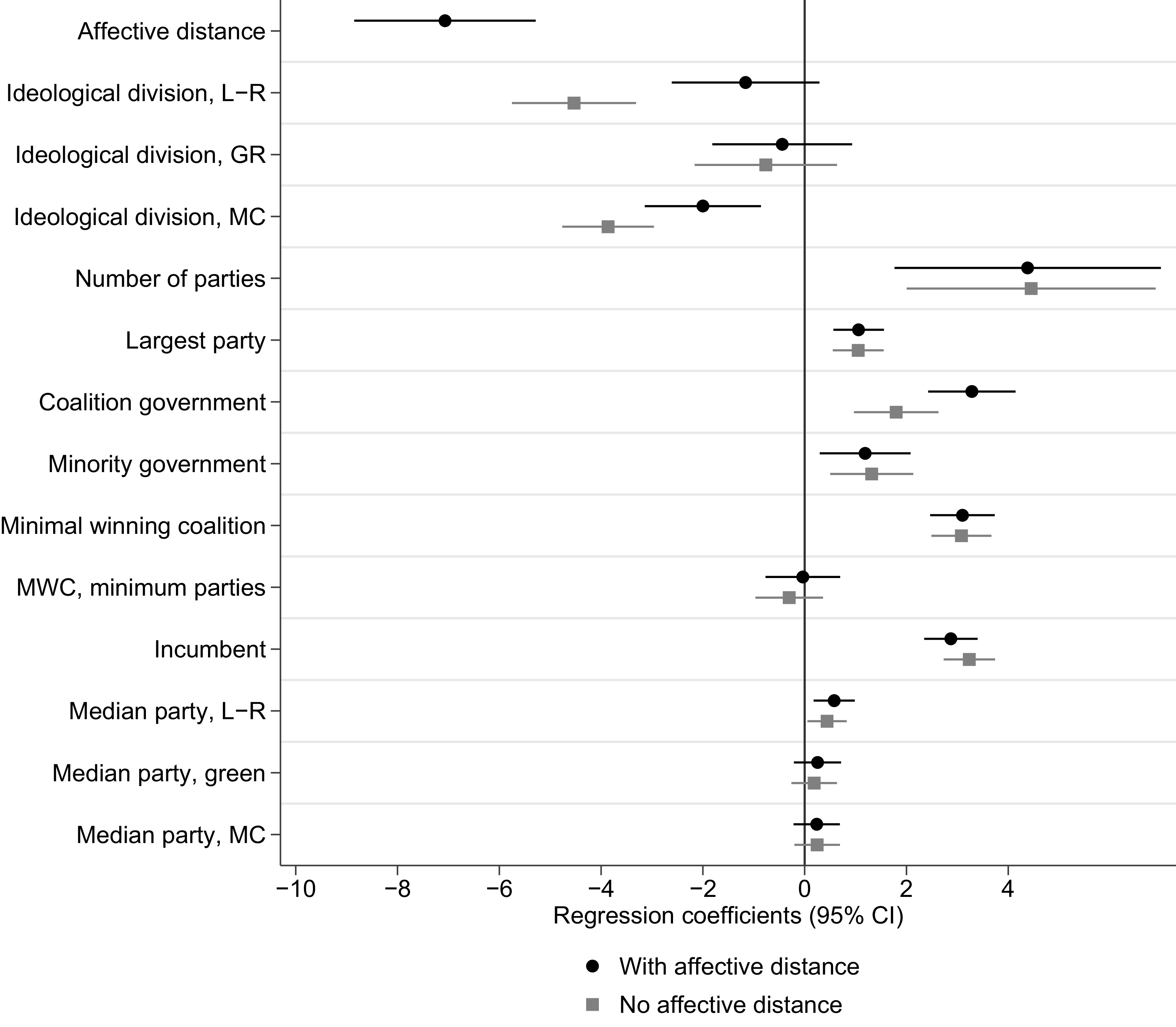
To further account for additional dimensions of political conflict, we next introduce a model that includes a control for ideological division on multicultural issues. Multicultural issues have emerged as a significant dimension of political competition in Sweden, potentially distinct from the traditional left-right axis. Positions on multiculturalism may be closely linked to affective polarization, as research has shown that cultural and identity-based issues can be powerful drivers of partisan animosity (Gidron, Adams and Horne Reference Gidron, Adams and Horne2023; Harteveld Reference Harteveld2021). By controlling for this dimension, we can better isolate the effect of affective polarization from substantive policy disagreements on contentious issues. We thus estimate models that include the degree of multicultural differences, in addition to the degree of left-right ideological division. The results from these models are shown in Figure 3.
Affective distance, left-right, and multicultural divisions as predictors of coalition formation.
Note: Affective distance and ideological division have been rescaled to a range of 0–1 to make direct comparisons with the dummy variables easier. Analysis is based on data on government formation opportunities in 2018. These results are limited to the 2017 data because data on multicultural positions are available only in this period. Number of formation opportunities: 201. Number of potential governments: 31,488.
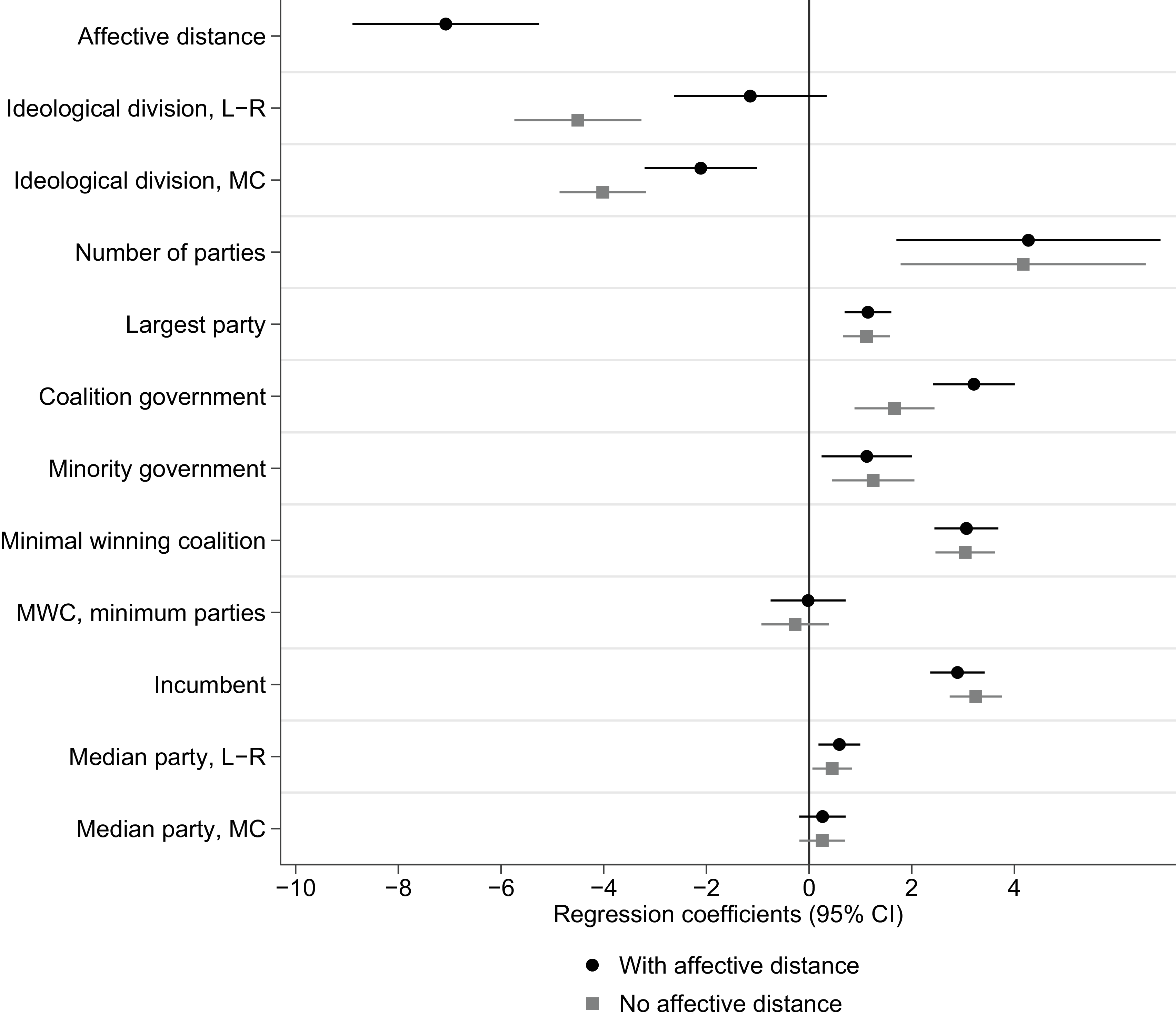
As shown in the figure, when accounting for policy differences across both dimensions but excluding affective distance (ie the gray symbols), both ideological division variables yield negative and significant coefficients, as expected. When we include affective distance in the model, we again find a statistically significant effect for this coefficient, supporting the main argument. The effect of the multicultural ideological division variable remains significant in this model but is substantively weaker.
Overall, these findings suggest that affect plays a role in coalition formation, beyond the traditional influence of ideological differences. The strong negative effect of affective distance indicates that identity-based divides between parties may be a significant barrier to coalition formation.
Accounting for the Sweden Democrats’ ‘pariah’ status
An important dynamic in the period under study is the rise and initial exclusion of the populist radical right party, the SD, at both national and local levels. In 2010, the year they entered the Swedish national parliament (Riksdag), they won seats in 244 of 290 municipalities, with an average of approximately 5% of seats, whereas in 2018 they won seats in 288 municipalities, with an average of approximately 14% of seats. During our study period, SD was widely regarded as a ‘pariah’ by other parties and largely excluded from negotiations at both national and local levels (Backlund Reference Backlund2020; Hellström and Lindahl Reference Hellström, Lindahl, Bergman, Bäck and Hellström2021).Footnote 19 Accordingly, negative attitudes toward the SD and its pariah status have influenced local government formation. Studying an earlier period, Loxbo (Reference Loxbo2010) shows that the probability of minority governments in Swedish municipal councils increased when the SD controlled the ‘balance of power’, such that neither traditional bloc held a majority. Similarly, Backlund (Reference Backlund2020) found an increased likelihood of cross-bloc coalitions under these circumstances.
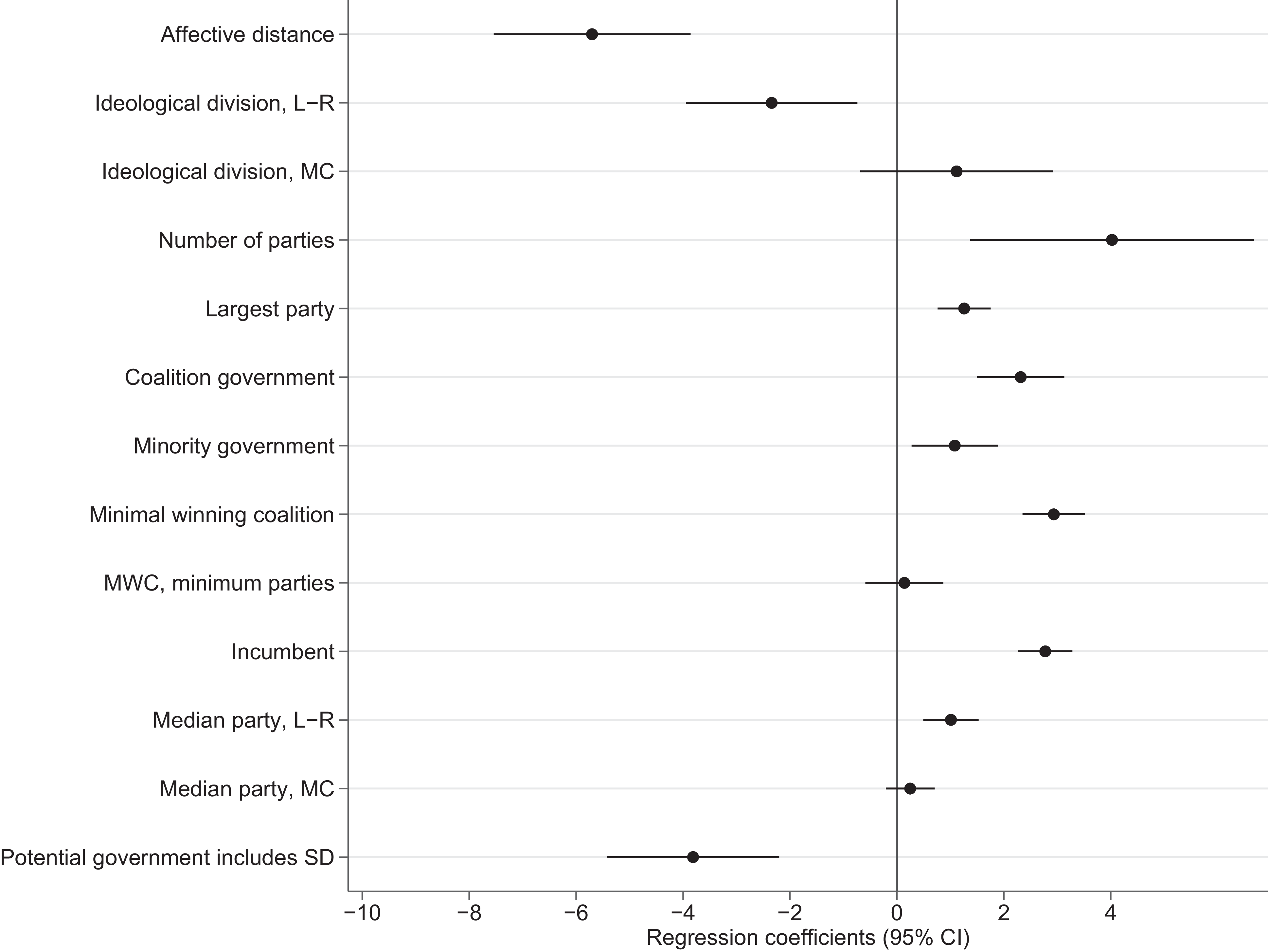
The systematic exclusion of the SDs can be understood as an extreme case of our broader argument regarding affective distance, where intense antipathy toward a particular party creates insurmountable barriers to cooperation regardless of potential policy compatibility. However, it is useful to examine whether our results are primarily driven by the SDs’ potentially outsized influence on government formation. To separate this specific dynamic from more general patterns of affective polarization, we constructed a dummy variable indicating whether SD is included in the potential government. This allows us to examine whether affective distance continues to influence coalition formation even after accounting for the effects associated with SD.
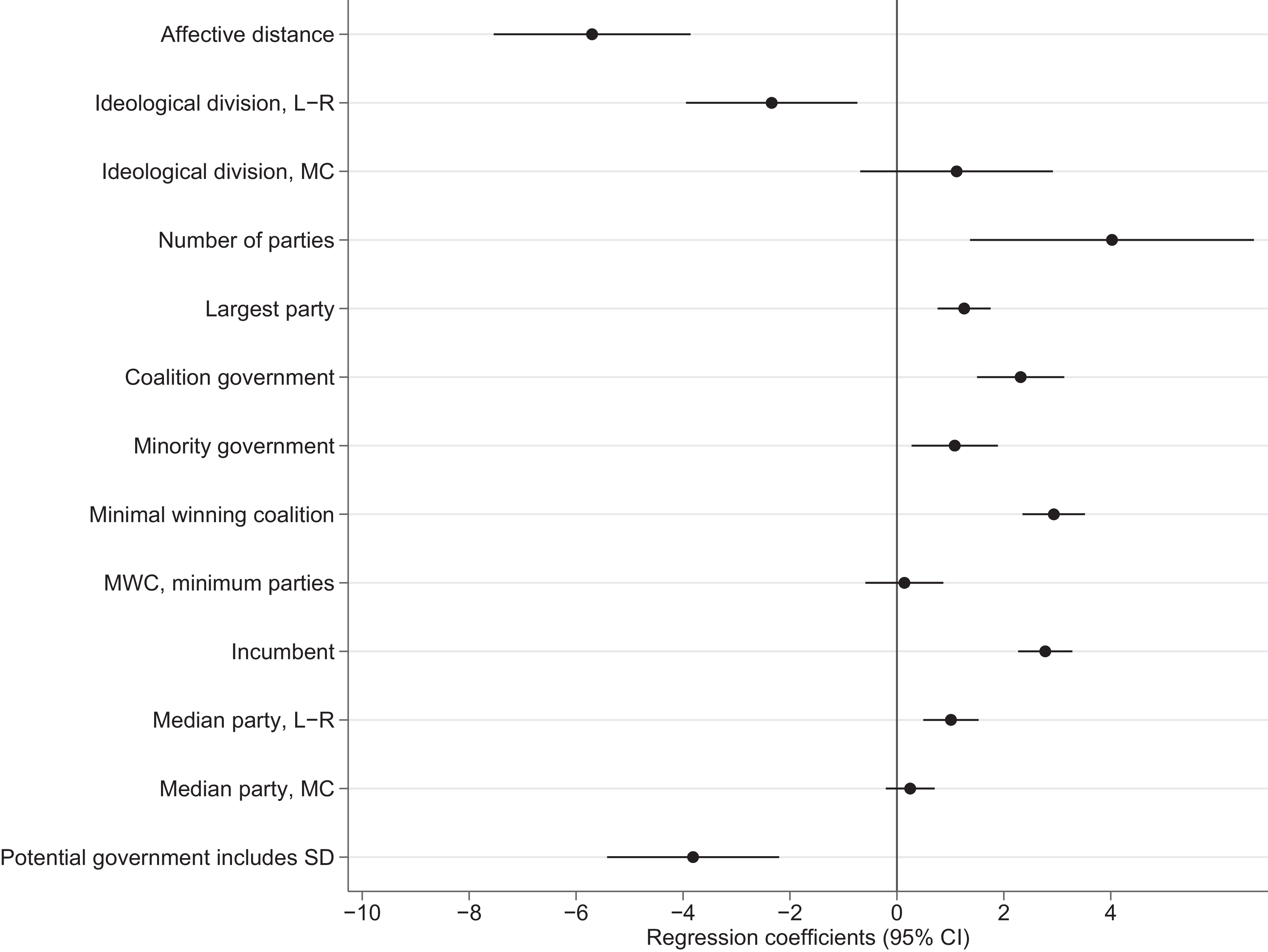
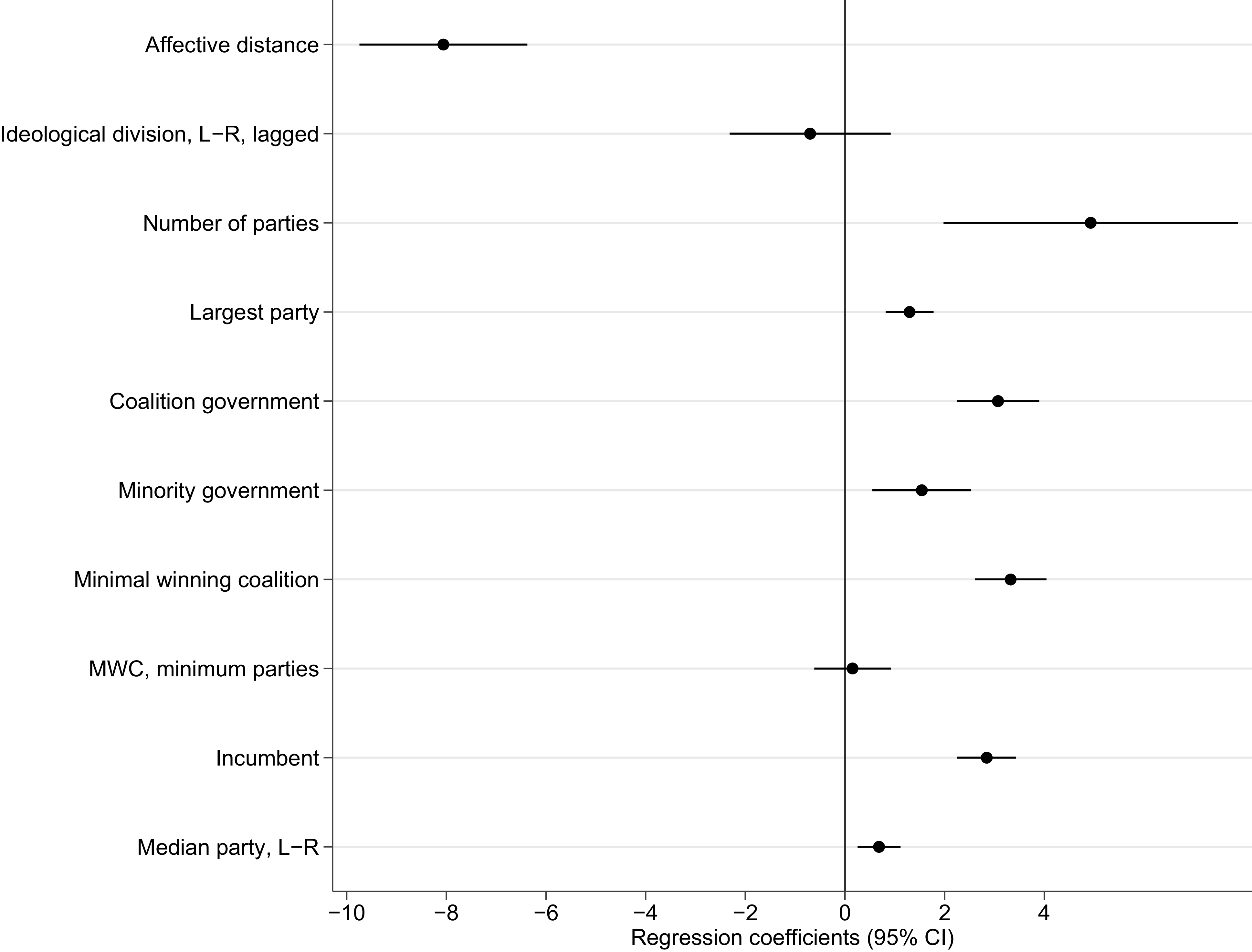
In this model, presented in Figure 4, the coefficient for the left-right ideological division variable is substantively and statistically significant. It shows an estimated coefficient in the expected direction, while the coefficient for multicultural ideological division is no longer statistically significant in this model. Importantly, affective distance maintains its negative and significant effect, emerging as a more substantively important factor in predicting government formation among all potential governments. While the SDs, which can be seen as a ‘pariah’ party, represent an extreme case of affective distance that influences coalition formation, the effects of affective polarization cannot be reduced to the role of the most disliked party alone.
Affective distance, ideology, and SD presence (2018) as predictors of coalition formation.
Note: Affective distance and ideological division have been rescaled to a range of 0–1 to make direct comparisons with the dummy variables easier. Analysis is based on data on government formation opportunities in 2018. Number of formation opportunities: 201. Number of potential governments: 31,488.
Additional robustness checks
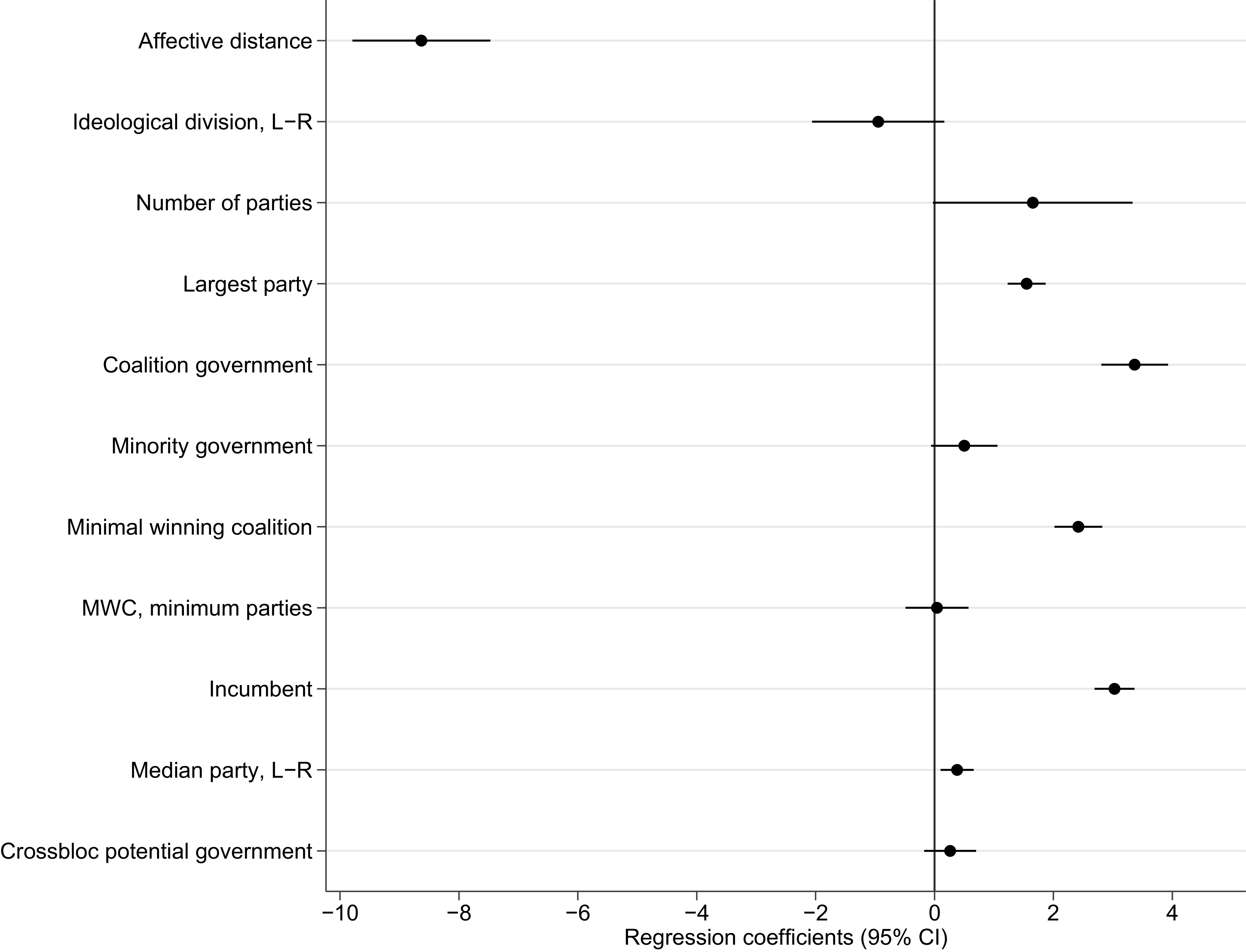
To evaluate the robustness of these results, we conducted several additional analyses. First, a potential interpretation of the above findings is that ideological division and affective distance may be capturing competition between Sweden’s two opposing ideological blocs, which intensified for the right and left in 2006 with the formation of pre-electoral coalitions in 2006 and 2010, respectively (Aylott and Bolin Reference Aylott and Bolin2007, Reference Aylott and Bolin2015; Hellström and Lindahl Reference Hellström, Lindahl, Bergman, Bäck and Hellström2021). While the left-of-center coalition was short-lived, the center-right ‘Alliance for Sweden’ persisted until 2018–2019 (Aylott and Bolin 2015, Reference Aylott and Bolin2019). To evaluate whether these inter-bloc tensions between the left and right drive our results, we introduced a dummy variable for potential governments including at least two parties from different blocs: the center-left bloc (Social Democrats, Green Party, and Left Party) and the Alliance (Moderates, Center Party, Liberals, and Christian Democrats). Including a cross-bloc dummy (see Appendix, Figure A1) does not substantially influence the results – the coefficient for affective distance still exerts a negative and significant effect on the likelihood that a potential government will form.
In addition, we expanded our analysis by leveraging the complete set of data on policy positions from the KOLFU surveys, including division on placements on the green or environmental dimension in our models (see Appendix Figure A2). Unlike left-right and multicultural divisions, the green dimension was largely irrelevant across most model specifications. This lack of significance suggests that the green dimension has limited importance at the local level regarding government formation and does not serve as a proxy for salient issues of this type.
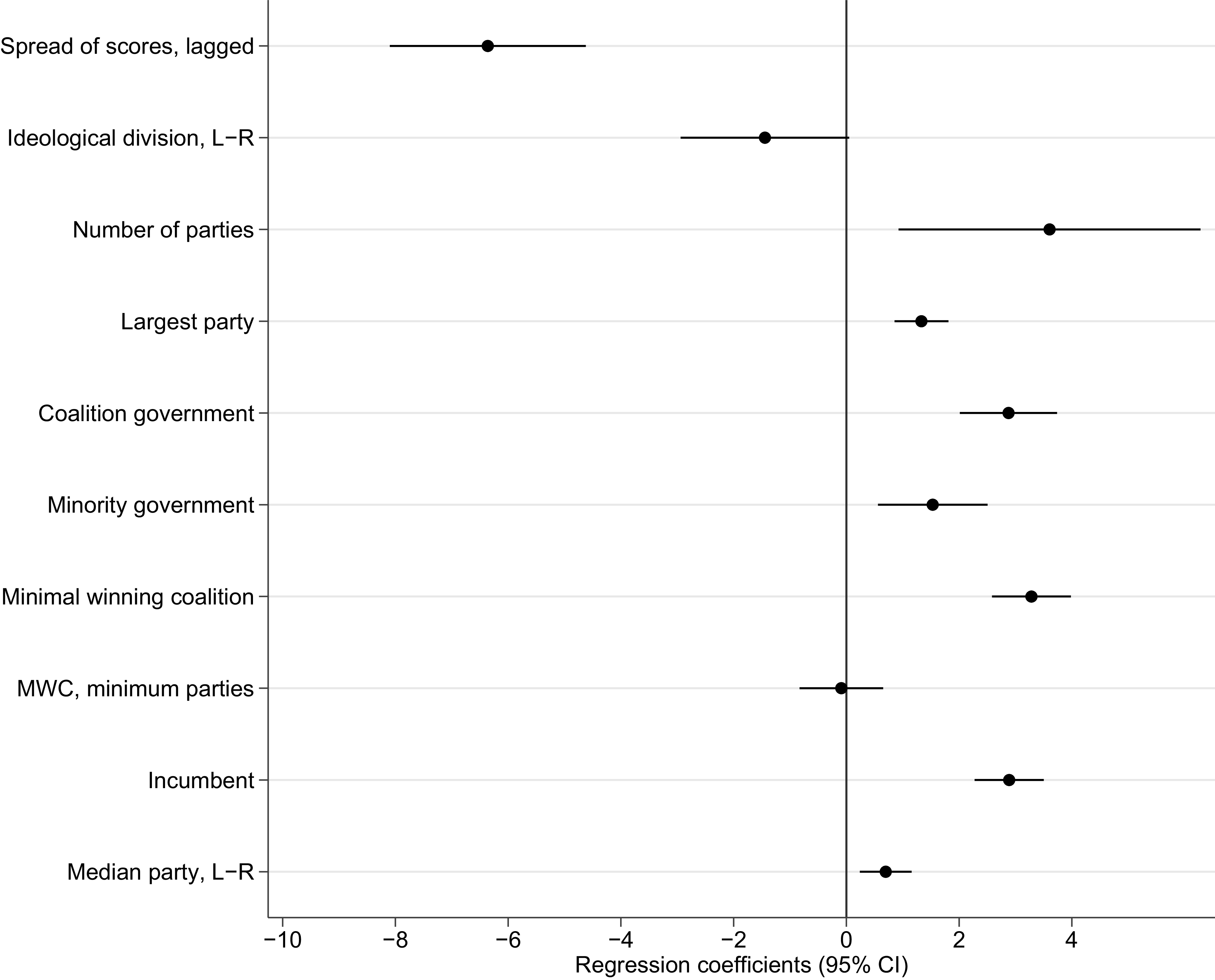
Next, we also estimated our models using a lagged rather than a contemporaneous ideological division variable (see Appendix, Figure A3). The coefficient for affective distance is nearly unchanged, while the coefficient for lagged ideological division in the coalition performs similarly to its contemporaneous counterpart (cf. Figure 2 above). We also estimated a separate model in which we lagged affective distance. In line with our expectations concerning the potential effects of greater affective distance between potential partners, greater levels of affective distance towards out-groups are likely difficult to change, and we should therefore expect previous values of affective distance to retain their effect in later time periods. We find that the effects of previous levels of affective distance are nearly as large as the contemporaneous measure (see Appendix, Figure A4). We note that these results should be interpreted cautiously because only two survey periods are available for this purpose.
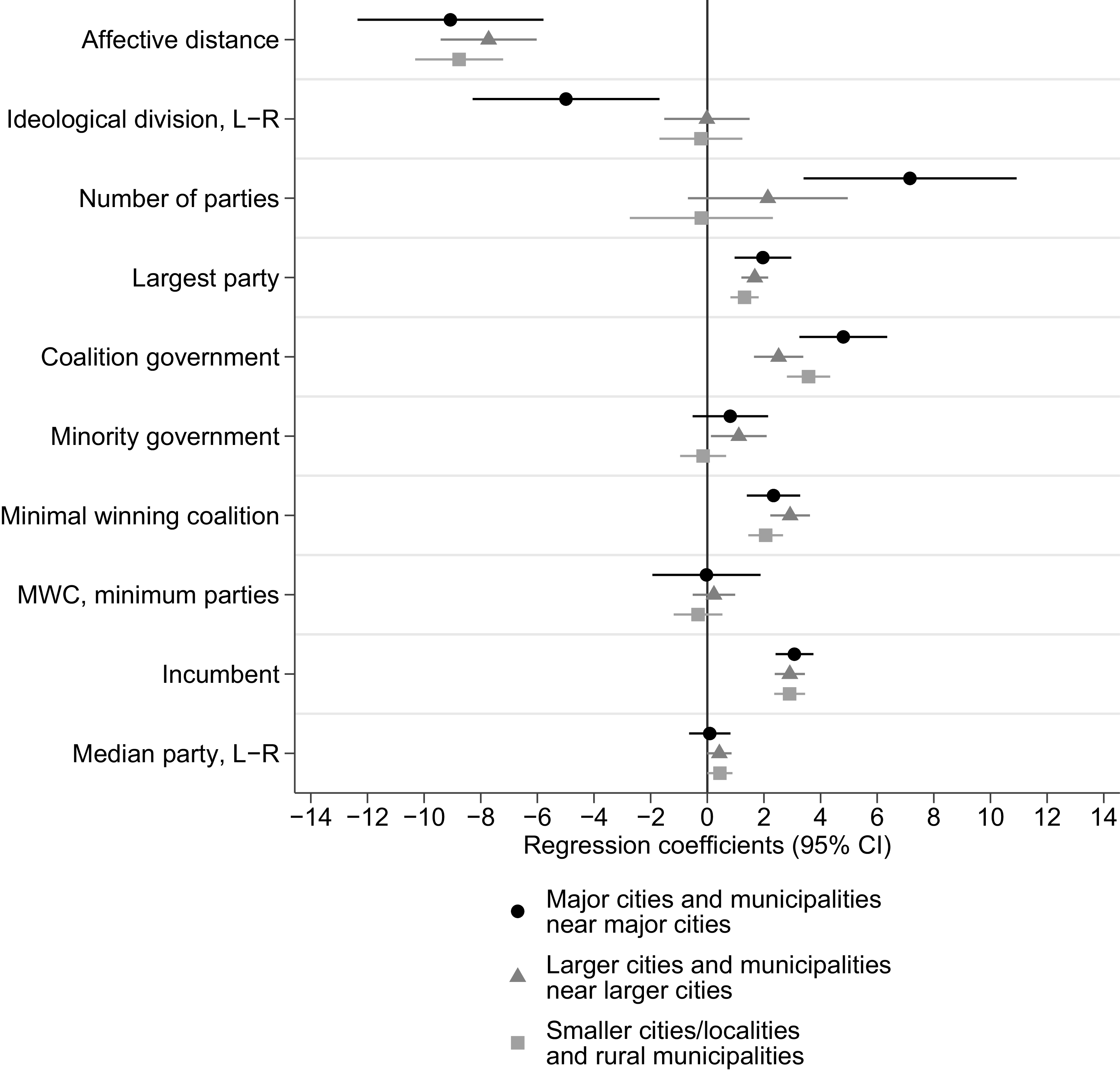
In addition, we analyzed the possible role of municipal population size in both affective distance and ideological divisions. In smaller municipalities, it may be the case that geographic and social proximity either attenuates the potential effects (positive and negative) of affective distance while simultaneously reducing the potential effects of ideological differences. The inverse holds for larger municipalities, where ideological differences become more salient. To test this, we estimate the model including affective distance and ideological divisions on the left-right dimension on different subsamples of the data,Footnote 20 specifically using the municipality classification scheme used by the Swedish Association of Local Authorities and Regions (2022), which accounts for population size and proximity to larger cities. Thus, we divide all municipalities into three categories – major cities and municipalities near major cities, larger cities and municipalities near larger cities, and smaller cities/localities and rural municipalities. The results (see Figure A5 in the Appendix) indicate potential differences across municipalities of different sizes, but notably not for affective distance. The coefficients remain negative and of similar magnitude across municipalities of varying sizes. Ideological divisions, however, have a negative and significant effect on coalition formation in major cities and municipalities in their vicinity, suggesting that they may be more pronounced as population size increases.
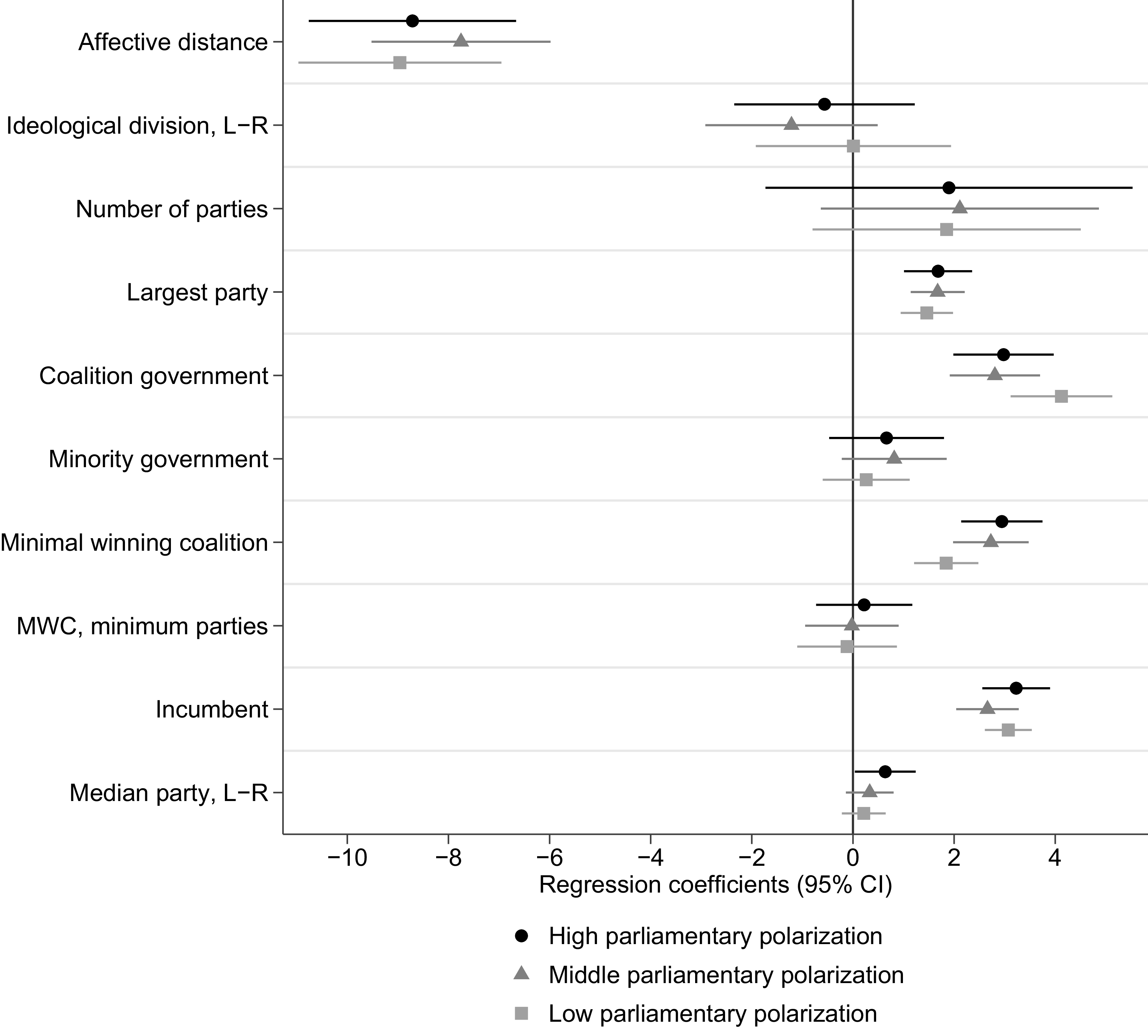
Finally, we account for varying levels of ideological polarization at the system (ie municipal council) level by splitting our sample into three equally sized groups (ie the 0th–33rd, 33rd–66th, and 66th–100th percentiles) based on their ideological left-right polarization. Similar to the rationale concerning different municipal sizes, it may be that less or more ideologically polarized municipal councils have a systematic effect on which coalitions can reasonably form, thereby affecting the potential effects of affective distance. The results (see Figure A6 in the Appendix) indicate that this is not the case: affective distance remains significant, negative, and comparable across all three contexts.Footnote 21
In sum, we observe that affective distance has a substantial and statistically significant effect across all model specifications, including those that account for ideological differences among parties in a potential government. Notably, the estimated effect of left-right ideological division in our main results loses its predictive power when our measure of affective distance is introduced, suggesting a nuanced relationship between ideological and affective distances. While ideological differences may appear to be the main interparty factor in coalition formation when considered alone, the introduction of partisan affect reveals a more complex dynamic. Our findings indicate that much of the effect of ideological differences on a government’s likelihood of formation may result from the increasing affective distance between parties. This interpretation implies that the emotional or identity-based divisions captured by affective polarization may be more directly influential in coalition negotiations than policy disagreements alone.
The persistence of the affective distance measure’s significance, even when controlling for ideological differences and other factors, underscores its role in shaping government formation. In particular, these results are present even when accounting for seemingly closely related factors, such as distance on multicultural issues, cross-bloc coalitions, and intense partisan affect toward the SDs which can be characterized as a ‘pariah’ party during the study period.
Conclusions
Recent research highlights identity-based conflict as a key driver of political polarization (eg Iyengar, Lelkes, Levendusky et al. Reference Iyengar, Lelkes, Levendusky, Malhotra and Westwood2019; Mason Reference Mason2018). While affective polarization has primarily been studied in mass public attitudes, there is growing recognition that it is also relevant to the politics of political elites (eg Banda and Cluverius Reference Banda and Cluverius2018; Enders Reference Enders2021). Because elite affective attitudes can hinder cooperation and compromise, they are likely to affect the formation of coalition governments in parliamentary democracies. Nonetheless, the potential impact of affective polarization on coalition politics has received limited attention. This study has aimed to fill this gap by investigating how elite affective polarization shapes the composition of governments. We hypothesized that, all else equal, greater affective distance would reduce the likelihood of parties forming a coalition. Hence, even when ideological differences between parties are small, a high degree of affective polarization may impede coalition formation. We interpret the results as suggesting that when elites are strongly negatively biased against opposing partisans, the capacity for trust necessary to act as credible partners is low.
Using survey data collected from Swedish councilors before the 2014 and 2018 municipal elections, we estimated the degree of affective polarization, based on like-dislike scores of potential governments in Swedish municipalities. We estimated several models of government formation using conditional logit on a choice set, while controlling for several features, most importantly, ideological differences among parties in a potential government. By examining these dynamics at the municipal level in Sweden, we were able to isolate the effects of affective polarization while controlling for many of the institutional and contextual factors that might confound such an analysis at the national level.
Our results indicate that affective distance between party elites is an important component in explaining government formation beyond ideological differences between parties. We find that higher levels of affective distance were negatively associated with government formation, and this result remained robust across all statistical models we estimated. We also examined whether our results were driven by the exclusion of a particular party, the radical right SDs, which has been treated as a pariah by the mainstream parties until recently (see, eg Calvo, Bäck and Carroll Reference Calvo, Bäck and Carroll2024). We find that the effect of affective distance on the government formed remains robust even when we control for the presence of the extreme cases of affective polarization in a potential government.
Elite surveys provide important analytical leverage for studying these mechanisms at work, as they allow us to measure affective polarization among the decision-makers directly involved in coalition formation, rather than relying on mass-level information or indirect behavioral indicators. By directly capturing elite-level attitudes, we can better distinguish the role of affective dynamics from other factors that might influence coalition choices, providing more precise evidence on the link between elite affective polarization and coalition formation than would be possible with aggregate data alone.
We argue that the mechanisms involved here are likely to derive from factors related to the effect of affective polarization on trust and interparty relationships. While our research design focused on directly measuring elites’ attitudes, it does not allow us to fully identify this causal pathway. However, we note that even potential strategic rationales related to mass affective polarization reflect and reinforce interparty mistrust. Meanwhile, factors such as weaker informal relationships among party leaders would erode the social foundations for building trust. Similarly, party influence against cooperation would emerge partly because of the perception that potential partners should not be trusted for broader reasons, regardless of the policy gains. Rather than treating these as competing explanations, we argue that they represent mutually reinforcing mechanisms by which affective polarization transforms potential coalition partners into less credible partners, regardless of stated policy objectives.
One of the limitations of our study is that we have only analyzed the impact of affective distance on government formation in one setting – the Swedish municipal context. The empirical design we used here is well-suited to the present study, as it provides elite survey data to capture partisan affect and allows us to analyze many formation opportunities while holding constant other features that do not vary within the Swedish political system. Previous research on Swedish local government coalitions has shown that left-right ideological variables predict government formation in patterns consistent with cross-national findings (Bäck Reference Bäck2003), and our models, which include ideology alongside traditional covariates, confirm this similarity. This provides some evidence that the present study does not utilize a case where ideology is less relevant, and we believe that the context does not bias our results in favor of affective polarization variables compared to variables capturing ideological division. Nevertheless, we cannot be certain that our results generalize and that predictor variables focusing on affective polarization would perform equally well in other contexts.
Swedish municipalities’ institutional features mirror parliamentary systems with respect to the key features related to the argument that affective distance can inhibit coalition cooperation, and thus, we expect this to operate similarly in national parliaments. At the subnational level, our findings suggest that similar patterns may be apparent where councils negotiate multi-party coalitions, such as Norwegian municipalities that have adopted local parliamentarism, or German Länder (eg Bäck, Debus, Müller et al. Reference Bäck, Debus, Müller and Bäck2013; Heinelt and Hlepas Reference Heinelt, Hlepas, Bäck, Heinelt and Magnier2006). However, the mechanism we identify is conditional on the institutional requirement that parties must cooperate to form governing coalitions. In systems where executive selection differs structurally, such as those with directly elected mayors holding independent executive authority (eg Italian and German municipalities; see Bäck, Heinelt and Magnier Reference Bäck, Heinelt and Magnier2006), the executive does not depend on sustained interparty agreement in the same way.Footnote 22 The key scope condition for our findings is thus the presence of multi-party parliamentary systems where coalition bargaining is a necessary step in government formation, and where the trust between potential partners therefore becomes consequential for which coalitions form.
To establish the political and institutional conditions, future research should examine additional contexts and conduct comparative analyses of the impact of affective polarization on government formation. The main limitation facing such extensions is the availability of data on elite-level affective polarization. However, legislative speech data could provide an alternative means of gaining insight into such polarization (eg Røed, Bäck and Carroll Reference Røed, Bäck and Carroll2025).
Another limitation of this study is related to the survey measure we use to gauge affective polarization. Although this type of measure has been used in most studies of affective polarization among voters (eg Gidron, Adams and Horne Reference Gidron, Adams and Horne2020; Iyengar, Sood and Lelkes Reference Iyengar, Sood and Lelkes2012; Wagner Reference Wagner2021), the survey question employed here has some weaknesses. The question used here asks local councilors to gauge their like-dislike toward other parties, rather than specifically asking about their feelings toward representatives of those parties. Such a question may therefore capture ideological differences between parties, rather than ‘affect’. Previous research on elite affective polarization in Sweden has shown that measures based on like-dislike questions about parties correlate strongly with alternative measures of affective polarization, such as questions about representatives’ traits (Bäck and Kokkonen Reference Bäck, Kokkonen, Öhberg, Oscarsson and Ahlbom2022). The fact that the effects persist when controlling for measures of ideological positioning, in terms of both left-right positions and multiculturalism, should also provide greater confidence that the residual variance captured by the like-dislike measure proxies for partisan affect. Future research should explore alternative affective polarization measures to fully disentangle the effect of ideology and affect when analyzing government formation in parliamentary systems.
Overall, this paper contributes to the growing literature on elite affective polarization by demonstrating its impact on coalition formation in parliamentary democracies. The results are also important for the literature on government coalitions, which has previously focused on ideological distance among parties. Our findings suggest that affective polarization among political elites poses a distinct and substantial barrier to interparty cooperation, beyond the effects of policy-based ideological differences. By highlighting the role of identity-based conflicts in shaping the dynamics of coalition formation, we provide new insights into the consequences of elite affective polarization for the functioning of democratic institutions. These results have important implications for understanding the challenges facing parliamentary democracies in an era of increasing political polarization. As affective polarization among political elites increases, parties’ ability to form stable and effective governing coalitions may be compromised, with potential consequences for the functioning of democratic systems.
Supplementary material
The supplementary material for this article can be found at https://doi.org/10.1017/S1475676526101480
Data availability statement
Replication data and scripts for the paper are available at https://doi.org/10.7910/DVN/X3VYJC.
Acknowledgements
The authors contributed equally to the article, and their names are in alphabetical order. We wish to thank the four anonymous reviewers for their helpful comments and suggestions. An earlier version of this paper was presented at the ECPR General Conference, 12–15 August 2024, in Dublin; at the EPOP Conference, 12–14 September in Manchester; at the DPIR November 8, 2024, seminar at Oxford; and at the UMepop workshop, 19–20 November, in Sundsvall. We are indebted to David Karlsson for making the data from the KOLFU study available to us. We are also grateful for comments on earlier versions of the paper by Niklas Bolin, Mihal Chiru, Lee De Wit, Ida Hjermitslev, and Radoslav Zubek.
Funding statement
We gratefully acknowledge the support from the Swedish Research Council (Project number 2020-01396) that made this research possible. Royce Carroll also acknowledges support from the British Academy (MD\170055).
Competing interests
The author(s) declared no potential conflicts of interest with respect to the research, authorship, and/or publication of this article.
Ethical statement
Anonymized data from the original survey data have been used to construct measures at a potential government level.
Appendix
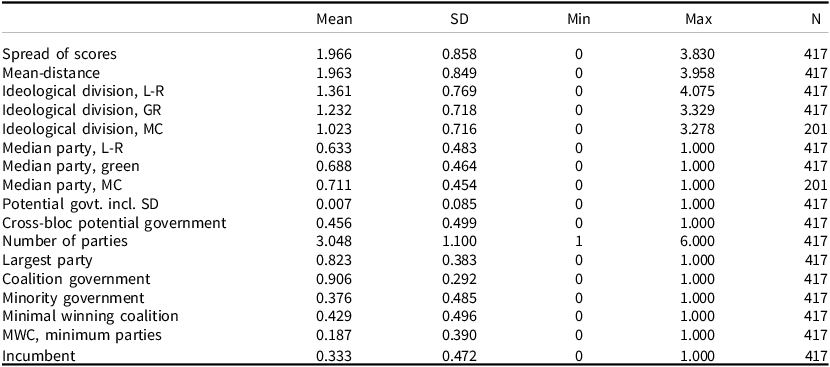
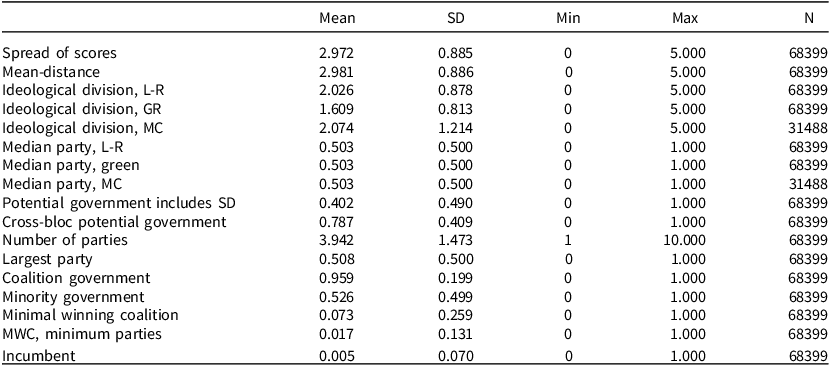
Descriptive statistics, potential governments
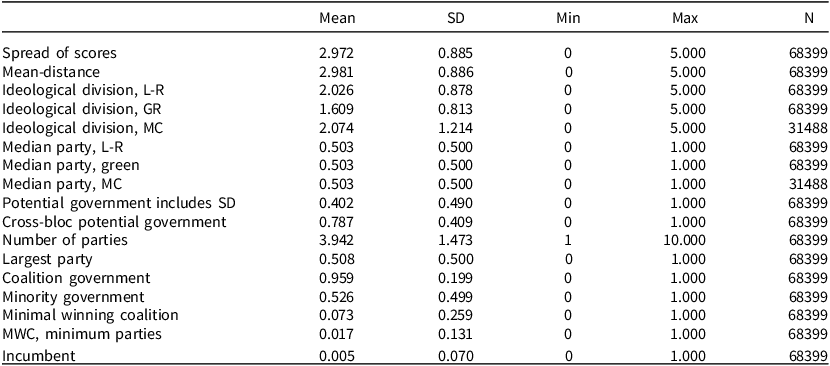
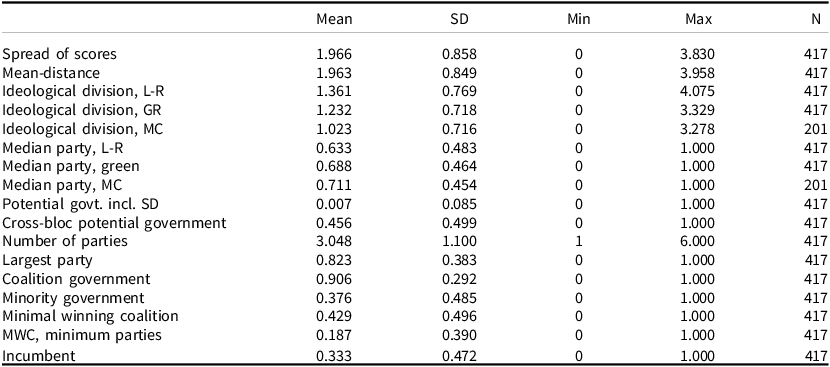
Descriptive statistics, formed governments
Responses used to construct affective measures and ideological measures
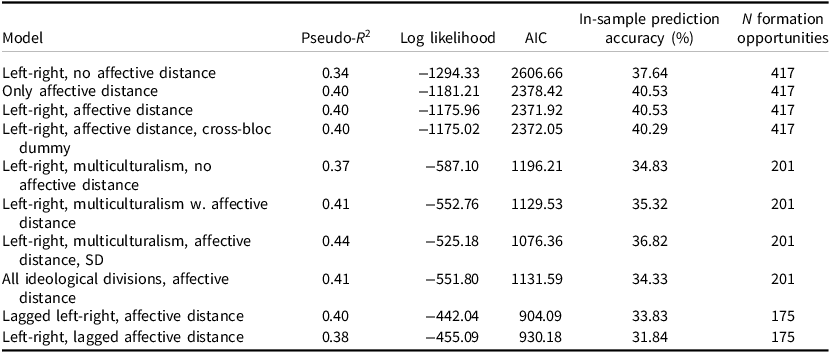
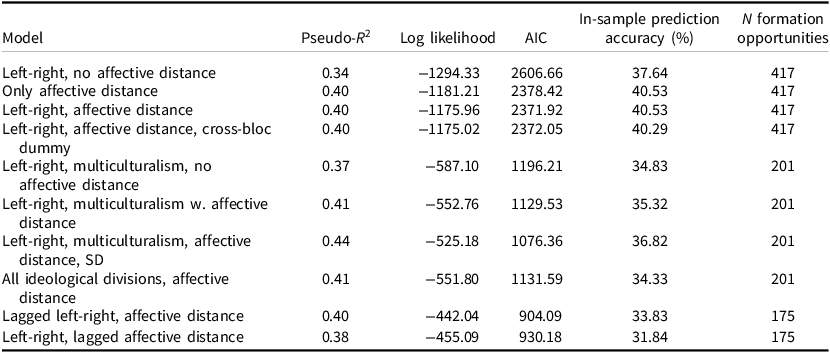
Fit statistics of main models
Figures A1 through A6 report the results from the main robustness tests discussed in the text. All continuous variables have been rescaled to a range of 0–1 to simplify comparison with dummy variables.
Affective distance, left-right division, and cross-bloc dummy (pooled model).
Note: Number of formation opportunities: 417. Number of potential governments: 68,399.
Affective distance, left-right, multicultural, and green divisions (2018).
Note: Number of formation opportunities: 201. Number of potential governments: 31,488.

Affective distance and lagged left-right division (2018).
Note: Number of formation opportunities: 175. Number of potential governments: 18,306.
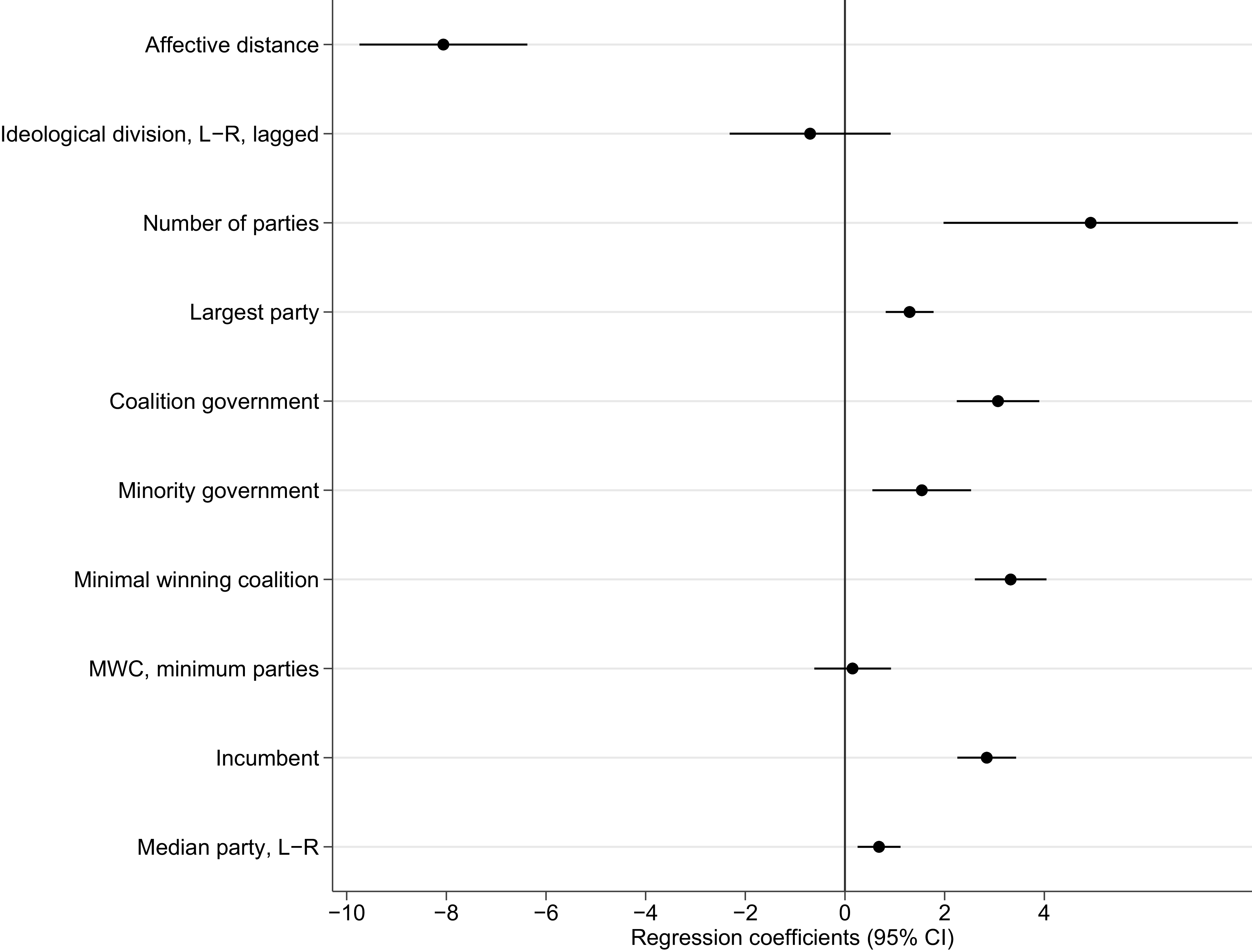
Lagged affective distance and left-right division (2018).
Note: Number of formation opportunities: 175. Number of potential governments: 18,306.

Affective distance and left-right division by municipality size (pooled).
Major cities and municipalities near major cities: Formation opportunities: 63. Number of potential governments: 14,560.
Larger cities and municipalities near larger cities: Formation opportunities: 162. Number of potential governments: 28,625.
Smaller cities/localities and rural municipalities: Formation opportunities: 192. Number of potential governments: 25,214.

Affective distance and left-right division by system-level polarization (pooled).
High polarization (66th–100th percentiles): Formation opportunities: 139. Number of potential governments: 22,239.
Medium polarization (33rd–66th percentiles): Formation opportunities: 139. Number of potential governments: 25,972.
Low polarization (0th–33rd percentiles): Formation opportunities: 139. Number of potential governments: 20,188.



 Open access

