




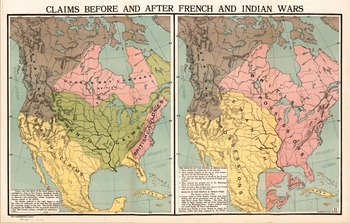
The United States was born out of empire. This fact fundamentally shapes how to understand the significance of the Declaration of Independence both in 1776 and since that time. For most American students, this idea needs explanation. Every spring I tell the origin story of the United States as part of a larger imperial history of the British Empire to around two hundred undergraduates. Most have not considered that at the time of the nation's birth most people on the planet lived in empires. North America itself was a patchwork of empires both Indigenous and European (see Figures 1–2). The Declaration of Independence encapsulates the drama of the breakup between what would become the United States and the British Empire, and it foregrounds the United States’ own history as an empire. This imperial rootedness of the American origin story has made teaching the Declaration a useful way to challenge the parochialism of popular “birth of the republic” narratives.
“Map of Indian Tribes of North America.” Map showing Indian tribal lands between 1600–1800 that indicate the non-European imperial geography of early North America. Wikimedia Commons and Library of Congress.

Figure 1 Long description
This historical map of North America depicts Indian tribal lands between 1600 and 1800. The map is oriented with north at the top. It uses different colors to represent various tribal territories, as indicated in the legend. Key labeled regions include the Great Lakes, Mississippi River and Rocky Mountains. Tribal names such as Sioux, Apache and Cherokee are listed. The map highlights the distribution of tribes across central and eastern North America, with less concentration in coastal and northern areas. The legend explains the color coding for tribal territories, providing insight into the non-European imperial geography of early North America. Boundaries are marked to delineate tribal lands, emphasizing the historical context of North American indigenous empires during this period.
Two maps showing “Claims before and after the French and Indian Wars” that indicate the European imperial geography of early North America. Library of Congress.

Figure 2 Long description
These historical maps of North America compare the changes made to European imperial geography in North America after the French and India Wars. It uses different colors to represent British, Spanish, and French claims across the continent. The vast expanse of territory in north western North America and labeled ‘Unexplored’ also is depicted. The legend explains the ‘Effects of the French and Indian Wars’ on this shifting geography where British and Spanish claims overtake French claims previously concentrated in the middle of the continent. Boundaries are marked to delineate European colonial claims, emphasizing the the effects of war and conquest in shaping how Europe’s imperial powers divided up North America during this period.
Here at my big public university—the University of Nevada, Las Vegas (UNLV)—every student must take a class on the “origin and history” of the Constitution to graduate. Many other institutions around the country have similar requirements that were rooted in early twentieth-century American political culture and the drive to promote “patriotic education.”Footnote 1 At UNLV, History 100 is a bread-and-butter course for the History Department. Simply put, it fills seats and helps us maintain our significant curricular presence despite declining enrollments in the discipline. I started team teaching the course in 2006 with my colleague who studies imperial Russia and five teaching assistants. Our brief was to fulfill the mandates of the Constitution requirement by situating the American origin story within a global context. This course, “Empires and Constitutions,” is the only history course that most students will take at UNLV, and I like to make it count.
That this quintessentially American history course is taught by a historian of Britain might come as a surprise to the legislators who mandated it. Teaching the Declaration of Independence in this commemorative moment has led me to reflect on what this document means for myself as a British historian and for the many students who have taken this course over the years assuming they know all about it already. Yet, as we British historians know, the Declaration is not a transparent rejection of imperial practice that inevitably leads to the birth of the United States. The official breakup between the British Empire and its settler colonies in North America on 4 July 1776, in a course like this, is often overshadowed by the rush to define and explain the post-revolutionary moment. The project of constitution-making at the state and federal levels can somehow appear more urgent, casting the Declaration of Independence as an inevitable, preliminary step to the establishment of the republic. I aim to disrupt this sense of inevitability and instead focus on the historical context and meaning of the Declaration's rhetorical rejection of kingship and empire.
I start in an obvious place: the Enlightenment. In order to make the case that the Declaration is an Enlightenment document, we used to trot out the usual suspects—Locke, Montesquieu, and Paine—and then move on. Only when I started engaging more fully with the limited nature of Enlightenment thinking about slavery, women, and Indigeneity by chronicling the Haitian Revolution, Olympe de Gouges, and the colonial arguments of Bartolome de las Casas and Juan Sepulveda did I start to get at the question students wanted to understand about the exclusionary nature of so-called Enlightenment universalism. “All men are created equal” and “endowed by their Creator with certain unalienable Rights” needed context and explanation, otherwise it sounded to students at one of the most diverse campuses in the United States like empty rhetoric. It made me start talking about the “we” in the Declaration more pointedly. Who is included in the circle of “we the people”? The answer that is repeated throughout the course is that it changes from generation to generation and that it is in their power to broaden or shrink that circle. In other words, they may not have been in “the room where it happened” but they have a role to play.
The problem of tyranny animates much of our discussion of the document itself. What happens when a legitimately constituted government begins to exceed the limits of protecting Lockean notions of “life, liberty, and property”? Any exercise of power beyond right requires resistance. This means that because the imperial government abrogated its part of the contract (to protect people's property), the people can renege on their obligations (to render obedience). Colonists used this idea to protest Parliament's imposing of taxes, leading to the claim “The end of uniting into commonwealths… is the preservation of property.” This sense of government as a contract was not new, but it took on new meaning in the explosive context of the American Revolutionary moment. The notion of mutual obligation challenged Constitutional monarchy as imperial practice in North America.
It is here where reading the Declaration of Independence as a utilitarian Enlightenment document runs up against the imaginative work that it had to do to keep the American Revolution going. The Revolutionary War began fifteen months prior to the signing of the Declaration, rendering it not so much a spark as a moment along the way to cutting ties with the British Empire. While Parliament deserved the blame for the crimes that the American revolutionaries believed had been committed against them, King George III took the blame in the Declaration. Charges are repeatedly rendered against “He” as the cause of the current war against the colonies. Cast as “facts” that prove the “absolute tyranny over these States,” these claims range from the sublime to the practical. Refusal to “Assent to the Laws” for the benefit of “the public good” is listed alongside keeping a standing army in peacetime and the quartering of troops. This revolutionary imagining of King George III as Nero, fiddling while Rome burned, sums up the early articulated sentiment embodied in these charges (Figure 3).
“Nero Fiddling Rome Burning” was published in 1770 as a critique of George III's neglectful treatment of American colonial complaints. Wikimedia Commons.

Figure 3 Long description
The engraving shows a dramatic scene with three figures. The central figure is depicted playing a violin, symbolizing Nero fiddling while Rome burns. He is dressed in classical attire, standing on a platform. To his left, a seated figure appears to be observing, while another figure stands behind him. In the background, flames and smoke rise from buildings, illustrating the burning of Rome. At the bottom, the text 'Nero Fiddling, Rome Burning' is inscribed. The engraving is marked as published for the Oxford Magazine in May 1770
Thus, in the guise of empirically based and thoughtfully considered evidence, the Declaration blamed the wrong source of colonial discontent. Complaints about King George's unwillingness to act on the petitions of colonists belied the fact that Parliament had enacted laws in the king's name that suited the agenda of an empire that needed to raise funds to protect its boundaries from Spanish, French, and Indigenous American imperial claims. The decisions that determined what to include in the long train of abuses speak to the limits of the settler colonial imagination that prefigured the colony as “British America,” rendering the free Black and enslaved populations invisible.Footnote 2 Thomas Jefferson's draft of the Declaration that blamed the king for the international slave trade famously was not included in the final document. Scholars have shown that Jefferson's rejected draft and his accusation against the king did not necessarily represent a moral condemnation of slavery itself.Footnote 3 Nevertheless, if the drafters of the Declaration had included this charge against King George, it would have been revolutionary indeed because of its rejection of the slave trade and its colonial origins in mercantilist policy. Settler colonialists would have had to find a new justification for the slave trade once there was no more king to impose it upon them.
Read as a series of choices made and not made, the Declaration transforms into a living document that invites students to imagine paths not taken. The decision to blame the king was not preordained. Six months before the issuing of the Declaration of Independence, Thomas Paine published Common Sense and offered the revolutionaries the vocabulary they needed to reject empire by making it personal. “No More Kings” was his calling card and it allowed settler colonists to reject empire without rejecting the constitutional forms on behalf of which they made their claims for independence. The six months that preceded the issuing of the Declaration allowed time for the idea of kingship as an illegitimate form of government to spread. Common Sense, after all, was a runaway bestseller. Kings, Paine claimed, were unnatural, even ridiculous: “One of the strongest natural proofs of the folly of hereditary right in kings is that nature disapproves of it; otherwise she would not so frequently turn it into ridicule by giving mankind an ass for a lion.”Footnote 4 In adopting this critique of kingship, the revolutionaries set themselves on a path of rendering empire illegitimate because it was the handmaiden of one-man rule.
This nuances the fact that America was born of empire. The Declaration necessarily engages imperial concerns. Blaming the king for inciting “merciless Indian Savages” “of our frontiers” signals the fear settler colonists had of living in a world made up of empires in competition with one another for land and loyalty. This assertion replaced Jefferson's condemnation of the slave trade in the final draft. The claim that “He has excited domestic insurrections amongst us,” in reference to Indigenous Americans, used racial tropes to condemn the king for not protecting the colonists after the Seven Years War. This final charge against the king in the Declaration reveals a preoccupation with the question of how these new united states would take their place as a player in the existing imperial world. Would they fight to eliminate their competitors in order to negotiate a place at the table among the empires of Europe and Indigenous North America?
The context of the historical reality of the new United States located at the crossroads of empire invites students to read the Declaration for both its anti-imperial rhetoric (against the British Empire) and imperialist posturing (as a new power to rival still competing empires in North America). Ultimately, I hope these considerations leave students with a more complex, globally engaged understanding of the Declaration. It can be read as both an anti-imperial document and one that sets the stage for establishing the new United States as an imperial power in North America. In this context, westward expansion in the wake of the American Revolution aligns the story of the United States much more clearly with the world of land-based empires spread across Europe, Africa, and Asia in the late eighteenth and early nineteenth centuries. After the 1898 Spanish American War, this empire would expand into the Caribbean, Asia, and the Pacific.
It turns out that I have gotten something out of teaching the Declaration over the years. Every iteration of the course, like most of what we historians teach, grapples with a set of contemporary concerns that reach well beyond the syllabus. This is especially true of a course on government rooted in the British imperial and democratic tradition taught at an American university. The idea that the USA took on the mantle of British power in the twentieth century after the fading of the British Empire is inescapable when considering the long history of Anglo-American relations that were defined by the American Revolutionary moment and the Declaration of Independence.
While the material I teach remains mostly the same, the moment in which it is taught changes its meaning and how it lands with students. September 11, the war in Afghanistan, and Covid all have shifted the stakes in one way or another and made me more aware of my focus on particular issues. In History 100, the nature of executive power remains a throughline of the course and a perennial contemporary issue. The post-Watergate era brought this issue to a head and has touched every administration since. When I started teaching History 100, George W. Bush and Dick Cheney began making the most fervent arguments in a generation about the power of the presidency. Democrats were not immune to this siren song of presidential power as seen in critiques of Barak Obama's drone strikes and reliance on executive orders. Today, we have the largest expansion to date of the presidential power argument with Donald Trump who has used the tools of the presidency to expand his own personal power in an unprecedented way.
This includes telling universities what they can and cannot teach. It has reopened the debate around mandating particular kinds of instruction in the United States. One of the questions I always ask students at the beginning of the course is “why do you think you have to take History 100?” Most seem more interested in the attendance policy and assignments than what seems to them like a quirky university policy. They are usually surprised to learn that it is mandated by the state, not the university. Every student in the state must pass a similar course to graduate. While teaching the Constitution does not necessarily require teaching the Declaration of Independence, it's hard to imagine a history course where you would not include it in the curriculum. That is exactly how our department has chosen to interpret our charge in teaching this material.
This mandate and the broadening of the curriculum to include documents like the Declaration of Independence have gone largely unquestioned over the years. The relative lack of interest and debate regarding this mandate enshrined in state law suggests a level of acceptance that belies what we think of when we consider a mandated curriculum in higher education in the USA. University professors typically do not appreciate state interference in curriculum matters. We see what happens in the extreme cases where state mandates impede the ability to teach material deemed important to disciplinary norms and student intellectual development, not to mention freedom of speech. The case of state interference in the University of Texas and University of Florida systems regarding matters of gender and race have had a chilling effect that goes beyond the student body in these regions.Footnote 5
While I am keen to get my students to understand the imperial roots of America's origin story, the State of Nevada's interest in this project came from a different place, dictated by regional and national political considerations. The Constitution requirement first was approved in 1923 when a bill was passed mandating “all the public and private schools, colleges, and universities” teach the “origin and history” of the state and federal constitutions. While no verbatim debates of the passage of the mandate exist, it seems to have been the product of the Red Scare politics and post-First World War posturing in US foreign policy that claimed spreading constitutionalism as a vital project.Footnote 6 Learning about the foundational documents, some believed, would protect the USA from radical politics and uneducated voters. Newly enfranchised and recently elected member of the Nevada State Legislature, Assemblywoman Marguerite H. Gosse, introduced Assembly Bill No. 163 to encourage “the study of and devotion to American institutions and ideals.”Footnote 7 One local paper saw little use for the new legislation and expressed skepticism about the motivations of the “patriotic people” behind the bill that passed with little fanfare.Footnote 8
Just over thirty years later, another bill was passed reinforcing the mandate. The need for a new mandate had little justification since the old legislation remained in effect. The imminent founding of UNLV the following year may have had something to do with this reiterative exercise but mostly it had to do with the national mood under the sway of McCarthyism. This period saw the enacting of an oath of allegiance and anti-communist pledges that took place in other public systems around the country, including the University of California and University of Washington.Footnote 9 In 1956, a new law was passed that specified that students must pass an exam in order to receive a diploma, though the rest of the language remained the same: “Instruction within the System must be given in the essentials of the Constitution of the United States and the Constitution of the State of Nevada, including the origin and history of the Constitutions and the study of and devotion to American institutions and ideals.”Footnote 10
My colleagues at other universities who hear that I teach a Constitutions class often express surprise. I remember wondering why, when I was hired at UNLV, that we Europeanists had the charge of teaching History 100. Over the years, it has come to make more and more sense. Connecting the global imperial and American stories as an ongoing dialogue that speaks to empire as a persistent model of state formation complicates the rise of the nation-state narrative in productive and interesting ways. I now also teach the story of the British Empire in North America this same way in my Modern Britain upper division course.
I don't think Senator Joseph McCarthy or the original authors of the Nevada statutes would have been able to imagine an entire course on Constitutions, let alone one developed by a British and a Russian historian. But that's the thing about mandates. Some are more plastic than others. Nevada faculty no longer sign loyalty oaths, but our students still need to learn about the Constitution. That's a good thing, in my view, and I'm probably the perfect person to do it. What I've learned about my students and teaching over the years is that the material we present in the classroom gets really interesting when the stakes are raised. Making students think about the “origin and history” of these United States in its past and present imperial guise seems particularly urgent in this political moment and as the nation commemorates the two hundred and fiftieth anniversary of the Declaration of Independence. Empire mattered to nation-making. When students see that, the American experience becomes less about the particularity of revolutionary claims than historical contingency and family resemblances.
Michelle Tusan is a Professor of History at the University of Nevada, Las Vegas, and Past President of NACBS. Her latest book The Last Treaty: Lausanne and the End of the First World War in the Middle East is now out in paperback. Please address any correspondence to: michelle.tusan@unlv.edu.



 Open access

