

Introduction Footnote 1
Latin America has experienced a wave of autocratization and democratic backsliding over the past decade (Aguiar Aliguar, Castro and Monsiváis Reference Aguiar Aguilar, Cornejo and Monsiváis-Carrillo2025; Pérez-Liñán, Schmidt and Vario Reference Pérez-Liñán, Schmidt and Vario2019; Haggard and Kaufman Reference Haggard and Kaufman2021a; Reference Haggard and Kaufman2021b; Ovares-Sánchez Reference Ovares-Sánchez, Duarte-Recalde and André2021). Within this regional trend, Costa Rica remains as one of the most stable democracies: since 1953, presidential and legislative elections have taken place uninterruptedly (Alfaro-Redondo Reference Alfaro-Redondo, Harvey and Christine2023). According to the Democracy Index from the Economist Intelligence Unit (EIU 2025), Costa Rica classifies as a full democracy, distinguishing from most of its regional neighbors. Alongside with Uruguay and Chile, it stands among the few Latin American countries with the highest level of rule of law (WJP 2025).
Costa Rica’s democratic stability rests on a robust institutional design, including a strong separation of powers, an independent judiciary (Cascante and Brenes Reference Cascante Segura and Brenes Barahona2015), and a Constitutional Court established in 1989, which stands as a key check on executive power and a guarantor of fundamental rights (Miranda Reference Miranda2019). The Supreme Electoral Tribunal (TSE), created in 1949, guarantees the integrity of electoral processes through its independence (Alfaro Reference Alfaro-Redondo, Harvey and Christine2023). The abolition of the army in 1948 further allowed the state to redirect resources toward education and social welfare, consolidating a model of democratic governance free from militarism (Alfaro Reference Alfaro-Redondo, Harvey and Christine2023).
This institutional framework correlates with historical high levels of democratic support among citizens, with averages between 0.7 and 0.8, the highest in Central America (Pignataro, Treminio, and Chavarría Reference Pignataro, Treminio and Chavarría-Mora2021). For decades, there were two major political parties, Partido Liberación Nacional and Partido Unidad Social Cristiano. However, this changed over the last two decades (Alfaro Reference Alfaro-Redondo, Harvey and Christine2023; Cascante and Lara Reference Cascante, Lara and Baca2020). Since the 2006 elections, fragmentation of the party system occurred, where historical loyalties eroded, party dealignment intensified, and the distance between parties and society grew (Barragán and Echeverría Reference Mélany and Chavarría Mora2023).
Despite longstanding institutional stability, Costa Rica has undergone transformations such as increased voter abstention, an economic crisis, citizen insecurity, corruption scandals, inequality and distrust of institutions (Casas-Zamora Reference Casas-Zamora2024; Ovares-Sánchez Reference Ovares-Sánchez, Duarte-Recalde and André2021).Rodrigo Chaves’s electoral victory in the 2022 presidential election transformed the traditional pattern of democratic stability. His leadership reflects a profile that combines social conservatism with economic liberalism, a confrontational governing style, and discursive affinities with the authoritarian and populist leaders such as Trump, Bolsonaro, and Bukele (Cascante and Guzmán Reference Cascante and Guzmán2022; Cascante and Muñoz Reference Cascante, Manuel Muñoz, Casullo and Araúz2023). The V-Dem freedom of expression index, which ranged between 0.93 and 0.99 from 2006 to 2021, declined to 0.88 in 2022 (Coppedge et al. Reference Coppedge, Gerring, Knutsen, Lindberg, Teorell, Altman, Angiolillo, Bernhar, Cornell, Fish, Fox, Gastaldi, Gjerløw, Glynn, Good God, Grahn, Hicken, Kinzelbach and Krusell2025).
The rise of this leadership is often associated with democratic backsliding, understood as the gradual weakening of the core attributes of democratic regimes, regardless of their prior level of institutional consolidation (Del Tronco and Monsiváis-Carrillo Reference Del Tronco and Monsiváis-Carrillo2020; Laebens and Lührmann Reference Laebens and Lührmann2021; Lührmann and Lindberg Reference Lührmann and Lindberg2019). Unlike abrupt breakdowns such as military coups, this process of executive aggrandizement and electoral manipulation, typically unfolds incrementally and may occur in both consolidated democracies and political systems with authoritarian features (Bermeo Reference Bermeo2016).
This raises a puzzle: how can a consolidated democracy with strong institutional foundations experience systematic executive pressure on its democratic credibility without falling into erosion or backsliding? More specific, how can we explain the democratic tensions observed in Costa Rica under the Chaves administration? Drawing on Bermeo’s (Reference Bermeo2016) concept of democratic backsliding, I propose the term “democracy under strain” to describe a regime in which the executive power delegitimizes institutions, attempts to restrict alternative media, and undermines press freedom, yet institutional resilience has so far absorbed these dynamics. This concept seeks to fill a gap in the literature by identifying a moment of tension distinct from erosion, crisis, or autocratization. Drawing on previous studies, I operationalize “democracy under strain” through three indicators: decline of press freedom, institutional delegitimization, and decreasing citizen support for democracy. I apply these indicators to Costa Rica, where there is an emergence of a populist leader with confrontational tactics.
Press freedom, as an indicator of democratic regimes, enables access to information and participation of diverse groups of society (Fitriana et al. Reference Fitriana, Hidayat and Ummul Firdaus2023); yet it is undermined by government actions such as harassment and persecution of journalists, censorship and media closure (Kenny Reference Kenny2020). Institutional delegitimization operates through rhetorical attacks against institutions; not as constructive criticism, but as “norm sabotage” targeting public support rather than policy change (Köker et al. Reference Köker, Swalve, Huber, Hönnige and Nyhuis2025). Finally, declining support for democracy shows the diffuse dimension: citizens’ willingness to accept or tolerate political decisions (Easton Reference Easton1953) and arises from the intersection of political, economic, and social factors.
The article consists of four sections: a literature review in the case of Costa Rica, the theoretical argument, the empirical evidence, a discussion of findings and conclusions.
Press Freedom, Institutional Delegitimization and Support for Democracy in Costa Rica
Press freedom plays a key role in understanding the dynamics of Costa Rica’s political regime. In a democracy, news media facilitates the debate of ideas (Garro and Solís Reference Garro Rojas and Solís2022). The literature generally agrees that press freedom entails the essential guarantees for the full exercise of citizenship (Garro and Solís Reference Garro Rojas and Solís2022), with particular emphasis on the right to access information (Vargas and Brenes Reference Vargas and Brenes Muñoz2012). Effective access to information contributes to the formation of critical citizenship, which requires not only the formal existence of press freedom, but the broader framework for its exercise.
Chaves’ communication strategy relies on weekly press conferences in which he controls the narrative and the questions from journalists (Díaz Reference Díaz González2024; Salazar Aguilar and Bonilla Reference Salazar Aguilar and Bonilla Cruz2026). Survey data from Central American countries evidence how Chaves publicly calls the press “scoundrels” and attacks those who question his conduct (Martínez and Rodríguez Reference Martínez de Lemos and Rodríguez López2022, 20). Garro and Solís (Reference Garro Rojas and Solís2022) examine the security conditions faced by journalists and find that 34.9% report exposure to harassment, 35.5% to threats, and 33.9% to surveillance.
Casas-Zamora (Reference Casas-Zamora2024) notes a 15-position drop in the World Press Freedom Index and an 11-place decline in the International IDEA’s Representative Government indicator during 2023, linking these setbacks to rising electoral abstention, economic crisis, citizen insecurity, corruption scandals, inequality, and declining institutional trust. This decline in press freedom aligns with a broader pattern of institutional delegitimization. Méndez-Castellanos (Reference Méndez-Castellanos2025) analyzes national reports and news coverage over four months, revealing conflicts between Chaves and the Legislative Assembly, the Judicial Power, and the General Comptroller’s Office. Although this decline began before 2022, it has worsened into political conflict, governance crisis, and polarization (Méndez-Castellanos Reference Méndez-Castellanos2025).
Citizen support for democracy has also declined regionally: Costa Rica, Panama, and Paraguay experienced drops of more than 10 percentage points, while Argentina, Colombia, the Dominican Republic, and Jamaica saw decreases of up to 20 points (Schiumerini and Lupu Reference Schiumerini and Lupu2021). Alfaro, Seligson, and Zechmeister (Reference Alfaro-Redondo, Seligson and Zechmeister2014) link political tolerance to democratic support and system stability in Costa Rica. However, between 2012 and 2014, this indicator decreased, suggesting that support for democracy is not exempt from authoritarian predispositions (Mora, Solís, and Soto Reference Mora, Solís and Diego Soto2014). Moreover, this decline is lower among younger age groups (Treminio and Pignataro Reference Treminio and Pignataro2015; Pignataro, Treminio, and Chavarría-Mora Reference Pignataro, Treminio and Chavarría-Mora2021).
Increases in citizen dissatisfaction toward democracy generate contradictions between citizen demands for a functional democratic system and institutional capacity to satisfy such expectations (Ovares-Sánchez Reference Ovares-Sánchez, Duarte-Recalde and André2021). In sum, previous studies suggest that Costa Rica experiences a process of democracy under strain, shaped by the decline of press freedom, verbal attacks on institutions, and declining citizen support for democracy.
Argument: The Three Signals of A Democracy under Strain
The concept “democracy under strain” draws on Bermeo’s (Reference Bermeo2016) framework of democratic backsliding, but differs in two dimensions. First, whereas backsliding entails the actual dismantling of institutions through executive aggrandizement, “democracy under strain” includes verbal attacks and delegitimization of institutions that remain formally intact. Second, whereas backsliding entails strategic electoral manipulation, “democracy under strain” seeks to restrict press freedom, but without full success. Thus, institutional resilience checks these pressures: it is a moment of democratic tension distinct from backsliding, erosion, or crisis (Haggard and Kaufman 2021; Laebens and Lührman Reference Laebens and Lührmann2021; Lürhman and Lindberg Reference Lührmann and Lindberg2019; Mainwaring and Pérez-Liñán Reference Mainwaring and Pérez-Liñán2013; Morlino Reference Morlino2025; Schedler Reference Schedler, Croissant and Tomini2024). The indicators shaping this tension are the decline of press freedom, institutional delegitimization, and decreasing citizen support for democracy.
Decline of Press Freedom
Press freedom refers to the autonomy of media from political interference or censorship (Kenny Reference Kenny2020), a condition essential for democracy given media’s capacity to criticize government actions (Craft Reference Craft and Meyers2010). Van Belle (Reference Van Belle2000) argues that press freedom enables communicators to safely question political and economic elites, while Fiss (Reference Fiss1996) suggests the state itself can serve as its ally by preventing the marginalization of minority voices.
In a democracy, news media fulfills five functions: Footnote 2 representation, deliberation, conflict resolution, accountability, and dissemination (Cook, cited in Craft Reference Craft and Meyers2010). The first three provide a forum for civil society to debate and resolve problems; accountability refers to monitoring those in power (Kovach and Rosenstiel Reference Kovach and Rosenstiel2021); and dissemination ensures citizens access the information needed for effective participation (Craft Reference Craft and Meyers2010). Under this framework, any governmental interference may be an obstruction to press freedom (Waisbord Reference Waisbord and Hernández2020), ranging from harassment and censorship to media closure and the use of internet trolls to silence critics (Kenny Reference Kenny2020; Tsui Reference Tsui2015).
The decline of press freedom thus reflects a democracy under strain, undermining institutional checks on government, restricting the public sphere and the accountability that defines a democratic system.
Institutional Delegitimization
Attacks on institutions by a political leader implicated in corruption scandals are a deliberate strategy of institutional delegitimization. Footnote 3 This strategy connects to contemporary populism: the ideational approach interprets populism as a thin-centered ideology that views society as “ultimately separated into two homogeneous and antagonistic groups, ‘the pure people’ versus ‘the corrupt elite’” (Mudde Reference Mudde2004, 562; Mudde and Kaltwasser Reference Mudde and Rovira Kaltwasser2017). From a Latin American perspective, De la Torre’s (Reference De la Torre2007) vision of populism is a political style based on a Manichaean rhetoric that builds on the struggle between the people and the oligarchy as a moral confrontation between good and evil.
However, interpretations that focus on people-centrism and anti-elitism without considering the antagonistic nature of populism fail to recognize its anti-pluralist nature (Benedek Reference Benedek2025). Building on this, Benedek (Reference Benedek2025) defines populism as an autocratic interpretation of democracy and political representation. As Olvera (Reference Olvera2022) notes, populist inclusion is symbolic rather than organic: participation is limited to the initiatives, topics, and timelines defined by the leader, constructing an abstract subject— “the people”—.
Building on this argument, the populist leader holds arbitrary power to determine and articulate the people’s will, making accountability virtually impossible and providing the ideological infrastructure for institutional delegitimization: when institutions are framed as instruments of elite domination rather than democratic safeguards, attacking them can be presented as an act of democratic re-build. This dynamic intensifies when the populist leader faces institutional controls for acts of corruption: institutions that investigate or constrain the executive are reframed not only as obstacles to popular will, but as instruments of elite conspiracy, the leader claims to be fighting.
As Recio and Vidal (Reference Recio and Vidal2023, 160) argue, “populism instrumentalizes institutions, puts them at its service, and does so by disrupting their proper functioning, trivializing the activity carried out within them.” In practice, populist leaders undermine institutions that obstruct popular will (Köker et al. Reference Köker, Swalve, Huber, Hönnige and Nyhuis2025), such as the Judicial Power, which can invalidate laws passed by the elected legislature and thus obstruct any political agenda.
What are the attributes of delegitimization strategies? Köker et al. (Reference Köker, Swalve, Huber, Hönnige and Nyhuis2025) define them as systematic campaigns of rhetorical and verbal attacks against institutions that, rather than seeking constructive change, operate as “norm saboteurs” aimed at eroding public support. Each attack links criticism of the institution to a broader narrative of systemic failure and the need for replacement.
Brown Arauz and Casullo (Reference Brown Araúz and Casullo2023) analyze Chaves’s discourse through populist traits: harm, the traitor, the enemy, a hero, bad manners, and autobiographical narration. They find that his internal traitor is “the same old one,” and his past-oriented myth is the phrase “making Costa Rica the happiest country in the world again.” The harm, according to presidential discourse, involves “privileges” that shaped an unequal system against the general interest, blaming both fiscally favored business sectors and the political class represented by traditional political parties with governing experience.
Based on the above, I propose that Rodrigo Chaves, as a populist leader, relies on these institutional delegitimization strategies that are harmful to Costa Rica’s democratic system. This populist rhetoric of delegitimization is another signal of democracy under strain, as it weakens control mechanisms, accountability, and separation of powers.
Support for Democracy
Easton (Reference Easton1953) distinguishes between diffuse and specific support. The former refers to favorable attitudes that allow citizens to accept or tolerate political decisions in the long term; the latter implies the evaluation of short-term performance or specific actions. In this framework, support for democracy as the best possible political system is part of diffuse support.
What factors influence support for democracy? We can find three types of explanations: first, economic explanations, such as satisfaction with personal economic situation; second, social explanations, including perception of corruption and security; finally, political explanations, such as presidential approval, respect for institutions and political participation.
Along economic lines, Amri (Reference Amri2023) finds that higher GDP per capita correlates with more positive attitudes toward democracy. Similarly, Carlin (Reference Carlin2006) notes that inequality and poverty negatively affect expressed support for democracy. In Latin America, Alister, Cea, and Guerrero (Reference Alister, Sánchez and Guerrero Chinga2015) argue that support for democracy increases with income level; however, positive economic evaluations have a greater effect in high-income countries than in low-income ones (Booth and Seligson Reference Booth and Seligson2009; Alister et al. Reference Alister, Sánchez and Guerrero Chinga2015).
Regarding social factors, experiencing corruption weakens citizen trust in political actors, institutions, and the government system, undermining support for democracy (Seligson et al., Reference Seligson, Young, Hamill and Eduardo2000, cited in Salinas and Booth Reference Salinas and Booth2011). Citizens hold the government responsible for fulfilling the social contract, and exposure to political corruption or crime erodes loyalty toward democratic practices (Cruz Reference Cruz and Mitchell2008; Seligson et al., Reference Seligson, Young, Hamill and Eduardo2000, cited in Salinas and Booth, Reference Salinas and Booth2011). Those victimized by corrupt officials or criminals may thus lose faith in democracy and its benefits.
However, comparative studies in Latin America show that perception of security and direct victimization by crime have different effects on democratic support (Malone Reference Malone2010). Similarly, direct victimization by corruption has little effect on democratic norms, whereas perception of widespread corruption significantly decreases democratic attitudes (Almeida and Casalecchi Reference Almeida and Avila Casalecchi2025). Morales Quiroga (Reference Morales Quiroga2009) notes that the impact of corruption on democratic legitimacy is not direct, suggesting that intermediate mechanisms and moderating variables condition this relationship.
Regarding political factors, Vairo (cited in Alister et al. Reference Alister, Sánchez and Guerrero Chinga2015) argues that low electoral participation replicates the existence of “dissatisfied democrats,” citizens who feel unrepresented and hold negative opinions about the political regime. Sendra and Bohigues (Reference Sendra and Bohigues2023) find that presidential approval can generate in-group and out-group divisions among citizens. Since presidential approval follows cycles of gain and loss (Carlin et al. Reference Carlin, Hartlyn, Hellwig, Love, Martínez-Gallardo and Singer2018), the timing of democratic support surveys matters. Moreno and Osorio (Reference Moreno Morales and Michel2022) find that citizen support for democracy in four Andean countries is affected by political positions than by government approval.
About institutional trust, Kim (Reference Kim2014) finds that greater political trust correlates with voting and formal participation, which in turn influences democratic support. Peralta (Reference Peralta2013) proposes that variation in regime support derives from an interaction between cultural values and institutional arrangements.
In sum, support for democracy is shaped by economic evaluations, perceptions of corruption and security, political participation, institutional trust, and presidential approval.
Dimensions of A Democracy under Strain: Evidence
To analyze the three dimensions of democracy under strain, I apply a mixed-methods strategy combining qualitative and quantitative analyses. First, I examine the evolution of press freedom through a longitudinal analysis covering 2006–25, complemented by specific cases from the current administration identified through a systematic search on the MediaCloud platform.
Second, I build a narrative based on judicial corruption cases involving the president and attacks directed at institutions, evidencing delegitimization strategies and confrontation with democratic accountability mechanisms.
Finally, I estimate a statistical model to explain variations in citizen support for democracy between 2006 and 2025. This period begins with the 2006 elections, which marked Costa Rica’s transition from a two-party to a multiparty system, a turning point that changed national political dynamics and created the structural conditions underlying contemporary democratic transformations.
Press Freedom
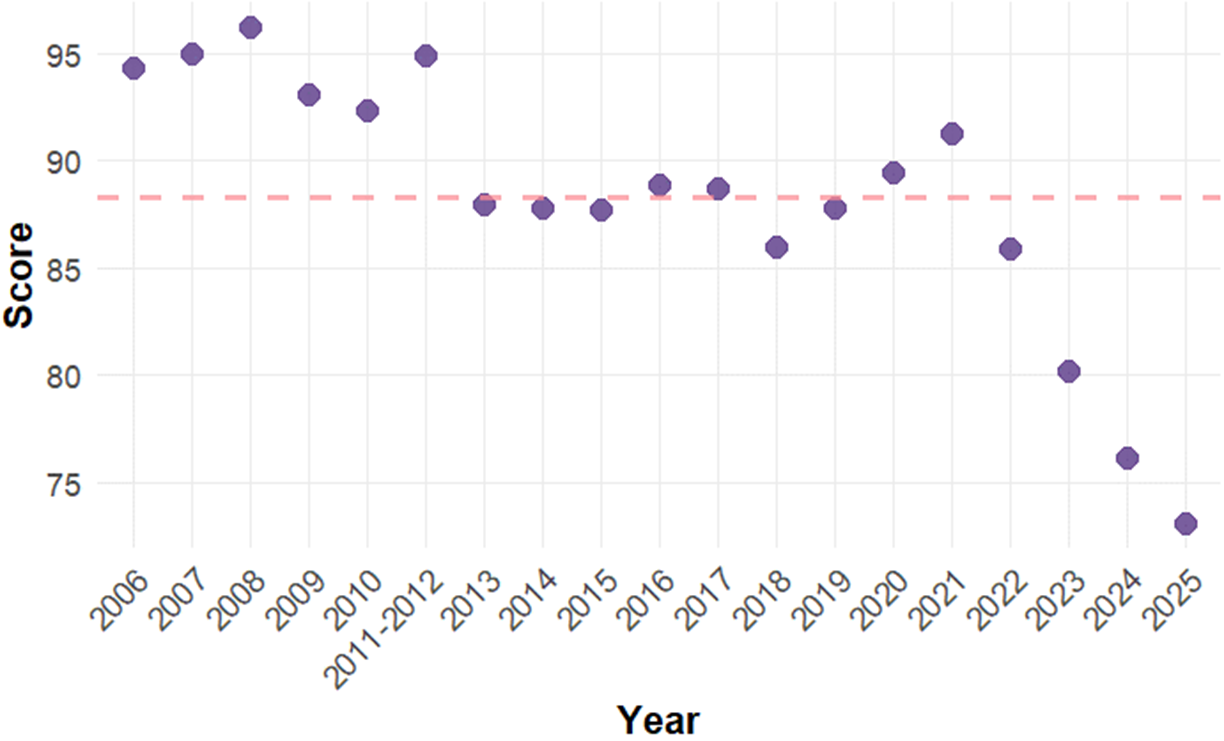
Figure 1 presents the evolution of Costa Rica’s score in the World Press Freedom Index developed by Reporters Without Borders. A higher index, means a higher level of press freedom. During the period (2006–25), the average score was 88.24.
Evolution of press freedom score in Costa Rica 2006–25 Footnote 4 .

Figure 1. Long description
The line graph illustrates the evolution of press freedom scores in Costa Rica over the years 2006 to 2025. The x-axis represents the years, starting from 2006 and ending at 2025, while the y-axis represents the score, ranging from 75 to 95. The data points indicate the press freedom score for each year. The scores are relatively high in the initial years, peaking around 2008, and then showing a general decline with some fluctuations. A red dashed line at approximately 88 marks a reference level. The scores drop significantly after 2020, reaching the lowest point in 2025. All values are approximated.
The analysis shows three moments: between 2006 and 2012, Costa Rica held its highest press freedom scores, consistently above 90; from 2013 through 2021, scores remained stable, between 85 and 91. However, from 2022 onward, there is a sustained decline, with scores dropping from 85.92 in 2022 to nearly 74.09 in 2025—the lowest value in the entire period.
To evidence the president’s attacks on news media, I conducted a systematic search on the MediaCloud platform using the following equation: “Rodrigo Chaves” AND (ataca OR insulta OR agrede OR ofende OR agravia OR menosprecia OR arremete OR descalifica) AND (prensa OR periodista OR medio OR “medios de comunicación” OR reportero) AND (“Costa Rica” OR “costarricense” OR “ticos”). I searched news from May 1, 2022, to September 4, 2025. The results yielded a total of 135 publications, primarily in: La Nación, La Teja, El País, NCR Noticias, El Financiero, and Teletica. Figure 2 presents a word cloud that visualizes the most frequent words.
Words with The Highest Number of Mentions.
Source: MediaCloud.
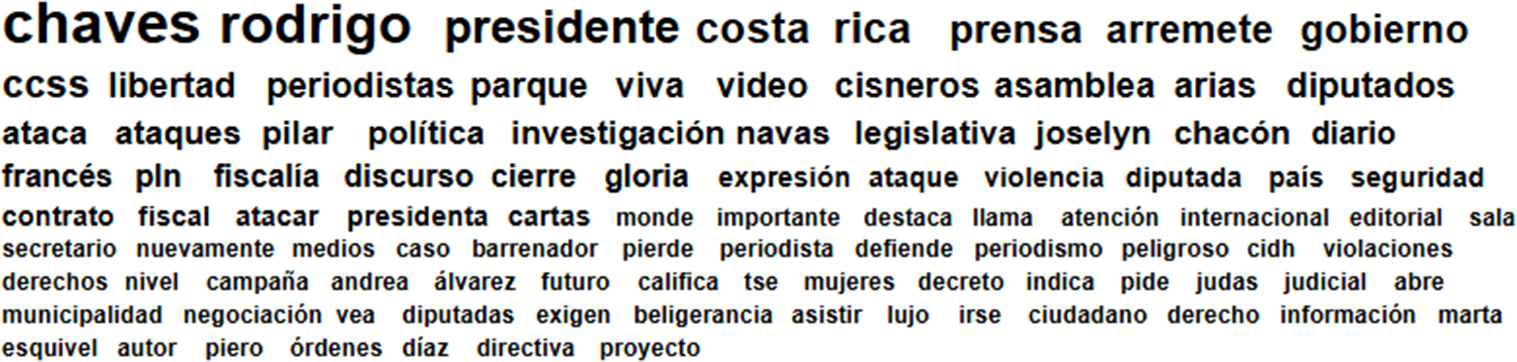
Figure 2. Long description
The image contains a block of text in Spanish with repeated words and phrases. The text includes names such as Chaves Rodrigo, Presidente Costa Rica, and various other terms related to politics, media, and government. The words are densely packed without clear formatting or structure.
The analysis of 135 articles shows how President Chaves developed a communication strategy of systematic attacks against media (Salazar Aguilar and Bonilla Reference Salazar Aguilar and Bonilla Cruz2026), an evident pattern since his electoral campaign. During his prior tour, Chaves publicly expressed his intention to “destroy” media companies such as La Nación and Canal 7 if elected (Inter-American Press Association 2022). Political communication specialists identify similarities between Chaves’s discourse and the rhetorical strategies of Trump and Bolsonaro, both grounded in a narrative that frames the press as “scoundrels and enemies” of the people (Quirós Reference Quirós2023). The official response, in turn, dismisses these attacks as a “myth” and denies any systematic policy against media (Angulo Reference Angulo2025).
The first event happened when the administration ordered the closure of “Parque Viva,” owned by Grupo Nación. Subsequently, during an official press conference, the president publicly attacked the newspaper using distorted information about corporate bond issues made between 2013 and 2014, questioning the company’s financial solvency. The executive management of Grupo Nación responded by clarifying that payments were made punctually (Alvardo Reference Alvarado2022; Chacón Reference Chacón2022; Sequeira Reference Sequeira2022).
A second case involved the false profile “Piero Calandrelli” (Alberto Vargas), who received payments from the Health Minister to produce defamatory content against journalists and opposition legislators. Although pro-government legislator Pilar Cisneros was identified as an intermediary, she denied involvement. The president responded by accusing the media of employing “political hitmen” and dismissing criticism of the minister as “unjustified” (elmundo.cr 2023; elperiodico.cr 2023).
Direct confrontations with journalists have also been recorded: Danilo Chaves from La Reacción was aggressively questioned by the president after suggesting disagreements between the Executive and the Legislative Assembly (Debrús Reference Debrús Jiménez2024), and Ignacio Santos from Teletica faced systematic criticism for disclosing presidential contact information on social media (Arce Reference Arce2024).
How have other actors beyond the press and the government responded? The opposition has framed these behaviors as a democratic threat, arguing that press freedom is essential for denouncing corruption and exercising institutional checks (Chinchilla Reference Chinchilla2023). The International Federation of Journalists issued a statement condemning violence against journalists and restrictions on access to information imposed by the Executive (Pomareda Reference Pomareda García2023).
From civil society, the Program for Freedom of Expression and Right to Information (PROLEDI 2024) found that 82.4% of citizens disapprove the presidential attitudes towards media, and that 99% of Chaves’s references to journalists in press conferences have been negative. Reporters Without Borders similarly identifies a decline in political guarantees for press freedom in the country.
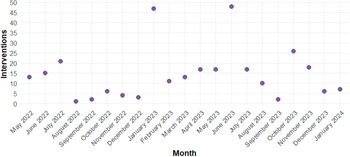
Figure 3, based on information from the IV Report on the State of Freedom of Expression in Costa Rica (UCR, CICOM, and PROLEDI, 2024), shows the president’s negative interventions toward the media by month. At the beginning of the administration, the levels are low or medium-low. In January 2023 and June 2023, the number is much higher, reaching around 50 interventions. Subsequently, levels are in a range between 5 and 25 monthly interventions, with some specific variations such as the increase in November 2023 (around 26 interventions) and a downward trend toward the end of the period.
Number of Negative Interventions from May 2022 to January 2024.

Figure 3. Long description
The line graph illustrates the number of negative interventions from May 2022 to January 2024. The x-axis represents the months, starting from May 2022 and ending in January 2024. The y-axis represents the number of interventions, ranging from 0 to 50. The data points show fluctuations in the number of interventions over time, with notable peaks in May 2023 and June 2023, reaching around 45 interventions. Other significant increases are observed in July 2022 and October 2023, with values around 20 and 25 interventions respectively. The lowest points are seen in August 2022 and December 2022, with interventions close to 0. All values are approximated.
In 2023, the Constitutional Court unprecedently condemned the president for offensive language directed at the press and opposition, marking the first judicial resolution of this nature against a president in Costa Rica (Murillo Reference Murillo2023). International scrutiny has also intensified: the US State Department reported on Chaves’s attacks against the press, highlighting verbal aggressions, harassment, and the use of state resources to punish critical media (Campos Reference Campos2024), while Le Monde noted that the Costa Rican president “does not tolerate journalistic criticism” and accuses media of “dark economic or political interests” (Bolaños Reference Bolaños Vargas2025).
More recently, the Chaves administration launched an auction of radio and television frequencies at costs threatening to force numerous stations off the air, drawing widespread criticism from press freedom organizations, political leaders, and religious groups (Murillo Reference Murillo2025c). The Constitutional Court suspended the process, arguing that two thirds of operating stations risked losing their frequencies (Murillo Reference Murillo2025d). The president defended the auction as an “end to decades of irregular concessions and referred to industry critics as a mafia” (Ruiz Reference Ruiz2025).
Institutional Delegitimization
International indicators reflect stable corruption perception levels during the period, ranging between 53 and 59 points (Surcos 2025). The Chaves administration has faced corruption accusations and judicial cases that have generated tensions with control institutions.
The first case involved a conflict with the Attorney General’s Office following the detention of the executive president of the Costa Rican Social Security Fund for Corruption (NCR 2024). Chaves framed these actions as “abuse of power” and a strategy to “intimidate the government.” A second case concerned allegations of extortion related to irregular contracting of government communication services using Central American Bank for Economic Integration (BCIE in spanish) funds (Murillo Reference Murillo2025a), suggesting that contractual requirements were drafted to benefit the president’s campaign advisor. A third case involves the alleged irregular financing of the 2022 presidential campaign through parallel structures, violating electoral code provisions on transparency (Murillo Reference Murillo2025b). The Public Ministry has requested the lifting of presidential immunity.
The conflict deepened when the president led a public mobilization against the prosecutor, calling him a “neighborhood thug,” while judicial authorities noted that such actions threaten the separation of powers (Benavides Reference Benavides2025). Chaves has framed these cases as “political persecution” and an opportunity to “change the rules of the game.”
Beyond specific cases, there is a systematic pattern of confrontation with control institutions. The General Comptroller’s Office has faced presidential attacks after identifying irregularities in the Costa Rican Institute of Electricity and the Social Security Fund (Miranda Reference Miranda2024). The Comptroller has noted that exposing irregularities remains its historical function, however current attacks are unprecedented in intensity compared to previous administrations.
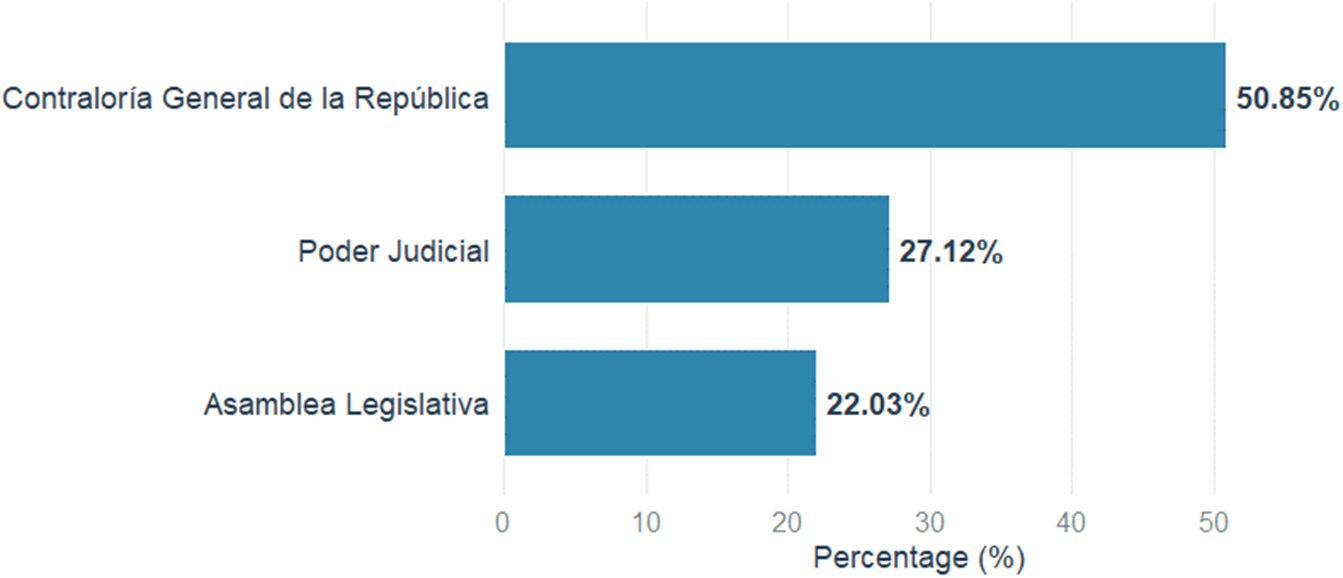
Figure 4 shows that the highest percentage of attacks made, relates to the General Comptroller’s Office in a period from June 2022 to September 2024 (Programa Estado de la Nación, 2024, based on press conferences).
Attacks on Institutions during Rodrigo Chaves’s Administration.

Figure 4. Long description
The bar graph compares the percentage of attacks on three institutions during Rodrigo Chaves’s administration. The x-axis represents the percentage, ranging from 0 to 50 percent. The y-axis lists the institutions: Contraloría General de la República, Poder Judicial, and Asamblea Legislativa. The Contraloría General de la República has the highest percentage of attacks at 50.85 percent, followed by Poder Judicial at 27.12 percent, and Asamblea Legislativa at 22.03 percent. The bars are horizontal and colored in blue. All values are approximated.
Support for Democracy
To analyze the decline in support for democracy, I used datasets from the “Latin American Public Opinion Project” at Vanderbilt University, which cover the years 2006, 2008, 2010, 2012, 2014, 2016, 2018, 2021, Footnote 5 and 2023. I estimate a multiple linear regression model with year fixed effects. According to Wooldridge (Reference Wooldridge2020), multiple linear regression is a model that allows evaluating the relationship between a dependent variable and multiple explanatory variables, while fixed effects help control for unobserved characteristics that are constant over time within groups of observations. The dependent variable is based on the question: “Changing the subject again, democracy may have problems, but it is better than any other form of government. To what extent do you agree or disagree with this statement?” (scale from 1 to 7). Footnote 6
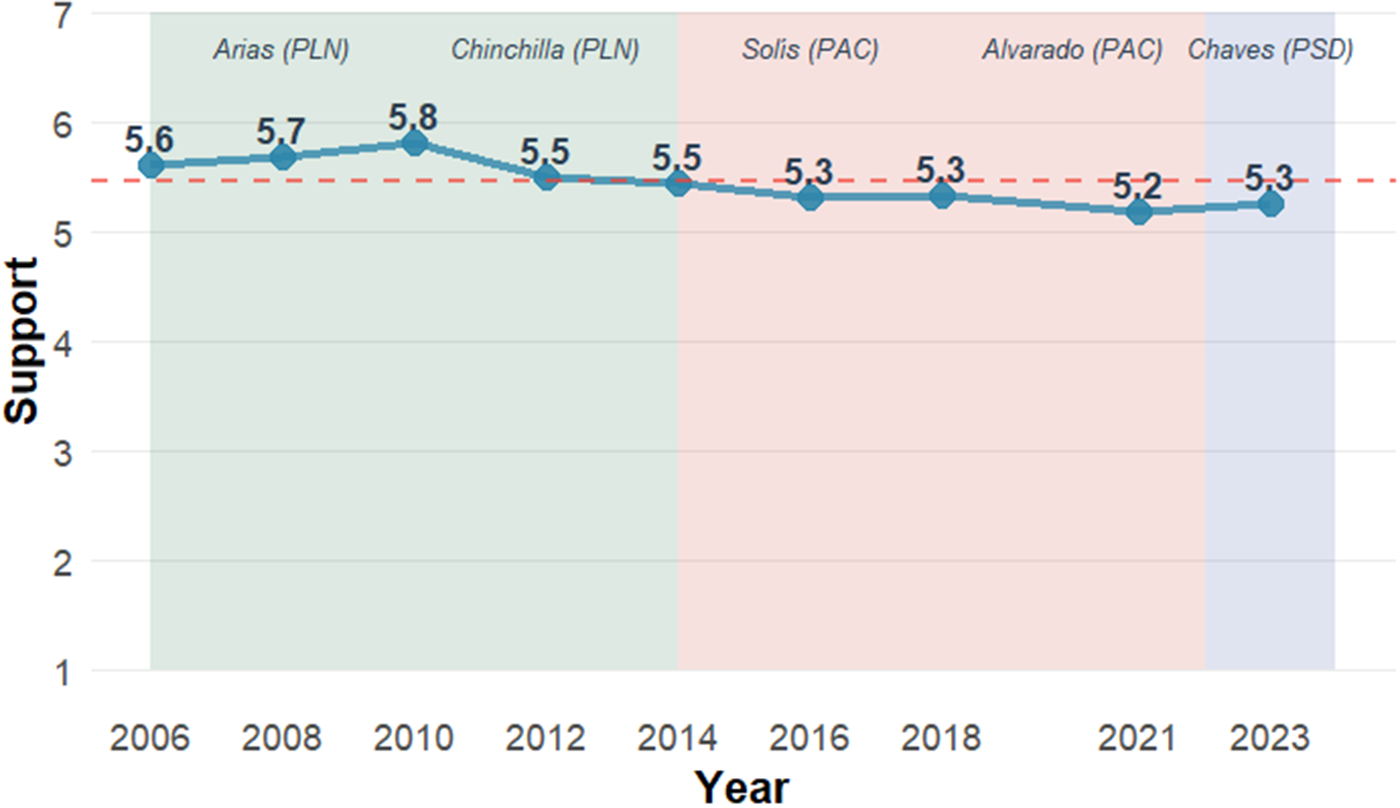
Figure 5 shows the evolution of the dependent variable from 2006 to 2023. The overall average was 5.5; however, in 2016, a slight decline begins, covering three presidential periods, Luis Guillermo Solís (2014–18), Carlos Alvarado (2018–22), and Rodrigo Chaves (2022–present), defined by party system fragmentation, limited cross-sector negotiation, the emergence of religious leaders, the COVID-19 crisis, and rising insecurity (Casas-Zamora Reference Casas-Zamora2024; Ovares-Sánchez Reference Ovares-Sánchez, Duarte-Recalde and André2021).
Citizen Support for Democracy in Costa Rica, 2006–23.

Figure 5. Long description
A line graph displays citizen support for democracy in Costa Rica from 2006 to 2023. The x-axis represents the years, ranging from 2006 to 2023, while the y-axis represents the level of support, ranging from 1 to 7. The graph highlights the support levels during the presidencies of Arias, Chinchilla, Solis, Alvarado, and Chaves. Support starts at 5.6 in 2006, peaks at 5.8 in 2010, and fluctuates slightly, ending at 5.3 in 2023. The graph includes a dashed red line indicating an average support level of 5.5. All values are approximated.
What explains the decline in support for democracy? Drawing on previous studies, I focus on three types of explanations. For the economic dimension, I include the variable “Do you consider that your current economic situation is better, the same, or worse than twelve months ago?” For the social dimension, I include security perception, measured by “Speaking of the place or neighborhood where you live and thinking about the possibility of being a victim of an assault or robbery, do you feel safe or unsafe?” and corruption perception, measured by “Taking into account your experience or what you have heard mentioned, is corruption of public officials in the country widespread or not widespread?’ For the political dimension, I include political participation through “Did you vote in the first round of the last presidential elections?”; confidence in news media through “To what extent do you have confidence in news media?” (1–7 scale); respect for institutions through “To what extent do you have respect for Costa Rica’s political institutions?” (1–7 scale); and presidential approval through “Speaking of the current government, would you say that the work the president is doing is good, fair, or bad?”
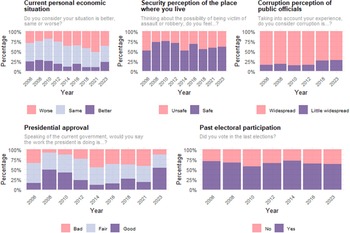
Figure 6 shows the evolution of the qualitative variables previously mentioned: economic situation, security perception, presidential approval, corruption perception and past electoral participation in Costa Rica from 2006 to 2023. Footnote 7
Perception of Economic, Social, and Political Dimensions in Costa Rica 2006–23.

Figure 6. Long description
The image contains five separate bar graphs depicting various perceptions in Costa Rica from 2006 to 2023. The first graph shows the current personal economic situation, with categories worse, same, and better. The second graph illustrates the security perception of the place where people live, with categories unsafe and safe. The third graph represents the corruption perception of public officials, with categories widespread and little widespread. The fourth graph displays presidential approval, with categories bad, fair, and good. The fifth graph indicates past electoral participation, with categories no and yes. Each graph uses different colors to represent these categories and shows trends over the years.
In the economic dimension, the graph shows mixed results. In general terms, citizens consider their economic situation has worsened or stayed the same; less than 25% report improvement. Notably, the proportion perceiving their situation as worse increased from 2014 through 2021, before declining slightly in 2023. Macroeconomic factors such as low wages, high cost of living, inflation, and inequality may explain this pattern. In the social dimension, regarding security perception, more than half of the population feels safe; however, in 2006, 2014, and 2018, security and insecurity perceptions were similar. About corruption, 75% or more, consider that corruption is widespread in the country.
Regarding the political dimension, the variable with greatest changes is presidential approval. During 2006, 2014, 2018, and 2021, between 30% and 50% of the people disapproved of the government. These years relate to the administrations of Partido Liberación Nacional and, predominantly, Partido Acción Ciudadana. In 2022, with tRodrigo Chaves, we can observe a substantial improvement in presidential approval. On the other hand, past electoral turnout remains stable throughout the period.
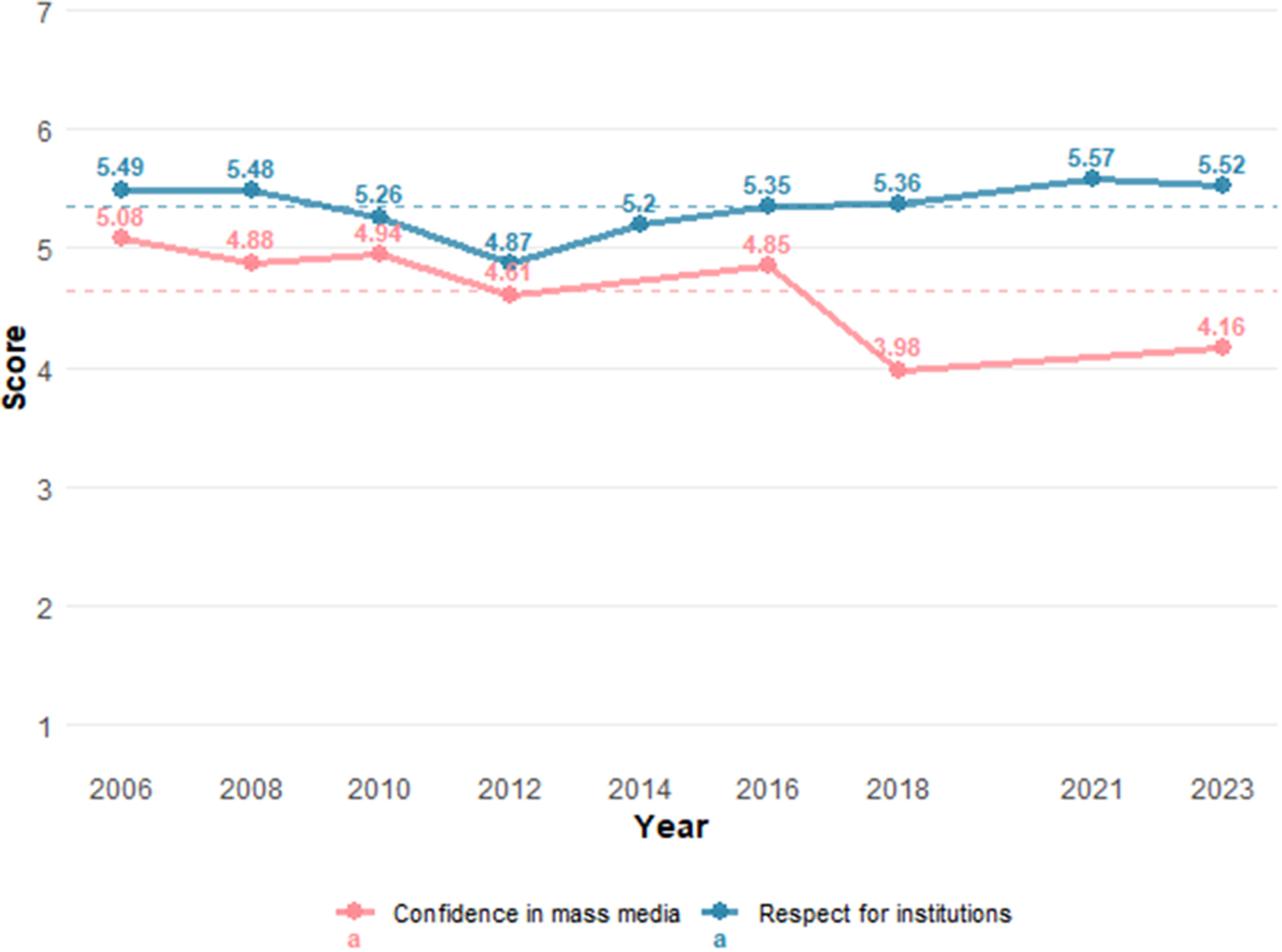
Figure 7 shows the quantitative variables: institutional respect and confidence in news media (1–7 scale). Both show a stable trend over the period. Respect for institutions scores is higher than confidence scores in news media across all years, evidencing institutional resilience. Notably, confidence in news media experienced a drop in 2018, reaching its lowest point at 3.98, before partially recovering in 2023.
Respect for Institutions and Confidence in News Media, Costa Rica 2006–23.

Figure 7. Long description
The line graph presents data on the trends in confidence in mass media and respect for institutions in Costa Rica over the period from 2006 to 2023. The x-axis represents the years, ranging from 2006 to 2023, while the y-axis represents the score, ranging from 1 to 7. Two data lines are plotted: one for confidence in mass media, marked in red, and another for respect for institutions, marked in blue. The confidence in mass media starts at a score of 5.08 in 2006, fluctuates slightly, and then declines significantly after 2016, reaching a low of 3.98 in 2018 before slightly recovering to 4.16 in 2023. Respect for institutions starts at a score of 5.49 in 2006, remains relatively stable with minor fluctuations, and ends at a score of 5.52 in 2023. All values are approximated.
Based on the literature review, I propose the following hypotheses:
-
1. When perception of the economic situation improves, support for democracy increases.
-
2. When security perception improves, support for democracy increases.
-
3. When corruption perception improves, support for democracy increases.
-
4. When respect for institutions improves, support for democracy increases.
-
5. When confidence in news media improves, support for democracy increases.
-
6. When presidential approval improves, support for democracy increases.
-
7. Prior electoral turnout is positively associated with support for democracy.
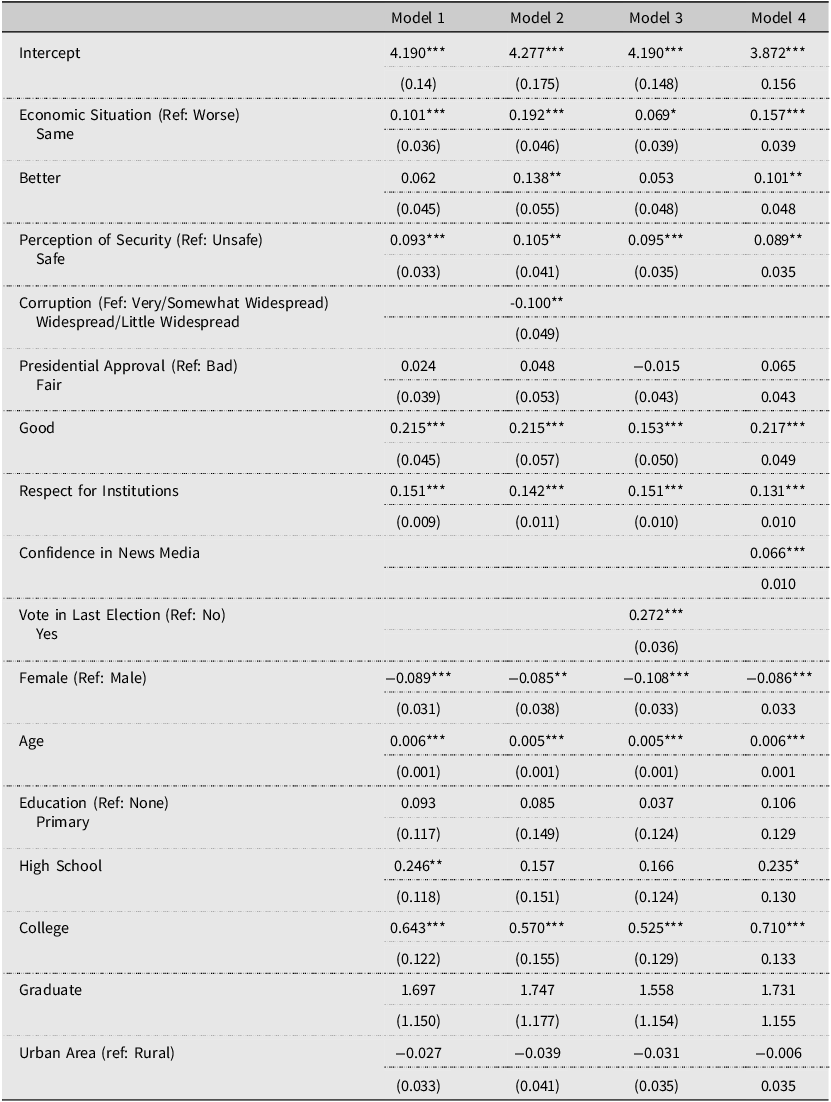
Table 1 shows evidence of the results of the estimated models. Model 1 includes fixed effects and all explanatory variables, excluding corruption, turnout in past elections, and confidence in news media. Model 2 adds the corruption variable and includes fixed effects, except for years 2018 and 2021. Model 3 uses turnout in past elections as an explanatory variable and fixed effects, except for 2021. Model 4 draws on confidence in news media as an explanatory variable and fixed effects, except for 2014 and 2021. All models control for variables: gender, age, education level, and locality type. The reference categories used are: “Male” for gender, “None” for education level, and “Rural” for locality type.
Economic, Social, and Political Factors Associated with Support for Democracy in Costa Rica

Table 1. Long description
The table presents data on the association of various economic, social, and political factors with support for democracy in Costa Rica. It includes four models, each with different explanatory variables and fixed effects. Model 1 includes fixed effects and all explanatory variables except corruption, turnout in past elections, and confidence in news media. Model 2 adds the corruption variable and includes fixed effects, except for years 2018 and 2021. Model 3 uses turnout in past elections as an explanatory variable and fixed effects, except for 2021. Model 4 includes confidence in news media as an explanatory variable and fixed effects, except for 2014 and 2021. All models control for gender, age, education level, and locality type. The reference categories used are Male for gender, None for education level, and Rural for locality type. The table lists coefficients and standard errors for each variable across the four models.
Note: Standard error in parentheses, p<0.001***, p<0.05**, p<0.1*.
Regarding economic variables, the economic situation presents mixed results. Perceiving the economic situation as the same—compared to perceiving it as worse—has a positive and significant effect on support for democracy across nearly all models, except for model 3. Perceiving the situation as better, however, only yields a positive and significant effect in model 4. These results offer partial support for the hypothesis.
The perception of security demonstrates a robust and positive effect on support for democracy, remaining statistically significant across all models, thereby supporting the hypothesis. Corruption, by contrast, presents a negative effect: perceiving corruption as little or widespread—relative to very/somewhat widespread—associates with a decrease in support for democracy, a finding that contradicts the hypothesis.
Concerning political variables, good presidential approval—compared to bad approval–has a positive and significant effect that holds consistently across all models. In a similar vein, respect for institutions, confidence in news media, and prior electoral participation also display positive and statistically significant effects, providing consistent support for the hypotheses. Among the control variables, only gender, age, and university-level education reach statistical significance: being a woman is negatively associated with support for democracy, while being older and having attained a university degree are both positively associated with it.
Discussion
Results from qualitative and quantitative strategies reveal the process of democracy under strain in Costa Rica. Regarding press freedom, decreases in international indexes show that attacks extend beyond discourse and create conditions that restrict journalistic work, confirming Van Belle’s argument that communicators require a secure environment to question political elites. The narrative framing the press as “enemy of the people” undermines the democratic functions identified by Cook, particularly accountability. The Costa Rican case shows that current obstructions operate through public attacks, disinformation operations, and indirect economic pressures, such as the frequency auction, ultimately contained by the Constitutional Court. This institutional resilience distinguishes democracy under strain from backsliding: institutions have not been dismantled, but pressure on them is systematic and unprecedented.
Citizen reaction suggests an additional tension: although 82.4% reject presidential attacks against the media, Chaves gained power by employing this anti-media rhetoric during the campaign. This dynamic illustrates Benedek’s anti-pluralist framing of populism: hostility toward the press may generate electoral returns in the short term, but foster gradual erosion in quality of democracy over time.
On the other hand, evidence on institutional delegitimization confirms the strategies described by Köker et al.: systematic campaigns that operate as “norm saboteurs” rather than constructive criticism. Conflicts with the Attorney General’s Office and the General Comptroller’s Office target institutions with the greatest capacity to control, hold accountable, and veto executive decisions. The presidential response to corruption accusations illustrates what Recio and Vidal call “instrumentalization”: labeling judicial cases as “political persecution” reframes institutional oversight as elite conspiracy, providing ideological cover for attacking the mechanisms designed to ensure accountability.
Furthermore, leading a public demonstration against the prosecutor and using phrases like “neighborhood thug” represents what Monsiváis calls an innovation in the authoritarian repertoire: an escalation from rhetorical confrontation to direct mobilization against judicial authority. The contrast between stable Transparency International indices and the intensity of these conflicts suggests a gap between aggregate corruption perception and the specific institutional conflicts generated by the executive. Yet control institutions continue to operate, indicating that Costa Rica’s democratic framework preserves its capacity to resist.
In turn, the results from the statistical model yield both confirmatory and mixed findings. Security perception reduces democratic support, confirming the hypothesis. The counterintuitive result on corruption reflects context dependency: in a setting where roughly 75% of citizens consider corruption endemic, marginal improvements in perception may not translate into greater democratic support. The economic variable shows inconsistent results, suggesting the possibility of an alternative hypothesis: different economic indicators or specific contextual conditions may better capture the relationship between economic perceptions and democratic support in Costa Rica.
The most significant finding, however, concerns the political dimension. Presidential approval, respect for institutions, electoral participation, and confidence in news media all show consistent positive relationships with democratic support. The result draws on a question: Why does Chaves hold comparatively high presidential approval while simultaneously pursuing institutional delegitimization strategies that erode the conditions under which democracy functions? This can be interpreted through Sendra and Bohigues’s framework: presidential approval may operate as a source of group belonging, generating in-group and out-group divisions that sustain political support independently of, or even despite, democratic decline. This result suggests that political polarization, not included in the current models, may be a key moderating variable that future research should address.
Taken together, the three indicators—declining press freedom, systematic institutional delegitimization, and decreasing democratic support—confirm that Costa Rica is experiencing a moment of democracy under strain. Institutions have shown resilience: the Constitutional Court has intervened, the Public Ministry has advanced corruption cases, and citizen disapproval of anti-press attacks remains high. Yet the pressure is sustained, coordinated, and without historical precedent in a country long regarded as a regional democratic benchmark.
Conclusion
This article asks how we can explain the democratic tensions observed in Costa Rica under the Chaves administration. The argument is that Costa Rica represents a democracy under strain: a theoretically distinct condition in which systematic executive pressure on democratic conditions coexists with institutional resilience.
Press freedom has declined, with attacks extending beyond rhetoric to create restrictive conditions for journalistic practice, yet the Constitutional Court has intervened and citizen disapproval of anti-press aggression remains high. Institutional delegitimization has reached unprecedented intensity, with conflicts and mobilization against judicial authorities that extend the authoritarian repertoire beyond conventional verbal attacks, yet institutions have not been dismantled and corruption cases against the executive continue. Democratic support shows a sustained declining trend since 2016, shaped primarily by political variables: respect for institutions, presidential approval, and confidence in media.
The findings also raise questions. A president who maintains high approval ratings while systematically undermining the institutional conditions that sustain democratic support suggests that political polarization and ingroup/outgroup dynamics may decouple citizen support for leadership from support for democratic institutions in ways that existing models do not fully capture. More broadly, the Costa Rican case demonstrates that longstanding democratic stability does not confer immunity against authoritarian pressure: it may instead generate a false sense of institutional invulnerability that makes gradual strain harder to detect and counter. Whether Costa Rica’s institutional resilience proves sufficient or whether sustained executive pressure eventually tips the balance toward erosion remains an open question. The 2026 electoral victory of Laura Fernández, Chaves’s former Minister of the Presidency and political heir, represents continuity with the current political project in a system that still bans consecutive reelection. The answer will carry significant implications for the study of democratic change in Latin America.
The author thanks the anonymous reviewers and the editors of Latin American Politics and Society for their thoughtful and constructive feedback on earlier versions of this manuscript. This publication was supported by the Universidad Nacional Autónoma de México (UNAM).

 Open access

