
Skip to main content Accessibility help
×
  • Cited by 494
    • Show more authors
    • You may already have access via personal or institutional login
    • Select format
    • Publisher:
      Cambridge University Press
      Publication date:
      05 June 2012
      13 March 2003
      ISBN:
      9780511615054
      9780521816205
      9780521016506
      Dimensions:
      (228 x 152 mm)
      Weight & Pages:
      0.747kg, 400 Pages
      Dimensions:
      (228 x 152 mm)
      Weight & Pages:
      0.635kg, 400 Pages
    You may already have access via personal or institutional login
  • Selected: Digital
    Add to cart View cart Buy from Cambridge.org

    Book description

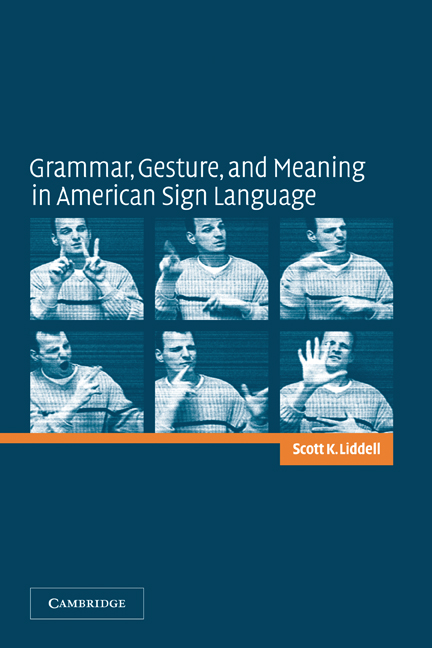
    In sign languages of the deaf some signs can meaningfully point toward things or can be meaningfully placed in the space ahead of the signer. This obligatory part of fluent grammatical signing has no parallel in vocally produced languages. This book focuses on American Sign Language to examine the grammatical and conceptual purposes served by these directional signs. It guides the reader through ASL grammar, the different categories of directional signs, the types of spatial representations signs are directed toward, how such spatial conceptions can be represented in mental space theory, and the conceptual purposes served by these signs. The book demonstrates a remarkable integration of grammar and gesture in the service of constructing meaning. These results also suggest that our concept of 'language' has been much too narrow and that a more comprehensive look at vocally produced languages will reveal the same integration of gestural, gradient, and symbolic elements.

    Reviews

    'This is a major contribution to sign language linguistics, and to linguistics generally.'

    Source: Language

    Refine List

    Actions for selected content:

    Select all | Deselect all
    • View selected items
    • Export citations
    • Download PDF (zip)
    • Save to Kindle
    • Save to Dropbox
    • Save to Google Drive

    Save Search

    You can save your searches here and later view and run them again in "My saved searches".

    Please provide a title, maximum of 40 characters.
    ×

    Contents

    References
    Aarons, Debra. 1994. Aspects of the syntax of American Sign Language. Ph.D. dissertation, Boston University
    Aarons, Debra, Benjamin, Bahan, Judy, Kegl, and Carol, Neidle. 1992. Clausal structure and a tier for grammatical marking in American Sign Language. Nordic Journal of Linguistics 15:103–142
    Aarons, Debra, Benjamin Bahan, Judy Kegl, and Carol Neidle. 1994. Subjects and agreement in American Sign Language. In Inger Ahlgren, Brita Bergman, and Mary Brennan (eds.), Perspectives on Sign Language Structure: Papers from the Fifth International Symposium on Sign Language Research, vol. I. University of Durham, England: The Deaf Studies Research Unit, 13–28
    Ahlgren, Inger and Brita Bergman. 1994. Reference in narratives. In Inger Ahlgren, Brita Bergman, and Mary Brennan (eds.), Perspectives on Sign Language Structure: Papers from the Fifth International Symposium on Sign Language Research, vol. I. University of Durham, England: The Deaf Studies Research Unit, 29–36
    Armstrong, David, William C. Stokoe, and Sherman Wilcox. 1995. Gesture and the Nature of Language. Cambridge: Cambridge University Press
    Bahan, Benjamin J. 1996. Non-manual realization of agreement in American Sign Language. Ph.D. dissertation, Boston University
    Baker, Charlotte and Dennis Cokely. 1980. American Sign Language: A Teacher's Resource Text on Grammar and Culture. Silver Spring, MD: T. J. Publishers
    Baker, Charlotte and Carol Padden. 1978. Focusing on the nonmanual components of American Sign Language. In Patricia Siple (ed.), Understanding Language through Sign Language Research. New York: Academic Press, 59–90
    Battison, Robbin. 1974. Phonological deletion in American Sign Language. Sign Language Studies 5:1–19
    Bergman, Brita and Östen Dahl (eds.). 1994. Ideophones in sign language? The place of reduplication in the tense-aspect system of Swedish Sign Language. In Carl, Bache, Hans Basb⊘ll, and Carl-Erik Lindberg (eds.), Tense, Aspect and Action. New York: Mouton de Gruyter, 397–422
    Bolinger, Dwight. 1961. Contrastive accent and contrastive stress. Language 37:83–96
    Bolinger, Dwight. 1972. Accent is predictable (if you're a mind reader). Language 48:633–644
    Bolinger, Dwight. 1975. Aspects of Language (2nd edition), New York: Harcourt, Brace, Jovanovich
    Bolinger, Dwight. 1986. Intonation and its Parts. Palo Alto, CA: Stanford University Press
    Bolinger, Dwight. 1989. Intonation and its Uses. Palo Alto, CA: Stanford University Press
    Boyes-Braem, Penny. 1981. Features of the handshape in American Sign Language. Ph.D. dissertation, University of California, Berkeley
    Brentari, Diane. 1998. A Prosodic Model of Sign Language Phonology. Cambridge, MA: MIT Press
    Bybee, Joan. 1985. Morphology: A Study of the Relation between Meaning and Form. Amsterdam: John Benjamins
    Chinchor, Nancy. 1981. Numeral incorporation in American Sign Language. Ph.D. dissertation, Brown University
    Chomsky, Noam. 1981. Lectures on Government and Binding. Dordrecht: Foris
    Clark, Herbert and Richard, Gerrig. 1990. Quotations as demonstrations. Language 66.4:764–805
    Cole, Debra. 2000. Course paper. Department of Linguistics and Interpretation, Gallaudet University
    Coulter, Geoffrey. 1979. American Sign Language typology. Ph.D. dissertation, University of California at San Diego
    Cruttenden, Alan. 1986. Intonation. Cambridge: Cambridge University Press
    Crystal, David. 1969. Prosodic Systems and Intonation in English. Cambridge: Cambridge University Press
    Crystal, David. 1991. A Dictionary of Linguistics and Phonetics (3rd edition). London: Basil Blackwell
    Davies, Shawna. 1985. The tongue is quicker than the eye: Non-manual behaviors in ASL. In William C. Stokoe and V. Volterra (eds.), SLR '83: Proceedings of the Third International Symposium on Sign Language Research. Silver Spring, MD: Linstok Press, 185–193
    DeMatteo, Asa. 1977. Visual imagery and visual analogues in American Sign Language. In Lynn Friedman (ed.), On the Other Hand: New Perspectives on American Sign Language. New York: Academic Press, 109–136
    Dudis, Paul. 2000. Tokens as abstract visible blended elements. Paper presented at conference, Conceptual Structures in Discourse and Language 5, University of California, Santa Barbara, May 11–14, 2000
    Duncan, Susan. 1996. Grammatical form and “thinking for speaking” in Chinese and English: An analysis based on speech-accompanying gestures. Ph.D. dissertation, University of Chicago
    Duncan, Susan. In press. “Gesture in language: Issues for sign language research. In Karen Emmorey (ed.), Perspectives on Classifier Constructions in Signed Languages. Mahwah, NJ: Lawrence Erlbaum Associates
    Edge, Vicki Lee and Leora Herrmann. 1977. Verbs and the determination of subject in American Sign Language. In Lynn Friedman (ed.), On the Other Hand: New Perspectives on American Sign Language. New York: Academic Press, 137–179
    Efron, David. 1941. Gesture and Environment. Morningside heights, NY: King's Crown Press
    Ekman, Paul and Friesen, W. F.. 1969. The repertoire of nonverbal behavioral categories: Origins, usage, and coding. Semiotica 1:49–98
    Emmorey, Karen. 1999. Do signers gesture? In L. Messing and R. Campbell (eds.), Gesture, Speech, and Sign. New York: Oxford University Press, 133–159
    Engberg-Pedersen, Elisabeth. 1993. Space in Danish Sign Language: the Semantics and Morphosyntax of the Use of Space in a Visual Language. Hamburg: Signum Press
    Fauconnier, Gilles. 1985. Mental Spaces. Cambridge, MA: MIT Press. Reprinted 1994, Cambridge: Cambridge University Press
    Fauconnier, Gilles. 1997. Mappings in Thought and Language. Cambridge: Cambridge University Press
    Fauconnier, Gilles and Mark Turner. 1994. Conceptual projection and middle spaces. UCSD Cognitive Science Technical Report
    Fauconnier, Gilles and Mark Turner. 1996. Blending as a central process of grammar. In Adele Goldberg (ed.), Conceptual Structure, Discourse and Language. Stanford, CA: CSLI Publications, 113–130
    Fillmore, Charles. 1982. Frame semantics. In Linguistic Society of Korea (ed.), Linguistics in the Morning Calm. Seoul: Hanshin, 113–137
    Fillmore, Charles. 1985. Frames and the semantics of understanding. Quaderni di semantica 6.2:222–253
    Fischer, Susan. 1973. Two processes of reduplication in American Sign Language. Foundations of Language 9:469–480
    Fischer, Susan. 1975. Influences on word order change in ASL. In Charles N. Li (ed.), Word Order and Word Order Change. Austin, TX: University of Texas Press, 1–25
    Fischer, Susan and Bonnie, Gough. 1978. Verbs in American Sign Language. Sign Language Studies 18:17–48
    Fischer, Susan and Wynne Janis. 1990. Verb sandwiches in American Sign Language. In S. Prillwitz and T. Vollhaber (eds.), Current Trends in European Sign Language Research. Hamburg: Signum Press, 279–293
    Fridman, Boris. 1994. The collective plural inflection of ASL: Pragmatics and grammar. Paper presented at Georgetown University Roundtable on Language and Linguistics: ASL Pragmatics. March, 1994
    Fridman, Boris and Scott Liddell. 1998. Sequencing mental spaces in an ASL narrative. In Jean P. Koenig (ed.), Discourse and Cognition: Bridging the Gap. Center for the Study of Language and Information, Leland Stanford Junior University, 255– 268
    Friedman, Lynn. 1975. Space, time, and person reference in American Sign Language. Language 51:940–961
    Friedman, Lynn. 1976. The manifestation of subject, object, and topic in the American Sign Language. In Charles N. Li (ed.), Subject and Topic. New York: Academic Press, 125–148
    Friedman, Lynn. 1977. Formational properties of American Sign Language. In Lynn Friedman (ed.), On the Other Hand: New Perspectives on American Sign Language. New York: Academic Press, 13–56
    Frishberg, Nancy. 1975. Arbitrariness and iconicity: Historical change in American Sign Language. Language 51:676–710
    Frishberg, Nancy. 1979. Historical change: From iconic to arbitrary (chapter 3). In Edward S. Klima and Ursula Bellugi (eds.), The Signs of Language. Cambridge: Harvard University Press
    Frishberg, Nancy and Bonnie Gough. 1973. Morphology in American Sign Language. Ms., The Salk Institute, La Jolla, CA
    Gee, James and Judy, Kegl. 1982. Semantic perspicuity and the locative hypothesis: Implications for acquisition. Journal of Education 164.2:185–209
    Haas, Mary. 1945. Spoken Thai. New York: Holt
    Haviland, John. 2000. Pointing, gesture spaces, and mental maps. In David McNeill (ed.), Language and Gesture. Cambridge: Cambridge University Press, 13–46
    Hoffmeister, Robert. 1977. The influential point. In William C. Stokoe, (ed.), Proceedings of the National Symposium on Sign Language Research and Teaching. Silver Spring, MD: National Association of the Deaf, 177–191
    Hutchins, Edwin. 2000. Material anchors for conceptual blends. Ms., Distributed cognition and HCI Laboratory, University of California, San Diego
    Jakobson, Roman. 1971. Selected Writings. Vol. I, Word and Language. The Hague: Mouton
    Janis, Wynne. 1995. A crosslinguistic perspective on ASL verb agreement. In Karen Emmorey and Judy Reilly (eds.), Language, Gesture, and Space. Hillsdale, NJ: Lawrence Erlbaum Associates, 195–223
    Jespersen, Otto. 1959. Language; Its Nature, Development, and Origin. London: Allen and Unwin
    Johnson, Robert E. and Scott K. Liddell. In preparation. Phonology in American Sign Language
    Kendon, Adam. 1972. Some relationships between body motion and speech. In A. Siegman and B. Pope (eds.), Studies in Diadic Communication. New York: Pergamon Press, 177–210
    Kendon, Adam. 1980. Gesticulation and speech: Two aspects of the process of utterance. In M. R. Key (ed.), The Relation between Verbal and Nonverbal Communication. The Hague: Mouton, 207–227
    Kendon, Adam. 1988. How gestures can become like words. In F. Poyatos (ed.), Crosscultural Perspectives in Nonverbal Communication. Toronto: Hogrefe, 131–141
    Kendon, Adam. 2000. Language and gesture: Unity or duality? In David McNeill (ed.), Language and Gesture. Cambridge: Cambridge University Press, 47–63
    Kita, Sotaro. 1993. Language and thought interface: A study of spontaneous gestures and Japanese mimetics. Ph.D. dissertation, University of Chicago
    Kita, Sotaro. 2000. How representational gestures help speaking. In David McNeill (ed.), Language and Gesture. Cambridge: Cambridge University Press, 162–185
    Klima, Edward S. and Ursula Bellugi. 1979. The Signs of Language, with Robbin Battison, Penny Boyes Braem, Susan Fischer, Nancy Frishberg, H. Lane, Ella M. Lentz, Don Newkirk, E. L. Newport, C. C. Pedersen, and Patricia Siple. Cambridge, MA: Harvard University Press
    Koestler, Arthur. 1964. The Act of Creation. New York: McMillan
    Lacy, Richard. 1974. Putting some of the syntax back into semantics. Ms., The Salk Institute, La Jolla, CA
    Ladd, D. Robert. 1978. Stylized intonation. Language 54:517–540
    Ladd, D. Robert. 1980. The Structure of Intonational Meaning. Bloomington: Indiana University Press
    Ladd, D. Robert. 1990. Intonation: emotion vs. grammar. Review of Bolinger 1989. Language 66:806–816
    Ladd, D. Robert. 1996. Intonational Phonology. Cambridge: Cambridge University Press
    Lakoff, George and Mark Johnson. 1980. Metaphors We Live By. Chicago and London: University of Chicago Press
    Langacker, Ronald W. 1987. Foundations of Cognitive Grammar. Vol. I, Theoretical Prerequisites. Stanford, CA: Stanford University Press
    Langacker, Ronald W. 1991. Foundations of Cognitive Grammar. Vol. I, Descriptive Application. Stanford, CA: Stanford University Press
    Langacker, Ronald W. 1999a. Discourse in cognitive grammar. Paper presented at the International Cognitive Linguistics Association, Stockholm, Sweden, July, 1999
    Langacker, Ronald W. 1999b. Grammar and Conceptualization. The Hague: Mouton de Gruyter
    LeBaron, Curtis and Jürgen Streeck. 2000. Gestures, knowledge, and the world. In David McNeill (ed.), Language and Gesture. Cambridge: Cambridge University Press, 118–138
    Lentz, Ella M. 1986. Teaching role-shifting. In Carol Padden (ed.), Proceedings of the Fourth National Symposium on Sign Language Research and Teaching. Silver Spring, MD: National Association of the Deaf, 58–69
    Liberman, Mark. 1979. The Intonational System of English. New York: Garland, Publishing
    Liddell, Scott K. 1977. An investigation into the syntactic structure of American Sign Language. Ph.D. dissertation, University of California, San Diego
    Liddell, Scott K. 1978. Non-manual signals and relative clauses in American Sign Language. In Proceedings of the First National Symposium on Sign Language Research and Teaching. Silver Spring, MD: National Association of the Deaf, 193–228
    Liddell, Scott K. 1980. American Sign Language Syntax. The Hague: Mouton
    Liddell, Scott K. 1982. THINK and BELIEVE: Sequentiality in American Sign Language Signs. Paper presented at Linguistic Society of America, University of Maryland, Summer Session
    Liddell, Scott K.. 1984a. THINK and BELIEVE: Sequentiality in American Sign Language signs, Language 60.2:372–399
    Liddell, Scott K. 1984b. Unrealized-inceptive aspect in American Sign Language: Feature insertion in syllabic frames. In J. Drogo, V. Mishra, and D. Teston (eds.), Papers from the 20th Regional Meeting of the Chicago Linguistic Society. Chicago: University of Chicago Press, 257–270
    Liddell, Scott K. 1990. Four functions of a locus: Reexamining the structure of space in ASL. In Ceil Lucas (ed.), Sign Language Research: Theoretical Issues. Washington, DC: Gallaudet University Press, 176–198
    Liddell, Scott K. 1994. Tokens and surrogates. In Inger Ahlgren, Brita Bergman, and Mary Brennan (eds.), Perspectives on Sign Language Structure. Papers from the Fifth International Symposium on Sign Language Research, vol. I. University of Durham, England: The Deaf Studies Research Unit, 105–119
    Liddell, Scott K. 1995. Real, surrogate, and token space: Grammatical consequences in ASL. In Karen Emmorey and Judy Reilly (eds.), Language, Gesture, and Space. Hillsdale, NJ: Lawrence Erlbaum Associates, 19–41
    Liddell, Scott K. 1996a. Spatial representations in discourse: comparing spoken and signed language. Lingua 98:145–167
    Liddell, Scott K. 1996b. Numeral incorporating roots and non-incorporating prefixes in American Sign Language. Sign Language Studies 92:201–226
    Liddell, Scott K. 1998. Grounded blends, gestures, and conceptual shifts. Cognitive Linguistics 9.3:283–314
    Liddell, Scott K. 2000a. Indicating verbs and pronouns: Pointing away from agreement. In H. Lane and Karen Emmorey (eds.), The Signs of Language Revisited: An Anthology to Honor Ursula Bellugi and Edward Klima. Mahwah, NJ: LEA publishers, 303– 320
    Liddell, Scott K. 2000b. Sources of meaning in ASL classifier predicates. Paper presented at the workshop Classifier Constructions in Sign Languages, La Jolla, CA, April 2000
    Liddell, Scott K. 2000c. Suprasegmentals at the core of an English construction. Paper presented at conference, Conceptual Structures in Discourse and Language 5, University of California, Santa Barbara, May 11–14, 2000
    Liddell, Scott K. In press a. Grammar and gesture in American Sign Language: Implications for constructing meaning. In Alyssa Wulf and Andrew Simpson (eds.), Proceedings of the 27thAnnual Meeting of the Berkeley Linguistics Society. Berkeley, CA: Berkeley Linguistics Society
    Liddell, Scott K. In press b. Sources of meaning in ASL classifier predicates. In Karen Emmorey (ed.), Perspectives on Classifier Constructions in Signed Languages. Mahwah, NJ: Lawrence Erlbaum Associates
    Liddell, Scott K. and Robert, E. Johnson. 1986. American Sign Language compound formation processes, lexicalization, and phonological remnants. Natural Language and Linguistic Theory 4.4:445–513
    Liddell, Scott K. and Robert E. Johnson. 1987. An analysis of spatial locative predicates in American Sign Language. Paper presented at the Fourth International Symposium on Sign Language Research, July 15–19, 1987
    Liddell, Scott K. and Robert, E. Johnson. 1989. American Sign Language: The phonological base, Sign Language Studies 64:195–277
    Liddell, Scott K. and Melanie, Metzger. 1998. Gesture in sign language discourse. Journal of Pragmatics 30:657–697
    Lillo-Martin, Diane. 1995. The point of view predicate in American Sign Language. In Karen Emmorey and Judy Reilly (eds.), Language, Gesture, and Space. Hillsdale, NJ: Lawrence Erlbaum Associates, 155–170
    Lillo-Martin, Diane and Edward S. Klima. 1990. Pointing out differences: ASL pronouns in syntactic theory. In Susan Fischer and Patricia Siple (eds.), Theoretical Issues in Sign Language Research. Chicago and London: University of Chicago Press, 191–210
    Locke, John. 1975. An Essay Concerning Human Understanding (edited with an introduction, critical apparatus and glossary by Peter H. Nidditch). Oxford: Clarendon Press
    Lucas, Ceil. 1995. Sociolinguistic variation in ASL: The case of DEAF. In Ceil Lucas (ed.), Sociolinguistics in Deaf Communities. Washington, DC: Gallaudet University Press, 3–25
    Lucas, Ceil and Clayton Valli. 1990. Predicates of perceived motion in ASL. In Susan Fischer and Patricia Siple (eds.), Theoretical Issues in Sign Language Research. Vol. 1, Linguistics. Chicago and London: The University of Chicago Press, 153–166
    MacLaughlin, Dawn. 1997. The structure of determiner phrases: Evidence from American Sign Language. Ph.D. dissertation, Boston University
    Maher, Jane. 1996. Seeing Language in Sign: The Work of William C. Stokoe. Washington, DC: Gallaudet University Press
    Mandel, Mark. 1977. Iconic devices in American Sign Language. In Lynn Friedman (ed.), On the Other Hand: New Perspectives on American Sign Language. New York: Academic Press, 57–107
    McDonald, Betsy. 1982. Aspects of the American Sign Language predicate system. Ph.D. dissertation, University of Buffalo, New York
    McNeill, David. 1985. So you think gestures are nonverbal?Psychological Review 92:350–371
    McNeill, David. 1992. Hand and Mind, What Gestures Reveal about the Mind. Chicago: University of Chicago Press
    McNeill, David. 2000. Catchments and contexts: Non-modular factors in speech and gesture production. In David McNeill (ed.), Language and Gesture. Cambridge: Cambridge University Press, 312–328
    McNeill, David and Susan Duncan. 2000. Growth points in thinking for speaking. In David McNeill (ed.), Language and Gesture. Cambridge: Cambridge University Press, 141–161
    Meier, Richard, P. 1990. Person deixis in American Sign Language. In Susan Fischer and Patricia Siple (eds.), Theoretical Issues in Sign Language Research. Vol. I, Linguistics. Chicago: University of Chicago Press, 175–190
    Meir, Irit. 1998. Thematic structure and verb agreement in Israeli Sign Language. Ph.D. dissertation, Hebrew University of Jerusalem
    Metzger, Melanie. 1995. Constructed dialogue and constructed action in American Sign Language. In Ceil Lucas (ed.), Sociolinguistics in Deaf Communities. Washington, DC: Gallaudet University Press, 255–271
    Neidle, Carol, Dawn MacLaughlin, Judy Kegl, Ben Bahan, and Debra Aarons. 1995. Overt realization of syntactic features in American Sign Language. Paper presented at Syntax seminar, University of Trondheim, Norway, May 1995
    Newkirk, Don. 1980. Rhythmic features of inflections in American Sign Language. Ms., The Salk Institute, La Jolla, CA
    Newkirk, Don. 1981. On the temporal segmentation of movement in American Sign Language. Ms., The Salk Institute, La Jolla, CA
    Newport, E. L. and Richard P. Meier. 1985. The acquisition of American Sign Language. In D. Slobin (ed.), The Cross-Linguistic Study of Language Acquisition. Vol. II, The Data. Hillsdale, NJ: Lawrence Erlbaum Associates, 881–938
    Ninio, Jacques. 2001. The Science of Illusions, trans. Franklin Philip. Ithaca and London: Cornell University Press
    Okrent, Arika. 997. The productive use of conceptual metaphor in ASL: How form and meaning can be connected without the bond of convention. Paper presented at Gallaudet Communication Forum. Washington, DC: Department of American Sign Language, Linguistics and Interpretation
    Okrent, Arika. 2002. A modality-free notion of gesture and how it can help us with the morpheme vs. gesture question in sign language linguistics (or at least give us some criteria to work with). In Richard P. Meier, K. Cormier, and D. Quinto-Pozos (eds.), Modality and Structure in Signed and Spoken Languages. Cambridge: Cambridge University Press
    Özyürek, Asli. 2000. The influence of addressee location on spatial language and representational gestures of direction. In David McNeill (ed.), Language and Gesture. Cambridge: Cambridge University Press, 64–83
    Padden, Carol. 1983. Interaction of morphology and syntax in American Sign Language. Ph.D. dissertation, University of California, San Diego
    Padden, Carol. 1986. Verbs and role-shifting in ASL. In Carol Padden (ed.), Proceedings of the Fourth National Symposium on Sign Language Research and Teaching. Silver Spring, MD: National Association of the Deaf, 44–57
    Padden, Carol. 1988. Interaction of Morphology and Syntax in American Sign Language. New York: Garland Publishing
    Padden, Carol. 1990. The relation between space and grammar in ASL verb morphology. In Ceil Lucas (ed.), Sign Language Research: Theoretical Issues. Washington, DC: Gallaudet University Press, 118–132
    Pierrehumbert, Janet. 1980. The phonology and phonetics of English intonation. Ph.D. dissertation, Massachusetts Institute of Technology. Published 1988, Indiana University Linguistics Club
    Sandler, Wendy. 1989. Phonological Representation of the Sign: Linearity and nonlinearity in American Sign Language. Publications in Language Sciences 32. Providence, RI: Foris
    Schembri, Adam. In press. Rethinking “classifiers” in signed languages. In Karen Emmorey (ed.), Perspectives on Classifier Constructions in Signed Languages. Mahwah, NJ: Lawrence Erlbaum Associates
    Schick, Brenda. 1990. Classifier predicates in American Sign Language. International Journal of Sign Linguistics 1.1:15–40
    Schubiger, Maria. No date. The Role of Intonation in Spoken English. Boston, MA: Expression Company
    Shepard-Kegl, Judy. 1985. Locative relations in American Sign Language: Word formation, syntax, and discourse. Ph.D. dissertation, Massachusetts Institute of Technology
    Stokoe, William C. 1960. Sign Language Structure: An Outline of the Visual Communication System of the American Deaf. Studies in Linguistics Occasional Papers, no. 8. Buffalo, NY: Department of Anthropology and Linguistics, University of Buffalo
    Stokoe, William C., Dorothy Casterline, and Carl Croneberg. 1965. The Dictionary of American Sign Language on Linguistic Principles. Washington, DC: Gallaudet College Press. Revised 1978, Silver Spring, MD: Linstok Press
    Supalla, Ted. 1978. Morphology of verbs of motion and location. In F. Caccamise and D. Hicks (eds.), Proceedings of the Second National Symposium on Sign Language Research and Teaching. Silver Spring, MD: National Association of the Deaf, 27–45
    Supalla, Ted. 1982. Structure and acquisition of verbs of motion and location in American Sign Language. Ph.D. dissertation, University of California, San Diego
    Supalla, Ted. 1986. The classifier system in American Sign Language. In C. Craig (ed.), Noun Classes and Categorization: Typological Studies in Language, 7. Philadelphia: John Benjamins, 181–214
    Supalla, Ted and Elissa Newport. 1978. How many seats in a chair? The derivation of nouns and verbs in American Sign Language. In Patricia Siple (ed.), Understanding Language through Sign Language Research. New York: Academic Press, 91–132
    Talmy, Leonard. 2000. Toward a Cognitive Semantics. Vol. I, Concept Structuring Systems. Cambridge, MA and London: MIT Press
    Tannen, Deborah. 1986. Introducing constructed dialogue in Greek and American conversational and literacy narratives. In Florian Coulmas (ed.), Reported Speech Across Languages. The Hague: Mouton, 311–332
    Tannen, Deborah. 1989. Talking Voices: Repetition, Dialogue, and Imagery in Conversational Discourse. Cambridge: Cambridge University Press
    Taub, Sarah F. 2001. Language from the Body: Iconicity and Metaphor in American Sign Language. Cambridge: Cambridge University Press
    Thompson, Henry. 1977. The lack of subordination in American Sign Language. In Lynn Friedman (ed.), On the Other Hand: New Perspectives on American Sign Language. New York: Academic Press, 181–195
    Turner, Mark. 1991. Reading Minds. Princeton, NJ: Princeton University Press
    Turner, Mark and Gilles, Fauconnier. 1995. Conceptual integration and formal expression. Journal of Metaphor and Symbolic Activity 10.3:183–204
    Uyechi, Linda. 1996. The Geometry of Visual Phonology. Stanford, CA: CSLI Publications
    Van Hoek, Karen. 1988. Mental space and sign space. Paper presented at the Annual Meeting of the Linguistic Society of America, December 29, 1988, New Orleans, Louisiana
    Hoek, Karen. 1992. Conceptual spaces and pronominal reference in American Sign Language. Nordic Journal of Linguistics, 15:183–199
    Van Hoek, Karen. 1996. Conceptual locations for reference in American Sign Language. In Gilles Fauconnier and E. Sweetser (eds.), Spaces, Worlds, and Grammar. Chicago: University of Chicago Press, 334–350
    Vogt-Svendsen, Marit. 1984. Word-Pictures in Norwegian Sign Language (NSL) – a preliminary analysis. University of Trondheim Working Papers in Linguistics 2, Trondheim: Universitetet i Trondheim, Lingvistisk Institutt, 112–141
    Vogt-Svendsen, Marit. 2001. A comparison of mouth gestures and mouthings in Norwegian Sign Language (NSL). In Penny Boyes Braem and Rachel Sutton-Spence (eds.), The Hands are the Head of the Mouth, The Mouth as Articulator in Sign Language. Hamburg: Signum Press, 9–40
    Wallin, Lars. 1996. Polysynthetic signs in Swedish Sign Language, trans. Don Miller. Edsbruk: Akademitryck AB. (Ph.D. dissertation, University of Stockholm, 1994.)
    Wescott, Roger W. 1971. Linguistic iconism. Language 47:416–428
    Wilbur, Ronnie. 1979. American Sign Language and Sign Systems. Baltimore, MD: University Park Press
    Wilbur, Ronnie 1987. American Sign Language, Linguistic and Applied Dimensions (2nd edition). Boston, MA: College Hill Press
    Wilcox, Phyllis P. 2000. Metaphor in American Sign Language. Washington, DC: Gallaudet University Press
    Winston, Elizabeth. 1991. Spatial referencing and cohesion in an American Sign Language text. Sign Language Studies 73:397–410
    Winston, Elizabeth. 1992. Space and involvement in an American Sign Language lecture. In J. Plant-Moeller (ed.), Expanding Horizons: Proceedings of the Twelfth National Convention of the Registry of Interpreters for the Deaf. Silver Spring, MD: Registry of Interpreters for the Deaf, 93–105
    Winston, Elizabeth. 1993. Spatial mapping in comparative discourse frames in an American Sign Language lecture. Ph.D. dissertation, Georgetown University, Washington, DC
    Wulf, Alyssa and Andrew Simpson (eds.). In press. Proceedings of the 27thAnnual Meeting of the Berkeley Linguistics Society. Berkeley. CA: Berkeley Linguistics Society
    Zimmer, June and Cynthia Patschke. 1990. A class of determiners in ASL. In Ceil Lucas (ed.), Sign Language Research: Theoretical Issues. Washington, DC: Gallaudet University Press, 201–210

    Metrics

    Altmetric attention score

    Full text views

    Total number of HTML views: 0
    Total number of PDF views: 0 *
    Loading metrics...

    Book summary page views

    Total views: 0 *
    Loading metrics...

    * Views captured on Cambridge Core between #date#. This data will be updated every 24 hours.

    Usage data cannot currently be displayed.

    Accessibility standard: Unknown

    Why this information is here

    This section outlines the accessibility features of this content - including support for screen readers, full keyboard navigation and high-contrast display options. This may not be relevant for you.

    Accessibility Information

    Accessibility compliance for the PDF of this book is currently unknown and may be updated in the future.
