



No CrossRef data available.
Article contents
Extending the mineralogy of U6+ (II): Barronite, a new uranyl silicate related to weeksite from Menzenschwand, Germany
Published online by Cambridge University Press: 07 July 2025
Abstract
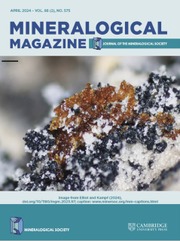
The new mineral barronite (IMA 2024-053), (□1.5Ba0.5)2(UO2)2Si5O12(OH)·2H2O, was found in the material from the Menzenschwand uranium deposit, Black Forest Mts., Germany, where it occurs as globular/acicular aggregates, consisting of long-prismatic crystals, up to 0.3 mm in length, in baryte and quartz-based gangue. Barronite is not associated with any other supergene minerals. Crystals are pale yellow with a colourless to pale yellow streak. Nevertheless, some of the crystals have a brown-orange tint, caused by Fe–Si-gels. The tenacity is brittle, the Mohs hardness is 1–2. The mineral has distinct cleavage on {100}; the fracture is uneven. Barronite is biaxial (+), with α = 1.599(2), β = 1.607(2), γ = 1.617(3); and 2V (meas.) = 86°. Optical orientation is X = b, Y ˄ a ≈ 3° in the obtuse angle β. Dispersion is distinct r>v. Pleochroism is distinct in hues of pale yellow, X<Y<Z. Electron microprobe analyses provided (based on 19 O atoms) (□1.369Ba0.345K0.165Ca0.086Pb0.024Fe0.011)Σ2.000(U0.996O2)2Si4.989O12(OH)·2H2O. Barronite is monoclinic, C2/m, a = 14.2115(11) Å, b = 14.0169(19) Å, c = 9.6545(8) Å, β = 111.59(6)°, with V = 1788.2(8) Å3 (Z = 4), refined from the corrected 3D ED data at 94K. The crystal structure refinement (R1 = 0.0791 for 6596 [I > 3σ(I)] reflections) refined from the 3D ED data confirmed that barronite has the same structural architecture as weeksite; however, it contains less H2O in the channels of the uranyl-silicate framework structure.
Keywords
Information
- Type
- Article
- Information
- Copyright
- © The Author(s), 2025. Published by Cambridge University Press on behalf of The Mineralogical Society of the United Kingdom and Ireland.
Footnotes
Associate Editor: Daniel Atencio
We dedicate this paper to the memory of Prof. Kurt Walenta (1927–2021), who was born in Prague (CZ) and later on made a significant contribution to the mineralogy of uranium.
References
Bartlett, J.R. and Cooney, R.P. (1989) On the determination of uranium-oxygen bond lengths in dioxouranium(VI) compounds by Raman spectroscopy. Journal of Molecular Structure, 193, 295–300.Google Scholar
Blatov, V.A., Shevchenko, A.P. and Proserpio, D.M. (2014) Applied topological analysis of crystal structures with the program package ToposPro. Crystal Growth & Design, 14, 3576–3586.Google Scholar
Brázda, P., Klementová, M., Krysiak, Y. and Palatinus, L. (2022) Accurate lattice parameters from 3D electron diffraction data. I. Optical distortions. International Union of Crystallography Journal, 9, 1–21.Google Scholar
Brown, I.D. (2002) The Chemical Bond in Inorganic Chemistry: The Bond Valence Model. Oxford University Press, UK, 1–278.Google Scholar
Burnham, C.W. (1962) Lattice constant refinement. Carnegie Institute Washington Yearbook, 61, 132–135.Google Scholar
Burns, P.C. (1998) The structure of boltwoodite and implications of solid solution toward sodium boltwoodite. The Canadian Mineralogist, 36, 1069–1075.Google Scholar
Colmenero, F., Plášil, J. and Sejkora, J. (2019) The layered uranyl silicate mineral uranophane-β: Crystal structure, mechanical properties, Raman spectrum and comparison with the α-polymorph. Dalton Transactions, 48, 167220–16736.Google Scholar
Čejka, J. (1999). Infrared spectroscopy and thermal analysis of the uranyl minerals. Reviews in Mineralogy and Geochemistry, 38, 521–622.Google Scholar
Demartin, F., Gramaccioli, C. M. and Pilati, T. (1992) The importance of accurate crystal structure determination of uranium minerals. II. Soddyite (UO2)2(SiO4)·2H2O. Acta Crystallographica, C48, 1–4.Google Scholar
Ewing, R.C. (2015) Long-term storage of spent nuclear fuel. Nature Materials, 14, 252–257.Google Scholar
Fejfarová, K., Plášil, J., Yang, H., Čejka, J., Dušek, M., Downs, R.T., Barkley, M.C. and Škoda, R. (2012) Revision of the crystal structure and chemical formula of weeksite, K2(UO2)2(Si5O13)·4H2O. American Mineralogist, 97, 750–754.Google Scholar
Fejfarová, K., Dušek, M., Plášil, J., Čejka, J., Sejkora, J. and Škoda, R. (2013) Reinvestigation of the crystal structure of kasolite, Pb[(UO2)(SiO4)](H2O), an important alteration product of uraninite, UO2+x. Journal of Nuclear Materials, 434, 461–467.Google Scholar
Frost, R.L., Čejka, J., Weier, M.L., Martens, W. and Kloprogge, J.T. (2006) A Raman and infrared spectroscopic study of the uranyl silicates-weeksite, soddyite and haiweeite. Spectrochimica Acta A, 64, 308–315.Google Scholar
Gagné, O. and Hawthorne, F.C. (2015) Comprehensive derivation of bond-valence parameters for ion pairs involving oxygen. Acta Crystallographica, B71, 562–578.Google Scholar
Gaubert, P. (1904) Produits deshydration de quelque phosphates et orientation du chlorure de baryum sur les mineraux des groups de l’autunite. Bulletin de la Société Française de Minéralogie, 27, 212–216.Google Scholar
Gemmi, M. and Lanza, A.E. (2019) 3D electron diffraction techniques. Acta Crystallographica, B75, 495–504.Google Scholar
Gemmi, M., Mugnaioli, E., Gorelik, T.E., Kolb, U., Palatinus, L., Boullay, P., Hovmöller, S. and Abrahams, J.P. (2019) 3D electron diffraction: The nanocrystallography revolution. ACS Central Science, 5, 1315–1329.Google Scholar
Ginderow, D. (1988) Structure de l´uranophane alpha, Ca(UO2)2(SiO3OH)2·5H2O. Acta Crystallographica, C44, 421–424.Google Scholar
Göb, S., Wenzel, T., Bau, M., Jacob, D.E., Loges, A. and Markl, G. (2011) The redistribution of rare-earth elements in secondary minerals of hydrothermal veins, Schwarzwald, southwestern Germany. The Canadian Mineralogist, 49, 1305–1333.Google Scholar
Hawthorne, F.C. and O.C, Gagné. (2024) New ion radii for oxides and oxysalts, fluorides, chlorides and nitrides. Acta Crystallographica, B80, 326–339.Google Scholar
Hofmann, B. and Eikenberg, J. (1991) The Krunkelbach Uranium deposit, Schwarzwald, Germany: Correlation of radiometric ages (U-Pb, U-Xe-Kr, K-Ar, 230Th–234U) with mineralogical stages and fluid inclusions. Economic Geology, 86, 1031–1049.Google Scholar
Jackson, J. M. and Burns, P. C. (2001) A re-evaluation of the structure of weeksite, a uranyl silicate framework mineral. The Canadian Mineralogist, 39, 187–195.Google Scholar
Khouchen, M., Klar, P.B., Chintakindi, H., Suresh, A. and Palatinus, L. (2023) Optimal estimated standard uncertainties of reflection intensities for kinematical refinement from 3D electron diffraction data. Acta Crystallographica, A79, 427–439.Google Scholar
Kraus, W. and Nolze, G. (1996) POWDER CELL – a program for the representation and manipulation of crystal structures and calculation of the resulting X-ray powder patterns. Journal of Applied Crystallography, 29, 301–303.Google Scholar
Krivovichev, S.V. (2012) Topological complexity of crystal structures: quantitative approach. Acta Crystallographica, A68, 393–398.Google Scholar
Krivovichev, S.V. (2013) Structural complexity of minerals: information storage and processing in the mineral world. Mineralogical Magazine, 77, 275–326.Google Scholar
Krivovichev, S.V. (2014) Which inorganic structures are the most complex? Angewandte Chemistry, International Edition, 53, 654–661.Google Scholar
Krivovichev, S.V. (2016) Structural complexity and configurational entropy of crystals. Acta Crystallographica, B72: 274–276.Google Scholar
Krivovichev, S.V. (2017) Hydrogen bonding and structural complexity of the Cu3(AsO4)(OH)3 polymorphs (clinoclase, gilmarite): a theoretical study. Journal of Geosciences, 62, 79–85.Google Scholar
Kubatko, K.A. and Burns, P.C. (2006) A novel arrangement of silicate tetrahedra in the uranyl silicate sheet of oursinite, (Co0.8Mg0.2)[(UO2)(SiO3OH)]2(H2O)6. American Mineralogist, 91, 333–336.Google Scholar
Libowitzky, E. (1999) Correlation of O-H stretching frequencies and O-H···O hydrogen bond lengths in minerals. Monatshefte für Chemie, 130, 1047–1059.Google Scholar
Lussier, A.J., Lopez, R.A. and Burns, P.C. (2016) A revised and expanded structure hierarchy of natural and synthetic hexavalent uranium compounds. The Canadian Mineralogist, 54, 177–283.Google Scholar
Markl, G. and Wolfsried, S. (2011) Das Uran von Menzenschwand. Chr. Weise Verlag, Munich, 143 pp.Google Scholar
Merlet, C. (1994) An accurate computer correction program for quantitative electron probe microanalysis. Microchimica Acta, 114/115, 363–376.Google Scholar
Nazarchuk, E.V., Tagirova, Y.G., Siidra, O., Charkin, D.O., Dmitriev, D.N., Kalmykov, S.N., Kasatkin, A.V. and Plášil, J. (2025) Polythermal studies of weeksite, a microporous uranyl silicate, and its synthetic analogues. Mineralogical Magazine, https://doi.org/10.1180/mgm.2025.10149Google Scholar
Ondruš, P. (1993) A computer program for analysis of X-ray powder diffraction patterns. Materials Science Forum, EPDIC-2, Enchede, 133–136, 297–300.Google Scholar
Palatinus, L. (2013) The charge-flipping algorithm in crystallography. Acta Crystallographica, B69, 1–16.Google Scholar
Palatinus, L. and Chapuis, G. (2007) SUPERFLIP—a computer program for the solution of crystal structures by charge flipping in arbitrary dimensions. Journal of Applied Crystallography, 40, 786–790.Google Scholar
Palatinus, L., Corrêa, C.A., Steciuk, G., Jacob, D., Roussel, P., Boullay, P., Klementová, M., Gemmi, M., Kopeček, J., Domeneghetti, M.C., Cámara, F. and Petříček, V. (2015a) Structure refinement using precession electron diffraction tomography and dynamical diffraction: tests on experimental data. Acta Crystallographica, B71, 740–751.Google Scholar
Palatinus, L., Petříček, V. and Correâ, C.A. (2015b) Structure refinement using precession electron diffraction tomography and dynamical diffraction: Theory and implementation. Acta Crystallographica, A71, 235–244.Google Scholar
Palatinus, L., Brázda, P., Jelínek, M., Hrdá, J., Steciuk, G. and Klementová, M. (2019) Specifics of the data processing of precession electron diffraction tomography data and their implementation in the program PETS2.0. Acta Crystallographica, B75, 512–522.Google Scholar
Petříček, V., Dušek, M. and Plášil, J. (2016) Crystallographic computing system Jana2006: Solution and refinement of twinned structures. Zeitschrift für Kristallographie, 231, 583–599.Google Scholar
Petříček, V., Palatinus, L., Plášil, J. and Dušek, M. (2023) Jana2020 - a new version of the crystallographic computing system Jana. Zeitschrift für Kristallographie, 238, 271–282.Google Scholar
Pfaff, K., Romer, R.L. and Markl, G. (2009) U-Pb ages of ferberite, chalcedony, agate, ‘U-mica’ and pitchblende: constraints on the mineralization history of the Schwarzwald ore district. European Journal of Mineralogy, 21, 817–836.Google Scholar
Plášil, J. (2014) Oxidation–hydration weathering of uraninite: the current state-of-knowledge. Journal of Geosciences, 59, 99–114.Google Scholar
Plášil, J., Fejfarová, K., Čejka, J., Dušek, M., Škoda, R. and Sejkora, J. (2013) Revision of the crystal structure and chemical formula of haiweeite, Ca(UO2)2(Si5O12)(OH)2·6H2O. American Mineralogist, 98, 718–723.Google Scholar
Plášil, J., Petříček, V., Locock, A.J., Škoda, R. and Burns, P.C. (2018) The (3+3) commensurately modulated structure of the uranyl silicate mineral swamboite-(Nd), Nd0.333[(UO2)(SiO3OH)](H2O)2.41. Zeitschrift für Kristallographie, 233, 223–231.Google Scholar
Plášil, J., Steciuk, G., Sejkora, J., Kampf, A.R., Uher, P., Ondrejka, M., Škoda, R., Dolníček, Z., Philippo, S., Guennou, M., Meisser, N., Rohlíček, J. and Mees, F. (2025) Extending the mineralogy of U6+ (I): Crystal structure of lepersonnite-(Gd) and a description of the new mineral lepersonnite-(Nd). Mineralogical Magazine, https://doi.org/10.1180/mgm.2025.29Google Scholar
Rosenzweig, A. and Ryan, R.R. (1975) Refinement of the crystal structure of cuprosklodowskite Cu[(UO2)2(SiO3OH)2]·6H2O. American Mineralogist, 60, 448–453.Google Scholar
Ryan, R.R. and Rosenzweig, A. (1977) Sklodowskite, MgO·2UO3·2SiO2·7H2O. Crystal Structure Communications, 6, 611–615.Google Scholar
Siidra, O., Zenko, D.S. and Krivovichev, S.V. (2014) Structural complexity of lead silicates: crystal structure of Pb21[Si7O22]2[Si4O13] and its comparison to hyttsjöite. American Mineralogist, 99, 817–823.Google Scholar
Steciuk, G., Škoda, R., Dillingerová, V. and Plášil, J. (2022) Chemical variability in vyacheslavite, U (PO4)(OH): Crystal-chemical implications for hydrous and hydroxylated U4+, Ca, and REE phosphates. American Mineralogist, 107, 131–137.Google Scholar
Vincent, R. and Midgley, P.A. (1994) Double conical beam-rocking system for measurement of integrated electron diffraction intensities. Ultramicroscopy, 53, 271–282.Google Scholar
Viswanathan, K. and Harneit, O. (1986) Refined crystal structure of β-uranophane Ca(UO2)2(SiO3OH)2.5H2O. American Mineralogist, 71, 1489–1493.Google Scholar
Walenta, K. (1976) Widenmannit und Joliotit, zwei neue Uranylkarbonatmineralien aus dem Schwarzwald. Schweizerische Mineralogische und Petrographische Mitteilungen, 56, 167–185.Google Scholar
Walenta, K. (1978) Uranospathite and arsenuranospathite. Mineralogical Magazine, 42, 117–128.Google Scholar
Walenta, K. (1983) Uranosilite, ein neues Mineral aus der Uranlagerstätte von Menzenschwand im südlichen Schwarzwald. Neues Jahrbuch für Mineralogie, Monatshefte, 1983, 259–269.Google Scholar
Walenta, K. (1985) Uranotungstit, ein neues sekundäres Uranmineral aus dem Schwarzwald. Tschermaks Mineralogische und Petrographische Mitteilungen, 34, 25–34.Google Scholar
Walenta, K. and Theye, T. (2007) Arsenovanmeersscheit, ein neues Uranmineral von der Uranlagerstätte Menzenschwand im südlichen Schwarzwald. Aufschluss, 58, 159–164.Google Scholar
Walenta, K. and Theye, T. (2012) Heisenbergite, a new uranium mineral from the uranium deposit of Menzenschwand in the Southern Black Forest, Germany. Neues Jahrbuch für Mineralogie - Abhandlungen, 189, 117–123.Google Scholar
Walenta, K., Hatert, F., Theye, T., Lissner, F. and Roeller, K. (2009) Nielsbohrite, a new potassium uranyl arsenate from the uranium deposit of Menzenschwand in the Southern Black Forest, Germany. European Journal of Mineralogy, 21, 515–520.Google Scholar
Wright, F.E. (1951) Computation of the optic axial angle from the three principal refractive indices. American Mineralogist, 36, 543–556.Google Scholar

Plášil et al. supplementary material
Plášil et al. supplementary material

File
73.7 KB