


Autism spectrum disorder (ASD) is a neurodevelopmental condition characterised by social-communication deficits and by restricted and repetitive behaviours.1 Since ASD is biologically based and centres around social and sociocognitive deficits, recent research explored the possibility that oxytocin - a neuropeptide hormone implicated in mammalian bond formation that plays an important role in human social relatedness, empathy and social understanding - may be dysfunctional in ASD. Several large-scale studies demonstrated genetic vulnerability on the oxytocin receptor gene (OXTR) in ASD,Reference Lerer, Levi, Salomon, Darvasi, Yirmiya and Ebstein2-Reference Wu, Jia, Ruan, Liu, Guo and Shuang4 underscoring the oxytocinergic system as a potential candidate in the pathophysiology of autism. Furthermore, intranasal administration of oxytocin improved social functioning in adolescents and adults with ASD and, in some cases, normalised aberrant brain patterns and social-behavioural expressions associated with the disorder, albeit for brief periods only.Reference Andari, Duhamel, Zalla, Herbrecht, Leboyer and Sirigu5-Reference Gordon, Vander Wyk, Bennett, Cordeaux, Lucas and Eilbott8 Research has also shown lower peripheral oxytocin in ASD.Reference Green, Fein, Modahl, Feinstein, Waterhouse and Morris9 These findings suggest that disruptions to the oxytocin system may underpin some of the social difficulties in autism and that elevating oxytocin levels exogenously may remedy some of the disorder’s maladaptive manifestations. Importantly, however, no study to date has tested the functioning of the oxytocin system in pre-schoolers with ASD, a stage when children enter the social world and acquire new skills, and when brain plasticity enables rapid maturation of networks implicated in social skill acquisition, emotion regulation and sociocognitive understanding.
Findings linking the same allelic variations on OXTR implicated in autism with normative parenting and, specifically, with decreased parent-infant gaze synchrony - which is disrupted in individuals with ASD and in infants who later develop autismReference Feldman, Zagoory-Sharon, Maoz, Weisman, Gordon and Schneiderman10,Reference Yirmiya, Gamliel, Pilowsky, Feldman, Baron-Cohen and Sigman11 - suggest that autism may be on a continuum with infant social difficulties. Such data also indicate that the parenting context may be an important setting to test the associations between oxytocin and ASD in early childhood. Studies of parent-child interactions in young children with ASD show that such children form close attachments with their parents, and parents exhibit the same levels of sensitive caregiving as those of typically developing children.Reference Oppenheim, Koren-Karie, Dolev and Yirmia12 Studies in both rodentsReference Ross and Young13,Reference Meaney14 and humansReference Feldman, Gordon, Shneiderman, Weisman and Zagoory-Sharon15,Reference Feldman, Gordon and Zagoory-Sharon16 show that oxytocin increases following social contact between parents and young, supporting the conclusion that even if baseline oxytocin levels are dysfunctional in ASD, they may be enhanced by parent-child social contact. Consistent with this hypothesis is research demonstrating biobehavioural synchrony of oxytocin and social reciprocity in the context of parent-child interactions. Oxytocin administration to the parent followed by parent-child interaction was found to increase the child’s salivary oxytocin levels, suggesting that positive and reciprocal interactions with the parent enhance the child’s oxytocin production.Reference Weisman, Zagoory-Sharon and Feldman17 Importantly, studies demonstrated similar increases in peripheral oxytocin following mother-child and father-child sessions.Reference Feldman, Gordon, Shneiderman, Weisman and Zagoory-Sharon15,Reference Feldman, Gordon and Zagoory-Sharon16 These data indicate that synchronous interaction with either parent elicits the child’s oxytocin response.
As such, the current study sought to answer three questions: (a) is there evidence for dysfunction of peripheral oxytocin in pre-schoolers with ASD; (b) can parent-child contact and synchronous interaction increase oxytocin production in pre-schoolers; and (c) are there differences between the effects of maternal v. paternal social contact on children’s oxytocin response. Based on the aforementioned studiesReference Lerer, Levi, Salomon, Darvasi, Yirmiya and Ebstein2-Reference Green, Fein, Modahl, Feinstein, Waterhouse and Morris9 which show disruptions of the oxytocin system in ASD, we hypothesised that baseline oxytocin levels will be dysfunctional in children with ASD already at the pre-school stage. However, consistent with research showing increase in peripheral oxytocin following parent-child social contact,Reference Feldman, Gordon and Zagoory-Sharon16,Reference Weisman, Zagoory-Sharon and Feldman17 we hypothesised that extended periods of parent-child contact will enhance oxytocin production in children with ASD. Furthermore, since similar effects on peripheral oxytocin were observed following mother-child and father-child interactions,Reference Feldman, Gordon and Zagoory-Sharon16 we expected that contact with both parents will enhance the child’s oxytocin levels. Finally, since oxytocin was found to be associated with the degree of parent-child synchrony,Reference Feldman, Gordon and Zagoory-Sharon16,Reference Weisman, Zagoory-Sharon and Feldman17 oxytocin levels were expected to correlate with measures of parent-child interactive synchrony, particularly in the gaze and touch modalities.
Method
Participants
Eighty families including mothers, fathers, and their pre-school-aged child participated in two groups. The ASD group included 40 pre-schoolers diagnosed with ASD by trained clinicians according to established criteria1 and their parents. Families were recruited from psychiatric clinics and special kindergartens in central Israel. Diagnosis was confirmed using the second edition of the Autism Diagnostic Observation Schedule (ADOS-2),Reference Gotham, Risi, Pickles and Lord18 with 56% of the children given module 2 of the ADOS-2 and 44% module 3. One child failed to meet ASD criteria on the ADOS-2 and was excluded from the study. The typical development (TD) group included 40 pre-schoolers with no known neuro-developmental or psychiatric diagnoses, and their parents. These were matched to the ASD group on mental age, gender and family demographics. Children in the TD group were screened for ASD using the Childhood Autism Spectrum Test (CAST).Reference Scott, Baron-Cohen, Bloton and Brayne19
All children were raised in two-parent families, both parents had completed high school, and the family was above the poverty cut-off. In total, 45% of the children were firstborn and 86% were males. To provide matching between groups on mental age, the TD group were slightly younger than the ASD group, and groups were matched on Stanford-Binnet Intelligence ScalesReference Thorndike, Hagen and Sattler20 raw scores (Table 1).
Table 1 Demographic information of parents and children in the ASD and TD groups

| Total sample Mean (s.d.) | ASD group Mean (s.d.) | TD group Mean (s.d.) | t(77) | |
|---|---|---|---|---|
| Child measures | ||||
| Age, months | 58.47 (13.93) | 63.38 (12.35) | 53.56 (13.83) | 3.31Footnote * |
| Stanford-Binnet Intelligence Scales | ||||
| Verbal reasoning | 14.83 (5.13) | 14.15 (4.08) | 15.51 (5.98) | 1.17 |
| Abstract/visual reasoning | 13.36 (10.27) | 12.67 (6.66) | 14.05 (12.98) | 0.59 |
| Quantitative reasoning | 11.35 (7.27) | 11.15 (5.59) | 11.54 (8.7) | 0.23 |
| Short-term memory | 12.49 (6.26) | 13.18 (4.86) | 11.79 (7.58) | 0.96 |
| ADOS-2 | 11.89 (3.23) | N/A | ||
| Parent measures | ||||
| Mother’s age, years | 36.88 (4.45) | 37.6 (4.45) | 36.14 (4.39) | 1.37 |
| Father’s age, years | 39.49 (5.14) | 40.34 (5.33) | 38.6 (4.86) | 1.12 |
| Mother’s education, years | 16.26 (2.38) | 15.94 (2.47) | 16.59 (2.28) | 1.42 |
| Father’s education, years | 16.39 (3.34) | 15.97 (3.71) | 16.87 (2.85) | 1.11 |
ASD, autism spectrum disorder; TD typical development; ADOS, Autism Diagnostic Observation Schedule; N/A, not applicable.
* P<0.05.
Procedure
Children were seen three times: once in kindergarten and twice at home.
Diagnostic and cognitive assessment
All children were visited in kindergarten for cognitive assessment using four domains of the Stanford-Binnet Intelligence Scales:Reference Thorndike, Hagen and Sattler20 verbal reasoning, abstract/visual reasoning, quantitative reasoning and short-term memory. In addition, children with ASD were administered the ADOS-2 by a trained psychologist.
Home visits
Two identical home visits were conducted - once with the mother and once with the father - within the same month, with each visit lasting approximately 2 h. Each visit included collection of four salivary samples from the parent and child and a 45-minute battery of parent-child contact developed at our lab (details available from the authors on request). The battery included 20 min of parent-child play in several tasks (free play, still-face, reunion, pick-up) and 25 min of child emotion regulation paradigms with the parent (regulation of negative emotions: ‘toy removal’ and ‘masks’ paradigms; joyous joint play: ‘puppets’ and ‘bubbles’ paradigms; and a delayed gratification paradigm).
Oxytocin collection and determination
Four saliva samples from each parent and child were collected during the home visit at the following time points: T 1 (baseline) - approximately 10 min after home arrival to enable some acquaintance with the child; T 2 (following parent-child interactions) - 20 min after T 1 at the end of the parent-child interaction part of the battery; T 3 (following parent-child contact) - 45 min after T 1 at the end of the entire parent-child contact period; and T 4 (recovery) - 15 min after T 3 to test the oxytocin system’s return to baseline.
Saliva samples were collected by Sallivatte (Sarstedt, Rommelsdorft, Germany). Salivettes were immediately stored at –20°C to be centrifuged twice at 4°C at 1500 × g for 15 min within 1 month. All samples were then stored at –80°C until further processed and then transferred to –20°C. Studies have shown that salivary oxytocin measured by immunoassay is a reliable biomarker, stable over time and correlates with oxytocin-related processes such as breastfeeding. Salivary oxytocin was also found to be associated with plasma oxytocin, genetic variability on OXTR, and to show a marked increase following intranasal oxytocin administration, suggesting coordination between central and peripheral activity on the oxytocin neuropathway that is reflected in salivary oxytocin.Reference Gordon, Vander Wyk, Bennett, Cordeaux, Lucas and Eilbott8,Reference Feldman, Gordon, Shneiderman, Weisman and Zagoory-Sharon15,Reference Feldman, Gordon, Influs, Gutbir and Ebstein21-Reference White-Traut, Watanabe, Pournajafi-Nazarloo, Schwertz, Bell and Carter24 The following procedure was used, consistent with ours and others’ research. First, all samples were concentrated by four (lyophilised) and then measured using a commercial ELISA (enzyme-linked immunosorbent assay) kit (Assay Design, Michigan, USA). Measurements were performed in duplicate and the concentrations of samples were calculated using MATLAB 7 for Windows according to relevant standard curves. The intra-assay coefficient of variability is less than 15.4%.
Parent-child synchrony
The first parent-child interactive episode included a 7-minute free play with age-appropriate simple toys. Consistent with prior research,Reference Feldman25 the behaviour of each parent-child pair was micro-coded on a computerised program (Noldus, Waggenigen, The Netherlands) in 0.01-second frames for several categories of non-verbal behaviour, including gaze, affect, vocalisation, proximity and touch, and each category included a set of mutually exclusive codes. The following categories were used: gaze - to partner, to object, joint attention, gaze aversion; affect - positive, neutral, negative-angry, negative-withdrawn; and touch - affectionate (e.g. hug, kiss, caress), functional-instrumental, stimulatory, aggressive, no touch.
Coding was conducted by two psychology students, who received extensive training in using the microcoding system and who were masked to all other information. Interrater reliability was computed on 15 interactions (19%) and exceeded 85% on all codes. Reliability was kappa = 0.85 (range 0.81-0.92).
Synchrony was computed as conditional probabilities (i.e. parent in behaviour X given child in behaviour Y) within a 1-second time window. The following synchrony variables were used: gaze synchrony - parent and child engage in simultaneous social gaze (parent looks at child, child looks at parent); joint attention - parent and child attend to the same toy; affect synchrony - parent and child simultaneously express positive affect; and touch synchrony - parent provides affectionate touch while parent and child look at each other. The frequencies of each variable were computed.
Statistical analysis
We first compared baseline oxytocin in the typically developing children and those with ASD during each home visit using t-tests. Then, a repeated-measure ANOVA examined time, parent and group effects in oxytocin production. Univariate tests followed significant effects. MANOVAs examined group differences in the four parent-child synchrony variables - gaze synchrony, joint attention, affect synchrony and touch synchrony - during each session, followed by univariate tests. Finally, Pearson’s correlations examined correlations between oxytocin and measures of parent-child synchrony for each group separately.
Results
Oxytocin during social contact in the ASD and TD groups and their parents
Prior to analysis, we tested whether oxytocin is related to child gender or age in months. No associations were found between age or gender and any of the eight oxytocin assessments (four with each parent) and these variables were not included in the following analyses.
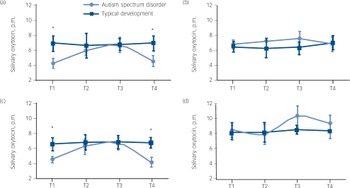
Baseline oxytocin levels of mothers and fathers did not differ between parents of typically developing children and those with ASD (t (77) = 0.34 and 0.51 for mothers and fathers respectively, not significant (ns)). On the other hand, children with ASD showed lower baseline oxytocin compared with the TD group and these lower levels were found during sessions with both mother (t (77) = 2.48, P>0.05) and father (t (77) = 2.27, P<0.05) (Fig. 1(a) and (c)). These findings provide test-retest support to our central hypothesis - that the oxytocin system is already dysfunctional in ASD in early childhood. Baseline levels of oxytocin were individually stable between mother-child and father-child sessions in both the TD (r = 0.47, P<0.01) and ASD group (r = 0.51, P<0.001). The two assessments were averaged into a single baseline measure, which, as expected, was lower in children with ASD compared with the TD group (t (77) = 2.53, P<0.05).

Fig. 1 Oxytocin levels in mothers, fathers, and children during mother-child and father-child interactions in the autism spectrum disorder (ASD) and typical development (TD) groups; (a) child with mother; (b) mother; (c) child with father; (d) father.
Oxytocin samples were assessed at: T 1 (baseline), 10 min after home arrival; T 2, 20 min after parent-child contact; T 3, 45 min after parent-child contact; and T 4 (recovery), 15 min after termination of parent-child contact. *P<0.05.
To assess the effects of time (change in oxytocin across assessments), parent (mother, father) and group (ASD, TD) on oxytocin production, a repeated-measure ANOVA was computed, with child oxytocin and parent as within-subject factors and group as between-subject factor. Results showed a main effect for time (F (d.f. = 6, 70) = 3.77, P = 0.011, effect size (ES) = 0.098), no effect for parent, and a main effect for group (F (d.f. = 2, 74) = 3.31, P = 0.035, ES = 0.079). These results indicate that oxytocin levels changed over time and that there were group differences in oxytocin. A time × group interaction effect was found (F (d.f. = 6, 70) = 3.42, P = 0.029, ES = 0.088), indicating that the change in oxytocin over time depended on group membership. Post-hoc analyses for child-mother interactions (Fig. 1(a)) showed that the aforementioned lower levels of oxytocin at baseline in the ASD group significantly increased following the initiation of social contact, and differences between TD and ASD groups were no longer found at both T 2 (20 min of contact) (F (1, 77) = 0.76, ns) and T 3 (45 min of contact) (Fig. 1(a)) (F (1,77) = 0.59, ns). However, the enhanced oxytocin levels declined at recovery and significant group differences were found again at T 4 (F (1, 77) = 3.82, P<0.05). Similar post-hoc analyses for child-father interaction showed the same pattern. After significantly lower levels of oxytocin at baseline among the ASD group, oxytocin levels increased and no differences were found at T 2 (F (1, 77) = 0.94, ns) and T 3 (F (1, 77) = 0.28, ns). However, oxytocin levels in the ASD group showed a significant decline after contact ended and group differences emerged again at T 4 (F (1, 77) = 4.02, P<0.05 (Fig. 1(c)). These findings demonstrate that during extended periods of contact with the mother or father, lower baseline oxytocin levels in children with ASD increase and reach normative levels, but that the effect lasts only as long as contact is maintained, and oxytocin returns to baseline 15 min after the termination of contact. Importantly, for typically developing children, change between one oxytocin assessment and the next did not exceed 10%.
Social synchrony in the ASD and TD groups during interactions with mother and father
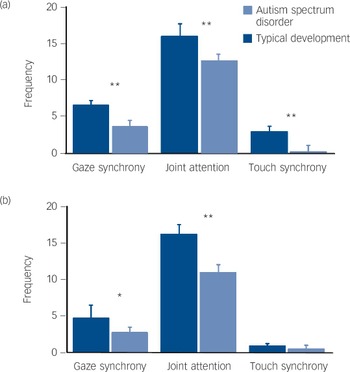
Two MANOVAs examined group difference in the four synchrony variables (gaze synchrony, affect synchrony, joint attention, touch synchrony) for child-mother and child-father interactions. An overall effect for group was found for both child-mother interactions (F (d.f. = 4, 74) = 4.26, P<0.01, ES = 0.12) and child-father interactions (F (d.f. = 4, 74) = 5.47, P<0.001, ES = 0.28). Univariate tests indicated that the TD group engaged in more frequent episodes of social gaze synchrony during interactions with both mother (F (d.f. = 1, 76) = 4.76, P<0.05) and father (F (d.f. = 1, 76) = 3.97, P<0.05). No differences were found in affect synchrony. However, the overall expression of positive affect was lower in the ASD group with both mother (F (d.f. = 1, 76) = 3.87, P<0.05) and father (F (d.f. = 1, 76) = 3.92, P<0.05). Children with ASD engaged less frequently in joint attention episodes with their mother (F (d.f. = 1, 76) = 4.02, P<0.05) and father (F (d.f. = 1, 76) = 4.87, P<0.05), and touch synchrony occurred less frequently between children with ASD and their mother (F (d.f. = 1, 74) = 6.55, P<0.01) and father (F (d.f. = 1, 76) = 4.22, P<0.05) (Fig. 2).

Fig. 2 Frequencies of parent-child gaze synchrony, joint attention and touch synchrony during interactions with the mother and father in the autism spectrum disorder (ASD) and typical development (TD) groups; (a) child with mother; (b) child with father.
*P<0.05, **P<0.01.
Child oxytocin and social behaviour
Medium-to-high correlations (r = 0.47-0.91) were found between the four oxytocin assessments for each child and the four oxytocin assessments in each session were combined into two global oxytocin scores, one for mother-child sessions and one for father-child sessions. To test whether the biobehavioural synchrony model applies to both TD and ASD groups, we examined correlations between the four synchrony variables and child oxytocin for each group separately. Results of the Pearson’s correlations are shown in Table 2.
Table 2 Correlations between child oxytocin and measures of social synchrony

| Child oxytocin with mother | Child oxytocin with father | |
|---|---|---|
| Gaze synchrony - TD | 0.33Footnote * | 0.19 |
| Gaze synchrony - ASD | 0.38Footnote * | 0.30Footnote * |
| Join attention - TD | 0.18 | 0.29Footnote * |
| Joint attention - ASD | 0.21 | 0.39 |
| Affect synchrony - TD | 0.07 | 0.09 |
| Affect synchrony - ASD | 0.12 | 0.15 |
| Touch synchrony - TD | 0.29Footnote * | 0.14 |
| Touch synchrony - ASD | 0.41Footnote ** | 0.17 |
TD, typically developing pre-schoolers; ASD, pre-schoolers diagnosed with autism spectrum disorder.
* P<0.05
** P<0.01.
As seen, the amount of social gaze synchrony with the mother correlated with child oxytocin in both groups and with the father in the ASD group only. Mother-child touch synchrony correlated with child oxytocin in both groups, and father-child joint attention similarly correlated with oxytocin in both groups. Overall, the magnitude of the correlations was similar in the two groups and differences in the magnitude of correlations were not significant as indicated by Fisher Z tests.
Finally, we measured the associations between oxytocin reactivity (change from baseline to T 2) and recovery (change from T 3 to T 4) and measures of social synchrony in the ASD group for each session. Correlations were found between mother-child gaze synchrony and the increase in oxytocin (oxytocin reactivity) (r = 0.29, P<0.05).
Discussion
Two important findings emerge from the current study: the first demonstrates dysfunction of the oxytocin system in ASD at an earlier age than previously shown; the other points in the direction of potential intervention. Regarding oxytocin dysfunction, our findings are the first to show that the oxytocin system already functions at a non-optimal level in ASD in early childhood, at the first period after the diagnosis has been made. It has been previously shown that peripheral oxytocin is remarkably stable in humans across a period of several years.Reference Feldman, Gordon, Influs, Gutbir and Ebstein21 It is thus possible that infants who are later diagnosed with ASD already exhibit a dysfunctional oxytocin response in early infancy. If validated, such abnormal oxytocin response may serve as an early biomarker in the context of genetic risk for ASD, but further longitudinal research is required to chart the development of the oxytocinergic system in ASD across childhood and adolescence. Associations between risk on the oxytocin system and ASD as well as the beneficial use of oxytocin administration in this population have been establishedReference Lerer, Levi, Salomon, Darvasi, Yirmiya and Ebstein2-Reference Green, Fein, Modahl, Feinstein, Waterhouse and Morris9 and the current data add the angle of risk measured in the periphery and extend the findings into early childhood. In combination, these studies highlight the involvement of the neurobiological system underlying human attachment, social reciprocity and empathy in the neurodevelopmental disorder of autism. Oxytocin underpins the capacity for social collaboration in mammals and this capacity builds on species-specific subtle cues that usher young members into social participation.Reference Ross and Young13,Reference Meaney14,Reference Feldman26 Among the core deficits in ASD is the inability to adequately use non-verbal social cues, for instance maintaining gaze synchrony with social partners. In mammals, rules of social conduct are learned within the parent-infant bond, and the specific hormonal and behavioural difficulties observed in children with ASD combined with the normative pattern of parental oxytocin and social behaviour may point to a link between the neurobiology of attachment and the aetiology of autism. Possibly, in such children the oxytocin system is unable to internalise the parents’ biobehavioural provisions into a self-regulated autonomic function that can operate without the parental concrete external regulatory support.
Second, the data demonstrate that during moments of social contact with the attachment figure, the low levels of oxytocin observed in ASD rapidly increase to normative levels and remain high as long as contact is maintained. Findings from several laboratories have shown that exogenous oxytocin administration increase levels of salivary oxytocin production within 10-15 min.Reference Gordon, Vander Wyk, Bennett, Cordeaux, Lucas and Eilbott8,Reference Weisman, Zagoory-Sharon and Feldman22,Reference Van Ijzendoorn, Bhandari, van der Veen, Grewen and Bakermans-Kranenburg23 Intriguingly, the current findings show that in children with ASD, parent-child contact has the same effect as external oxytocin administration, increasing oxytocin levels within the first 20 min of contact through touch, physical proximity and social gaze coordination - non-verbal modalities previously associated with oxytocin increase in humans and other mammals.Reference Ross and Young13-Reference Feldman, Gordon, Shneiderman, Weisman and Zagoory-Sharon15 Within the framework of the biobehavioural synchrony model, we suggest that episodes of social contact afford unique opportunities for the real-time coordination of biological and behavioural processes between two individuals within an attachment relationship, moments when one partner can affect the physiology of the other through synchrony of visual affective social cues, and have demonstrated such synchronous processes in hormonal, autonomic and brain systems.Reference Feldman26 These ‘external regulatory’ functions of the parents’ mature physiological systems on stabilising the child’s immature systems is observed in all mammals,Reference Hofer, Golberg, Muir and Kerr27 and it is possible that part of the neurodevelopmental deficit in ASD is the oxytocin system’s inability to internalise the parental external regulatory support into a smooth autoregulated function.
Associations between behavioural patterns of social synchrony and oxytocin levels were of similar magnitude in the TD and ASD groups, with slightly stronger associations between biology and behaviour in the ASD group. These data point to the applicability of the biobehavioural synchrony model in cases of ASD and demonstrate the dependence of the child’s neuroendocrine systems on the parent’s sensitive responsiveness even in a disorder involving severe social and communicative dysfunction. Findings are consistent with previous research which showed comparable levels of sensitive caregiving among parents of typically developing children and those with ASD,Reference Yirmiya, Gamliel, Pilowsky, Feldman, Baron-Cohen and Sigman11,Reference Oppenheim, Koren-Karie, Dolev and Yirmia12 and extend previous research by pointing to the links between the neuroendocrine system that underpin human sociality and synchronous social interactions between parent and child in the ASD group. The correlations found between increase in oxytocin and mother-child gaze synchrony in the ASD group suggest that patterns of mutual social gaze within attachment relationships may be one mechanism by which social bonds may trigger more optimal functioning of the oxytocin system.
Our findings have salient implications for intervention in young children with ASD and underscore the age when intervention efforts should be focused. First, results highlight the malleability of the system and its openness to environmental inputs and caregivers’ investments. The fact that it is possible for the maladaptive oxytocin system of a child with ASD to reach typical levels indicates that such normalisation is within the system’s potential reach and raises the hope that in the near future pharmacological or behavioural treatments will be able to maintain these normative levels beyond the period of actual contact. Furthermore, the findings suggest that a combination of endogenous and exogenous sources of oxytocin may be fruitfully applied to these children and that applying such interventions at an early age may be most advantageous. It is possible that carefully monitored exogenous administration accompanied by specifically tailored social contact that highlights the specific components that trigger oxytocin release, such as affectionate touch and mutual gazing, will work synergistically to normalise the child’s oxytocin system beyond the moments of contact. Finally, the findings point to the importance of including fathers in future interventions for young children with ASD. Since such children have severe communicative difficulties, mothers are often drawn into the job of mediating between the child and the social world, sometimes to the exclusion of fathers. Extremely little research has been conducted on the father-child relationship in young children with ASD, with no study, to our knowledge, testing hormones and behaviour during father-child interaction. The findings that father-child contact was as effective as maternal contact in improving children’s oxytocin levels should be used to encourage fathers and support interventions that emphasise father participation and father-child contact.
Limitations
Several study limitations should be noted. First, for a fuller assessment of the oxytocin system, genetic data on OXTR should have also been collected and this should be a necessary next step. More frequent oxytocin assays could have informed whether oxytocin increased in children with ASD before 20 min of contact. This is essential for parents since most daily interactions between parents and young children are shorter than 20 min of uninterrupted contact and it is important to know how much contact is needed before the system improves in order to incorporate such moments into the parents’ daily routine. During the second half of the 45-minute social battery (between T 2 and T 3), children underwent emotion regulation paradigms, some of which elicit stress (the ‘toy removal’ and ‘masks’ paradigms) in addition to those that elicit joyful play with the parent. These stressful paradigms may have affected the child’s oxytocin levels at T 3 and T 4 and it is possible that without such stress the enhanced oxytocin response would have not declined so rapidly. In addition, a recent study showed that among pre-adolescent and adolescent girls and boys, plasma oxytocin levels did not differ between those diagnosed with ASD and controls.Reference Miller, Bales, Taylor, Yoon, Hostetler and Carter28 Although the divergent findings may relate to the difference in child age or to the pubertal transition, further research across the entire developmental spectrum is needed to fully chart the oxytocin system’s functioning in children and adolescents with ASD. The inclusion of other related hormones such as cortisol, vasopressin or hormonal indices of the reward or immune systems could have shed further light on the interaction of oxytocin with other physiological systems. Future research is required to specify the mechanisms through which contact exerts its effects. It is possible that extended moments of social contact trigger epigenetic changes or that improvement occurs via interactions between oxytocin and other related neurobiological systems (e.g. hypothalamic-pituitary-adrenal, dopamine or immune systems) or that such periods downregulate amygdala activity via oxytocin-amygdala projections. The effect of social contact with significant others, both within and outside the family, on oxytocin levels in children with ASD should be examined in order to learn whether the effects reported here are unique to parental contact and how they could be effectively translated to other social relationships. For the construction of effective interventions it is critical to learn whether contact provided by teachers, familiar adults or peers may trigger the same oxytocin response. Finally, much further research is required to integrate pharmacotherapy with concrete attachment-based therapies for parents and young children with ASD to utilise the system’s malleability during a sensitive period for social development in order to gently facilitate the child’s entry into the social world.
Funding
The study was supported by the German-Israeli Science Foundation (1114-101.4/2010), the Irving B. Harris Foundation, the US-Israeli Bi-National Science Foundation, and the Association for Children at Risk, Israel.





eLetters
No eLetters have been published for this article.