

Slang is an ideological framework for reasoning about language that defines a class of deviant registers of language. The ideology may exist with varying degrees of intensity, ubiquity, and institutionalized force within a language community. It is strengthened when a given speech variety comes increasingly to acquire the status of a baseline register, a standard in relation to which others are normatively evaluated as deviant or substandard. When a baseline standard is presumed as given, a relatively uniform set of metadiscursive criteria on norm and deviance become available as intuitions to persons exposed to standard-setting institutions. The more widely the standard is presupposed in diverse social practices, the more “natural” its metadiscursive criteria appear to language users and the more they draw attention to discourses that deviate from them.
Under these conditions, the question “What is slang?” is often treated simply as a question about the characteristics of an object discourse, typically the words and utterances denoted by the term slang. The more the object discourse rises to salient attention, the easier it is to gather a large number of slang words and attempt to study their structural properties or to investigate their use in discourse and social interaction. Such a study reveals much about the characteristics of slang repertoires, as I show below, yet we cannot answer the question “What is slang?” by taking the repertoires of an object discourse as our point of departure, both for the general reasons that I have outlined elsewhere (Agha Reference Agha1998; Reference Agha2007a, 145–89), which ensure that repertoire-centric reductionism fails for every register formation in every known language, and for others that are more specific to the case of slang, as I now show.
The incompleteness of a repertoire perspective is painfully obvious and its reasons are well known. Slang repertoires exhibit changes that cannot be explained simply by appeal to structural property of slang words. Slang is “passing language” (to use a nineteenth-century term) in more than one sense. Expressions fall into and out of current slang usage with great rapidity. Many expressions also cross repertoire boundaries over time so that expressions that began as slang contractions (e.g., English phone, bike, pub, bus) often find their way into the standard language, sometimes even replacing the terms from which they were derived (cf. bus vs. autobus). A repertoire-centric approach is therefore quite unrevealing about the nature of slang as a social formation. It is also incomplete as a method of analysis since slang expressions are not differentiable from the rest of the language without using native metapragmatic judgments of norm and deviance as data on identification. These data are not to be found in slang expressions but in discursive and other metasemiotic activities that differentiate such expressions from others and typify their social indexical values, and, once analyzed as data, clarify whether and for which groups (and in which period) some expressions have happened to count or do still count as slang expressions, thus differentiating group-centric positionalities of social evaluation.
Although the term slang describes speech repertoires, its usage indexes relationships between social groups. To say that some utterance is slang, or contains a slang expression, is to inhabit a metapragmatic stance that evaluates its speaker as deviating from a presumed standard. Such a stance may or may not correspond to social regularities of evaluation. In its least constrained usage the term slang may be employed as a term of open pejoration for virtually any form of speech simply in order to dismiss it. I am not concerned with such cases here. My concern rather is with cases where one person’s judgment that an utterance is slang is replicable in the metapragmatic judgments of other speakers. Under these conditions, any metadiscursive use of the term slang locates its speaker in an ideological framework for reasoning about register varieties where the relationship between standard and deviant object discourses defines group-centric social relationships among their speakers.
By “tropes of slang” I refer to the class of (meta)semiotic processes described below whereby speech repertoires come to be evaluated as deviant with respect to one or more presupposed standards when brought under slang formulations, including cases where underlying criteria are not readily described by the evaluators who employ them and cases where speech habits perceived as deviant by one subgroup are renormalized in the speech of others, who invest these forms with distinct indexical values. The dialectic of norm and trope (Agha Reference Agha2007a, 5–9), which I explore for the cases at hand, has nothing in particular to do with slang, of course, but is a pervasive feature of all social life insofar as it is organized by semiotic processes and, through its representative moments (the normalization of cultural models of conduct, the manipulation of models through tropic variants, the renormalization of tropes for distinct social domains of evaluators), is a ubiquitous principle of cultural variation and group differentiation, regardless of which rubric—such as deference (Agha Reference Agha2007a, 295–339), kinship (Agha Reference Agha2007a, 340–85), or brands (Agha Reference Agha2015)—these semiotic processes may be grouped under within folk taxonomies. My goal here is to attend to its role in discursive practices that are commonly thought to include samples of so-called slang.
The most obvious of such tropes is the trope of personification. If we attend to the data of metapragmatic judgments we find that expressions that are enregistered as slang repertoires are routinely described by means of words predicable of persons, including adjectives that describe characterological attributes (e.g., casual, informal, crude, cool) or modifiers that assign slang repertoires to social categories (e.g., teenage slang, doctor’s slang, military slang). Ideologies of slang typically convert slang repertoires into systems of stereotypical social indexicals whereby particular kinds of social personae are linked to—and thus can be inhabited and negotiated through the use of—slang expressions, including personae emblematic of membership in or exclusion from specific social groups. Though seemingly simple, the production of personae is a highly laminated trope and bespeaks changing relations between groups, as we shall soon see.
Therefore slang is used in this article not simply as the name of a speech variety but as a term whose usage indexes relationships between discourses and their speakers. This issue becomes especially important when we turn in the last section to discourses of a type that were once called slang but are now given entirely distinct metadiscursive and characterological formulations by their own speakers, and the mainstream term slang becomes increasingly irrelevant to grasping the social indexical effects mediated by their use.
Slang and Its Analogues
The term slang has itself meant different things in different historical periods and, given the difficulty its proponents have faced in defining it, has come to be grouped under more encompassing rubrics, such as “slang and its analogues.”Footnote 1 I use this phrase to introduce the generic phenomenon here, but my goal is to decompose its denotata into their semiotic partials and to outline the metadiscursive processes through which they become grouped under this rubric. These processes are far more interesting than the labels under which they have been aggregated and, once understood, transform questions like “What is slang?” from questions about speech repertoires to questions about (meta)discursively mediated relations among social groups.
A curious feature of the cultural construct is that in periods in which the term is in common use, and especially in the second half of the twentieth century a great many speakers were wedded to a particular picture of what slang really is and, often, to a fiercely committed judgment on its value. Since slang registers have been derided by mainstream discourses for so long, a common—and laudable—goal of recent work has been to show that they are merely functionally differentiated registers within languages, which, like other registers, serve complex and important social functions in the contexts in which they are used. Yet both kinds of stances—positions that are “for” slang and those “against” it—have always been inhabitable positions on the cultural formation. We merely happen to live in a period where cultural metadiscourses that evaluate some (but not all) slang varieties in positive terms have become relatively more institutionalized than they once were. For example, American youth slang is nowadays part of global mediatized processes (e.g., pop music, movies, television, travel, and tourism) that make particular expressions of the variety very widely known. It is not difficult today to find speakers of Japanese, Thai, or Bengali who employ fragments of American youth slang even though they do not speak English fluently. Although youth slangs appear to exist independently of each other in most, if not all, societies, it may well be that global processes of these kinds are transforming regional varieties of youth slang into generic emblems of “cool” that, despite local differences, have translocal properties as well. Yet, contemporary enthusiasms about youth slang aside, we cannot understand the general characteristics of slang ideologies and practices by taking youth slang (or, even less so, contemporary American youth slang) as our point of departure. We need a wider empirical base.
Historically, the term slang has been used in a much broader sense than is commonplace today, a usage that includes not only age-graded slangs but also slangs associated with particular social classes and professions, as well as specialized registers used—or believed to be used—by members of criminal professions; for this last subclass of slang varieties, the terms cant and argot are also used. Table 1 lists some of the more specific register names that have been used for slang in this broad sense.
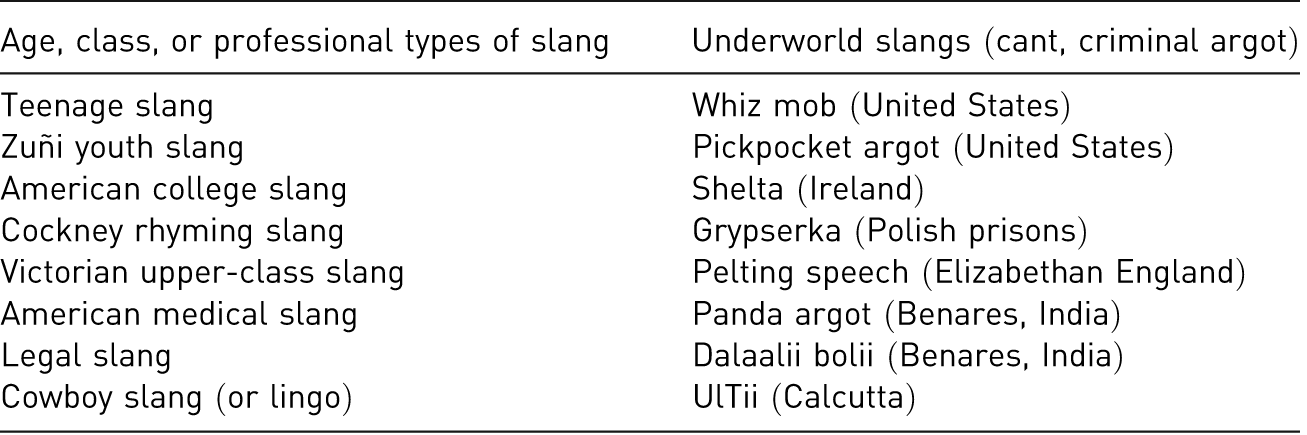
Sources.—Maurer Reference Maurer1955; Frankyn Reference Franklyn1960, Newman Reference Newman and Hymes1964; Halliday Reference Halliday1976; Mehrotra Reference Mehrotra1977; Gordon Reference Gordon1983; Eble Reference Eble1996.
The speech varieties that have historically been viewed—or are viewed today—as slang are by no means identical to each other. They differ enormously in their users; in the settings of their appropriate use; in the languages within which they are functionally differentiated as registers; and in the historical relations between users of the slang and other speakers of the language. But they share certain features too. Varieties that are treated as slang within a language do not themselves comprise a discrete “language,” whether in the sense of having a wholly distinct phonology and morphosyntax, of possessing distinct vocabulary items for every term lexicalized in the source language, or of being the only speech variety used by a community. Slang vocabularies typically exist as functionally differentiated registers within the total repertoires of a language, and their own repertories tend to belong to highly restricted lexical domains (primarily words denoting persons and their activities). Moreover, no one who uses slang uses it all the time; to know a slang is to know that it is appropriate only to certain occasions. In this sense slang is a contextual register of speech, and, like every other register, effective competence in the register includes knowledge of when not to use it.Footnote 2
When the register characteristics of slang are not recognized, tropes of slang are readily reified. For instance, Halliday (Reference Halliday1976) classifies argotic varieties of slang as “anti-languages,” arguing that it is their “metaphorical character” that constitutes them as such. But since no slang is a “language” unto itself but rather a contextually specific register fraction of a language, no slang is an anti-“language,” except in a metaphorical sense. And Halliday’s view that argotic varieties reflect an “anti-reality” or that their usage constitutes an “anti-society” implies that to switch contextually between registers of a language is to switch between realities and societies.
Once we see that slang formations are definable only through relationships between metadiscourses and object discourses, it is possible to see that the tropic qualities of slang depend on both features of metadiscourses and of object discourses, including tropes performed through each, which exhibit substantial variation. Even the perception that slang usage indexes deviant social personae has several distinct sources. One of these is the fact that slang is definable only as a value boundary phenomenon.
Slang as a Value-Boundary Phenomenon
Although slang is inherently value-laden, its social value is articulated in different ways from different social positions. In the case of age-graded slangs, for instance, different value judgments can typically be obtained at different points in a person’s life cycle: in many societies, persons who, when young, employ slang terminologies in in-group usage tend as they grow older to come to take a dim view of slang.
To speak of the “social values” of enactable signs is simply to note that certain social regularities of metapragmatic evaluation can be observed and documented as data. Any act of evaluating the social values of a speech repertoire is an act in which the evaluator formulates an interactional position (for self) vis-à-vis the repertoire evaluated (and its users). Hence to say that the values of slang repertoires differ by social position is always to speak of interactionally projected acts of self (vs. other) positioning.Footnote 3 The interesting thing about slang (and its analogues) is that slang repertoires are not simply register fractions of a language; they invariably exist at a value boundary. The notion can be defined as follows: a register exists at a “value boundary” if it (1) is negatively valorized by at least one set of metapragmatic evaluators and (2) is positively evaluated by at least one (other) group of evaluators.
We know that many, if not all, register systems tend to involve value boundaries in this sense. But for very hegemonic kinds of registers, such as the standard language, negatively valorizing discourses often have a marginal status. Thus one can go about investigating all kinds of properties of a standard language without worrying about countervalorizations or even noticing that the object under analysis is, in fact, a register linked to a value system. Slang is the very opposite. Our initial encounters with slang are almost invariably encounters with a value boundary phenomenon. Although most registers empirically turn out to involve value boundaries of a more or less salient kind, slang registers can be identified only at a value boundary.
For every slang, both negative and positive evaluations are routinely produced, though not generally by the same evaluators. The idea that slang is substandard or vulgar is itself a negative evaluation. Such metapragmatic evaluations are ubiquitous today. They are institutionalized in standard-oriented and standard-replicating practices, such as lexicography and schooling. The ability to differentiate a slang from the rest of the language depends on negative valorizations that are articulated by such practices and recycled in the intuitions of those exposed to them.
But encounters with slang varieties thus identified are also encounters with positive evaluations of speech. Nothing functions as a slang unless it is used. For any living slang—one that exists as a functioning variety for some users—we can invariably find occasions where the use of slang expressions is ratified by interlocutors as appropriate to the current interactional frame. Such responses are implicit metapragmatic evaluations that typify a slang usage as appropriate to its context but do not describe what they typify (Agha Reference Agha2007a, 150–54). When a slang variety continues to be used by a subgroup—despite its negative valorization by mainstream institutions—the “routinization of ratified use” in in-group speech constitutes a social regularity of positive evaluation.
In some cases competing valorizations are centered in the habits of specific demographic groups. For instance, teachers and parents often characterize contemporary youth slang as a form of cognitive impairment, for example, as something that “robs our children of the ability to think clearly.” When such negative assessments are encountered by the slang’s speakers as emanating from a group other than their own, the activity of using the slang is often valorized as an emblem of self-differentiation (against the first group) and of in-group identity among its users (in the second). And in many contemporary cases, the speech variety in question comes to be repossessed by its users under metapragmatic descriptions that do not employ the word slang. But why does slang involve a value boundary?
The Voicing Structure of Slang Metadiscourses
The word slang is not a slang word. It is a word of Standard English. The lexeme does not belong to the deviant register that it names. Hence to employ the term descriptively is to use one register to characterize another and thus to inhabit a register boundary in the act of description. In particular, such a usage is voiced from the perspective of the standard.
It is useful to locate such tropes within a larger context of metapragmatic tropes mediated by names for speech varieties. All of the terms listed in table 2 are Standard English words. But whereas the terms in column 1 are usable without register breach when the speech variety they name is being used, the terms in columns 2 and 3 are not usable in this way. Thus, the term sports commentary can readily occur in a televised sports broadcast. But psychobabble is not a term used in psychobabble, and legalese does not belong to legal register. Switching registers in moments of metadiscursive typification often yields forms of contrastive footing. A lawyer cannot characterize his own closing argument as legalese without self-disparagement, but using the term to impugn the opposing counsel’s arguments is good strategy. Although a great variety of interactional tropes can be achieved by using the terms in columns 2 and 3, all of these effects depend in part on the fact that to utter them is to use one register to characterize another and, thus, to inhabit a register boundary through the act of usage.
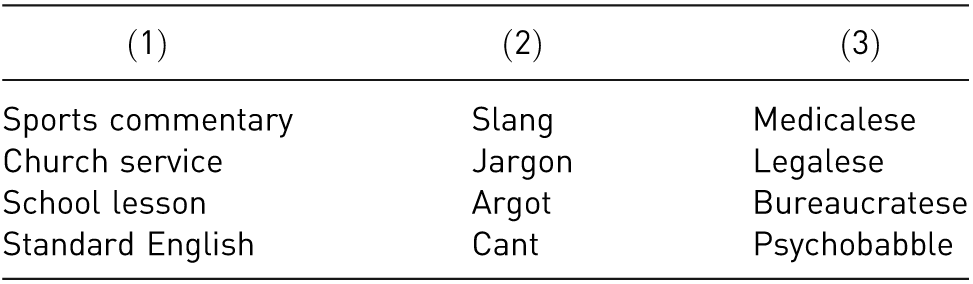
Some of these terms personify speech in an explicit way. The terms in column 3 are formed by adding a metalinguistic suffix (-ese, -babble) to a term associated with a category of person. The derivational suffix –ese productively takes as its stem a role designating noun (bureaucrat-) or an adjective (legal-, medical-) that describes practices associated with a social role; and the derived term transparently denotes the social role category whose speech it mocks. The terms in column 2 are, by contrast, lexically nonspecific in their personifications. Yet compound expressions, or phrases derived from them, such as those listed in table 1, readily link them to specific social personae.
Let us now focus on the term slang in particular: It does not belong to the register it names. And it does not lexically name the kind of person who uses it. Yet the denotation of the term is not specified solely by its lexical form. The term slang routinely occurs in discourses that personify slang varieties in explicit and specific ways. Whenever a person-designating expression occurs as a modifier to the noun slang, the noun phrase as a whole personifies a speech variety. Thus to speak of lawyers’ slang, college slang, or thieves’ slang is to use a noun phrase that describes an apparently bounded speech variety, whose boundary is specified by naming its speaker. And although the term slang formulates speech and speakers as deviant in some way, the description as a whole is voiced from the standpoint of the standard language. Such standard-voiced formulations of deviance are commonly read backwards as etymologies of the word form itself.Footnote 4 The association of slang with “thieves and vagabonds” is attested in dictionary entries from relatively early on and is perhaps recycled into popular imaginaries through them.Footnote 5
Metadiscursive Genres
There are many genres of slang metadiscourse (whether popular or authoritative, print mediated or electronic) that circulate representations of specific speech varieties in public life. Some of these employ the term slang to characterize repertoires and speakers, explicitly drawing social-characterological boundaries around facts of speech variation. Others merely embed slang expressions into discursive activities that are not officially about slang (e.g., movies, advertisements, humor) but that nonetheless deploy slang stereotypes in more implicit ways; the recognizability of criterial personae by audiences is often a condition on the success of these projects. This is especially important in the commercial sector where the marketing of products strategically relies on the ability of target audiences to identify with social personae that can be inhabited ever more fully through the acquisition of product emblems (Agha Reference Agha2011).
Metadiscourses that typify slang by using the word slang differ sharply from more implicit patterns of metapragmatic typification, as in the case of utterances that merely respond to a usage as if it were substandard or deviant in some way, or utterances that evidence evaluative awareness of a register contrast in responding to a specific pattern of slang usage by switching to a reciprocal slang response. These patterns of metapragmatic typification tend also to differ by discourse genre. For example, the term slang shows up commonly in metadiscursive practices that prescribe the use of Standard English by proscribing another usage as slang. But the word slang shows up rarely, if ever, in discourses that employ slang expressions to sell commercial products (such as branded automobiles like the Kia Sportage®) or in discursive interactions where patterns of reciprocal slang usage effectively serve to maintain the in-group identities of interlocutors.
Slang is not a discrete or unitary phenomenon at either the object-discursive level (since its repertoires change rapidly) or the metadiscursive level (since its social life is shaped by competing valorizations), but particular forms of slang do acquire a certain specificity at the intersection of these levels. Our folk sense that we are dealing with a bounded phenomenon derives from the fact that when we think of slang, or encounter a slang usage, we are faced with a speech repertoire whose values are given by specific metapragmatic judgments, often ones that are socially inculcated in us as habits of evaluation by institutional discourses of different kinds. Although such lines are invariably drawn in sand, they are sometimes reinforced by sand castles, as one example should make clear.
Drawing Boundaries by Invoking Standards
Although the semantic range of the term slang has expanded and contracted in various ways over the last two centuries, one feature that remains constant is the perception that it names a substandard variety. But which standard do slang varieties deviate from?
Since the 1850s the development of the register we now call Standard English has, of course, provided a common baseline of evaluation. The fact that Standard English is itself a historically varying register—linked to slang, for example, by patterns of word borrowing in both directions—is worth noting, but this issue is not itself to the point since Standard English is not the only baseline standard used to reckon the deviance of slang. It is rather the perception that some unified standard exists that is critical to the pejorative treatment of slang repertoires and speakers.
Of course, the perception that a standard exists is merely the presupposition that at least one standard exists. But different standards have, in fact, been invoked at different times, and some of these invocations are themselves part of an effort to construct new standards or to expand the social domain of incipient ones.
Thus, Morris Fishbein, the editor of the American Medical Association’s journal, writes in the 1930s:
(1) Many words have found their way into medical vocabularies with unusual meanings that are not recognized even by medical dictionaries. Such writings may be characterized as medical jargon or medical slang … they … are the mark of the careless and uncultured person.” (Reference Fishbein1938, 47)
The appeal to “medical dictionaries” is an appeal not to Standard English but to the standard register of medicine, or Medical Standard (capital M, capital S); and the phrase “careless and uncultured person” is one among many he uses to describe those who use medical slang. According to Fishbein, postmortem is medical slang, autopsy is Medical Standard; diabetic is medical slang, person with diabetes is Medical Standard; epileptic is medical slang, person with epilepsy is Medical Standard. In his role as editor, he then legislates: “In the publications of the American Medical Association such usages are banned” (49).
I noted earlier that slang expressions routinely cross register boundaries sometimes even replacing the terms with which they once contrasted as slang. Although most of the words that Fishbein once banned—postmortem, diabetic, epileptic, and many others—have now become Medical Standard and no longer count as slang, the boundary between the standard and its slang still exists, and new forms of medical slang emerge routinely in the speech of doctors, nurses, and other medical personnel. Gordon (Reference Gordon1983) cites a number of such expressions, including beached whale ‘an obese patient’, gomer ‘alcoholic, unkempt, derelict’, crock ‘patient who constantly complains, but has no disease’, crick ‘a crock who turns out in the end to have a legitimate disease’. And, as with all slang registers, such expressions are treated as appropriate only to certain participation frameworks. They do not occur in the presence of patients or senior doctors, but are common in the banter of younger medical personnel during coffee breaks or chance meetings in corridors and elevators.
Interactional Microspaces
In large standard-language communities many slang varieties coexist as functionally differentiated registers within the same language. The social domain in which any given slang register effectively functions in communication corresponds to the class of persons competent in its use. Partridge (Reference Partridge1933) describes twenty-five varieties of slang used in British English in the first quarter of the twentieth century. These include slangs used by Cockney speakers, workmen, tradesmen, journalists, lawyers, doctors, publishers, literary critics, sailors, soldiers, and many others. If his descriptions are accurate we may assume that these varieties were prototypically centered in at least these social domains: although some expressions in each variety were evidently known more widely as well, most expressions were commonly used and understood only by members of these social groups.
Cases of this kind suggest that large standard language communities are characterized by massive society-internal register differentiation through the ideological framework of slang. Many kinds of slang coexist with each other within a language community and define many microspaces of interaction linked to specific social practices and groups. Such microspaces are not hermetically sealed off against each other, of course, given the fact that some slang expressions are recycled through diverse metadiscursive practices—including, today, television, internet, movies and other mass media—from one social domain to others, often yielding forms of fragmentary circulation (Agha Reference Agha2007a, 165–67) of speech forms and of intuitions about them, whether across locales (including national boundaries) or across demographic profiles (scholars vs. the people they study). Nonetheless, from the standpoint of fluency or authentic proficiency, the zoning of slang varieties into interactional microspaces ensures asymmetries of effective competence within a language community: All fluent speakers of a language are not fully competent in any one of its slang varieties.
Although each variety called slang presupposes a baseline standard, the baseline may differ for different ones. The fact that every baseline is itself a historically varying register need not interfere with the fact that slang utterances effectively mediate forms of interpersonal footing in microspaces of social interaction among those who recognize them as slang.
But shifting baselines do proliferate slang varieties. Partridge (Reference Partridge1933) observes that every class has its slang. This is an accurate use of the bare lexeme slang. The presupposition that a standard exists can be used to formulate negative judgments both within and across group boundaries. In the former case, the judgment often re-partitions the group around facts of language use, implicitly contrasting a subgroup that upholds its standard with one that does not. In the latter case, the speech of another class is handy in stigmata of downward or upward mobility, organizing behaviors and aspirations within the group. But the process is indexically open: the unmodified use of the term slang implies no specific sociological boundary. And since class-specific slangs change generationally, the bare lexeme slang operates as a cultural shifter of a rather specific kind: When its usage formulates some speech variety as nonstandard, the act (1) presupposes the existence of some (at least one) standard, though different ones may be relevant to different microspaces of interaction, and (2) entails a reclassification of speech and speakers, which, over historical time, may re-partition social groups successively and iteratively, giving subgroups and stigmata new social lives in the eyes and ears of those who recognize them.
Tropic Features of Slang Lexemes
The repertoires of slang include lexical items but also prosodic, syntactic and other features of “speech style.” Although slang is therefore typically an enregistered style of conduct (Agha Reference Agha2007a, 185–88), its lexical features constitute the most transparent (easily reportable) subset of its stylistic repertoires. Popular metadiscourses about slang give disproportionate attention to its lexical repertoires, treating them—through a metonymic reduction—as the slang itself, thereby reformulating slang as a lexical register of the language.
Slang expressions include lexemes of varying degrees of complexity—including fixed phrases, idioms and other holophrastic lexations. Once we examine the internal structure of these lexemes it is evident that the lexical register of slang consists of a system of lexicalized tropes that appear fractionally to deviate from the standard presupposed as relevant in the instance. Slang is both familiar and strange to the standard ear, a fact on which its ironic force depends.
Table 3 illustrates the lexical repertoires associated with a few of the slang registers listed in table 1. Each table panel (1–6) presents lexical data on register contrasts in the usual tabular display. Such a display employs three kinds of discursive data, which I have distinguished here by means of CAPS, italics, and roman typeface. Listed at the top of each panel is a metadiscursive characterization of the speech variety. Each such characterization specifies a chronotopic boundary of usage (Agha Reference Agha2007b), implying a specific type of user and/or locale (thieves, British person, college student, etc.) and a period in which the register was in common use (seventeenth century, nineteenth century, etc.). The italicized forms on the left are the lexical items of the register in question. The forms on the right are corresponding “standard” expressions.
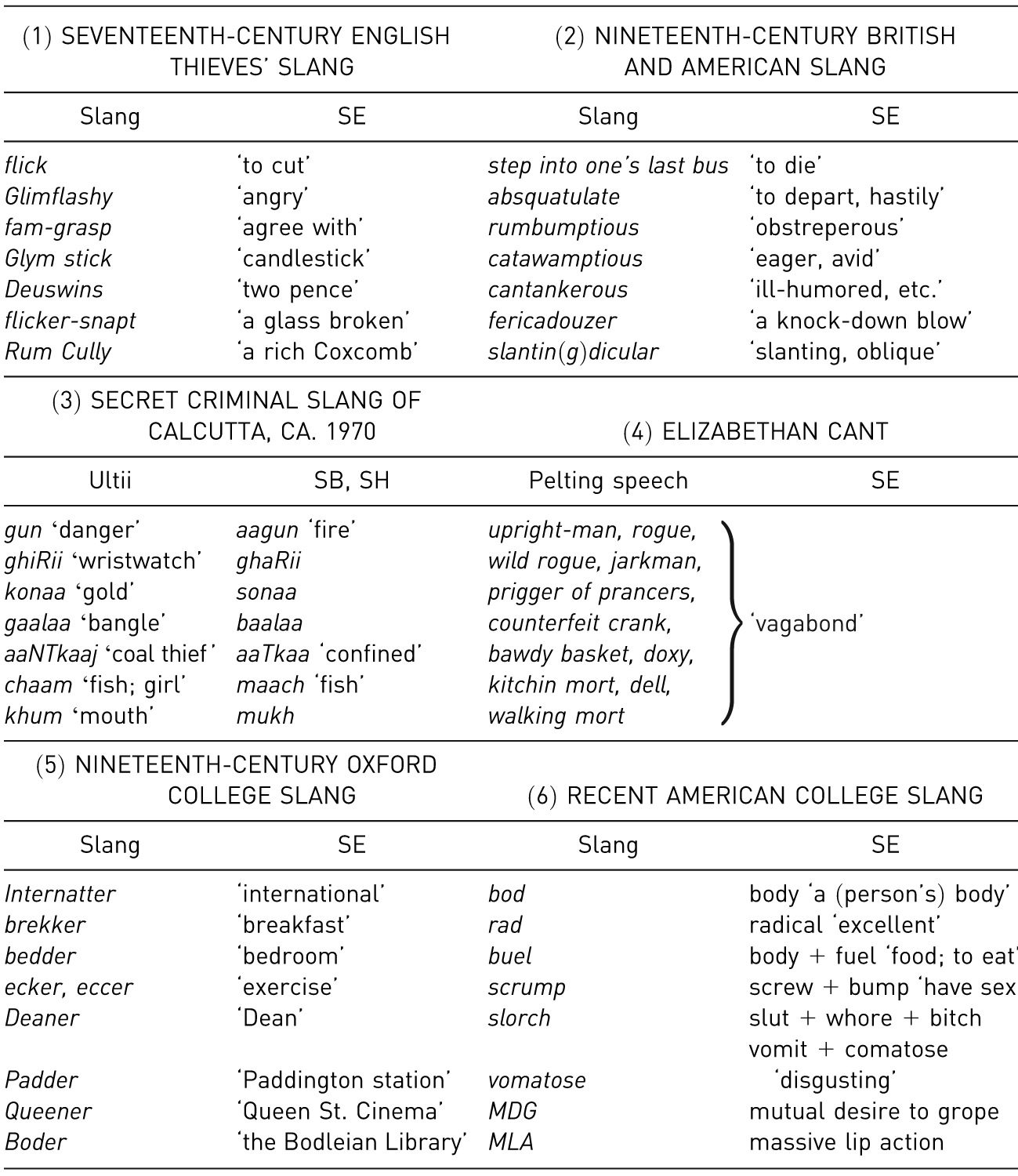
Note.—SE = Standard English; SB = Standard Bengali; SH = Standard Hindi.
If we consider the nature of the correspondence between slang and standard expressions in each row of table 3, it is readily apparent that we are dealing with partial correspondences in each case. A partial correspondence involves a structural analogue or calque along some dimension of lexical organization but not others, an issue to which I return below. Each italicized expression on the left corresponds fractionally to the standard expression on the right, and (from the perspective of the standard) is therefore fractionally deviant. This fractional congruence is due to various types of lexicogrammatical tropism across register boundaries, such as blends (buel / body + fuel, in panel 6), aphaeresis (word-initial omission: aagun / gun, in panel 3), metathesis (chaam/maach, in panel 3), lexical hypertrophy (the eleven words for vagabond in panel 4), hyponymy (bod ‘a (person’s) body’ in panel 6), and so on.
Before we proceed to a discussion of such cases it is vital to see that fractional congruence of lexical items across register boundaries differentiates lexical registers only under certain conditions. These conditions are met in naturally occurring slangs, but not in artificial slangs derived from simple rule-governed word games.
Partial Lexicalization and Register Breach: Textual Foregrounding of Deviance
For the artificial slangs shown in (2), slang expressions are formed by simple rules that are highly productive in the sense that they can be applied to every word in the language.
(2) Slangs based on simple, productive rules (Crystal Reference Crystal1987, 59):
-
(a) English back slang: inversion of letters yielding “backward” pronunciation
kew = week; neetrith = thirteen; tekram = market
-
(b) French parler a l’envers ‘speaking backwards’: inversion of syllables
painsco = copains ‘friends’; rima = mari ‘husband’; verlen = l’envers ‘backwards’
-
(c) English Pig Latin: fronting of initial consonant to word-final position, followed by an ay or e
Utpay = put; Utpay atthay okkbay ownday = Put that book down.
Thus a back slang is formed by a rule of inversion, yielding words that are pronounced “backwards” in relation to the standard language. In a variety used by English soldiers in the First World War what is inverted is the letters of the written word, as shown in (2a). In the French variety of back slang in (2b), what is inverted is the order of syllables. Pig Latin in (2c) involves consonant fronting plus vowel addition. In these cases rules of word formation like inversion, consonant movement and vowel addition are used to create deviant lexemes from the materials of the standard language. But the rules that yield structural calques are very simple and regular. The standard lexeme is predictable from the slang form if you know the rule. There is no need to learn a separate vocabulary and, since rules of word formation apply productively across word classes, every lexical item in an utterance can be a slang expression (e.g., Pig Latin “Utpay atthay okkbay ownday” [Put that book down]).
In such cases, slang expressions and nonslang source expressions do exhibit structural calques, but insofar as the rules that map the latter onto the former are simple and universally productive across every syllable and word class, slang utterances can readily consist wholly of slang expressions, and no utterance-internal indexical noncongruence typically results in the speech of proficient speakers. Only when you combine multiple principles of structural calquing and relax the condition that they apply regularly across the entire lexicon, as is the case for naturally occurring slangs, do structural calques yield utterance-internal forms of “deviance.”
In the case of naturally occurring slangs (such as the ones in table 3 above), only a small subset of the standard vocabulary has slang alternants, and these can occur only in a narrow range of grammatical slots in slang utterances. In most cases, the majority of slang expressions are lexicalized as nouns, adjectives and verbs, with few or none occurring in other grammatical classes.
Partial lexicalization entails that slang lexemes occur as foregrounded segments in discourse. This is illustrated for American College Slang in (3):
(3) Natural slangs: Partial lexicalization and register breach (Eble Reference Eble1996):
-
(a) The doper music is loud tonight.
-
(b) Question: “How’s the weather?”
Answer: “Rainage.”
-
(c) That guy has one killer jump shot.
-
(d) Don’t read that book—it’s a real wanker.
-
(e) My parents didn’t come through with fundage.
In such cases, slang expressions occur in bounded regions of discursive text, as text-segments whose surrounding material is not slang. It is therefore not possible to use slang expressions without the accompaniment of nonslang expressions in the same utterance, and hence, not possible to use the slang register without register breach in the sense discussed above.
Partial lexicalization thus sets a limit on slang as a speech style: Slang utterances are internally noncohesive by register criteria. They consist of contiguous text-segments that belong to different registers. The standard language also involves a distinctive lexical register, of course, but its register includes lexemes of every grammatical category. This is no accident or happenstance; it is a systematic feature of how standard registers are formulated by metadiscursive institutions. Hence it is possible to construct long chunks of Standard discourse without register breach. By contrast, the pervasiveness of register breach within slang utterances foregrounds the perception of utterance-internal “deviation” whenever these utterances are encountered by Standard speakers.
It is also worth noting that when the language games in (2) are transformed into group differentiating slang varieties, they are also converted into registers that exhibit partial lexicalization (in repertoires) and register breach (in usage). Thus Verlan is a slang register that is derived from parler l’envers and therefore exhibits the forms of syllable inversion characteristic of the source language game in (2b)—indeed, the term Verlan is itself an inversion of l’envers—but which, today, is no longer comprehensible to “noninitiates” due to a number of additional features, such as the unpredictable alteration of medial vowels and word truncation in many Verlan words, and, even more effectively, due to extensive forms of word borrowing—whether from languages spoken by minorities in France, such as Arabic, Wolof, and Portuguese, or the recycling of archaic French slang into contemporary Verlan—and the subsequent transformation of many borrowed words through syllable inversion. And prosodic features (which have nothing to do with syllable inversion) mark Verlan as distinct from French too. At the same time, many words that occur in Verlan utterances are not distinct from Standard French at all, thus linking partial lexicalization to register breach in multiple ways at the level of utterances (Doran Reference Doran, Pavlenko and Blackledge2004, 96–99).
Yet this is not the only way in which the object discourses of slang appear deviant. Whereas slang utterances exhibit deviation through register breach (due to co-occurrence of slang and nonslang expressions), slang lexemes themselves appear deviant to the standard ear too, but for an entirely distinct reason.
Cross-Repertoire Tropes
At the level of lexical repertoires, the perception of deviation is an effect of structural calques between lexemes belonging to distinct registers. Two items belonging to different registers are structural calques if they exhibit a partial formal analogy along some (at least one) dimension of phono-lexico-grammatical organization. Their partial likeness is notionally grasped as a similarity of denotational content, and their dissimilarity is often described in contrastive personifications of their speakers. In (4), Erich, a high school student is comparing two lexical items—kick back and relax. The two are partially analogous in structural sense (Agha 2007a, 112–15)—both are intransitive verbs, both take animate subjects, and both are near antonyms of work hard—but they differ in phonolexical form. Erich describes this partial sense equivalence as a similarity of “ideas”—as how the idea behind one “fits” the idea behind the other—but he personifies the difference between them as a difference of speaker type, treating relax as the “normal” term that he—as a presumably normal person—prefers:
(4) From partial congruence to persona differentiation (Bucholtz Reference Bucholtz2001, 90)
Erich: The idea behind the term fits but the term itself doesn’t—isn’t the way I prefer it to be. Like “kick back.” I just prefer something—some normal term. … Like “to relax” … something like that.
Slang lexemes are typically structural calques or partial analogues of standard lexemes, making slang both familiar and strange to the standard ear. But most speakers cannot readily describe the nature of these structural calques and, instead, personify the difference, as Erich does, thereby transforming facts of morphosyntactic or phonolexical difference into facts of sociological difference.
Most slang items permit multiple analogies to words of the standard. Thus the slang term blurb not only exhibits a phonological analogy to words like blunt and curb—to bl(unt) at syllable onset, to (cu)rb at syllable coda, and to both in the vowel at syllable peak—it also occurs as a direct object of the verb read and, hence, is a syntactic analogue of words like book, magazine, bible, pamphlet, and so on. Such multiple analogies are possible because every word has a hierarchical constituency with respect to grammar—concurrently manifesting phonemic, syllabic, morphemic, and phrasal constituency—any of which may be analogous across the register boundary as others differ. Slang words like scoopage, fundage, rainage, and foodage exhibit partial analogies to standard words like postage, both phonologically and morphologically (in the last syllable). The morphological analogy obscures a disanalogy, however, since the suffix –age is overgeneralized in the slang, yielding an expanded set of base stems (including scoop-, fund-, rain- and food-) in the slang variety, but not in the standard. (Other Standard English lexemes, like voyage and suffrage are also vaguely reminiscent of the slang set, but they are no longer analyzable as having a segmentable suffix –age, and therefore less transparent as calques.)
Given the fact that any given slang expression has all of these kinds of structure—phonological, morphological, syntactic—the hierarchical constituency of the word ensures that many kinds of partial analogies are implemented concurrently. Comparability along one dimension, but noncomparability along others yields a denotationally tropic effect in discourse. Thus scoopage is a morpholexical calque of postage due to identity of suffix, and also because both verb stems, scoop- and post-, take inanimate direct objects. Yet when the American College slang lexeme scoopage is used for “sexually desirable persons” (as in “Is Joe scoopage?”) a person is tropically formulated as an inanimate object, as a thing that can be scooped up (or out) when used as an instrument of gratification.
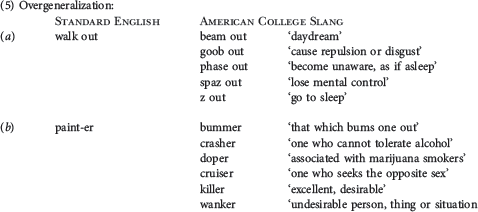
In (5), the cross-repertoire trope depends on overgeneralization. For instance, beam out is an animate subject verb, and thus comparable to walk out. Although the class of slang expressions in (5a)—beam out, goob out, and so on—is based on derivational processes that are familiar when they apply to verbs like walk (yielding walk out in Standard English), the class is formed by overgeneralization to words that are either not verbs or not recognizable as standard words (goob, phase, spaz, z). Similarly, the –er in American College slang in (5b) forms words through overgeneralization from Standard English (where transitive agentive verbs, like paint, yield agentive nouns, like painter) to a miscellany of expressions (including dope and wank, which yield a miscellany of derived forms, whether noun or adjective, whether animate/agentive or not) in the slang register. This particular -er formant is comparable to the nineteenth-century Oxford -er (in table 3, panel 5), though patterns of word truncation and overgeneralization are different.
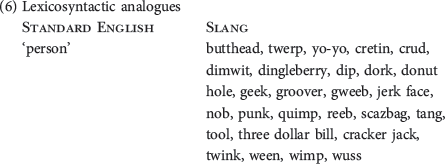
In (6), we see syntactic analogues. Although none of the expressions in the slang column (butthead, twerp, yo-yo, etc.) are semantically equivalent to the Standard English lexeme person, they are all nonetheless syntactico-semantic analogues. Expressions in both columns occur in grammatical constructions that are criterial for the class of [+human] nouns in English—they all permit equational predication with human nouns (“Joe is a real X”), they all occur as subjects of verba sentiendi (“The X {saw me/read the newspaper}”), and all permit resumptive anaphoric reference with him/her—but only one of the items, the form person, belongs to the standard register; all the others are slang. Under these conditions, one lexical item in Standard English has many analogues in slang, and, quite apart from the trope of lexical hypertrophy, all the slang lexemes appear to depersonify or repersonify their referent in some way.
Such examples can be multiplied without limit for every slang variety ever described. But the phenomenon of cross-repertoire tropism is common to all cases. Grammatical calques invest lexical contrasts across register boundaries with forms of partial likeness that are tropically organized across several concurrent dimensions of grammatical organization. But these partial analogies are not readily described by language users because they involve multiple, lexemically intersecting “covert” categories (Whorf Reference Whorf and Carroll1956) of structural sense, and the fractional noncongruence of structural sense dimensions among utterance segments is routinely personified instead as a social-characterological difference among those whose utterances these are, their speakers. A metaphysics of personified social difference, often viewed as differentiating characterological “essences” among persons, readily emerges as a Whorfian “fashion of speaking” in such cases, thus converting and reanalyzing differences configured by one semiotic principle (structural sense) into differences that effectively constitute a semiotic principle of an altogether distinct kind (group differentiation).
When Slang Becomes Irrelevant to Slang
I observed earlier that slang is not a unitary phenomenon at either the metadiscursive or object discursive levels and I have observed that distinct forms of “deviance” emerge from tropes at both levels. Tropes involving personification, metonymic reduction, or value boundaries primarily involve metadiscursive practices of language users. And tropes involving register breach and repertoire calques draw attention to utterances and repertoires of the object discourse. And it should be evident that, despite the analytical usefulness of distinguishing these two levels, tropic formulations of both kinds are recursively embedded in each other and stacked within utterance segments when persons inhabit footings with each other through slang formations. It is therefore unsurprising that many registers whose object discourses are of the type traditionally called slang are formulated today as registers of an entirely different kind by metadiscourses produced by their speakers and by analogues recycled in the mass media.
The Indonesian slang register called Bahasa Gaul (Smith-Hefner Reference Smith-Hefner2007) exhibits all of the features characteristic of slang object discourses: cross-repertoire tropes based on grammatical calques and word borrowings from a large number of source registers (including English, as well as Indonesian criminal argots). Mainstream metapragmatic discourses characterize it as a slang linked to linguistic and mental corruption in the usual way. But the metapragmatic discourses of its young users treat the register as an emblem of egalitarianism and generational distinction from older speakers and, through its links to urban Jakarta, as an emblem of cosmopolitanism and upward social mobility. A growing number of self-help books targeted to young populations have appeared in recent years, and even young Muslim preachers, although linked to the conservatism of an ongoing Islamic resurgence, have begun to pepper their speech with Gaul in order to bring young television audiences into the sphere of religious propriety. Gaul is now well on its way to middle-class respectability, though it is still indexical of “cool” and trendy personae, and its usage remains susceptible to metapragmatic evaluations of brashness, overfamiliarity, and rudeness.
In the case of the Nouchi register used by young people in Côte d’Ivoire (Newell Reference Newell2009), the indexical revalorization of the register also depends on recursive embedding of meta- and object discourses, though the discourses are entirely different. In a context where the Ivorian state has long promoted a purist version of French as an emblem of national modernity, Nouchi provides a contrastive emblem of autochthonous modernity to its users. Although it draws on an obscure criminal argot, also called Nouchi, the modern slang register of Nouchi draws on other source registers, such as Dioula, associated with translocal trade, and also English. Yet its syntactic patterns remain entirely those of French. It therefore contrasts with pure French as an autochthonous “popular French” to some degree, though it also recalls translocal figurements of speaker persona as well. Changes in the register’s indexical values are also linked to changes in its social domain and social range (Agha Reference Agha2007a, 169): Through its appropriation by university students and its recycling in mass media, Nouchi is now exported overseas through musical genres and other cultural products; and, as it becomes increasingly the primary register used in public settings by those between ages 10 and 30, it is coming to be evaluated much less as a slang, as classically understood, than as an emblem of an emerging national identity.
The case of Indonesian Bahasa Gay (Boellstorff Reference Boellstorff2004) is somewhat analogous. Although used by gay and lesbian persons as an emblem of homosexual identity, and still treated as a “secret” gay language by many mainstream discourses, Bahasa Gay is not known to, or spoken by, all gay persons; and it is not generally semantically opaque when used because its lexemes typically occur in discursive cotextual frames where most surrounding material is standard Indonesian; and, through its recycling in mass media, its elements are increasingly appropriated by nongay Indonesians as a vernacular emblem of translocal national belonging.
The Gothic/Lolita speech registers used by young Japanese women (Gagné Reference Gagné2008)—whose linguistic forms are clearly deviant in relation to standard Japanese and which clearly exist at a value boundary within Japanese society—are merely fragments of commodity registers (Agha Reference Agha2011), where speech is deployed along with sartorial styles—including corsets, bonnets, long one-piece dresses, and parasols—which together constitute a multi-channel sign configuration that functions as an enregistered emblem of being an “urban princess.” A growing number of magazines and web forums recycle representations of this register, making such stereotypic indexicals available to a trans-local community of young women, who readily trope upon it through variants of speech and dress, serially formulating forms of positional uniqueness though a proliferation of local variants.
Many cases of this kind have been described for other societies in a growing literature. But what kinds of cases are they? Has slang somehow changed when no one was looking? The answer must be a qualified “no.”
All the value boundary registers that I have discussed have invariably existed as forms of communication whose indexical values are defined by competing metadiscourses. In the historical literature on “slang,” it is the entrenched perspective of the standard that obscures the existence of metadiscourses through which speakers of a “deviant” object discourse formulate competing indexical values of the registers they use. They have always done so. More recent work simply attends more fully to this fact. Both norm and deviance will always be around, and they will continue to “hang out” together: You can’t have one without the other. And all value boundary registers are transformed—in repertoires, indexical values, and social domains—through the activities of those who orient to them. If something has changed it is our ability to study the implications of this fact for the organization and transformation of society.
Once we move beyond a repertoire-centric approach to the thing called “slang,” we find a number of distinct semiotic and metasemiotic processes through which competing valorizations and forms of reanalysis alter relations between modes of discursive practice and hence among those whose practices these are. The set of sociohistorical circumstances and (meta)semiotic processes through which the slang construct once came into felt effulgence and institutional hegemony in standard language communities (whether in Europe or elsewhere) are inextricably indexed by present-day uses of the term slang itself. Since the term is not likely to go away anytime soon, this imbrication is worth attending to by those who purport to study its referent today. Meanwhile as these sociohistorical conditions change, the slang construct becomes less and less useful for understanding those who are linked to it—whether by decrying or defending it, or merely by using some putative sample of it. Once we attend to the (meta)semiotic processes whose variable aggregation appears to yield the slang construct as their visible sum—processes that are ubiquitous in other forms of enregisterment that involve no slang, where other iterations of these processes yield variable aggregations that are recognized as registers of “other” kinds (Agha Reference Agha2007a)—it becomes possible to analyze the shifting fates and fortunes of value boundary registers of whatever kind we are able ethnographically to observe today, and not just the ones that have hitherto been called “slang” (and hence discussed above), and to do so without being pinioned or fossilized by the standard- and repertoire-centric gaze in whose amber the slang construct was born.



