


1. Introduction
The upper airway plays a pivotal role in maintaining respiratory function and is vital during medical procedures such as intubation and airway management. Video laryngoscopes are essential tools in modern intubation, and their design relies heavily on the anatomical dimensions of the upper airway. However, airway dimensions shift significantly during mouth opening, complicating the development of laryngoscope blades optimized for diverse populations. A deeper understanding of these dynamic anatomical variations is crucial for creating efficient ergonomic and population-specific devices. Traditional imaging methods such as CT or MRI provide insight into the static structure of the upper airway but are limited by their inability to track functional transitions such as the shift from a closed to an open mouth. Moreover, repeated imaging exposes patients to unnecessary radiation, incurs costs, and lacks practicality in clinical settings.
A study on the Mexican population revealed that existing video laryngoscope blades were unsuitable due to anatomical differences specific to this population. The findings emphasized the necessity for redesigned blades to accommodate these variations (Reference Matehuala-Morán, Pino Pérez, Fuentes-Alvarez, Beltrán Fernández, Hernandez-Gilsoul, Saldaña Villaseñor, Rojas-Vega, Ramírez Cadena and Alfaro-PonceMatehuala-Morán et al., 2022). Similarly, an evaluation of endotracheal tube placement in the Indian population showed that the standard recommendations 23 cm for males and 21 cm for females often resulted in over-insertion. This could lead to the tube entering the cricoid ring, increasing the risk of complications during intubation (Reference Varshney, Sharma, Kumar and VarshneyVarshney et al., 2011). Moreover, difficult airways are frequently associated with unique anatomical features, such as a protruding sternal region or an anteriorly positioned larynx, which further complicate intubation (Reference McintyreMcintyre, 1989). These studies underscore the importance of tailoring laryngoscope blades to the anatomical characteristics of different populations. Building on this, another study explored the design of patient-specific pediatric laryngoscopes using open-mouth CT scans. A 3D model of the upper airway was generated, and the blade profile was designed using a space colonization algorithm. However, this approach focused solely on blade profiling and was contingent upon the availability of open-mouth CT scans for each patient (Reference Sims, Boutelle, Inziello, Lobo Fenoglietto and StubbsSims et al., 2019). The literature was explored to investigate changes in the upper airway due to mouth opening. One study examined the effect of mouth opening on upper airway collapsibility in sleeping subjects by measuring cephalometric data in awake conditions for both closed- and open-mouth states. However, the study recorded only a limited number of parameters, and the extent of mouth opening was not quantified (Reference Meurice, Marc, Carrier and SeriesMeurice et al., 1996).
A study evaluated the impact of open- and closed-mouth conditions on upper airway anatomy in 28 patients using lateral cephalometry and nasopharyngoscopy. Significant anatomical changes were observed due to mouth opening. The study found that open-mouth breathing reduced the retropalatal and retroglossal areas and lengthened the pharynx in the upper airway. While mouth opening was adjusted based on patient comfort for the study, no measurements were taken to quantify the degree of mouth opening. Figure 1 shows the upper airway anatomy of the human, where 1 represents the retropalatal plane (RP), 2 represents the retroglossal plane (RG), 3 represents the plane from vallecula to the pharyngeal wall, and UAL represents the upper airway length.
Upper airway. 1: retropalatal plane, 2: retroglossal plane, 3: a horizontal plane from vallecula to pharyngeal wall, UAL: Upper Airway Length

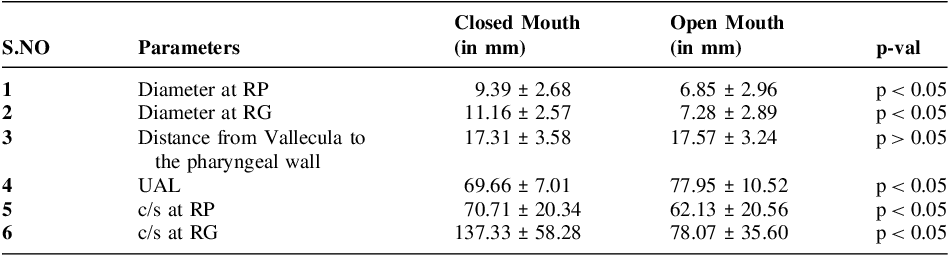
Table 1 (Reference Lee, Choi, Shin, Lee, Kwon and LeeLee et al., 2007) highlights the significant anatomical changes in the upper airway between closed- and open-mouth states and the p-value for the significance of the difference. Key parameters such as retropalatal and retroglossal diameters show a notable reduction, indicating airway narrowing upon mouth opening; additionally, the UAL increases, suggesting airway elongation. These variations emphasize the impact of mouth opening on airway structure, which is crucial for intubation planning and laryngoscope blade design.
Table showing open and closed mouth data and p-value for significance in the difference

A separate study investigated the risk of upper airway constriction during maximum mouth opening, such as when using a mouth prop during dental procedures. In 13 healthy adult volunteers, the sagittal diameter of the upper airway was measured on lateral cephalograms under two conditions: closed mouth and maximally open mouth at three points (1, 2 & 3), as shown in Figure 1. The figure illustrates three key airway measurement points in the sagittal plane: A (diameter at RP), B (diameter at RG), and C (distance from vallecula to the pharyngeal wall). These were the only three airway dimensions available in the literature for both closed mouth and open mouth states along with the extent of mouth opening. Therefore, these three dimensions were selected as features to develop a model to assess the feasibility of the proposed algorithm. Significant reductions in airway dimensions were observed, with decreases of 54.1% in A, 47.3% in B, and 47.4% in C. These findings highlighted the substantial impact of maximum mouth opening on upper airway dimensions (Reference YamazakiYamazaki, 2010).
There is a notable lack of literature addressing anatomical changes in the upper airway due to mouth opening. Additionally, existing research on video laryngoscope blade design lacks a structured framework to accommodate these changes. This paper introduces a machine learning (ML) algorithm designed to predict upper airway dimension changes from the closed-mouth state to the open-mouth state. By leveraging features such as age, height, weight, inter-dental distance (mouth opening), and certain closed-mouth airway characteristics, the proposed model bridges the gap of data between closed and open-mouth states. These predictions can provide accurate, population-specific insights, particularly for underrepresented groups such as the Indian population, where anatomical variations significantly influence the usability of medical devices.
The primary objective of this preliminary study is to develop and validate a machine learning algorithm to demonstrate the feasibility of predicting open-mouth airway dimensions based on closed-mouth airway data and demographic features. Given the limited dataset, this research serves as an initial exploration into the potential correlations, laying groundwork for future studies using larger, diverse datasets to create robust, generalizable models. The outcomes of this study hold potential for designing customized laryngoscope blades, thereby improving intubation outcomes and device effectiveness in diverse populations.
2. Methodology
The approach is based on CRISP-DM (CRoss Industry Standard Process for Data Mining) because it is an existing methodology for data mining . The CRISP-DM method was chosen because it explicitly emphasizes the data science workflow, which aligns closely with our research objectives, in contrast to methods like Kanban and Scrum, which primarily focus on team collaboration and project management (Reference Wirth and HippWirth & Hipp, 2000).
It comprises six steps, presented in the following sections: I. Business understanding; II. Data understanding; III Data preparation; IV. Modelling; V. Evaluation; VI. Deployment. This Framework was modified to predict the anatomical movement in the upper airway due to the opening of the mouth.
2.1. Business understanding
In this phase, the conceptualization of the objectives and needs takes place. The proposed approach aims to use demographic data and the anatomical data of the upper airway in closed and open-mouth states to develop an algorithm which can predict the anatomical changes caused by mouth opening. The algorithm should take demographic data, anatomical features in the case of a closed mouth and the extent of mouth opening as input and should be able to predict changes in anatomical features. For the success criteria, the model should provide the output for all the anatomical features given as the input. For resource availability, the data would be acquired from the literature for the model training and the data from the CT scans of the upper airway can be used in the subsequent studies to increase the accuracy of the model.
2.2. Data understanding
Data understanding involves identifying, collecting, analyzing and verifying data sets to achieve the project objectives. As the study focuses on upper airway changes, anatomical features that change with the mouth opening should be considered. For this study, we have considered the linear distances between different parts of the upper airway to be the desired anatomical features. Literature was explored to investigate the anatomical features that change due to the mouth opening. From this literature, the following parameters were defined as features that were getting affected due to the mouth being opened and the demographic data for the model (Jha et al., Reference Jha, Thakur, Tripathi, Jain, Kumari, Chaturvedi and Arya2016; Lee et al., Reference Lee, Choi, Shin, Lee, Kwon and Lee2007; Schebesta et al., Reference Schebesta, Hü, Rö, Ringl, Mü and Kimberger2012).
-
Anatomical data
-
Diameter at the retropalatal plane (A)
-
Diameter at the retroglossal plane (B)
-
Cross-sectional area at retropalatal plane
-
Cross-sectional area at retroglossal plane
-
Vallecula to pharyngeal wall distance (C)
-
Upper airway length (UAL)
-
Extent of Mouth opening
-
-
Demographic data
-
Age
-
Sex
-
Height
-
Weight
-
These are the identified features which can be used to develop a machine-learning algorithm to predict changes caused by mouth opening.
2.3. Data preparation
The required data can be calculated if the open and closed-mouth CT scan images are available. In our case, we have used data extracted from the literature because of the non-availability of open-mouth CT. The selection of the features was based on the availability of the data for both open and closed-mouth conditions. From the literature, we found data for three parameters in a study conducted on 13 patients. This study had data on changes in the diameter of the airway at the closed and maximal mouth openings. The following parameters were available in the literature for both open and closed-mouth states which will be used to train the algorithm (Reference YamazakiYamazaki, 2010).
-
Anatomical Data:
-
Diameter at the retropalatal plane (A)
-
Diameter at the retroglossal plane (B)
-
Vallecula to pharyngeal wall distance (C)
-
Extent of mouth opening
-
-
Demographic Data:
-
Age
-
Weight
-
Height
-
Before modelling, it is vital to understand the data statistically. The box plot is used to study the spread of the data and to study the correlation between the features. A Pearson’s correlation analysis is done to find the correlation between the different parameters.
2.4. Model development
2.4.1. Algorithm selection
The Modelling phase focuses on building and evaluating various machine-learning models to predict open-mouth airway dimensions using closed-mouth airway data and patient-specific features. Ordinary Least Squares (OLS) was selected as the initial modelling algorithm due to its simplicity, interpretability, and suitability for small datasets, making it a common baseline in exploratory analyses for understanding linear correlation (Reference Wooldridge and BrazilWooldridge et al., 2016). The evaluation was conducted using a hold-out validation technique, where 20% of the data was reserved as a test set using the ‘sklearn traintestsplit’ method once, ensuring it remained unseen during training.
2.4.2. Model input and output
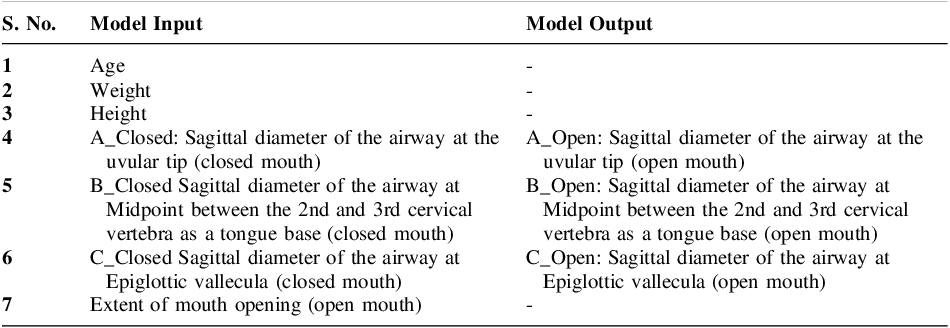
The demography data, closed-mouth airway features and the extent of mouth opening will serve as the input to the model, and the open-mouth airway dimensions will be the output.
Input and output of the ML model

2.5. Model evaluation
The model will be evaluated using Mean Absolute Error (MAE), Mean Squared Error (MSE) and R-Square to assess its predictive accuracy.
2.6. Model deployment
2.6.1. Design of medical devices
The predicted anatomical data can guide the design of video laryngoscope blades optimized for the unique upper airway characteristics of different populations. The model can also aid in designing custom-fit medical devices or tools that require a precise understanding of the airway anatomy, improving both functionality and patient comfort.
2.6.2. Clinical practice
The model would be used to predict changes after a certain amount of mouth opening, which would be very helpful for planning any investigation in the upper airway, e.g., intubation, sleep apnea studies, dentistry, etc.
3. Results and discussion
All the 13 patients considered in the study were males, with the mean age of participants being 33 years, with a standard deviation of 9.8 years, and the average weight was 72 kg, with a height mean of 170.8 cm. Additionally, the mouth opening, with an average of 57.8 mm (SD = 8.5 mm), exhibits moderate variation, as shown in Table 3.
Demographical Data

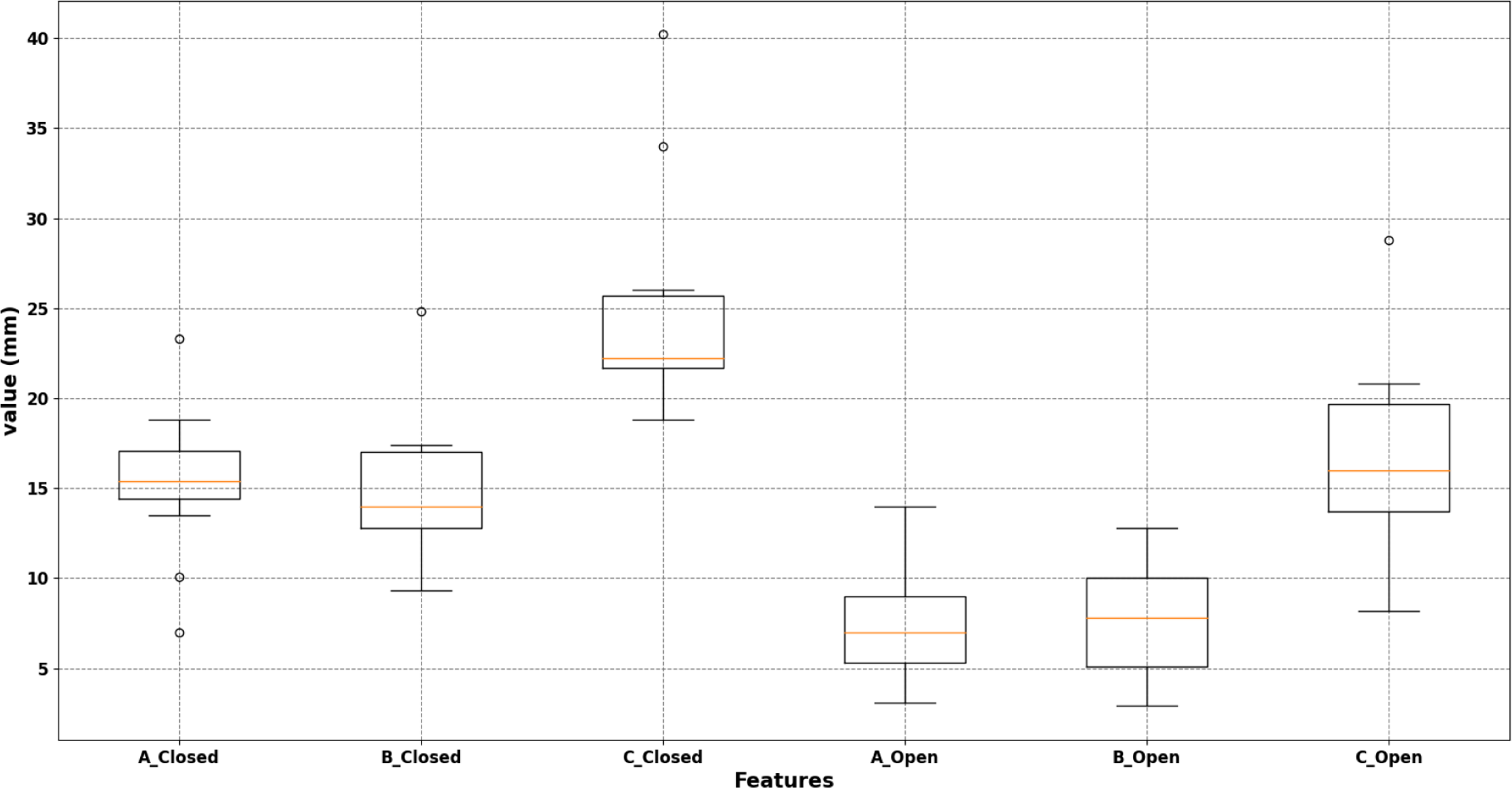
The box plot provides a detailed visual representation of the variability and distribution of closed and open airway measurements (A, B, and C) as shown in Figure 3. For closed-airway measurements, the median values for A, B, and C are approximately 16 mm, 14.6 mm, and 24.7 mm, respectively, with interquartile ranges (IQR) of around 2 mm for A, 4 mm for B, and 6 mm for C. In the open-airway state, the median values for A, B, and C shift to 7.7 mm, 7 mm, and 16.3 mm, respectively, with reduced IQRs of approximately 4 mm, 3 mm, and 5 mm. This significant reduction in dimensions A and B upon mouth opening suggests substantial anatomical changes that directly affect airway visibility and thus impact the effectiveness of laryngoscopy procedures. Dimension C exhibits relatively more stability across the two states, indicating that it may be less sensitive to mouth opening. However, the observed variability underscores the need to account for such anatomical shifts when designing and using medical devices like laryngoscopes. These findings emphasize the importance of understanding airway dynamics to ensure successful intubation and enhance patient safety and comfort during airway management procedures.
Distribution of values for each feature

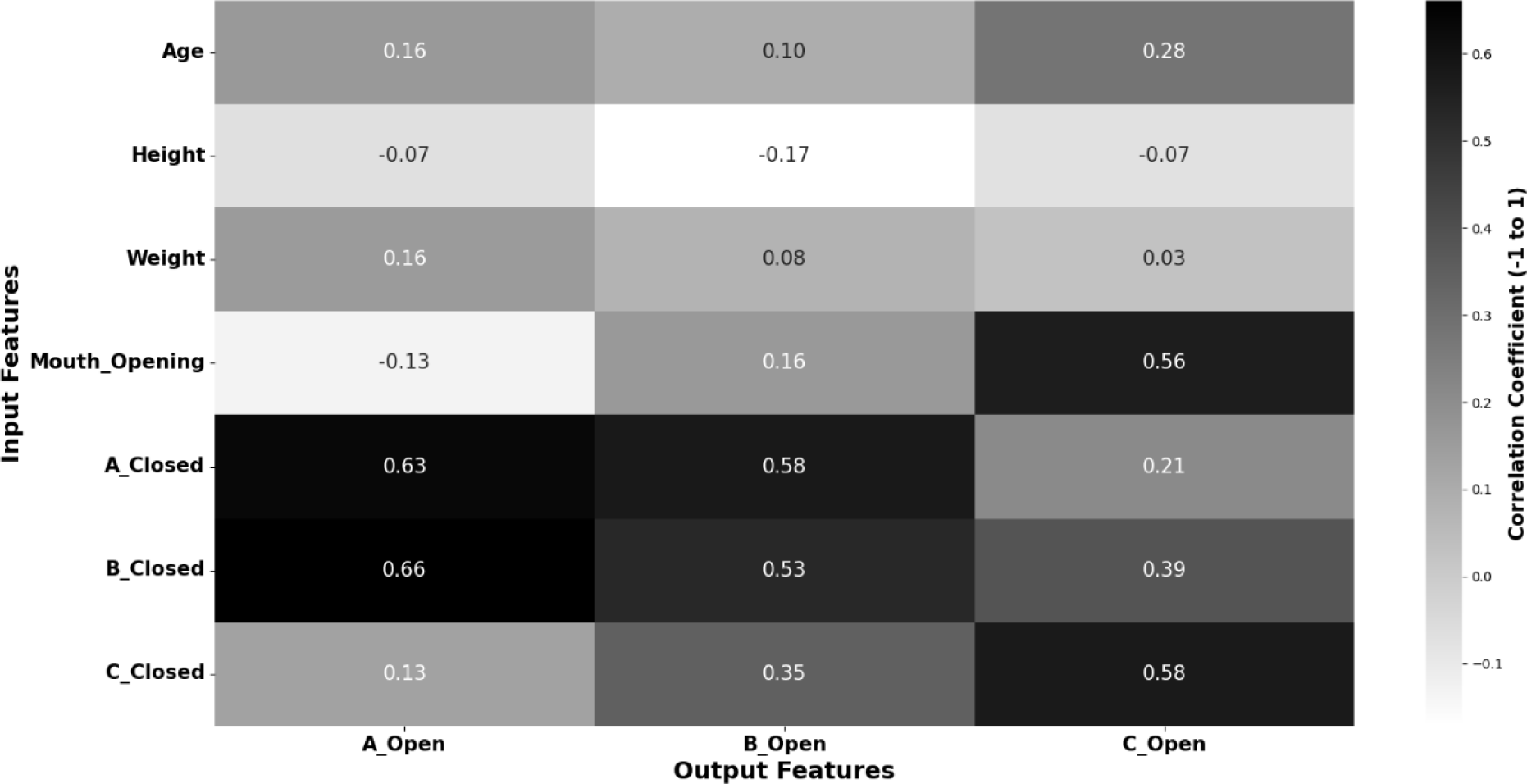
Heat map showing Pearson’s correlation coefficient between input and output features

Pearson’s correlation analysis was done between input and output features, which showed a significant correlation between some features, as shown in Figure 4. The correlation coefficient had low values for the demographic data with other parameters. Features with low correlation coefficients can be excluded from developing the machine learning algorithm, but as the number of data points is low, these data points are also used.
OLS algorithm was used to develop the model on 80% of the data as training data and 20% as the test data. Three models were developed using OLS, as it does not support multiple outputs. For Each model, all seven inputs were considered, and the three outputs were considered one by one, hence creating three models, i.e. model:1 with A_open as output, model:2 with B_Open as output, and model:3 with C_Open as output. For the performance evaluation, R-squared, MSE (Mean Squared Error), and MAE (Mean Absolute Error) were calculated for all three models.
R-squared, MSE and MAE for all three models

Ones the open-mouth parameters are defined, the blade design can be approached in two ways: first, by directly applying a space colonization algorithm to open-mouth airway scans and approximating the resulting shape into an L-shaped blade profile (Reference Sims, Boutelle, Inziello, Lobo Fenoglietto and StubbsSims et al., 2019); second, by grouping airway anatomies into clusters and designing blades optimized for each cluster. Our proposed approach adds a critical intermediate step using a machine learning model that predicts open-mouth airway dimensions from closed-mouth measurements and teeth distance. This predictive step enables practitioners to bypass the difficulty of obtaining open-mouth CT scans directly, significantly enhancing accessibility and feasibility. Additionally, this model can be embedded into clinical software systems, allowing anesthesiologists, dentists, and surgeons to input available closed mouth airway measurements along with the mouth-opening distance, thus providing accurate and personalized predictions of open-mouth airway dimensions. This capability would enhance clinical planning and device customization.
4. Conclusion
The model presented here serves two important purposes: providing clinicians with predictive tools to anticipate airway anatomy before intervention and assisting device designers in optimizing laryngoscope blade design. For clinicians, this predictive capability enhances preparation, reducing the likelihood of complications during procedures such as intubation. By estimating airway dimensions in the open-mouth state based on closed-mouth data, the model helps clinicians anticipate potential difficulties and select appropriate airway management strategies in advance. Simultaneously, the model aids device designers by predicting open-mouth airway conditions, enabling the development of population-specific or even patient-specific laryngoscope blades tailored to anatomical variations. While its immediate application in time-sensitive emergencies may be limited, the model’s broader utility lies in its role in planning, training, and optimizing airway management strategies in both elective and critical-care settings.
The algorithm demonstrates strong predictive performance, with R-squared values of 0.98, 0.94, and 0.74 for the three airway features under consideration. These results indicate the model’s effectiveness in estimating open-mouth airway anatomy based on available features. However, incorporating additional anatomical parameters could further enhance its predictive accuracy and clinical relevance. The ability to anticipate airway dimensions has significant potential applications, including optimizing laryngoscope blade design, improving intubation planning, and assessing conditions such as obstructive sleep apnea.
Despite its promise, the study is limited by the small dataset used for model training. Expanding the dataset with a more diverse sample population would likely enhance the model’s robustness and generalizability. Furthermore, the inclusion of intermediate mouth states, such as partially open conditions, could provide a more detailed and dynamic representation of airway variations, improving its applicability in real-world scenarios.
Beyond airway management, this methodology holds potential for broader applications in medical research and clinical practice. Similar predictive modeling techniques could be applied to study anatomical movements in other regions of the body, such as the shoulder or knee, offering insights into musculoskeletal dynamics and aiding in the development of customized medical devices and rehabilitation strategies. Future work should explore these avenues to expand the model’s impact across various domains of healthcare and biomedical engineering




 Open access

