





Impact Statement
This review paper aims to compile the latest findings in the field of carbon capture process modeling. The discussion encompasses various technologies, including physical absorption, chemical absorption, adsorption, membrane separation and chemical looping processes. This paper clearly highlights the existing advancements in modeling these technologies within the literature while also clarifying current trends and identifying research gaps in related fields. In addition, the features of these processes concerning product purity, recovery, energy efficiency and economics are discussed and compared. We believe that this paper will be beneficial for readers who are new to this area and wish to familiarize themselves with the subject.
Introduction
Carbon capture, utilization and storage (CCUS) is a key technology in the global effort to reduce carbon dioxide (CO2) emissions and mitigate climate change. The process involves capturing CO2 from different sources, such as power plants, industrial facilities or even directly from atmosphere, and either storing it underground or using it in various industrial applications. According to the International Energy Agency (IEA), carbon capture could contribute up to 19% of the total CO2 reductions needed by 2050 to meet climate goals (International Energy Agency, 2024). At present, carbon capture is crucial for decarbonizing hard-to-abate industries, including cement, steel and chemical production.
Three primary concepts for capturing CO2 have been developed in recent decades. These include pre-combustion, post-combustion and oxy-fuel combustion capture. Post-combustion capture has been widely proposed to capture CO2 from point emission sources after combustion, such as the waste gases produced by power plants, the steel and cement industries. In contrast, pre-combustion capture removes CO2 before the combustion of fuels. It is commonly associated with the gasification-based processes, such as the integrated gasification combined cycle (IGCC). Finally, oxy-fuel combustion involves burning fuels in the presence of high-purity oxygen. This process generates flue gas that is rich in CO2 and water vapor, allowing for the efficient separation of CO2 through condensation (Dinca et al., Reference Dinca, Slavu and Badea2018; Kheirinik et al., Reference Kheirinik, Ahmed and Rahmanian2021).
The existing technologies for CO2 capture are outlined as follows. Physical absorption, which relies on the physical solubility of CO2 in a solvent, is a prominent method for capturing CO2 when it is present at high partial pressures (Tiwari et al., Reference Tiwari, Bhardwaj, Nigam, Pant and Upadhyayula2022). Commercial demonstrations, such as the Selexol process (which uses dimethyl ethers of polyethylene glycol, or DEPG), the Rectisol process (which employs chilled methanol) and the Purisol process (which utilizes N-methyl-2-pyrrolidone), fall into this category (Wibowo et al., Reference Wibowo, Susanto, Grisdanurak, Hantoko, Yoshikawa, Qun and Yan2021). By contacting CO2-rich gases with the amine solvent, water-soluble compounds, such as carbamates or bicarbonates, can be formed. In contrast, chemical absorption captures CO2 at relatively low partial pressures. This method relies on the formation of chemical bonds between CO2 and specific solvents, typically amines (e.g., monoethanolamine (MEA), diethanolamine (DEA), methyldiethanolamine (MDEA) and piperazine (PZ)), to facilitate its removal (Tiwari et al., Reference Tiwari, Bhardwaj, Nigam, Pant and Upadhyayula2022). In chemical absorption processes, solvent regeneration is achieved through thermal stripping, which contributes to the energy-intensive nature of this method (Karimi et al., Reference Karimi, Shirzad, Silva and Rodrigues2022). In general, physical and chemical absorption processes can be operated in a scheme depicted in Figure 1a,b, respectively.
General flowsheets for various CO2 capture processes. (a) Physical absorption processes. (b) Chemical absorption processes. (c) Adsorption processes. (d) Membrane separation processes. (e) Chemical looping processes.

Adsorption-based methods capture CO2 by exploiting the differences in affinity between gases and adsorbents (Edens et al., Reference Edens, McGrath, Guo, Du, Zhou, Zhong, Shi, Wan, Bennett and Qiao2023). In these processes, the adsorbent operates in a cyclic manner, consisting of an adsorption step followed by a regeneration step. Figure 1c illustrates the conceptual flowsheet of the adsorption-based processes. Typically, regeneration (or desorption) can be achieved by either increasing the operating temperature (i.e., temperature-swing adsorption, or TSA), decreasing the pressure (i.e., pressure-swing adsorption, or PSA; vacuum pressure-swing adsorption, or VPSA) or employing a combination of both methods (i.e., pressure–temperature swing adsorption, or PTSA (Karimi et al., Reference Karimi, Shirzad, Silva and Rodrigues2022)). Solid materials, such as zeolites (Magomnang et al., Reference Magomnang, Maglinao, Capareda and Villanueva2018), activated carbons (Ferella et al., Reference Ferella, Puca, Taglieri, Rossi and Gallucci2017), silica gels (Shen et al., Reference Shen, Shi, Zhang, Na and Fu2018) and metal–organic frameworks (MOFs) (Ghanbari et al., Reference Ghanbari, Abnisa and Daud2020), have been reported to be feasible for CO2 capture through selective adsorption. To address the potential trade-offs between product purity and gas recovery (Stangeland et al., Reference Stangeland, Kalai, Li and Yu2017; Shaikh et al., Reference Shaikh, Pornpraprom and D’Elia2018), more complex configurations, such as the 2-staged PSA (Zhang et al., Reference Zhang and Xu2023; Obi et al., Reference Obi, Onyekuru and Orga2024) and dual-reflux pressure-swing adsorption (DRPSA) (Rossi et al., Reference Rossi, Paloni, Storti and Rota2019; Rossi et al., Reference Rossi, Storti and Rota2021), have been proposed. Since adsorption-based processes are semi-continuous, their production rates are generally lower compared to those of absorption-based processes (Buvik et al., Reference Buvik, Høisæter, Vevelstad and Knuutila2021). Careful consideration and optimization of the time step for each procedure are essential to ensure the overall productivity of the adsorption-based processes. Aside from capturing CO2 from significant point emission sources, adsorption-based methods can also be utilized for direct air capture (DAC) (Marinic et al., Reference Marinic and Likozar2023; Kong et al., Reference Kong, Song, Liao, Zhang, Wang, Deng and Feng2024).
Membrane separation technology represents an emerging approach for CO2 capture, utilizing three distinct transport mechanisms: solution diffusion, facilitated transport and molecular sieving. Specialized membrane modules, including Plate-and-Frame, Spiral-Wound and Shell-and-Tube (hollow fiber) configurations (Da Conceicao et al., Reference Da Conceicao, Nemetz, Rivero, Hornbostel and Lipscomb2023; Osman et al., Reference Osman, Chen, Elgarahy, Farghali, Mohamed, Priya, Hawash and Yap2024; Wang, Reference Wang2024), have been extensively designed for this purpose. Generally, the membrane allows CO2 to permeate while retaining other components, such as N2, in the retentate. This facilitates the effective separation of CO2. Figure 1d illustrates the conceptual design of the membrane-based process for CO2 capture. A fundamental challenge in membrane technology is the inherent trade-off between permeability and selectivity, which is characterized by the Robeson upper bound. Recent breakthroughs in materials science have focused on enhancing separation performance to exceed conventional limits (Asghari et al., Reference Asghari, Salahshoori, Salmani, Jorabchi, Moghaddam and Khonakdar2024; Hua et al., Reference Hua, Park and Jeong2024).
Chemical looping combustion represents another innovative approach to CO2 capture that utilizes metal oxides (MxOy) as oxygen carriers in a dual-reactor system designed to combust various types of fuels (Rydén et al., Reference Rydén and Lyngfelt2006; Adánez et al., Reference Adánez and Abad2019). The most commonly used metals include Fe (Ishida et al., Reference Ishida, Zheng and Akehata1987; Mattisson et al., Reference Mattisson and Lyngfelt2001; Fan et al., Reference Fan and Li2010), Cu (Richter et al., Reference Richter and Knoche1983; Ishida et al., Reference Ishida, Zheng and Akehata1987), Ni (Ishida et al., Reference Ishida, Zheng and Akehata1987; Mattisson et al., Reference Mattisson and Lyngfelt2001), Mn (Ishida et al., Reference Ishida, Zheng and Akehata1987; Mattisson et al., Reference Mattisson and Lyngfelt2001) and Co (Mattisson et al., Reference Mattisson and Lyngfelt2001). In this process, metal oxides circulate between a fuel reactor (the first step) and an air reactor (the second step), facilitating fuel combustion without direct contact with air. Specifically, the fuel reactor combusts the inlet fuels using oxygen in the metal oxide, thereby producing a flue gas. Subsequently, the reduced metal oxides are regenerated by combustion with air, allowing for the circulation of the oxygen carrier (Abbasi et al., Reference Abbasi, Farniaei, Rahimpour and Shariati2013; Abuelgasim et al., Reference Abuelgasim, Wang and Abdalazeez2021). The schematic representation of the chemical looping process is shown in Figure 1e. In this system, the significant heat generated during combustion reactions can be harnessed for electricity production, thereby enhancing overall energy efficiency (Abuelgasim et al., Reference Abuelgasim, Wang and Abdalazeez2021; Chang et al., Reference Chang, Hu, Xu, Huang, Chen, He, Han, Zhu, Ma and Wang2023). While CO2 and water vapor are the primary constituents, the composition of flue gases varies depending on the types of fuels being combusted. For instance, the combustion of biomass generates higher moisture content and volatile matter. The combustion of solid fuels may produce ash, particulates and other contaminants. Consequently, different considerations regarding the downstream separation process are necessary.
Table 1 presents a comparison of various carbon capture methods, illustrating the comprehensive concepts behind each technology, and the technological readiness levels (TRL) of these technologies. In this review, we will examine recent advancements in all the aforementioned CO2 capture technologies within the context of process simulation. We will highlight existing findings, current development trends and the challenges associated with studying each of these process technologies.
The comparison between different carbon capture methods (Coppola et al., Reference Coppola and Scala2021; Li et al., Reference Li, Yuan, Deng, Zhao and Lee2021; Goel et al., Reference Goel, Moghaddam, Liu, He and Konttinen2022; Hou et al., Reference Hou, Fong, Freeman, Hill and Xie2022; Kamolov et al., Reference Kamolov, Turakulov, Rejabov, Díaz-Sainz, Gómez-Coma, Norkobilov, Fallanza and Irabien2023; Abad et al., Reference Abad, Filsouf, Adánez-Rubio, Mendiara, de Diego, Izquierdo, Gayán and Adánez2024; Soo et al., Reference Soo, Lee, Wu, Tao, Wang, Zhu and Bu2024; Chen et al., Reference Chen, Won and Yu2025)

Progress in the modeling of CO2 capture processes
Physical absorption
Most existing process studies in the field of physical absorption methods have extensively focused on the Selexol and Rectisol processes. The Selexol solvent, a mixture of dimethyl ethers of polyethylene glycol (DEPG), is highly effective at absorbing CO2 at elevated pressures (usually in 30–60 atm (Chen et al., Reference Chen, Chen and Hung2013)), making it particularly advantageous for gas streams with high CO2 partial pressures. Well-established thermodynamic models, such as Kent-Eisenberg model, have frequently been used to model this process in commercial simulation software (Koronaki et al., Reference Koronaki, Prentza and Papaefthimiou2015). Within the literature, the basic dual-staged Selecol process for acid gas (i.e., CO2 and H2S) removal, typically incorporated in the IGCC process, has been widely studied in the literature (Ahn, Reference Ahn2017; Zhang et al., Reference Zhang and Ahn2019). Optimization, techno-economic and exergo-economic evaluation have also been demonstrated in the literature using rigorous modeling frameworks (Ramzan et al., Reference Ramzan, Shakeel, Güngör and Zaman2018; Mei et al., Reference Mei, Zhai, Zhao, Yao and Ma2024).
In contrast, the Rectisol process, which employs a methanol-based solvent, operates most effectively at low temperatures (usually 25–40 °C) (Gatti et al., Reference Gatti, Martelli, Maréchal and Consonni2014; Sharma et al., Reference Sharma, Hoadley, Mahajani and Ganesh2016), where the solubility of CO2 is enhanced. Equation of state models (e.g., Redlich-Kwong-Soave, or RKS) have primarily been utilized to describe the mixture properties in this system. Within the literature, the single-stage Rectisol process has been proposed using rigorous modeling (Yang et al., Reference Yang, Zhang, Xie, Gu and Liu2021; Yang et al., Reference Yang, Zhang and Song2022), demonstrating improved performance with feedstocks containing acidic gases. Various heat integration strategies have also been proposed for reducing energy consumption for the Rectisol process (Sharma et al., Reference Sharma, Hoadley, Mahajani and Ganesh2016; Sun et al., Reference Sun, Liu, Zhang and Dai2024).
More recently, ionic liquids (ILs) have garnered significant interest as alternative physical solvents for CO2 capture. ILs are molten salts that remain liquid at temperatures below 100 °C. They possess unique properties, such as low volatility, high thermal stability and a tunable structure, which make them particularly attractive for CO2 capture applications. The interaction between CO2 and ILs is largely enhanced by the unique ion pairings and structures of the ILs, which can be customized to optimize CO2 solubility and selectivity. Various literature studies have reported the potential for reducing energy using ILs as physical absorbents (de Riva et al., Reference de Riva, Suarez-Reyes, Moreno, Díaz, Ferro and Palomar2017; Ma et al., Reference Ma, Gao, Wang, Hu and Cui2018; Li et al., Reference Li, Huang, Jiang, Xia, Wang and Ai2020). However, several limitations hinder the large-scale application of ILs for CO2 capture. Notably, most ILs exhibit high viscosity, which significantly reduces mass transfer rates and complicates process design. In addition, the high cost of IL synthesis and uncertainties regarding their long-term environmental impact pose further challenges. Addressing these drawbacks remains a key focus of ongoing research in the field (Elmobarak et al., Reference Elmobarak, Almomani, Tawalbeh, Al-Othman, Martis and Rasool2023).
To date, inherent limitations continue to hinder the effectiveness of physical absorption processes in practical applications. For instance, the dependence on high CO2 partial pressures for efficient absorption renders the process ineffective for capturing CO2 under industrially relevant conditions, such as flue gas at atmospheric pressure. Future research through process modeling should focus on identifying new physical absorbents, improving their stability and enhancing our understanding of process dynamics.
Chemical absorption
To date, various solvents have been reported to efficiently capture CO2 through chemical absorption. Among these, monoethanolamine (MEA) has established itself as the benchmark solvent for carbon capture applications, particularly in post-combustion processes. In the literature, most existing process studies have modeled the chemical absorption processes using rate-based simulations and have employed the e-NRTL (Putta et al., Reference Putta, Pinto, Svendsen and Knuutila2016) and extended UNIQUAC (Aronu et al., Reference Aronu, Gondal, Hessen, Haug-Warberg, Hartono, Hoff and Svendsen2011) models as the thermodynamic framework for process simulation. Within the existing research on process modeling, the focus is on process design, the development of various configurations, dynamics and optimization. For instance, design and optimization of the entire MEA-based process have been demonstrated to enhance overall process efficiency (von Harbou et al., Reference von Harbou, Imle and Hasse2014; Luo et al., Reference Luo and Wang2017). Advanced absorber configurations, such as the rotated bed reactor, have also been modeled to mitigate the energy inefficiencies associated with the MEA-based process by enhancing mass transfer (Borhani et al., Reference Borhani, Oko and Wang2019; Im et al., Reference Im, Jung and Lee2020). The incorporation of various process intensification strategies, such as the utilization of heat pump, intercoolers and others, has also been demonstrated in the literature for reducing energy consumption (Taipabu et al., Reference Taipabu, Viswanathan, Wu, Handogo, Mualim and Huda2023; Zhou et al., Reference Zhou, Zhu, Chen, Ren, Su, Hu, Wang and Xiang2023). Other studies addressed the process dynamics and control structures can also be found in the literature (Nittaya et al., Reference Nittaya, Douglas, Croiset and Ricardez-Sandoval2014; Moser et al., Reference Moser, Wiechers, Schmidt, Monteiro, Charalambous, Garcia and Fernandez2020). Currently, modeling MEA-based systems presents several technical challenges due to the need to simultaneously incorporate mass and energy balances, kinetics and ions into the process model. In addition, other practical challenges that concern energy efficiency (Oh et al., Reference Oh, Yun and Kim2018), solvent degradation (Vega et al., Reference Vega, Sanna, Maroto-Valer, Navarrete and Abad-Correa2016) and environmental impact (Karl et al., Reference Karl, Wright, Berglen and Denby2011) continue to be addressed through the use of process modeling technologies.
In addition, ammonia and potassium carbonate (K2CO3) solutions can serve as conventional chemical absorbents for CO2 capture. The existing literature modeling the chemical absorption processes using ammonia solutions has consistently found that operating at lower temperatures increases CO2 loading and, consequently, reduces solvent recirculation rates (Niu et al., Reference Niu, Guo, Zeng and Lin2012; Jongpitisub et al., Reference Jongpitisub, Siemanond and Henni2015). The use of a K2CO3 solution for chemical absorption was one of the earliest demonstrations of CO2 capture. Previous modeling studies revealed that the feedstock flow rate and the concentration of K2CO3 significantly influence CO2 removal efficiency (Wu et al., Reference Wu, Wu, Hu, Mirza, Stevens and Mumford2018; Kaur et al., Reference Kaur and Chen2020). Modifications to the configuration of K2CO3-based processes, including the incorporation of flue gas pre-cooling, rich solvent preheating, lean vapor recompression (Ayittey et al., Reference Ayittey, Obek, Saptoro, Perumal and Wong2020) and the use of a hollow fiber membrane contactor (Li et al., Reference Li, Wang, Zhang, Hu, Cheng and Zhong2018; Nakhjiri et al., Reference Nakhjiri, Heydarinasab, Bakhtiari and Mohammadi2020), have also been documented in the literature. However, these technologies also have certain limitations. The high volatility and potential corrosiveness of the ammonia solution may lead to increased initial setup costs and operational challenges. Compared to other chemical absorbents, the kinetics of ammonia as a solvent for capturing CO2 is also slower (Wang et al., Reference Wang, Conway, Fernandes, Lawrance, Burns, Puxty and Maeder2011; Jilvero et al., Reference Jilvero, Normann, Andersson and Johnsson2014).
In addition, mixed amine and biphasic systems have emerged as promising methods to improve process performance. The use of mixed amines leverages the complementary properties of various amines to achieve enhanced performance. For example, the use of mixed MEA/PZ (Orangi et al., Reference Orangi, Aromada, Razi and Øi2022; Zafari et al., Reference Zafari and Ghaemi2023), MDEA/PZ (Zhao et al., Reference Zhao, Liu, Cui, Liu, Yue, Tang, Liu, Lu and Liang2017; Hosseini-Ardali et al., Reference Hosseini-Ardali, Hazrati-Kalbibaki, Fattahi and Lezsovits2020), AMP/PZ/MEA solvents (Nwaoha et al., Reference Nwaoha, Beaulieu, Tontiwachwuthikul and Gibson2018; Nakrak et al., Reference Nakrak, Tontiwachwuthikul, Gao, Liang and Sema2023) and MDEA/MEA (Capra et al., Reference Capra, Fettarappa, Magli, Gatti and Martelli2018; Orangi et al., Reference Orangi, Aromada, Razi and Øi2022) for CO2 capture has been documented in the literature to enhance process performance in term of kinetics, transfer rate or cyclic durability. In the rigorous modeling of these systems, the complex reaction kinetics and the characterization of mass transfer will present significant challenges.
In contrast, the biphasic CO2 capture process exhibits phase separation (i.e., CO2-lean and CO2-rich) upon the dissolution of CO2 in the liquid phase. The modeling of these systems has been limited due to their complex thermodynamic behavior, despite numerous experimental studies (Barzagli et al., Reference Barzagli, Mani and Peruzzini2017; Liu et al., Reference Liu, Niu, Zhan, Xing, Huang, Yuan, Peng, Chen and Li2024). Recently, Chen et al. (Chen et al., Reference Chen, Won and Yu2025) investigated a novel biphasic process that employs a blended solvent consisting of 2-ethylamino ethanol (EAE), diethylene glycol diethyl ether (DEGDEE) and water, representing one of the few attempts to rigorously model the biphasic system. They demonstrated the potential for utilizing low-temperature waste heat to mitigate CO2 indirect emissions. Future simulation studies are recommended to investigate the increase in viscosity of the CO2-rich phase, as a more thorough consideration of mass transfer and pumping requirements is necessary.
In summary, chemical absorption plays a crucial role in carbon capture. Processes that incorporate various chemical absorbents have been extensively studied in terms of design, optimization and configuration development, among other factors. Future research is recommended to address operational challenges, such as potential absorbent degradation and viscosity issues, in both conventional and new processes, including the use of blended or biphasic solvents.
Adsorption
Adsorption-based processes for CO2 capture have been extensively studied in the literature. In general, PSA utilizes differences in pressure-dependent adsorption capacities to achieve CO2 separation, demonstrating particular effectiveness for high-pressure feed streams in pre-combustion applications. However, its application to post-combustion capture encounters energy penalties related to flue gas compression (Farmahini et al., Reference Farmahini, Krishnamurthy, Friedrich, Brandani and Sarkisov2021; Osman et al., Reference Osman, Hefny, Abdel Maksoud, Elgarahy and Rooney2021; Zhu et al., Reference Zhu, Xie, Wu, Miao, Xiang, Chen, Ge, Gan, Yang and Zhang2022). VPSA is well-suited for low-pressure feed streams as it eliminates the need to pressurize flue gas (Deng et al., Reference Deng, Gopalan and Sarkisov2023). Nevertheless, achieving vacuum conditions can be challenging in large-scale systems (Farmahini et al., Reference Farmahini, Krishnamurthy, Friedrich, Brandani and Sarkisov2021; Zhu et al., Reference Zhu, Xie, Wu, Miao, Xiang, Chen, Ge, Gan, Yang and Zhang2022; Chung et al., Reference Chung, Kim, Jung and Lee2024). TSA utilizes temperature-dependent adsorption behavior and demonstrates significant potential in systems that can access low-grade heat, but it may require a longer cycle time due to the limited heating and cooling rates of the adsorption bed. However, extensive modeling studies have concentrated on breakthrough behavior, with relatively limited progress in modeling cyclic adsorption processes, including the optimization of design and operating parameters (Chatziasteriou et al., Reference Chatziasteriou, Georgiadis and Kikkinides2024; Ward et al., Reference Ward and Pini2024).
Extensive studies have highlighted the benefits of employing the DRPSA configuration to balance the trade-off between purity and recovery compared to the conventional PSA method (Rossi et al., Reference Rossi, Paloni, Storti and Rota2019; Guan et al., Reference Guan, Wang, Yu, Shen, He, Tang, Li and Zhang2021). For instance, Chang et al. (Chang et al., Reference Chang, Chiu, Jao, Shang, Lin and Yu2024) proposed a cyclic model of the DRPSA process for capturing CO2 from flue gas. Their process achieved a CO2 purity and recovery rate of 93.8%, while requiring less energy (DRPSA: 1.74 GJ/ton compared to conventional PSA: 2–3 GJ/ton), marking a significant improvement over the conventional PSA process (Kong et al., Reference Kong, Song, Liao, Zhang, Wang, Deng and Feng2024). In addition to the DRPSA configuration, development of vacuum and temperature swing adsorption (VTSA) (Elfving et al., Reference Elfving, Bajamundi, Kauppinen and Sainio2017; Gao et al., Reference Gao, Hoshino and Inoue2020), steam-assisted vacuum swing adsorption (SA-VSA) (Stampi-Bombelli et al., Reference Stampi-Bombelli, van der Spek and Mazzotti2020; Liu et al., Reference Liu, Huang, Zhang, Fang, Liu, Wang and Jiang2023) and multi-bed configurations (Jung et al., Reference Jung, Park, Won and Lee2018; Xu et al., Reference Xu, Chen, Seo and Deng2019; Beleli et al., Reference Beleli, de Paiva, Seckler and Le Roux2023), has been ongoing to enhance the process efficiency.
The properties of adsorbents (e.g., adsorption isotherms, mass transfer, kinetics) are essential for modeling adsorption-based processes. Adsorption isotherms quantify the amount of gaseous species that can be adsorbed under various conditions (i.e., temperature, pressure). Various isotherm models, such as the Langmuir and Freundlich models (Tao et al., Reference Tao, Zhang and Xu2022; Lin et al., Reference Lin, Meng, Ju, Han, Meng, Li, Du, Song, Lan and Jiang2023; Ma et al., Reference Ma, Xu, Su, Shao, Zeng, Li and Wang2023), can be used for this purpose. Mass transfer refers to the movement of adsorbate molecules from the gas phase to the adsorption sites within the adsorbent, significantly impacting the efficiency and timescale of the process (Lin et al., Reference Lin, Meng, Ju, Han, Meng, Li, Du, Song, Lan and Jiang2023). When developing adsorption kinetics, it is crucial to consider factors such as external film resistance and internal diffusion resistance in simulations. In addition, descriptions of other properties – such as pore sizes, surface areas and surface functional groups – enhance the modeling performance of adsorption-based processes (Lin et al., Reference Lin, Meng, Ju, Han, Meng, Li, Du, Song, Lan and Jiang2023; Hanh et al., Reference Hanh, Shih, Chen, Srinophakun, Chiu, Liu, Tsai, Cheng and Chang2024). For adsorption beds, various configurations such as fixed beds (Osman et al., Reference Osman, Hefny, Abdel Maksoud, Elgarahy and Rooney2021; Akinola et al., Reference Akinola, Bonilla Prado and Wang2022), fluidized beds (Dhoke et al., Reference Dhoke, Cloete, Krishnamurthy, Seo, Luz, Soukri, Park, Blom, Amini and Zaabout2020) and moving beds (Grądziel et al., Reference Grądziel, Zima, Cebula, Rerak, Kozak-Jagieła, Pawłowski, Blom, Nord, Skjervold and Mondino2023; Skjervold et al., Reference Skjervold and Nord2023) can be utilized. Other configurations, such as radial flow fixed beds and multi-stage fluidized beds, enhance efficiency and flexibility, necessitating customized models to accurately capture their unique characteristics (Pirklbauer et al., Reference Pirklbauer, Schöny, Pröll and Hofbauer2018; Singh et al., Reference Singh, Alatyar, Berrouk and Saeed2023).
In summary, adsorption processes for low CO2 concentrations show promise in terms of specific energy when compared with other carbon capture methods. Future research should focus on accurately modeling multi-component isotherms, optimizing multi-bed configurations, enhancing cyclic operations and further understanding the properties of adsorbents.
Membrane separation
The rigorous modeling of membrane-based CO2 capture processes has attracted considerable research interest. In this context, the membrane module was developed on a user-defined platform, such as Aspen Custom Modeler, and integrated with simulation software, including Aspen Plus or Aspen HYSYS, for flowsheet analysis. Within the existing field, Hoorfar et al. (Hoorfar et al., Reference Hoorfar, Alcheikhhamdon and Chen2018) proposed various membrane configurations and identified that a two-stage process with recycling enhances overall process performance. Samei and Raisi (Samei et al., Reference Samei and Raisi2022) and Janakiram et al. (Janakiram et al., Reference Janakiram, Lindbråthen, Ansaloni, Peters and Deng2022) reported that the properties of the membrane significantly affect the optimal configuration for the separation. The optimization of membrane-based processes through the integration of a rigorous model with supplementary algorithms has also been conducted in the literature (Yerumbu et al., Reference Yerumbu, Sahoo and Sivalingam2023; Pedrozo et al., Reference Pedrozo, Panagakos and Biegler2024; Song et al., Reference Song, Kim, Lee, Lee, Yeo and Kim2024). In addition to separating CO2 from point sources, membrane-based process has also been utilized in direct air capture (DAC) (Gama et al., Reference Gama, Dantas, Sanyal and Lima2024).
Accurate modeling of membrane modules necessitates a thorough consideration of non-ideal effects that lead to deviations from theoretical predictions. These include the Joule-Thomson effect during gas expansion, concentration polarization at membrane interfaces and deviations in real gas behavior (Kancherla et al., Reference Kancherla, Nazia, Kalyani and Sridhar2021; Da Conceicao et al., Reference Da Conceicao, Nemetz, Rivero, Hornbostel and Lipscomb2023). Without proper consideration of these non-ideal effects, the driving force and permeance may be overestimated, resulting in an overly optimistic assessment of separation capacity (Li et al., Reference Li, Lian, Zhang and Song2023). The literature discusses various non-ideal effects in membrane processes, including the examination of gas mixing near the membrane surface by Abdul Majid et al. (Abdul Majid et al., Reference Abdul Majid, Kuznetsova, Castel, Favre and Hreiz2024), incorporation of fugacity calculations by Jomekian and Bazooyar et al. (Jomekian et al., Reference Jomekian and Bazooyar2023) and the correction of mass transfer coefficient by Ververs et al. (Ververs et al., Reference Ververs, Ongis, Arratibel, Di Felice and Gallucci2024). In addition to process modeling, the use of CFD simulation provides detailed insights into the complex interplay between module geometry and transport phenomena. It can help identify the relationships between structural parameters and system performance, including hydrodynamics, mass transfer and heat transfer mechanisms (Abdulabbas et al., Reference Abdulabbas, Mohammed and Al-Hattab2024; Mansoorkhaki et al., Reference Mansoorkhaki, Esmaeili, Abolhasani, Saadat and Kim2024; Momeni et al., Reference Momeni, Kargari, Dadvar and Jafari2024), as well as process designs and types of membranes (Samei et al., Reference Samei and Raisi2022). Despite these advancements, challenges persist due to the lack of local experimental validation of hydrodynamics, which should be addressed in future research (Foo et al., Reference Foo, Liang, Goh and Fletcher2023).
In general, most literature studies on the development of membrane-based processes focus on creating configurations for separating binary mixtures that contain CO2. We recommend future exploration into developing processes that utilize more industrially relevant gas mixtures, as well as more detailed modeling of the non-ideal effects of membranes and a more comprehensive description of hydrodynamics (Li et al., Reference Li, Lian, Zhang and Song2023). Hybrid configurations that integrate membrane technologies with other carbon capture methods, as well as multi-stage membrane separation designs (Song et al., Reference Song, Kim, Lee, Lee, Yeo and Kim2024; Ni et al., Reference Ni, Li, Zhang, Bao and Zhang2025), are also recommended for further investigation.
Chemical looping process
Essentially, chemical looping processes involve both solid (i.e., metal oxides) and vapor (i.e., flue gases) phases. Due to the lack of reaction kinetics, most existing studies have proposed using equilibrium-based (i.e., the RGibbs module in Aspen Plus) (Cui et al., Reference Cui, Sun, Tian, Liu and Guo2023; Wu et al., Reference Wu, Gao, Wu and Xiao2023; Jiang et al., Reference Jiang, Li, Santasalo-Aarnio and Järvinen2024) or lumped modeling (Saeed et al., Reference Saeed, Shahrivar, Surywanshi, Kumar, Mattisson and Soleimanisalim2023; Pankhedkar et al., Reference Pankhedkar, Sartape, Singh, Gudi, Biswas and Bhargava2024; Yaqub et al., Reference Yaqub, Oboirien and Leion2024) methods to simulate these processes. This facilitates further techno-economic assessments (TEA) and life cycle assessment (LCA) studies (Zhao et al., Reference Zhao, Zhang, Cui, Duan, Huang, Wei, Mohamed, Shi, Yi and Nimmo2022; Lim et al., Reference Lim, Tan, Chan, Veksha, Lim, Lisak and Liu2023; Ortiz et al., Reference Ortiz, García-Luna, Chacartegui, Valverde and Pérez-Maqueda2023). Essentially, these types of simulations provide a quick understanding of overall process performance based on experimental observations.
The application of advanced technologies in modeling chemical looping processes is well-documented in the literature. The incorporation of CFD technology for modeling is demonstrated in the work of (Wang et al. Reference Wang, Chen, Chen, Yuan, Duan and Xiang2024) (to retrofit a rotary kiln with a single-atom fluid heat recovery system and an electric field) and Chou et al. (to simulate granular flow and heat transfer in a rotating calciner for CO2 capture) (Chou et al., Reference Chou, Chen, Hsiau and Liu2023), among others. The incorporation of DFT-based kinetic modeling has been demonstrated by Cai and Li (for the calcium looping process) (Cai and Li Reference Cai and Li2024), Cai et al. (Reference Cai, Liang, Tang, Yang, Fang and Yao2024) (Zr and Mg doping for enhancing CO2 adsorption in calcium looping processes), among others. These studies provide more detailed insights into reactor design, particularly concerning the physical and chemical behaviors occurring within the reactor.
Furthermore, various processes can benefit from the in-situ CO2 removal capabilities of chemical looping technology. Specifically, the sorption-enhanced water gas shift reaction (Chu et al., Reference Chu, Li, Zhang and Fang2023; Davies et al., Reference Davies, Babamohammadi, Yan, Clough and Masoudi Soltani2024), steam methane reforming (Cheng et al., Reference Cheng, Kim, Ebneyamini, Li, Lim and Ellis2023; Zhang et al., Reference Zhang, Li, Chu and Fang2023) and gasification (Wang et al., Reference Wang, Wang, Jin, Ma and Ling2023; Song et al., Reference Song, Chen, Zhou, Fang, Lu, Xiao and Zeng2024) are frequently discussed to identify cleaner methods for hydrogen production. The incorporation of machine-learning technologies in modeling chemical looping processes has also been demonstrated. These technologies are particularly effective in describing the dynamics of chemical looping processes (Song et al., Reference Song, Lu, Wang, Liu, Wang, Xiao and Zeng2023; Li et al., Reference Li, Wang, Liu and Tian2024).
To date, there are challenges that hinder the commercialization of chemical looping processes. For example, the highly exothermic reactions occurring in the fuel reactor can lead to the sintering or melting of the oxygen carrier (Abbasi et al., Reference Abbasi, Farniaei, Rahimpour and Shariati2013; Narindri Rara Winayu et al., Reference Narindri Rara Winayu, Tseng and Chu2023). In addition, the overall capital expense of implementing chemical looping systems on a large scale remains a significant obstacle (Singh et al., Reference Singh, Buelens, Poelman, Marin and Galvita2023; Fleiß et al., Reference Fleiß, Priscak, Hammerschmid, Fuchs, Müller and Hofbauer2024). To address these issues, it is recommended that further development focus on detailed reactor design, the synthesis of oxygen carriers and the large-scale synthesis and operation of chemical looping processes.
Dynamic modeling of CO2 capture processes
Aside from steady-state design, dynamic process modeling is also essential. In practice, dynamic simulation can accurately reflect the performance of a process under varying conditions, capturing transient behaviors and real-time responses that are often observed during operation. In addition, it demonstrates how control strategies respond to operational changes, such as flow rate and inlet gas composition. Data from existing pilot-scale studies can be valuable for validating the proposed dynamic systems.
Being one of the most mature technologies for CO2 capture, the solvent-based chemical absorption process has garnered significant attention in the field of dynamic modeling over the decades. Existing studies have reported on the proposal of basic control structures, indicated that flexible operation is technically feasible and highlighted the need for further model improvements (Nittaya et al., Reference Nittaya, Douglas, Croiset and Ricardez-Sandoval2014; Nittaya et al., Reference Nittaya, Douglas, Croiset and Ricardez-Sandoval2014; Flø et al., Reference Flø, Kvamsdal, Hillestad and Mejdell2016; Bui et al., Reference Bui, Flø, de Cazenove and Mac Dowell2020). However, the limitation of software somewhat hinders the progress in the field, as will be discussed in Section 2.7. In contrast, dynamic modeling for physical absorption processes have been rate. However, considering that physical absorption has been industrially proven and implemented in 60 commercial gasification and natural gas operations worldwide, including projects such as OptiCanada (Canada), Sarlux and API (Italy), and Coffeyville (USA) (Hekmatmehr et al., Reference Hekmatmehr, Esmaeili, Pourmahdi, Atashrouz, Abedi, Abuswer, Nedeljkovic, Latifi, Farag and Mohaddespour2024), it is believed that there is sufficient knowledge in this field.
Several studies focusing on dynamic and realistic modeling can be found in the literature regarding various technologies. For instance, Wilkes et al. (Reference Wilkes and Brown2022) developed a vacuum swing adsorption model for gas turbine exhaust, which maintained CO₂ purity and recovery with only minor deviations during realistic load swings, performing comparably to an amine system under highly transient flow conditions. Tripodi et al. (Reference Tripodi, La Pietra, Tommasi and Rossetti2023) created a dynamic simulation of a hollow-fiber membrane, characterizing the system’s response and recovery times during pressure and flow transients. Lindmüller et al. (Reference Lindmüller, Haus and Heinrich2023) examined the dynamic operation of chemical looping, enhancing the understanding of the transient behavior of the interconnected fluidized bed system. We believe that further studies are ongoing to advance dynamic modeling.
Limitation in process simulation
Despite significant efforts in modeling CO2 capture processes, the following limitations remain at the current stage. These limitations are outlined as follows.
To date, a significant gap exists in the dynamic modeling of CO2 capture processes. The limitations of the software, along with the lack of detailed process information (e.g., kinetics), are the primary reasons for this gap. Notably, we would like to emphasize the inadequacy of Aspen Technology’s dynamic modeling tool, Aspen Plus Dynamics, in supporting the description of chemical capture processes using rate-based calculations (Anugraha et al., Reference Anugraha and Brata2023). Consequently, equilibrium-based calculations have been employed in the limited number of existing studies, which do not accurately represent the precise behavior in the absorber (Nittaya et al., Reference Nittaya, Douglas, Croiset and Ricardez-Sandoval2014; Gaspar et al., Reference Gaspar, Gladis, Jørgensen, Thomsen, Von Solms and Fosbøl2016). In addition, most rigorous steady-state modeling encounters convergence issues. This includes rate-based modeling of chemical absorption systems that incorporate detailed mass, energy, and charge balances, as well as the modeling of adsorption units or membrane systems that involve complex flow fields and transport phenomena. When modeling adsorption-based processes using Aspen Adsorption, the convergence issues compel existing studies to adopt common simplifications, such as employing a one-dimensional flow field and a linear driving force model to represent the behaviors (Deschamps et al., Reference Deschamps, Kanniche, Grandjean and Authier2022; Yousef et al., Reference Yousef, Qiblawey and El-Naas2024). The requirement to use the same form of adsorption isotherm for each species in a column restricts the ability to accurately depict more complex adsorption behaviors.
In contrast, the absence of universal modules for novel processes, such as membrane separation and chemical looping, presents a significant barrier in this field (Iora et al., Reference Iora and Thangavelautham2012; Li et al., Reference Li, Lian, Zhang and Song2023). To obtain sufficient details, considerable effort is required to develop models grounded in scientific and engineering principles. However, these modules may be too complex for practical use in flowsheet synthesis. Consequently, numerous studies have sought to model these units using simpler approaches, such as equilibrium-based reactions or yield-based reactions and separations (i.e., zero-dimensional models). While these types of models can be beneficial for conceptual studies, their practical reliability remains uncertain.
Overall, these limitations underscore the necessity for careful interpretation of simulation results and, whenever possible, validation against experimental data to ensure reliability and practical relevance.
Evaluation results in the literature
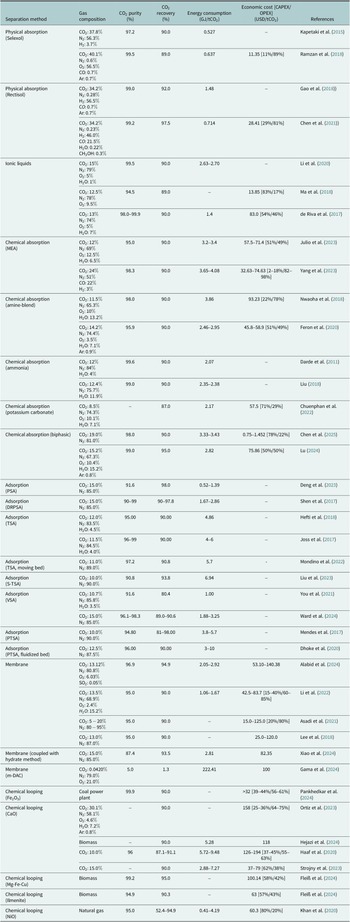
The recent simulation findings for various carbon capture technologies are summarized in Table 2. This comparison highlights the feed composition, capture efficiency and purity, energy consumption and economic performance across different processes. The observations are discussed below.
Comparison of different processes for CO2 capture

In the existing literature, physical absorption processes have been developed to capture CO2 from higher concentration sources (i.e., 13% to 30% by volume), while chemical absorption and membrane-based processes have focused on dilute point sources (i.e., less than 15% by volume), such as syngas produced from coal gasification. As chemical looping processes capture CO2 from combustion, their working concentration may depend significantly on the fuels used. Currently, existing modeling studies have attempted to incorporate chemical looping in the combustion of coal, biomass and natural gas.
In terms of energy performance, physical absorption (i.e., 0.5 to 1.5 GJ/ton) demonstrates more favorable energy economics compared to chemical absorption (i.e., 2.0 to 4.0 GJ/ton). The primary reason for this is the simpler solvent regeneration process in physical absorption, which occurs through pressure differences and is more energy-efficient than the thermal stripping required in chemical absorption. Proposing process intensification for chemical absorption processes, such as heat-pump-assisted processes, offers a pathway to reduce energy consumption to below 2.0 GJ per ton, albeit at the cost of complicating the process configurations. For adsorption processes, TSA processes (i.e., 4.0 to 6.0 GJ/ton) generally consume more energy compared to the PSA processes (i.e., 0.5 to 2.9 GJ/Ton). The significant variation in energy consumption results from the different properties of the various adsorbents used. Membrane-based processes also exhibit favorable energy performance, ranging from 1.06 to 2.92 GJ/ton. However, their performance is significantly influenced by the permeability and selectivity of the membrane module, leading to variations in the pressurization requirements needed to generate the driving force for permeation. Chemical looping processes display variable energy profiles that are strongly correlated with the properties of the oxygen carriers and the conditions of the process. The energy requirements are particularly sensitive to the redox characteristics of the metal oxide carriers and the composition of the feed gas stream.
The economics of all CO2 capture processes can be significantly influenced by the assumptions made in the study. These include the use of different financial model, consideration of production scale and the region where the technologies are deployed. Currently, the reported unit cost of CO2 capture is less than $150/ton, regardless of the technologies employed. In some cases, unit costs have been reported to be below $50/ton. This suggests that these studies primarily focused on commercial-scale CO2 capture. Given that relevant technologies have various TRLs, it is advisable to conduct economic assessment of small-scale operations that reflect the conditions associated with initial deployment phases. This approach is also consistent with the developmental stage characterized by the absence of those technologies. In addition, it is recommended that future techno-economic assessments be validated with pilot-scale data to enhance the reliability of the results generated.
As demonstrated in Table 2, the distribution of capital expenditure (CAPEX) and operating expenditure (OPEX) varies across different studies when analyzing the same technology due to the process uncertainties. Furthermore, certain items related to less mature processes pose challenges in techno-economic evaluations. These factors include the operational longevity of materials (e.g., membranes, absorbents, oxygen carriers) and the module efficiency of membranes, among others. The high-temperature reactors and the solid circulation and processing units in chemical looping processes are the primary cost drivers. However, the absence of cost data for these components complicates their techno-economic assessment. The clarification of issues warrants further study.
The current research gaps in the field of process simulation for CO2 capture technologies are summarized below. Firstly, existing studies often concentrate on comparing the specific energy requirements of various capture technologies rather than providing a more comprehensive analysis that includes economic, environmental and spatial considerations. Secondly, existing studies do not consider the differences in productivity among various processes (e.g., adsorption-based and absorption-based) when claiming the superiority of one technique over the others. In addition, current environmental analyses tend to focus solely on the indirect emissions resulting from utility consumption while neglecting the impact of direct emissions from uncaptured CO2 and other environmental indicators. Furthermore, while extensive studies have attempted to evaluate a single technology in detail, other research comparing various technologies often fails to present data derived from rigorous process simulations. Also, the indicators used for process evaluation vary across different studies, making direct comparisons challenging.
To address these issues, Chang et al. proposed a uniform platform to comprehensively compare various absorption- and adsorption-based processes in terms of economic (through TEA), environmental (through LCA) and equipment footprint (Chang et al., Reference Chang, Chiu, Jao, Shang, Lin and Yu2024). An integrated indicator (i.e., EEES) was introduced to compare these processes. The overall performance in response to changes in production scale and carbon permit values was investigated. This platform could provide a robust foundation for the continued investigation of diverse carbon dioxide capture technologies. Additional innovative methodologies may be incorporated into this platform for further optimization, contingent upon the development of appropriate and rigorous models.
Conclusion
Process modeling techniques have emerged as a vital focus for assessing various CO2 capture processes. To date, significant advancements have been made in developing process models for a variety of carbon capture technologies, including physical and chemical absorption, adsorption, membrane separation and chemical looping separation. Existing studies have involved the creation and evaluation of different process configurations, optimization techniques and assessments through techno-economic analysis or life cycle assessment. Further exploration through process modeling techniques has been ongoing.
As absorption-based processes have matured, future research should focus on investigating dynamic and continuous operations, developing new solvents or systems and studying potential solvent degradation. For adsorption-based processes, improved strategies for cyclic operation should be proposed through rigorous process modeling. For membrane-based processes, it would be beneficial to develop a modeling framework that connects process configurations with various feed compositions and membrane characteristics while also incorporating non-ideal membrane properties into the simulations. For chemical looping processes, a deeper understanding can be attained by incorporating more detailed modeling of the reactor, with an emphasis on either reaction kinetics or hydrodynamics.
In summary, this review paper aims to compile the latest findings in the field of carbon capture process modeling. We believe that this paper will be beneficial for readers who are new to this area and wish to familiarize themselves with the subject.
Open peer review
To view the open peer review materials for this article, please visit https://doi.org/10.1017/cat.2025.10006.
Author contribution
Conceptualization: B.-Y.Y.; Data curation: Y.-S.C., H.-H.C., H.-S.J., Y.-Q.K.; Funding acquisition: B.-Y.Y.; Investigation: Y.-S.C., H.-H.C., H.-S.J., Y.-Q.K.; Methodology: Y.-S.C., B.-Y.Y.; Project administration: Y.-S.C., B.-Y.Y.; Supervision: B.-Y.Y.; Writing (original daft): Y.-S.C., H.-H.C., H.-S.J., Y.-Q.K., B.-Y.Y.; Writing (review and editing): Y.-S.C., B.-Y.Y.
Financial support
The research funding from the National Science and Technology Council if R. O. C. (Grant No. 113-2218-E-002-027 and 113-2923-E-006-011) is greatly appreciated.
Competing interests
The authors declare that they have no known competing financial interests or personal relationships that could have appeared to influence the work reported in this article.



 Open access


Comments
Dear Editors,
On behalf of all co-authors, here I am submitting our recent work, entitled “Progress in modeling of Carbon Capture Technologies” for possible publication in Cambridge Prism: Carbon Technologies. This is an invited submission from the journal.
This review paper aims to compile the latest findings in the field of carbon capture process modeling. The discussion encompasses various technologies, including physical absorption, chemical absorption, adsorption, membrane separation, and chemical looping processes. This paper clearly highlights the existing advancements in modeling these technologies within the literature, while also clarifying current trends and identifying research gaps in related fields. We believe that this paper will be beneficial for readers who are new to this area and wish to familiarize themselves with the subject.
According to the request from the journal office, we have significantly reduced the word count for this paper from over 13,000 to approximately 5,200 (without reference). This aligns with the journal’s regulation of word count of 5,750.
Should you need any further information regarding this paper, please don’t hesitate to contact me. On behalf of our research team, I would like to thank you for the opportunity to publish in this excellent journal.