

Introduction
In the last 20 years, we have seen growing attention in Scandinavian archaeology towards the study of the Iron Age household (500 bce−1050 ce). Although the household as a social unit has been referred to and discussed by scholars for decades, there is increasing awareness of the household's potential as an analytical category, its complexity and its multi-scale properties, which has resulted in theoretical and methodological developments (e.g. Armstrong-Oma Reference Armstrong-Oma2007; Bukkemoen Reference Bukkemoen2015; Reference Bukkemoen2021; Croix Reference Croix2012; Reference Croix, Kristiansen and Giles2014; Eriksen Reference Eriksen2016; Reference Eriksen2019; Webley Reference Webley2008). Scandinavian Iron Age archaeology has a long and strong tradition of settlement studies with the longhouse and farm as the main research focus. Following from this long-standing engagement, the longhouse in particular has continued to be the primary source for studies that explore Iron Age households, and household studies tend to focus on single periods. However, decades of intense research into Iron Age settlement, social structure and technology have opened new avenues to explore households. In this paper, I highlight the heterogeneity and spatiality of Iron Age households by looking beyond the longhouse and explore the possibilities that longer-term perspectives unlock. Accordingly, I focus on how we may approach the household as a heterogeneous, long-term phenomenon, and how analytical studies of the household can provide new perspectives on Iron Age socio-political development.
The household's multifaceted, flexible and interdependent nature is argued in Stella Souvatzi's (Reference Souvatzi2008) significant work on Neolithic Greece. This work demonstrates the potential inherent in the household as an analytical category and how this perspective allows for the use of a wider variety of archaeological data to explore households. In the following, the crux of the argument goes as follows: firstly, by shifting our image of the household from an ahistorical entity to a heterogeneous social unit that changes over time, the household is made visible as an analytical category that allows us to study the Iron Age household as an unstable unit in a long-term perspective. Secondly, a long-term perspective on households as process and heterogenous units draws attention to what households do and how they unfold in different locations and through activities, practices and relations. Essentially, insight into such aspects of households over time enables the study of variation, contextual emergence of knowledge, social memory, identity formation, continuity and recalibration, thus providing crucial entry points to understand social processes. This stance requires a firmer grasp of methodological and theoretical approaches that provide ground-up perspectives and allow for the navigation between different scalar levels.
Internationally, household archaeology developed during the 1980s with its roots in American archaeology and its close ties to anthropology (see, for example, Hendon Reference Hendon1996; Tringham Reference Tringham, Smelser and Bates2001, for overviews). The household concept originates from social anthropology as a conceptual alternative to family or kinship, acknowledging that households are defined more by relationships between its members, which are constructed through activity-sharing rather than by abstract rules and may consist of several generations and have members who are not kin. In essence, the household is the most fundamental unit of society, an enduring social formation (Ashmore & Wilk Reference Ashmore, Wilk, Wilk and Ashmore1988, 1; Beaudry Reference Beaudry, Fogle, Nyman and Beaudry2015; Souvatzi Reference Souvatzi2008, 12).
Drawing on theoretical insights from the Communities of Practice (CoP) framework (Roddick & Stahl Reference Roddick and Stahl2016b; Wenger Reference Wenger1998) and posthuman thinking through relational and assemblage-based perspectives (DeLanda Reference DeLanda2006; Fowler Reference Fowler2017; Harris Reference Harris2017; Lucas Reference Lucas2012), this paper highlights the potential of the household as an analytical framework for insight into social continuity and change. The present study builds on a solid foundation of previous work and begins by looking into a selection of these and how they have contributed to the understanding of the Scandinavian Iron Age household. Alternative theoretical and methodological entry points to households are then examined in relation to the ongoing discussion of the turbulent mid-sixth century ad from the perspective of household reorganization. Through a case study highlighting crafts and culinary practices as fruitful avenues for exploring the dynamics of households and larger social processes, I demonstrate how new theoretical perspectives trigger new insight into a period of turbulence and the usefulness of long-term perspectives to illuminate change and reorientation (Bukkemoen Reference Bukkemoen2021).
New currents in household archaeology
In 1982, Richard Wilk and William Rathje (Wilk & Rathje Reference Wilk and Rathje1982) drew attention to the household as a complex social and economic unit. Seeing households as the level at which social groups articulate directly with economic and ecological processes, the household was perceived as a task-focused group where the social, economic, and ritual activities are concentrated in the indoor and outdoor areas around the dwelling unit. Attention was put on the household as a centre for production, distribution, transmission, and reproduction, and focusing on the household was an attempt to provide a sort of mid-level theory between artefacts such as pottery and tools and grand narratives of culture change, or between people and processes (Wilk and Rathje Reference Wilk and Rathje1982).
Internationally, household archaeology has developed in tandem with several theoretical strands, especially influenced by feminist theory and post-processual archaeology, bringing in perspectives of ideology, power, religion, and symbolism, to illuminate the internal dynamics of households (Hendon Reference Hendon, Meskell and Preucel2004; Tringham Reference Tringham, Gero and Conkey1991; Reference Tringham, Smelser and Bates2001). Recent research emphasizes the complexity and relationality that characterizes households, making them always in a state of becoming or in process; far from being bounded entities, they are closely intertwined with society at large in different ways and to different degrees. Households are social groups, building blocks and assemblages that are constituted by and through tasks and practices, roles and relationships, in addition to the materiality, spatiality and temporality of everyday life (Beaudry Reference Beaudry, Fogle, Nyman and Beaudry2015; Bolender & Johnson Reference Bolender and Johnson2018; Jervis Reference Jervis2024; Souvatzi Reference Souvatzi2008; Sørensen & Vicze Reference Sørensen, Vicze and Kienlin2024).
Houses and settlements in Iron Age Scandinavia
The Scandinavian Iron Age (c. 500 bce−1050 ce) covers approximately 1500 years and, while an agrarian population was most prominent in this area, Sami people also inhabited the Scandinavian peninsula with their household organization. However, here focus is put on the agrarian settlements of the Iron Age.
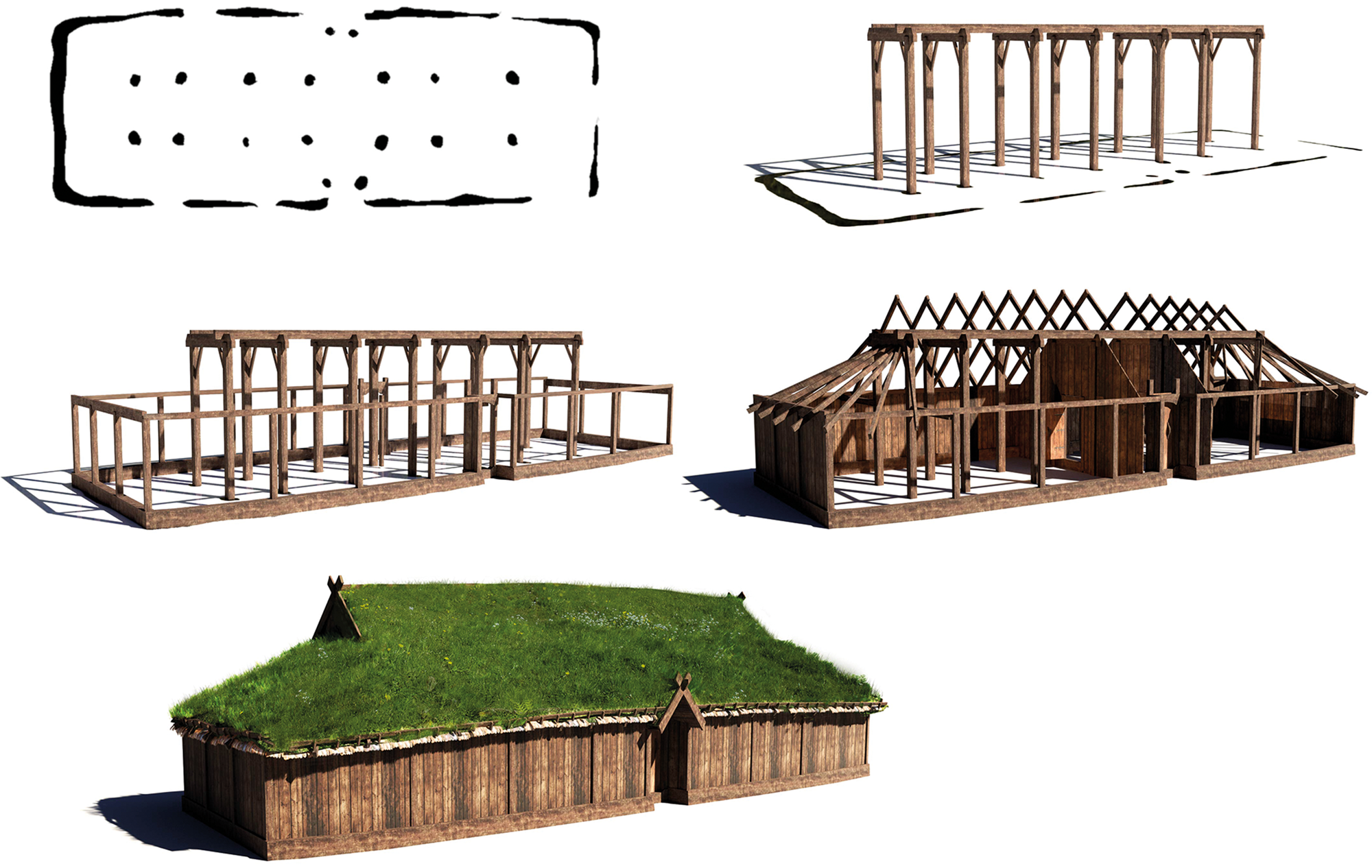
Traces of settlements, mostly in the form of three-aisled longhouses, are at the heart of studies of the Iron Age in Scandinavia (Fig. 1). The dwellings, usually made of timber and wattle-and-daub, are mostly preserved through post-holes below the plough soil, which makes it possible to reconstruct house plans to a reasonable degree, as well as to identity the position of entrances and internal partitions (Croix Reference Croix, Kristiansen and Giles2014; Eriksen Reference Eriksen2019; Gjerpe Reference Gjerpe2023). Some areas have better-preserved house ruins in forest areas or areas for pasture (e.g. Hagen Reference Hagen1953; Petersen Reference Petersen1933; Stenberger Reference Stenberger1933). The most frequent settlement unit throughout most of the Iron Age seems to be a farmstead consisting of a longhouse, often accompanied by various types of associated utility buildings. However, several farms could also form smaller and larger villages (Ødegaard & Ystgaard Reference Ødegaard, Ystgaard, Ødegaard and Ystgaard2023). A changing spatial structure, from floating, one-phase settlements to multi-generational houses and a gradual establishment of property rights, seems to characterize the general development from the pre-Roman Iron Age to the end of the Viking Period (Bukkemoen Reference Bukkemoen2015; Reference Bukkemoen2021, 170–75; Eriksen Reference Eriksen2019; Gjerpe Reference Gjerpe2023, Herschend Reference Herschend2009). Variations of mixed farming dominate subsistence strategies, while traces of hunting, fishing, iron extraction, quarrying of stone and other activities, permanent or seasonal settlements in coastlands, woodlands and mountainous areas fluctuate through the Iron Age and point to varied resource utilization, settlement structure and household organization (e.g. Baug Reference Baug2015; Eriksson Reference Eriksson2023; Indrelid et al. Reference Indrelid, Hjelle and Stene2015; Karlsson et al. Reference Karlsson, Emanuelsson and Segerström2010; Lindholm et al. Reference Lindholm, Ersmark, Hennius, Lindgren, Loftsgarden, Svensson and Symes2021; Rundberget Reference Rundberget2017; Svensson Reference Svensson, Baug, Larsen and Mygland2015). This varied and fluctuating character of settlement and resource management constitutes an essential framework for the trajectories of Iron Age households.
Illustration of the principles behind a three-aisled longhouse from the Scandinavian Iron Age. (Copyright: Arkikon.)
The household as a demographic, ahistorical entity
In the wake of the first visible Iron Age house ruins being recognized, invaluable effort was centred on defining building traditions, house layout and socio-economic relations (e.g. Grieg Reference Grieg1934; Petersen Reference Petersen1933; Stenberger Reference Stenberger1933; Zangenberg Reference Zangenberg1925). The household may be referred to, but is rarely a focus of study. We encounter a fixed, demographic unit that changes in accordance with the size of the house, rooted in evolutionary models and analogies to written sources such as the Icelandic sagas (Hagen Reference Hagen1953; Møllerop Reference Møllerop1958; Opdahl Reference Opdahl2003; Skre Reference Skre1998, 14).
Gradually, focus changed from the individual longhouse to investigating the house in its wider settlement context, in line with the methodological development of excavating larger areas with preserved settlement remains below the topsoil (Beck Reference Beck2017, 28). New insight into social organization and adaptation was gained, often focusing on macro-scale settlement patterns and examining social differentiation in terms of status and economic role. The term ‘household’ is rarely used, while concepts such as ‘settlement units’, ‘holdings’ and ‘farmsteads’ often denote the basic socio-economic unit (e.g. Hvass Reference Hvass1983; Myhre Reference Myhre1982; Ramqvist Reference Ramqvist1983). In the classic work on the large pre-Roman Iron Age village at Hodde, the farmsteads are divided into four size groups, where each group represents a socio-economic class. Behind these classes were households, referred to as farmsteads with different forms of specialization (Hvass Reference Hvass1985).
Studying socio-economic distinctions in the Roman Iron Age and Migration Period at Jæren in southwest Norway based on the farms or holdings, Bjørn Myhre (Reference Myhre1982) argued for a correlation between house size, number of people and social differentiation. Myhre made calculations of the number of people on each farm based on the size of the dwelling areas and the number of farms documented at Jæren compared with the size of the population in late historic times. Each farm was argued to house an extended family of three generations and a few servants, somewhere between 10 and 20 people (Myhre Reference Myhre1982; Reference Myhre and Òlafsson1983). However, Nils Ringstedt (Reference Ringstedt1989) questioned the household concept and argued for a separation of the concept of the family from the concept of the household to underline that households may include people other than family members, such as servants, and have a domestic function.
These and other works provide considerable new insight into house and farm structure as well as socio-economic organization. However, the methodological and theoretical frameworks of the time meant that the household rarely became an object of study, but was regarded as a demographic unit, according to the number of members, or as the material correlate of a farmstead or a dwelling. The actual composition of the household is treated as relatively standardized and unchanging, and thus a more or less ahistorical, timeless entity.
Households with internal dynamics
Research on social stratification and hierarchy has been a dominant focus in Scandinavian archaeology since the 1980s and ’90s (see Lund et al. Reference Lund, Furholt and Austvoll2022 for a critical comment on this tradition). The background for this approach is to be found in new theoretical foundations for social organization, primarily Elman Service's (Reference Service1971) neo-evolutionary anthropological model, but also Heiko Steuer's (Reference Steuer and Randsborg1989) model of the Personenverbandstaat. A significant focus of research that provides an important conceptual framework for much later work was the gradual transformation of Scandinavian and Germanic societies from tribal and kinship communities to early states during the Iron Age with attention to articulations of social status and rank, primarily using burial and settlement data (Hedeager Reference Hedeager1992; Herschend Reference Herschend1993; Reference Herschend2009; Mortensen & Rasmussen Reference Mortensen and Rasmussen1988; Reference Mortensen and Rasmussen1991; Myhre Reference Myhre, Kristiansen and Paludan Müller1978; Reference Myhre1987; Reference Myhre, Joensen, Johansen, Kløvstad and Myhre1991; Skre Reference Skre1998).
With attention to ideology, power and religious aspects behind the physical surroundings so prominent in post-processual archaeology, several studies have emphasized the relation between houses, settlements and social structure to gain insight into social differentiation (Ångeby Reference Ångeby, Artelius, Englund and Ersgård1999; Carlie Reference Carlie, Brink and Price2006; Herschend Reference Herschend1989; Reference Herschend1993; Reference Herschend2009; Løken Reference Løken, Myrvoll, Christensson and Bergset1992; Reference Løken2001; Reference Løken2020; Streiffert Reference Streiffert2001). Frands Herschend made active use of the household concept in his discussion of the settlement structure in the Early Iron Age (500 bce–550 ce), which is characterized by a development towards fewer farms and increasing house size. Herschend argues for a centralization process where people lose their land and are integrated into the new and considerably longer longhouses, thus opening up for increasing household differentiation and a replacement of the nuclear family of the pre-Roman Iron Age with larger household units (Herschend Reference Herschend1993; Reference Herschend2009). The emergence of the hall-room in the Early Iron Age (Herschend Reference Herschend1993; Løken Reference Løken2001), identified through the increasing trestle span of certain houses, further contributed to illuminate differentiation within and among households. Importantly, Svante Norr (Reference Norr1996) emphasized the household as a unifying concept that encompassed social domination and class conflict, arguing that changes in house layout in this period might relate to the dynamics of social life rather than changes in subsistence pattern so prevalent in earlier approaches.
These works turn valuable attention to the presence of social differentiation within and among households. There is substantial research on household variability and composition, and discussions of the evolutionary premises behind earlier approaches to the demographic unit making up Iron Age farmsteads as mainly based on kinship (Opdahl Reference Opdahl2003; Skre Reference Skre1998). Social organization and households as composed of different types of people and activities also received attention in the wake of feminist and gender archaeology in Scandinavia (e.g. Dommasnes Reference Dommasnes1982; Engelstad Reference Engelstad1991). These issues were mostly studied through mortuary evidence where it was possible to investigate especially the role of women by linking expressions of rank and roles to sexed individuals. Material culture emerges as significant in this context, where specific artefacts appear as symbols of status and role. This led to new interpretations of female roles based on grave finds. In a broader context, Marxist-feminist and feminist critique have influenced and had great impact on household research, and both household studies and gender studies have continuously informed each other (Morgan Reference Morgan, McKie, Bowlby and Gregory1999).
Household as a scale of analysis
As a reaction to houses and settlements being considered more or less blueprints of overarching social structures, there has been a growing tendency since around the turn of the millennium in Scandinavia to focus on the household itself through practices in domestic space and to examine households through the material traces of everyday practices. This is due to the significant impact of theories of practice and structuration (Bourdieu [1977] Reference Bourdieu2000; Giddens Reference Giddens1984), as well as the cumulative influence from household archaeology in general. These theories open perspectives addressing the dynamic between the micro-level of day-to-day practices and larger-scale social structures. Put simply, the perspective moves from the household as a demographic, ahistorical entity, via an entity that mirrors the overarching social structure, to the household as a scale and analytical unit that unfolds through interior space and the remnants of past practices. Ruth Tringham (Reference Tringham, Gero and Conkey1991) uses the term microscale on the archaeology of household, underlining microscale as a starting point to illuminate diversity in household production and composition (see also Hendon Reference Hendon1996).
With an emphasis on the daily repetitive practice of materialization and the socialization of human behaviour, material culture becomes an arena for studies of household activities, their spatial distribution and their changing temporal patterns. In his study of the Early Iron Age in western Denmark, Leo Webley (Reference Webley2008) considers independent farmsteads as households and demonstrates that household relations are not isolated from the external social world, nor do they respond passively to externally imposed changes. Rather, households can themselves play an important, active role in maintaining or renegotiating wider social relations. Webley brings forth how daily practices of domestic space underpin large-scale settlement development, and that the nature of the household unit and its role within the wider social world changes through the course of the Early Iron Age.
Significant contributions have been made in recent years to the understanding of households from spatial organization and social approaches to dwellings (see also Streiffert Reference Streiffert2001). Access and circulation as organizing and regulating interactions between inhabitants and guests are illuminated through spatial syntax analysis to establish patterns of movement through the Viking Age longhouse (Beck Reference Beck, Kristiansen and Giles2014; Eriksen Reference Eriksen2019), and biographical approaches and social chronology are applied to gain insight into the entwined relationship between houses, settlements and inhabitants (Amundsen & Fredriksen Reference Amundsen and Fredriksen2014; Bukkemoen Reference Bukkemoen2015). Deep-time studies have addressed the intimate relationship between humans and animals in the longhouse space (Armstrong-Oma Reference Armstrong-Oma2018), while the relationship between gendered activities and spatial organization in the Viking Age has been studied using archaeological material from rural settlements (Croix Reference Croix2012). Sarah Croix (Reference Croix2012) argues that the organization of labour is a key factor shaping daily life and relations between household members. Recently, Marianne Hem Eriksen has addressed Viking Age households through domestic space, architecture, movement and ritual (Eriksen Reference Eriksen2016; Reference Eriksen2019; Reference Eriksen2020). Eriksen emphasizes the connection between the architecture of the house and its mutually dependent relationship with the inhabitants and acknowledges that Viking Age households would have varied significantly, between regions, groups and social strata. Applying more of a relational approach, Eriksen (Reference Eriksen2019) emphasizes the Viking Age households as inherently fluent and unbounded, changing continuously as people are born and die, guests arrive and new farm hands are taken in. The political role of households is argued through the different strategies that can be utilized to promote social differentiation, consciously or unconsciously, for instance through different levels of access. In Anna Beck's resent research on the Viking Age longhouse and the making of home (Beck Reference Beck2017), a bottom-up approach and assemblage theory offer significant insight to the multi-temporal character of the longhouse and its inhabitants.
In summary, there has been a significant research effort to illuminate Iron Age settlement development and house architecture, and in recent years, several works have paid particular attention to exploring the household. Through these works, the household comes into view as a dynamic, heterogenous and powerful social unit, an assemblage consisting not only of humans but also of more-than-human-relations. Such studies underline the politicization of the household in that its internal relations are inextricable from the larger economic, political and social structures of society, and there is a potential in developing these insights further.
The household as a location for learning, maintenance and change over time
Undeniably, research show that the longhouse and farmstead formed vital spaces for many households in the Scandinavian Iron Age. However, house and farmstead are not synonymous with household. To gain a more comprehensive understanding of the processes that take place in households over time and their multi-scalar composition, there is potential in looking beyond the dwelling and to recognizing that households have both spatial and social dimensions that take place within a larger social arena. Inherent in the vast archaeological record of the Scandinavian Iron Age is a capacity for broader perspectives to explore household processes, duration and change.
Arguably, households unfold in different locations and through activities, practices and relations, and this repertoire of households (cf. Wenger Reference Wenger1998) represents analytical mechanisms, which result in existing or changing boundaries rather than homogeneity in households themselves (Souvatzi Reference Souvatzi2008, 10). Rather, households emerge within larger contexts, and approaching household as a transitional process highlights their emergent properties (Souvatzi Reference Souvatzi2008, 19), which leads to studies of the Iron Age household as a longer-term phenomenon. Moreover, this stance puts emphasis on the repertoire of households and the identification of these in the archaeological record. Ben Jervis (Reference Jervis2024) recently argued for the multi-scalar composition of households, pointing to how households are both more-than-human in their composition and entangled in, and constitutive of, processes which extend beyond their bounds. This outlook highlights household archaeology as a starting point for multi-scalar analysis of historical processes (Jervis Reference Jervis2024, 3). To pick up on this point, households are, moreover, locations for continuity and change, redefinition and resilience, as well as for the shaping and transformation of social structures (cf. Wenger Reference Wenger1998). As the most fundamental unit of society, households are core arenas for social learning and identity formation through daily practices, seasonal activities, travels, encounters and inter-household relationships. In these relations and contexts, social memories are created, altered and forgotten, and history and identity are shaped and anchored. As such, the household is a collection of relations and properties, an assemblage that constantly shifts and changes over time. To explore households as inextricably woven into and shaping such processes, there is a need for methodological and theoretical entry points that not only bring out the properties and relations that constitute and shape households over time, but that accentuate how knowledge, learning and identity emerge within social contexts and locations.
Theoretical entry points to households
Relational approaches, assemblage thinking (e.g. Crellin Reference Crellin2020; DeLanda Reference DeLanda2006; Deleuze & Guattari Reference Deleuze and Guattari1987; Fowler Reference Fowler2017; Hamilakis Reference Hamilakis2017; Harris Reference Harris2017; Jervis Reference Jervis2024; Lucas Reference Lucas2012) and the Communities of Practice framework (Roddick & Stahl Reference Roddick and Stahl2016b; Wenger Reference Wenger1998) represent theoretical currents that facilitate bottom-up explorations of household dynamics and effectively navigate scale (see e.g. Bukkemoen Reference Bukkemoen2021).
The heterogenous, emergent and relational character of households is compatible with assemblage theory, which is outlined in more detail elsewhere. However, I want to highlight the contribution of this theoretical approach to the understanding of entities, such as households, settlements, artefacts, burials, etc., as assemblage theory may work as an instrument for studying complex phenomena from the ground up, in a diachronic perspective and in relation to broader relations (Crellin Reference Crellin2017; DeLanda Reference DeLanda2006, 32; Fowler Reference Fowler2017; Harris Reference Harris2017).
An assemblage is composed of heterogeneous material and immaterial components with diverse properties and emerges from the relationships between the component parts, which also include the practices comprising the assemblage. The term foregrounds the deliberate act of bringing things, beings and entities together, and the agency involved in the process (DeLanda Reference DeLanda2006; Fowler Reference Fowler2017; Hamilakis & Jones Reference Hamilakis and Jones2017; Harris Reference Harris2017). In order to gain insight into household continuity and reorientation, it is relevant to consider that different household components are often held together over time, so that settlements, artefacts, burials, technologies, landscape utilization, or dwellings within a particular time-span or geographical area appear quite similar or with clearly similar features (see e.g. Beck Reference Beck2018, for the theory applied to buildings). This maintenance of form, which is really about enduring and stable relationships, is in line with discussions of typology and processes of territorialization; assemblage thinking is therefore particularly valuable in identifying how different properties, materials, and practices—in other words, relations—emerge, persist and dissolve (Crellin Reference Crellin2020; DeLanda Reference DeLanda2006, 12–25; Fowler Reference Fowler2017; Lucas Reference Lucas2012, 199–202). Defining such relations provides insight into aspects that are retained or abandoned, details that inform of continuity, discontinuity and memory, and that are linked to the constant flow of people, things, materials, activities and knowledge that characterize households. Rather than adopting a fully fledged assemblage approach, this way of thinking is useful as a framework for sorting materials and properties, recognizing the state of becoming or process that characterizes assemblages (see also Bukkemoen Reference Bukkemoen2021, 32–4).
Social context is essential for studies that aim to approach socio-political processes using the household as an analytical unit. Such studies question what factors create continuity, reorientation, creativity and rupture, and where such processes are located over time. A Community of Practice (CoP) is a group of people who share an interest in a domain of human endeavour and engage in a constant process of collective learning and identity formation. It is crucial that people interact and learn together through participation, which leads to the development of a shared repertoire of resources (experiences, stories, material culture, relations, ways of doing)—a shared practice (Wenger Reference Wenger1998). A community, for example a household or a production community, is defined by the relations between (heterogenous) members, i.e. relations established through practice. However, the CoP framework also benefits from recent developments that put increased emphasis on objects or ‘things’ as well as materials as participants and shapers of practices (Knappett Reference Knappett2011, 102–4; Roddick & Stahl Reference Roddick, Stahl, Roddick and Stahl2016a, 8).
As a fundamental unit of society, households are core arenas for social learning and identity formation. The CoP framework focuses on the different social contexts—Communities of Practice—where culture and traditions are produced and reproduced through social action and accentuates the transmission of cultural knowledge through the performative nature of social learning (Roddick & Stahl Reference Roddick, Stahl, Roddick and Stahl2016a; Wenger Reference Wenger1998). The historical perspective on social practices is emphasized, drawing attention to social learning and how practices within communities persist, in addition to the mechanisms behind change and reorientation. The contextual emergence of knowledge that characterizes communities is suitable for studies of household practices, discontinuity, and how practices relate to broader structures because the shared competence is always in interplay with the member's experiences (Wenger Reference Wenger1998). Studies that address turbulent conditions, where value, knowledge and power are recalibrated, are particularly inspiring, as they highlight how learning and knowledge are also shaped by discontinuity (Roddick and Stahl Reference Roddick and Stahl2016b).
Rather than viewing context as based on different scalar levels, there is potential in approaching context as emergent, relational and web-like (Harris Reference Harris2017; Roddick & Stahl Reference Roddick, Stahl, Roddick and Stahl2016a, 21 with refs; Stahl Reference Stahl2014). The CoP framework navigates scale by recognizing that small-scale learning arenas are connected in larger constellations through the movement of people, things and practices (Roddick & Stahl Reference Roddick, Stahl, Roddick and Stahl2016a; Wenger Reference Wenger1998, 105–10, 127–33, 260–65). Therefore, the landscape of practice will also be an emergent structure in which learning constantly creates localities that reconfigure the geography (Wenger Reference Wenger1998, 130–31). These are productive approaches when studying households and especially when approaching socio-political processes with households as an analytical framework. Etienne Wenger's concepts of imagination and alignment are also fruitful as they capture different modes of belonging and how similarities occur at larger time and spatial scales. While imagination revolves around perceptions, direct and vicarious knowledge, alignment relates to similarities across distances, and the alignment of practices and material correlates with others in order to fit within broader structures (Roddick & Stahl Reference Roddick, Stahl, Roddick and Stahl2016a, 12–13; Wenger Reference Wenger1998, 175–81).
As an extension of this, it is therefore vital to illuminate the conditions for learning, as it is entwined with larger patterns of identity and discourse. Much has been done in this field of research within apprenticeship studies (e.g. Crown Reference Crown2014; Roddick & Stahl Reference Roddick and Stahl2016b; Wallaert-Pêtre Reference Wallaert-Pêtre2001; Wendrich Reference Wendrich and Wendrich2012). While technologies are crucial for the continuation of practices and traditions, they also provide a basis for creativity, improvization, emulation and innovation (Jørgensen et al. Reference Jørgensen, Sofaer and Sørensen2018, Wallaert-Pêtre Reference Wallaert-Pêtre2001). In addition to viewing types as components that are held together over time, as discussed earlier, practices fundamentally involve the negotiation of meaning. This implies that practices create patterns, e.g. artefact types, the way a meal is performed, or household organization, and that the production of such patterns anew, or with marked alterations, creates an experience of meaning (Wenger Reference Wenger1998, 52). Others have meaningfully tied this insight to studies of traditions by considering the dynamic between discursive and non-discursive practices (Roddick & Hastorf Reference Roddick and Hastorf2010).
Moreover, social practice shapes spatial relations, and this provides insight into locations and contexts where learning and negotiation of meaning take place (Wenger Reference Wenger1998, 130). In this dynamic between learning, the contextual emergence of knowledge, location and meaning, there is a perspective on memory; this is because participation in social practice and reification are inherently forms of remembering and forgetting (Wenger Reference Wenger1998, 88–9). These are aspects of memory possible to observe in the archaeological record through the emergence, persistence or dissolution of relations.
Case study: household reorganization, culinary practices and socio-political change
In recent years, the growing evidence of a climatic downturn of global significance has led to a renewed interest in the mid-sixth century ce and the Fimbulwinter myth in Scandinavian archaeology (for overview, see e.g. Gjerpe Reference Gjerpe2021; Gundersen Reference Gundersen2019). Lately, scholars increasingly point to the importance of avoiding monocausal explanations behind the substantial changes in the archaeological record of the sixth century and underline attention to regional variation and the resilience of societies, as well as the importance of illuminating both synchronic and diachronic variation (e.g. Gjerpe Reference Gjerpe2021; Gundersen Reference Gundersen2019; Reference Gundersen2022; Näsman Reference Näsman2012). Studies also point to considerable changes in the social landscape in the centuries leading up to the transition, with new leadership ideals and a break with an earlier strict kinship system (e.g. Hedeager Reference Hedeager1992; Røstad Reference Røstad2021, 279–304).
In the introduction to this paper, I argued that long-term perspectives on households turn attention to household practices and how they unfold in different locations and through various relations. Changes in culinary practices c. 400–800 ce in Norway offer a useful case study through which to examine household reorganization in interplay with socio-political processes (Bukkemoen Reference Bukkemoen2021). The household is a primary unit for food sharing, and identity production through food and everyday food practices develops into larger food traditions (Bukkemoen Reference Bukkemoen2021, 40–44 with refs; Hastorf Reference Hastorf2017). As part of the repertoire of a community, meals negotiate meaning through each new re-enactment. Routines, gestures, artefacts and raw materials included in a culinary practice are forms of remembrance and forgetting, and sources of continuity and discontinuity. As such, they provide vital insights to histories of learning, negotiation of meaning, and identity as a temporal process. Food and meals, therefore, serve as a link to the history of households and larger communities and to their maintenance. This embeddedness is the source of the power of a meal, and the underlying tendency towards conservatism and repetition (Bukkemoen Reference Bukkemoen2021, 40–44; Connerton Reference Connerton1989, 72–3; Graff Reference Graff2020; Hastorf Reference Hastorf2017, 60, 67–8; Sutton Reference Sutton2001, 20; Wenger Reference Wenger1998, 52).
Due to their temporal and spatial dimensions, food and meals are particularly informative sources for studies of social change and for analyses focusing on social contexts—Communities of Practice—where meaning is produced through learning and participation in social action. Stressing the production of meaning turns the spotlight on continuity and discontinuity, and the location where learning and participation take place. In what follows, culinary practices are approached as resources emerging within households and larger communities and their negotiation of meaning. In this case, the intertwined relationship between crafts and culinary practices is employed to investigate changes in households and their production of meaning during this period of turbulence. Both crafts and culinary practices are highly material and deeply embodied technologies of daily life that involve cultural knowledge, learning, skills and techniques for transforming raw materials, while simultaneously shaping diverse subjectivities and materializing social distinctions (Gokee & Logan Reference Gokee and Logan2014; Stahl Reference Stahl2014).
From ceramic to iron and soapstone culinary equipment
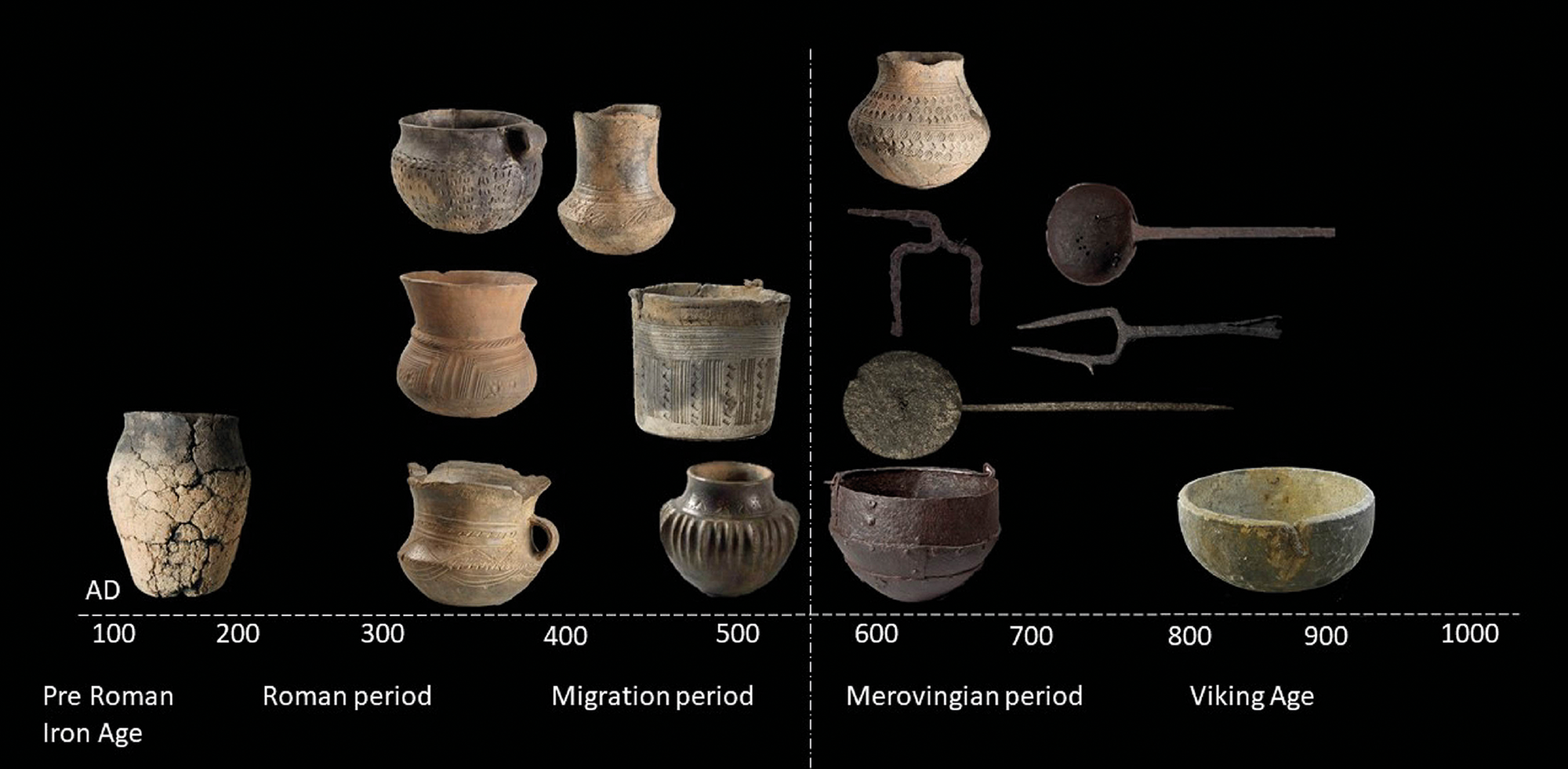
The case study takes as a point of departure a significant change in locally produced culinary utensils from the mid-sixth century and the following centuries in south Norway. During this time, a long tradition of ceramic vessels ended and was succeeded by a gradual introduction of suspended containers made of iron and later soapstone, along with tools such as frying pans and roasting spits (Bukkemoen Reference Bukkemoen2021)Footnote 1 (Fig. 2). Due to the preservation conditions and better chronological control, the artefact material in the study belongs to grave contexts.
An overview of the relative chronology for materials and culinary objects. (From Bukkemoen Reference Bukkemoen2021.)
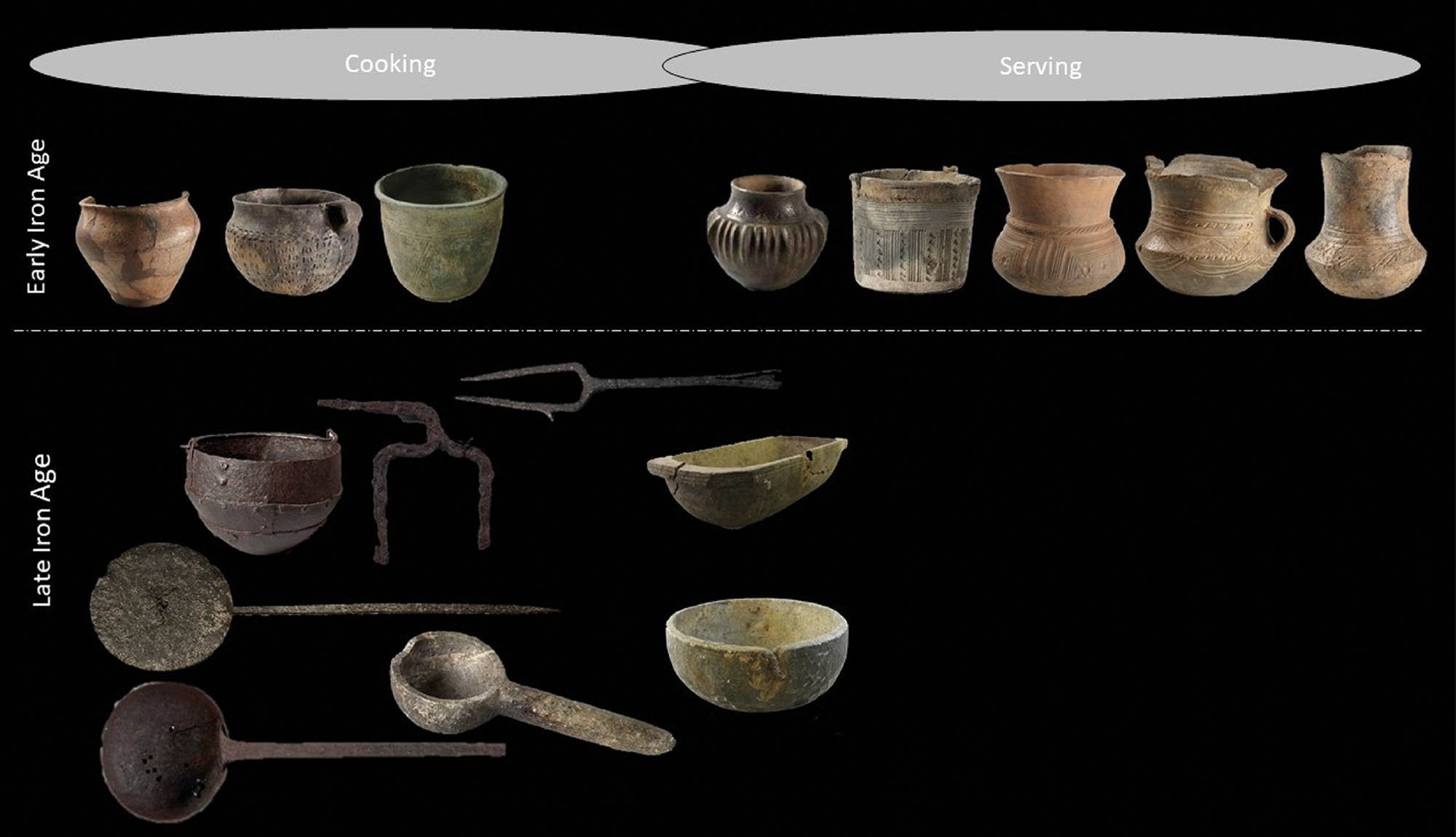
The fluctuating character of materials, objects and properties in burial assemblages during the Iron Age can be interpreted through Chris Fowler's (Reference Fowler2017, 102–3) argument on the efficacy of specific objects and how the relevance of certain objects emerges and dissipates. New artefacts create new resonances and effects that contribute to the production of meaning in households (cf. Wenger Reference Wenger1998). The change in culinary equipment is illustrated in a simplified chaîne opératoire, a useful tool to structure the chronology c. 350–1050 ce according to the operational sequence of a meal (Fig. 3). The sorting revealed a sliding scale in emphasis, from equipment made for serving to cooking, following the change from ceramics to iron and soapstone, indicating a significant change in the meal as a repertoire of households and their negotiation of meaning in social practice (Bukkemoen Reference Bukkemoen2021, 108–9). This reorientation of meals as a social practice has been further explored through craft communities and the spatial location of culinary practices.
A simple overview of how culinary artefacts from the Iron Age in Norway invoke different parts of the meal and produce a sliding scale from serving to cooking. (From Bukkemoen Reference Bukkemoen2021.)
It has been possible to illuminate remembrance and forgetting as negotiation of meaning (Wenger Reference Wenger1998) in household practices through close technological studies of ceramic, iron and soapstone containers. As emergent assemblages, artefacts provide insight to divergent learning environments, openness and the possibility for recalibration of knowledge (Bukkemoen Reference Bukkemoen2021, 38–40, 117–68 with refs). Recent detailed analyses of the design structure and technological development of different pottery ware and production modes demonstrate how a vivid ceramic production shows signs of stagnation and decay as well as creativity and innovation during the fifth and sixth centuries. From being omnipresent in Iron Age households, ceramics seem gradually to lose social relevance. It has been suggested that the everyday learning trajectories in households were fading in the late fifth century as the few pottery types left were further developed in specialized workshops where metal was foregrounded at the expense of ceramics (Fredriksen & Kristoffersen Reference Fredriksen, Kristoffersen, Austvoll, Erikden, Fredriksen, Melheim, Prøsch-Danielsen and Skogstrand2020; Fredriksen et al. Reference Fredriksen, Kristoffersen and Zimmermann2014; Reference Fredriksen, Rødsrud and Caruso2020; Kristoffersen & Magnus Reference Kristoffersen and Magnus2010; Rødsrud & Fredriksen Reference Rødsrud, Fredriksen, Ødegaard and Ystgaard2023; see also Bukkemoen Reference Bukkemoen2021, 118–24 with refs). The first iron cooking equipment from the seventh and eighth centuries turns up in areas with proximity to iron ores (for example the aristocratic female burial at Åker, southeast Norway (Røstad Reference Røstad2019), differ in geographical gravity to ceramics, and show close similarities with artefacts in the rich aristocratic burials from Vendel and Valsgärde, eastern central Sweden, that appear already from the mid-sixth century (Bukkemoen Reference Bukkemoen2021, 128–46 with refs).
Detailed technological and contextual analyses have revealed that, during the fifth and sixth centuries, strong relationships seem to emerge between specialized crafts and individual households, and that some of these communities show a capacity for reorientation in the seventh and eighth centuries, with access to utilize outfield resources such as iron for cooking equipment, a technology where metal-working techniques are further developed. Close association with the artefacts from central Sweden as well as continental and Anglo-Saxon metal containers underpin ongoing processes of identity formation in the 600s and 700s, building on aspects of a shared culinary practice (Bukkemoen Reference Bukkemoen2021, 128–46 with refs). The CoP perspective on continuity is useful here, as it highlights how continuity involves a capacity to recalibrate knowledge in new spheres of interaction (Roddick & Stahl Reference Roddick, Stahl, Roddick and Stahl2016a, 5; Wenger Reference Wenger1998, 93–4) and how recalibration may produce possibilities for connection with other communities and for strengthening the household's social position and coherence. We see the forging of new relations and processes of belonging (Wenger Reference Wenger1998, 175–81) in a period of turmoil, involving a meal repertoire where a specific style and taste are significant resources for the negotiation of meaning.
Culinary practices and households: changes in spatial location
Zooming out, the increasing emphasis put on cooking equipment can be further explored by considering the spatial structure of culinary practices over time, which seem to be entwined with changes in the settlement structure.
The first 400 years ce seem to be characterized by significant household reorganization and changes in the perception of the household as a social group, with a gradual transition from a floating to a more permanent settlement structure. Dwellings are increasingly built close to or even upon older buildings, buildings with hall-rooms appear and signs of house repair point to efforts made to prolong the lifetime of houses and to accommodate long-term reoccupation (Bukkemoen Reference Bukkemoen2015; Eriksen Reference Eriksen2019, 111–29; Gjerpe Reference Gjerpe2023, 93–114; Herschend Reference Herschend1993, 179; Reference Herschend2009; Løken Reference Løken2020). The emergence of a material repertoire such as enduring houses, differences in house size, ceramic serving ware, a fixed farm layout, fields and burial mounds, serve as central resources for sustained practice, producing both household coherence, differentiation and a sense of genealogy and history (Bukkemoen Reference Bukkemoen2021, 171 with refs). These features underline the gradual emergence of enduring relationships, which contributed to stabilizing practice (DeLanda Reference DeLanda2006; Lucas Reference Lucas2012, 199–204) and helped define and maintain the social and spatial continuity between and among households. Focus on durability and location allowed households to construct narratives of a permanent social group with a fixed place in the world and in time (Gerritsen Reference Gerritsen and Beck2007, 163). In other words, we see the work of imagination and the creation of new images of the world and the self (Wenger Reference Wenger1998, 175–8).
A narrowing of spatial distribution and significant discontinuity evolve in the turbulent late sixth and seventh centuries, when numerous farms are deserted while others develop as stronger farm units with considerable continuity. Scholars suggest fewer but larger farms, increasing stratification, a reorganization of agricultural production, a significant increase in the utilization of outfield resources and a strengthening of territorial rights (Eriksen Reference Eriksen2019, 117–18; Gjerpe Reference Gjerpe2023; Grønnesby Reference Grønnesby2019; Myhre Reference Myhre2015, 103–8). Feasting halls become fewer and more prominent (Carstens Reference Carstens, Eriksen, Pedersen, Rundberget, Axelsen and Berg2015). A substantial assembling of economic, political, ritual and genealogical resources and relations in particular households make households important hubs for identity and belonging, and the household appears to be evolving into a social institution.
Changes in location for communal culinary practices underpin this pattern. Large open-air cooking-pit sites for large commensal events show a gradual recession during the fifth and sixth centuries in areas where the first iron equipment occurs (Gundersen et al. Reference Gundersen, Rødsrud, Post-Melby, Rødsrud and Mjærum2020), while large waste heaps and food storage on elite farms indicate ritual slaughter, large-scale food provision and consumption, and thus a relocation of commensal events to settlement sites and feasting halls (Bukkemoen Reference Bukkemoen2021, 179–80 with refs). Relocation creates discontinuity in learning and practice and allows for redefinition or discursive practice (Wenger Reference Wenger1998). Studies of bread and meat based on material from Scandinavia also support tendencies towards differentiated cuisine (Bukkemoen Reference Bukkemoen2021, 187–92 with refs). Private food events featuring new styles and tastes within the walls of feasting halls mark a departure from previous long-term communal meal practices. As such, relocation alters the meaning of food and establishes a closer relation between food, leadership and household identity. The new meal repertoire becomes a resource that helps stabilize practices and draws attention to the household and its emergent position (Bukkemoen Reference Bukkemoen2021).
This is a fairly simple and schematic representation of a process that must have been much more heterogeneous and varied. The aim, however, is to highlight that considering households as assemblages emerging within specific historical contexts draws attention to the components, relations, properties and practices that constitute, shape and reshape households over time, offering a potential for new knowledge.
Concluding thoughts
Despite much attention to Scandinavian Iron Age settlement structure and buildings over the years, it is only recently that the knowledge that can be gained from household studies has been clearly recognized. This paper aims to challenge the conceptions of what the household is and highlight that households are heterogenous, emergent assemblages with untapped potential for diachronic and spatial studies. Moving beyond conceptions of the household as a demographic unit, or almost synonymous with a dwelling or a farm, shifts focus to the different relations and practices that characterize households over time and the different locations in which households unfold, which allows for a broader use of archaeological data to explore households. By extension, the aim is not only to study the household as such, but to explore the socio-political processes that arise from participation in practice, including the contextual emergence of knowledge, remembrance, forgetting, continuity and recalibration produced in households over time.
Acknowledgements
I would like to thank Professor Per Ditlef Fredriksen for valuable comments on earlier drafts of this article. In addition, I thank the editors of CAJ and three anonymous reviewers for their constructive and engaged input.


 Open access

