


1 Introduction
In a 1983 political declaration, heads of state or government from the then ten members of the European Community (now the European Union, EU) confirmed their commitment to “progress towards an ever closer union among the peoples and Member States of the European Community.” In today’s interconnected European policymaking space, the EU represents a unique multilevel governance system that enables member states to jointly address complex, border-crossing challenges, such as climate change, which individual nation-states cannot resolve alone. The EU governance system operates on the principle that EU institutions’ joint decisions and actions impact member states. This process requires cooperation among member states to implement joint solutions. Over time, it should lead to more coordinated or harmonized national politics, policies, and polities (Holzinger & Sommerer, Reference Holzinger and Sommerer2011; Knill et al., Reference Knill, Tosun and Bauer2009). Such collaboration helps achieve common goals such as food safety in the single market or the free movement of goods and services (Fink, Reference Fink2013). A visible outcome of this process is policy convergence, where EU member states adopt increasingly similar policies, especially when they prove effective in achieving desired results (Holzinger & Knill, Reference Knill2005).
1.1 The Problem
Understanding the sources of policy convergence and divergence across political jurisdictions is crucial for studying the problem-solving capacity of multilevel governance systems like the EU (Bennett, Reference Bennett1991; Holzinger & Knill, Reference Knill2005). What patterns of policy divergence and variation have emerged across EU member states, one of the most prominent multilevel governance systems? When and why does policy convergence occur across member states, across multiple policy domains? Does it happen only in sectors where competences have been explicitly delegated to the EU (see Online Appendix I), or does it occur in other sectors too? What explains the variation across sectors and countries? If convergence is limited, why is this the case?
EU scholarship has examined why convergence versus variation exists in policy outputs with mixed results (Jordan, Reference Jordan2005; Strunz et al., Reference Strunz, Gawel, Lehmann and Söderholm2018). Policy convergence may result from various causal processes. Supranational harmonization orchestrated by the EU is just one possible cause. Other causes include regulatory competition, cultural similarities, emulation, and transnational problem-solving (Holzinger & Knill, Reference Knill2005; Knill, Reference Knill2005: 771). The degree of convergence also depends on the concreteness of EU policies and member states’ implementation options.
The distinctive nature of the EU has prompted efforts to develop generalizable theoretical frameworks to analyze its operation (Hooghe & Marks, Reference Hooghe and Marks2019; Nugent, Reference Nugent2017). This research draws from international relations (Moravcsik, Reference Moravcsik1993), federalism and multilevel governance (Hooghe & Marks, Reference 85Hooghe and Marks2003), state-building (Richardson, Reference Richardson2012), historical institutionalism (Pierson, Reference Pierson1996), learning theory (Radaelli & Dunlop, Reference Radaelli and Dunlop2013), and comparative politics (McNamara, Reference McNamara2018). These frameworks propose mechanisms to understand policy convergence and variation, including creeping competences (Chalmers et al., Reference Chalmers, Jachtenfuchs and Joerges2016), the joint decision trap (Scharpf, Reference Scharpf2006; Falkner, Reference 83Falkner and Falkner2011), cross-national learning (Toshkov, Reference Toshkov2013), noncompliance (Falkner et al., Reference Falkner, Treib, Hartlapp and Leider2005), differentiated integration (Schimmelfennig et al., Reference Schimmelfennig, Leuffen and Rittberger2015; Leuffen et al., Reference Leuffen, Rittberger and Schimmelfennig2022), and policy implementation (Zhelyazkova et al., Reference Zhelyazkova, Thomann, Ruffing and Princen2024).
Research often focuses on these processes separately, leading to “siloes” where connections between insights remain unclear. Few efforts systematically compare the scope conditions and observable implications of these frameworks. Scholars now face a vast array of frameworks with limited guidance on which one to apply in a given empirical context. This hinders cumulative theoretical progress and complicates teaching. To address this, synthesizing and advancing the literature requires explaining how multiple dynamics operate across policy domains, including those under member-state jurisdiction, where convergence may happen without EU pressures.
1.2 A Policy Dynamics Approach
This Element introduces a unifying framework of policy dynamics to analyze policy convergence or variation in the EU and its member states. We analyze policymaking within the broader framework of the European Union policymaking space to synthesize findings from a range of EU research. We argue that the processes leading to convergence or divergence should be viewed together as alternative policy dynamics. We build on Weaver’s (Reference Weaver2020) concept of “policy dynamics” – durable constellations of political actors and causal mechanisms with distinct policy consequences over time in multilevel governance systems. A policy dynamic is a series of recurring patterns between:
Actors and strategic behavior: Political actors, driven by bounded rationality, engage in strategic behavior to achieve policy, political, and institutional goals.
Causal mechanisms: These mechanisms contribute to a specific outcome but do not determine it entirely (Falletti & Lynch, Reference Falletti and Lynch2009).
Opportunity structure: Conditions that either facilitate or inhibit causal mechanisms, including scope conditions that determine whether a dynamic can operate at all (Kitschelt, Reference Kitschelt1986).
Policy consequences: These outcomes, which may manifest strongly or weakly, depend on whether facilitating conditions are present and limiting conditions absent.
This framework builds on EU literature, including Börzel and Risse’s (Reference Börzel, Risse, Featherstone and Radaelli2003) Europeanization framework, and aims to integrate various frameworks for systematic comparison, identifying their applicability to specific settings.
1.3 A Non-exhaustive Typology
This Element elaborates on nine examples of specific policy dynamics found in the EU policymaking space and the dominant causal mechanisms and opportunity structures associated with each dynamic. This list does not exhaust the policy dynamics found in the EU policymaking space, but it does incorporate those that are best documented, most theorized, and certainly among the most prevalent and consequential. These are:
harmonization, the imposition of uniform and binding EU policies on member states that are predominantly set at the EU level within policy sectors of existing EU jurisdiction;
creeping competences, an expansion of EU jurisdiction into policy sectors not previously seen as within the purview of the EU;
race to the bottom, competition between member states to attract investment and avoid expenditures exacerbated by a lack of solidarity, leading to low levels of regulatory activity or spending in areas where member states have primary or exclusive jurisdiction over policy;
member state noncompliance, the pursuit of policies by member states that do not conform to the intentions of EU rules without authorization from the EU for such nonconformity;
differentiation, the pursuit of member-state discretion to opt out from or pursue policies distinct from those set by the EU, when they cannot afford outright nonparticipation or noncompliance;
diffusion, the socially mediated spread of policies over time, drawn primarily from the experiences of other member states and without coercion by the EU;
failing forward, the deepening of integration through the creation of incomplete EU policies and institutions due to lowest common denominator bargaining in times of crisis, which causes future crises that trigger new but still incomplete policies and institutions (Jones et al., Reference Jones, Kelemen and Meunier2021);
joint decision trap, the use of veto-points in EU institutions to prevent or limit policy or institutional changes from the status quo, “resulting either in blockages or in inefficient lowest-denominator compromises” (Scharpf, Reference Scharpf2006: 848);
mutual recognition, the reciprocal acknowledgment of existing policies and rules at the member-state level for trade purposes, where policies are primarily set at the member-state level, with recognition that they have authority to do so.
We argue that the evolution of EU policymaking can largely be explained as the interaction of various policy dynamics and the competition among their advocates and opponents within an actor-centered institutionalist approach. Policy dynamics affect policies and convergence in two ways: as entrenched principles and processes for decision-making, and as bases for challenging or altering entrenched policymaking patterns. The first is more familiar: Once a policymaking dynamic becomes embedded in decision-making procedures and policymakers’ strategic calculations in a specific policy domain, outputs consistent with that dynamic are likely to persist as new controversies arise. For instance, once exclusive EU jurisdiction in a domain is established, extended harmonization typically becomes dominant, while differentiation, once entrenched in EU treaties and law (see Online Appendix I), produces limited policy variation across member states. Even noncompliance with EU law could, in theory, become a dominant policymaking principle if it goes unchallenged and unpunished.
The EU and other multilevel governance systems involve conflicting actors and interests. Thus, it is not surprising that multiple policy dynamics exist in the EU and its member states, and that actors challenging existing policies may use policy dynamics strategically to legitimize their positions, build coalitions, or shift decision-making venues to promote their interests and challenge dominant policy dynamics. For example, the joint decision trap can build a blocking coalition against European Commission initiatives. Some dynamics, such as creeping competences, are specifically aimed at altering policymaking venues and/or principles (see Online Appendix I).
1.4 Core Arguments
We present five key arguments about the role of policy dynamics in EU policymaking. First, the EU is characterized by multiple policy dynamics, sometimes operating simultaneously in the same domain. Some are more prevalent than others, and a single dynamic often dominates individual policy sectors. Second, each dynamic has causal mechanisms that guide policymaking, often with a distinct set of leading actors. Diffusion, for example, involves information flows across member states on policy instruments without coercion by EU institutions. In contrast, creeping competences generally involve the European Commission expanding EU jurisdiction into new areas not explicitly delegated by treaties. These causal mechanisms can vary in complexity; member-state noncompliance, for example, can involve multiple actors and actions at various stages and venues, from failure to transpose EU legislation to non-implementation by subnational governments.
Third, different policy dynamics produce varying payoffs for institutional actors – including member-state governments, national parliaments, bureaucracies, the European Parliament, firms, lobbies, and civil society organizations. Which dynamics emerge and become dominant may be contested by these actors, who promote specific dynamics to build alliances or weaken opponents. Success in utilizing a policy dynamic to affect outcomes depends on having relevant resources and leverage.
Fourth, sectoral attributes and jurisdictional arrangements are not the sole determinants of which dynamics and levels of convergence emerge. Actors’ efforts to deploy specific dynamics are constrained by their resources, leverage, and the facilitating or limiting conditions of the opportunity structure (Kitschelt, Reference Kitschelt1986). Political incentives, policy feedbacks, and diverse preferences across member states play a crucial role in determining which dynamics emerge. A favorable opportunity structure – with supportive, resourceful actors – leads to a stronger effect of the dynamic on policy outputs. Where such conditions are weak or absent, the dynamic’s impact on outputs is muted.
Finally, governmental and societal actors strategically invest time and resources in policy dynamics that advance their interests. These investments include venue selection, issue framing, and coalition-building. However, actors avoid investing in dynamics they perceive as offering low returns (e.g., low success probability in venue-shifting, see Online Appendix I). Actors may invest at different levels – actively, moderately, or passively – based on perceived opportunities or threats. In sectors where one dynamic dominates, new threats may prompt actors to increase investments in reinforcing the status quo or explore more viable alternatives. Shifts in opportunity structure, incentives, resources, and investments explain why specific dynamics emerge or decline over time, contributing to patterns of convergence or variation.
1.5 Our Contribution
This Element integrates multiple policy dynamics to address gaps in the current literature and advance the study of the EU and multilevel governance. First, most specialized literature treats the EU as a “sui generis” political system, rather than as a case of multilevel governance that can benefit from broader frameworks (Piattoni, Reference Piattoni2010; Tortola, Reference Tortola2014). By examining the EU through the lens of policy dynamics in multilevel governance systems, we aim to open new avenues for comparison across systems. Second, while research acknowledges that many policy actors operate at both the EU and member-state levels and engage in venue-shopping (Guiraudon, Reference Guiraudon2000; Kaunert et al., Reference Kaunert, Léonard and Hoffmann2013), this Element considers policymaking in sectors where EU institutions dominate, member states are dominant, and where their interaction is crucial.
Third, there is a lack of comparative analysis on (1) when specific policy dynamics emerge, (2) their strength once embedded, (3) variation across policy domains, (4) strategies employed by actors, and (5) their evolution over time. We contribute by synthesizing existing literatures, arguing that multiple policy dynamics coexist and often compete, shaping outcomes in both strong and muted forms across different domains and time periods. Finally, we advance the literature on policy dynamics (Weaver, Reference Weaver2020) by treating them as not just entrenched modes of policymaking but also as strategies employed by actors to modify or overturn existing modes.
We propose that understanding and integrating multiple EU policy dynamics into a comprehensive framework is the missing link to understanding policy convergence and divergence in the EU multilevel policymaking space. A detailed analysis of convergence is beyond this Element’s scope; here, we introduce the policy dynamics framework, connect it to existing literature, and provide preliminary evidence of its utility. This framework offers a tool to navigate proposed convergence mechanisms, facilitating comparative and causal process-oriented research. While designed to be accessible to undergraduates, the framework is particularly useful for scholars and students at postgraduate and higher levels interested in studying EU policy convergence and divergence.
Section 2 elaborates on policy convergence and a general model of the factors shaping specific dynamics in multilevel governance systems. It also briefly discusses key processes and venues in EU policymaking, primarily for readers with limited EU knowledge. Section 3 examines the emergence and evolution of nine policy dynamics in the EU, their causal mechanisms, and consequences. Section 4 provides case studies of EU fiscal policy governance and tobacco policy, illustrating the evolution of these dynamics over time. Section 5 compares the dynamics, conditions for their occurrence, actors’ strategic investments, and strategies for testing and refining the framework.
2 Analyzing Policy Dynamics and Policy Convergence in the EU
What are the forces that determine the depth, breadth, and geographic scope of policy convergence across policy domains and over time in the member states of the EU? In this section, we develop the concepts of policy dynamics and policy convergence further to show how they can be useful in understanding EU multilevel governance, giving particular attention to the role of institutional actors and their strategic behavior. We make these arguments here in a general form to both highlight the common features of how policy dynamics affect policymaking and to facilitate comparison across systems of multilevel governance. We also introduce readers to the general perspective we adopt on the EU policymaking space and its multiple policymaking venues before turning to specific policy dynamics in the next section.
2.1 Policy Convergence
The dependent variable of interest in this Element is the degree of convergence of sector-specific policy choices and outputs at the member-state level. Knill (Reference Knill2005: 768) defines convergence as
any increase in the similarity between one or more characteristics of a certain policy (e.g., policy objectives, policy instruments, policy settings) across a given set of political jurisdictions (supranational institutions, states, regions, local authorities) over a given period of time. Policy convergence thus describes the end result of a process of policy change over time towards some common point, regardless of the causal processes.
For simplicity, we focus on the national level when observing convergence. Although regional and local patterns of convergence or divergence exist within countries, we do not discuss them here. This dependent variable contrasts with studies that seek to explain the development of EU institutions and their stability or legitimacy (McNamara, Reference McNamara2015; Schraff & Schimmelfennig, Reference Schraff and Schimmelfennig2020).
2.1.1 What Is Policy Convergence?
Policy convergence is a multifaceted phenomenon (Knill, Reference Knill2005; Jörgens et al., Reference Jörgens, Lenschow and Liefferink2014). It can refer to increasingly similar policy objectives, such as the free movement of people. Convergence can also involve the adoption of similar policy instruments. In its extreme form, this could result in complete harmonization, as seen with the EU pet passport, which enables pets to travel freely within and beyond the EU. More often, we observe similar but distinctive instruments implementing a policy across different member states, such as providing mobile EU citizens access to welfare entitlements in their country of residence. Finally, convergence may occur in the settings of applied instruments, such as setting a minimum wage as a share of the national median wage.
Policies can converge in different ways. Convergence may involve laggard countries catching up with more innovative ones, or all member states shifting toward an exemplary model over time (Knill, Reference Knill2005: 769). Policy convergence in a sector can be distinguished along at least three dimensions: (1) depth, or the degree to which individual policy dimensions within a sector become similar; (2) breadth, or the degree to which multiple policy dimensions within a domain become similar; and (3) geographic scope, or the degree to which similar or identical policies spread across all political jurisdictions of interest. For example, euro area monetary policies are highly convergent in both breadth and depth, but their geographic scope is limited to the twenty member states of the euro area. Policy convergence is measured through policy choices and outputs (instruments and settings) rather than policy outcomes (such as economic growth or emission levels), as outcomes are influenced by the effectiveness of policies and many other factors.
2.1.2 Does the EU Cause Policy Convergence?
Examples of policy convergence among EU countries abound. For instance, rules for tobacco advertising have moved toward a similar degree of restrictiveness across the EU (López-Nicolás & Stoklosa, Reference López-Nicolás and Stoklosa2019). Similarly, member states have abolished roaming charges for EU citizens using mobile phones across the EU (de Wilde, Reference De Wilde2019). At the same time, policy convergence varies substantially across sectors. EU social policy has transformed domestic parental leave policies but had a modest effect on national policy changes in areas like childcare or family taxation (Avdeyeva, Reference Avdeyeva2006). In environmental policy, despite the prescriptive EU approach at the time, Knill and Lenschow (Reference Knill and Lenschow2005) observed limited institutional changes in national regulatory arrangements and low cross-national convergence (see also Liefferink & Jordan, Reference Liefferink and Jordan2005; Jörgens et al., Reference Jörgens, Lenschow and Liefferink2014). Strunz et al. (Reference Strunz, Gawel, Lehmann and Söderholm2018) found that EU renewable energy policies had heterogeneous objectives, reflecting different potentials and production capacities across member states. Thus, we must also ask about the sources of continued policy variation across member states, such as differences in the policy preferences of citizens, business elites, and fiscal or administrative capacity. Are the same factors contributing to policy divergence in federal systems (Weaver, Reference Weaver2020) also relevant for understanding policy variation in the EU?
The claim that the EU causes policy convergence faces two challenges. First, conceptually, we lack the counterfactual: Would similar patterns of convergence have occurred without the EU (Radaelli, Reference Radaelli, Exadaktylos and Radaelli2012)? In some areas, the answer is clear. For example, the EU’s Eastern enlargement in 2004 and 2007 led to policies facilitating Eastern European workers’ access to the EU-15 labor markets. In other areas, however, it’s unclear what role the EU has played. Fiscal policies have increasingly converged due to post-euro-crisis mechanisms, but convergence varies with the fiscal stress faced by member states (Kočenda et al., Reference Kočenda, Kutan and Yigit2008; Bertarelli et al., Reference 80Bertarelli, Censolo and Colombo2014). Furthermore, increased policy similarity may result not from a single harmonizing EU process, but from autonomous actions by individual governments. The prevalence of nuclear power in most EU states has declined over time, with some reversals (Müller and Thurner, Reference Müller and Thurner2017), while abortion policies have generally become more liberal (Knill et al., Reference Knill, Richardson and Mazey2015). However, significant outliers remain in both sectors, and changing public opinion and party competition have played a larger role than EU institutions in these policy shifts. Second, Knill et al. (Reference Knill, Tosun and Bauer2009) highlight that Europeanization – defined as the EU’s impact on member-state policies and institutions (Featherstone & Radaelli, Reference Featherstone and Radaelli2003) – can lead to effects other than policy convergence, such as dismantling inconsistent policies or integrating new instruments without dismantling existing ones.
Together, these observations suggest that the link between EU actions and policy convergence is not automatic or self-evident. So, why do policies in the EU converge – or not?
2.2 Policy Dynamics
Based on our synthesis of the literature, we suggest that heterogeneous policy dynamics explain policy convergence or divergence in the EU, rather than any single monocausal explanation. However, it is possible to identify the conditions under which these dynamics operate and the likely results they produce. In the previous section, we introduced the role of policy dynamics as recurrent configurations of:
Supportive and resourceful policy actors with leverage and resources to achieve their objectives,
Causal mechanisms influencing the policy choices of EU institutions and member-state governments,
Opportunity structures that facilitate or limit the strategic actions of policy actors and the impact of causal mechanisms, and
Policy consequences, particularly concerning policy convergence or divergence in the EU.
We now elaborate on these elements of policy dynamics.
2.3 Institutional Advocates and Opponents, and Their Investment Decisions
A critical factor in the emergence of a policy dynamic is institutional backing from advocates with the capacity and leverage to advance that dynamic in pursuit of their political or policy interests. Policy dynamics depend on the strategic behavior of multiple actors. Resourceful actors with conflicting interests may promote competing dynamics, form alliances, and seek decision-making venues where their preferred dynamics are likely to prevail. However, some actors may oppose or resist the dynamics others try to employ.
The institutional landscape in the multilevel EU policymaking space includes politicians, bureaucrats in the European Commission and member-state governments, members of the European Parliament (EP), and societal interests like firms, trade associations, and civil society organizations. These actors have diverse objectives. Elected politicians in member states and the EP are especially interested in electoral survival, making them sensitive to issues of high political salience in their home countries. Mass publics have thus exerted a drag on integration (Hooghe & Marks, Reference Hooghe and Marks2009), particularly on identity issues. Politicians may also pursue other objectives, such as advancing specific policy goals or the power of the institutions where they build their careers.
Actors (governments, interest groups, and NGOs) make boundedly rational strategic decisions about whether to “invest” in policy dynamics to achieve their objectives. Investments in policy dynamics may take several forms. As discussed in Section 5, they may invest actively (with high intensity), moderately, or passively (low intensity and visibility). Investment intensity depends on perceived threats, opportunities, expected returns, resource limitations, and the degree of uncertainty. For example, in the joint decision trap, passive investment involves monitoring proposals from the European Commission and the EP for those perceived as contrary to an actor’s interests. Moderate investment could include signaling opposition to Commission proposals, such as national parliaments submitting Reasoned Opinions in the EU’s Early Warning System (EWS) (van Gruisen & Huysmans, Reference van Gruisen and Huysmans2020) (see Online Appendix I). Active investment might involve lobbying against proposed initiatives, mobilizing other national parliaments under the EWS (Malang & Leifeld, Reference Malang and Leifeld2021), or pressuring member-state governments or EP members.
While some actors have consistent preferences for specific policy dynamics (e.g., Eurosceptics favoring differentiation), most do not. Instead, they see these dynamics primarily as vehicles for achieving other policy, institutional, or electoral goals. Actors may shift investment from less viable dynamics to alternatives that seem more promising. For example, member-state governments or trade associations may shift from blocking a Commission initiative to seeking exemptions (differentiated integration) or national discretion (differentiated implementation) if a powerful member state defects from their coalition. They may also pursue multiple dynamics simultaneously (e.g., differentiated implementation and mutual recognition) if uncertain which is more likely to succeed in gaining favorable outcomes.
2.4 Causal Mechanisms
The policy dynamics framework models the reasons for policy convergence or divergence in the EU as sets of causal mechanisms. Causal mechanisms are processes that link causes with outcomes and consist of a series of parts composed of entities engaging in activities (Beach & Pedersen, Reference Beach and Pedersen2016: 35). Regardless of the methods they employ, credible explanation requires researchers to be attentive to the interaction between causal mechanisms and context, that is, the conditions that shape the scope and meaning of the causal process and its outcome (Falletti & Lynch, Reference Falletti and Lynch2009).
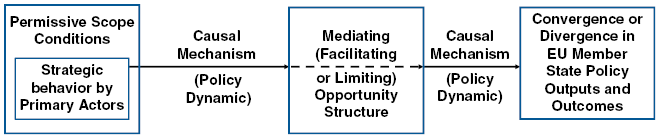
Accordingly, Figure 1 presents a simplified model of the relationship between the components of an individual policy dynamic. Adopting this analytic perspective allows us to compare the different dynamics and specify the conditions under which they are more or less likely to operate. We further elaborate on the precise mechanisms at play within each dynamic in Section 3, and illustrate them graphically.
Schematic representation of a policy dynamic
2.5 Opportunity Structures
The preferences of institutionalized actors in choosing to support a deeply embedded policy dynamic in a policy sector or to invest in and potentially build coalitions to support an alternative policy dynamic are not formed in a vacuum. Indeed, those choices are heavily constrained by jurisdictional arrangements and a number of other factors that form the “opportunity structure” for the emergence of a policy dynamic in a particular sector.
2.5.1 Scope Conditions: Jurisdictional Arrangements
Some EU policy dynamics likely operate only under specific “scope conditions”: in their absence, they will not function. Scope conditions mainly involve sector-specific jurisdictional arrangements that determine decision-making venues and which political actors are privileged in the process. Treaty provisions, decisions by the Court of Justice of the European Union (CJEU), and principles like subsidiarity define which policies fall under EU competence, member-state competence, or shared jurisdiction. While these arrangements are fixed in the short term, they can change over time and are often unclear in practice (van Kersbergen & Verbeek, Reference van Kersbergen and Verbeek2007). This ambiguity allows for efforts to expand Brussels’ jurisdiction and challenges from member states.
For example, leaders of some member-state governments may imitate other countries’ policies (emulation/diffusion) for political or policy gains, but they can only do so when they have exclusive or shared jurisdiction in that sector. In other cases, member states may build a blocking coalition in the European Council to prevent initiatives that could set an institutional precedent for increased harmonization (commonly known as a joint decision trap), even if they support the policy substance.
2.5.2 Mediating Conditions
Which policy dynamics emerge in particular sectors is not determined solely by jurisdictional arrangements. Even if a policy dynamic is present, mediating conditions can affect its impact. “Facilitating” conditions strengthen the mechanisms at work, while “limiting” conditions reduce their impact. For example, a race to the bottom occurs when member states fear negative consequences if their policies diverge from their neighbors. Conversely, emulation/diffusion dynamics are facilitated by mechanisms like the Open Method of Coordination (OMC) and the European Semester (Verdun & Zeitlin, Reference Verdun and Zeitlin2018), which provide benchmarks and transmit lessons on policy outcomes. Mediating conditions include: (1) jurisdictional and policy regime characteristics, (2) policy sector characteristics and policy feedbacks, and (3) heterogeneity of member-state characteristics.
Jurisdictional and Policy Regime/Sector Characteristics and Policy Feedbacks
Three major jurisdictional and policy regime characteristics determine the operation of policy dynamics: jurisdiction (see “scope conditions”), decision rules, and financial arrangements. EU decision rules have evolved, with unanimity partially replaced by qualified majority voting (QMV) (see Online Appendix I). QMV is generally less favorable to the status quo, making a “joint decision trap” less likely (Golub, Reference 84Golub2007). Financial arrangements also vary across sectors. Policy convergence is more likely where EU funding constitutes a substantial share of sector resources and is contingent on meeting EU requirements. Other EU funding sources, like the Instrument for Pre-Accession Assistance (IPA) and the European Social Fund, may also promote convergence if funding conditionality is credibly enforced. Policy variation is less likely when the EU distributes resources to incentivize specific policies or equalize fiscal capacity (Ladi et al., Reference Ladi, Tsarouhas and Copeland2025; Zeitlin et al., Reference Zeitlin, Bokhorst and Eihmanis2025). Policy feedbacks from existing policies also affect the development and persistence of dynamics. If member states have policies with concentrated beneficiaries, those interests may resist new EU policies that threaten existing privileges (Kvist, Reference Kvist2004). Other sector characteristics, like high-mobility corporations seeking lower taxes or looser regulations, can contribute to a “race to the bottom” dynamic (Holzinger & Sommerer, Reference Holzinger and Sommerer2011).
Heterogeneity of Member-State Unit Characteristics and Preferences
Heterogeneity across member states in policy preferences and fiscal/administrative capacity significantly contributes to distinctive policy dynamics. Variation in preferences can stem from voters, the governing party’s ideology, or pressure from interest groups whose resources differ across countries. These preferences may shift with changes in governing parties or coalitions. Policy variation is likely when member states have distinct policies with self-reinforcing feedbacks and concentrated stakeholder support. Diverse preferences among public or powerful interests across member states should trigger the “joint decision trap,” restrict creeping competences, and privilege the status quo in EU decision-making (Golub, Reference 84Golub2007). Heterogeneous preferences should promote policy divergence when there is moderate issue salience that incentivizes politicians to respond to voters’ or interest groups’ preferences. Member states may process common pressures differently based on domestic political forces and institutional characteristics (Müller & Thurner, Reference Müller and Thurner2017). Politicians also assess the costs of being an outlier relative to other states. Variation in preferences results in continued divergence in spending on services and “value-based” policies like abortion services and nuclear energy. Countries with low fiscal and administrative capacity are less likely to implement expensive policies and may engage in noncompliance with EU policies (Falkner et al., Reference Falkner, Treib, Hartlapp and Leider2005).
2.6 Outcomes: Strong and Muted Forms of Policy Dynamics
Rather than being uniform, the consequences of a policy dynamic are likely to take a “muted” rather than “strong” form when scope and facilitating conditions allow the dynamic to operate, but limiting conditions are also present, and multiple actors press for alternative dynamics. Strong and muted forms of each policy dynamic, and their expected impact on policy convergence, are summarized in Tables 2 and 3 in the concluding section of this Element. A “hegemonic” policy dynamic exists in sectors where the causal mechanisms and the coalition supporting a specific policy dynamic are so entrenched that potential supporters of alternatives stop making substantial investments in them. Conversely, shifts in facilitating and limiting conditions should alter policy dynamics, muting, strengthening, or even eliminating a dynamic over time. Changes in the policy preferences of national publics, political elites, and sectoral advocacy coalitions may also influence the evolution of policy dynamics.
2.7 Multiple Policymaking Venues and Pathways in the EU Policymaking Space
In Online Appendix II, we provide a brief overview of EU and member-state institutions, as well as key societal actors for readers unfamiliar with them. Those with only superficial EU knowledge will find Box 1, which summarizes core concepts, and Online Appendix II particularly useful. Readers already familiar with the EU institutional and actor landscape can turn directly to Section 2.7.2. Online Appendix I contains a glossary of key terms for those needing clarification. For a more in-depth introduction to the EU, we recommend the works by Hix and Høyland (Reference Hix and Høyland2022), McNamara (Reference McNamara2015), or McCormick (Reference McCormick2020). In the remaining sections, we assume readers have substantial knowledge of EU institutions and their operations.
EU Multilevel Governance
Multilevel governance generally describes the upward allocation of authority away from central states (e.g., to the EU), downward to regional and local levels (e.g., federalism), and sideways to societal actors (e.g., networks). Multilevel governance in the EU is the set of formal and informal rules that regulate the formulation, adoption, implementation, enforcement, and review of the legislative or nonlegislative instruments involved in an EU policy (see Online Appendix I). Under supranational EU governance, the European Commission proposes policies, which the Council and/or the EP negotiate and adopt. The Commission supervises member-state implementation and enforces policy. The CJEU reviews member-state compliance. Under intergovernmental governance, member-state governments in the Council and in the European Council voluntarily decide to coordinate their positions and adopt a decision.
European Integration
The process through which member states transfer policy competences to the EU and create supranational and intergovernmental institutions for exercising those competences. Integration comprises bargaining between different actors (politics), the formulation, adoption, and implementation of specific policies, and the establishment of a common political system and legal order (polity). European integration can mean transferring further powers to the EU level (deepening) or admitting new member states to the EU (widening).
Europeanization
The domestic impact of Europe – its influence on domestic policy, polity, and politics – as both an effect and a two-staged process of uploading and downloading. Uploading refers to how, when, and to what end national policy preferences are brought to the European table and pursued using the EU as a means of amplifying national policy. Downloading is the process by which collectively agreed EU policies are embedded within national policies and institutions over time. Member states also learn from one another in terms of information, analysis, and policymaking structures.
2.7.1 EU Governance, European Integration, and Europeanization
Multilevel governance involves delegating decision-making authority beyond the national level (Hooghe & Marks, Reference 85Hooghe and Marks2003). Over time, there has been an “upward delegation of powers” to the EU, expanding its scope, membership, and political diversity. Initially, the EU operated under unanimity, requiring all member states to agree before enacting new policies. This has since shifted to QMV to prevent stalemate (Schütze, Reference Schütze2021) (see Online Appendix I), though informal consensus remains influential. Additionally, the EU established new political institutions to resolve policy conflicts.
This process is called European integration. Initially, it was thought that sectoral market integration – such as coal and steel – through exclusive or shared regulation by the supranational community would trigger a chain reaction (Schimmelfennig et al., Reference Schimmelfennig, Leuffen and Rittberger2015). Integration in coal and steel would spill over to other sectors like transport and energy, and subsequently to industrial policy, prompting vertical integration, or deepening cooperation between member states and supranational institutions, notably the Commission, the CJEU, and the EP, especially after its first direct election in 1979 (Niemann et al., Reference Niemann, Lefkofridi, Schmitter, Wiener, Börzel and Risse2019). In the 1960s, an alternative view emerged: The European Community appeared to follow the script of international relations theory, where national governments protect their sovereignty unless sharing it benefits them. In this “realist” view (see Online Appendix I), integration occurs because national governments, representing domestic interests, pursue it to gain more flexibility, particularly against domestic lobbies (Moravcsik, Reference Moravcsik1993). Today, the EU’s multilevel system is a compound polity with elements of horizontal and vertical separation of powers (Fabbrini, Reference Fabbrini2019), but also a “mixed polity” lacking clear-cut separation of powers (Majone, Reference 88Majone2002; Wallace et al., Reference Wallace, Pollack, Roederer-Rynning and Young2020) (see Online Appendix I). It reconciles national and common European interests through institutional interactions, where sovereignty is shared among EU institutions and member states, and the institutions cooperate closely (Art. 4 TEU). The principles guiding EU policymaking reflect national government leaders’ concerns, ensuring the supranational union does not make decisions with which they might disagree. Supranational institutions (the Commission and the EP) for independent decision-making coexist with intergovernmental institutions (the Council and the European Council) that represent national interests. Several institutions have been explicitly delegated exclusive policymaking authority in multiple sectors, with some, like competition policy, also having independent enforcement capacity over member states. Since the Maastricht Treaty (1992), EU integration has expanded into politically sensitive areas of “core state powers” like foreign policy, defense, taxation, fiscal policies, border control, asylum policies, and the rule of law (Freudlsperger & Weinrich, Reference Freudlsperger and Weinrich2024; Genschel & Jachtenfuchs, Reference Genschel and Jachtenfuchs2016).
The question of policy convergence in this multilevel system goes beyond integration, also addressing how EU actions influence policymaking in member states. This two-way process is called Europeanization (Börzel, Reference Börzel2002; Zgaga et al., Reference Zgaga, Thomann and Goubier2024). Member states shape EU policymaking outcomes by uploading their policy preferences and then downloading EU policies through implementation (Radaelli, Reference Radaelli, Cini and Bourne2006). National parliaments formalize EU policies into domestic law (formal transposition), and member-state governments ensure their practical effect domestically (practical implementation). Policy convergence or divergence can result from integration, uploading, downloading, or their combinations. These processes involve different institutions, actors, and policymaking venues, which set the stage for the specific policy dynamics at work. Policy dynamics are the strategies that actors, especially member-state governments, employ during integration, uploading, and downloading to move policies toward their preferred positions.
Member states balance the benefits of EU-wide integration, such as economies of scale, pooling risks, and preventing negative side effects from uncoordinated policies, with the need to preserve national policy autonomy in sectors with strong preferences. This ensures that member governments are heard, not regularly compelled to adopt objectionable policies, and can retain some autonomy if desired. These efforts have led to a complex set of institutional and jurisdictional arrangements that generally favor the policy status quo or a “lowest common denominator” response, often through joint decision traps and differentiation dynamics (Falkner, Reference 83Falkner and Falkner2011). These efforts have also created multiple policymaking venues with distinctive players and different decision-making rules. These venues provide different opportunities for actors with varying biases toward the status quo (Wallace et al., Reference Wallace, Pollack, Roederer-Rynning and Young2020). Lastly, the availability of multiple venues has given rise to distinctive policymaking dynamics that political and social actors use to advance their interests (Princen, Reference Princen2011).
2.7.2 Multiple Policymaking Venues and Pathways
Which EU-level institutions are involved in policymaking, if at all, varies depending on the policy sector. There are some policy domains that are purely under EU jurisdiction, including the customs union, competition policy, monetary policy for the euro area countries, and fisheries, reflecting the EU’s origins in market integration. Other policy domains are under exclusively national jurisdiction with heterogeneous member-state policy preferences, and fiscal and administrative capacities. These include healthcare, pensions, tax policy, and social assistance. Some policy domains have shared jurisdictions between the EU and member states, including agricultural policy, foreign aid, common foreign policy, security and defense policy, and justice and home affairs. Fiscal policy is, in theory, primarily a matter of national jurisdiction, but the EU operates a system of budgetary surveillance that has made deep inroads into how governments must report spending, deficits, and debt (Zgaga, Reference Zgaga2026). To guard against the EU’s tendency to expand its policy competences, EU treaties have included the principle of subsidiarity: Wherever a lower level of government can adequately perform a task, then the EU should not go beyond what is needed to achieve the objectives of the treaties. For every legislative proposal, the Commission must perform a subsidiarity test. National parliaments of the member states can challenge proposed EU legislation and can request the annulment of EU laws in the CJEU on grounds of violating subsidiarity (Art. 5 TEU).
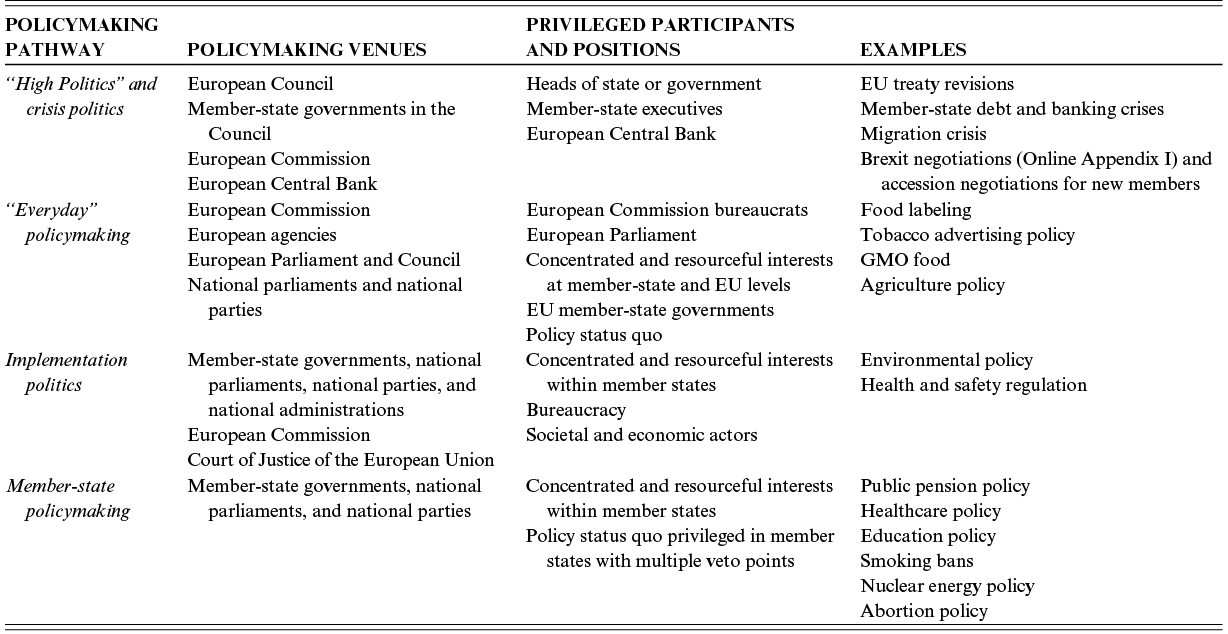
In this European policymaking space, we can distinguish between four broad policymaking pathways with corresponding venues, depending on jurisdiction, involving different levels and institutions, and resulting in different types of policies that vary in how binding EU-level decisions are for member states; these are summarized in Table 1. These pathways and venues should not be confused with actual policy dynamics, but set the stage for policy dynamics to unfold.
High Politics and Crisis Politics
First, “high politics” (Princen and Van Esch, Reference 90Princen and van Esch2015) and crisis politics are primarily made in areas of joint jurisdiction at the trans- or intergovernmental level. These procedures apply mainly in sensitive – and easily politicized – policy domains in which sovereignty questions arise (so-called core state powers, see Genschel & Jachtenfuchs, Reference Genschel and Jachtenfuchs2016), such as common foreign, security, and defense policy; economic (fiscal and budgetary) policy (see Online Appendix I); and migration and asylum policy. There, the European Council has become the crucial decision-maker because heads of state or government manage to depict themselves as symbols of national sovereignty and, thus, as the only actors that possess the right legitimacy to take fundamental political decisions. Moreover, for important decisions, such as association agreements, accession of new members, withdrawal from the EU, and serious breaches of fundamental rights, the Commission gives a proposal to the Council, which makes a decision, and the EP has a veto right. In common foreign and security policy, member states are in the driving seat and the decisions are not subject to CJEU jurisdiction.
Everyday Policymaking in the European Union
Second, “everyday policymaking” (McNamara, Reference McNamara2015) happens primarily at the EU level in areas of exclusive EU or joint jurisdiction. It typically results in so-called directives and regulations (see Online Appendix I), which are adopted jointly by the Council and the EP based on a proposal from the Commission (the so-called ordinary legislative procedure or OLP, see Online Appendix I), and are transposed into domestic law by national parliaments and practically applied by administrative units at central, subcentral, and also “street level” (Thomann & Zgaga, Reference Thomann, Zgaga and Brandsma2024). Everyday policymaking results in legislative acts that (a) allocate rights, duties, or resources to member states and (b) are binding for member states, who have to implement them. In EU everyday politics, bureaucrats working in the Commission largely monopolize the EU’s legislative agenda, but they need to take into account the views of other institutional actors (see Tsebelis and Kreppel, Reference Tsebelis and Kreppel1998; Princen, Reference Princen2011; Bocquillon and Dobbels, Reference Bocquillon and Dobbels2013; Koop, Reh, and Bressanelli, Reference 87Koop, Reh and Bressanelli2022), in particular the Council and the EP.
In most cases, member-state governments consist of a coalition of two, three, or even more parties. Hence, governments in the Council need to find a synthesis between the positions of the parties that form the respective governmental majority. In addition, since the Council meets in different sectoral configurations (e.g., agriculture, competition, and foreign affairs), it comprises ministers from the various parties of the coalition, which may often have different if not incompatible policy preferences. Heterogeneity in the Council (e.g., some center-right and some center-left governments) may make it more complicated to pass legislation – the so-called “gridlock effect” (Crombez & Hix, Reference Crombez and Hix2015) – due to the difficulty of finding a common position. On the other hand, if the EP and the Council have similar political majorities, it becomes easier to adopt new EU policies (Hagemann & Høyland, Reference Hagemann and Høyland2010).
The EP is organized in twenty-two standing committees and several related subcommittees specialized in different policy areas which adopt various instruments to affect the EU’s policymaking process. For example, the committees issue reports to advise the Commission on legislative proposals. They also amend existing Commission’s proposals and adopt reports on their own initiative, which are then presented to the plenary. Moreover, committees can be set up to temporarily deal with specific issues, to investigate certain events or phenomena (e.g., a natural disaster or the rise of xenophobia) or to examine cases of maladministration or misspending (Christiansen et al., Reference Christiansen, Griglio and Lupo2023).
Among societal interests, groups that have enough resources to organize cross-nationally to lobby EU institutions, and those that can enlist member-state governments – businesses in particular – are also likely to be privileged (Rasmussen, Reference Rasmussen2015). Member states will try to “upload” their policy preferences into the resulting EU policies (Börzel, Reference Börzel2002), but they can still adjust the latter during implementation politics (Zgaga et al., Reference Zgaga, Thomann and Goubier2024). National parliaments do not play a strong role only when transposing EU legislation. Since the Lisbon Treaty, national parliaments also participate more strongly in everyday policymaking and check if EU policies comply with the subsidiarity principle, for example, when parties react to communications from their government before European Council summits (Schütze, Reference Schütze2021). Committee members of the European and national parliaments can meet to discuss matters of common concern.
Implementation Politics
Thirdly, we also find “implementation politics” in all of those (often regulatory) policy areas where member states need to implement EU law (Zhelyazkova & Thomann, Reference Zhelyazkova, Thomann, Jordan and Gravey2021). Implementation includes, first, legal transposition into national law, either by national parliaments or by bureaucracies. The preferences of national parties matter a lot during transposition. In coalition governments, one or more parties might act as veto players and try to block the transposition of an EU legislative act. Strong opposition parties can also try to bring their voice in to affect implementation politics. Domestic actors may change (customize) an EU policy to adapt it to their interests (Zgaga et al., Reference Zgaga, Thomann and Goubier2024). When member states face strong pressure from the EU or from financial markets, or when they agree with a European policy because they already have a similar domestic policy in place, they can also opt for literal transposition (Zgaga & Thomann, Reference Zgaga and Thomann2025).
These formal rules then need to be put into practice by administrative actors at different levels of governance, and by citizens, service providers, and economic actors (Thomann & Zgaga, Reference Thomann, Zgaga and Brandsma2024). In parallel, the implementation of EU policies is also monitored and enforced by member states themselves, but also the Commission and the CJEU, various agencies and regulatory networks (Scholten, Reference Scholten2023). Here, the downloading phase is the crucial venue for policy dynamics and will be decisive in determining the resulting level of policy convergence. Nevertheless, this stage can interact with the prior stages of integration (Princen et al., Reference Princen, Schimmelfennig, Sczepanski, Smekal and Zbiral2024) and uploading during EU policymaking (Zgaga et al., Reference Zgaga, Thomann and Goubier2024).
Member-State Policymaking
Finally, conventional “member-state policymaking” by national governments and parliaments dominates those areas where member states have primary or exclusive jurisdiction. In these areas, policy convergence or divergence is largely unrelated to what the EU does, or at minimum the result of diffusion or learning from neighboring policies, even though the EU may still issue “soft policies” – guidelines, recommendations, and declarations that do not have legal force but may still affect policy choices of and implementation by member states – to try and foster convergence. Member-state policymaking implies that there is, inherently, variation across EU countries in their preferences for specific policies that are embodied in domestic legislation and regulation. These differences in preferences can have multiple roots, including the orientation of voters, the ideology of parties in the government and in the opposition, and pressure from interest groups whose resources and leverage differ across countries – and often a combination of all three. Thus, these preferences may change over time with shifts in governing parties or coalitions which can act as veto players. And it does not require that there be anything close to a national consensus on these preferences, just that domestic political processes, in the absence of an EU override, would lead to policies that vary across member states. Heterogeneity in member-state preferences is a major mediating condition for all policy dynamics where member states have exclusive or primary jurisdiction in a policy sector, and substantial discretion in the absence of binding EU rules. As we discuss in Section 5.2 (Table 2), these multiple policymaking venues and pathways can privilege and provide distinct opportunities for different sets of actors and for different policy dynamics, both as dominant modes of policymaking and as strategies to reinforce or challenge existing modes of policymaking.
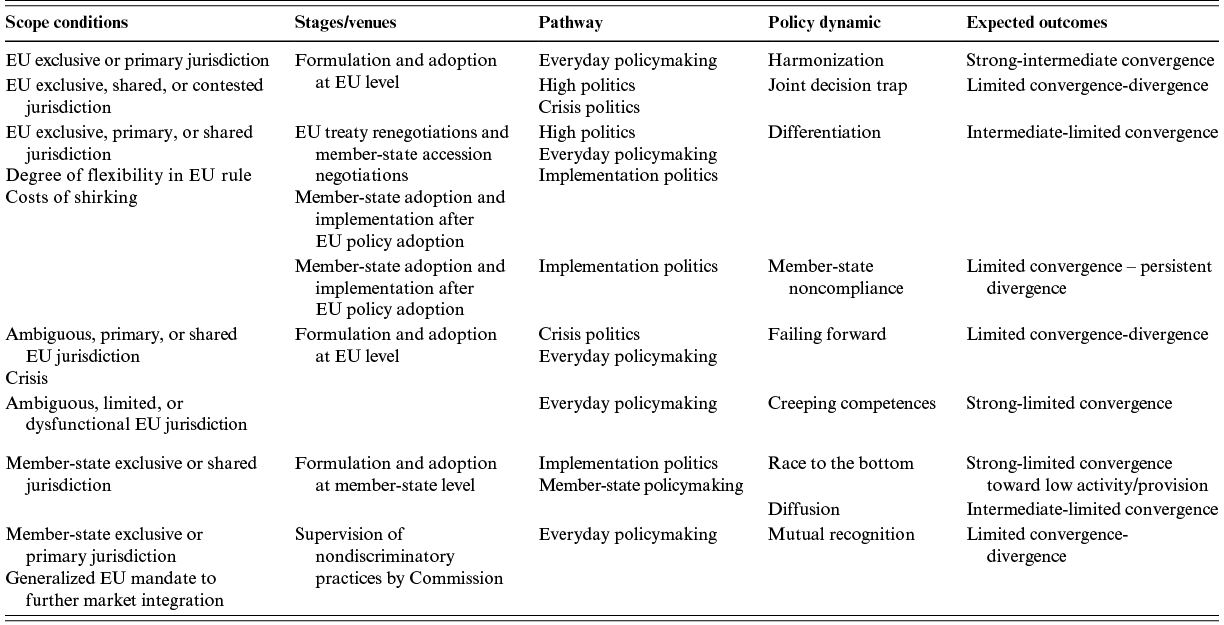
We now explore how specific institutional and societal interests in the EU policymaking space try to use the opportunities provided by institutional structures to pursue their interests. In Section 5, we return to a comparative description of which dynamics operate in which venues and under which conditions.
3 Multiple Policy Dynamics in the European Union
What policy dynamics are most common in EU policymaking? Who are the key actors, what causal mechanisms are at work, and what conditions determine their operation? In this section, we discuss nine ideal-type policy dynamics identified in EU and multilevel governance literature (Weaver, Reference Weaver2020). These are grouped into three categories: those that primarily encourage convergence (harmonization, creeping competences, and race to the bottom); those that generally encourage intermediate or mixed outcomes – convergence limited in depth, scope, or time (differentiation, diffusion/learning, failing forward, and member-state noncompliance); and dynamics that encourage divergence (joint decision trap and mutual recognition). Six of the nine dynamics (all but race to the bottom, learning/diffusion, and mutual recognition) assume some level of EU policymaking intervention. In the case of mutual recognition, the CJEU may also play a key role through its rulings, as seen in landmark judgments in the 1960s and 1970s that triggered market integration (Schütze, Reference Schütze2021).
We illustrate each policy dynamic with a figure mapping its main actors, scope conditions, causal mechanisms, predicted EU member-state convergence/divergence outcomes, and mediating conditions that affect these outcomes.
3.1 Harmonization
Harmonization involves the imposition of uniform EU “hard law” in the form of standards, regulations, and directives to replace national standards, using “the Commission’s exclusive right of legislative initiative, the legislative powers of the Council and the EP, and the central role of the Court of Justice of the European Union in guaranteeing the respect of the rule of law” (Smismans, Reference Smismans2011: 504). This is broader than viewing harmonization as a specific legal instrument with no room for deviation. Harmonization involves several actions: a decision by EU institutions to make national policies more similar, such as in terms of requirements, standards, and ceilings; EU institutions adopting binding legislative or executive acts; and member states implementing those policies, often willingly, but sometimes in response to conditionality, lobbying, or actions by the European Commission to detect and warn against violations, and/or by the CJEU to support a violation finding.
Figure 2 summarizes the harmonization dynamic. Whether the EU has exclusive or primary jurisdiction is a key scope condition for harmonization, which operates during the formulation and adoption of policies at the EU level in “everyday” policymaking (see Table 2). Core institutional advocates of the harmonization dynamic include the European Commission, the EP, the Council, and the CJEU. Strong forms are most likely when these actors’ views align, driven by shared interest in joint action due to pressures in the single market, external shocks, or crises. Business actors may support harmonization in general, but oppose it if it raises their costs, for example, higher sustainability costs for large firms (Kinderman, Reference Kinderman2020). Member-state governments and parties, whether in the governmental majority or opposition, may oppose harmonization (Cohen et al., Reference Cohen, Manes Rossi and Brusca2023). Therefore, member-state politics help explain whether harmonization takes on a strong or muted form.
Harmonization
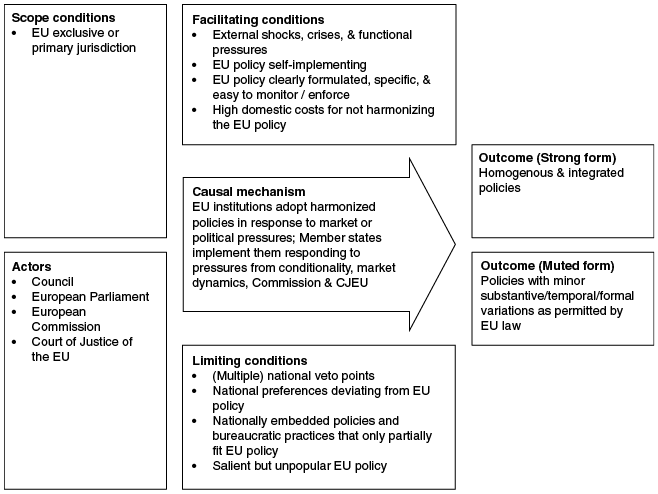
In the strong form, following a Commission proposal, member-state governments (in the Council) and the EP adopt homogeneous and integrated policies. Member states then implement these policies domestically. Strong harmonization is most likely when political majorities in the Commission, the Council, and the EP belong to the same party families, member-state preferences converge, deviation costs are high, the EU has exclusive or primary jurisdiction, and the EU policy is clear and specific. External shocks and crises can also lead to harmonization by exposing inadequacies in earlier, less harmonized policies. Strongly harmonized EU policy often takes the form of regulations directly applicable in member states, without the requirement – as with directives – that member states transpose EU rules into national law (Blom-Hansen et al., Reference Blom-Hansen, Christensen, Grøn, Jensen and Mortensen2023). Given monitoring and enforcement costs and the limited capacity of the Commission, it helps if monitoring compliance is easy and inexpensive. The EU may provide resources to member states with lower capacity to adopt harmonized policies, such as in environmental policy (Börzel & Buzogány, Reference Börzel, Buzogány, Zito, Burns and Lenschow2020).
Frequently, harmonization takes on a muted form because political majorities in the Commission, Council, and EP differ; member-state practices partially fit EU policy; national veto points complicate implementation; or member-state preferences to deviate from EU policy increase opposition to harmonization (Mastenbroek & Kaeding, Reference Mastenbroek and Kaeding2006; Zhelyazkova, Reference Zhelyazkova2014; Zgaga et al., Reference Zgaga, Thomann and Goubier2024). In large coalition governments, parties with different preferences may act as veto players, threatening to exit the coalition if a policy they oppose is harmonized. Powerful opposition parties may also block or delay harmonization. High issue salience can lead politicians to claim credit for deviating from unpopular EU policies. For example, the Service Directive, known as the Bolkestein directive, aimed at establishing a single market for services, faced strong opposition from far-right parties in Italy because it forced the beach concession market to open to competition, potentially damaging local operators (Chang et al., Reference Chang, Hanf and Pelkmans2010). As a result, member-state policies will converge toward the EU policy, but with minor variations within the scope permitted by EU law.
Other forms of muted harmonization include member states adopting EU policies with legally permitted time lags, as with East European member states’ access to EU 15 labor markets (Steunenberg & Toshkov, Reference Steunenberg and Toshkov2009). The EU may set minimum standards that member states can exceed or “customize” in a compliant manner if they choose (Dougan, Reference Dougan2000; Thomann, Reference Thomann2019; Thomann & Zhelyazkova, Reference Thomann and Zhelyazkova2017; Zhelyazkova et al., Reference Zhelyazkova, Kaya and Schrama2016) (see Online Appendix I). Unlike the differentiation (Section 3.5) or member-state noncompliance (Section 3.4) dynamics, EU actors, especially the Commission, dominate the harmonization dynamic. Harmonized EU policies offer little scope for divergence, given the EU’s exclusive or primary jurisdiction. Strong EU enforcement pressures and high costs for deviations also facilitate the harmonization dynamic.
The EU’s food safety policies show both strong and muted harmonization. Initially, EU food legislation aimed to ensure free movement of foodstuffs within the common market, with food safety and consumer protection not a priority (Ugland & Veggeland, Reference Ugland and Veggeland2006). Food legislation remained fragmented within member states’ competence (Holm & Halkier, Reference Holm and Halkier2009; Ugland & Veggeland, Reference Ugland and Veggeland2006). In response to cross-border food crises like “mad cow disease” (Knowles et al., Reference Knowles, Moody and McEachern2007), food safety gained political attention in the late 1990s. The EU changed its regulatory approach to regain public trust (Ugland & Veggeland, Reference Ugland and Veggeland2006) and ensure high protection of human health, covering all stages of food production and distribution. The EU established the European Food Safety Authority (EFSA) for risk assessment, while risk management and communication were assigned to the Directorate-General for Health and Food Safety (DG SANTE). The General Food Law defined by Regulation (EC)178/2002 led to seventeen regulations and eleven directives on animal health, fifty-seven regulations and thirty-one directives on food hygiene, and fourteen regulations and eight directives on plant health, regulating food safety throughout the food chain.
Research indicates successful harmonization due to the uniform implementation of these policies and their shift toward a more consumer-centered perspective (Holm & Halkier, Reference Holm and Halkier2009). However, member-state variation remains in transposition and enforcement as countries customize EU food safety provisions to fit domestic circumstances while complying with EU rules. Reasons for this muted harmonization include national regulatory traditions, unclear EU rules, lack of strong problem pressure (e.g., preventing food scandals), and domestic conflicts over policy (Borraz et al., Reference Borraz, Beaussier, Wesseling, Demeritt, Rothstein, Hermans, Huber and Paul2022; Thomann, Reference Thomann2019; Zhelyazkova et al., Reference Zhelyazkova, Thomann, Ruffing and Princen2024).Footnote 1
3.2 Creeping Competences
A policy dynamic of creeping competences occurs in the EU context when the Commission expands EU jurisdiction into new policy domains that the founding treaties do not explicitly delegate to the European level and may even have reserved for member-state discretion. This dynamic has been frequently analyzed (e.g., Pollack, Reference Pollack2000; Duina & Kurzer, Reference Duina and Kurzer2004; Garben, Reference Garben2019; Vėlyvytė, Reference 95Vėlyvytė2023) because early integration theory saw it as a standard method for European integration. Contrary to the negative connotation of “creeping,” early proponents viewed this expansion of competences as functional spillovers (see Online Appendix I). For instance, the communitization of the coal and steel sector suggested that regulating and building a common transport network for heavy goods might also be necessary.
Recently, scholars have pointed to the Commission’s self-interest in expanding its authority and budget over more policy domains as a driving force behind the tacit expansion of competences, which ultimately faciltates convergence in member-state policies. The dynamic of creeping competences occurs when the European Commission exploits a window of opportunity to expand its competences, often based on an initial assumption of temporariness. For example, the multiple crises of the first two decades of the 2000s (euro crisis, COVID-19 pandemic) triggered a dynamic of creeping fiscal competences (Garben, Reference Garben2019), granting the Commission stronger powers to supervise member-state budgets and to raise new money through EU debt (Zgaga, Reference Zgaga2026). Figure 3 summarizes this dynamic.
Creeping competences
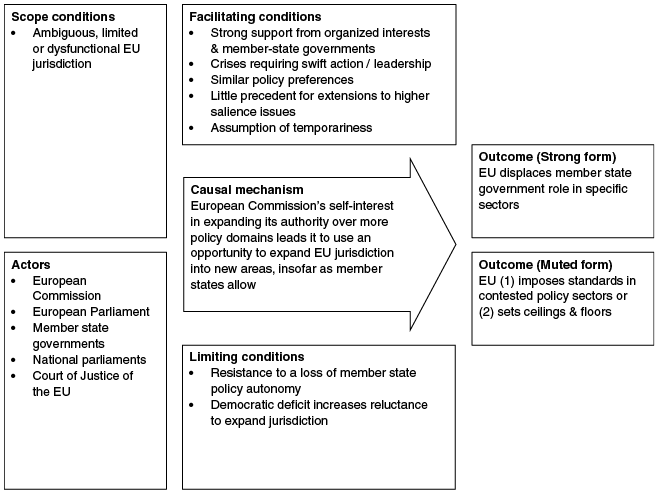
Ambiguous, limited, and/or dysfunctional assignment of policy authority is a scope condition for creeping competences. The lack of clarity about who holds responsibility for certain policy areas, combined with inefficiencies in policy implementation, allows the Commission to push for further EU involvement. Gaps arise when member states are unable or unwilling to act collectively, leaving room for the Commission to assert its role. Politically sensitive or complex issues often prompt member states to delegate responsibility to the EU to avoid domestic conflicts or gain collective leverage.
Creeping competences can also emerge when member states’ responses to new challenges are insufficient or fragmented, making EU-level action seem necessary or attractive. This often occurs in areas where member states struggle to coordinate national policies or lack resources to address transnational issues. For instance, environmental policies have seen creeping competences as the EU took on a larger role in setting standards, monitoring compliance, and financing projects that member states found difficult to handle alone.
The Commission’s strategic use of the “flexibility” of EU law is crucial to the expansion of competences. The EU treaties provide broad legal bases for adopting secondary legislation, often without precisely defining the scope of authority. The Commission exploits this flexibility to introduce policies that progressively shift powers to the EU level, particularly in areas where member-state competence is unclear. The idea of “functional spillover” explains how the EU extends its competences logically but not strictly through treaty mandates. This process typically occurs in sectors with broader economic, social, or environmental implications, such as competition policy or migration.
In some cases, the Commission frames these expansions as temporary or emergency measures to be reversed later. For instance, the response to the 2008 financial crisis led to the creation of the European Stability Mechanism (ESM) and the European Banking Union. These measures, initially framed as short-term solutions to stabilize the financial system, became institutionalized and permanent features of EU governance. Similarly, the Commission’s involvement in fiscal policy has increased over time, first through surveillance mechanisms like the European Semester, and later by giving the Commission the power to issue budgetary recommendations and impose sanctions on noncompliant states.
The creeping competences dynamic has both supporters and critics. Proponents argue that it strengthens EU cohesion and ensures more efficient responses to cross-border challenges. They view the expansion of EU competences as a way to make the EU more responsive to the complex problems facing member states. This is especially relevant in areas like climate change, financial regulation, and migration, where collective EU action is more effective than fragmented national responses.
Critics, however, argue that the Commission’s power expansion undermines subsidiarity, which ensures decisions are made at the most local level possible. They claim creeping competences erode member-state sovereignty and bypass democratic accountability. Many member states view the Commission’s increasing influence in sensitive areas like fiscal policy and taxation as a threat to their political autonomy. The creation of new EU competences often faces opposition from national governments, especially when they believe these competences encroach on areas traditionally within national jurisdiction.
The EU’s response to the COVID-19 pandemic exemplifies the creeping competences dynamic. As the pandemic worsened, the Commission proposed and pushed for new initiatives, such as joint vaccine procurement, a recovery fund, and a new EU debt instrument. These actions, initially framed as emergency measures, raised questions about long-term EU involvement in economic recovery and health policy. The EU’s now more prominent role in public health and fiscal policy has sparked debates over the future of these competences.
Similarly, the Commission expanded its role in digital governance and cybersecurity, areas where EU involvement was previously limited. The Digital Services Act (DSA) and the Digital Markets Act (DMA) represent significant strides in EU regulation of the digital economy, an area where member states were reluctant to cede power. The Commission’s success in these domains illustrates how creeping competences emerge when member states struggle with transnational issues or face pressure to harmonize policies to ensure the single market functions properly.
Despite challenges, the Commission’s ability to drive the expansion of competences reflects the evolving nature of EU governance. As the EU grows more integrated, new policy domains will inevitably require an extension of EU powers, whether through formal treaty changes or informal practices. The Commission’s ability to frame new policy areas as necessary for the internal market or as urgent responses to crises will likely continue to shape EU competences’ trajectory.
Ultimately, the creeping competences dynamic highlights the tension between national sovereignty and EU integration. While the EU’s collective action is vital in addressing global challenges, centralizing power in Brussels raises concerns about democratic accountability and the role of member states in shaping EU policies. How the Commission navigates these challenges, and how member states respond, will determine the future balance of power within the EU.
3.3 Race to the Bottom
The key actors in a race to the bottom are member-state governments. Race to the bottom is driven by competition among member states, for example, to attract businesses by lowering taxes and program standards over time, and to discourage immigration by those who are likely to be frequent users of services and low contributors to revenue (Aisbett & Silberberger, Reference Aisbett and Silberberger2021). In its strong form, a race to the bottom would lead to homogeneous policy outputs across member states in specific sectors at a low level of activity, service or rights provision, such as wage standards, social benefits, environmental standards, and corporate taxation. In its muted form, a race to the bottom implies member-state activity that is limited and may decline over time, but where national variation remains as domestic political parties push back and constrain “races” (Weaver, Reference Weaver2020). Figure 4 summarizes the race to the bottom dynamic.
Race to the bottom
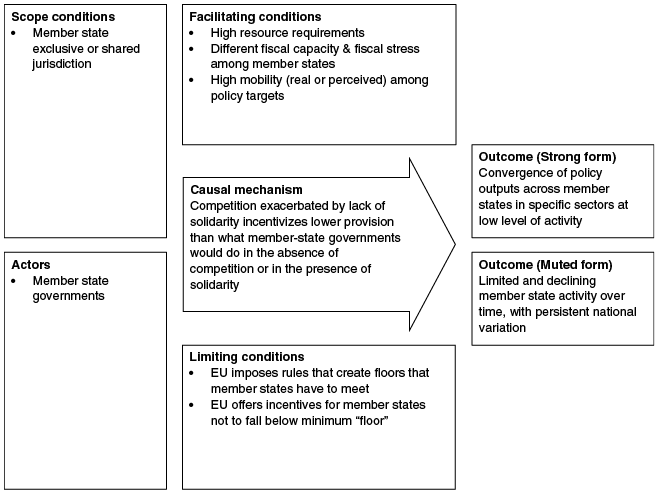
The literature on federalism suggests several scope and facilitating conditions under which we might expect a race to the bottom in the EU, notably when member states have exclusive or shared jurisdiction in a policy sector. When part of a member-state policy elite (especially in the government) strongly believes that the factors of production (business) or consumption (recipients of government services or transfers) in a sector are mobile, this could foster a race to the bottom, especially if national politicians fear competitive effects on mobile factors of production and/or blame from voters for a perceived loss in competitiveness and/or a lower availability of social benefits for native citizens. High member-state heterogeneity in national fiscal capacity and tax regimes, and the large number of member states limit their ability to provide credible assurance that they will not compete, especially after EU enlargement (Genschel et al., Reference Genschel, Kemmerling and Seils2011). A “race” is likely to be more muted if – in order to oppose a spiral toward the bottom – the Commission, the EP, and the Council (1) impose laws, rules, or informal coordination mechanisms that create floors that the states have to meet in program standards, and/or (2) offer incentives for member states not to fall below a minimum policy “floor.”
The bulk of existing literature suggests that a race to the bottom rarely occurs in the EU and is generally muted where it does occur. For example, Skupnik (Reference Skupnik2014) found no evidence of a “welfare magnet” effect or benefit reductions as a result of EU enlargement, hence continued divergence. Holzinger and Sommerer (Reference Holzinger and Sommerer2011) find weak evidence of a race to the bottom in environmental regulation in the EU, as firms and states within Europe have preferred to avoid potentially harmful competition in environmental policy through policy harmonization facilitated by a “race to Brussels” instead.
Scholars of tax competition have reached a different conclusion, however, especially with regard to corporate taxation. Genschel et al. (Reference Genschel, Kemmerling and Seils2011: 600) cite the creation of a single market as a constraint on national tax authorities, combined with unanimity rules in the Council of Ministers on tax coordination, strong preference differences between member states, and a CJEU that is sympathetic to corporate arguments that corporations exploiting “the lower tax level of another Member State (…) is (…) not an abuse to be stopped, but a legitimate right to be protected in the single market,” including special tax regimes (see also Genschel & Jachtenfuchs, Reference Genschel and Jachtenfuchs2016). Efforts to introduce QMV on tax issues to facilitate a more harmonized tax system in the EU have repeatedly failed, largely as a result of opposition from low-tax states, with the expansion of the EU to predominantly low-tax Eastern and Central European states increasing barriers further (Tudor & Appel, Reference Tudor and Appel2016). Still, countervailing tendencies to the race to the bottom in tax law have materialized over the last few years. In December 2022, the Council agreed on the minimum taxation rate of 15 percent for corporate profits in all member states, with the possibility to impose penalties on noncompliant multinational corporations (Council of the EU, 2022). In addition, in September 2024, the CJEU ruled that very low effective tax rates (so-called “sweetheart deals”), such as the one that Ireland granted to Apple, constitute an unlawful subsidy that violates EU state aid (Schickler, Reference Schickler2024).
In a different policy area, following the unprecedented migration flow to the EU in 2015, and given the absence of a common EU asylum policy based on interstate solidarity, the restrictive migration policies of some governments have triggered a muted form of the race to the bottom. For instance, Austria has set an upper limit on asylum applications from 2016 and has temporarily suspended its obligations under international and European asylum law (Benedek, Reference Benedek2016). Similar trends took place in Hungary and Poland (Moise et al., Reference Moise, Dennison and Kriesi2024). In general, “right-wing and far-right parties are associated with lower asylum recognition rates” (Winn, Reference Winn2020: 88).
3.4 Member-State Noncompliance
Member-state noncompliance with EU law is one of the most frequently analyzed EU policy dynamics (Börzel et al., Reference Börzel, Hofmann, Panke and Sprungk2010; Hartlapp, Reference Hartlapp, Behnke, Broschek and Sonnicksen2019), involving member-state governments, parliaments, and public administrations. Noncompliance occurs when member states’ actions do not conform to EU policy intentions (Knill, Reference Knill, Richardson and Mazey2015; Treib, Reference Treib2014), such as delayed, incomplete, or incorrect transposition by national parliaments or failure to implement policies in practice (Kaeding, Reference Kaeding2006; Zhelyazkova & Thomann, Reference Zhelyazkova, Thomann, Jordan and Gravey2021). Correct transposition is often subject to interpretation and controversy.
As summarized in Figure 5, noncompliance may lead to variation in policy outputs and outcomes, with policy in noncompliant states staying close to the status quo ante, unless the European Commission successfully terminates noncompliance through an infringement procedure (Jensen, Reference Jensen2007). Overall, muted and temporary noncompliance is more common than prolonged, blatant (strong) shirking, though there are exceptions.
Member-state noncompliance
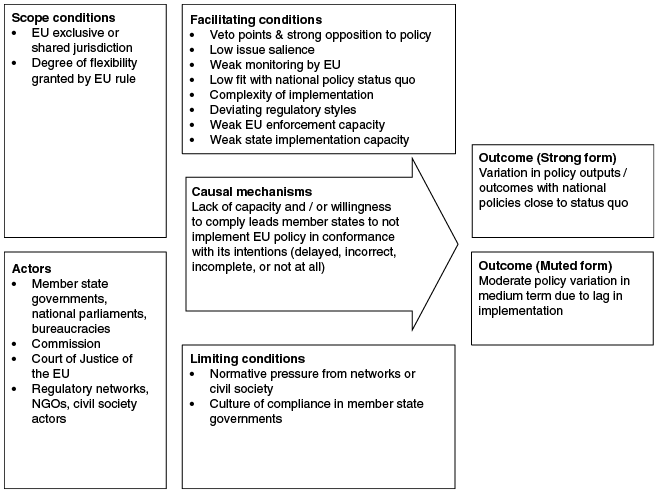
Member-state noncompliance has many explanations: This is a causally heterogeneous policy dynamic. The mechanisms underlying member-state noncompliance are generally described as a lack of capacity, willingness, or both (Falkner et al., Reference Falkner, Treib, Hartlapp and Leider2005). “Unwillingness to comply” prevails when member-state governments, influential actors, or national parties actively oppose the implementation of EU policies, especially when political divergence occurs within a governmental coalition. Noncompliance results from concentrated domestic opposition or divergent preferences in member states compared to the EU Commission (Mastenbroek & Kaeding, Reference Mastenbroek and Kaeding2006), or from differing regulatory styles or cultures (Falkner et al., Reference Falkner, Treib, Hartlapp and Leider2005). It may also arise from issue salience: When an issue is crucial for governing parties who favor EU policies – for example, stronger environmental laws for coalitions involving Green parties – transposition occurs faster (Spendzharova & Versluis, Reference Spendzharova and Versluis2013). Finally, member states may engage in “opposition through the back door” to compensate for failed attempts to influence the EU policy (Thomson, Reference Thomson2010; Zhelyazkova, Reference Zhelyazkova2014).
Conversely, “inability to comply” often leads to unintentional noncompliance, caused by a lack of capacity to process, interpret, and adapt EU policies into national contexts (Schmälter, Reference Schmälter2018a) due to different interpretations, administrative issues, or political instability. Member-state governments may also lack the necessary resources, bureaucratic support, or efficiency to enforce EU policies (Tallberg, Reference Tallberg2002; Jensen, Reference Jensen2007). Inability to comply may lead to more muted, temporary noncompliance, such as implementation delays, and moderate policy variation, for example, in labor rights and environmental regulation. Here, the EU has worked to reduce noncompliance through capacity-building efforts in Central and Eastern Europe, alongside enforcement (Börzel & Buzogány, Reference Börzel, Buzogány, Zito, Burns and Lenschow2020). Normative pressures from transnational networks, NGOs, and civil society groups may also help resolve noncompliance through socialization and learning (Dimitrova & Buzogány, Reference Dimitrova and Buzogány2014; Zhelyazkova & Thomann, Reference Zhelyazkova, Thomann, Jordan and Gravey2021). Various theories for explaining the interplay between capacity and willingness underlying member-state noncompliance dynamics exist. For instance, goodness of fit theories model noncompliance as the result of adaptation pressures stemming from a discrepancy between EU policies and domestic policies or institutions (Börzel & Risse, Reference Börzel, Risse, Featherstone and Radaelli2003; Knill, Reference Knill, Richardson and Mazey2015), with mixed empirical evidence (Brendler & Thomann, Reference 81Brendler and Thomann2024; Falkner et al., Reference Falkner, Treib, Hartlapp and Leider2005; Mastenbroek & Kaeding, Reference Mastenbroek and Kaeding2006). Institutions as well as policy feedbacks and path dependence can also affect whether noncompliance occurs. Haverland (Reference Haverland2000: 100) argues that “veto points [in member-state governments] tend to shape the timing and quality of implementation regardless of differential gaps in the goodness of fit between European requirements and national traditions. Domestic opposition is activated by adaptation pressure, but whether it is successful or not depends on the availability of veto points.”
In deciding whether or not to comply, member-state governments must also calculate the costs of noncompliance, including the reactions of the Commission and, ultimately, the CJEU: How far will they be willing to go to crack down on violations given resource constraints, with what tools and what incentives? The Commission has engaged in “supranational forbearance” over the past two decades in order to preserve member state support for their integration initiatives (Kelemen & Pavone, Reference 86Kelemen and Pavone2023: 779). Member-state governments may be more inclined to violations if they believe they will not be prosecuted in CJEU proceedings. At the passive (low investment) end, they may simply monitor EU policies for potential conflicts with their own policies, or at the intermediate level, delay transposition of EU policies and/or implement them incompletely. At the highest (and most costly) level, member states may implement policies that clearly violate EU regulations and directives, pressure the European Commission not to enforce EU policies by threatening to oppose other Commission initiatives, and appeal policies that clearly violate EU policies to the CJEU to delay compliance. Ultimately, what sets this dynamic apart from muted forms of harmonization and differentiation is that member states do risk the costs associated with noncompliance.
Member-state noncompliance occurs in areas where the EU has some degree of jurisdiction. Inflexible EU rules grant member states less discretion for compliance and typically increase both adaptation pressure and the costs of noncompliance (Zgaga & Thomann, Reference Zgaga and Thomann2025).
The EU’s Common European Asylum System (CEAS) is a striking case of member-state noncompliance. The Dublin Regulation determines which member state is responsible for examining a given asylum application (Schmälter, Reference Schmälter2018b). The CEAS led to some degree of convergence of national asylum policies and prevented a race to the bottom (Toshkov, Reference Toshkov2014). Yet, member states systematically and persistently breach their protection responsibility under the Dublin Regulation, whose allocation rules led member-state governments to take unilateral efforts to deter refugees. Most Dublin requests do not result in actual relocation of a refugee, and irregular entry, and the onward migration of refugees through Europe, persist. Member states have incentives to free ride on the efforts of others. While the first-influx countries often lack the capacity to deal with the high number of asylum seekers, the other EU member states lack the political willingness to comply with the distribution mechanisms (Lutz et al., Reference Lutz, Kaufmann and Stünzi2020). The European Commission appears unwilling to enforce the Dublin regulations. In particular, Southern European first-influx countries have faced infringement procedures – but other noncompliant member states have not been named and shamed. Instead, the Commission prefers to employ capacity-enhancing instruments and persuasion-based efforts to improve compliance via agencies and networks, with limited effectiveness so far (Schmälter, Reference Schmälter2018b).
3.5 Differentiation
Reflecting the EU’s motto “united in diversity,” the differentiation dynamic entails efforts to legitimize variation in centralization, territorial extension, and operational discretion across policy areas and member states (Schimmelfennig et al., Reference Schimmelfennig, Leuffen and Rittberger2015; Zhelyazkova et al., Reference Zhelyazkova, Thomann, Ruffing and Princen2024). The underlying causal mechanism is that key actors within member states – governments, parliaments, and political parties – have differing preferences and capacities, leading them to limit or vary the alignment of national practices with the EU’s intentions, while avoiding outright nonparticipation or noncompliance, which are considered too costly. The result is limited policy convergence among member states.
In its strong form, differentiation occurs as differentiated integration (DI), when decisions about participation in the EU polity are made. In its muted form, it appears as differentiated policy implementation (DPI), especially when member states cannot opt out of EU policies or national governments cannot upload their preferences before implementation (Steunenberg, Reference 93Steunenberg2019; Zhelyazkova et al., Reference Zhelyazkova, Thomann, Ruffing and Princen2024). Empirically, DI and DPI tend to occur sequentially or together, as they “are two forms of differentiation in the EU, which are used to address different aspects of a common underlying set of concerns” (Princen et al., Reference Princen, Schimmelfennig, Sczepanski, Smekal and Zbiral2024: 466). Figure 6 summarizes the differentiation dynamic.
Differentiation
DI = differentiated integration; DPI = differentiated policy implementation.
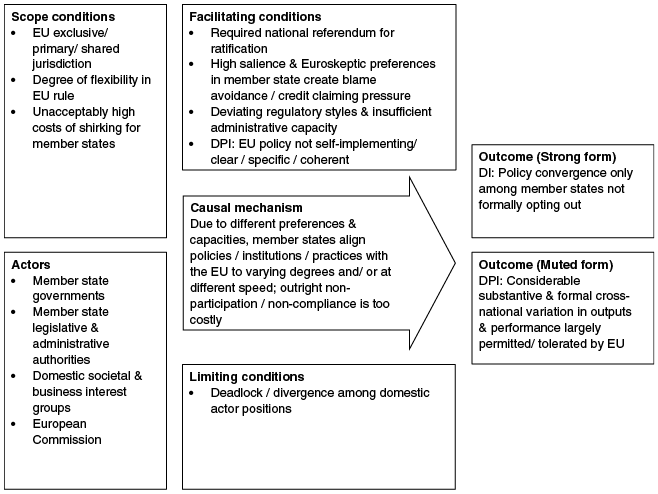
Differentiated integration involves different requirements across member states to adhere to common EU policies (Leuffen et al., Reference Leuffen, Rittberger and Schimmelfennig2022; Schimmelfennig & Winzen, Reference Schimmelfennig and Winzen2014; Leruth et al., Reference Leruth, Gänzle and Trondal2022). Member states may attempt to opt out of EU policies during treaty renegotiations when unanimity is required, and most countries wish to move forward, but one or a few oppose certain provisions. Alternatively, member states may move toward increased harmonization at different speeds, with some not yet ready for full integration (Moland, Reference Moland2024), receiving temporary opt-outs during EU accession, or being excluded from a uniform policy regime when secondary EU law is adopted (Schimmelfennig & Winzen, Reference Schimmelfennig and Winzen2014). DI operates intermittently, with long-term consequences, as policy convergence occurs only among member states who opt in. Its main drivers are member-state governments, who approve treaty changes.
Differentiation primarily occurs through DPI, where discretion exists during legal and practical policy implementation in the EU. DPI captures efforts by member-state governments to secure and use discretion when implementing EU policies they have opted into (Zhelyazkova et al., Reference Zhelyazkova, Thomann, Ruffing and Princen2024). National representatives may lobby in Brussels for more flexibility in policy transposition, turning rigid regulations into more flexible, voluntary instruments (Blom-Hansen et al., Reference Blom-Hansen, Christensen, Grøn, Jensen and Mortensen2023; Hartlapp, Reference Hartlapp, Behnke, Broschek and Sonnicksen2019; Zbiral et al., Reference Zbiral, Princen and Smekal2023), so that both EU requirements and domestic interests can be met (van den Brink, Reference van den Brink, Garben and Govaere2017). Legislative and administrative authorities modify EU policies to accommodate domestic preferences, capacities, and conditions (Zhelyazkova et al., Reference Zhelyazkova, Thomann, Ruffing and Princen2024). This leads to considerable diversity in how member states deviate from the EU rule (Thomann, Reference Thomann2019; Zgaga & Thomann, Reference Zgaga and Thomann2025; Bondarouk & Mastenbroek, Reference Bondarouk and Mastenbroek2018). The EU tolerates this variation, and it is often fully compliant (Thomann & Zhelyazkova, Reference Thomann and Zhelyazkova2017). However, it goes beyond the minor variations seen under muted harmonization. Muted differentiation can be seen as “opposition through the back door” by member states while avoiding noncompliance costs (Thomson, Reference Thomson2010). DPI may feed back into EU policymaking (Börzel, Reference Börzel2002; Polman et al., Reference Polman, Eerd and Zwaan2022), with member states defending their customized policies before the CJEU or the European Commission (Thomann, Reference Thomann2019).
Several conditions facilitate the differentiation dynamic. The unanimity requirement among EU member states for treaty revisions and new member accessions is key for DI. Public referenda in some member states to ratify or implement EU treaty revisions strengthen the leverage of governments seeking opt-outs or customized implementation. Strong populist parties and Eurosceptic preferences among member-state publics may also affect their willingness to press for opt-outs or DI. Politicians may seek opt-outs to defend national autonomy against EU encroachment.
Differentiated policy implementation is facilitated by the inherent ambiguity of many EU rules, requiring interpretation. EU policies allow various degrees of flexibility for national authorities to implement rules (van den Brink, Reference van den Brink, Garben and Govaere2017). DPI can also be driven by functional factors. For instance, shared pressures like ensuring traceability of animal food products in the single market can lead to convergent customization patterns across member states when they customize EU policies beyond minimum standards (Thomann, Reference Thomann2019). Administrative capacity can drive differentiation, as some member states cannot afford to exceed EU requirements, such as preventing money laundering (Zhelyazkova et al., Reference Zhelyazkova, Thomann, Ruffing and Princen2024). Member states and domestic bureaucrats may interpret EU rules differently, aligning them with existing national policies and institutions (Falkner et al., Reference Falkner, Treib, Hartlapp and Leider2005; Brendler & Thomann, Reference 81Brendler and Thomann2024; Zgaga et al., Reference Zgaga, Thomann and Goubier2024).
The strong form of differentiation is rare because (1) opportunities for DI arise rarely, during treaty and accession negotiations, and (2) both the Commission and other member states resist it, fearing a cascade of additional requests for exceptions. Examples include Denmark and the UK opting out of the euro. Sweden held a nonbinding referendum in 2003 on joining the euro, which voters rejected; the EU tolerated this, despite Sweden’s legal obligation to join the euro area under its Treaty of Accession.
Conversely, more muted forms of differentiation are common. For instance, the EU Directive (2009/28/EC) on renewable energy put pressure on member states to transition to renewable energy due to climate change and energy security concerns. In 2009, member states varied in the degree to which their existing renewable energy levels, institutions, and regulatory styles aligned with the targets. Brendler and Thomann (Reference 81Brendler and Thomann2024) identified various patterns of customized transposition in six Western European countries. Some member states adopted more ambitious policies than prescribed, while others adjusted the EU’s substance to fit domestic needs, due to strong sociopolitical consensus and a good fit with preexisting arrangements. Conversely, some member states adopted the EU targets literally, due to a lack of pressure or need for customization (Zgaga & Thomann, Reference Zgaga and Thomann2025). While this led to some convergence in national renewable energy policies, over 60 percent of policies were customized in different ways (Brendler & Thomann, Reference 81Brendler and Thomann2024).
3.6 Diffusion
Policy diffusion is the socially mediated spread of policies over time within and across the EU and its member states (Knill, Reference Knill2005; Maggetti, Reference Maggetti, Graziano and Tosun2022). The literature identifies four mechanisms that lead to policy diffusion (Blatter et al., Reference Blatter, Portmann and Rausis2022); we focus on two similar mechanisms, learning and emulation, and argue that they represent an underlying diffusion dynamic, where information flows across member states on policy instruments and consequences, without coercion by EU institutions, and leads them to adopt similar policies (see Figure 7). We treat competition separately under the race to the bottom dynamic, and coercion under the harmonization dynamic.
Diffusion
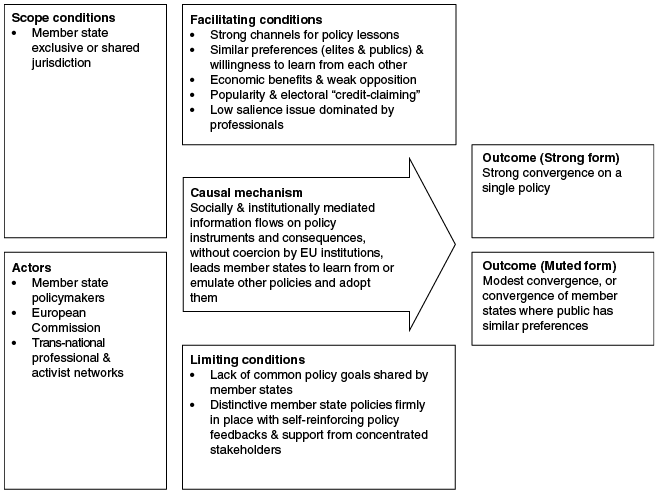
Learning is a cognitive process that draws on the perceived success or failure of policy innovations as solutions to a public problem (Blatter et al., Reference Blatter, Portmann and Rausis2022). Governments update “beliefs about policy based on lived or witnessed experiences, analysis or social interaction” (Radaelli & Dunlop, Reference Radaelli and Dunlop2013: 923). Emulation refers to a process of “copy-pasting” in which member states are guided by perceptions and standards of appropriateness (Gilardi & Wasserfallen, Reference Gilardi and Wasserfallen2019). In the classic “laboratories of democracy” model, individual second-order governments experiment in policy. Policies that appear to be successful are likely to be copied or adapted by other units, while policy failures tend to die out. In its strong form, this dynamic produces strong policy convergence on a single policy among member states. Its more muted forms result in modest, partial, and incomplete policy convergence, or convergence only among a subset of EU members.
For this policy dynamic, member states must have exclusive or shared jurisdiction in a policy sector. The literature generally distinguishes three mechanisms of learning, suggesting different mediating conditions. First, instrumental learning aims to improve policy. Second, under social learning, paradigmatic changes occur in policies and dominant policy ideas. For example, over time, many countries have shifted from a strict “War on Drugs” approach to more progressive, health-oriented policies that focus on reducing harm rather than criminalizing individuals for drug use. Third, political learning is motivated by considerations of power and influence such as reelection (Radaelli & Dunlop, Reference Radaelli and Dunlop2013). The federalism literature suggests that emulation is likely when a possible innovation (1) saves money for units adopting it or costs little, and (2) raises little political opposition from concentrated interests (Weaver, Reference Weaver2020). If the innovation is broadly popular, it may offer electoral “credit-claiming” awards to politicians who innovate. But if the issue is low salience and professionals who share norms and paradigms about what constitutes “good policy” dominate policymaking, diffusion may occur with little public discussion.
Like the federalism literature, the EU literature suggests a complicated and context-specific diffusion process, with a number of facilitating and limiting conditions likely to mediate whether member-state governments in fact engage in lesson-drawing – either positive or negative – from other member states. Diffusion, or learning, is facilitated within clusters of member states where elites and publics share sufficiently similar values that they are willing to learn from each other. Learning can also be enhanced where channels for transmitting policy lessons between member states are strong, and even more so where there are either potential sanctions, as in Country Specific Recommendations under the European Semester (Verdun & Zeitlin, Reference Verdun and Zeitlin2018), or where the EU provides incentives for policy change by funding part of the costs. Indeed, potential lesson drawing (and potentially coercion) is exercised through EU processes like the European Semester (see Online Appendix I). The EU may try and create such channels that facilitate diffusion and learning through a variety of noncoercive governance mechanisms. For example, the “Open Method of Coordination” (OMC) tried to foster the voluntary cooperation of EU member states through soft mechanisms such as guidelines and indicators, benchmarking, sharing of best practice, peer pressure, and naming and shaming. In areas such as social, immigration, cultural, and education policy, the OMC has had mixed success in bringing about convergence in goal attainment (Barcevičius et al., Reference Barcevičius, Weishaupt and Zeitlin2014; Tholoniat, Reference Tholoniat2010). More generally, under “experimentalist governance” (Sabel & Zeitlin, Reference 91Sabel and Zeitlin2010; Zeitlin & Rangoni, Reference Zeitlin and Rangoni2025), policy convergence in the EU may result from a recursive process of framework rule-making and revision across levels and sectors, using mechanisms such as reporting duties, peer review, and deliberative processes (Eckert & Börzel, Reference Eckert and Börzel2012) designed to foster learning “as a mechanism for promoting convergence of performance through comparisons of experience in implementing alternative approaches to reaching common objectives in different national contexts” (Zeitlin, Reference Zeitlin, Heidenreich and Zeitlin2009: 216) (see Online Appendix I).
Several conditions can limit diffusion across member states, however. If member states have distinctive policies firmly in place with self-reinforcing policy feedbacks, including the provision of concentrated benefits to powerful stakeholders, then those stakeholders are likely to resist any change. Hostility of a member-state government to EU interference in areas of national jurisdiction and administrative isolation of OMC activities within the member-state bureaucracy contributes to the marginalization of both lesson-drawing and lesson-offering (Alexiadou & Lange, Reference Alexiadou and Lange2015). Laroque and Noël (Reference Laroque and Noël2014) argue that when policy priorities differ among member states, learning may affect policy agendas more than policies actually adopted. Overall, the impact of lesson-drawing on promoting cross-national convergence under the OMC has been characterized as muted, indirect, and very uneven across countries and policy domains (Barcevičius et al., Reference Barcevičius, Weishaupt and Zeitlin2014). Clearly, learning through purely voluntary and nonbinding benchmarking and comparison of practices across member states may not necessarily lead to greater convergence in national policies, but may also lead to new forms of differentiation arising from the adaptation of generic policy recipes to distinctive local contexts.
EU cohesion policy provides an example of a muted form of diffusion. Its objective is to reduce disparities in the development of regions, in particular by providing financial and infrastructure support to rural areas, areas affected by industrial transition, and regions which suffer from severe and permanent natural or demographic handicaps. In the 2000s, EU cohesion policy “involved three procedural innovations: the joint definition of EU goals for the policy and the adoption of national strategies to guide implementation; an earmarking instrument to encourage the allocation of expenditure to Lisbon-related interventions and a mechanism for strategic reporting to the Council of Ministers to promote accountability and high-level debate about effectiveness” (Mendez, Reference Mendez2011: 519–520). Substantively, this experimentalist setting has indeed led national cohesion policies to converge toward alignment with the EU’s goals, though very significant variation remained: The openness of the EU goals made the Lisbon agenda compatible with preexisting national goals. It has also led to enhanced vertical coordination between levels of governance. Yet, actual learning was limited: The program was seen more as a “compliance exercise,” which makes Mendez (Reference Mendez2011) question the sustainability of the EU’s attempts at fostering this policy dynamic.
3.7 Failing Forward
Failing forward materializes in extraordinary phases of European integration, especially during crises. If particularly severe, these crises can be symmetrical (affecting most or all member states), new (causing unprecedented problems), or existential (threatening the EU’s survival) (Jones et al., Reference Jones, Kelemen and Meunier2021). The gravity of such crises prompts heads of state or government to convene in the European Council or involve other supranational institutions, such as the Commission (Angel & Jones, Reference Anghel and Jones2023).
Another scope condition is that neither the EU nor member states have exclusive competence over a policy. In areas “in the middle of the competence spectrum” (Jones et al., Reference Jones, Kelemen and Meunier2021: 1528), such as core state powers (Genschel & Jachtenfuchs, Reference Genschel and Jachtenfuchs2016), the EU has some agenda-setting and policymaking powers, but overall, member states remain in charge. Failing forward begins with a muted form of joint decision trap, which fails to structurally change a policy, resulting in belated forward steps at integration and incomplete capacity creation (see Figure 8).
Failing forward
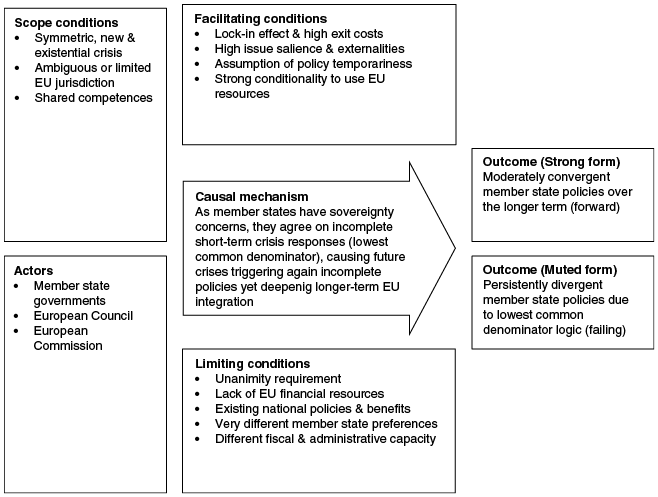
Unsurprisingly, heads of state or government interpret crises differently and have varying preferences for responding (Schramm, Reference Schramm2024). Within coalition governments, parties may diverge on crisis solutions. Since the European Council makes decisions by unanimity, each government has veto power, risking stalemate. However, in crises, nonaction is not an option. With diverging preferences, national governments can only agree on “lowest common denominator” or “stop-gap” solutions. They often seek the Commission’s support for ambitious proposals, which governments then negotiate and amend, typically making them less ambitious. The Commission does not oppose failing forward solutions but usually advocates for more far-reaching change (Smeets & Beach, Reference Smeets and Beach2023a). For example, after proposing the recovery fund NextGenerationEU (NGEU) to address COVID-19’s economic impacts, governments reduced the package’s size and increased the loans component compared to the grants component (Ladi et al., Reference Ladi, Tsarouhas and Copeland2025).
Although European Council members recognize that “these stop-gaps would be unsustainable and that more comprehensive reforms would eventually be needed” (Jones et al., Reference Jones, Kelemen and Meunier2021: 1520), they agree only on incremental changes that are “partial and inadequate,” rather than paradigmatic shifts (Jones et al., Reference Jones, Kelemen and Meunier2016: 1027; Schmidt, Reference 92Schmidt2020). These incomplete outcomes leave policy problems unresolved, leading to future crises (Jones et al., Reference Jones, Kelemen and Meunier2016). For instance, financial support may help member states handle asylum seekers’ costs, but does not change the Dublin Agreement’s principle that the first arrival country is responsible. Thus, systemic problems of overburdening and lack of solidarity remain. The failing forward dynamic can also appear in the Council when formal approval is needed, such as sanction packages against Russia or reform of the Stability and Growth Pact (see Section 4.1).
However, incomplete crisis responses can still push the EU forward, fostering new policy competences, strengthening European institutions, or welcoming new EU members. The self-undermining policy feedbacks from inadequate initial responses lead EU institutions to “move forward” in later policymaking rounds, to “deeper European integration through increased coordination of national policies, the transfer of authority to the EU level, or the strengthening of the EU’s authority in existing areas of competence” (Jones et al., Reference Jones, Kelemen and Meunier2021: 1523). For example, NGEU does not secure the EU more resources in the long term but broke the taboo on debt mutualization and sparked debate about a stronger European fiscal capacity (Woźniakowski et al., Reference Woźniakowski, Zgaga and Fabbrini2023). As a result, “with hindsight, moments when the EU had appeared to fail turned out to be instances of failing forward” (Jones et al., Reference Jones, Kelemen and Meunier2021: 1521). Short-term bargaining leads to compromise, while long-term spillovers and empowered supranational institutions promote deeper integration. This complex, multistage failing forward dynamic is reactive rather than proactive. The “forward movement” is neither inevitable nor necessarily desirable, and its medium-term spillover effects are likely limited (see Knill et al., Reference Knill, Steinebach and Fernández‐i‐Marín2020 on environmental policy). If the EU fails forward, public support oscillates between pragmatism in crisis response and contestation due to unresolved issues, undermining support for the EU.
A failing forward dynamic is more likely when policymakers face high “termination costs,” such as leaving the EU or dismantling Economic and Monetary Union (EMU) (Rhodes, Reference Rhodes2021). High issue salience also increases the likelihood of failing forward: When a policy is important, governments will more easily agree on incomplete reforms rather than nonsolutions. Minimal agreements become more palatable if the EU policy is perceived as temporary, such as NGEU, or when conditionality tied to financial crisis aid fosters deeper integration. Failing forward is a compromise that avoids politically costly, permanent transfers of sovereignty to the EU, which Euroskeptic parties oppose and Europeanist actors may be reluctant to endorse. Factors limiting failing forward include the unanimity requirement for decisions, which favors the status quo, and EU financial resource scarcity, hindering the creation of public goods like protecting borders or regulating migration. When national policies benefit constituencies, governments may resist costly EU reforms that threaten their established policies. Similarly, strong member-state fiscal and administrative capacities allow countries to focus on domestic anti-crisis measures rather than EU-level reforms.
The failing forward dynamic has been explored critically (Rhodes, Reference Rhodes2021) in contexts such as the euro crisis (Jones et al., Reference Jones, Kelemen and Meunier2016; Reference Jones, Kelemen and Meunier2021), eastward expansion (Anghel & Jones, Reference Anghel and Jones2022), COVID-19 (Bulmer, Reference Bulmer2022; Brooks et al., Reference Brooks, de Ruijter, Greer and Rozenblum2023), European enlargement (Anghel & Jones, Reference Anghel and Jones2022), neighborhood policy (Rabinovych, Reference Rabinovych2021), environmental policy (Knill et al., Reference Knill, Steinebach and Fernández‐i‐Marín2020), and security and defense in response to Russia’s invasion of Ukraine (Anghel & Jones, Reference Anghel and Jones2023). Section 4 presents a case study on the failing forward dynamic: The 2024 reform of the Stability and Growth Pact (see Online Appendix I). Overall, evidence suggests that failing forward is intermittent and produces moderate policy convergence in its strong (forward) form over the long term, as new EU policies may pose more or less strict obligations on member states (Anghel & Jones, Reference Anghel and Jones2022; Bulmer, Reference Bulmer2022; Brooks et al., Reference Brooks, de Ruijter, Greer and Rozenblum2023; Rhodes, Reference Rhodes2021). For example, the Recovery and Resilience Facility (RRF) is a new EU policy that made resources available to member states via common debt for the first time. This moved the EU forward in fiscal terms, and to benefit from the RRF, member states committed to similar spending areas (green economy, digitalization) and common rules on resource management. This resulted in some convergence on expenditure policies and administrative structures for managing EU funds (Zeitlin et al., Reference Zeitlin, Bokhorst and Eihmanis2025). When EU policy follows a lowest common denominator logic (failing), member states retain discretion during implementation (Zgaga et al., Reference Zgaga, Thomann and Goubier2024), which limits policy convergence (muted form). For example, the EU’s loose migration cooperation still leaves national governments free to address specific challenges or align with electoral preferences (Lavenex, Reference Lavenex2018).
3.8 Joint Decision Trap
Another EU policy dynamic that is likely to preserve substantial policy divergence across member states is what Scharpf (Reference Scharpf2006) has conceptualized as the joint decision trap (JDT) into which intergovernmental bargaining can easily fall (see Figure 9).
Joint decision trap
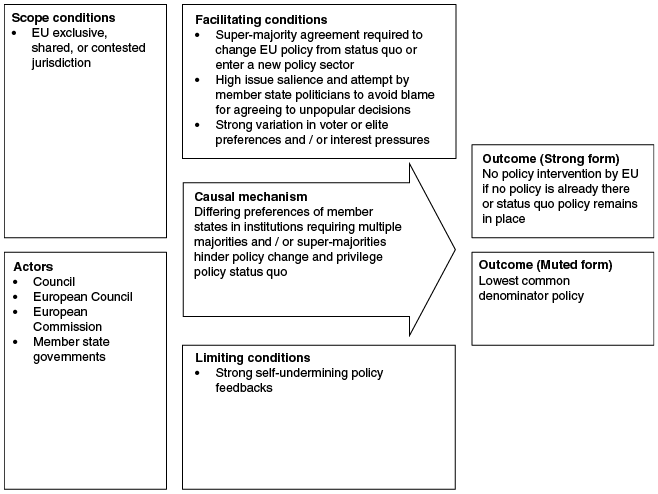
The EU is an extreme case of Tsebelis’ theory of veto player systems (Tsebelis, Reference Tsebelis2002). Like members in the second legislative chamber (Bundesrat) in Germany, the members of the Council of the EU (formerly the Council of Ministers) represent the interests of second-level governments rather than voters directly. This means that their decisions are not only shaped by the specific substantive policy issue, on which their preferences tend to be quite diverse, but also by the expected effect on their institutional power and authority. Even if they could agree on the policy substance, some may still block it because they cannot agree on the institutional change involved. For instance, member states may all agree that it would be good to charge a digital tax that would fall primarily on American tech companies, but some EU governments are in principle opposed to the institutional precedent that would set, giving the EU more competences on taxation. This frequently results in lowest-common-denominator policies or blockage in the Council or even at the highest political level, in the European Council – in other words, a status quo bias in favor of policy divergence.
National parliaments and parties can also play a role in the JDT when the successful adoption of certain EU policies depends on their domestic approval. For example, in 2012 the Bundestag had to give its green light to the financial assistance mechanism “European Stability Mechanism,” and even in a context of crisis the EU had to “wait” for the positive decision of the German parliament. Similarly, in 2016 the parliament of Wallonia, one of the three regions of Belgium, by a large majority rejected the Comprehensive Economic and Trade Agreement (CETA) between the EU and Canada, thus preventing the approval of all the then twenty-eight member states required for the deal to enter into force.
This policy dynamic occurs when policymaking is under the jurisdiction of the EU rather than the member states, or when member-state jurisdiction is being contested by actors seeking to extend EU jurisdiction, with actors opposing this extension using the JDT to block it. The institutional characteristics of the EU, notably qualified majority requirements in the Council and a norm of unanimity in the European Council in matters of great importance to a member state, combined with strong variation in elite preferences and/or interest group pressures across member states, regularly fulfil the conditions for a JDT dynamic.
Jurisdictional boundaries may, however, also be subject to contestation. The energy sector, for example, is an area of strategic importance to member-state governments, and there are great differences across members in their import dependence. In order to circumvent the JDT in energy policy, the European Commission had to use its powers over competition policy to create a more unified and open internal energy market, with some success (Pollack & Slominski, Reference Pollack, Slominski and Falkner2011; Smeets & Beach, Reference Smeets and Beach2023b). Similarly, in 2022, heads of state or government disagreed on sanctions packages against Russia because their countries differed in their reliance on Moscow’s supply of oil and gas. To avoid the resulting JDT, exemptions from the ban on these important raw materials had to be made to potential vetoing countries, such as Hungary and the Czech Republic.
The classic JDT literature suggests that the trap in its “pure” form is likely to result in stalemate and the status quo of policy divergence prevailing (cf. Scharpf, Reference Scharpf2006, for a critical reflection on his earlier work). A more muted consequence involves a “lowest common denominator” response that reflects policies that are acceptable to the veto players in the Council. Strategic investment behavior also creates potential “exits” from the JDT, outlined by Falkner (Reference 83Falkner and Falkner2011) and her collaborators, in multiple EU policy domains. Perhaps most important is qualified majority (rather than unanimity) voting rules, which, since the 2009 Lisbon Treaty, have expanded to the vast majority of policies and legal acts (Schütze, Reference Schütze2021). Qualified majority voting has reduced the legislative “gridlock,” the number of policies that cannot be adopted due to a JDT. In turn, under QMV, a less frequent JDT and a smaller legislative gridlock have been facilitated by the fact that, in certain historical moments, the main actors (Commission, EP, and Council) had similar political preferences because they belonged to a similar party group/affiliation. For instance, a Council with more center-right governments and, at the same time, an EP with a center-right majority, led to a smaller gridlock interval and to a larger legislative output in the early 2000s (Crombez & Hix, Reference Crombez and Hix2015). Other exit paths range from shifting decision-making venues, socialization of members to the preferences of the majority, log-rolling across issues, transitory compensation, low issue salience, and technical complexity of some issues, mitigating the intransigence of member-state governments. These strategies, known from bargaining theory, usually lead to some policy convergence without going the entire way to upward harmonization. Overall, the JDT may be a less viable strategy than in the past because the exit options, notably QMV, have increased.
The JDT may also just be covered up, however: Knill et al. (Reference Knill, Steinebach and Fernández‐i‐Marín2020) argue that, in the environmental domain, the financial crisis pushed the European Commission to become a “hypocritical policy entrepreneur,” emphasizing pronouncement over enforcement actions as members proved unable to overcome policy differences. This then leads to quite muted policy convergence in the sense that international agreements formulate long-term goals, such as net-zero by 2050, which the EU breaks down into more near-term goals; but the policies with which to achieve these goals domestically are still largely at the discretion of member states. Exit from the JDT can also occur under the pressure of powerful non-EU countries. For instance, in 2022, the Council managed to adopt a directive on the minimum taxation of multinational corporations because the Biden administration exercised pressure on those countries that had long opposed it (Hakelberg, Reference Hakelberg2024).
3.9 Mutual Recognition
The main driver of the mutual recognition policy dynamic (see Figure 10) is the Commission’s institutionalized drive for market integration (Schmidt, Reference Schmidt2007). Born as a form of negative integration aimed at removing trade barriers, the principle of mutual recognition says that whatever is legally produced and sold in one member state can also be sold in another member state, even if technical standards vary between the two countries. Where adopted, it does away with lengthy negotiations over harmonized minimum standards or legal requirements of production and product quality (Pelkmans, Reference Pelkmans2012).
Mutual recognition
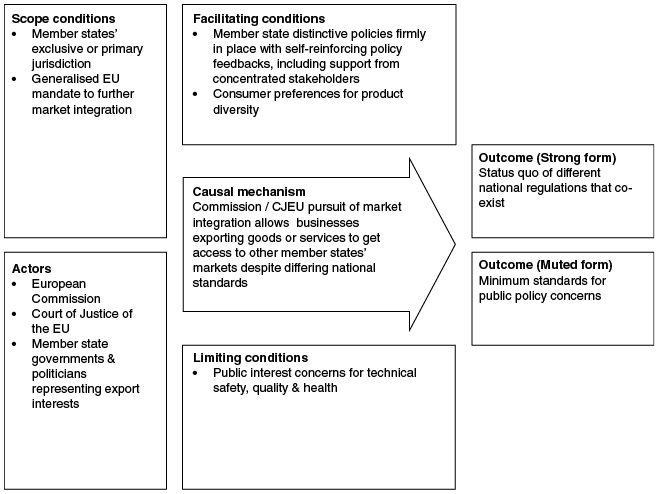
The principle was first mentioned in what is probably the EU’s most famous court case. The Cassis de Dijon ruling in 1979 challenged the German authorities’ attempt to prohibit the sale of French Cassis as liqueur because its alcohol content of 16% was below the stipulated 25% to qualify as liqueur in Germany. The Commission turned the specific reasoning of the Cassis de Dijon ruling into a general legal principle of mutual recognition (Alter & Meunier-Aitsahalia, Reference Alter and Meunier-Aitsahalia1994).
Embracing this principle was the Commission’s response to the obstacles it faced whenever it wanted to make the four freedoms of movement in the internal market a reality (Pelkmans, Reference Pelkmans2012). It has taken the EU several years to define what chocolate is, notably what ratio of cacao to fat qualifies as that sweet product, and what mineral water is in contrast to simple spring water. Preferences across EU member states vary and are hard to change because they are embodied in national legislation and regulation, the ideology of governing parties, and pressure from interest groups who want to preserve national discretion. But these strong preferences for the national status quo also make member states reluctant to simply accept products from other member states. This is particularly the case when it comes to services (Nicolaïdis & Schmidt, Reference Schmidt2007): posting of workers that are employed in one country but often sent for an extended period to work in another country raises the issue of undercutting employment protections in the destination country (Davies, Reference Davies2002).
The Bolkestein Directive, so called after the proposing Commissioner, was a proposal to introduce mutual recognition for all services to create a single market (Chang et al., Reference Chang, Hanf and Pelkmans2010, Pelkmans, Reference Pelkmans2012). The market-liberal hope was that competition would exercise pressures toward convergence on best practice. However, national regulation addresses real problems of imperfect information and market failures such as quality uncertainty: for example, patients do not have the expertise to judge the quality of a medical service, and the consequences of dubious treatments can be severe. Hence, the Bolkestein Directive in its original form was widely resisted by several political parties – especially Euroskeptic ones – across Europe and led to mass demonstrations in European capitals; the revised Services Directive 2006/123/EC has hardly any services sectors regulated by unqualified mutual recognition (Chang et al., Reference Chang, Hanf and Pelkmans2010). Foodstuff, by contrast, is a large category of products where mutual recognition of national regulation can be found.
Mutual recognition is not a free-for-all, as critics of this ‘neoliberal’ policy dynamic sometimes suggest: It requires that businesses can demonstrate that their product is lawfully marketed in another member state. Member states can insist, for morally sensitive goods (e.g., pornographic publications) and regulated services (e.g., professions with qualifications), that the rules in the originating country are not equivalent to the rules in the importing member state, and allow national parliaments to pass relevant legislation setting limits to the principle of mutual recognition. Economic actors then have to challenge restrictions on the mutual recognition principle in front of courts, which often turns out to be unsuccessful. When challenged, CJEU jurisprudence (for example, the judgment Noria Distribution Srl of 2017) has tended to limit the unqualified application of the principle (Janssens, Reference Janssens2013). The Court has clarified that the principle of mutual recognition is rather conditional and not absolute: Member states have to commit to mutual recognition, but Reg. 764/2008 (“Mutual Recognition Regulation”) assures them significant space to regulate their domestic markets and to justify restrictions to trade (Weatherill, Reference Weatherill2017). Hence, “the implementation of the principle of mutual recognition in internal market law is subject to significant variation, much of which is due to legislative pushback against the principle” (van den Brink et al., Reference van den Brink, Dawson and Zglinski2023: 16). As a result, mutual recognition may, thus, have occasionally led to muted convergence, for instance in the EU regulation of professional qualifications. But, as indicated, pure mutual recognition is not widely applied in the EU legal space, with the noticeable exception of food.
4 Case Studies of Policy Dynamics
We have argued that the EU is characterized by multiple policy dynamics. The previous section detailed nine policy dynamics. But what do these dynamics look like in practice? Specifically, how do policy dynamics evolve – both as embedded, and sometimes hegemonic, policymaking mechanisms and as strategies to defend or overturn those mechanisms – in policy domains where multiple dynamics interact? We focus on four types of relationships: policy dynamics (1) operating in parallel across subdomains; (2) operating in sequence when one dynamic supplants another as a policymaking mechanism or actor strategy; (3) operating as mutual reinforcement when one dynamic helps build coalitions or make policy; and (4) operating in competition when opposing actors or coalitions compete to defend, revise, or overturn embedded mechanisms. In this section, we present two sectoral case studies to explore these relationships in more detail.
4.1 EU Fiscal Policy Governance
EU fiscal policy governance, particularly the 2024 reform of the Stability and Growth Pact (SGP), is a useful case of multiple and competing policy dynamics – harmonization, creeping competences, member-state noncompliance, differentiation, failing forward, and the JDT. Over time, EU fiscal policy governance has seen the interplay of key policy actors (especially powerful member states such as Germany and France, and the Commission) and policy changes (subsequent waves of SGP reforms).
When EMU was created in 1992 with the Maastricht Treaty, Germany was the most economically powerful country. Its central bank, the Bundesbank, enjoyed high credibility due to the stability of the German currency, the Deutschmark, and low inflation. Other EU member states followed the Bundesbank’s policies to ensure currency stability. Given its strong influence, Germany feared losing from forming a monetary union with EU countries that had high debts and weak currencies. Excessive government spending, especially in Southern Europe, could cause negative externalities for the entire currency area. This is why the German government, under its Christian Democratic Party (CDU) leader, Helmut Kohl, negotiated a specific fiscal policy governance regime for EMU. EU fiscal policy governance created a framework that constrained member-state discretion in domestic spending (Zgaga, Reference Zgaga2026). Strict rules on deficits, debt, inflation, and interest rates became the condition for joining the euro area.
Elements of DI were evident from the outset, as the UK and Denmark won exemptions, and Sweden opted out de facto. However, the Maastricht Treaty left many details unresolved, notably the degree of automaticity of sanctions for failing to meet debt and deficit targets, what constituted a “severe recession” allowing a member state to escape sanctions, and the size of those sanctions (Thygesen, Reference Thygesen, Hallett, Hutchison and Jensen1999). In the absence of a credible deterrent, how could member states be made to abide by fiscal discipline once in the common currency?
4.1.1 Origins of the Stability and Growth Pact
To tame potentially profligate governments, Germany proposed the SGP. The SGP is a set of rules regulating the maximum allowed deficit (3 percent) and debt (60 percent) ratio to gross domestic product (GDP), along with sanctions the Commission and Council can issue as part of the excessive deficit procedure (EDP, see Online Appendix I) for noncompliance (Zgaga, Reference Zgaga2026).
Since its negotiation in 1995, the SGP has been marked by opposing preferences between the two largest EU countries, Germany and France. While Germany championed the SGP, France sought to limit its constraining effects, ensuring governments retained the final say on whether to open an EDP. For Germany, the SGP aimed to harmonize member-state fiscal policies toward budgetary discipline. The CDU used the SGP strategically to reassure domestic public opinion, which largely viewed the euro as a “bad deal” for Germany (Heipertz & Verdun, Reference Heipertz and Verdun2010).
The need for unanimous approval by member states and the resulting JDT led to compromises from both sides and some remaining discretion in implementation. The SGP contains both “preventive” (mainly reporting by member states, and surveillance and recommendations by the Commission) and “corrective” (EDP) provisions. The result was the institutionalization of a regulatory regime characterized by muted harmonization and significant potential for noncompliance by member states (Heipertz & Verdun, Reference Heipertz and Verdun2010).
4.1.2 Implementation and Evolution of the Stability and Growth Pact
From the perspective of national governments, the SGP represents creeping competences: Governments often struggle to finance their political programs due to the 3 percent deficit limit and because the Commission must approve national budgets for compatibility with European fiscal rules (Schütze, Reference Schütze2021). Over the last thirty years, most governments were unwilling to comply with the SGP, while some, like Italy and Greece, were unable due to preexisting high public debt. Large countries like France and Spain with high levels of public expenditure also struggled. Only a small number of European countries generally complied with the fiscal rules (Buti & Pench, Reference Buti and Pench2005). Thus, in its early years, the SGP saw widespread member-state noncompliance, both from a lack of willingness and capacity. The SGP was also complex and difficult to enforce for the Commission because member states who were targeted by the SGP rules also decided on enforcement. In 2003, France and Germany breached the 3 percent deficit threshold but found a majority in the Council to reject the Commission’s sanction recommendation. The JDT showed that the SGP could not be enforced against the strongest member states. Following this noncompliance, the SGP was reformed in 2005. However, the reform introduced more discretion and flexibility, making the achievement of sound public finances more unlikely (Sacher, Reference Sacher2021).
The euro crisis (2009–2013) was seen as a crisis of member states with excessive deficits. In response, under pressure from Germany, and with France and the Commission’s support, the SGP was strengthened with the Six Pack and Two Pack. This aimed to further harmonize fiscal policies to ensure budgetary discipline. However, the stricter rules were heavily criticized for several reasons. First, by further limiting domestic spending, they represented creeping competences in core state powers – fiscal policy. Second, the rules neglected economic growth and were seen to impoverish Southern European countries (Jacoby & Hopkin, Reference Jacoby and Hopkin2020).
The stricter rules increased noncompliance, prompting a 2017 debate on reforming the SGP. This process was interrupted by the COVID-19 pandemic in 2020. Learning from the euro crisis, it became clear that most member states would be unable to comply with the SGP in a crisis that required massive health spending. Therefore, to manage the pandemic, all member states activated the “general escape clause,” suspending parts of the SGP until the end of 2023 to allow for increased domestic spending. During this time, the debate on reforming the SGP resumed (Schmidt, Reference 92Schmidt2020).
4.1.3 Recent Reform of the Stability and Growth Pact
Dissatisfaction with the SGP led to a proposal by the Commission in April 2023 to replace the one-size-fits-all approach of the fiscal rules with country-specific differentiation. This revised approach would adjust the “reference trajectory” for member states with a deficit above 3 percent of GDP and a debt-to-GDP ratio above 60 percent, considering each country’s circumstances. Similarly, the Commission proposed country-specific escape clauses to deviate from expenditure targets in exceptional circumstances (European Commission, 2023).
This approach was not universally popular. In the Council, Germany pushed for a stricter, more enforceable SGP with clear benchmarks to assess yearly deficit and debt reductions, and for the same rules to apply to all member states. It also favored leaving the 3 and 60 percent ratios unchanged in the EDP, with the Commission making EDP decisions, thus reducing the Council’s political discretion (Federal Ministry of Finance, 2023). Unlike this German effort to promote greater fiscal harmonization, France sought a tailored reform, adjusting rules to each member state’s economic circumstances, with enforcement involving negotiations between the Commission and countries, and a discretionary role for the Council in sanctions. The Commission’s assessment should rely on general debt sustainability analysis, not strict numerical benchmarks. Italy demanded that investments and reforms (such as environmental, defense, and digital policy, as well as those under the COVID-19 RRF) be excluded from the deficit-to-GDP ratio. Other member states did not fully align with any of these three positions but often had their own views on specific reform aspects (Tamma, Reference Tamma2023).
This created a potential JDT, as the Council needed unanimity to approve the new SGP. Yet, all member states had a vested interest in exiting the JDT and finding a compromise because failure to do so would revert the SGP to its old form in 2024 – an outcome no member state wanted. After several months of negotiations, the Council reached an agreement in December 2023, and the EP refrained from proposing substantive changes. On April 30, 2024, the reformed SGP entered into force (Zgaga, Reference Zgaga2026).
The reformed SGP is a blend of continuity and change, with EU-wide uniformity and country-specific differentiation. Member states accepted the outcome because they avoided further creeping competences and fiscal harmonization, particularly the empowerment of the Commission and stricter rule enforcement. They also welcomed the new SGP’s granting of more flexibility to countries in how to comply with EU fiscal regulation, enabling differentiated implementation. However, the many factors the Commission must now consider during an EDP make enforcement even more difficult, as assessing noncompliance becomes more ambiguous (Zgaga, Reference Zgaga2026). Thus, while the SGP aims to foster policy convergence around sustainable public finances, the 2024 reform represents a case of muted failing forward. It is unlikely to systematically achieve this aim in the short term, and divergence between member-state fiscal policies will likely persist.
4.1.4 Challenges to the Reformed Stability and Growth Pact
While the new fiscal rules are more flexible, they are not flexible enough to permit the large-scale, permanent exclusion of crucial spending items from the deficit-to-GDP ratio. This primarily concerns defense investments, which have become necessary due to Russia’s threat and the second Trump administration’s demand for EU member states to significantly increase military spending. Defense spending can be exceptionally raised by activating the national escape clause, allowing countries to temporarily depart from their national medium-term fiscal-structural plans outlined by the SGP (Pench, Reference Pench, Fabbrini and Petit2024). This occurred in April 2025, but it remains a temporary and exceptional, not structural, solution. As a result, member states with more fiscal space due to manageable deficit-to-GDP ratios have started increasing defense spending, while countries with high deficits are less able to do so. A prominent example is Germany: In March 2025, the German Bundestag and Bundesrat approved a constitutional amendment allowing defense spending exceeding 1 percent of GDP to be excluded from the debt brake. Parliament also passed a historic debt package of 500 billion euros, covering defense, infrastructure, and climate investments (Fabbrini & Fabbrini, 2026). It remains to be seen how other member states will use the national escape clause to engage in new “defence borrowing” (Zgaga, Reference Zgaga2025). Therefore, the 2024 SGP has triggered new forms of differentiated implementation based on domestic preferences and capacities.
4.1.5 Discussion
EU fiscal policy governance, especially the SGP, illustrates how different institutional actors (supranational and intergovernmental) and multiple policy dynamics play a role in implementation and negotiations aimed at reforming a European policy regime of muted harmonization. While member-state fears of further creeping competences triggered the recent reform process, the very real threat of the JDT and the possible return to the pre-pandemic SGP hung over the negotiations, limiting the scope of change in the policy rules while creating an incentive to find an agreement. The outcome of the most recent reform was characterized by a space for some limited flexibility and country-specific differentiation, but it remains to be seen if the increased space for differentiated implementation that comes with the new SGP manages to solve the “old” problems of lack of noncompliance and difficulties in enforcement. The focus of the new Pact, like previous versions, is still more on stability than on growth, and future divergence of positions between those countries that want to preserve fiscal discipline (Germany and the “Frugal Four” coalition) and those that push for more spending possibilities at home and in Europe (France, Italy, and Spain) remains likely. Three policy dynamics have been absent or weak in EU fiscal policy governance. Leaving aside mutual recognition and race to the bottom, which is typically observed on single market policies, to some extent diffusion has taken place, because finance ministers at the ECOFIN Council and public officials working in finance ministries have several occasions to exchange best practices, also with the Commission, on how to comply with EU fiscal rules, even though the final decisions remain within the member states.
4.2 Tobacco Policy
Tobacco control policy is a particularly useful illustrative case of multiple policy dynamics because different aspects of tobacco control policy (e.g., taxation, advertising, labeling and packaging, and restrictions on where and to whom the products are sold and in which public place smoking is permitted) have different jurisdictional arrangements, key policy actors, and policymaking venues, all of which have been contested and subject to change over time. Attitudes toward tobacco use in most member states have become decidedly more critical over time, although unevenly across member states; this facilitated stricter policies at the member-state level, but not necessarily more convergent policies. At the same time, EU and member-state policymakers have confronted a resourceful and oligopolistic opponent to stiffer tobacco control in transnational tobacco companies, which have long enjoyed good relations with member-state politicians and political parties in many member states; tobacco industry advocates invested in the JDT, differentiation, and mutual recognition strategies to defend their entrenched position. A strong but less well-resourced counter-coalition which included public health NGOs and medical professionals as key players (e.g., Weishaar et al., Reference Weishaar, Collin and Amos2016) also emerged, investing their limited resources in harmonization and creeping competence strategies, as well as the diffusion of knowledge about the risks of smoking and actions by governments taking more aggressive tobacco control actions. Both sides have sought to build broader alliances with policymakers in the Commission and member-state governments, and, in the case of the tobacco industry, business and agricultural interests, to advance their interests (Smith et al., Reference Smith, Fooks, Gilmore, Collin and Weishaar2015).
In the early years of the EU, tobacco policy was primarily perceived as an area of member-state jurisdiction, but treaty revisions in 1986 and 1997 rather vaguely recognized health protection as a matter of concern for the Community. Moreover, around the turn of the century, the European Commission participated in the negotiation of the Framework Convention on Tobacco Control (FCTC), an international treaty that bound its signatories – including the EU and indirectly its member states – to increase the stringency of several dimensions of tobacco control, but without setting uniform standards or creating an enforcement mechanism. The EU ratified the FCTC in 2005. The FCTC gave additional leverage to tobacco control proponents to seek increases in the stringency of tobacco control in the EU policymaking space, but without necessarily triggering a harmonization policy dynamic or leading to a convergence in tobacco control policies within the member states. These complex jurisdictional and power relationships have played out in distinctive ways across different aspects of tobacco control policy.
4.2.1 Tobacco Advertising
One of the earliest arenas for tobacco control policy action at the EU level concerned tobacco advertising. Duina and Kurzer (Reference Duina and Kurzer2004) characterize the European Commission’s early efforts in this realm as a leading example of “creeping competences”, facilitated by the ambiguity of EU jurisdiction over public health in the EU’s treaties, by “increasing public awareness about the dangerous effects of tobacco” (p. 58), and by backing from some member states and still-weak public health lobbies. Commission work on a tobacco advertising directive began in 1987 and reached the Council in 1989.
The creeping competences dynamic was, however, initially stymied by resistance from member states with politically strong tobacco industries and many smokers. These powerful member states and their tobacco industry allies invested in building blocking coalitions using supermajority voting rules – a JDT policy dynamic – in the Council of Ministers to delay and weaken Commission initiatives (Duina & Kurzer, Reference Duina and Kurzer2004). The industry and its member-state allies also prepared several fallback strategies, including a weak minimum harmonization requirement, and pressing for a “directive that permits continued advertising in any member state that chooses to authorize it” (quoted in Neuman et al., Reference 89Neuman, Bitton and Glantz2002: 1324) – in effect, a differentiation strategy – while concealing the industry’s role in developing and lobbying for these proposals. When shifting Council majorities (notably a change in the UK’s position under the Blair government) allowed for the enactment of a Tobacco Advertising Directive in 1998, the losers again used a JDT strategy, winning a 2000 decision from the CJEU that overturned the Directive. The Commission then proposed a somewhat weaker initiative, which was adopted in 2003 and upheld by the CJEU in 2006.
4.2.2 Tobacco Labeling
The tobacco industry employed similar tactics in trying to block or weaken the 2001 and 2014 Tobacco Products Directives (Tobacco Tactics, 2021). The first directive allowed, but did not require, member states to include pictorial warnings, reflecting differing member-state preferences and pressures from the tobacco industry against stronger mandates. The 2014 Tobacco Products Directive required increasingly stringent cigarette pack warnings, including pictures, while allowing member states to enact even stricter provisions (notably, plain packaging in the UK before their withdrawal from the EU). These measures again encountered strong tobacco industry resistance, including efforts to build coalitions with retailers (Berteletti et al., Reference Berteletti, King, Burch and Friedlaender2017; Hiilamo & Glantz, Reference Hiilamo and Glantz2015). Shifts in public opinion on tobacco control in many EU countries, combined with shifts in the venues where policy was made (away from agriculture and toward health ministries at both the Member State and EU Council of Ministers levels), meant that the tobacco industry was unable to develop a blocking coalition against the directive, although some provisions (e.g., on plain packaging) were weakened during the legislative process (Costa et al., Reference Costa, Gilmore, Peeters, McKee and Stuckler2014).
4.2.3 Tobacco Taxation
A muted form of the harmonization policy dynamic occurred in the case of cigarette tax harmonization: While a directive effective in 2006 set minimum excise taxes in member states on both a per 1,000 cigarette basis and as a percentage of the retail price, major differences remain across member states in tax rates (López-Nicolás & Stoklosa, Reference López-Nicolás and Stoklosa2019). This muted form of policy harmonization reflects different policy feedbacks (percentages of the population who smoke), variations across countries in cigarette industry influence, and other factors.
Fear of cigarette smuggling can limit member states’ willingness to increase cigarette taxes, and transnational tobacco companies have used such claims to convince national policymakers to limit tobacco tax increases, with success in some countries (Skafida et al., Reference Skafida, Silver, Rechel and Gilmore2014), but without setting off a race to the bottom. Tax competition in tobacco policy is constrained by member-state minimum pricing obligations under the FCTC (a muted harmonization dynamic), to which the EU is a signatory, although excise tax dispersion across member states remains high (López-Nicolás & Stoklosa, Reference López-Nicolás and Stoklosa2019).
4.2.4 Smoking Bans
The adoption of smoking bans in bars and restaurants is a policy area that remains under member-state, and in some cases subnational, jurisdiction. In this sector, mutual recognition, or variation based on divergent member-state preferences, has been partially supplanted by a diffusion/emulation dynamic in the adoption of smoking bans, as public support for those bans has grown across the EU. Toshkov (Reference Toshkov2013) argues that policy learning across EU member states has increased the geographic spread and strictness of smoking ban policies, with the FCTC acting as both a model and a prod, and the EU itself as a source of diffusion of policy ideas (Studlar et al., Reference Studlar, Christensen and Sitasari2011). Countries like Ireland, lacking dependence on tobacco production, have acted as both major consumers of policy lessons from elsewhere and as models of aggressive tobacco control policies (Studlar, Reference Studlar2015). But, especially in the period prior to the adoption of the 2014 EU Tobacco Products Directive, a common set of ideas about the dangers of smoking and secondhand smoke have had a more powerful impact on policy agendas than on final policy decisions in areas of tobacco control policy where member states retain discretion (Cairney, Reference Cairney2009). A move toward diffusion of more stringent smoking bans and other tobacco controls has been muted in many countries due to outstanding cross-national differences in smoking rates and the political clout of tobacco farmers and transnational tobacco companies, but those differences are declining over time, at least in some long-standing laggard countries like Germany (Grüning et al., Reference Grüning, Strünck and Gilmore2008; Kurzer & Cooper, Reference Kurzer and Cooper2016).
4.2.5 Discussion
Tobacco control policy, in short, is a good illustration of the parallel and often competing operation of multiple policy dynamics within a single broad policy sector, the need to build coalitions to challenge a deeply embedded policy dynamic, and the factors that underlie the form (strong or weak) or absence of individual policy dynamics. In addition to the dynamics previously discussed, member-state shirking has taken a number of different forms in the tobacco control policy sector, notably delays in transposition of the 2014 Tobacco Products Directive and difficulties in enforcing sales restrictions in countries with weak enforcement capacity (European Commission, 2021). Other policy dynamics have been notable mostly from their absence or very weak appearance in the tobacco control sector. For example, tobacco control has never been of sufficient salience to become an issue in treaty negotiations that could lead to DI. As scope, facilitating, and limiting conditions, and the resources and investment strategies of major actors shift over time, so too do the prospects for policy convergence and divergence.
5 Conclusions and Research Agenda
This Element explores why several decades of European integration have led to remarkable policy convergence across member states in some areas, but not in others. While the EU is a unique political system with no directly comparable institutions, it shares key characteristics with multilevel governance systems. These include the distribution of decision-making power across multiple levels and institutions, interactions and negotiations among levels of government, a strong role for civil society, and complex networks of governmental and nongovernmental actors. Insights from the theoretical literature on multilevel governance have been integrated into the policy dynamics framework developed here (Ferrera et al., Reference Ferrera, Kriesi and Schelkle2024; Hooghe & Marks, Reference 85Hooghe and Marks2003). In this concluding section, we summarize our core argument, compare the different policy dynamics, and discuss the conditions under which they are likely to occur or change. We also explore the implications of the complexity-informed perspectives underlying our framework and suggest promising areas for future research.
5.1 Summary of Theoretical Argument
We aimed to explain cross-sector and cross-temporal variations in policy convergence within the EU policymaking space through policy dynamics. These dynamics trace the links between (1) the interests and strategies of policy actors, (2) causal mechanisms like the diffusion of policy ideas and the presence of multiple veto points or implementation capacity, (3) scope and mediating conditions that affect these mechanisms, and (4) policy consequences. We measure policy consequences in terms of convergence in policy choices and outputs across EU member states. When embedded in policy, policy dynamics may take stronger or more muted forms. When these dynamics are deeply embedded and face no significant opposition, they can be considered hegemonic.
Individual policy dynamics emerge when specific facilitating conditions, including jurisdictional arrangements, are present. Under strong limiting conditions, these dynamics may be muted or absent. Significant challenges to deeply embedded policy dynamics occur when resourceful actors form coalitions around alternative dynamics, promoting them as alternatives to the status quo. Sometimes, actors may invest in multiple dynamics (e.g., learning/diffusion and creeping competences) when it is unclear which is most likely to succeed in challenging the status quo.
The diversity of actors, constellations, and policymaking venues in the EU contributes to why full policy convergence is rare. There is resistance to homogenizing the EU policymaking space, which actors pursue through strategies like noncompliance, differentiation, and the JDT – though only when they have the necessary legal and coalition-building resources.
The EU is a union of mature democratic nation-states with diverse interests and political processes. The twenty-seven member states vary greatly in size, and their businesses wield different market power. Stronger states often seek to amplify their leverage through EU legislation, while weaker states protect themselves from such dominance. Minimum harmonization often reflects the compromise between these motivations. Member states frequently drive convergence, while the Commission has consistently favored market integration over maximum legal harmonization. These complex dynamics explain why there is more “unity in diversity” than an “ever closer union,” with the latter understood as an irresistible drive toward uniformity.
5.2 Comparing and Demarcating the Dynamics
This Element examines nine prominent policy dynamics, though additional dynamics are discussed in the literature. A good explanatory framework theorizes scope conditions, policymaking venues, actors, strategies, causal mechanisms, mediating conditions, and outcomes. Delineating multiple dynamics in these terms is useful for testing – and where warranted, falsifying – the core claims and coherence of this approach.
Research on the EU and its member states has produced many theoretical lenses to study EU policy processes and outcomes. A given empirical case can often be studied from multiple perspectives, so the choice of analytical lens is key. Ultimately, the value of the policy dynamics framework, or any analytical approach, lies in its ability to provide insight into a broad range of empirical phenomena and generate multiple testable hypotheses. We believe the policy dynamics approach adds value because it integrates insights from various literatures on the evolution of the EU, showing how seemingly distinct analytical siloes – such as creeping competences, DI, and the JDT – fit together.
For example, EU asylum policy can be studied as a case of member-state noncompliance or as a race to the bottom. Our discussion of mutually reinforcing policy dynamics suggests that it is most useful to view it as combining both elements. Many member states seek to avoid the political, economic, and social costs of migration through policies that are sometimes compliant with EU law and sometimes not. As stated in the introduction, policy dynamics are generally pursued to achieve policy and political goals, rather than as ends in themselves. The asylum case shows that while each dynamic presents a coherent set of propositions, they may overlap and interact, leading member states to pursue multiple strategies that they view as complementary “imperfect substitutes” to achieve their objectives. Similarly, a muted JDT can evolve into a failing-forward dynamic as powerful actors recognize that the status quo is no longer viable.
The focus on actor constellations and investments means the causal mechanisms shaping policy dynamics cannot be reduced to exogenous forces. Once a hegemonic policy dynamic is challenged, the objectives and strategic behavior of politicians and other societal actors at both the member-state and EU levels shape the dynamics at play, but not in a fully controllable direction. Multiple dynamics may operate simultaneously in the same policy domain, with strategic investments and behaviors by key actors at the EU and member-state levels. When this happens, any single dynamic is likely to have a muted impact. An important lesson from the tobacco control case is that governmental actors, such as member-state governments and the European Commission, can deploy multiple dynamics to advance their preferences, often in coalition with organized interests. Even hegemonic dynamics can be challenged as actor preferences, bargaining leverage, and coalition opportunities change.
This may frustrate those seeking statistical independence and exogeneity in their analysis. However, we argue that the real challenge lies in the theoretical and causal heterogeneity underlying policymaking in the EU’s multilevel governance system. Recognizing potential interactions between policy dynamics and their impact on policy is not a barrier to understanding but a promising area for future empirical research and theorizing.
Accordingly, Table 2 compares and groups the nine dynamics according to at which stages and venues of the complex EU multilevel governance process they are most likely to occur, which dynamic(s) they expect to be present in a given policy or case, and what levels of divergence or convergence appear likely in a given setting. It is in high politics and crisis politics, for example, that policy dynamics such as DI and failing forward are most likely to be found. In “everyday politics,” policy dynamics such as harmonization, creeping competencies, the JDT, and differentiated implementation are likely to play out – sometimes in competition with each other as different actors seek to influence how policy is made. Implementation politics is particularly likely to see policy dynamics such as differentiated implementation and member-state shirking in operation. Policy dynamics such as differentiated implementation, race to the bottom, and diffusion/learning are most likely to appear in the realm of member-state policymaking.
This allows researchers to develop more specific hypotheses to test. The table shows that, under the same scope conditions and/or in the same policymaking venues, more than one policy dynamic might emerge, sometimes simultaneously. A major advantage of the policy dynamics framework is that it allows us to compare the core propositions made by different literatures and frameworks, and not only identify similarities and differences between them but also to assess their relative explanatory merits and lacunae. This, in turn, allows for theoretical progress and cumulation in the face of causal complexity and heterogeneity.
5.3 Understanding the Conditions under Which Dynamics Occur and Change
The reason that so many policy dynamics are present in the EU context is that many strategic actors with diverse interests are able to influence the policymaking process, and different sets of facilitating and limiting conditions operate within and across policy domains, regions, and over time. This Element suggests specific reasons for the high level of variation in the prevalence and strength of specific policy dynamics across policy domains, geographic regions, and over time. In Tables 3, 4, and 5, we compare the actor constellations, strategies, and mediating conditions that make the occurrence of a given dynamic more or less likely in a given setting. The existence of “strong” forms of policy dynamics depends not only on scope conditions (Column 1 of Table 2), but also on the presence of facilitating and mediating conditions that facilitate or inhibit the development of a strong support coalition. Table 3 summarizes, in one place, the facilitating and limiting conditions for each policy dynamic that were shown in Figures 2–10 and the accompanying text in Section 3 of this Element.
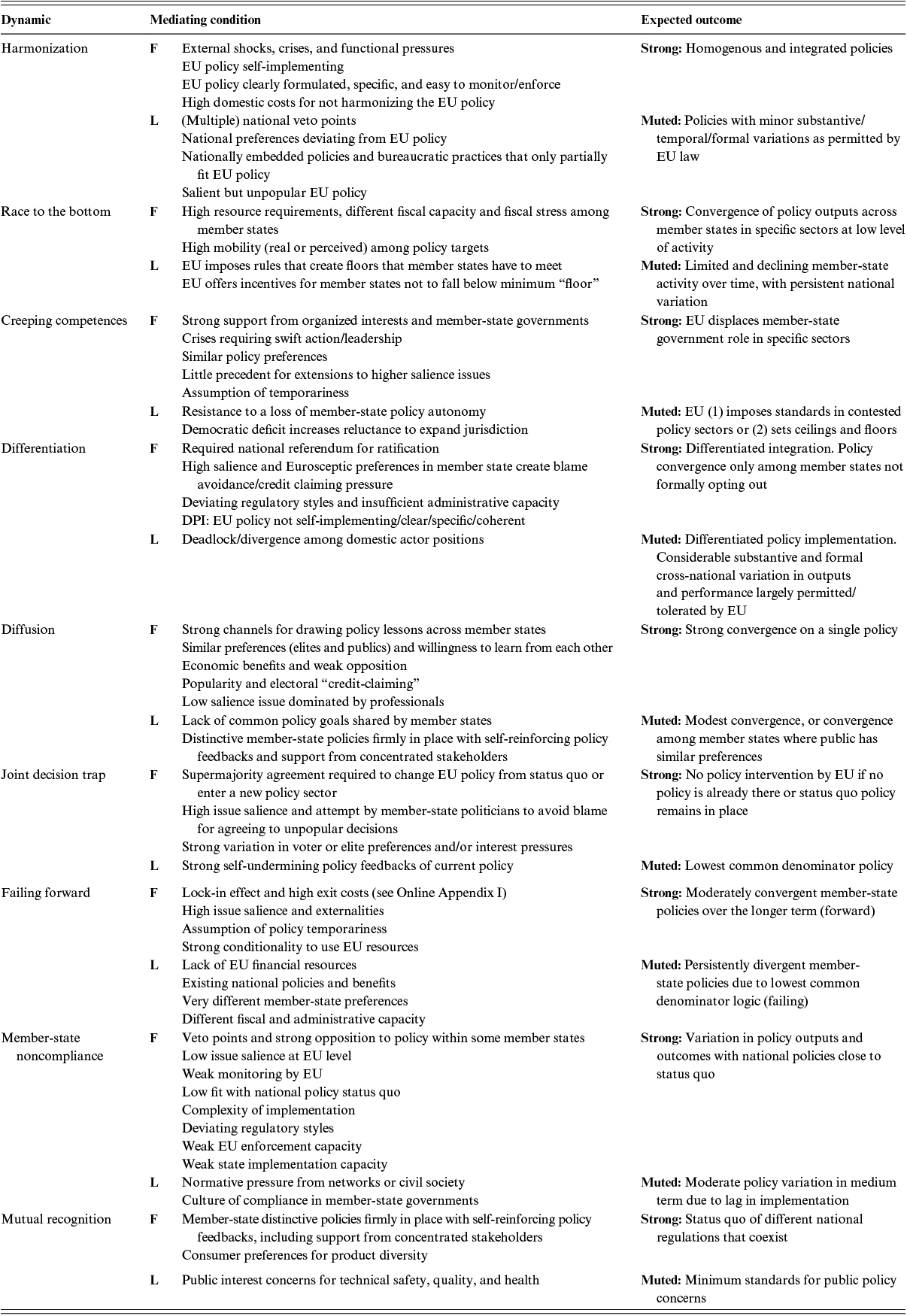
For example, a “race to the bottom” of standards and regulations requires the scope condition of member states having policymaking discretion in this domain. But it also is facilitated by competition among member states and policymaker concern that being a policy outlier poses risks of competitive disadvantage vis-à-vis other members. Creeping competences is likely to occur only where there is at least some ambiguity about the jurisdiction of EU institutions in policymaking, but it is also facilitated when a crisis delegitimizes the existing policy assignment (see Tables 2 and 3). Diffusion/learning is likely to be most evident where member states have a predominant policymaking role, but also face problem pressure; the Commission is then regularly called upon to organize multilateral exchanges regarding reform experiences supported by comparative indicators. For instance, activation in labor market policy, that is, using spells of nonemployment for training measures or subsidizing work rather than unemployment transfer payments, was an EU-orchestrated response to high and persistent unemployment among young and older workers.
As suggested earlier, the evolution of policy dynamics is rarely the exclusive result of exogenous changes, but also the result of strategic investments by various political actors. Table 4 summarizes and details these investment strategies for the different dynamics. As we have seen in the detailed discussion of individual policy dynamics in Section 3 and the case studies, specific policy dynamics offer understandings of how policies are made and by whom, the stakes involved in particular decisions, as well as lessons on how to influence policy that are likely to be familiar to actors seeking to influence policy. These understandings can be useful in building coalitions among actors to solve collective action problems.
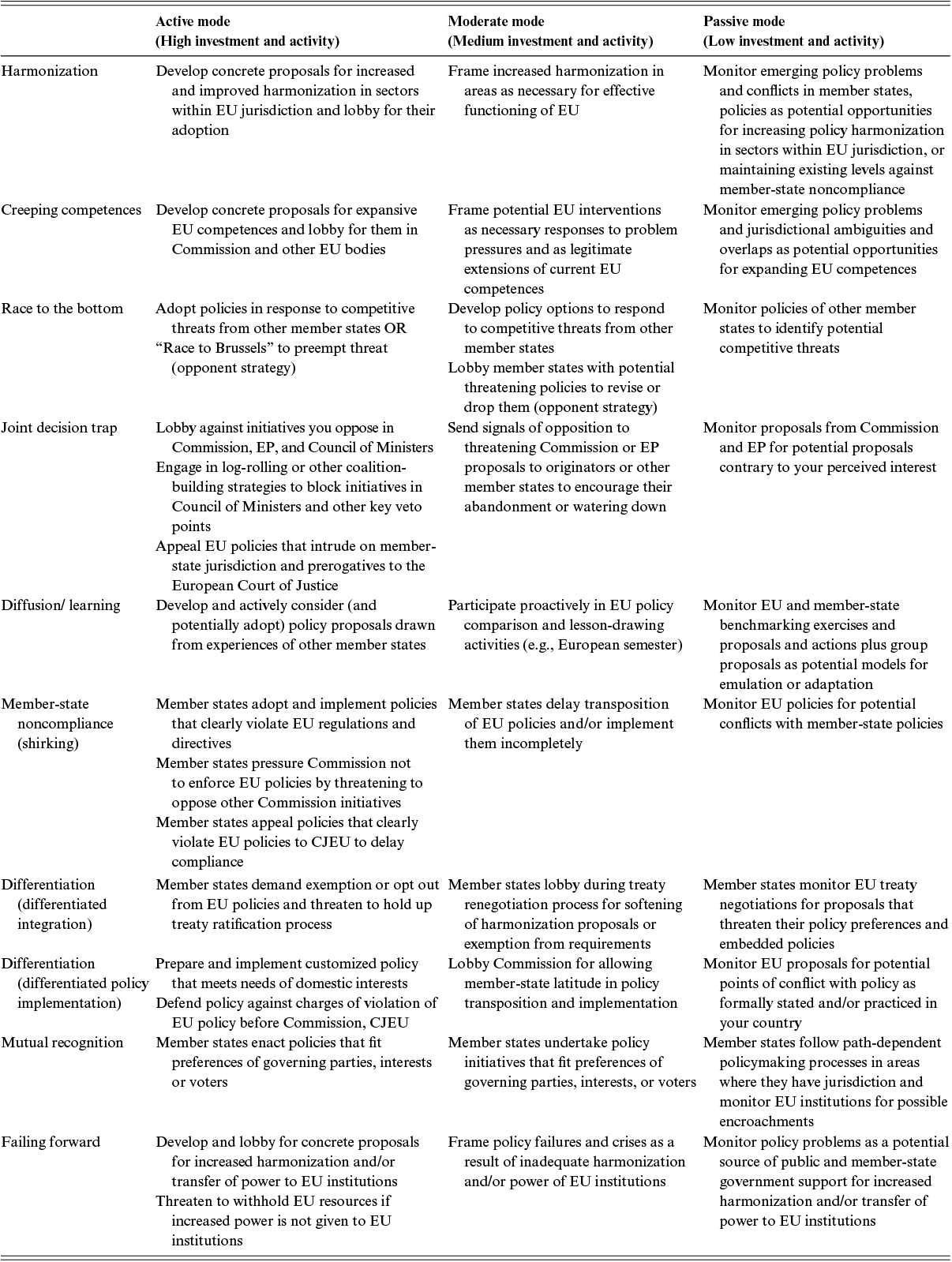
Actors’ existing capacities, investment opportunities, expected returns, and prospects for attracting allies influence these strategic decisions. Actors may venue-shop for policymaking venues (see Online Appendix I), where they believe that decisions favorable to their interests are most likely to be made. They may engage in framing, making arguments about the stakes in a policy decision that will affect the perceptions and actions of other actors. They may engage in interest mobilization and coalition-building to directly affect the actions of potential allies. But they may also be reluctant to invest in a policy dynamic as an alternative to an entrenched one with which they are deeply unhappy (e.g., challenging entrenched harmonization by investing in shirking or differentiated implementation) if the investment costs are high and the probability of success is low. Member-state governments can engage in log-rolling (a member state supporting another member state on an unrelated issue in exchange for that member state’s support on an issue that is of concern to the first member state) or other coalition-building strategies to block initiatives that they oppose in the Council of the European Union or other key veto points.
Table 5 outlines the diverse strategic incentives that may lead actors to invest in specific dynamics, ordered from the supranational to domestic-level actors involved. The level of investment intensity is based on perceived threats and opportunities, and expected returns, but also on resource limitations – for example, the limited resources of the European Commission to investigate member-state aid to domestic industries – and a high degree of uncertainty about payoffs and negative repercussions (Finke, Reference Finke2022). Investment by most actors in a policy domain, either in defending or challenging an entrenched policy dynamic, is therefore likely to be low when an issue is of low salience and actions that threaten their interests do not appear imminent. Actors sometimes actively invest in alternative policy dynamics to prevent a particular dynamic from taking a strong form: minimum harmonization in part helps prevent the race to the bottom from becoming a strong dynamic.
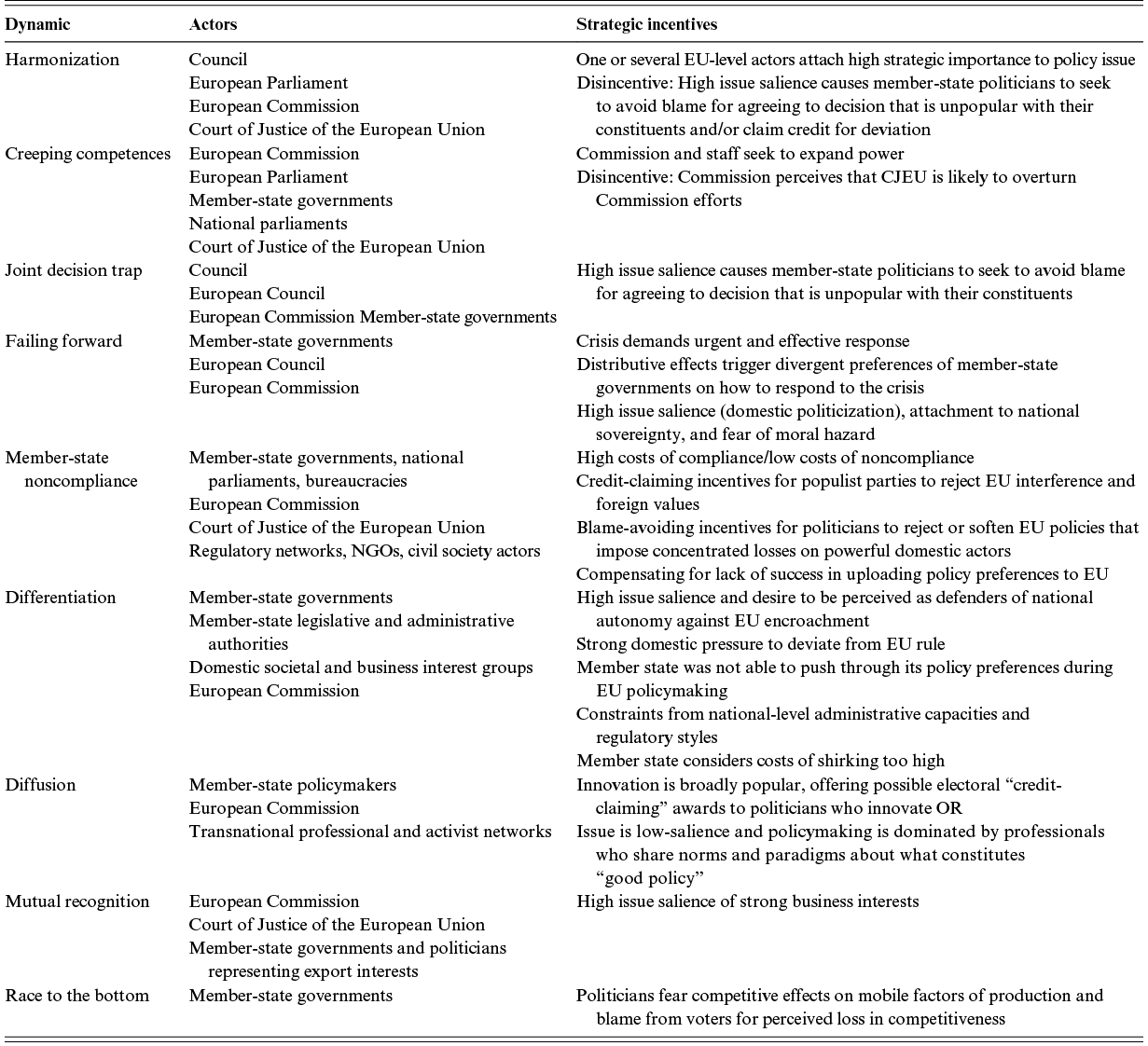
Further exploration of specific strategies (e.g., framing, venue-shopping, coalition-building, interest mobilization) in which actors invest in trying to employ particular policy dynamics could throw light on the actor constellations necessary to succeed in disrupting or preserving the status quo.
5.4 A Complexity-informed Perspective
The policy dynamics framework is admittedly complex, but that complexity reflects the reality of complex policymaking in the European Union policymaking space. Incorporating complexity does not, however, mean that the framework is not testable or falsifiable. On the contrary, the policy dynamics framework suggests a rich array of testable hypotheses on topics such as the conditions under which political actors will defend an entrenched policy dynamic or invest in challenging it. With Tables 2 through 5, we have sketched the potential for formulating observable implications for scholars to explore, both about policy dynamics in general, and about specific dynamics.
For instance, we generally expect that any single policy dynamic is likely to become and remain hegemonic only when a strong and stable support coalition is assembled that allows that dynamic to become entrenched in a policy domain and discourages potential supporters of an alternative dynamic from making significant investments in challenging the hegemonic policy dynamic. Deciding to invest in and building a coalition to oppose a policy dynamic that is already deeply entrenched in a policy domain (e.g., mutual recognition in the nuclear energy sector) is problematic because the prospects for success are likely to be perceived as very low. But our case studies of EU fiscal policy governance and tobacco policy show that it does occur. For example, we can hypothesize that a previously hegemonic policy dynamic is most likely to be overturned by a combination of (1) exogenous shocks and crises that disrupt an existing advocacy coalition supporting that policy dynamic (Nohrstedt & Weible, Reference Nohrstedt and Weible2010), (2) the defection of an important member of that coalition, and (3) unifying opponents around a single alternative policy dynamic rather than divided support among several alternative dynamics. The relative importance (or lack thereof) of each of these factors can be assessed through empirical investigation of multiple cases, and the utility of the policy dynamics framework can be assessed against alternative approaches.
Challenges to entrenched policy dynamics or efforts to employ them to challenge the status quo may also come from the very top. For example, the European Commission confronted with serious or widespread member-state noncompliance in a policy domain is likely to seek the prevention of such behavior. It may begin by engaging in passive investments in a harmonization dynamic, such as monitoring member-state activities for potential violations of state aid rules, and collecting information from interested third parties, such as competing firms (Finke, Reference Finke2022). When warranted by evidence that such a violation has occurred, the Commission may move to a moderate investment by opening a formal investigation. If a negative decision is reached but the member state does not withdraw or amend them, it has to decide whether to escalate the conflict and make the major investment of referring the case to the CJEU – which it does in only about 2 percent of all formal investigations (Finke, Reference Finke2022). An interesting empirical question for further research concerns when the Commission undertakes a major investment: Is it when the dynamic of noncompliance becomes so common that it undermines the policy or when the Commission perceives an easy target for making an example?
Our comparative discussion illustrates how useful such a complexity-informed perspective is for fostering systematic and cumulative research, whose results can speak to each other. By allowing for such comparisons, the policy dynamic framework should also be a useful tool for teaching EU policymaking. In a field characterized by theoretical and causal heterogeneity, this framework allows for systemically identifying which theory is most accurate in explaining a given case. Such a “congruence analysis” approach is useful in fields where multiple theories compete, since it allows us to identify those observations that are useful to discern accurate from inaccurate theories (Sager et al., Reference Sager, Thomann, Zollinger and Mavrot2014). The way in which the policy dynamics integrate causal mechanisms, scope, and mediating conditions lays the analytical and methodological basis to allow for process-oriented, qualitative, but also quantitative research informed by precise causal expectations.
5.5 Areas for Future Research
Each of the policy dynamics outlined here does operate in the EU, but there is great variation across those dynamics in their overall prevalence and whether they operate in a strong or relatively muted form. Harmonization is a dominant or even hegemonic policy dynamic in many policy domains as time goes on, but it frequently takes place in muted forms such as minimum standards and customization. The fact that established policies and procedures are deeply embedded in some member states and, thus, costly to change is a major constraint on harmonization, facilitating the formation of opposing coalitions. Differentiated integration operates intermittently at the time of treaty renegotiations and accession negotiations. Much more research needs to be done, however, before we can issue more definitive assessments of the relative prevalence, under what conditions, and at which junctures specific policy dynamics occur beyond the rough assessments offered here.
While the policy dynamics discussed here incorporate those that are most studied and, likely, most prevalent in the EU, the multilevel governance literature suggests additional policy dynamics that could be explored if space permitted. For example, Vogel (Reference Vogel1997) and others have written about a “race to the top” or “California effect,” in which member states compete to offer more generous programs or more stringent regulations (e.g., stricter environmental standards) to attract firms or workers. For example, in financial market regulation, even before the creation of the Banking Union, the UK, as the EU’s financial center, regularly went for “gold-plating” European rules so as to gain an advantage in risk perception by bank shareholders. In 2011, however, the British government introduced a mechanism to prevent such gold-plating, which was costly for UK-based financial businesses and grist to the mill for Euroscepticism with its trope of “EU red tape.” Overall, however, references to a race to the top in the EU policy literature are limited; probably more pertinent and prevalent in the EU context is the “race to Brussels,” in which member-state governments and interests seek common EU rules to avoid a race to the bottom (Holzinger & Sommerer, Reference Holzinger and Sommerer2011; Bradford, Reference Bradford2020). The Posting of Workers legislation is a case in point: Originally introduced to prevent a race to the bottom on employment standards and reservation wages after Southern enlargement, it has become an instrument of upward standard-setting for resident workers (Kyriazi, Reference Kyriazi2023).
Another potential dynamic is policy dismantling, which Gravey and Jordan (Reference Gravey and Jordan2016) have argued has increasingly been on the agenda at both the EU and member-state level. Our analysis of policy dynamics provides a useful framework to understand the causal mechanisms and mediating and scope conditions at work in dismantling, as well as its prevalence, across multiple policy domains. The “hyperconsensual” nature of EU institutions suggests that a strong dynamic of dismantling EU policies is likely to be quite limited, since stakeholders are likely to have developed around a particular policy that are ready to defend its benefits, while the losers from the status quo have no tangible evidence for a different future. A more “muted” outcome – a softening of those policies – is a more likely outcome, as noted by Skogstad (Reference Skogstad2017) in her discussion of European biofuels policy. For EU policies implemented at the member-state level, increased shirking in policies enacted by those governments, both through a rollback of formal member-state policies and the implementation of existing policies, is a more likely outcome than outright dismantling, as documented by Roggeband and Krizsán (Reference Roggeband and Krizsán2018) in the case of gender equality policies in Eastern Europe.
The analysis in this Element suggests several additional promising areas for future theorizing and research. Clearly, policy dynamics can both serve as imperfect substitutes and be deployed strategically as responses to other policy dynamics; a more systematic examination of these relationships would be fruitful. In a more methodological direction, development of measures of policy convergence that are more directly comparable over time and across domains would be useful, as would a more systematic analysis of the prevalence of various policy dynamics outlined in this Element, in both strong and weak forms. In addition to myriad cross-national case studies, a number of analyses focusing on a small number of sectors and cross-national time-series studies (e.g., Toshkov, Reference Toshkov2014) exist in the vast EU literature. A meta-analysis of these studies, though fraught with methodological problems including noncomparable definitions and missing data, offers one potentially fruitful approach to understanding the overall prevalence of specific policy dynamics.
Another potential extension of the policy dynamics framework is to give increased attention to the role of the EP and of societal interests – especially business. Since the EP is now a co-legislator with the Council on many policy areas, it has become an important arena for business lobbying (Rasmussen, Reference Rasmussen2015; Bunea et al., Reference Bunea, Ibenskas and Weiler2025). Future studies should further investigate how the EP influences the policymaking process, in particular through its committees and subcommittees (Gianna, Reference Gianna2023; Bardoux & Delreux, Reference Bardou and Delreux2024; Stephenson, Reference Stephenson2025). This is important in order to shed better light on the policy dynamics where this Element has found evidence of the role of the EP, especially harmonization, differentiation, creeping competences, and failing forward. The impact of populist and anti-EU parties on the EP’s involvement in the policymaking process is also a topical issue that deserves further scholarly attention (Fabbrini & Zgaga, Reference Fabbrini and Zgaga2024). The emphasis in this Element has been on the role of governmental actors as drivers of competing policy dynamics but, as discussed briefly in Section 2.3, societal actors can also play major roles in investing in specific policy dynamics to advance their interests, for example, through building multiactor coalitions. This is, of course, particularly evident in the role of transnational tobacco companies. Many studies have suggested that business enjoys a privileged position in the EU policymaking space and use their resources to act at multiple levels to advance their interests (for contrasting views, see, for example, Rasmussen, Reference Rasmussen2015; Keller, Reference Keller2018; Dür et al., Reference Dür, Marshall and Bernhagen2019), especially on issues of lower salience (see also Online Appendix II). Like governments, business is likely to view specific policy dynamics as tools to advance their interests rather than as intrinsically valuable or preferable. Understanding how businesses and other interests act as drivers of and allies of governmental actors in trying to advance or block the deployment of particular policy dynamics can help to enrich an understanding of those dynamics and policymaking generally.
The analysis in this Element can also be used to understand the evolution of the EU policymaking space – and potentially other systems of multilevel governance – over time (Richardson, Reference Richardson2012). Feedback loops from the first-order political and policy consequences of specific policy dynamics, including stronger or weaker convergence, almost certainly have a major influence on how policymaking in the EU and member states evolves. For example, the argument of Jones, Kelemen, and Meunier (Reference Jones, Kelemen and Meunier2016, Reference Jones, Kelemen and Meunier2021) that JDTs first lead to lowest common denominator policies in response to crises, contributing to policy failure and then to “failing forward” integration, is a provocative claim about how both self-reinforcing and self-undermining feedback of a specific policy dynamic affects the evolution of the EU. Similarly, the notorious proposal by then Commissioner Bolkestein to make mutual recognition the formally instituted policy dynamic in services markets led to mass protests, especially from organized labor in public services, that spurred the exact opposite, notably highly differentiated regulation of services. Even so, it broke the deadlock of a JDT at which the Single Market Program for services had arrived. Broad categories of services have since been created, for which convergence to different degrees has been achieved. Malang and Schraff (Reference Malang and Schraff2023) show that opt-outs decrease integration support, thus reinforcing further differentiation. These second-order consequences for policy convergence and divergence in the EU policymaking space – the main concern of this Element – deserve further attention.
Finally and more generally, explicit comparison with other systems of multilevel governance is another promising area for research. Despite the EU’s unique status as a set of governing institutions, the parallels with other systems of multilevel governance instruments are strong. Indeed, of the nine policy dynamics identified in this Element, five have exact parallels with the federalism policy dynamics identified in Weaver’s study of federal systems (Reference Weaver2020): harmonization (labeled preemption/supplantation in the federalism article), race to the bottom, member-state noncompliance (shirking), diffusion, and the JDT. Another two dynamics, creeping competences and mutual recognition, have close parallels with the turf-claiming and collusive benchmarking federalism dynamics in the federalism literature. Differentiation does not appear on Weaver’s list, but it clearly does operate in some federal systems, especially those that have strong regionally concentrated ethnic minorities, such as Spain, Canada, and Belgium (Hooghe & Marks, Reference Hooghe and Marks2023). Further exploration of parallels and differences between policy dynamics in the EU and other federal systems can provide further insights into how and why the EU is unique as a system of multilevel governance – and how it is not.
Acknowledgments
The authors thank Waltraud Schelkle for her contribution to and involvement in the writing process; Jeffrey Anderson, R. Daniel Kelemen, Dirk Leuffen, Kathleen McNamara, Sebastiaan Princen, and Jeremy Richardson for comments on earlier drafts; Marius Schweikert for his background research; and Marin Gillot for excellent research assistance. Drafts were presented at the 2020 ECPR joint sessions, the 2022 conference of the ECPR Standing Group on the European Union, and the 2025 conference of the ECPR Standing Group on Regulatory Governance.
Series Editor
Catherine De Vries
Bocconi University
Catherine De Vries is a Dean of International Affairs and Professor of Political Science at Bocconi University. Her research revolves around some of the key challenges facing the European continent today, such as Euroscepticism, political fragmentation, migration and corruption. She has published widely in leading political science journals, including the American Political Science Review and the Annual Review of Political Science. She has published several books, including Euroscepticism and the Future of European integration (Oxford University Press), received the European Union Studies Association Best Book in EU Studies Award, and was listed in the Financial Times top-5 books to read about Europe’s future.
Gary Marks
University of North Carolina at Chapel Hill and European University Institute
Gary Marks is Burton Craige Professor at the University of North Carolina Chapel Hill, and Professor at the European University Institute, Florence. He has received the Humboldt Forschungspreis and the Daniel Elazar Distinguished Federalism Scholar Award. Marks has been awarded an Advanced European Research Council grant (2010–2015) and is currently senior researcher on a second Advanced European Research Council grant. He has published widely in leading political science journals, including the American Political Science Review and the American Journal of Political Science. Marks has published a dozen books, including A Theory of International Organization and Community, Scale and Regional Governance.
Advisory Board
Sara Hobolt, London School of Economics
Sven-Oliver Proksch, University of Cologne
Jan Rovny, Sciences Po, Paris
Stefanie Walter, University of Zurich
Rahsaan Maxwell, University of North Carolina, Chapel Hill
Kathleen R. McNamara, Georgetown University
R. Daniel Kelemen, Rutgers University
Carlo Altomonte, Bocconi University
About the Series
The Cambridge Elements Series in European Politics will provide a platform for cutting-edge comparative research on Europe at a time of rapid change for the disciplines of political science and international relations. The series is broadly defined, both in terms of subject and academic discipline. The thrust of the series will be thematic rather than ideographic. It will focus on studies that engage key elements of politics — e.g. how institutions work, how parties compete, how citizens participate in politics, how laws get made.
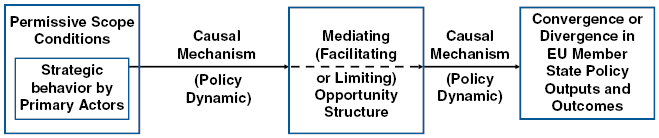
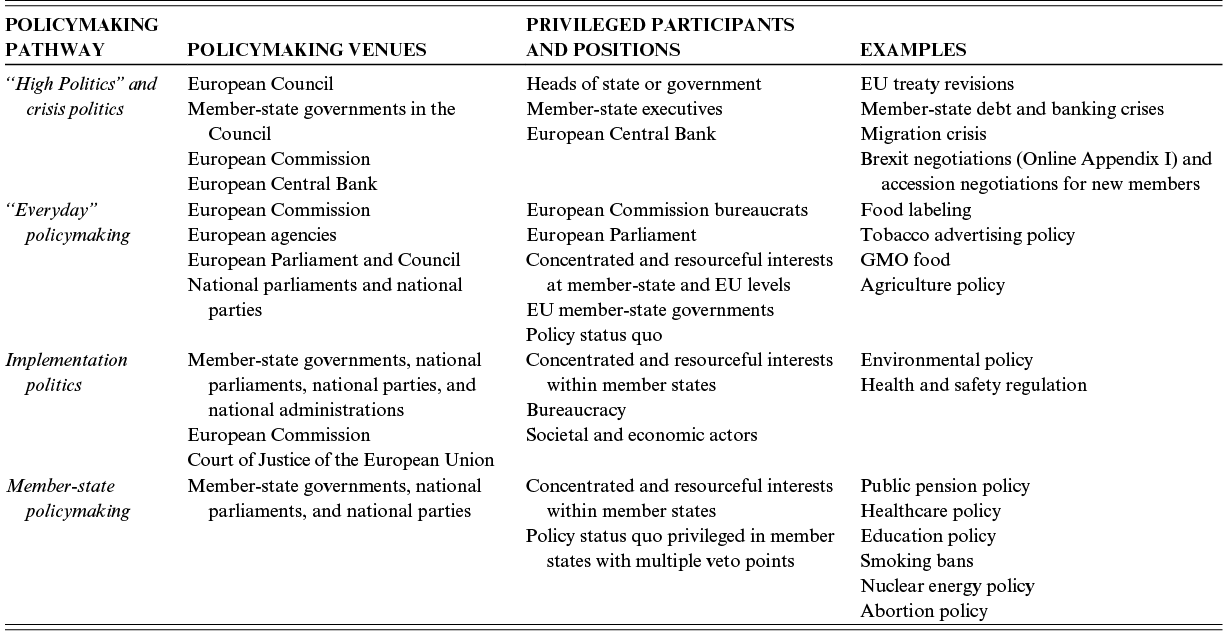
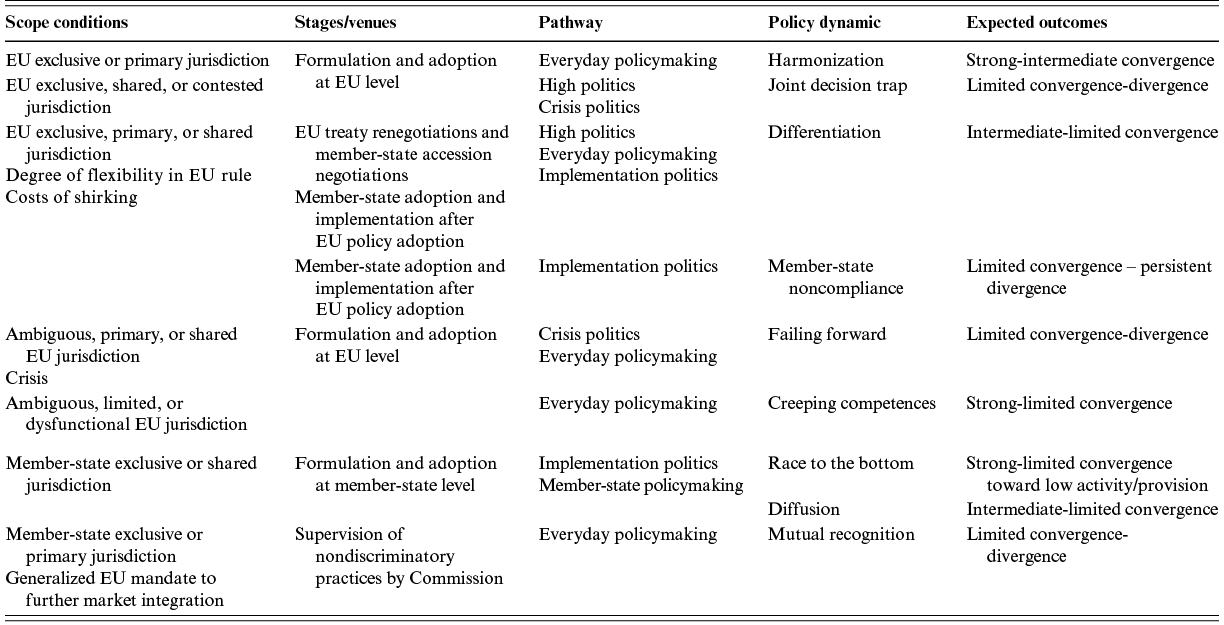
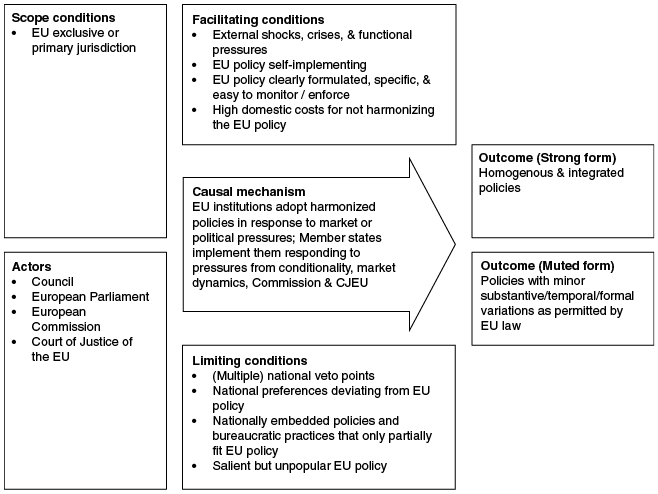
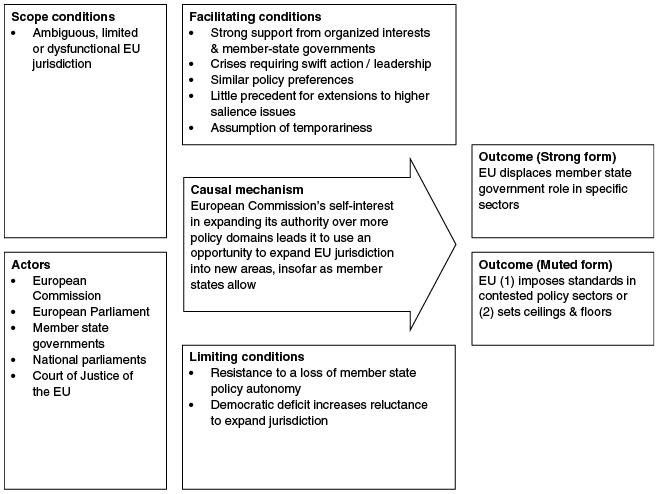
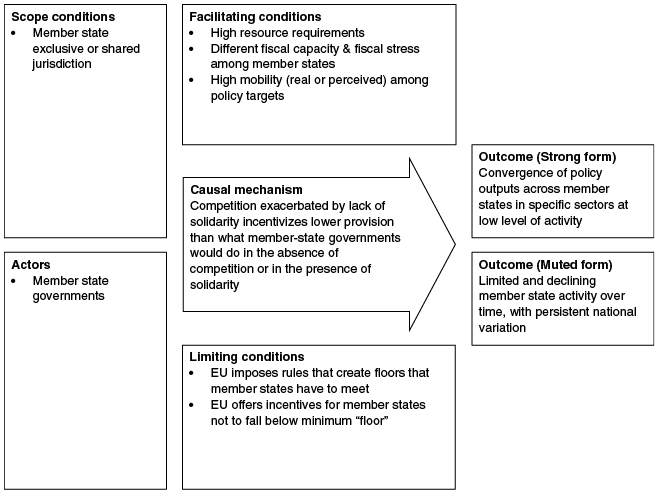
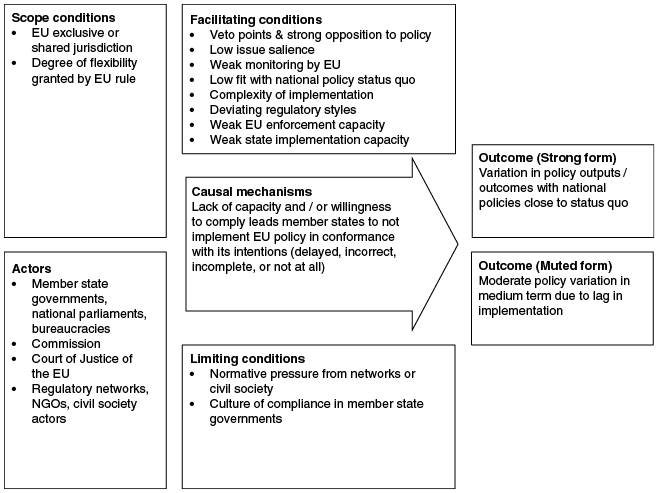
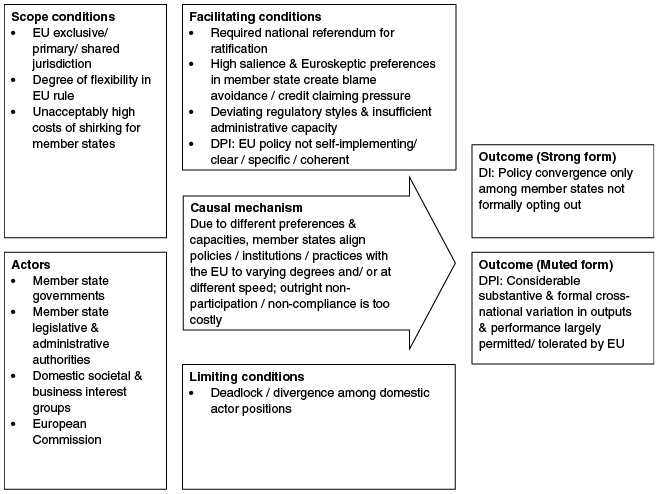
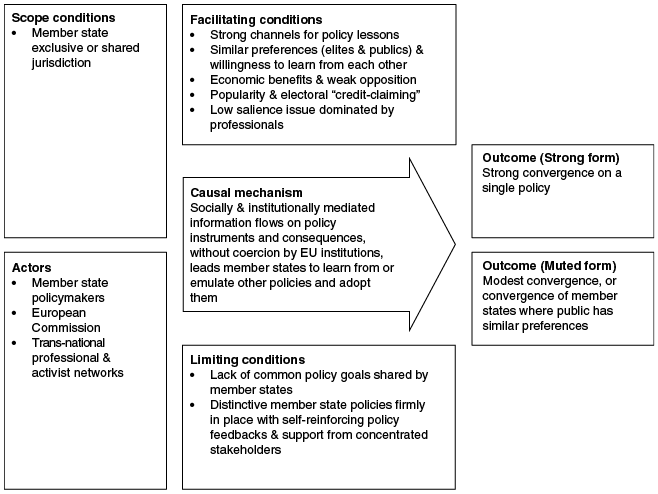
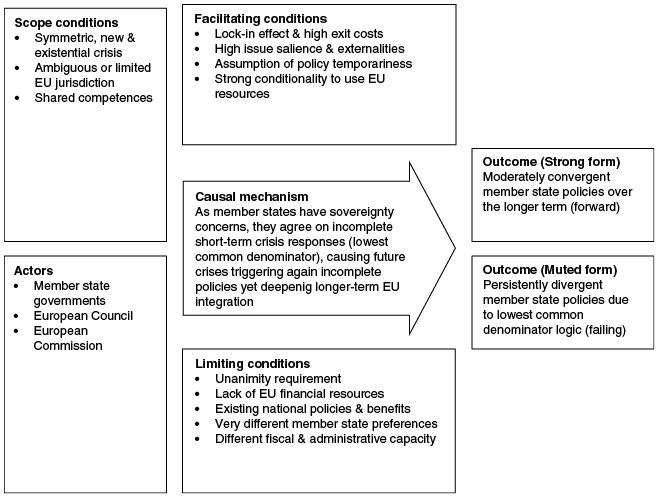
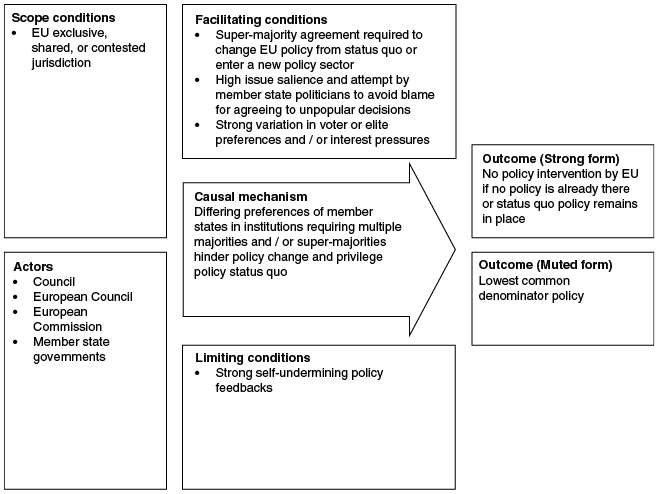
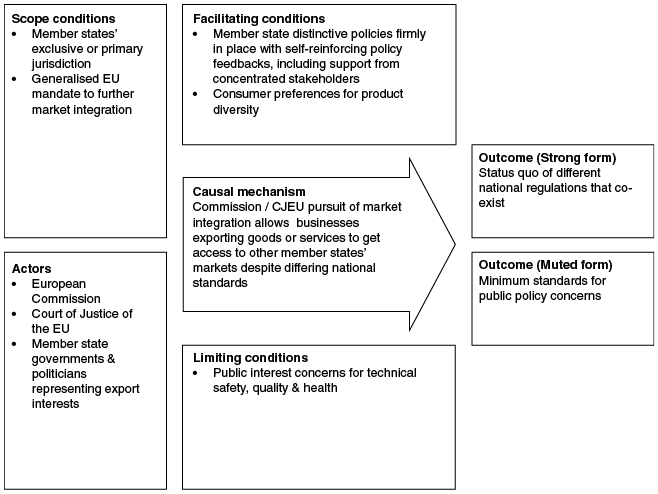
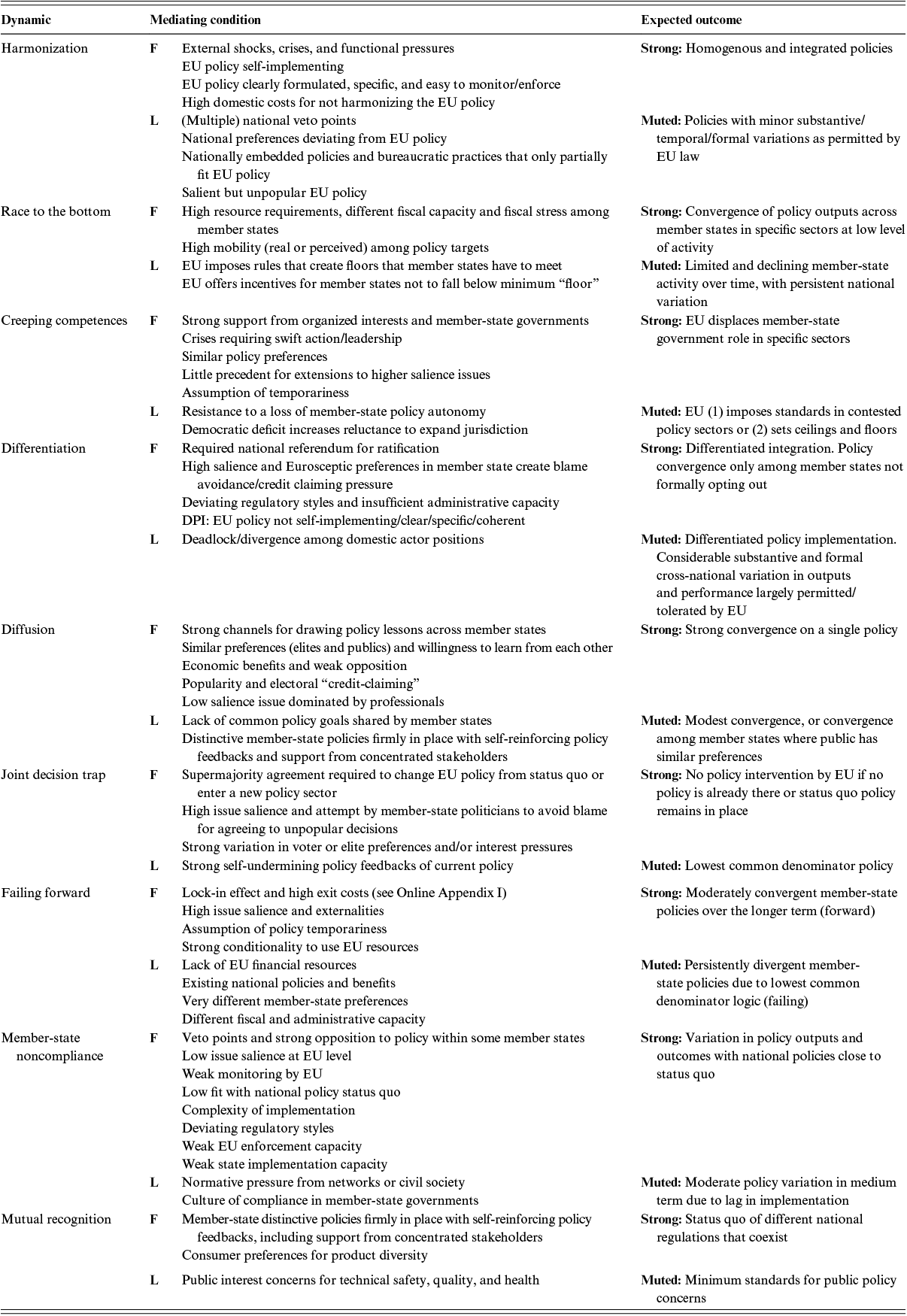
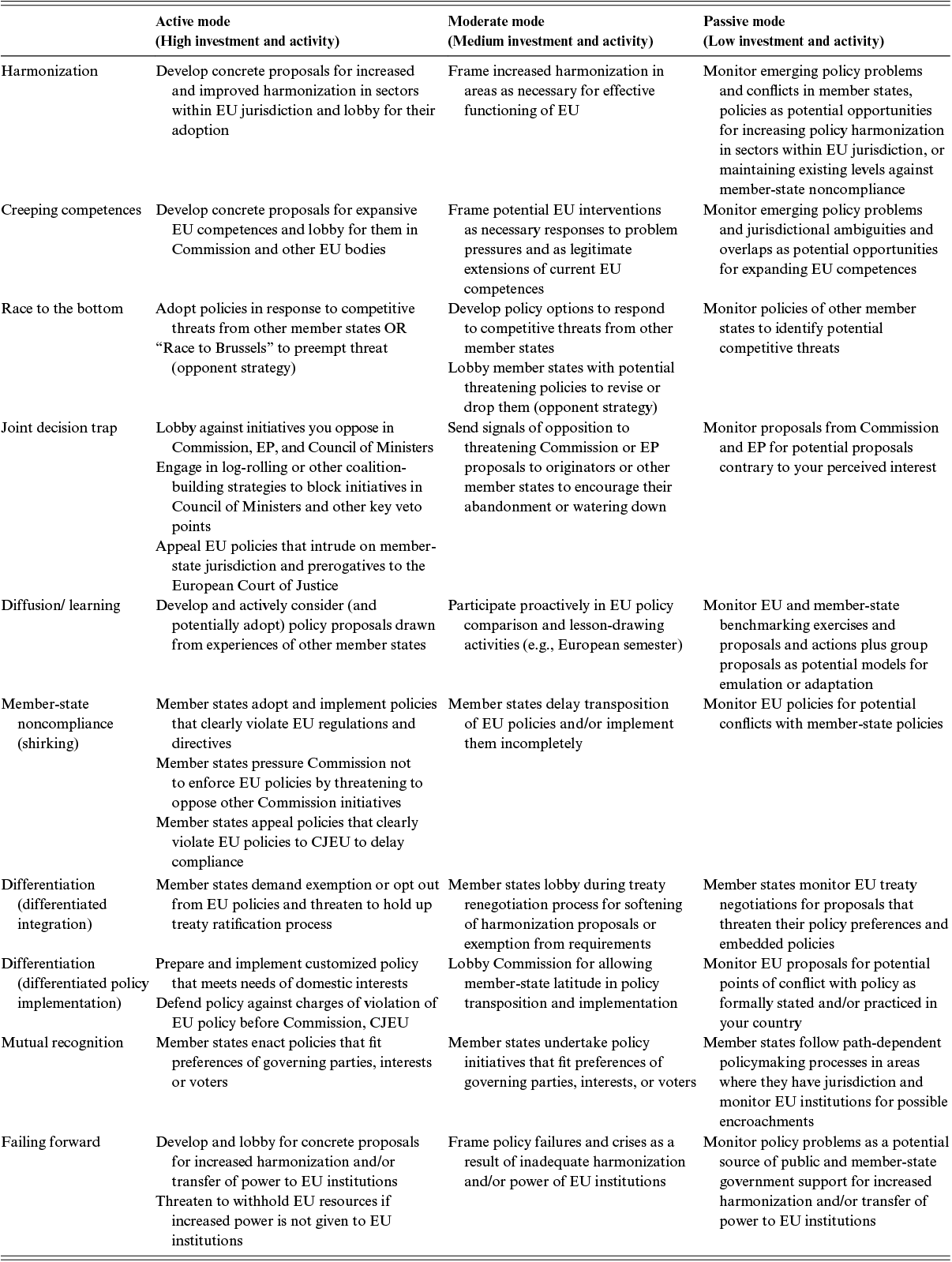
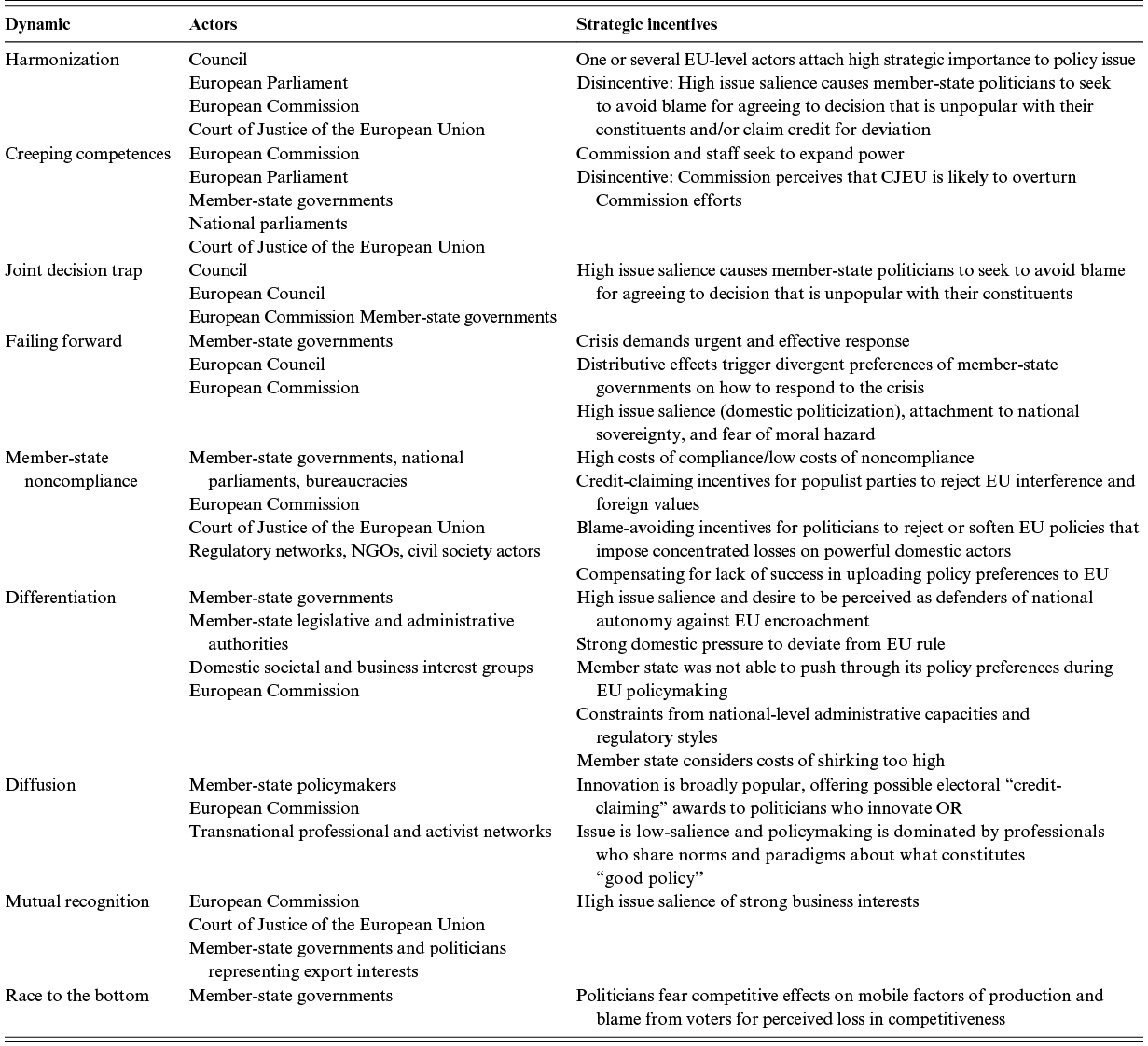

 Open access