

1. Introduction
Electoral concerns often guide parties' candidate selection decisions. This often benefits incumbents who have already proven their electability, especially in electoral systems allowing or encouraging the personal vote. However, electoral reforms may turn conventional wisdoms about electability upside down, introduce electoral uncertainty and pitch incumbents against each other fighting over sparse nominations.
While seat-maximization may guide parties' candidate selection in normal times, the desire to find the right candidate for the right district may be compounded when parties face a surplus of incumbents after (magnitude reducing) redistricting or electoral system reform. When the electoral system for Scottish local elections changed from single-member districts (SMDs) to larger multi-member districts, the Labour party had to deal with a surplus of incumbents. Yet, luckily for the party's selectors, the newly introduced single transferable vote allowed the party to have all incumbents willing to run to do so and outsource the final decision to the electorate (see Clark and Bennie, Reference Clark and Bennie2008).
The situation the Japanese Liberal Democratic Party (LDP) found itself in, however, was more intricate when facing the 1996 general election under a new set of electoral rules. Following the reform enacted in 1994, magnitude in the nominal tier has been reduced from over 500 seats to 300 SMDs, while an additional 200 seats were allocated through proportional representation (PR). While rural prefectures were overrepresented under the old system – significantly favoring the LDP and providing most of its incumbents – the electoral reform led to a correction in this rural–urban seat disparity and created two kinds of challenges for the LDP. Sparse rural districts had too many former incumbents and the now greater number of urban seats was in need of supply. As a result, many incumbents of the LDP were competing with their co-partisans for the party's official nomination in the new districts.
How has the LDP, dominating Japanese politics since its inception in 1955, managed this nomination challenge in the wake of electoral reform? The party faced two general problems: how to maximize its seats by allocating the right candidate to the right district, and second, how to coordinate its many incumbents lest two of them run against each other. Moreover, with the creation of SMDs with newly drawn boundaries, the electoral reforms rendered the party's institutions the most important to its candidate selection process – that is, intra-party factions and personal support groups – ineffective to a certain degree. Factions had to cooperate to coordinate on a single candidate and personal support groups had to be convinced to fall in line behind the party's official nominee. Facing now the challenge of accommodating more incumbents than there are districts in the rural strongholds and avoiding that own candidates run against each other in the same district, how could the party convince incumbents to move from the district onto the party list and based on what characteristics did the party nominate candidates to the newly instituted districts?
While the consequences of the Japanese electoral system reform on representation (e.g., Horiuchi and Saito, Reference Horiuchi and Saito2003; Catalinac, Reference Catalinac2016, Reference Catalinac2018), the wider party system (e.g., Di Virgilio and Kato, Reference Di Virgilio, Kato, Giannetti and Grofman2011), the organizational structure of the LDP (Reed, Reference Reed2002; Krauss and Pekkanen, Reference Krauss and Pekkanen2004), the fate of its intra-party factions (e.g., Cox et al., Reference Cox, Rosenbluth and Thies1999; Park, Reference Park2001; Reed, Reference Reed2002; Giannetti and Thies, Reference Giannetti, Thies, Giannetti and Grofman2011) and its candidate selection processes (e.g., Asano, Reference Asano2003, Reference Asano2006; Smith, Reference Smith2018) have received substantial attention, we lack systematic micro-level accounts examining how the LDP as the largest party and its incumbents solved many local coordination challenges of accommodating an excess number of incumbents to the newly instituted SMDs. With demand for district nominations outstripping the supply of electoral districts and, moreover, that of attractive ones, prefectural party branches and candidates were between a rock and a hard place (Reed, Reference Reed1995). This paper, hence, examines the LDP's nomination strategies prior to the 1996 election by focusing on two questions: first, which incumbents moved to the party-list tier of the mixed-member electoral system and which incumbents received the nominal tier nomination? And second, who out of the (regional) pool of potential candidates received which district nomination?
According to Di Virgilio and Reed (Reference Di Virgilio, Reed, Giannetti and Grofman2011), candidate selection for the first election under the mixed-member majoritarian (MMM) system was still highly decentralized, with selection decisions taken at the district level. They identify three types of nomination strategies to match candidates to the new districts: personal base, that is, nominating the candidate with the greatest personal support in the new district; tag team, that is, nominating one out of two strong candidates in the district and putting the other on a promising list position and then switching these nominations in the next election (also known as Costa Rica agreement), and; strong opponent, that is, nominating a candidate in an opposition stronghold, who usually is being rewarded with a competitive list-position. Among these types, only the second one alludes to the coordination challenge of accommodating relatively more incumbents than there are districts to run in, while all three follow the logic of seat-maximization. Yet, despite this typology we have no systematic account whether nominating the strongest contender was the only nomination strategy employed by the LDP and whether there are others, and if so, under which circumstances they have been used. Who, for example, was nominated in districts created from multiple previous districts and which thus have an expectedly lower personal vote potential for many candidates? Moreover, under what circumstances did the party hand-out promising list positions, that is, those with greater probability of election, compared to rather competitive list positions whose electability is, in fact, highly contingent on the candidate's performance in the district. Finally, how contingent was this nomination pattern on prefectural factors?
My results show that the LDP skillfully employed the bargaining chips they were handed through the newly instituted party list to defuse local stand-offs. Nomination failures happened more frequently in regions with lower PR magnitude, while the clear majority of candidates receiving the official party nomination in the districts were in fact successful. I can, moreover, show that the LDP appears to have followed two cues of matching incumbents to new districts, namely endorsing those with the highest expected electoral pay-off and, in districts newly patched together and hence cutting through incumbents' personal vote appeal, candidates with a more credibly centrist ideological position. This finding speaks to the literature on spatial models of electoral competition (e.g., Downs, Reference Downs1957) by exploring under what circumstances parties may nominate candidates based on their ideological profile. In addition, my results contribute to the literature on candidate selection in general by adding to our understanding how seat-maximizing parties and candidates respond to electoral uncertainties, and to the literature on candidate selection within the LDP in particular, by adding to the debate about how much we can treat the LDP as a unitary actor when it comes to nominations (e.g., Cox and Rosenbluth, Reference Cox and Rosenbluth1996; Reed, Reference Reed2009).
Hence, my findings contribute to the study of Japanese politics and offer additional insights into how the LDP, despite its bitter factional rivalries that forcefully surfaced during the nomination processes and the divisive party leadership selection prior to the 1996 election (e.g., Reed, Reference Reed1995; Cox et al., Reference Cox, Rosenbluth and Thies1999), managed to stay united by solving numerous local nomination contests that eventually has allowed the party to continue dominating Japanese politics to this day – in sharp contrast to the post-electoral fate of the Italian Christian Democrats to which the LDP often has been compared. The next section details how candidate selection worked under the old electoral system and how it has changed in the wake of the electoral system reform.
2. Candidate selection in two electoral systems
Between 1947 and 1994, Japan employed the single nontransferable vote (SNTV) in multi-member districts, ranging in magnitude from two to six with an average of four to elect a total of 511 seats in the Diet in 1993. Voters cast their vote not for a party, but for an individual candidate, and excess votes of winners were not transferred to co-partisans of the district. The LDP, as the de facto sole majority-seeking party, had to nominate on average at least two candidates per district were it to gain a legislative majority. Many of its candidates, hence, found themselves in competition over conservative voters with their co-partisans of the same district. With the party-label thusly rendered rather useless, candidates competed on grounds of the personal vote, pork-barrel politics and sought for organizational advantages over their co-partisans (see Carey and Shugart, Reference Carey and Shugart1995). They came to rely heavily on personalized support groups known as kōenkai – local formal-membership organizations with allegiance rather to the politician, than the party – and the LDP's intra-party factions (e.g., Cox et al., Reference Cox, Rosenbluth and Thies1999; Krauss and Pekkanen, Reference Krauss and Pekkanen2011). In consequence, candidate nominations were much in the hands of these local kōenkai and the party's factions.
Local kōenkai were among the most influential actors in deciding upon successors to retiring or deceased incumbents. In many cases, relatives such as sons or daughters were chosen to replace the outgoing incumbent on account of their name recognition and voters' personal fealty to the former incumbent (e.g., Krauss and Pekkanen, Reference Krauss and Pekkanen2011; Smith, Reference Smith2018). The leadership of the LDP usually acquiesced to these local decisions of running hereditary candidates as failing to do so would result in the creation of a strong independent conservative opponent able to beat the party's official candidate. Yet, sustaining such support networks as the kōenkai as well as financing profligate constituency services in order to gain an edge over the conservative competition required candidates to look for financial support. This demand was usually met by one of the LDP's faction, which were only too eager to add names to their roster, as increasing faction membership in the caucus led to greater influence over allocation of senior party posts, including that of the party president which for most of the time coincided with the office of Prime Minister (Cox et al., Reference Cox, Rosenbluth and Thies1999).
Yet, in the early 1990s corruption scandals reached a new peak and fueled debate on electoral reform. The high level of intra-party competition of the SNTV system was readily identified as the main culprit causing this ‘money politics’, plus a number of other ills such as the influence of factions within the LDP and the lack of policy and programmatic election campaigning associated with SNTV (e.g., Reed and Thies, Reference Reed, Thies, Shugart and Wattenberg2001). Eventually, electoral reform in the shape of an MMM system was agreed upon. For the 1996 election, 300 newly instituted SMDs were created and complemented with another 200 seats in eleven multi-member districts allocated using PR. With the move from multi- to SMDs, reformers sought to do away with the excessive intra-party competition of the SNTV and, with it, the money politics and the factions' heavy hand in candidate endorsements.
In 1994, roughly one year after the 1993 election seven membersFootnote 1 appointed by the prime minister to the parliamentary boundary commission started their task of drawing 300 new electoral districts. When drawing the boundaries the commission was to follow a few basic principles including a general (though not perfect) equality of populations across districts, contiguity of districts, the protection of local government boundaries (unless necessary to satisfy the equality principle or contiguity) and of natural and social conditions (Moriwaki, Reference Moriwaki, Handley and Grofman2008: 108f.). The allocation of the 300 districts took place in two steps. First, each of the 47 prefectures received one district, then the remaining 253 districts were distributed across prefectures according to population sizes following the principle of the largest remainder (Moriwaki, Reference Moriwaki, Handley and Grofman2008; Sakaguchi and Wada, Reference Sakaguchi, Wada, Handley and Grofman2008).
The literature on the impact of the electoral reform on candidate selection in Japan is small but growing. Most of the extant accounts examine how the changes to the electoral rules have affected the demand of party selectorates' for certain types of candidates including legacy candidates (e.g., Asano, Reference Asano2003; Smith, Reference Smith2018) or how the electoral system reform has affected the organizational structure of parties' candidate selection methods, particularly its centralization and the role of factions (e.g., Asano, Reference Asano2006; Smith and Tsutsumi, Reference Smith and Tsutsumi2016).
How have the new rules affected the demand for types of candidates? Examining the number of legacy candidates in the LDP before and after the electoral reform, Smith (Reference Smith2018) finds in fact a considerable drop in legacy candidates competing, starting with the first election under MMM. This is especially pronounced for first-time candidates, as the electoral advantage of legacy candidates, that is, their greater name recognition, still has value in SMDs but much less so when compared to the previous multi-member districts. With respect to the LDP's faction, Cox et al. (Reference Cox, Rosenbluth and Thies1999) had expected not so much their disappearance but a diminished role in the endorsement of new candidates without prior factional affiliation. The move to SMDs eliminated intra-party competition and the need for lavish ‘money politics’ aimed at outdoing co-partisan competition. At the same time, the newly instituted SMDs in many cases have torn apart candidates' geographically concentrated kōenkai and their fragments often were pushed to support the LDP's sole candidate nominated for that district. New candidates, they argue, found themselves in positions with relatively more leeway toward faction bosses who had to rally behind the LDP's official candidate. Asano (Reference Asano2003), indeed, reports that under MMM affiliation to the factions providing the party president or the party's secretary general, the party's top positions, became more important compared to the old system, pointing to a monopolization of candidate endorsements (see also Cox et al., Reference Cox, Rosenbluth and Thies1999: 44).
Overall, the LDP's candidate selection methods became much more centralized in the wake of the electoral reform (Asano, Reference Asano2006). Already in the years between the electoral reform and the first election under MMM have the prefectural branches become more important in candidate selection and were tasked by the LDP headquarters to sort out the many local nomination challenges in the freshly drawn SMDs of their prefectures (Cox et al., Reference Cox, Rosenbluth and Thies1999: 42f.). The LDP even saw the establishment of party district branches in the run-up to the 1996 election, something the entrenched kōenkai system has been successfully rejecting for decades (Krauss and Pekkanen, Reference Krauss and Pekkanen2011). With the newly adopted PR tier and the provision for dual candidacy – that is, competing in the SMD and on the PR list – prefectural party branches now gained leverage over candidates using promising list positions and the dual candidacy option as bargain (Reed, Reference Reed1995).
While a number of studies suggest that the LDP solved its coordination challenge of having too many incumbents for too few districts, which additionally have been redistricted, by nominating those candidates with the strongest kōenkai support in the new SMDs (e.g., Reed, Reference Reed1995; Cox et al., Reference Cox, Rosenbluth and Thies1999; Di Virgilio and Reed, Reference Di Virgilio, Reed, Giannetti and Grofman2011), there is actually no systematic analysis to empirically back these anecdotes and claims. In fact, a number of open questions remain about how the LDP has managed to match candidates and incumbents to the newly established SMDs and who of the previous candidates and incumbents were put on the party-list, either as a dual candidate or as a sole list candidate? This paper, hence, sets out to explore such questions as on what basis candidates were chosen for which districts and how candidates’ electoral prospects are linked to their type of candidacy and list-position. The next section lays out my expectations about the LDP's nomination strategies for nominations in both the nominal tier and the proportional representation track.
3. Where to run whom?
How do parties and incumbents respond to such profound rule changes that follow a complete overhaul of the electoral system? The specific coordination problem the LDP faced has been unique; how to accommodate a surplus number of mainly rural incumbents willing to run in some but not just any SMD. How would a party trying to maximize its seat allocate its incumbents? As most of these incumbents could make some sort of claim to one or more of the newly instituted SMDs and given their party-independent personal support coming from the kōenkai, the LDP's main task was to avoid that more than one LDP-affiliated candidate would run in the same district. At the party level, the party moreover had to avoid its disintegration, with fissures visible during the election for the party president. The eventual election of the popular Hashimoto Ryūtarō in early 1996, defeating a young Koizumi, not only averted further cracks in the national party but also asserted the LDP's ambition to become the largest party (Cox et al., Reference Cox, Rosenbluth and Thies1999: 51).
Yet, more difficulties in the regional party branches lie ahead. For instance, at the local level of the newly instituted districts which were carved out of the previous multi-member districts, candidate nomination resembled a classic collective action problem. For the individual candidate previously competing or elected in the former district, running in the SMD with the most geographic overlap and hence greatest expected electoral pay-off is the most rational decision. However, since the former districts housed several candidates or incumbents of the LDP, running in a specific SMD becomes rational for many of them. Although rational for the individual, from a party's perspective having more than one party-affiliated candidate running in the same SMD is obviously irrational for at least two reasons: first, it can split the party's support leading to a third party victory, and, second, it could leave the party short of quality candidates in vacant adjacent districts. Reed (Reference Reed1995) reports a number of LDP candidates engaging in a game of chicken to obtain the party's official nomination in their favorite district by threatening to run as independents. Following the logic of game-theoretical models, we would expect that absent any central arbiter candidates would very likely give in to their individual rationality and run in their most desired district, thereby undermining the party. However, with the introduction of the PR tier the prefectural party branches gained an advantage over wayward candidates. By promising list positions with good prospects of election to confrontational candidates, it became easier to convince them to either move to the party-list or to compete in less attractive districts but with the safety of a list position. This enabled the prefectural party branch to solve its regional and local nomination challenge. Below, I will spell out how the party could use this new found influence to coordinate candidates at the local level.
Although candidates had still a high degree of autonomy from the regional party leadership, it was often rational for them to follow the party's suggested nomination decision. While still enjoying personal support from their kōenkai, these were often reduced in strength due to redrawn district boundaries that cut right through them. Additionally, solely relying on specific segments of the electorate could not promise victory as much in SMDs as it did in multi-member districts. Hence, running as an independent on reduced personal support while facing a similar conservative candidate with official party backing appeared unwise. Yet, while the party gained in leverage over candidates, the right candidate still needed to be matched to the right district. Which candidate should run in which district and why? Who should be given a list position? To solve this seat-maximization challenge of matching the right candidates to the right districts, the LDP, I argue, has followed two kinds of cues: electoral strength and, where this was absent, candidates' Downsian ideological outlook.
First, electoral strength. Under SNTV, candidate support has been geographically highly concentrated, usually around the candidate's hometown (Hirano, Reference Hirano2006). Expecting the highest electoral pay-off, it is thus only rational for vote-seeking candidates and the party to have local candidates run in those new SMDs that encompass either their hometown or the highest concentration of personal support. Hence, I expect that candidates are nominated in districts that include their hometown or in which their electoral support is expected to be the greatest.
The second cue is ideology. In some circumstances no single candidate may have a strong support base in a newly instituted district. This is more likely the case in those SMDs that have less geographic overlap with previously strong candidates' old districts. With the inclusion of new geographic areas come new segments of voters that are unfamiliar with the candidate, implying a loss of name recognition – a significant source of the incumbent advantage in the highly personalized electoral context of Japan. As a correlate, new challenger entry is more likely following redistricting that cuts off incumbents from their support (Carson et al., Reference Carson, Engstrom and Roberts2006). As the incumbency advantage for candidates in redistricted districts is at best proportional to the degree that the new district comprises shares of the old district (see also Ansolabehere et al., Reference Ansolabehere, Snyder and Stewart2000), the electoral disadvantage this entails may be countered by adjusting to the changed nature of electoral incentives stemming from moving from the old multi-member districts to the new SMD system. As Catalinac (Reference Catalinac2018) demonstrates, candidates in Japan were well aware that SMD elections require a more universal and broader ideological appeal to win compared to the previous SNTV system. For candidates in districts patched together from multiple previous multi-member districts it hence becomes attractive to rectify a lack of name recognition with a more centrist appeal. This implies that ideologically more extreme candidates are nominated in districts in which they have a larger personal vote due to their name recognition. In contrast and compared to the previous multi-member districts, less extreme candidates and more centrist candidates are chosen for the new SMDs in which their expected personal vote is rather low. As candidates cannot rely on their personal reputation in these cases, making an ideological appeal as a more centrist candidate becomes most rational (Downs, Reference Downs1957). Therefore, I expect an interaction between the geographic correspondence between old and new districts with candidates' ideology, as centrist positions are expected to sway the newly apportioned part of the electorate.
While these are the two cues expected to guide the LDP's seat-maximization strategy of matching candidates to the new SMDs, they moreover build the ground for the LDP's party lists, with which the actual incumbent coordination may be solved. In particular, the prefectural party branches – which thanks to the PR tier gained in bargaining power vis-à-vis the notoriously local selectorates – could use the list to defuse local stalemates in two similar but still different ways. First, in prefectures in which the LDP had more incumbents than SMDs at their disposal, candidates may be convinced to standdown from running in the nominal tier entirely by offering them a top rank on the party list, thus, essentially promising them to be elected without the need for local campaigning. Second, candidates who run in the nominal tier but not in their preferred district or an electorally unattractive one may be rewarded by the party either with a top list position or by placing these candidates in the mid-range of the party-list on the same rank. The idea behind this second type of list nomination is the so-called ‘best-loser provision’. While those candidates successful in their districts are taken off the list and enter parliament right away, district-losers are reranked within their bracket of list-positions according to how narrow their loss in the district was. Depending on how many PR seats in the region the party is entitled to, some of the best losers could still be elected. For parties facing a nomination struggle, this provision of the electoral system has two advantages. For one, it can pacify candidates who run in electorally unfavorable districts by providing the prospects of a mandate even in defeat. Second, to make this prospect come true candidates are thus incentivized to fully engage in campaigning in a competitive district. For the party a win–win solution.
Hence, I expect the LDP to employ the usage of promising list positions and of bracket-list positions differently. In particular, I expect that candidates in prefectures with an excess number of incumbents are put on promising list positions and that only candidates running in electorally favorable districts are not awarded any of the sparse list positions.
4. Data
To test these expectations and to explore the LDP's nomination strategies in the face of an incumbent surplus, I rely on a number of data sources.Footnote 2 First, I use the 1993 general election results at the municipal level to project each candidate's expected electoral strength onto the newly instituted SMDs. To capture the personal strength of each candidate, only the personal votes and not those of co-partisans are counted, implying that in municipalities outside a candidate's 1993 district the expected personal vote is 0. This is combined with candidates' biographical and political backgrounds provided by Smith and Reed (Reference Smith and Reed2018). These two sources allow me to operationalize candidates' electoral strength and location of hometowns. Moreover, these data further allow to distinguish between returning candidates' choice of candidacy – e.g., list positions and dual-candidacy – in the 1996 general election. Data on candidates' ideological positions come from Catalinac (Reference Catalinac2018) and are based on candidates' personal election manifestos. As one of the very few means of communication for candidates during the heavily restricted election campaign to articulate their policy positions (cf. McElwain, Reference McElwain2008), their standardized format and the guaranteed distribution to all registered voters in the district through the local electoral commission, make candidates' personal election manifestos a perfect way to measure how candidates' portray their ideological position to the voters (Catalinac, Reference Catalinac2016: 63f.). These manifestos have been scaled along a one-dimensional ideological spectrum conforming to the traditional left-right dimension of political competition (Catalinac, Reference Catalinac2018). Importantly, I use ideological information on candidates based on their 1993 election manifestos instead of their 1996 manifestos for two reasons: first, using the 1993 manifestos-cum-ideology avoids endogeneity issues arising from candidates drafting their manifestos explicitly tailored to their new SMD.Footnote 3 Second, as the LDP had greater incentive to nominate candidates whose ideological moderation was more credible to new and more importantly also to old voters who could call flip-flopping otherwise, using the 1993 data allows to identify these credibly moderate candidates better suited to win over new centrist voters without scaring off previous voters through large ideological repositioning. Specifically, candidates' ideological moderation is measured by calculating their absolute ideological distance from the median position of all candidates of a given district weighted by the candidates' voteshares to account for potential fringe candidates with extreme ideological values.Footnote 4
As I expect moderate ideology to bear on nominations more strongly in districts in which candidates are less likely to have a strong name recognition for their past performance, I calculate for each candidate the degree to which each of the potential new districts contain geographic areas that were not part of the very candidate's former SNTV district and hence introduce new voters unaccustomed to the candidate. Importantly, redistricting rules in Japan provide only little room for gerrymandering as district boundaries, while taking social and natural conditions of a region into account, should be contiguous and respect local government boundaries, such as cities, towns or villages. At the same time, populations may vary but no single district should house more than twice the number of voters than the smallest district (e.g., Christensen, Reference Christensen2003; Moriwaki, Reference Moriwaki, Handley and Grofman2008). Hence, the basic assumptions of the median voter theorem should not be gravely violated by, for instance, district boundaries drawn to favor any single party, and thus eclipsing ideological competition. In contrast, parties were incentivized to cater stronger to the median voter (cf. Catalinac, Reference Catalinac2018).
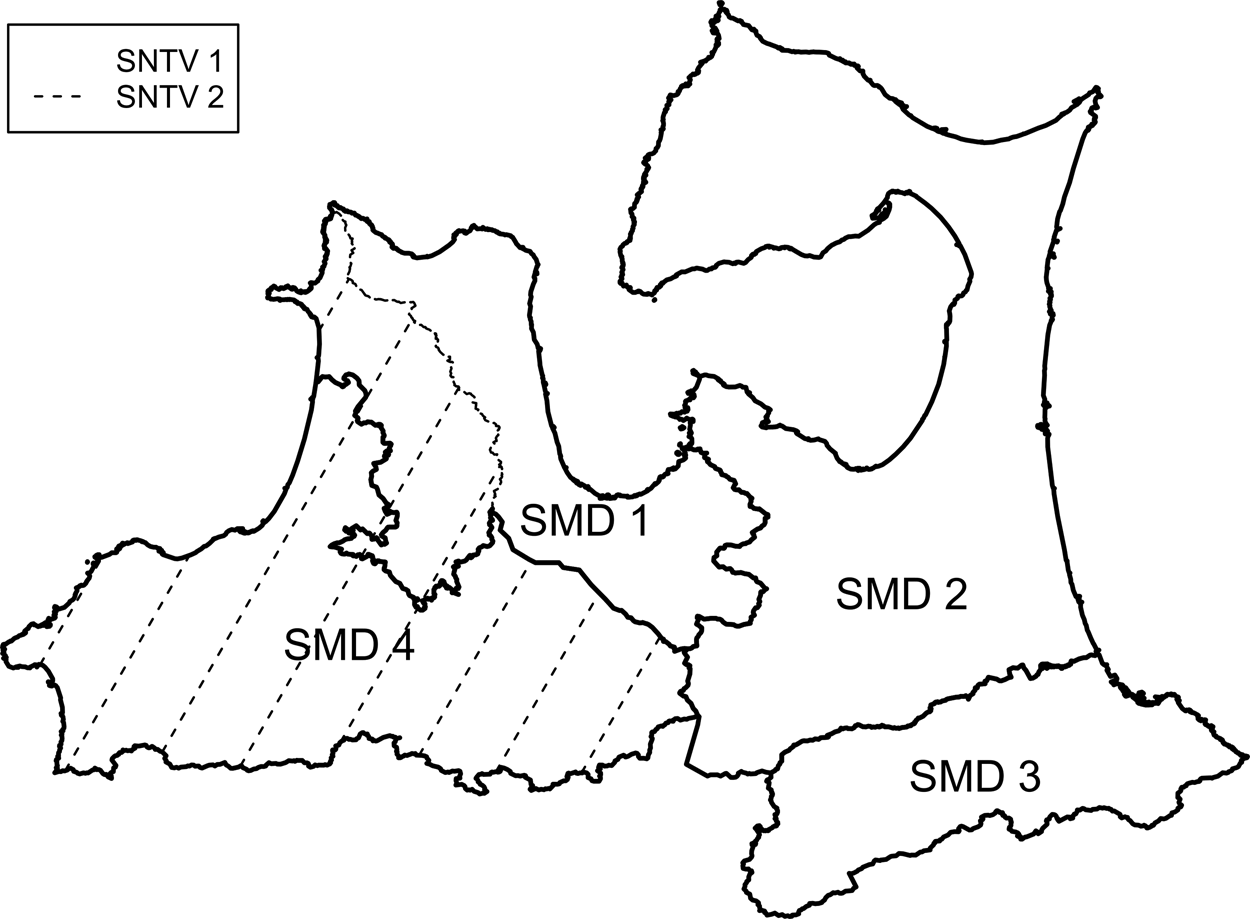
Roughly 15% of all new districts, that is, 40 in total, have been created from more than one old district. Figure 1 illustrates this for the Aomori prefecture. In 1993, Aomori prefecture was divided into two multi-member districts, Aomori 1st and Aomori 2nd, to return four and three members respectively. While the new Aomori 2nd and Aomori 3rd SMDs were perfect subsets of the old Aomori 1st, the new Aomori 1st has been built by the remainder of the old Aomori 1st and the old Aomori 2nd's city of Goshogawara and Kitatsugaru county. The new Aomori 4th district, then, is made up of the remainder of the old Aomori 2nd district. For a candidate of the former Aomori 1st district, the proportion of new geographic area would be 0 when facing either the new Aomori 2nd or 3rd as these contain no unacquainted area, but 0.39 for the new Aomori 1st district. Put differently, roughly 60% of the geographic area of the new Aomori 1st has been part of our candidate's former district, while roughly 40% of the area comes from another previous SNTV district.Footnote 5 It is in these cases, that I expect ideology to have a significant effect on the nomination decision, as the new geographic area comes with an electorate less familiar with the incumbent of the previously neighboring district – in this case, the voters living in the city of Goshogawara and Kitatsugaru county. The proportion of new voters of an SMD, that is, those voters living in municipalities previously assigned to a different SNTV district, correlate with 0.987 with the proportion of the new geographic area a candidate may face in the new SMDs.Footnote 6 Using data from the Japanese Election and Democracy Study (JEDS) (see Richardson et al., Reference Richardson, Uchida, Ikeda, Pharr, Hayashi, Nishizawa, Patterson, Tanifuji, Tanaka and Kawakami1996) conducted before and after the 1996 general election, it becomes clear that voters in districts patched together from multiple former SNTV districts are indeed and as expected less likely to associate their LDP candidate with indicators of the personal vote, such as the arrangement of parties and trips for supporters or the attendance of weddings and funerals while controlling for new first-time candidates (see Table 3 in the Appendix).
Electoral boundaries in Aomori Prefecture, 1993 and 1996. Figure shows boundaries of the 1993 multi-member and 1996 SMDs projected onto each other. The unshaded area indicates the former Aomori 1st district with a magnitude of 4. The shaded area indicates the former Aomori 2nd district with a magnitude of 3. The thick solid lines show the boundaries for the four new SMD districts.
5. Matching candidates to districts
Has the LDP matched its candidates to districts based on their expected electoral strength as suggested in the literature (e.g., Reed, Reference Reed1995; Cox et al., Reference Cox, Rosenbluth and Thies1999; Di Virgilio and Reed, Reference Di Virgilio, Reed, Giannetti and Grofman2011)? Has it been the party's sole strategy in maximizing its seats or has the LDP followed other nomination strategies, too, especially for those cases in which electoral strength alone would not promise victory? To examine these questions I make use of a conditional logit framework. Specifically, I treat the newly designed SMDs as the unit of analysis and all of the 1993 competing LDP and LDP-leaning independent candidates of those former SNTV districts that have some geographic overlap with the new districts as the choice set. Obviously, I have to assume that all 1993 candidates would have run again if they were nominated. Since non-selection and voluntary retirement from politics is observationally equivalent, I cannot further differentiate between retirees and failed nominations. From the 1993 LDP incumbents 76% have competed again in 1996 and 70% of all 1993 LDP candidates (not all under the LDP banner though). This is slightly lower when compared to prior elections but this number may underestimate the actual percentage of candidates willing to run – or incumbents for that matter, who are more likely to run again – as more than usual might have fallen victim to non-selection in the wake of the electoral reform.Footnote 7 This setup allows us to examine why a certain candidate was nominated to a district out of a pool of potential and serious contenders. This candidate pool is restricted to these candidates in order to not inflate the number of observations with implausible choices of candidates.Footnote 8 Additionally, districts in which the LDP did not nominate any candidate, a new candidate and those SMDs for which the choice set would consist of only one candidate are excluded from the sample. This leaves me with 281 candidates being under consideration for the nomination in one of 169 new districts.
As mentioned above, the challenge of matching incumbents to new districts was particularly severe in rural areas. In 105 districts the LDP nominated a fresh face instead. Simple logit analyses suggest that these new candidates have mainly been nominated in more urban districts and in regions with fewer incumbents available. Obviously, these two factors are moreover confounded by the expected electoral performance of the LDP.Footnote 9 The analyses below hence hold implications particularly for nomination challenges in areas where parties are strong and can choose from a pool of willing incumbents.
In addition, analyzing the matching of candidates to districts statistically comes with a big caveat. As candidates in this set-up are under consideration in multiple districts, being predicted as the nominee in one district should remove them from all other districts they have been under consideration for. This in turn would affect the likelihood of nomination of the remaining candidates. Hence, the analyses of the conditional logit models require the assumption that given the model specification there is only one ‘best match’ between a candidate and a district.Footnote 10
Table 1 presents the results from three conditional logit estimations examining once the nomination of former incumbents and once of all candidates in those districts in which the LDP did not nominate a completely new candidate. Each model includes as control variables age and seniority (i.e., times elected before), both demeaned to capture relative effects compared to the slate of candidates under consideration given that both are related to the decision of running again, and whether the candidate belongs to the mainstream faction of the LDP (i.e., belonging to the faction of the party president or the party's secretary-general). Although kōenkai have a significant influence on nomination decisions, two variables included in the model are meant to implicitly control for it: both the expected voteshare and to a lesser degree the proportion of new geographic area approximate the strength of candidates' kōenkai, for which systematic data are lacking. Explicit robustness checks test for the dynastic status of candidates, an unweighted measure of ideology and for the proportion of new voters in the electorate replacing the geographic indicator. Results remain stable and are presented in Tables 8 and 9 in the Appendix.
Candidate nomination in new districts
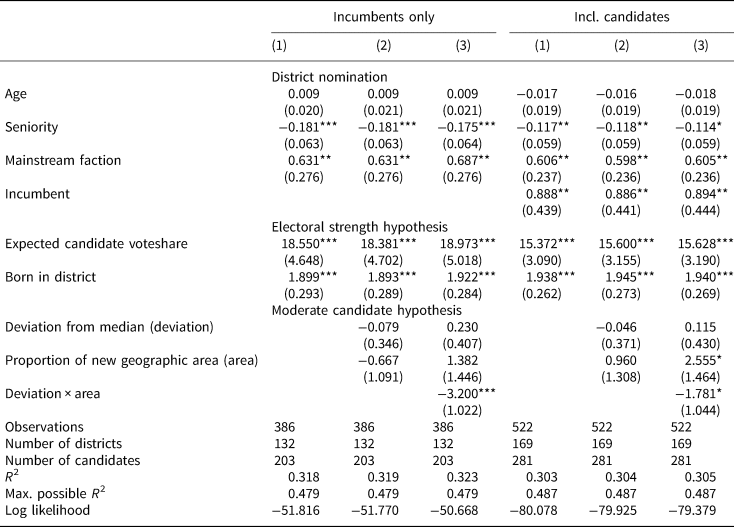
Note: Conditional logistic models with robust standard errors. Post-reform SMDs as unit of analysis with all 1993 LDP (LDP-leaning independent) candidates of the previous 1993 district with geographic overlap as the choice set.
*P < 0.1; **P < 0.05; ***P < 0.01.
As expected the projected personal electoral strength and being a local to that district play a highly significant role in the nomination decisions in both samples. Obviously, both of these factors are often interdependent, as voters typically prefer local candidates over those parachuted in (Horiuchi et al., Reference Horiuchi, Smith and Yamamoto2020). Yet, both exert a significant influence on the nomination of candidates independently of each other. Figure 2 shows the predicted probabilities of receiving the district nomination for three hypothetical candidates conditional on their expected voteshare in the district and when all other covariates are set to 0. Given the conditional logit set-up, candidates' probabilities depend on the probabilities of nomination of all other candidates, as only one candidate can receive the official party endorsement. As the probabilities of all candidates must sum to one (someone must receive the nomination after all), an increase in one candidate's probability thus entails a decrease in all other candidates' probabilities, the extent to which is conditional on the other candidates' covariate values. In the left-most panel, now, candidate 1's expected voteshare is set to 15%, while the voteshare of the two other candidates competing for the nomination is set to the sample's mean value of 17%. As these candidates in this example are highly comparable, all are predicted a probability of between 26 and 37% and the final nomination appears to be a random call. However, if we increase candidate 1's expected voteshare in the new district to 30% while keeping the other two candidates' voteshares at the mean, candidate 1's probability of obtaining the party nomination increases to over 80% as plotted in the middle panel. Increase the expected voteshare once more to 45% in the right-most panel, and candidate 1's nomination it appears becomes a safe bet.
Predicted probability of district nomination conditional on electoral strength. Figure shows the predicted probabilities of district nomination under the assumption that only one out of three hypothetical candidates can obtain the official party nomination. Candidates are incumbents and comparable on all covariates, only with candidate 1 varying on expected voteshare in the new district. Solid lines indicate 90% confidence bounds, dashed lines 95% levels. Quantities obtained from n = 1, 000 simulations based on the variance–covariance matrix from model 1 in Table 1.

Localness exhibits a similarly strong influence over candidates' chances of obtaining the party's nomination. Comparing two hypothetical candidates with similar electoral and political backgrounds and that only differ on whether they are born in the locality or not, results in predicted probabilities of official party endorsements of 87% (with a confidence interval ranging from 81 to 92%) for local candidates and in probabilities of 13% (ranging from 8 to 19%) for non-local candidates. These probabilities are based on model 4 from Table 1 and refer to all candidates. Looking at the incumbents-only sample (model 1), results in predicted probabilities for local and non-local incumbents are still significantly different but differ only by around 8%-points. These findings echo the descriptive findings of Hirano (Reference Hirano2006) on the geographically concentrated electoral support around candidates' hometowns and underscore the experimental findings on voters' preference for local candidates in Japan (e.g., Horiuchi et al., Reference Horiuchi, Smith and Yamamoto2020).
The variables on candidates' ideological moderation and the degree to which the new district contains geographic areas not part of the former multi-member district are introduced to the model once separately, and once with an additional interaction term. Separately, neither of these factors has a significant impact on the party's nomination decision. However, once interacted the interaction term becomes significant. Figure 3 depicts how the interaction effect unfolds over a pool of three hypothetical candidates in consideration for the party's nomination. Candidates 2 and 3 are assigned average values of ideological deviation, while that of candidate 1 (C1) differs across the two columns. The rows represent two SMD contexts that differ by the degree to which they contain geographic areas previously not a part of these three candidates' former district. In the first row, the new SMD has been completely carved out of their former SNTV district. The second row, however, presents a situation in which the new SMD has been created to equal parts from two different former SNTV districts.
Predicted probability of district nomination conditional on the deviation from median and on the district's proportion of new geographic area. Figure shows the predicted probability of obtaining a district nomination under the assumption that only one out of three hypothetical candidates can obtain the official party nomination. Candidates are comparable on all covariates, only with candidate 1's ideology varying. Ideological deviation is set to the mean for the two other candidates under consideration. The rows display how the predicted probability of nomination changes with the combination of ideological deviation and the two SMDs' varying degrees of geographic correspondence to the candidates' former districts. Solid lines indicate 90% confidence bounds, dashed lines 95% levels. Quantities obtained from n = 1, 000 simulations based on the variance–covariance matrix from model 3 in Table 1.

Now, in the left panel, C1 is assigned the minimum value of deviation from the median and the maximum value of deviation in the right panel. The differences in the predicted probabilities are hence solely due to the combination of C1's ideological deviation and the degree of geographic integrity between the new district and C1's former one. The left panel shows that espousing a more centrist position helps C1 to gain the upper hand in the nomination in those districts patched together from multiple former districts. But this advantage disappears in those SMDs that have been carved out completely from only one former SNTV district. Also, becoming ideologically more extreme as shown in the right panel hurts C1's chances of nomination in the patched SMD but not in the perfect subset SMDs.
A case in point is Sakurai Shin, nominated for the new Niigata 2nd. Sakurai moved from the old Niigata 3rd to the new Niigata 2nd whose area comprised of ca. 60% of the previous Niigata 1st, which meant that more than half of the geographic area Sakurai had to compete in can be considered to be void of personal support for him. His projected voteshare trailed the strongest contender by 19%-points and although he could claim to be a native to Niigata, his hometown of Yamato-machi was located in the new Niigata 5th. Nonetheless, among the four incumbents considered to be serious contenders to Niigata 2nd, Sakurai had the lowest ideological deviation with a 20% lower deviation than the second lowest ideological deviant. Other incumbents who appear to have benefitted from a more centrist position include Murakami Seiichirō for the new Ehime 2nd or Matsushita Tadahiro for the new Kagoshima 3rd. Both have been nominated in districts with a newly apportioned geographic area making up between 52% (Matsushita) and 75% (Murakami) of their new districts' area. Matsushita's ideological deviation was a whopping 89% lower than that of Miyaji Kazuaki who in turn led in the projected voteshare for the new Kagoshima 3rd. A similar picture emerges for Murakami whose deviation was only a third of that of Ochi Ihei, for whom the projected voteshare in the new Ehime 2nd was more favorable.Footnote 11 All four were natives to their respective districts.
To sum up, in new districts patched together from multiple former districts, candidates face a new segment of voters most likely oblivious to the candidate's personality and achievements (see Table 3 in the Appendix). Here, the LDP had the incentive to factor prospective candidates' ideological profiles into their nomination calculation, hoping perhaps that a candidate with a more centrist position is capable of making broader appeals without putting off an established voter base through flip-flopping. However, was it that the party matched centrist candidates to patchwork districts or merely that candidates or incumbents more extreme and better connected with the (local) party did not want to run in them? In any case, given the lower incumbency advantage and personal vote in reapportioned districts (e.g., Ansolabehere et al., Reference Ansolabehere, Snyder and Stewart2000) and the fact that the LDP and its incumbents were aware of the changed nature of electoral incentives in SMDs (e.g., Asano, Reference Asano2006; Catalinac, Reference Catalinac2018), it is likely that a more centrist ideological profile might have played a role. For more recent elections, Smith and Tsutsumi (Reference Smith and Tsutsumi2016), for instance, find that when using open recruitment the LDP and the Democratic Party of Japan nominated new candidates who are less likely to espouse local level political experience – and hence, lack obvious attributes for a personal vote – but who are ideologically closer to the national median. In practice, candidates in patchwork districts are very likely to be responsive to a newly apportioned electorate (see Leveaux-Sharpe, Reference Leveaux-Sharpe2001) and may hence campaign on their personal vote in those municipalities that were part of their old district but emphasize their moderate position when campaigning in newly apportioned municipalities.
Overall, these findings support my expectations that the LDP did not solely rely on electoral strength of candidates to match the most promising contender to the right district, but moreover, though depending on the geographic make-up of the new districts, took cues of candidates' ideology serious in their nomination decision. These nomination strategies in fact have yielded party-wide electoral returns with a large number of elected candidates. Out of 169 recurring candidates that were matched to the new districts, 135 have won their district directly, 17 have lost their local races but narrowly enough so to obtain a mandate through the party list and 17 were defeated. Interestingly, the LDP's two strategies seemed to have paid-off handsomely. Candidates matched on basis of their expected electoral strength were more likely to win their districts, as were ideologically more moderate candidates competing in districts that are not perfect geographic subsets of their old multi-member district (see the logistic regression model in Table 10 in the Appendix).
6. Solving nomination challenges through the party-list
How has the LDP used the newly institutionalized party-list tier in the first post-reform election? Has the LDP used promising list positions to defuse local stand-offs between two or more incumbents seeking the nomination for the same district? Since dual-candidacy appears to have been the default option, the analysis below focuses on what differentiates the nomination on a promising list position and the nomination in a district without a list nomination from dual-candidates.
To explore the usage of the PR tier, results from a multinomial logit estimations are presented in Table 2, explaining the choice of candidacy in the 1996 election. Here, candidates may compete on a promising rank, that is, a single-rank list position above the first bracket of dual-candidates who are placed on the same rank (called ‘negotiated PR nominations’ by Di Virgilio and Reed, Reference Di Virgilio, Reed, Giannetti and Grofman2011), as a pure SMD candidate or – the reference category – as a dual-candidate, that is, those candidates competing in a district and placed on the same list rank with other dual-candidates of the same PR district. For the sake of completeness, not competing (not re-selected) candidates and those put on a hopeless list position are grouped together. As controls, age, seniority and belonging to the LDP's main faction, that is, the party president's faction, are included, as the type of candidacy may be contingent on candidates' biological age, their electoral streak or mentors within the party.Footnote 12
Candidacy type in 1996 and candidate coordination
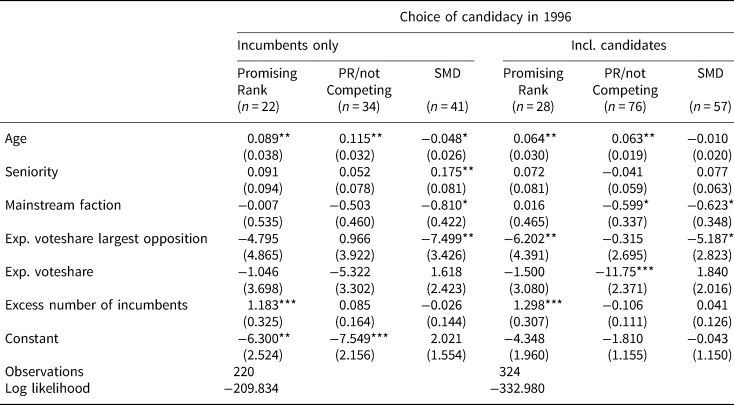
Note: Multinomial logit model. Reference categories are dual-candidates. Sample consists of all 1993 LDP (LDP-leaning independent) candidates. Expected votes for PR-only and not competing candidates calculated as a best case scenario using data from each candidate's most promising district.
*P < 0.1; **P < 0.05; ***P < 0.01.
The sample consists of all 1993 LDP and LDP-leaning independent incumbents and candidates, that is, candidates who could plausibly expect an official party nomination. Those 1993 candidates that were not competing in 1996 are also included in the analysis to avoid selection on the dependent variable. For these non-competing candidates as well as the PR only candidates, expected electoral circumstances are calculated based on a best case scenario, that is, I use the electoral data from these candidates' most promising district to obtain a more conservative estimation compared to using candidates' worst district options. As before, electoral variables are based on 1993 results projected onto the 1996 electoral district boundaries. Of prime interests are candidates' expected voteshares, the expected voteshare of the largest opposition party and the excess number of incumbents in the prefecture. This last variable captures the ratio of successful LDP candidates of the prefecture in 1993 to the number of SMDs in the same prefecture in 1996. Higher values, hence, indicate a surplus of incumbents for which no SMD exist in the prefecture.
The findings with respect to promising ranks are clear. Incumbents and candidates competing in regions with more incumbents than nominal tier districts are more likely to be put on such a preferential rank than running as dual-candidates. Older candidates too are more likely to receive promising rank positions. Compared to dual-candidates, nominal tier only nominations are handed out less to candidates competing in districts with an expectedly stronger opposition. This implies that some dual-candidates run in electorally unattractive districts but can still hope to be elected through the list. Let's discuss the implications in turn.
The notion of having a surplus of incumbents is exactly what lies at the heart of coordinating nominations. Given the greater prestige of running in the district, a number of candidates larger than the supply of districts intended to compete for the district's nomination, sometimes by threatening to run as an independent without an official LDP endorsement. When we expect that the LDP has in fact used the party-list to convince some of these surplus candidates to standdown in the district race and instead compete solely on the party-list, the variable capturing the excess of incumbents should exhibit a positive and significant effect. In fact, in a number of districts with more than one incumbent the LDP introduced the so-called Costa Rica agreement. Two candidates seeking the district nomination take turn in competing in the district and on the party list. Comes the next election, the previous district candidate moves to the party list and the previous list candidate competes in the district. Yet, while this solves the immediate nomination challenge in the first election under MMM, it only delays a concluding settlement.
Promising list-positions have been handed more often to candidates in prefectures with more re-election seeking incumbents than available districts, exactly those places with the highest potential for competitive nominations and, also, nomination failures when previous LDP-affiliated incumbents run as independents against the official party candidate. There have also been a number of cases where candidates were competing in unattractive districts who were put on promising ranks as their chances of being elected through the ‘best loser provision’ were slim. These candidates include, for example, Fukuya Takashi of Tokyo's 2nd and Etō Seiichi of Oita's 1st districts, who garnered only 77.7 and 53.9% of the district winner's voteshare, respectively.
For SMD-only nominations, it appears to have been handed out to candidates competing in districts which compared to those of dual-candidates have weaker opposition. While the models do not report systematic differences in expected voteshares between pure SMD and dual-candidates, what sets them apart is the strength of the opposition they each may face. Hence, districts with strong non-LDP candidates usually do not see a SMD-only candidate, while districts considered safe are likely to see candidates without a list position. Given the ‘best-loser provision’ this may eventually lead to a legislative overrepresentation of marginal districts.
Overall, the LDP appears to have exploited the potential of the PR nomination systematically to not only solve locally contested nominations, but also to accommodate the electoral needs of its candidates in general. Although 34 out of 292 districts contested by the LDP saw some sort of nomination failure, that is, two or more candidates of LDP-stock competing against each other, without this usage of the PR tier, there are likely to have been many more. In fact, nomination failure is a function of the number of LDP candidates and incumbents in a prefecture and the magnitude of the prefecture's PR district (see Table 12 in the Appendix). While the probability of nomination failure increases with the number of candidates and incumbents, the number of available PR seats attenuates this risk. This aptly utilization of the PR nominations might, in fact, have helped the LDP to stay united and not dissolve into a number of smaller infighting conservative parties or independents, as elaborately summarized by Reed (Reference Reed1995) for the Niigata prefecture. Finally, it shows how in prefectures belonging to regions with lower PR magnitude the LDP had less bargaining chips vis-à-vis determined candidates and was thus institutionally limited in using list positions to avoid nomination failures.
In the later elections of 2003, 2014 and 2017 redistricting again led to a surplus of incumbents in a number of local settings. Reminiscent of the 1996 election, the LDP used PR nominations on promising ranks to solve these nomination challenges. In a few cases, incumbents agreed on a Costa Rica agreement (Kaneta Eikō of Hokkaido's 7th and Nakatani Shinichi of Yamanashi's 3rd), while many others moved directly to PR without such an agreement (e.g., Satō Ren of Oita's 4th, Fukui Teru of Kochi's 1st or Kamei Hisaoki of Shimane's 3rd) (see also Smith, Reference Smith, Pekkanen, Reed and Scheiner2016).
7. Conclusion
The LDP in Japan managed to stay united and, together with the Communist party, has been one of the two parties that retained their organizational integrity in the wake of the electoral reform. What's more, the LDP even capitalized on the new electoral rules and continued dominating Japanese politics until today. In this paper, I argue that one reason why the party did not dissolve into smaller regional conservative parties fighting each other and in fact finished the first post-reform election as the clear winner, has been its candidate nomination strategies for the newly instituted SMDs. Given the previous multi-member electoral districts, many prefectural LDP branches had too few electoral districts for all of their incumbents seeking re-nomination and re-election. Yet, I have shown that through the matching of the most appropriate candidates to the right district and the offering of party-list positions to candidates otherwise determined to run against co-partisans, the LDP has managed to solve most of its many local nomination challenges and indeed saw most of its candidates successful.
My findings have implications for the study of candidate selection in the wake of electoral reform in general and for the study of Japanese politics in particular. For one, my results corroborate expectations about party's conservative seat-maximizing approach to candidate selection. As previous studies that have explored the trade-off between candidates' electability and ideological position find that parties usually prefer electorally viable candidates (e.g., Bochel and Denver, Reference Bochel and Denver1983; Norris and Lovenduski, Reference Norris and Lovenduski1995; Hassell, Reference Hassell2017), my findings add some nuance to this picture by showing that the role of ideology is contingent on the expected degree of the candidate's personal vote appeal. Where this is low or absent, parties appear to know how to take advantage of candidates' ideological profile and its appeal to voters. A second implication suggests that parties are quick to adapt to new electoral rules and incentives. The clever usage of the newly instituted party-list allowed the LDP to defuse local contests for nominations and to successfully avoid the nomination of more than one LDP-affiliated candidate per district.
In the field of Japanese politics, my empirical findings mirror the claim made by a number of scholars pre- (e.g., Reed, Reference Reed1995) and post-reform (e.g., Asano, Reference Asano2006) that candidate selection within Japanese parties and within the LDP in particular has seen a general shift toward centralization, most notably in the prefectural party branches. Moreover, it speaks to recent research on the effects of the electoral reform on candidates' ideological positioning. The tendency for candidates to become more moderate or at least to move closer to the median voter (e.g., Catalinac, Reference Catalinac2016) has in some circumstances been channeled by the party through the nomination of more moderate personnel to certain districts. Eventually, my results contribute to the nomination strategies employed by the LDP for the very first election under MMM. The party's nomination strategy was not limited to merely choosing the electorally most promising candidate (e.g., Di Virgilio and Reed, Reference Di Virgilio, Reed, Giannetti and Grofman2011), but was complemented by selecting moderate candidates for districts with lower geographic overlap with the candidates' former ones. My results on the usage of the PR tier, moreover, help to understand why the LDP went through the electoral reform rather unscathed and in fact could win the first election under MMM, despite its internal fissures over reform before the adaption of the reform, the contested election of the party president and the numerous local nomination stalemates.
Future research may follow-up on the consequences of electoral reform at the individual level by exploring how candidates' campaign styles differ between municipalities that were newly apportioned to a district and those that have been part of the district for a longer time. Extrapolating from my findings, I would expect a difference in the emphasis of ideology and personal achievements in the campaign between these municipalities, especially when personal achievements mainly pertain to the appropriation of locally concentrated benefits as was the case in Japan prior to the electoral reform. Moreover, has the nomination of more moderate candidates resulted in representational differences across the different SMDs down the line?
Supplementary material
The supplementary material for this article can be found at https://doi.org/10.1017/S1468109921000396 and https://dataverse.harvard.edu/dataset.xhtml?persistentId=doi:10.7910/DVN/9SUFRU&version=DRAFT&faces-redirect=true.
Conflict of interest
The author declares none.


 Open access

