





Eating disorders, including anorexia nervosa, bulimia nervosa and binge eating disorder (BED), are associated with some of the highest mortality rates among psychiatric illnesses, resulting in over 3.3 million premature deaths annually. Reference Hambleton, Pepin, Le, Maloney, Aouad and Barakat1–Reference Arcelus, Mitchell, Wales and Nielsen3 A significant number of eating disorder-related deaths are due to suicide, Reference Miskovic-Wheatley, Bryant, Ong, Vatter, Le and Aouad2,Reference Hercus, Baird, Ibrahim, Turnbull, Appleby and Singh4 particularly among individuals with anorexia nervosa (one in five deaths). Reference Arcelus, Mitchell, Wales and Nielsen3 The prevalence of suicidal ideation in individuals with anorexia nervosa and bulimia nervosa had been estimated as ranging between 50 and 60%, and between 17 and 25% for suicide attempts. Reference Amiri and Khan5 Research presents mixed findings on the mechanisms linking eating disorders and suicidality. Some studies suggest that symptoms of eating disorders lead to suicidal thoughts and behaviours, while others propose that suicidality might precede or even contribute to the development of eating disorders and that both conditions may share biological and psychological risk factors. Reference Smith, Zuromski and Dodd6 Generally, our understanding of the link between eating disorders and suicidality has been limited by a lack of longitudinal studies. A single meta-analysis focused exclusively on longitudinal research with suicide-related outcomes revealed a major gap, identifying only 14 studies over the past 5 decades that examined whether eating disorders predict suicide attempts or deaths. Importantly, none of these studies investigated suicidal ideation. The findings showed that, while eating disorders were significant predictors of suicide attempts, they did not predict suicide deaths. Reference Smith, Velkoff, Ribeiro and Franklin7 Some studies also suggest that symptoms of eating disorders can arise following suicidal thoughts and attempts, highlighting a potentially bidirectional relationship. Reference Forrest, Zuromski, Dodd and Smith8,Reference Trujillo, Forrest, Claypool and Smith9 A common precursor to suicide in the general population is self-harm, with about 60% of individuals who complete suicide having a history of self-harm, mostly within a year before the suicide attempt. Reference Gairin, House and Owens10,Reference Cliffe, Seyedsalehi, Vardavoulia, Bittar, Velupillai and Shetty11 According to a meta-analysis of 29 studies, individuals with eating disorders are prone to engage in self-harm, with 22% of subjects with anorexia nervosa and 33% of those with bulimia nervosa having reported lifetime self-harm. Reference Cucchi, Ryan, Konstantakopoulos, Stroumpa, Kaçar and Renshaw12 A more recent systematic review estimated the prevalence of non-suicidal self-injury in those with eating disorders as even higher – 40%. Reference Amiri and Khan5 Due to the widely demonstrated co-occurrence between eating disorders, self-injury and suicidal ideation and attempts, The National Institute for Health and Care Excellence (NICE) has emphasised the need for research focusing on psychiatric conditions co-occurring with eating disorders, with a particular focus on self-harm. 13 This urgency is amplified by the co-occurrence between eating disorders and self-harm being ranked among the top ten research priorities in a survey of patients, carers and clinicians, Reference van Furth, van der Meer and Cowan14 and by the COVID-19 pandemic and associated lockdowns, which have led to an increase in new eating disorder diagnoses. Reference Devoe, Han, Anderson, Katzman, Patten and Soumbasis15,Reference Trafford, Carr, Ashcroft, Chew-Graham, Cockcroft and Cybulski16 Currently, no comprehensive theoretical framework exists to explain why individuals with a history of eating disorders face an elevated suicide risk. A relevant model in this area is the interpersonal-psychological theory of suicide, which suggests that suicide risk arises when three conditions are present: a sense of social isolation or lack of belonging, feelings of being a burden to other, and an acquired capability for suicide. Reference Witte, Cukrowicz, Braithwaite, Selby and Joiner17 While this theory has been influential, evidence on its applicability to eating disorders remains sparse. A recent review identified ten small, mostly cross-sectional, studies that examined this model in the context of eating disorders, highlighting a pressing need for large-scale, longitudinal research with extended follow-up and repeated measures to more effectively assess suicide risk in subjects with eating disorders. Reference Zeppegno, Calati, Madeddu and Gramaglia18 The aim of the present project is to investigate the longitudinal associations between symptoms of body dissatisfaction and disordered eating and subsequent self-harm and suicidal ideation, utilising the structural equation modelling framework in two large UK-based cohorts, the Twins Early Development Study (TEDS) and the COVID-19 Psychiatry and Neurological Genetics (COPING) study. These cohorts differ substantially in their profiles, allowing us to explore the temporal dynamics between symptoms of body dissatisfaction and disordered eating, self-harm and suicidal ideation between a developmental, population-based sample (TEDS) and cross-sectional clinical sample (COPING). The present study seeks to provide a comprehensive understanding of how body dissatisfaction and disordered eating symptoms contribute to the development of suicidal ideation.
Method
Sample
The current study used data from two UK-based cohorts, TEDS, Reference Lockhart, Bright, Ahmadzadeh, Breen, Bristow and Boyd19 which is a population-based twin sample, and the COPING study, Reference Davies, Hübel, Herle, Kakar, Mundy and Peel20 which is a clinical cohort recruiting predominantly participants with a lifetime history of anxiety and mood disorders.
TEDS
The TEDS sample consists of more than 10 000 pairs of twins born in England and Wales between 1994 and 1996. The TEDS twins have been assessed 15 times from infancy through to early adulthood on a variety of demographic, behavioural, cognitive and mental health measures. The sample of TEDS twins is representative of the UK population in terms of ethnicity and socioeconomic status (SES); details of representativeness and attrition are available (see ref. Reference Lockhart, Bright, Ahmadzadeh, Breen, Bristow and Boyd19 ). In the present study we investigated the longitudinal relationships between symptoms of body dissatisfaction and disordered eating measures at ages 16, 21 and 26 years, and measures of self-harm and suicidal ideation collected at ages 21 and 26 years. The mean age of the sample was 16.3 years (s.d. = 0.69) at age 16 years data collection, 22.3 years (s.d. = 0.91) at age 21 years data collection and 26.4 years (s.d. = 0.92) at age 26 years data collection. The sample selected for analyses comprised 5196 individuals, including 807 monozygotic twin pairs, 1201 dizygotic twin pairs and 1180 unpaired twins. Females comprised 67% (n = 3468) of the sample, and 95% (n = 4931) of participants reported European ethnic origin. Within the sample, 33% (n = 1718) of individuals reported experiencing lifetime depression and 20% (n = 1026) reported experiencing lifetime anxiety. Of the total of 5196 twins, 3% (n = 172) of individuals were diagnosed with anorexia nervosa, 2% (n = 82) with bulimia nervosa and 1% (n = 48) with BED.
The COPING study
The COPING sample included participants from the National Institute for Health and Care Research (NIHR) BioResource. Reference Davies, Hübel, Herle, Kakar, Mundy and Peel20 Alongside COVID-related measures, the COPING study incorporated questionnaires from the Genetic Links to Anxiety and Depression (GLAD) study and Eating Disorders Genetics Initiative UK (EDGI UK). Reference Davies, Kalsi, Armour, Jones, McIntosh and Smith21,Reference Monssen, Davies, Kakar, Bristow, Curzons and Davies22 Further information on the sub-cohorts, recruitment and exclusion criteria is available (see refs Reference Davies, Hübel, Herle, Kakar, Mundy and Peel20,Reference Davies, Buckman, Adey, Armour, Bradley and Curzons23 ). The COPING study incorporated 20 follow-up waves conducted between May 2020 and July 2021, half of which included assessments of symptoms of disordered eating, self-harm and suicidality. To ensure broad temporal coverage and adequate spacing across the pandemic period, we selected data on symptoms of disordered eating, self-harm and suicidal ideation collected at the first follow-up – that is, in early June 2020 (referred to as baseline henceforth), at the eighth follow-up in September/October 2020 and at the 20th follow-up in June/July 2021. We additionally included data related to psychosocial aspects of participants’ lives, collected at the third follow-up in late June 2020. Our selected sample resulted in a total of 490 individuals with complete data for at least one of the time points for symptoms of disordered eating, self-harm and suicidal ideation. The mean age of the sample was 47.7 years (s.d. = 15.9). Females comprised 53% (n = 261) of the sample, and 81% (n = 397) of participants reported European ethnic origin. Within the selected sample, 42% (n = 204) of individuals self-reported a lifetime history of major depression and 33% (n = 163) reported a lifetime history of anxiety disorder. Regarding lifetime eating disorder diagnoses, 5% (n = 24) reported being diagnosed with anorexia nervosa, 2% (n = 9) with bulimia nervosa and 1% (n = 7) with BED. In addition, four individuals reported being diagnosed with purging disorder, seven with avoidant/restrictive food intake disorder and two with another feeding or eating disorder.
Ethical standards
TEDS has received ethical approval from Kings College London Research Ethics Committee (reference nos PNM/09/10–104 and HR/DP-20/21–22060). Consent was obtained before data collection at every wave.
The London – Fulham Research Ethics Committee approved the GLAD Study on 21 August 2018 (REC reference no. 18/LO/1218), and EDGI UK on 29 July 2019 (REC reference no. 19/LO/1254). The NIHR BioResource has been approved as a Research Tissue Bank by the East of England – Cambridge Central Committee (REC reference no. 17/EE/0025). The COPING study was approved by the South West – Central Bristol Research Ethics Committee on 27 April 2020 (REC reference no. 20/SW/0078). The Repeated Assessment of Mental Health in Pandemics study was approved by the Psychiatry, Nursing and Midwifery Research Ethics Committee at King’s College London on 27 March 2020 (no. HR-19/20–18157).
Measures
Symptoms of body dissatisfaction and disordered eating
In the TEDS sample, different measures of body dissatisfaction and disordered eating were administered at each age. At age 16 years, the twins responded to 4 items from the Eating Disorder Diagnostic Scale (EDDS) Reference Stice, Fisher and Martinez24 asking about body perception during the previous 6 months. At age 21 years, the 12-item Eating Disorder Inventory-2 Reference Garner25 was administered, encompassing items related to restricting, bingeing/purging and body image. At age 26 years, disordered eating symptoms were measured using a screener of anorexia nervosa, bulimia nervosa and BED symptoms, mapping on to DSM-5 criteria. 26 All items are listed in Supplementary Table 1 available at https://doi.org/10.1192/bjp.2025.10468. In the COPING sample, symptoms of body dissatisfaction and disordered eating were assessed using the 13-item Eating Disorder Examination Questionnaire (EDE-Q), which is a brief measure of eating disorder symptom severity. Reference Gideon, Hawkes, Mond, Saunders, Tchanturia and Serpell27 In addition to total EDE-Q score, we also created symptom scores indexing restricting, purging and bingeing behaviours. These symptom scores were created as latent variables using structural equation modelling (SEM) in the package lavaan as a data reduction technique. Reference Rosseel28 Even though our measures focus on both body image issues and disordered eating, we refer to these as disordered eating symptoms for clarity and readability. For a list of items and details on symptom score items, please refer to Supplementary Table 2.
Self-harm and suicidal ideation
In the TEDS cohort, at age 21 years self-harm behaviours were measured using 10 items adapted from the Child & Adolescent Self-harm in Europe (CASE) Study. Reference Madge, Hewitt, Hawton, Wilde, Corcoran and Fekete29,Reference Paykel, Myers, Lindenthal and Tanner30 Suicidal ideation was measured using three items adapted from the same survey. Reference Madge, Hewitt, Hawton, Wilde, Corcoran and Fekete29,Reference Paykel, Myers, Lindenthal and Tanner30 At age 26 years, self-harm and suicidal ideation were assessed using the following 2 items scored on the Likert scale: (a) In the past year, have you ever hurt or harmed yourself on purpose in any way (e.g. by taking an overdose of pills, or by cutting yourself)? And (b) In the past year, have you ever thought about killing yourself, even if you would not really do it? Reference Madge, Hewitt, Hawton, Wilde, Corcoran and Fekete29,Reference Paykel, Myers, Lindenthal and Tanner30 Self-harm and suicidality data were not collected at age 16 years in TEDS. In the COPING sample, self-harm and suicidal ideation were measured using the Thoughts and Feelings questionnaire (TAF). Reference Davis, Coleman, Adams, Allen, Breen and Cullen31 The following two items were used to assess symptoms of self-harm: (a) Have you contemplated harming yourself? and (b) Before the pandemic, had you deliberately harmed yourself, whether or not you meant to end your life? Suicidal ideation was assessed by the following item: Many people have thoughts that life is not worth living. Have you felt that way? The remaining items temporally related to the COVID-19 pandemic were discarded.
Mental health diagnoses
In TEDS, data on lifetime depression and anxiety were collected using the Composite International Diagnostic Interview for Depression (CIDID) and Anxiety (CIDIA). Reference Kessler, Andrews, Mroczek, Ustun and Wittchen32 Eating disorder diagnoses were assessed using a bespoke measure developed by the Psychiatric Genomics Consortium (PGC) for the UK Biobank study. In COPING, diagnoses of eating disorders, major depressive disorder and generalised anxiety disorder were evaluated based on the Mental Health Diagnosis questionnaire (MHD), adapted from the UK Biobank Questionnaire. Reference Davis, Coleman, Adams, Allen, Breen and Cullen31 This questionnaire was integrated into the baseline COVID assessment for the remaining COPING participants.
Analyses
Analyses for this project were pre-registered with the Open Science Framework (OSF) (https://osf.io/xy273/). The hypotheses are listed in Supplementary Note 1. All analyses were perfomed using R version 4.4.0 (for macOS; R Foundation for Statistical Computing, Vienna, Austria; https://www.r-project.org/).
Longitudinal models
A SEM framework was employed to explore the longitudinal associations among symptoms of disordered eating, self-harm and suicidal ideation. Repeated measures of these variables were used to construct a hypothetical model that included cross-path analyses within and between the variables, as illustrated in Fig. 1. In TEDS, we investigated the temporal relationships between symptoms of disordered eating measured at ages 16, 21 and 26 years and symptoms of self-harm and suicidal ideation measured at ages 21 and 26 years, using all available data from the twins and accounting for family clustering. To account for the clustering of individuals within families we used the cluster argument in lavaan, which applies a robust sandwich estimator to adjust standard errors and test statistics for non-independence of observations. Reference Rosseel28 An equivalent model was estimated in the cross-sectional COPING cohort, where symptoms of specific disordered eating, including anorexia nervosa, bulimia nervosa and BED, were measured at baseline, followed by 2 follow-up assessments of disordered eating administered 5 and 8 months apart. Data on self-harm and suicidal ideation were collected using the same instruments at baseline, as well as at the follow-ups. Covariates in TEDS included age at data collection, gender and SES, and age at baseline and gender in COPING. In both cohorts, we restricted the sample to those individuals who had complete data for at least one time point of each variable, and subsequently used the full-information maximum-likelihood (FIML) implemented in lavaan to account for data missingness. We repeated the analyses in TEDS using a subset of individuals with algorithm-derived diagnosis of anorexia nervosa, bulimia nervosa or BED, and with self-reported lifetime diagnosis in COPING. We additionally performed the mediation analyses between symptoms of disordered eating at baseline and suicidal ideation at the final time point, employing candidate mediators that included mid-point measures of psychosocial variables related to interpersonal relationships, health behaviours and life events. For details and results of the mediation analyses please refer to Supplementary Note 2, Supplementary Table 7 and Supplementary Figs 3 and 4.
The longitudinal path diagrams. The models present the autoregressive longitudinal paths between symptoms of body dissatisfaction and disordered eating, self-harm and suicidal ideation, as well as cross-trait longitudinal paths between the variables in (a) TEDS and (b) COPING samples. TEDS, Twins Early Development Study; COPING, COVID-19 Psychiatry and Neurological Genetics study.

Results
Longitudinal models in TEDS
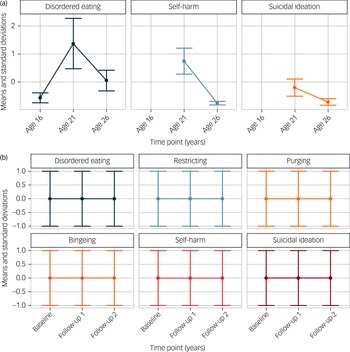
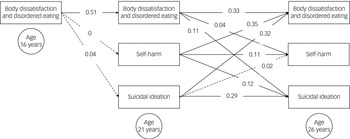
In the TEDS cohort, tests of linearity indicated that eight predictor–outcome associations showed evidence of nonlinearity whereas four associations were adequately described by linear models (Supplementary Table 3). Variables were generally normally distributed apart from expected skew in low-prevalence behaviours (Supplementary Table 4). In the TEDS cohort, the most severe symptoms of disordered eating, self-harm and suicidal ideation were on average reported when the twins were approximately 21 years of age, and were subsequently observed to drop by the time the twins reached 26 years (Fig. 2(a)). At age 16 years, the disordered eating scores were significantly lower compared with ages 21 and 26 (Fig. 2(a)). Results of the longitudinal SEM analysis are presented in Fig. 3 for the total TEDS sample, and in Supplementary Fig. 1 for the proportion of TEDS participants diagnosed with any eating disorder. Model fit indices and path estimates with 95% confidence intervals for all the models are included in Supplementary Tables 5 and 6. Table 1 shows model fit indices for the main models that included total samples. The longitudinal models in TEDS yielded an acceptable fit, with root mean square error of approximation (RMSEA) ranging between 0.12 [0.12, 0.13] and 0.14 [0.12, 0.17]. Disordered eating at age 16 years was significantly associated with disordered eating at age 21 years (β = 0.51 [0.45, 0.56]), which in turn was significantly associated with disordered eating at age 26 years (β = 0.33 [0.29, 0.38]), demonstrating continuity over time. Similarly, self-harm at age 21 years demonstrated a significant relationship with that at age 26 years (β = 0.11 [0.07, 0.16]), while suicidal ideation at age 21 years was significantly associated with that at age 26 years (β = 0.29 [0.24, 0.34]), indicating stability across the 2 time points.
Means and standard deviations of the measures of body dissatisfaction and disordered eating, self-harm and suicidal ideation in (a) TEDS and (b) COPING samples. TEDS, Twins Early Development Study; COPING, COVID-19 Psychiatry and Neurological Genetics study.

The longitudinal path diagram of the TEDS sample (N = 5196). The models present the autoregressive longitudinal paths between symptoms of body dissatisfaction and disordered eating, self-harm and suicidal ideation, as well as cross-trait longitudinal paths between the variables. TEDS, Twins Early Development Study.

Model fit indices for the main models including total samples

TEDS, Twins Early Development Study; COPING, COVID-19 Psychiatry and Neurological Genetics study; CFI, comparative fit index; TLI, Tucker–Lewis Index; AIC, Akaike information criterion; BIC, Bayesian information criterion; RMSEA, root mean square error of approximation.
Cross-domain associations showed more nuanced patterns. Disordered eating at age 16 years did not show a significant effect on self-harm or suicidal ideation at age 21 years. However, disordered eating at age 21 years was significantly associated with self-harm at age 26 years (β = 0.04, [0.01, 0.07]) and suicidal ideation at age 26 years (β = 0.11 [0.07, 0.14]). Notably, self-harm at age 21 years was a significantly stronger predictor of disordered eating (β = 0.35 [0.27, 0.43]) compared with suicidal ideation (β = 0.12 [0.07, 0.17]) at age 26 years. Interestingly, suicidal ideation at age 21 years was also strongly correlated with disordered eating at age 26 years (β = 0.32 [0.24, 0.40]), but not with self-harm at age 26 years. When the sample was restricted to those individuals who had been diagnosed with any eating disorder, only within-domain paths remained significant.
Longitudinal models in COPING
In COPING, 20 associations were identified as nonlinear compared with only 4 linear associations (Supplementary Table 3). In addition, disordered eating symptoms, self-harm, suicidal ideation and purging showed positive skew (Supplementary Table 4). In the COPING cohort, the scores on both general and specific disordered eating measures, self-harm and suicidal ideation were nearly equivalent across the three time points (Fig. 2(b)). Results of the SEM analysis are presented in Fig. 4 for the total COPING sample, and in Supplementary Fig. 2 for the proportion of COPING participants diagnosed with any eating disorder. Model fit indices and all path estimates with 95% confidence intervals are included in Supplementary Tables 5 and 6. The SEM results indicated that disordered eating symptoms exhibited moderate stability over time, with baseline disordered eating being significantly linked with that at follow-up 1 (β = 0.45 [0.38, 0.52]), and follow-up 1 disordered eating with that at follow-up 2 (β = 0.50 [0.43, 0.57]). The stability of restricting behaviours was higher, with baseline restricting being more strongly associated with that at follow-up 1 (β = 0.70 [0.65, 0.75]), and follow-up 1 restricting being strongly associated with that at follow-up 2 (β = 0.79 [0.76, 0.83]). Purging and bingeing behaviours also showed stability, although the effects were slightly lower than for restricting (purging: baseline to follow-up 1, β = 0.64, [0.59, 0.69]; bingeing: baseline to follow-up 1, β = 0.61, [0.56, 0.67]). Self-harm and suicidal ideation exhibited strong temporal stability across all models. Baseline self-harm demonstrated a strong relationship with that at follow-up 1 (β = 0.54–0.56 across models), and follow-up 1 self-harm with that at follow-up 2 (β = 0.59–0.60). Similarly, baseline suicidal ideation was linked to follow-up 1 suicidal ideation (β = 0.60–0.61), and that at follow-up 1 to that at follow-up 2 (β = 0.64 in all models). Longitudinal models in COPING generally resulted in poor fit, with RMSEA estimates ranging between 0.21 [0.17, 0.26] and 0.24 [0.20, 0.29].
The longitudinal path diagrams of the COPING sample. The models present the autoregressive longitudinal paths between symptoms of body dissatisfaction and disordered eating, self-harm and suicidal ideation, as well as cross-trait longitudinal paths between the variables in the total COPING sample (N = 490). Results are presented for symptoms of body dissatisfaction and (a) disordered eating, (b) restricting, (c) purging and (d) bingeing. COPING, COVID-19 Psychiatry and Neurological Genetics study.

We found minimal evidence for cross-domain effects in COPING. Symptoms of body dissatisfaction and disordered eating at baseline did not show a significant relationship with follow-up 1 self-harm or suicidal ideation. Similarly, baseline restricting, purging and bingeing behaviours showed no significant associations with follow-up self-harm or suicidal ideation. However, follow-up 1 self-harm was significantly associated with follow-up 2 suicidal ideation in all models, with coefficients ranging from β = 0.14 to 0.15.
Discussion
This study examined the longitudinal relationships between symptoms of body dissatisfaction and disordered eating, self-harm and suicidal ideation in two cohorts, TEDS and COPING, revealing distinct patterns of stability and cross-domain associations over time. In the TEDS cohort, symptoms of disordered eating, self-harm and suicidal ideation demonstrated little continuity across adolescence and young adulthood, with peak severity observed around age 21 years and decline by age 26. Cross-domain associations indicated that self-harm and suicidal ideation at age 26 years were more strongly associated with symptoms of disordered eating at age 21 than vice versa. In contrast, the COPING cohort showed greater stability in symptoms over time but minimal evidence of cross-domain effects. In the TEDS cohort, symptoms of disordered eating were observed to peak at age 21 years, with a notable decline by age 26. This pattern suggests that, while disordered eating may be most pronounced in young adulthood, there is a tendency for symptoms to decrease as individuals move into the later stages of adulthood. Similar developmental trends were observed for symptoms of self-harm and suicidal ideation, which aligns with previous research indicating that self-harm may fluctuate or diminish as individuals age, Reference Marzecki, Ahmadzadeh, Oginni, Pingault, McAdams and Zavos33 perhaps in part because of the decrease in symptoms of disordered eating. However, in TEDS, at age 16 years, the items primarily assessed body dissatisfaction, at age 21 they included a combination of body dissatisfaction and disordered eating symptoms and at age 26 they began to align more closely with DSM-5 criteria for eating disorders. As such, the peak in symptoms at age 21 years should be interpreted in light of the specific symptom profile measured at that time, rather than as evidence of a definitive peak in symptoms of disordered eating.
The finding that self-harm and suicidal ideation at age 21 years were much stronger predictors of disordered eating at age 26 than the reverse suggests a directional relationship in which self-injurious thoughts and behaviours play a more central role in the development or persistence of disordered eating, rather than vice versa. This could indicate that self-harm and suicidal ideation represent earlier manifestations of underlying psychological distress, which later evolve into disordered eating symptoms as individuals seek alternative methods of emotional regulation, stress reduction or self-punishment. Reference Foye, Hazlett and Irving34,Reference Foye, Hazlett and Irving35 The markedly stronger association in this direction may also reflect the way in which self-harm functions as a coping mechanism for distress, with disordered eating behaviours emerging subsequently as either an extension of these maladaptive strategies or a more socially acceptable form of self-injurious behaviour. Reference Foye, Kakar, McNamara, Musial, Jewell and Griffiths36 In contrast, the weaker effect of disordered eating on later self-harm or suicidal ideation suggests that, while these conditions often co-occur, eating pathology alone may not be as potent a risk factor for self-harm as self-harm is for disordered eating. Our findings align with the literature’s mixed results regarding the bidirectional relationship between disordered eating and suicidality. The observation that self-harm and suicidal ideation at age 21 years are strongly associated with disordered eating at age 26 emphasises the pathway where self-harm precedes disordered eating. Reference Forrest, Zuromski, Dodd and Smith8,Reference Trujillo, Forrest, Claypool and Smith9
The observed directional relationship, in which self-harm and suicidal ideation at age 21 years are linked to disordered eating symptoms at age 26, aligns with a hypothesis of the overlap between symptoms of disordered eating and self-injury. Reference Washburn, Soto, Osorio and Slesinger37 This theory suggests that, for some individuals, disordered eating behaviours – such as restricting, bingeing, purging or excessive exercise – may serve as a method of self-harm rather than solely being driven by weight or shape concerns. Reference Washburn, Soto, Osorio and Slesinger37,Reference Fox, Wang, Boccagno, Haynos, Kleiman and Hooley38 Additionally, research indicating that nearly a third of patients in intensive treatment for self-harm engage in disordered eating behaviours, as a form of self-injury, reinforces the hypothesis that self-harm can manifest in multiple ways. Reference Pérez, Marco and Cañabate39 The higher clinical severity at baseline among individuals with self-injurious disordered eating behaviours mirrors findings from the TEDS cohort, where self-harm and suicidality at an earlier stage were associated with later eating disorder symptoms, suggesting that self-injurious behaviours may evolve over time into different forms of psychological distress. Reference Washburn, Soto, Osorio and Slesinger37 The literature addressing the relationship between eating disorders and suicidality has been characterised by a lack of longitudinal studies. Reference Smith, Zuromski and Dodd6 Most research in this area, including meta-analyses, has relied on cross-sectional and retrospective data, which cannot determine the directionality of the relationship between these two constructs. The only meta-analysis that has focused solely on longitudinal studies with suicide outcomes highlighted a substantial gap in this research, with only 14 longitudinal studies in the past 50 years exploring whether symptoms and diagnoses of eating disorders predict suicide attempts or death. Reference Smith, Velkoff, Ribeiro and Franklin7 Notably, no studies have addressed suicidal ideation. One meta-analysis found that eating disorders were weak but significant predictors of suicide attempts, but not death. Reference Smith, Velkoff, Ribeiro and Franklin7
By contrast, in the COPING cohort, eating disorder symptoms demonstrated greater stability over time. This stability was evident in restrictive behaviours, which showed the strongest temporal associations, compared with purging and bingeing. Unlike the TEDS sample, cross-domain effects in COPING were generally weak although self-harm and suicidal ideation exhibited strong reciprocal associations over time. This difference could be attributed to the unique clinical and demographic characteristics of the COPING sample. TEDS, as a representative population-based sample, captures a broad range of eating disorder symptoms, self-harm and suicidal ideation. By contrast, COPING, as a clinical cohort, comprises individuals with a history of mood and anxiety disorders. This suggests that, in a clinical population with heightened emotional distress, self-harm and suicidal ideation may operate as distinct processes while disordered eating may function as an independent maladaptive coping mechanism.
Other key factors contributing to the differential outcomes between the TEDS and COPING samples are the age of participants and the study design. TEDS follows a developmental trajectory with the current data collected from adolescence into early adulthood, a critical period for the onset and fluctuation of eating disorders, self-harm and suicidal ideation. The dynamic interplay between these behaviours in TEDS suggests that adolescence and early adulthood may be particularly sensitive windows for their co-occurrence. In contrast, COPING is a cross-sectional study with a much older mean age (late forties), capturing a population in which these behaviours may have stabilised over time. The greater temporal stability in COPING of eating disorder symptoms, particularly restrictive behaviours, could reflect the chronic nature of these disorders in individuals with a history of mood and anxiety disorders, and who may have long-established maladaptive coping mechanisms. Moreover, the stronger associations between self-harm and suicidal ideation in COPING suggest that, in an older clinical population, these behaviours may be more ingrained and operate as distinct but interconnected constructs, whereas in younger, general-population samples like TEDS they may still be in flux and influenced more by other psychopathological processes, including disordered eating.
Another crucial difference between the TEDS and COPING samples is the timing of data collection. The COPING data were gathered during the COVID-19 pandemic and associated lockdowns, a period marked by heightened psychological distress, social isolation and disruptions to healthcare access. These factors may have contributed to the strong stability of symptoms, because individuals with pre-existing mental health conditions might have experienced exacerbations of their symptoms due to pandemic-related stressors. In contrast, the TEDS data were collected across a broader developmental span, outside the immediate context of the pandemic, allowing for a more naturalistic examination of how these symptoms evolve from adolescence to early adulthood. The lack of significant cross-domain associations in COPING may reflect the unique psychosocial conditions of the pandemic, where distress was widespread but may not have followed typical trajectories of mental health co-occurrence. Conversely, the TEDS findings suggest that, in a general-population sample, disordered eating, self-harm and suicidal ideation may be potentially influenced by developmental and environmental factors beyond acute stressors. These differences highlight the need to establish broader contextual influences, such as global crises, when interpreting findings on mental health trajectories.
The clinical emphasis on early intervention in self-harm aligns with recommendations by NICE, 13 which stress the importance of addressing co-occurring psychiatric conditions such as self-harm to mitigate the risks of both suicidality and eating disorders. Intervening at the stage of self-harm may not only reduce the immediate risk of suicide but also prevent the later onset or escalation of disordered eating. Because self-harm is a well-documented precursor to suicide in the general population, Reference Cliffe, Seyedsalehi, Vardavoulia, Bittar, Velupillai and Shetty11,Reference Foster, Gillespie and McClelland40 identifying and treating self-injurious behaviours early, and addressing deficits in emotional regulation and maladaptive coping strategies, could help break the cycle of distress and maladaptive coping before it leads to more severe psychopathology. Additionally, given the emerging evidence that self-harm and suicidal ideation may be stronger predictors of later disordered eating than the reverse, addressing these behaviours proactively could interrupt the trajectory leading to disordered eating. Because the evidence from the TEDS cohort suggests that adolescence and early adulthood represent critical risk windows for the emergence of both disordered eating and self-harm, research is necessary to determine the precise nature of this relationship and whether early intervention in teenage populations could mitigate long-term risk trajectories. Reference Solmi, Radua, Olivola, Croce, Soardo and Salazar de Pablo41 From a clinical standpoint, the findings suggest that treatment strategies for individuals engaging in self-harm should incorporate screening for emerging disordered eating symptoms. This could include routine screening for symptoms of body dissatisfaction and disordered eating in individuals presenting with suicidal thoughts and behaviours. Research suggests that individuals with both eating disorders and a history of self-harm experience less reduction in body dissatisfaction and drive for thinness following in-patient treatment, but this effect becomes non-significant when controlling for negative affect. Reference Olatunji, Cox, Ebesutani and Wall42 This suggests that self-harm may not independently hinder treatment outcomes but, instead, operate through broader emotional distress encompassing emotion dysregulation, impulsivity and distress intolerance. Reference Lavender, Wonderlich, Engel, Gordon, Kaye and Mitchell43,Reference Slee, Spinhoven, Garnefski and Arensman44 Because negative affect plays a central role in the persistence of both self-harm and disordered eating, interventions should prioritise emotional regulation strategies to improve treatment outcomes and reduce the likelihood of long-term psychopathology. Reference Olatunji, Cox, Ebesutani and Wall42,Reference Solano, Fernández-Aranda, Aitken, López and Vallejo45 Although the present findings suggest that self-harm and suicidal ideation in adolescence may be key risk factors for disordered eating in early adulthood, lack of data on self-harm and suicidality at age 16 years limits our understanding of whether these behaviours in mid-adolescence predict later eating disorder onset, making this a priority for future research.
Limitations
While this study provides important insights into the relationship between symptoms of body dissatisfaction and disordered eating and suicidal ideation, several limitations must be acknowledged. One key limitation is the COPING sample being substantially smaller due to poor data coverage across waves of repeated data collection, limiting statistical power and the ability to detect significant effects. In addition, because multiple paths were estimated, the possibility of type I error should be acknowledged. Several of the observed associations had confidence intervals close to zero and might not survive correction for multiple testing. The presence of nonlinearity in many associations, particularly in the COPING cohort, indicates that simple linear models may not fully capture the shape of the longitudinal relationships among symptoms of disordered eating, self-harm and suicidality. Substantial skewness highlights the rarity of these behaviours and may limit the generalisability and stability of parameter estimates. Notably, the COPING data were collected during the COVID-19 pandemic, a period of heightened psychological distress that may have resulted in the increase of severity of disordered eating symptoms and self-harm in ways not accounted for in the analyses. Reference Trafford, Carr, Ashcroft, Chew-Graham, Cockcroft and Cybulski16 The short time frame between COPING measurements points – spanning only a few months – limited our ability to identify sustained or clinically significant shifts detectable across the multi-month intervals between assessments. Although the COPING cohort is also characterised by wide age variability, inconsistent follow-up and limited sample size constrained our ability to apply age-stratified longitudinal approaches. Additionally, the suicidal ideation measure did not capture the frequency or intensity of suicidal thoughts. Given the dichotomous nature of the suicidal ideation variable and the limited temporal resolution, our ability to capture short-term fluctuations in suicidality was compromised. Another limitation is that we did not examine the role of co-occurring personality disorders, particularly borderline personality disorder, in mediating the relationship between symptoms of disordered eating and suicidality. Reference Chen, Brown, Harned and Linehan46,Reference Links and Aslam47 While we chose not to focus on this perspective due to concerns about stigma and the reductive nature of such explanations, it remains a potential confounding factor that future research should consider. Finally, our approach to account for family clustering treated all twin pairs equivalently and did not distinguish between mono- and dizygotic twins. Because concordance of disordered eating and related symptoms is higher in monozygotic pairs, Reference Bulik, Sullivan, Wade and Kendler48 residual dependence may remain.
In summary, the present study highlights distinct longitudinal patterns between symptoms of body dissatisfaction and disordered eating, self-harm and suicidal ideation across two cohorts, emphasising the importance of developmental and contextual factors. The TEDS findings suggest that these behaviours are more dynamic and interrelated in adolescence and young adulthood, whereas the COPING cohort demonstrated greater temporal stability, particularly in restrictive eating behaviours. The stronger effects of self-harm and suicidal ideation on later symptoms of eating disorders in TEDS highlight the necessity for targeted early support for suicidal thoughts and behaviours that may help mitigate subsequent symptoms of body dissatisfaction and disordered eating in young adulthood. The study advances the field by providing longitudinal evidence highlighting a potential directional pathway of psychological distress that could inform early intervention in self-injurious behaviours to mitigate future body image and eating pathology.
Supplementary material
The supplementary material is available online at https://doi.org/10.1192/bjp.2025.10468
Data availability
Data availability is not applicable to this article because no new data were created or analysed in this study.
Acknowledgements
We acknowledge the ongoing contribution of the participants in the Twins Early Development Study (TEDS) and their families. TEDS is supported by the UK Medical Research Council (no. MR/V012878/1 and previously MR/M021475/1). We also acknowledge the participation of National Institute for Health and Care Research (NIHR) BioResource, the NIHR BioResource Centre Maudsley, Biomedical Research Centre (BRC) at South London and Maudsley (SLaM) National Health Service (NHS) Foundation Trust and King’s College London volunteers, and thank the BioResource staff for their help with volunteer recruitment. We thank all participants who have kindly taken part in this study. This study represents independent research supported by NIHR BRC BioResource at SLaM NHS Foundation Trust and King’s College London. The views expressed in this publication are those of the authors and not necessarily those of the NHS, NIHR or the UK Department of Health.
Author contributions
A.M. and M.H. conceived and designed the study. A.M. analysed the data. A.M. wrote the paper, with helpful contributions from U.F., S.K., T.J., E.J.T., R.D., U.S., G.B. and M.H. A.M., U.F., S.K., T.J., J.T., G.K., I.S., L.M., S.B., I.M., C.M.M., J.A., H.D., E.J.T., R.D., U.S., G.B., M.H. contributed to interpretation of the data, provided critical feedback on paper drafts and approved the final draft.
Funding
This work is supported by the Rosetrees – Stoneygate Fellowship and MQ Transforming Mental Health (no. MQF22\10) awarded to M.H. This paper represents independent research funded by the NIHR Maudsley BRC at SLaM NHS Foundation Trust and King’s College London. U.S. is supported by the Medical Research Council/Arts and Humanities Research Council/Economic and Social Research Council Adolescence, Mental Health and the Developing Mind initiative as part of the EDIFY programme (grant no. MR/W002418/1). She also receives salary report from NIHR BRC for Mental Health, SLaM NHS Foundation Trust and the Institute of Psychiatry, Psychology and Neuroscience, King’s College London. We thank NIHR BRC at SLaM NHS Foundation Trust and King’s College London for funding.
Declaration of interest
None.
Transparency declaration
The manuscript is an honest, accurate and transparent account of the study being reported. No important aspects of the study have been omitted, and any discrepancies from the study as planned and pre-registered have been explained.
Analytic code availability
Analytic scripts are available via https://github.com/agmusial/longitudinal_links_eds_sh_si.



 Open access


eLetters
No eLetters have been published for this article.