




The Swordsman in Double-Flag Town (Shuangqi zhen daoke 双旗镇刀客, 1991, He Ping) is widely recognized in Chinese-language film criticism as the work that crystallized the label of the Western-wuxia film (西部武侠片).Footnote 1 In this discourse, “Western-wuxia” functions not as a formally codified subgenre but as a flexible critical shorthand for wuxia (武侠 martial chivalry) films set in China’s western and northwestern provinces. This wuxia subgenre’s development was significantly influenced by the rise of the Chinese Western (xibu pian 西部片) – a primarily post-Cultural Revolution film wave characterized by thematic diversity, ideological introspection, and state-sponsored artistic experimentation – which popularized China’s West as a legible and culturally charged cinematic space readily available for cross-generic appropriation.Footnote 2 Double-Flag Town exemplifies this constellation of influences. While retaining a wuxia-inflected moral and narrative logic, the film, as screenwriter Yang Zhengguang and critic Xiao Yunru (Zhang Reference Zhang2004, 115–119) note, draws on the aesthetic vocabulary and reflective sensibility of Chinese Westerns and intentionally evokes the town-taming structure of Hollywood Westerns.Footnote 3 Its multi-genre composition reflects the early Reform-era Chinese film industry’s gradual shift toward a more commercialized, market-oriented model, in which genre blending became a key strategy for broadening audience appeal and, in turn, opened both the Chinese Western and the wuxia traditions to new expressive possibilities.Footnote 4
Compared with the prototypical Double-Flag Town, contemporaneous and subsequent works grouped under the Western-wuxia label do not all strike the same balance between wuxia and Western elements. The degree of generic inflection largely depends on the director and the film. For instance, He Ping, a prominent mainland auteur associated with the Chinese Western, has often seen his Western-wuxia films tagged as both wuxia and Chinese Westerns due to their rich portrayal of China’s western landscapes and culture. By contrast, Tsui Hark, a Hong Kong director known for his wuxia films, incorporates Chinese Western elements to expand and innovate within the wuxia tradition, leading his films to be primarily discussed within the framework of wuxia. Despite their divergent generic tendencies, these films remain unified by their primary settings in China’s western borderlands – a spatial orientation that underwrites the very coherence of the loose label. However, this defining frontier logic has seldom been examined as a structuring imaginary specific to China’s west-set wuxia films in either English- or Chinese-language scholarship.
Considerable English-language scholarship has examined both wuxia and Chinese Westerns in relation to Hollywood Westerns, yet such work largely foregrounds cross-cultural genre exchanges rather than comparing their frontier imaginaries. For wuxia, critics often highlight transnational genre crossovers, such as Tom Dey’s Shanghai Noon (2000) (Lo Reference Lo2005, 147–176) and Quentin Tarantino’s Kill Bill series (2003–2004) (McGee Reference McGee2007, 235–243; Pang Reference Pang2005). For Chinese Westerns, attention has centered on post-2010 modern-setting gunfight films, including Let the Bullets Fly (Rang zidan fei 让子弹飞, Jiang Wen, 2010), Wind Blast (Xifeng lie 西风烈, Gao Qunshu, 2010), and No Man’s Land (Wuren qu 无人区, Ning Hao, 2013). English-language scholarship typically categorizes these films as “Eastern Westerns” or “Asian Westerns,” reading them as Asian reinterpretations of global Western traditions and evidence of cross-cultural influences (Den Troost Reference Den Troost2016; Lee Reference Lee, Paryz and Leo2015; Teo Reference Teo2017, 75–108). One notable exception is Daniel Fried’s article (Reference Fried2007), which offers a rare overview of the origins and development of Chinese Westerns, including their hybridization with wuxia. Even so, his examination of the genre’s evolution still prioritizes its perceived influences and parallels with Hollywood and broader Western traditions while neglecting the roots and characteristics of Chinese frontier narratives. By contrast, mainland Chinese scholarship tends to foreground the visual representation of China’s western space in wuxia cinema but remains focused on aesthetic and natural landscapes. Discussions of sociocultural dimensions generally consider how they support wuxia themes and narratives without elevating China’s western borderlands to a thematic category comparable to the frontier in Hollywood Westerns.
In response, this essay analyzes wuxia’s representation of China’s premodern western frontiers as a cinematic tradition distinct from its transnational influences, localizing it within China’s historical sociopolitical contexts and cultural cinematic traditions. To better illuminate the distinctly Chinese understanding and imagination of its premodern western frontiers, it examines how Western-wuxia films construct national myth by rewriting the history of China’s Old West in dialogue with Hollywood Westerns’ reinterpretations of America’s Old West. To be noted, this essay uses the term “frontier” interchangeably with “borderland” and “periphery,” reflecting the direct translation of the Chinese term bianjiang (边疆), a neutral designation denoting both a broad zone and a linear border (Perdue Reference Perdue2005, 520). Retaining “frontier” as a comparative category – despite its expansionist connotations in Euro-American discourse – allows this study to examine both the parallels and the divergences in the cultural representation of border spaces in Hollywood Westerns and Chinese wuxia films.
For reasons of scope, case studies focus on Hong Kong directors’ Western-wuxia films from the late 1980s to the 2010s. Despite wuxia’s origins in Shanghai, Hong Kong cinema and its filmmakers have been the driving force in shaping and extending the tradition. In contrast, mainland directors’ West-themed period action films often lean toward the historical epic genre or, like He Ping’s works, align more closely with the Chinese Western genre, making them better suited for analysis within alternative genre frameworks or hybrid models. By comparison, Hong Kong directors’ wuxia films set in China’s western frontiers generally remain firmly rooted in the wuxia tradition, making them ideal for exploring the genre’s evolving engagement with frontier themes. The timeframe from the late 1980s to the 2010s is chosen not only because it represents the Western-wuxia subgenre’s most substantial development. More significantly, since these Western-wuxia films were predominantly produced after the 1984 Sino-British Joint Declaration on Hong Kong’s 1997 handover and involved varying degrees of collaboration with the mainland, their evolution vividly reflects the broader industrial shift over the past few decades that Yiu-wai Chu (Reference Chu2013, 104) identifies: Hong Kong-mainland coproduction has shifted from a supplementary strand within Hong Kong cinema to its most prominent form in both the mainland and international markets. As such, this subgenre also offers a crucial lens for examining whether and how this industrial transformation was accompanied by a cultural-political reorientation in the coproductions’ textual and ideological configurations.
I argue that as Hong Kong filmmakers’ wuxia output has become increasingly integrated into China’s national market, the frontier trope in these films has gradually moved from embodying cultural ambivalence and abstract nationalism to participating in China’s state-backed transnational strategies. Late-twentieth-century Hong Kong-dominated wuxia coproductions appropriate Chinese western frontier landscapes primarily to concretize the abstract, mythic space of jianghu (江湖 rivers and lakes) and channel its anti-authority ethos, in ways reminiscent of revisionist Hollywood Westerns’ disillusionment with the frontier myth and growing skepticism toward national identity and progress. By contrast, post-2000 transnational wuxia blockbusters have increasingly integrated the frontier trope into a narrative of state-centered nationalism and global cultural outreach, mirroring how classic Hollywood Westerns often mythologize the American frontier to reinforce U.S. exceptionalism.
American and Chinese historical perceptions and portrayals of their western frontiers
The West and the frontier are fluid concepts whose geopolitical references shift with the country’s territorial expansion or contraction. Historically, both the American and Chinese empires regarded their “Wests” as geopolitical peripheries. In the Anglo-American colonial framework, the entire United States was the West and the frontier for European settlers, from the establishment of Jamestown in 1607 to the eventual statehood of New Mexico and Arizona in 1912. Under this view, the term “frontier” primarily designated “an area on the edge of Anglo-American settlement, defining the land beyond as unsettled and uncivilized” (Cayton and Teute Reference Cayton, Teute, Cayton and Teute1998, 1). In Chinese history, the Old West was known as Xiyu (西域, the Western Regions). The term, emerging as early as the Qin Dynasty (221–207 BC), primarily reflects a Han Chinese-centric conception of the lands west of the key frontier passes of the Jade Gate and Sunny Gate. In its broadest sense, it encompasses both imperial territories and regions beyond, stretching from Central and Western Asia to the Indian subcontinent and even Eastern Europe and North Africa (Wang Reference Wang2010, 101). Akin to the Eurocentric view of the American West, the Sinocentric tianxia (天下all under heaven) worldview – particularly shaped by Confucian political philosophy – saw the Western Regions as lands beyond the civilized.Footnote 5 As expressed in the maxim “under the vast heavens, all is the king’s land” (putian zhixia, mofei wangtu 溥天之下莫非王土), this worldview is conceived primarily as a cultural order rather than a fixed territorial claim, envisioning an open and expanding realm whose extent is defined by the emperor’s moral authority rather than military occupation. Collapsing the distinction between the central polity and the wider world, it structures the world into hierarchical concentric circles centered on the Central Plains (Zhongyuan 中原), homeland of the Huaxia (华夏) people and their Han Chinese descendants, with perceived levels of civilization diminishing progressively in surrounding regions as distance increases (Duara Reference Duara and Wang2017, 70–71; Fairbank Reference Fairbank and Fairbank1968, 2; Zheng Reference Zheng2015, 179–180). Thus, although both traditions imagined their West through a center-periphery hierarchy, they invested it with different political statuses. Whereas the American West was central to U.S. expansion and identity formation, the stability of China’s West served primarily to sustain imperial authority in the Central Plains. These differences shaped each empire’s frontier governance and produced distinct myths of the West in their national imaginaries.
The concept of the frontier typically gains national significance with the formation of a sovereign state or nation. As Andrew Cayton and Teute (Reference Cayton, Teute, Cayton and Teute1998, 1) observe, it was only after the American Revolution, “as American citizens began to contemplate the settlement or conquest of the North American continent, that they began to call areas beyond the pale of their civilization ‘frontiers.’” One century later, historians Frederick Jackson Turner and Theodore Roosevelt, accumulating ideas around the “frontier” since colonial times, asserted the primacy of the frontier, or rather the westerly advance of Euro-American peoples in the making of the American nation and character.Footnote 6 Turner’s 1893 conference paper, “The Significance of the Frontier in American History,” and Roosevelt’s four-volume The Winning of the West (1889–1896), respectively privilege what Richard Slotkin (Reference Slotkin1992, 33) identifies as the frontier myth’s core themes of “virgin land” and “race war.” Turner’s thesis, developing from the nineteenth-century myth of the garden, emphasizes westward expansion as a democratizing force, Americanizing European settlers and fostering democracy and individualism (Smith Reference Smith1950, 251). Roosevelt’s historiography depicted it as a heroic saga of racial conflicts leading to American nationality and progress, rationalizing Anglo-American colonial domination and genocide of Indigenous peoples through a supremacist ideology of social Darwinism and Manifest Destiny (Slotkin Reference Slotkin1992, 42–51). Correspondingly, whereas Turner’s populist view frames westward expansion as a peaceful occupation led by yeoman farmers, Roosevelt’s managerial-progressive view highlights violence, celebrating rugged individuals – such as hunters, Indian fighters, and cowboys – as its primary agents.
Despite the overt authority of Turner’s socioeconomic analysis in academic historiography after 1900, Roosevelt’s war-oriented and racialist historiography is paramount in mass-culture mythology, including Hollywood Westerns, according to Slotkin (Reference Slotkin1992, 61). As Karen R. Jones and John Wills observe, “Substituting the gun for the plough, Hollywood promoted a carbine version of Frederick Jackson Turner’s 1893 frontier thesis” (Reference Jones and John2009, 61). Generally speaking, Hollywood Westerns played out both Turnerian populist and Rooseveltian progressive versions of liberal ideology, but the genre’s narratives align more closely with Roosevelt’s historiography in their forms, as critics agree on violence as central to the Western and the cowboy as a quintessential embodiment of a uniquely democratic, individualistic, and progressive American character. Heavily drawing on Turnerian and Rooseveltian triumphalist, Euro-American-centric interpretations of history, silent- and classic-period Hollywood Westerns typically dramatized the frontier as the meeting point between civilization and wilderness and framed American nation-building through what Slotkin famously theorizes as the myth of “regeneration through violence,” celebrating the gun-toting cowboy taming the “wilderness” while downplaying the human and environmental costs of colonial expansion.
Among Western auteurs, John Ford is an indispensable grand master in associating the frontier with “the formation of America’s character and nationhood” (Kitses Reference Kitses2004, 42). His Westerns epitomize a classic mode that combines populist and progressive ideologies in nationalist narratives poised on quests for both personal redemption and social progress, where the family anchors both individual support and community cohesion.Footnote 7 Despite being heralded as “the essence of the classical artist,” Ford “mediated on revisionism as early as Fort Apache (1948), and became increasingly reflective and critical with later works,” including The Searchers (1956), The Man Who Shot Liberty Valance (1962), and Cheyenne Autumn (1964) (Kitses Reference Kitses, Kitses and Rickman1998, 19). Ford’s evolving tone signals the genre’s revisionist turn, which later became increasingly shaped by postmodern pluralism and its decentering of master narratives. New Indian and new Western scholarship was most ideologically significant in deconstructing the genre’s emphasis on Anglo-American male superiority and American exceptionalism.Footnote 8 Cayton and Teute observe that over the last quarter of the twentieth century, the revisionist enterprise has “reenvisioned American borderlands as worlds of social diversity, innovative cultural adaptations, and political mutability” (Reference Cayton, Teute, Cayton and Teute1998, 3). According to them (2–5), revisionist historians emphasize frontiers or la frontera (Patricia Nelson Limerick’s term), viewing frontiers as dynamic contact zones where heterogeneous racial, ethnic, and cultural groups met, exchanged, collided, and grappled with each other rather than as rigid dividing lines between states or racial and ethnic groups. This focus on multisided power negotiations is reflected in Hollywood Westerns’ efforts to foreground previously marginalized groups – including Native Americans, Latinos, Africans, and Asian Americans as well as women of all races – who were largely overshadowed by the glorification of white males during the silent and classic phases. Despite an ideological shift from an imperialist celebration toward a critical postmodern reflection on frontier expansion, the western frontiers have remained central to the American national myth.
In contrast to the West’s defining role in American exceptionalism, China’s western regions, as imperial borderlands, have been peripheral to Chinese culture and identity under the Sinocentric tianxia worldview. As analyzed earlier, during the U.S. nation-building process, the West was imagined as an open, economically exploitable frontier destined for settler occupation and transformation. In a different configuration, since Chinese dynasties – especially Han regimes – situated the Central Plains as the cultural and moral center from which order radiated outward, they often prioritized the stability and prosperity of this heartland over the peripheral regions. Their frontier policy, accordingly, emphasized maintaining political order rather than conquering or absorbing lands beyond (Swaine and Tellis Reference Swaine and Tellis2000, 31–32, 68). Within this framework, the formidable western regions functioned less as destinations for permanent settlement than as strategic buffers against nomadic incursions. At the same time, their location made them vital conduits for cross-cultural trade, diplomacy, and interaction along the Silk Road. Ultimately, China’s western borderlands were primarily treated as protective peripheries essential to preserving the stability of the imperial heartland and sustaining civilizational continuity across diverse ethnic regions.
However, this should not be mistaken for a timeless or uniform policy of restraint. Imperial China’s frontier governance also combined defensive priorities with episodic territorial expansion: earlier Han dynasties – particularly the Han and Tang – approached frontier affairs mainly through tributary relations, suzerainty, and shifting spheres of influence, whereas later steppe regimes such as the Yuan and Qing pursued more institutionalized approaches to frontier administrative integration. Yet even these regimes, while militarily assertive, placed enduring emphasis on safeguarding the agrarian core. That said, the wuxia genre under discussion here almost exclusively adopts Han-centered perspectives, reflecting the cultural worldview of the Central Plains; for this reason, the complexities of non-Han regimes and their distinct imperial strategies will not be elaborated on in this analysis.Footnote 9
Although imperial governance and classical writings consistently reflected strategic frontier thinking, China had historically lacked a formalized frontier theory comparable to the Turnerian concept of the American frontier until modern times, when European and American scholarship on frontiers influenced Chinese academic discourse. Nonetheless, images and themes of the western frontiers and the Western regions have permeated premodern Chinese literature across genres, from official histories and travelogues to lyrical poetry and imaginative fiction.Footnote 10 Historical records and travelogues – including “Dayuan liezhuan” (大宛列传 Biography of Dayuan) of Shiji (史记 Records of the Grand Historian) by Sima Qian (145–86 BC); “Xiyu zhuan” (西域传 Accounts of the Western Regions) of Hanshu (汉书 Book of Han) by Ban Gu (32–92); and Datang xiyu ji (大唐西域记 Great Tang Records on the Western Regions) orated by Xuanzang (602–664) and compiled by Bianji (619–649) – are committed to describing the geography, resources, cultural practices, religious beliefs, and political structures of the kingdoms and regions along the Silk Road, shaping Han Chinese knowledge of the Western Regions. Lyrical poetry, particularly Tang frontier poems, frames the western borderlands within narratives of warfare centered on safeguarding the homeland and defending the nation. These poems glorify national defense, expressing personal ambition to build an official career through military heroism and the endurance of frontier hardships alongside comrades, while also conveying war-weariness, homesickness, and laments over the immense human cost of violence.Footnote 11 Beyond being historical settings for conflicts and connections between Han Chinese and other ethnicities, borderlands also appear as havens for youngbloods, assassins, and professional sworders, as noted by Lin (Reference Lin and Cai2018, 161). Some poems portray wandering martial artists seeking refuge outside imperial law or avenging past wrongs, incorporating themes of knight-errantry into the frontier setting. Sinocentric depictions of the Western Regions in these literary works fueled both literati curiosity and imperial imaginings of cultural hierarchy, oscillating between fascination and civilizational superiority. Some works blend the documentary realism of historical records with the fantastical depictions of the Western Regions in pre-Qin mythology like Shan hai jing (山海经 Classic of Mountains and Seas), as seen in the sixteenth-century novel Xiyou ji (西游记 Journey to the West), which synthesizes travelogue traditions with Buddhist allegory, Daoist cosmology, and Ming-era state concerns.
Wuxia cinema has long blended realistic and fantastic depictions of the Chinese western frontiers, transforming these authentic places into representations of jianghu – a mythic space akin to the American West. While these settings reflect aspects of historical reality, they are primarily shaped by genre conventions and fictional narratives. As the People’s Republic of China’s (PRC) reform and opening-up policy (from 1978 onward) granted Hong Kong filmmakers access to mainland landscapes, and as post-late-1970s Chinese Westerns popularized imagery of China’s West, Hong Kong filmmakers increasingly recognized the cinematic potential of China’s western regions as a space amenable to romanticization, much like the American West, and incorporated them into wuxia coproductions with mainland studios as sites of adventure, wonder, and romance.Footnote 12 Within this body of Hong Kong-mainland coproductions that prominently feature China’s far western regions, wuxia films can be classified into three subgenres based on their narrative patterns. The first type is shenmo (神魔 gods and demons) wuxia, set in mystical and supernatural worlds. Key examples include the A Chinese Odyssey/Dahua xiyou 大话西游 series (Pandora’s Box/Yueguang baohe 月光宝盒 and Cinderella/Xianlü qiyuan 仙履奇缘, Jeffrey Lau, 1995, starring Stephen Chow) and the Journey to the West/Xiyou 西游 series (Conquering the Demons/Xiangmo pian 降魔篇, Chow and Derek Kwok, 2013, and The Demons Strike Back/Fuyao pian 伏妖篇, Tsui Hark, 2017, with Chow as producer). Loosely inspired by the premodern novel Journey to the West, these films reinterpret myths of the Western Regions with comedic and imaginative twists, transforming geographical locations into theatrical spaces that heighten their mystical and supernatural qualities. The second type comprises ahistorical jianghu stories revolving around a mixed assortment of wandering martial artists within a vigilante frontier society. The third type features nationalist stories set against specific historical backdrops, relating the knights-errant’s martial chivalry to national goals. I shall elaborate on frontier imagery in the latter two human-centered wuxia narrative types while leaving the discussion of shenmo wuxia for another occasion, as its realm is too far from the anthropocentric myths of my study.
Chinese western borderlands in Hong Kong-dominated late-twentieth-century coproductions
Prominent late-twentieth-century Western-wuxia films by Hong Kong directors are mostly reinventions of mid-twentieth-century literary and cinematic wuxia works, incorporating regional specificities of China’s northwest and the new era’s zeitgeist to reimagine the genre’s legacy. According to Law Kar (Reference Law and Yau2001, 31–32), exposure to revolutionary ideals during the regional and global upheavals of the 1960s and 1970s – including the Vietnam War, civil rights and Black Power movements in the U.S., New Left activism in Europe, and the PRC’s Cultural Revolution – fueled “a local anti-establishment counterculture” primarily targeting the British colonial government in Hong Kong, reflecting the population’s “collective assertion of a strong anticolonial, pro-local identity” (32). This anti-establishment sentiment finds expression in wuxia films set in specific historical contexts as an irreconcilable political opposition between the unofficial world of jianghu and the official institutions of the imperial court through two primary themes: power struggles between loyalist refugees and corrupt officials and ethnic conflicts between Han knights-errant and the ruling Manchu Qing authority. In ahistorical jianghu tales, the anti-authority sentiment often appears as a rebellion against an orthodox clan within jianghu or an authoritarian figure of the clan. Hong Kong-dominated wuxia coproductions during the city’s transitional period (1984–1997) from a British colony to the PRC’s Special Administrative Region (SAR) continued to embrace these three anti-establishment themes. For instance, Ann Hui’s Princess Fragrance (Xiangxiang gongzhu 香香公主/Gebi enchou lu 戈壁恩仇录, 1987), the second part of her film The Romance of Book and Sword (Shujian enchou lu 书剑恩仇录), reworks Jin Yong’s eponymous novel (first serialized between 1955 and 1956) and centers on Han knights-errant allying with Uyghurs to resist Manchu Qing rule.Footnote 13 Frankie Chan’s A Warrior’s Tragedy (Biancheng langzi 边城浪子, literally meaning Bordertown Wanderer, 1993) adapts Gu Long’s eponymous novel (first serialized in 1972), exploring the interplay of love, hatred, and revenge in jianghu. New Dragon Gate Inn (Xin longmen kezhan 新龙门客栈, Raymond Lee, 1992) reimagines King Hu’s iconic Dragon Gate Inn (Longmen kezhan 龙门客栈, 1967). Ashes of Time (Dongxie xidu 东邪西毒, Wong Kar-wai, 1994) loosely adapts Jin Yong’s novel The Legend of the Condor Heroes (Shediao yingxiong zhuan 射雕英雄传, first serialized between 1957 and 1959). The Blade (Dao刀, Tsui Hark, 1995) remakes Zhang Che’s The One-Armed Swordsman (Dubi dao 独臂刀, 1967).
Among these films, only Hui’s and Chan’s works were filmed in China’s northwestern regions to faithfully reflect the original novels’ settings. Other filmmakers resituate their narratives of social turbulence in these regions largely because of the regions’ historical resonance and geographical attributes. Reminiscent of Hollywood’s reimagined, anarchic Old West, China’s northwestern regions – historically borderlands beyond the reach of imperial authority and zones of intense cultural and military interaction between Han and nomadic or semi-nomadic ethnic groups – become ideal settings for the vigilante jianghu world. Geographically, the striking landscapes of particularly Gansu, Qinghai, Ningxia, and Xinjiang – from grand canyons and salt lakes to expansive pastures and deserts – bring the adventurous jianghu world to life, infusing it with a sense of mystery, grandeur, and fantasy. These far-from-the-Central Plains locations offer exotic, mystical settings for characters to encounter extraordinary adventures, find love, and uncover buried treasures. Expanses of wilderness provide dramatic backdrops for chase scenes, and high-rise rocky formations naturally accommodate booby traps and other dynamic action sequences evocative of adventures in the American West. Besides, vast, arid deserts and plains visually metaphorize the liminal, borderless nature of jianghu and the fluid, precarious existence of its dwellers.
Notably, although Hong Kong filmmakers, like their Hollywood counterparts, used rugged terrains of China’s western borderlands to heighten drama and action and emphasize characters’ heroism and solitude, they did not make these landscapes integral to national mythmaking. They did not grant any Chinese topographical features the same national iconic status that American natural wonders like the Grand Canyon and Monument Valley have held in Hollywood, where their celebration was regarded as “an eminently patriotic activity” (Buscombe Reference Buscombe and Petro1995, 91, 93).Footnote 14 They neither emphasized mountains as majestic, awe-inspiring symbols of spiritual uplift through dramatic lighting and expansive compositions nor highlighted vast, unspoiled vistas as virgin lands “ripe for the taking, breathtakingly beautiful and ready for redemption” through establishing shots, as in classic Hollywood Westerns (Wheelock Reference Wheelock, Pavlik, Marubbio and Holm2017, 34). Instead, Chinese western landscapes in transitional-period Hong Kong cinema often appear void-like, lacking historical or cultural specificity. Whether anchored in a pseudo-realistic location or an undefined time and place, these settings evoke what Ackbar Abbas terms déjà disparu: a paradoxical feeling wherein “what is new and unique about the situation is always already gone, and we are left holding a handful of clichés, or a cluster of memories of what has never been” (Reference Abbas1997, 25). This elusive, slippery, and ambivalent quality reflects Hong Kong’s historical liminality and pervasive uncertainty surrounding its forthcoming reintegration with the PRC on the brink of the 1997 handover. As Abbas observes, “Almost every film made since the mid-eighties, regardless of quality or seriousness of intention, seems constrained to make some mandatory reference to 1997” (Reference Abbas1997, 24). This claim may overstate the case for “culturally androgynous” (Yau Reference Yau and Yau2001, 5–13) Hong Kong cinema. However, most wuxia films of this transitional period from a colonial to a postcolonial society grapple with an anxious negotiation of identity and belonging, foregoing the conventional resolutions of (re)unity and (re)union often seen in Shaw Brothers productions of the 1960s and 1970s.
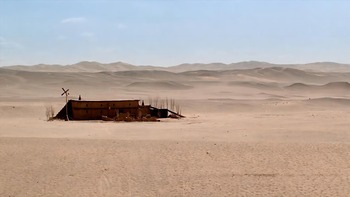
This cultural imperative is evident in recurring visual motifs of locales of looming disappearance, such as solitary inns and precarious shelters set amidst desolate deserts (Figure 1). While Hollywood Westerns often depict deserts with lush adornments like sagebrush and cacti and towering rock formations like buttes and mesas looming behind, lending a sublime beauty to the wilderness, Hong Kong filmmakers prefer a stark and unembellished mise-en-scène of empty and lifeless landscapes. While Hollywood features bustling, tangible towns as dominant imagery of frontier communities to emphasize white settlement and social progress, Hong Kong cinema primarily uses human structures isolated within the desert, settings reminiscent of Hollywood’s way stations, to evoke a society caught in flux and impermanence. Specifically, Hollywood’s town-taming stories frame the emerging frontier community as an ideological site to idealize the American character and destiny, as seen in Dodge City (Michael Curtiz, 1939), and My Darling Clementine (John Ford, 1946), or to investigate the political fractures within American society, as seen in High Noon and The Man Who Shot Liberty Valance (John Ford, 1962). By contrast, Hong Kong filmmakers anchor border depictions within the timeless and unanchored jianghu realm, where spatio-temporal boundaries blur, and historical eras often merge through anachronisms and achronisms, mirroring Hong Kong’s liminal cultural status.
Rolling sand dunes enclose the solitary Dragon Gate Inn under a clear, open sky. A screenshot from New Dragon Gate Inn.

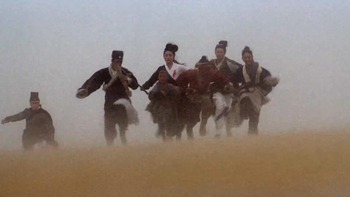
New Dragon Gate Inn and Ashes of Time are representative cases. New Dragon Gate Inn retains the core storyline and historical setting of King Hu’s 1967 film: during the Ming dynasty, a group of exiled patriots battles a eunuch-led tyrannical secret service to rescue the children of a persecuted official. However, the adaptation brings a darker tone reminiscent of revisionist Westerns like The Wild Bunch (Sam Peckinpah, 1969) and McCabe & Mrs. Miller (Robert Altman, 1972), depicting a similarly morally eroding world where utilitarianism prevails. Amid this, knights-errant Zhou Huai-an (Tony Leung Ka-fai) and Qiu Moyan (Brigitte Lin) stand out as rare figures wielding martial arts as embodiments of Confucian ideals of loyalty, honor, and righteousness. The unforgiving desert externalizes this society’s callousness. Unlike Hollywood’s typical portrayal of open landscapes as symbols of freedom and individualism, the film uses close framing and shallow depth of field to render the desert a claustrophobic, entrapping space (Figure 2).Footnote 15 Meanwhile, the desert becomes a dynamic actor, interacting with characters by facilitating or obstructing their combat actions, a portrayal seldom seen in Hollywood Westerns.
The three protagonists race through swirling sand, shielding two orphaned children as the arch-villain closes in from behind, partially obscured by the dusty haze in the foreground. A screenshot from the climactic final battle in New Dragon Gate Inn.

Despite its unique depiction of the desert, the film’s narrative heart is the inn it encloses. The brilliant use of the inn as a microcosm of society – where deceit, shifting alliances, and moral struggles unfold – elevates both Lee’s 1992 remake and Hu’s 1967 original to “classic” status, transforming the site into an iconic symbol of jianghu. As a hub of social interaction and relaxation that draws together a diverse mix of travelers, the Dragon Gate Inn resembles a Hollywood frontier saloon, but its intricate architectural details set it apart from the typically open-floor-plan saloon, transforming it into a fluid battleground for martial arts choreography – especially in Lee’s remake. Narratively, Lee’s remake deepens the original’s conflicts by portraying the innkeeper, Jade King (Maggie Cheung), as a morally ambiguous and sexually alluring woman navigating alliances among opposing forces. Aesthetically, Lee dynamically integrates the inn’s vertical and horizontal spaces, hidden passages, and exterior settings such as rooftops and courtyards, turning the strategic battles among factions into visually stunning martial sequences in this enclosed yet volatile setting.
While New Dragon Gate Inn still portrays martial arts as extensions of the knights-errant’s chivalric ideals, Ashes of Time presents a more degenerative world where judicial institutions collapse, and no knights-errant rise to uphold justice. Here, jianghu is symbolized as the hero Ouyang Feng’s (Leslie Cheung) ramshackle hut, a transactional space where martial arts are reduced to commodities, and the resolution of enyuan (恩怨 debts of gratitude and resentment) turns into “business.”Footnote 16 Compared with the simplicity of the hut, the surrounding desert commands the film’s visual focus. Unlike Ford’s sweeping, monumental shots of Monument Valley that evoke the grandeur and mythos of the American West, Wong Kar-wai’s desert is fragmented and elusive, often revealed through a right-to-left pan that offers only partial glimpses (Figure 3). In contrast to Lee’s realistic portrayal, which uses natural lighting and desaturated tones to highlight the desert’s harshness, Wong rejects realism in favor of a surreal, otherworldly representation through expressionistic visual techniques, including highly saturated colors, hazy filters, shifting light, and canted angles. The desert becomes an ahistorical space carrying ungraspable affectivity.
A screenshot from a right-to-left pan of the desert, bathed in golden-yellow hues with hints of green in the background, appears in Ouyang Feng’s opening self-narration sequence in Ashes of Time.

According to Wimal Dissanayake (Reference Dissanayake2003, 119–128), the film presents a world without totalities or unities, an effect resulting from Wong’s ontology and epistemology of fragmentation and his aesthetic of “perceptual and cognitive disturbance” (Bettinson Reference Bettinson2015, 49). The culturalist readings of the fragmentary world as reflections of the “disjointed, transitory, ephemeral, arbitrary, and haphazard” modern experiences (Dissanayake Reference Dissanayake2003, 122) and particularly of Hong Kong’s colonialism, a history consisting of “a series of slippery dislocations” (Abbas Reference Abbas1997, 32), may hold some truth. However, the most directly relevant aesthetic drive behind the celluloid fragmentariness stems from Wong’s self-declared dominant themes of rejection and exclusion (Ciment Reference Ciment1995, 44). This jianghu accommodates not fighters engaged in Manichaean struggles but lone drifters consumed by rejection and abandonment in love, desperately yearning to reconnect yet unable to recover what has been lost and entrapped in the lingering memories of the past. Beneath the façade of a jianghu narrative, Ashes of Time is, in essence, Wong’s stylized exploration of love as a metaphor for repressed desire, isolation, and alienation. Wong’s aesthetic of disturbance, including elliptical editing, abrupt perceptive shifts, and smudge motion, fractures the diegetic world’s sense of time and space, immersing viewers in the characters’ fragmented memories and guiding them to uncover the truth through these subjective ruptures.
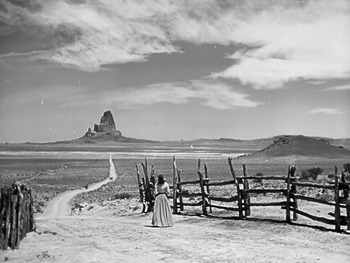
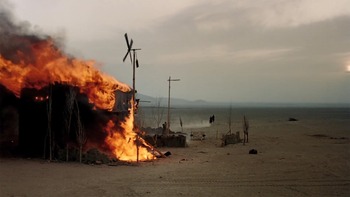
Both New Dragon Gate Inn and Ashes of Time conclude with the protagonists burning their shelters to reconcile with their pasts and riding off to start anew. New Dragon Gate Inn ends on an open note reminiscent of the concluding view of My Darling Clementine (John Ford, 1946), as Jade rides into the distance after heartbroken Huai-an, who has retreated into a solitary exile after Moyan’s tragic death in the final Manichaean showdown. However, unlike the more harmonious mise-en-scène in Clementine (Figure 4), the burning inn dominating the foreground (Figure 5) overshadows the riders vanishing into the wilderness, reminding viewers of Huai-an’s earlier rejection of Jade’s plea to stay, making it uncertain whether the burning inn emphasizes chaos and loss or hope of reunion and a new life. By contrast, in Clementine, the winding road Wyatt Earp (Henry Fonda) follows guides the viewer’s gaze naturally toward the iconic Monument Valley and the open, continuous horizon, conveying resilience and the possibility of return – a promise to Clementine that Wyatt might one day return. In Ashes of Time, roaring flames fill the frame, visually overwhelming the viewer (Figure 6). They can be interpreted as a cathartic release from Ouyang’s long-held desires, regrets, and unresolved feelings, illustrating his acceptance of losses and his eventual readiness to let go. The on-screen subtitles inform viewers of Ouyang’s subsequent rise in jianghu, but the film has already revealed his eventual death alongside Hong Qi earlier, casting a somber shadow over his worldly achievements and underscoring the futility of trying to escape fate.
Clementine stands by a rustic fence, watching Wyatt ride down a winding dirt road that stretches toward a distant rock formation under a vast, open sky. A screenshot from My Darling Clementine.

The blazing inn on the left side of the frame overshadows Jade and her companion riding into the distance after Huai-an, under a darkened, somber sky. A screenshot from New Dragon Gate Inn.

A screenshot from Ashes of Time.

Distinct from his Hong Kong contemporaries’ preference for an abstract, minimalist wilderness to epitomize the borderland, Tsui Hark brings it to life as a tangible community with abundant realistic details in The Blade. Stephen Teo (Reference Teo and Yau2001, 144) praises The Blade for presenting a vibrant multicultural frontier community, breaking away from the conventional depiction of a homogeneous Han China in earlier Hong Kong wuxia films, including New Dragon Gate Inn, where Tsui contributed as a screenwriter and producer. However, Tsui’s portrayal is not a straightforward historical recreation but an imagination drawing on his hybrid cultural upbringing.Footnote 17 It mystifies the geographical margin as an alien space, setting a dynamic stage for his drama of bloody chaos. Tsui superficially appropriates non-Chinese elements – including Middle Eastern, Central Asian, and other Eurasian ethnicities and cultures – when portraying jianghu staples such as markets, inns, restaurants, and shops, emphasizing the frontier as a fluid cultural contact zone while arousing exoticism and mystery. This imaginative layering is especially evident in the portrayal of the two arch-villains, whose exotic attire and heavily made-up or tattooed appearances evoke an eerie and otherworldly presence and distance the characters from any authentic cultural grounding. Meanwhile, despite Tsui’s sensitivity to realistic details in the setting, he obscures its geography and temporality. The film situates the story somewhere in ancient China’s West but withholds specifics about locations and time. For instance, it remains unclear whether Tie Tou (Moses Chan) and Xiang Ling (Song Lei) ever leave their town to search for the hero Li Ding-an (Vincent Zhao). The film unfolds their journey through fragmented and chaotic sequences, showing different environments without offering spatial coherence or continuity. This ambiguity blurs the boundaries of jianghu, as if it existed everywhere and nowhere. Similarly, the passage of time between events is opaque, leaving viewers unsure how much time elapses during Tie Tou and Xiang Ling’s journey. In this regard, although Tsui shifts the borderland’s visual focus from desolate wilderness to bustling towns, he retains a similarly mythic and indeterminate jianghu world as his contemporaries.
Chinese western frontiers in post-2000 transnational blockbusters
Entering the new millennium, Chinese cinema entered what scholars have commonly called the “blockbuster age” (dapian shidai 大片时代), an accelerated process of marketizing its film industry and commercializing its cinema, particularly catalyzed by China’s reentry into the World Trade Organization (WTO) in 2001 and its post-2007 soft power policy.Footnote 18 During this period, as Hong Kong cinema faced declining local and international markets, it increasingly turned to the mainland Chinese market for survival. The 2004-implemented Hong Kong-Mainland Closer Economic Partnership Arrangement (CEPA) facilitated Hong Kong cinema’s market transition by granting coproduction national status, propelling major Hong Kong film companies, producers, and directors to relocate their offices and personnel to the Chinese mainland to capitalize on the PRC’s economic and policy incentives and participate in high-budget blockbuster coproduction (Chu Reference Chu2013; Yau Reference Yau, Cheung, Marchetti and Yau2015). Paralleling frontier mythology’s persistence as a salient narrative framework for Hollywood blockbusters despite the decline of the Western genre (King Reference King2000, 2), the wuxia genre became the dominant Chinese blockbuster form for competing with the growing influx of Hollywood imports in the domestic market and a key medium for projecting China’s soft power on the global stage during the first decade of the 2000s, following the global success of Crouching Tiger, Hidden Dragon (Wohu canglong 卧虎藏龙, Ang Lee, 2000) and Hero (Yingxiong 英雄, Zhang Yimou, 2002).Footnote 19 Wendy Su (Reference Su2016, 150) defines these made-in-China wuxia blockbusters as hybrids that use the Hollywood mode – featuring transregional and transnational investments, casts, and crews; and spectacular film techniques – as an extravagant shell to promote Chinese identity and values. As the wuxia genre only gained a strong foothold in the mainland film industry after Hero (Teo Reference Teo2016, 193) but had long been a staple of Hong Kong cinema, Hong Kong filmmakers naturally became key creators of these historicist blockbusters. However, as these coproduction primarily targeted the mainland market, Hong Kong filmmakers adapted their narratives to the tastes of mainland audiences and the regulatory demands of mainland authorities, a dynamic that critics describe as the “mainlandization” (Szeto and Chen Reference Szeto, Chen, Cheung, Marchetti and Yau2015) or “nationalization” (Pang Reference Pang2007) of Hong Kong-mainland coproduction output in the new millennium.Footnote 20
This content transition is particularly evident in the representation of Chinese nationalism in post-2000 Hong Kong-mainland coproductions. Pre-2000 Hong Kong wuxia cinema primarily embodied a form of what Teo terms “abstract nationalism”: “a kind of nationalism that is not tied either to mainland China or Taiwan, from the vantage point of Hong Kong” (Teo Reference Teo2016, 63). Primarily targeting diasporic Chinese audiences, Shaws’ new-school wuxia films (mid-1960s–early 1970s) often constructed an idealized and ahistorical China – “an imagined homeland expressed by principally an invented tradition, a shared past, and a common language” (Fu Reference Fu2008, 12) – that evoked nostalgia and eased cultural anxiety.Footnote 21 This abstract nationalism persisted into Bruce Lee’s films and other kung fu films of the 1970s, evolving into a form of culturalized anticolonial and anti-imperial nationalism “detached from any specific political state” (Morris Reference Morris, Tinkcom and Villarejo2001, 182–183), as Hong Kong cinema expanded its reach among marginalized multinational communities in the U.S. and other Western countries.Footnote 22 Late-twentieth-century Hong Kong-dominated Western-wuxia coproduction, as previously discussed, perpetuated this imagined, essentialist assumption of Chineseness and portrayed Chinese western borderlands as a liminal space of “anxiety, ambiguity, and contradiction in between” (Shu Reference Shu2003, 52) to investigate themes of displacement and belonging. However, new-millennium coproductions by Hong Kong directors pivot away from these symbolic portrayals toward a more tangible Chinese history and identity aligned with the PRC’s political agenda, reflecting what Teo (Reference Teo2013, 65), drawing on B. Anderson, terms “official nationalism”: a form of nationalism “emanating from the state, and serving the interests of the state first and foremost” (Anderson Reference Anderson2016 [1991], 159).
A conspicuous manifestation is their spectacular display of Chinese western landscapes. In contrast to Raymond Lee’s and Wong Kar-wai’s portrayals of the desert as a confined space, new-millennium wuxia blockbusters – including Tsui Hark’s Seven Swords (Qijian 七剑, 2005) and Flying Swords of Dragon Gate (Longmen feijia 龙门飞甲, 2011) and Daniel Lee’s 14 Blades (Jinyi wei 锦衣卫, 2010) and Dragon Blade (Tianjiang xiongshi 天将雄师, 2015) – foreground the grand scale and boundless majesty of the frontier landscape. Of course, spectacularizing landscapes – through breathtaking compositions, sweeping aerial shots, and digital enhancements – is a common blockbuster technique that enhances global accessibility. Yet beyond their transnational commercial appeal, these glorified depictions of China’s frontier landscapes also function as cultural diplomacy, investing these spaces with a nationalistic vision of territorial grandeur – much as Hollywood Westerns idealized the American West as a symbol of national pride.
This nationalist inflection becomes more pronounced when Hong Kong filmmakers juxtapose the monumental frontier vistas with the imposing spatial markers of official authority. In their pre-2000 wuxia works, Hong Kong directors typically foreground frontier regions while neglecting or omitting the spaces of official power, thereby casting the borderland as a timeless, fantastical elsewhere. By contrast, their post-2000 works pay sustained attention to authority spaces – most directly through courier stations and military forts embedded within frontier landscapes and more obliquely through cross-cutting contrasts with palatial courts. Such visual rhetoric reconfigures border regions as integral to the state’s territorial vision and governance, reinforcing the civilization-periphery and state authority-regional liminality dichotomies. Tsui’s Flying Swords, a sequel to New Dragon Gate Inn, exemplifies this shift. New Dragon Gate Inn leaves “Dragon Gate” a mere spoken reference – an enigmatic waypoint with little historical grounding. By contrast, Flying Swords overlays the setting with explicit spatial delineations – from the imperial court to frontier courier stations and military garrisons – visualizing the projection of state authority into the borderlands. It further materializes the fictional site by introducing a fragmented stone stele inscribed in Western Xia script with the words “Dragon Gate Flying Armor,” whose meaning the characters carefully explain, and historicizes it by locating the space near the historical Yumen Pass. This heightened attention to spatial realism and historical anchoring is also evident in 14 Blades and Dragon Blade. Both films incorporate the historical site of Wild Geese Gate, a strategic fort on the Great Wall, as a pseudo-realistic staging – much like John Ford’s use of Monument Valley on the Arizona-Utah border to stand in for Texas and New Mexico – to illustrate ancient China’s static defense structures in the depiction of the contested Western Regions.Footnote 23
A more significant indication of Hong Kong filmmakers’ narrative shift toward state-centric Chinese nationalism is their emphasis on national unity and harmony. In Seven Swords, Tsui departs noticeably from using the frontier community as a symbol of the detached, abstract jianghu of The Blade, instead grounding it within a historically and geopolitically specific setting. Loosely based on Liang Yusheng’s eponymous novel (first serialized between 1956 and 1957), the film downplays the original focus on intense Manchu-Han national and familial vengeance. It omits Qing imperial authority almost entirely, reducing it to a briefly appearing prince, and shifts the moral center of evil onto the prince’s agent – a bounty-hunter-like figure leading a greedy, sadistic gang. Meanwhile, it relocates the story’s major setting from the Central Plains to China’s western borderlands by simplifying the Heaven and Earth Society – an originally nationwide anti-Qing organization – into a secluded, conflict-averse frontier community, thereby avoiding the depiction of Han trauma over the Manchu conquest of their homeland. The diminished historical depth leads Fried to describe this film as “genre-conscious entertainment” with a most Kurosawan plot but lacking national consciousness (Reference Fried2007, 1494). Fried is right that Seven Swords draws inspiration from Kurosawa’s Seven Samurai (1954), but Tsui does not simply translate Kurosawa’s themes into a different cultural setting with similar plot mechanics as Hollywood’s The Magnificent Seven (John Sturges, 1960) does. Deep down, it leans into Chinese wuxia cinema’s moral and aesthetic landscapes. Notably, the film anchors the story in a tangible geographical framework by situating the frontier community within a mix of actual and imagined peripheral locations, lending concreteness and realism to the otherwise abstract jianghu world and emphasizing the frontier as a liminal zone of socio-political tensions. Moreover, the film’s Chinese nationalism, though subtle, is still present but differs from the original novel’s narrow, Han-centered nationalism. By redirecting the focus from Manchu-Han ethnic conflicts to internecine struggles, the film paves the way for a resolution where Han martial heroes – recalcitrant anti-Qing in the original novel – ultimately find it possible to petition the emperor to lift the ban on private martial activity. This change not only neutralizes the traditional jianghu-court conflict but also recasts the Qing emperor not as an antagonistic foreign authority but as a wise and benevolent ruler whom all Chinese subjects can rely on, indicating a unified Chinese nationalism.
While Seven Swords maintains a subtle pro-authority stance in its depiction of the jianghu-court relationship, 14 Blades and Dragon Blade more explicitly position martial heroes as primary defenders of imperial authority who prioritize national interests over personal concerns, battling internal threats or external aggressors to safeguard the state. 14 Blades is a metonymic translation of its Chinese title, Jinyi wei, which refers to a secretive and elite imperial military force that served as the emperor’s personal bodyguards and secret police during the Ming Dynasty (1368–1644) and to which the film’s hero belongs. Pre-2000 wuxia films typically depict the Iinyi wei as agents of a degenerate authority that persecutes righteous fugitives, a theme vividly dramatized in King Hu’s Dragon Gate Inn and Raymond Lee’s readaptation, among many others. 14 Blades subverts this wuxia trope through Qinglong (Donnie Yen), the jinyiwei commander, who transforms from a blindly obedient executioner into a conscious defender of dynastic legitimacy. Rallying other vigilantes – including an infamous desert bandit gang and an escort agency – he thwarts Prince Qing’s (Sammo Hung) plot to usurp the empire’s throne on the frontier. By heroizing Qinglong as an embodiment of national righteousness, the film reconfigures Jinyi wei in a manner similar to the Hollywood Western’s lawman-marshal archetype: bureaucratic figures who restore social justice and order through personal moral conviction.
By showcasing jianghu figures under Qinglong’s leadership as dedicated to restoring imperial order, 14 Blades reconfigures the frontier – long cast in pre-2000 wuxia films as an alternative realm opposing imperial officialdom and beyond its reach – into a complementary space aligned with central authority. This shift signals a broader change in knights-errant’s stance toward imperial power: the system, once irredeemably corrupt, is now portrayed as capable of renewal through the loyalty and sacrifice of righteous figures. This ideological realignment is articulated narratively in the film’s conclusion, which foregrounds not exile but reintegration. Whereas earlier wuxia narratives often end with corrupt officials punished, yet the hero is still excluded from courtly life, 14 Blades explicitly stages the reintegration of righteous figures into imperial order. After the usurper is eliminated, Minister Zhao Shenyuan (Damian Lau) is restored to office and reunited with his family, while the emperor resumes court sessions – an image of bureaucratic stability. Parallel to this, the heroine inherits her father’s security escort agency, ensuring that martial justice in jianghu continues to serve rather than rival the state. Social harmony is thus located in the consolidation of imperial authority rather than in jianghu autonomy. The conclusion also departs from the unresolved, melancholic endings common in transitional-period Hong Kong wuxia films, which reflected anxieties over political liminality before the handover. 14 Blades offers an ambiguous but hopeful closure: though Qinglong appears mortally wounded after defeating his adversary, the film withholds verbal confirmation of his death. Instead, it concludes with the heroine gazing through a brass telescope as a silhouetted rider emerges against a glowing sunset, accompanied by her words, “Having hope is happiness.” Freezing on this image, the film leaves a glimmer of reunion – whether real or imagined – softening the tragedy and affirming continuity between state order, jianghu justice, and the promise of renewal.
While the climactic battles of 14 Blades unfold across the frontier, the setting functions less as a transformative crucible than as a theatrical backdrop against which the film’s state-affirming ideology plays out. The film does not stage Qinglong’s moral commitment as a product of the borderlands. His resolve to uphold loyalty and sacrifice is firmly established before his journey to the frontier; the confrontations in the borderland merely provide the context for him to manifest his predetermined ethical stance. This sharply diverges from the mythopoetic role the frontier assumes in classic Hollywood Westerns, where contested border spaces – whether in Ford’s nationalist epics like Stagecoach (1939) and the cavalry trilogy (1948–1950) or in Hawks’ town-taming tales Rio Bravo (1959) and El Dorado (1966) – constitute the very crucible of national regeneration. In these American narratives, the imposition of order on lawless borderlands symbolizes both the birth of the nation and the characters’ psychological renewal. By contrast, 14 Blades employs the frontier primarily as a spectacle-enhancing landscape – a source of martial peril and visual grandeur – while leveraging its multiethnic and culturally plural composition mainly for greater realism, an advancement over earlier Hong Kong productions.
The frontier’s role as a dynamic actor in its own right finds its full realization in Daniel Lee’s next Western-wuxia film, Dragon Blade. This film marks a significant departure from the Western-wuxia works discussed earlier. Whereas Hong Kong directors typically employed the frontier as a domestic periphery – a symbolic site for negotiating center-periphery relations within China – Lee reimagines the frontier as a generative space for cultivating a collective civic ethos closely tied to contemporary Chinese global aspirations. The film embraces China’s historical legacy by situating its narrative of multicultural collaboration against a tyrannical Roman usurper along the Silk Road, set in 48 BC during the Western Han Dynasty – a period marked by China’s growing influence and strategic engagement in the Western Regions. As Su-Ching Huang (Reference Huang2020, 209–213) reads, the film highlights intercultural understanding and cooperation through the sequences at Wild Geese Gate, where a multiethnic coalition of Han Chinese, Roman legionaries, and nomadic peoples labors to repair the fortifications, forging bonds of brotherhood and foreshadowing the imagined cosmopolitan city of Regum. This vision reconfigures the Great Wall’s political symbolism: shifting from a militarized boundary of exclusion, as in 14 Blades, to a collective project of inclusion that allegorizes the forging of a trans-ethnic political order grounded in shared values of peace and cooperation. This allegorical shift resonates closely with the PRC’s Belt and Road Initiative (BRI), a Silk Road–inspired twenty-first-century strategy that was launched initially as an infrastructure and economic development program but later framed more broadly as promoting “win–win cooperation,” “people-to-people connectivity,” and the building of “a community of shared destiny.”Footnote 24 Dragon Blade makes this association even more explicit in the scene where the Roman general Lucius (John Cusack) vividly describes the Silk Road to the blind prince Publius (Jozef Waite). Accompanied by sweeping aerial shots of deserts, his narration mythologizes the Silk Road as a civilizational lifeline, “the great artery of trade and culture that connects the West to the great kingdoms of the East.” By fusing Publius’s nostalgic recollection of a lost home with sublime images of borderland landscapes, the sequence humanizes the geopolitical space and transforms it into a site of transcultural belonging. In this way, Dragon Blade invests China’s contemporary global outreach with cultural legitimacy, recasting ancient frontier imaginaries as allegories for present-day internationalism.
This transnational vision distinguishes Dragon Blade further from the Han-centered narratives of earlier Western-wuxia films by Hong Kong filmmakers. Compared with the superficial evocation of a multiethnic environment in The Blade (1995) and 14 Blades (2010), Hui’s The Romance of Book and Sword (1987) develops a more nuanced, multiethnic vision of China’s western borderlands. The film offers an attentive depiction of Uyghur culture and daily life and seeks to move beyond pure Han nationalism by presenting Han-Manchu relations in politically complex terms rather than relying on a reductive oppressor-oppressed binary. Nonetheless, its narrative ultimately remains bound to a Han-centric framework, since the story’s moral and political stakes continue to be filtered through the perspective of Han protagonists.
Dragon Blade’s shift from traditional wuxia’s ethnic nationalism toward a transnational coalition is not merely aesthetic. As a high-budget Hong Kong-mainland coproduction with international investment, the film’s survival depended on satisfying both the global box office – demanding international stars (such as Jackie Chan and Cusack) and cross-cultural storylines – and the domestic market, which requires narratives aligned with state-sanctioned themes. By visualizing a Chinese model of globalization rooted in cultural continuity and inclusivity, the film operates simultaneously as a commercial blockbuster and as a soft-power allegory, transforming wuxia’s populist ethos into a narrative aligned with contemporary visions of multipolar cooperation – an orientation that, as Huang (Reference Huang2020, 201, 210) notes, figures prominently in the PRC’s film coproduction guidelines.
Dragon Blade’s integration into Chinese cultural globalization and its alignment with state-sanctioned moral messaging are often perceived as mainlandization or nationalization. However, despite their engagement with Chinese national identity, 14 Blades and Dragon Blade exhibit significant thematic and ideological differences from state-sponsored mainland historical epics such as The Desert Mission (Damo zijin ling 大漠紫禁令, Fangxiang, 1986), The Queen of Tibet (Wencheng gongzhu 文成公主 or Datang gongzhu xiyu ji 大唐公主西域记, Wu Fasheng, 1986), and Grand Commander of West Regions (Xiyu da duhu 西域大都护, 2012). Unlike these didactic epics, which prioritize historical realism and a ruling elite perspective, 14 Blades and Dragon Blade maintain Hong Kong cinema’s prioritization of individual agency over state ideology by focusing on marginalized protagonists navigating socio-political upheavals. They also preserve fast-paced, visually dynamic martial arts sequences as the core of their commercial entertainment. At the same time, both films suffer from narrative inconsistencies, particularly in their depiction of individual motivation in relation to collective ideals. In 14 Blades, the protagonist’s transformation from a loyal imperial enforcer to a righteous hero lacks clear justification, making his character arc feel abrupt and unconvincing. Dragon Blade is grounded in a valid justification for its hero’s role as a peacemaker, but its moral messaging of international peace and cooperation as a universal benefit is weakened by its adherence to Hong Kong wuxia’s tradition of heroizing marginal figures. The hero’s liminal status and his faction’s limited political and military power make his grand pacifist ideals feel detached from political pragmatism and also render the final victory over an overwhelming tyrant feel contrived. These issues are further compounded by its superficial historicization, symbolic ethnic representation, and reliance on ethnic stereotypes, making the film less historically and politically grounded than mainland-studio-produced epics, which frame peace efforts within state-backed authority and institutional diplomacy.Footnote 25
In this regard, contrary to critical concerns about the disappearance of Hong Kong cinema (Abbas Reference Abbas1997), CEPA has not homogenized the work of Hong Kong directors involved in mainland coproductions. Rather, this collaborative mode has created new national and global opportunities. As Laikwan Pang (Reference Pang2007, 414) observes, although Hong Kong’s film industry lost the cultural privileges once tied to its colonial status, its practitioners have leveraged their expertise to secure a new role. For Hong Kong directors, sustained participation in mainland coproductions has provided a crucial survival channel, allowing them to secure access to the mainland market through a commercially driven engagement with Chinese nationalism. Such an economically driven, globalization-compliant “utilitarian” strategy (424) parallels earlier survival tactics of “assimilation and synthesis of various regional cultures and global genre idioms” (Yau Reference Yau, Cheung, Marchetti and Yau2015, 20) to resist foreign dominance in the local market and expand into overseas markets. At the same time, Hong Kong’s capital, technical expertise, and star labor have been pivotal in shaping the PRC’s new commercial film market. As Pang notes, most Chinese transnational films directed by mainland auteurs, including Zhang Yimou, Chen Kaige, and Feng Xiaogang, were “institutionally backed by Hong Kong investment, technicians, and performers” (Reference Zhang2007, 418). Overall, coproductions have resulted in a form of reciprocal yet asymmetrical integration between the Hong Kong and mainland film industries.
Conclusion
Westerns are often perceived as uniquely American, not because the geographic West is inherently exceptional, but because the “West” carries a nation-defining significance for American identity – an association that does not easily translate to other cultures. Whereas the American West symbolizes national genesis through expansion, progress, and reinvention, China’s West has never borne the same foundational meaning. For the imperial authority in the Central Plains, China’s West mainly functioned as a strategic buffer against nomadic incursions, a geopolitical and economic hub facilitating trade and multiethnic interactions, a cultural periphery complementing the Central Plains, and an outpost of Sinicization.
Late-twentieth-century Hong Kong-dominated wuxia coproduction largely detaches their portrayals of Chinese western borderlands from such historical and geopolitical realities. Instead, they appropriate the regions’ peripheral status as allegories of Hong Kong’s own liminality and transitional anxieties before the 1997 handover. The frontier in these films – whether imagined as desolate wilderness or as hybridized multicultural towns – emerges as a mythic, indeterminate space, secluded from both the rest of China and the wider world. Many of these films share a critical edge and a disillusioned tone, resonating with post-1970s revisionist Hollywood Westerns that often express skepticism toward authority. By contrast, post-2000 transnational coproductions conspicuously shift from this abstract nationalism toward a state-centered nationalism rooted in Chinese historicity. Initially, they still treat the frontier as an internal periphery that refracts Hong Kong’s ambiguous cultural positioning, but over time, they replace the uncertainty of earlier works with uplifting narratives that recast China’s West as integral to the nation’s destiny. This transformation crystallizes most clearly in the reconfiguration of the jianghu–court dynamic. In pre-2000 coproductions, jianghu and the court often stand in opposition: driven into exile on the frontier by a corrupt and ineffectual court, knights-errant either resist its authority outright or uphold it only reluctantly. Post-2000 blockbusters, however, soften this antagonism by increasingly validating the court as the rightful sovereign over frontier regions and by situating jianghu figures as agents who ultimately contribute to state order. In this symbolic realignment, the frontier trope itself is re-signified – from a mythic margin reflecting Hong Kong’s colonial-era anxieties to a borderland incorporated into a national project of unity – mirroring the broader integration of Hong Kong-mainland coproductions into mainland cultural discourse. By embedding themselves in this state-centered narrative, these films not only reinforce state ideology but also gradually extend the frontier trope beyond the national frame, aligning it with China’s global cultural and diplomatic ambitions – Dragon Blade being a particularly salient case. Much like Hollywood Westerns, which have deployed the frontier to mythologize national identity and project global influence, post-2000 coproduction increasingly recast China’s western borderlands as sites of specific geopolitical significance – cultural crossroads vital to both national cohesion and international engagement.
It is a pity that wuxia, like its Hollywood counterpart, declined before its trajectory could be fully compared as a parallel genre that evolved alongside its nation’s rise to global power. Nevertheless, comparing the developmental trajectories of Hollywood Westerns and broader Chinese action genres over the next twenty years would offer insight into how both nations use the frontier trope to shape national identity, global perceptions, and geopolitical narratives. The future trajectory of Chinese action cinema will reveal whether it follows Hollywood’s golden-age self-mythologizing or develops a more self-reflective and globally resonant discourse.
Acknowledgements
I would like to thank the anonymous reviewers for their insightful comments and suggestions. This article is adapted from my doctoral dissertation, completed at Memorial University of Newfoundland, and has been significantly revised for journal publication.
Competing interests
The author declares no potential conflict of interest.



 Open access

