


Introduction
Young women outnumber young men in many urban areas throughout the world whereas young men are overrepresented in rural areas (East Germany: Kröhnert & Vollmer, Reference Kröhnert and Vollmer2012; Eckhard & Stauder, Reference Eckhard and Stauder2018; Europe: European Spatial Planning Observation Network (ESPON), 2013; worldwide: Edlund, Reference Edlund2005; United Nations, 2015). The sex ratio (ratio of males to females) in the Netherlands is 1.03 in the age range 20-30 but the four largest Dutch cities Amsterdam, Rotterdam, The Hague and Utrecht have a sex ratio of 0.90 in this age range (2017, Centraal Bureau voor de Statistiek (CBS) StatLine open data, 2021a). These spatially skewed sex ratios are largely caused by female rural-urban migration streams. Both men and women migrate to cities, but women do so to a larger extent (Thadani & Todaro, Reference Thadani, Todaro, Fawcett, Khoo and Smith1984; Leibert et al., Reference Leibert, Montanari, Wiest, Lang, Henn, Ehrlich and Sgibnev2015; Eckhard & Stauder, Reference Eckhard and Stauder2018; ESPON, 2013). For men and women cities can be attractive since they provide an opportunity to make a living without constraints of the rural context and the family and since they provide cultural and social amenities. In addition, the literature describes two other explanations for (specifically female) migration. The first points to the obvious opportunities for employment and education in urban areas: the city as a ‘socioeconomic escalator’ (Fielding, Reference Fielding2012; ESPON, 2013). Although women still lag behind men in labour market participation around the world (World Bank, 2021), they are overrepresented in tertiary education in many countries (Organisation for Economic Co-operation and Development (OECD) OECD.stat 2021; Stoet & Geary, Reference Stoet and Geary2020), including in the Netherlands (CBS StatLine open data, 2021b). The last explanation focuses on the opportunities for relationships: the city as a marriage market or, in more modern terms, relationship market. Edlund (Reference Edlund2005) presented such a relationship market model, showing that women’s preference for men with a high level of resources drives an influx of women into urban regions, specifically lower educated women. This influx continues until an equilibrium is reached at which women outnumber men. Edlund found evidence for these patterns on the level of Swedish municipalities. To our knowledge this theory has never been investigated at the level of the individual life course. This study aims to investigate the consequences of migration to cities for rurally born women on the individual level, studying relationship formation, family formation and labour market outcomes. Educational potential and aspirations (translating into a high educational level later in life) plays a pivotal role in women’s migration patterns in early adulthood and will receive special attention in this study.
Different areas of the life course are inseparably linked: literature consistently shows that women face a trade-off between career and motherhood meaning that decisions in one area influence the other. Due to selection processes and structural characteristics of the urban environment this trade-off may play out differently in cities compared to rural areas and differently for different categories of women.
This study’s main research question thus reads: what are the benefits and potential risks of migration to cities for lower and highly educated rurally born women with respect to education, labour market position, relationship formation and family formation?
The study uses unique integral individual level data on four complete birth cohorts of women born in rural areas between 1970-1973. The data are derived from a large set of administrative registers availabe at Statistics Netherlands. Women’s life course outcomes in midlife, age 42, are investigated in the context of their place of residence in early adulthood, age 25. The study contributes to existing literature in the following ways. First, it takes a much needed interdisciplinary approach, integrating biosocial, sociological/sociogeographical and economic perspectives. Second, although women’s rural-urban migration has been investigated in a large number of countries, most studies take a macro or meso level approach. This study looks at consequences of migration for women at the individual level. Third, the Netherlands is an interesting case as female participation in higher education has increased over the last decades and economic participation is high, but part time work is still the norm for many women, particularly for mothers. In this context, the trade-off between career and fertility is a reality and the benefits of having a partner with a high level of resources are large.
Theoretical background
The city as a socioeconomic escalator
Female rural-urban migration can be connected to emancipation processes: increasing aspirations and opportunities for women to obtain an independent economic position and/or an academic educational level. The number of women participating in higher education has risen and has surpassed that of men in most industrialised countries (Vincent-Lancrin, Reference Vincent-Lancrin2008; Charles, Reference Charles2011). In the Netherlands, female employment has been on the rise for many decades as well (CBS StatLine open data, 2021c) and wage gaps are decreasing (CBS StatLine open data, 2021d). In the life course of rural young adults, social mobility is often linked to geographical mobility. The so called ‘escalator regions’, -usually highly urbanised regions- offer better chances for individuals in education, jobs and income, thus triggering rural-urban migration (Feijten et al., Reference Feijten, Hooimeijer and Mulder2008; Van Ham et al., Reference Van Ham, Findlay, Manley and Feijten2012; Fielding, Reference Fielding2012; Eckhard & Stauder, Reference Eckhard and Stauder2018). Universities and colleges, as well as highly paid knowledge work, are concentrated in and around large cities (Moretti, Reference Moretti2012). Moreover, there is a fairly large urban-rural wage gap with comparable jobs being paid less in rural areas (Glaeser & Maré, Reference Glaeser and Maré2001; Buitelaar et al., Reference Buitelaar, Weterings, Raspe, Jonkeren and Boterman2016). Especially the young and highly educated urban workers profit from this wage advantage (Verstraten et al., Reference Verstraten, Verweij and Zwaneveld2018), but not only them. Cities also provide other possibilities for vocational education and jobs, particularly for female dominated vocations. These opportunities may form a moving incentive for all women, not only for those who aim for a high education. In short, migration to cities may yield substantial benefits in terms of human capital. The study’s first hypothesis, the socioeconomic escalator hypothesis, predicts that a) women who migrated to large cities as young adults are more often highly educated later in life and b) both lower and highly educated women have better paid jobs on average compared to rurally living women.
The city as a relationship market: theories on partner preferences
Besides its role as a job market, the high density of (young) people in urban areas means that cities function as places where a suitable partner can be found: the city as a relationship market. Preferences of men and women for a prospective partner have been studied by a wide range of scientific fields with different theoretical perspectives. This study aims to integrate some of these perspectives by taking a multidisciplinary approach, using biosocial (evolutionary psychology and evolutionary demography), economical, sociological and sociogeographical theory.
Although there are large individual differences with respect to partner preference, a number of studies across a range of different societies show that average tendencies of men and women go in different directions. On average, women show a tendency to prefer partners with resources and a high earning capacity (Buss, Reference Buss1989; Geary et al., Reference Geary, Vigil and Byrd-Craven2004; Buunk et al., Reference Buunk, Dijkstra, Fetchenhauer and Kenrick2002). Men instead tend to prefer women who are in their reproductive life phase and/or show signs of fertility (Buunk et al. Reference Buunk, Dijkstra, Kenrick and Warntjes2001; Geary et al. Reference Geary, Vigil and Byrd-Craven2004). In line with women’s stated preferences, men with high levels of resources (or a high educational level) are more successful in finding both brief and long-term partners (Borgerhoff Mulder, Reference Borgerhoff Mulder1990; Pérusse, Reference Pérusse1993; Hopcroft, Reference Hopcroft2006; Pollet & Nettle, Reference Pollet and Nettle2008). Next to the vast social, cultural and environmental influences on modern human’s behaviour, some psychological processes, preferences and behaviours of modern humans may still reflect those that were evolutionary advantageous for our ancestors. Evolutionary theory predicts the sex that invests most in the offspring should be the ‘choosier’ sex when it comes to mating. In most animal species these are the females (Bateman, Reference Bateman1948; Trivers, Reference Trivers and Campbell1972). While in many species the reproductive success of males is limited mainly by the number of partners they can mate with, female reproductive success is generally more dependent on the ‘quality’ of the partner, and, in species with post-natal paternal investment, his providing capacity (Geary et al., Reference Geary, Vigil and Byrd-Craven2004). This makes mating a biological market with females choosing those partners that have the most to offer (Noë & Hammerstein, Reference Noë and Hammerstein1994). In long-term human relationships men’s reproductive success is also dependent on the ‘quality’ of their partner, so both men and women are expected to be choosy to some extent (Geary et al., Reference Geary, Vigil and Byrd-Craven2004).
Sociological theory too predicts that the attractiveness of an individual as a potential partner partly depends on their levels of resources, such as education and income (Kalmijn, Reference Kalmijn1998; Blossfeld, Reference Blossfeld2009; Gautier et al., Reference Gautier, Svarer and Teulings2010). From a female perspective a partnership with a high-income man ensures a better socioeconomic status for both the woman and her children. Throughout history and throughout the world, children growing up in wealthy circumstances have had better health and higher survival rates in childhood (Barrett et al., Reference Barrett, Dunbar and Lycett2002; Berkman et al., Reference Berkman, Kawachi and Glymour2014). Furthermore, socioeconomic status tends to be transmitted from parents to children (e.g. Blau & Duncan, Reference Blau and Duncan1967; Ganzeboom et al., Reference Ganzeboom, Treiman and Ultee1991; Breen & Goldthorpe, Reference Breen and Goldthorpe1997). According to this reasoning men should prefer high-resources women as long term partners too, although this male preference should traditionally be weaker than that of women due to men’s greater economic role (Kalmijn, Reference Kalmijn1998). Women and men seeking out partners of higher social economic status is known as the economic competition hypothesis (Kalmijn, Reference Kalmijn1994) or status attainment hypothesis (Smits et al., Reference Smits, Ultee and Lammers1998), which is contrasted with the cultural matching hypothesis: preference for a partner with a similar cultural status (Kalmijn, Reference Kalmijn1994). Both mechanisms may eventually lead patterns of assortative mating or homogamy: partnership formation within (socioeconomic) groups (Kalmijn, Reference Kalmijn1998). In sum, from biosocial, sociological and economic perspectives there is reason to assume that women have a preference for high-resource men and that although men might have such a preference too, this is likely to be less strong.
The city as a relationship market: local markets
Marriage markets (or relationship markets) are very much local markets in the geographical sense, with locally varying market conditions (Pollet & Nettle, Reference Pollet and Nettle2008; Qian et al., Reference Qian, Lichter and Tumin2017; Cooke, Reference Cooke2011). In western countries, men with a high level of resources –i.e. a high education, high income- are not distributed randomly over the country but are predominantly found in urban regions. Studies indicate that local sex ratios and the relative availability of men with resources influence women’s marriage behaviour. Women marry less often when there is a shortage of men, and especially if ‘economically attractive’ men are scarce (Lichter et al., Reference Lichter, LeClere and McLaughlin1991). Pollet & Nettle (Reference Pollet and Nettle2008) show that the positive influence of male socioeconomic status on female marriage probability is greater in areas with an abundance of men, suggesting that women can afford to be choosier in those areas.
However, local marriage markets are not closed but open and are influenced by sex-specific migration patterns (Eckhard & Stauder, Reference Eckhard and Stauder2018). Hence, local sex ratios are not strictly exogenous factors on marriage probabilities but are contingent on migration decisions around perceived marriage probability and perceived ‘quality’ of marriage partners. In turn, this may result in locally skewed sex ratios. Since men with high levels of resources are predominantly found in cities, this may provide an incentive for women to migrate to cities (Thadani & Todara, Reference Thadani, Todaro, Fawcett, Khoo and Smith1984). Edlund (Reference Edlund2005) presented an economic model predicting that women’s preference for men with high wages should lead to an influx of women into urban regions, specifically of the lower educated women. (In this model, women with high labour market potential should migrate to cities for work regardless of marriage market conditions.) This influx should continue until an equilibrium is reached in which there is a surplus of women in cities. In equilibrium, women in urban areas have a higher probability to form a relationship with a man with a high wage, but also a higher probability of staying single. In equilibrium the expected pay-offs –based on probabilities of finding a partner with a high wage, a partner who does not have a high income, or staying single –are equal in urban and rural areas. On the regional level, an overrepresentation of women is indeed positively correlated with average male incomes in Sweden (Edlund, Reference Edlund2005). The premise in the current study, following Edlund, is that staying single (and childless) as a result of a skewed sex ratio can be viewed as a risk of migration to cities. Furthermore, a partner with a high level of resources is presumed to be more favourable for women than a partner who does not have those resources, and can be viewed as a benefit of migration. This study does not measure partner preferences or migration motives. It can only look at consequences of migration and see whether these fit with the theory of Edlund, but without direct measurements of individual preferences and motives, the study provides no direct proof. Two hypotheses are derived. The relationship market competition hypothesis predicts that women who migrated to cities are more often single and childless later in life compared to rurally living women. It furthermore predicts that this is mediated by the female-skewed sex ratio in cities which makes it harder for women to find partners under competitive market conditions. The relationship market supply hypothesis predicts that women who migrated to cities more often have a highly educated partner, and that this ‘city effect’ is mediated by the relative abundance of highly educated men in cities. Educational attainment of men is taken as a proxy for male resources or earning capacity. This effect is expected to be stronger for highly educated women due to segregated relationship markets (e.g. Kalmijn & Flap, Reference Kalmijn and Flap2001; Stauder & Kossow, Reference Stauder and Kossow2021) and a male preference for higher educated women. Note that the relationship market competition and supply hypotheses are not contradicting. Rather, they are two sides of the same coin in the model of Edlund (Reference Edlund2005). The study starts with a general description of migration patterns of men and women of different educational levels, in order to see whether men indeed migrate to cities to a lesser extent than women do, and how the net migration flows of rural men and women are composed in terms of education. Edlund (Reference Edlund2005) specifically predicts that the surplus of women in cities can be attributed to lower educated women. In recent decades however, a slight overrepresentation of highly educated women can also be expected due to women’s increased participation in higher education.
Career versus family, a ‘city lifestyle’ of highly educated women
In many countries, childlessness is more common among highly educated women than among lower educated women (Liefbroer & Dykstra, Reference Liefbroer and Dykstra2000; Sigle-Rushton & Waldfogel, Reference Sigle-Rushton and Waldfogel2007; Keizer et al., Reference Keizer, Dykstra and Jansen2008). Recent cohorts in Denmark, Norway and Sweden are the exception (Jalovaara et al., Reference Jalovaara, Neyer, Andersson, Dahlberg, Dommermuth, Fallesen and Lappegård2019). For some women childlessness is an active positive life style choice (Hakim, Reference Hakim2003; review in Tanturri et al., Reference Tanturri, Mills, Rotkirch, Sobotka, Takács, Miettinen, Faludi, Kantsa and Nasiri2015). However, in many cases, childlessness arises from a combination of circumstances, life events and small choices and decisions (Keizer et al., Reference Keizer, Dykstra and Jansen2008). Labour market circumstances can play an important role: An extensive body of research shows that specifically women, not men, face a trade-off with respect to career and family (reviews in Sigle-Rushton & Waldfogel, Reference Sigle-Rushton and Waldfogel2007; Blau & Kahn, Reference Blau and Kahn2017). It is suggested that the very low levels of fertility in Italy, Spain and Japan are related to the stark trade-offs between career and motherhood in these countries (Mills et al., Reference Mills, Mencarini, Tanturri and Begall2008; Brodmann et al., Reference Brodmann, Esping-Andersen and Güell2007; Feyrer et al., Reference Feyrer, Sacerdote and Stern2008). In the Netherlands, 42% of first-time mothers cut back their working hours or stop altogether as opposed to only 8% of fathers (Perez et al., Reference Perez, Van den Brakel, Portegijs, Portegijs and Van den Brakel2018). When mothers do work, they suffer a ‘motherhood penalty’ in many Western countries and start earning much less than childless women and fathers (Kleven et al., Reference Kleven, Landais and Søgaard2018). These opportunity costs of motherhood are higher for more educated women as their initial earning capacity is higher (Sigle-Rushton & Waldfogel, Reference Sigle-Rushton and Waldfogel2007; Jalovaara et al., Reference Jalovaara, Neyer, Andersson, Dahlberg, Dommermuth, Fallesen and Lappegård2019). This could explain the pattern that especially higher educated women more often remain childless. The exceptions are Denmark, Norway and Sweden: countries that have high socioeconomic gender equality and extensive social policies supporting equal work/care balance of mothers and fathers, thus greatly reducing the opportunity costs of motherhood (Jalovaara et al., Reference Jalovaara, Neyer, Andersson, Dahlberg, Dommermuth, Fallesen and Lappegård2019).
Sociogeographic theory predicts that the trade-off between career and family may play out differently in cities compared to rural areas. First, selective migration could play a role. Cities may attract women with a ‘work centred’ life style preference, who have more years of education and more often tend to remain single and childless (Hakim, Reference Hakim2003). Through its scale, inherent heterogeneity, and the anonymity of urban public space, cities provide women with opportunities to free themselves from traditional female identities and life course expectations as wives or mothers (Wilson, Reference Wilson1991; Spain, Reference Spain2014). Generally, women in (inner) Dutch cities do indeed have a higher labour market participation compared to less urban contexts (De Meester, Reference De Meester2010). Second, there are the structural factors of the urban environment and urban labour market. Due to characteristics of the urban labour market highly educated city women may have more demanding careers than their rural counterparts, making it more difficult to combine work and motherhood. On the other hand, cities have many amenities such as extensive public transport and flexible child care, that help to facilitate the combination of work and parental care (Wekerle, Reference Wekerle1985; Spain, Reference Spain2014). And Boterman & Karsten (Reference Boterman and Karsten2014) show that in cities gender equity within especially (upper) middle class couples is higher than in suburban areas, whereas gender equity in rural areas is lower still. The city lifestyle hypothesis predicts that city women, especially the highly educated, are more often single and childless than rural women due to selection processes. On the other hand, urban services and amenities may lead to an absence or even reversal of this ‘city effect’.
Methods
Data
Data were derived from the System of Social statistical Datasets (SSD) of Statistics Netherlands (Bakker, Van Rooijen & Van Toor, Reference Bakker, Van Rooijen and Van Toor2014). The SSD combines a vast number of administrative registers, among which the population register, tax registers and educational registers. Most registers are longitudinal and cover the complete Dutch population, making these data exceptionally well suited for research on life course and mobility. The research population of Table 1 (a first overview of men’s and women’s migration patterns) consisted of 103,509 native Dutch women and 107,649 native Dutch men born between 1970 and 1973 in rural Dutch areas. Children of international migrants -mainly of German or Belgian origin in these cohorts- were not included since they may have very different migration patterns and motives. A few cases were excluded in which the municipality was unknown at age 25. For all subsequent analyses, women were excluded who emigrated to another country or died between the age of 25 and 42 (3.4%), as well as women who were in a same-sex marriage or cohabited with a woman at age 42 (0.8%). This last group was excluded because they may behave differently from heterosexual couples with respect to family formation and the trade-off between career and fertility. After these selections the main research population consisted of 99,130 women: 73,944 lower educated women (low or midlevel education, see below), 16,953 higher vocationally educated women (bachelor degree or higher vocational education) and 8,233 university educated women (master’s degree or higher). Higher vocationally educated women were not explicitly part of the research question, since the hypotheses focused explicitly on contrasts between highly educated women and lower educated. Higher vocationally educated women’s outcomes were expected -and found- to be intermediate between the university educated and the lower educated. However, in order to include all variation between women, it is relevant to also present the outcomes of higher vocationally educated women. For reasons of conciseness, the outcomes of bachelor/higher vocationally educated women are only briefly discussed in the results section.
Rurally born men and women: educational level at age 42 by place of residence at age 25; birth cohorts 1970-1973

Dependent and independent variables
Dependent variables (measured at age 42) were Relationship status (1): married or cohabitation with a male partner yes (1), no (0); Relationship status (2) for the subpopulation of partnered women: has a highly educated partner, i.e. higher vocational, bachelor’s or master’s degree, yes (1), no (0); Fertility: has one or more children yes (1), no (0); Labour market status: midlevel job (ref), high paid job, low paid job, self-employed, social benefits, no income (mostly housewives). Jobs were categorized as ‘low paid’ if the monthly wage (corrected to full time equivalent if the job was part time) fell within the 40 lowest percentiles (based on the wage distribution of all women in these cohorts), ‘high paid’ if the wage fell within the 80-100 percentile range, and ‘midlevel’ in all other cases (40-80 percentile range).
The main independent variable under study was Urbanity of the municipality where women resided at age 25 (1995-1998). This age was chosen because 25 is the age around which people start their careers and begin to establish serious relationships. At earlier ages, many women are still in education. At later ages, women who still live in cities are an increasingly selective group with respect to the outcome variables. Reverse causality may become an issue: e.g. single people staying in cities precisely because they have not yet found a suitable partner instead of the city itself influencing the risk of singlehood. No data were available on mobility before the age of 25. However, there is good reason to assume that the vast majority of rural-urban moves before age 25 were made in early adulthood, from 18 years onwards. Life course mobility studies show a peak in rural-urban migration in early adulthood (Fielding, Reference Fielding2012; Kooiman et al., Reference Kooiman, Latten and Bontje2018), as did exploratory analyses on the StatLine open data bank (CBS StatLine open data, 2021g) showing that around 80% of women under 25 who migrated to large cities in 2010 were between the ages of 18 and 25.
The main independent variable was classified into three categories based on characteristics of the municipality: population density, whether the municipality was part of the formal ‘urban regions’, and if yes, whether there was a university in the urban region. In 1995, the Netherlands had 22 urban regions. Urban regions are characterised by a high degree of urbanisation, serving as functional units for the daily lives of residents as well as being main centres of economic activity and employment within the region. This usually includes one main city and a number of surrounding suburban municipalities. Other densely populated municipalities exist outside of formal urban regions, but they are of limited economic importance. Eleven urban regions have a university within their borders: Groningen, Enschede, Nijmegen, Utrecht, Amsterdam, Rotterdam, Maastricht, Eindhoven, Tilburg, Leiden and The Hague (including Delft). Two smaller municipalities, Hillegom and Lisse, were included due to their very close proximity to Leiden. No universities are located outside of the urban regions. Women’s living municipality at age 25 were thus classified in three categories: 1. University regions: Urban regions with a university, 2. Other cities: other urban regions and all municipalities with more than 1000 addresses/km2) and 3. Rural areas: municipalities with less than 1000 addresses/km2 that were not part of an urban region.
Women’s municipalities of birth were similarly categorized, and category 3 was selected to define the study population.
Further independent variables at the individual level (measured at age 42) were Labour market status, Fertility; (see above) and Relationship status (3): married or cohabits with a highly (college or university) educated partner, a lower educated partner or no partner (ref).
Independent variables at the municipality level (measured at age 25 except % Protestant Christian) were % Highly educated of 25-year old men: the percentage of highly educated 25-year old men (higher vocational, bachelor’s or master’s degree) out of all 25-year old men; and % Protestant Christian: the percentage of voters in the muncipality for the two political parties with a clear Protestant Christian signature (Staatkundig Gereformeerde Partij and ChristenUnie). This last variable was used as a control variable. Some Dutch rural areas have a relatively large Protestant Christian population: the Dutch ‘Bible belt’. These areas are characterised by a high religious involvement and a (by Dutch standards) unusually high fertility (CBS 2016; CBS 2017) that are not typical for rural areas in general. Due to data limitations, this variable was not measured in 1995 but in 2012. However, the Dutch ‘Bible belt’ is very stable with respect to religious beliefs of its inhabitants. Lastly, Sex ratio was defined as the Weighted Age Specific Sex Ratio: the number of ‘potential male partners for women aged 25’ in the municipality, divided by the number of women of aged 25 in the municipality (see below).
Sex ratio and the supply of highly educated men
The economic market model presented above is driven by the local sex ratio which indicates the ‘supply’ of men relative to the ‘competition’ (other women). A simple age specific and geographically specific sex ratio would be the ratio of men to women of a certain age in a certain geographical area. However, this measure is in fact too simple as it ignores the fact that men and women have specific preferences with respect to their partners, and that there are constraints as well (see Eckhard & Stauder, Reference Eckhard and Stauder2019, for an extensive comparison of different measures of partner market conditions that incorporate aspects of these preferences and constraints). Arguably the most important preference is age: on average, women marry men that are a few years older and vice versa (Buss, Reference Buss1989; Eckhard & Stauder, Reference Eckhard and Stauder2019; CBS Statline open data 2021e). The supply of men for women of a certain age thus consists of men in a range of ages, who are on average a bit older. This study uses the weighted age specific sex ratio (WASSR, Fossett & Kiecolt Reference Fossett and Kiecolt1991). This measure uses the known age distribution of male partners of women of a given age i (calculated from the data) as weights for women’s preferences, and multiplies the weight of male age j with the number of men of age j in the municipality (CBS Statline open data 2021f). The sum over all male ages is the numerator. This represents the ‘pool’ of potential male partners from which a woman could choose: the supply. The denominator is the number of women of age i, representing the female competitors for these potential male partners. The weighted age specific sex ratio is formally written as:
 $$WASSR_i^F = {{\sum\nolimits_j {{w_{ij}}} *{M_j}} \over {{F_i}}}$$
where F i are the number of women in age group i, M j are the number of men in age group j, and w ij is the weight per age group j of the male that reflects their probability (0-1) of being chosen by a woman of age group i.
The WASSR could still be improved upon. Four potential improvements are discussed. Unfortunately however, these improvements were impossible to calculate due to data limitations. First, both unpartnered and partnered men and women are included in the WASSR. However, partnered men can be considered to be less “available” than unpartnered men, and partnered women can be considered “competition” to a lesser extent than unpartnered women. Second, it was impossible to correct the calculations for the presence of non-heterosexual men and women. This is probably not problematic: this group is relatively small and differences between urban and rural areas in the ratio of non-heterosexual males to non-heterosexual females are expected to be negligible. Third, the weights are based on the age constellations within existing couples with women of age i, not on the age preference (or age difference acceptance) of women that form a relationship at age i. Fourth, better still than the WASSR would be the availability ratio, which takes into account not only the age preference of women, but also implements in the denominator the age preferences of the potential male partners (Goldman et al., Reference Goldman, Westoff and Hammerslough1984; Eckhard & Stauder, Reference Eckhard and Stauder2019).
Next to –and independent of- the general supply of men, the supply of highly educated men is hypothesized to form a pull factor for women to migrate. The relative availability of highly educated men is operationalised as the proportion of highly educated men at age i out of the total number of men at age i. Using this relative availability allows to parse out the independent effect of the supply of highly educated men net of the effect of the supply of men in general (i.e. the sex ratio). Again, partnered men were not excluded and ideally, this measure should be based not on age i but on the above-mentioned pool of potential male partners of women at age i. However, the data did not allow for these refinements.
Methods of data analysis
Multilevel mixed-effects linear regression models were used to test the hypotheses with respect to relationship status and fertility. Level 1 were individuals, level 2 was the municipality where women resided at age 25, with random intercepts per municipality. This was done to account for potential systematic variation between municipalities that could lead to incorrect estimations of standard errors. Level 1 and level 2 variance are reported, as well as intraclass correlation coefficients (ICC) as an indicator of similarity of individuals within municipalities. In some models, the explained variance at the municipality level was significant. In all cases, the ICC’s were quite low, indicating that only a very small proportion of the variation in outcomes was attributable to differences between municipalities. Since differences between municipalities were not the focus of this study, level 2 outcomes are not discussed in the results. To get insight in the mediating effect of the municipality characteristics sex ratio and supply of highly educated men, the relationship market competition hypothesis and the relationship market supply hypothesis were tested in several steps in Tables 4, 5 and 7, starting with the effect of urbanity (Model 1), then adding individual characteristics (Model 2), and adding municipality characteristics in Model 3. As the labour market status hypothesis did not predict a role of municipality level characteristics, a full multilevel model was not necessary. Instead, multinomial logistic regression was used with a cluster correction for municipality, and relative risk ratios are presented. Except for one model with an interaction term, models were run separately for different subpopulations of women based on their educational level: university educated (master’s degree or higher), and lower educated (no master’s or bachelor’s degree: low or midlevel education). Unfortunately the data did not allow for a distinction between low educated and midlevel educated persons.
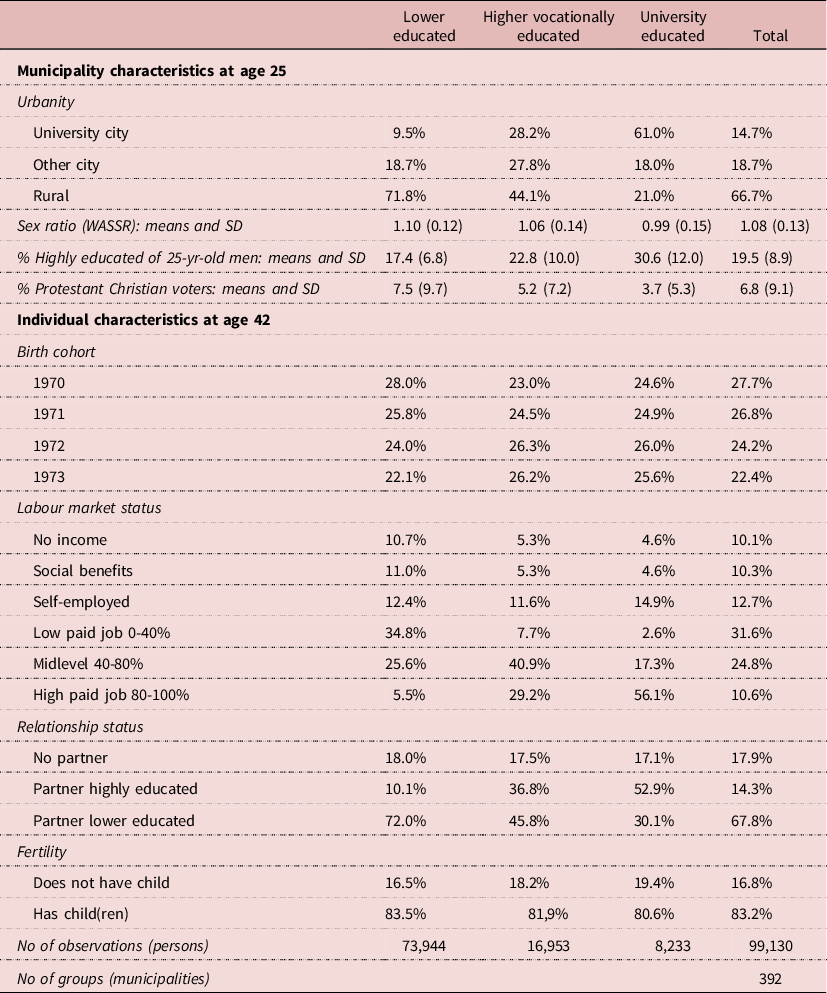
Descriptives of dependent and independent variables: percentages or means and standard deviations
Multinomial logistic regression on labour market status at age 42 (relative risk ratios)
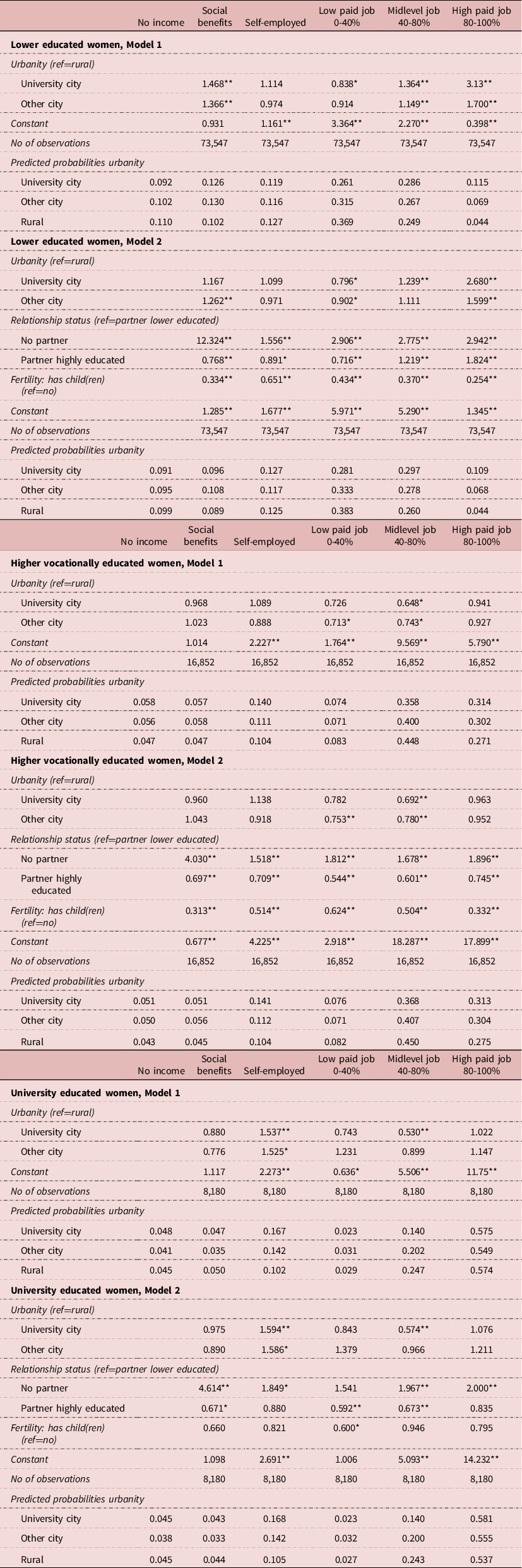
** p<0.01, * p<0.05. Relative risk ratios >1 depict a positive effect relative to the reference category, <1 depict a negative effect. Cluster correction for municipality. Model 2 is corrected for birth year (coefficients not shown).
Multilevel mixed-effects linear regression on the probability of having a partner (ref=no partner) at age 42 (coefficients)

** p<0.01, * p<0.05. Coefficients >0 depict a positive effect relative to the reference category, <0 depict a negative effect. Models 2 and 3 are corrected for labour market status and birth year (coefficients not shown). Significance of the municipality-level explained variance is based on LR test versus linear model (Chi-bar-square).
Results
Descriptive results: Rural men and women’s migration patterns
To give a first overview of general migration patterns of men and women, Table 1 shows the location at age 25 of all 107,649 rurally born native Dutch men and 103,509 rurally born native Dutch women in the Dutch birth cohorts 1970-1973. First, it is noteworthy that there are 4,140 more men than women in these birth cohorts at age 25. Both men and women migrated to cities, but within each educational level women were more likely to have migrated than men. Those who were university educated later in life were the most likely to migrate before age 25: 58% of eventually university educated men lived in university cities at age 25 and an additional 15% in other cities. 61% of eventually university educated women lived in university cities and an additional 18% in other cities. This is in line with the premise that both men and women migrate for educational purposes. Among men and women who got a university education (later in life), women were more likely to migrate to cities than men leading to an small surplus of eventually university educated women in cities of 624. Compared to similary educated men, women who eventually got a higher vocational education were overrepresented in all cities. Women do not need to go to university cities to get a higher vocational education as higher vocational institutes can be found throughout the country in most (larger and smaller) cities.
The surplus of (eventually) lower educated women in university cities was 1,179; of the eventually higher vocationally educated women it was 1,213, and of the university educated it was only 368. Although the migration propensity among the non-university educated was smaller than that of university educated, they constituted a much larger group. Hence, most of the surplus of 25-year-old rurally born women in university cities consisted of women who did not get a university education.
Table 2 shows the descriptives of the research population of women. Of those women who were later lower educated, a majority of 72% lived rurally at age 25. Of those with a higher vocational education, a large minority of 44% lived rurally and the rest was equally distributed over non-university and university cities. Of those who were university educated at age 42, a majority of 61% lived in university cities at age 25 and only 21% lived rurally. These results again underline the important role of education as a purpose of rural-urban migration, and confirm the socioeconomic escalator hypothesis. On average, the municipalities where university educated women resided had a higher share of highly educated men and a lower share of Protestant-Christian voters than municipalities of higher vocationally educated women, while municipalities of lower educated women had the lowest shares of highly educated men and the highest shares of Protestant-Christian voters. Also, university educated women’s municipalities had a average sex ratio of 0.99 (i.e. female skewed), whereas the sex ratio of municipalities of higher vocationally educated women was 1.06 and that of lower educated was 1.10 (i.e. male skewed). These municipality characteristics are strongly correlated to urbanity with (university) cities having, on average, a higher share of highly educated men, a lower share of Protestant-Christian voters and a more female-skewed sex ratio compared to rural municipalities.
Multilevel mixed-effects linear regression on probability of having a highly educated partner (ref=lower educated partner) at age 42 (coefficients)

** p<0.01, * p<0.05. Coefficients >0 depict a positive effect relative to the reference category, <0 depict a negative effect. Models 2 and 3 are corrected for labour market status and birth year (coefficients not shown). Significance of the municipality-level explained variance is based on LR test versus linear model (Chi-bar-square).
At age 42, the majority of women were employed. Lower educated women were most often employed in a low or midlevel-paid job, higher vocationally educated most often held midlevel jobs, and the majority of university educated women were employed in a high-paid job. Also, lower educated women more often lived on social benefits and were housewives more often than higher vocationally educated and university educated women. There was no large difference between women with different educational levels with respect to being in a relationship, but there was a steep educational gradient with respect to the partners’ education with lower educated women being much less often in a relationship with a highly educated partner (10%) than higher vocationally educated (37%) and university educated women (53%). There was a small gradient with respect to fertility: Lower educated had children somewhat more often (84%) compared to higher vocationally (82%) and university educated women (81%).
Labour market status: the socioeconomic escalator hypothesis
Table 3 shows the results of the multinomial logistic regression on labour market status, testing the socioeconomic escalator hypothesis: do women have better socioeconomic outcomes if they lived in cities at age 25? Model 1 is the model with only the urbanity variable without controls, Model 2, the full model, is discussed below but most patterns were robust and already visible in the first model without control variables. The predicted probabilities (Figs. 1a, 1b and 1c) reveal a clear gradient within the different job levels with respect to urbanity. Lower educated women were more often employed in high and midlevel paid jobs when they lived in cities at age 25 compared to rural areas. University and higher vocationally educated women were more often employed in high paid jobs when they lived in university cities at age 25. In cities, lower educated were more often employed in midlevel jobs but university and higher vocationally educated women less often. A midlevel job is relatively well paid for lower educated, but relatively low paid for the highly educated. Hence, the results are in line with the socioeconomic escalator hypothesis. Furthermore, university educated were more often self-employed in cities, as were the higher vocationally educated. Lower educated women were slightly more often dependent on social benefits.
Multilevel mixed-effects linear regression on the probability of having a highly educated partner (ref=lower educated partner) at age 42; lower and university educated women with interaction effect (coefficients)

** p<0.01, * p<0.05. Coefficients >0 depict a positive effect relative to the reference category, <0 depict a negative effect. Model is corrected for labour market status and birth year (coefficients not shown). Significance of the municipality-level explained variance is based on LR test versus linear model (Chi-bar-square).
Predicted probabilities and 95% confidence limits of labour market status by urbanity for lower educated women, based on Table 3, Model 2.

Predicted probabilities and 95% confidence limits of labour market status by urbanity for higher vocationally educated women, based on Table 3, Model 2.

Predicted probabilities and 95% confidence limits of labour market status by urbanity for university educated women, based on Table 3, Model 2.

To get insight in the trade-off between career and family formation the control variables ‘relationship status’ and ‘fertility’ are shown as predicted probabilities (Figure 2a, 2b, 3a and 3b, excluding the higher vocationally educated). Figure 2a and 2b show that there is no evidence of a trade-off between career and the probability of being in a relationship for either lower or university educated women. Single women were least likely to be without income. Since women without income are often housewives, it is likely that their labour market status followed their relationship status, not vice versa. Single women were less likely to be self-employed but much more likely to be on social benefits. Lower educated women with a highly educated partner were less likely to be in a low paid job compared to being in a midlevel or high paid job. University educated women with a highly educated partner were less likely to be employed in a midlevel job and slightly more likely to be employed in a high paid job.
Predicted probabilities and 95% confidence limits of labour market status by relationship status for lower educated women, based on Table 3, Model 2.

Predicted probabilities and 95% confidence limits of labour market status by relationship status for university educated women, based on Table 3, Model 2.

Predicted probabilities and 95% confidence limits of labour market status by fertility for lower educated women, based on Table 3, Model 2.

Predicted probabilities and 95% confidence limits of labour market status by fertility for university educated women, based on Table 3, Model 2.

Some evidence for a trade-off between career and fertility (motherhood) was found, especially for lower educated women (Figure 3a): Childless lower educated women more often had midlevel and high paid jobs compared to women with children (despite the fact that women with these types of jobs more often had a partner, Figure 2a). Women with children were more often self-employed or without income. This also points to a trade-off since female entrepreneurs work on average 25 hours a week in the Netherlands and combining work and private life is an important motive for starting a business among European women (Piacentini, Reference Piacentini2013). Childless lower educated women were more often dependent on social benefits than women with children, as were single lower educated women. This suggests that economic and relationship/family disadvantages cluster within certain vulnerable groups, especially among lower educated women. With regard to university educated women, Figure 3b shows that the differences between women with and without children were small although women with children were a bit more often employed in midlevel jobs compared to their childless counterparts.
In short, being in a relationship shows no correlation with labour market position but having children does, although specifically for lower educated women. This indirectly contradicts the city lifestyle hypothesis which predicted a trade-off between career and family formation that is greater for the highly educated than for lower educated. However, it should be noted that this study uses a rough measure of ‘career’ and might underestimate the trade-off for all women.
Relationship status
Table 4 tests the relationship market competition hypothesis and the city lifestyle hypothesis and shows the effects of urbanity on the probability of having a partner. Model 1 is the model with only the urbanity variable, Model 2 includes individual control variables and Model 3 further includes control variables on the municipality level to get more insight in the potential mediating role of municipality characteristics, especially sex ratio, within the ‘city effect’. Predicted probabilities show that lower educated women less often had a partner at age 42 when they lived in cities at age 25 compared to when they lived in rural areas in all of the models, in line with the relationship market competition hypothesis. Also in line with this hypothesis, a higher sex ratio (relatively more men) was related to an increased probability of having a partner for lower educated women. However, a city effect still remained even after correction for sex ratio. The full model shows that 78.1% of lower educated women were estimated to have a partner in university cities, 80.9% in other cities and 82.9% in rural areas. Hence, the ‘city effect’ is not completely mediated by sex ratio.
For university educated women, the picture is different. In contrast to the relationship market competition hypothesis and city lifestyle hypothesis, living in cities was not associated with a lower likelihood of having a partner in any of the models. Women living in other cities at age 25 even had a higher predicted probability of having a partner in Models 1 and 2. Sex ratio had no influence on university educated women’s probability of singlehood either, contradicting the relationship market competition hypothesis. The share of highly educated men had no influence, but there was a negative association between the share of Protestant-Christian voters in the municipality and the probability of having a partner.
Higher vocationally educated women resembled the lower educated to a large extent. Like the lower educated, living in university cities at age 25 was associated with a lower predicted probability of having a partner. However, unlike the lower educated this was not true for non-university cities, and the effect might in part be mediated by the sex ratio in cities: the significant effect disappeared after introducing municipality characteristics in Model 3, of which sex ratio clearly had the strongest effect.
For women who had a partner Table 5 shows the effects of urbanity on the probability that this partner is highly educated, thus testing the relationship market supply hypothesis. Again, Model 1 is the model with only the urbanity variable, Model 2 includes individual control variables and Model 3 further includes control variables on the municipality level. The predicted probabilities show that all women (lower, higher vocationally and university educated women) were much more likely to have a highly educated partner in cities compared to rural areas in all models, in line with the relationship market supply hypothesis. Furthermore, as this hypothesis predicted, the share of highly educated men in the area had a highly significant positive influence. After including this variable the ‘city effect’ became somewhat smaller, but remained significant for all women. So, the city effect was not fully mediated by the supply of highly educated men. For lower educated women, sex ratio had a negative effect: a male-skewed sex ratio was related to a lower chance of having a highly educated partner and the share of Protestant-Christian voters had a negative effect as well. The relationship market supply hypothesis predicted that the ‘city effect’ is stronger for university educated women than for lower educated. The predicted probabilities presented in Table 5 indeed suggest just that: urban-rural differences are more pronounced for the university educated. A formal test is presented in a multilevel mixed-effects linear regression analysis on the pooled group of lower and university educated women (excluding the higher vocationally educated): the interaction between urbanity and education level is positive and significant (Table 6).
Multilevel mixed-effects linear regression on fertility (having child(ren) yes=1, no=ref) at age 42 (coefficients)

** p<0.01, * p<0.05. Coefficients >0 depict a positive effect relative to the reference category, <0 depict a negative effect. Models 2 and 3 are corrected for labour market status and birth year (coefficients not shown). Significance of the municipality-level explained variance is based on LR test versus linear model (Chi-bar-square).
Fertility
Table 7 tests the relationship market supply hypothesis by looking at fertility. In areas with a relative abundance of men, women are expected to have a higher fertility. Model 1 includes only the urbanity variable, Model 2 includes individual control variables and Model 3 further includes control variables on the municipality level. Additionally, Model 4 corrects fertility for relationship status: whether the woman has a partner and whether this partner is lower or highly educated. Lower educated women’s predicted probability of being a mother at age 42 was somewhat lower when they lived in university cities at age 25 (81,7%) compared to other cities (83,5%) and rural areas (83,8%, Table 7, Model 2), but the differences were small. After correcting for municipality characteristics, this ‘city effect’ disappeared completely. In line with the relationship market supply hypothesis, sex ratio was highly significant in Model 3 and apparently mediated the city effect for the lower educated. Unsurprisingly, the effect of sex ratio disappeared when the lower educated woman’s own relationship status was accounted for in Model 4. Relationship status itself had a large influence on fertility. Apparently, the local sex ratio does not directly influence fertility, but it influences women’s chances of being in a relationship and through that, also fertility. Interestingly, lower educated women with a highly educated partner had a higher fertility than those with a lower educated partner. Living in other, non-university cities was not significantly related to fertility with the exception of the full model: After correcting for the influence of relationship status, lower educated women living in non-university cities had a higher predicted probability of being a mother than women in rural areas (83.1% in rural areas versus 84.2% in other cities).
Again, the pattern was different for university educated women. Their fertility was not lower in large cities, but even higher (although this effect disappeared for university cities when municipality level characteristics were corrected for). Sex ratio had no significant influence on fertility. These results contrast the relationship market supply hypothesis. The proportion of highly educated men had no influence on fertility either, but university educated women living in areas with a larger share of Protestant Christian inhabitants had a lower fertility. Like lower educated women, university educated women had a higher fertility when they had a partner and the probability of having children was even higher when their partner was higher educated.
Higher vocationally educated women again held an intermediate position. For them, there was no significant city effect on fertility, living in a municipality with more Protestant Christian inhabitants had a negative influence, and sex ratio had a positive influence, but this effect disappeared after correcting for relationship status, as it did for lower educated women.
Discussion
Within the Dutch cohorts studied in this paper, both rural men and rural women migrated from rural areas to cities, but men did so to a lesser extent than women. The majority of rurally born women that were later university educated lived in university cities at age 25, presumably having obtained their education there. However, the surplus of young women in cities mainly consisted of women who never graduated from university, since non-university educated constituted the biggest group numerically among the migrants.
As expected, cities functioned as socioeconomic escalators for women with respect to education and work. Both lower and university educated rural women who had lived in large cities at age 25 had better paid jobs later in life than the women who stayed in rural areas. This study found no evidence for the city lifestyle hypothesis for the university educated: the idea of the highly educated city woman being single and childless as a positive lifestyle choice and/or an increased focus on career. There was a small educational gradient with respect to fertility: university educated were less often mothers. However, no negative ‘city effect’ was found for the university educated. On the contrary, in most models they more often had children when they lived in (non-university) cities at age 25 compared to rural areas. Urban services and paid amenities such as flexible child care facilities may facilitate the combination of work and care in cities for the affluent middle class. In contrast, lower educated women did run a higher risk of remaining single in cities compared to rural areas, and a very small increase in the risk of remaining childless was seen in university cities. This might be a lifestyle choice for some women, but most likely not for all of them. On the one hand, employment in a high paid or midlevel job was associated with childlessness which could be indicative of a career-oriented lifestyle. On the other hand, singledom and childlessness were also associated with living on social benefits which is indicative of economic vulnerability. The study provided evidence to support the relationship market supply hypothesis: Both lower and university educated urban women were more often in a relationship with a highly educated man compared to their rural counterparts, and this effect was stronger for the university educated. Women with a highly educated partner were more likely to have children. Interestingly, this held true for the lower educated women as well as for the university educated. If having children is seen as a increased level of commitment within a relationship then this finding contradicts the cultural matching hypothesis which states that both women and men seek similarity in partners (Kalmijn, Reference Kalmijn1994). It is, however, in line with the economic competition or status attainment hypothesis (Kalmijn, Reference Kalmijn1994; Smits et al., Reference Smits, Ultee and Lammers1998) and with the hypothesis from evolutionary psychology that men with high levels of resources are attractive for women (Buss, Reference Buss1989; Geary et al., Reference Geary, Vigil and Byrd-Craven2004). The relationship competition hypothesis –city women remaining single or childless because they face increased competition with other women- was confirmed for lower educated but not for university educated women. The female-skewed sex ratio explained the lower fertility of lower educated women in cities. Their increased risk of remaining single in cities was partly explained by sex ratio, but not completely: a significant effect of urbanity remained after sex ratio was included in the model. Future studies that focus specifically on the influence of sex ratio might shed more light on this by including and comparing the effects of different measures of sex ratio (cf. Eckhard & Stauder Reference Eckhard and Stauder2018).
The fact that lower educated women but not higher educated were more often single when they lived in cities at age 25 indicates that in favourable market situations many (highly educated) men might prefer highly educated women as long-term mates (‘male choice’ in biosocial terms). This is in line with the large body of sociological literature on educational homogamy, but contrasts with theory and findings from evolutionary psychology that mainly women, not men, prefer high-resource partners. However, as societal gender equality rises such a preference would make increasing economic sense for men. Segregation in relationship markets may play a role as well. People with different educational levels have less opportunities to meet each other in their neighbourhood, leisure activities and at work.
As outlined in the introduction, in this study benefits and risks are framed within the context of both economic outcomes and family outcomes. The results showed clear economic benefits of female migration to cities. City women had jobs that paid better, and they more often had a relationship with a highly educated man who has the potential for high earnings himself. For university educated women, this study found no risks of migration. For lower educated women on the other hand, migration to cities appears to involve potential risks as well as potential gains, as predicted by Edlund’s model (Reference Edlund2005). Migration to cities was associated with a higher probability of partnering a highly educated man with resources, but also a higher probability of staying single and childless due to, among other things, the female-skewed sex ratio in cities. There also appeared to be some economic risks for lower educated women: those who migrated to non-university cities were more often dependent on social benefits than those who stayed in rural areas. These risks moreover seemed to cluster within certain groups: women on social benefits were more often single and childless.
From this study it cannot be concluded whether migration for marriage or relationship prospects is a real part of women’s migration flows within the Netherlands. To get more insight in women’s motivations, in-depth qualitative and survey studies are needed. Many human societies, including old European societies, are patrilocal: women become part of the male’s household upon marriage and hence female marriage migration is more common than male’s (e.g. Mulder & Wagner, Reference Mulder and Wagner1993; Seielstad et al., Reference Seielstad, Minch and Cavalli-Sforza1998; Oota et al., Reference Oota, Settheetham-Ishida, Tiwawech, Ishida and Stoneking2001). Such systems are common in societies where men monopolise resources such as land or cattle and thus attract mates (Mace, Reference Mace, Frey, Störmer and Willführ2011). In modern economies, resources mainly consist of human capital: a high education and the potential for high earnings. Men with high levels of resources are concentrated in urban areas. If some women do indeed migrate to urban areas to enhance relationship prospects (Thadani & Todaro, Reference Thadani, Todaro, Fawcett, Khoo and Smith1984) this could be seen as a modern form of female marital migration. Increasing socioeconomic gender equality might enhance male preference for a high-resource partner too and any such female marital migration -if it exists- should be expected to diminish over time.
In many aspects, socioeconomic contrasts in the Netherlands are increasing, both within cities and between urban and rural areas. Female rural-urban migration is likely to contribute significantly to these contrasts. Rather than merely being the ‘tied movers’ that they were in the past, women nowadays have individual mobility agency to achieve their goals of education, career and relationship formation, either within a couple (Smits et al., Reference Smits, Mulder and Hooimeijer2003) or on their own. The highly educated find each other within the urban relationship markets, leading to sociogeographical ‘sorting’: highly educated couples concentrate within and around larger cities, and lower educated couples in more rural areas. Two highly educated people who combine their individual financial, social and cultural resources increase their socioeconomic advantage, and provide the optimal circumstances to transmit their socioeconomic status to their children. This could lead to increasing regional contrasts. Forecasts predict that urban areas will continue to grow worldwide and highly educated may continue to become more and more clustered within urban areas in Western countries (Kooiman et al., Reference Kooiman, Latten and Bontje2018). Such clustering of talent further benefits cities in terms of knowledge capital, but will leave rural areas at an increasing disadvantage. Within urban areas, there are socioeconomic contrasts too, reflected in the diverging socioeconomic and family life courses of university educated and lower educated women.
Conclusions
Female migration to cities served to increase women’s resources. In line with the idea of cities as socioeconomic escalators, women who migrated from rural to urban areas were more often university educated and had better paid jobs later in life. The city also functioned as a relationship market with a relative abundance of men with resources. Both lower and university educated city women were more likely to be in a relationship with a highly educated man compared to their rural peers. University educated women benefited both in terms of their own socioeconomic outcomes and in terms of their partners’ resources. However, for lower educated women urban migration may entail risks as well as benefits as these women also had an increased probability of being single later in life.
The autors assert that all procedures contributing to this work comply with the ethical standards of the relevant national and institutional committees on human experimentation and with the Helsinki Declaration of 1975, as revised in 2008.
The authors have no conflicts of interest to declare.
This research received no specific grant from any funding agency, commercial entity or not-for-profit organization.


 Open access

