


Introduction
What explains regional differences in anti-immigration policy preferences? This question has become a prominent puzzle in the literature on immigration attitudes and radical right voting over the last decade. The macro-level study of anti-immigrant reactions has typically focused on differences between countries. However, national differences have been increasingly overshadowed by stronger patterns of subnational variation, especially since the turn of the new century (Arzheimer & Bernemann Reference Arzheimer and Bernemann2024; Cremaschi et al. Reference Cremaschi, Rettl, Cappelluti and De Vries2025; Golder Reference Golder2016; McKay Reference McKay2019; Vasilopoulou & Talving Reference Vasilopoulou and Talving2023). Unpacking the mechanisms behind the geographical polarization of political attitudes is an important endeavor for at least two reasons. First, it can help to explain why regional disparities correlate strongly with anti-globalization backlash and most of the political upheaval experienced after the 2008 Global Financial Crisis (Broz et al. Reference Broz, Frieden and Weymouth2021), including the election of Donald Trump as US president (Rodriguez-Pose et al. Reference Rodriguez-Pose, Lee and Lipp2021) and the Brexit vote in the United Kingdom (Carreras et al. Reference Carreras, Irepoglu Carreras and Bowler2019; Colantone & Stanig Reference Colantone and Stanig2018). Second, sharp geographical disparities in political preferences can disrupt the performance of liberal democratic institutions. For instance, they can bias the translation of votes into seats, and reduce the incentives of parties to represent ideologically distant areas (Rodden Reference Rodden2010).
While regional differences in anti-immigration preferences are behind some of the most consequential political events of our days, the reasons behind them are not well understood. In this paper, we propose a new theory of interregional mobility and spatial heterogeneity of anti-immigration attitudes. Our argument has three steps. First, we argue that individuals exhibit stronger anti-immigration sentiment when exposed to structural labor market risks, defined as regional labor markets with high unemployment rates and indicative of structurally low demand for those individuals’ occupation-specific labor. Second, we expect high labor market risks at the regional level to affect individuals’ probability of moving to a different region with better labor market prospects. We argue that movers are more likely to migrate interregionally when they face better structural employment prospects in their new region compared to their previous one, especially when their occupational skills are sufficiently transferable. Third, the two previous micromechanisms have implications for the spatial political makeup of the country. The higher the proportion of risk-reducing movers into a given region, the lower the level of aggregate anti-immigration concern we expect to find.
We provide evidence for our argument using georeferenced panel data from the German Socio-Economic Panel (GSOEP) in combination with detailed information on the dynamics of regional (county-level) labor markets, obtained through original aggregations of data from the German microcensus. The combined data not only allow us to trace changes in individual exposure to unemployment risks over time but also confirms important regional patterns in the distribution of anti-immigration concerns, with notable variation both between regions and within regions over time. Using this rich and novel database, we run a series of longitudinal analyses allowing us to test the intra-individual effects of regional labor market dynamics, net of static unobserved characteristics simultaneously affecting individuals’ probability to move and anti-immigration sentiment.
Our findings make three main contributions to interrelated literatures. First, while residential sorting has been suggested as a determinant of geographical polarization of attitudes and preferences (Martin & Webster Reference Martin and Webster2020), the reasons behind residential mobility are typically ignored or unclear. The few studies that analyze the drivers of residential sorting tend to focus on the cultural and attitudinal congruence between one’s preferences and the destination area (Gallego et al. Reference Gallego, Buscha, Sturgis and Oberski2014; Maxwell Reference Maxwell2019).
We argue that regional–occupational unemployment market risks are an important and overlooked driver of residential choices and attitudinal change. As they define structural regional imbalances between occupational labor demand and supply, regional–occupational unemployment risks are an important causal precedent to second-order labor market outcomes like wages and a novel explanation of residential mobility that complements non-economic factors like self-selection into culturally similar environments. Advancing existing approaches to occupational explanations of attitudes and behaviors, we focus on intra-individual and intra-occupational risk dynamics and thereby circumvent the well-known endogeneity concerns that result from workers’ initial self-selection into occupations (see Kitschelt & Rehm Reference Kitschelt and Rehm2014).
Our findings have inevitable implications for the canonical debate between cultural and economic theories of anti-immigration sentiment. While our analyses confirm the importance of cultural sorting (Sobolewska & Ford Reference Sobolewska and Ford2020), they also suggest that economic risk cannot be ignored (Abou-Chadi et al. Reference Abou-Chadi, Cohen and Kurer2025; Bolet Reference Bolet2020; Carreras et al. Reference Carreras, Irepoglu Carreras and Bowler2019; Colantone & Stanig Reference Colantone and Stanig2018; Dancygier & Donnelly Reference Dancygier and Donnelly2013; Fetzer Reference Fetzer2019; Malhotra & Mo Reference Malhotra, Margalit and Mo2013). Our analyses reveal the importance of combining occupational and regional levels of analysis to explain both patterns of anti-immigration concern and interregional mobility. When doing that, demand-side factors and labor market risks emerge as powerful economic determinants of individual anti-immigration sentiment (Pardos-Prado & Xena Reference Pardos-Prado and Xena2019) and its geographical distribution.
Second, the literature is divided between compositional and contextual explanations (Maxwell Reference Maxwell2019). Compositional theories argue in favor of the stability of preferences over the life cycle and self-selection into congruent environments as a mechanism to explain geographical sorting (Gallego et al. Reference Gallego, Buscha, Sturgis and Oberski2014). By contrast, contextual explanations expect residential areas to shape people’s preferences, depending on contact opportunities or group-conflict threats (Heerden & Ruedin Reference van Heerden and Ruedin2019; Lancee & Schaeffer Reference Lancee, Schaeffer, Koopmans, Lancee and Schaeffer2015). Our analyses unpack a new microlevel mechanism of residential relocation and reveal that preferences do indeed adjust depending on the relative change in economic conditions from origin to destination. Both self-selection and contextual effects are at play – while interregional movers are more likely to be liberal to begin with, their preferences adjust at the destination, where exposure to improved levels of local economic risk ameliorates anti-immigration concern. Workers with transferable skills are more likely to relocate geographically and to subsequently reduce anti-immigration sentiment.
Third, our labor market mechanism at the individual level helps to explain increasing geographical heterogeneity over time. High proportions of economic risk-reducing movers into specific areas shape their demography and average attitudinal outlook, especially when those destination areas enjoy low levels of unemployment and high GDP per capita. While recent work has unpacked important dynamics taking place in so-called ‘left-behind’ places (Dancygier et al. Reference Dancygier, Dehdari, Laitin, Marbach and Vernby2025; McKay Reference McKay2019), our aggregate results suggest that the process of geographic polarization is especially driven by well-performing areas becoming ever more liberal.
Theoretical Expectations
Our theoretical argument links the political geography of anti-immigration sentiment to the interplay of subnational heterogeneity in labor markets, residential mobility, and individual immigration attitudes. In developing our argument, we emphasize the role of regional–occupational unemployment risks. This offers a novel perspective on domestic migration that moves beyond well-known paradigms based on income maximization, as employment security captures an important dimension of economic well-being – future-oriented and uncertainty-reducing – whose behavioral implications are distinct from those of income.
Unemployment risks reflect imbalances between occupational labor demand and supply. Where risk is high, supply of occupation-specific labor exceeds demand, meaning that a share of workers trained to perform a given occupation fail to find employment. To the contrary, where risk is nil, demand for occupation-specific labor is barely met by – or perhaps even exceeds – regional labor supply. Such imbalances in occupation-specific demand and supply are an important causal precedent to wages: low risk strengthens the bargaining position of job applicants and incentivizes employers to pay higher wages. However, moving beyond this indirect mechanism of income maximization, we argue that the prospect of living in contexts of high employment security also affects residential mobility and anti-immigration sentiment in distinct and so far overlooked ways: via economic self-insurance.
Existing research in comparative political economy highlights that individuals seek insurance against adverse economic events. Next to demanding public insurance provided by the welfare state (see, for example, Rehm Reference Rehm2016), individuals may also seek to self-insure against future disruptions of income streams, for instance via asset ownership (Ansell Reference Ansell2014). Here, we propose residential mobility across regional labor markets as another important mechanism of economic self-insurance. By sorting into subnational labor markets where demand for one’s occupational profile is high, individuals can not only maximize their income but also minimize their risks of unemployment for the foreseeable future.Footnote 1 Risk minimization, in turn, is of immediate relevance and of distinct theoretical value for understanding immigration-related attitudes. This is because, in line with demand-side labor market competition theories of anti-immigration sentiment, high structural demand for one’s labor shields native workers from threats posed by immigrant labor supply and thereby explains more liberal immigration attitudes. In the following, we expand on these premises by developing our argument in three steps.
Unemployment Risks and Anti-Immigration Attitudes
The first step of our argument concerns the impact of regional labor market dynamics on anti-immigration attitudes. Most labor market competition theories of anti-immigration sentiment have their origin in the factor proportions model (Hainmueller et al. Reference Hainmueller, Hiscox and Margalit2015). This model expects immigrants to lower the wages of native workers with similar skills. Assuming perfect substitutability between immigrant and native workers, low-skilled (high-skilled) workers are expected to fear low-skilled (high-skilled) workers and to prefer high-skilled (low-skilled) workers. The intuitive predictions of classical labor market models, however, have fared very poorly in rigorous empirical tests. When exposing individuals to randomized skill levels of immigration, there is no evidence that patterns of competition emerge at similar levels of skill (Hainmueller & Hiscox Reference Hainmueller and Hiscox2007). This has led researchers to shift their attention toward the important role of education and value divides between more cosmopolitan attitudes (typically clustered in cities) and more nationalist and nativist orientations (increasingly concentrated in towns and rural areas) (Sobolewska & Ford Reference Sobolewska and Ford2020).
Newer analyses of labor market dynamics, however, suggest that demand-side (as opposed to supply-side) factors can systematically shape public attitudes towards immigration. While most previous work focuses on supply-side shocks (inflows of immigrants who are supposed to lower wages and job prospects among local workers), the availability of jobs at similar levels of skill has a pervasive effect on anti-immigration attitudes (Pardos-Prado & Xena Reference Pardos-Prado and Xena2019). This builds on research showing that occupational-level dynamics can have strong local effects on individuals’ perceptions of interethnic competition and political preferences (Bolet Reference Bolet2020; Dancygier & Donnelly Reference Dancygier and Donnelly2013; Malhotra & Mo Reference Malhotra, Margalit and Mo2013). Based on previous research, we thus hypothesize the following:
Hypothesis 1: The higher the unemployment risks an individual is exposed to, the greater their worries about immigration.
Unemployment Risks and Residential Mobility
Second, we expect that prospects of relative improvements in regional labor market risks within one’s occupational group will increase the motivation to move to a new region with better labor market prospects. Neoclassical economic models of migration are based on the canonical expectation that when the net benefit of migrating is greater than the cost, migration ensues. More specifically, destinations with an abundance of capital and a more limited supply of labor will offer substantially higher wages, and these wage differentials will induce workers from poorer economies to move to high-wage destinations (Borjas Reference Borjas1988). The empirical accuracy of theories based on wage differentials, however, has been put into question. The relationship between origin-levels of economic development and migration appears to be curvilinear, highlighting the limitations of migration calculi exclusively based on income maximization, and pointing to the importance of other factors – like resources and aspirations – needed to migrate (De Haas et al. Reference De Haas, Czaika, Flahaux and Villares-Varela2019).
The literature on urban economics has shown that economic motivations are important to understand internal migration. The main focus, however, has been on housing market developments. Ganong and Shoag (Reference Ganong and Shoag2017) develop a model in which rising housing prices in high-income areas deter low-skill migration and slow income convergence. Rising housing prices have also been identified in the political science literature as key determinants of the shifting electoral coalitions and political geography of radical right and social-democratic support (Abou-Chadi et al. Reference Abou-Chadi, Cohen and Kurer2025; Adler & Ansell Reference Adler and Ansell2020; Chou & Dancygier Reference Chou and Dancygier2021).
While the role of housing markets is increasingly understood, the impact of regional labor market prospects as determinants of interregional mobility remains understudied. Occupational unemployment has proved to be an important proxy for heightened risk perceptions, which in turn explain increased levels of support for social policy programs among other political outcomes (Rehm Reference Rehm2009; Rehm et al. Reference Rehm, Hacker and Schlesinger2012). The role of the geography of labor market risk seems especially important at a time when globalized economies increase the incentives of certain kinds of firms and sectoral economies to concentrate spatially (Broz et al. Reference Broz, Frieden and Weymouth2021; Ottaviano Reference Ottaviano2011; Silva & McComb Reference De Silva and McComb2012). Assuming an exogenous impact of globalization on firm geographical concentration, it is thus reasonable to expect that risk-reducing motivations in the labor market are a powerful determinant of interregional migration. This leads to our second hypothesis:
Hypothesis 2: Individuals are more likely to move interregionally when they face lower unemployment risks in their new region of residence than in their previous one.
While regional economies are likely determinants of risk-reducing patterns of relocation, we expect those patterns to be conditional on individuals’ level of skill transferability in the job market. The concept of skill transferability is linked to a tradition of research in labor economics focusing on occupation-specific investments and typically ignored in the immigration literature (Becker Reference Becker1962; Shaw Reference Shaw1987). According to this perspective, high levels of occupation-specific capital (the contrary of skill transferability) that are independent of educational qualifications ties workers to their occupations and makes switching difficult. Occupational skill specificity has also proved to be an important determinant of wage inequality, in the sense that higher specificity leads to higher economic returns in the longer run (Kambourov & Manovskii Reference Kambourov and Manovskii2009; Sullivan Reference Sullivan2010; Zangelidis Reference Zangelidis2008). Therefore, the prospect of switching jobs after the accumulation of experience and occupational capital in a declining sector is either not possible or related to significant income losses. This is why workers with high levels of occupation-specific human capital have been shown to be more supportive of generous social policies and redistribution measures in case of an employment shock (Iversen & Soskice Reference Iversen and Soskice2001). Our third hypothesis thus expects that, even though regional labor market risks may increase the motivation to move to a region with better prospects, actually deciding to move will be more likely among workers with high levels of skill transferability.
Hypothesis 3: Individuals are more likely to move interregionally when they face lower unemployment risks in their new region of residence than in their previous one, provided their skills are sufficiently transferable (conditional effect).
The validity of H3 relies on the assumption that geographical moves without occupational transition and downgrading are less likely, or more costly, among workers with low levels of skill transferability. Even in the less likely scenario of geographical moves without occupational transitions, the accumulation of firm-specific human capital can also incur costs in the context of transitions within similar task and skill levels. However, these assumptions might not apply in all cases. It is equally plausible to expect that individuals with less transferable skills, and therefore the most exposed to potential labor market disruptions, are more likely to move to areas with lower unemployment risk for their particular occupation. The validity of the assumptions underpinning H3 will thus be tested in the empirical analyses below.
Interregional Risk-Reducing Relocations and the Political Georaphy of Anti-Immigration Sentiment
The last step of our argument builds upon the micromechanisms of residential relocation and anti-immigration attitudes sketched out in the previous hypotheses. Demographic flows are increasingly identified as determinants of compositional changes and socio-political attitudes (Dancygier et al. Reference Dancygier, Dehdari, Laitin, Marbach and Vernby2025). If high occupational risk in a given region is connected with both the likelihood to move interregionally and with anxieties over interethnic competition, labor market dynamics should be connected with increasing geographical differences in anti-immigration attitudes. More specifically, we expect movers who relocate into areas with better labor market prospects to lower their anti-immigration concern, therefore contributing to a decrease in the average level of anti-immigration hostility in that area. This leads to our last hypothesis:
Hypothesis 4: The higher the proportion of interregional risk-reducing movers into a given region, the lower the aggregate level of anti-immigration sentiment in that region.
Data
To investigate the link between regional labor markets, residential relocation, and anti-immigration sentiment, we combine a novel time-series cross-sectional data collection on regional labor markets with georeferenced panel data from the German Socio-Economic Panel (GSOEP). We obtained custom time series cross-sectional data on regional labor markets from the German Federal Statistical Office (DESTATIS), which has carried out the German microcensus since 1957. The microcensus is an official statistical survey. Each year, DESTATIS interviews a representative sample of roughly 1 per cent of the German residential population (370,000 households with 810,000 individuals). The survey items cover questions on demography and socio-economic characteristics, including questions on labor market participation, qualifications, and occupations. Participants are obligated to provide information for most of the questions.Footnote 2 Given the exceptionally large and representative sample, the microcensus allows for the study of subpopulations at granular subnational levels.
While the full micro-level data are only available for on-site use at DESTATIS research data centers, we have produced a custom aggregate-level dataset in collaboration with DESTATIS. Specifically, we have obtained annual time-series cross-sectional summaries at the level of so-called Regionale Anpassungsschichten (RAS) for 1996 to 2019. RAS are the smallest subnational entities at which DESTATIS provides weights that allow for the generation of regionally representative subnational aggregate information. RAS are statistical geographies based on the administrative geographies of Kreise or Kreisfreie Städte (counties/cities), which are meaningful and salient geographical entities, with their own parliaments, administrations, and budgets. An RAS is identical to a county or city if the population of counties or cities exceeds 500,000 residents. For less populous counties and cities, an RAS is composed of two or more adjacent administrative entities such that their combined population exceeds 500,000 residents. Counties and cities can therefore be fully mapped onto RAS regions. Whereas the number of German cities and counties fluctuated between 439 and 401 between 1996 and 2019, the number of RAS regions varied between 130 and 145.
Next to information on the demographic composition and general labor market characteristics of RAS regions, our time-series cross-sectional data feature regional–occupational information (job prevalence and unemployment risks across ISCO88 major groups and Oesch-8 classes). This crucial regional–occupational information sets our data collection apart from existing data, including official administrative and labor market statistics.
We use this novel region-level data collection in combination with micro-level panel data from the GSOEP. The GSOEP is an annual household panel that has been in operation since 1984. Aside from extensive information on the demographic composition and socio-economic situation of households and their constitutive members, the GSOEP also features various items on subjective perceptions and worries as well as on the political views of respondents. To test our theory about the effects of interregional residential relocation, we use a restricted-access version of the GSOEP that is exclusively available for on-site use in the GSOEP research data center at the DIW in Berlin, Germany. Over and beyond the standard survey items, this version of the GSOEP contains geospatial information on household locations, including administrative identifiers for zip codes, municipalities, and counties, as well as information on the distance following households’ relocation based on exact geo-coordinates of household addresses.
We exploit the fact that both the GSOEP and our dataset on RAS regions can be linked via county/city IDs (Kreiskennziffer). As a result, we can augment respondent data with time-varying information on regional occupation-specific labor market contexts. While we do not have explicit information on whether respondents’ region of residence coincides with the location of their workplace, data from the German microcensus on individuals’ commute time to the workplace gives us reasonable confidence that the place of residence is strongly indicative of the location of the workplace: roughly 75 per cent of economically active respondents in the microcensus state that the trip to their workplace takes less than 30 minutes. Only 5 per cent state that it takes them longer than one hour to get to their workplace.
For our analyses, we use GSOEP waves 16–34 (1999–2017). These waves contain all necessary variables for studying our research question and for accurately linking our regional–occupational information to the GSOEP. We focus on economically active respondents, that is, those participating in or actively seeking to participate in the labor market. This excludes pensioners, people working in the household, and those still in education. Furthermore, we restrict the sample following two criteria. First, we only use observations for whom information on their place of residence in the current and previous years is available. Second, and relatedly, we only retain respondents who have completed at least two interviews and exclude observations of respondents’ first interview, as these do not bear information on the previous place of residence. Following these sample restrictions, we are left with information on 92,979 annual observations from 12,988 individuals living in unique households. Due to missing data points in this sample, we generated M = 5 multiply imputed versions of the data using Amelia II’s Expectation Maximization Bootstrap algorithm (Honaker et al. Reference Honaker, King and Blackwell2011), a flexible tool for the fast imputation of datasets containing variables of various data types that also accounts for the time-series cross-sectional structure of the data.Footnote 3
Main Concepts: Measurement and Descriptives
Anti-immigration sentiment
The GSOEP presents respondents with a list of items and prompts them to disclose how worried they are about each of them on a three-point scale ranging from ‘no worries’ over ‘some worries’ to ‘big worries’. Since 1999, this list has featured an item prompting respondents to disclose their worries about immigration to Germany.Footnote 4 It is possible that our dependent variable partly captures the salience of, and not only attitudes towards, immigration. However, the strong and significant correlation between our dependent variable and a number of attitudinal items capturing anti-refugee sentiment in the 2016 wave of the GSOEP strongly suggests that our dependent variable also has a negative attitudinal component (see Figure A1.3 in the Online Appendix). This reflects its use in several studies as a measure of positional immigration attitudes (see, for example, Maxwell Reference Maxwell2019 and Pardos-Prado & Xena Reference Pardos-Prado and Xena2019). We use this measure as an outcome in our analyses, recorded to range from -1 (‘no worries’) to + 1 (‘big worries’).
Public opinion estimates of anti-immigration sentiment 1999–2017: county means (left), annual intra-county deviations from county means (center), and association between county means and intracounty change in levels between 1999–2007 and 2008–2017 (right).

Our argument highlights the geographical clustering and increasing polarization of anti-immigration sentiment over time. Therefore, the question arises how strongly public opinion on immigration varies across regions, how strongly it has changed within regions over time, and how differences in regional levels and rates of change over time correlate. Figure 1 addresses these questions by using public opinion estimates of anti-immigration sentiment at the level of German NUTS3 regions.Footnote 5 Estimated regional mean levels, shown on the left, range from −0.35 to 0.42, with a standard deviation of 0.15. This is mirrored by sizeable variation within regions over time, as shown in the center. The right-hand side of Figure 1, lastly, offers an initial exploration of how variations within and across regions correlate. It plots the county-level means in the nineteen-year period we study (x-axis) against the change in mean levels from the first to the second half of the time series (y-axis). While average regional sentiment was generally less immigration-averse in the 2008–17 period than in the preceding 1999–2007 period,Footnote 6 liberal change in immigration sentiment is more pronounced in regions with more liberal levels overall.
Regional labor markets
The question of whether regional labor market discrepancies motivate residential relocation (that is, self-selection into different regional labor markets) prompts the question of how strongly labor market prospects differ across regions. While interregional discrepancies in income levels and costs of living are well documented, we highlight an important, albeit often overlooked, feature of regional labor markets: regional demand for occupation-specific labor. High demand for labor that meets specific task structures and work logics is not only likely to increase wages (Kambourov & Manovskii Reference Kambourov and Manovskii2009; Sullivan Reference Sullivan2010; Zangelidis Reference Zangelidis2008); it is also indicative of expanding regional–occupational clusters, which promise bright economic prospects and medium-term job security.
We capture labor demand by regional–occupational unemployment risks (see, for example, Rehm Reference Rehm2009; Rehm Reference Rehm2016). This measure captures the unemployment rate for specific occupational subgroups within regions and years. Whereas low unemployment risks indicate high demand for a specific type of labor, high unemployment risks indicate that the supply of labor outweighs demand. We choose to capture unemployment risks within occupational classes according to the Oesch scheme (Oesch Reference Oesch2006a; Oesch Reference Oesch2006b), which distinguished eight classes: self-employed professionals and large employers, small business owners, technical (semi-)professionals, production workers, (associate) managers, clerks, socio-cultural (semi-)professionals, and service workers. This classification is particularly suited to our study as it provides a substantively meaningful grouping of task structures and work logics, and explicitly incorporates information on self-employment. It combines a vertical dimension of skills with a horizontal dimension that distinguishes interpersonal, technical, organizational, and independent work logics. The latter are important drivers of socio-cultural issue preferences like immigration attitudes (Kitschelt & Rehm Reference Kitschelt and Rehm2014).
Regional–occupational unemployment risks by Oesch classes.

Figure 2 shows how strongly unemployment risk varies within occupational classes across regions within Germany. The plots show regional–occupational unemployment rates, averaged within each region over the time span from 1999 to 2017. Over and beyond well-established mean differences across classes, with production and service workers especially exposed to unemployment risks, we see considerable spatial heterogeneity in occupation-specific unemployment risks. For instance, we see that a significant share of production workers in our sample work in regional labor markets with unemployment risks well below 5 per cent, while other members of the same occupational group are exposed to regional labor market risks between 25 per cent and 40 per cent. This highlights that employment security is not only a function of which occupation somebody works in, but critically hinges on where someone works in a given occupation. In Online Appendix A1.9, we show that this objective measure also strongly correlates with subjective perceptions of employment security.
Individual skill specificity
Our theoretical expectations state that individuals are less likely to move across regions to find secure employment when they possess highly specific skills, which impose constraints on transferability across occupations. To capture skill specificity empirically, we rely on the standard measure of absolute skill specificity introduced in Iversen and Soskice (Reference Iversen and Soskice2001), and Cusack et al. (Reference Cusack, Iversen and Rehm2006). This measure is based on the International Standard Classification of Occupations (ISCO-88). ISCO-88 classifies 390 specific occupations (unit groups) and groups them into nine so-called major groups with homogeneous skill profiles. Skill specificity is then derived as the ratio of the proportion of unit groups in a given major group over the prevalence of ISCO major groups in the economy. For each major group, this reflects the ratio of available distinct occupations over the prevalence of jobs in these occupations in the economy.Footnote 7
As we are concerned with the question of how skill specificity constrains interregional mobility in the national economy, we treat skill specificity as a national (and not as a regional) measure. We therefore use weighted national-level aggregates from the GSOEP to capture the denominator, that is, the job prevalence of each ISCO-88 major group in a given year. Examples of low skill specificity in our data are, for instance, waiters, housekeepers, office clerks, or cleaners. By contrast, some examples of occupations with high skill specificity are miners, metal production workers, and cement and mineral machine operators.Footnote 8
Interregional residential relocation
Residential relocation is a common phenomenon. While the number of individuals that move in any given year may be low – our data from the German microcensus show that an average of 6.4 per cent of the population move from one year to the next – most people move at least once during their lifetime. According to GSOEP data, 95.6 per cent moved at least once since turning eighteen. Even during the nineteen-year period we study, 42 per cent of respondents moved at least once. Given an average number of 10.1 interviews per respondent, this is a sizable percentage.
However, not all moves are alike. On the one hand, 36.9 per cent of respondents moved intraregionally (within the same county or city) while in the sample. This large percentage is perhaps unsurprising, as intraregional moves include relocations within the same locality. Such moves often occur at several points in an adult’s life due to changes in household composition and household size (for example adults entering and ending relationships, children being born or leaving the household upon finishing school, etc.). On the other hand, 12 per cent of respondents moved interregionally while in the sample. Although interregional moves occur less frequently than intraregional moves, they are ultimately more important for the study of social and political attitudes. This is because they alter the subnational socio-political geography of a country (thus bearing the potential for compositional change) and because they expose individuals to a new residential environment (thus bearing the potential for intra-individual responses to new contexts).
The differences between the two types of moves are forcefully illustrated by some sample descriptives calculated from the GSOEP data. Intraregional movers have an average distance between their old and new homes of about 3 km. In contrast, interregional movers tend to relocate to places that are much farther away from their old homes at 100 km on average.Footnote 9 Whereas intraregional movers tend to stay close to their old home and thus rarely have to sever pre-existing social and economic ties, interregional movers typically not only face new social environments but also completely different labor market contexts than before. In fact, questions prompting individuals to disclose their main reasons for moving suggest that labor market conditions are an important driver of interregional relocation: whereas 33.8 per cent of interregional movers cite job-related drivers among the main reasons for moving, only 4.4 per cent of intraregional movers do so.
To explore the interplay of the two central components of our explanatory framework, we provide some initial descriptive estimates of the nexus between regional–occupational labor market risks and interregional residential relocation. Whereas our explanatory framework analyzes this relationship dynamically at the individual level – asking how the prospects of intra-individual risk reductions predict individual interregional mobility – the descriptive evidence presented here explores this relationship statically at the regional–occupational level – asking how regional–occupational levels in unemployment risks predict percentages of gross in- and out-movers, as well as the mover volumes and net balances.
Towards this end, we use the GSOEP data to estimate how regional–occupational levels in unemployment risks predict the presence of interregional movers. We start by binning the three-year moving average in respondents’ regional–occupational unemployment risk into quartiles. We then employ a simple non-parametric approach for our descriptive inquiry and calculate the sample proportions of recent interregional in-movers and impending interregional out-movers within each quartile. We classify respondents as impending out-movers if they move interregionally within five years following the interview and, analogously, as recent in-movers if moved to their current address from a different region in the five years before the interview.Footnote 10 To obtain accurate estimates of inferential uncertainty, we block-bootstrap the data by respondents. We perform this procedure across all imputations of the data and then pool the resulting bootstrapped estimates across imputations.
Figure 3 presents the results. The figure is divided horizontally into four plots, one for each quantity of interest: the gross percentages of recent in-movers and impending out-movers, the gross volume of in- and out-movers, and the corresponding net balance, that is, the difference between in- and out-movers. In each plot, horizontal bars that extend along the x-axis indicate the corresponding percentages (or, in the case of net balances, percentage points) for each quantity. The y-axis partitions these estimates by the quartile of unemployment risks, ranging from occupations with high regional employment security (Q1) to those with high regional unemployment risks (Q4).
Interregional moves: gross in-mover and out-mover percentages, gross mover volumes, and net mover balances by quartiles of regional–occupational unemployment risks.

The plot reveals several noteworthy patterns. As we can see in the first plot, the lower the regional–occupational unemployment risks, the more likely we are to observe people who recently moved into the region. The second plot shows that neither the same nor the inverse pattern applies for impending out-movers. Even though these are more widespread in the lower half (Q1 and Q2) than in the upper half (Q3 and Q4) of the distribution of unemployment risks, they peak in Q2 and are lower again in Q1. Taken together, as shown in the third plot, residential mobility becomes more widespread into a given region the more secure employment is. Most importantly, as the fourth plot reveals, there is a strong lopsidedness of in- and out-movers in the first quartile. Here, significantly more people are recent in-movers than impending out-movers.
While these descriptive insights do not yet test our hypothesis that individuals move interregionally in pursuit of intra-individual improvements of their employment security, they highlight that regional–occupational employment security is, in fact, a predictor of interregional net in-moves. By implication, regions whose labor markets are dominated by low-risk occupations tend to experience higher volumes and positive net balances of interregional relocation. This gives a first indication of where our proposed microlevel mechanisms are most likely to play out, and how they may eventually contribute to our understanding of subnational geographical polarization.
Analyses and Findings
Longitudinal Microlevel Evidence
In a first set of analyses, we provide longitudinal microlevel evidence. Our interest lies in the intra-individual effects of regional–occupational unemployment risks and anti-immigration sentiment in the context of residential mobility. As such comparisons are only observable for respondents who moved at least once while in the sample, we restrict our inquiry to movers. Our units of analysis are annual respondent-level observations within mover spells – uninterrupted respondent-level time series that involve two different residential addresses.Footnote 11
Due to our theoretical interest in the effects of interregional residential relocation, we subset our analyses to intraregional mover spells on the one hand and interregional mover spells on the other. The effects among intraregional movers provide a baseline: it may be that people are generally more likely to move as their employment security improves, even while staying put in their region of residence.
We sequentially model two types of outcomes – first anti-immigration sentiment, then residential relocations – as a function of regional–occupational unemployment risks. Specifically, we study how intra-individual change in these labor market conditions affects anti-immigration sentiment and moving decisions. Analytically, we focus on the within-effects of unemployment risks. We include both the contemporaneous (in mover-years: post-moving) and the lagged (in mover-years: pre-moving) values of individuals’ regional–occupational unemployment risk. Through the absorption of static individual traits that may co-determine occupational choice and attitudes (and by accounting for dynamic occupational change), we seek to ensure that our estimates of the effects of occupational risk dynamics are free from confounding due to self-selection into specific occupations (see Kitschelt & Rehm Reference Kitschelt and Rehm2014).
We study the within-effects of unemployment risk reductions in a series of within–between models (Bell & Jones Reference Bell and Jones2015). This is a variant of the correlated random effects estimator (Mundlak Reference Mundlak1978), which can jointly capture within effects (via within-demeaned covariates) and between effects (via unit means of covariates or other time-invariant variables). These models yields within-effect estimates identical to those from ‘classical’ fixed effects models. However, they have the benefit of being able to accommodate clustering through additional random effects. This is crucial in light of our data structure, where we must account for various residential and spatial dependencies.
Our linear models take the baseline form of
 $$\eqalign{{y_{i,t}} =& \ \alpha + {({{\bf{x}}_{i,t}} - {{{\bf{\bar x}}}_i})^\prime }\beta + {\bf{\bar x}}_i^\prime \gamma + {\bf{z}}_i^\prime \delta + \cr & {\nu _i} + {\nu _{{j_{[i,t]}}}} + {\epsilon _{i,t}} \cr} $$
Here, $({\bf x}_{i,t} - \bar {{\bf x}}_i)$
represents a vector of time-varying within-respondent-demeaned variables, and β is a vector of corresponding within-effects – our estimates of primary interest.
$({\bf x}_{i,t} - \bar {{\bf x}}_i)$
represents a vector of time-varying within-respondent-demeaned variables, and β is a vector of corresponding within-effects – our estimates of primary interest. $\bar {{\bf x}}_i$
gives an analogous vector of respondent-means of the same variables and
$\bar {{\bf x}}_i$
gives an analogous vector of respondent-means of the same variables and ${\bf z}_i^{\prime }$
a vector of other time-constant variables. The vectors γ and δ capture the corresponding between effects. ν
i
is a respondent-level random intercept and ν
j
[i,t]
is an additional random intercept for the county/city in which respondent i lives at time t. Lastly, ϵ
i, t
is an error term that captures the remaining idiosyncratic variation in outcome y for each respondent i at time t.
${\bf z}_i^{\prime }$
a vector of other time-constant variables. The vectors γ and δ capture the corresponding between effects. ν
i
is a respondent-level random intercept and ν
j
[i,t]
is an additional random intercept for the county/city in which respondent i lives at time t. Lastly, ϵ
i, t
is an error term that captures the remaining idiosyncratic variation in outcome y for each respondent i at time t.
This dynamic specification allows us to retrieve the contemporaneous effect of risk on anti-immigrant concerns. Unemployment risks are measured on the unit scale. As such, the raw coefficient of a change in risk is hardly substantively meaningful – it would be indicative of a 100 percentage point increase in unemployment risks. Instead, our quantity of interest is the marginal effect of a hypothetical one percentage point decrease in unemployment risks.Footnote 12
Our selection of control variables in these models seeks to capture a range of likely time-varying confounders. First, we include education (secondary or less, post-secondary non-tertiary, and tertiary degrees), age (<25, 25–39, 40–54, and 55+), and the number of household members to account for the fact that the processes of aging, educational attainment, and family formation may co-determine individuals’ labor market standing on the one hand and their socio-political attitudes and decisions to move on the other. To separate the effects of unemployment risks from the effects of actual experiences of unemployment, we also control for individual unemployment at t − 1 and t. To capture possible regional confounders, we also include region-level controls for East/West residence, residence in rural, suburban, or urban places, mean age, and the region-level proportion of foreign-born residents. For each of these measures, we include both lagged (t − 1) and contemporaneous (t) values.
To account for economic push factors that may co-determine unemployment risks and attitudes or moving decisions, we take into account individuals’ housing market situation at t − 1. Specifically, we control for homeownership and (imputed) rents. Imputed rents is a standard measure in the GSOEP that reflects homeowners’ monthly savings from owning their primary residence. By interacting homeownership with (imputed) rents, we capture the differential impact of housing markets dynamics for owners and renters.
In terms of economic pull factors, occupational upgrading (or prospects thereof) may co-determine risk reductions and relocation decisions. To eliminate this source of confounding, we control for respondents’ Oesch class at both t − 1 and t.Footnote 13 As a hard test, we additionally subset our samples to mover spells in which relocation was not accompanied by an immediate change in occupational class.
All models are estimated across M = 5 versions of the multiply imputed data. Subsequently, we pool the estimates by simulating the sampling distributions of the parameters and combining the simulation draws across the five imputations before calculating our quantities of interest. Additionally, all models employ cross-sectional sampling weights included in the GSOEP.
Labor market risk and anti-immigration sentiment
The first of our micro-level analyses studies the within-effects of unemployment risk on anti-immigration concern. The corresponding findings are shown in Figure 4. The figure shows the results from two variants of the model: the upper panel shows the model with the selection of covariates described above; the lower panel shows the same models while additionally controlling for annual public opinion estimates of regional anti-immigration sentiment.
The motivation for adjusting for regional public opinion is to test whether intra-individual effects of regional–occupational labor market risks on attitudes persist beyond changes in the opinion climate in an individual’s region of residence. This has different implications for interregional and intraregional movers. For interregional movers, the specification accounts for cultural sorting. While mechanisms of cultural sorting may be endogenous to our proposed economic mechanism (for example, if liberal individuals move to regions with better employment security that also happen to be more liberal), showing that regional–occupational unemployment maintains a significant and sizable direct effect in the lower panel would reassure us that our hypothesized economic mechanism applies beyond mechanisms of cultural-attitudinal sorting. On the other hand, for intraregional movers who do not change regions, the specification adjusts for the intraregional dynamic evolution of public opinion. It thereby accounts for the possibility that individual attitudinal change may be affected by changes in regional opinion climates.
Marginal within-effect of a hypothetical one percentage point reduction in regional–occupational unemployment risks on respondents’ anti-immigration sentiment. Point estimates and simulation-based 95 per cent confidence intervals.

As the upper panel shows, risk reductions significantly predict lower anti-immigration sentiment for all movers, albeit far more strongly in interregional mover spells than in intraregional mover spells. Whereas, at −0.005 (−0.006, −0.003), the magnitude of the effect among intraregional movers is comparable to the overall effect at −0.006 (−0.007, −0.004) units, the effects are much more pronounced in interregional mover spells at −0.011 (−0.014, −0.007) units and −0.011 (−0.015, −0.006) units in interregional mover spells not involving occupational transitions, respectively.
However, as shown in the lower panel, these attitudinal responses to changes in unemployment risks are, in part, reflective of broader attitudinal change in regional contexts, be they dynamic opinion change within regions or differences between origin and destination regions upon interregional relocations. Once we additionally control for region-level estimates of anti-immigration sentiment, the effects for mover spells that occur within one and the same region are near zero. However, our hypothesized effects persist in interregional mover spells, where, beyond regional differences in anti-immigration sentiment between origins and destinations, risk reductions predict a −0.006 (−0.009, −0.002) unit decrease in worries about immigration. While the lower effect magnitude in the lower panel suggests that, as identified in previous literature, cultural sorting does indeed explain an important part of the relationship between residential choices and social attitudes, these findings highlight that decreases in unemployment risk are generally predictive of lower anti-immigration sentiment in the context of interregional residential relocation.
Robustness
We subject these findings to several robustness checks, which we report as part of Online Appendix A2. First, Figure A2.8 tests the robustness of the findings to the inclusion and omission of time-varying economic variables like income and occupational class. Second, Figure A2.9 restricts our analyses to the pre-move and post-move years in each mover spell akin to a first-difference analysis. Third, Figure A2.21 replicates the main specification while excluding mover spells during which respondents experienced unemployment at any point. All specifications support the findings from our main analyses.
Regional–occupational unemployment risks, skill specificity, and interregional residential relocation
In a second step, we turn towards the effects of regional–occupational unemployment risks on residential relocation. Establishing this relationship is a delicate task from a causal perspective: at face value, pre–post-moving differences in labor markets are a result of respondents’ relocation. However, we may reasonably assume that individuals’ initial decision to relocate is itself motivated by expectations about what awaits them in their destination region, including anticipated changes in the labor market conditions they will be exposed to following their move. Therefore, we treat residential relocation as the outcome of intra-individual comparisons of pre- and post-movement comparisons of labor market conditions.
Once again, our quantity of interest is the marginal effect of a hypothetical one percentage point decrease in unemployment risks. We first retrieve the unconditional within-effect of regional–occupational unemployment risks on interregional residential relocation and then test whether this effect is conditioned by individuals’ skill specificity using a linear interaction effect.
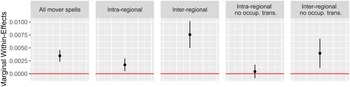
Figure 5 reports the marginal within-effects of a hypothetical one percentage point reduction in regional–occupational unemployment risks on the probability of moving. Next to the overall effect across all mover spells, it also reports these effects for intraregional and interregional movers, both including and excluding those whose relocation coincides with a change in occupations.
Marginal within-effect of a hypothetical one percentage point reduction in regional–occupational unemployment risks on the probability of moving. Point estimates and simulation-based 95 per cent confidence intervals.

The first plot shows that individuals are more likely to relocate when their employment security improves from origin to destination. Overall, a one percentage point reduction in unemployment risk predicts a 0.3 (0.2, 0.5) percentage point increase in the probability of moving. As shown in the second plot, at 0.2 (0.1, 0.3) percentage points, this effect also materializes among intraregional movers. However, as we can infer from the fourth plot, this effect is an artifact of occupational upgrading: once we only focus on individuals who neither change their occupation nor their region of residence, temporal fluctuations in unemployment risks do not predict relocation. Conversely, as we can see in the third and fifth plots, the effect is pronounced and significantly positive among interregional movers. At 0.8 (0.5, 1.0) percentage points, risk differentials between origins and destinations strongly predict interregional relocations. This effect persists among those who move without changing occupational classes, albeit with a smaller magnitude at 0.4 (0.1, 0.7) percentage points. Thus, we can conclude that the prospects of employment security at a new place of residence constitute an important driver of interregional mobility, even in the absence of occupational upgrading.
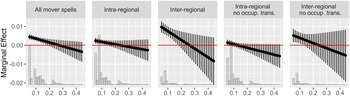
Next, we test our expectation that this general effect is particularly pronounced among individuals with transferable skills. Whereas individuals with transferable skills can navigate across national labor markets relatively freely in pursuit of better labor market conditions, individuals with specific skills will likely face greater constraints. In Figure 6, we therefore condition the effects of a risk reduction on respondents’ skill specificity.
Conditional marginal within-effect of a hypothetical one percentage point reduction in regional–occupational unemployment risks on the probability of moving as a function of absolute skill specificity. Point estimates and simulation-based 95 per cent confidence intervals.

The findings show that reductions in unemployment risk become less predictive of residential relocation as skill specificity increases. The positive effects previously established in Figure 5 are, as before, concentrated among interregional movers (center) and interregional movers who do not change occupations (right). However, as we learn from Figure 6, these effects are only and especially pronounced at the left-hand side of the horizontal axis – among individuals with highly transferable skills. Among individuals with highly specific skills, in contrast, the effects are null. This shows that moving across regions in the pursuit of higher employment security is a phenomenon that only systematically occurs among those who possess sufficiently flexible skill sets.
Robustness
We scrutinize our findings in a series of robustness checks, all of which we present across various subsections of Online Appendix A2. In our main analyses, we modeled the probability of moving as a function of risk changes, given our expectations that individuals move in anticipation of changes to their economic situation. A first caveat is that even though individuals may compare the economic prospects at their eventual destination to their situation at their place of residence, they may do so based on pre-move expectations about the destination, not the actual post-move situation. To address this concern, Figures A2.12 and A2.19 use a first-order lag of economic risk in post-moving years, such that at the time of moving, the risk differential results from a comparison of destination and origin at time t − 1. The effects among interregional movers are consistent with those presented above, albeit slightly smaller in magnitude. A second caveat is that even though individuals move in response to economic prospects, unemployment risks ultimately change as a result of moving, not the other way around. Figure A2.30 therefore presents the effect of moving on unemployment risks. The findings are consistent with our general argument that interregional moving goes hand in hand with significant risk reductions.
Third, Figures A2.11 and A2.17 test if our results are robust to the inclusion or omission of time-varying covariates like class and income. Fourth, in Figures A2.13 and A2.20, we only retain the pre-move and post-move years, akin to a first-difference specification. Fifth, Figure A2.16 reports a specification which estimates the contemporaneous effect of risk while omitting the lag. Sixth, Figure A2.22 replicates the analyses without mover spells during which respondents experienced any periods of unemployment. The results from all these analyses are consistent with those from our main specifications.
Seventh, we scrutinize the linear interaction assumptions implicit to Figure 6 by dichotomizing absolute skill specificity at its median. The findings, shown in Figure A2.18, confirm that risk reductions only affect moving among respondents with below-median skill specificity. Eight, we harmonize the occupational basis of our measures of unemployment risks and skill specificity and replicate the conditional effects with regional–occupational unemployment risks calculated at the level of ISCO major groups in Figure A2.28. While we find no effect moderation among intraregional movers, we still find a pronounced pattern where we hypothesized that the conditionality would exist: among interregional movers. Lastly, we vary the definition of what constitutes an intraregional or interregional relocation. Whereas our main specification uses moves within and across Germany’s 401 NUTS3 regions (counties and cities) to operationalize these concepts, Figures A2.14 and A2.15 use coarser approaches by focusing on moves within and across the 145 RAS regions and fifty Labor Market Regions, defined by the Institute for Employment Research of the Federal Employment Agency as vastly self-contained regional labor markets. Using these coarser geographical entities increases the magnitude of the effect of unemployment risk on interregional relocation. This underlines that risk differentials between origin and destination are an important driver of interregional moves.
Supplementary analyses
In addition to our extensive robustness checks, we perform a series of supplementary analyses to add further insights on, and contextualization of, our findings.
First, Figure A2.10 compares the effects of risk reductions in the context of moving against the pre/post effect of relocation. It shows that net of risk dynamics, individuals (and especially interregional movers) do not become more liberal in their immigration-related attitudes. Liberal attitude change thus critically hinges on risk reductions. Second, we compare the standardized within-effects of increases in respondents’ equivalized household income to those of reductions in their unemployment risks. Figure A2.25 reports these effects on residential mobility. It shows that both increases in income and reductions in unemployment risk predict residential mobility, and interregional moves in particular. Additionally, Figure A2.31 shows that risk reductions also predict incomes, highlighting that, next to high employment security, decreasing risk also results in income gains. However, Figure A2.26 shows that, unlike unemployment risks, income does not exert liberalizing within-effects on respondents’ immigration sentiment. Taken together, these analyses show that while income can explain residential mobility, it neither significantly blocks the sizable effects of unemployment risk, nor can it account for intra-individual changes in anti-immigration sentiment. This underlines the unique theoretical value of our focus on unemployment risks.
Third, we subset our analyses by younger and older respondents. We define younger respondents as those aged under forty at the midpoint of the respective mover spells, and older respondents as those aged forty and above. Whereas Figure A2.23 shows that the effect of risk on anti-immigration sentiment is comparable across both groups, Figure A2.24 reveals that the effect of risk reductions on relocation are far more pronounced among younger respondents. Perhaps unsurprisingly, these findings suggest that while risk reductions in the context of moving are an important explanation of attitude change among interregional movers, the phenomenon of interregional moving in pursuit of better employment security is less pronounced among older individuals.
Fourth, Figure A2.29 replicates our analysis for three other worries about national-level phenomena – crime in Germany, the general economic situation, and xenophobia – to test if the mechanism we identify transcends immigration attitudes in the sense that individuals who improve their situation upon moving become overall less concerned with national politics altogether. We find that this is not the case. While we find pronounced negative effects of individual risk reductions on worries about the national economy, likely indicative of projecting from one’s personal experience onto the national economy, we do not find such negative effects for worries about crime or xenophobia. Fifth, to emphasize the implications of our micro-level mechanisms and as a segue into our aggregate-level analysis, Figure A1.5 gives a descriptive portrayal of the trends in anti-immigration sentiment among risk-reducing movers. It shows that the trends between both groups start to diverge post-moving, with intraregional movers maintaining their levels while interregional movers become slightly more liberal. While descriptive, this analysis suggests that risk-reducing interregional relocations predict lasting shifts towards more liberal immigration attitudes.
Lastly, our analyses have shown that intra-individual risk reductions in the context of moving have the strongest effects, on both relocation and anti-immigration sentiment, among interregional movers. As this group is clearly not a random subset of the population, Table A1.1 explores how interregional movers differ from intraregional movers (and those who do not move) in terms of demographic, socio-structural, and socio-economic covariates. The descriptive characterization reveals that our micro-level mechanisms of within-respondent liberal attitude change pertain primarily to a subgroup characterized by urban residence, high education, and employment in high-skilled occupations – groups which have previously been found to display above-average liberal immigration attitudes (see, for example, Kitschelt & Rehm Reference Kitschelt and Rehm2014; Maxwell Reference Maxwell2019). Thus, our findings imply that the successful cross-regional pursuit of employment security predicts the strongest shift towards liberal immigration attitudes among members of groups that are fairly liberal to begin with.
Aggregate-Level Evidence: Interregional Risk-Reducing In-Moves and Regional Anti-Immigration Sentiment
In a third and final step, we investigate the macro-level implications of the intra-individual behavioral mechanisms we have so far studied. We study the aggregate-level relationship between the proportion of interregional risk-reducing in-movers in a given region and anti-immigration sentiment at the level of the 401 German counties/cities, aggregating repeated yearly observations within their 2017 boundaries over the full nineteen-year period from 1999 to 2017. We define interregional risk reducing (IRRR) in-movers as those individuals who moved into a new region and experienced a decrease in the three-year average of regional–occupational unemployment risks in the process.
Our central variables are aggregate-level estimates from the GSOEP survey data. To retrieve these, we use a global smoothing approach via multilevel regression with region-level predictors and annual county-level random intercepts (see Hanretty et al. Reference Hanretty, Lauderdale and Vivyan2018). Thus, we estimate the county-level average of anti-immigration sentiment and the share of IRRR in-movers based on the systematic and random components of predictive multilevel models.
We predict yearly values of regional anti-immigration sentiment via hierarchical linear models. The systematic component of the models includes fixed effects for state, years, and region types, which classifies counties as rural, suburban, or urban. Additionally, next to the region-level proportion of foreign-born residents, we include cross-classifications of state and year as well as of state and region type fixed effects. In any given year, the county-year random intercepts, then, capture idiosyncratic county-level deviations from the systematic component. These random-effects are characterized by the shrinkage property (Gelman & Hill Reference Gelman and Hill2007): whereas the random deviations for county-years with a large number of data points add decisively to the prediction, in county-years with few data points, the random deviations are shrunken towards zero. Thus, their predictions rely heavily on the information entailed in the systematic component.
We proceed analogously for the prediction of yearly county-level proportions of IRRR in-movers. Due to the binary outcome variable, we employ hierarchical logistic models. We include the same fixed effects, and cross-classifications thereof, as in the previous model. In place of the region-level proportion of foreign-born residents, we include regional unemployment rates.
After retrieving point estimates of the aggregate-level county-year predictions of both concepts, we model within-county effects of IRRR in-moving proportions on our estimates of regional anti-immigration sentiment via within–between models. In doing so, we control for a host of time-varying within-demeaned confounders at the level of the 401 counties and cities: next to a linear time trend, we adjust for mean age, the proportion of women, the unemployment rate, the proportions of non-citizens and unemployed non-citizens, and the logged GDP per capita. We also include the county-means of these variables, along with the county-means of variables which were not observed annually like property prices, logged population density as a variable that hardly changes over time, and a time-invariant indicator distinguishing (partly) rural counties (Landkreise) from cities (kreisfreie Städte) of various size: with less than 100,000 inhabitants, 100,000 to 499,999 inhabitants, and at least 500,000 inhabitants. While these analyses are not immune to unobserved confounders that vary over time, Figure A3.32 in the Online Appendix shows consistent results when including a more extensive battery of controls accounting for the educational and occupational composition of regions over time. Section A3.2 in the Online Appendix also reports satisfactory checks for the sensitivity of our results to potential time-varying confounders.
We use such county means for a series of interaction effects to to assess if any effects of IRRR in-movers are systematically concentrated in ‘booming’ (economically well-performing) regions as opposed to stagnating regions. Towards this end, we condition the within-effect of the proportion of IRRR in-movers on county-means of unemployment and logged GDP per capita. All right-hand-side variables are taken from official administrative statistics, provided by the INKAR database.
Findings
Figure 7 reports the marginal within-effects of the proportion of IRRR in-movers in a county/city on our small-area estimates of county/city level aggregate anti-immigration sentiment. Whereas the first plot presents the unconditional marginal effects, the second and third plots condition the marginal effects of IRRR in-movers on average 1999–2017 levels in unemployment and GDP per capita (log), respectively.
Marginal within-effects of the county/city level proportion of interregional risk-reducing in-movers on county/city level anti-immigration sentiment. Point estimates and simulation-based 95 per cent confidence intervals.

As we can infer from the first plot shown in Figure 7, the estimated proportion of IRRR in-movers significantly predicts regional discrepancies in anti-immigration sentiment over time. Of note, as the second and third plots show, this effect is driven by attitudinal change in economically booming regions: counties or cities with low unemployment and high GDP per capita. This shows that the influx of new residents who move into a region to find more favorable labor market conditions can help us understand subnational change in immigration-related attitudes across regions. As we show via univariate and bivariate descriptives in Figure A1.1 in the online appendix, such regions are characterized by more liberal immigration-related sentiment overall. Thus, our mechanisms uncover processes of progressive evolution of liberal places: It is booming liberal places that become ever more liberal as increasing numbers of interregional risk-reducers move in.
It is important to note that this finding is not equivalent to postulating an effect of mere regional population growth. As we show in Figure A1.2 in the online appendix, within counties, anti-immigration sentiment does not correlate negatively with in-moving in general. Thus, our findings suggest that in-moves of economically active risk-reducers in particular predict liberal change. These constitute an important, albeit far from exhaustive, share of all in-movers, which also includes immigrants and domestic movers who do not reduce their risks or do not (yet) participate in the labor market at all. Altogether, our findings show that economic incentives not only drive residential mobility but also affect the attitudes of risk-reducing movers and public opinion in those regions that receive them.
Summary and Discussion
What explains regional differences in anti-immigration sentiment? In this paper, we have proposed a new mechanism for this phenomenon by stressing how subnational heterogeneity in regional–occupational labor markets provides incentives for interregional relocation. Our mechanism follows three steps. First, we have argued that reduced economic risk alleviates concerns about immigration. We have not only shown that intra-individual reductions in occupational unemployment risks alleviate immigration-related concerns in a systematic fashion, but also found that this effect is much stronger among individuals with interregional moving experiences. This finding thus underlines the importance of economically motivated residential sorting for understanding individual concerns about immigration.
Second, we have argued and shown that individuals are more likely to move to regions where demand for their labor is higher, which – beyond immediate gains from increased incomes or occupational upgrading – promises comfortable labor market prospects and employment security for the foreseeable future. Although individuals’ ability to follow these incentives effectively is constrained by the transferability of their skills, we have shown that the prospects of intra-individual reductions in occupational unemployment risks systematically predict interregional relocation.
Third, we have also shown that these intra-individual behavioral mechanisms have macro-level implications for the political geography of anti-immigration sentiment: net of various structural differences, regions receiving a large share of risk-reducing movers over time show lower aggregate levels of anti-immigration concern.
Our findings advance the debate on the political geography of anti-immigration concern in different ways. First, the literature on residential sorting has come up with diverging findings on whether geographical polarization is due to the self-selection of like-minded people into similar areas (Gallego et al. Reference Gallego, Buscha, Sturgis and Oberski2014; Maxwell Reference Maxwell2019), or whether living in a new context still has the capacity to change people’s mindsets (Heerden & Ruedin Reference van Heerden and Ruedin2019; Lancee & Schaeffer Reference Lancee, Schaeffer, Koopmans, Lancee and Schaeffer2015; Martin & Webster Reference Martin and Webster2020). Our contribution confirms that cultural sorting is an important factor driving residential mobility – interregional movers are more likely to be younger, single, urban, highly educated, and skilled. These are known correlates of positive attitudes towards immigration, suggesting that liberals are more likely to move in the first place. However, mindsets do change further at destination if the motivation to move was economic and if labor-market risk is indeed ameliorated. This means that beyond cultural sorting, economic push and pull factors cannot be ignored when understanding residential choices and perceived immigration threat.
At the aggregate level, our results suggest that regional economic risk is an important and usually omitted driver of the new political geography of anti-immigration concerns. This confirms that local economic dynamics of different sorts have an effect on social attitudes beyond cultural divides (Bolet Reference Bolet2020; Carreras et al. Reference Carreras, Irepoglu Carreras and Bowler2019; Colantone & Stanig Reference Colantone and Stanig2018; Fetzer Reference Fetzer2019). However, our contribution adds a fresh perspective on why the politics and economics of the twenty-first century have resulted in increasingly heterogeneous regions within countries – higher proportions of economic risk-reducing movers across regions significantly shape the attitudinal makeup of destination places. The process is driven by individuals with higher chances to have liberal attitudes moving to economically well-performing areas, and becoming even more liberal over time. This shifts the attention from the so-called left-behind areas (Dancygier et al. Reference Dancygier, Dehdari, Laitin, Marbach and Vernby2025; McKay Reference McKay2019) to the changing demographic and attitudinal composition in booming places as an important and overlooked piece of the puzzle.
Supplementary material
The supplementary material for this article can be found at https://doi.org/10.1017/S0007123425101038.
Data availability statement
This article uses sensitive georeferenced micro-level survey data from the German Socio-Economic Panel (GSOEP), an annual household panel survey operated by the German Institute for Economic Research (DIW). Due to its augmentation with small-area regional identifiers, the DIW enforces strict data protection measures.Footnote 14 Among other measures, georeferenced versions of the data are restricted to on-site use at the GSOEP Research Data Center in Berlin.
Replication data for this article can be found in Harvard Dataverse at: https://doi.org/10.7910/DVN/VMFSOZ.
Acknowledgments
We thank Nick Baumann and Sarah Lehmann for their excellent research assistance, Robert Herter-Eschweiler at the German Federal Statistical Office for his help in compiling the regional labor market data from the German Microcensus, and Philipp Kaminsky, Christine Kurka, Antonia Meier, Janine Napieraj, and Ingo Sieber at the GSOEP Research Data Center at DIW Berlin, as well as Thomas Wöhler at the GSOEP Remote Hub at the Cluster of Excellence ‘The Politics of Inequality’ at the University of Konstanz for their help and hospitality. Versions of this paper were presented at the eleventh Annual Meeting of the European Political Science Association (online), the 2021 Humboldt Political Behavior Workshop in Berlin, the Political Behaviour Seminar at the London School of Economics, the Mittelbau Colloquium at the Mannheim Centre for European Research, the Comparative Politics Cluster Meeting of the University of Glasgow, the Political Behaviour and Public Opinion Symposium at the University of Barcelona, the Connected_Politics Lab at University College Dublin, and the Department of Politics and International Relations Seminar Series at the University of Oxford.
Financial support
This research received no specific grant from any funding agency, commercial, or not-for-profit sectors.
Competing interests
None to disclose.




 Open access

