

Early separation is assumed to reduce the risk of transfer of pathogens from the dam to the neonatal calf, but a wide range of health benefits associated with extended cow–calf contact have also been documented (Beaver et al., Reference Beaver, Meagher, von Keyserlingk and Weary2019). On many commercial dairy farms, it is routine practice to separate the calf from the dam within 24 h of calving (de Passillé et al., Reference de Pasillé, Marnet, Lapierre and Rushen2008; Stěhulová et al., Reference Stěhulová, Lidfors and Spinka2008). Proponents of early separation consider it economically beneficial (due to an increase in saleable milk) and ethically preferable (as it is thought to preclude the formation of a maternal bond that becomes progressively more difficult to break) (Flower and Weary, Reference Flower and Weary2003). One rationale for immediate cow–calf separation is the health benefit ostensibly afforded by artificial calf rearing. The concern over disease transmission stems from the agammaglobulinemic state of the neonatal calf and its heightened susceptibility to disease during this time (Beaver et al., Reference Beaver, Meagher, von Keyserlingk and Weary2019). Artificial feeding of calves is thought to allow better control of colostrum quality and quantity and thus improve the transfer of maternal immunoglobulins to the calf. Moreover, the dam's faecal coliform count increases by up to 107 cfu during the peri-parturient period (Pelan-Mattocks et al., Reference Pelan-Mattocks, Kehrli, Casey and Goff2000), leading to a concern that calves permitted to remain in the calving area are at an increased risk of exposure to pathogens (McGuirk, Reference McGuirk2008). Despite these concerns, health benefits of prolonged contact have been documented for calves and cows, ranging from increased immunoglobulin absorption from colostrum (Stott et al., Reference Stott, Marx, Menefee and Nightengale1979), to decreased mortality rates for calves (Alvarez et al., Reference Alvarez, Saucedo, Arriaga and Preston1980) and reduced risk of mastitis for cows (Walsh, Reference Walsh1974). Thus, allowing the cow and calf to remain in contact presents a mosaic of purported health benefits and risks, for which there is a lack of consensus.
The beneficial effects of suckling systems have been demonstrated (Beaver et al., Reference Beaver, Meagher, von Keyserlingk and Weary2019) as suckling not only removes residual milk from the udder but lysozymes responsible for bacterial inhibition present within the saliva of calves are thought to contribute to the reduction of mastitis rates (Mdegela et al., Reference Mdegela, Kusiluka, Kapaga, Karimuribo, Turuka, Bundala, Kivaria, Kabula, Manjurano, Loken and Kambarage2004). Cows with high cell count are at a higher risk of developing mastitis (van den Borne et al., Reference Van den Borne, Vernooij, Lupindu, van Schaik, Frankena, Lam and Nielen2011), which may lead to increased use of antibiotics if the cow is going to stay in the herd. The use of antibiotics in dairy production is a risk factor for the development of antimicrobial resistance. Increased frequency of milk removal has been associated with lower somatic cell scores and lower cell counts (Smith et al., Reference Smith, Ely, Graves and Gilson2002). Since dairy calves usually suckle between 4–6 times per day (Fröberg and Lidfors, Reference Fröberg and Lidfors2009), it could be argued that the increased frequency of udder emptying could lead to a reduction of SCC, thus reducing the risk of mastitis and the need for antibiotic treatments. Therefore, the present study enrolled cows with high somatic cell counts to test the hypothesis that suckling 3 fostered calves could reduce SCC and result in improved udder health during the suckling period compared to traditional management of milking cows twice per day.
Calves are most vulnerable to health issues before weaning and the first few months of life are of utmost importance to longevity and lifetime productivity (Lorenz, Reference Lorenz2021). However, there is currently a lack of clarity regarding the effects of cow–calf rearing systems, with minimal research focusing on the impact of foster cow rearing on the calves. Since this rearing system may help alleviate concerns regarding the practice of early cow–calf separation it is important to demystify the effects of foster-cow rearing on dairy calf health and welfare. The aim of this study was to evaluate a foster-cow–calf rearing system on the adoption or acceptance of fostered calves, and on milk production and udder health as well as calf health and weight gain compared to calves being separated from their dam at birth and raised individually. The predictions were that keeping a high-yielding dairy cow with a high somatic cell count with three foster calves during eight weeks will reduce somatic cell count in milk and will improve calf growth and decrease diarrhoea.
Materials and methods
Animal housing and management
Experimental procedures used in this study were approved by the ethics committee of the University (SICUAE-FMVZ-2021). The study was conducted on a dairy farm with 2000 Holstein milking cows in the state of Aguascalientes, Mexico. In line with general management at the farm, the cows were housed in a cubicle-based loose housing system and the calves were housed in individual outdoor hutches.
Experimental design
Seventeen cows were used for the study, inclusion criteria being an average of 30 l of milk per day, three or more lactations, more than 100 d of pregnancy and high somatic cell count (750 000 cells/ml) or subclinical mastitis diagnosed at least once during the current lactation. Cows were randomly allocated to either a foster group (FG) or a control group (CG). Data from one cow from the control group was removed because it died during the trial due to unforeseen reasons. Each FG was kept with three calves in a pen of 30 m2, and CG cows were housed together in a separate pen. All cows were fed a total mixed ration.
Forty-eight heifer calves were recruited at birth and fed with 10% of their birth weight of good quality colostrum (>22% Brix) using plastic bottles with a rubber nipple. Calves were randomly allocated to one of two treatments:
1. FG, comprising 8 units, each consisting of 1 cow with 3 fostered calves. The starting age of the calves was between 3–9 d from birth, none of the calves were offspring of any foster cow and the cows and calves were kept together as a unit for 8 weeks.
2. CG, comprising 24 calves housed individually in outdoor hutches and fed whole milk twice per day using plastic bottles with a rubber nipple for 8 weeks. The milk feeding regime was as follows: from birth to 2 weeks of age 4 l per day, from 3–4 weeks of age 8 l per day, from 5 to 6 weeks 6 l per day and from 7–8 weeks of age 4 l per day and then weaned at 8 weeks of age. In addition, control calves had ad libitum access to concentrate, hay and water.
The duration of the experiment was 8 weeks, which is the average weaning time in a traditional artificial rearing system. Over the eight weeks three control calves got sick or died and were removed from the study, but no foster calves became ill (online Supplementary Fig. S1).
Formation and initial management of foster cow–calf groups
The foster cows were initially tied up at the feed manger to reduce the risk of the cow attacking the fostered calves during the first moments after introduction. Observations were performed of the cow's behaviour using a portable video camera to record the foster cow and calf interactions during the first 2 h after forming the group. If the foster cow behaved calmly and did not kick or throw her head towards the calves the cow was released. If the cow showed any signs of aggression towards the fostered calves during the first 2 h after being put together, that unit was excluded, and the cow was brought back to the herd. Only one cow from the initial 8 foster cows showed aggression towards the calves from the beginning and was removed from the experiment, the foster cow used in exchange did not show any sign of aggression and completed the foster cow group.
Foster cow behavioural response towards the calves
The strength of the filial bond between the foster cows and each individual fostered calf was evaluated during the first 2 h from video recordings based on the maternal behaviour displayed from each cow towards each individual calf. Starting 24 h after introduction, behavioural response towards calves was also assessed for 2 h every day for the duration of the experiment. The cow–calf filial bond was scored as either adopted or accepted. A calf was considered as adopted when the foster cow displayed full maternal behaviour towards the calf including affiliative behaviours such as licking calf, allowing calf to initiate suckling in any position and displaying protective behaviour towards the calf. A calf was considered as accepted when foster cows did not allow calf to initiate nursing unless other calves where already nursing and allowed the calf to suckle only from behind the rear legs, and where the foster cow showed no affiliative behaviours and no protective behaviour towards the calf.
Cow measurements
CG were milked twice daily (10–14 h interval) whereas FG were only milked once per week after an 8–12 h period of no suckling. Suckling was prevented by fitting an udder net to the foster cows. Milk production (let down) was recorded daily in CG, and once per week in FG. Milk samples from both groups were collected once a week for California mastitis test, Wisconsin mastitis test (Thompson and Postle, Reference Thompson and Postle1964), and somatic cell count with a cassette for a test with a DeLaval® cell counter (DeLaval, Sweden). FG were walked 150 m from their pens to a smaller milking parlour for milking and CG walked 120 m from their pens to the main milking parlour (online Supplementary Fig. S1).
Calf measurements
Each calf was weighed at birth, on the day of introduction (age 3–9 d), and weekly from the start of the study until weaning at 8 weeks of age. Diarrhoea scores were recorded once per week using the calf health scoring chart from the Wisconsin-Madison University, as 0 = normal, 1 = semi-formed, pasty, 2 = loose, but stays of top of bedding, 3 = watery, sifts through bedding (online Supplementary Fig. S1).
Statistical analysis
Data analysis was carried out in SAS (Statistical Analysis System, Vary, USA, ver. 9.4). Plots were made of the raw data to check for normal distribution, and descriptive data, such as means and standard deviation (sd), were calculated. Calculations were made of the FG and CG cows somatic cell count and Wisconsin test scores at week 0 (before introduction of calves) and then weekly until week 8. For statistical analysis weeks 1–4 were merged to one period and weeks 5–8 were merged to a second period. Somatic cell count and Wisconsin test score were normally distributed. Statistical analysis was carried out with a mixed analysis of variance (proc mixed) with an autoregressive covariance structure. The model tested for the effect of treatment (FG vs. CG), period (weeks 0, 1–4 vs. 5–8) and treatment × period. Random factor was cow id and repeated was week/subject = id (week). Calculations were made of each calf's total weight gain from the start of the study until weaning, mean daily weight gain from start to weaning, and mean weight gain per week. Statistical analysis was done with a t-test to test for differences between FG and CG calves. Additional statistical analysis was carried out with a mixed analysis of variance (proc mixed) with an autoregressive covariance structure. The model tested for the effect of treatment (FC calves vs. CG calves) and treatment × period (weeks 1–4 vs. weeks 5–8) interaction with starting age and birth weight as covariates. Random factor was calf id and repeated was week/subject = id (week).
Results
Acceptance of the calves
After 26 h, and for the whole duration of the experiment, 6 out of 8 cows adopted the three calves, letting them suckle in all positions and showing maternal behaviours towards all the calves. One cow adopted 2 calves and accepted 1 calf, and another cow adopted 1 calf and accepted 2 calves. Considering these 8 cow/calf units, this indicates a calf acceptance rate of 100% and an adoption rate of 87.5%. However, one other cow was aggressive already from the start, so calves were removed immediately, and no data were recorded for her.
Cow measurements
Milk production (let down) was 2.52 ± 1.04 and 10.07 ± 0.76 l per milking for FG and CG, respectively. In addition to this, when weighing the 3 calves of each FG unit before and after suckling, an average weight difference of 6.75 ± 1.15 kg was recorded.
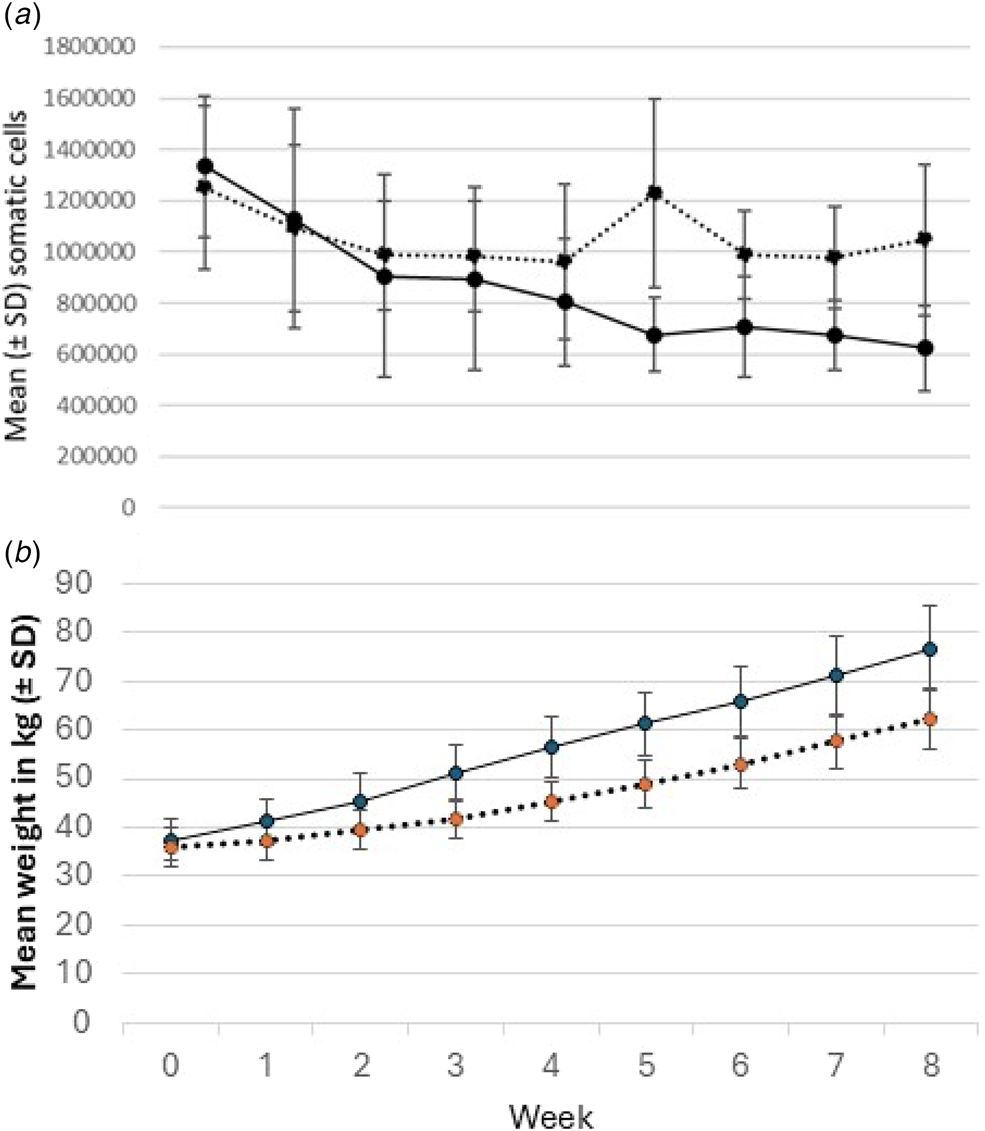
Somatic cell count showed a significant interaction between treatment and period (P < 0.001). Initially and until week 4 of the study there were no differences in SCC between FG and CG (Fig. 1a). However, from 5 weeks onwards, FG had significantly lower SCC than CG (670 ± 151 vs. 1,061 ± 226 × 103 cells/ml, P < 0.01: online Supplementary Table S1). In FG, SCC decreased significantly from week 0 to weeks 1–4 and again from there until weeks 5–8. In CG, SCC was significantly lower in weeks 1–4 and weeks 5–8 compared to week 0, but did not differ between weeks 1–4 and weeks 5–8 (online Supplementary Table S1). Wisconsin test scores behaved similarly to SCC (online Supplementary Table S1). There was a significant interaction between treatment and period (P < 0.001). FG had significantly lower Wisconsin test score than CG during weeks 5–8, but not during week 0 or weeks 1–4. Wisconsin test score in FG decreased significantly from week 0 to weeks 1–4 and again from weeks 1–4 to weeks 5–8. In CG cows Wisconsin test was significantly lower in weeks 1–4 and weeks 5–8 compared to week 0, but did not differ between weeks 1–4 and weeks 5–8 (online Supplementary Table S1).
Somatic cell count (top panel, a) in cows and body weight in calves (lower panel, b). Solid lines are foster cows (a) and fostered calves (b), dotted lines are controls. Three calves were fostered to each foster cow in the first week of life and measurements continued for 8 weeks. Control cows received standard management and were milked twice daily, control calves were housed individually in outdoor hutches and fed age-related amounts of whole milk twice per day. Values are mean ± sd, n = 8 foster cows, 7 control cows, 24 fostered calves, 21 control calves.
Calf measurements
Calf body weight data is shown in Fig. 1b. Mean total weight gain from birth until weaning was significantly higher in FG calves than in CG (39.2 ± 7.4 vs. 26.4 ± 5.1 kg, P < 0.001). Daily weight gains were 700.9 ± 27.1 and 471.1 ± 19.8 g/d in FG and CG calves, respectively (P < 0.001). The FG and CG calves had similar weights at birth (35.6 ± 3.7 and 34.4 ± 3.8 kg, respectively). However, FG calves maintained a higher growth rate than CG calves from 1 to 8 weeks of age (Fig. 1b). There was a significant interaction for calf weight gain between treatment and period (P < 0.001) and a significant effect of treatment (P < 0.001), but no effect of starting age or birth weight (both P > 0.05).
For fostered calves there was considerable variation in the mean daily weight gain depending on which cow they belonged to (Table 1). For example, in foster cow 1411 there was a difference in mean daily weight gain over the 8 weeks of 491 g/day between the heaviest and lightest calf. However, in foster cow 956 there was only a difference of 27 g/day in the mean daily weight gain of her three calves, even though both foster cows showed equally maternal behaviour towards their calves who were considered as adopted (Table 1).
Calf daily weight gain values for individual cow–calf units from birth until 8 weeks of age
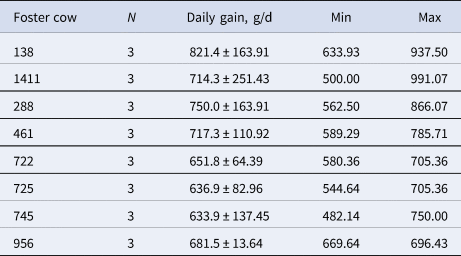
Values are mean ± sd, together min and max values.
The number of calves with different diarrhoea scores is shown in Table 2. There was no difference in the incidence of diarrhoea between FG and CG calves (13.8 and 9.5%, respectively; P > 0.05, tested as binomial data 0 vs. 1–2, Table 2). There was a significant effect of week on the incidence of diarrhoea (P < 0.001). Interaction between treatment and week was not significant. Score 2 was received by some calves when they entered the study (week 0) and during weeks 1–3, but thereafter calves were mainly scored with 0 or 1. No calves received a diarrhoea score of 3.
Diarrhoea score for calves fostered in first week of life (FG, n = 24) and control calves reared traditionally in individual hutches and given milk twice per day (CG, n = 21)
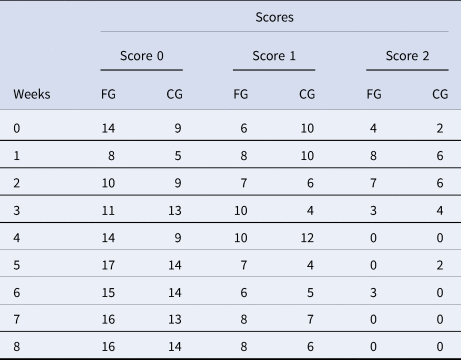
Definition of scores: 0 = normal, 1 = semi-formed, pasty, 2 = loose, but stays of top of bedding. Score 3 (watery, sifts through bedding) was never observed.
Discussion
The results from this study show that most cows without any previous experience of rearing calves can readily accept, and successfully rear, three alien calves. A previous study (Loberg et al., Reference Loberg, Hernandez, Thierfelder, Jensen, Berg and Lidfors2007) carried out on Swedish Red and Swedish Holstein cows found similar results, but in the study of Loberg and Lidfors (Reference Loberg and Lidfors2001) 2 cows out of 48 tested needed to be removed due to excessive aggression towards the four foster calves. Also, 15 cows had to be tied up for some hours in order to accept being suckled by 4 foster calves (Loberg and Lidfors, Reference Loberg and Lidfors2001). Our cows were tied up for the first 2 h to avoid calves being hurt by the foster cow if she was aggressive. As one cow was so aggressive that she had to be removed this was a good preventive measure. It may, therefore, be advisable to always keep the cow tied for the first hours and observe for any signs of aggression to ensure the calf welfare whenever grouping new foster cows and calves together.
A higher growth rate is commonly observed in calves raised with the mother or a foster cow, compared to calves that are kept in a traditional rearing system (Roth et al., Reference Roth, Keil, Gygax and Hillmann2009; Fröberg et al., Reference Fröberg, Lidfors, Svennersten-Sjaunja and Olsson2011), which is consistent with the results obtained in the present study. Research on the effects of long-term in-contact rearing is currently limited, and studies are needed to demonstrate the benefits in the productive life of calves.
Milk production (let down) recorded once per week in the foster cows was greatly reduced, probably due to insufficient milk ejection during milking. The milk that the three fostered calves suckled, was probably due to a better milk ejection that resulted in heavier calves at weaning. In previous research the vacuum that a calf suckling its dam produces is higher than that produced by a milking unit (Mayntz and Costa, Reference Mayntz and Costa1998). Previous studies have shown that feeding calves daily milk allowances at or above the equivalent of 20% of body weight improves average daily gain during the pre-weaning period (Jasper and Weary, Reference Jasper and Weary2002; Rosenberger et al., Reference Rosenberger, Costa, Neave, von Keyserlingk and Weary2017). Further studies are needed to determine milk consumption in fostered calves, but our results showed that implementation of this rearing system increases weight gain over an 8 week period. No data on calf weights were obtained after the weaning off from the foster cows, but other studies have shown that if calves have a good weight gain during their first 8 weeks their weight continues to be improved even after a small dip caused by weaning compared to control calves (Fröberg et al., Reference Fröberg, Lidfors, Svennersten-Sjaunja and Olsson2011).
Somatic cell count and the Wisconsin test scores in the FG showed a consistent reduction and lower scores respectively compared with CG, which suggest an improvement in udder health possibly due to a frequent emptying of the udder by the fostered calves. In a study by Köllmann et al. (Reference Köllmann, Zhang, Wente, Lücken, Leimbach and Krömker2021) they conclude that udder health can be improved by multiple calves suckling in terms of mastitis, nevertheless this could also lead to an increase in pathogen transmission. Our results support the idea that udder health is improved by multiple calves suckling each cow.
The total and daily weight gain of fostered calves was significantly higher than that of control calves. The milk allowance given to control calves appears to have limited their growth when compared to fostered calves that could suckle freely several times per 24 h. Studies have shown that even generous milk allowances (such as feeding 10% of the calves body weight in milk per day) appear to restrict growth when compared to calves allowed to drink milk ad libitum (Jasper and Weary, Reference Jasper and Weary2002). Having such different growth trajectories pre-weaning can have long lasting effects on milk production. Increased pre-weaning growth rates have been linked to increased milk production during their first lactation (Soberon et al., Reference Soberon, Raffrenato, Everett and Van Amburgh2012). Therefore, it is possible that the increased pre-weaning FG calf growth rates we observed could have a long term impact on future milk production, something that is worthy of further study. However, there was considerable variability in weight gain between individual FG calves, perhaps because foster cows did not adopt or even completely accept some calves; thus, they had a reduced access to milk.
Promotion of rumen development is one of the main arguments for the use of early weaning of dairy calves, whereby calves can be encouraged to consume solids from a young age. Healthy rumen development in calves is linked to the efficiency with which that animal can utilize grain and forage and relies upon the bacterial colonization of the gut after birth (Diao et al., Reference Diao, Zhang and Fu2019). It is generally accepted that rumination in calves develops due to increased intake of solid food and at 3–4 weeks of age, consumption of solids is a key driver in calf growth (Khan et al., Reference Khan, Weary and von Keyserlingk2011). Calves fed a higher milk allowance have been shown to have a reduced starter intake compared to calves fed a more restricted milk allowance (de Pasille et al., Reference de Passillé, Borderas and Rushen2011). However, grazing behaviour relies upon mimicry and learning from social models (Cantor et al., Reference Cantor, Neave and Costa2019). Therefore, foster-cow rearing may promote consumption of solids in calves at a younger age than if reared without the appropriate social model. Foster-cow rearing provides a more complex environment than artificially rearing calves which may similarly play a role in allowing earlier (and different) inoculation of microbes in the digestive tract. This may have long lasting and meaningful consequences on the development of the young animal both during the milk rearing phase, and post weaning. In the present study we did not measure the foster calves concentrate intake and this measure should be included in future studies evaluating foster cow–calf systems.
Separating the calf from the cow immediately or within a few hours of birth has been an accepted dairy farming practice for the last century, based on the argument that as much milk as possible should be used for human consumption (Weary and Chua, Reference Weary and Chua2000). Cows currently produce up to 4 times more than what a calf needs to consume, which opens the possibility of considering alternatives for calf rearing. Different groups of scientists, producers and veterinarians in countries such as Sweden, Denmark, the Netherlands, France, Norway, New Zealand and Canada, have investigated and are evaluating various cow–calf contact rearing systems in specialized dairy production systems (Johnsen et al., Reference Johnsen, Grønmo Kischel, Sætervik Rognskog, Vagle, Engelien Johanssen, Ruud and Ferneborg2021; Constancis et al., Reference Constancis, Hellec, Bareille and Vaarst2023). To our knowledge, this is the first such work carried out in Latin America. Countries like Mexico are different in various respects (size of herd, breeds), but specialized large systems tend to use traditional rearing methods, and this work could be a first step towards considering alternative rearing systems. We have shown that it is possible to rear dairy calves on foster cows with high somatic cell counts and to get an improved growth rate in calves and an improved udder health in cows kept on large private dairy farms in Latin America.
In conclusion, fostered calves were accepted by most cows, fostered calves exhibited a higher growth rate than calves reared in a traditional rearing system, and there was no significant difference in the incidence of diarrhoea between fostered and control calves. Our findings suggest that there may be benefits, at the calf level, to foster-cow rearing which make it an appealing option for rearing dairy-calves in a more natural way. However, a large variation in weight gain was observed between foster cow–calf groups suggesting that either dominant calves may be suckling a higher amount of milk or else some cows may be restricting access to milk to favour one or more preferred calves. Constant monitoring of calves is required to ensure all calves in the foster groups maintain an appropriate rate of growth. Further research is needed to understand post-weaning and long term effects of foster-cow rearing.
Supplementary material
The supplementary material for this article can be found at https://doi.org/10.1017/S0022029925000172
Acknowledgements
Funding was generously provided by UNAM-DGAPA-PAPIIT-IN213621, the Swedish Foundation for International Cooperation in Research and Higher Education (STINT Dnr. IB 2020-8617) and by a PASPA-DGAPA-UNAM-scholarship to DAC. We are grateful to Maria Fernanda Enriquez Jiménez, Jessica Ramírez Lobera and Abraham González Aguila for data collection and to farm staff at La Escondida, Aguascalientes, Mexico.


 Open access

