


1. Introduction
Artificial neural networks, abbreviated as neural networks (NNs), are a subfield of machine learning, commonly referred to as deep learning, that have been applied to demography in recent years for analysing and predicting mortality rates and other mortality-related metrics. Generally speaking, an NN can be seen as a universal function approximator, that is, a mapping that, once properly structured and trained, can approximate any function that links a series of inputs to outputs, see Hornik et al. (Reference Hornik, Stinchcombe and White1989). Focusing on mortality forecasting, there are two advantages of using NNs instead of traditional stochastic models such as the Lee–Carter Model and its extensions, see Lee and Carter (Reference Lee and Carter1992). First, they simplify the model definition and free us from specifying how variables, such as age and calendar year, interact. Second, they allow us to consider the mortality experience of several populations simultaneously. Among the most important contributions to NNs applied to mortality forecasting, the following studies are among the ones that stand out: Richman and Wüthrich (Reference Richman and Wüthrich2021), and Perla and Scognamiglio (Reference Perla and Scognamiglio2023) exploit feedforward NNs; Nigri et al. (Reference Nigri, Levantesi, Marino, Scognamiglio and Perla2019), Chen and Khaliq (Reference Chen and Khaliq2022), Lindholm and Palmborg (Reference Lindholm and Palmborg2022), and Euthum et al. (Reference Euthum, Scherer and Ungolo2024) use long short-term memory NNs; Perla et al. (Reference Perla, Richman, Scognamiglio and Wüthrich2021), Wang et al. (Reference Wang, Zhang and Zhu2021), and Schnürch and Korn (Reference Schnürch and Korn2022) utilize convolutional NNs; and Hainaut (Reference Hainaut2018) as well as Scognamiglio (Reference Scognamiglio2022) apply hybrid models.
In this paper, we focus on simultaneously forecasting the mortality rates of a given set of countries. In order to do that, we implement a methodology called multi-task NNs, consisting of several NNs that share a certain number of parameters. In the past years, multi-task deep learning has been applied with promising results in several fields, such as computer vision, see Girshick (Reference Girshick2015), natural language processing, see Collobert and Weston (Reference Collobert and Weston2008), speech recognition, see Deng et al. (Reference Deng, Hinton and Kingsbury2013), and insurance, see Lindholm et al. (Reference Lindholm, Richman, Tsanakas and Wüthrich2023). Finally, we recommend Zhang and Yang (Reference Zhang and Yang2021) for a theoretical overview of multi-task NNs.
Specifically, we propose a hierarchical network structure for multi-population mortality forecasting. The lower hidden layers of these multi-task NNs, which is those closer to the input layer, are shared across all countries, capturing the general properties of mortality trends, while the higher hidden layers, that is those closer to the output layer, are country-specific or shared only within clusters of countries with more similar past mortality trends. The clusters are obtained by applying the k-means clustering machine learning technique to past data for some key mortality metrics, that is, life expectancy and lifetime standard deviation. Finally, each country has its own layer to learn its distinct property.
In this paper, we quantitatively compare multi-task NNs with pre-existing single-task NNs and stochastic models considering mortality data of seventeen different countries. The comparison is based of mortality rates, life expectancy, and lifetime standard deviation forecasting errors. With multi-task NNs, we expect to improve the performance of NNs at country-specific level dedicating more parameters to single countries.
Our main conclusions are that multi-task NNs performance compared to single-task NNs and stochastic models depends on the metric, age range, and training period considered. Overall, single-task NNs give the best results in terms of mortality rates forecasting error, while multi-task NNs and stochastic models have the lowest forecasting error, respectively, for life expectancy and lifetime standard deviation. Furthermore, implementing a weighting scheme in their training improves the multi-task NNs performance, especially for life expectancy and lifetime standard deviation when considering wider age ranges.
The remainder of this paper is organized as follows. Section 2 contains a general theoretical framework for feedforward NNs, followed by a practical application to mortality rates forecasting. In Section 3, we introduce feedforward multi-task NNs and present the NNs proposed by us. In Section 4, the data used in the empirical analysis and settings for the training of the NNs are reported. In Section 5, the numerical results are presented and discussed. In Section 6, we draw the conclusion and propose some future outlooks.
2. Feedforward neural networks
Feedforward neural networks (FNNs) are the most basic type of NN. Information flows in one direction, from input neurons through hidden layers to output neurons, see Schmidhuber (Reference Schmidhuber2015). Cycles and loops are not present in this type of NN. They are generally used for classification, regression, and pattern recognition, and, in particular, they can be applied to mortality forecasting. In this context, FNNs are especially useful for mortality forecasting when the focus is on modelling the relationship between input features (age, calendar year, cohort year, etc.) and mortality rates.
2.1 Notation and terminology
Given a set of L input variables $\mathbf{X} = (X_{1},\dots,X_{L})$
that can be numerical or categorical, or a combination of them, and the corresponding output Y, we have to focus on the hyperparameters of the NNs, that is those settings that have to be set before the parameters are learnt in the training process, see Goldberg (Reference Goldberg2017) and Prince (Reference Prince2023). These hyperparameters are
$\mathbf{X} = (X_{1},\dots,X_{L})$
that can be numerical or categorical, or a combination of them, and the corresponding output Y, we have to focus on the hyperparameters of the NNs, that is those settings that have to be set before the parameters are learnt in the training process, see Goldberg (Reference Goldberg2017) and Prince (Reference Prince2023). These hyperparameters are
-
• N: number of hidden layers in the NN.
-
• $L_{1},\ldots, L_{N}$
: numbers of neurons for each layer.
$L_{1},\ldots, L_{N}$
: numbers of neurons for each layer. -
•
$f^{(1)},\ldots, f^{(N+1)}$
: activation functions of the NN. Notice:
$f^{(1)}$
will be the activation function of the first hidden layer, while
$f^{(N+1)}$
will be the activation function of the output layer. Some popular activation functions, which are also used in this paper, are Sigmoid (also called Logistic), Hyperbolic Tangent (
$\tanh$
), and Rectified Linear Unit (ReLU), see Dubey et al. (Reference Dubey, Singh and Chaudhuri2022).


Once we have specified these hyperparameters, it is possible to estimate the parameters $\mathbf{B}^{(1)} \in \mathbb{R}^{L_{1}\times L}$
,
$\mathbf{B}^{(1)} \in \mathbb{R}^{L_{1}\times L}$
, $\mathbf{B}^{(2)} \in \mathbb{R}^{ L_{2} \times L_{1} },\ldots, \mathbf{B}^{(N)} \in \mathbb{R}^{L_{N}\times L_{N-1}}$
,
$\mathbf{B}^{(2)} \in \mathbb{R}^{ L_{2} \times L_{1} },\ldots, \mathbf{B}^{(N)} \in \mathbb{R}^{L_{N}\times L_{N-1}}$
, $\mathbf{B}^{(N+1)} \in \mathbb{R}^{1\times L_{N}}$
, and
$\mathbf{B}^{(N+1)} \in \mathbb{R}^{1\times L_{N}}$
, and $\mathbf{c}_{1} \in \mathbb{R}^{L_{1}}$
,
$\mathbf{c}_{1} \in \mathbb{R}^{L_{1}}$
, $\mathbf{c}_{2} \in \mathbb{R}^{L_{2}},\ldots, \mathbf{c}_{N} \in \mathbb{R}^{L_{N}}$
,
$\mathbf{c}_{2} \in \mathbb{R}^{L_{2}},\ldots, \mathbf{c}_{N} \in \mathbb{R}^{L_{N}}$
, $c_{N+1} \in \mathbb{R}$
, that represent respectively weight matrices and intercept vectors. These are the parameters that are learned during the training of the network.
$c_{N+1} \in \mathbb{R}$
, that represent respectively weight matrices and intercept vectors. These are the parameters that are learned during the training of the network.
The layers will be so computed, using matrix notation:
 \begin{equation}\mathbf{Z}^{(1)} = f^{(1)}(\mathbf{c}_{1} + \mathbf{B}^{(1)}\mathbf{X}) \in \mathbb{R}^{L_1},\end{equation}
where $\mathbf{X} \in \mathbb{R}^L$
is the input vector,
$\mathbf{X} \in \mathbb{R}^L$
is the input vector,
 \begin{equation}\mathbf{Z}^{(j)} = f^{(j)}(\mathbf{c}_{j} + \mathbf{B}^{(j)}\mathbf{Z}^{(j-1)}) \in \mathbb{R}^{L_j},\text{ }j = 2,\dots,N.\end{equation}
Finally, for the output layer:
 \begin{equation}\hat{Y} = Z^{(N+1)} = f^{(N+1)}(c_{N+1} + \mathbf{B}^{(N+1)}\mathbf{Z}^{(N)}) \in \mathbb{R}.\end{equation}
We now discuss the training of the NN during which all the weight matrices and intercept vectors are estimated through a process called backpropagation. In order to do that, the additional hyperparameters reported below have to be specified, see Prince (Reference Prince2023).
-
• The loss function is the criterion through which, starting from the observed value of the outputs and the predicted output of the network, we calculate the quantity that has to be minimized when we train the NN. In the remainder of this paper, the mean squared error (MSE) is used as loss function:
(2.4)where n is the number of observations,
\begin{equation} MSE = \sum_{i=1}^{n}(Y_{i}-\hat{Y}_{i})^2, \end{equation}
$Y_{i}$
are the observed values of the output, and
$\hat{Y}_{i}$
are the values predicted by the NN as in Equation (3).
-
• The optimizer is the algorithm used during the training phase to adjust the parameters of the neural network in order to minimize the loss. In the remainder of this paper, we will utilize the Adam optimizer (Adaptive Moment Estimation), a gradient-based optimization algorithm that leverages first-order (gradient) and second-order (squared gradient) moment estimates to adapt the learning rate for each parameter, see Kingma and Ba (Reference Kingma and Ba2014).
-
• The number of epochs is the amount of times the optimizer runs on the training set.
-
• The validation set is a subset of the available data used to provide an unbiased evaluation of a model fit identifying eventual overfitting while the training set is used to tune the NN parameters.
-
• The batch size defines the number of training samples processed simultaneously before the model’s weights are updated. It determines how many samples are passed through the network in each forward and backward pass during training.
-
• The learning rate controls the size of the steps taken during the optimization process when adjusting the weights of the model.


2.2 Feedforward single-task neural network applied to mortality forecasting
In this subsection, we are going to provide a framework for forecasting of mortality rates with feedforward single-task NNs based on the paper of Richman and Wüthrich (Reference Richman and Wüthrich2021). The input variables considered in the NNs are calendar year t, age x, gender g, and country p, ${\tilde{\mathbf{X}}} = (t, x, g, p)$
, and they will be treated as categorical with the single exception of calendar year, which will be treated as numerical, while the output, Y, is the central mortality rate
${\tilde{\mathbf{X}}} = (t, x, g, p)$
, and they will be treated as categorical with the single exception of calendar year, which will be treated as numerical, while the output, Y, is the central mortality rate $m_{x,t}^{(g,p)}$
at age x, year t, gender g, and population p. In order to treat the categorical variables in the input layer, embedding layers are used, see Mikolov et al. (Reference Mikolov, Sutskever, Chen, Corrado and Dean2013). An embedding layer, from a mathematical point of view, is a function that maps discrete data into continuous vector representations. So, given a categorical variable with b distinct categories or levels (e.g., the categories ‘male’ and ‘female’ for the variable ‘gender’, the different countries for the variable ‘country’, etc.), and a dimension d, which represents the size of the continuous embedding space (e.g., each categorical level will be represented by a vector in
$m_{x,t}^{(g,p)}$
at age x, year t, gender g, and population p. In order to treat the categorical variables in the input layer, embedding layers are used, see Mikolov et al. (Reference Mikolov, Sutskever, Chen, Corrado and Dean2013). An embedding layer, from a mathematical point of view, is a function that maps discrete data into continuous vector representations. So, given a categorical variable with b distinct categories or levels (e.g., the categories ‘male’ and ‘female’ for the variable ‘gender’, the different countries for the variable ‘country’, etc.), and a dimension d, which represents the size of the continuous embedding space (e.g., each categorical level will be represented by a vector in $\mathbb{R}^d$
), the embedding layer performs the mapping
$\mathbb{R}^d$
), the embedding layer performs the mapping
 \begin{equation} f\;:\; \{0,1,\dots,b-1\} \rightarrow \mathbb{R}^d.\end{equation}
In a NN, the embedding layer can be identified with a parametrized matrix belonging to $\mathbb{R}^{b\times d}$
. The parameters of the embedding layers, similarly to the parameters of the hidden layers, are learned as the network is trained. Notice that if
$\mathbb{R}^{b\times d}$
. The parameters of the embedding layers, similarly to the parameters of the hidden layers, are learned as the network is trained. Notice that if $d = 1$
, the embedding layer becomes equivalent to the classical treatment of categorical variables in regression models: each level of the variable is coded with a specific value. Following Richman and Wüthrich (Reference Richman and Wüthrich2021), d is set equal to 5 for all three categorical variables, so:
$d = 1$
, the embedding layer becomes equivalent to the classical treatment of categorical variables in regression models: each level of the variable is coded with a specific value. Following Richman and Wüthrich (Reference Richman and Wüthrich2021), d is set equal to 5 for all three categorical variables, so: $x\rightarrow\mathbf{x}\in\mathbb{R}^5$
,
$x\rightarrow\mathbf{x}\in\mathbb{R}^5$
, $g\rightarrow\mathbf{g}\in\mathbb{R}^5$
, and
$g\rightarrow\mathbf{g}\in\mathbb{R}^5$
, and $p\rightarrow\mathbf{p}\in\mathbb{R}^5$
. Once embedding vectors (
$p\rightarrow\mathbf{p}\in\mathbb{R}^5$
. Once embedding vectors ( $\mathbf{x}$
,
$\mathbf{x}$
, $\mathbf{g}$
and
$\mathbf{g}$
and $\mathbf{p}$
) have been created, we have the vector
$\mathbf{p}$
) have been created, we have the vector $\mathbf{X} = (t,\mathbf{x},\mathbf{g},\mathbf{p})\in\mathbb{R}^{16}$
that represents the actual input that will be passed to the first hidden layer of the NN. The number of hidden layers here considered differs by the NN considered,
$\mathbf{X} = (t,\mathbf{x},\mathbf{g},\mathbf{p})\in\mathbb{R}^{16}$
that represents the actual input that will be passed to the first hidden layer of the NN. The number of hidden layers here considered differs by the NN considered, $N = 2$
or 5; the number of neurons in each hidden layer is equal to 128 neurons,
$N = 2$
or 5; the number of neurons in each hidden layer is equal to 128 neurons, $L_{1} = \dots = L_{N}=128$
; the output layer that represents the mortality rate for the gender g in the country p at age x in year t has one neuron,
$L_{1} = \dots = L_{N}=128$
; the output layer that represents the mortality rate for the gender g in the country p at age x in year t has one neuron, $L_{N+1} = 1$
, with sigmoid activation function,
$L_{N+1} = 1$
, with sigmoid activation function,
 \begin{equation}m_{x,t}^{(g,p)} = Z^{(N+1)} = \frac{1}{1+e^{-(c_{N+1} + \mathbf{B}^{(N+1)}\mathbf{Z}^{(N)})}}.\end{equation}
The NNs also differ among themselves by the type of activation function in the hidden layers, $f^{(1)}=\dots=f^{(N)}=\tanh$
or
$f^{(1)}=\dots=f^{(N)}=\tanh$
or $f^{(1)}=\dots=f^{(N)}=$
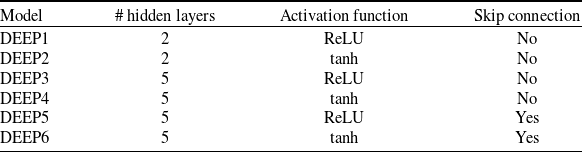
ReLU, and by the presence or not of a direct connection, called a skip connection, between the embedding layer and the last hidden layer. These NNs are referred as DEEPi,
$f^{(1)}=\dots=f^{(N)}=$
ReLU, and by the presence or not of a direct connection, called a skip connection, between the embedding layer and the last hidden layer. These NNs are referred as DEEPi, $i=1,\dots,6$
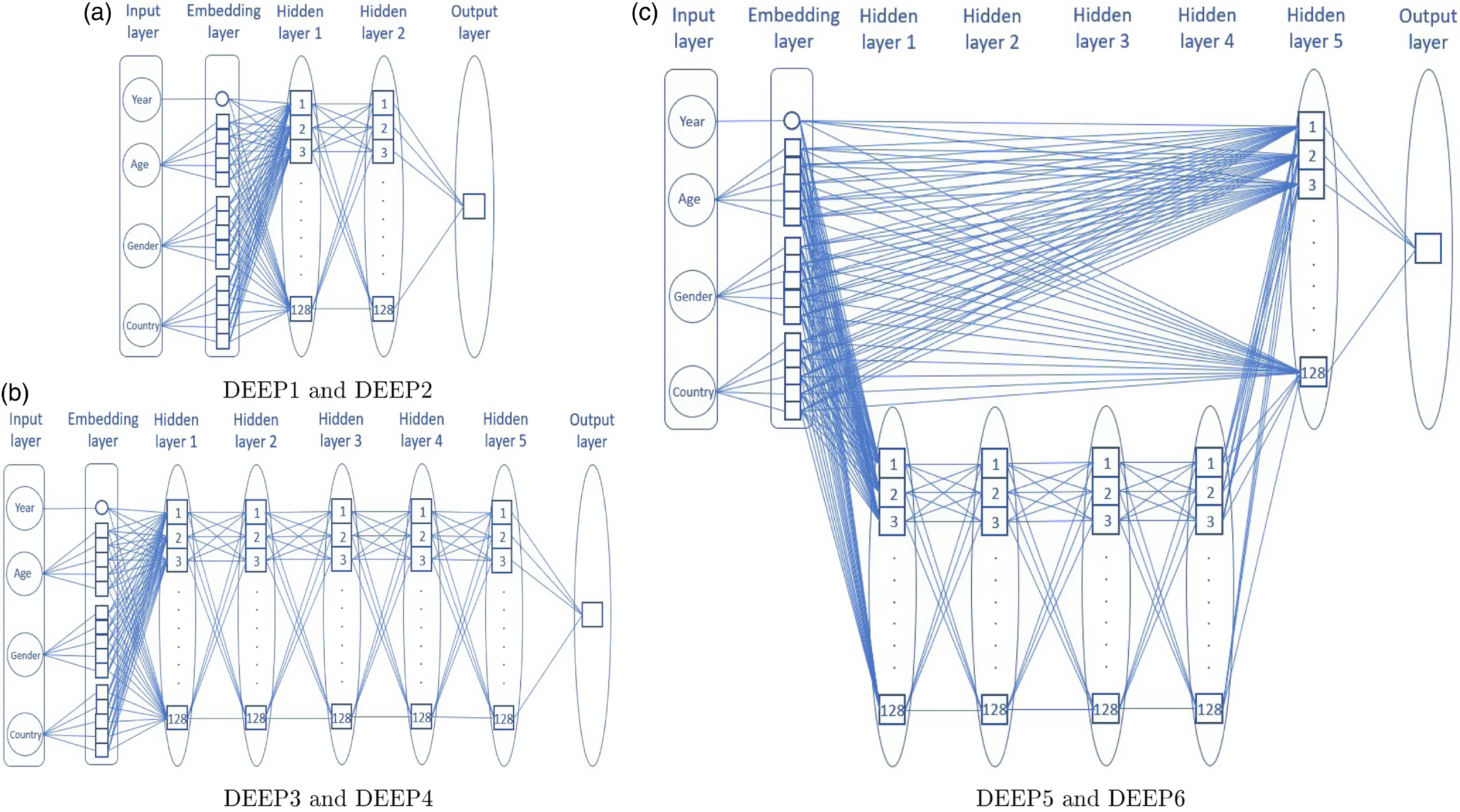
, and the details about their architecture are reported in Table 1 and in Figure 1.
$i=1,\dots,6$
, and the details about their architecture are reported in Table 1 and in Figure 1.
Summary of the NNs DEEPi, $i=1,\dots,6$
, architectures.
$i=1,\dots,6$
, architectures.
3. Multi-task neural networks
Generally speaking, multi-task deep learning consists of different NNs (one for each task) that share at least one layer. The shared part of the NNs can be the input layer, one or more hidden layers, or a combination of them. It is relevant to notice that the output layer cannot be shared, as we must have one output neuron for each task. Given that we have P different datasets, each corresponding to a distinct country, this paper employs multi-task NNs with a multi-input, multi-output structure, see Menet et al. (Reference Menet, Hersche, Karunaratne, Benini, Sebastian and Rahimi2023). Specifically, these NNs share hidden layers across tasks while maintaining P separate input and output layers.
Architecture of the NNs DEEPi, $i=1,\dots,6$
as described in Table 1.
$i=1,\dots,6$
as described in Table 1.
Let us now consider $P\gt1$
countries and the following P tasks:
$P\gt1$
countries and the following P tasks: $T_{p} = $
“forecasting the mortality rates for
$T_{p} = $
“forecasting the mortality rates for $p^{th}$
country”,
$p^{th}$
country”, $p = 1, \dots, P$
. If we want to forecast the mortality rates of the P countries using a feed-forward NN, then we have three different options. The first consists of using P different NNs with their own input layer, hidden layers, and output layer, with the
$p = 1, \dots, P$
. If we want to forecast the mortality rates of the P countries using a feed-forward NN, then we have three different options. The first consists of using P different NNs with their own input layer, hidden layers, and output layer, with the $p{\rm th}$
of them to predict the mortality rates of the
$p{\rm th}$
of them to predict the mortality rates of the $p{\rm th}$
country. This solution can be called single-task NNs approach and is graphically represented in Figure 1(a). The second option is to use one single-task NN like those presented in Section 2 (see Figure 2(b)). The third option is to consider the P NNs sharing one or more of their hidden layers, and in this way we will have a multi-task NN, see Figure 2(c). Generally, a multi-task NN has three main advantages compared to using P different single-task NNs. First, it noticeably improves the training time as we optimize just one NN rather than P different NNs. Second, as the countries are likely to share some common behaviours in their mortality evolution, such as the long-term trend of improving mortality, there will likely be mutual benefits for all the P tasks by training them together, see Crawshaw (Reference Crawshaw2020). Third, the multi-task neural network will operate on a single large dataset rather than P smaller datasets, thereby capturing a greater amount of information and leading to more robust predictions.
$p{\rm th}$
country. This solution can be called single-task NNs approach and is graphically represented in Figure 1(a). The second option is to use one single-task NN like those presented in Section 2 (see Figure 2(b)). The third option is to consider the P NNs sharing one or more of their hidden layers, and in this way we will have a multi-task NN, see Figure 2(c). Generally, a multi-task NN has three main advantages compared to using P different single-task NNs. First, it noticeably improves the training time as we optimize just one NN rather than P different NNs. Second, as the countries are likely to share some common behaviours in their mortality evolution, such as the long-term trend of improving mortality, there will likely be mutual benefits for all the P tasks by training them together, see Crawshaw (Reference Crawshaw2020). Third, the multi-task neural network will operate on a single large dataset rather than P smaller datasets, thereby capturing a greater amount of information and leading to more robust predictions.
Illustrations of single and multi-task NNs for mortality prediction.
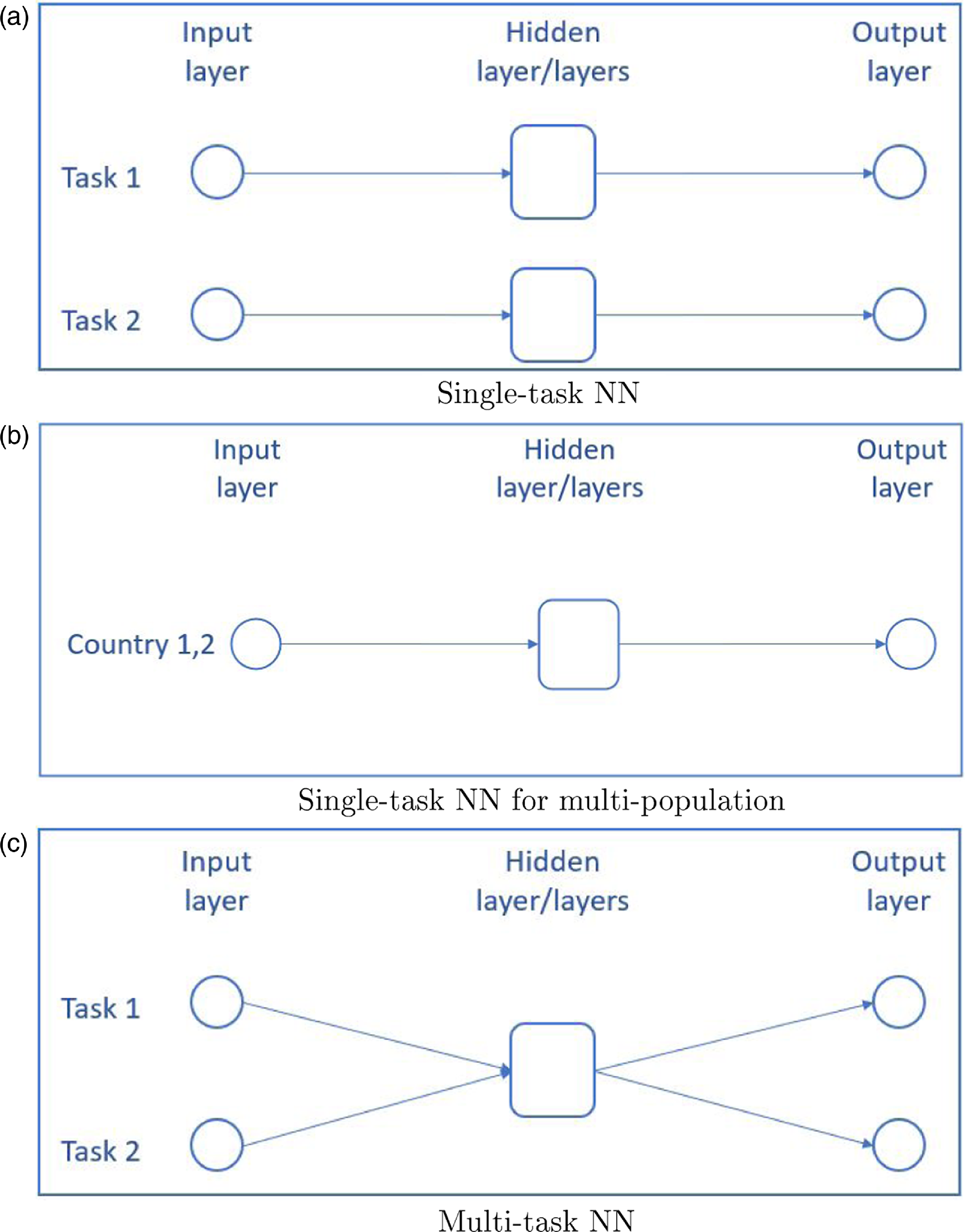
At this point, we pose a different question: what is the advantage of using a multi-task NN (see Figure 2(c)) compared to a single-task NN, as presented in Section 2 (see Figure 2(b))? The primary advantage is that a multi-task NN not only shares knowledge across related tasks through shared layers (as in single-task NNs) but also enables task-specific specialization via country-specific layers. For instance, when a single-task NN is trained on a large set of countries, it can become dominated by the majority countries–those with similar mortality trends–while minority countries, such as the United States and Japan, which exhibit distinct mortality patterns, tend to be under-represented. This imbalance often leads to poorer predictions for the minority countries. In the Results Section, among other things, we will evaluate whether the multi-task structure in Figure 2(c), with its country-specific layers designed to capture unique mortality patterns, can address this issue effectively.
3.1 Architecture of the multi-task NNs for mortality forecasting
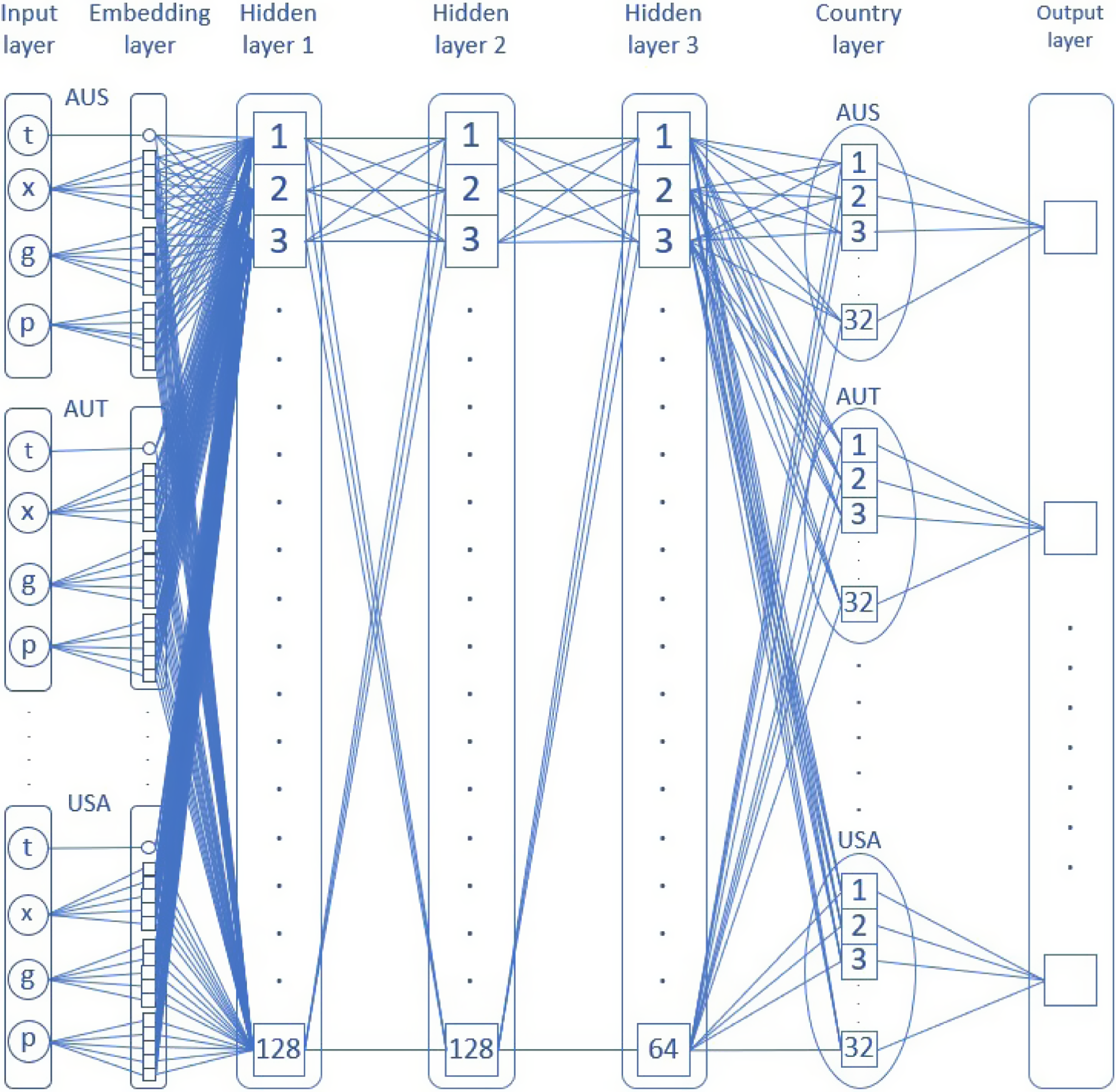
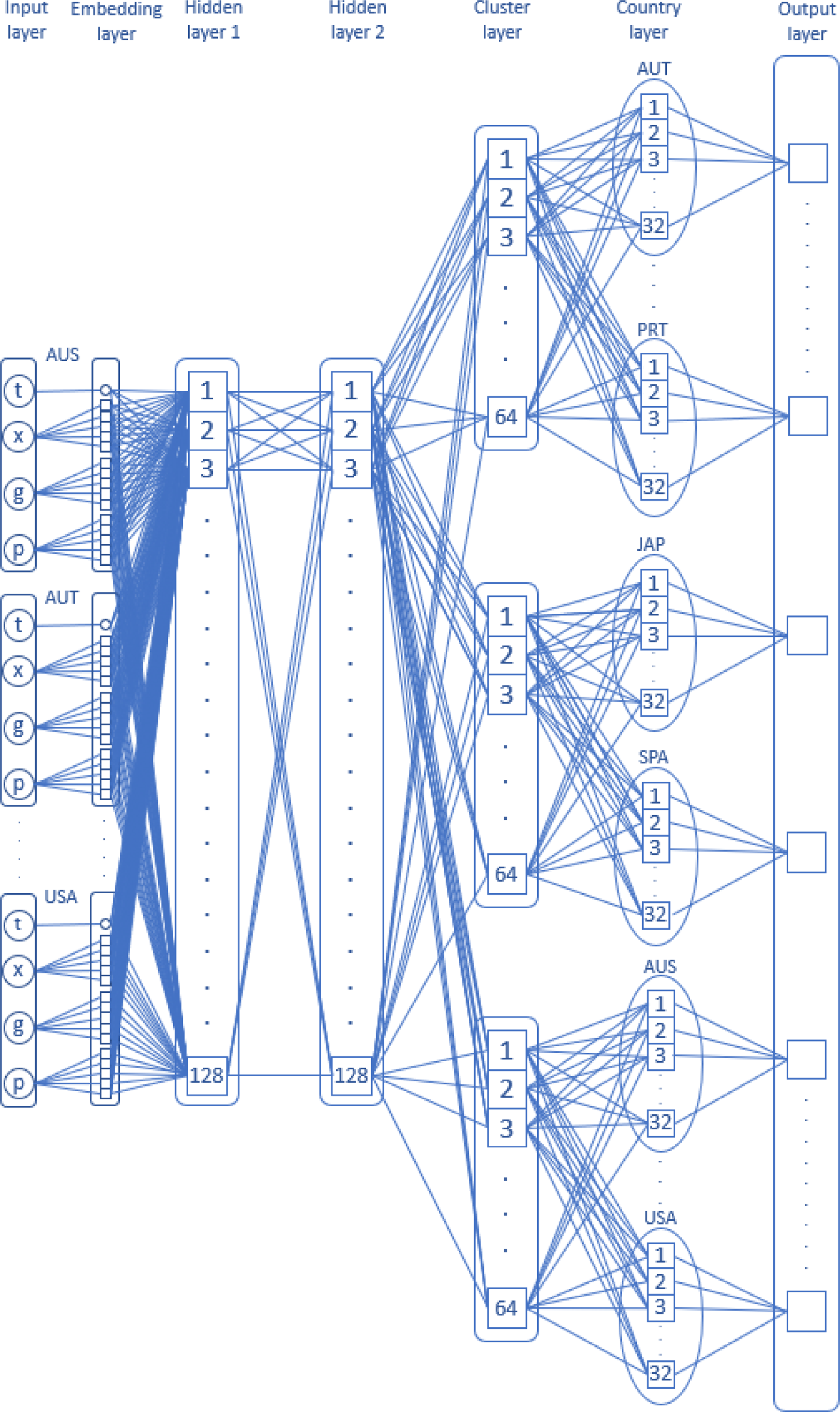
Similarly to the NNs discussed in Section 2, the multi-task NNs will be of the feedforward type. They will have P input layers, one for each country, where the variables are calendar year, age, country, and gender. There are then P different embedding layers where each categorical variable, that is, age, country, and gender, is transformed into a vector belonging to $\mathbb{R}^{5}$
as explained in Section 2.2. These embedding layers are fully connected to two hidden layers with 128 neurons and
$\mathbb{R}^{5}$
as explained in Section 2.2. These embedding layers are fully connected to two hidden layers with 128 neurons and $\tanh$
activation function, following Richman (Reference Richman2022). The second of these intermediate layers is then fully connected to a third hidden layer with 64 neurons and
$\tanh$
activation function, following Richman (Reference Richman2022). The second of these intermediate layers is then fully connected to a third hidden layer with 64 neurons and $\tanh$
activation function. From the third hidden layer, there are ramifications with P country-specific hidden layers having 32 neurons and
$\tanh$
activation function. From the third hidden layer, there are ramifications with P country-specific hidden layers having 32 neurons and $\tanh$
activation function. Finally, these P layers are connected to P output layers where the activation function is of Sigmoid type. Figure 3 reports a graphical representation of the just-described NN, which will be referred to as MT1 in the remainder of this paper.
$\tanh$
activation function. Finally, these P layers are connected to P output layers where the activation function is of Sigmoid type. Figure 3 reports a graphical representation of the just-described NN, which will be referred to as MT1 in the remainder of this paper.
Graphical representation of the multi-task NN MT1.
In more formal terms, the layers of MT1 will be computed as follows:
-
• Input layer:
(3.1)
\begin{equation} {\tilde{\mathbf{X}}}_{p} = (t,x,g,p) \text{, }\text{ }\text{ }p=1,\dots,P. \end{equation}
-
• Embedding layer:
(3.2)
\begin{equation} \mathbf{X}_{p} = (t,\mathbf{x},\mathbf{g},\mathbf{p}) \in \mathbb{R}^{16} \text{, }\text{ }\text{ }p=1,\dots,P, \end{equation}
(3.3)
\begin{equation} \mathbf{X} = (\mathbf{X}_{1},\dots,\mathbf{X}_{P}) \in \mathbb{R}^{16\times P}. \end{equation}
-
• Hidden layer 1:
(3.4)where
\begin{equation} \mathbf{Z}^{(1)} = f^{(1)}(\mathbf{c}^{(1)} + \mathbf{B}^{(1)}\mathbf{X}) \in \mathbb{R}^{128}, \end{equation}
$\mathbf{c}^{(1)}\in \mathbb{R}^{128}$
,
$\mathbf{B}^{(1)}\in \mathbb{R}^{128\times 16\times P}$
, and
$f^{(1)}=\tanh$
.
-
• Hidden layer 2:
(3.5)where
\begin{equation} \mathbf{Z}^{(2)} = f^{(2)}(\mathbf{c}^{(2)} + \mathbf{B}^{(2)}\mathbf{Z}^{(1)}) \in \mathbb{R}^{128} , \end{equation}
$\mathbf{c}^{(2)}\in \mathbb{R}^{128}$
,
$\mathbf{B}^{(2)}\in \mathbb{R}^{128\times 128}$
, and
$f^{(2)}=\tanh$
.
-
• Hidden layer 3:
(3.6)where
\begin{equation} \mathbf{Z}^{(3)} = f^{(3)}(\mathbf{c}^{(3)} + \mathbf{B}^{(3)}\mathbf{Z}^{(2)}) \in \mathbb{R}^{64} , \end{equation}
$\mathbf{c}^{(3)}\in \mathbb{R}^{64}$
,
$\mathbf{B}^{(3)}\in \mathbb{R}^{64\times 128}$
, and
$f^{(3)}=\tanh$
.
-
• Country specific layers:
(3.7)where
\begin{equation} \mathbf{Z}_p^{(4)} = f^{(4)}(\mathbf{c}_{p}^{(4)} + \mathbf{B}_{p}^{(4)}\mathbf{Z}^{(3)}) \in \mathbb{R}^{32}\text{, }\text{ }\text{ }p=1,\dots,P, \end{equation}
$\mathbf{c}^{(4)}_{p}\in \mathbb{R}^{32}$
,
$\mathbf{B}^{(4)}_{p}\in \mathbb{R}^{32\times 64}$
, and
$f^{(4)}=\tanh$
.
-
• Output layers:
(3.8)where
\begin{equation} Z^{(5)}_{p} = f^{(5)}(c^{(5)}_{p} + \mathbf{B}^{(5)}_{p}\mathbf{Z}_p^{(4)}) \in \mathbb{R},\text{ }\text{ }\text{ }p=1,\dots,P, , \end{equation}
$\mathbf{c}^{(5)}_{p}\in \mathbb{R}$
,
$\mathbf{B}^{(5)}_{p}\in \mathbb{R}^{32}$
, and
$f^{(5)}=\text{{sigmoid}}$
.


3.2 Clustering of the third hidden layer
When considering a group of countries, it is natural that some share similar mortality trends while differing from others. These similarities and differences can stem from various social, economic, and geographical factors. For example, the Scandinavian countries, characterised by high wealth levels, extensive social welfare, and geographical proximity, will likely exhibit similar mortality evolutions. To enhance the performance of the multi-task network, we propose clustering the third hidden layer. This approach allows clusters of countries with similar mortality trends to share additional parameters, creating a hierarchical network structure. In this design, lower layers (i.e., hidden layers 1 and 2) capture the overall mortality trend across all countries, while the higher layer (i.e., hidden layer 3) extracts patterns shared by clusters of countries with similar trends. Finally, each country-specific layer learns the distinct mortality pattern for its respective country. To identify countries with similar survival patterns effectively, we can analyze historical mortality data using specific techniques that group countries into homogeneous sets known as clusters. For relevant studies on clustering techniques in the context of mortality forecasting, see Danesi et al. (Reference Danesi, Haberman and Millossovich2015), Nandini and Sanjjushri (Reference Nandini and Sanjjushri2023), and Carracedo et al. (Reference Carracedo, Debón, Iftimi and Montes2018).
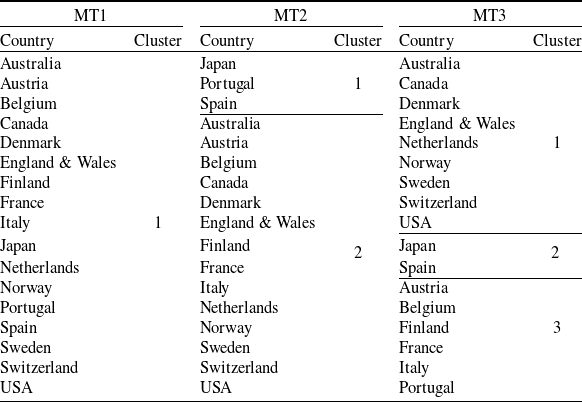
Having regard to the above discussion, we aim to assess the advantages of clustering the P countries based on their past mortality experiences and construct a new NN architecture that incorporates this clustering. To achieve this, we implement a two-step procedure for each $K = 2, 3$
, where K denotes the number of clusters:
$K = 2, 3$
, where K denotes the number of clusters:
-
1. We use K-means clustering for grouping the P countries into K groups, see Scitovski et al. (Reference Scitovski, Sabo, Martnez-Álvarez and Ungar2021). In order to do that, we consider the observed changes, in a chosen training period, of the following metrics:
-
• Life expectancy for a newborn, truncated at age 90, see Dickson et al. (Reference Dickson, Hardy and Waters2019):
(3.9)where
\begin{equation} \overset{\circ}{e}_{0:{90},t} = \sum_{x = 1}^{90} {}_{x-1}p_{0,t} {\Big(} 1 - \frac{1}{2} q_{0 + x - 1,t} {\Big)}, \end{equation}
$q_{x,t}$
and
${}_{h}p_{x,t}$
are, respectively, the 1-year probability of death at age x in year t and the probability of surviving for h years for an individual aged x in year t. These quantities can be derived from the mortality rates
$m_{x,t}$
using the following formulas: (3.10)
\begin{equation} q_{x,t} = \frac{m_{x,t}}{1 + \frac{1}{2} m_{x,t}}, \end{equation}
(3.11)
\begin{equation} {}_{h}p_{x,t} = \prod_{j=1}^{h}(1-q_{x+j-1,t}). \end{equation}
-
• Standard deviation of the lifetime of a newborn, truncated at age 90:
(3.12)where
\begin{align} \text{SD}_{0:{90},t} &= \sqrt{ \sum_{x = 0}^{89} {}_{x|1}q_{0,t}\text{ } ( x - \overset{\circ}{e}_{0:{90},t})^2 + {}_{90}p_{0,t} ( 90 - \overset{\circ}{e}_{0:{90},t})^2}, \end{align}
${}_{h|1}q_{x,t}$
represents the deferred 1-year probability of death between ages
$x+h$
and
$x+h+1$
for an individual of age x in year t, and is given by (3.13)
\begin{align} {}_{h|1}q_{x,t} = {}_{h}p_{x,t} q_{x+h,t}. \end{align}
-
-
2. For each K, we build the NN MTK, similar to MT1 but with K clustered hidden layers instead of hidden layer 3. These clustered hidden layers have 64 neurons and a
$\tanh$
activation function and are fully connected to hidden layer 2. Furthermore, they are connected with the country-specific layers based on the following rule: if a country is in cluster k, with
$k=1,\dots,K$
, then its country-specific layer is fully connected with cluster layer k. For the remaining parts of the NN, that is input layers, embedding layers, hidden layer 1, hidden layer 2, country-specific hidden layers, and output layers, they are specified as in MT1. Formulas for calculating input layer, embedding layer, and hidden layers 1 and 2 are the same of (7)–(11). For the cluster layers, we have (3.14)where
\begin{equation} \mathbf{Z}_k^{(3)} = f^{(3)}(\mathbf{c}_k^{(3)} + \mathbf{B}_k^{(3)}\mathbf{Z}^{(2)})\in \mathbb{R}^{64},\text{ }\text{ }\text{ }k=1,\dots,K, \end{equation}
$\mathbf{c}_k^{(3)}\in \mathbb{R}^{64}$
,
$\mathbf{B}_k^{(3)}\in \mathbb{R}^{64\times 128}$
, and
$f^{(3)}=\tanh$
. For the country specific layers, we have (3.15)where
\begin{equation} \mathbf{Z}^{(4)}_{p} = f^{(4)}(\mathbf{c}^{(4)}_{p} +\sum_{k=1}^{K} I_{p,k}\mathbf{B}^{(4)}_{p}\mathbf{Z}_k^{(3)})\in \mathbb{R}^{32},\text{ }\text{ }\text{ }p=1,\dots,P, \end{equation}
$\mathbf{c}^{(4)}_{p}\in \mathbb{R}^{32}$
,
$\mathbf{B}^{(4)}_{p}\in \mathbb{R}^{32\times 64}$
,
$f^{(4)}=\tanh$
, and
$I_{p,k}=1$
if country p belongs to cluster k and
$I_{p,k}=0$
otherwise. Finally, the formula for the output layer is the same as (14).


The architectures of MT2 and MT3 can be found, respectively, in Figures 4 and 5.
Graphical representation of the multi-task NN MT2.

Graphical representation of the multi-task NN MT3.
4. Data, clustering, and training
The choice of the countries we consider in the quantitative analysis is based on three factors: first, they must have data available in the HMD.Footnote 1 Second, historical data series for these countries must be complete from the year 1950 onwards. Third, each selected country must have had a population of at least 3 million in 1950. In light of this, we consider historical mortality data for males and females from $P = 17$
countries: Australia, Austria, Belgium, Canada, Denmark, England & Wales, Finland, France, Italy, Japan, Netherlands, Norway, Portugal, Spain, Sweden, Switzerland, and the US. For these countries, we consider the yearly central mortality rates obtained from HMD in three different age bands: 0–89, 20–89, and 55–89 to test the sensitivity of the different approaches with respect to the age band. Regarding the choice of the time interval, we considered, following Richman and Wüthrich (Reference Richman and Wüthrich2021), a 50-years training period (1950–1999) and a 20-years test period (2000–2019). Finally, in order to study how the performance of the models varies based on the length of the training period, we also considered the following training sets: 1955–1999, 1960–1999, 1965–1999, 1970–1999, 1975–1999, and 1980–1999 (using 20–89 as reference age range).
$P = 17$
countries: Australia, Austria, Belgium, Canada, Denmark, England & Wales, Finland, France, Italy, Japan, Netherlands, Norway, Portugal, Spain, Sweden, Switzerland, and the US. For these countries, we consider the yearly central mortality rates obtained from HMD in three different age bands: 0–89, 20–89, and 55–89 to test the sensitivity of the different approaches with respect to the age band. Regarding the choice of the time interval, we considered, following Richman and Wüthrich (Reference Richman and Wüthrich2021), a 50-years training period (1950–1999) and a 20-years test period (2000–2019). Finally, in order to study how the performance of the models varies based on the length of the training period, we also considered the following training sets: 1955–1999, 1960–1999, 1965–1999, 1970–1999, 1975–1999, and 1980–1999 (using 20–89 as reference age range).
The results of clustering using the approach described in Section 3.1 are reported in Table 2. Looking at the composition of the clusters obtained, we notice that Japan and Spain are clustered together in both cases. We also have a group of European countries, that is, Austria, Belgium, Finland, France, Italy, and Portugal that are clustered together, and another one with Australia, Canada, Denmark, England & Wales, Netherlands, Norway, Sweden, Switzerland, and the USA.
Results of clustering.
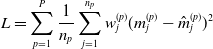
Regarding the training of the multi-task NNs, we used the following hyperparameters: 150 epochs when using 55–89 age band, and 250 epochs when using 20–89 and 0–89 age bands, batch size equal to 32, learning rate equal to 0.0005, Adam optimizer, and mean squared error as loss function:
 \begin{equation} L = \sum_{p=1}^{P}\frac{1}{n_p}\sum_{j=1}^{n_p}w_j^{(p)}(m_j^{(p)}-\hat{m}_j^{(p)})^2\end{equation}
where $n_p$
is the total number of observations for country p, and
$n_p$
is the total number of observations for country p, and $w_j^{(p)}$
is the relative weight. We set
$w_j^{(p)}$
is the relative weight. We set $w_j^{(p)} = 1$
in the unweighted case and
$w_j^{(p)} = 1$
in the unweighted case and $w_j^{(p)} = \frac{1}{m_j^{(p)}}$
in the weighted case. In the following, results obtained using multi-task NNs are denoted by MT1, MT2, and MT3, in the unweighted case, and by MT1 w, MT2 w, and MT3 w, in the weighted case. Finally, we repeated the training of each NN 10 times in order to ensure robustness towards the effects of randomness in the training process.
$w_j^{(p)} = \frac{1}{m_j^{(p)}}$
in the weighted case. In the following, results obtained using multi-task NNs are denoted by MT1, MT2, and MT3, in the unweighted case, and by MT1 w, MT2 w, and MT3 w, in the weighted case. Finally, we repeated the training of each NN 10 times in order to ensure robustness towards the effects of randomness in the training process.
5. Results
In this section, we compare goodness of the forecasts obtained using multi-task NNs, MT1, MT2, and MT3 (both in the weighted and unweighed case), the single-task NNs DEEP1, DEEP2, DEEP3, DEEP4, DEEP5, and DEEP6, and 3 widely used stochastic mortality models from the literature – the single population version of the Lee-Carter model (LC), see Lee and Carter (Reference Lee and Carter1992),
 \begin{equation} \ln(m_{x,t}^{(g,p)}) = \alpha_{x}^{(g,p)} + \beta_{x}^{(g,p)} \kappa_{t}^{(g,p)},\end{equation}
the single population version of the Cairns-Blake-Dowd model (CBD),Footnote 2 see Cairns et al. (Reference Cairns, Blake and Dowd2006),
 \begin{equation} \ln(m_{x,t}^{(g,p)}) = \kappa_{t}^{(1,g,p)} + \kappa_{t}^{(2,g,p)} (x - \bar{x}),\end{equation}
and a version of the Augmented Common Factor model (ACF), see Chen and Millossovich (Reference Chen and Millossovich2018), used for modelling simultaneously both gender and a set of different countries,
 \begin{equation} \ln(m_{x,t}^{(g,p)}) = \alpha_{x}^{(g,p)} +B_xK_t + \beta_{x}^{(g)}k_{t}^{(g)} + \beta_{x}^{(g,p)}k_{t}^{(g,p)}.\end{equation}
Here $\alpha_{x}^{(g,p)}$
,
$\alpha_{x}^{(g,p)}$
, $\beta_{x}^{(g)}$
,
$\beta_{x}^{(g)}$
, $\beta_{x}^{(g,p)}$
, and
$\beta_{x}^{(g,p)}$
, and $B_{x}$
are age-dependent parameters,
$B_{x}$
are age-dependent parameters, $\bar{x} = {72}$
, the average over the population age range 55–89, while
$\bar{x} = {72}$
, the average over the population age range 55–89, while $k_{t}^{(g)}$
,
$k_{t}^{(g)}$
, $k_{t}^{(g,p)}$
,
$k_{t}^{(g,p)}$
, $k_{t}^{(1,g,p)}$
,
$k_{t}^{(1,g,p)}$
, $k_{t}^{(2,g,p)}$
and
$k_{t}^{(2,g,p)}$
and $K_t$
are time-dependent stochastic factors. Here
$K_t$
are time-dependent stochastic factors. Here $k_{t}^{(g,p)}$
(in the LC model),
$k_{t}^{(g,p)}$
(in the LC model), $k_{t}^{(1,g,p)}$
,
$k_{t}^{(1,g,p)}$
, $k_{t}^{(2,g,p)}$
, and
$k_{t}^{(2,g,p)}$
, and $K_t$
are modelled as a random walk with drift, while
$K_t$
are modelled as a random walk with drift, while $k_{t}^{(g)}$
and
$k_{t}^{(g)}$
and $k_{t}^{(g,p)}$
(in the ACF model) are modelled as an AR(1). Notice that unlike the ACF model, the LC and CBD models treat different countries independently. Both the fitting and the forecasting of these three models are obtained using the StMoMo package, see Villegas et al. (Reference Villegas, Kaishev and Millossovich2018).
$k_{t}^{(g,p)}$
(in the ACF model) are modelled as an AR(1). Notice that unlike the ACF model, the LC and CBD models treat different countries independently. Both the fitting and the forecasting of these three models are obtained using the StMoMo package, see Villegas et al. (Reference Villegas, Kaishev and Millossovich2018).
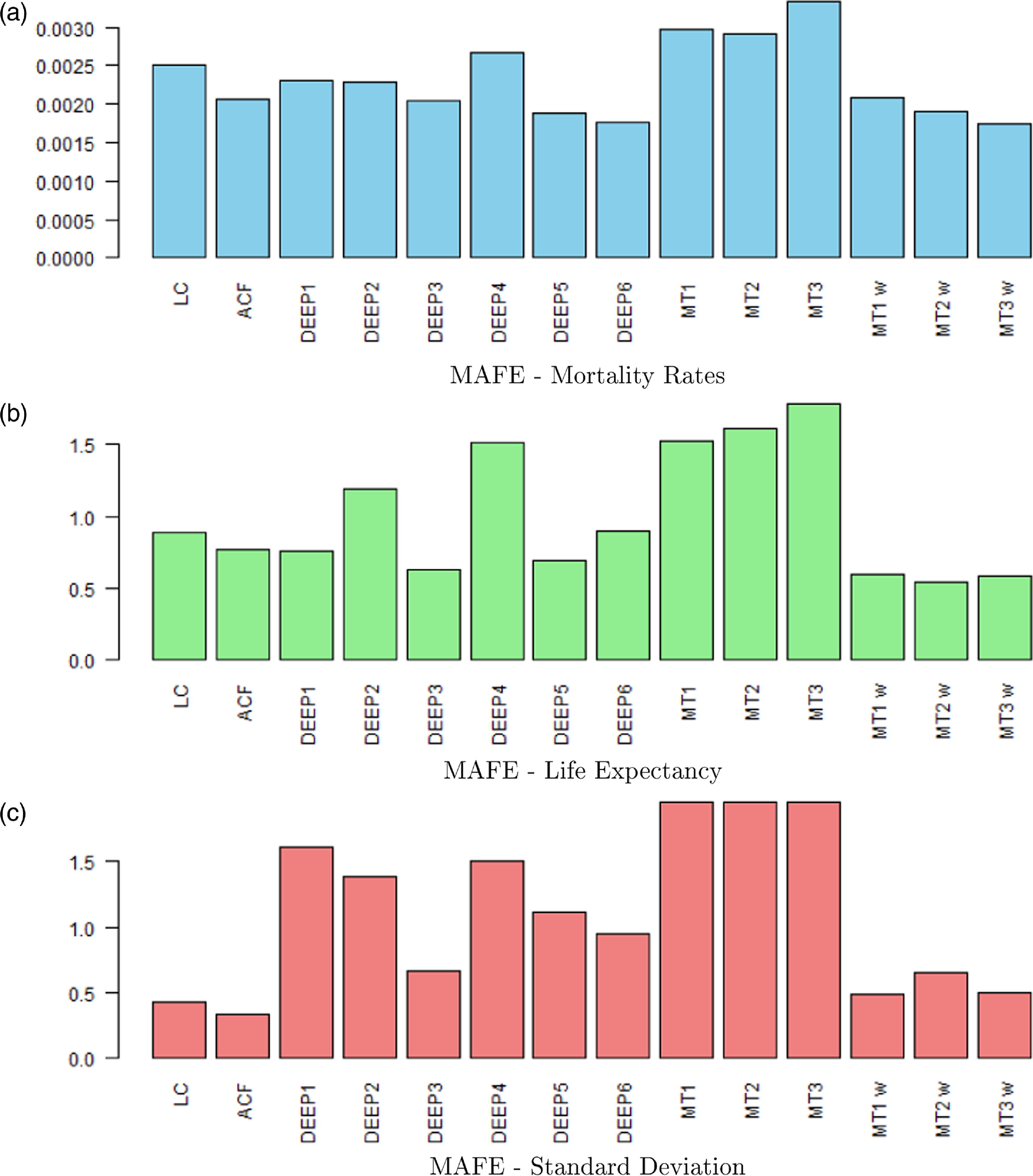
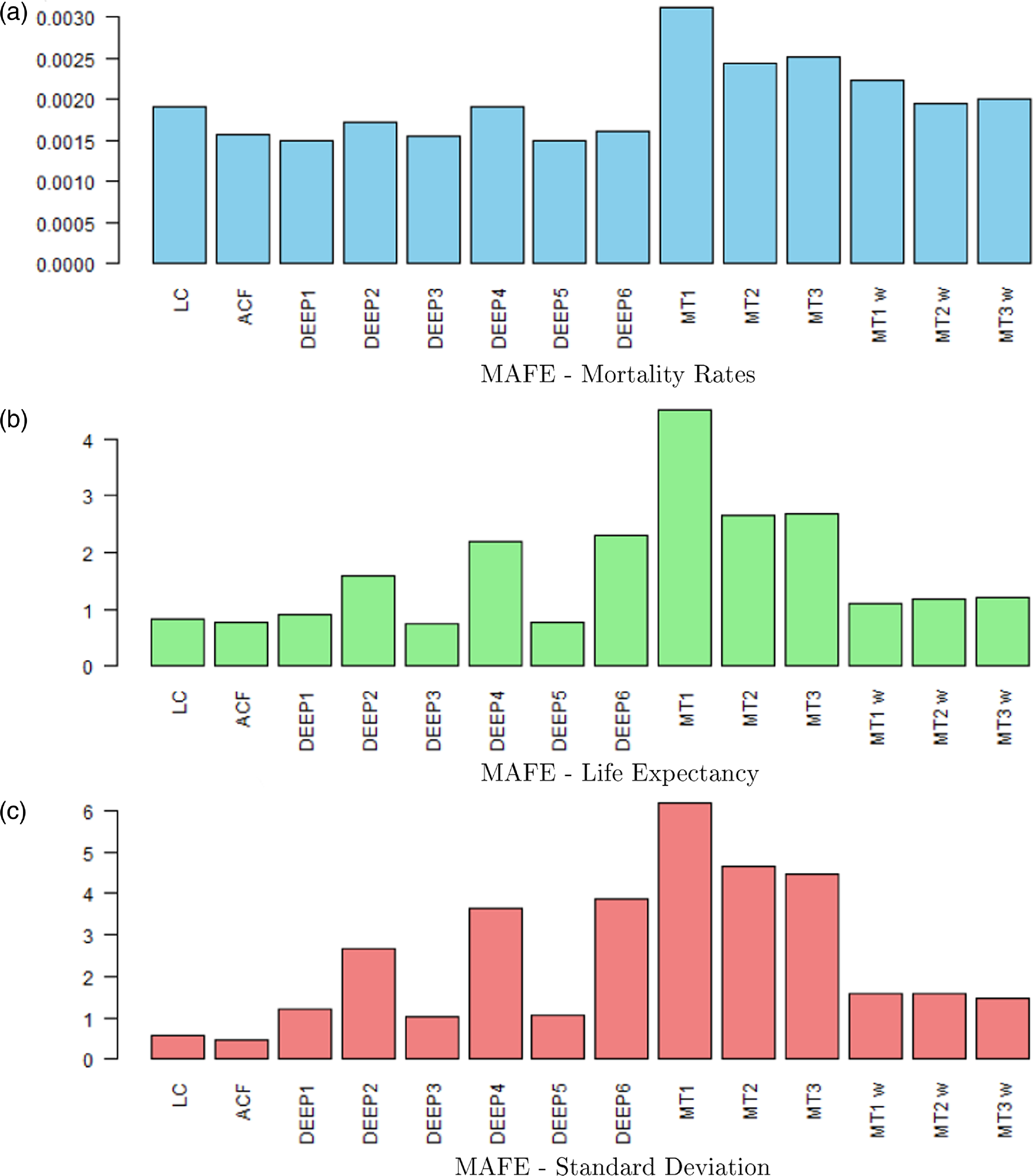
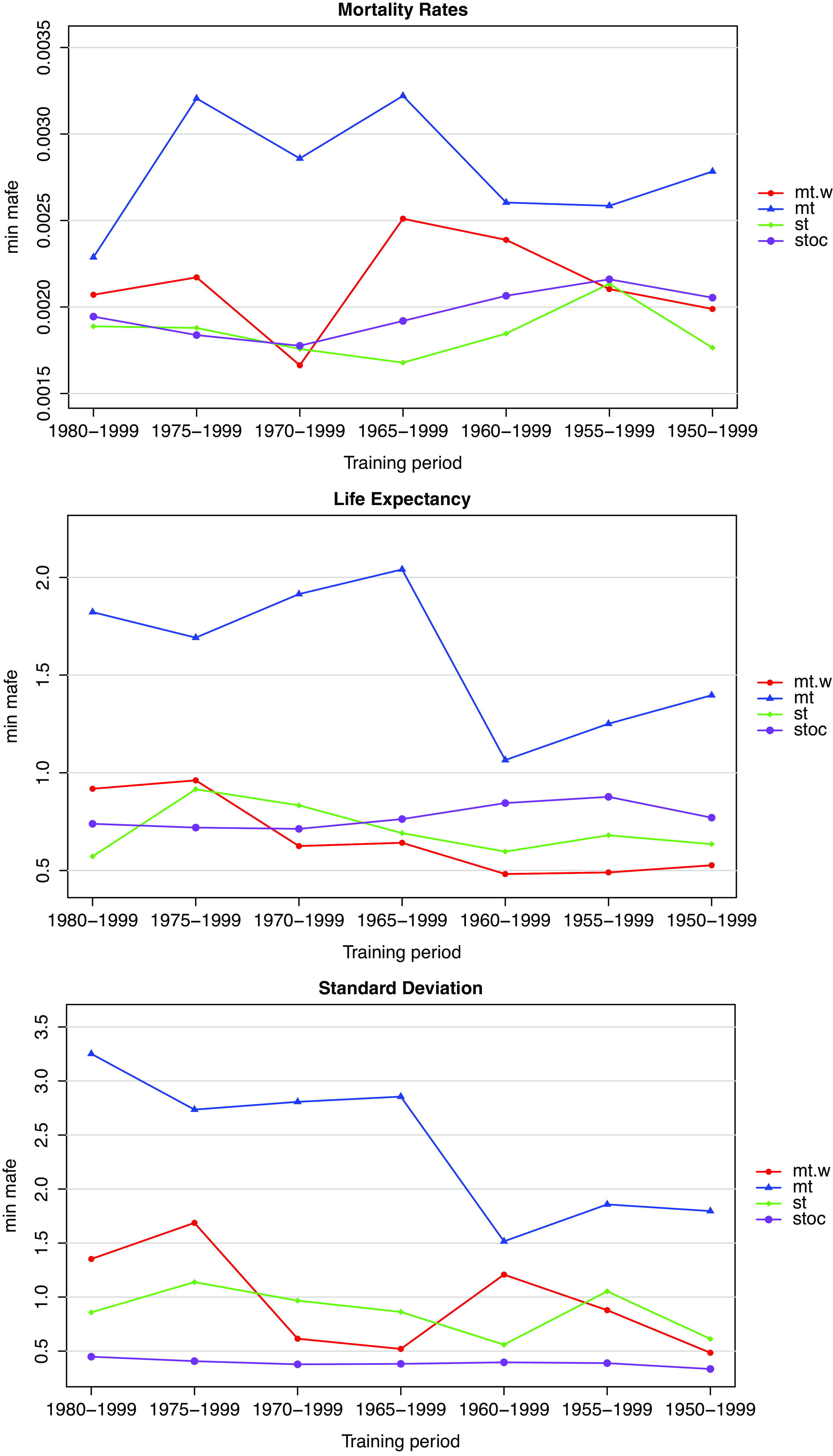
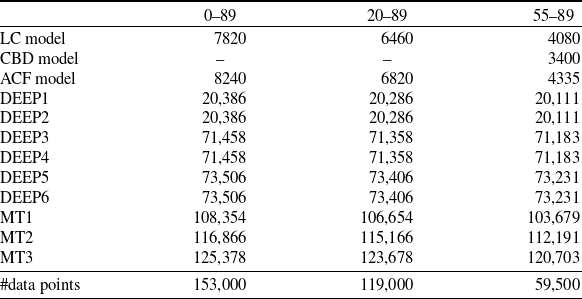
The comparison of models results is based on three metrics: mean absolute forecasting error (MAFE) for individual yearly death rates, for life expectancy, and for standard deviation of the lifetime. Figures 6, 7, and 8 report the three metrics, respectively, for the 55–89, 20–89, and 0–89 age ranges while using 1950–1999 as training period and 2000–2019 as test period. Figures 10–18 extend this analysis by showing the three metrics for individual countries. Figure 9 shows the evolution of the three metrics using different lengths for the training period using 20–89 as age range. Finally, Table 3 summarises the total number of parameters in each approach for the three age ranges considered here.Footnote 3
Comparison of MAFE for mortality rates, life expectancy, and standard deviation. Age range: 55–89.
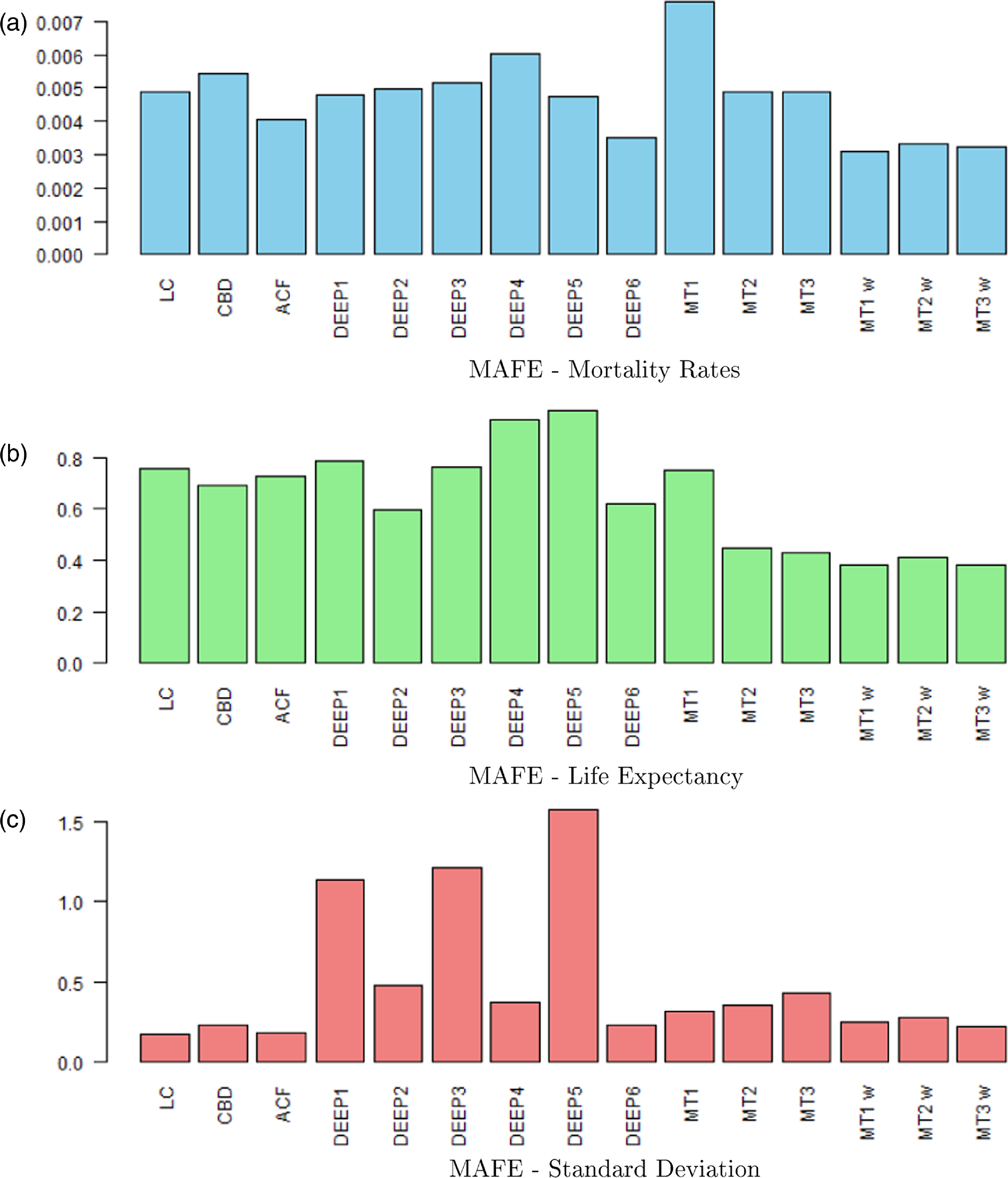
Comparison of MAFE for mortality rates, life expectancy, and standard deviation. Age range: 20–89.
Comparison of MAFE metrics for mortality rates, life expectancy, and standard deviation. Age range: 0–89.
Minimum MAFE for single-task NNs, multi-task NNs, and stochastic models by training period and metric considered.
Number of parameters and data points by approach and age range.
We observe that there is variability in the different approaches performance based on the metric and age range considered. In Figure 6, we notice how multi-task NNs show noticeable results in the 55–89 age range both with and without the weighting scheme. Indeed, they outperform all other approaches for life expectancy MAFE. Multi-task NNs with weighting scheme results appear to be the best ones for mortality rates MAFE, while in standard deviation MAFE they are outperformed only by Lee–Carter and ACF models.
Focusing on 20–89 age range in Figure 7, we notice a big difference with respect to the 55–89 age range case. First, multi-task NNs without a weighting scheme turn out to be the worst ones for all three the metrics considered here. In contrast, multi-task NNs with a weighting scheme still show good results. Indeed, they are among the best ones for mortality rate MAFE, alongside DEEP5 and DEEP6, for life expectancy MAFE, alongside DEEP3, and for standard deviation, where they are outperformed only by Lee-Carter and ACF models. The reason for such a big difference between the performance of multi-task NNs with and without weighting scheme, especially for life expectancy and standard deviation, is likely due to the training of the NNs. Indeed, mortality rates at lower ages are underestimated, due to their lower magnitude, during the training process which tends to place more emphasis on observations with higher magnitude, such as the ones at older ages. As a consequence, the NNs will produce poor forecast for lower ages mortality rates and, as a consequence, bigger errors for life expectancy and standard deviation, which are heavily influenced by mortality at early ages.
Finally, focusing on Figure 8, we observe a similar pattern also when considering the 0–89 age range. Indeed, the multi-task NNs trained without a weighting scheme result in the poorest performance for all the three metrics considered. Also multi-task NNs with a weighting scheme have a weaker performance compared to the other two cases considered previously. In fact, we notice how Lee–Carter and ACF models, and DEEP1, DEEP3, and DEEP5 single-task NNs have better performance compared to them. Nevertheless, the advantage of using a weighting scheme is still important for multi-task NNs, especially when considering life expectancy and standard deviation. Finally, here we can notice the benefit of clustering the third hidden layer in multi-task NNs (notice that the clustering is based on historical values of life expectancy and standard deviation in the age range 0-89). Indeed, both MT2 and MT3 show an improvement to MT1 in all the metrics considered here. We also observe that when introducing a weighting scheme in the training of the NNs this benefit tends to disappear.
In Figures 10–18, the MAFEs by country and approach are shown. Specifically, the filled black dot (and the corresponding vertical black line) represents the global MAFE (i.e. the same metric showed in Figures 6–8), while the coloured dots represent the MAFE for individual countries. Focusing on the US and Japan, that is two countries with particular pattern in the evolution of mortality in the last decades, we notice how the multi-task NNs with a weighting scheme provide generally better results with respect to single-task NNs if we consider the 55–89 age range. When widening the age range to 20–89 and 0–89, the advantage of multi-task NNs on the two countries tends to disappear, with their MAFE being often above the one of single-task NNs. Overall when considering all countries, we notice how in the 55–89 age range case, multi-task NNs tend to have lower dispersion across the countries’ MAFEs compared to single-task NNs.
In Figure 9, the minimum MAFE by approach, training period (while keeping fixed the age range 20–89), and metric is reported. The minimum MAFEs for single-task NNs, multi-task NNs without weighting scheme, multi-task NNs with weighting scheme, and stochastic models are obtained as the minimum among DEEP1-DEEP6, MT1-MT3, MT1 w-MT3 w, and LC-ACF, respectively. We can observe how for mortality rates MAFE, single-task NNs generally give the best results with the exception of three training periods: in 1970–1999 and 1955–1999, they are outperformed by multi-task NNs with a weighting scheme, and in 1975–1999, they are outperformed by stochastic models. Although the gap with stochastic models narrows when considering shorter training periods, multi-task NNs performance appears to be less steady, and results to be the best one only in one case. Nevertheless, the benefit of using a weighting scheme is noticeable in all the training periods considered here. Finally, the stochastic models outperform NNs in all cases considered while focusing on lifetime standard deviation. They always have the lowest minimum MAFE, despite the gap with NNs getting more narrow in the longest training period, showing a similar trend also found in the mortality rates MAFE. With regard to the NNs, single-task and multi-task alternate with each other in terms of best performance with a consistent result that using a weighting scheme improves the forecasting accuracy of multi-task NNs.
In conclusion, Table 3 provides the details on the number of parameters and data points considered, categorized by approach and age range, for the training period 1950–1999. We can notice how the number of parameters for stochastic models, DEEP1, and DEEP2 is definitely lower than the number of data points in all the age ranges considered. The remaining single-task NNs, MT1, and MT2 exceed the number of data points when the age range is 55–89 but stay below it for wider age ranges. Finally, MT3 has a number of parameters lower than the number of data points only when considering the 0–89 age range.
6. Conclusion
The results show that using a 50-year training period, the performance of multi-task NNs compared to single-task NNs and traditional stochastic models depends on the metric considered and, especially on the age range. More specifically, the out-of-sample precision of multi-task NNs is good with a shorter age range but tends to deteriorate when this age range is increased. This is likely due to the underestimation of lower ages mortality rates that happen in the training period. Adding a weighting scheme to multi-task NNs, markedly improves their performance, especially for life expectancy and standard deviation. Finally, it is noticeable that multi-task NNs with clustering based on past life expectancy and standard deviation show better results only when a weighting scheme is not considered.
When testing the models on shorter training periods, we arrive at a similar conclusion with respect to the 1950–1999 training period case. What is worthy to point out is that traditional stochastic models tend to perform relatively better compared to NNs when considering a short training period.
In terms of future research on multi-task NNs, at least five straightforward developments could be considered: first, implementing multi-task NNs where the generic task is based on a categorical variable such as age and gender, rather than, or alongside, country. Second, using a different machine learning technique, such as one specifically designed for time series, to cluster the countries based on past mortality experience. Third, a penalization could be added to the loss function of the NNs to ensure that female and male mortality do not diverge, or even that the mortality of different populations does not diverge, achieving some degree of coherence. Fourth, multi-task NNs of the same type as those proposed in this paper could be applied in a different context, such as forecasting mortality rates by cause of death within a single population. Fifth, further analysis aiming to study the question of explainability of multi-task NNs could be conducted, see Perla et al. (Reference Perla, Richman, Scognamiglio and Wüthrich2024).
Supplementary material
To view supplementary material for this article, please visit https://doi.org/10.1017/asb.2025.10.


 Open access

