




 Open access

Crossref Citations

This article has been cited by the following publications. This list is generated based on data provided by Crossref.
Uzochukwu, Benjamin S. C.
Okeke, Chinyere
O’Brien, Niki
Ruiz, Francis
Sombie, Issiaka
and
Hollingworth, Samantha
2020.
Health technology assessment and priority setting for universal health coverage: a qualitative study of stakeholders’ capacity, needs, policy areas of demand and perspectives in Nigeria.
Globalization and Health,
Vol. 16,
Issue. 1,
Baghbanian, Abdolvahab
Merlin, Tracy
Carter, Drew
and
Wang, Shuhong
2020.
Methods for the health technology assessment of complex interventions: a protocol for a scoping review.
BMJ Open,
Vol. 10,
Issue. 11,
p.
e039263.
Chalkidou, Kalipso
Claxton, Karl
Silverman, Rachel
and
Yadav, Prashant
2020.
Value-based tiered pricing for universal health coverage: an idea worth revisiting.
Gates Open Research,
Vol. 4,
Issue. ,
p.
16.
Chalkidou, Kalipso
Claxton, Karl
Silverman, Rachel
and
Yadav, Prashant
2020.
Value-based tiered pricing for universal health coverage: an idea worth revisiting.
Gates Open Research,
Vol. 4,
Issue. ,
p.
16.
Ghazinoory, Sepehr
Majidi, Basireh
Nasri, Shohreh
Zandi, Mohammad Ehsan
Farrokhi, Hosein
Javedani, Majid
and
Barzanouni, Majid
2021.
Differences between health technology assessment topics in high- and middle-income countries: a scoping review.
Archives of Public Health,
Vol. 79,
Issue. 1,
Yang, Chai
Wang, Yanjun
Hu, Xiaoxuan
Chen, Yujun
Qian, Liting
Li, Fuchang
Gu, Wei
Liu, Qiang
Wang, Di
and
Chai, Xiaoqing
2021.
Improving Hospital Based Medical Procurement Decisions with Health Technology Assessment and Multi-Criteria Decision Analysis.
INQUIRY: The Journal of Health Care Organization, Provision, and Financing,
Vol. 58,
Issue. ,
Mukherjee, Kanchan
2021.
Integrating technology, innovation and policy: COVID-19 and HTA.
Health Policy and Technology,
Vol. 10,
Issue. 1,
p.
16.
Ramponi, Francesco
Twea, Pakwanja
Chilima, Benson
Nkhoma, Dominic
Kazanga Chiumia, Isabel
Manthalu, Gerald
Mfutso-Bengo, Joseph
Revill, Paul
Drummond, Michael
and
Sculpher, Mark
2022.
Assessing the potential of HTA to inform resource allocation decisions in low-income settings: The case of Malawi.
Frontiers in Public Health,
Vol. 10,
Issue. ,
Fasseeh, Ahmad Nader
Saragih, Sarah Maria
Hayek, Noha
Brodovska, Sasha
Ismail, Adham
ElShalakani, Amr
Abaza, Sherif
Obeng, George Dennis
Ameyaw, David
and
Kalo, Zoltan
2022.
Impact of health technology assessment implementation with a special focus on middle-income countries.
Health Policy and Technology,
Vol. 11,
Issue. 4,
p.
100688.
Surgey, Gavin
Mori, Amani T
and
Baltussen, Rob
2022.
Health Technology Assessment in Tanzania: Capacity and experience of HTA committee members.
Journal of Global Health Economics and Policy,
Vol. 2,
Issue. ,
Surgey, Gavin
Mori, Amani T
and
Baltussen, Rob
2022.
Health Technology Assessment in Tanzania: Capacity and experience of HTA committee members.
Journal of Global Health Economics and Policy,
Vol. 2,
Issue. ,
Falkowski, Anna
Ciminata, Giorgio
Manca, Francesco
Bouttell, Janet
Jaiswal, Nishant
Farhana Binti Kamaruzaman, Hanin
Hollingworth, Samantha
Al-Adwan, Mariana
Heggie, Robert
Putri, Septiara
Rana, Dikshyanta
Mukelabai Simangolwa, Warren
and
Grieve, Eleanor
2023.
How Least Developed to Lower-Middle Income Countries Use Health Technology Assessment: A Scoping Review.
Pathogens and Global Health,
Vol. 117,
Issue. 2,
p.
104.
Baker, Peter
Barasa, Edwine
Chalkidou, Kalipso
Chola, Lumbwe
Culyer, Anthony
Dabak, Saudamini
Fan, Victoria Y.
Frønsdal, Katrine
Heupink, Lieke Fleur
Isaranuwatchai, Wanrudee
Mbau, Rahab
Mehndiratta, Abha
Nonvignon, Justice
Ruiz, Francis
Teerawattananon, Yot
Vassall, Anna
and
Guzman, Javier
2023.
International Partnerships to Develop Evidence-informed Priority Setting Institutions: Ten Years of Experience from the International Decision Support Initiative (iDSI).
Health Systems & Reform,
Vol. 9,
Issue. 3,
Mori, Amani Thomas
2023.
Mandatory health insurance for the informal sector in Tanzania—has it worked anywhere!.
Frontiers in Health Services,
Vol. 3,
Issue. ,
Mbau, Rahab
Vassall, Anna
Gilson, Lucy
and
Barasa, Edwine
2023.
Factors influencing institutionalization of health technology assessment in Kenya.
BMC Health Services Research,
Vol. 23,
Issue. 1,
Mbau, Rahab
Vassall, Anna
Gilson, Lucy
and
Barasa, Edwine
2023.
Factors Influencing the Institutionalization of Health Technology Assessment: A Scoping Literature Review.
Health Systems & Reform,
Vol. 9,
Issue. 3,
Dzingirai, Blessing
Dambiko, Prudence
Matyanga, Celia
Manyau, Pinky
Tagwireyi, Dexter
Postma, Maarten J.
Mafirakureva, Nyashadzaishe
and
van Hulst, Marinus
2024.
A situational and stakeholder analysis of health technology assessment in Zimbabwe.
International Journal of Technology Assessment in Health Care,
Vol. 40,
Issue. 1,
Surgey, Gavin
Curocichin, Ghenadie
Garabajiu, Maria
Novakovic, Tanja
Pana, Adrian
and
Oortwijn, Wija
2024.
The development of a roadmap for Health Technology Assessment implementation in Moldova.
F1000Research,
Vol. 13,
Issue. ,
p.
518.
Surgey, Gavin
Curocichin, Ghenadie
Garabajiu, Maria
Novakovic, Tanja
Pana, Adrian
and
Oortwijn, Wija
2024.
The development of a roadmap for Health Technology Assessment implementation in Moldova.
F1000Research,
Vol. 13,
Issue. ,
p.
518.
Wahbi, Aumaima
Khaddouj, Karim
Aziz, Hantem
Naoufal, Lahlimi
Mkik, Marouane
and
Hebaz, Ali
2025.
Proceedings of the 4th International Conference on Advances in Communication Technology and Computer Engineering (ICACTCE’24).
Vol. 1312,
Issue. ,
p.
464.
Health technology assessment (HTA) is a pillar to support the achievement of universal health coverage (UHC) in a resource constrained environment. Without HTA there is little to guide the allocation of resources. The process of institutionalizing HTA in a low-income country (LIC) raises two pertinent questions:
(1) How does one introduce the concept of HTA such that HTA becomes an integrated part of routine decision making for planning and operational policy within the healthcare system?
(2) What should an HTA system look like in a resource-limited setting? How does one establish a solid and comprehensive (“evidence based”) foundation for decision making for the introduction and utilization of health technologies at all levels in the healthcare system?
With a focus on the first question, this paper outlines the process of introducing concepts of HTA: the journey during which an HTA committee became established from the initial engagement through the activities leading to the successful inception of the committee. This is the first attempt to systematically document the stages of introducing HTA in a LIC in sub-Saharan Africa (SSA). While some processes followed in Tanzania are unique to the country, the paper will highlight several lessons that can be learned and applied in other countries that aspire to introduce HTA.
HTA to Inform Spending Decisions
HTA is a mechanism to support decision making in health toward setting more cost-effective priorities. It has increasing recognition of its role as an important component to achieving UHC through more efficient allocation of resources (Reference Chalkidou, Glassman and Marten1), yet its use is mostly limited to high- and middle-income countries. HTA considerations in decision-making processes are almost nonexistent in the SSA region (Reference Chalkidou, Levine and Dillon2). However, there is a need for HTA to ensure value for money due to tighter resource constraints as many countries transition out of dependence on development aid and aim toward UHC.
While HTA is generally recognized as an important mechanism to ensure efficient resource allocation (see Figure 1 for HTA agencies worldwide) it is seldom an integral component of the health system in countries that are most in need of better resource allocations. The sub-Saharan African region faces significant challenges in the consolidation and explicit linking between HTA and decision making. Its absence is due to the difficulty of implementation and capacity requirements. Countries are not yet familiar with the concepts, or if they are, they have limited capacity for the implementation (Reference Chalkidou, Levine and Dillon2).
HTA agencies worldwide (Reference MacQuilkan, Baker and Downey23;Reference Richards24).
Challenges to Institutionalizing HTA
There are many challenges to institutionalizing HTA in a LIC, including technical, operational, political, and human resource constraints. Financial constraints might also hinder the institutionalization of HTA—while there may be long-term financial benefits to HTA, there is a need for the upfront funding and financing of HTA operations and related work. There are technical capacity challenges: HTA requires a specialized set of skills in health economics to undertake economic evaluations (supply side) and then to evaluate the evidence for policy implementation (demand side) (Reference Li, Ruiz, Culyer, Chalkidou and Hofman3). The operational challenges are closely linked to political will and financial constraints: by whom will the HTA body be constituted, where will it sit within the legislative structures, what will its entity status be, how will it inform decisions or policy to be enacted?
Introducing HTA is a disruptive policy change, as it redefines the systems and dynamics for policy decision making. While the underlying principle for HTA is a transparent, well-defined system for decision making, it shifts the power away from the traditional decision-making system. Understanding and meeting these challenges will be important if countries are to introduce a functioning HTA system and get the best value for money from its existence.
Methodology
Our aim for this paper was to systematically document the process of engagement by the various role players (see Table 1 for definitions of key players), which led to the formal establishment of an HTA committee in Tanzania. A situational analysis (Reference Sandelowski4) was conducted to map the current decision-making structures in Tanzania and identify potential areas where there was a need for HTA. An in-depth understanding of the existing decision-making structures allowed us to develop appropriate recommendations for the institutionalization of HTA in Tanzania.
Key Players and Definitions in the Tanzanian Health System
Continuous engagement with key actors throughout the study process was inevitable in order to improve the authors’ understanding and experience of the health system in Tanzania. In addition, a review of available meeting minutes and documentation was undertaken. This paper is the culmination of detailed discussions with various actors involved in shaping the health system in Tanzania.
Health and Health System in Tanzania
Tanzania is categorized as a LIC with a total population of approximately 54 million, a per capita gross domestic product (GDP) of US$601 (2015) and a per capita expenditure on health of about US$32 per year. Government revenue as a percent of GDP is 20.7 percent (2014) and in 2015, total health expenditure accounted for 6 percent of the country's GDP (5). The country faces a high burden of noncommunicable diseases (NCDs), which account for approximately 31 percent of all deaths in Tanzania (6).
The Government of Tanzania (GoT) operates a decentralized healthcare system such that the management and governance of the health sector is heavily influenced by the process of the devolution of functions to regional and district governments.
At the national level, the MoHCDGEC plays the lead role in stewardship and regulation of the sector and is in charge of the provision of health services at national-level hospitals and regional referral hospitals. The Ministry establishes the policy framework for all health interventions, which include the STG and NEMLIT—within the Ministry this responsibility falls under the Pharmaceutical Services Unit (PSU). The Ministry also coordinates the functions of semi-autonomous institutions like the Medical Stores Department (MSD). MSD is responsible for the procurement, storage, and distribution of medicines to public health facilities.
The National Health Insurance Fund (NHIF) is a statutory health insurance scheme established by parliament in 1999. It is currently the largest health insurance scheme in the country and is compulsory for civil servants. The contribution is 6 percent of the employee's gross salary, which is shared equally between the employer and the employee. The NHIF covers the cost of drugs procured through MSD for those who are covered by the health insurance.
The STG/NEMLIT determines the type of treatment/medicine which should be provided by the medical officer at each facility level, and similarly the procurement and reimbursement of medicines in Tanzania should be guided by the NEMLIT.
Priority Setting in Tanzania
There is no formalized priority-setting mechanism in the Tanzanian healthcare system, and current decision-making processes do not incorporate health economic analysis. Decisions are taken by the leadership at the national level and are made in a bureaucratic fashion, with little or no evidence to underpin them. Decisions related to specific programs and initiatives are assigned to individual committees charged with providing recommendations to the Minister. Examples of such committees are the National Malaria Steering Committee and the National Medicines and Therapeutic Committee (NMTC). These decision-making bodies generally comprise leaders at the Ministry of Health as well as district-level managers and directors in charge of specific programs and initiatives. Many of the committees are chaired by the chief medical officer (CMO) who oversees all of the service delivery sections at the Ministry of Health.
A review of government policy documents (Reference Mori, Macha and Surgey7) shows that some elements of HTA are referred to. For example, the draft National Health Policy 2017 states that the government will [among other things] “improve adequate knowledge in HTA for evidence-based selection of quality and safe technology as well as realizing value for money” (8). The standard operating procedure (SOP) for reviewing the STG/NEMLIT also emphasize that recommendations should consider “cost-effectiveness” and “available resources (affordability)” (9) however, there are no guidelines or details for inclusion or exclusion of a medicine; a decision that is still left at the discretion of the reviewer (Figure 2). However, research shows that there is little capacity to undertake HTA (Reference Surgey, Mori, Macha and Hofman10) and the authors experience is that it is at all levels (academic, national, and local).
SOPs for reviewing the STG/NEMLIT and the STG/NEMLIT documents.
The country is committed to moving toward UHC by ensuring everybody has access to needed health services of high quality and is protected against financial risks that could arise as a result of paying for health care (11;12). As Tanzania moves toward universal coverage reforms are focused on improving efficiency and equity, for example, through the strategic purchasing of goods and services. Given the political drive, there is a need and an opportunity to link HTA to product selection, procurement, pricing negotiations, strategic purchasing, and provider payment. As the health services provided by the Government of Tanzania are not well defined, there is an opportunity for HTA to help define priority services as well as a process for doing so, in order to ensure best value for money and broader stakeholder buy in of coverage decisions.
Introducing HTA into the Health Decision-Making Process
Typically, a national HTA strategy pursues two general aims (13;14): to establish a solid and comprehensive “evidence-based” foundation for decision making for the introduction and utilization of health technologies at all levels in the healthcare system and to ensure that HTA becomes an integrated part of routine decision making for planning and operational policy within the healthcare system.
Engagement with the Government of Tanzania began in 2014 with PATH (an international nongovernmental organization) through the access and delivery partnership (ADP), which is a project aimed to help LMICs expand their capacity to access and introduce new health technologies (15). This helped provide sensitization on the HTA topic and created understanding that integration of HTA processes into the Tanzanian context will support health resource allocation. In order to introduce HTA into the system, discussions on a demonstration project took place, this project could then help show the value of HTA.
Ministry officials have expressed concerns around efficiency and pricing and they have looked to HTA as a potential solution in addressing these issues. To this end, a workshop on HTA was hosted by the Ministry of Health in collaboration with PATH in early 2015. Partners from Thailand—the health intervention and technology assessment program (HITAP), and South Africa—the priority cost effective lessons for system strengthening (PRICELESS SA) participated in the workshop. Both HITAP and PRICELESS are core members in the international decision support initiative (iDSI), which is a global network working to increase the value and impact of health spending. The workshop aimed to raise awareness of HTA and its role in informing decisions as well as serving as a platform where the experience and knowledge from both HITAP and PRICELESS could be shared. HITAP is a semi-autonomous research unit with the responsibility for appraising a wide range of health technologies and programs to inform policy decisions in Thailand. PRICELESS is a research to policy unit based at Witswatersrand University School of Public Health, South Africa, whose mission is to provide analysis that will inform the way in which resources are allocated and priorities are set to improve public health.
The following questions were considered at the meeting:
(1) What are the potential applications of HTA for evidence-based policy development?
(2) What factors are conducive to introducing HTA, and what are the barriers?
(3) Who are the key stakeholders in supplying HTA and who are the target users of HTA results?
Several key points emerged, including a strong political will to establish a structured mechanism to prioritize health technologies and interventions that would bring value for money to Tanzania. A success factor was the identification of a particular project, representing a good starting point for establishing a priority-setting mechanism in Tanzania: using priority setting for NEMLIT revision. At the time, Tanzania had an urgent need to update their STG/NEMLIT and it was agreed that this would be a good opportunity to use an HTA, evidence-informed process to do so.
A follow-up workshop was then held towards the end of 2015 to identify gaps in technical skills and capacity relating to the medicine selection processes with representatives from the Ministry of Health. The workshop brought to light a number of challenges about how to actively practise evidence-based medicine, which include a lack of understanding of how to define PICO (population, intervention, comparator, outcome) and use appropriate search terms and secondary databases such as Pubmed to identify relevant sources of evidence and limited skills to conduct a critical appraisal of the literature. In previous reviews, the participants had relied on informal searches using universal search engines such as Google or ad hoc articles as source evidence. Other challenges included lack of understanding of activity-based costing (ABC) analysis of medicine and missing data on medicines quantification to assist in the priority setting process. The participants in the workshop showed some concerns around the pharmacoeconomics and how to go about doing this due to a lack of skills in costing and economic evaluation. It was necessary to introduce basic costing skills as a first step and over the course of the workshops it became clear that the clinicians would prefer to hand this over to the pharmaceutical services unit (PSU) and health economists on the team.
The PSU, under the Ministry of Health, led the development of the fifth edition (2017) of the STG/NEMLITs. The PSU is the secretariat to the expert review team (ERT) who are responsible for developing/reviewing the STG/NEMLIT, tasked by the National Medicines Therapeutic Committee to update the guidelines. The ERT undertake the review, update, and then present their revisions to the National Medicines Therapeutics Committee who then approve changes.
It was noted in the workshop, that historically there has been very little collaboration between academic units and the Ministry. At this time (in 2015) there was a list of essential medicines, however, these medicines were drawn from the STGs. There was, in reality, an unlimited access to any of the registered medicines in Tanzania—procurement, affordability and availability issues notwithstanding. There was no specific adherence to any particular list of medicines.
The Essential Medicines List and Revision Process
The essential medicines list (EML) is among the earliest efforts to inform explicit priority setting in LMICs (Reference Glassman and Chalkidou16). Tanzania was one of the pioneers of the essential medicines program having produced its first list of essential medicines in the early 1970s. The concept was later adopted by the World Health Organization (WHO) with the first WHO modal list of essential drugs being produced in 1977 (Reference Mori, Kaale, Ngalesoni, Norheim and Robberstad17). The medicines selected are based on public health relevance, and evidence on efficacy and safety. Listed essential medicines are considered to be cost-effective buys (18;19) and the list is considered as a tool to promote health equity (Reference Kar, Pradhan and Mohanta20). Countries' EMLs need to be regularly updated to ensure they contain key commodities and that they reflect up-to-date evidence on effectiveness and safety.
The NEMLIT can be used to guide the procurement and supply of medicines in the public sector, which is directly linked to the STGs and can be an important information and education tool used by health professionals. The STG/NEMLIT has a role to play in informing the health benefits package and it ensures treatment offered is “best practise” for the country setting based on available resources (equipment, medical personnel etc.) (Reference Ochalek, Revill and Manthalu21).
The NEMLIT is updated every 4–6 years by a committee of experts who come from different institutions, and is approved by the NMTC, a multidisciplinary team, chaired by the CMO, with 16 members. Historically, the selection criteria in Tanzania have been loosely based on efficacy, safety, availability, and compliance with WHO recommendations. There was little to no consideration of cost-effectiveness criteria, which is evidenced by the committee having no knowledge of cost-effectiveness (Reference Mori, Kaale, Ngalesoni, Norheim and Robberstad17).
The 2017 development and revision of the STG/NEMLIT involved capacity-building workshops and on-going engagement between the Tanzanian ERT and continuous technical support from HTA experts contracted to PRICELESS SA. Such engagement enabled in-country stakeholders to gain an in-depth understanding and practical experience of evidence-based selection of medicines while simultaneously developing their knowledge base on the principles of HTA. Training and support was given on using evidence-based medicine and costing for priority setting in medicines. These linkages to the HTA process again provided the affirmation that HTA has a critical role to play in decision making.
To ensure transparency and sound methodology of the revision of the medicines, a guidance document, in the form of an SOP (9) was developed by a group of national and international experts aimed at providing systematic guidance for developing and reviewing the STGs, vertical program treatment guidelines and associated medicine lists (NEMLIT inclusive), that could be used in future review processes. It was subsequently endorsed by the National Medicines Therapeutic Committee (NMTC), chaired by the CMO.
The guidance document outlines the approach to the review of the STG/NEMLIT and describes the process of topic prioritization. A notable aspect to the guidance is the incorporation of cost-effectiveness in considering medicines or treatment options. While there is no direct reference on how to establish thresholds for inclusion or exclusion of medicines, this is the first time that the guidance for the development of the STG/NEMLIT has incorporated cost-effectiveness.
Compared to previous revisions of the NEMLIT, the SOP enables the incorporation of a new principle, ensuring that any addition or deletion from the EML needs to be on the “basis of proven scientific data regarding effectiveness, safety and cost-effectiveness.” The SOP further goes on to state that appropriate treatment options need to be linked to the evidence gathered and that “these recommendations should consider efficacy, safety and cost-effectiveness” instead (9). The revised STG/NEMLIT was finalized in the first quarter of 2018. The final list of medicines had approximately 140 medicines removed, while approximately 170 new products were added. The inclusion criteria for medicines considered efficacy, safety, cost-effectiveness as well as registration with the Tanzanian Food and Drugs Authority (TFDA). These criteria were not individually weighted. While the 2017 NEMLIT still contains some questionable drugs regarding their inclusion in the EML—for example, the medicine levobupivacaine is not yet registered for use by the TFDA and the medicine bevacizumab has a lack of proven efficacy in certain cancers (Reference van den Bent, Klein and Smits22), there were a number of drugs which were excluded due to cost-effectiveness criterion not being met. The skills built through this process provide an opportunity for further revisions of the NEMLIT and have set the foundation for establishing an HTA mechanism in Tanzania.
Establishment of the Tanzanian HTA Committee
While the process of the revision of the STG/NEMLIT was underway, the first HTA meeting was convened by the acting CMO in September 2017. The purpose of this meeting was to define the terms of reference for the committee and to give an overview of HTA. Committee members were nominated from various units/departments based on their seniority.
A second HTA committee meeting was held in May 2018, supported by PRICELESS/iDSI, which discussed the need for capacity building among the committee members. It was agreed that HTA committee meetings would be used as a platform for ongoing HTA mentorship and capacity building.
During this process there has been recognition of inefficiencies in the system, for example, the disconnect between the procurement list at the Medicines Stores Department (MSD) and NEMLIT and the National Health Insurance System (NHIS) benefit package. MSD makes available a list of medicines and medical supplies via its price catalogue, which facilitates its use as a guide to place orders. MSD then distribute drugs to public health facilities through its nine zonal offices. The procurement of essential medicines at the MSD is not limited to the EML. Medicines for tertiary care can be procured under request of health institutions offering care and management. According to a manager in the NHIS, “43% of items in the NHIF benefit package are not listed in NEMLIT.”
The HTA process has since been recognized as an appropriate mechanism to align the NEMLIT and the National Health Insurance Fund reimbursement list; as a participant from a recent workshop stated “HTA will help us fix this”—that is, begin to align the EML with the National Health Insurance Fund reimbursement list of medicines. If the medicines that are reimbursed are limited to those on the EML it could generate large financial savings for the scheme which may help reduce subscription costs by enlarging the pool of members.
Factors Contributing to Success
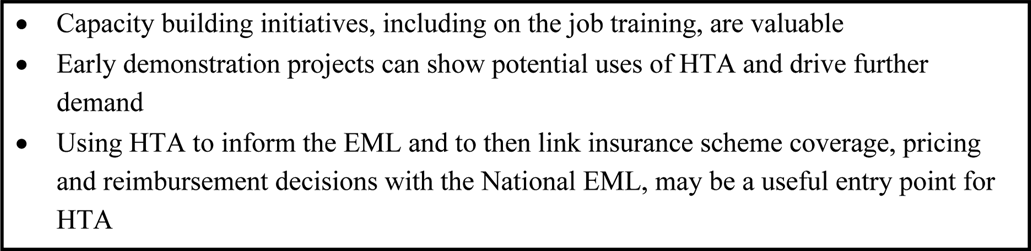
A number of important factors contributed to the successful introduction of HTA and establishment of an HTA committee in Tanzania, some of which are generalizable and can be applied in countries that aspire to introduce HTA. A summary of key lessons is outlined in Figure 3.
Key lessons learned.
The Tanzanian experience teaches us that engagement of policy makers and the identification of an appropriate entry point during the initial phases are key success factors, particularly while there is momentum and political will. A demonstration project needs to be selected that is not just an academic exercise but which also contributes to the creation of demand (for HTA). Using a project, which is seen as a necessity for the country, provides opportunity to engage further and sustain efforts around HTA topics. This reinforces the HTA messaging and also gives opportunity to provide capacity building around health economics topics.
Strengthened individual, institutional, and organizational capacity was crucial for the creation of the HTA committee. This could not have been achieved without the strong partnership between development partners and local officials which was key to influencing strategic direction. The major lesson learnt from the experience was that, strong political will was generated by multiple influential partners and by ongoing, in-depth engagement. Despite some movement of individuals within the Ministry, there has been one consistent focal point who has been fully engaged from the beginning, which has been a significant factor in the establishment of an HTA committee and the incorporation of evidence-informed priority setting in decision making (within the EML).
Discussion
This paper describes the journey of introducing HTA in Tanzania and outlines emerging lessons that can guide future HTA-related initiatives in similar resource-limited settings. In Tanzania, it has been recognized that HTA can play a critical role in an efficient healthcare system. For the first time, cost-effectiveness has been considered in the development of the EML and adherence to the STG/NEMLIT is being enforced by the Ministry. By using the process of the revision of the NEMLIT, an opportunity was created to demonstrate that HTA is not only a concept for discussion, but can be translated into a workable process in practice.
Three specific strategic objectives were achieved during the process:
(1) Establishment of a political commitment to promote (facilitate) HTA uptake.
(2) Foundation of structures for utilization of HTA information.
(3) Increased demand for HTA.
The Tanzanian government has shown commitment to ensuring value for money and to delivering UHC. To achieve this, HTA has been identified by the country as a critical element. HTA is the international gold standard for utilizing health economic principles to comparatively assess evidence for cost, clinical effectiveness, safety, and equity to provide evidence as to whether an intervention is a cost-effective investment within a given health system and to assist in the prioritization of health resources.
Introducing the concept of HTA and building capacity on topics related to HTA began in 2015 when an introductory workshop was held in Dar es Salaam, with the aim of providing a forum for stakeholders in Tanzania to learn about the HTA process, its need, and applications with examples in developing/low-resource settings.
The introduction of HTA was made possible through a demonstration project, in this case a revision of the STG/NEMLIT. Activities related to this project resulted in opportunities for capacity development, and reinforcement of messages related to HTA. The revision was an extensive exercise, during which Tanzania was able to set up and establish an HTA committee. The establishment of a committee is an achievement and is a key building block to institutionalizing HTA for evidence-nformed decision making.
The Challenges Ahead and Future of HTA in Tanzania
Despite the significant progress, there are still a number of challenges ahead. A major factor is a lack of financial resources—there is no dedicated funding to support the HTA workstream as yet. Given the number of competing priorities between workstreams in the Ministry, individuals' time is split between various activities, which means the pace of progression can be slow at times.
The capacity for understanding HTA is also limited. While there is recognition of how HTA could enhance the health system, the overall understanding of the potential power of HTA and the capacity to interpret results and convert those into policy, needs to be harnessed. There are a number of economics' studies, however, these have not effectively been translated into policy and the HTA ecosystem is yet to be defined.
Tanzania has shown remarkable political will to establish an HTA process. To develop and implement a functional and robust national HTA system to best inform the provision of healthcare services, development and amendment of the relevant policy and legislative framework is needed. A systematic process for the incorporation of HTA would help institutionalize HTA for decision making in the health system. Linking outputs with the explicit decision-making needs of the health system provides the best opportunity to realize a functioning and sustainable HTA system in Tanzania. The revision of the NEMLIT provided an opportunity to use HTA in the selection of essential medicines. By using this process it has been possible to demonstrate the potential power of HTA as a policy tool. This has led to the creation of the Tanzanian HTA committee, while at its infancy there is momentum to build capacity for HTA and to integrate this into the Tanzanian health system. A functional HTA entity will enable transparency in terms of setting priorities as universal health care unfolds in Tanzania.
Acknowledgments
The authors acknowledge the contributions of Yot Teerawattananon and Shelly Mcgee in the founding stages of the project. The authors also acknowledge the contribution of PATH (an international nongovernmental organization) for organizing, hosting and facilitating the workshops in Tanzania, and providing technical assistance to Ministry of Health, Community Development, Gender, Elderly and Children (MoHCDGEC) and lead reviewers of National Essential Medicines List (NEMLIT). The comments received from Renay Weiner and Laura Downey are appreciated. The authors thank Daudi Msasi for his revision of the manuscript. This project would not have been possible without the contribution of Henry Irunde for spearheading the revision of the Standard Treatment Guidelines (STG)/NEMLIT and supporting the introduction of HTA and Professor Muhammad Bakari Kambi for his leadership in the MoHCDGEC.
Financial Support
This paper was produced as part of iDSI (www.iDSIhealth.org), a global initiative to support decision makers in priority setting for UHC. The work received funding from Bill & Melinda Gates Foundation (grant OPP1087363, “Establishing Priority Setting Institutions in Developing Countries”), the UK Department for International Development, and the Rockefeller Foundation.
Further financial support for the project was provided by the ADP (www.ADPHealth.org). The ADP is an initiative funded by the government of Japan that aims to assist LMICs in enhancing their capacity to access and deliver new health technologies for tuberculosis, malaria, and neglected tropical diseases.
The funders had no role in study design, data collection and analysis, decision to publish, or preparation of the manuscript.
Authors' Contributions
GS conceived and designed the analysis and wrote the paper; FS and JM lead the EML revision process and developed the related sections in the paper. GS and WR helped establish the HTA committee; KH and KC contributed to the main conceptual ideas and provided critical feedback.
Source of Funding
The funding for this paper and the work conducted in Tanzania was made possible through the iDSI, which receives funding support from Bill & Melinda Gates Foundation, the UK Department for International Development, and the Rockefeller Foundation. The workshops held in Tanzania were made possible by PATH through financial support provided by the ADP initiative funded by the government of Japan.
Conflicts of Interest
The authors have nothing to disclose.