

Introduction
Japan holds a unique position in health care internationally. Although Japanese companies do not lead globally in the medical device industry, some specializing in small medical instruments demonstrate strong competitiveness.Footnote 1 In contrast, American firms dominate the industry overall.Footnote 2 Domestically, however, public satisfaction with the health care system in the United States remains relatively low.Footnote 3 By comparison, Japan enjoys widespread recognition for its high-quality health care. This reputation has not only enhanced its credibility in Japan but also attracted medical tourists from other countries, particularly from neighboring Asian countries, which in turn has enhanced Japan’s international prestige in health care.
Existing studies emphasize the importance of a well-developed social security and insurance system in establishing a robust health care infrastructure.Footnote 4 Japan is no exception—its universal health insurance system, introduced in 1961 and consisting of employer-based health insurance and National Health Insurance, has played a central role in sustaining a high-quality health care system.Footnote 5 However, it is important to note that in Japan, even after its introduction, universal health insurance has coexisted with private, out-of-pocket medical services.
For instance, advanced medical technologies, such as MRI and CT scans, are generally covered by public insurance and are primarily used for diagnostic purposes in symptomatic patients—that is, their use is subject to physician gatekeeping.Footnote 6 At the same time, the reputation of Japanese health care is also reinforced by the widespread availability of preventive and comprehensive health screenings targeted at asymptomatic individuals. Since these screenings have traditionally been positioned as private, non-insurance-covered services, institutional mechanisms, such as government-imposed price controls, cannot fully explain their development.
In addition, business historians have shown that Japanese hospitals and medical device companies actively adopted and integrated Western hospital systems and technologies.Footnote 7 Further investigation of this process can shed light on Japan’s emergence as a leading medical nation from a business history perspective while also deepening our understanding of medical technologies’ international transfer and diffusion.
Against this backdrop, this study explores why and how automated multiphasic health testing and services (AMHTS), a preventive medicine technology that originated in the United States, gained popularity in Japan despite not being covered by public health insurance. Although AMHTS had lost credibility in the United States and lacked institutional support in Japan, it nonetheless succeeded in gaining widespread adoption. This surprising trajectory raises important questions about how medical technologies are socially adopted for reasons beyond functional performance and policy incentives.
Developed by Kaiser Permanente to address postwar physician shortages and budget constraints, AMHTS advanced under Dr. Morris F. Collen’s leadership with computer-integrated systems such as the IBM 1440, introduced in the 1960s.Footnote 8 By the 1970s, more than 300 institutions, supported by organizations such as the American Medical Association, had adopted AMHTS. Although still underresearched, it was considered a promising technology at the time.Footnote 9 Despite initial expectations, AMHTS faced significant challenges and criticism. Concerns focused on the dehumanization of health care and the lack of scientific evidence for reducing mortality rates. Although Dr. Collen claimed that he conducted a randomized controlled trial comparing mortality rates between screened and unscreened groups, its scientific validity was questioned because of some confounding factors in the trial, and major insurers such as Medicare and Blue Cross Blue Shield declined to support its adoption.Footnote 10 Further complicating matters, President Nixon’s shift in policy toward the “War on Cancer” redirected funding from general preventive care to cancer-focused initiatives. By 1974, AMHTS began to decline in the United States. However, Collen’s decision not to patent the technology facilitated its international transfer, and in the 1970s, Japan emerged as a major adopter.Footnote 11
Why and how did AMHTS, a US-developed technology, spread in Japan despite lacking public insurance coverage? Addressing this question provides valuable insights into Japan’s success in the medical field and contributes to the business history of medical technology transfer and diffusion.
Given that health care systems are deeply shaped by national policies and institutional structures, scholars in business history have often employed analytical frameworks, such as the National Innovation System (NIS), that emphasize comprehensive assessments of state-level institutional arrangements.Footnote 12 However, AMHTS fell outside the scope of Japanese public insurance schemes and was not incorporated into the official reimbursement system since it was not a therapeutic measure. Thus, while institutional and contextual factors remain historically significant, this study calls for a shift in emphasis—from institution-centered perspectives to the situated agency of individual actors. In particular, what mattered in the case of AMHTS was not merely its functional effectiveness but how the technology was interpreted, adapted, and endowed within the Japanese context. To account for these dynamics, this paper draws on Fitzgerald et al.’s theory of interlocking interactions to analyze the diffusion of AMHTS, focusing on how multiple stakeholders—situated within specific institutional and contextual environments—actively engaged with the technology in interpretive and strategic ways, thereby reconstructing its meaning and legitimacy.Footnote 13
This study illustrates how the diffusion of AMHTS in Japan was shaped by a process in which high-cost, elite medical services—excluded from public insurance—were reframed and rationalized as accessible and mass-oriented yet also scientifically reliable practices. Building on this observation, this paper proposes the concept of the “democratization of premium health services” as a key mechanism in the diffusion of AMHTS.
In the 1960s, Japanese hospital administrators marketed Ningen Dokku, a comprehensive health screening service, to affluent clients. Competing with other hospitals, they aimed to repurpose underutilized facilities after tuberculosis control and generate new revenue streams. Despite high costs and a lack of insurance coverage, wealthy individuals actively adopted the service. To broaden access, administrators streamlined and shortened Ningen Dokku. Large corporations subsidized employee use as part of welfare programs. However, traditional physician-led diagnostics—which rely on manual examinations and clinical experience—constrained further reductions in cost and time. To overcome this constraint and further expand access to screening services, Japanese physicians adopted AMHTS, a US-developed technology, to computerize and simplify screenings. While the US authorities assessed the effectiveness of AMHTS primarily through randomized controlled trials focused on mortality reduction, Japan evaluated its reliability based on abnormality detection rates in comparison with conventional Ningen Dokku screenings. In this context, physicians and other stakeholders actively reframed AMHTS as a technological innovation that enabled the traditional, expensive Ningen Dokku service to become more affordable and efficient without compromising its perceived reliability. This reframing positioned AMHTS as simplified Ningen Dokku and made it easier for it to spread, particularly among corporate employees, whose use of the technology was often subsidized by their employers. Their active adoption accelerated the diffusion of AMHTS in Japan.
Literature Review and Problem Definition
In the field of business history of health care and medical devices, scholars have emphasized the need to examine both domestic institutional constraints imposed by governments and the strategic actions of firms. National regulatory systems exert a profound influence on the adoption of medical technologies. For this reason, analytical frameworks, such as the NIS, that comprehensively assess the institutional and structural characteristics of a country are considered valuable. At the same time, the importance of firm-specific capabilities has also been highlighted. Gelijns and Rosenberg argue that, in addition to institutional factors like the NIS, capabilities unique to firms—such as technological development, marketing strategy, service infrastructure, and brand credibility—can decisively shape outcomes in international competition.Footnote 14
In line with these insights, business history research on Japan’s medical device industry—the main focus of this paper—has emphasized the domestic institutional environment, particularly the universal public insurance system and the widespread presence of small, budget-constrained hospitals, which have shaped the competitive strategies and product development trajectories of domestic firms. The hospital sector in Japan has been characterized by intense competition, especially among private institutions. Before World War II, small private hospitals were dominant, whereas the postwar period saw the expansion of large public hospitals. Nevertheless, relatively small private hospitals have continued to maintain a significant presence.Footnote 15
For instance, the diffusion of low-cost diagnostic devices, such as CT scanners and low-tesla MRI machines, was driven by the preferences of small hospitals, intense competition among device makers, and the public insurance system. Domestic manufacturers, such as Toshiba, Hitachi, and Shimadzu, responded by localizing production and developing simplified technologies tailored to this institutional and market environment. The strategic orientation of Japanese firms was further reinforced by two key policy interventions: the inclusion of CT scanners in the national fee schedule shortly after their initial introduction in 1975 and the inclusion of MRI in 1985. These policy decisions significantly accelerated the widespread adoption of both technologies.Footnote 16
In addition to these domestic institutional forces and firms’ strategic dynamics, another key focus in the business history of health care has been the incorporation of medical technologies, especially those developed abroad. For example, Godley, Joseph, and Leslie-Hughes have shown that Merck & Co. maintained ties with its former German parent, E. Merck of Darmstadt, in the 1930s, enabling it to receive important technology transfers that supported its research capacity and later global competitiveness.Footnote 17 Buckley and Carter also note that in rapidly innovating sectors, such as the pharmaceutical industry since the 1990s, knowledge management has become strategically vital. In such contexts, firms must efficiently absorb, share, and reconfigure externally dispersed knowledge to convert it into organizational assets.Footnote 18
Similarly, research on Japan’s medical industry has significantly enriched our understanding of cross-border technology transfer. Although one study exceptionally focuses on knowledge transfer from Japanese to Spanish firms,Footnote 19 most studies focus on knowledge transfer from the West to Japan. This is because Japan was an early and influential market that introduced Western medical technology on a large scale, and it was also a country whose social context was profoundly different from that of Western countries. For example, in the mid-1980s, Siemens developed a computed tomography (CT) scanner in collaboration with Yokogawa Electric to meet the specific demands of the Japanese market.Footnote 20 The emphasis was not only on importing and imitating foreign technology but also on adapting it to the characteristics of the Japanese medical market and the needs of physicians.Footnote 21
Scholars have also examined how Japan’s medical industry—which appears unique and distinct from a Western perspective—has developed over time. One key finding is that both medical device manufacturers and hospitals in Japan have competed to differentiate themselves to meet domestic demand. This competition has led to close relationships between manufacturers and hospitals, allowing them to adopt Western technologies and systems while adapting them to the Japanese market. According to a study that analyzed the development of Japan’s medical device industry from the 1880s to the outbreak of the Sino-Japanese War in 1937, small and medium-sized enterprises based their operations on reverse engineering and traditional metalworking techniques. These companies maintained competitiveness by adapting imported products to meet the needs of Japanese medical practices through collaboration with physicians. Intense competition in the domestic market encouraged the design of simple and affordable products. Moreover, large companies advanced the development of technologies, such as X-ray equipment, through international technology transfers and partnerships with domestic research institutions.Footnote 22 Japanese small hospitals actively sought to introduce the latest medical technologies to treat the growing number of patients efficiently. This market-driven mechanism spurred competition among Japanese companies to develop and promote X-ray equipment. A prime example of success in this environment was Shimadzu Corporation. The company rapidly popularized X-ray devices among Japan’s privatized and small-scale hospitals by focusing on in-house technology development and implementing unique communication strategies with the medical community—collaborating with physicians, engaging in academic activities, and establishing training schools for radiology technicians.Footnote 23 Despite its technological superiority, Siemens failed to dominate the Japanese market. This was largely because Siemens primarily adopted an international strategy of manufacturing in Germany and exporting its products, which led to a lack of understanding of the Japanese local market and insufficient flexibility to adapt.Footnote 24
The case of AMHTS is consistent with prior studies showing that US-developed innovations were embedded in the Japanese institutional context through collaboration between hospitals and medical device manufacturers. This reflects a longstanding pattern in the business history of Japanese health care, whereby firms and hospitals—operating under intense market competition—jointly adapted Western technologies to local conditions.
However, AMHTS also presents a crucial divergence from the established patterns observed in prior research. First, unlike many US-developed technologies that were adopted only after demonstrating their functional success internationally, AMHTS had already lost credibility in the United States and was largely abandoned. Equally important is that while AMHTS remained outside Japan’s public insurance system, it nevertheless managed to diffuse without the support of institutional reimbursement incentives. This suggests that its diffusion cannot be fully explained by functional performance or alignment with policy-driven inducements.
These insights form the foundation of this study’s central question: how a US-developed technology that lost credibility in the United States, the country of its origin, came to be embraced in Japan despite lacking public insurance support. Rather than being adopted on the basis of proven functionality or institutional incentives, AMHTS gained traction through processes of reinterpretation by local actors within specific cultural and market contexts. This case thus points to the need for a broader analytical perspective—one that not only considers regulatory frameworks and technological efficacy but also pays close attention to how meanings are constructed and reshaped in the diffusion of medical innovation. In adopting such a perspective, this study addresses a critical blind spot in the literature: the pathways through which innovations are adopted outside state-led health insurance systems, adoption propelled by actor-driven meaning-making rather than formal reimbursement policies.
Methods
We construct a plausible historical narrative in chronological order, focusing on specific aspects guided by a theoretical framework. Elements of the theory are interwoven into the narrative to clarify the focus provided by the theory while ensuring that the narrative flow remains seamless and uninterrupted. A theoretical lens grounded in a social constructionist perspective is reasonable for examining the past because social constructionism serves as a well-established framework in the social history of medicine, as the meaning and interpretation of medical technology have often been central to its diffusion. For example, Schlich’s sociohistorical study of surgery argues that the diffusion of medical technology is better explained through social networking and construction rather than mere usefulness or utility.Footnote 25
Building on this foundation, this paper adopts Fitzgerald et al.’s “Interlocking Interactions” framework to analyze the diffusion process of AMHTS in Japan.Footnote 26 This framework, in particular, highlights the polysemy of scientific evidence regarding medical technology’s credibility and its context-dependent interpretation. It also emphasizes the roles of active agents—not passive recipients—in promoting dissemination and underscores their interdependence with contexts both within and beyond their organizations. Adopters are viewed as active interpreters and reconstructors of innovation, making decisions influenced by factors such as economic incentives and professional consensus.Footnote 27
This theoretical lens—which emphasizes complexity, the active role of actors in interactions, and the context-dependent nature of scientific validity in medical technology—is particularly well suited to the case of AMHTS because the diffusion of this technology cannot be fully explained by institutional frameworks or functional superiority alone. Rather, its spread was shaped through locally embedded, interactive processes of interpretation and reconstruction in which actors engaged with the technology in ways that were meaningful within specific cultural and institutional contexts. As such, this theoretical lens is especially appropriate for revealing the mechanisms through which AMHTS gained traction despite lacking both policy support and international functional validation.
With respect to the treatment of historical sources, we employed a reputable research method for business history.Footnote 28 First, for contextualization, we examined a wide range of books and articles related to preventive medicine, especially in Japan. Then, in line with our theoretical lens, we focused on various academic papers, newspaper articles, and journal articles. In addition to online materials, we utilized resources from several libraries, such as the National Diet Library, the Labor Library, and university libraries. Additionally, as a supplementary step, we reviewed the literature on AMHTS from the United States, including the oral history of Dr. Collen.Footnote 29 All authors conducted source criticism, cross-checking sources for validity and excluding those deemed to have relatively low credibility. We subsequently arranged the events roughly in chronological order and constructed a brief historical narrative. Furthermore, in April 2024, we presented our research findings to a veteran physician who serves as a board member of the Japan Society of Preventive Medical Care. We asked him to review the content for any inconsistencies with historical events recognized by stakeholders in the industry. Finally, we arrived at the most plausible historical narrative through criticism and revision.Footnote 30
Diffusion of AMHTS in Japan
1937–1965: The Birth and Institutionalization of Ningen Dokku in Japan
In contrast to setbacks in the United States, Japan adopted the AMHTS in the 1970s. An essential factor enabling this diffusion was that Collen did not patent the technology. Nevertheless, as the history of the AMHTS in the United States illustrates, not patenting a technology does not necessarily ensure its immediate adoption by society. The diffusion of AMHTS in Japan was supported by a comprehensive health examination known as Ningen Dokku, which was established in Japan in the 1950s.
The term Ningen Dokku can be traced back to the period before the war, when it was coined following an event involving two notable politicians. In 1937, Yukio Sakurauchi and Magoichi Tawara, both prominent members of the Democratic Party, underwent medical examinations at the Sakaguchi Lab of Internal Medicine at the University of Tokyo.Footnote 31 To dispel any rumors of serious illness, they held a press conference prior to their admission, in which Professor Kozo Sakaguchi explained that their hospital visit was akin to a ship entering a dry dock (Dokku, in Japanese) for inspection and maintenance rather than for treatment of illness.Footnote 32
Although full-body medical examinations were not commonly available to the public at hospitals, individuals with political and financial influence could manage to secure such services through their personal networks. Junji Owatari, a former journalist specializing in political and economic affairs at the Asahi Shimbun and the founder of Hoken Dōjinsha, a publishing house dedicated to the dissemination of medical knowledge, was one of these individuals.Footnote 33 During a comprehensive four-day health checkup at the First National Hospital of Tokyo (formerly the First Military Hospital of Tokyo), Owatari encountered the concept of “Dokku,” that is, a comprehensive health examination practice from the prewar era that was introduced to him by Kozo Sakaguchi, who had assumed the role of principal at the hospital. This experience motivated Owatari to advocate for and expand the concept of “Dokku.”Footnote 34
He collaborated with Hiroshi Moriya, a friend since elementary school and an internist and the administrative director at the First National Hospital of Tokyo, to realize his vision. On July 12, 1954, the First National Hospital of Tokyo introduced the “Short-term Inpatient Comprehensive Medical Examination,” a program in which patients were hospitalized for five days to undergo more than 50 different tests spanning all medical departments, including ophthalmology, dentistry, dermatology, and psychiatry. Owatari and Moriya refrained from using “Dokku” as the name of the program because it sounded too commercial for a national hospital initiative, at a time when the Ministry of Health and Welfare (MHW) was still unsure how to handle such a screening program for preventive medicine.
Owing to the difficulty in securing multiple beds in the general ward, a room that used to be the army officers’ sunroom in the old building was designated as a special room for these checkups and was equipped with two beds. Patients were admitted to this room every Monday, underwent various tests, received a comprehensive diagnosis on Friday, and were discharged. Based on the initial results, additional examination items were subsequently introduced, extending the stay to six days. Given the challenges associated with the national hospital engaging in promotional activities to attract examinees, Hoken Dōjinsha formed the “Dokku Entry Association” to handle the recruitment of examinees, reception, and administrative tasks. Although the national hospital avoided using the term “Dokku” in its public communications,Footnote 35 Hoken Dōjinsha, a private publisher, actively promoted and accepted patients under the “Dokku” designation.
The program started very well. Although the fee at the time of its opening was as high as 8,000 yen, almost equal to the starting monthly salary for a college graduate entering the national public service (8,700 yenFootnote 36), as it was not covered by health insurance and later increased to 10,000 yen when it became a 6-day-stay program, the number of reservations quickly reached capacity, owing to Hoken Dōjinsha’s marketing efforts. In September, the Yomiuri Shimbun, a popular national newspaper, featured the program “Ningen Dokku” (ningen in Japanese means human in English), which attracted so much attention that reservations were booked up to two years in advance.Footnote 37 This led to the name Ningen Dokku becoming firmly established in both the public and the medical field.Footnote 38
To address the demand, Owatari and Moriya facilitated the establishment of Ningen Dokku at St. Luke’s International Hospital in Tokyo, which had a friendly relationship with the First National Hospital of Tokyo.Footnote 39 Director Hashimoto of St. Luke’s was interested in the idea and decided to implement a six-day inpatient Dokku, allocating three beds for this purpose. As St. Luke’s Hospital is private, it prominently advertised Ningen Dokku and doubled the fee to 20,000 yen compared with that charged by the First National Hospital of Tokyo. Ningen Dokku at St. Luke’s was also quickly filled with reservations; thus, with Owatari’s help, Tokyo Women’s Medical University and Showa Medical University also started Ningen Dokku in November 1954.Footnote 40 In addition, Keio University opened Ningen Dokku in February 1955, independent of Hoken Dōjinsha, in response to requests from patients who had become interested in Ningen Dokku through media articles.Footnote 41
Behind these physicians’ enthusiasm for Ningen Dokku at the time was their multiple purposes as both professional physicians and hospital managers. With respect to professionalism, such physicians working for large hospitals in Tokyo and leading Japanese health care systems foresaw the arrival of the era of preventive health care.Footnote 42 These physicians also recognized that it was beneficial for them as professionals to determine the standard health condition at each age through health checkups provided to many people.Footnote 43
With respect to business, physicians expected Ningen Dokku to have the potential for business. The health insurance system generally binds the price of medical care; thus, if hospitals want to increase their profits, they either cut costs,Footnote 44 increase the number of beds, or rely on uninsured care such as Ningen Dokku. Generally, physicians are less open to such commercial intentions; however, Shigeaki Hinohara, one of the prominent physicians leading Ningen Dokku, described himself as a “merchant” and emphasized the importance of prices. He also highlighted the significant demand for preventive medicine and its potential contribution to hospital revenue:
“Preventive medicine is rapidly expanding now, with endless demand. Therefore, we conduct 80 checkups daily in preventive medicine and plan to double this soon. I believe it is possible. […] When you go to a decent golf course, you pay 30,000–50,000 yen per round, including meals. People spend the same amount on food and clothing. Why can’t they spend it on their health? That’s absurd.”Footnote 45
Particularly for private hospitals exposed to a competitive environment,Footnote 46 the effective utilization of tuberculosis wards, for which demand was declining, was an important issue for hospital management, and Ningen Dokku was one of the ways to effectively utilize such wards. The death rate from tuberculosis, which had long been the leading cause of death among Japanese people, improved significantly because of various tuberculosis control measures, dropping from 216.3 per 100,000 in 1939 to 110.3 in 1951—approximately half.Footnote 47 Moreover, lifestyle-related diseases such as cerebrovascular disease, cancer, and heart disease emerged as important causes of death.Footnote 48 The number of tuberculosis beds increased until 1955, when 47% of all beds in the country were designated for patients with tuberculosis. However, demand for these beds declined thereafter. Although public hospitals continued to handle tuberculosis cases, private hospitals had to repurpose their tuberculosis beds to remain financially viable.Footnote 49
Physicians working in hospitals that were early adopters of Ningen Dokku formed a network crossing “interorganizational boundaries.”Footnote 50 In October 1955, they established the Ningen Dokku Research Group, where they shared their experiences with physicians from hospitals considering the introduction of Ningen Dokku. Footnote 51 They reported the clinical cases of Ningen Dokku to both the group and medical journals. The focus of their reports was on the selection of sufficient test items and contents to detect abnormalities related to lifestyle diseases, on methods of combining and arranging a variety of tests across treatment departments into a coordinated program conducted for a short period, and on the rate (or the number) of abnormalities detected. They judged the Ningen Dokku program to be effective because it achieved a certain rate of abnormality detection. The media echoed these physicians’ views. Media articles reporting Ningen Dokku also focused on the rate (or the number) of abnormalities detected and argued that Ningen Dokku was effective in reducing concerns about lifestyle diseases,Footnote 52 which further raised the level of interest in Ningen Dokku. In this way, Ningen Dokku became “scientifically” validated and socially accepted.Footnote 53
However, there were significant limitations to its use by the general public. Ningen Dokku required a six-day hospital stay and was therefore expensive. It was available only to those who were financially well off and had time to spare. Even the program offered by Tokyo Metropolitan Hiroo Hospital (a public hospital), which “aimed to provide low-cost access to Ningen Dokku for Tokyo residents,” charged 17,000 yen in 1958,Footnote 54 which was half the price of other hospitals but still twice the starting monthly salary for a college graduate entering the national public service at the time (9,200 yenFootnote 55). For this reason, Ningen Dokku was cynically referred to as “executive Dokku,”Footnote 56 “bourgeois Dokku,”Footnote 57 or “Ningen Dokku Deluxe.”Footnote 58 A particular problem with the six-day inpatient stay and the high costs involved was that the patients were limited to elderly individuals. However, most of the abnormalities detected in Ningen Dokku were due to poor lifestyle habits from a young age; thus, it was hypothesized that it would be effective to have more young people undergo Ningen Dokku to prevent or detect these abnormalities at an early stage.Footnote 59
Therefore, as soon as Ningen Dokku launched, a great deal of effort was put into seeking ways to simplify various tests and shorten the duration to alleviate the financial burden.Footnote 60 One of them was a simplified Ningen Dokku that did not require hospitalization. Specifically, the Central Health Consultation Center established in Aichi Prefecture in 1955 started a five-day walk-in medical examination called Gairai (hereafter, outpatient) Ningen Dokku in November of the same year.Footnote 61 Additionally, the Koishikawa Branch of the University of Tokyo Hospital started a six-day outpatient Ningen Dokku in April 1956.Footnote 62 Outpatient Ningen Dokku focused on the examination items necessary to detect lifestyle disease-related abnormalities and omitted dental, dermatological, orthopedic, and psychiatric examinations.Footnote 63 Although outpatient Ningen Dokku was convenient for patients, the reliability of the results obtained from some tests, which had to be performed in a stabilized physical condition ensured through measures taken during hospitalization, was considered problematic.Footnote 64
The simplified outpatient Ningen Dokku process was also pursued by some large companies’ health insurance associations that had infirmaries for tuberculous control, which were becoming idle. In February 1957, in response to the increasing demand for Ningen Dokku from its members, the Asahi Shimbun Health Insurance Association opened a Ningen Dokku program for members aged forty and over, in which they could undergo health checks held at the company’s medical facilities during breaks in the work week while going to work each day.Footnote 65 The cost was reduced to 2,500 yen, which was covered by the association. In the same year, MHW officially recognized Ningen Dokku and approved funding for its use at the First National Hospital of Tokyo, which was then able to operate the program independently without sales and administrative support from Hoken Dōjinsha.Footnote 66 The provision of the same kind of simplified outpatient Ningen Dokku held at infirmaries without any charge to members was followed by health insurance associations of Tokyo Textile Wholesalers (July 1958), Onoda Cement (January 1959), and Kirin Brewery (April 1959).Footnote 67
The simplification, shortening, and cost reduction of Ningen Dokku advanced significantly when the Japan Hospital Association (hereafter, JHA) and the National Federation of Health Insurance Societies (hereafter, the Kenporen)—an organization representing private employer-based health insurance societies across Japan—began discussions to promote a short-term Ningen Dokku program lasting one night and two days.Footnote 68 Although the Kenporen was a central actor in the national health insurance system, this initiative operated outside the formal system.
At the time, as continued base salary increases had created budgetary leeway for corporate health insurance associations, these associations were looking for an effective use of their budgetary surplus.Footnote 69 With growing dissatisfaction among employees regarding the perceived waste of insurance premiums if they did not fall ill, combined with an increasing desire to undergo the otherwise unaffordable Ningen Dokku, Dr. Chikashi Mizuno, an executive of the Kenporen, proposed the idea of having corporate health insurance associations subsidize the cost of Ningen Dokku.
As Ningen Dokku at the time was not easily accessible—even for employees of large corporations—the Kenporen asked the JHA to arrange a simplified and shortened Ningen Dokku program. As St. Luke’s International Hospital, where Hashimoto, the president of the JHA, was the director, had been considering shortening, simplifying, and lowering the cost of Ningen Dokku,Footnote 70 St. Luke’s began offering “short-term Ningen Dokku” for members of the Muromachi Health Insurance Association (the health insurance association of 80 former Mitsui zaibatsu group companies), to which Mizuno belonged, in October 1958.Footnote 71
This program focused on test items necessary to detect lifestyle disease-related abnormalities, similar to outpatient Ningen Dokku, and included approximately 30 different tests conducted over one night and two days; the price was 9,000 yen, of which the individual taking the short-term Ningen Dokku paid only 2,000 yen and the association paid the rest.Footnote 72 The media referred to this program as “Salaryman Dokku,” which was easily available to the ordinary working class.Footnote 73 In April 1959, the JHA and the Kenporen signed an agreement to certify high-quality hospitals for short-term Ningen Dokku (one night and two days) and to refer patients from member health insurance associations to these designated facilities.Footnote 74
After further trials in other hospitals and health insurance associations, the JHA and the Kenporen formally launched the short-term Ningen Dokku program in May 1959, with 17 hospitals and 124 health insurance associations in the Tokyo, Osaka, and Kyoto areas.Footnote 75 The JHA specified and standardized the contents of short-term Ningen Dokku, and hospitals wishing to join the program were required to have facilities and professionals sufficient to implement the specified contents of the short-term Ningen Dokku. Footnote 76 Members of health insurance associations participating in the program could undergo standardized short-term Ningen Dokku at hospitals certified by the JHA. The fee per person was 9,500 yen, among which the amount to be paid by the individual varied depending on the health insurance association to which the individual belonged and ranged from approximately 2,000–4,000 yen, and the association paid the rest.Footnote 77 In addition, an application fee of 1,000 yen and a processing fee of 50 yen were paid by the individual. By December 1960, 133 hospitals and 376 health insurance associations nationwide had joined the program.Footnote 78
The physicians involved formed the Short-Term Ningen Dokku Research Group in August 1959,Footnote 79 as they had done with the original Ningen Dokku. Those physicians actively published papers on clinical cases of short-term Ningen Dokku in medical journals.Footnote 80 Their focus was almost the same as that published to justify the effectiveness of the original Ningen Dokku process, and they actively published articles in professional medical journals or books justifying the trend. They judged the short-term Ningen Dokku process to be effective based on the finding that there was little difference between the detection rates of abnormalities in the original Ningen Dokku and the short-term Ningen Dokku. Footnote 81 Physicians involved with the outpatient Ningen Dokku argued that the same was true for the outpatient Ningen Dokku. Footnote 82
By 1960, six years after Ningen Dokku was introduced at St. Luke’s International Hospital, nearly 3,000 examinees had been accepted by the hospital for both one-week and two-day Dokku. Footnote 83 By 1965, St. Luke’s International Hospital had grown to a scale where approximately 1,000 people used the Ningen Dokku annually, combining the one-week and two-day Dokku. Focusing solely on the one-week Ningen Dokku, the cumulative number of examinees had exceeded 4,000 over ten years as of 1965 (the examinees’ ages ranged from 20 to 90, with an average age of 55).Footnote 84
However, challenges for diffusion remained. First, even though the duration was shortened to two days and one night, there was still a limitation on the number of beds, leading to a situation where examinees needed to wait for three to four months from application to examination.Footnote 85 Second, although the introduction of the short-term format and financial subsidies—provided independently by the Kenporen—made Ningen Dokku more accessible, at least to employees of those corporations, access remained limited to a relatively privileged segment of the population, and it continued to be a luxury service for the general public. These issues were recognized as major problems that needed to be solved for physicians involved in Ningen Dokku at that time.
1966–2023: Introducing AMHTS for Rationalizing Ningen Dokku in Japan
As the theory suggests, “not simply passive” but “actively involved” adopters in unique contexts play essential roles in the diffusion of innovations in health care.Footnote 86 In Japan, physicians who had promoted Ningen Dokku interpreted and utilized AMHT systems as an innovative means to address the challenges Ningen Dokku faced at that time (as noted, “AMHTS” stands for automated multiphasic health testing and services; however, when referring to technical aspects, “AMHT systems” is used). The examination using AMHT systems could be completed within a three-hour outpatient visit, eliminating the need for a large number of hospital beds. Although AMHT systems differ from Ningen Dokku in nature, proponent physicians positioned them as the next generation of Ningen Dokku. This approach aligned with the ongoing trend of shortening the duration of Ningen Dokku—from week-long checkups to outpatient-based examinations (averaging four hours a day over four days) and short-term Ningen Dokku (lasting two days). These physicians actively integrated AMHT systems into the Ningen Dokku category.
This unique positioning of AMHT systems began when Tohru Iwatsuka at the Aichi Central Health Consultation Center read a report on AMHT systems in the Japanese edition of Reader’s Digest in September 1966. Iwatsuka was impressed by the report, informed Hinohara about it, and visited Kaiser’s Oakland Clinic in February 1967 to receive instructions on the system. After returning to Japan, he reported on Kaiser’s system at the Hospital Automation Study Group held in April, a specialized study group of the Japan Society of Medical Electronics and Biological Engineering (the Japan Society of ME).Footnote 87 Yoshinori Iwai (Toshiba), the chairperson of the study group, and Ryosei Kashida, a professor at the University of Tokyo who served as a director of society, took a strong interest; thus, they also visited Kaiser. Kashida noted that when he and Toshifusa Sakamoto (the first president of the Japan Society of ME) visited Kaiser’s facility in July 1967, Sakamoto repeatedly mentioned, “This system will be essential for the future of Ningen Dokku.” This anecdote indicates that at that time, they already considered categorizing AMHT systems into Ningen Dokku. Shortly thereafter, Iwai also visited Kaiser, was impressed, and began working to introduce the systems to Toshiba. Sakamoto later became an advisor to Toshiba and supported Iwai’s activities.Footnote 88
Toshiba was a leading Japanese large medical equipment manufacturer that promoted the widespread use of AMHT systems. As the company was involved in the computer business, as well as medical equipment, the trend toward automation in the medical industry was a major business opportunity. Toshiba, which had its own central hospital, planned to build a new center specializing in one-day health checkups with AMHT systems for employees and their families, including those of affiliated companies. In May 1970, the Toshiba Health Examination Center, the first in Japan to be equipped with AMHT systems, was completed, and it began operating in December. The center was later opened to the public.Footnote 89 Whereas Ningen Dokku took at least two days and cost 20,000–30,000 yen, with the most expensive costing 100,000 yen, this center could perform all the necessary examinations in just four hours for 18,000 yen.Footnote 90 Toshiba called its AMHT system Sōgō Kenshin (comprehensive health checkups), but at the same time, it introduced this concept as the “three-hour Ningen Dokku” and emphasized the impact of its systems.Footnote 91
Toshiba developed its own AMHT systems in-house while gaining experience at its center and launching them on the market. Soon after Toshiba began marketing its own AMHT systems externally, the Fukuoka Prefectural Center of Health Care, which began operations in December 1971, adopted the system. Toshiba led the diffusion of the system in its early years, and Iwatsuka and Saito noted at the time that “more than half of the AMHTS systems [sic] adopted are Toshiba systems, and there was only one case that adopted the Medidata System. The remaining four institutions have developed their own systems. As in the U.S., the number of commercial systems is on the rise, and the size of the system is becoming compact.”Footnote 92
Toshiba promoted the introduction of AMHTS not only because of the economic motivation to develop it into a business for external system sales but also because the company regarded its use as a preventive investment to improve the health of its own employees and their families. Ishitani and his colleagues, who led the introduction, wrote: “Due to the shortage of younger workers, the burden on middle-aged and older employees has been increasing. At the same time, illness is becoming more common among managers, who hold key positions in corporate competition.Footnote 93 Under these circumstances, it is urgent to modernize and rationalize occupational health management. As part of this effort, we have decided to establish a comprehensive medical checkup center at Toshiba Central Hospital to conduct adult disease screening for employees of the company and its affiliates, as well as their families.” In this sense, the introduction of AMHTS was viewed as a preventive investment aimed at maintaining employee health and securing long-term productivity.
Table 1 lists the institutions that introduced AMHT systems in the late 1960s and early 1970s. Table 1 shows that Toshiba was the most significant driving force behind the introduction of AMHT systems in the early years of their diffusion. Specifically, Toshiba’s TOSBAC accounted for thirty of the fifty-one computers used by the listed facilities. The fact that the IBM products that followed accounted for only six units suggests that Toshiba had built highly competitive advantages.
Facilities that introduced AMHT systems in the late 1960s and early 1970s

Note: Translated by the authors. If the facility has an English name, the English name is indicated in parentheses. "Byōin" means “hospital,” “Shinryōjo” means “clinic,” and “Sōgō Kenshin” refers to “comprehensive health checkups”.
Source: Nishi, Saburo. “AMHTS no Mondaiten [Problems with AMHTS].” Kōshū Eisei [The Journal of Public Health Practice] 38 (1974): 594–601.
The introduction of AMHTS progressed not only in private companies like Toshiba but also in public institutions. Takahashi, Iwatsuka, and their colleagues at the Aichi Central Health Consultation Center, which was conducting outpatient Ningen Dokku to lighten the burden of the original Ningen Dokku, also promoted the introduction of AMHT systems. In December 1967, Aichi Prefecture decided to adopt Kaiser’s AMHT systems and established the Aichi Prefectural Center of Health Care in April 1971, succeeding the Aichi Central Health Consultation Center. They modeled the design on the Kaiser system and added a stomach examination, which was unique to Japan. Following the fee ordinance in Aichi at the time, the price was set at 15,000 yen,Footnote 94 which was less than half the starting salary for a national public servant in 1971, 41,400 yen for a college graduate. Iwatsuka called AMHTS “Jidōka Kenshin” (automated health checkups) in his article in 1970 and Sōgō Kenshin (comprehensive health checkups) in 1976,Footnote 95 but the center used the result sheet of its AMHTS under the name of Ningen Dokku, which clearly shows that they equated AMHTS with Ningen Dokku. Footnote 96 The fact that both Toshiba’s and the Aichi Prefectural Center of Health Care’s systems were based on the Kaiser model demonstrates how Collen’s decision not to patent AMHTS served as a foundation for its widespread adoption in Japan. Around the same time, the Church of Perfect Liberty (PL), a Japanese religion, introduced Kaiser’s AMHTS, and PL health care centers were opened in Tokyo and Osaka in December 1970 and October 1971, respectively. The following year, in 1972, St Luke’s International Hospital and Toma Hospital opened health checkup centers with AMHTS.
The picture shown in Figure 1, which was taken in Yokohama in 1972, provides a clear image of AMHTS, which was introduced as Sōgō Kenshin (comprehensive health checkups). The photo is preserved in the Asahi Shimbun Photo Archive, and the captions are “Computer Dokku for a quick and easy diagnosis in 3 hours” and “Computer connected to X-ray room.” This indicates that AMHTS was understood and introduced as part of the Dokku category by the media as well in Japan.
Sōgō Kenshin (Comprehensive Health Checkups) using computer Dokku, Yokohama, 1972.
Source: Asahi Shimbun.
Note: Reproduced with permission from The Asahi Shimbun. The article’s Creative Commons license does not cover this image. All rights reserved.

In parallel with what became known as AMHTS in the United States in 1970, the expectations for the service were growing as well. Kashida, who served as director of Kanto Central Hospital after retiring from the University of Tokyo, noted in 1972 that “the system was comparable to the contents of Ningen Dokku and could perform tests on dozens to more than a hundred subjects at a time in only three hours, and the burden on the subjects was greatly reduced in terms of both days and cost compared with Ningen Dokku.”Footnote 97 Toyoaki Suzuki, a physician of internal medicine at the Tokyo Metropolitan Police Hospital who had been involved in Ningen Dokku for many years, said in 1974, “In 1954, a one-week Ningen Dokku was started, followed by the current two-day Ningen Dokku in 1959, which has continued to this day. AMHTS with automated health checkup systems is expected to become [the predominant format for] mainstream health checkups.”Footnote 98 In 1974, several facilities with AMHT systems signed contracts with the Kenporen, and a series of health checkup centers were established, mainly in urban areas.Footnote 99
Additionally, physicians actively introduced automatic analyzers to increase the number of test items performed by AMHTS. This process quickly reached the same level as that of the short-term Ningen Dokku, and some of the tests were even superior to those of the short-term Ningen Dokku. For example, Kashida wrote in 1974, “The examination items of the AMHTS are almost the same as those of the overnight two-day Ningen Dokku, but the number of chemical test items is far greater because a multichannel automatic chemical analyzer is used.”Footnote 100 Hinohara also noted that as of 1975, “AMHTS facilities provide almost constant test items, and far more tests are performed for blood chemistry analysis than for the two-day Ningen Dokku. This is a major challenge for the conventional inpatient two-day Ningen Dokku.”Footnote 101 In fact, there was even a movement to make a two-day Ningen Dokku similar to AMHTS.Footnote 102
While the active involvement of private firms, public institutions, and physicians was essential to the adoption of AMHTS, its broader diffusion and institutionalization also depended on the policy environment of the country. In this regard, government initiatives in the 1970s and 1980s by the Ministry of International Trade and Industry (MITI) and the MHW helped lay the groundwork for AMHTS to take root in Japan. For instance, MITI regarded medical technology as a strategic industry and actively supported the domestic production and export of medical equipment. As a result, its industrial policy posed no serious obstacles to the development of devices and systems needed for AMHTS. Meanwhile, MHW’s 1978 launch of the first National Health Promotion Movement (a precursor to Health Japan 21) encouraged early health screenings, further aligning with the ongoing diffusion of AMHTS.
Efforts to promote the use of AMHTS also emerged from the academic community. For example, Nihon Jidōka Kenshin Shisutemu Kenkyūkai (the Japan Society of Automated Multiphasic Health Testing System and Services) was established in 1973 to support the sound development of AMHTS. One of its founding members, Hiroyuki Toma—then president of Toma General Hospital and also an executive board member of the JHA—played a key role in creating a system that enabled certified automated health screening facilities to receive examinees referred by corporate health insurance societies.Footnote 103 This system was built upon a contractual framework established in 1959 between the JHA and the Kenporen to facilitate the spread of manual short-term Ningen Dokku. Under the new arrangement, the academic society would recommend high-quality AMHTS facilities to the JHA, which would then enter designated contracts with the Federation based on those recommendations. Initiated in 1974, this system opened a formal channel through which examinees could be referred from health insurance societies to certified AMHTS facilities, thereby accelerating the diffusion of the technology.
However, the names of Jidōka Kenshin (automated health checkups), Sōgō Kenshin (comprehensive health checkups), and AMHTS were still relatively unknown. Miki, the president of a hospital that proactively introduced Ningen Dokku and AMHTS, insisted in 1979 that “the long history of Ningen Dokku and the very sprightly and easy-to-remember term have been well accepted by the public, but the term ‘Jidōka Kenshin system’ is not well publicized because it is technical, difficult to remember, and difficult to understand. Unlike the half-day and outpatient Dokku conducted at hospitals, we should consider the term Jidōka Kenshin system, which checks many people in a short period with automatic analyzers and computers and immediately judges the results, cautions, and provides lifestyle guidance, even if the definitions are somewhat different in a technical sense, by coming up with an easy-to-remember and friendly name.”Footnote 104 Thus, proponent physicians kept calling AMHTS “three-hour Dokku” to conjure images of Ningen Dokku.
At around the same time, there were some emotional or nostalgic feelings toward humanism in health care. In a 1979 article, physicians who promoted the idea of AMHTS faced criticisms such as “physicians currently do not even use a stethoscope” and “physicians rely on automated examinations and do not face the patient anymore.”Footnote 105 The same doctors noted that as early as 1991, some people described AMHTS as “mechanical and cold.”Footnote 106 They acknowledged the danger of regarding AMHTS as a panacea and emphasized the importance of maintaining the human presence of the physician. However, such emotional resistance and cautious arguments did not significantly hinder the momentum of physicians who were trying to integrate AMHTS into the Ningen Dokku program.
Subsequently, public organizations, health insurance associations, life insurance companies, and private hospitals established health checkup centers; by the early 1980s, approximately 70 institutions were in operation.Footnote 107 In 1982, Kashida wrote that the “AMHT system is a new medical system for Ningen Dokku that incorporates modern technologies and methods so that even more people can take the ‘Ningen Dokku’ that has become common in Japan.”Footnote 108 In addition, the price of AMHTS was kept low due to the strong will of the proponents in hospitals. In a workshop by Nihon Jidōka Kenshin Gakkai (the Japan Society of Automated Multiphasic Health Testing System and Services)Footnote 109 held in 1977, Miki stated, “We should make sure that the price of Jidōka Kenshin should not be as expensive as it was when Ningen Dokku started and only a privileged few with money and time were able to take it.”Footnote 110 These statements suggest that they were considering a pricing policy primarily for dissemination.
A report in 1986 by Miki indicated that the difference in the average price between one-day AMHTS and short-term Ningen Dokku was small in 1974, with the former costing 25,400 yen and the latter costing 29,400 yen.Footnote 111 In fact, certain hospitals offering AMHTS set the highest price at 35,000 yen at the time, which was even higher than the price of the short-term Ningen Dokku. However, although the price of short-term Ningen Dokku rose as the number of test items increased, the price increase for AMHTS was restrained. As shown in Figure 2, in 1986, although the price of short-term Ningen Dokku rose to 59,000 yen, the average price of AMHTS was only 34,800 yen, that is, 24,200 yen less expensive. The highest price was 45,000 yen, which was even 14,000 yen less than the short-term Ningen Dokku. The lowest price was 25,000 yen, which was less than half the price of the short-term Ningen Dokku. Footnote 112 Thus, AMHTS was seen as a low-cost version of Ningen Dokku.
Price changes in Ningen Dokku.
Source: Prepared by the authors based on Miki, Toru. “Keizai teki Mondaiten [Economic Issues].” Byōin [Hospital] 45 (1986): 650–652.

The scientific evidence for this technology’s effectiveness was “interpreted” using context-dependent criteria and understood as unproblematic.Footnote 113 Physicians at multiple hospitals who actively promoted the diffusion of Ningen Dokku interpreted AMHT systems as scientifically valid based on comparisons with abnormality detection rates in the conventional manual Ningen Dokku. They judged AMHT systems to be both reliable and scientifically acceptable. This approach contrasts with that in the United States, where Kaiser Permanente, as a single organization, sought to establish scientific evidence by demonstrating reduced mortality rates through comparisons between groups that received AMHTS and those that did not.
Even though the price for AMHTS was kept lower, the accuracy was as high as that of the two-day Ningen Dokku. Norio Sasamori, the director of the health checkup center at Makita Hospital at that time, conducted a large questionnaire survey to compare the two-day Ningen Dokku with AMHTS and reported, “In a study of gastric cancer, the detection rate of early-stage cancer in both groups was as high as approximately 70%, with no qualitative differences.”Footnote 114 He also reported that the frequencies of some abnormalities tended to be lower in AMHTS than in the two-day Ningen Dokku but noted that “this difference is not due to a problem of examination accuracy, but to the fact that the age range of the participants in the automated checkups is lower than that of the two-day Ningen Dokku, and many of the participants are business people of large companies that take good care of their health.”
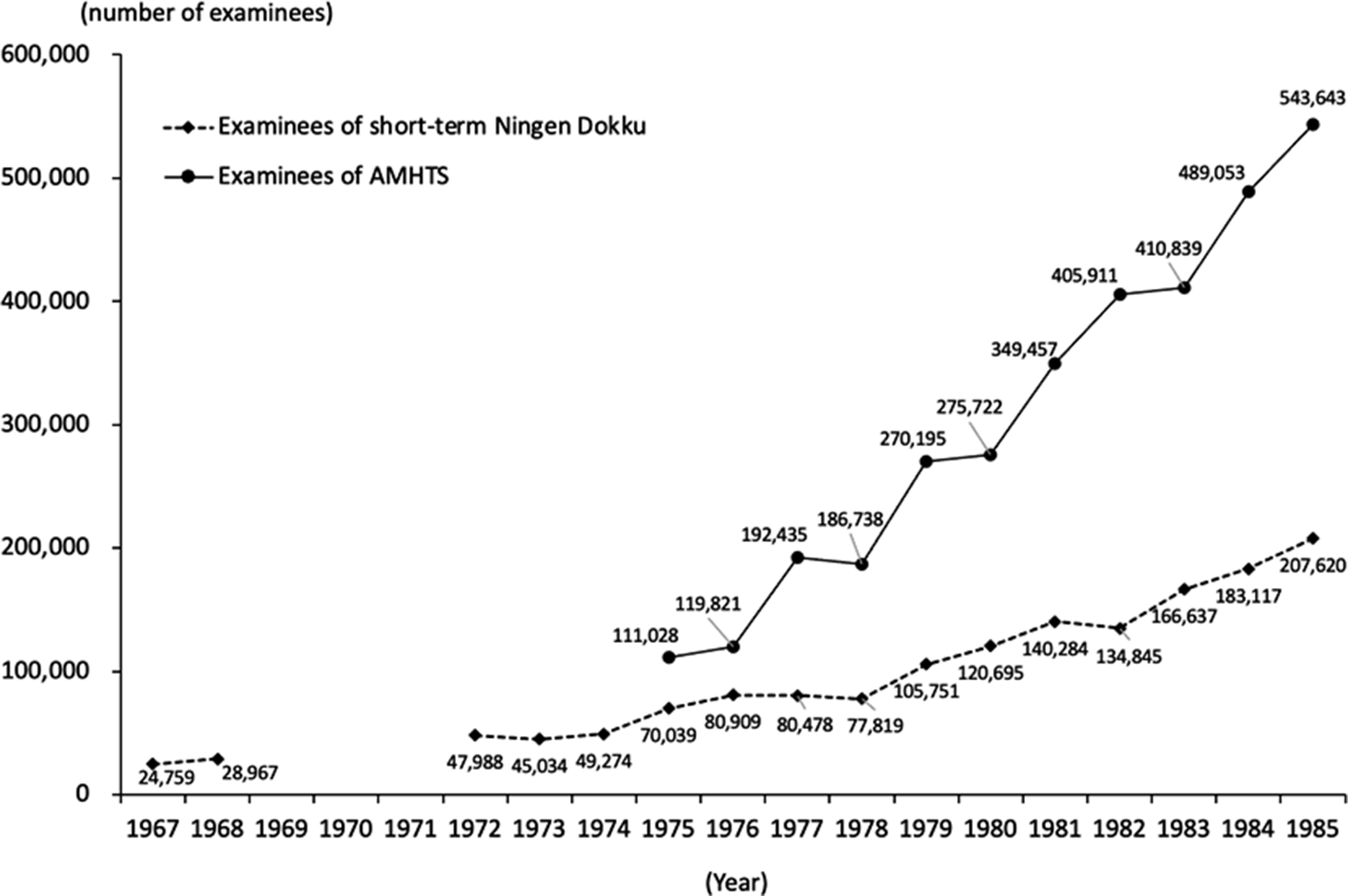
The fact that AMHTS was inexpensive and offered the same accurate tests as Ningen Dokku quickly encouraged its widespread use. The number of people taking AMHTS increased at a faster pace than did the number of people taking short-term Ningen Dokku, as shown in Figure 3. As of 1975, the number of examinees for AMHTS had already exceeded that of the short-term Ningen Dokku by approximately 40,000. The difference in the pace of increase after that point was remarkable; in 1985, the number of examinees for AMHTS exceeded 540,000, whereas the number for the short-term Ningen Dokku was approximately 200,000.
Number of examinees of short-term Ningen Dokku and AMHTS.
Source: Prepared by the authors based on Nihon Byōin Kyōkai [Japan Hospital Association]. “Nihon Byōin Gakkai Rinshō Yobō Igaku Iinkai Hōkoku [Report of the Committee on Clinical Preventive Medicine of the Japan Hospital Association].” Nihon Sōgō Kenshin Igakkai-Shi [Japanese Journal of MHTS] 13 (1986): 373–374.
Note: This survey was conducted by the Committee on Clinical Preventive Medicine (Rinshō Yobō Igaku Iinkai) of the Japan Hospital Association.

In 1987, the test items at AMHTS centers and those at short-term Ningen Dokku centers were in close competition, as shown in Table 2, which was drawn from a book published in 1987 by Yukio Andoh, Chief of Internal Medicine at St. Luke’s International Hospital. In the same book, AMHTS is numbered among the “types of Ningen Dokku,” which again suggests that the proponents of AMHTS included it in the category of Ningen Dokku. Kousaku Nakayama, the president of the Japan Society of Ningen Dokku at the time, noted that “when compared in terms of test items, there is no significant difference between the two (overnight Ningen Dokku and AMHTS).”Footnote 115
Test items by type of Ningen Dokku

Note: Translated by the authors.
Source: Andoh, Yukio. Kenkō Shindan Jushinsha Hitsudokuhon [Essential Reading for Health Examination Examinees], Tokyo: Japan Planning Center, 1987, 108–109.
St. Luke’s International Hospital also viewed AMHT systems as a significant means of reducing the burden of Ningen Dokku. Like other physicians, Hinohara called AMHTS “three-hour Ningen Dokku” in his article.Footnote 116 This framing further reinforced the legitimacy of AMHTS as an active promoter of Ningen Dokku. Following a series of moves that aimed to encompass AMHTS within Ningen Dokku, in April 1996, the Clinical and Preventive Medicine Committee of the JHA officially decided to refer to short-term Ningen Dokku as overnight Ningen Dokku and AMHTS as one-day Ningen Dokku. Footnote 117 This was the official moment at which AMHTS was included in the Ningen Dokku category. AMHTS gained a scientifically credible position by being integrated into Ningen Dokku, which had long been established in Japan. For the general public, this shift meant that what had once been an exclusive, high-end medical service—outside the scope of public insurance—had become accessible without compromising on technological standards. Even into the 2020s, AMHTS continues to be used in comprehensive health screenings throughout Japan, particularly in the form of one-day or short-stay Ningen Dokku programs offered by hospitals and health checkup centers under the well-established label of Dokku.
In summary, physicians in Japan who promoted the diffusion and shortening of Ningen Dokku formed interhospital networks to advance their efforts. They interpreted AMHT systems as a technology to streamline and rationalize Ningen Dokku, positioning it as an extension of their attempts to modernize the process. These physicians validated the scientific basis of AMHT systems using abnormality detection rates in traditional Ningen Dokku as a benchmark, thus framing AMHTS as both reliable and scientifically sound. Moreover, medical equipment manufacturers, recognizing a business opportunity, expanded the range of test items by introducing automated analyzers they had developed, offering them at lower prices than the standard Ningen Dokku. This combination of professional advocacy and cost-effectiveness led to the widespread diffusion of AMHTS, which was more affordable than traditional Ningen Dokku. Furthermore, AMHTS freed Ningen Dokku from the constraints imposed by bed availability, enabling its expansion and further institutionalization. Physicians, medical equipment manufacturers, and other proponents of Ningen Dokku actively promoted and facilitated the adoption of AMHTS in Japan. For the general public, this development was welcomed as an opportunity to access that prestigious Dokku—once reserved for the elite—even without insurance coverage and at a much lower cost. As a result, the technology gained broader social acceptance.
Discussion and Conclusion
Although research on the business history of health care has become more active, it is still in its early stages. Studies on the business history of global health care have focused on the process of local market adaptation of technology by local firms.Footnote 118 However, there are few studies on the business history of the transfer and diffusion of medical technology that focus on the interpretation of medical innovations and their scientific evidence and include broader social actors such as physicians, users, health insurance associations, and corporations in their analysis. Moreover, the diffusion of medical innovations that operate outside the framework of public health insurance remains poorly understood.
We explored why and how AMHTS, developed in the United States in the 1960s, gained wide acceptance in Japan. We organized the historical developments by drawing on the theoretical lens of interlocking interactions. This theory underscores the ambiguity of scientific knowledge, the active roles of actors, and the importance of contextual interactions in the diffusion process of medical innovations. This highlights that adopters are not passive recipients but active interpreters and reconstructors of innovation whose decisions are shaped by factors such as economic incentives and professional consensus. Such adopters often engage in strategic efforts to reshape institutional meanings and practices—a process that can be understood as a form of institutional work.Footnote 119 In particular, the theory draws attention to the polysemy of scientific evidence regarding the credibility of medical technology and its reliance on contextual interpretation. Furthermore, it stresses the interdependence between active agents and the contexts within and beyond their organizations, highlighting their crucial roles in promoting dissemination. This theoretical perspective closely aligns with our historical analysis, which is grounded in extensive Japanese historical sources, providing a rich empirical foundation for understanding the diffusion of AMHTS in Japan. This study contributes primarily to business history in health care, particularly the adoption and diffusion of medical technologies.
Guided by theory, this study identified four key mechanisms that shaped the adoption of AMHTS in Japan. First, the scientific credibility of medical innovations depends on local interpretations. Although Kaiser Permanente in the United States relied on randomized controlled trials to validate AMHTS, it faced rejection from key stakeholders. In contrast, Japanese physicians assessed AMHTS as scientifically valid based on comparable abnormality detection rates with those of Ningen Dokku, a standard widely accepted as reliable. Second, Japanese physicians and other stakeholders actively adapted and promoted AMHTS to shorten and streamline Ningen Dokku, framing it as “three-hour” or “one-day Dokku.” Their efforts made AMHTS more accessible and cost-effective, aligning with public and private sector needs. Third, interorganizational networks facilitated AMHTS diffusion. Physicians have formed cross-organizational study groups and leveraged institutional ties to promote their adoption. Finally, external and internal contexts reinforced diffusion. Government policies supporting preventive medicine and growing public awareness of adult-onset diseases created a favorable macro environment, whereas hospital-based physicians expected preventive care to be a promising revenue source.
This study also constructs and investigates a hypothesis that extends Fitzgerald et al.’s theory. While the framework developed by those researchers highlights the contextual nature of scientific evidence and actor interactions, it does not enable them to theorize how symbolic reinterpretation—especially the reframing of technologies for the elite into mass services—serves as a driver of diffusion. We fill this gap by conceptualizing this symbolic mechanism as a strategic form of institutional work.Footnote 120 Specifically, we show that framing an innovative medical technology as a rationalized version of an existing premium health service can legitimize its scientific validity and enable broader societal adoption.
We term this mechanism the democratization of premium health services. This phrase refers to a symbolic process through which newly introduced medical technologies or services are reinterpreted as streamlined and affordable versions of existing high-cost, exclusive health services—without diminishing their perceived quality. In this process, the prestige and credibility associated with the original premium services are transferred to these new offerings. Such symbolic reframing produces institutional and cultural legitimacy, facilitating the acceptance and adoption of innovation by broader segments of society. Japanese physicians actively interpreted and reconstructed AMHTS within interorganizational networks, presenting it as a streamlined and cost-effective alternative to the conventional, expensive, and time-consuming Ningen Dokku. They rebranded the service as “three-hour Dokku” or “one-day Dokku,” leveraging its affordability and efficiency to appeal to corporate sponsors and middle-class consumers. This process, combined with the government’s active promotion of preventive medicine and shifting public health priorities as well as corporate welfare programs that subsidized health checkups, created a favorable environment for diffusion.
This series of symbolic initiatives that redefined the meaning of AMHTS as a rationalized version of Ningen Dokku enabled ordinary citizens to interpret it not as a novel medical technology but as the moment when “that once-expensive and time-consuming Ningen Dokku” became something affordable and accessible in everyday life. This transformation highlights the power of symbolic framing in promoting the diffusion of medical innovations that remain beyond the scope of public insurance.
Importantly, the diffusion of AMHTS did not merely rely on the preexisting legitimacy of Ningen Dokku—it also contributed to a reconfiguration of the concept itself. Originally, manually administered Ningen Dokku was understood as an elite service that required a week-long inpatient stay; even after simplification, it typically involved several days of hospitalization. However, the widespread adoption of AMHTS symbolically and institutionally redefined Ningen Dokku as a broader category that included one-day, outpatient, and automated checkups. In this way, AMHTS not only inherited the prestige of Ningen Dokku but also reshaped its meaning and boundaries. This reflexive transformation demonstrates that the symbolic framing of a medical innovation can influence—and even reconstruct—the very institutional categories upon which its legitimacy depends. It underscores the mutually constitutive relationship between innovation and its interpretive context, whereby meaning-making processes reshape both the innovation and the institutional structures that accommodate it.
While the overall trajectory of AMHTS diffusion in Japan may appear unusually smooth or even linear, this perception is largely the result of a strategic framing that positioned AMHTS as a rationalized extension of Ningen Dokku—an already institutionalized and trusted service. In the 1950s, when manual Ningen Dokku was first introduced, the MHW initially expressed hesitation. Yet over time, Ningen Dokku gained legitimacy and became part of Japan’s institutionalized health system, albeit one targeted at elites. The subsequent diffusion of AMHTS built on this established legitimacy. Thus, the apparent smoothness of AMHTS adoption reflects the effectiveness of symbolic strategies in lowering social resistance to medical innovation.
Despite the insights provided by this study, important historical aspects of AMHTS remain underexplored. In particular, further research is needed to clarify differences in pricing structures between public and private providers as well as variations in service delivery models across different types of institutions, including specialized centers, public hospitals, and private hospitals.
Although further medical evidence is still awaited, Japan’s historical experiments suggest that comprehensive preventive medicine may be an effective means of maintaining the health of the populationFootnote 121 and reducing health care costs. Nevertheless, challenges remain. Because AMHTS operates outside the public insurance system, disparities in access persist. For instance, health insurance associations for large corporations (under the Kenporen) tend to offer more generous subsidies for Ningen Dokku than those available under the National Health Insurance system, which serves the self-employed, retirees, and public sector employees. Despite such inequalities, the expansion of what was once an exclusive health service to broader segments of the population represents a significant step forward.
Japan’s process of introducing high-end Ningen Dokku to society and then introducing AMHTS as a lower-cost version of such checkups, thereby attracting public attention, can serve as a reference for other countries to promote preventive medicine and suggest concrete measures to achieve global universal health coverage.
Declaration about Competing Interests
This work was supported by JSPS KAKENHI Grant Number 21H00738 and Hitotsubashi University Graduate School of Business Administration Collaborative Research Support Grant. We declare that the authors have no significant competing financial, professional, or personal interests that might have influenced the performance or presentation of the work described in this manuscript.




 Open access

