





Introduction
Recent political developments across Europe have shown that the far right is gaining power in many established democracies. They spread their nativist, exclusionary, and authoritarian worldview in parliaments, in the streets, and on social media (Mudde Reference Mudde2002; Pirro Reference Pirro2022).Footnote 1 The entrenchment of far-right actors, ranging from parties to civil society organisations and social movements, is partly connected to dynamics in public debates and the mainstreaming of far-right positions on controversial issues such as Islam and migration. Far-right actors have successfully mobilised as agenda setters in public debates, in particular in critical moments such as the so-called ‘refugee crisis’ or ‘Covid crisis’ (Della Porta et al. Reference Della Porta, Castelli Gattinara, Eleftheriadis and Felicetti2020; Gessler and Hunger Reference Gessler and Hunger2021; Hutter and Kriesi Reference Hutter and Kriesi2021).
A central factor in the rise of the far right is the behaviour of mainstream actors. Previous research has shown that the entrenchment of the far right depends on mainstream actors in the political and media arenas. Following Moffitt (Reference Moffitt2022), we define mainstream actors as actors perceived as legitimate and/or normal by the broad public. Footnote 2 Mainstream actors can contribute to the mainstreaming of the far right by distributing and adopting the far-right issues. First, mainstream parties play an important role in the accommodation and normalisation of far-right actors by forming coalitions or policy alliances (eg., Abou-Chadi and Krause Reference Abou-Chadi and Krause2020; Brause and Kinski Reference Brause and Kinski2022; Heinze Reference Heinze2018; Heinze and Weisskircher Reference Heinze and Weisskircher2023; Meguid Reference Meguid2005). Second, the mass media play a crucial role in the entrenchment of the far right in Western democracies by increasing the salience and legitimacy of far-right issues and frames (eg., Brown, Mondon and Winter Reference Brown, Mondon and Winter2021; Castelli Gattinara and Froio Reference Castelli Gattinara and Froio2023; De Jonge Reference De Jonge2019, Reference De Jonge2021; Ellinas Reference Ellinas2010; Völker and Saldivia Gonzatti Reference Völker and Saldivia Gonzatti2024).
However, scholarship still lacks clarity on three key issues. First, most studies focus on the electoral arena and there is a need to consider mass-mediated public debates. Second, there is little research that takes a long-term perspective on the discursive relationship between the far right and the political mainstream. Third, empirical studies often look at far-right parties and lack a broad perspective on the far right as a collective group of actors, including civil society organisations, social movements, and terrorist groups. To this end, we investigate the following research question: How and under what conditions do far-right actors influence the communication of mainstream parties over time?
To answer this research question, we combine research on the far right, party politics, and political communication to develop a discourse perspective on far-right mainstreaming. We define discursive mainstreaming as an incremental process through which far-right ideas gain visibility, resonance, and legitimacy in the public sphere. Public debates can be seen as a warning for far-right mainstreaming that will manifest politically in the next step (Völker and Saldivia Gonzatti Reference Völker and Saldivia Gonzatti2024). Building on previous research (eg., Abou-Chadi Reference Abou-Chadi2016; Abou-Chadi and Krause Reference Abou-Chadi and Krause2020; Meguid Reference Meguid2005), we assume that when mainstream parties adopt the issues of the far right, they contribute to the mainstreaming of the far right.
Empirically, this article offers the first large-scale empirical assessment of the issue convergence between far-right actors and mainstream parties in mediated public debates since the 1990s in Germany. We innovate by using automated text analysis to investigate the relations between actors and issues in mass media debates. The study presents a new way of analysing discourse dynamics in large text corpora and is based on two novel datasets that include a broad range of actors: first, we semi-automatically collect far-right actors and mainstream parties in Germany since the 1990s. Second, we rely on topic models and time-series analysis to analyse over 500,000 newspaper articles on cultural debates in six newspapers over 26 years.
The results show that mainstream parties have contributed to the discursive mainstreaming of the far right over the past decades. This can be seen in three developments: first, since the 1990s, the issue agendas in cultural debates of far-right actors and mainstream parties have converged, particularly on the issues of migration, integration, and racism. Second, with regard to agenda-setting dynamics, the results show that the influence of far-right actors on mainstream parties’ communication in public debates has increased over time. The issue emphasis of far-right actors increasingly drives the issue emphasis of mainstream parties, particularly in debates on the policy-oriented issues of Islam, migration, and integration. Third, the contagious effect exists across different party ideologies. However, the analysis shows that the agenda setting of far-right actors more strongly influences the issue emphasis of opposition parties than the issue emphasis of government parties. Finally, we find a slightly positive cumulative influence of far-right actors on mainstream parties after one month, but no significant cumulative influence beyond this period.
Overall, the study offers a better understanding of the entrenchment of the far right in liberal democracies and highlights the crucial role of mainstream parties and the mass media. The article is structured as follows: first, we outline the theoretical framework, combining insights from research on the far right, party politics, and political communication. The second part describes the research design and methodological approach. Finally, we present the empirical findings and discuss how they contribute to previous research explaining the rise of the far right and its campaigns in contemporary democracies.
Theoretical framework
Mainstreaming the far right
Scholars who study the entrenchment and growing acceptance of the far right have referred to this process as far-right mainstreaming (eg., Brown, Mondon and Winter Reference Brown, Mondon and Winter2021; Lindekilde Reference Lindekilde2014). We study discursive mainstreaming of the far right, defined as an incremental process through which far-right ideas gain visibility, resonance, and legitimacy in the public sphere (Völker and Saldivia Gonzatti Reference Völker and Saldivia Gonzatti2024). The central aspect of the discursive mainstreaming of the far right is the diffusion of far-right ideas based on nativist, exclusionary, and authoritarian worldviews (Mudde Reference Mudde2002) into various spheres of society. As such, the ideas are not perceived as radical or extreme anymore – they do not deviate from the norm and are not questioned by mass society but become part of everyday life (Miller-Idriss Reference Miller-Idriss2018; Valentim Reference Valentim2024). This incremental process and diffusion of ideas can lead to the acceptance of the far right as a legitimate force in society. Far-right mainstreaming is persuaded by different societal actors – from extreme actors to mainstream actors (Brown, Mondon and Winter Reference Brown, Mondon and Winter2021). Previous research has analysed this process from a variety of perspectives, providing important insights into the drivers of far-right mainstreaming.
The first research strand focuses on the political success of the far right in party competition (ie Abou-Chadi and Krause Reference Abou-Chadi and Krause2020; Akkerman, de Lange and Rooduijn Reference Akkerman, de Lange and Rooduijn2016; Cole Reference Cole2005; Heinze Reference Heinze2018; Hobolt and De Vries Reference Hobolt and De Vries2015; Meguid Reference Meguid2005; Minkenberg Reference Minkenberg2017; Mudde Reference Mudde2019). These studies show that the political cooperation of mainstream parties with far-right parties by forming government coalitions, policy-making, and protest politics are crucial factors driving the rise of the far right (see Castelli Gattinara, Froio and Pirro Reference Castelli Gattinara, Froio and Pirro2022). Second, different studies shed light on the communication strategies of far-right actors, in particular on social media (ie Heft et al. Reference Heft, Knüpfer, Reinhardt and Mayerhöffer2020; Klein and Muis Reference Klein and Muis2019; Klinger et al. Reference Klinger, Bennett, Knüpfer, Martini and Zhang2023; Wahlström and Törnberg Reference Wahlström and Törnberg2021). Within the existing literature on far-right communication, researchers have highlighted the crucial role of online campaigns by far-right actors for gaining support and forming social networks with like-minded (eg., Caiani, della Porta, and Wagemann Reference Caiani, della Porta and Wagemann2012; Froio and Ganesh Reference Froio and Ganesh2019; Urman and Katz Reference Urman and Katz2020). De Jonge (Reference De Jonge2019, Reference De Jonge2021) and Ellinas (Reference Ellinas2010) demonstrate that mainstream parties and media practitioners can use similar strategies when dealing with the far right, ranging from accommodation to demarcation from far-right actors and ideas. Far-right actors depend on both types of actors to gain public visibility and influence public opinion. In many liberal democracies, far-right discourses of nationalism, racism, and antisemitism have become widespread in society (Brown, Mondon and Winter Reference Brown, Mondon and Winter2021; Kallis Reference Kallis2013; Krzyżanowski Reference Krzyżanowski2020; Krzyżanowski and Ekström Reference Krzyżanowski and Ekström2022), leading to ‘the normalisation of exclusion’ (Wodak Reference Wodak2015, p. 117). While these approaches provide important insights into the qualitative dimension of the mainstreaming process – in particular, how issues are discussed and whether extremist frames are normalised or legitimised – we extend this research by taking a structural perspective on agenda-setting dynamics. By analysing a long-term trajectory of far-right influence, our study captures the extent to which mainstream party communication has been shaped by far-right actors over time.
Following Bennett and Pfetsch (Reference Bennett and Pfetsch2018), Hänggli and Kriesi (Reference Hänggli and Kriesi2010), and Wolfsfeld (Reference Wolfsfeld1997), we conceptualise mass media debates as a part of a larger public contestation between different actors to shape the public agenda and public opinion. In this sense, content covered in mass media debates becomes a legitimate part of everyday debate – contestation reaches the general public. Public debates can act as a signal for developments that will manifest politically in the next step. The next section combines insights from agenda-setting research and the literature on party competition to derive hypotheses about discursive mainstreaming and its drivers.
Agenda setting in cultural debates
Public attention is crucial for far-right actors to disseminate their ideas to a broader audience (eg., Andrews and Caren Reference Andrews and Caren2010; Bos, Van der Brug and De Vreese Reference Bos, Van der Brug and De Vreese2010). Agenda-setting literature highlights the interdependent relationship between mass media and political actors, where both influence each other (Gilardi et al. Reference Gilardi, Gessler, Kubli and Müller2022 b; Green-Pedersen and Mortensen Reference Green-Pedersen and Mortensen2015; Green-Pedersen and Stubager Reference Green-Pedersen and Stubager2010; McCombs and Shaw Reference McCombs and Shaw1972; Van Aelst and Walgrave Reference Van Aelst and Walgrave2011). Political actors, particularly elite parties, often fulfil media news values, increasing their chances of shaping the media agenda. Conversely, political actors depend on media exposure to attract public attention and prioritise their issues, especially during election campaigns. Political contestation between parties increasingly takes place in the public sphere (Kriesi et al. Reference Kriesi, Grande, Dolezal, Helbling, Höglinger, Hutter and Wüest2012, pp. 39, 207), and the media has even become an important information channel for the public and politicians themselves (McCombs and Shaw Reference McCombs and Shaw1972; Van Aelst and Walgrave Reference Van Aelst and Walgrave2011). Agenda setting is pivotal in determining which issues attract political attention and influence policy outcomes (Gilardi et al. Reference Gilardi, Gessler, Kubli and Müller2022a). However, the impact of agenda setting depends on the nature of the issues introduced into the public debate (Soroka Reference Soroka2002). Green-Pedersen and Stubager (Reference Green-Pedersen and Stubager2010) demonstrate that opposition parties strategically emphasise issues they own to politicise them in their competition with government parties.
Similarly, far-right actors, especially far-right opposition parties, are successful as agenda setters in debates on cultural issues. Debates on cultural issues focus on who is excluded as an outsider and who is included as a member of the cultural community (Kriesi et al. Reference Kriesi, Grande, Dolezal, Helbling, Höglinger, Hutter and Wüest2012). Following Green-Pedersen (Reference Green-Pedersen2019, pp. 26–27), cultural issues relate to overall macro-debates on the cultural conflict line, whereas a particular issue within “cultural issues” relates to a specific debate, for example, on migration or nationalism. Footnote 3 These issues structure political conflicts on integration and demarcation in Europe (eg., Kriesi et al. Reference Kriesi, Grande, Dolezal, Helbling, Hoeglinger and Hutter2008, Reference Kriesi, Grande, Dolezal, Helbling, Höglinger, Hutter and Wüest2012). In the demarcation–integration cleavage, far-right parties and green parties are positioned at opposite poles, representing the ‘winners’ and ‘losers’ of globalisation (Hooghe and Marks Reference Hooghe and Marks2018). Public debates on these contested cultural issues have provided windows of opportunity for the far right to gain public attention and mobilise support. Far-right actors benefit from polarised cultural debates in which they present themselves as defenders of the nation. They connect the issues of Islam or immigration with their ideological goals (eg., nativism, racism, anti-elitism, anti-pluralism, and socio-cultural authoritarianism) and address different targets (eg., minorities or left-wing opponents) (Berntzen Reference Berntzen2019; Bjørgo and Ravndal Reference Bjørgo and Ravndal2019; Mudde Reference Mudde2019; Ravndal Reference Ravndal2018). As issue owners, far-right actors have become the central actors associated by the public with cultural issues and benefit from public debates on these issues (Walgrave, Tresch and Lefevere Reference Walgrave, Tresch and Lefevere2015).
Far-right actors depend on discursive linkages with mainstream parties to gain visibility and resonance in the public sphere. They benefit from any resonance in the public sphere as far as the mobilisation of far-right supporters is concerned (Bonikowski Reference Bonikowski, Skey and Antonisch2017). While the attention paid by mainstream parties during the so-called ’refugee crisis’ to immigration was driven by radical right parties, mainstream parties did not adopt all far-right positions (Gessler and Hunger Reference Gessler and Hunger2021). However, even critical and negative reactions by mainstream parties towards far-right actors can increase their visibility and improve radical actors’ opportunities to shape the direction of public debates (Muis, Krouwel and de Lange Reference Muis, Krouwel and de Lange2015).
Scholarship on polarisation highlights how growing ideological divides between political groups and declining intergroup trust create fertile ground for far-right actors to thrive (eg., Harteveld, Mendoza and Rooduijn Reference Harteveld, Mendoza and Rooduijn2022; Iyengar, Sood and Lelkes Reference Iyengar, Sood and Lelkes2012; McCoy and Somer Reference McCoy and Somer2019; Reiljan Reference Reiljan2020). Polarisation can contribute to the mainstreaming of the far right in public debates and electoral politics, as mainstream parties strategically adopt or amplify far-right rhetoric to compete for polarised electorates (Steenvoorden and Harteveld Reference Steenvoorden and Harteveld2018; Mudde Reference Mudde2019).
These findings indicate the increased visibility of cultural issues owned by the far right such as immigration and Islam in the public sphere. Based on this research, we assume that the emergence of cultural cleavages has benefited far-right actors as issue owners and allowed them to influence the public agenda. Mainstream parties have responded by increasingly referring to these cultural issues owned by the far right.
H1: The mediated issue agendas of far-right actors and mainstream parties have converged over time.
Moreover, we expect far-right actors to draw attention to far-right issues and push mainstream parties to diffuse them. Previous research shows that when far-right parties are electorally successful and enter parliament, they are able to influence the political agenda, in particular by diffusing their issue positions on immigration into the political mainstream (Abou-Chadi Reference Abou-Chadi2016). Mainstream right-wing parties have contributed to the rise of far-right positions as they have spread and reinforced far-right narratives and promoted the politicisation of immigration (Meyer and Rosenberger Reference Meyer and Rosenberger2015). Far-right parties are not only able to dominate public debates but also polarise parliamentary debates on immigration. This is particularly the case in German parliamentary debates: in previous years, in every third case where parties mention a competing party, they refer to the far-right party Alternative für Deutschland (AfD) (Schwalbach Reference Schwalbach2022). Therefore, we expect far-right actors to be successful communicators on contested cultural issues such as migration and Islam. In an attempt to (re)gain public support, mainstream parties follow far-right actors in emphasising these issues. This is addressed by the second hypothesis on far-right agenda setting.
H2: The mediated issue emphasis of far-right actors predicts the mediated issue emphasis of mainstream parties.
Mainstream party responses
What makes mainstream parties respond to the far-right issue agenda? There is some mixed evidence on how mainstream parties should act to win the electoral battle with far-right actors. As Bräuninger et al. (Reference Bräuninger, Däubler, Huber and Rudolph2022) highlight, ‘mainstream parties face a difficult trade-off. Moving rightwards, for example, by offering candidates with immigration-sceptic positions, can attract voters. However, if this also increases the salience of the cross-cutting dimension, others may be lost to the challenger party’ (Bräuninger et al. Reference Bräuninger, Däubler, Huber and Rudolph2022, p. 1942). Centrist positions open a programmatic void that can be filled by far-right electoral entrepreneurs (Arzheimer Reference Arzheimer2009). It has been shown that far-right parties benefit when mainstream parties move closer to the median voter because they can fill a representation gap (Ignazi Reference Ignazi1992; Kitschelt and McGann Reference Kitschelt and McGann1997). Yet, the ‘conspiracy of silence’ thesis argues that avoiding issues owned by the far-right marginalises far-right positions and discourses and renders them invisible (Bale Reference Bale2008). Political actors mobilise more support by emphasising the issues they care about than by criticising the issues of their opponents (Budge Reference Budge1982, pp. 149–150). Meguid (Reference Meguid2005) distinguishes between the dismissive, accommodative, and adversarial strategies of mainstream parties. Her study shows that by adopting accommodative or adversarial strategies, mainstream parties increase the salience of issues ‘owned’ by the far right and move the issue from the fringes into the mainstream debate.
Previous findings in the literature on party competition show that mainstream parties’ responses to the far right depend on party ideology and the government–opposition divide (Heinze Reference Heinze2022). First, mainstream right-wing parties are more likely to respond to far-right issues than their left-wing counterparts due to the considerable overlap in voter bases and policy agendas (Bale et al. Reference Bale, Green-Pedersen, Krouwel, Luther and Sitter2010; Han Reference Han2015; Heinze Reference Heinze2022). Right-wing parties more often adopt policy positions and frames of the far right aiming to maximise voters (Akkerman Reference Akkerman2015; Alonso and da Fonseca Reference Alonso and da Fonseca2012; Harmel and Svåsand Reference Harmel and Svåsand1997). This is particularly the case in the context of critical events such as election campaigns or terrorist attacks (Gessler and Hunger Reference Gessler and Hunger2021; Völker Reference Völker2023). Second, the study by Van Spanje (Reference Van Spanje2010) of 11 Western European countries shows that opposition parties were more likely to adopt anti-immigration stances than parties in government. Government parties find it easier to exclude and ignore initiatives from far-right challengers (Heinze Reference Heinze2022). In line with previous research on party politics, we expect similar dynamics in political communication and that parties’ responses to the far right will differ according to their ideology and government–opposition role. We expect right-wing parties and opposition parties to be more responsive to the issue emphasis of far-right actors than left-wing parties and parties in government.
H3: The mediated issue emphasis of far-right actors more strongly influences the mediated issue emphasis of right-wing parties than the issue emphasis of left-wing parties.
H4: The mediated issue emphasis of far-right actors more strongly influences the mediated issue emphasis of opposition parties than the issue emphasis of government parties.
Overall, our discourse perspective contributes to the large literature on party competition and far-right mainstreaming with a long-term analysis of mass-mediated public debates. The long-term perspective shows to what extent and how far-right actors and mainstream parties are discursively connected, and how mainstream parties promote the discursive mainstreaming of far-right actors and ideas. The next section describes how we measure and empirically test our hypotheses.
Research design
This study focuses on the discursive mainstreaming of the far right in Germany since the 1990s. This empirical study of Germany offers important insights into the transition of the far right from the fringes to the mainstream in Western democracies for several reasons. First, Germany illustrates key dynamics of far-right mainstreaming, which is taking place in many European democracies as a process that unfolds in multiple arenas – on the streets, in public debates, on social media, and in parliaments. The rise in support for far-right parties over the past 15 years is a trend that is unfolding “across most European states, from North to South and East to West” (Schraff, Vergioglou and Demirci Reference Schraff, Vergioglou and Demirci2023, p. 576). Once considered exceptionally resilient due to its post-war democratic norms (Art Reference Art2007), the electoral support for the far-right party AfD shows that Germany is experiencing a broader European trend in which far-right parties are gaining political power.
Second, Germany is an interesting case to derive novel explanations for the entrenchment of the far right because it contradicts “widely found patterns in political science” (Weisskircher Reference Weisskircher2023, p. 2). While the rise of the AfD marks an important shift, it is not a turning point, but rather the ‘tip of the iceberg’ of far-right activity in Germany. For decades, Germany has experienced significant levels of right-wing violence and terrorism (RTV), with the highest levels recorded in Western Europe since the 1990s (Ravndal et al. Reference Ravndal, Bjorgo, Fridlund and Guhl2021). This includes the right-wing violence of the 1990s, the terrorism by the NSU from 2000 to 2010, and recent attacks in Halle in 2019 and Hanau in 2020. Similarly, far-right actors successfully mobilise on the streets such as the PEGIDA movement – the Patriotic Europeans Against the Islamisation of the West in 2014/2015 or during the Covid-19 health crisis in 2020 and 2021 (Volk Reference Volk2020). Compared to other European countries, Germany’s historical and political legacy enriches the study of far-right mainstreaming as an ‘unlikely’ political context.
Third, the German case allows us to examine the transition and mainstreaming of the far right in two distinct ‘waves’: from its position as radical fringe actors in the 1990s to its more formalised presence in mainstream politics today (Mudde Reference Mudde2019). Unlike countries such as France, the Netherlands, or Austria, where far-right parties have been firmly established in electoral politics for a longer period, Germany is a relative latecomer to the electoral success of far-right parties. This makes Germany a compelling case for studying the mechanisms and factors that enable this transition. At the same time, the persistent legacies of far-right violence and street mobilisation reveal patterns of continuity that challenge the narrative of democratic resilience often associated with post-war Germany.
Data
We analyse mass media debates on cultural issues from 1994 to 2021 among six newspapers in Germany. We rely on mass media data because we are interested in discourse dynamics in the broad public sphere. The study of mass media assumes a shared agency between media outlets and political actors. Media outlets ultimately decide who to mention, who to give a voice to, and whose position to present in the news. However, media content depends on the actual behaviour of political actors. Traditional media agendas, parties’ social media agendas, and politicians’ social media agendas are interdependent and represent similar debates (Gilardi et al. Reference Gilardi, Gessler, Kubli and Müller2022b). For example, in their study of the anti-immigration campaign across different media platforms, Klinger et al. (Reference Klinger, Bennett, Knüpfer, Martini and Zhang2023) show that far-right ideas travel from far-right online platforms to mainstream media sites. To reduce media bias, we collect a heterogeneous sample of newspapers with different ideological orientations: the centre-left daily newspaper “Süddeutsche Zeitung” and the left-wing “taz” as well as the right-wing “Welt” and the radical-right weekly “Junge Freiheit”. Moreover, we collect regional daily newspapers, “Stuttgarter Zeitung” (Western Germany) and “Sächsische Zeitung” (Eastern Germany). The collected newspaper articles originate from the outlets’ print versions (see online Appendix A). The ideological and geographical heterogeneity of the newspaper selection reflects the debates in the broad German public sphere.
The focus of the media analysis is on cultural debates as they represent the key issues that provided windows of opportunity for the far right to gain power in many Western democracies (Hooghe and Marks Reference Hooghe and Marks2018; Kriesi et al. Reference Kriesi, Grande, Dolezal, Helbling, Hoeglinger and Hutter2008, Reference Kriesi, Grande, Dolezal, Helbling, Höglinger, Hutter and Wüest2012). The articles mentioning these debates were collected using dictionaries capturing cultural issues. The dictionary keywords were carefully selected and tested (see online Appendix B) and identified 520,408 articles across the six newspapers.
We identify relevant issues and actors within these debates using automated text analysis. First, to identify issues within cultural debates, we implement structural topic modelling, including year-month and media source covariates for the estimation (Roberts et al. Reference Roberts, Stewart, Tingley and Airoldi2013, Reference Roberts, Stewart, Tingley, Lucas, Leder-Luis, Gadarian, Albertson and Rand2014). Topic models serve as an exploratory, unsupervised method to classify texts into topics based on clusters of co-occurring words (Blei and Lafferty Reference Blei and Lafferty2007; Blei, Ng, and Jordan Reference Blei, Ng and Jordan2003; Roberts et al. Reference Roberts, Stewart, Tingley and Airoldi2013, Reference Roberts, Stewart, Tingley, Lucas, Leder-Luis, Gadarian, Albertson and Rand2014). The models show the prevalence of a specific topic within a particular text. We focus on sentence groups since news articles include many unrelated debates. Sentence groups are sentences within news articles identified by our dictionaries, including the preceding and succeeding sentences.
We analyse models based on 929,928 sentence groups allowing for topics (K) from 3 to 65 and select the most concordant topic model. First, the selection procedure involves maximising both semantic coherence and exclusivity across topics to find the statistically optimal k. Accordingly, several models are selected based on different optima for further inspection. Second, two student assistants labelled each topic across different models based on textual information from each topic (most likely words, most representative texts). We then compared the labels in terms of convergence between both codings and discussed the face validity of similarly performing models. In Appendix D, we elaborate more thoroughly on how we selected the topic model through parameter optimisation and comparison of independent labelling procedures. We selected model K = 42 based on a final discussion among the research group, in which we considered the face validity, the consistency of the various topics, and the qualitative confirmation of certain expectations in the exploration of topics’ predicted text by reading these. Footnote 4 We discussed and aggregated the 42 topics into substantially relevant issues, for example, racism, Islam, migration, international politics, Europe, etc. (see Appendix D). Topics appearing in mass media debates vary in their emphasis over time and in the language they are associated with. Since we focus on aggregated relevant issues, we connect certain topics that might be linked to different semantic wording over time. For example, if the topics’ wording of ‘asylum-seeker’ and ‘refugee’ are popular at different moments, we still combine them into one issue. We use the aggregated issue prevalences to establish measures for issue emphasis and agenda setting. The substantive interpretation of the issue dynamics is discussed below.
Second, we collect mainstream parties based on their institutionalised status. We define mainstream parties following Heinze (Reference Heinze2022), including the right-wing parties CDU/CSU (Christian Democrats) and FDP (Free Democratic Party) and the left-wing parties SPD (social democrats), Die Grünen (greens), and Die Linke (the left). This includes wording according to three criteria: (1) all parties of the German parliament (Bundestag); we capture party names as well as colloquial party labels; (2) all nationally elected members of the German parliament; and (3) the party leadership.
Third, to analyse far-right actors, we collect a novel list of far-right actors. This list covers a wide range of actor types, from political parties and civil society organisations to violent and terrorist groups. Identifying far-right actors is challenging since no official lists since the 1990s in Germany exist. Therefore, we semi-automatically revise the yearly security reports of the German Bundesverfassungsschutz (Federal Office for the Protection of the Constitution) from 1995 to 2020, covering the political crime and security situation nationwide. The reports include far-right, far-left, and Islamist political crime. The report includes actors who are classified as extreme-right actors and organisations with whom they interact. We capture all organisations that are mentioned when far-right radicalisation is discussed, including both radical right actors who reject the democratic constitution and extreme right actors who fundamentally oppose the democratic constitution and aim to destroy the democratic system. The reports cover a wide range of activities, from political violence, protest to hate speech, and therefore include most of the far right’s repertoire of actions.Footnote 5
We filter and edit the reports with named-entity recognition to identify combinations of semantic objects, subjects, and locations mentioning far-right issues. Based on this procedure, we revise the object-subject-location lists and manually collect unique far-right actors (Appendix C). Based on this procedure, we create a unique dataset of 557 German far-right actors over time, which offers new opportunities for further research.
Methods
Our methodological approach follows a two-step logic. First, we focus on the issues associated with far-right actors and mainstream parties to study issue convergence in mass media debates. Following Green-Pedersen (Reference Green-Pedersen2019, pp. 26–27), we define an issue at the level of “bundle of policy problems”. That is, an issue englobes different policy problems to be solved. For example, the migration issue might refer to “problems” (or sub-issues) such as additional housing, job-market, and language integration or economic and cultural enrichment. We speak of ‘issues’ when referring to cultural issues/debates in general or the concept of ‘issue emphasis’. We speak of a specific issue when referring to individual debates within cultural issues, such as nationalism or migration debates. We analyse issue emphasis based on cultural issues associated with far-right actors and mainstream parties in mass media debates to test H1 and examine their respective issue agendas. Shared issue agendas reflect how actors are interrelated through the issues they raise and the issues they are associated with. We use topic models to analyse the prevalence of issues. For each group of sentences mentioning a relevant far-right actor or mainstream party, topic models produce prevalence measures for the issue of interest (asylum, integration, Islam, Islamism, migration, nationalism, Nazism, racism, Europe, and security). The data include issue-specific prevalences associated with each actor type (yearly means). This allows us to explore which issues are important for mainstreaming processes. We inspect both joint mentions of far-right actors and mainstream parties over time as well as to what extent both actor types are mentioned with the same issues.
Second, to analyse the agenda-setting effect of far-right actors on mainstream parties, we built models that consider the TSCS structure of the data. The following models show how we measure the influence of far-right actors on the issue emphasis of mainstream parties and test H2, H3, and H4. As we are interested in the issue emphasis of actors, we subtract the general debate prevalence of the issue (sentences without actor mentions) from the actor-specific issue prevalence (Actor issue−emphasis = Actorissue −prevalence − GeneralDebateissue −prevalence). The measure then reassures the actor-specific emphasis on the respective issue. The harmonisation permits to control for the over-emphasis of issues accounting for contextual factors in the general debate. Our approach accounts for the general dynamics of cultural debates and agenda setting in the mass media, for example, during periods of higher refugee influx, when the media are more likely to discuss the refugee issue.
Following Beck and Katz (Reference Beck and Katz1996) and Ezrow, Hellwig and Fenzl (Reference Ezrow, Hellwig and Fenzl2020), we specify linear models including the lagged mainstream party issue emphasis (Y it−1), the far-right issue emphasis in the current period (X it), and one lagged period (X it−1) as independent variables. Furthermore, although we harmonise actor-specific issue emphasis by discounting the issue prevalence of the general debate, we focus on the intensity of change from t −1 to t 0 (∆ Issue emphasis) (see Jordan and Philips Reference Jordan and Philips2018). This is because we are interested in the relative dynamics of emphasis by political actors and not in the absolute emphasis of an issue when we discuss mainstreaming. The Ezrow, Hellwig, and Fenzl (Reference Ezrow, Hellwig and Fenzl2020) specification allows to study short-term effects through contemporaneous changes (∆X it) as well as long-term effects through the lagged main independent variable without change (X it−1) (see De Boef and Keele Reference De Boef and Keele2008):
 $$\Delta Y_{it} = \alpha_{0} + \alpha_{1}Y_{it-1} + \beta_{0} \Delta X_{it} + \beta_{1}X_{it-1} + \varepsilon_{it}$$
The models include robust standard errors in the case of estimating multiple issues within single models. Depending on the analysis, year or actor-level variables are included either as fixed effects or in interaction. Year-fixed effects seem to be the lowest suitable temporal level considering the monthly data structure. We discuss the time specification and provide alternative model specifications in Appendices H.1 and H.5. Furthermore, we include the lagged main independent variable – far-right issue emphasis (X it−1) – to examine long-term cumulative effects on mainstream actor issue emphasis. The associative analyses are followed by dynamic model simulations of the relationship of far-right actors’ and mainstream parties’ issue emphasis over time (Williams and Whitten Reference Williams and Whitten2012; see also Ezrow, Hellwig and Fenzl Reference Ezrow, Hellwig and Fenzl2020). In other words, we analyse for how long far-right agenda setting impacts mainstream parties’ communication and whether the impact intensifies over time. By randomly drawing parameters from the multivariate normal distribution of the estimated OLS regressions, such model simulations exploit the autoregressive characteristic (AR(1)) of the model specification and account for the lagged dependent and lagged independent variables of interest within each iteration in each prediction estimation. The parameter simulations from the models’ distributions allow the prediction of different uncertainty scenarios based on the original data and model estimates (Williams and Whitten, Reference Williams and Whitten2011, p. 578). This two-step approach allows for a comprehensive analysis of how far-right actors’ issue emphasis influences a mainstream party’s communication.
Results
How and under what conditions do far-right actors influence the communication of mainstream parties? Turning to the results, the first part sheds light on the overall trends in public debates and the distribution of mediated issue salience for far-right actors and mainstream parties in cultural debates over time. Second, we analyse the dynamics of agenda setting and the drivers of far-right agenda setting, focusing on party, issue, and time dynamics.
Issue agendas of the far right and the mainstream
In the first step, we shed light on the visibility of mainstream parties in cultural debates. Figure 1 shows the predominance of political parties in debates on cultural issues such as migration, Islam, and nationalism. It shows the relative share of mainstream parties and the far-right party AfD in cultural debates based on monthly and yearly means.Footnote 6 The overall trend shows that the visibility of mainstream parties in cultural debates has increased over time. The relative share is independent of general trends in public debates, such as the increasing salience of cultural issues in the context of the so-called ‘refugee crisis’.
Mainstream parties and the AfD in cultural debates, monthly and yearly means.

There are two groups of parties regarding their visibility in cultural debates. The first group with high visibility includes the far-right party AfD, the right-wing conservative parties CDU/CSU (Union), and the social democratic party SPD. In line with previous research (Gessler and Hunger Reference Gessler and Hunger2021; Kriesi and Hutter Reference Kriesi, Hutter, Hutter and Kriesi2019), the far-right party AfD is the issue owner in debates on cultural issues and has the highest visibility. Moreover, the SPD and Union dominated cultural debates. It is important to note both were governing parties between 2005–2009 and 2013–2021, which increases their public visibility per status (the Union governed continuously from 2009 to 2021). The second group of parties with low visibility in cultural debates are the green party Die Grünen, the left party Die Linke, and the economic liberal FDP. The FDP de-emphasises cultural issues the most.Footnote 7
Over time, the figure shows that there are contentious episodes when the mediated emphasis on cultural issues has increased across the parties. The 9/11 terrorist attack in the United States can be seen as a critical juncture in cultural debates because it increased the prevalence of far-right frames on cultural issues and generated associations between Islam, Muslim integration and public security (see Ruigrok and van Atteveldt Reference Ruigrok and van Atteveldt2007). The next peak was in the period between 2010 and 2011. In 2011, the first Islamist terrorist attack occurred in Germany, when two US soldiers were shot dead at Frankfurt airport. Moreover, the revelation of the murders of the terrorist group NSU occurred in 2011. These critical events may have forced parties to address issues such as discrimination against Muslims. The final peak in cultural debates between 2016 and 2018 occurred in the context of several politicised events. This includes the “refugee crisis” in 2015/16, the UN Global Compact for Migration in 2018, the sexual assaults on New Year’s Eve 2015/16, and the Islamist terrorist attack in Berlin in 2016/17. This is also the period in which the AfD gained more attention in public debates. As previous research has shown (ie Klinger et al. Reference Klinger, Bennett, Knüpfer, Martini and Zhang2023), this period was marked by a heated debate on immigration, asylum, and integration.
This trend changes from 2020 onwards. Since then, mainstream parties and the AfD have been less associated with cultural issues in public debates. This decline is linked to the emergence of new issues that have become more important for political parties in the context of the COVID-19 crisis that began in 2020. Although there are differences between the parties and variation over time, overall, we see an increasing emphasis on cultural issues for all mainstream parties. The level in the 2020s is higher than in the 1990s. This suggests that cultural issues, which are usually owned by the far right, are becoming more important in the communication of mainstream parties.
The second step of the analysis investigates the mediated issue-specific prevalences associated with mainstream parties and far-right actors. Actor-specific mediated issue prevalence refers to the issues with which actors are associated in public debates, differentiating by actor type mention or no actor type mention. Figure 2 shows the mediated issue prevalence of different groups of actors (smoothed yearly means) based on the issue-specific prevalences associated with these actors in mass media debates. It shows the extent to which far-right actors, mainstream parties, both or none are associated with cultural issues.Footnote 8 The analysis shows that far-right and mainstream parties are associated with similar issues, ranging from asylum and migration to international politics, integration, and racism. These issues can be classified into different issue types. First, issues that focus on the ideology of the far right, such as Nazism and racism, describe and are attributed to the far right by other actors.Footnote 9 Second, policy-oriented issues, such as Islam and migration, are potentially and intentionally placed and promoted by the far right in public debates.Footnote 10
Mediated issue prevalence by actor group over time.
Note: across issues, each actor-specific issue emphasis amounts to 1. Therefore, comparisons do not reflect absolute emphasis.

In line with H1, the results show that the mediated issue agendas of far-right actors and mainstream parties have converged over time. Since 1994, the issue agendas of far-right actors and mainstream parties on the policy issue of migration have increasingly converged while mediated issue convergence on the issues of racism and integration emerged shortly after 2010. Similarly, since around 2008, the issue of Islam has played a more important role for both types of actors. Figure 13 in the Appendix G confirms the mediated convergence trend looking at the macro-level divergence between far-right and mainstream parties’ prevalence by issue over time. Note that mediated issue convergence can occur through joint mentions as in Figure 2 and through the raising of similar issues as in Figure 13, Appendix G (it reflects the convergence of issue agendas not the convergence of frames or positions). On other issues, such as nationalism and asylum, there has been a slightly divergent trend since 2015, although the overall variation over time is less pronounced.
Notably, there are also differences and variations in absolute terms between issues and over time. While the issue of integration is more important in debates where mainstream parties are mentioned, racism is more important in public debates where far-right actors are mentioned. Both far-right actors and mainstream parties dominate migration debates in absolute terms. Looking at the development of the mediated emphasis over time, the graph shows a U-shaped distribution: the mediated emphasis on migration falls since the 1990s and rises in 2015 in the context of the so-called migration crisis. The association between racism and far-right actors peaked in 2011. This may also be related to the public attention given to the NSU revelations. Since then, far-right actors have been less and less associated with the issue of racism and more with policy issues such as migration. Moreover, mainstream parties have increasingly been associated with issues owned by the far right. The association of mainstream parties with the issues of integration has played a more important role since 2000. In contrast, the issues of asylum, nationalism, and security played a minor role in public debates when associated with both types of actors. Overall, public debates show similar issue-specific prevalences associated with mainstream parties and far-right actors. While their mediated issue emphasis varies over time, there is a convergence trend in their mediated issue agendas, particularly in debates on migration, integration, and racism. The next step in the analysis is to examine the agenda-setting dynamics and their drivers.
Far-right agenda setting and its drivers
How contagious is the mediated issue emphasis of far-right actors on mainstream parties? To address this question, we analyse in a global model whether far-right actors’ mediated issue emphasis influences mainstream parties’ mediated emphasis at the month level. Mediated issue emphasis refers to the issues with which actors are associated in public debates, measured as their relative dominance in debates on certain issues. Remember that the emphasis measurement through the general debate harmonisation accounts for external drivers of the overall issue prevalence. Therefore, actor-specific emphasis is independent of externalities in the time series.
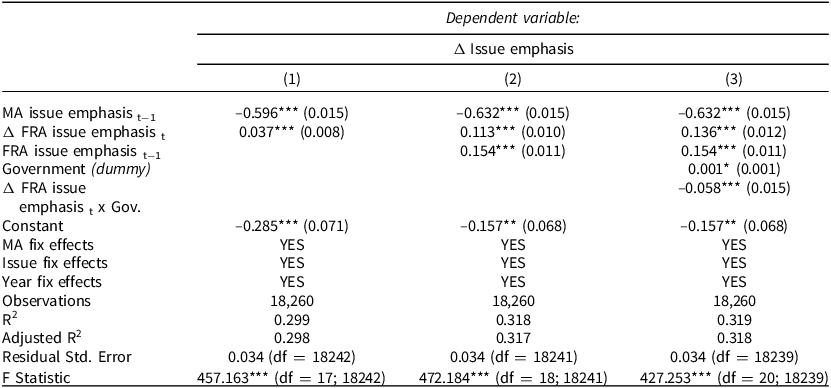
Table 1 presents the regression results from a global model with mainstream actor, issue, and year-fixed effects. Overall, in line with H2, the mediated issue emphasis of far-right actors predicts the issue emphasis of mainstream parties, presenting evidence for the far-right agenda setting. Across the different models, as stated before, we focus on the change in mediated issue emphasis, which more accurately captures the potential effect since we do not focus on absolute levels of attention to certain cultural issues in public debates but on temporal shifts in emphasis from the previous to the current month. First, Model 1 shows how far-right actor mediated issue emphasis change predicts mainstream parties’ mediated issue emphasis change as a contemporaneous effect within the same month. Model 2 implements the full Ezrow, Hellwig, and Fenzl (Reference Ezrow, Hellwig and Fenzl2020) specification accounting for the previous absolute level of far-right issue emphasis (X it−1).
Far-right issue emphasis influence on mainstream parties’ issue emphasis.

Note: significance levels *P < 0.1; **P < 0.05; ***P < 0.01. Robust standard errors in parentheses. Main Model 2 mirrors the Ezrow, Hellwig, and Fenzl (Reference Ezrow, Hellwig and Fenzl2020) specification. Appendix H discusses heteroskedasticity, non-stationarity, and cross-sectional dependence and presents PCSE models and other cluster error corrections. Appendix J presents media-data balanced models. The results of the main Model (2) are robust to alternative specifications. Interaction models of Figure 3 (right panel) and Figure 4 can be found in the Online Replication Material due to the length of the regressions.
According to Model 1, the mediated issue emphasis changes of far-right actors, thus, drive mainstream parties’ mediated issue emphasis change by around 3.7%. In other words, a large shift in far-right mediated issue emphasis from one month to another has a statistically significant impact on the mainstream parties’ mediated issue emphasis shift, even when the effect size is small. Furthermore, when accounting for long-term effects in Model 2, we see that both the contemporaneous as well as the long-term effects are substantially larger: the mediated issue emphasis change of far-right actors impacts mainstream parties’ mediated issue emphasis change by around 11% (statistically significant at P < 0.01). These effects are moderate in substantial terms. However, the evidence points to a consistent effect across models. Furthermore, the effects can be substantial in scenarios of large absolute far-right issue emphasis. Footnote 11 Overall, these results offer strong supportive evidence for the far-right agenda-setting effect (H2).
What are the drivers behind far-right agenda setting? As the agenda-setting effect can vary widely across actors and time, we analyse four potential explanations for the effects: over-period effects, the party ideology, the government–opposition divide, and the type of issue. Figure 3 compares the effect of far-right agenda setting by party ideology and government–opposition divide. First, the left panel of the figure shows the agenda-setting effect for different parties over time. We exploit mainstream parties’ fix effects and year-fixed effects in interaction with far-right actors’ issue emphasis shifts in the analysis in the left panel of Figure 3. The predicted probabilities are based on +0.05 far-right issue emphasis change (+1 SD). The figure shows that the positive relation between far-right actors’ issue emphasis change and mainstream parties’ issue emphasis change increases over time. The more the far right is associated with certain issues from one month to the next, the more these issues are subsequently associated with the mainstream parties. The relationship clearly intensifies over time. While strong mediated issue emphasis of the far right led to no statistically significant increases in mainstream mediated issue emphasis in the 1990s, the effects significantly increased in size between 2015 and 2021.
Far-right influence on mainstream parties’ mediated issue emphasis over time.
Note: Predicted values of mainstream party issue emphasis change (1) at +0.05 far-right issue emphasis change in the left panel (one positive standard deviation) – full models not reported due to length; and (2) at +0.5 far-right issue emphasis change in the right panel, based on Model 3, Table 1. OLS-specified linear regression interacting actors, years, and far-right issue emphasis change fixed effects. Robust standard errors.

Figure 3 shows that contrary to our hypothesis H3 on party ideological differences, the agenda-setting effect of far-right actors is not stronger for right-wing parties than for left-wing parties. The mediated issue emphasis of far-right actors did not influence the mediated issue emphasis of the right-wing liberal FDP and the right-wing conservative CDU/CSU more strongly than the mediated issue emphasis of the left-wing parties, the social democrats SPD, green party Die Grünen, and left party Die Linke. The left-wing party SPD and the right-wing parties CDU/CSU (Union), which have been in government during most of the period covered, seem to be on average less affected by far-right issue emphasis changes. The smaller parties FDP, Die Grünen, and Die Linke, which have been in opposition during most of the period covered, were more reactive to shifts in issue emphasis in cultural debates by the far right. Among this group, the right-wing party FDP was the most affected one in terms of agenda setting. At the end of the 2010s, the FDP was almost twice as likely as the left-wing party SPD to be affected by changes in debates associated with the far right.
Second, based on Model 3 in Table 1, the right panel in Figure 3 supports the party-specific observations concerning the government–opposition divide. In line with H4, the figure shows that opposition parties were more reactive to far-right issue emphasis, almost as twice as reactive compared to government parties. The findings show that the far-right agenda setting is rather related to the government–opposition divide than to party ideology. In contrast to previous research showing that the party ideology of mainstream parties is important for political cooperation with far-right parties (Heinze Reference Heinze2022), we find that far-right actors influence the communication of all mainstream parties in cultural debates.
In sum, we gain insight into three important dynamics. First, the influence of far-right actors on the mediated issue emphasis of mainstream parties has increased over time. Second, the positive effects are found across the different mainstream parties, regardless of their ideology. Third, we find evidence supporting that the agenda setting of far-right actors is more contagious for parties in opposition than parties in government. As our analysis does not include positions on these issues, different reasons for the responses of mainstream parties are possible: mainstream parties may refer to far-right issues because they adopt far-right positions or frames, or to counter far-right positions or promote alternative frames. We have so far validated our theoretically derived hypotheses, which we summarise in Table 2. Next, we analyse issue-specific dynamics and the agenda-setting cumulative effects over time to explore these phenomena further.
Summary of the hypothesis validation

Concerning issue-specific dynamics, Figure 4 portrays the effect of far-right actors on mainstream parties’ mediated issue emphasis change by issue. Similar to the previous analysis, we do not find major party-specific differences overall. However, the results show that the mediated influence of the far right on mainstream parties seems to flow exclusively through specific issues. Within the issues of security, Nazism, nationalism and Europe, there are no or only marginal relationships between the mediated issues emphases of far-right actors and mainstream parties. Although the issue of nationalism has become more important over time for the communication of both mainstream and far-right actors (see Figure 2), far-right actors do not drive the mediated issue emphasis of mainstream parties. Furthermore, the results show negative effects for the issues of racism, Islamism, and international politics. That is, when far-right actors are more strongly associated with these issues, mainstream parties are less reactive. In these cases, there are some party-specific differences. For example, Die Linke is not negatively affected by racism once the far right has set the agenda; and Die Grünen, and the Union are less reactive to far-right actors’ emphasis on Nazism compared to the other parties (statistically significant).
Far-right influence on mainstream parties’ issue emphasis across issues.
Note: Predicted values of mainstream party issue emphasis change at +0.05 far-right issue emphasis change (+1SD). OLS-specified linear regression interacting actors, issues, and far-right issue emphasis change fixed effects. Robust standard errors; full models not reported due to length.

Turning to positive relationships, the most substantial effects of far-right actors on mainstream parties can be found in public debates on migration and integration, followed by asylum and Islam. These issues appear to be the driving forces behind the discursive influence of the far right. Within these issues, the Union reacts the most strongly to far-right emphasis on migration. However, when it comes to the far right’s emphasis on integration, there are no major differences between the parties’ emphasis, with the exception of Die Linke, which is significantly less affected by it. In the case of Islam, the Union and the FDP are the only statistically significant reactive parties to the far-right agenda setting. While there is a positive effect on the issue of Islam, there is a negative effect on the issue of Islamism. This dynamic may be related to thematic shifts, where debates about Islamism and Islamist terrorism become a general debate about Islam (Bleich and van der Veen Reference Bleich and van der Veen2022; Ruigrok and van Atteveldt Reference Ruigrok and van Atteveldt2007). Overall, there are no major party-specific patterns and the far-right agenda-setting effects in cultural debates in the mass media are evenly spread across the different mainstream parties. The influence of the far right on mainstream parties’ communication seems to flow in particular through policy-oriented issues such as migration and integration.
Finally, we inspect the cumulative time effects of the mediated issue emphasis of the far right using dynamic model simulations over time. In other words, we are interested in how long the mediated issue emphasis of far-right actors influences the mediated issue emphasis of mainstream parties, and whether these effects intensify. Figure 5 depicts this relationship based on model simulations using the 5th quantile, the 95th quantile and the mean values of the far-right actors’ issue emphasis.Footnote 12 We analyse all issues together, as well as asylum, migration, integration and Islam (where significant positive relationships exist, as shown above), and Islamism separately. Overall, even though we find a slightly positive cumulative influence for all issues after one month (upper left), we do not find a significant cumulative influence beyond this period. This dynamic is similar for the issues of asylum and migration (middle and right upper panels). In the case of Islamism, although there is a negative contemporaneous effect (see above), the dynamic cumulative analysis shows a slightly positive effect, but only after one month.
Far-right influence on mainstream parties’ issue emphasis shifts – dynamic cumulative analysis.
Note: Following Ezrow, Hellwig, and Fenzl (Reference Ezrow, Hellwig and Fenzl2020), we disintegrate the change equation and implement a normal full lagged model for both the dependent and independent variables, which is then accounted for in the dynsim estimation (see Williams and Whitten Reference Williams and Whitten2011). The model is panel specified for issue, actor, and month.

Moreover, we find a moderate positive effect for the issue integration and a stronger effect for debates on Islam. After two to three months, the far-right’s mediated issue emphasis on integration continues to influence mainstream parties’ issue emphasis. In the case of Islam, the influence increases significantly by 50% from the first to the third month after the far-right agenda setting – the strongest cumulative effect we find. In other words, after three months, the far-right mediated issue emphasis on Islam and integration continues to influence the mediated issue emphasis of mainstream parties. Thus, far-right agenda- setting effects on specific issues seem to cumulatively influence the agenda of mainstream parties in the long run, surviving over several news cycles. These results highlight the idiosyncrasy of certain ‘sticky’ issues of the far right, such as Islam and integration.
Conclusion
In this article, we have investigated how the far right has influenced the communication of mainstream parties since the 1990s. Drawing on automated text analysis, we have studied the relations between actors and issues in mass media debates in Germany. The aim of our study is twofold. First, we aim to contribute to the understanding of far-right mainstreaming with a long-term perspective of the discursive dimension of political conflict. Second, we present a new way of analysing agenda-setting dynamics in large text corpora that can be used in different research fields. Overall, the automated text analysis of 520,408 German newspaper articles shows that mainstream parties have contributed to the discursive mainstreaming of the far right over time. In contrast to previous research (eg., Art Reference Art2007; Ellinas Reference Ellinas2010), our findings demonstrate that Germany is no longer an outlier; rather far-right actors and issues have gained influence in public debates. This can be seen in three developments in public debates.
First, the results show that cultural issues, which are owned by the far right, increasingly shape the communication of mainstream parties. The empirical analysis shows that the mediated issue agendas of far-right actors and mainstream parties have converged over time, especially on issues of migration, integration, and racism. Second, with regard to agenda-setting dynamics, our analyses show that the mediated issue emphasis of far-right actors predicts the mediated issue emphasis of mainstream parties. In other words, the far right influences the communication of mainstream parties, particularly in debates on policy-oriented issues such as Islam, migration, and integration. Third, the agenda-setting effect is observed across different party ideologies, indicating the widespread impact of the far right. Interestingly, in contrast to previous findings showing that right-wing parties are more likely to respond to the far right than left-wing parties in the political arena (Bale et al. Reference Bale, Green-Pedersen, Krouwel, Luther and Sitter2010; Han Reference Han2015; Heinze Reference Heinze2022), we find that the influence of far-right actors on the communication of mainstream parties does not largely depend on party ideology. However, the analysis shows that the contagious effect is stronger for opposition parties than for government parties. Finally, the dynamic time simulation analysis shows that far-right agenda setting in cultural debates is in general a short-term effect – the effect on mainstream parties for most issues declines significantly after one month. However, we find that even after two to three months, the far-right agenda can influence the mainstream parties’ communication on the issues of Islam and integration, surviving several news media cycles.
These findings contribute to ongoing public and scholarly debates on how and why far-right actors are gaining power in many established democracies. Our findings extend previous research that shows that efforts by mainstream parties to attract voters by adopting far-right issues tend to strengthen far-right parties (Abou-Chadi Reference Abou-Chadi2016; Abou-Chadi and Krause Reference Abou-Chadi and Krause2020; Bale Reference Bale2008; Meguid Reference Meguid2005). The findings suggest that the political communication by mainstream parties plays a central role in the electoral success of the far right. Moreover, far-right agenda setting in public debates not only influences electoral fortunes but also has broader implications for democratic discourse: it contributes to the discursive mainstreaming of far-right ideas. While we have analysed far-right mainstreaming in a country where far-right actors have not (yet) entered the government, it seems enriching to compare developments in different political contexts and countries. This could be a starting point for further comparative analyses to investigate how and to what extent discursive opportunities matter once far-right parties are in government, such as in Italy, Hungary, Finland, and Switzerland. Moreover, our empirical approach can be used to study the counter-dynamics of far-right mainstreaming in other countries, such as Poland, where far-right support has declined, and to analyse the driving forces behind this development.
Our study demonstrates that further research needs to consider two driving forces behind the entrenchment of the far right in liberal democracies: first, the discursive mainstreaming of far-right actors and issues and processes beyond electoral politics. In particular, mainstream parties are key actors in shifting the boundaries of acceptable speech on contentious issues such as Islam and migration. Second, future research should examine the rise of the far right from a long-term perspective and consider it as a broad group of actors. Importantly, our study shows not only that mainstream parties raise the same issues as the far right, but that the former are driven by the latter. Mainstream parties’ communication on Islam, migration, and integration is a response to the agenda setting of far-right actors. Looking at the 2024 European election campaigns, where migration was a key issue and far-right parties increased their public and electoral support, such dynamics are likely to be found beyond the German case and need to be explored further.
Our long-term study provides a comprehensive picture of far-right mainstreaming as an incremental process in Germany. However, our study has several limitations and opens up avenues for further research. While our analysis focuses on agenda-setting dynamics from a structural perspective, it does not reveal how mainstream parties emphasise far-right issues, whether there is also a pattern of normalisation and legitimisation. Future research can address this directionality in agenda setting and, as a next step, further analyse actors’ positions, frames, and sentiments using methods such as word embeddings and qualitative approaches. Furthermore, while our study has revealed the dynamics of debates on issues that are owned by the far right, it would be interesting to investigate the reverse phenomenon of far-right parties adopting the frames of mainstream parties in order to gain credibility on issues that are not at the core of their campaigns, such as health during the Covid-19 pandemic or economic policy. As far-right ideas travel across platforms (Klinger et al. Reference Klinger, Bennett, Knüpfer, Martini and Zhang2023), scholarship on far-right politics would benefit from further research on far-right mainstreaming in a hybrid media environment and the interaction between the online and offline spheres. It would be promising to use our approach to study agenda-setting dynamics on other platforms and arenas, such as social media debates or parliamentary debates.
In conclusion, our article indicates that discursive mainstreaming has contributed to the entrenchment of the far right in liberal democracies. The findings suggest that public debates often signal future political developments. When mainstream parties adopt far-right issues, they help to disseminate far-right ideas and legitimise their ideologies.
Supplementary material
The Appendix includes information on data collection and methodology as well as further descriptive statistics.
Data availability statement & Data deposition
Aggregated data, code, and the replication materials are available in the following OSF repository: https://osf.io/ag5d7/. Due to commercial law, we cannot make full-text corpus data from newspapers available. However, we make document feature matrices available. All the codes can be inspected in the OSF repository.
Acknowledgements
We would like to thank the anonymous reviewers for their excellent comments and Endre Borbáth, Léonie de Jonge, Simon Franzmann, Robert Huber, Lea Kaftan, Marta Lorimer, Daniel Meierrieks, and Michael Zeller. We are very grateful to those who provided very useful comments at the ECPR General Conference 2023, EPSA Annual Conference 2023, the DEZIM conference “In Search of the Radicalized Mainstream” and the Far-Right Research Network Berlin 2023. Special thanks go to the incredible team of research assistants: Mika Bauer, Timon Imig, Carina Siebler, and Leonhard Schmidt.
Funding statement
This research was funded by the WZB Berlin Social Science Center and by the German Federal Ministry of Education and Research within the framework of the programme “Research for Civil Security” of the Federal Government and the German Federal Ministry of the Interior (grant no. MOTRA-13N15223). The open access publication was funded by the WZB Berlin Social Science Center.






 Open access

