


Introduction
Across today’s democracies, citizens’ allegiance to the principles of liberal democracy seems weaker than once thought. Although most cross-national surveys show a generalized preference for ‘democracy’ on the part of most citizens, a considerable segment of those who express such preference seems simultaneously comfortable with endorsing nondemocratic alternatives (Inglehart, Reference Inglehart2003; Schedler and Sarsfield, Reference Schedler and Sarsfield2007; Carlin and Singer, Reference Carlin and Singer2011; Welzel, 2011, Reference Welzel2013). It has even been argued that the established democracies in North America and Western Europe have experienced a ‘deconsolidation’ from this point of view, particularly among the younger generations (Foa and Mounk 2016, Reference Foa and Mounk2017). Although such a diagnostic has been since then questioned and nuanced (Alexander and Welzel, Reference Alexander and Welzel2017; Voeten, Reference Voeten2016; Claassen, Reference Claassen2020a; Wuttke et al., Reference Wuttke, Gavras and Schoen2020), the fact remains that the notion of a nearly universal support to democratic regimes is difficult to sustain today.
In recent years, the worries about this possible erosion of democratic support have been increasingly voiced in conjunction with a concern with rising ideological polarization (McCoy et al., Reference McCoy, Rahman and Somer2018; Carothers and O’Donohue, Reference Carothers and O’Donohue2019; Svolik, Reference Svolik2019). They are in line with Sartori’s seminal work about party systems, in which he had already suggested that ideological polarization was likely to lead to a situation where ‘the democratic legitimacy of the political system is widely questioned’ (Sartori, Reference Sartori1976: 135). Additionally, important experimental or quasi-experimental studies in the USA and Venezuela (Graham and Svolik, Reference Graham and Svolik2020; Svolik, Reference Svolik2020) have more recently made a compelling case that voters’ ideological extremism and candidates’ ideological polarization increase popular acceptance of undemocratic practices. Are these findings confirmed in a broad multinational variety of cross-national contexts?
In this study, we use data from 11 surveys conducted in liberal democratic regimes in 5 different continents to examine two different individual-level mechanisms that help with illuminating the relationship between ideological polarization and principled support for democracy. The first concerns ideological polarization among voters, manifested in the extent to which they tend to place themselves in extreme ideological positions. More specifically, we examine whether the extent to which individuals position themselves farther from the ideological center in their respective societies – their ideological extremism – is related to their commitment to democracy. The second individual-level mechanism concerns party system polarization, but particularly the extent to which voters perceive their party system to be ideologically polarized (Lelkes, Reference Lelkes2016). More specifically, we examine whether, independently of voters’ own extremism, their perception of the ideological distance between candidates or parties is related to their propensity to express a principled support for democracy.
For data, we resort to a subset of the postelection surveys conducted under the Comparative National Elections Project (CNEP). Footnote 1 In a subset of 11 surveys, conducted in liberal democratic regimes contained in this comparative dataset, we find a unique combination of features crucial for our purposes. First, those surveys contain respondents’ self-placement along a left–right/liberal–conservative scale, allowing for the measurement of their level of ideological extremism. Second, more unusually, those same surveys also elicited from respondents their assessments of where the major political parties in their respective political systems are positioned along a similar left–right or (for the USA) liberal–conservative scale. This permits the construction of a variable capturing voters’ perceptions of the extent to which their party system is ideologically polarized. Third, unlike any other cross-national postelection survey, these same CNEP studies also capture respondents’ attitudes towards democratic rule in a way that overcomes the reliance on single items capturing ‘overt’ preferences for democracy, allowing instead the additional use of items capturing rejection of autocratic regimes (Ariely and Davidov, Reference Ariely and Davidov2011).
In the following section, we address the implications that ideological extremism (IE) and perceived party system ideological polarization should have for individuals’ principled support for democratic rules. We discuss the existing literature and its findings and present our own expectations. Section 3 presents our data and estimation strategies. Section 4 is centered on employing a nonparametric strategy to examine the functional form of those relationships, later confirmed by parametric estimates, and several robustness checks. Finally, in the conclusion, we summarize and discuss our findings, their limitations, and implications.
Theory, existing findings, and main expectations
Ideological extremism and democratic support
The notion that ideological extremism is antithetical to liberal democracy has a long historical pedigree. In modern discourse, the very concept of ‘extremism’ established itself, first, in the context of the 1917 Russian Revolution, to describe the ‘extreme left’ threat to the democratic establishment, and it was expanded later to describe the threat coming from the ‘extreme right,’ following the rise of Fascism and Nazism (Backes, Reference Backes2007: 244). As Arzheimer (Reference Arzheimer2011) notes, this is the fundamental basis of the notion behind the relationship between IE or radicalism – understood in spatial terms, along a left–right axis – and antidemocratic positions.
Many empirical studies show that the extent to which voters place themselves in extreme ideological, issue, and policy positions is correlated with attitudes that are uncongenial to the acceptance of democratic rules and practices, such as alternation in government, checks and balances, or respect for minority rights. For example, ideological extremists seem less likely than moderates to exhibit ‘loser’s consent,’ that is, to accept electoral defeat as a legitimate outcome (Anderson et al., Reference Anderson, Blais, Bowler, Donovan and Listhaug2005), and are instead more prone to adhere to conspiratorial theories about electoral integrity (Miller et al., Reference Miller, Saunders and Farhart2016; Krouwel et al., Reference Krouwel, Kutiyski, van Prooijen, Martinsson and Markstedt2017; Norris et al., Reference Norris, Garnett and Grömping2020). Ideological extremists also tend to reject the status quo of representative democracy in favor of other forms of governance (Wojcieszak, Reference Wojcieszak2014), to be more politically distrustful (Kutiyski et al., Reference Kutiyski, Krouwel and van Prooijen2021), to hold intolerant views about ethnic, religious, or ideological minorities (Midlarsky, Reference Midlarsky2011), to be more inflexible about the correctness of their beliefs and the incorrectness of those of others (Toner et al., Reference Toner, Leary, Asher and Jongman-Sereno2013), and to feel greater animosity towards parties other than their own (Schmitt and Holmberg, Reference Schmitt, Holmberg, Klingemann and Dieter1995; Berglund et al., Reference Berglund, Holmberg, Schmitt, Thomassen and Thomassen2005; Rico, Reference Rico and Torcal2010).
These findings are compounded by more direct evidence showing that ideological or policy extremists are unlikely to be reliable supporters of liberal democratic institutions and practices. Graham and Svolik (Reference Graham and Svolik2020) develop a theoretical framework where voters with preferences over both positional issues and democratic principles choose candidates that vary both on their policy platforms and on their compliance with democratic rules and practices. In a series of survey-based candidate choice experiments conducted in the USA and Venezuela (Svolik, Reference Svolik2020; Graham and Svolik, Reference Graham and Svolik2020), they show that voters who hold more extreme policy positions are more willing to tolerate undemocratic behaviors displayed by candidates, in exchange for getting policies closer to their ideal points. In Venezuela, only ideologically moderate voters were willing to defect from candidates who advance an undemocratic platform – in this case, a heavily partisan composition of the Supreme Court and of the electoral commission. In turn, those with more extreme positions end up trading-off policy with democracy, if the former is according to their preferences (Svolik, Reference Svolik2020). In the USA, citizens with more extreme positions on either side of different issues were less likely (in comparison with moderates) to defect from candidates who proposed to engage in undemocratic practices, such as packing courts and electoral commissions, suppressing votes, ignoring court rulings, and violating media freedoms and the right of assembly (Graham and Svolik, Reference Graham and Svolik2020). Footnote 2 This suggests that voters with more extreme positions are less likely to be consistently committed to liberal democracy and its principles.
H1. The relationship between the ideological extremism of citizens and their principled support for democracy should be negative.
Perceived party ideological polarization and democratic support
Voters can hold extreme positions in party systems that are not very polarized ideologically. Furthermore, high levels of systemic polarization are not necessarily perceived as such by voters. As Knutsen and Kumlin (Reference Knutsen, Kumlin and Thomassen2005) show, although there is a positive relationship between actual party system polarization – as captured in party manifestos or expert surveys – and voters’ perceptions of ideological polarization, such a relationship is far from perfect. Finally, at the individual level, although ideological extremism and perceived polarization are empirically related (Lupu, Reference Lupu2015; Ward and Tavits, Reference Ward and Tavits2019), they must be seen as different constructs: while voters’ level of extremism belongs, so to speak, to the demand-side of politics, voters’ perceptions of party system polarization pertain to how they view the available political and partisan supply. Instead of assuming that voters’ accurately gauge ‘actual polarization’ – and they seem to fail to do so consistently (Westfall et al., Reference Westfall, Van Boven, Chambers and Judd2015; Lelkes, Reference Lelkes2016) – it is both possible and relevant to assess their perceptions of polarization: as Enders and Armaly put it, ‘the social world is based on perceptions, and it is these perceptions that individuals act on’ (Reference Enders and Armaly2019: 817).
There are good reasons to believe that such perceived polarization should be related to support for democracy. One classic treatment of the topic concerns the implications of what Bartolini called ‘electoral decidability,’ a concept akin to Downs’s (Reference Downs1957) ‘party differential’: ‘the level of policy or issue position differentiation among parties, and the visibility and clarity of these differences for the voter’ (Bartolini, Reference Bartolini2000: 33, our emphasis; see also Bartolini, Reference Bartolini, Gunther, Montero and Linz2002; Reference Bartolini1999). For Bartolini, excessive decidability is likely to pose a problem for well-functioning democracies. In democratic regimes, reaping the benefits of competition between parties and candidates over policies require that such competition is restrained within a ‘capsule’ of ‘norms, social practices and legal provisions which define the conditions of competition’ (Bartolini, Reference Bartolini2000: 38). Agreement around this capsule indicates that adherence to certain norms should not be part of the competition. However, when electoral decidability is maximized by a partisan supply that is too polarized, it risks putting these norms into play.
Graham and Svolik (Reference Graham and Svolik2020) show what happens when such norms become part of the choice set of voters under conditions of high candidate polarization. In their experimental study, where candidates are assigned policy platforms (from extreme liberal to extreme conservative) and ‘democratic’/‘undemocratic’ positions that are both made known to subjects, voters who have to choose between very ideologically distant options end up discounting the democratic credentials of such options: ‘greater candidate polarisation results in a greater share of voters who are willing to tolerate undemocratic behavior […] independently of voter polarisation’ (Graham and Svolik, Reference Graham and Svolik2020: 401).
However, there is another side to this problem. Bartolini also suggested that the minimization of electoral decidability could also become problematic for system support. This occurs because, at least to some extent, parties must offer some differences for voters: ‘[w]hatever the party offers, it must be: (1) different from what other parties offer; and (2) clearly perceived by voters’ (Bartolini, Reference Bartolini, Gunther, Montero and Linz2002: 95, our emphasis). When decidability is brought to a minimum, rending the positions of parties indistinguishable from voters’ points of view, the likely consequences are ‘political indifference and/or alienation’ as well as ‘political dissatisfaction, voter defection, and even mass disenfranchisement’ (Bartolini, Reference Bartolini, Gunther, Montero and Linz2002: 105). In other words, what is a stake in democratic elections from the citizens’ points of view cannot be so low as to render them – and democracy itself – irrelevant (Przeworski, Reference Przeworski2019: 8).
Several empirical studies lend empirical support to this hypothesis. With at least some amount of polarization between parties and candidates, voters find it easier to convert their preferences into electoral choices (Dalton, Reference Dalton2008; Levendusky, Reference Levendusky2010; Sulmont, Reference Sulmont2021), potentially enhancing democratic representation. Under very low polarization, the result is lower levels of turnout – a result of an ‘electoral market failure’ (Lago and Martinez, Reference Lago and Martinez2011: 7) – that leads to ‘indifference-based abstention’ (Plane and Gershtenson, Reference Plane and Gershtenson2004; Dalton Reference Dalton2008; Wessels and Schmitt, Reference Wessels and Schmitt2008; Hetherington Reference Hetherington2009; Westfall et al., Reference Westfall, Van Boven, Chambers and Judd2015; Rodon, Reference Rodon2017; Enders and Armaly, Reference Enders and Armaly2019; Hobolt and Hoerner, Reference Hobolt and Hoerner2020). More importantly for our purposes, the minimization of electoral decidability also seems to have attitudinal implications. Across a large number of political systems, voters’ perception that the partisan supply is ideologically undifferentiated is related with a decreased intensity with which they believe that ‘who people vote for’ or ‘who is in power’ makes any difference, or that there is ‘a party that represents one’s views’ (Kittilson and Anderson, Reference Kittilson, Anderson, Dalton and Anderson2011; Blais et al., Reference Blais, Singh, Dumitrescu and Thomassen2014; Pardos-Prado and Riera, Reference Pardos-Prado, Riera, Müller-Rommel and Casal Bértoa2016; Wagner, Reference Wagner2021; Hobolt et al., Reference Hobolt, Hoerner and Rodon2021).
Schmitt and Freire (Reference Schmitt, Freire, Sanders, Magalhães and Toka2012) had already suggested that the relationship between ideological polarization and the quality of democracy might be curvilinear rather than linear. On the one hand, acute ideological polarization becomes harmful by challenging citizens’ commitment to fundamental aspects of the procedural dimension of democracy, including ‘requirements such as the rule of law, freedom of speech, and free and fair elections’ (Schmitt and Freire, Reference Schmitt, Freire, Sanders, Magalhães and Toka2012: 67). On the other hand, acute ideological depolarization might be harmful for the substantive quality of representative democracy, leading citizens to perceive a ‘lack of issue congruence between voters and the parties they vote for, because parties under those conditions lack a distinct issue agenda and policy profile’ (Schmitt and Freire, Reference Schmitt, Freire, Sanders, Magalhães and Toka2012: 68).
All this suggests the possibility that voters who perceive their party system to be either too much or too little polarized may both be less prone to be committed to democracy. In a recent study, Ridge (Reference Ridge2021) finds precisely that those who perceive either very little or very major differences between parties are both less likely to express satisfaction with the way democracy works in their country. We suggest this should also be the case for the support for democracy proper. In other words, the relationship between perceived party ideological polarization and principled support for democracy should display an inverted-U shape (concave): support for democracy should be higher when individuals perceive party ideological polarization in the party system to be neither extremely low nor extremely high:
H2. The relationship between perceived party ideological polarization and principled support for democracy should be negatively curvilinear (concave or in a U inverted shape).
Data and estimation strategy
Data
The combination of measures of ideological self-placement, of assessments of where parties are placed along the same scale, and of valid measures of support for democracy that allows us to simultaneously test our two hypotheses is extremely unusual in cross-national surveys. However, the CNEP data set includes 11 nationally representative surveys with precisely that unique combination of features. Footnote 3 Our main criterion of inclusion of country/years in the CNEP dataset is whether the country was a ‘liberal democracy’ at the time the survey was conducted, relying on the V-Dem dataset (Coppedge et al., Reference Coppedge, Gerring, Henrik Knutsen, Lindberg, Teorell, Altman, Bernhard, Steven Fish, Glynn, Hicken, Lührmann, Marquardt, McMann, Paxton, Pemstein, Seim, Sigman, Skaaning, Staton, Wilson, Cornell, Alizada, Gastaldi, Gjerløw, Hindle, Ilchenko, Maxwell, Mechkova, Medzihorsky, von Römer, Sundström, Tzelgov, Wang, Wig and Ziblatt2020). More concretely, we use the variable v2x_regime, which allows us to include regime/years identified as ‘liberal democracies’.
First, we need to measure respondents’ support for democracy. We already know that exclusive reliance on items that elicit such support overtly and superficially leads to problems of internal consistency, reliability, and cross-cultural equivalence of measures (Ariely and Davidov, Reference Ariely and Davidov2011). Therefore, unlike Karp and Milazzo (Reference Karp and Milazzo2015), who previously found no relation between ideological extremism and democratic support, we employ neither satisfaction with democracy nor ‘overt’ support for democracy as the main dependent variable. Instead, we attempt to refine the measurement of democratic support by complementing the use of an ‘overt support’ item – agreement with ‘Democracy is preferable to any other form of government’ – with items capturing disagreement/agreement with particular (autocratic) ways of governing the country: ‘Only one political party should be allowed to stand for election and hold office’; ‘Elections and the National Assembly should be abolished so that we can have a strong leader running this country’; and ‘The army should govern the country.’ Footnote 4
We estimate a Confirmatory Factor Analysis (CFA) with one latent variable with its variance constrained to 1 and with the four observed variables centered on the country/year means to estimate the Fixed Effects for each parameter. As we can observe in Table 1, Footnote 5 results show that these four items measure the same construct, something that is also reflected in all the goodness-of-fit statistics. Given these results, we decided to use the resulting latent variable computed on the country/year estimation as our main dependent variable, Principled support for democracy (to see the distribution of this variable see Table 4A in online Appendix).
Cross-national confirmatory factor analysis (CFA) with fixed effects for the items composing principled support for democracy in 11 country-years

*** P < 0.001.
Second, we need a measure of individuals’ ideological extremism one of our two main independent variables of interest. Except for some US-based studies – where voters’ issue preferences are often used (Abramowitz and Saunders, Reference Abramowitz and Saunders2008; Abramowitz, Reference Abramowitz2010; Iyengar et al., Reference Iyengar, Sood and Lelkes2012: 422–5; Lelkes, Reference Lelkes2016: 394–8) Footnote 6 – most comparative studies on this topic look at voters’ positions on the dominant ideological dimension of party competition: the left–right scale. In Europe, voters’ position on the left/right dimension is one of the strongest predictors of voting choices (Schmitt and Thomassen, Reference Schmitt, Thomassen and Thomassen2009; van der Brug et al., Reference van der Brug, Franklin, Popescu, Toka and Thomassen2009; Rosema and de Vries, Reference Rosema, de Vries, Rosema, Denters and Aarts2011) and constitutes the main dimension of political conflict and policy representation (Costello et al., Reference Costello, Thomassen and Rosema2012). Additionally, although the specific meaning of left and right might change from country to country in Latin America (see Kitschelt et al., Reference Kitschelt, Hawkins, Luna, Rosas and Zechmeister2010), increasing evidence suggests its widespread use as a heuristic device across Latin American societies (Zechmeister and Corral, Reference Zechmeister and Corral2013), even showing how elite polarization along the left–right scale strengthens the connection between voters’ ideological placement and their vote choices (Singer, Reference Singer2016). Additionally, this framework has been employed to explain the dynamics of the party system polarization and dispersion since the classic work published by Sartori (Reference Sartori1976) and Sani and Sartori (Reference Sani, Sartori, Daalder and Mair1983), as well as its consequences for democratic breakdowns (Linz and Stepan, Reference Linz and Stepan1979). Only in the case of the USA, the scale used is the conservative/liberal scale.
Extremism, from this point of view, is typically obtained by calculating the distance between each respondent’s left–right self-placement and some centeral position, either the mid-point of the scale itself (Ward and Tavits, Reference Ward and Tavits2019; Wagner, Reference Wagner2021) or a centeral tendency measure of the distribution of voters (Karp and Milazzo, Reference Karp and Milazzo2015; Bischof and Wagner, Reference Bischof and Wagner2019). We follow the latter approach by computing ideological extremism (IE) as the absolute difference between the respondents’ left–right/liberal–conservative self-placement and the average placement of respondents from the same country/year. In other words, IE is simply:
 $${\rm{IE_i}} = \sqrt {{\rm{}}({\rm{Ideo}}{{\rm{l}}_i} - {\rm{}}{{\overline {{\rm{Ideol}})} }^2}} .$$
where $Ideo{l_i}$
denotes the left–right/liberal–conservative position of each individual respondent i, and
$Ideo{l_i}$
denotes the left–right/liberal–conservative position of each individual respondent i, and $\overline {{\rm{Ideol}}} $
denotes the country–year average of the ideological self-placement of voters. This distance is squared to produce positive values and then the square root is taken to readapt the metric to the original scale.
$\overline {{\rm{Ideol}}} $
denotes the country–year average of the ideological self-placement of voters. This distance is squared to produce positive values and then the square root is taken to readapt the metric to the original scale.
Finally, we need a measure of individuals’ perceptions of the ideological polarization in their country’s party system. Based on the classic treatment by Hazan (Hazan, Reference Hazan1995, Reference Hazan1997), voter surveys can be used to assess the extent to which citizens perceive the party system as ideologically polarized (Lelkes, Reference Lelkes2016: 399) or dispersed (Alvarez and Nagler, Reference Alvarez and Nagler2004: 50; Ezrow, Reference Ezrow2007: 186). With this measure, which has commonly been used in the most recent comparative literature (Dalton, Reference Dalton2008; Lachat, Reference Lachat2008; Curini and Hino, Reference Curini and Hino2012; Lupu, Reference Lupu2015; Wagner, Reference Wagner2021), we can determine how each voter places the partisan supply along the left–right/liberal–conservative continuum. With that information, we can calculate how far voters perceive parties to be from each other and from some centeral position (overall citizens’ average placement or some other party supply measurement). Typically, these measures also consider each party’s contribution to overall polarization by weighting their share of the popular vote (the utility or expected benefit of its support). We thus measure (Weighted) Perceived Ideological Polarization (WPIP), according to the following formula: ${\rm{WPI}}{{\rm{P}}_{\rm{i}}} = \sqrt {\mathop \sum \nolimits_{p = 1}^p {\rm{}}{v_p}{\rm{*}}{{({\rm{IdPositio}}{{\rm{n}}_{ip}} - {{\overline {{\rm{IdPosition}}} }_i})}^2}} .$
where p is the political party, i is the individual respondent, $\;{\rm{IdPosition}}$
ip
is the left–right position of party p assigned by respondent i,
$\;{\rm{IdPosition}}$
ip
is the left–right position of party p assigned by respondent i, ${\overline {{\rm{IdPosition}}} _i}$
is the respondent’s average ideological position of political parties, and
${\overline {{\rm{IdPosition}}} _i}$
is the respondent’s average ideological position of political parties, and ${v_p}$
is the size of each party, measured as the normalized proportion of votes that each selected party received. The average ideological position of political parties is also weighted by their respective party electoral size:
${v_p}$
is the size of each party, measured as the normalized proportion of votes that each selected party received. The average ideological position of political parties is also weighted by their respective party electoral size: ${\overline {{\rm{IdPosition}}} _{\rm{i}}} = \sum\nolimits_{{\rm{p}} = 1}^{\rm{p}} {({{\rm{v}}_{\rm{p}}}{\rm{*}}\;{\rm{IdPositio}}{{\rm{n}}_{{\rm{ip}}}})} $
This index has been calculated for all respondents who attribute an ideological position to at least two parties. To check the sensitivity of the indicator to the data source, we compared our average WPIP scores with the polarization index devised by Dalton to measure the spread of parties along the Left–Right scale (Dalton, Reference Dalton2008), which uses the public’s mean perception of a party’s Left–Right position in each nation, weighted by the vote share for each party, based on data from the Comparative Study of Electoral Systems (CSES) project (Dalton, Reference Dalton2017). The correlation for our 11 cases is of .91. Footnote 7
Estimation
To test our hypotheses, we start with a data-driven flexible approach to the study of the functional form of the relationship between extremism (IE) or perceived polarization (WPIP) with principled support for democracy: the estimation of a Generalized Additive Model (GAM) (Wood, Reference Wood2006). GAMs allow the estimation of ‘smooth’ rather than parametric terms for our two variables of interest, by calculating the coefficients for a series of basic functions that (may) add up to a more complex relationship than a mere linear one (Ross, Reference Ross2019). This is of particular importance for the test of H2 – the curvilinear relationship between WPIP and principled support for democracy – but can also be used to examine the negative relationship between extremism and principled support for democracy proposed in H1. Then, after an examination of the functional form of the relationship between these variables using GAMs, we also estimate models using ordinary least squares (OLSs) to confirm our findings.
In this study, we are mainly interested in relationships that occur at the individual level, that is, between IE and WPIP, on the one hand, and principled support for democracy, on the other. Therefore, in both our GAM and OLS estimations, we adopt a fixed-effects approach that enables us to examine the relationship between ‘Level 1’ (individual level) variables while variability associated with the cluster level (country/year) is accounted for, thereby reducing the problem of omitted variable bias at the cluster level (Huang, Reference Huang2016).
Finally, the models also contain controls for individual-level variables available in all 11 surveys. The ‘ideological asymmetry’ hypothesis (Nilsson and Jost, Reference Nilsson and Jost2020) suggests that authoritarian preferences tend to increase the farther individuals place themselves to the right (Torcal, Reference Torcal2008; Sprong et al., Reference Sprong, Jetten, Wang, Peters, Mols, Verkuyten, Bastian, Ariyanto, Autin, Ayub, Badea, Besta, Butera, Costa-Lopes, Cui, Fantini, Finchilescu, Gaertner, Gollwitzer, Gómez, González, Hong, Jensen, Jasinskaja-Lahti, Karasawa, Kessler, Klein, Lima, Mégevand, Morton, Paladino, Polya, Renvik, Ruza, Shahrazad, Shama, Smith, Torres, van der Bles and Wohl2019). De Leeuw et al. (Reference de Leeuw, Rekker, Azrout and van Spanje2021) suggest this relationship is, instead, conditional: whether opposition to democracy comes mostly from the left or the right depends on whether recent autocratic experiences were, respectively, ‘leftist’ (in postcommunist democracies, for example) or ‘rightist’ (in postfascist or postmilitary democracies). Given that only the latter type of countries is included in our sample, we include left–right self-placement to take into account the possibility that, independently of the relationship between extremism – how far respondents are from the ideological center of their country’s electorate – and democratic support, the extent to which individuals place themselves to the right might also be negatively related with our main dependent variable.
Party identification and economic evaluations are also included to take into account the possibility that extremism, perceived polarization, and democratic support may be driven either by negative feelings towards existing parties or by negative evaluations of government outputs. Footnote 8 Unfortunately, in the surveys, we lack measures of citizens’ ‘emancipative values’, which are important correlates of liberal understandings of democracy (Welzel, Reference Welzel2011). However, we are able to control for education, a correlate of those variables, and also a marker of socioeconomic status. Additionally, it is possible that lower levels of both education and interest in politics might foster both lack of support for democracy, ‘centerist’ ideological self-placements, and a lack of ideological differentiation between parties. This is an additional reasoning behind the inclusion as controls of education as well as, more importantly, political interest, and, in fact, age (see for instance, Boxell et al., Reference Boxell, Gentzkow and Shapiro2017). Finally, we also include gender (a dummy variable identifying female respondents).
The resulting list of the democratic country/years in CNEP, where all these variables are present, includes a variety of countries from different regions and institutional settings: it includes surveys conducted in older Western democracies such as France (2017), Germany (2017), Great Britain (2017), and the USA (2016 and 2020); third-wave democracies in Southern Europe, such as Greece (2015) and Spain (2015); Latin American consolidated liberal democracies such as Chile (2017); an Asian democracy, Taiwan (2016); and an African democracy, South Africa (2004 and 2009).
Results
Table 2 presents our GAM results in these 11 country/years, with smooth terms for the IE and WPIP covariates, estimating the shape of their relationship with principled support for democracy without making assumptions about functional form.
Extremism, perceived polarization, and principled support for democracy (generalized additive models with country-year fixed effects)

Country-year dummies not displayed; standard errors in parentheses.
* P < 0.05.
** P < 0.01.
*** P < 0.001.
The second section of the table shows the conventional parametric terms. They show that principled support for democracy increases with party identification, education, interest in politics, and age, and it is also lower among women. The relationship between evaluations of the economy and support for democracy is not linear. Finally, the more individuals place themselves to the right in absolute terms (controlling for how relatively extreme their ideological positions are in relation to the country average), the lower their principled support for liberal democracy.
However, for our purposes, the most important results are in the first section of the table, which shows the effective degrees of freedom for each smoothed term, representing the complexity of the smooth. An edf of 1 would represent a straight line. The values for IE and WPIP, however, are, respectively, 4.33 and 6.56. P values, both at P < .001, allow us to reject the null hypothesis that the lines representing the relationship between both variables and support for democratic principles are straight lines.
What is the form of these relationships that results from the GAM analysis? This can be easily visualized in Figure 1. On the left panel of the figure, we can see that although the relationship between ideological extremism and support for liberal democratic principles is broadly negative, as anticipated in H1, it is not linear. Instead, it seems closer to an exponential relationship, through which adherence to liberal democratic principles remains mostly stable up to intermediate levels of ideological distance from the societal mean, dropping precipitously as that distance increases beyond those intermediate levels. In other words, the strength of the negative relationship between extremism and support for liberal democratic principles increases as the level of extremism itself increases. Conversely, on the right panel of the figure, we can observe an inverse curvilinear relationship between perceived party polarization and principled support for democracy. In other words, democratic support is higher neither at the lowest nor at the highest levels of perceived polarization, supporting H2.
Nonlinear relationships between extremism, perceived partisan polarization, and support for democracy based on results from Model 1 (95% confidence intervals).
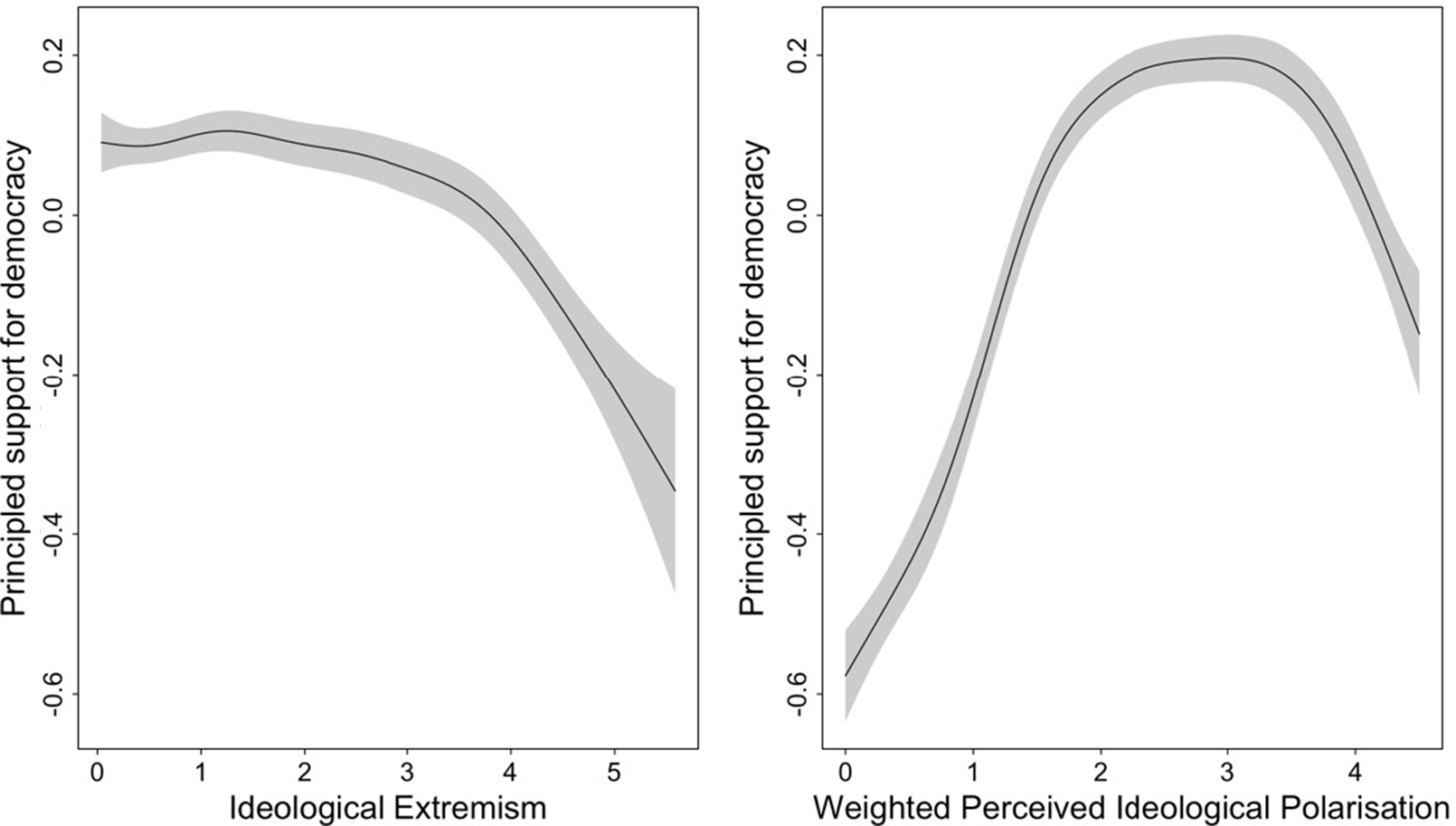
To be sure, in spite of the causal flavor of the theoretical argument, the observational data from cross-sectional surveys employed here precludes a causal interpretation of these findings. For example, although there is experimental evidence pointing to the causal relationship between extremism and democratic support (Graham and Svolik, Reference Graham and Svolik2020; Svolik, Reference Svolik2020), a reverse causal flow remains conceivable: voters who for some reason are less attached to democratic norms and principles may end up moving to more radical ideological positions in their contexts. However, it is more difficult to envisage the reverse causal mechanism through which lower support for democracy would lead some voters in some contexts to perceive very large ideological differences between parties while simultaneously leading others to perceive very small ones. In any case, both very high and very low decidability is associated with lower democratic support in our data, even when political interest, party identification, and education are kept constant.
To confirm these findings using a more conventional analytical approach, we shift to OLS and estimate three models. Model 2 assumes linearity in the relationship between IE and WPIP and support for democracy. Model 3 adds a quadratic transformation of WPIP as formulated in H2 and corroborated by the preceding GAM estimation. Model 4 also adds the exponential term for IE to the linear function of IE, represented by the function $f\left( x \right) = b({e^x})$
, with x being the original individual ideological extremism (IE) scale.
$f\left( x \right) = b({e^x})$
, with x being the original individual ideological extremism (IE) scale.
The results are presented in Table 3. As can be seen, the simple linear specifications of the main variables—IE and WPIP—yield statistically significant coefficients (Model 2): whereas the former seems to be negatively related with principled democratic support, the latter seems positively related. However, when we add the quadratic term of perceived party ideological polarization as we proposed in H2 (Model 3), this term is negative and significant, and the fit of the model (lower Akaike Information Criterion and higher adjusted R 2) improves, thus exhibiting a better adjustment to the data. In Model 4, the parameter of the exponential term for individual extremism is negative and significant: the predicted values of the principled support for democracy scale do not vary in the lower 50 percentiles of the exponential transformation of ideological extremism, but decrease substantially at the 75th percentile, and dramatically so at the 90th percentile. Finally, its addition produces a new improvement in the fit of the model, confirming that this relationship seems to be better captured by an exponential form. Footnote 9
Ideological extremism, perceived partisan polarization, and support for democracy (OLS with country–year fixed effects)

Country-year dummies are not displayed; cluster corrected standard errors are in parentheses.
* P < 0.05.
** P < 0.01.
*** P < 0.001.
Figure 2 presents the predicted values of the dependent variable according to Model 4 (Table 3). As can be seen on the left panel of Figure 2, there is an estimated abrupt nonlinear decline in support for democracy as individuals become more ideologically extreme. On the right panel, the relationship between perceived ideological polarization in the party system and principled support for democracy exhibits a concave or ‘inverted-U’ shape, indicating again that the latter is maximized when individuals perceive polarization as neither very low nor very high.
Predicted values of principled support for democracy based on Model 4, Table 3 (95% confidence intervals).

In sum, the evidence leads us to reject the null hypotheses regarding the effects of IE and WPIP, supporting H1 and H2. However, the negative relationship between extremism and liberal democratic support is not best described as linear but rather as exponential: the decline in support for liberal democratic principles seems to be larger as ideological extremism increases after discounting the linear effect of ideological extremism, which turns out not to be significant. To put it differently, the mere cardinal distance between the individual’s position and the ideological societal mean does not seem to capture the kind of ‘extremism’ that is consequential for democratic values: instead, the distance that is associated with a decline in support for democracy needs to be ‘large,’ one that places individuals considerably far from the mean position of society, and only that distance is associated with a lower principled support for democracy. This is both a conceptual and measurement issue about ‘ideological extremism’ that might deserve more detailed attention in future research.
Robustness
To assess the robustness of our results, we conducted several additional analyses. First, we replaced economic evaluations with evaluations of government performance as a control variable that might better capture the potential contamination of diffuse support for democracy by specific support. Unfortunately, the latter variable is available in a smaller number of surveys. However, in appendix, we show results of additional GAM and OLS estimations where such a replacement is made. Using evaluations of government performance reduces the number of individual-level cases from about 16,520 to 13,999 observations and from 11 to 9 country/years. Footnote 10 Despite this, results are clearly confirmed (see Table 7A in appendix for the OLS estimation and Table 8A for the GAM estimation). The visualization of predicted values coming from these models also confirms the functional form of the relationship we had already observed (Figures 1A and 3A in appendix).
Second, as Iversen and Soskice (Reference Iversen and Soskice2015) have argued, it is possible that voters’ positional closeness to the center is more a reflection of an incapacity to express an ideological position – caused by low levels of sophistication – than an expression of ideological moderation. Similarly, the inability to perceive any ideological difference between the parties in the system can also be an expression of low sophistication or even of ‘satisficing’ in survey responses (Krosnick, Reference Krosnick1991). This low sophistication, in turn, can be related to a lower principled support for democracy, potentially biasing our results, in spite of the inclusion of political interest and education as controls. Thus, we re-estimated the models after dropping 10% of the respondents closest to the value zero in each measure of ideological polarization (the value of the lowest 10 percentile is 0.227 for WPIP and 0.965 for IE). This means that a total of 3,363 cases included in the full model presented in Tables 2 and 3 were dropped. We also control for political interest and education as we did previously. The results in Tables 7A and 8A and Figures 2A and 4A in appendix confirm the degree, direction, and nature of the relationships we observed between both IE and WPIP with principled support for democracy, although there is some reduction of the adjusted R 2.
Finally, since we are dealing with a hierarchical data structure with individuals nested in country/years, and although we are interested only in relationships at the individual level, we repeated the analysis employing a multilevel random model with between-effects (REB) (Bell et al., Reference Bell, Fairbrother and Jones2018) but including also the random slopes of the relevant variables, as recommended recently by Heisig and Schaeffer (Reference Heisig and Schaeffer2019). This strategy also allows us to estimate the country/year variance of the slopes of the IE exponential and WPIP Quadratic. Results for this model (in Table 9A in Appendix) show that the between individuals effects coefficients do not vary even when we leave the slopes of these coefficients random. Although model fit improves slightly with random slopes, variances for the slopes are close to zero and nonstatistically significant. These results thus display the lack of variation of the between effects of the variables IE exponential and WPIP Quadratic across country/years.
Finally, we contemplate the possibility that the relationship between IE and WPIP might be mutually contingent. Other studies have shown interactions between ideological self-placement and party system polarization in the explanation of political behavior. For example, Rodon (Reference Rodon2017) shows that party system polarization has heterogeneous effects on turnout, increasing primarily the participation of voters who place themselves in the ideological center. In our case, it is possible that the tendency for extremists to withdraw democratic support might be contingent upon the extent to which they perceive the system to be ideologically polarized: if, from the extremist’s point of view, party systems fail to offer sufficiently polarized options, they can become even less supportive of the regime; conversely, if they perceive the party system to be ideologically polarized, this might lead them to recognize the existence of alternatives that represent their views and to adhere more to democracy.
To contemplate this possibility, we estimate a GAM model that allows for an interaction between the continuous variables IE and WPIP. Table 10A in Supplementary Appendix shows the summary of results. Figure 3 shows a contour plot, colorized in such a way that red color represents lower predicted values of principled support for democracy and yellow/white values higher ones, contingent upon the combination of values of ideological extremism and perceived party system polarization.
Predicted principled support for democracy, based on GAM model interacting ideological extremism and weighted perceived party system polarization.

As we can see, the maximization of levels of principled support for democracy still results here from the combination of intermediate levels of perceived party system polarization (roughly between 2 and 3 in our scale) and avoiding high levels of ideological extremism (below roughly 3.5 in our scale). In other words, the results are basically the same as those obtained when the smooths were not allowed to interact.
Discussion
This study addresses two different implications of ideological polarization for principled support for democracy. One flows from the Sartorian tradition, which argues that, in situations of high ideological polarization, the legitimacy of the political system is likely to be widely questioned. The other flows from the Downsian tradition, which argues for some level of polarization to generate ‘party differential’ or ‘electoral decidability’ in the party supply. While these may seem at odds with one another, we found that both hold some power in explaining how ideological polarization is related to democratic legitimacy.
In the preceding pages, we have approached this theoretical and empirical puzzle by exploring the relationship between two different manifestations of ideological polarization and support for democracy. The first is IE, ideological extremism, which measures the extent to which citizens’ place themselves in the most extreme positions of the ideological scale in their political systems, reflecting a ‘demand-side’ of polarization. The second is WPIP, (weighted) perceived ideological polarization, which results from where individuals locate political parties in that same scale relative to one another and reflects their perception of the extent to which party system supply is ideologically polarized.
Our results indicate that individual ideological extremism tends to have an exponentially negative relationship with principled support to democracy. This result suggests that extremism is perhaps more a matter of ‘kind’ than of ‘degree’. In other words, individuals that are ‘moderately’ distant from the ideological average positions in their societies are no more and no less likely to question democracy as a regime: it is only when that distance becomes increasingly large – that is, ‘extreme’ – that democratic support also starts decreasing precipitously. This also fits well the notion that the extent to which voters’ position themselves away from the ideological center conveys intensity, rather than a mere position on a scale (Rabinowitz and Macdonald, Reference Rabinowitz and Macdonald1989: 95–96).
Additionally, we also find an ‘inverted-U’ (concave) relationship between the ideological polarization of the party system (as perceived by voters) and democratic support, thus reflecting the argument that both low and high levels of polarization of parties can have negative implications for democratic legitimacy. This occurs as this measure of perceived polarization contains information on the level of ‘party differential’ or ‘electoral decidability’ of the party supply, which is absent in the other indicator—individual IE. As hypothesized by Bartolini (Reference Bartolini2000), Przeworski (Reference Przeworski2019) and others, low levels of party differential are also associated with a questioning of the legitimacy of democratic competition. The combination of these findings helps reconcile two apparently contradictory arguments in the literature about party system polarization and its potential consequences for democracy.
We believe that this discussion and the evidence presented helps shedding light on the current debate about the potential consequences of increasing levels of polarization observed in numerous contemporary democracies. Our results suggest that, from a supply perspective, some amount of polarization may contribute to democratic legitimacy, particularly in the context of profound economic and social crisis, by offering citizens a way to vent their growing discontent. However, problems can also arise if this polarization reaches a very high level, and even more so if this is connected with the increasing levels of individuals’ ideological extremism from the demand side. This combination might present a more serious threat to representative democracies. Thus, to the extent that public support does indeed help democracy survive (Claassen, Reference Claassen2020b), this seems to depend not only on the presence of low ideological polarization among the citizenry but also a moderate level of (perceived) polarization in the party supply. We hope these findings stimulate further studies, particularly based on experimental or panel data, that make it possible to assess the nature of the causal relationships between these different dimensions of ideological polarization and democratic support.
Supplementary material
To view supplementary material for this article, please visit https://doi.org/10.1017/S1755773922000066.
Acknowledgements
We would like to express our gratitude to Josep Maria Comellas (Research and Expertise Center for Survey Methodology – RECSM) who has helped us to write all the syntax for the polarization formulas. Early versions of this article were presented at the SPARC Research Group of ICS-ULisbon (October 2020), at the Annual Conference of the World Association of Public Opinion Research (October 2020), and at European Politics Online Workshop (May 2021). We are grateful to the organizers of these events for giving us the opportunity to present our work and for all comments received there. We also thank Paul A. Beck and Richard Gunther for the valuable information provided about the Comparative National Election Project (CNEP) surveys.


 Open access

