


Political parties use ambiguous language in their campaign appeals for different reasons. Previous research has established that ambiguous language, if used judiciously, can help parties to broaden their electoral appeal (Hersh and Schaffner Reference Hersh and Schaffner2013; Lo, Proksch, and Slapin Reference Lo, Proksch and Slapin2016; Somer-Topcu Reference Somer-Topcu2015; Tomz and Van Houweling Reference Tomz and Van Houweling2009). It allows them to avoid polarizing stances, enabling different voter groups to interpret the party’s campaign statements in ways that align with their own preferences. As we argue in Chapter 9, this is particularly relevant to parties on the right that face an increasingly polarized support base due to globalization. Another reason for parties to use ambiguous language is that it shields them from future retrospective sanctions by voters. If they were to make clear promises, they may be forced to break those promises when in government and then be punished by voters at the next election. This is particularly relevant to center-left parties, as globalization places significant and heavy constraints on them when they attempt to fulfill their campaign promises (Chapter 4). However, we know much less about how ambiguity helps parties to avoid retrospective sanctions for breaking promises, which is the focus of this chapter.
Ambiguous campaign statements reduce the likelihood that voters will sanction parties for enacting policies that do not align with their (voters’) policy preferences for two related reasons. First, vague campaign statements regarding the specific policies a party intends to implement make it hard for voters to pinpoint exactly what was promised. Because vague language leaves room for multiple interpretations, voters may struggle to determine whether the party delivered what it promised. For instance, a promise to “reform the tax system” could mean different things to different people: some might expect lower taxes for businesses, while others might expect simplified tax filing. If the party enacts some tax adjustments but not in the way a segment of voters anticipated, it becomes unclear whether the government’s actions amount to a kept or broken promise. Voters might make inferences about what policies a party will enact based on the party’s ambiguous statements. However, if the party’s actions in government do not align with those inferences, voters may not conclude that the party broke its promise. Second, vague campaign statements give parties the flexibility to claim success through various policy measures. If the wording of a campaign statement is broad enough, a governing party can frame their actions as fulfilling a promise even if the policy does not match voters’ expectations exactly. For example, a promise to “improve education” might lead some voters to expect increased funding for public schools, while others might expect a focus on curriculum reform. If the party implements only minor changes, they can still claim they followed through on their education promise, reducing the likelihood that voters see this as a failure.
For those reasons, our baseline expectation is that ambiguous campaign statements reduce the severity of voters’ sanctioning of politicians for decisions that do not align with voters’ policy preferences. Ambiguity makes it harder for voters to identify specific policy breaches, offering flexibility in policy interpretation, and lowering expectations for full delivery. This strategic ambiguity helps parties avoid direct accountability for failing to enact promised policies, ultimately shielding them from electoral punishment.
We are, however, primarily interested in the use of ambiguity in the context of globalization, which leads us to formulate our ambiguity-in-globalization expectation. We argue that the use of ambiguity is effective even in the context of globalization’s constraints. As we find in Chapter 6, retrospective sanctioning is particularly strong in the context of economic globalization. In the globalized conditions under which many governing parties, particularly on the left, find it harder to fulfill their campaign promises, they are punished more severely by voters for breaking promises. Ambiguity, we argue, is a way of mitigating this punishment. This leads us to expect that even under globalization constraints, ambiguous campaign statements reduce the severity of voters’ sanctioning of politicians for decisions that do not align with voters’ policy preferences. This ambiguity-under-globalization expectation is a particularly demanding test of the effectiveness of ambiguity due to two considerations. First, voters might give politicians some slack when broken promises are due to the constraints of globalization, reasoning that the broken promise was beyond the governing parties’ control. Second, voters may dislike the use of ambiguous language so much that any benefit parties gain from avoiding breaking an explicit promise is outweighed by voters’ irritation at politicians’ refusal to take a clear stance. When voters attach more importance to parties’ ability to formulate feasible promises as indicators of their governing competence, this second consideration may be more important in globalized contexts. To the extent that these other considerations are important, the evidence will not support our expectation that ambiguity is effective even under globalization’s constraints.
To test these expectations, we return to the preregistered survey experiment on voters’ responses to broken campaign promises, which we examine in previous chapters. In parts of this survey experiment, we varied the levels of ambiguity of the statements made by the politician who featured in the experiment. The findings show that ambiguity significantly reduces the severity of the punishment that voters impose on the politician when he failed to deliver on his promise or took actions that were contrary to voters’ preferences. Moreover, ambiguity is effective even when respondents are presented with information on globalization shocks that make their preferred policies less feasible. These results provide strong evidence in support of the effectiveness of ambiguity in shielding governing politicians from electoral punishment. Survey experiments inevitably have an artificial quality to them, which is both their strength and their weakness. The artificialness of the experimental setting allows us to isolate the effects of individual treatments in ways that would be impossible with an observational research design. Critics of survey experiments usually point to their weaknesses in terms of external validity, which relates to the extent to which we can generalize the findings from an experiment to other more realistic settings. This limitation is why it is important to consider the findings from this survey experiment with the findings from the observational analyses of party behavior from the other chapters. Taken together, they form an integrated body of evidence that broadly supports our theoretical argument.
Experimental Design
The survey experiment analyzed in this chapter examines whether voters punish politicians for breaking campaign promises. As the experiment was introduced in Chapter 6, here we summarize only the essential elements of the experimental setup and focus on the additional treatments examined in this chapter, namely, vague and ambivalent campaign statements.
As discussed in Chapter 6, the experiment was preregistered and fielded online with YouGov in the summer of 2024. After excluding respondents who failed attention checks, the final sample consists of 4,277 US adults, recruited to be broadly representative of the population using demographic quotas (age, gender, race, education, region, and 2020 presidential vote). Details of the sample characteristics and balance across treatments are provided in the online Supplementary Material and summarized in the figures in Chapter 6. Respondents are first asked about their party identification and their stance on corporate tax incentives. Based on these responses, each is presented with a hypothetical candidate (Gary Clark) from their preferred party (Republican or Democrat), who makes a campaign statement about corporate tax policy. The statements align with the respondent’s policy views, allowing us to isolate the effects of ambiguity.
The key innovation in this chapter is the introduction of message-type variation. Respondents are given a candidate who makes either a clear, vague, or ambivalent statement about tax incentives. While clear statements express an unambiguous policy position, vague statements use imprecise language, and ambivalent ones include internally inconsistent cues. This design allows us to assess how voters respond to different types of ambiguity in campaign communication.
All respondents are presented with the following information:
We would now like you to consider the following hypothetical scenario. Gary Clark was a [Democratic/Republican] candidate for the state legislature. During the campaign, he made several statements about corporate tax policies, including the following statements:
We randomly assign one of the following three statements to respondents who oppose tax incentives:
[T1: Clear Statement] “We need to make sure that large companies pay their fair share in our state, so that we can invest in policies that promote economic growth and give hard-working Americans the chance to join or maintain their place in the middle class. I will fight to end tax breaks for large companies in our state.
Time and time again, we see that tax incentives for large companies do not pay off in real economic gains and often fail to produce jobs. We need to end corporate tax breaks to ensure that large companies pay their fair share and contribute to the well-being of Americans in our state.”
[T2: Vague Statement] “We must invest in policies that promote economic growth and give hard-working Americans the chance to join or maintain their place in the middle class. We need corporate tax policies that ensure we reach this goal.
My priority is the well-being of my fellow Americans. I support tax policies on large companies that help our economy to grow and create new jobs.”
[T3: Ambivalent Statement] “We need to make sure that large companies pay their fair share so that we can invest in policies that promote economic growth and give hard-working Americans the chance to join or maintain their place in the middle class. I will oppose unfair tax breaks for large companies in our state.
Time and time again, we see that tax incentives to large companies have paid off in real economic gains and the creation of jobs. I will support corporate tax incentives to ensure that large companies remain in our state and contribute to the well-being of my fellow Americans.”
Respondents who favor tax incentives also receive one of three statements. While the vague and ambivalent statements are the same as in the previous treatment, respondents who favor tax incentives and are randomly assigned a “clear” statement are given the following statement:
[T1: Clear Statement] “We must promote economic growth, create new jobs, and give hard-working Americans the chance to join or maintain their place in the middle class. I will fight to expand tax incentives for large companies in our state, so they stay and grow, and contribute to this goal.
Time and time again, we see that tax incentives for large companies pay off in real economic gains and job creation. We need to expand corporate tax incentives to ensure that large companies remain and contribute to the well-being of Americans in our state.”
We then inform the respondents that Gary Clark won a seat in the state legislature and that the state legislature is voting on a bill that would introduce new tax incentives for large companies. We ask respondents to say how they thought Gary Clark will vote. Responses could range from being very confident that Clark would support the bill to being very confident that he would oppose the bill (a 5-point scale that includes the option to be unsure of how Clark would vote).
Our second treatment involves a globalization condition for half of our respondents (the control group does not receive any treatment and serves as our sample for testing our first hypothesis). The globalization condition introduces a globalization shock that makes the policy that Gary Clark favored (and the respondent preferred) less likely. Half of the respondents who oppose tax incentives are treated with the following information (the other half receives no information):
Between the election campaign and the vote, large companies began moving their operations to foreign countries that offered new tax incentives. This threatened to increase unemployment and the state’s ability to fund public services because of falling tax revenues. This was a big part of the debate on the bill introducing new large tax incentives for large companies. Some people who were previously against tax incentives for large companies now argued in favor of them in this new situation.
Half of the respondents who favor tax incentives are treated with this alternative information (the other half receives no information):
Between the election campaign and the vote, the global economy and our main overseas markets took a significant downturn. This threatened to increase unemployment and the state’s ability to fund public services because of falling tax revenues. This was a big part of the debate on the bill introducing new large tax incentives for large companies. Some people who were previously in favor of tax incentives for large companies now argued against them in this new situation.
Our third treatment is Gary Clark’s vote on the bill. We randomize respondents such that half of the respondents are informed that Gary Clark voted in favor of the bill, and half of the respondents are informed that Gary Clark voted against the bill. This means that across the possible positions in favor or against tax incentives, respondents are randomly confronted with a situation in which Gary Clark breaks his promise and a situation in which Gary Clark keeps his promise.
After we provide respondents with Gary Clark’s vote, we ask them to evaluate him on his “likeability.” Respondents could rate Gary Clark on a scale from 0 to 10 where 0 is “dislike a great deal” and 10 is “like a great deal.” We also ask respondents whether the following phrases describe Gary Clark:
1. Someone who represents his constituents well
2. A politician who is open minded
3. A person who lacks integrity
4. A politician who keeps his campaign promises
5. A politician who adapts well to changing circumstances
6. A politician who is competent
Experimental Results
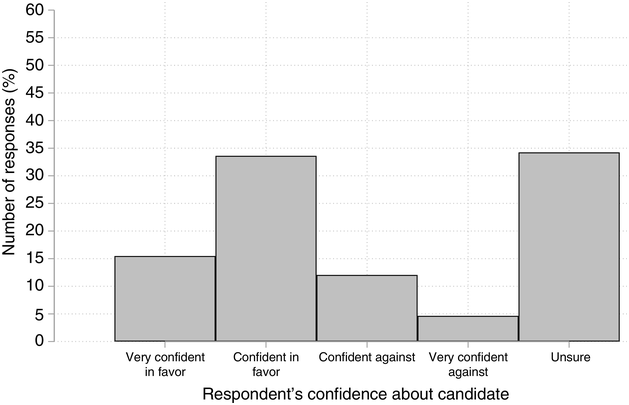
Before presenting the main experimental results, we assess whether the type of statement treatment works as expected. We expect that voters who are presented with a vague statement to be much less confident about how the candidate would vote. This, in turn, makes voters less likely to be certain about whether the candidate broke his promise, therefore leading to reduced sanctioning. To test this assumption, we asked respondents the following after the candidate Gary Clark made his statements:
Gary Clark won a seat in the state legislature. Now, the state legislature has to vote on a bill that will introduce new large tax incentives for large companies. How do you think [Democrat/Republican] Gary Clark will vote?
Possible responses were: I am very confident that Gary Clark will vote for the legislation, I am confident that Gary Clark will vote for the legislation, I am confident that Gary Clark will vote against the legislation, I am very confident that Gary Clark will vote against the legislation, I am unsure how Gary Clark will vote.
Figure 10.1 presents a histogram of the responses, indicating the range of certainty across different statements. In our sample, almost 35 percent of respondents are unsure about how the candidate would vote. If the assumption that ambiguity reduces voters’ certainty is supported, we would expect that respondents who receive a vague or ambivalent statement to be less certain about how Gary Clark will vote. Our expectation is borne out by the data. Those who receive vague or ambivalent statements are significantly more likely (p<0.001) to say that they are uncertain about how Gary Clark would vote.
Voter confidence about the politician’s vote
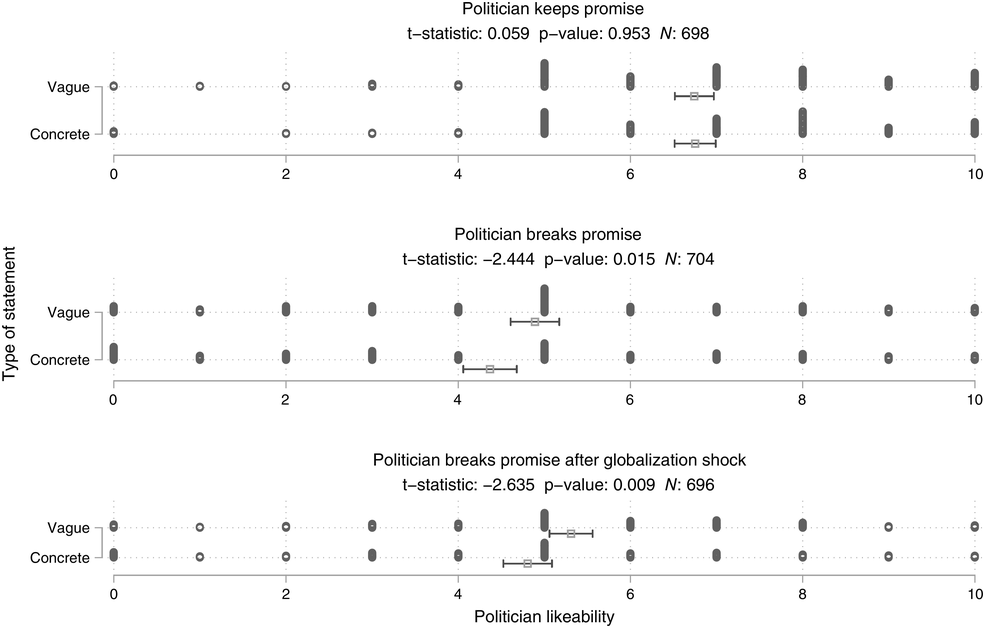
Moving to the main results, we first use difference-in-means tests to analyze whether vagueness is effective in reducing the severity of voters’ sanctions for broken promises, in the absence of a globalization shock. Figure 10.2 presents the results graphically. The graph shows the means for each sample using a light gray square, including 95 percent confidence intervals, as well as a histogram with information on sample distribution at various values of the dependent variable along the x-axis, here Politician Likeability.
Main experimental results
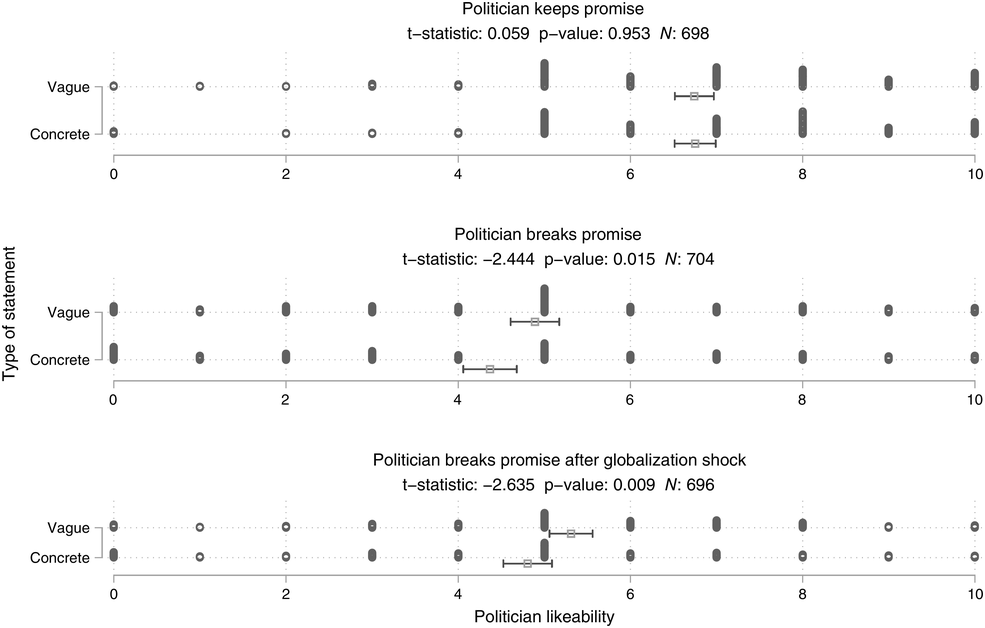
Figure 10.2 Long description
The three samples from top to bottom are separated by the politician keeping his promise, breaking it, and breaking it after globalization shock. The mean for each sample is represented by a light gray square with red bar confidence intervals. The top plot has 698 observations, a t-statistic of 0.059, and a p-value of 0.953. The middle plot has 704 observations, a T statistic of negative 2.444, and a p-value of 0.015. The bottom plot has 696 observations, a t-statistic of negative 2.635, and a p-value of 0.009.
The top graph compares the mean likeability when Gary Clark (1) voted in line with voters’ policy preferences after making a vague statement and (2) voted in line with voters’ policy preferences after making a concrete promise and keeping that promise. The middle graph compares the mean likeability when Gary Clark (1) voted against voters’ policy preferences after making a vague statement and (2) voted against voters’ policy preferences after making a concrete promise and breaking that promise. First, we find that respondents like candidates who break their promises significantly less than those who keep them. The average likeability rating of candidates falls from 6.75 for politicians who keep their concrete promises to 4.36 for candidates who break a concrete promise and 4.89 for candidates who vote against voters’ preferences after making a vague statement.Footnote 1 Second, we find no significant difference in the likeability of candidates that keep their vague versus concrete promises, indicating that voters do not punish politicians who make vague promises (unless those candidates vote against voters’ policy preferences). The results further support our main hypothesis, that respondents significantly (p<0.015) reduce their support for politicians who break concrete promises as compared with politicians who vote against voters’ preferences after making vague campaign statements. Vagueness pays off in reducing the severity of electoral punishment for perceived broken promises.Footnote 2
Table 10.1 shows that these results are robust to different outcomes.Footnote 3 Respondents who are treated with a vague statement, and then informed that Gary Clark voted against their preference on tax policies, are significantly more likely to believe that Gary Clark represents his people well, adapts well to changing circumstances, is open minded, has integrity, is good at keeping promises, and competent than respondents who are treated with a Gary Clark who breaks a clear promise.
| Concrete | Vague | Diff | p-value | |
|---|---|---|---|---|
| Represents people well | 4.72 | 5.23 | 0.51 | 0.00 |
| Open minded | 5.21 | 5.47 | 0.26 | 0.04 |
| Lacks integrity | 5.70 | 4.97 | −0.73 | 0.00 |
| Good at keeping promises | 3.98 | 5.03 | 1.05 | 0.00 |
| Adapts well to changing circumstances | 5.30 | 5.56 | 0.26 | 0.04 |
| Competent | 5.13 | 5.50 | 0.36 | 0.01 |
Note: The table presents the results of difference-between-means tests in a sample where the politician breaks his promise, comparing the treatment group where the politician makes a concrete promise to the treatment group where the politician makes a vague promise.
The bottom graph of Figure 10.2 presents the results for respondents who are treated with an adverse globalization shock. This comparison is crucial for testing our expectation that even under globalization constraints, ambiguous campaign statements reduce the severity of voters’ sanctioning of politicians for decisions that do not align with voters’ policy preferences. As expected, and as in the results without a globalization shock, voters’ punishment is significantly harsher when politicians break a clear promise (likeability is 4.81) than when politicians vote contrary to respondents’ policy preferences after making a vague campaign statement (likeability is 5.31, p<0.004).
In addition, we find that respondents rate politicians who vote contrary to their policy preferences after making vague campaign statements or who break clear promises less harshly when a globalization shock occurs than in the absence of a globalization shock. When politicians vote against respondents’ policy preferences after making vague campaign statements, they receive milder punishment when a globalization shock occurs (likeability is 5.31 in the bottom graph) than without a globalization shock (likeability is 4.89 in the middle graph). The difference is significant in a difference-between-means test (p<0.015). The same is true for politicians who break clear promises after a globalization shock (likeability is 4.81 in the lower graph) compared with politicians who break clear promises without a globalization shock (likeability is 4.37 in the middle graph, p<0.021).
Are Vague Statements More Effective than Ambivalent Statements?
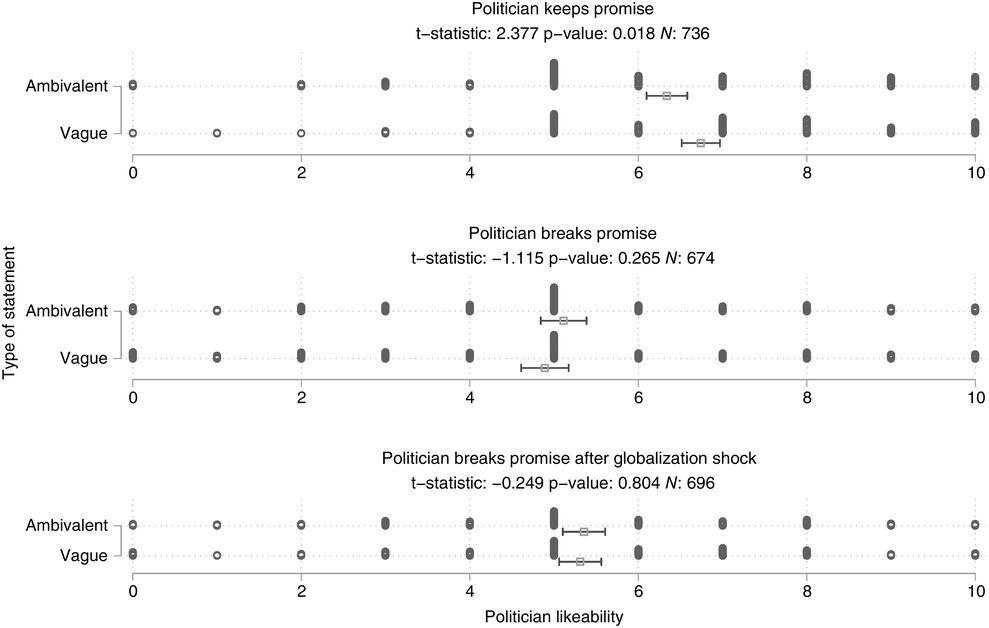
Our main argument and analysis so far focused on politicians’ use of vagueness as a strategy for avoiding retrospective sanctioning for promise breaking. In Chapter 9, we argue that ambivalent statements, meaning multiple statements that lean in different directions, are generally less effective at forestalling future punishment by voters of politicians who do not act in line with voters’ preferences. Figure 10.3 compares respondents’ assessments of a politician who makes vague statements with a politician who makes ambivalent statements. “Keeping the promise” means that the politician votes in line with the respondent’s preferences, while “breaking the promise” means that the politician votes against the respondent’s preferences. Voters often project their own policy preferences onto politicians who make vague or ambivalent statements.
Is vagueness better than ambivalence?
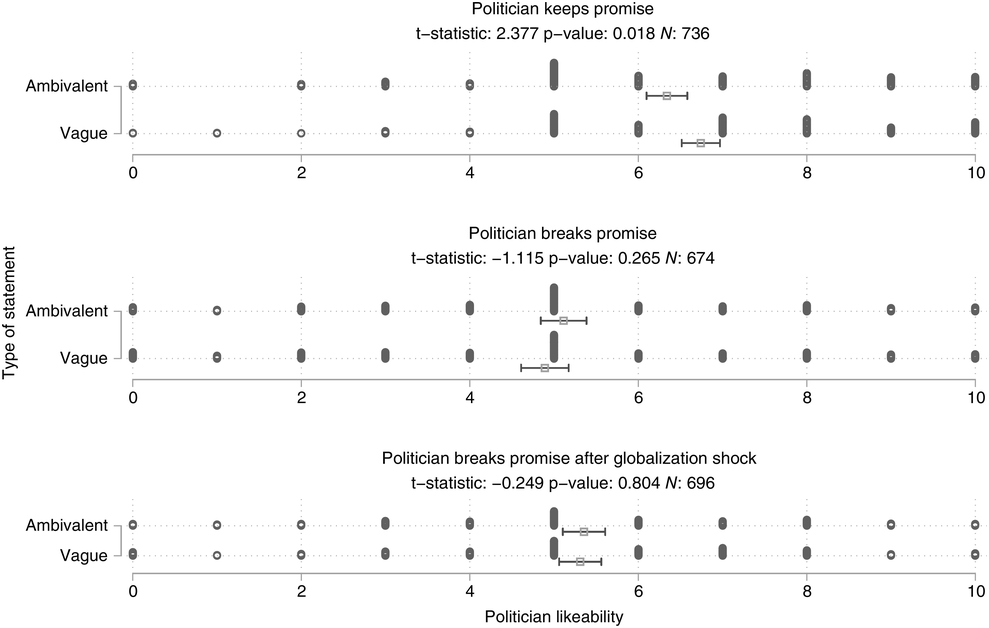
Figure 10.3 Long description
The three samples from top to bottom are separated by the politician keeping his promise, breaking it, and breaking it after globalization shock. The mean for each sample is represented by a light gray square with red bar confidence intervals. The top plot has 736 observations, a t-statistic of 2.377, and a p-value of 0.018. The middle plot has 674 observations, a t-statistic of negative 1.115, and a p-value of 0.265. The bottom plot has 696 observations, a t-statistic of negative 0.249, and a p-value of 0.804.
In line with the previous results, breaking promises (in this case, voting against respondents’ preferences) significantly reduces support for the politician. However, against our expectations, ambivalent statements are not significantly more costly than vague statements, whether there is a globalization shock (bottom graph) or not (middle graph). Table 10.2 shows that the null results are robust across different outcome variables.
| Vague | Ambivalent | Diff | p-value | |
|---|---|---|---|---|
| Represents people well | 5.23 | 5.22 | −0.01 | 0.97 |
| Open minded | 5.47 | 5.60 | 0.13 | 0.30 |
| Lacks integrity | 4.97 | 4.95 | −0.02 | 0.88 |
| Good at keeping promises | 5.03 | 4.97 | −0.06 | 0.69 |
| Adapts well to changing circumstances | 5.56 | 5.74 | 0.18 | 0.15 |
| Competent | 5.50 | 5.46 | −0.04 | 0.77 |
Note: The table presents the results of difference-between-means tests in a sample where the politician votes against respondents’ preferences (breaks his promise), comparing the treatment group where the politician makes vague statements to the treatment group where the politician makes ambivalent statements. The results include respondents independent of whether they receive the globalization treatment. The results are robust if we split the sample by respondents who are treated with a globalization shock and respondents who are not treated with a globalization shock.
The evidence does not support the expectation that vagueness is a superior strategy to ambivalence. We assumed that voters are more likely to believe that candidates who make ambivalent statements would vote in line with their (voters’) preferences than candidates who make vague statements. However, this does not appear to be the case. The difference between respondents who are exposed to a vague politician compared with those who are exposed to an ambivalent one is insignificant with respect to respondents’ average level of confidence about how the politician would vote (p<0.97).
One potential explanation for this nonfinding is that respondents might give politicians with whom they have a partisan affinity the benefit of the doubt. Recall that we present respondents with a candidate that matches their own partisanship. While this allows us to isolate the main effect we are interested in, it may limit the extent to which we detect the full implications of ambivalence, particularly if citizens are less forgiving of ambivalence (or inconsistency) in the statements of candidates who do not match their own partisanship, as the existing literature suggests (Bonilla Reference Bonilla2022; Naurin Reference Naurin2011; Naurin, Soroka, and Markwat Reference Naurin, Soroka and Markwat2019; Simas, Milita, and Ryan Reference Simas, Milita and Ryan2021).
Nonetheless, in line with our main argument, voters generally disapprove of ambivalence. Even when politicians keep their promises (top graph in Figure 10.3), the average likeability score for ambivalent politicians (6.33) is significantly lower than the average likeability score for vague politicians (6.74, p<0.018). This is in marked contrast to our findings in Figure 10.2 where we find no significant differences between vague and concrete statements.Footnote 4 While these comparisons were not preregistered, they indicate that voters have an inherent dislike of ambivalence (less so of vagueness). As such, the findings shed light on why politicians do not tend to increase their use of ambivalence in contexts in which governments are highly exposed to globalization, as they do in relation to vagueness.
Overall, the experimental results provide evidence that politicians can use ambiguous statements to improve public support. The use of vague language in election campaigns allows politicians to minimize the future electoral costs of breaking promises. While we do not find a strong difference between ambivalence and vagueness when politicians vote contrary to citizens’ preferences, voters generally dislike ambivalence, even when politicians vote in line with their preferences. These results support our explanation of why parties use vague language when their country is deeply integrated into the global economy. Parties know that globalization’s constraints may limit their capacity to keep their campaign promises and also that carefully calibrated use of vague language, rather than making specific promises, can mitigate future electoral punishment for breaking promises.
Discussion
This chapter examines how politicians use ambiguity in their campaign statements to reduce the severity of voters’ punishment of them for breaking campaign promises. Ambiguity in the form of vague campaign statements is an effective way for parties to reduce the severity of electoral punishment for breaking clear promises. Making vague statements is often a better strategy than making a clear promise and breaking it, even when the party may be able to make a case that the broken promise was due to globalization constraints beyond its control. While previous research provided robust evidence that ambiguity helps parties appeal to a broader range of voters, we know less about how ambiguity shields parties from retrospective sanctions for broken promises. There are two key reasons why ambiguity helps parties avoid being held accountable for broken promises. First, ambiguous campaign statements make it difficult for voters to clearly identify what was promised, creating confusion about whether a promise was broken. Even when voters formulate expectations about what candidates will do based on vague campaign statements, actions that contravene these expectations may not result in harsh electoral punishment. Second, ambiguous statements give parties more flexibility when they enter government office. Governing parties may claim success by framing their actions as fulfilling a broad and flexible interpretation of their previous commitments.
The findings strongly support our theory that ambiguity helps insulate political parties from electoral punishment, and they align with the key finding from Chapter 9 that parties’ election programs contain vaguer language when countries are more deeply integrated into the international economy. The evidence from the survey experiment supports our main expectation that vagueness mitigates the negative electoral consequences of promise breaking. This holds even when promise breaking was accompanied by globalization-induced shocks that made concrete promises less feasible. Politicians who voted contrary to voters’ preferences after making vague statements receive lighter punishment from voters than candidates who broke clear promises that are in line with voters’ preferences.
Parties’ use of ambiguity to avoid future electoral punishment for promise breaking has significant negative implications for democratic accountability. Promissory representation is weakened when parties blur their commitments excessively. Voters lose the ability to assess effectively whether parties have delivered on their promises, undermining their ability to hold elected officials accountable. When governing parties’ accountability to voters is weakened, governments can implement policies that may not reflect what voters want. This disconnect between promises and policies undermines the fundamental mechanisms of promissory representation, according to which electoral commitments are supposed to guide voters’ expectations and governing parties’ actions. If policies no longer align with voters’ preferences, the quality of substantive representation deteriorates, weakening the democratic process. Chapter 11 concludes by bringing together the book’s main findings and their implications for the erosion of democratic representation.

 Open access