

1. Purpose: Observing bottom-up challenges to the developmentalist law
Since the rise of neo-institutional economics in the 1990s, international development agencies have guided “legal transplants” or a project of globalization of national law in Asian and African developing countries,Footnote 1 even at the sacrifice of recipient country’s own democratic deliberation in the legislative process. Outside of the formal route of legislation, however, there are certain democratic routes which remain available for the modification of the thus transplanted formal law, through people-driven contests at the grassroots. Traditional mediation systems, some of which are linked to formal state forums such as judicial courts and administrative tribunals through the appeal system, are often the forums where such normative contests take place involving open dialogues. In such grassroots forums of people, the normative basis for their assertions is the justice that they know, in other words, customary law.
But we should be reminded that the term “customary law” is a label given by outsiders to what is simply the “law” for the local people. The label “custom” or “customary law” started to matter in the positivist codification in Europe and its export to the colonies for negating existing legal regimes except for what was partially allowed to exist as such by the colonial law.Footnote 2 It includes not only vernacular customs in daily life but also concrete norms which used to constitute the formal law until the modern law was imposed. Such former formal law often remains firm in the consciousness of the people, even though the current formal law allows them only within a constrained status of “customary law.”
We sometimes encounter this firm type of customary law in the sphere of property law on land and forest, where we can observe emerging democratic channels of legal reform aiming at a bottom-up modification to the state law from the grassroots, especially when the state implements a transplanted legal model that negates the core principles of the people’s understanding of justice. There are farmers left in a vulnerable position because of lacking the formal title to their ancestral land under the transplanted model of land law; there are people whose humble residences and modest access to natural resources for making living from fisheries and/or forests are labelled as criminal trespass against state properties; there are also people who are labelled as “squatters” but maintain a strong belief in their entitlement to the land. These typical situations look similar across many jurisdictions in Asia and Africa, and the substance of their claims is labelled together as “customary rights.”
But there are some variations in the outcomes of their contests. In some jurisdictions, there is a regime of positive law that recognizes customary law within the regime of formal property rights. In other jurisdictions, even if the positive law fails to have an explicit provision that recognizes customary rights, there are well-functioning dispute resolution forums that act as a catalyst of normative contests for improving the status of customary rights, instead of eliminating them. In such well-functioning forums, we may observe certain tactics of the wise men who lead the dispute towards a normative compromise that is legally acceptable in his forum, or, in other words, a “legal postulate” that legal anthropologist Masaji Chiba worked on to detect across Asian and African societies in his study of sustainable institutional bases of legal pluralism (Chiba, Reference Chiba and Masaji Chiba1986, p. 78). In fact, it is remarkable that, while facing the same international pressure of “legal transplants,” certain countries are experiencing serious social disturbance but others are maintaining social order, which suggests the need for comparative investigation into the varying status of customary law under a regime of formal law, and also variation in the “legal postulate” which helps grassroots contests against the “legal transplants.”
The authors of this special issue eventually share a common interest in the factors helping such grassroots contests of “customary rights” that seek a change to the developmentalism, which is a phantom of the past few centuries of modernism aiming at growth, that still binds the contemporary law and society.
2. Key concepts and theoretical review
2.1. Customary rights, formal law/informal law, indigenous people’s rights
In this special issue, we refer to the terms “customary law” and/or “customary rights” as a set of binding social norms which is firmly held by a group of local people as a law, without regard to recognition by state law. Sometimes, a legal dispute identifies the existence of customary law which has been so naturally rooted in the people’s notion to the point of being forgotten in their normal lives, but comes to the front of their consciousness when it is tested by the intrusion of outside parties. A customary law is, in this sense, not a static pre-modern tradition, but an actual practice performed every day. In this sense, what is labelled as “customary law” by outsiders is simply the “law” for the insiders.
Customary law as a law, distinguished from a mere custom, has existed in every society and often recognized by formal law since Roman law, but its status in the regime of positive law has varied. Amid the era of European positivism, Savigny’s historical jurisprudence held back the German codification by his assertion of Volksgeist, which was critically succeeded by Otto von Gierke’s contention of Volksrecht. Similarly, the reception of European codes in Japan had to go through the codification contest which suspended the country’s first 1890 civil code for a decade until the fundamental revisions were made to it to explicitly confirm the equal status of customary law to formal law.Footnote 3 English law has sustained customary law, distinguished from the common law as general law, proven to endure since time immemorial uncontested even by the kings’ laws.Footnote 4 The variation was even larger between Asian colonies; while British colonies narrowed the protection of “customs” to family law sphere, adat was studied for preservation in Netherland East Indies.Footnote 5
We do not always deem “customary law” as an antonym of “formal law,” nor a synonym of “informal law.” The dichotomy of “formal law/informal law” deals with the formal recognition by state law,Footnote 6 but our study covers both formally recognized and unrecognized “customary law” under the entire legal regime of a jurisdiction.
Rather, we are interested in the changing status of “customary law” under a regime of positive law. The term “positive law” here is the man-made legal regime as the antonym of “natural law,” and therefore it can explicitly or implicitly contain “customary law” as a part of the man-made regime of law.
The “customary law” in our sense includes “indigenous people’s rights” but is not limited to them. Since the adoption of the United Nations Declaration on the Rights of Indigenous Peoples (UNDRIP) in 2007 as a non-binding resolution, a rush of national legislation has occurred for the protection of the cultural identities of indigenous individuals and groups, but usually such legislation treats “indigenous people’s rights” as “culture” rather than the “law.” Though this status as “culture” can be used as a tactic to challenge the formal state law through the “cultural defense,” such a challenge is like a bet, calling for an exceptional protection of pre-modern values by creating a vacuum zone in the formal state law, instead of challenging its substance. The concept “culture” contains the nuance of pre-modern values which is tentatively allowed to exist within a blank zone but should ultimately be overcome. Our concept of “customary law” should be free from such labelling as a target for ultimate denial by modern law.
2.2. Donors’ practice and theory: “Formalization” of customary rights
Indeed, the mainstream of the post-WWII development studies has been critical of the recognition of customary rights under the regime of modern law. The monists, right wing academics who aim for the establishment of an integrated legal regime in each developing country, have dominated the scene since the 1960s, which was the era of political independence in former colonies, while deeming legal pluralism to be a failure of legal integration.Footnote 7 Legal anthropologists, on the other hand, have exalted legal pluralism as the result of successful adaptation by Asian and African societies to the foreign-driven legal models.Footnote 8 Between these extremes, a compromised approach has been taken by the international donor agencies such as the World Bank and the United Nations Development Programme (UNDP), featuring institutional frameworks for the formal recognition of customary rights within the acceptable range in tandem with the fundamental values of the modern regime.Footnote 9 But we should pay attention to the ultimate goal of such “formalization” projects; by taking a gradualist’s approach to the temporary recognition of customary rights, a certain institutional design for their ultimate unification into the formal state regime is already incorporated. The 1999 Village Land Law of Tanzania is a well-known product of the World Bank in this regard, which provides for the registration of “customary village land” (art. 21) as a means of protection of the communal collective rights to land, but at the same time, the same Law allows for the establishment of an individual stake over such communal land as a “customary right of occupancy,” which is transferable even to outsiders (art. 27). Also, the 2001 Cambodian Land Law, a product of the World Bank and the Asian Development Bank together with German aid, is known for its registration system for the collective ownership by indigenous communities, but it requires a series of strict procedural steps before being eligible for the ultimate protection (arts. 23–27), and such community ownership is destined to be divided into individual shares to meet with social evolution (art. 27). Thus, what looks like a system for protection is in fact a gradual means of elimination of customary rights.
It seems that the rhetoric of “informality” has concealed the true nature of this gradualism. Development economists used to refer to a pair of words, “formality/informality,” in the context of national statistics, on the question of how to incorporate production by the local grassroots economy into the formal statistics. But it was Hernando de Soto who dared to apply such rhetoric of “formality/informality” to law reform, emphasizing the need for expanding the reach of formal state law to the local grassroots society. Initially, in his epoch-making book The Other Path: The Invisible Revolution in the Third World, de Soto identified a reasonable social order functioning within the informal economic sector and concluded that it is the state’s failure to recognize such active grassroots economy in the formal statistics (De Soto, Reference De Soto1989). However, in his later work titled The Mystery of Capital: Why Capitalism Triumphs in the West and Fails Everywhere Else, de Soto shifted the blame for the failure of the informal economic sector remaining trapped in poverty due to the lack of access to formal systems such as land title and company registration (De Soto, Reference De Soto2003). Thus, his dichotomy of “formality/informality” turned from the blaming of the state’s failure to recognize the informal sector, to the blaming of the informal sector for failing to be recognized by the formal system. Accordingly, his recommendation for law-making has also drastically shifted from the deregulation of formal law to the strengthening of formal law through the “formalization” of informal sector.
In fact, this shift in his stance became obvious when de Soto joined the drafting of the UNDP’s policy paper for legal assistance, Making the Law Work For Everyone (UNDP and De Soto, 2008). It picked up “property rights” as one of four target areas of law reforms, starting with an impressive expression that a property right is a human right, and calling for the establishment of formal law that works for the “inclusion of the poor in the formal economy.” As the core principle of the “pro-poor property-rights system,” the UNDP emphasized the land title registration, as a “direct social intervention” by the state (UNDP, 2008). But it is designed as a temporary social intervention (UNDP, 2008), with an implication that the temporarily recognized pro-poor rights are destined to be gradually eliminated and integrated into the single formal system. In this regard, the UNDP particularly refers to “community-based ownership” of land and natural resources, for which the formal recognition should incorporate the condition that the individual members of the community can each enjoy a share, and that such individual shares should be open to outside parties (UNDP, 2008). Here, the modern Western value is evident in supporting liberal transactions of individual property rights.
Thus, the dichotomy of “formality/informality” featured by the theorists around the development donors is constrained by the rhetoric of modernism, seeing customary rights as impediments to social evolution.
2.3. Shifting “Positivität”
De Soto’s catchy question of why capitalism triumphs only in the West and fails in Asia and Africa already sounds like Max Weber’s premise that the rationalized formal legal system constituted the basis of Western capitalism, which is the opposite of de Soto’s original insights into the active informal sector in Peru.
As for the theory that guides the “legal transplant” by international donors, Max Weber’s Sociology of Law has frequently been cited, particularly by the theorists emphasizing the historical trend of legal evolution towards the formalistic characteristics of modern law (Pistor and Wellons, Reference Pistor and Wellons1999, p. 34). But they failed to cite the critiques by Weber’s successors, such as Nicholas LuhmannFootnote 10 and Jürgen Habermas,Footnote 11 on the ultimate result of Weber’s legal evolution.
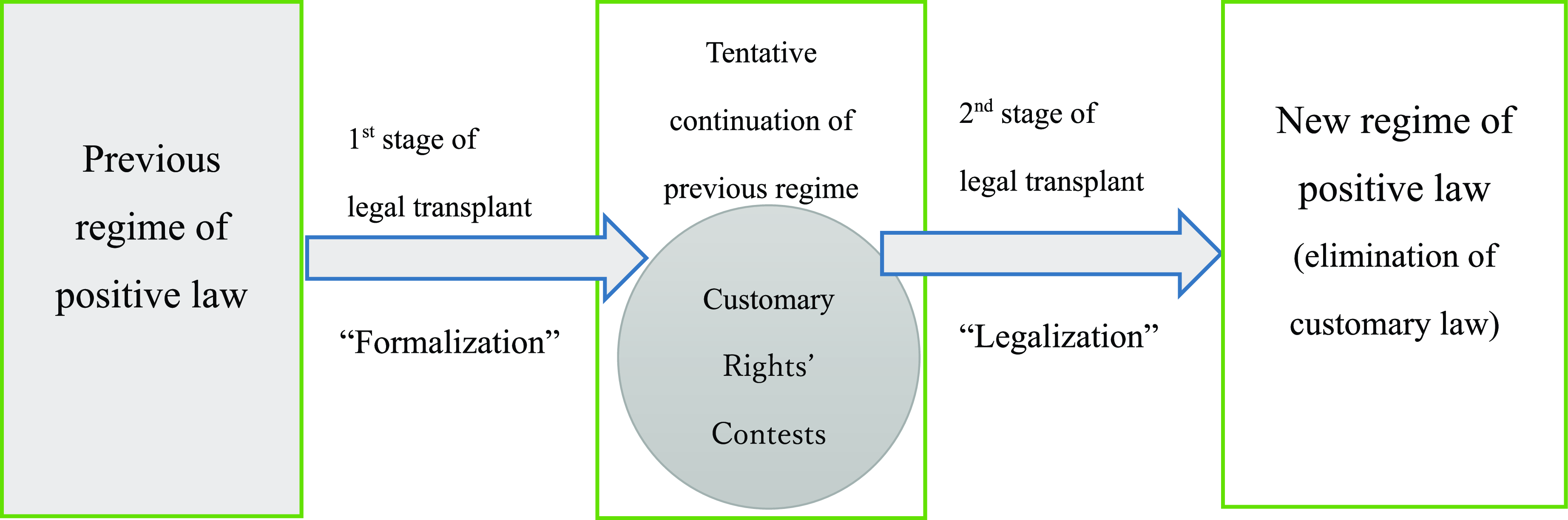
Today, the donors’ “legal transplant” has increased the peril of “internal colonization of the lifeworld” as a result of the changing Positivität led by the external pressure of structural adjustment programmes which impede the chances of democratic communications in the recipient countries. It is noted that such donor-driven changes to the regime of positive law often take a two-step process, as described in Figure 1: first, by imposing the land/forestry law reforms meant for the “formalization” of “customary rights” which have actually been a part of the positive law that accepts legal pluralism but are now targeted for gradual elimination; and second, through the “legalization” of thus formalized customary rights, destined to be incorporated into the new regime of positive law that aims at legal integration, or otherwise to be eliminated. “Legal transplant” is, in short, a project of incremental elimination of the former regime of pluralist positive law, where the label of “customary law” is a marking given to the rights targeted for elimination through the incremental process from “formalization” to “legalization.”
“Legal Transplant” as a two-step shift of positive law. Source: Compilation by the author.
But we lawyers know the free law theory contended by Eugen Ehrlich, who lived in the same era as Weber but paid more attention to the might of the living law in the lifeworld.Footnote 12 He himself was involved in a mission of “legal transplant” at that time, to transplant the modern Civil Code to the rural areas of the European continent. But what Ehrlich observed was the stubbornness of Ukrainian people who never stopped asserting what they considered the law to be, and the flexibility of judges who never hesitated to accept such local law as the basis of dispute resolution. We, the authors of this special issue, also hold a common interest in the living law that the people choose through their communications to settle their problems, and the way the decision-makers locate such living law within the regime of positive law. Such grassroots communications may bring about a change to the regime of positive law, against the fate of “internal colonization of the lifeworld” by donors’ legal transplants excluding democratic deliberations.
2.4. Historical axis of customary rights: Confrontation to colonialism/globalism
Many societies in Asia and Africa have fought against “the colonization of the lifeworld” twice in their modern history; first, through the democratic efforts for post-independence law reform that aimed at overcoming the exploitative apparatus of colonial law, and second, by the contemporary challenge from the grassroots against the “legal transplant” in the era of globalization. The spheres of land law and forestry law are the typical target areas, as confirmed by a quick historical review.
In Indonesia, the post-independence legislation on land was an attempt to get rid of the Dutch colonial regime, where the treatment of the customary law (Adatrecht) was at stake. The same debate had already taken place during the colonial era, when the question of whether the 1838 Civil Code of the Netherlands should equally be applied to the indigenous people in the colonies. In this debate, Cornelis Van Vollenhoven, a renowned promoter of Adatrecht, boldly predicted that the plurality of Adatrecht would forever remain separate from the formal law (van Vollenhoven, Reference van Vollenhoven1931, p. 405), but the forefront of the judicial practice started to eagerly call for the codification of customary laws, and their ultimate integration into the Western law as a result of socio-economic evolution.Footnote 13 The 1854 constitution (Regeringstreglement), after a long debate, explicitly supported legal pluralism by recognizing the application of indigenous people’s law, institutions, and customs at the indigenous courts within the principle of fairness and justice. However, the 1870 Agrarian Law declared nationwide land nationalization (domein verklaring), which meant a unified application of formal land law to the entire territory of the nation. Though Van Vollenhoven expected that this declaration meant the state’s caretaking for the protection of Adatrecht, the historical fact was the opposite;Footnote 14 it triggered land exploitation for capitalist gain through ownership (eigendom) or long-term leaseholds (erfpacht).Footnote 15 If put cynically, the role played by these pro-Adatrecht scholars was to help the incremental penetration of colonial law deep into the colonies, by diluting the inherently formal nature of many of the existing local land regimes under the nostalgic, pre-modern label of Adatrecht.Footnote 16
Similarly in Burma, historian John S. Furnivall was critical of the British initial attempt at the codification of Burmese customary laws for the use in court by A. D. Maingy, the first British commissioner of Tenasserim (1825–1833), as it lacked the understanding of the diversity and the flexibility of local customary regime (Furnivall, Reference Furnivall1948, pp. 30–1). Even though the Burmese law had a codified order that included the Dhammathat as a collation of basic civil and criminal rules, the Yazathat containing the king’s administrative regulations, and the Hpyathton as a collation of judicial decisions, as well as judgment commentaries such as the Mahayazathat, they together constituted a reference for dispute resolution under the traditional mediation culture, in which the central roles are played by the disputing parties through the presentation of arguments in front of the public (Okudaira, Reference Okudaira and Hooker1986, pp. 30–5). Lacking the knowledge of this adversarial legal culture, the British rulers were quick to lose respect for the flexible local law, until Judicial Commissioner Sir John Jardine resorted to the comprehensive introduction of the Indian Code to Burma in 1872.Footnote 17 Art. 13 of the 1898 Burma Laws Act went on to declare the exclusion of Burmese local law except for the ethnic and religious customs in the spheres of family and succession (Furnivall, Reference Furnivall1948, p. 31). He explained the British effect on Burmese law as “For Burmese custom Mr. Maingy substituted the rule of law,” but such an expression already represents the typical view that sees the Burmese law as a mere “custom” instead of the “law.”
Given the fact that the most renowned supporters, such as Van Vollenhoven and Furnivall, held a discriminative view of the local law as a “custom,” it was only natural that the colonial reign took over the existing regime of positive law. However, what was thus labelled as a “custom” remained as the “law” in the mind of people. Despite the superficial change of the written regime of Positivität, the label of “custom” sometimes functioned as a cover for the continuing former positive law to survive. Post-colonial independence reforms in the spheres of land and forestry laws were often a project for the revival of the pre-colonial formal regime which survived the colonial period under the cover of “custom” (Kaneko, Reference Kaneko, Kaneko, Kadomatsu and Tamanaha2021, Kaneko and Lin, Reference Kaneko, Lin, Kaneko, Kadomatsu and Tamanaha2021).
To this, the contemporary “legal transplant” led by the international donors again brings in similar colonial legal apparatus such as the mid-19th century’s Torrens land titling system, which eliminates untitled claims that impede land transactions to promote growth (Bruce et al., Reference Bruce, Geovarelli, Leonard, Bledsoe and Mitchell2006). The recent donors’ model of the registration of customary land use is, as aforementioned, a temporary measure of “formalization” which incrementally eliminates the existing claims (Deininger, Reference Deininger2003).
Such a quick chronological sketch gives us an image of the historical cycle of the legal battle fought between the inherent value held in many Asian and African societies that aims at the stability of lives and livelihoods, and the modern value that requires individualized property rights dedicated to liberal transactions for growth. Then, from now on, in which direction will this battle head towards? Perhaps we may envision two directions: one of transnational rulemaking to increase the binding effect,Footnote 18 or the other of grassroots efforts at dispute resolution as a route of direct democracy until the status of Positivität is regained. This special issue intends to explore the possibility of the latter route, through the observation of norms and procedures of grassroots dispute resolution in the target Asian and African societies.
3. Methodological framework: Ascertaining the factors of normative contests
As a method for the case studies observing the determinants of normative contests through grassroots dispute resolution, the authors in this special issue start with understanding the characteristics of the norms asserted by the disputants, and then, identifying the status of such claims labelled as a “customary right” within the regime of positive law of the target jurisdiction, and further, investigating the substantive and procedural criteria applied by the mediators in realizing dispute resolution, or in other words, the “legal postulate” guiding a normative compromise acceptable for his forum as well as the disputing parties to fill the gaps between state law and customary law, which may be a key to help a successful legal modification from the bottom up. While each author in this special issue gives somewhat different weight to them, the basic points to be investigated include, among others, the following.
First, to comprehend the substantive nature of the asserted claims, we will pay attention to the degree of strength of the asserting party’s belief that such a claim is the “law,” rather than mere “custom” or “culture.” We also need to know the historical origin of such a claim. We will then investigate the detailed substance of the claim, in terms of the bundle of rights and obligations involved in the claim, the object of the claim or the scope of the target property if the claim is asserted as a property right, the scope of the subjects who can claim such rights, and the burdens or obligations required to be met as the conditions for the enjoyment of such rights.
Second, we will conduct a historical review of the positive law of the target jurisdiction, with reference to the changing status of the present claim as a customary right. Such a claim of customary rights in the present day might have been a formal right under the former regime of positive law in a certain period of legal history. Particularly, the spheres of land law and forestry law in Asia and Africa have experienced drastic changes. A comparative historical review may identify the similarities as well as the variations across the jurisdictions.
Third, we will articulate the modes of normative compromise sought at the dispute resolution forums to sustain a claim based on “customary law” within the regime of positive law. Brian Z. Tamanaha describes the advantage of the “socially embedded” structure of the unofficial local tribunals whose conclusion is often arrived at through open debates and discussions over the facts and the appropriate norms, under the social pressure to settle (Tamanaha, Reference Tamanaha2021, p. 71). This description of the vivid, democratic, and creative process of social communication in local fora is, however, only successful for the types of issues which “manage the everyday lives and social intercourse within their communities” in Tamanaha’s thought (Tamanaha, Reference Tamanaha2021, p. 96). But the authors in this special issue hold an assumption that such “socially embedded” forums for dispute resolution can work as a basis of communication in the sense of Habermas through the joint efforts for the settlement of normative conflicts, by linking to the state’s formal forums through the appeal system, backed by a broader range of society, probably through mass media and social networking services. It is worthwhile, therefore, to pay attention to the interactive process between the parties, mediators, community members, and the amicus from outside society, in choosing the appropriate norms in particular dispute cases.
Legal anthropologist Masaji Chiba, in his proposal of a field of “comprehensive comparative law,” articulated the method of identifying the “legal postulate” or a comprehensive normative base that works behind the scenes of successful dispute resolution in each society (Chiba, Reference Chiba and Masaji Chiba1986, p.78). When a decision-maker in the “socially embedded” forum seeks a conclusion that can better satisfy not only the disputing parties but also a larger society, he cannot avoid basing his reasoning on a common, and usually implicitly held principle of justice in the society. In a case involving the conflict of norms between the formal state law and the community’s justice, he needs to establish his reasons based on a higher level of “legal postulate” that sublates the gap between them in a Hegelian manner. By looking at such hard efforts of sublation through the interactive communications between the mediator and parties in front of local society, we will be able to find a key to an exit out of the paralysis of modern law.
4. Customary rights in struggle: A comparative view of post-disaster recovery
For observing the contests of customary rights within the regime of positive law, post-disaster recovery offers us a rare opportunity since it is a phase with high complicacy where all categories of rights and interests of the disaster-affected people are asserted simultaneously in the struggle for reconstruction, and such assertions are often made against government-led reconstruction projects prioritized by state law (Fitzpatrick and Compton, Reference Fitzpatrick and Compton2021). In the following, to briefly demonstrate the method of this special issue, the author intends to approach cases in four countries that involve similar evictions under governmental pressure, namely, the traditional villages (gampongs) in Aceh Province, Indonesia, in the post-2004 Indian Ocean Tsunami recovery; Moken villages in Phuket and Phang Nga provinces in Thailand that were affected by the same 2004 Tsunami; basic autonomous units barangays in Leyte and Basay islands of the Philippines after the 2013 Typhoon Yolanda; and the fishery communities in East Japan after the 2011 East Japan Earthquake and Tsunami.
4.1. Tsunami-affected villages in Aceh, Indonesia: Constitutional question tested at the grassroots
4.1.1 . Claims of customary rights
The Indian Ocean Tsunami occurred on 26 December 2004 and took the lives of more than 100,000 citizens of Banda Aceh, the capital city of Aceh special province in Indonesia. The author has conducted joint research with scholars at Siah Kuala University in Banda Aceh, covering several target villages equally seriously affected by the tsunami but chose different ways in response to the government-proposed relocation: namely, Lambada Lhok village in Baitsussakam district, which chose to implement the land titling project known as “RALAS” supported by the international donors’ association headed by the World Bank for reconstruction on the original coastal land; Cadek village in Baitsussakam district, which refused the RALAS land titling project and instead realized reconstruction on the original coastal land through the village’s own effort; Desa Dea Gulumpan village in Ulee Lheu ward, which refused the RALAS project and reconstructed the village on the original land through the village’s own efforts, but accepted the construction of a tsunami evacuation tower supported by Japanese aid; Lambung village in Ulee Lheu ward, which implemented a land readjustment project through Japanese aid instead of the RALAS project; Neuheun village, which was formed by a merger of seven coastal villages that chose the relocation to higher ground in several kilometres’ distance from the city centre; and Dayah Mamplam village in Leupueng district, which relocated to higher ground through the village’s own effort (Kaneko, Reference Kaneko2014; Kaneko et al., Reference Kaneko, Alvisyahrin, Husin, Wang and Florano2023; Husin and Alvisyahrin, Reference Husin, Alvisyahrin, Kaneko, Matsuoka and Toyoda2016; Alvisyahrin et al., Reference Alvisyahrin, Husin, Oktabina, Sunarty, Kaneko, Alvisyahrin, Husin, Wang and Florano2023). A concern of the author’s group was the fact that half of the communities which had refused the government-proposed relocation but decided to reconstruct on their original grounds along the seashore refused to implement the international donors’ RALAS programme for land titling. The target village leaders provided similar answers that the reason for refusal was their fear that the RALAS would harm the traditional land order of each village. Some of them even showed a strong hatred towards the land title registration system as a legal trap which could capture the whole of their lives and livelihoods under the control of formal legal system dominated by capitalism. All interviewed village leaders echoed that they definitely choose the Sharia court as the means of dispute resolution, instead of the normal courts, especially because of the Sharia court’s active and flexible functioning since the tsunami to endorse the outcomes of customary village mediations, which was later institutionalized by the special appeal system under the local ordinances (Qanun) No. 9 and No. 10 in 2008 (Fitzpatrick, Reference Fitzpatrick2017). Also, in the author’s interview with the judges at the Sharia court, it was confirmed that the judges made it a principle to accept any of the diverse local customary laws adat in Aceh if all parties to the dispute willingly came under it, since it is a principle explicitly established under the Quran.
Such findings in Banda Aceh reminded us of the preceding work of the legal anthropologists Franz and Keebet von Benda-Beckmann on the matrilineal legal culture of Minangkabau in West Sumatra Island, which paid attention to the forum-shopping behaviour of the people in settling disputes according to the mutually agreed choice of norm between the disputing parties, as a wisdom of the people living in a society of legal pluralism to handle the conflicts (von Benda-Beckmann, Reference von Benda-Beckmann1979). Indeed, we saw the villagers in post-tsunami Aceh wisely selecting the forum for dispute resolution in order to apply the norm of their own choice.
However, this peaceful legal culture of forum choice for dispute resolution fails to apply once a conflict goes beyond a chosen norm, especially when one of the parties starts to assert the formal law. The author’s team has met such critical cases, often involving the issues of forest land as well as agricultural land. In the case of Village D (anonymous), for example, the whole village had chosen relocation from the area inundated by the tsunami to nearby high ground which the villagers had a strong belief they were entitled to as the village’s common land, where village leaders had managed the cultivation of cash crops such as clove, but they were met with a claim by a party who asserted registered ownership of the same land. If this assertion of ownership prevailed, it would invite the excessively cruel outcome of forcing the whole village’s households to be evicted again after all their efforts at resettlement and recovery from the great loss caused by the tsunami. The confrontation between the parties appeared to be at a critical point when the author’s team first visited there in 2014, with both sides barely holding back from violence. The legal position of Village D was weak, however, due to the unregistered holding of village common land having limited legal status recognized by the formal law, namely the 1960 Basic Agrarian Law of Indonesia, as discussed in the next section. Therefore, Village D had chosen to raise the case to the Ombudsman’s Office for a political solution, after learning that Sharia court lacks jurisdiction over the formal law’s issues, instead of choosing the normal court which would only apply the formal law in a literal manner to affirm the claim of registered ownership.
4.1.2. Normative gap between the formal law and adat
The 1960 Basic Agrarian Law is the fundamental law in the sphere of land law in Indonesia, and its preamble declares the ideal of an agriculture-based society based on adat, i.e. customary law, by establishing a sui generis land order to replace the former 1870 land regime from the Dutch rule as well as the property law section of the Civil Code. But it should be noted that this new land order maintained the principle of numerus clausus (art. 4) which represents the modern legal policy of European continental civil law that limits the list of property rights to minimize the existing rights and interests that impede the absolute nature of ownership. It also succeeded the colonial land registration system as a compulsory condition for the transfer of land (art. 23, etc.) as well as a means of public notice (art. 19). On the other hand, the Law allocates only a single provision to the protection of customary community rights (hak ulayat) according to the national interest and within the limit of national law (art. 3), and subject to state control for the interest of the nation’s entire population (arts. 1, 2).
Thus, the 1960 Basic Agrarian Law is centred upon individualized property rights that reflect modern values, while placing the rights stemming from adat under state control. Namely, the Law upholds hak milik, which is equivalent to ownership, as the supreme right (art. 20), and is transferable subject to registration (art. 23). Though absentee land ownership is restricted (art. 24), short-term leases have been recognized naturally in the actual implementation of the Law. Other major categories of property rights, such as the right to cultivate on state land (hak guna bangunan) and the right to construct on state land (hak guna usaha), require registration as a compulsory condition, and are transferable following registration (arts. 32, 38). Even the hak pakai, a land use right available for foreign entities, can be the subject of transfer if the contract allows it (art. 43). On the other hand, the remainder of the listed property rights are a series of individualized customary rights, seemingly separated from the original order of common use in customary communities, such as a forest clearing right (hak membuka tanah), forest product collection right (hak memungut hasil hutan), and water access and fishing rights (hak guna air), but all of them are subject to governmental regulations (arts. 46, 47).
This subordinated status of adat-based rights under the 1960 Basic Agrarian Law invited exploitation by the state during Suharto’s authoritarian regime in the name of the public interest (kemakmuran rakyat) as provided in the Constitution (art. 33, sec. 1), and therefore, the post-Suharto era saw a nationwide movement calling for the recovery of unfairly taken land and forests.Footnote 19 The Constitutional amendments introduced between 1999 and 2001 realized the inclusion of new provisions on the protection of adat and customary communities (art. 18B, sec. 2 and art. 28I, sec. 3) in response to the people’s demands, but they lack clear definitions. Accordingly, further efforts are awaited for the accumulation of constitutional interpretations that will materialize the protection of customary rights, especially on the question of the substantive nature of hak ulayat; whether it is a property right with an element of exclusive right, or merely a right granted at the discretion of the state to enter state land to collect products from it.
4.1.3. Normative compromise sought at the constitutional court
The question of the legal nature of hak ulayat has been repeatedly tested in numerous legal disputes, but the normal courts seem to have evaded from rendering a conclusive answer to the question. The Supreme Court judgment rendered in 2006 in the Tanjung Mulia case was, for example, a disappointment by dodging the issue in that the plaintiff villagers’ claim to their customary community land was as a matter of contractual interpretation of the land lease agreement between the local sultan and a Dutch investor during the colonial era, on the assumption that the status under the contract was succeeded by the state.
An activist approach was taken, on the other hand, by the Constitutional Court judgment in the case of community-owned forests (Number 35/PUU-X/2012), which was rendered in 2013 and addressed the constitutionality of the 1999 amendment to the 1967 Forestry Law that introduced the binary categorization of forests, namely state forests and private forests, without establishing community-owned forests (hutan adat) as a third category. Instead, it merely classified hutan adat as a sub-category of state forests (art. 1, sec. 6), and required a series of strict preconditions for the formal recognition of an “adat community” to be eligible for the status of hutan adat management (art. 4, sec. 3, art. 9). Such preconditions for the registration of an adat community included the proof of actual continuation of such an adat-based community, public notice of its presence, and its meeting with the national interest, which could function as criteria for denial, instead of recognition, of customary communities. The plaintiffs, including the nationwide network of indigenous people AMAN and local groups from Riau Province in Sumatra as well as Bandung, raised the question of the constitutionality of the relevant clauses of the Forestry Law, to which the Constitutional Court found that the categorization of hutan adat as a sub-category of state forest (art. 1, sec. 6) was unconstitutional, while sustaining the provision for the registration of an adat community (art. 4, sec. 3) by narrowing the interpretation of its preconditions to be implemented within the spirit of the fundamental principles of the Constitution’s Preamble.Footnote 20
Following the series of amendments to the relevant ministerial regulations which practically changed the implementation of the Forestry Law, hutan adat is currently deemed as an independent area exclusively protected from state intervention, where the adat community can exercise their hak ulayat as a strong right.Footnote 21 But the system of adat community registration is still required for any local communities to be eligible for such enjoyment of hak ulayat in their ancestral forests.Footnote 22
We cannot conclude easily whether the compromise in the constitutional interpretation applied by the Constitutional Court, which sustained the registration system of “adat community” at the sacrifice of the categorization of “adat forests” was a “legal postulate” for a normative modification. Perhaps this judgment did not affect the substance of governmental forestry development policy, but rather has confirmed the narrowness of the likelihood of a hak ulayat lawfully functioning without registration.
This assumption seemed to be applicable even in the aforementioned case of Village D when the author’s team visited there one year after the Constitutional Court’s judgment. While the villagers’ assertion of village-owned land is understood in the context of a hak ulayat, the villagers’ status seemed to be lacking a clear basis under the formal law due to the lack of registration as an “adat community,” and hence it was their choice to resort to the Ombudsman in their search for a justifiable resolution beyond the settings of formal law. Interestingly, a few years later, the author’s team learned that the case of Village D came to a solution through an amicable mediation, in response to a suggestion given by the Aceh Ombudsman.Footnote 23
4.2. Tsunami-affected Moken villagers in Thailand: Contest under legal positivism
4.2.1. Indigenous people’s claim against post-disaster eviction
The Moken, an indigenous group of people who speak the Moken language and are known for their hunter-gatherer lifestyle around the coastal areas of Phuket and Phang Nga provinces of southern Thailand, also faced the same serious destruction as Banda Aceh by the Indian Ocean Tsunami on 26 December 2004. But they had to face a fate that was even more severe in the stage of post-tsunami restoration of their lives, since Thai government was quick to apply a series of formal laws, including a decree to ban reconstruction activities in tsunami-inundated areas based on the 1992 Environmental Protection Law (art. 9, arts. 43–45) as well as the 2004 Land Readjustment Law,Footnote 24 in order to utilize this disaster as an opportunity to evict Moken people from areas where the government envisages development projects, mostly for tourism.
Though the Moken villages raised complaints against the eviction, the provincial governors simply dismissed them as lacking legal grounds. Indeed, most of the Moken people lacked formal registration of their citizenship, let alone ownership under Thai law, even though they could show factual evidence of long-term, continued, exclusive use of coastal land areas, including ancestral graveyards as proof of continuous existence of Moken villages stemming back many centuries. Asked about the legal nature of such long-term use, in the author’s interview survey conducted in August, 2013 in several tsunami-affected Moken villages, including Tung Wa village and Tubtawan village in Phang Nga Province, and Laem Tuk Kae village on Koh Sirey Island in Phuket Province,Footnote 25 all interviewed villagers expressed a similar view that they did not claim any “right” equivalent to ownership, but instead they only ask for recognition of their status to make a humble living in limited areas of the coastal land, which has been continued for generations.
Despite this similar view on the humble nature of their claims, there were differences among the strategies taken by these Moken villages in seeking the restoration of their traditional lands and livelihoods. The village chief of Tung Wa in Phang Nga Province enthusiastically explained how the village achieved triumph through a movement against the local administration by physically restoring occupation of their village land at the end of a protest march backed by the foreign mass media. But the author’s team observed many scenes of neighbouring Moken villages being put under physical pressure from the government to force their eviction, such as several graveyards being set fire to by the military and the police, which indicates the extreme rareness of success in the style of Tung Wa village in physically restoring occupation of their land. Tubtawan village in Phang Nga Province, on the other hand, obtained triumph through judicial mediation following litigation at the formal judicial court, to fight against an eviction order initiated by a land developer who had obtained a grant from the government. This legal triumph of Tubtawan village was also an extremely rare case only made possible by the constant pro bono legal assistance extended by attorneys in Bangkok.
4.2.2. Positive law that negates customary rights
Indeed, the positive law in Thailand allows very limited scope for the Moken villages to survive since it has been designed for the denial of customary rights of indigenous people. The occupants of any land parcel lacking ownership registration are deemed as trespassers under the formal property regime, as repeatedly confirmed by the precedents of the Supreme Court, while attempts to establish a collective right of communities under the concept of “community rights” in the sphere of constitutional law has failed due to the repeated failure to pass draft bills that would materialize such a concept.
The formal regime of land in Thailand consists of the property law section under the 1934 Civil & Commercial Code as the fundamental basis in the civil sphere, which centres on a compulsory land registration system (art. 1299) that secures the absolute nature of registered ownership by negating any unregistered rights and interests, and the 1954 Land Law as subsequently amended, which provides for the procedural method of land title registration according to the Torrens system. As the Civil & Commercial Code treats unregistered land as wasteland, which is automatically categorized as state-owned land (art. 1304), and prohibits the acquisitive prescription of such state-owned land (art. 1306), the consequence is that any ancestral lands of Moken villages are treated as state-owned land, if not the subject of land title registration.
Such an exploitive design in the formal law in Thailand has resulted in the denial of traditional customary order that existed in pre-modern Thailand, including the traditional right of occupation over land cleared by one’s own labour (chapchorn, จับจอง) which ultimately matures through acquisitive prescription to a permanent right of ownership (garmasit, กรรมสทธ).Footnote 26 In the process of forming the modern law in Thailand, many chapchorn or garmasit were not recognized as modern ownership and subject to the nationalization of wasteland.Footnote 27 In every political contest where the peasants have protested against lawful land-grabbing under the formal law, the Thai military has repeatedly responded with a coup. In this context, the 1954 Land Law has functioned as a means of appealing a land redistribution policy to appease the peasants, but the Law incorporates particular designs which make fundamental progress in land redistribution difficult, such as a short time limit for submitting an application for land redistribution without a title certificate. Rather, the Law has functioned as a means for offering the grant of wasteland management over unregistered land areas, involving the eviction of unregistered parties (art. 9), instead of a means of land redistribution. This is despite the involvement of the World Bank in the facilitation of land titling under the same Law, which has received high praise (Rattanabirabongse et al., Reference Rattanabirabongse, Eddington, Burns and Nettle1998), but still sees 40% of the eligible land area remaining unregistered.
Given the difficulty in asserting traditional individual rights under the current formal law, there has been an attempt at “community land titling” or the assertion of collective rights to common property as a new mode of human rights under the constitutional debates.Footnote 28 Under the 1997 Constitution of Thailand which was drafted in the democratic environment that followed the 1992 coup, “community rights” were newly provided for in article 46, in response to the call for community land titling, as well as the movement for community social welfare in urban slums, but the draft bill to materialize the substance of such rights was delayed. Then, after the 2006 coup, the 2007 Constitution (arts. 66, 67) again provided for “community rights,” but among the three bills to materialize the concept (namely a bill on community land use rights over state-owned forests, a bill on the management and promotion of coastal communities, and a bill on fisheries), only the bill on community land use rights over state-owned forests went through the legislative procedure, yet its promulgation was suspended due to a judgment rendered by the Constitutional Tribunal which ruled the legislation unconstitutional. Then, after the 2014 coup, the current 2017 Constitution (arts. 41–43) again provided for “community rights,” but newly incorporated a limitation clause based on the considerations of public welfare and the public order and good morals (art. 42), the details of which are delegated to the legislature (art. 43, sec. 2). In 2019, the Law on Community Forestry came onto the scene, but its substance is a system for forest management rights within forests designated as a “community forest” (ป่าชุมชน), instead of the recognition of communal property rights.Footnote 29
There is criticism that the limitation of the substantial effect of “community rights” under the Thai Constitutions is already evident in Thai translation of the term “community”; while the previous draft constitutions used the original Thai word mu-barn (หมู่บ้าน, which literally means a group of households) and the word chompen-muan (ชนพื้นเมือง, which corresponds to “indigenous people”) to corresponding to community,Footnote 30 the current 2017 Constitution instead adopts the term chum-chon (ชุมชน), which literally means “gathered people” lacking the element of traditional bonding, and started to appear under the 1994 Tambon Autonomy Law that established a new level of local autonomous bodies Tambon (ตําบล) for the purpose of weakening the social protests of the traditional local communities (Kawamori, Reference Kawamori2013).
Thus, the current positive law in Thailand seems to have limited room for the recognition of the Moken villagers’ claims for the restoration of their lives and livelihoods on coastal lands. Lacking registered ownership under the Civil Code, their land comes under state ownership and is granted to developers as “wasteland” management. Nor can the constitutional provision on “community rights” offer meaningful remedies due to the scarcity of its substance. Even if the failed bill on coastal communities’ management had been materialized into legislation, the structure of such a bill was no different from the system for selective registration of communities, which may result in the negation of the majority of existing communities similar to the outcomes of the aforementioned 2019 Community Forest Act,Footnote 31 which is deficient as a legal basis for the Moken villagers to claim the exclusive use of their ancestral lands.
4.2.3. Legal postulate outside the “law” in dispute resolution
Due to the lack of recognition under the positive law, and the legal positivism at the Thai courts, the question is whether there remains any hope for the Moken villagers to resort to legal dispute resolution in search of a normative challenge.
In the author’s interviews back in 2013 with the leaders of aforementioned Tubtawan village in Phang Nga Province, even though the case was reported as a legal triumph for the village, the mood of the village leaders looked far from triumphant. The case was fought against a commercial developer who had obtained a government grant for wasteland management, and Tubtawan village achieved a triumph in that a half of their original lands were formally restored and the villagers’ ownership thereon was formally secured (with a third-class land title certificate). Despite this achievement, all of the interviewed villagers lamented over the loss of half of their ancestral land without an identifiable reason. According to them, this was a 50–50 compromise that resulted from court-annexed mediation, which was conducted during the initial litigation as a means for the presiding judge to avoid delivering a clear judgment with legal reasoning.
In the author’s interviews in Laem Tuk Kae village on Koh Sirey Island of Phuket Province, on the other hand, the villagers were facing the same type of litigation as Tubtawan village, commenced by a land developer who had received a government grant. Faced with litigation that sought an eviction order against all of the villagers, a senior villager expressed an impressive view to the author that the village should cautiously stay away from the formal judicial procedure, because it would only bring them into the trap of the formal legal system, which is already firmly designed for the denial of the Moken’s way of life. His rejection of the formal procedure seemed to be backed by an accurate knowledge of the formal law, including the thin substance of the draft bills then being debated on the concept of “community rights” provided by the 2007 Constitution of Thailand.
These two villages give us a meaningful contrast in choosing a different “legal postulate” in dealing with the positive law that negates their legal customs. Similarly affected by the Indian Ocean Tsunami, and similarly facing litigation commenced by commercial developers utilizing the law as a weapon, Tubtawan village chose to engage in the formal legal procedure, while the Koh Sirey villagers dared to stay away from the legal procedure.
As for the consequences, the Tubtawan villagers ended up losing half of their ancestral land, but what made them disappointed was not this loss itself, but their failure to have their assertion of a collective right to community land heard. They obtained half of the original land as individual ownership under the normal law, but failed to win in their claim for a “community right.” As for the consequences for the Koh Sirey villagers, on the other hand, after nearly ten years after the author’s interview during the critical time of the legal contest against eviction, although there has been a degree of population drain, the villagers are presently maintaining their traditional way of living; sleeping in a humble hut, catching no more than a bag of fish caught in a hand-made trap, and selling the small catch at local markets to buy minimum daily needs. They successfully resisted the legal pressure of eviction through a wise compromise of accepting the status as a spot for eco-tourism. Obviously, they have won this compromise outside of the law. Because they have the knowledge of the positive law to the extent of thoroughly understanding its substance that completely negates the customary way of living, they dared to seek a “legal postulate” to stay away from such law, which brought a triumph for the Koh Sirey villagers.
4.3. Typhoon Yolanda in the Philippines: Customary groups under local autonomy law
4.3.1. Customary rights of the “Squatters”
Typhoon Yolanda which hit the central islands in the Philippines on 8 November 2013, involved a storm surge several metres high that reached one kilometre inland, and took more than 6,000 victims’ lives. The Philippines had enacted the 2010 Disaster Risk Reduction and Management Act, which is known for a bottom-up institutional mechanism for disaster response based on the barangay, the local unit that was initiated by President Marcos in the 1970s, but has developed into the basic unit of local autonomy under the 1991 Local Government Code. Its post-disaster recovery phase was, however, led by the top-down initiative known as the “Post-Disaster Needs Assessment” (PDNA) under the guidance of international donors such as the World Bank and the Asian Development Bank, where the level of barangays was excluded from political negotiation between the national and municipal governments for recovery planning.Footnote 32 Meaningful consultation with the barangay level was rare in the process of PDNA, except for occasional progress reports by the city to barangay chiefs. Such donor-driven, top-down disaster recovery planning was destined to isolate the interests of disaster victims.
A symbol of such top-down disaster recovery was the national order that banned reconstruction activities within the range of 40 metres from the coastline, which meant the mandatory eviction of those who used to have their houses and livelihoods on the seaside land.Footnote 33 It was obviously nonsense to set the construction ban at the 40-metre line, according to all interviewed barangay leaders, as the inundation by the storm surge reached one kilometre inland. They all shared a similar view that the genuine nature of the ban was land taking for urban redevelopment. Rather, their opinions were divided on the point of whether alternative residential land should be provided as compensation to the evacuees within the target 40-metre area. Since most of those who used to reside in such seashore areas were “squatters” in the sense that they lacked the land title for such land, the criticism was heard that they were not eligible for legal compensation, and if they were to be subsidized as disaster victims, such a subsidy should be provided equally to all victims regardless of the 40-metre line.Footnote 34
To identify the legal issues involved in this debate on the reconstruction ban, the author’s team conducted an interview survey in March 2014, four months after Typhoon Yolanda, with the barangay leaders of Barangay 60A and Barangay 90 in Tacloban city, the capital of Leyte Province, Barangay San Rogue in Tanauan city on Leyte Island, and Barangay Palaypay in Basay city on Samar Island. One of the findings from the interviews was the differences in the legal status of those who were generally referred to as “squatters.” Barangay 60A in Tacloban city, for example, is a naturally formed community of migrants who drifted to the area by boat and started to settle around the fish market to make a living by selling fish. Most of the residents have less than a few decades of history of residence, and were aware that their area has been targeted for an urban redevelopment project under the city’s general development plan. Barangay Palaypay in Basay city, located just in front of Barangay 60A of Tacloban city across the San Juanico Strait, is a historical fishery community stemming back hundreds of years, according to the barangay leaders, who were obviously unsatisfied to be treated similarly to the squatters merely because they lacked formal certificates of land ownership. Although the leaders of both Barangay 60A and Barangay Palaypay harshly criticized the abruptly declared construction ban along the seashore, there seemed to be a slight degree of difference in the strength of their protests; in Barangay 60A, while a leader of the youth council was decisive in his will to protest against government eviction, an elder leader of the temporary shelter management body commented his personal expectation to be supported by the government rescue plan for relocation to safer land, while all of the leaders of Barangay Palaypay were so determined to protest the eviction that they expected to see blood if the city enforced such an eviction. Such a difference in the degree of obsessive attachment to the land between communities that were both seriously affected by the same typhoon may imply a difference in the rights held by those people, even though they are similarly labelled as “squatters.”
4.3.2. Status of “Squatters” under the positive law
Indeed, there has not been enough argument to clarify the criteria for categorization as “squatters”; whether it is a matter of migrants who lack public status such as citizenship or residence, or whether it is a matter of possible trespassers who lack formal registration of land ownership. The barangay leaders contest against eviction looks similar to that of the Moken villagers in Thailand in the sense that they both lack formalization of their land rights, but there seems to be a more delicate difference in the nature of the asserted land rights. Further, even though all of their assertions of rights to land are destined to fail under the formal property regime, there is still room for barangay communities to assert their lawful status under public law as the basis to contest their eviction.
The land law regime of the Philippines is not much different from Thailand in its positivism centred on absolute ownership stemming back to the Regalian Doctrine during Spanish rule, which is succeeded in the current Constitution (art. 12, sec. 2) that recognizes ownership only by those who are explicitly granted ownership upon payment and formal registration of their land title. Even though land reforms have been repeated to mitigate land concentration,Footnote 35 pro-poor policy has featured the provision of social apartments instead of a fundamental redistribution of land title. Since judicial precedent has been maintained for the denial of acquisitive prescription of ownership, there is no room for claiming ownership by proving long-term occupation, no matter how many years long it has been. Hence, the residents of Barangay Palaypay have no chance to assert ownership of the land despite their continuous habitation and fishery livelihood for many generations, and therefore they are treated merely as “squatters.”
There is a chance, on the other hand, to assert their long history of continued fishery livelihoods in the context of collective rights, the same as the argument of “community rights” in Thailand, but the 1997 Indigenous Peoples’ Rights Act in the Philippines is facing an unresolved constitutional question.
Apart from the assertion of property rights, either individual or collective, there remains the status of the barangay that is firmly defined as the basic unit of local autonomy under the 1991 Local Government Code, having its own legal personality independent from the upper administration, vested with strong authority such as law-making and tax-collection powers, and backed by the democratic election of the leaders. Even when a municipal government moves to evict an individual migrant household, a barangay as an independent public body can stand for the protection of the entire regime of community’s autonomy, and may change the nature of the dispute from the property law context of “state land vs. trespasser lacking land title” to the public law context of “municipal development policy vs. barangay autonomy” to defend the lives and livelihoods of community members.
4.3.3. Collective approach in barangay dispute resolution
At present, ten years on from the typhoon, most of the affected barangay communities on Leyte and Basay islands have continued to live on their original seashore lands, resisting the pressure of evictions (Florano, Reference Florano, Kaneko, Alvisyahrin, Husin, Wang and Florano2023). In the author’s view, behind this high ratio of triumph despite their lack of formal title to the land, there is the tactic of barangay leaders to deal for collective compensation, instead of individualized compensation such as the provision of individual housing. What they emphasized in the author’s interview was the protection of the basis of their livelihoods; access to the fish market and the aggregated goodwill that has been generated there by all members of Barangay 60A, and access to the fishery area for all members of Barangay Palaypay. They also referred to the value of social capital that has been accumulated in each community for years, which would be in vain if the 40-metre ban is compulsorily implemented only to destroy the integrated social value to nothing.
This assertion of the integrated value of community life could make the calculation of the overall compensation much higher than the simple aggregation of compensation to individuals, making it ineligible for the government to proceed with an urban redevelopment project involving the eviction of “squatters.” The term “squatters” here is no longer a vulnerable category of people who lack the title to land, but a basis for an active claim for aggregated compensation for a community that functions as a public entity. This assertion of collectiveness seems to be a “legal postulate” that the wise barangay leaders base their claims under the public law, despite the property law negating their individual property rights.
4.4. Tsunami-affected communities in East Japan: Trapped in civil law–public law contest
4.4.1. Collective property rights (Iriaiken)
The East Japan Earthquake that occurred on 11 March 2011 caused a massive tsunami that reached 41 metres in height and killed more than 22,000 people. The post-disaster reconstruction phase saw a debate on the choice of safety measures to be applied to the 400-kilometre-long coastline along the Pacific Ocean side of East Japan. The author has visited the tsunami-affected areas several times since 2011 to investigate the outcomes of the contest between the local communities and the government-funded reconstruction projects which prioritized the construction of safety measures, such as 15 metres high seawalls and land-readjustment projects for land filling, which took several years until completion, and meanwhile suspended the reconstruction of housing and livelihoods of the disaster-affected people.
In the initial stage, there were plenty of counterproposals by the tsunami-affected communities who called for the relocation of their entire community to nearby higher ground, to realize absolute safety from future tsunamis, while saving a great deal of time and cost compared to the huge construction works proposed by the government. This wise proposal by the local people, which was possibly the best solution for concurrently achieving safety and speedy reconstruction at low cost, was, however, quickly rejected by the government on the grounds of difficulty in identifying the owners of many of the candidate areas of high ground that were proposed for relocation. According to the report by the Ministry of Land, Infrastructure and Transportation (hereinafter “MLIT”), the government’s reconstruction planning is facing tremendous difficulties in identifying the owners of land; in Iwate Prefecture, for example, approximately 9,000 parcels of candidate land lack identifiable owner in the land registry, with the implication that such land parcels involve the issue of customary communal land (iriaiken).Footnote 36
Iriaiken is a general term referring to collective rights over communal common land in forests, pastures and coastal areas, inherited from the pre-modern era but still existing nationwide in modern Japan.Footnote 37 Historians have proven that most of the demarcation of such communal land areas had been settled nationwide by the early 17th century through numerous legal disputes (yamaron) between neighbouring villages (known as yamakiri, or division of mountain areas), and the exclusive management of each area of communal land has been maintained by the respective community thereafter.
In fact, almost all of the coastal communities in East Japan which the author has visited for a survey have maintained iriaiken, even though the legal forms varied; some communities have kept their communal forest in the form of a property foundation (zaisanku) under the Local Autonomy Law, some in the name of a production forest association, some via co-ownership under the names of community leaders, and others simply maintain traditional practices without taking any particular process under the formal law. But one fact in common is that the daily lives and livelihoods of community members depend on the iriaiken; for example, fishery rights on shore have a link to iriaiken on land, and therefore, once a person leaves the village community, he is automatically deemed to have abandoned his fishery rights. This customary principle of automatic forfeiture of communal rights upon exit from the community has been confirmed by judicial precedents.Footnote 38 Therefore, for those who have maintained their livelihoods in coastal areas, it was crucial to achieve reconstruction within the bounds of their communal order.
Then, the question is why the Japanese government was so reluctant to accept the proposals of many tsunami-affected communities yearning for reconstruction within the bounds of their communal order. To answer this question, we need to review the changing positive law in Japan in tandem with the treatment of iriaiken.
4.4.2. Iriaiken under civil code vs. administrative law contest
The formal property regime under the current 1898 Civil Code of Japan has explicitly recognized the iriaiken as a part of the closed property list within the principle of numerus clausus; namely, those iriaiken which have a nature of co-ownership, to which the provisions on co-ownership are applicable together with local custom (art. 263), and those iriaiken which lack the nature of co-ownership, to which the provisions on usufruct are applicable together with local custom (art. 294). This explicit recognition was a result of the nationwide political movement in support of iriaiken during the 1890s, known as the “code debate” which ultimately resulted in the suspension of the implementation of Japan’s first Civil Code of 1890 that lacked recognition of iriaiken.
Despite this formal recognition by the fundamental code in the sphere of civil property law, however, the Japanese government has continued attempts to control and ultimately eliminate iriaiken through the introduction of a series of administrative laws, such as the 1966 Modernization of Iriai Forests Act. The policy stance of the MLIT’s refusal to utilize land areas involving iriaiken for the post-2011 tsunami reconstruction is understood in this context of the Japanese government’s continuously hostile attitude towards the pro-iriaiken civil property regime under the Civil Code.
One of the main focuses of the post-tsunami MLIT campaign on land without identifiable ownership was the “irregular registrations.” Indeed, there are numerous cases of irregular information appearing on the front page of land registration throughout Japan, which are a remnant from the efforts made by local communities to secure their iriaiken during the early Meiji modernization period. In 1974, the Meiji government abruptly introduced the binary demarcation of state-owned land and private-owned land for the land record system, resulted in the abolition of the “public ownership” category once envisaged as the basis for recording iriai land. This sudden policy triggered a nationwide boom of various attempts to secure iriaiken by a variety of expressions within the private-owned category; e.g., the so-called kimei-kyouyu-chi type involving one or several individuals’ names often followed by the term “others,” which implies joint ownership of the entire community members; the kyouyu-soudai-chi type with the name of a single person who is supposed to be the leader of the community appearing in the record; and the aza-mochi-chi type with the name of the old community appearing in the record. If the communities failed to secure their common land in any such form of private ownership, they were destined to be automatically categorized as state-owned land, and their right could merely be treated as a usufruct on such state-owned land. It was a Japanese version of domein verklaring or “wasteland management,” similar to those applied by the Western powers to Asian colonies in that period.
But, then, the 1890 Civil Code took the French principle of non-formalist land transfer based solely on the will, and refused to introduce a compulsory land registration system. Since then, both registered and non-registered iriaiken have lawfully existed nationwide until the present day. Lacking any need to secure iriaiken at the registry, a variety of expressions of iriaiken in the previous era’s land record have been left untouched, and automatically carried over to the new registration in the 1960s when the Japanese government attempted the integration of the former land record system into the real property registration.
The post-2011 tsunami campaign by the MLIT on the issue of land without identifiable ownership was, therefore, an attempt of the neo-liberal government to challenge the property regime under the Civil Code which explicitly recognizes iriaiken regardless of registration. The 2019 Law on Adjustment of Registration and Administration of Land for Which the Heading Section Owner is Unknown declares the ultimate goal of the facilitation of land use for economic development and enhancement of the people’s lives through the adjustment of irregularities in title registrations (art. 1), through an ex officio investigation of ownership (art. 3), and a judicial procedure which mandates a court-appointed administrator to manage the land, including its sale (art. 19). Such a procedure will enable developers to place iriai land on the open market without giving the local community a practical chance to intervene.
Thus, the iriaiken that have been recognized under the formal property regime in the sphere of civil law are now facing a critical time under the public law. This is a contest over the “Positivität” fought within the formal legal regime, between the fundamental civil law on one side and the public law manipulated in the Diet under the supermajority of the leading party.
4.4.3. Chances through restoring autonomy
This contest between the civil law and the public law is not a fight based on an equal footing; the former is being asserted by the groups of disaster-affected people under the worst situation in their lives, having lost their family members, housing and livelihoods, and dependent upon governmental support in temporary shelters for years, while the latter is implemented by the state authority responsible for handling the post-disaster recovery budget amounting to 30 trillion yen. In this extremely unbalanced setting, we may seldom find any chances of normative challenge.
The author has covered some successful cases of East Japan communities which realized the relocation of their entire community to accessible nearby locations,Footnote 39 but in fact, most of such cases failed in their attempt to let the government use their iriai land. In the case of the Akahama district in Otsuchi town, for example, the original area that the Akahama community proposed to the government for relocation was former iriai land, which was once separated into individual private shares during the 1920s, but the relevant owners confirmed their will to dedicate the target area for the sake of the entire community’s relocation plan. But the government refused to use such land on the grounds of the lack of identifiable ownership under the land registration. Instead, the relocation plan of Akahama was divided by the government into two separate areas, excluding the former iriai land areas. This was far from the ideal of integrated relocation that the Akahama residents yearned for.Footnote 40
Another example is the case of Kanehama district in Miyako city, targeted by the MLIT for the construction of experimental safety measure “double levees” that required a vast area of land to be sacrificed to form a tsunami pool for future tsunamis, which is expected to swallow tsunami water so as to protect inland industrial areas from the direct force of a tsunami. For this purpose, the government purchased the coastal iriai land at the lowest price possible as miscellaneous land, by obtaining the signature of each individual heir of the persons whose names appeared in the title section of the land registration that had been carried over from the old land record. It appeared to be a typical example of the kimei-kyouyu-chi type of registration made by the Kanehama ancestors to secure their iriai land during the era of demarcation of state and private ownership in the Meiji period. Therefore, the government should have obtained the consent of the present members of the Kanehama iriaiken, instead of the heirs of those who had already left the community, according to the established judicial precedent on the principle of the loss of iriaiken rights upon exit from the community. The government’s attitude to simply ignore this firmly established judicial precedent on iriaiken is a further evidence of the unbalanced contest between the disaster-affected people defending the existing “Positivität” under property law and the government trying to rewrite such “Positivität.”
Disaster-affected communities are hardly resistible to the government. They lack a meaningful forum for defence. The judicial process is out of reach, both in terms of physical distance and lack of professional support. Even the venue for mediation by the bar association under the 2004 Law on the Promotion of Alternative Dispute Resolution (ADR) is in the prefectural capital, a few hundred kilometres away.
Perhaps, the only meaningful legal defence of iriaiken in present Japan is preventive one, rather than seeking ex post facto legal remedies. In the author’s recent survey in the rural parts of Hyogo Prefecture on the social response to the implementation of the aforementioned 2019 Law, a new attitude was observed among the local communities to improve the legal status of their iriaiken under the administrative law, such as obtaining the mayor’s permission to establish a certified communal body (ninka-chien-dantai) under the Local Autonomy Law,Footnote 41 and secure the iriai land by the registration of ownership in the name of such a public body. It appears that the abrupt introduction of the 2019 Law has created a moment for certain communities to re-strengthen their autonomy, which is what historically used to characterize iriaiken as its inherent element.
5. Status and elements of customary rights in disasters
5.1. Policy contest: Changing status of customary rights
A common implication from the post-disaster experience in the four regions outlined above is the changing status of customary rights under the positive law, as a result of a policy contest.
Both Indonesia and Japan have placed the customary rights within the regime of property rights under the positive law: Indonesia’s Basic Agrarian Act (art. 3) recognizes hak ulayat, and Japan’s Civil Code (art. 263 and art. 294) recognizes iriaiken. Such recognition was the result of a radical challenge by the grassroots people against lawmakers in the period of fundamental legal reform; Indonesia’s colonial independence war that led to the ultimate repealing of colonial land law, and Japan’s “code debate” which was backed by nationwide protests against the old Civil Code that negated the iriaiken. But the challenge is continuing: Currently in Indonesia, there continues a movement to strengthen the legal nature of hak ulayat as an exclusive property right of community groups, as affirmed in the 2013 judgment of the Constitutional Court. In Japan, conversely, the iriaiken that have been secured by accumulated judicial precedents under the Civil Code are facing a contest from a series of administrative laws which provide procedural opportunities for the neo-liberal government to grant development rights over iriai land to third parties.
In Thailand and the Philippines, the sphere of property law under the fundamental civil code negates the customary rights; the compulsory land registration system automatically invalidates unregistered customary rights and prohibits the acquisitive prescription of wasteland, which precludes the chance for unregistered parties to assert any rights based on long-term use. In the sphere of public law, the increasing democratic calls have achieved some changes, such as the inclusion of “community rights” in the human rights section of the Thai constitution and the enactment of the Law on Indigenous Peoples’ Rights in the Philippines, but the materialization of such new rights is stuck due to the political environment.
Thus, the status of customary rights under a regime of positive law is perpetually changing, which is after all a contest of policy choices fought under the flag of “Positivität”; whether to design positive law in support of modernist developmentalism to eliminate customary rights as an impediment to economic growth, or whether to design a new order centring on the customary rights in the contemporary context which may guide the way forward to a solution for climate change and other global problems. Here, we know the third choice is being proposed by the leading development donors such as the World Bank and the UNDP: the registration of customary rights, or “formalization” in the sense of De Soto. In the post-disaster reconstruction in the four countries studied in the above, this third choice is found at the centre of the governmental response: the adat community and ulayat land registration systems in Indonesia, whose constitutionality was tested at the Constitutional Court; the registration systems for forest, coastal land, and local fishery management entities under the relevant bills to materialize “community rights” under the Thai constitution; the certificate of ancestral domain title registration under the Indigenous Peoples’ Rights Act in the Philippines; and the system of land grants under the 2019 Law on Adjustment of Registration and Adjustment of Land for Which the Heading Section Owner is Unknown in Japan. What is shared among them is the vagueness of the criteria for eligibility to utilize the procedure, which can function as the means to exclude many communities if such criteria are arbitrarily implemented, only to result in the land fluidization for economic growth.
It is worthy, therefore, to investigate the actual implementation of such registration systems to identify the true nature; whether it is an attempt at the continuation of customary rights, or a system for refusal, or a compromise for the incremental elimination.
5.2. The subject of customary rights: “Consensus” in lieu of legal personality
It is a meaningful finding that the first step chosen by the disaster-affected communities when facing the government pressure of eviction was similar among all four countries; the creation of “consensus.” Such an internal consensus was then utilized as the basis of external negotiation in search of resolutions to the dispute. In the Aceh villages’ confrontation against the eviction plan under the national government’s Blueprint, each village formed its own consensus through the traditional principles of village mediation musyawarah and mufakat, before bringing the result of such consensus to the Sharia Court for judicial endorsement. Moken villagers in Thailand also formed an internal consensus, either to take up litigation in the case of Tabutawan village, or to refuse involvement in any legal procedure in the case of Koh Sirey villagers. The barangay leaders in the Philippines following Typhoon Yolanda made use of the formal “consensus” under the Local Government Code of the Philippines, since this voluminous legislation is interestingly silent on rules about decision-making, entrusting it to the consensus in each barangay. In the reconstruction of Akahama town in East Japan, both the traditional autonomous body and the newly formed youth group “Thinkers of Akahama’s Recovery” hand in hand sought consensus under a slogan of “without leaving any single person behind.”
“Consensus” is the extreme form of grassroot democracy, in which each member is vested with a veto. Such “consensus” commonly sought in these post-disaster cases may inform us of a necessary element in the grassroots challenges against the state law: to assert a strong claim, there must be solid collectiveness of the community as the subject of such claims.
It is not easy in either case to form such a collectiveness. Of course, these communities had to face the government’s “divide and conquer” strategy of intervention: the gamphong leaders in post-tsunami Aceh who led their own chosen reconstruction on the original seashore were isolated from meaningful governmental support; the Moken villagers in Thailand saw much population drain due to the warm policy shown to evacuees; in the post-Yolanda Philippines, the 40-metre line of construction ban divided the affected households; the reconstruction of Akahama in East Japan was divided by the government into two areas.
Despite all the losses, however, these communities struggled to reconstruct their own lifeworld. The strength of their collectiveness, or in other words, of their grassroot democracy was tested. It might help them if the law provided an institutional basis with looser decision-making rules for securing the legal personality of customary groups. But such means of “formalization” should only be offered as an open choice among plural options, as in the case of Japan’s voluntary procedure for ninka-chien-dantai under the Local Autonomy Law, instead of a compulsory registration system, in consideration of the risk of manipulation as discussed in the previous section on the third way that may hinder, instead of strengthen, the identification of the subject of community rights’ claims.
5.3. The object of customary rights: Protection of ecological entirety
The most impressive message that we have received from the interviewees who chose to stay in these disaster-affected communities is their love and thanks to Mother Nature that makes their lives possible. The village chief of Lambada Lhok in Aceh explained that they had no other choice than reconstruction in the inundated area, as it is the will of the God Almighty, who sends both gifts and trials of Mother Nature. An old, wise villager of Koh Sirey Island in Phuket shared with us his decision to stay on the coast, as he is responsible for protecting his forefathers’ sea from the exploitive capitalists to entrust it to his descendants. Filipino fishermen in Barangay Palaypay told us that their dignity as human beings stems from the sea, which they won’t hesitate to risk their lives to secure. A fisherman in Kanehama, East Japan, similarly spoke about his adorable Kanehama, which literally means “golden shore,” as an integrated ecological entirety, including the hinterland mountains, and the brooks stemming therefrom which water the rice fields and make especially pure sake rice wine, before flowing into the sea to incubate the rich marine resources, none of which should be sacrificed in such a worthless manner for experimental “double levees.”
Even though the Kanehama fisherman passed away in the middle of his resistance to the government’s pressure to evict him, his golden words still remain to tell us the true object of the customary rights: an eternity of sustainable ecology and its long-term relation with humans.
5.4. Commitment to the sustainability as “Legal Postulate” in dispute resolution
Since all cases reviewed here were similar scenarios of resistance by fishery communities who were affected by a tsunami (or storm-surge) against government pressure of eviction, there seems to be a commonness to the “legal postulate” among the assertions of these local people. They have claimed a right to make a living which is bound to the ecology, on the condition that they are responsible for the sustainable management of such ecological order. This bundle of rights and obligations in the intercourse between humans and nature is similarly emphasized in the words of gampong leader of Lambada Lhok in Aceh on their receptivity of all gifts and tests offered by nature, in the wish of the wise old man of Moken village of Koh Sirey to secure his ancestral ocean for the next generation, in the decision of Basay fishery village leaders to sacrifice their lives to defend their access to sea, and in the Kanehama fisherman’s description of local life based on the entity of ecology.
Therefore, it is natural that they share the common principle that any individual member loses the access right to the commons when he/she stops to fulfil the commitment to the sustainable management of ecological environment.
6. A perspective of customary rights in revival
Customary rights used to be the target of adoption into the regime of formal law, or otherwise elimination, under the era of modernist “development” that sought economic growth, with legal reform as its means. But in the present era of facing global challenges, the voices of the people in a normative contest for the defence of customary rights should be listened to drive our urgent task of fundamental legal reform to change the “Positivität” for a sustainable globe. This progress is being delayed, probably because of unenthusiastic lawyers, who are brought up deeply rooted in modern values and are the most conservative sect opposed to fundamental reform. Perhaps, we need to start with educating lawyers as well as economists on the wisdom of people who are struggling at the forefront of the contest against the realm of modern formal law that is designed for the promotion of great development projects, including the post-disaster reconstruction at the sacrifice of the ecology.
For the purpose of learning from the forefront of people’s contests, this special issue takes up cases from Egypt, Indonesia, Japan, Kenya, and Myanmar, with our eyes focused on the substance of the claims of local communities and their procedural choices to have the state’s formal regime recognize their claims.
In his study of the Egyptian case of the eviction of squatters from Warraq Island in the Nile River, contemporary Islamic law scholar Kazuaki Takemura identifies a variation in the legal status among those who are generally labelled as “squatters” through a careful empirical investigation as well as historical legal review, particularly on the relationship between the Egyptian Civil Code art. 874 and the traditional Islamic principle from the hadith known as ihya al-mawat (restoration of wasteland). Takemura draws our attention to the different consequences of the contest against the eviction, where 30% of the so-called “squatters” have successfully preserved their land, with an implication of the different degrees of their attachment to and belief in the legal entitlement to the land.
Shinichiro Ishida’s study on the ongoing struggles for land justice of the Ⓘgembe communities in the Kenyan Central Highlands illustrates how the people of Athîrû Gaiti have navigated the complexities of land disputes using indigenous dispute resolution mechanisms alongside state legal processes to realize their land rights. Having experienced much of the injustice during the government-sponsored land formalization, local people have learned that law and justice are different, and therefore, the tendency is that they use the law as a tactic to realize what they know as justice. The author contends that the real strength in defending land rights lies in the steadiness to devote all ability to navigate the complex plural systems between indigenous and state mechanisms.
Kosuke Mizuno and his colleagues contribute with the result of their continued survey on the ongoing land dispute in Pandang Island, Riau Province, in Indonesia concerning the concession for timber industry abruptly granted by the government within the area unilaterally declared as the state forest area (kawasan hutan). Since such state forest area covers almost entire land of the Pandang Island, an intensive protest occurred until making the central government to establish a special mediation forum which recommended a partial cancellation of the concession. The aftermath of this seemingly significant triumph is, according to the findings of this survey, an unchanged practice of the company ignoring customary land rights since the villagers lack the formal title, even though their land holding is found to be the unregistered ownership (hak milik adat) endorsed by the Basic Agrarian Law, given the length of constant land holding for many generations. An implication from this case review is a limitation of political contest in bringing about the ultimate justice unless fundamental changes are brought to the formal law and practice.
Gakuto Takamura’s empirical approach to customary rights iriaiken in forests in Japan identifies the fact that the recent legal reforms that frame communal forests with irregular registration as “abandoned lands with unknown owners” have weakened the confidence of common owners in their customary rights. While the communities which have established forestry cooperatives are often managing their common forests well due to economies of scale and mitigating the tragedy of the anti-commons, the cooperatives which have prioritized the registration of ownership face greater difficulties. He concludes that the legal postulates in play which underpin the conflicts between official and unofficial laws, or in particular between official registration and customary rights, are the reduction of transaction costs being pursued through the government intervention, such as the bypassing of registration and opting for resolutions based on customary rights.
On the farmland disputes soaring since the 2012 land law reform in Myanmar, Ye Naing Lin and Yuka Kaneko apply interview surveys to dig into the substantive nature of customary rights on ancestral land Bobapaingmyae, asserted by the farmers as household’s exclusive right of land holding, contestable to land taking. The outcome of traditional mediations in a uniquely open and adversarial procedure is the protection of farming household livelihoods, which corresponds to the norm succeeded from the pre-colonial regime of positive law, upheld by not only village-mediators but also the upper level of appellant dispute resolutions which affirm the claims of Bobapaingmyae that lack formal registration, upon one condition that “actual cultivation” is proven. Based on the constant emphasis put by all interviewed mediators on the “actual cultivation” as the absolute requirement for any claim, the authors estimate its function as a historically developed legal tactic since the colonial time that enables a compromise between plural legal regimes by requiring the objective appearance of a right to the world, as a formalistic reasonableness in Weber’s sense, for realizing the substantive justice.
All in all, the contributions to this issue describe a similar effort made by the local people in every nook and cranny around the world to assert almost the same substance of justice through their customary rights’ claims, which is the right for the continuation of an ecological way of being. When this consonant movement is collectively observed, it seems to be a restoration of “customary rights” to challenge the formal law from the grassroots. We will explore the essence of such challenges that guide the coming regime of “Positivität.”

 Open access

