

Following a Mental Health Act assessment in England and Wales, two doctors, at least one of whom should have special experience in the diagnosis and treatment of mental disorder, have to decide whether the statutory criteria for detention have been met. 1,Reference Fennell2 If they have, and a decision is made for the patient to be detained, the doctors have to give their reasons in a medical recommendation. Reference Bartlett and Sandland3,Reference Jones4 There are four statutory criteria under the Mental Health Act 1983. Reference Zigmond5 The first is that a patient has a mental disorder other than dependence on drugs and alcohol alone. Reference Fennell6 Second, the disorder is of a nature or degree that warrants admission to hospital for assessment and/or treatment; 7 nature refers to the particular disorder that the person is diagnosed with, its chronicity, prognosis and previous response to treatment for that disorder; 8 degree refers to the current manifestations of the disorder. 8 Third, admission is necessary in the interests of the patient's own health; and/or in the interests of the patient's own safety; Reference Fennell9 and/or with a view to the protection of others. Reference Fennell9 Compulsory admission is only deemed necessary if options within the community have failed and the patient cannot be admitted to hospital on a voluntary or informal basis. Reference Fennell10 An additional criterion for detention under Section 3 is that appropriate medical treatment is available. Reference Fennell11
A medical recommendation contains some pre-printed statements covering the criteria for detention that the doctor makes by signing the form. The doctor can delete some of these statements depending on whether they judge the detention necessary in the interests of health and/or safety and/or the protection of others. 8 Following these pre-printed statements, there is a box, which would comfortably take 150 words, where the doctor, who is expected to know the legal requirements for detention, Reference Bartlett and Sandland12-Reference Fennell14 gives their reasons why the statutory criteria 1 have been met and why detention is strictly necessary. Reference Jones4 If the patient is being detained under Section 3, there is space to enter the name of the hospital which will provide appropriate treatment and to which the patient is going to be admitted. Medical recommendations are subsequently scrutinised to see whether they show sufficient support for the assertions made on the form. Reference Bartlett and Sandland15-Reference Jones18
The aim of this audit was to review the written reasons given for detention under Section 2 and Section 3 of the Mental Health Act and assess them against the gold-standard criteria based on the statutory requirements (Box 1).
Method
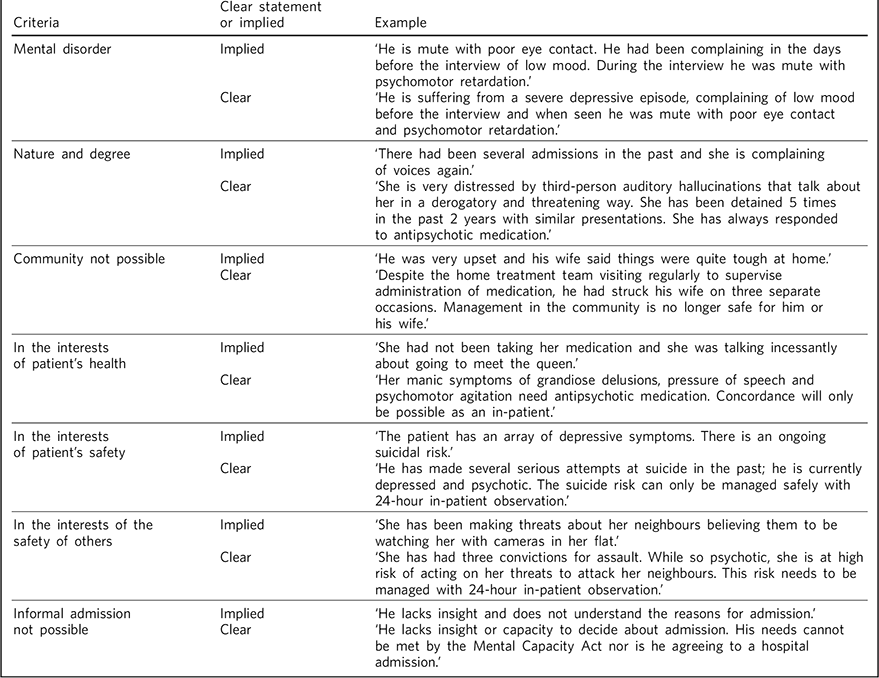
All medical recommendations for detention under Section 2 and 3 of the Mental Health Act written in November and December 2008 in Berkshire Healthcare NHS Foundation Trust and Oxford and Buckinghamshire Mental Health Partnership NHS Trust were reviewed by two assessors. The assessors were psychiatrists who had expressed an interest in the audit and had a good command of English used in mental health records. They underwent 4 h of training by J.C. or J.M. During this training a consensus was reached as to what was a clear statement of reasons and when the reasons were just implied (Table 1).
Box 1 Gold-standard criteria used to test the medical recommendations for detention
-
• Clear evidence to support the presence of a mental disorder
-
• A statement indicating its nature and/or degree
-
• Why it was in the interests of health, safety or the protection of others
-
• Why management in the community was not possible
-
• Why informal admission was not possible
Each of the recommendations was read by two assessors who checked legibility and whether the following were clearly present, implied or absent, as judged against the gold-standard criteria (Box 1):
-
1 an explicit statement about the presence of a named mental disorder and the reasons for believing this;
-
2 descriptions of degree and/or nature of the mental disorder that warranted 24-hour detention under care of responsible clinician;
-
3 reasons for 24-hour hospital detention and why a less restrictive option (management in the community) was not possible;
-
4 if the doctor stated that detention was in the interest of the patient's health, clear reasons why this was so;
-
5 if the doctor stated that detention was in the interests of patient safety, clear reasons why this was so;
-
6 if the doctor stated that detention was necessary for the protection of others, clear reasons why this was so;
-
7 reasons why informal admission was not justified.
In 8% of cases the two assessors were not in agreement whether the recommendation implied rather than clearly stated the reasons for compulsion. For each of these a third assessor was asked to arbitrate.
Examples of the difference between implied and clear statement of reason
| Criteria | Clear statement or implied |
Example |
|---|---|---|
| Mental disorder | Implied | ‘He is mute with poor eye contact. He had been complaining in the days before the interview of low mood. During the interview he was mute with psychomotor retardation.’ |
| Clear | ‘He is suffering from a severe depressive episode, complaining of low mood before the interview and when seen he was mute with poor eye contact and psychomotor retardation.’ |
|
| Nature and degree | Implied | ‘There had been several admissions in the past and she is complaining of voices again.’ |
| Clear | ‘She is very distressed by third-person auditory hallucinations that talk about her in a derogatory and threatening way. She has been detained 5 times in the past 2 years with similar presentations. She has always responded to antipsychotic medication.’ |
|
| Community not possible | Implied | ‘He was very upset and his wife said things were quite tough at home.’ |
| Clear | ‘Despite the home treatment team visiting regularly to supervise administration of medication, he had struck his wife on three separate occasions. Management in the community is no longer safe for him or his wife.’ |
|
| In the interests of patient's health |
Implied | ‘She had not been taking her medication and she was talking incessantly about going to meet the queen.’ |
| Clear | ‘Her manic symptoms of grandiose delusions, pressure of speech and psychomotor agitation need antipsychotic medication. Concordance will only be possible as an in-patient.’ |
|
| In the interests of patient's safety |
Implied | ‘The patient has an array of depressive symptoms. There is an ongoing suicidal risk.’ |
| Clear | ‘He has made several serious attempts at suicide in the past; he is currently depressed and psychotic. The suicide risk can only be managed safely with 24-hour in-patient observation.’ |
|
| In the interests of the safety of others |
Implied | ‘She has been making threats about her neighbours believing them to be watching her with cameras in her flat.’ |
| Clear | ‘She has had three convictions for assault. While so psychotic, she is at high risk of acting on her threats to attack her neighbours. This risk needs to be managed with 24-hour in-patient observation.’ |
|
| Informal admission not possible |
Implied | ‘He lacks insight and does not understand the reasons for admission.’ |
| Clear | ‘He lacks insight or capacity to decide about admission. His needs cannot be met by the Mental Capacity Act nor is he agreeing to a hospital admission.’ |
The results of the first cycle were disseminated electronically to all consultants, specialist registrars, registered Section 12-approved doctors, approved mental health practitioners (AMHPs) and scrutineers. An aide-memoire (Box 2) was sent with the results so that all doctors who completed the forms, and AMHPs who accepted them, had a template of what should be included in the reasons for detention.
Box 2 Aide-memoire
When documenting reasons for detention we suggest five clear statements, as follows:
-
Patient ‘A’ has ‘such and such'a mental disorder characterised by the following symptoms —
-
The nature of their disorder is demonstrated by— AND/OR The degree of their disorder is demonstrated by—
-
Community treatment is not possible because — and this makes 24-hour specialist hospital admission necessary.
-
Hospital admissionis necessary in the interests of ‘A's’ health because he or she needs—; in the interests of patient ‘A's'safety to manage the risks of—; and for the protection of others to manage the risks of—
-
Informal admission is not possible because Patient A is not agreeing to admission, AND/OR the established nature of their mental disorder strongly indicates that they will not sustain a commitment to informal admission AND/OR the patient lacks capacity but the patient's needs cannot be appropriately met by relying on the Mental Capacity act alone.
This generated questions and discussion and time was taken to answer all these questions by email. Across the two trusts there were only 12 doctors (5 independent and 7 trust doctors) who were present at over 80% of Mental Health Act assessments that resulted in detention. These doctors were approached individually and informed about the results of the audit and what would be considered best practice. The results of the first cycle were presented to the relevant Mental Health Act committees in each trust and appropriate educational forums. Following this period of feedback, the second audit cycle took place. This was in March and April 2009 in Oxford and Buckinghamshire and in September and October 2009 in Berkshire.
Results
Number of recommendations and grade of doctor signing them
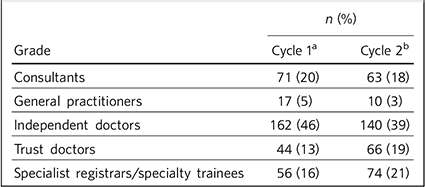
In the first cycle of the audit, 214 medical recommendations signed by 350 doctors were received in the two trusts; 78 were separate and 136 were joint recommendations. A total of 175 patients were detained, 99 under Section 2 and 76 under Section 3. In the second cycle, the trusts received 202 medical recommendations signed by 352 doctors, 52 separate and 150 joint. There were 176 patients detained, 108 under Section 2 and 68 under Section 3. The breakdown of doctors signing recommendations by grade for both audit cycles is given in Table 2.
Grade of total number of doctors signing recommendation
| n (%) | ||
|---|---|---|
| Grade | Cycle 1Footnote a | Cycle 2Footnote b |
| Consultants | 71 (20) | 63 (18) |
| General practitioners | 17 (5) | 10 (3) |
| Independent doctors | 162 (46) | 140 (39) |
| Trust doctors | 44 (13) | 66 (19) |
| Specialist registrars/specialty trainees | 56 (16) | 74 (21) |
a. n = 350.
b. n = 352.
In both cycles of the audit there was no statistical difference in the quality of the recommendations between the different grades of doctors as measured against the gold standard.
Appropriate medical treatment
In all of the Section 3 forms a suitable hospital for medical treatment was entered. Similarly, all the patients detained under Section 2 were received for assessment and treatment in psychiatric hospitals that were suitable for this purpose. However, we did not look for a specific statement in the Section 2 recommendations regarding this.
Legibility
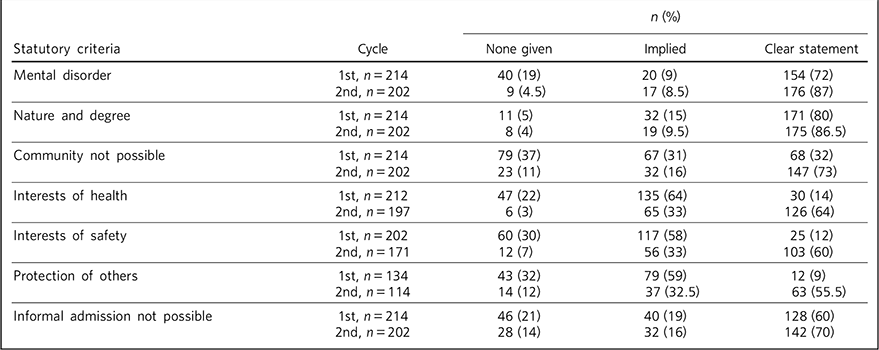
In both cycles all written recommendations were deemed to be sufficiently legible (Table 3).
Improvements were observed for all the statutory criteria in the second cycle. The doctors were weakest at giving reasons why detention was in the interests of health and/or safety and/or the protection of others, and even after the second cycle there was room for improvement here.
A recurring mistake made by doctors was that if a patient was deemed to be lacking in capacity to consent to hospital admission or to be without insight, this was deemed sufficient reason for compulsion rather than informal admission. It is worth remembering that if a patient has no capacity, compulsion is only necessary if they cannot be ensured appropriate and necessary treatment under the Mental Capacity Act. 13,Reference Eastman and Peay19,Reference Fennell20
Discussion
Our data are comparable with other studies. Reference Wall, Churchill and Hotopf21 As many as 99% (first cycle) and 98% (second cycle) of recommendations stated that it was in the interests of the patient's health to be detained; 94% and 85% stated that it was in the interests of safety; and 63% and 56% stated that it was for the protection of others. Similar results were reported elsewhere. Reference Wall, Churchill and Hotopf21
We acknowledge that deciding whether reasons for detention are implied or clearly stated is a matter of judgement about which there could be disagreement and is frequently a test of the use of English as much as it is a test of understanding the legal requirements for detention. However, absence or clear presence of reasons is something that the two assessors could be confident about.
Quality of reasons or description given for each of the statutory criteria in the two cycles of the audit
| n (%) | ||||
|---|---|---|---|---|
| Statutory criteria | Cycle | None given | Implied | Clear statement |
| Mental disorder | 1st, n = 214 | 40 (19) | 20 (9) | 154 (72) |
| 2nd, n = 202 | 9 (4.5) | 17 (8.5) | 176 (87) | |
| Nature and degree | 1st, n = 214 | 11 (5) | 32 (15) | 171 (80) |
| 2nd, n = 202 | 8 (4) | 19 (9.5) | 175 (86.5) | |
| Community not possible | 1st, n= 214 | 79 (37) | 67 (31) | 68 (32) |
| 2nd, n= 202 | 23 (11) | 32 (16) | 147 (73) | |
| Interests of health | 1st, n = 212 | 47 (22) | 135 (64) | 30 (14) |
| 2nd, n = 197 | 6 (3) | 65 (33) | 126 (64) | |
| Interests of safety | 1st, n = 202 | 60 (30) | 117 (58) | 25 (12) |
| 2nd, n = 171 | 12 (7) | 56 (33) | 103 (60) | |
| Protection of others | 1st, n= 134 | 43 (32) | 79 (59) | 12 (9) |
| 2nd, n = 114 | 14 (12) | 37 (32.5) | 63 (55.5) | |
| Informal admission not possible | 1st, n = 214 | 46 (21) | 40 (19) | 128 (60) |
| 2nd, n = 202 | 28 (14) | 32 (16) | 142 (70) | |
The overarching impression was that although doctors are able to describe the clinical features of a patient with a mental disorder, they have more difficulty clearly focusing on the statutory criteria and providing brief evidence to support their conclusions. The first cycle confirmed that doctors were most consistent at documenting the mental disorder (72%) and its nature and/or degree (80%). A clear description of a mental disorder and its nature and degree may imply that detention is necessary but it is not the equivalent of giving clear reasons. Similar to other studies, Reference Bhatti, Kenney-Herbert and Cope22-Reference Humphreys, Kenney-Herbert and Cope25 our audit showed that doctors were far less clear about the legal requirements for detention, namely, explaining why assessment and/or treatment in hospital was necessary; that alternatives to detention in hospital had been considered; and why informal admission was not possible. It was as though doctors thought like this: ‘I have found this patient to be showing obvious signs and symptoms of a mental illness, therefore they should be detained in hospital’. They had missed out showing essential steps in their reasoning, that is, why it was necessary in the interests of health, safety and protection of others for the patient to be in hospital; and careful consideration of the two prerequisites for compulsion. First, that less restrictive alternatives to detention had been entertained and were deemed to be unsuitable or had failed. Reference Fennell10,Reference Fennell14,Reference Jones18,Reference Peay, Roberts and Eastman23 Second, that informal admission was not possible for good reason. After the second cycle there was still significant room for improvement in these areas.
After completing the first cycle of the audit the data were generally well received and particularly the independent doctors were glad to have feedback to improve practice. The gold standard was universally accepted by all Section 12-approved doctors with whom we discussed it. A personal approach to individual doctors who completed a large number of recommendations was helpful in getting doctors to accept that there are clear standards for medical recommendations and subsequently recording them. The aide-memoire was very well received and doctors found it helpful in improving the standard of recommendations. For some senior psychiatrists who had performed the role of scrutineer in the past, there was a paradoxical resistance to a systematic, standardised approach to giving the reasons for detention. Even though they accepted the rationale for each of the criteria, they preferred a reliance on trusted expert opinion rather than pre-set standards, believing that the form was inviting to give their opinion rather than justifying detention against an established legal framework. During discussions about the audit, views about this did not shift. Although not measured in the audit, J.M. (scrutineer for Berkshire) has found that returning recommendations for amendment Reference Jones18 rapidly changed doctors’ willingness to use accepted criteria. Our suggestion would be that recommendations should be returned when any of the following are missing: a clear description of a recognisable mental disorder that warrants admission; clear reasons why the patient cannot be managed in the community; and an appropriate justification of why the patient cannot be admitted informally. To maintain standards of completion scrutineers should be ready to return forms for amendment irrespective of the seniority or standing of the doctor who completed them. Reference Jones18 Above all, scrutineers should be able to give a clear explanation of the reasons they do not support the conclusions.
There is no space on Section 2 forms to record the name of the hospital where appropriate assessment and treatment can be provided. A period of assessment is as much a specialist intervention as medical treatment. It would seem right in the spirit of the Mental Health Act that patients detained for a period of assessment were going to a hospital capable of carrying out this very important medical process.
Many doctors complained that during Section 12 training they had not received formal instruction on the completion of medical recommendations. They reported being taught about the background to the Mental Health Act and the meaning of such terms as ‘deprivation of liberty’ and ‘mental disorder’, but not what should be included in medical recommendations and what was considered to be a reasonable medical examination during a Mental Health Act assessment. This audit suggests that Section 12 training should include systematic teaching on what is expected in medical recommendations.


 Open access


eLetters
No eLetters have been published for this article.