





Management Implications
Hexazinone at 1.12 kg ai ha−1 provided a greater application window, and increased Sporobolus indicus var. pyramidalis control and consistency compared with 0.56 kg ai ha−1 in greenhouse and field experiments. The herbicide provided maximum efficacy from mid-June to mid-August when applications were followed by 10 to 75 mm of rainfall within the first 7 d after treatment. Therefore, as suggested by earlier studies, hexazinone should be applied at this rate during this application time frame in Florida to maximize efficacy on Sporobolus species. Additionally, ranchers may consider applying hexazinone when the rainfall predicted for the next few days is favorable for S. indicus var. pyramidalis management. Although natural rainfall occurrences cannot be controlled, herbicide applications should be planned to maximize the likelihood of success. Furthermore, hexazinone use for S. indicus var. pyramidalis management should be part of an integrated management program to achieve maximum and sustainable control.
Introduction
Florida’s subtropical climate, together with its approximately 1,300 mm of annual average rainfall, potentially allows high levels of forage production throughout the year, making forages an important source of nutrients in cow–calf operations (Mossler Reference Mossler2008). Forage systems in Florida are composed of warm-season perennial grasses, including bahiagrass (Paspalum notatum Flueggé), bermudagrass [Cynodon dactylon (L.) Pers.], stargrass (Cynodon nlemfuensis Vanderyst), and limpograss [Hemarthria altissima (Poir.) Stapf & C.E. Hubbard], with bahiagrass being the primary forage utilized for year-round grazing (Chambliss and Sollenberger Reference Chambliss and Sollenberger1991). The popularity of bahiagrass among cow-calf producers is due to its tolerance to low soil pH, overgrazing, and pesticide applications, as well as its low fertilization requirements (Chambliss and Sollenberger Reference Chambliss and Sollenberger1991). Although bahiagrass will grow year-round in the southern portions of the Florida peninsula, shortened daylengths during the winter season (October through March) reduce bahiagrass growth significantly, which typically results in overgrazing. Although bahiagrass will persist when overgrazed and underfertilized and without proper attention to soil pH, it is likely also more subject to increased weed infestations.
Weed interference can negatively impact forage production (Arnold and Santelmann Reference Arnold and Santelmann1970; de Marchi et al. Reference de Marchi, Marques, Araújo, Silva and Martins2022; Jakelaitis et al. Reference Jakelaitis, Gil, Simoes, de Souza and Ludtke2010) and utilization (Herbin et al. Reference Herbin, Golluscio and Rodriguez2021; Sather et al. Reference Sather, Kallenbach, Sexten and Bradley2013). Among all weeds present in Florida’s grasslands, the weedy Sporobolus grasses small smutgrass [Sporobolus indicus (L.) R. Br.] and giant smutgrass [Sporobolus indicus (L.) R. Br. var. pyramidalis (P. Beauv.) Veldkamp] have been persistent invaders in established bahiagrass pastures (Rana et al. Reference Rana, Sellers, Ferrell, MacDonald, Silveira and Vendramini2015). This is due to low grazing preference of weedy Sporobolus grasses by beef cattle, which results in overgrazing and loss of the desirable forage species over time (Wilder et al. Reference Wilder, Ferrell, Sellers and MacDonald2008). Sporobolus indicus var. pyramidalis also invades other habitats such as natural areas, roadsides, and other disturbed open areas, influencing their biodiversity by competing with native plants for growth resources (Mooney and Cleland Reference Mooney and Cleland2001). Additionally, Sporobolus indicus var. pyramidalis invasion in natural areas alters the soil, affecting infiltration, stabilization, and carbon sequestration and devaluing these areas for native species (Rai and Sigh Reference Rai and Singh2020). Furthermore, Sporobolus indicus var. pyramidalis can diminish the recreational value of many roadsides and natural areas, reducing their aesthetic worth. Hence, the management of weedy Sporobolus species is an important and necessary practice.
Sporobolus indicus var. pyramidalis is a perennial warm-season grass with an average bunch size of 30- to 45-cm diameter. This grass weed has a seed head with panicle branches directed upward and produces seeds from July to October, and sometimes in spring, with more than 45,000 seeds per plant. It is dormant in the winter season, and the seeds remain viable in the soil for more than 2 yr. Sporobolus indicus var. pyramidalis grows in a wide range of environments, tolerates poor soil conditions, and rapidly germinates at 20 to 35 C (Rana et al. Reference Rana, Wilder, Sellers, Ferrell and MacDonald2012; Shay et al. Reference Shay, Baxter, Basinger, Schwartz and Belcher2022). The seeds are smaller, which allows for easier distribution, mainly by animals, wind, and water.
The efficacy of many different active ingredients has been investigated over the past 50 yr to control weedy Sporobolus (Johnson Reference Johnson1975; Mislevy and Currey Reference Mislevy and Currey1980; Nishimoto and Murdoch Reference Nishimoto and Murdoch1994; Rana et al. Reference Rana, Sellers, Ferrell, MacDonald, Silveira and Vendramini2015; Smith et al. Reference Smith, Cole and Watson1974). Hexazinone is currently the only selective option available for use in bahiagrass and bermudagrass pastures that has shown to effectively control Sporobolus species (Ferrell et al. Reference Ferrell, Mullahey, Dusky and Roka2006; Mislevy et al. Reference Mislevy, Martin and Hall2002). It is a herbicide with apoplastic mobility and limited translocation through the phloem when absorbed by leaves (Shaner Reference Shaner2014). Application of hexazinone is recommended during the summer at a rate of 1.12 kg ai ha−1 for weedy Sporobolus species management when rainfall is sufficient for incorporation and uptake from the soil solution (Ferrell et al. Reference Ferrell, Mullahey, Dusky and Roka2006; Mislevy et al. Reference Mislevy, Martin and Hall2002). Although hexazinone is the only current selective option for managing Sporobolus species in Florida pastures, there are differences in forage tolerance due to environmental conditions before and after application as well as differences in species and/or cultivars (Sellers et al. Reference Sellers, Ferrell and MacDonald2008; Wilder et al. Reference Wilder, Ferrell, Sellers and MacDonald2008).
Similar to differences among forage species and/or cultivars, there are discrepancies in the literature concerning application timing and rate efficacy on weedy Sporobolus species control. For example, field experiments conducted by Brecke (Reference Brecke1981) showed that S. indicus control with hexazinone at 1.7 kg ha−1 applied during the spring did not differ from the same treatment applied during the fall, as both provided effective control. Conversely, lack of control for the standard recommendation of hexazinone at 1.12 kg ai ha−1 applied during midsummer has also been observed in Florida. For example, Ferrell and Mullahey (Reference Ferrell and Mullahey2006) reported excellent S. indicus var. pyramidalis control with this treatment in 1998, but lack of S. indicus var. pyramidalis control for the same treatment applied in the following year.
Several different factors could be associated with the variable hexazinone efficacy, but rainfall patterns after hexazinone application are likely to play a significant role. Hexazinone is mainly absorbed by Sporobolus roots; thus, it must be present at lethal concentrations within the root zone of target plants to be effective. However, hexazinone is prone to leaching due to its high solubility (33,000 mg L−1) and low coefficient of adsorption (K oc = 54 ml g−1) (Felding Reference Felding1992). Therefore, the potential for hexazinone to leach below the root zone is high, especially during the summer, when rainfall is abundant in Florida. Additionally, Florida soils are predominantly sandy from Lake Okeechobee northward (Brown et al. Reference Brown, Stone, Carlisle, Myers, Ewel, Stone, Carlisle, Myers and Ewel1990). Sandy surface textures and low organic matter (OM) content increase the likelihood of hexazinone leaching below the root zone.
Pesticide transport into the soil has been well documented and extensively modeled for several decades (Aslam et al. Reference Aslam, Iqbal, Deschamps, Recous, Garnier and Benoit2015; Beulke et al. Reference Beulke, Brown, Fryer and Walker2002; Edwards et al. Reference Edwards, Shipitalo, Dick and Owens1992; Monquero et al. Reference Monquero, Amaral, Binha, Silva and Silva2008). It has been clearly described that excessive rainfall can leach soil-applied herbicides out of the root zone, resulting in inadequate control. Conversely, insufficient rainfall after application can result in the absence of incorporation and subsequent lack of herbicide efficacy (Landau et al. Reference Landau, Hager, Tranel, Davis, Martin and Williams2021; Savage and Barrentine Reference Savage and Barrentine1969; Weise and Hudspeth Reference Weise and Hudspeth1968). Furthermore, failure to adequately incorporate soil-applied herbicides exposes them to degradation through certain environmental factors (e.g., volatilization, photolysis, surface runoff), which can also decrease efficacy (Kanissery et al. Reference Kanissery, Gairhe, Kadyampakeni, Batuman and Alferez2019; Knake et al. Reference Knake, Appleby and Furtick1967; Savage and Barrentine Reference Savage and Barrentine1969).
Although the effects of rainfall on hexazinone leaching have been extensively studied using soil columns (Feng et al. Reference Feng, Stornes and Rogers1988; Monquero et al. Reference Monquero, Amaral, Binha, Silva and Silva2008; Tonieto and Regitano Reference Tonieto and Regitano2014) and in environmental fate experiments (Neary et al. Reference Neary, Bush and Douglass1983), there is limited information available regarding the impacts of rainfall on hexazinone incorporation and herbicidal efficacy for S. indicus var. pyramidalis control in Florida grasslands. Hence, the objectives of this study were to determine: (1) the effects of simulated rainfall after application on hexazinone efficacy, (2) the effects of application timing and hexazinone rate on S. indicus var. pyramidalis control in the field, and (3) the influence of natural rainfall on hexazinone efficacy in the field.
Material and Methods
Greenhouse Experiment
Greenhouse experiments were conducted at the University of Florida Institute of Food and Agricultural Sciences, Range Cattle Research and Education Center (RCREC), near Ona, FL (27.6517° N, -81.1687° W) in 2017 and 2018. Field soil was collected at the research center on March 26, 2017, and sieved through a 5-mm screen to remove unwanted debris. The soil was an Ona fine sand (sandy, siliceous, hyperthermic Typic Alaquods) with a mean soil pH of 4.9 and 3.0% OM. Sporobolus indicus var. pyramidalis clumps were collected from a pasture near the research center (27.6344° N, -81.9758° W) on May 25, 2017, and May 30, 2018. Individual culms with intact roots were separated from the clumps and planted in 3-L plastic pots (16-cm-diameter top, 12-cm-diameter base, and 16-cm depth), filled with field-collected soil amended with 14-14-14 (N:P2O5:K2O) slow-release fertilizer (Osmocote® Smart-Release Plant Food, Scotts-Sierra Horticultural Products, Marysville, OH). Plants were grown in a greenhouse maintained at 30/24 C day/night temperatures under a 14-h photoperiod using a combination of natural and supplemental lighting during the experimental period. Clear vinyl 10-cm-deep by 14-cm-diameter saucers were placed underneath each pot, and plants were subirrigated as needed.
Treatments included a 2 by 7 factorial arrangement of two hexazinone (Velpar® L, 240 g ai L−1, DuPont, Wilmington, DE) rates of 0.56 and 1.12 kg ai ha−1, and seven simulated rainfall accumulation volumes (0, 6, 12, 25, 50, 100, and 200 mm) distributed in a completely randomized design with four replicates. At the time of the experiment, Velpar® L was produced by DuPont; ownership has changed to Novasource (Tessenderlo Kerley, Phoenix, AZ). A non-treated control was added for treatment comparisons. Non-treated controls were not subjected to simulated rainfall and were only subirrigated. Each pot was considered to be an experimental unit. Before herbicide application, all pots were subirrigated to soil saturation and were allowed to drain for 48 h. Hexazinone treatments were applied using a CO2 pressurized backpack sprayer equipped with a 1.5-m boom calibrated to deliver 187 L ha−1. Herbicides were applied on July 26, 2017, and July 20, 2018, and plants were approximately 40-cm tall at the time of application, approximately 2 mo after planting. A Tlaloc 3000 rainfall simulator (Joern’s Inc. in West Lafayette, IN) at an intensity of 65 mm h−1 and under a pressure of 27.6 KPa was used to simulate incorporation with rainfall 2 h after hexazinone application. This rainfall simulator covers a 2.8 by 2.3 m2 area with a central nozzle at 3 m above the plant canopy. Polyethylene tarps were used as a windscreen on all sides of the simulator to prevent uneven rainfall across the experimental units. Pots were allowed to drain for 3 h after the rainfall simulations before being returned to the greenhouse. All pots were placed in plant irrigation saucers and subirrigated with 60 ml of water as needed after the rainfall treatments until the end of the experiments.
Sporobolus indicus var. pyramidalis control was determined qualitatively by visual estimates of control ranging from 0% (no control) to 100% (complete death) at 30 d after treatment (DAT), and quantitatively by clipping the aboveground biomass at 30 DAT at 7.5 cm above the soil surface. Biomass samples were dried at 60 C for 72 h, and dry weights were recorded. Aboveground biomass was expressed as percent reduction compared with the non-treated control for statistical analyses.
Statistical analyses were performed using the statistical software R v. 3.4.3 (R Core Team 2014). Normality, independence of errors, and homogeneity of variance were visually examined for all response variables, and no data transformation was deemed necessary. All response variables were analyzed by fitting mixed-effects models using the package nlme in R (Pinheiro et al. Reference Pinheiro, Bates, DebRoy and Sarkar2016). The model statement for all response variables included hexazinone rate, rainfall accumulation volume, and their interactions as fixed effects, whereas the experimental run was considered a random effect. The effects of simulated rainfall were modeled using nonlinear regression models. The effective rainfall accumulation volume needed to increase visual estimates of control and reduce biomass responses by 50% (ER50) for each hexazinone rate was derived from a four-parameter log-logistic regression model using the ED function in the drc package in the R statistical environment (Knezevic et al. Reference Knezevic, Streibig and Ritz2007) (Equation 1):
 $${y = c + \{ d - c / 1 + {\rm{exp}}{\left[b {\left({\rm{log}} \, x - {\rm{log}} \, e\right)}\right]\}}}$$
where y is the response variable (visual estimates of control or aboveground biomass percent of reduction), x is simulated rainfall accumulation volume (mm), b is the relative slope at the inflection point, d is the upper limit of the curve, c is the lower limit of the curve, and e is the inflection point (ER50) of the fitted line. Model selection was based on Akaike’s information criterion (AIC) in the qpcR package in R (Ritz and Spiess Reference Ritz and Spiess2008). Additionally, a lack-of-fit test at the 95% level (P ≤ 0.05) comparing the nonlinear regression models to ANOVA was conducted to test the appropriateness of model fit (Ritz and Streibig Reference Ritz and Streibig2005). Differences among parameter estimates were compared using SE and t- and F-tests at the 5% significance level (Knezevic et al. Reference Knezevic, Streibig and Ritz2007).
Field Experiment
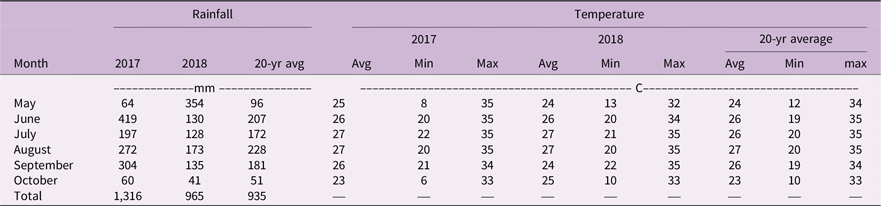
Field experiments were conducted in a pasture with ≥90% S. indicus var. pyramidalis ground cover on private property near the University of Florida Institute of Food and Agricultural Sciences, RCREC (27.627° N, -81.978° W) in 2017. The experiment was repeated in an adjacent location within the same pasture in 2018. The predominant soil was a Smyrna fine sand (sandy, siliceous, hyperthermic Aeric Alaquods) with 1.7% OM. Soil pH before initiation of the study was 5.0 and 4.7 in 2017 and 2018, respectively. A rainfall data logger (RainWise RainLog 2.0, RainWise, Boothwyn, PA) was installed in the research area, and rainfall data were recorded hourly throughout the experimental period. The 20-yr average rainfall data from the weather station located at the research center are also presented in Table 1.
Average monthly rainfall (mm) recorded at the research sites and temperature (C) recorded from the Florida Automated Weather Network weather station located at the Range Cattle Research and Education Center, near Ona, FL, in 2017 and 2018 compared with the 20-yr average.
The experiment was a split-plot design with four replications. Main plot (12 by 15 m; 180 m2) treatments included 22 weekly herbicide application timings beginning in the first week of May and ending in the last week of September. Subplot treatments included two rates of hexazinone at 0.56 and 1.12 kg ha−1 in plots measuring 6 by 15 m (90 m2). A non-treated control at each application timing was added for treatment comparisons. Herbicide treatments were applied with a tractor-mounted, compressed-air broadcast sprayer equipped with a 3-m boom calibrated to deliver 233 L ha−1.
Sporobolus indicus var. pyramidalis control was determined qualitatively as previously described in the greenhouse experiment at 35 DAT. Additionally, S. indicus var. pyramidalis plant density (number of live plants per square meter) was assessed at the beginning of the following growing season after treatment application (May 7, 2018, and March 14, 2019) by placing two 1.0-m2 quadrats at two random locations per experimental unit. Plants were only considered dead when completely lacking any green tissue. The two counts were averaged to represent the mean plant density per plot. Plant density data were expressed as percent reduction for statistical analysis by comparing the density recorded in treated plots at the end of the experiments with the average number of live plants present in the 22 non-treated control plots (1 non-treated plot per application timing) at the end of the experiments.
Statistical analyses were performed using the open-source statistical software R v. 3.4.3 (R Core Team 2014). Normality, independence of errors, and homogeneity of variance were visually examined for all response variables, and data were transformed when ANOVA assumptions were violated. Arcsine square-root transformation was used on S. indicus var. pyramidalis visual estimates of control at 35 DAT (%). Nonetheless, non-transformed means are presented. Data were subjected to ANOVA to test for year, application timing, hexazinone rate, and the effects of their interactions. Treatments were considered different when P ≤ 0.05, and interactions not discussed were not significant. Means were separated using Fisher’s LSD test at a 5% level of significance when appropriate.
In addition, field rainfall data were analyzed in three steps by fitting mixed-effects models using the package nlme in R (Pinheiro et al. Reference Pinheiro, Bates, DebRoy and Sarkar2016). First, seven rainfall classes were designated to characterize the total amount of rainfall recorded during the first 7 DAT: 0 (0 to 9 mm); 1 (> 9 ≤ 25 mm); 2 (> 25 ≤ 50 mm); 3 (> 50 ≤ 75 mm); 4 (> 75 ≤ 100 mm); 5 (>100 ≤ 125 mm); and 6 (> 125 mm). The 7-d period was chosen because (1) previous research suggested that rainfall 1 to 6 d after application of cinmethylin, which is also a soil-applied herbicide, resulted in optimal grass weed control (Wittsell and May Reference Wittsell and May1983), and (2) we wanted to decrease the chances of confounding effects due to herbicide dissipation processes. Second, rainfall class and rainfall class by hexazinone rate interaction were considered covariates and were included in the model as fixed effects. Year was considered a random effect in the covariance model to ensure sufficient data points within each rainfall class. Finally, means were separated using Fisher’s protected LSD test at 5% level of significance when appropriate.
Results and Discussion
Greenhouse Experiment
There was a hexazinone rate by rainfall accumulation effect for visual estimates of S. indicus var. pyramidalis control (P = 0.0001) and aboveground biomass reduction at 30 DAT (P = 0.0034). Therefore, the effects of increasing rainfall accumulation are presented separately for each hexazinone rate (Table 2; Figures 1 and 2). In addition, a lack-of-fit test at the 95% level was not significant for all curves, indicating that the regression models were appropriate (Ritz and Streibig Reference Ritz and Streibig2005).
Log-logistic regression parameter estimates (±SE) and rainfall needed to achieve 50% visual plant damage and 50% dry biomass reduction of Sporobolus indicus var. pyramidalis in 30 d after treatment (DAT) with hexazinone in whole-plant experiments under greenhouse conditions in Ona, FL, in 2017 and 2018 a .

a Log-logistic model: y = c + {d – c/1 + exp[b(log x – log e)]}, where y is the response, x is the simulated rainfall volume, b is the slope of the inflection point, c is the lower limit of the curve, d is the upper limit of the curve, and e is the inflection point of the fitted line (equivalent to the simulated rainfall volume [mm] to cause 50% decrease in hexazinone efficacy [ER50]).
b ER50 estimates followed by the same letter within each species are not different according to t- and F-tests at the 5% significance level.
Visual estimates of control (%) (30 d after treatment) of Sporobolus indicus var. pyramidalis in response to two hexazinone rates and increasing volumes of simulated rainfall from whole-plant studies conducted under greenhouse conditions in 2017 and 2018. Rainfall was simulated at 0, 6, 12, 25, 50, 100, and 200 mm. Solid and dashed lines represent predicted values. Data were fit to a four-parameter log-logistic regression model: y = c + {d − c/1 + exp[b(log x − log e)]}, where y is the response, x is the simulated rainfall volume, b is the slope of the inflection point, c is the lower limit of the curve, d is the upper limit of the curve, and e is the inflection point of the fitted line (equivalent to the simulated rainfall volume [mm] to cause 50% decrease in hexazinone activity [ER50]).

Dry aboveground biomass reduction (%) (30 d after treatment) of Sporobolus indicus var. pyramidalis in response to two hexazinone rates and increasing volumes of simulated rainfall from whole-plant studies conducted under greenhouse conditions in 2017 and 2018. Rainfall was simulated at 0, 6, 12, 25, 50, 100, and 200 mm. Solid and dashed lines represent predicted values. Data were fit to a four-parameter log-logistic regression model: y = c + {d – c/1 + exp[b(log x – log e)]}, where y is the response, x is the simulated rainfall volume, b is the slope of the inflection point, c is the lower limit of the curve, d is the upper limit of the curve, and e is the inflection point of the fitted line (equivalent to the simulated rainfall volume [mm] to cause 50% decrease in hexazinone activity [ER50]).
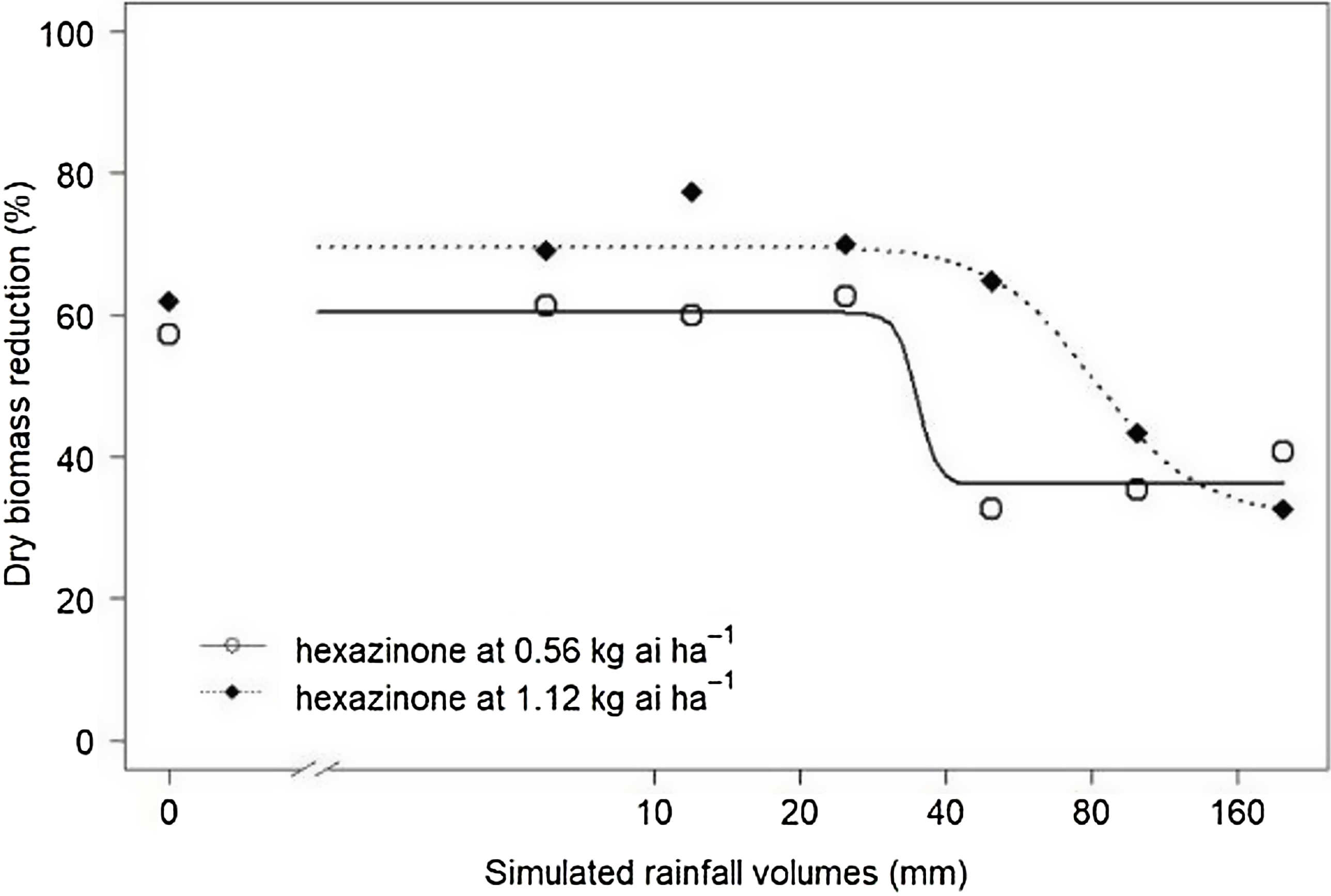
Increasing simulated rainfall accumulation significantly impacted hexazinone efficacy at both rates for visual control and biomass reduction (Figures 1 and 2). In general, control with hexazinone at 0.56 kg ha−1 did not decline until rainfall accumulation exceeded 25 mm, whereas control at 1.12 kg ha−1 did not decline until rainfall accumulation exceeded 50 mm. In addition, the effective rainfall accumulation volume needed to reduce visual estimates of control by 50% (ER50) was 49 mm for hexazinone at 0.56 kg ha−1 and 92 mm for hexazinone at 1.12 kg ha−1 (Table 2). Similarly, the ER50 value estimates for biomass reduction were at least two times greater for hexazinone at 1.12 versus hexazinone at 0.56 kg ha−1 (82 mm vs. 35 mm) (Table 2).
These data indicate a significant difference in the rainfall accumulation necessary following hexazinone application to activate hexazinone at 0.56 and 1.12 kg ha−1 efficacy for S. indicus var. pyramidalis control. This is consistent with other published studies that assessed the effects of simulated rainfall on herbicide efficacy. Negrisoli et al. (Reference Negrisoli, Velini, Correa, Rossi, Carbonari, Costa and Perim2011) reported that control of signalgrass [Urochloa decumbens (Stapf) R. Webster] with a premix of clomazone and hexazinone at 0.88 and 0.22 kg ai ha−1, respectively, was enhanced when followed by 30 mm of simulated rainfall compared with the treatments without rainfall after application. Furthermore, Tonieto and Regitano (Reference Tonieto and Regitano2014) reported decreased hexazinone efficacy at 0.50 kg ha−1 on little bell [Ipomoea grandifolia (Dammer) O’Donell] when followed by 120 mm of simulated rainfall within the first 7 d after herbicide application. This same study also determined that wheat (Triticum aestivum L.) straw mulch reduced hexazinone leaching 7-fold, indicating that soil OM plays a key role in hexazinone leaching (Koskinen et al. Reference Koskinen, Stone and Harris1996; Stone et al Reference Stone, Harris and Koskinen1993). Given the fact that the soils utilized in this study and those in the majority of pastures in Florida are sandy with low OM, it is likely that hexazinone leaching below the root zone is a primary reason for reduced efficacy under high rainfall accumulations. The use of subirrigation in this experiment following simulated rainfall may have resulted in less overall leaching from the entire system during the length of the experiment. While it is possible that subirrigation kept hexazinone concentrations in some of the treatments longer than would occur with surface watering, surface watering could have resulted in additional leaching, which would have removed the impact of simulated rainfall on the day of application.
Field Experiment
There was a year by application and timing by hexazinone rate effect for S. indicus var. pyramidalis visual control at 35 DAT data (P = 0.0009) and density reduction (P = 0.0001). Therefore, data are presented per year (Tables 3 and 4). Additionally, characteristic symptoms of photosystem II–inhibiting herbicides were observed at 35 DAT for all application timings and in both years, ranging from slight necrosis and chlorosis on leaves to complete desiccation.
Rainfall received 7 d after treatment (DAT), Sporobolus indicus var. pyramidalis visual estimates of control at 35 DAT, and density reduction the following year with at hexazinone rates applied in 2017 at 22 different timings at the Range Cattle Research and Education Center, near Ona, FLa.
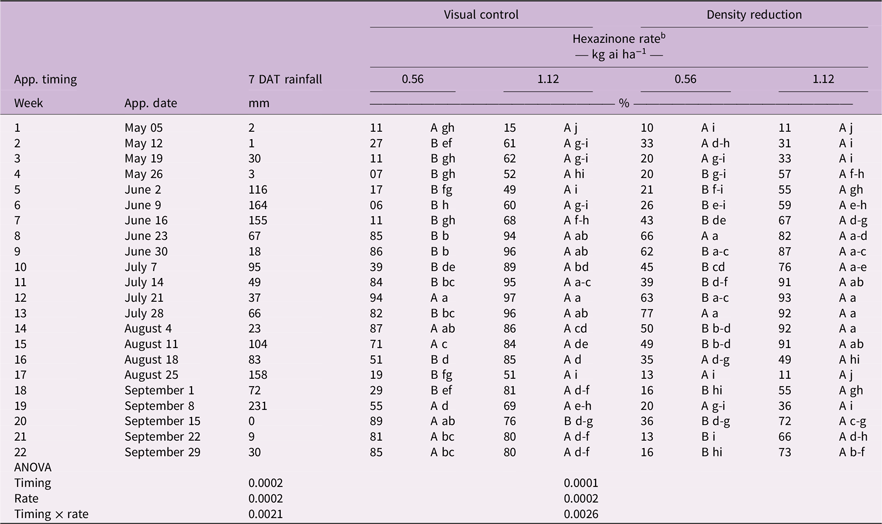
a Effect of year × timing × rate was significant (P < 0.05), so results were analyzed and presented by year.
b Means within response variables and within rows followed by the same uppercase letter and means within response variable and within columns followed by the same lowercase letter are not significantly different according to Fisher’s protected LSD test at P ≤ 0.05.
Sporobolus indicus var. pyramidalis visual estimates of control at 35 d after treatment (DAT) and density reduction the following year with two hexazinone rates applied at 22 different timings at the Range Cattle Research and Education Center, near Ona, FL in 2018 a .
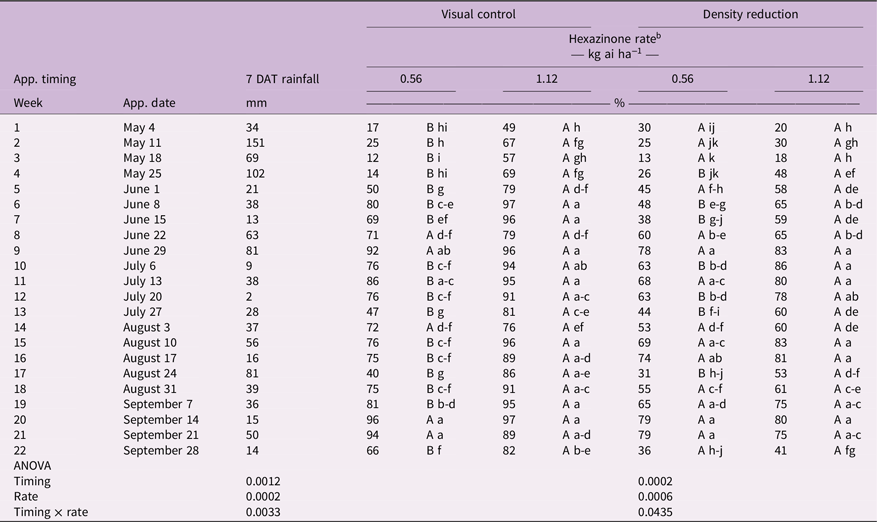
a Effect of year × timing × rate was significant (P < 0.05), so results were analyzed and presented by year.
b Means within response variables and within rows followed by the same uppercase letter and means within response variable and within columns followed by the same lowercase letter are not significantly different according to Fisher’s protected LSD test at P ≤ 0.05.
In 2017, hexazinone at 1.12 kg ha−1 resulted in more consistent and greater control than hexazinone at 0.56 kg ha−1 (Table 3), as it provided greater than 90% control at five application timings (June 23, June 30, July 14, July 21, and July 28). In contrast, hexazinone at 0.56 kg ha−1 provided greater than 90% control at only one application timing (July 21; 94% control). Similar responses were recorded for S. indicus var. pyramidalis density reduction, as hexazinone at 0.56 kg ha−1 provided greater than 60% S. indicus var. pyramidalis reduction at only four application timings (June 23, June 30, July 21, and July 28), whereas hexazinone at 1.12 kg ha−1 provided greater than 80% S. indicus var. pyramidalis reduction at seven application timings (June 23, June 30, and July 14 to August 11).
Additionally, hexazinone applications at 1.12 kg ha−1 broadened the window of optimum application timing. For example, visual estimates of control were at least 80% at 12 times following 1.12 kg ha−1 versus 9 times following 0.56 kg ha−1 hexazinone. Similarly, density reductions exceeded 70% at 10 times following 1.12 kg ha−1 versus only 1 time following 0.56 kg ha−1.
In 2018, both rates provided similar visual estimates of control at five application times (June 22, June 29, August 3, September 14, and September 21), with greater control for 1.12 kg ha−1 hexazinone at all the other application timings (Table 4). Similarly, both rates provided similar decreases in S. indicus var. pyramidalis density at seven application times in 2018 (June 29, July 13, August 10, Auguast 17, September 7, September 14, and September 21), with greater density reductions for 1.12 kg ha−1 hexazinone at all the other application timings (Table 4). Previous research has also reported greater and consistent S. indicus var. pyramidalis control with hexazinone at 1.12 kg ha−1 compared with 0.56 kg ha−1 in Florida (Wilder et al. Reference Wilder, Sellers, Ferrell and MacDonald2011). Additionally, hexazinone at 0.56 kg ha−1 provided the greatest level of control (71% to 96%) and density reduction (60% to 79%) when applied from the third week of June through the third week of July, as well as during the first 3 wk of September. Similar to observations made in 2017, increasing the hexazinone rate to 1.12 kg ha−1 increased the window of optimum application timing. For hexazinone at 1.12 kg ha−1, the greatest S. indicus var. pyramidalis control (76% to 97%) and density reduction (59% to 86%) were observed from the second week of June until the second week of August, as well as during the first 3 wk of September. Hexazinone at 1.12 kg ha−1 extended the window of optimum application timing by approximately 30 d compared with application at 0.56 kg ha−1.
Previous research has also investigated the effects of hexazinone rate and application timing on weedy Sporobolus species control. Mislevy et al. (Reference Mislevy, Shilling, Martin and Hatch1999) observed that S. indicus control in Florida was more effective when hexazinone was applied during midsummer or fall compared with spring applications. Additionally, the authors stated that control with hexazinone at 0.56 kg ai ha−1 was variable, ranging from 65% to 89% during spring and 86% to 91% during midsummer. Conversely, Rana et al. (Reference Rana, Sellers, Ferrell, MacDonald, Silveira and Vendramini2015) found that a single hexazinone application at 0.56 kg ai ha−1 during midsummer did not decrease S. indicus var. pyramidalis density compared with the non-treated control. Research conducted by Wilder et al. (Reference Wilder, Sellers, Ferrell and MacDonald2011) found that S. indicus var. pyramidalis control was above 90% at 12 mo after application when hexazinone rates were equal to or greater than 1.12 kg ai ha−1, but below 70% for hexazinone applied at 0.56 kg ai ha−1. In addition, the authors observed that the variability in the level of control tended to decrease at hexazinone rates greater than 0.56 kg ai ha−1, while it increased at rates lower than 0.56 kg ai ha−1. Moreover, Ferrell et al. (Reference Ferrell, Mullahey, Dusky and Roka2006) reported excellent S. indicus var. pyramidalis control at 365 DAT with hexazinone 1.12 kg ha−1 applied in July. However, significantly lower control for the same treatment was recorded the following year. Therefore, based on results from the literature, the control of weedy Sporobolus species with hexazinone can be variable, with effective and poor control recorded with both hexazinone rates and at different application timings. Nonetheless, hexazinone rates equal to 0.56 kg ai ha−1 applied during spring or late fall may result in poor control. Results from our study support this statement, as applications performed in May, the first half of June, and the second half of September showed lower effectiveness compared with the other application timings in both years.
Several different factors likely played a role in the variable hexazinone efficacy responses observed across application timings in both years. However, we hypothesize that the rainfall pattern after application is likely one of the main factors, as hexazinone is primarily absorbed through the root system and much less so through the foliage (Shaner Reference Shaner2014). Rana et al. (Reference Rana, Sellers, Ferrell, MacDonald, Silveira and Vendramini2015) suggested that the amount of rainfall after application plays a critical role in hexazinone efficacy on S. indicus var. pyramidalis, with excessive or scarce rainfall often resulting in lack of control. Our greenhouse results also support this suggestion, as hexazinone effectiveness was acceptable when followed by 12 to 25 mm of simulated rainfall for hexazinone at 0.56 kg ha−1 and 12 to 50 mm of simulated rainfall for hexazinone at 1.12 kg ha−1 (Figures 1 and 2). Similarly, Nagy (Reference Nagy2008) reported that at least 14 mm of rainfall is required during the first 2 wk after application for the optimal activation of acetochlor, another soil-applied herbicide widely used for preemergence weed control in corn (Zea mays L.) production systems. In addition, Smith et al. (Reference Smith, Ferrell, Webster, Fernandez, Dittmar, Munoz and MacDonald2016) observed lack of Palmer amaranth (Amaranthus palmeri S. Watson) control with dicamba, a synthetic auxin herbicide that also has high solubility (4,500 mg L−1) and low adsorption (K oc = 13.4 ml g−1), when subjected to increasing irrigation volumes in field experiments. The authors attributed the lack of efficacy to the dynamic mobility of dicamba in the soil, suggesting that high volumes of irrigation leached dicamba beyond the seed germination zone.
Although it is widely accepted that scarce or excessive rainfall after application will impact soil-applied herbicide efficacy, studies determining this optimum rainfall range for S. indicus var. pyramidalis control with hexazinone have never been investigated in Florida. We attempted to accomplish this by recording the rainfall pattern hourly for 2 yr in the field trials and recording the effect of hexazinone rate by rainfall class for control (P = 0.0028) and density reduction (P = 0.0189) (Table 5). We were then able to analyze the results by rainfall class. Overall, greater control at 35 DAT was observed for both hexazinone rates, ranging from 57% to 69% at 0.56 kg ha−1 and from 81 to 90% at 1.12 kg ha−1 in simulated rainfall classes 1 (10 to 25 mm) to 3 (51 to 75 mm) (Table 5). Also, S. indicus var. pyramidalis control was the lowest in rainfall classes 5 (101 to 125 mm) and 6 (>125 mm), followed by the rainfall class 0 (0 to 9 mm), for both application rates (Table 5). Furthermore, a similar rainfall class effect was detected for S. indicus var. pyramidalis density reduction in the hexazinone 0.56 kg ha−1 treatment, as greater responses were recorded in rainfall classes 1 to 3 (54%, 52%, and 55% density reduction, respectively). However, the effects of rainfall class were not as pronounced for S. indicus var. pyramidalis density reduction in plots treated with hexazinone 1.12 kg ha−1, as similar responses were recorded for rainfall classes 0, 1, 2, 3, and 5 (Table 5). Nonetheless, peak hexazinone efficacy for S. indicus var. pyramidalis control in the field studies appeared to have occurred when 10 to 75 mm of rainfall accumulated within 7 d of application, regardless of the hexazinone rate (Table 5).
Rainfall class by hexazinone rate for visual control at 35 d after treatment (DAT) and density reduction of Sporobolus indicus var. pyramidalis in the following year at the University of Florida Institute of Food and Agricultural Sciences, Range Cattle Research and Education Center, near Ona, FL a .
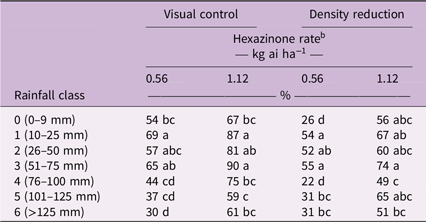
a Data represent the means across application timings and years (2017 and 2018).
b Means within response variable, hexazinone rate, and columns followed by the same lowercase letter are not significantly different according to Fisher’s protected LSD test at P ≤ 0.05.
Although the rainfall class analysis in the field indicated that there is a relationship between rainfall accumulation and hexazinone efficacy, there were application timings within the suggested optimum rainfall range that resulted in low hexazinone effectiveness (e.g., May 19 and September 1 in 2017; and June 1, June 15, July 27, and August 3 in 2018) as well as application timings outside the suggested optimum rainfall range that resulted in good hexazinone efficacy (e.g., July 7 and August 11 in 2017; and June 30 in 2018). This was likely because several other factors may also contribute to the success of S. indicus var. pyramidalis management with hexazinone, including the timing and intensity of rainfall events within the first 7 d following application. Hexazinone at 1.12 kg ha−1 applied on August 11, 2017, was followed by daily rainfall amounts of 31, 0, 2, 16, 34, 7, and 13 mm during the first week after application (totaling 104 mm at 7 DAT) and provided 91% reduction in density. Conversely, hexazinone at 1.12 kg ha−1 applied 1 wk later (August 18, 2017) and followed by daily rainfall amounts of 0, 2, 0, 0, 14, 6, and 61 mm during the first week after application (totaling 83 mm at 7 DAT) provided only 49% reduction in density. Thus, the timing and intensity of the first rainfall events might significantly contribute to rainfall–hexazinone dynamics for S. indicus var. pyramidalis management. Our greenhouse results may corroborate this statement, as rainfall was simulated the day of hexazinone application. Further research should be conducted to determine whether delaying simulated rainfall impacts control under controlled conditions.
The impact of rainfall on hexazinone efficacy in most Florida soils will likely follow the results from this study. Research has shown that hexazinone leaching is higher in sandy than in clay soils (Cristina dos Reis et al. Reference Cristina dos Reis, Tornisielo, Pimpinato, Martins and Filho2017; Dousset et al. Reference Dousset, Chauvin, Durlet and Thevenot2004). Conversely, a separate study indicates that soil OM content is a better indicator of hexazinone sorption than soil texture (Koskinen et al. Reference Koskinen, Stone and Harris1996). Given this information, the relatively low OM content and high porosity of Florida’s sandy soils will likely lead to rapid leaching of hexazinone below the root zone of Sporobolus plants.
Overall, rainfall within the first 7 DAT with hexazinone is important regarding S. indicus var. pyramidalis management in Florida pastures. While we recognize that natural rainfall cannot be controlled, this information is important for users of this herbicide to understand when applications will likely fail. Because hexazinone is one of the most expensive herbicides, it is important to understand how rainfall patterns impact S. indicus var. pyramidalis control. For instance, it is common for rainfall to be limited in the early spring (March through May) in southern Florida, but springtime rainfall is common in the Florida panhandle. Additionally, as rainfall forecasting improves with new technology, pasture managers will be able to make application decisions that should provide more consistent S. indicus var. pyramidalis control.
Funding statement
This work was supported by the USDA National Institute of Food and Agriculture, Hatch project 10006034 and the Florida Cattle Enhancement Board.
Competing interests
The authors declare no conflict of interest.


 Open access

