


Introduction
Mediation is a process in which an impartial third-party neutral (the mediator), who possesses no authority to issue a decision, seeks to help the parties resolve their dispute and negotiate settlement terms.Footnote 1 It is characterised as a voluntary, consensual process, with self-determination a core value.Footnote 2 The literature does, however, indicate a notable evolution in its role. Scholars observe that it can function as a vehicle for state intervention into otherwise private relationships, increasing the scope of behaviours that may be brought within the realms of state control.Footnote 3 This may be prone to occur where state actors can act as mediator, particularise the process, penalise parties for not engaging in good faith, provide recommendations and issue determinations of legal compliance.Footnote 4 Indeed, for Brigg, mediation exhibits capacity to govern where the process has disputants assume nondisputing self-identities and align their behaviour with a guiding norm.Footnote 5 In this way, ‘mentalities’ can be moulded by the state to help secure its wider political aims.Footnote 6 Given this ability of the state to ‘dictate from the shadows of the discursive facades it erects’,Footnote 7 the utility and wider implications of this mode of governance warrant closer scrutiny.
This paper provides empirically grounded insights into the efficacy of mediation-based governance.Footnote 8 It does so in the setting of the OECD Guidelines for Multinational Enterprises on Responsible Business Conduct (the Guidelines).Footnote 9 These are perhaps, the most prominent international standards applicable to multinational enterprises (MNEs) and comprise non-binding recommendations.Footnote 10 They seek to enhance businesses’ contribution to sustainable development and address the adverse impacts it has on people, the planet, and society.Footnote 11 Whilst voluntary and legally unenforceable, they are seen as ‘morally binding’ on MNEs and states and able to ‘compel’ MNEs to act responsibly.Footnote 12 Despite their voluntary status, references to the Guidelines are incorporated in legislation, including the EU Taxonomy,Footnote 13 rendering them somewhat of a ‘hybrid’ of soft and hard law.Footnote 14
National Contact Points (NCPs) are central to the Guidelines’ mobilisation and implementation. These state-based, non-judicial grievance mechanisms seek to assist the resolution of complaints submitted to them by ‘notifiers’ (ie interested parties, including individuals and NGOs) relating to alleged breaches of the Guidelines by an MNE. Where the complaint warrants further examination, they may offer their ‘good offices’ (ie facilitate access to consensual and nonadversarial means, such as mediation or conciliation, to assist the parties in resolving the issue(s) raised).Footnote 15 NCPs possess important associated powers, including the ability to inform this dialogue with their expertise, act as mediator, provide recommendations on how better to comply with the Guidelines (and follow up on whether this occurred) and issue a determination of (non)observance.Footnote 16 A unique and widely utilised feature of the NCP system is its extraterritorial reach, with notifiers able to submit their complaint to the NCP of the country where: (i) the issue(s) took place; or (ii) the MNE is established (eg headquartered).Footnote 17
The focus of this paper is alleged breaches of the Guidelines’ Environment chapter. Environmental complaints were selected as they often involve ‘conflicts over the quality of life itself’, meaning the way they are resolved (or not) ‘determine[s] the future of our planet’.Footnote 18 It is of pressing societal and environmental importance that mediation-based governance is equipped to resolve such disputes satisfactorily. Whilst there have been empirical studies of other chapters, such as Human Rights,Footnote 19 and NCP practices generally,Footnote 20 there have been no studies dedicated to the Environment chapter. For Morgera, the ‘disparate results of complaints submitted to NCPs on environmental matters’ means that NCPs ‘actual impact on improving corporate environmental accountability and responsibility remains an open question’.Footnote 21 I explore that question and, in so doing, contribute to the larger debate around whether mediation-based governance ought to be utilised to realise a state’s wider political aims.
I argue that the empirical reality exposes tensions inherent in mediation-based governance which present both challenges and opportunities for it: (in)consistency in the state’s influence over negotiations; (dis)trust between disputants; and (future-orientated) temporal focus. If these are not addressed, mediation-based governance will, despite its initial theoretical appeal, be unable to realise states’ wider political aims, such as sustainable development and ensuring business responsibility for adverse impacts. Private interests are just too ingrained and prevailing power structures in society too dominant for its current manifestation to protect and preserve aims of such a public character.
Curation of a large (n=81), original dataset for 2000–2025, one of the longest periods of study in this field to date, permits generation of novel empirical insights into: state approaches to issuance of determinations in respect of alleged violations of the Environment chapter; notifying NGO attitudes to confidentiality; and the nature and temporal focus of NCP recommendations to aid MNE compliance with the Guidelines and whether they are performed. Thus, this paper’s primary contributions lie in its: (i) elucidation that procedural, ideological and temporal restrictions are hindering environmental outcomes; and (ii) use of theoretical lenses to expose the implications for mediation-based governance.
The paper is structured as follows. I begin with a primer on mediation before outlining the theory underpinning mediation-based governance. I then explain the methodology and results, examining issuance of determinations, attitudes to confidentiality and temporal focus in detail. I proceed to explore the findings’ implications. Recommendations for reform are set out and a conclusion drawn.
1. Mediation-based governance: a theoretical foundation
This section lays the theoretical foundation for understanding how the mediation process governs. I deploy the widely-cited definition of governance derived by Kjaer, who sees it as referring to ‘the setting and management of political rules of the game, and more substantially with a search for control, steering and accountability’.Footnote 22 In turn, a party ‘governs’ where it controls, steers and seeks accountability.
(a) Mediation: a primer
It may be prudent to begin by sketching mediation’s key features, forms, and strengths and weaknesses. It will be recalled that in mediation, the mediator, an impartial third-party neutral, will seek to help the parties resolve their dispute and negotiate a settlement.Footnote 23 In broad terms, the mediation process may be evaluative or facilitative. In the former, the mediator is empowered to express their (non-binding) view on the merits of the issues to help the parties reassess their positions.Footnote 24 In the latter, the mediator has no such capacity and will not attempt to challenge parties’ perceptions or influence them directly.Footnote 25
Mediation has known strengths. First, the dialogue it facilitates allows the parties to share information and listen to and better understand each other’s views.Footnote 26 This may help get to the heart of the conflict’s ‘broader causes’,Footnote 27 an important outcome where parties must navigate an ongoing relationship.Footnote 28 Secondly, responsibility for resolving the dispute is placed upon the parties, who may be best positioned to develop a ‘sensible, workable and acceptable solution’.Footnote 29 Where it leads to a consensual solution, as opposed to one imposed unilaterally following a ‘win-lose’ confrontation,Footnote 30 this maximises its ‘acceptability and stability’ to the parties.Footnote 31 The prospect of voluntary compliance is heightened as a result.Footnote 32 Thirdly, it can facilitate ‘flexible, decentralized, and fact-specific’ solutions.Footnote 33 Settlements can be ‘tailored’ to needs,Footnote 34 injecting potential for creativity often not possible in court-issued remedies.Footnote 35 Parties may incorporate ‘flexible or adaptive agreements’ that can deal with changing conditions.Footnote 36 Finally, it can deal with complex, transnational and multiparty disputes in ways courts cannot.Footnote 37
The use of mediation, particularly in environmental disputes, has perceived weaknesses. First, settlement is said to be akin to plea bargaining and results in society getting ‘less than what appears, and for a price it does not know it is paying’.Footnote 38 Mediation treats harm as a ‘private’ matter to be resolved between the parties themselves, without input from an appropriate public regulator.Footnote 39 Any specific actions agreed between the parties to address the harm may be considered ‘opaque’, given that they are devised confidentially ‘out of public view’.Footnote 40 This means wider society cannot be sure of their adequacy environmentally. Secondly, ‘fundamental value differences’ or ‘opposing ideologies’ are often present in environmental disputes,Footnote 41 such as those pertaining to the proper use of natural resources. Such disputes are less likely to be resolved by mediation.Footnote 42 Where extreme differences are held, bargaining is unlikely to convince each side of the legitimacy of the other’s concerns.Footnote 43 Thirdly, mediation can exhibit bias against environmental interests.Footnote 44 To facilitate compromise, mediators may seek to ‘obscure’ underlying value conflicts and cast the dispute in terms of conflicting interests, each being legitimate.Footnote 45 This can ‘suppress’ core issues at stake and deprive environmentalists of ‘moral high ground’, an advantage within the wider political process.Footnote 46 Finally, there may be ‘asymmetrical’ distributions of resources and power.Footnote 47 These may, however, be realigned where the mediation process is government-backed.Footnote 48
(b) How the mediation process governs
The theory articulating mediation’s capacity to govern derives principally from the field of sociology, with the work of Pavlich and of Brigg prominent. They see two spaces coexisting contemporaneously in mediation. The first is a ‘sphere of “freedom”’ for individual choice existing beyond state intervention, with the state and its formal institutions remaining ‘the absolute basis for order’.Footnote 49 The second, less visible one, is a ‘regulatory environment’ in which disputants’ ‘selves’ can be reconfigured and in which they are encouraged towards a guiding norm with a view to facilitating ‘the expansion and intensification of state control’.Footnote 50 This leads Pavlich to consider Foucault’s neologism ‘governmentality’ apt to describe mediation’s role in society.Footnote 51 These ‘regulatory environments’ enable ‘subject “mentalities”’ to be moulded by the state to secure its wider political aims.Footnote 52 Governmentality, when deployed by the state, functions as an ‘internal voice’ capable of regulating conduct with ‘minimal extraneous involvement’.Footnote 53
For Brigg, the reconfiguration of participants’ ‘orientation’ to the dispute, to their selves and to others is a fundamental goal of mediation.Footnote 54 Their orientations are adjusted through the management of ‘interpersonal interactions’ between the disputants and with the mediator.Footnote 55 These interactions are key sites for effecting governance.Footnote 56 Mediators act as ‘agents of governance’Footnote 57 by moving the disputants through a series of phases to bring about shifts in their orientation and by attempting to ‘mobiliz[e] their self-interest’.Footnote 58 They also control the ‘structure of exchanges’ (or interactions) between the parties, avoiding ‘judgments and decisions about the content of the conflict’,Footnote 59 a statement of greater applicability to facilitative mediation than evaluative mediation. Thus, whilst mediation exhibits a ‘liberal, laissez faire, orientation to participants’ there is a ‘paradox’, as mediators ‘cannot but act upon [them]’.Footnote 60 Though, for mediation to govern, selves must be willing to ‘act upon their (own) selves’.Footnote 61
Normalisation is a technique used by the mediator to evaluate disputant behaviour. It does so ‘by referring [it] to a norm which marks both the threshold of normality and a standard to which the entity should aspire and move’.Footnote 62 The guiding (or macro) norm is the ‘figure and behaviour of the non-violent, thoughtful, rational, harmonious, and non-disputing … organization’, with these qualities usually ‘embodied’ by the mediator and ‘articulated’ in the goals of the mediation process.Footnote 63 Disputants are encouraged ‘to take control of themselves’ with respect to it (or, to use language consistently, reconfigure themselves against it).Footnote 64 Conformity is rewarded through encouragement and praise and non-conformity punished through verbal cues and body language.Footnote 65 Normalisation does not seek to evaluate behaviour to punish it.Footnote 66 Instead of judging, the mediator ‘surveys, scrutinises, and encourages shifts in the actions of entities’ by relating their behaviour to an ideal. Footnote 67 It is in this way that the mediation process exercises power ‘by way of insinuation with(in) the being of parties’ rather than over them.Footnote 68 Disputants’ behaviour may be considered ‘normalised’ when brought within the ‘realms of acceptable deviation’.Footnote 69
It is through the techniques of reconfiguration and normalisation that governance via mediation proceeds through ‘regulatory practices of freedom’ that exist beyond the formal rule of law.Footnote 70 For Brigg, the operation of liberal governance is achieved ‘precisely by avoiding threat, sanction, or similar devices that characterize the operation of sovereign power’.Footnote 71 Nevertheless, he sees mediation as operating in the ‘shadow’ of formal state institutions (eg the courts).Footnote 72 If mediation fails, ‘legal processes, the rule of law, or state sovereignty … serve as the default, final, and superordinate arbiter’.Footnote 73 The ‘entwinement’ of the informal (dialogue) and formal (determination) helps foster ‘behaviors and ways of being consistent with transnational liberal goals’.Footnote 74 As we shall see, mediation’s capacity to govern is ‘complex and contingent’ and ‘[g]overnance through “freedom” is intrinsically incomplete, and open to subversion’.Footnote 75 This may occur, most notably, where a disputant refuses to participate in mediation in good faith and so resists liberal governance by the state.Footnote 76
2. Case selection, data collection and methodology
(a) Case selection
The Guidelines and associated NCP system are used as a case-study to examine mediation-based governance empirically. Introduced in 1976, the Guidelines did not originally possess an Environment chapter. This was introduced in 2000. It was subject to minor revision in 2011 and substantial revision in 2023. All specific instances (ie complaints made by notifiers alleging non-observance of the Guidelines) in the dataset pertained to alleged infringements of the Environment chapter under the 2000 and 2011 Guidelines, with NCPs proposing forward-looking (ie future orientated) recommendations based on the 2023 Guidelines’ chapter in three of them.Footnote 77 The chapter is nearly identical in the 2000 and 2011 editions of the Guidelines. Each begins with a Chapeau, indicating the importance of environmental protection and of contributing to sustainable development, then articulates eight recommendations: establish and maintain an environmental management system (1); provide information on potential impacts and communicate and consult with communities (2a and b); assess foreseeable environmental, health, and safety-related impacts (3); do not use lack of full scientific certainty as a reason to postpone prevention or minimisation of damage (4); maintain contingency plans (5); improve corporate environmental performance (6(a)–(d)); provide adequate education/training (7); and contribute to development of public policy (8).
The 2023 revision introduced important changes, emphasising far more prominently the range of adverse environmental impacts that may be generated by economic activity,Footnote 78 including climate change, and referring to the need for MNEs to address those they have caused or contributed to.Footnote 79 The other significant introduction was explicit reference to risk-based due diligence,Footnote 80 a recommendation more implicit within recommendation 3 of the 2000 and 2011 Guidelines’ Environment chapter.
NCPs are critical to the implementation of the Guidelines. All governments adhering to the OECD Declaration on International Investment and Multinational Enterprises, which recommends observance of the Guidelines,Footnote 81 are legally required to establish NCPs ‘to further the effectiveness of the Guidelines’.Footnote 82 Fifty-two states possess them.Footnote 83 They have two roles: (i) promoting awareness and uptake of the Guidelines; and (ii) contributing to resolution of issues arising in relation to specific instances.Footnote 84 Their legally mandated, decentralised and extraterritorial dispute resolution function distinguishes the Guidelines from other ‘soft-law’ frameworks.Footnote 85 The essential question is whether they are efficacious.
NCPs are interesting subjects against which to test the efficacy of mediation-based governance as they possess powers that enable them to control, steer and seek accountability (ie govern). First, they can inform other government agencies of parties’ good faith engagement (or lack thereof) in good offices.Footnote 86 Non-engagement, where communicated intra-governmentally, can have repercussions for an MNE. This could include withdrawal of the state’s economic diplomacy. For example, in China Gold, the Canadian NCP indicated that China Gold’s non-engagement in the specific instance process would be taken into account in any application it made for enhanced trade advocacy support and/or export-related financial services provided by the Canadian government.Footnote 87 This exposes a paradox: whilst the process is voluntary, engagement is ‘expected’.Footnote 88 Secondly, NCPs, who can function as mediator,Footnote 89 must ‘actively inform’ dialogue between disputants with their expertise on the Guidelines to assist in dispute resolution.Footnote 90 This was apparent in Atradius, where the Dutch NCP stated that the ‘objective’ of good offices ‘is to help the parties reach an agreement on the NCP’s recommendations’.Footnote 91 Thirdly, as with mediators in an evaluative mediation, NCPs can issue recommendations.Footnote 92 These are actions the parties are encouraged to take ‘to resolve the issues’ and the MNE is encouraged to take ‘to observe the Guidelines’.Footnote 93 NCPs can follow up, assess progress on their implementation and report their findings.Footnote 94 Finally, NCPs can issue determinations on whether an MNE has observed the Guidelines.Footnote 95 Whilst the power was only formally introduced under the 2023 revision to the Guidelines, several NCPs issued them habitually prior to this. The power, which is not traditionally associated with mediation, divides NCPs. Some feel it conflicts with their role as non-judicial grievance mechanisms and refuse to issue them.Footnote 96 Others issue them as they see pedagogic value in articulating Guideline-compliant behaviour.Footnote 97
Through these powers, NCPs can ‘shape’ mediation outcomes and influence disputants’ relationships ‘by creating leverage and incentivizing settlement’.Footnote 98 We might see, for instance, the state’s power to withdraw economic diplomacy in the event of non-engagement and the power to issue recommendations as enabling it to control and steer MNE behaviour. The power to issue a determination, however, through the ‘naming and shaming’ associated with an adverse finding and the potential for this to damage relations with the MNEs investors and broader stakeholders,Footnote 99 may help deliver a degree of accountability in the event of a breach of the Guidelines.Footnote 100 Thus, NCPs powers delineate new boundaries between public and private modes of dispute resolution and warrant closer empirical study.
(b) Data collection
The OECD’s ‘National Contact Points for Responsible Business Conduct Database’ provided the source data (Figure 1). Maintained by the OECD NCP Secretariat, it comprises over 650 specific instances handled by NCPs since 2000. It is searchable using a range of criteria, such as topic (eg Human rights or Environment) and country of the issue. For this study, the ‘Environment’ topic was utilised, resulting in an initial dataset of 161 specific instances at the study’s cutoff date of 30 April 2025. These often comprised allegations relating to multiple chapters of the Guidelines. Where this occurred, analysis was limited to discussion of the Environment chapter. Given the goal of interrogating the final decision of NCPs, the search was restricted to those which were ‘Concluded’.Footnote 101 This reduced the dataset to 96 specific instances. Of these, 15 were excluded as the final decision was, in fact, not relevant, unavailable or it could not be translated into English using automated translation software. This resulted in a final dataset of 81 specific instances. After close reading of the initial assessment, final decision and follow-up statement(s) for all 81 specific instances (the ‘evidence base’), pertinent data for each, including whether agreement was reached, a determination issued, recommendations provided and/or the NCP followed up, was collated and tabulated using Excel.
(c) Methodology
A qualitative research methodology was deployed. Inductive thematic analysis of the evidence base was undertaken. Three themes were prominent and recurring: NCP approaches to issuance of determinations; notifier attitudes to mediation confidentiality; and the temporal focus of the NCP specific instance procedure. Discussion of determinations, confidentiality and temporality within the evidence base was coded using NVivo. Recommendations issued by NCPs pertinent to the Environment chapter were also coded thematically.
3. Results
This section details the study’s empirical findings. I outline these in overview before considering those related to the study’s themes of focus in greater detail. These have important implications for the perceived efficacy of mediation-based governance, which I discuss in the subsequent section.
(a) Overview
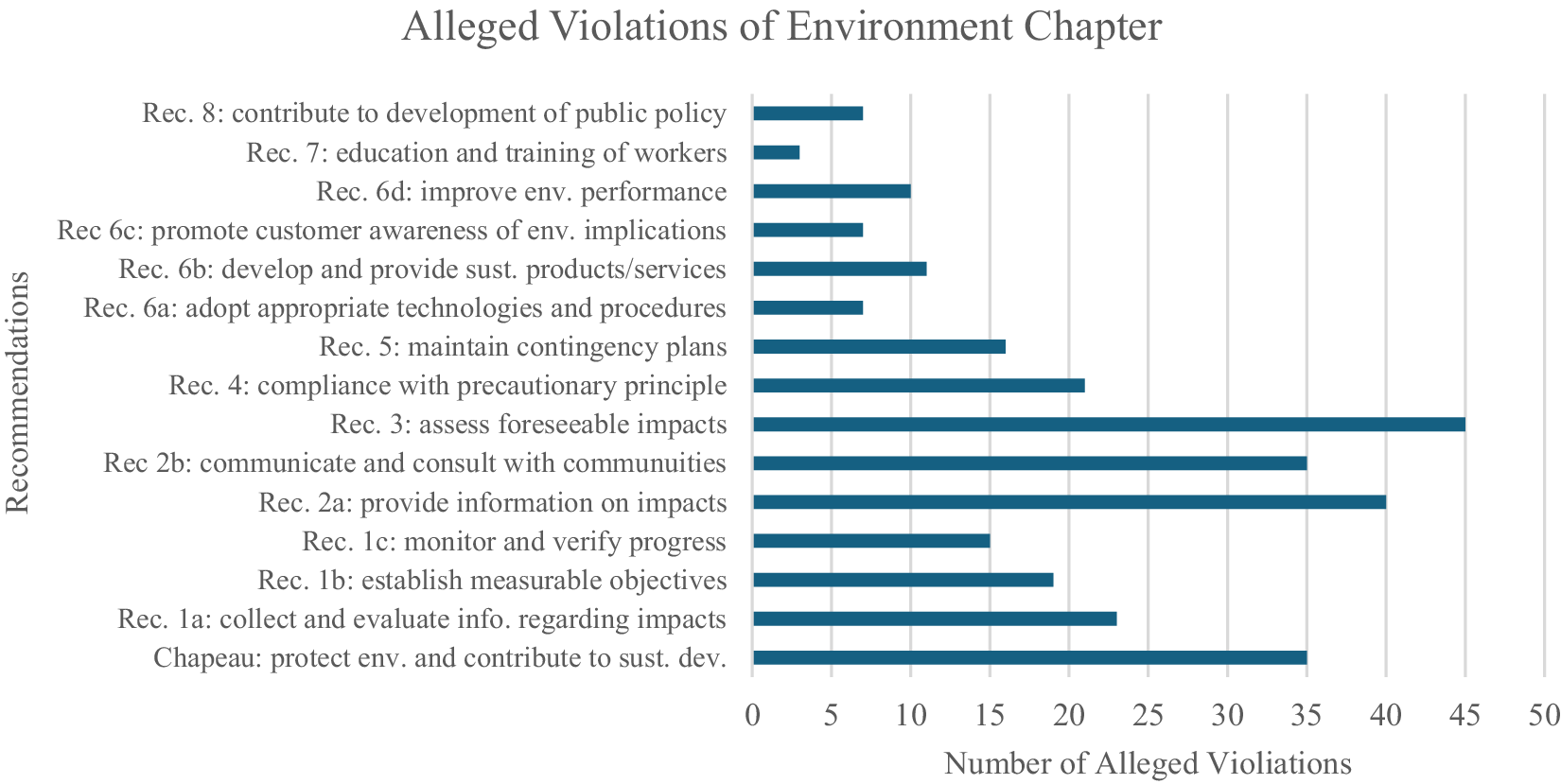
As seen from Figure 2 below, the most common recommendations alleged to have been violated related to assessing foreseeable environmental, health and safety-related impacts (recommendation 3) (45); providing information on potential impacts (recommendation 2(a)) (40); communicating and consulting with communities (recommendations 2(b)) (35); and protecting the environment and contributing to sustainable development (the Chapeau) (35). These comprised more than half of all alleged violations.
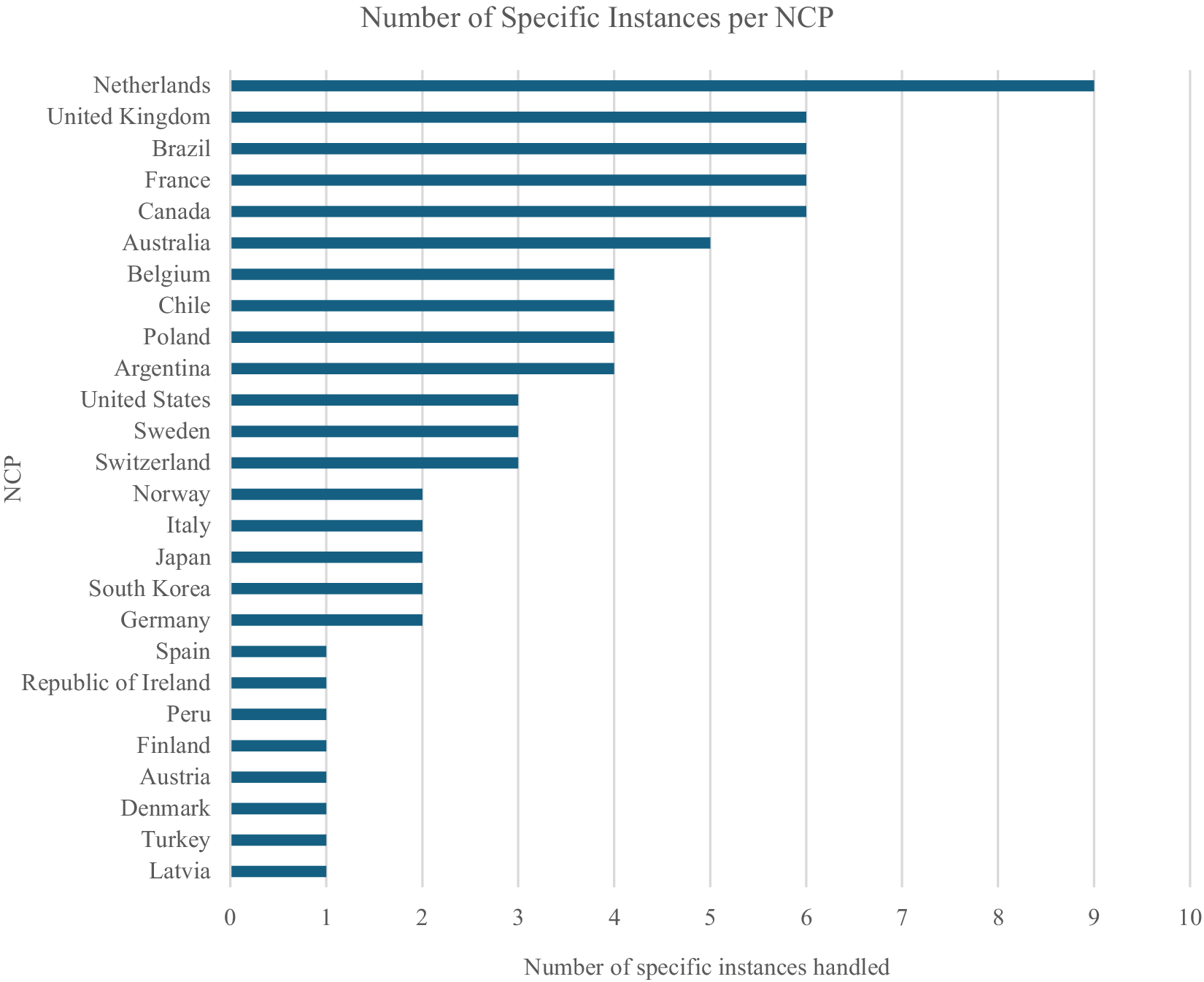
Number of specific instances in the dataset per NCP (2000–2025).

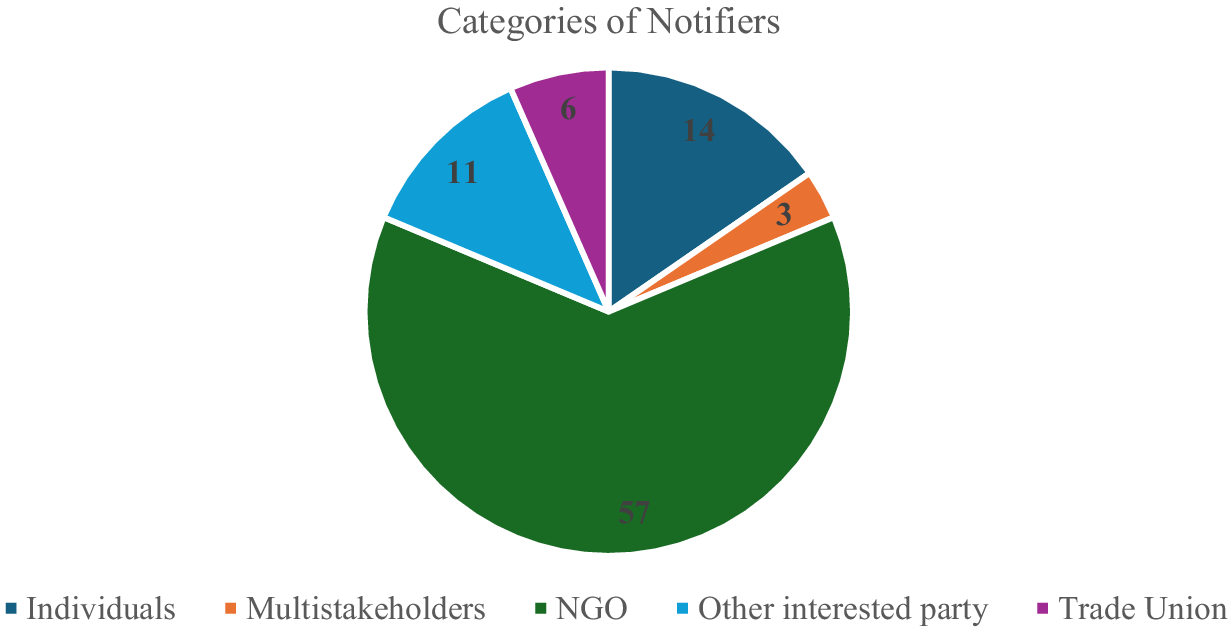
As seen from Figure 3 below, five categories of notifiers submitted specific instances: individual(s) (14); multistakeholder (three); NGO (57); other interested party (eg a law firm) (11); and trade union (six). In nine specific instances, different categories of notifiers collaborated to submit the complaint. Notifiers chose not to engage in good offices in six (7.4%) specific instances and MNEs in 22 (27.2%). This substantiates the OECD’s observation that NCPs ‘faced challenges’ engaging MNEs.Footnote 102 Four dispute resolution techniques were used: bilateral talks (one); conciliation (two); facilitated dialogue (15); and mediation (30). These were facilitated by NCPs (eg as mediator) in 34 and by an independent facilitator (eg private mediator) in 12. The average duration (ie from notification of complaint to publication of final decision) was long at just under 2.5 years (28.7 months).Footnote 103 The 2011 and 2023 Guidelines advise that NCPs should, generally, strive to conclude cases within 12 months.Footnote 104
Categorisation of alleged violations of the 2000 and 2011 Guidelines’ Environment chapter (2000–2025).
Note: Whilst the particular recommendation(s) in the 2000 and 2011 Guidelines’ Environment chapter alleged to have been violated were specified in the vast bulk of initial assessments and/or final decisions, there was a small number: (i) where this did not occur; or (ii) which did not specify relevant sub-sections (ie recommendations 1, 2 and 6). In these cases, the allegations made against the MNE were categorised manually under the most pertinent recommendation(s) (including sub-section(s), where relevant).
Categories of notifiers of specific instances in the dataset (2000–2025).
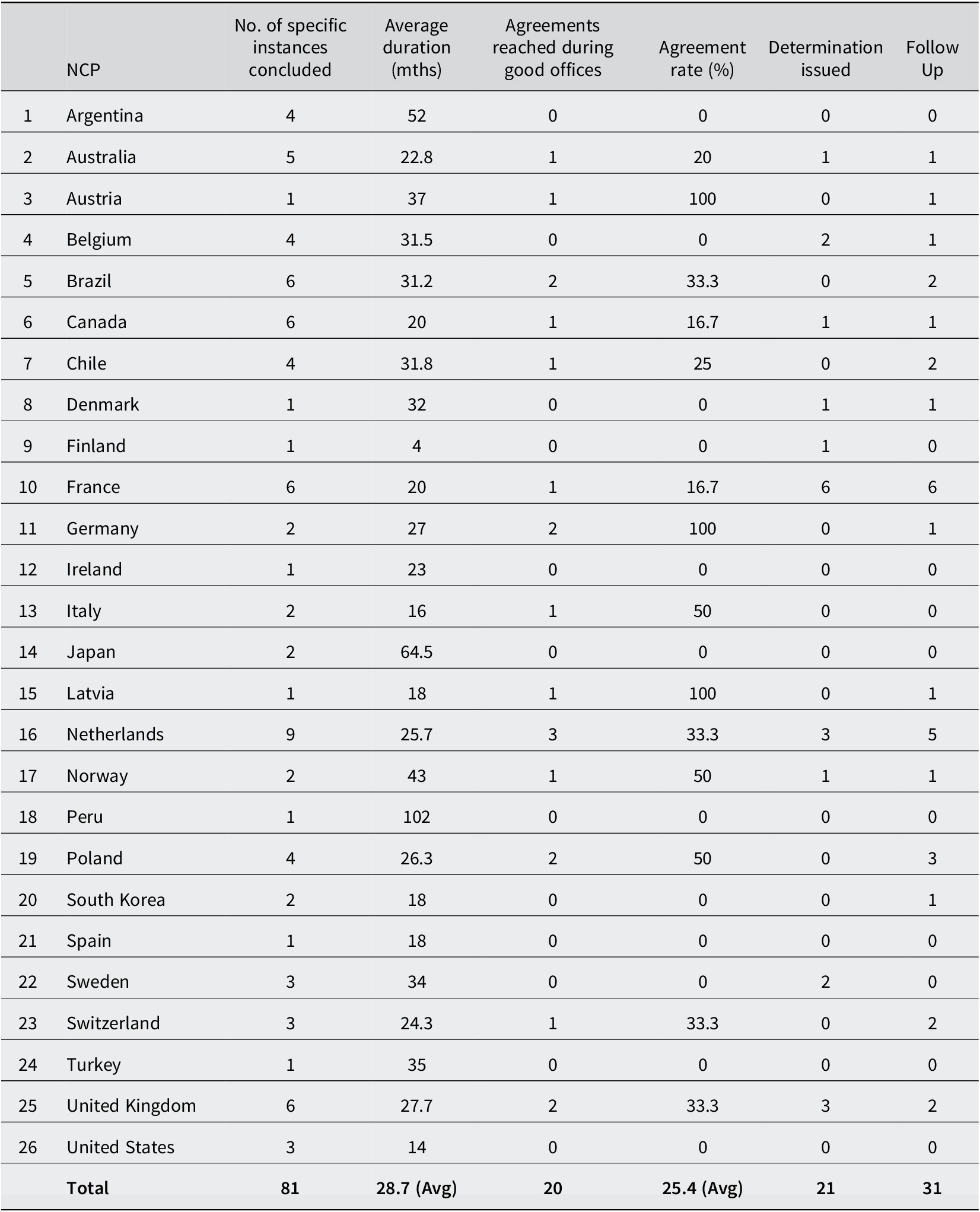
As seen in Table 1 below, agreements were reached during good offices in 20 specific instances (24.7%). Six were partial. In a further eight specific instances, agreements were reached via private negotiations. These were not counted as ‘agreements’, as whilst the notification led to a resolution, this was done privately (and secretly) without the NCP’s oversight and direct influence. These findings may be contrasted with the agreement rate for all specific instances handled by NCPs in 2024, where only 17.2% (5 of 29) resulted in full agreement within the NCP process, with a further two full agreements outside of it.Footnote 105 Thus, full agreement between the parties during good offices is a rarity.
Overview of outcomes of specific instances in the dataset relating to the Environment chapters of the 2000 and 2011 Guidelines (2000–2025)

Recommendations were issued by NCPs in 53 specific instances (65.4%). This is consistent with a 2019 OECD report which found 64% (69 of 108) of specific instances contained recommendations,Footnote 106 but lower than the 70% (17 of 26) issuance rate for NCP activity in 2024.Footnote 107 As seen in Table 1, NCPs followed up on their recommendations in 31 cases (38.3%).Footnote 108 Only 15 reports were available on the OECD database. Three reported full compliance, eight partial compliance and three non-compliance. In one, the NCP made no examination of compliance. These finding are consistent with a recent study of recommendations issued by the Dutch NCP between 2011 and 2021, which found limited or no implementation of recommendations by MNEs in many cases.Footnote 109
(b) Key findings
(i) Determinations
We will now consider how NCPs approached the issuance of determinations in respect of alleged breaches of the Environment chapter. First, they were issued in 21 (25.9 %) specific instances by 10 NCPs, with a finding of observance in nine (42.9%) and non-observance in 11 (52.4%). In a further complaint,Footnote 110 the appropriateness of the MNE’s actions could not be established. Typically, dialogue failed irretrievably before they were issued. The findings align with other studies on their use more generally under the Guidelines. A 2019 OECD report found that, from a dataset of 108 cases between 2011–2018, determinations were issued in 24 (22%).Footnote 111 For all specific instances concluded in 2024, they were issued in five (of 30) (16.7%), with a finding of observance in one and non-observance in four.Footnote 112 We might characterise the discretion to issue determinations as being of a general, binary nature with that decision made in furtherance of a pre-formed judgement of the perceived wider benefits of state intervention in a government-backed informal dispute resolution system.
Secondly, we have a clearer understanding why some NCPs fail to issue determinations. Thirteen NCPs, handling a total of 34 complaints, did not issue them.Footnote 113 That most NCPs do not go beyond a ‘mediation-only’ approach to examine an MNE’s conduct is established in the literature.Footnote 114 What is less well understood is the reasoning deployed for this. The study found that most non-issuing NCPs emphasise their non-adversarial, problem-solving function (or priority) without offering an explicit rationale for not issuing determinations.Footnote 115 Others expressly refuse to issue them. The Brazilian,Footnote 116 South KoreanFootnote 117 and USFootnote 118 NCPs emphasised that they were mechanisms for reaching agreement and so did not make a judgement about an MNE’s conduct. The Japanese NCP did not issue them, as the Guidelines do not require it to.Footnote 119 And the US NCP also asserted that it did not have the legal authority to investigate, prosecute or adjudicate issues submitted to the NCP process.Footnote 120 These perspectives align with the traditional vision of mediation as a voluntary, consensual, problem-solving process.Footnote 121 However, that there are two divergent ideological positions on the proper role of the state is problematic for the entire system’s effectiveness.
NCPs, typically, exercise their discretion to issue a determination upon the failure of good offices. Somewhat of an outlier, the Dutch NCP, which, historically, issues determinations, stated in ING that it would take into consideration ING’s behaviour during (failed) good offices in deciding whether to issue one.Footnote 122 Thus, good behaviour during good offices may negate the bad behaviour that led to the complaint being submitted in the first place. This case-specific discretionary approach may be contrasted with, for instance, that of the UK NCP. Its case handling procedure asserts that where parties are unable to agree on mediation or mediation fails, a determination ‘will’ be issued.Footnote 123 It must, therefore, issue a determination when those circumstances arise, even where an MNE engages in good faith.
(ii) Confidentiality
We move now to consider notifier attitudes to confidentiality during good offices. First, six NCPs reported notifying NGOs refusing to agree to confidentiality.Footnote 124 Typically, this resulted in their withdrawal from the process.Footnote 125 Reasons proffered included confidentiality; obscuring the process’s transparency;Footnote 126 inhibiting freedom of speech;Footnote 127 stifling public debate;Footnote 128 and limiting ability to campaign, a strategy at the ‘heart’ of the NGO’s activity and which it used to achieve its goals.Footnote 129 They appear to view themselves as more powerful (and more comfortable ideologically) outside of the mediation process than within it. Whilst they may desire that the dispute be resolved, their disengagement may be explained by a need to ensure they do not inhibit their ability to pursue legal proceedings or engage in targeted campaigning, whether at that time or in the future.Footnote 130 They may feel forced to withdraw to retain a public voice, uphold their values and remain true to their strategies.Footnote 131
Secondly, in nine final decisions, despite strong messaging around the importance of maintaining confidentiality, NCPs reported confidential mediation communications being intentionally disclosed by notifying NGOs.Footnote 132 This reinforces the OECD’s observation that confidentiality in relation to campaigning during specific instances is an ‘ongoing challenge’ for NCPs.Footnote 133 These disclosures may be: (i) part of a deliberate strategy from the outset; or (ii) a consequence of a frustration with the process, trajectory of negotiations and/or the MNE’s behaviour during them. In terms of (i), NGOs may be using good offices as a ‘fishing expedition’,Footnote 134 a strategy NCPs are aware of and advise notifiers against pursuing.Footnote 135 A notifier may recognise, prior to submitting the complaint, that legally sensitive information could be disclosed by the MNE in an attempt to settle, which may be used in ongoing campaigning and/or to commence legal proceedings.Footnote 136 They may then seek to ‘try the case in public’ by bringing this information into the public realm.Footnote 137 The resulting media attention may be harnessed by the NGO to help realise their objectives.Footnote 138 The NCP process affords a high profile, public platform from which to maximise publicity for their activities and NGOs will be acutely aware of this potential.
(iii) Temporal focus
We now consider the temporal focus of the NCP specific instance procedure. First, in 19 (23.5%) specific instances NCPs emphasised the procedure’s ‘forward-looking’ problem-solving focus, considering it beyond their role to investigate past practices of MNEs.Footnote 139 In Van Oord,Footnote 140 the MNE imposed a forward-looking temporal limitation through its threat to abstain from engaging in good offices. Usually, it was the NCP that imposed it. OECD guidance may have informed this practice. A guidance document for NCPs on the issuance of recommendations and determinations asserts that ‘[t]he specific instance procedure provides a consensual, non-adversarial, forward-looking “forum for discussion” for issues that arise relating to implementation of the Guidelines’.Footnote 141 It cites Section 1C of the Procedural Guidelines to the (old) 2011 Guidelines to substantiate this. Neither this nor the 2023 Guidelines refer to the process being solely forward-looking. Thus, not only is this temporal limitation not required by the Guidelines, but it also appears to be entirely inconsistent with their ambitions, more on which is said below.
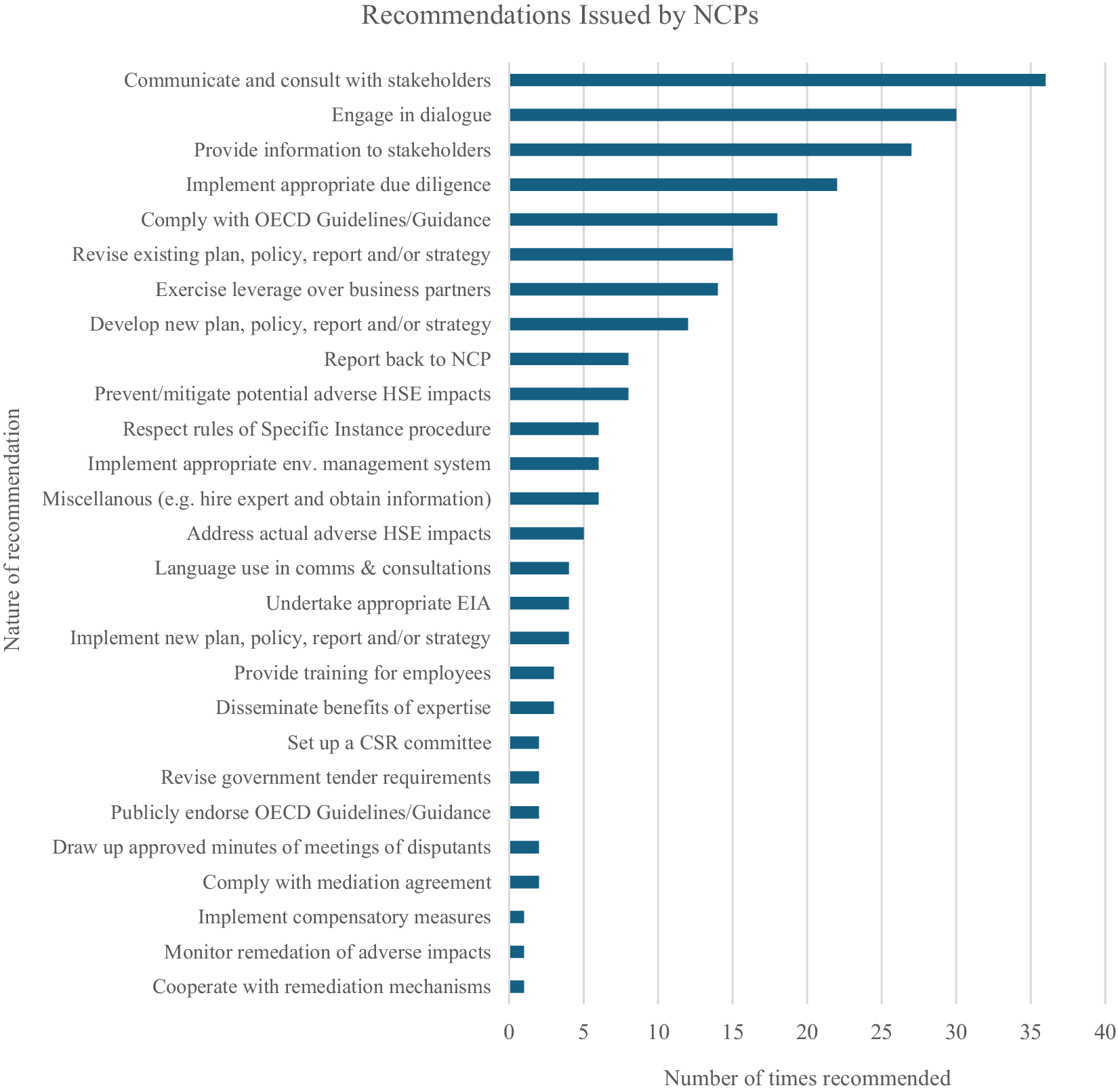
Secondly, virtually all the recommendations issued by NCPs are ‘forward-looking’, with communicating and consulting with communities, engaging in dialogue and providing information to stakeholders prevalent (see Figure 4 below). Whilst, if performed, such changes may prevent future harms arising and so can function as a form of remedy,Footnote 142 they fail to address harm that has already occurred.Footnote 143 Of the 244 (sub)recommendations in the dataset,Footnote 144 only five relate to addressing actual adverse health, safety and environmental impacts (ie through remediation, such as clean-up or provision of compensation).Footnote 145 That NCPs principally adopt a forward-looking approach aligns with the findings of a large 2015 study (n=250) of the approach of NCPs across all chapters of the Guidelines.Footnote 146 It may, once again, be the guidance issued by the OECD for NCPs that has influenced this practice. The OECD asserts that a ‘strength’ of recommendations is that they are ‘forward-looking’.Footnote 147 This temporal restriction is, however, not set out anywhere in the Guidelines, the Procedures, nor their earlier versions.
Recommendations issued by NCPs ordered according to their nature.
Note: Often there was more than one (sub) recommendation within a single formal recommendation. Where this occurred, the formal recommendation was broken down into is constituent sub-recommendations. There were 244 sub-recommendations in total.

Several NCPs emphasise the limited role they believe they play in providing backward-looking recommendations (eg address actual adverse impacts). In Pöyry, the Finnish NCP stated that it was not within its competence to issue recommendations pertaining to the mitigation of damage already caused by an MNE or the provision of compensation for actual damage caused, as it functions as a ‘negotiation and arbitration body’.Footnote 148 The inference appears to be that it is unwilling to issue such backward-looking recommendations as this would be akin to deciding on legal liability, something that the Guidelines do not provide for.Footnote 149 There will certainly be a cost associated with complying with such recommendations, but it is entirely misconceived to conflate them with a determination of liability.
4. Discussion
This section explores three themes of focus in the study: issuance of determinations; confidentiality; and temporality. I begin by laying a theoretical foundation for each. This facilitates deeper understanding of the wider implications of the findings. I propose recommendations for reform in the following section.
(a) Issuance of determinations
The findings illustrate divergence of practice amongst NCPs in the use of the power to issue determinations. We shall see that whilst the power enables a state to exert influence over negotiations through conferring ‘bargaining chips’ on the parties, if some NCPs refuse to issue them, a lack of parity in the treatment of disputes and disputants emerges, creating inequity and inhibiting the system’s effectiveness.
(i) The shadow of the state
In their seminal paper, Mnookin and Kornhauser contend that parties do not bargain to resolve their disputes ‘in a vacuum’ but do so in the ‘shadow of the law’.Footnote 150 The outcome likely to be imposed by a judge should the parties not reach agreement and the matter proceeding to court gives each party ‘bargaining chips’.Footnote 151 The term ‘shadow’ is used here as a metaphor for the influence of the predicted judicial decision on private ordering. For Harrison, environmental mediation often takes place in the shadow of the law, as the parties know that ‘in the absence of a settlement there will be an administrative, quasi-judicial or judicial determination in accordance with law …, even if the precise outcome is uncertain’.Footnote 152 He connects the shadow cast by such a determination (broadly conceived) to the balance of bargaining power between the parties, observing that the law provides ‘regulatory mechanisms’ (or, per Mnookin and Kornhauser, allocates bargaining chips to the disputants) that ‘restrain or moderate the exercise of unequally distributed power in society’.Footnote 153 Thus, for Harrison, the very possibility for a determination to be made may enable the weaker party to bargain with the stronger one on a more equal footing. And for Luban, it may help ‘break deadlocks’ between the parties.Footnote 154 There will, in contrast, be no shadow within which to bargain where a determination will not be issued should negotiations fail.Footnote 155
A variety of factors can influence the role and importance of the law’s shadow for bargaining. Crowe et al observe that factors such as power imbalances, experience and (lack of) access to legal advice affect the ability of a party to bargain ‘effectively and strategically’ in the law’s shadow.Footnote 156 For Bibas, ‘legally irrelevant factors’, such as ‘[s]tructural forces and psychological biases’ can ‘prevent mutually beneficial bargains or induce harmful ones’.Footnote 157 ‘[B]luffing, puffery, fear, and doubt’ can also hinder bargaining.Footnote 158 Where each side sees a ‘different, distorted shadow’ they may fail to settle even where this would be in their best interests.Footnote 159 However, sound legal advice may mitigate this prospect.Footnote 160
Traditionally, ‘shadow effects’ are associated with ‘judicialized governance’.Footnote 161 However, similar effects may flow from the power of NCPs to issue determinations.Footnote 162 I consider this part of the state’s shadow rather than the law’s owing to the power’s discretionary basis. When an NCP’s general discretion is exercised in the affirmative, as per the UK NCP, the power casts a potentially influential shadow over the negotiations. In terms of its shadow effects, a finding of non-observance can generate an array of negative ‘costs’ for MNEs. For EU-headquartered MNEs, their activities will be deemed environmentally unsustainable for the purposes of the EU taxonomy.Footnote 163 This could prompt an investor to divest their investment in the MNE and move their funds to a more responsible business.Footnote 164 And where, as in BTC, an MNE provides contractual assurances under its loan agreement(s) that their operations will observe a particular legal framework (eg the Guidelines), they will be in breach of contract should they be found to violate it.Footnote 165 An adverse determination may also expose MNEs to reputational costs,Footnote 166 with Lott et al evidencing empirically that being investigated or charged with environmental violations resulted in an ‘economically meaningful’ decrease in a firm’s share value.Footnote 167 Whilst MNEs may incur such costs differently, a finding of non-observance may reasonably be expected to have a similar impact. It may also result in an MNE being excluded from government tenders.Footnote 168
Thus, where sufficient negative costs can be mobilised, issuance of a determination by the state affords a means of controlling and steering the behaviour of MNEs towards an ideal (eg compliance with the Guidelines) and generating accountability in respect of their failure to adhere to it.Footnote 169 Indeed, Otteburn, in a recent empirical study of alleged breaches of the Guidelines’ Human Rights chapter, found that the power to issue a determination was ‘a crucial component of the institutional design for access to effective remedy’, with absence of this mandate ‘frequently lead[ing] to no remedy’.Footnote 170
(ii) Implications
The findings have implications for the efficacy of mediation-based governance. First, whilst the prospect of a legal determination confers a shadow in which the parties can bargain,Footnote 171 the strength of shading cast by the power for an NCP to issue a determination will depend upon how that NCP exercises its general and, where relevant, case-specific discretion. If an MNE knows that the power is available to the NCP under its case-handling procedure, will be used by it, and expects to be impacted negatively (hurt) by an adverse determination, the shadow cast will be strong and may incentivise the MNE to search more meaningfully for agreement.Footnote 172 Conversely, the strength of the shading will weaken where there is uncertainty as to whether the power will be used and it will disappear entirely where an NCP refuses to invoke it. This will reduce notifier bargaining power, weakening their ability to reach agreement.Footnote 173 Moreover, where MNEs predict no NCP interference, non-observance of the Guidelines, and non- or weak engagement with good offices, can be expected to continue, if not escalate as few MNEs will acknowledge their responsibility independently of a determination.Footnote 174 Whilst state discretion in setting up NCPs is broad,Footnote 175 divergence of practices amongst NCPs as to the issuance of determinations runs counter to the principle of functional equivalence set out in the Procedures.Footnote 176 At present, disputes (and disputants) are being treated unequally, an observation that is levelled against the wider NCP system.Footnote 177
Secondly, we may expect notifying NGOs to be selective in respect of the NCP to be targeted, raising difficulties in relation to consistent deployment of this mode of governance across the globe and parity between respondents across states. With the exception of Brazil, NCPs that issue determinations handle the greatest number of complaints (see Table 1). I cannot evidence that they receive a high number of complaints because they issue determinations. Nevertheless, the prospect of their issuance may be expected to be an attractive pull for notifiers.Footnote 178 MNEs located in jurisdictions where the NCP issues determinations may be expected to receive greater attention from notifiers compared to those headquartered in countries where they are not issued.Footnote 179 Thus, respondents based in the latter escape scrutiny, unlike those in the former. MNEs in states that issue them will be at a competitive disadvantage to those in states that do not, owing to the higher compliance costs associated with avoiding an adverse determination.Footnote 180 Discretionary power is unlikely to facilitate consistency of practice amongst NCPs.Footnote 181
Thirdly, when an NCP exercises its general discretion to issue a determination in the affirmative, as per the UK NCP’s approach, notifying NGOs may be incentivised to fail to reach a mediated agreement, particularly where the settlement would require them to compromise their values. This is borne out by the study which found that the average agreement rate for NCPs that issue determinations was nearly half the average agreement rate for those that do not. The legal mobilisation literature tells us that the features of a legal/judicial system (or legal opportunities) can shape the likelihood and outcomes of the mobilisation of law by NGOs.Footnote 182 The prospect for an adverse determination to be issued, and the negative ‘costs’ that it can generate for an MNE, may be characterised as such a feature.Footnote 183 Where the parties fail to reach agreement, NCPs that issue determinations are freed to decide on observance. Recognising different NGOs may have varying objectives and differ in the tactics they deploy to achieve these (eg lobbying or litigation);Footnote 184 a finding of non-observance may generate greater impact than reaching a ‘secret’ agreement, particularly in relation to providing moral vindication.Footnote 185 This may, in fact, be success in their eyes.Footnote 186 It is, therefore, mistaken to equate a low agreement rate with a low rate of success. For some, mediation is (quite intentionally) destined to fail from the outset.
(b) Confidentiality
We saw that confidentiality proved controversial for notifying NGOs, with some refusing to agree to it and others deliberately breaching it. This is problematic, as confidentiality is essential to build trust between disputants, a step crucial to reaching a mediated agreement.Footnote 187 If notifying NGOs are unwilling to agree to it/respect it if it hinders their campaigning and free speech, then this will erode trust.
(i) Confidentiality as a trust substitute
Mediation is, generally, offered on the basis that what the parties discuss is both confidential and unavailable for use in future court proceedings.Footnote 188 Confidentiality is one of mediation’s ‘fundamental and universal’ characteristics,Footnote 189 with its importance emphasised under the Guidelines. The Commentaries assert that ‘good faith’ engagement in proceedings is ‘expected’, with ‘maintaining confidentiality where appropriate and consistent with the NCP’s case-handling procedures’ a crucial aspect of this.Footnote 190 NCPs may seek written assurance from the parties that confidentiality will be maintained.Footnote 191 And under the Procedures, parties must not ‘disclose publicly or to a third party … facts and arguments shared by the other parties or the NCP (including where relevant by an external mediator or conciliator) during the proceedings’.Footnote 192 Similar statements existed in the 2000 and 2011 Guidelines.
Confidentiality is considered ‘critical’ to effective mediation.Footnote 193 It is said to give comfort to the parties that they can engage in frank and open discussions without fear that what they say will be disclosed and used against them,Footnote 194 whether in parallel or subsequent litigation or to the press/public.Footnote 195 For instance, an offer made by an MNE in a genuine attempt to settle could be heralded as an admission of guilt/wrongdoing and used to cast it in an unfavourable light.Footnote 196 As confidentiality deprives parties of the ability to use mediation communications to the detriment of the other, it paves the way for more meaningful, open interactions.Footnote 197 Candour is deemed crucial to reaching settlement in mediation for it heightens the prospect of parties discovering opportunities for agreement.Footnote 198 In mediation, they will be asked to identify the spectrum of their needs and interests, which is likely to require divulging sensitive (and potentially self-damaging) facts.Footnote 199 There is a tension as when parties reach mediation their relationship is often marred by animosity and distrust.Footnote 200 Most specific instances have a history pertaining to the MNE’s conduct or are part of an NGO’s ongoing campaign.Footnote 201 The longer the history, the wider the trust deficit. Often lack of trust, and the failure to communicate that flows from this, prevents disputes being resolved.Footnote 202 An assurance of confidentiality made by both parties is, however, said to ‘reduc[e] the risks and uncertainties associated with trusting’, enabling the parties to ‘participate more fully in mediation even if their levels of interpersonal trust are low and their levels of distrust are high’.Footnote 203
For Deason, though, confidentiality ‘is, and should be, controversial’ for it often competes with important values that may be better served through reporting a party’s conduct.Footnote 204 Mediation’s confidentiality shields MNEs from public scrutiny.Footnote 205 An MNE that wishes to cover up the adverse impacts its activities have caused or may cause in a host country (eg through an oil spill) may choose to mediate any associated dispute to benefit from confidentiality and so prevent public disclosure of legally significant and/or reputation-damaging facts.Footnote 206 When such disputes settle, the true costs to the host state’s environment and citizens – the negative externalities caused by the MNE – remain hidden.Footnote 207 Thus, confidentiality enables MNEs to retain control of a dispute (and, crucially, the facts that underlie it) to the potential detriment of affected stakeholders and, indeed, society more broadly.Footnote 208 This merely reinforces the fact that mediation is a ‘private’ process, not one played out in a public forum.Footnote 209
(ii) Implications
The findings have implications for the efficacy of mediation-based governance. First, if NGOs, the most common notifier of complaints under the Environment chapter by some margin and key third-party ‘enforcers’ of environmental law,Footnote 210 are unwilling to agree to mediation confidentiality, opportunities for legal mobilisation raised by the NCP system contract. Fewer complaints will be submitted and/or proceed to full assessment, with the consequence that there will be fewer opportunities to invoke mediation-based governance. We may understand legal mobilisation as encompassing ‘any process by which individuals or collective actors invoke legal norms, discourse or symbols to influence policy or behaviour’.Footnote 211 The NCP system does, of course, enable actors, such as NGOs, to invoke legal norms set out in the Guidelines with a view to influencing MNE behaviour. This may be characterised as an ‘insider’ strategy, for it enables NGOs to ‘target’ decision-makers (ie NCPs) ‘directly’ and comprises exchange of ‘policy-relevant information’,Footnote 212 specifically evidence supporting the allegation(s) of non-observance. This may be contrasted with an ‘outsider’ strategy, which comprises use of protests and campaigning ‘to generate pressure on power-holders indirectly by appealing to the public at large’.Footnote 213 By requiring parties to adhere to confidentiality, insider strategies may no longer be a viable mobilisation strategy for NGOs who feel MNEs should not avoid public scrutiny of their adverse impact-causing activities by engaging in mediation. Structured opportunities for MNE ‘mentalities’ to be (re)shaped by the state and, in turn, ensure pursuance of more sustainable development by MNEs, are lost as a result.
Secondly, whilst breaching confidentiality may generate a short-term benefit for the disclosing NGO in terms of heightened public profile and impact of, say, its outsider strategies, through its erosion of trust it dilutes the power of future notifiers and worsens the prospect for them to resolve their disputes. MNEs are likely to refuse to engage in the process, fearing it is just not worth the risk.Footnote 214 Even if they do grudgingly agree to participate to pacify an NCP, caution in negotiating generated by the threat of disclosure by the NGO will likely render the process a ‘pro forma nullity’.Footnote 215 With a 27.2% MNE non-engagement rate, the NCP system is already failing to engage many. The well-recognised risk (and reality) of notifying NGOs breaching mediation confidentiality will probably not be helping this. Whilst MNE non-engagement does not preclude the operation of mediation-based governance, as NCPs may choose to issue recommendations and/or a determination, the prospect for agreement falls away entirely.
The efficacy of mediation-based governance hinges upon confidentiality being agreed to and maintained by NGOs.Footnote 216 Where they are unwilling to do so, the mediation process becomes a ‘house of cards subject to complete disarray’Footnote 217 and its capacity to govern efficaciously collapses entirely.
(c) Temporal focus
We saw that, in essence, most NCPs adopt a purely ‘forward-looking’ approach. Whilst this might engage otherwise recalcitrant MNEs, it absolves them from responsibility for past harms and leaves actual adverse impacts unaddressed and unpriced, moving us some distance from the normative ideal.
(i) Prospective responsibility
An important judgement that an NCP must make relates to the procedure’s temporal focus, that is whether it is ‘forward-looking’ (seeking to bring respondents into compliance in the future), ‘backward-looking’ (examining the accuracy of the allegations and responsibility for past harms) or both. The study exposes NCPs as adopting mainly a ‘forward-looking’ (future-orientated) focus. I term this temporally skewed normalisation. The norm against which MNEs are being normalised is that of a private actor that is neither asked nor expected to address the actual adverse impacts caused by their activities.
The literature on prospective (legal) responsibility, as articulated by Feinberg and by Cane, helps illustrate why temporally skewed normalisation is problematic. For Feinberg, when we ascribe prospective responsibility, we mean that if some (future) event fails to occur then the person judged responsible for it at the outset ought to be the proper subject of other judgements, such as blame.Footnote 218 Those judgements are made retrospectively.Footnote 219 The idea of duty is important to Feinberg. He asserts that, ‘our duties are to obey rules or authoritative commands’.Footnote 220 These duties are to be taken seriously as ‘standards of behaviour’ and their dereliction is ‘morally or legally wrong, not merely imprudent or expensive’.Footnote 221 To say someone is ‘responsible’ for doing something in the future, means that they are subject to a ‘prospective liability’.Footnote 222 If judged responsible for failing to perform it, that for which they are ‘liable’ becomes real and a sanction (eg blame or condemnation) ought to be forthcoming.Footnote 223
Cane takes forward the twin-facing nature of legal responsibility. He sees ‘[i]deas such as accountability, answerability and liability’ as ‘look[ing] backwards to conduct and events in the past’ and ‘form[ing] the core’ of what he terms ‘historic responsibility’.Footnote 224 In contrast, ‘ideas of roles and tasks look to the future, and establish obligations and duties’, what he terms ‘prospective responsibilities’.Footnote 225 Like Feinberg, he observes that ‘[a] person under a legal duty has a prospective responsibility to fulfil that duty, and can be held historically responsible for failure to do so’.Footnote 226 For Cane, historic responsibility ‘enforces, reinforces and underwrites prospective responsibility’ and is ‘not an end in itself’.Footnote 227 Its role is to help ‘maximiz[e] compliance’ with prospective responsibilities.Footnote 228
We may draw upon the Guidelines for illustrative purposes. The need for adverse impacts, actual and potential, to be addressed may be conceptualised as a socially and environmentally important responsibility ascribed to both MNEs and NCPs. When we say that each party is responsible in this way, we mean that they are ascribed a prospective responsibility – a duty – they ought to discharge.Footnote 229 We see this logic in Atradius, where the Dutch NCP asserted that MNEs have a ‘duty’ to comply with the Guidelines.Footnote 230 The Guidelines may be deemed to set out a series of tasks to be performed by MNEs. In line with Cane’s logic, these create duties (or prospective responsibilities) to be discharged by them.
To deal with the duty of MNEs first, the Environment chapter of the 2023 Guidelines is explicit in recommending that MNEs address their adverse impacts. For instance, MNEs are to provide for, or co-operate in, ‘remediation as necessary to address adverse environmental impacts the enterprise has caused or contributed to’.Footnote 231 And the Commentary to the chapter asserts that ‘environmental management’, a phrase the Guidelines emphasise embodies activities aimed at ‘addressing environmental impacts related to an enterprise’s operations, products and services’Footnote 232 is ‘a ‘business responsibility’.Footnote 233 Under the 2011 Guidelines, the recommendation that MNEs ‘address’ adverse impacts on matters covered by the Guidelines (eg the environment) caused by their activities ‘when they occur’ was contained in Chapter II General Principles.Footnote 234 Its Commentary stated that ‘actual impacts are to be addressed through remediation’.Footnote 235 The 2000 Guidelines were silent on addressing impacts, though they did recommend that MNEs ‘conduct their activities in a manner contributing to … sustainable development’.Footnote 236 Thus, in total, a guiding norm (or ideal) against which MNEs ought to be normalised is that of a private actor that addresses their actual and potential adverse environmental impacts.
In terms of the duty of NCPs, the 2023 Guidelines confer discretion upon them to determine the aim of the assistance they provide to the parties to resolve the dispute. Two aims include ‘furthering the implementation of the Guidelines in the future and/or addressing adverse impacts in a way consistent with the Guidelines’.Footnote 237 And the role of NCPs includes ‘creating conditions for dialogue and agreement between the parties around a commitment by the enterprise to … address … adverse impacts that may have occurred’.Footnote 238 Thus, whilst there is no explicit statement that NCPs must ensure MNEs address their actual adverse impacts, doing so ought to be prominent in the minds of NCPs. Actual adverse impacts are negative externalities and states have the power and, indeed, responsibility to ensure these are internalised by the MNEs that caused or contributed to them. The need for NCPs to adopt a backward- and forward-looking temporal focus to their normalising judgement is essential to facilitating this goal.
(ii) Implications
The findings have implications for the efficacy of mediation-based governance. First, temporally skewed normalisation releases respondent MNEs from (historic) responsibility for past harms, leaving actual adverse impacts unaddressed and unpriced. This is problematic for two reasons. The first is that, as Cane asserts, historic responsibility is imposed, principally, to maximise the prospect of prospective responsibilities being performed in the first place.Footnote 239 In failing to impose it, incentives to undertake duties imposed by the Guidelines are attenuated and their effectiveness eviscerated.Footnote 240 This jeopardises the integrity of the environment, places the health and safety of the public at risk and stores up problems for existing and future generations.Footnote 241 The second is that it conveys a dangerous message to industry: rather than it being the ‘responsibility’ of MNEs to address adverse impacts caused by their activities,Footnote 242 the costs of doing so fall to society and the environment itself. This is contrary to the economic logic of the polluter-pays principle which the OECD originated more than fifty years ago.Footnote 243 The principle, as articulated by the OECD, holds that polluters should bear the costs of pollution prevention and control measures (including restoration) decided by public authorities to ensure the environment was in an ‘acceptable state’.Footnote 244 The cost of these measures was to be ‘reflected in the cost’ of goods and services that cause pollution in production and/or consumption (ie internalised).Footnote 245 They were not to be subsidised by the state where this would have the effect of creating ‘significant’ distortions in international trade and investment.Footnote 246 An important extension to the principle was made by the OECD in 1989, whereby the costs of reasonable measures to prevent and control accidental pollution were also to be attributed to polluters.Footnote 247 In contrast to the logic of cost internalisation emphasised by the OECD, temporarily skewed normalisation masks the true cost to society of the respondent MNE’s production of its goods or services, with the externalised costs operating as an indirect subsidy and affording it an inequitable advantage in international trade and investment.Footnote 248 Through its deployment, NCPs risk perpetuating the (re)formation of mentalities entirely inconsistent with the Guidelines’ aims and the venerable normative ideals reflected in them.
Secondly, temporally skewed normalisation reinforces patterns of inequality within and between richer and poorer countries.Footnote 249 It results in economically developed home states failing systematically to recommend that MNEs trading in economically challenged host states address adverse impacts caused there. Despite ostensibly remaining neutral, NCPs are indirectly augmenting the position of powerful MNEs and exhibiting bias against the environmental interests of host states.Footnote 250 This is evidence of a situation where the ‘political jurisdiction’ of the state ‘is narrower than the scope of the environmental disputes they face’.Footnote 251 Whilst, as we have seen, NCPs have powers to incentivise the engagement of MNEs, the NCP specific instance procedure is voluntary, meaning their participation cannot be mandated. In operationalising temporarily skewed normalisation, states seem to be making a pre-emptive concession – an amnesty of sorts – in an attempt to neutralise ‘fundamental social conflict’.Footnote 252 Such conflict is unlikely to be resolved – and so is ‘dangerous’ – as it ‘oppose[s] the individual to state or capital’.Footnote 253 Attempts by NCPs to impose historic responsibility for breaching the Guidelines may, for MNEs, be considered ‘obstructive to achiev[ing] settlement’ and something for mediators to ‘neutralise’.Footnote 254 For Abel, the most significant way this is done is ‘denying redress’ by refraining from using powers the institution professes to possess.Footnote 255 Failing to recommend adverse environmental impacts caused by an MNE’s operations be addressed, when empowered to under the Guidelines, is a way of achieving this. It does, however, exacerbate environmental degradation within economically challenged host states.
Temporarily skewed normalisation, and the forward-looking remedies it can facilitate, may operate ‘as a hedge to avoid all-out defeat’ for notifiers and can help to realise some of the strengths associated with mediation articulated at the outset of this paper.Footnote 256 However, remedying harm caused by economic activity is key to the idea of business responsibility and pursuit of sustainable development espoused by the Guidelines and ought to be understood as core to any substantive remedy for notifiers.Footnote 257
5. Reform
This section sketches three proposals to address the implications raised in the previous section. First, notifiers ought, upon submitting the complaint, to be able to select which procedure they wish to utilise, with choices including: (i) mediation-only; (ii) issuance of a determination upon mediation failing or the MNE not engaging; or (iii) issuance of a determination with no mediation. This has certain benefits. The first is that option (ii) enables the state to cast a reliable and predictable shadow over the negotiations, rebalancing bargaining power more equitably between the parties.Footnote 258 This improves access to remedy for reasons detailed above.Footnote 259 The second is that the prospect of MNEs experiencing negative costs in the event of an adverse determination under (ii) and (iii) affords a means of generating accountability for breaching the Guidelines.Footnote 260 The key is fostering a culture of negative cost creation by the public and private sector, such as precluding MNEs subject to adverse determinations from government tenders and encouraging lenders to include terms in loan agreements requiring compliance with the Guidelines. This enhances the depth of shading afforded by the power and incentivises more responsible conduct.
Secondly, with options (ii) and (iii), a determination ought not be issued if the confidentiality of the NCP process is breached by a notifier. Three pathways for notifiers may help uphold the importance of maintaining confidentiality and, in turn, the creation of trust so central to the efficacy of any alternative dispute resolution system.Footnote 261 Only those who genuinely want to mediate proceed to mediation and so we may expect them to be willing to uphold confidentiality. Those wishing to harness ‘outsider’ strategies (eg campaigning) to achieve their objectives may select option (iii). Option (i) retains the risk of confidentiality being breached by NGOs to further their ‘outsider’ strategies. However, MNEs will likely refuse to engage should this regularly prove to be the case. In turn, we may expect this to correct notifier behaviour.
Thirdly, for options (ii) and (iii), ‘forward-’ and ‘backward-looking’ recommendations ought to be issued by NCPs. Recommendations are not appropriate for option (i), as this would interfere with the process’s confidentiality. Their issuance is most pertinent where non-observance is established. They ought to focus on correcting the area(s) where non-observance was identified. Recalling the shading provided by the power to issue determinations, the specific instance procedure’s temporal focus should, at the very least, be a negotiable issue in utilising options (i) and (ii). Failing to do so will make it near impossible for NCPs to meet the strategic aims of many NGOs, a key third-party enforcer of the Guidelines.
Conclusion
This paper sought to provide novel empirically grounded insights into the efficacy of mediation-based governance in the context of environmental disputes. It found that the empirical reality exposes tensions inherent in this mode of governance, which present both challenges and opportunities for it: (in)consistency in the state’s influence over negotiations; background levels of (dis)trust between disputants; and (future-orientated) temporal focus. If these are not addressed, the findings indicate that mediation-based governance will, despite its theoretical appeal, be unable to realise wider political aims. Indeed, there is a risk that in deploying this mode of governance, state-based non-judicial grievance mechanisms will perpetuate the (re)formation of mentalities entirely inconsistent with the aims of the applicable legal framework and the normative ideals reflected in it. In the context of this study of the practices of NCPs, this was seen most clearly in the dominant ‘forward-looking’ temporal focus of the complaints-handling process. This was found to absolve respondent MNEs from responsibility for past harms and leave actual adverse impacts unaddressed and unpriced, contrary to the logic of the polluter-pays principle originated by the OECD. Sustainable development and business responsibility for adverse impacts are not goals that should be delegated by the state to private parties to address through state-facilitated bargaining; private interests are too firmly ingrained and prevailing power structures in society too dominant for this mode of governance to protect and preserve aims of such a public character.



 Open access

