


On a cold, dry day in November 2021 in Warsaw, Poland, by the entrance to a luxurious office building in the city center, we stumbled upon a group of activists writing accusatory slogans on the pavement on our way to interview a think tank based in the building. The contrast between these activists outside and the seemingly unaffected think tankers, dressed in well-cut suits, inside the polished office, was stark. Earlier that week, during an interview with another think tank, when we explained that we planned to meet with both pro- and antigovernment organizations, we heard “Why would you want to talk to them?! They should be put in jail!” It is rather uncommon for think tanks to express such strong reactions even though many would see them as divisive. Are think tanks victims or culprits in polarization?
Polarization is a phenomenon that has been extensively studied across various disciplines. It is usually defined as a division into two sharply contrasting groups, which might take the extreme form of antagonism between Us and Them, where the other group is perceived as an existential threat (McCoy, Rahman, and Somer Reference McCoy, Rahman and Somer2018). However, there are still some overlooked areas that should be highlighted in the study of polarization, in terms of both a theoretical understanding of the phenomenon and an empirical focus. In this paper, we help increase the understanding of polarization processes by focusing on organizations that do research, analysis, and communication for policy development (Stone Reference Stone2013, 64). These organizations, which we term think tanks, similar to other mesolevel actors, have been largely overlooked in research on polarization, which tends to focus on the macrolevel (mostly political parties and, to a lesser extent, media) or the aggregated microlevel (voters) (e.g., Abramowitz and Saunders Reference Abramowitz and Saunders2008; Esmer Reference Esmer and van Beek2019; Graham and Svolik Reference Graham and Svolik2020; McCoy, Rahman, and Somer Reference McCoy, Rahman and Somer2018; McCoy and Somer Reference McCoy and Somer2021; Somer, McCoy and Luke Reference Somer, McCoy and Luke2021; Svolik Reference Svolik2019; Vachudova Reference Vachudova2019). Apart from incidental comments about polarization trickling down to various forms of groupings, little is known about how mesolevel actors contribute or react to polarization (Rahman Reference Rahman2019; Özler and Obach Reference Özler and Obach2018; Roggeband and Krizsán Reference Roggeband and Krizsán2021; Ivanovska Hadjievska Reference Ivanovska Hadjievska2022). We study how mesolevel actors are implicated in polarization, as well as how they prompt depolarization. Hence, we ask the following questions: In what ways, if at all, are think tanks engaged in (de)polarization processes? In the interest of bringing the mesolevel to the study of polarization, we propose a conceptual framework, clarifying the mechanisms of (de)polarization. Thus, our second research question is: What mechanisms drive (de)polarization discourse and interactions at the mesolevel? We arrive at the classification of mechanisms of think tank (de)polarization abductively (Reichertz Reference Reichertz2010; Thompson Reference Thompson2022), i.e., using a combination of deductive inference from the ample prior scholarship on polarization at the macro and microlevels and inductive inference based on analysis of our rich interview data, consisting of 53 interviews across 41 think tanks in Hungary and Poland.
Our aim is not to assess the severity or degree of polarization in the cases we study; rather, we focus on the theoretical development of the scholarly debate on processes of (de)polarization and an empirical exemplification in two selected cases, Hungary and Poland, where polarization is acute and manifest (McCoy and Press Reference McCoy and Press2022). Both Hungary, since 2010, and Poland, since 2015, have experienced an acceleration in the polarization dynamic, instrumentally driven by radical right-wing governments in these countries. This relatively fresh polarization experience helps us capture the phenomenon on the go rather than relying on reconstructions of a distant past. We suspect that the mechanisms that we identified may also be activated in other less pernicious cases.
The gist of our argument is that think tanks not only fall victim to polarization but also find ways to navigate processes of polarization. We showcase how think tanks relate to structural constraints, retaining agency in severely polarized contexts. On one hand, we argue that polarization radically changes the structural and discursive conditions for think tank activities. On the other hand, we contend that think tanks are agents of (de)polarization, either by further spurring or by trying to halt polarization processes. These tendencies can be captured by think tanks activating the following mechanisms: perceptions of “Us,” perceptions of “Them,” and perceptions of the “middle-ground.” When think tanks on the other side of the polarization divide are perceived as criminals who should be “put in jail,” interactions with them are expected to be terminated. Hence, think tanks sort themselves into two camps, constructed as Us versus Them, and the shrinking middle ground becomes the battleground. However, at times, these same mechanisms are activated in a reverse way when think tanks resist polarized discourse and make efforts to maintain the middle ground of interactions across the polarization rift. In those instances, they contribute to depolarization.
The article is structured as follows: first, we discuss the extant literature on the phenomenon of (de)polarization, identifying the need for additional research on the mesolevel. We then change our focus to think tanks as objects of study. Next, we develop our theoretical framework on the mechanisms of (de)polarization at the mesolevel, arguing that the same mechanisms, i.e., perceptions of Us, Them, and the middle ground, can be activated in polarizing and depolarizing ways. The subsequent section presents our case selection and context, as well as the methods applied in the study. Finally, we analyze our rich interview material, showcasing think tanks as (de)polarization agents. We conclude with a reflection on our contribution to existing scholarship and avenues for future research.
Prior Studies on (De)Polarization
As a research topic, polarization is flourishing. Studies that seek to identify the nature, origins, and pernicious consequences of polarization abound (e.g., Abramowitz and Saunders Reference Abramowitz and Saunders2008; Svolik Reference Svolik2019; Graham and Svolik Reference Graham and Svolik2020; Vachudova Reference Vachudova2019; Esmer Reference Esmer and van Beek2019; Haggard and Kaufman Reference Haggard and Kaufman2021; Laebens and Öztürk Reference Laebens and Öztürk2021; Lührmann Reference Lührmann2021; McCoy and Somer Reference McCoy and Somer2021; Somer, McCoy, and Luke Reference Somer, McCoy and Luke2021). A moderate level of polarization is identified as important for democracies to thrive, differentiating between party positions and thus enabling electoral competition and the formation of ideological preferences among citizens (e.g., Hetherington Reference Hetherington2001). However, when polarization deepens, it contributes to the dismantling of democratic practices and norms, undermining the legitimacy of democratic institutions (Somer and McCoy Reference Somer and McCoy2019; Tworzecki Reference Tworzecki2019; Vachudova Reference Vachudova2019; Vegetti Reference Vegetti2019). The distinguishing characteristic of such pernicious polarization is the singular and negatively defined line of division between parties or voters, separating them into a unified Us versus Them. This line of division becomes the basis of social identities, as They are perceived as an existential threat to our identity (McCoy, Rahman, and Somer Reference McCoy, Rahman and Somer2018). Such a sharp split makes democracies vulnerable to erosion, as constituencies are less likely to exert “checks” on politicians who act in line with the constituencies’ own interest and solidify their identity. “Partisan interests” (such as economic benefits and identity narratives) trump “democratic principles” (Svolik Reference Svolik2019; Graham and Svolik Reference Graham and Svolik2020). In highly polarized societies, the most important line of division becomes pro- or anti-incumbent. Since polarization changes perceptions and thus interests and incentives, the longer that pernicious polarization persists, the more difficult it is to divert this dynamic (McCoy and Somer Reference McCoy and Somer2021). Thus, societies are kept in a vicious cycle of polarization—a “self-propagating dynamic that spirals out of control” (McCoy and Somer Reference McCoy and Somer2021, 8) and contributes to the erosion of democracy.
Polarization is usually studied at the macrolevel, such as party-political polarization, or at the microlevel, measured through aggregated voters’ preferences. Moreover, the literature commonly identifies polarization as driven by party-political elites (e.g., Abramowitz and Saunders Reference Abramowitz and Saunders2008; McCoy, Rahman and Somer Reference McCoy, Rahman and Somer2018; McCoy and Somer Reference McCoy and Somer2021; Somer, McCoy and Luke Reference Somer, McCoy and Luke2021; Svolik Reference Svolik2019; Vachudova Reference Vachudova2019; Esmer Reference Esmer and van Beek2019). Nevertheless, most of these elite-focused studies also observe that in severely polarized societies, polarization occurs at all levels, from macro to micro, which implicitly entails that even mesolevel actors become part of the process.
Civil society scholars have studied divisions between civil society organizations (CSOs) in various areas. As in the case of electoral competition, it has been observed that polarization has a productive function in the civil sphere. For instance, Jeffrey Alexander argues that polarization and a dynamic between frontlash and backlash, expressed in binary language, are constitutive of the civil sphere and civil discourse (e.g., Alexander Reference Alexander, Lamont and Fournier1992; Alexander Reference Alexander2019). However, pernicious polarization among mesolevel organizations, which destroys civil solidarity and transforms agonistic forms of democratic competition into antagonistic forms (Mouffe Reference Mouffe2005), has been far less studied. A few scholars mention the consequences of pernicious polarization on the mesolevel, portraying polarization that trickles down or has “spill over effects in civil society” (Ivanovska Hadjievska Reference Ivanovska Hadjievska2022, 3; also Rahman Reference Rahman2019; Özler and Obach Reference Özler and Obach2018). A focus on the agency that mesolevel actors exhibit in maintaining or disrupting polarization is even less common, though with some notable exceptions (Roggeband and Krizsán Reference Roggeband and Krizsán2021; Sörbom and Jezierska Reference Sörbom and Jezierska2023).
Mesolevel polarization entails heightened politicization of civil society (Bonura Reference Bonura2015; Özler and Obach Reference Özler and Obach2018), where a broad range of previously nonpoliticized issues and groups are drawn into polarized logic, demanding more political engagement (Levitsky et al. Reference Levitsky, Loxton, Van Dyck and Domínguez2016; Jezierska Reference Jezierska2023a). Such politicization also entails that the middle ground of organizations dedicated to their statutory activities—without a political stance—gradually disappears. In some instances, governments manufacture political divides in civil society by forming parallel organizations, called GONGOs (government organized NGOs), that mirror existing CSOs (Özler and Obach Reference Özler and Obach2018; Gerő et al. Reference Gerő, Szikra, Fejős and Kerényi2023; Çelebi Reference Çelebi2022). In this way, the government reconfigures the civil society landscape to fit its political ends (Kravchenko, Kings, and Jezierska Reference Kravchenko, Kings and Jezierska2022; Roggeband and Krizsán Reference Roggeband and Krizsán2021; Toepler et al. Reference Toepler, Zimmer, Fröhlich and Obuch2020), which furthers the polarization and pillarization of civil society (Ekiert Reference Ekiert, Stoltzfus and Osmar2021; Pospieszna et al. Reference Pospieszna, Płatek, Piotrowski and Monkos2023).
While not fully detached from other levels, we contend that polarization at the mesolevel deserves thorough investigation. We suspect that think tanks and other CSOs are not mere receptors of government actions. The main drivers of polarization, with significant resources for employing polarizing strategies, are political leaders (Enyedi Reference Enyedi2016; Lorch Reference Lorch2021; McCoy, Rahman, and Somer Reference McCoy, Rahman and Somer2018; Mietzner Reference Mietzner2021; Rahman Reference Rahman2019; Somer, McCoy, and Luke Reference Somer, McCoy and Luke2021; Svolik Reference Svolik2019; Tworzecki Reference Tworzecki2019; Vachudova Reference Vachudova2019) and media outlets (e.g., Prior Reference Prior2013; Törnberg Reference Törnberg2022). However, as actors at the crossroads between politics, media, academia, and civil society, think tanks also contribute to furthering polarization and can help in disrupting a polarization spiral. In the absence of more systematic analyses, the literature is still inconclusive regarding the effects that polarization has on the mesolevel and on think tanks more specifically (but see Laebens and Öztürk Reference Laebens and Öztürk2021) as well as regarding the role these actors might play in (de)polarization. Additionally, as we are learning from a newer focus on depolarization strategies, responses to polarization can take different forms (McCoy and Somer Reference McCoy and Somer2021; Somer, McCoy, and Luke Reference Somer, McCoy and Luke2021), and as we discuss in the theory section, they can be both reactive and proactive, as well as polarizing and depolarizing.
Why Think Tanks?
In this article, we focus on think tanks as distinct actors in the (de)polarization dynamic. Think tanks assume varied organizational forms—while most are nongovernmental foundations and associations, some are incorporated into the structure of public administration. All think tanks engage in policy analysis and advocacy, even if their functions and specific roles in political systems differ depending on national opportunity structures.Footnote 1 Think tanks are situated across various societal fields, such as politics, media, the market, and academia (Medvetz Reference Medvetz2012), utilizing these fields’ logics, capitals, and languages to achieve their goal of policy influence. We assert that their reliance on connections in these fields makes think tanks exceptionally vulnerable to polarizing divisions and the effects of diminishing middle ground. However, we also see them as uniquely positioned among other CSOs to propel (de)polarization. Even though there are contextual differences in how think tanks are positioned within the sociopolitical structure, in most contexts, think tanks are part of the civil society elite (Jezierska Reference Jezierska2020), commonly having more resources than average CSOs and having relatively privileged access to the public sphere and political actors. In this sense, think tanks can use their elite position to fuel divisive discourse and interactions through their production of political knowledge, which might be applied to legitimize/discredit political strategies. Conversely, think tanks can also lead by example in countering polarization. Given their privileged position, they might be more prone to risk, going against the polarization tide, than other CSOs. However, think tanks contextually differ in their agency due to variations in political opportunity structures, such as points of access, availability of funding, and public recognizability. Hence, the agency of think tanks is circumscribed to varying degrees. Nevertheless, compared to most other CSOs, think tanks can play an important role in (de)polarization processes and there is evidence that think tanks can be rather influential in some issue areas and under some conditions, both when it comes to shaping the public debate and public opinion as well as successfully pushing for given policy directions and concrete policy solutions (Stone Reference Stone1996; Krastev Reference Krastev2001; Abelson Reference Abelson2002). For instance, in Poland and Hungary, prior studies have shown that think tanks have had a crucial role in forming and sustaining the illiberal agenda (Dąbrowska Reference Dąbrowska, Bluhm and Varga2019; Buzogány and Varga Reference Buzogány and Varga2023; Jezierska Reference Jezierska and Laruelle2023b).
One important feature of think tanks is that these organizations, to be authoritative as sources of policy knowledge and expertise, carefully manufacture an image of independence (Jezierska and Sörbom Reference Jezierska and Sörbom2021). A claim to nonpartisanship is central to their identity (Jezierska Reference Jezierska2018), even among organizations fully funded by the state. In a polarized context, however, the nonpartisan image becomes especially arduous to uphold. As the neutral middle ground shrinks, “people will find it increasingly costly to defend a nonpartisan and ‘virtuous’ position” (Somer and McCoy Reference Somer and McCoy2019, 14), thus becoming involved in polarization processes. When this happens, knowledge produced by think tanks loses the authority derived from epistemic credentials based on the image of being independent. Instead, with deepening divisions in society, identity claims weigh more heavily than issue-based arguments—it becomes crucial who issued a given statement rather than what the statement is (Somer and McCoy Reference Somer and McCoy2019). For think tanks as knowledge producers, this might imply both an obstacle and an opportunity. This certainly limits their chances of reaching a broader audience across the polarization rift—all allegedly neutral policy knowledge or arguments coming from the “other” side will be decried as suspicious. On the other hand, think tanks may gain increased credibility among their partisans. Those who identify as being on “their” side of the divide will grant the think tanks’ analyses and arguments automatic legitimacy. With privileged access to the ears of their allies, think tanks have the potential to help redraw the polarization divide or to humanize the opposition bloc by translating the antagonistic discourse of enemies into the agonistic imagination of competitors (Mouffe Reference Mouffe2005). However, as noted, going against the tide of polarization might be costly.
Mechanisms of (De)Polarization—A Systematizing Intervention
We engage in the debate on polarization by distinguishing mechanisms of (de)polarization at the meso level. We understand polarization as political, agentic, processual, and endogenous (McCoy, Rahman, and Somer Reference McCoy, Rahman and Somer2018; McCoy and Somer Reference McCoy and Somer2021; Somer and McCoy Reference Somer and McCoy2019; Somer, McCoy, and Luke Reference Somer, McCoy and Luke2021). Polarization is political and agentic because it can be traced to the deliberate strategies of political actors to exploit preexisting cleavages for their own political ends, and it forms a process that is difficult to control. We focus on the endogenous aspects of polarization even though we acknowledge that exogenous factors such as financial crises, climate change, and internet algorithms can facilitate polarization.
Polarization as a process is characterized by specific discursive and interaction dynamics. On one hand, polarization is a “discourse-driven process” (McCoy, Rahman, and Somer Reference McCoy, Rahman and Somer2018, 23). The divisions between the two blocs are exacerbated discursively by the use of dehumanizing, depersonalizing, and stereotyping language to create distinct and mutually exclusive identities and interests. On the other hand, polarization is also driven by distinct patterns of interactions between actors. Both “communication and social interaction are at the heart of crystallization of polarizing opinions, worldviews, and identities” (McCoy, Rahman and Somer Reference McCoy, Rahman and Somer2018, 24). Even though these are intertwined in practice, we analytically distinguish between discourse and interactions in our operationalization of (de)polarization mechanisms (for detailed operationalization, refer to online appendix 1).
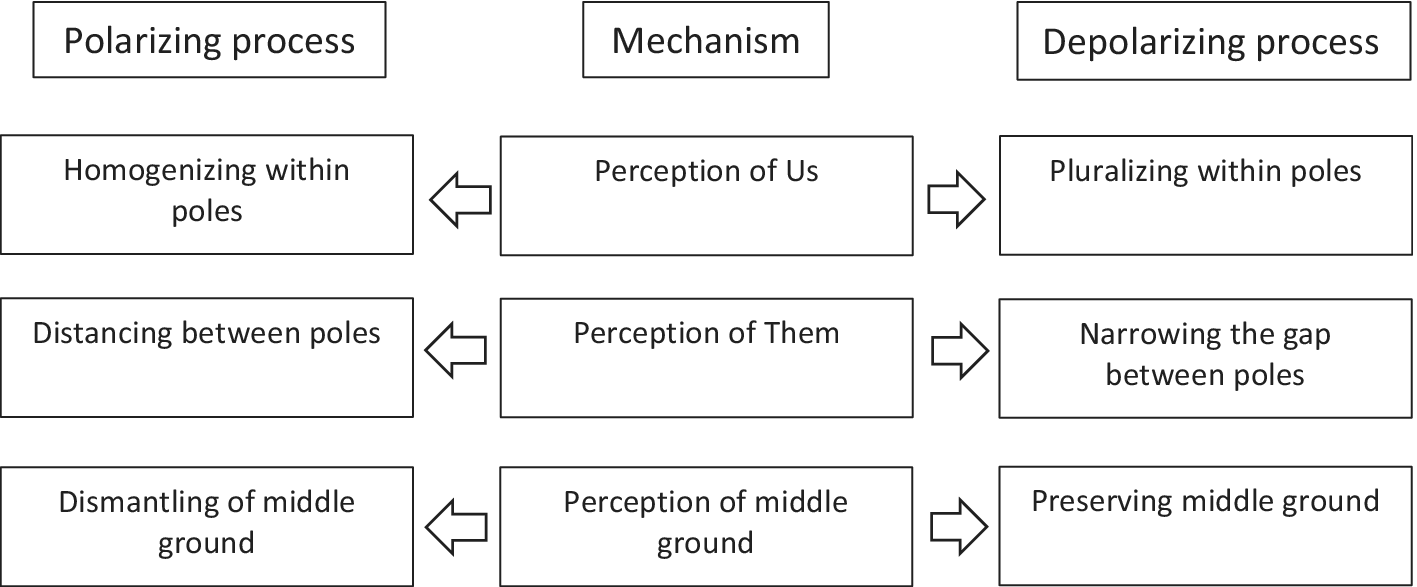
Building on deductive inferences from the prior scholarship reviewed earlier and combined with inductive inferences from our interview data, we abductively (Reichertz Reference Reichertz2010) identify three mechanisms of (de)polarization that operate at the mesolevel: perceptions of Us, perceptions of Them, and perceptions of the middle ground (see figure 1). Mechanisms are seen here as gears in the social machinery making up polarization (Gross Reference Gross2009, 363). Mechanisms are general, unfold over time, and thus contribute to the situation of pernicious polarization by altering discourses and relations among actors (Tilly Reference Tilly2001, 572). Importantly, the same mechanisms can also contribute to reverting polarization (cf. Tilly Reference Tilly1995, 1601) if they operate toward deescalating divisions, distancing, and mutually exclusive radicalization of arguments. Hence, we contend that depolarization processes work in a similar way to polarization processes through the same three mechanisms and through discourse and interactions.
(De)polarization mechanisms

The mechanisms we identify consist of altering perceptions, which in turn alters discourse and relations and, through these, the environment as such (Tilly Reference Tilly2001, 572). We suggest that through their practices (in the form of discourses and interactions), civil society actors, including think tanks, contribute to processes of (de)polarization. In other words, the mechanisms need to be activated to contribute to either depolarization or polarization. Juxtaposing the mechanisms and practices that make up polarization and depolarization, we make an original contribution towards building a general understanding of (de)polarization at the mesolevel.
It is through their activation of these mechanisms that think tanks become (de)polarization agents alongside other actors in the political arena. We understand agency as a “temporally embedded process of social engagement [with] varying degrees of maneuverability, inventiveness, and reflective choice shown by social actors in relation to the constraining and enabling contexts of action” (Emirbayer and Mische Reference Emirbayer and Mische1998, 963, 964). McCoy, Rahman, and Somer (Reference McCoy, Rahman and Somer2018, 18) use the term “political entrepreneurs” to describe those who “effectively highlight and activate underlying cleavages in a society, bringing to the fore, constructing or reinventing a dominant cleavage around which other cleavages align.” Our understanding of the mechanisms of (de)polarization warrants differentiation between polarization entrepreneurs and depolarization entrepreneurs. Hence, we identify think tanks as polarization entrepreneurs when they fuel polarization by activating specific perceptions of Us, Them, and the middle ground, i.e., discursively and relationally erasing differences within their own pole, creating distance between the poles and dismantling the middle ground. In an already polarized environment, such as in Hungary and Poland, actions that contribute to polarization are more of a habitual sort, as they fit into the usual way of doing things. This does not mean that they are less agentic (Emirbayer and Mische Reference Emirbayer and Mische1998, 973), as they provide the necessary grease for the polarization wheels. Think tanks are identified as depolarization entrepreneurs when they counter polarization through discourses and relations that highlight plurality within their own pole, narrow the gap between the poles and preserve the middle ground. In the current sociopolitical contexts of Hungary and Poland, depolarizing actions require going against the tide and, in this sense, require “a reflective distance from received patterns that may (in some contexts) allow for greater imagination, choice, and conscious purpose” (Emirbayer and Mische Reference Emirbayer and Mische1998, 973). We see agency in both these more habitual actions and these more inventive actions, as well as in proactive and reactive strategies (cf. McCoy and Somer Reference McCoy and Somer2021; Somer, McCoy, and Luke Reference Somer, McCoy and Luke2021). For instance, the activation of polarizing perceptions of Them at the mesolevel can take the active form of epistemic discrediting and morally condemning organizations on the other side of the divide or the more passive lack of reaction to such denigrating language used by political parties in joint debates. A depolarizing perception of the middle ground could be triggered by actively manufacturing meetings between the two camps or by more passive avoidance of engagement in the most politicized topics.
Case Selection and Methods
We develop our argument based on data from Hungary and Poland, examples of two highly polarized societies with ongoing de-democratization. Since 2010, Hungary has gradually moved from a “liberal democracy” to an “electoral autocracy,” and Poland, whose illiberal turn can be traced to the years 2015–2023, backslid from the category of “liberal democracy” to that of “electoral democracy” (Boese et al. Reference Boese, Alizada, Lundstedt, Morrison, Natsika, Sato, Tai and Lindberg2022). Importantly, polarization did not start with de-democratization in Hungary and Poland—measures on the macro- and aggregated microlevels show that moderate levels of polarization preceded de-democratization. However, polarization spiked and has stayed at unprecedented high levels since 2010 in Hungary and 2015 in Poland (Boese et al. Reference Boese, Alizada, Lundstedt, Morrison, Natsika, Sato, Tai and Lindberg2022, 33–34).Footnote 2 In both countries, the line of division is formed on the GAL-TAN scale, i.e., cultural and symbolic issues (Enyedi Reference Enyedi2016; Fomina Reference Fomina, Carothers and O’Donohue2019; Tworzecki Reference Tworzecki2019; Vachudova Reference Vachudova2019; Vegetti Reference Vegetti2019).Footnote 3 Polarization in Hungary and Poland is endogenous, i.e., it is “primarily driven by political actors deliberately employing polarizing politics to achieve their aims” (Somer, McCoy, and Luke Reference Somer, McCoy and Luke2021, 2), exploiting and exaggerating preexisting cleavages. The autocratizing states and governmental parties enacting the illiberal agenda play a fundamental role in orchestrating polarization in Hungary and Poland and in determining the context for think tanks’ operations, shaping their possibilities for acting as (de)polarization entrepreneurs.
To analyze (de)polarizing discourses and interaction patterns among think tanks, we used qualitative data. First, we mapped the total population of think tanks in both countries (70 in Poland and 68 in Hungary), including information on their size (staff and budget), date of foundation, location, and general profile. Following common practice in think tank studies, we applied a functional definition of think tanks, avoiding definitional qualms. We define think tanks as organizations that “do research, analysis and communication for policy development … in both the public and the private domains” (Stone Reference Stone2013, 64). Hence, our mapping included all Polish and Hungarian organizations that fulfill both of the following criteria: 1) prioritize policy knowledge production and 2) prioritize policy advocacy in their activities. While most of these organizations are legally CSOs (associations or foundations), a few are part of the administration. Second, from this mapping, we strategically selected a sample of 17 think tanks in Hungary and 24 think tanks in Poland. This targeted sample covers variation in terms of ideological positioning (from left to right, from antigovernment to progovernment), size, organizational age, and issue areas (for more details on our sample, refer to online appendix 2). While no firm representativity can be claimed, we made maximal effort to ensure that a broad range of think tank experiences were included.
Semistructured interviews with key representatives from these selected think tanks were our main source of data. The interviews were conducted in two waves. In 2020 and 2021, due to the COVID-19 pandemic, interviews were mostly conducted via video conference. The second wave, with a smaller group of think tanks from the sample (6 each in Hungary and Poland), was conducted in person in 2021 and 2022. In total, we gathered 53 interviews across 41 think tanks. A common interview guide was followed in both countries, with themes centering on policy influence, relations with other actors, and the changing context since 2010/2015. Importantly, in the first wave, we did not ask specifically about polarization, but almost all think tankers brought it up as a fundamental factor impacting their operations. In the second wave of interviews, we chose a recent issue debated in a politicized manner in the respective national media (the position of EU law in the Polish legal order and parliamentary elections in Hungary) to prompt a more focused conversation about how polarization affects think tank activities. Interviews from the first wave were conducted in Hungarian and Polish (except for one English-language interview in Hungary), the second wave of interviews was held in English. The average length of the interviews was one and a half hours. The interviews were translated, transcribed, and manually coded with the help of NVivo (refer to online appendix 1 for examples of coding decisions). Since polarization is commonly perceived as a negative process, social desirability bias in the interview situation should be mentioned. One could expect that think tanks would more readily speak of themselves as victims of polarization than propagators of it and that our interviewees would rather highlight their contribution to depolarization than polarization.
Even though our data include Polish and Hungarian think tanks, the study does not center on comparison but on generating new knowledge about theoretical mechanisms of (de)polarization and their empirical expressions. Nevertheless, we note that in relation to (de)polarization, the similarities between Hungarian and Polish think tanks are striking, while differences in discourse and interactions are few.
State-Driven Polarization in Hungary and Poland
Since 2010 in Hungary and from 2015–2023 in Poland, the governments led by the Hungarian Civil Alliance (Magyar Polgári Szövetség, Fidesz) and the Law and Justice (Prawo i Sprawiedliwość, PiS) parties, respectively, have strategically endeavored to control and limit civil society space, including think tanks. Such actions fit into a wider global tendency documented in de-democratizing states (Christensen and Weinstein Reference Christensen and Weinstein2013; Carothers and Brechenmacher Reference Carothers and Brechenmacher2014; Rutzen Reference Rutzen2015; Poppe and Wolff Reference Poppe and Wolff2017). Rather than mere closure, in both Hungary and Poland, we witness a reconfiguration of the civic space, which is characterized by the systematic exclusion and limitation of the activities of CSOs that are critical of the governmental agenda, paralleled by strategic support for the establishment and operation of CSOs that align with government ideology (Roggeband and Krizsán Reference Roggeband and Krizsán2021; Kravchenko, Kings, and Jezierska Reference Kravchenko, Kings and Jezierska2022; Gerő et al. Reference Gerő, Szikra, Fejős and Kerényi2023). This reconfiguration concentrates on enacting discriminatory funding patterns and granting selective access to policymaking processes and the advocacy space (Roggeband and Krizsán Reference Roggeband and Krizsán2021). As a result, parallel CSOs and think tanks emerged with very different conditions for CSOs positioning themselves for the government and those positioned against the government.
Ideologically based reconfiguration of funding is particularly consequential for think tanks since their operations–policy knowledge production and advocacy—require costly, highly qualified personnel. A quick look at the condition of Hungarian and Polish think tanks before 2010/2015 reveals that very few organizations had a solid financial basis. They lacked endowments or larger capital reserves. Their survival was dependent on securing short-term funding, which they obtained from public and private domestic and foreign sources. Philanthropy was not well developed, and foreign funding had significantly diminished as a source of revenue due to foreign foundations directing democracy promotion funds outside the EU (Roth Reference Roth2007; Jezierska Reference Jezierska, Kravchenko, Kings and Jezierska2022).Footnote 4 EU grants, mostly distributed through the state, appeared to be rather difficult to obtain, costly to administer, and thus accessible only to larger organizations. In effect, even think tanks that tried to diversify their sources of income through crowdfunding, tax direction campaigns,Footnote 5 and various international sources were largely left at the mercy of state (-distributed) funding. However, since 2010 in Hungary and from 2015–2023 in Poland, the governments have been more proactive in controlling funds for civil society, including think tanks.
In both countries, new state institutions coordinating fund allocation for civil society and think tanks were established—the Hungarian National Cooperation Fund and the Polish National Freedom Institute. Both have systematically skewed funding patterns, favoring government-friendly organizations (Kapitány Reference Kapitány2019; Krizsán and Sebestyén Reference Krizsán, Sebestyén, Krizsán and Roggeband2019; Bill Reference Bill2022; Ślarzyński Reference Ślarzyński2022). Moreover, especially in Hungary, the remaining foreign funding has been further curtailed. Following government attempts to seize control over funding distribution from organizations such as the Open Society Foundation or the EEA and Norway Grants, these funders largely withdrew from Hungary. In both Hungary and Poland, CSOs and think tanks supported by foreign funding have been subjected to excessive auditing, inspections, and smear campaigns. Additionally, in Hungary, between 2017 and 2021, a law required special registration for CSOs that received foreign funding and a public display of that fact, denouncing them as “foreign agents.”
In addition to changing patterns in funding, the think tank landscapes in Hungary and Poland are also strongly affected by changes in government accountability mechanisms and in the accessibility of policymaking processes (Krizsán, Jezierska, and Sörbom Reference Krizsán, Jezierska and Sörbom2023). Even before 2010/2015, Hungarian and Polish think tanks complained about problems with access, as politicians and civil servants rarely sought external policy advice (Jezierska Reference Jezierska2018). Nevertheless, think tanks could secure some access, mostly through personalized connections with decision makers. Since 2010/2015, following a typical trajectory for de-democratizing states (Bauer et al. Reference Bauer, Peters, Pierre, Yesilkagit and Becker2021), Hungary and Poland have moved toward top-down, centralized, often extremely fast-paced policymaking while simultaneously diminishing the autonomy of public administration and disrupting expert consultation mechanisms (Mazur Reference Mazur, Bauer, Peters, Pierre, Yesilkagit and Becker2021; Hajnal and Boda Reference Hajnal, Boda, Bauer, Peters, Pierre, Yesilkagit and Becker2021). These changes dramatically reshaped think tanks’ possibilities for policy advice, making access virtually impossible for government-nonaligned think tanks and privileging government-friendly think tanks (Krizsán, Jezierska, and Sörbom Reference Krizsán, Jezierska and Sörbom2023).Footnote 6
Hence, through changes in both funding and access to policymaking, governments in Hungary and Poland polarize think tanks, deliberately tilting the playing field for policy expertise and creating uneven conditions for pro- and antigovernment organizations. While government-critical think tanks are experiencing a closing space of action, organizations aligning ideologically with Fidesz or PiS mention that the government is actually more responsive and inclusive than before 2010/2015. In the next section, we revert the lens from observing think tanks as victims of polarization processes to analyzing think tanks as agents in (de)polarization.
Think Tanks as (De)Polarization Agents
The structure of this section follows the logic of our three mechanisms of (de)polarization (see figure 1): perceptions of Us, perceptions of Them, and perceptions of middle ground. Our analysis showcases very similar processes in both Hungary and Poland, which is why the Hungarian and Polish data are jointly analyzed in each section. We interpret these prevailing similarities as evidence that pernicious polarization is such a powerful process that it trumps differences in the sociopolitical environment, pushing Polish and Hungarian think tanks toward similar dynamics of interaction and discourse. The small differences between the two contexts that emerged are nevertheless highlighted. We mainly ascribe these differences to the time lapse in the introduction of illiberal solutions in Hungary and Poland, which coincided with the spike in polarization. The subheadings under each mechanism group the specific actions (interactions or discourse) that we identified in the interviews (refer to online appendix 1). While most of our evidence suggests that think tanks contribute to polarization, we also highlight some emerging interactions and discourses that contribute to depolarization.
Perceptions of Us
We observe explicit (sometimes externally ascribed) identification with one or the other polarization pole among the interviewed think tanks. This sorting is accompanied by increased cohesion around the poles. In effect, the broad diversification of think tanks that existed prior to the illiberal shifts in Hungary and Poland is suppressed, and think tanks align around the polarization axis, resulting in a sharp distinction between Us and Them—two rather unified blocs.
Identifying with one of the poles. Our interviewees promptly noted that clear identification with one of the polarization poles is currently the dominant organizing principle of the landscape of think tanks in both Hungary and Poland. This can stem from self-identification with the pro- or antigovernment camp, as indicated by interviewees’ assertions that “I am working for a progovernment think tank” (IP21_HU) and “We identify with values that I and my colleagues believe are true of the opposition and not of the government” (IP15_HU), or external identification with these groupings ascribed by other actors, whereby “you are either treated as belonging to one side or the other” (IP23_PL).
The side to which a particular think tank belongs is revealed by mundane practices. For instance, criticizing the government or the opposition is enough to be identified as belonging to one of the poles:
We often hear that we are kind of, I don’t know, an annex of the Civic Platform [oppositional party in Poland] or that we work for the Civic Platform, or we support it—just because we often criticize the policies of the Law and Justice party. (IP17_PL)
The same applies to progovernment think tanks:
We were identified as a kind of pro-PiS environment before 2015 and sometimes after 2015. This resulted not so much from some strict political connection or from our being advocates praising that particular political camp … but simply from similar criticism of previous governments. (IP11_PL)
In addition to criticism of the government or opposition, another revealing factor of which camp think tanks belong to is their position on practically any policy issue. Few policy issues remain nonpoliticized, and the different issues form a predictable package: “Today, if you ask someone what they think about the expansion of the Paks nuclear power plant, the answer will tell you exactly what they think about migration and refugees” (IP8_HU).
Hence, think tanks are “pushed into corners” (IP13_PL) and create two poles. It is apparent that this sorting of oneself and others follows the polarization line at the political level. Moreover, the logic of social division dictated by polarization dilutes the otherwise carefully guarded boundary between think tanks and the party-political sphere. At least at the level of self-representation, think tanks would otherwise strive to maintain this separation (Jezierska Reference Jezierska2018; Jezierska and Sörbom Reference Jezierska and Sörbom2021), attempting to be seen as non-party-political entities. Polarization makes such claims even harder. Antigovernment think tanks argue that the democratic erosion orchestrated by incumbents has forced them to diverge from the neutral image they previously curated and to become more activist, taking a political stance (Jezierska Reference Jezierska2023a). In effect, the simplification of the social space creates two mutually opposed camps comprising both think tanks and political parties (cf. Ślarzyński Reference Ślarzyński2022 on alignment between CSOs and political parties). As we will see, other demarcation lines are also becoming increasingly porous, being subordinated to the main polarization logic, separating the Hungarian and Polish think tanks into two camps.
Increasing cohesion within poles. This bifurcation of the social space is associated with internal consolidation of the two blocs. Think tanks network with each other, organizing events and debates that predominantly comprise like-minded organizations and publics. One such important example on the progovernment side dates back a few years before PiS came to power. Since 2011, the annual conference “Poland. A Great Project”Footnote 7 has been gathering Polish right-wing politicians, CSOs, academics, public intellectuals, and businesspeople, who provide the ideological and policy backbone for the illiberal direction in politics.
Consolidation is even more visible among antigovernment think tanks and CSOs. For instance, in 2015, the year when PiS gained power, government-critical organizations in Poland launched a new initiative called the Network of Social Organizations (Sieć Organizacji Społecznych), with the telling acronym SOS. Several interviewees highlighted the astonishingly wide differences between CSOs engaged in this initiative (for instance, leftist and neoliberal think tanks), joining forces in the face of what they perceived as a common threat—the erosion of democracy. The network, initially taking the form of regular informal meetings, has formalized to varying degrees in different thematic areas. For instance, SOS for Education has its own website and publicizes joint actions (https://sosdlaedukacji.pl/), while SOS for Energy has looser collaboration forms but still spans organizations representing a wide range of ideological positions. SOS appears as a united front in meetings with the government: “within this structure of the Network of Social Organizations, we managed to force the government, I mean the Ministry of Finance to be precise, to hold public hearings” (IP25_PL). Indeed, the tightening of ranks within the antigovernment camp is seen as an attempt to provide a “counterbalance for the expansion of the state” (IP12_PL).
Admittedly, the Hungarian case provides less evidence of new cooperation patterns contributing to pole consolidation. One example, however, is the Hungarian Civilization Coalition (Civilizáció), which gathers some CSOs on the antigovernment pole. The coalition was established in 2017 in direct response to the government’s attacks on CSOs and legislation about foreign funding for civil society. Even though smaller than that in Poland, this initiative spans a broad range of different types of CSOs, including some think tanks engaged in various struggles, such as human rights, minority rights, and socioeconomic equality, that would otherwise be unlikely to join forces.
As evidenced earlier, antigovernment organizations are often reactive with respect to state actions; nevertheless, they show an entrepreneurial spirit, finding new ways to mobilize. They recognize the polarizing actions of the government and its allies in civil society and organize to at least partly counterbalance these forces. At the same time, involuntarily, clear identification with one of the poles and intensified interactions within the poles contribute to increased polarization.
Perceptions of Them
The consolidation of Us is paired with distancing from Them. Such distancing is practiced in several ways: by cutting off connections between the poles, by morally condemning those on the other side of the rift, and by the professional depreciation of Them.
Cutting off connections between Us and Them. Most of our interviewees stated that they have effectively cut off contact with the other pole. This severing is an effect of specific perceptions of Them, i.e., organizations on the other pole, perceptions that prompt a reconsideration of previous relations. Reportedly, pernicious polarization over a longer period, as in the case of Hungary, tends to increase the distance between the camps, leading to the disappearance of even informal connections:
There were some connections from our previous research that we had, but now they completely died. Even our informal connections. In the beginning, I personally had teammates in ministries or right-wing analysis institutes. I would say that we kept in touch with pro-Fidesz institutes and for a while, we met, we had a coffee, we talked, and that started to disappear completely around 2013, 2014. It was the same with all my colleagues. (IP14_HU)
However, this “disappearance” and “dying off” of contact did not happen automatically. It resulted from a change in previously existing patterns of interaction.
Think tankers not only abstain from relations with Them but also actively guard the line of division between Us and Them. Organizations that attempt to keep some communication channels with the other side open are disciplined by fellow think tanks (Sörbom and Jezierska Reference Sörbom and Jezierska2023): “We were attacked, even publicly called out on the internet, and told that we have blood on our hands, because we sat at the same table” (IP13_PL). As one Hungarian think tanker explained, appearing in the company of members of think tanks from the other side is associated with major reputational risks:
If you go to venues that are organized by, you know, that are to a large extent the place for government-affiliated think tanks, then some of the people who are outside of the government will likely consider that you may have sold your soul to the government. (IP18_HU)
Apparently, interactions across the rift are seen as morally compromising. “Sold your soul” and “blood on your hands” are not just powerful figures of speech. They reflect the move from regular agonistic relations between differently positioned think tanks, in which competition prevails, to a moral language of condemnation, characterizing antagonistic relations (Mouffe Reference Mouffe2005). By severing relations with organizations on the other side, think tanks undoubtedly contribute to the polarization spiral.
Morally condemning Them. In addition to changing patterns of interactions, think tankers resort to various forms of discursively marking distance from the other pole. Our interviewees confirm observations from the literature that polarized groups construct each other as being evil and lacking moral legitimacy (McCoy, Rahman, and Somer Reference McCoy, Rahman and Somer2018, 19), while motivations behind the other side’s actions are questioned as ill-intentioned or self-interested (McCoy, Rahman, and Somer Reference McCoy, Rahman and Somer2018; Somer and McCoy Reference Somer and McCoy2019, 10). The progovernment think tanks that we interviewed presented government-critical organizations as simply frustrated at having lost their comfortable spot in the mainstream after the liberal hegemony in the public sphere was disrupted by the PiS and Fidesz governments (cf. Dąbrowska Reference Dąbrowska, Bluhm and Varga2019; Jezierska Reference Jezierska and Laruelle2023b). Allegedly, this frustration leads to a loss of integrity among antigovernment think tanks. In the eyes of progovernment think tanks, those on the other side assume a position of total criticism (echoing PiS’s derogatory slogan of “total opposition”), which is seen as intellectually dishonest. On the other hand, antigovernment think tanks strongly condemn organizations siding with PiS and Fidesz. As mentioned in the introduction, progovernment organizations are sometimes described as those who “should be in jail” (IP27_PL). In a slightly more restrained manner, the progovernment side is depicted as cynical, i.e., acting for their own benefit and defending the government while aware of its dangerous antidemocratic politics: “When I talk to them, they know and are ashamed of what they participate in” (IP8_PL). Similarly, a Hungarian think tanker contends that “I know that a lot of what he [another think tanker] says, he says because he has to say it, and it is something he doesn’t fully agree with” (IP15_HU). These quotes signal the moral judgment of those on the other side as hypocrites and opportunists, aware of the wrongdoing they are guilty of. One Hungarian think tanker puts it quite bluntly: “There are those who we think are morally not on the same level as us, and we are very much staying away from them” (IP1_HU). Changed perceptions lead to changed interactions. Not surprisingly, when interviewees were asked to give concrete examples, such moral assessments and hierarchies neatly followed the polarization rift.
Professionally depreciating Them. Not only are the ethics of those on the other side questioned, but such think tankers are also presented as incompetent and simply following orders: “They don’t think” (IP5_PL). Think tankers depreciate the professional conduct of organizations on the other side and question their independence. One Hungarian antigovernment think tank called the output of progovernment think tanks “just government propaganda at an analytical level” or “partisan opinion wrapped in expertise” (IP2_HU). Speaking about progovernment think tanks in Poland, one progressive think tanker argued that they are
semipolitical organizations. All these Jagiellonian, Piast, Sobieski, Kościuszko, and the like, they are like that …. It suddenly turned out, after a few years, that if they [PiS] really need something, they don’t go there. If they really don’t know, but they need some specific thing, like if they really need to send a document to the European Commission on how to spend structural funds or the European Social Fund—if they really need such a specific thing, then they don’t want these boys all of a sudden, all these Piast institutions or whatever they are called. (IP2_PL)
The interviewee describes think tanks siding with the government as “semipolitical,” indicating an allegedly corrupting effect on the epistemic quality of their output. Furthermore, one Hungarian think tanker presented progovernment think tanks as mere puppets steered by the government:
They are told what to produce, and then they produce it. They probably partly have some autonomy. So, they also give some input to government work. But I can’t view these organizations as actors independent of the government. (IP5_HU)
Similar discursive strategies of questioning the objectivity and quality of knowledge production from the other side transpire when progovernment think tanks describe the antigovernment side:
When the Batory Foundation [a liberal think tank] releases a report on legislation, I know very well that it will not include those things that Law and Justice did well, and I know why they will not be included, right? Well, because it’s simply by definition an institution that believes that we’re dealing with a government that needs to be replaced, and for that reason it’s going to be very critical of them. (IP3_PL)
Issue alignment and identification of a think tank as belonging to the other camp again leads to the supposed predictability of positions on other issues and supposed dishonesty in analysis. The think tanks on the other side are described as producing biased output that only corroborates their established position in the polarization divide.
Even access to policymakers, which would otherwise be seen as a measure of success for think tanks, is used to professionally discredit the think tanks who cherish it. Those who have access are portrayed by government-critical organizations as lacking independence from the government. This, in turn, serves as a basis for questioning their analyses:
Unfortunately, the think tanks that are listened to are mainly those that are somewhat close to those in power …. But the value of this, I think, is average … well, because it is burdened with this poor relation. (IP6_PL)
While evidence of polarizing narratives—think tanks delimiting themselves both morally and professionally from the other camp—dominated our interviews, some think tankers described deliberate attempts to counter polarizing narratives about Them. These think tankers tried to avoid dehumanizing representations of opposing politicians and think tankers: “It’s not an aversion to human beings, it’s just a lack of common ground” (IP13_PL).
Perceptions of the Middle Ground
What follows from consolidation within poles and distancing between the poles is that the in-between space, that is, the space of interactions and debate between think tanks from both sides, shrinks. As organizations thriving on broad relations with various types of actors (politicians, bureaucrats, activists, journalists, etc.) and brokers between those actors, think tanks take on the expectations of custodians of severely truncated middle ground. In the perniciously polarized reality of Hungary and Poland, there is not much middle ground to speak of, and in truth, some think tank actions and language are more divisive than connecting; however, we also see reflection on the problematic nature of polarization and visible ambitions of and efforts at mending the cracks. It is through this mechanism that we observe most explicit depolarization attempts.
Erasing ambiguity and nuance. Alongside polarized perceptions of Us and Them, the middle ground, where think tanks would otherwise interact, disappears. This entails that meetings and exchanges of ideas between variously positioned think tanks rarely take place. In effect, convergence on policy issues or agreement on certain policy problems and solutions are virtually impossible between the poles. In the words of one Hungarian progovernment think tanker: “[The policy debate] has become more partisan ….. It has become more divided. Maybe in the 2000s there was more consensus between the two sides? I see less of that now” (IP17_HU).
We see evidence that think tankers conform to this situation but also that they actively contribute to the deconstruction of the middle ground. When nonalignment, i.e., attempts to opt out from the division, is presented as a compromising strategy, it increases polarization.
Well, the space for such a think tank, which would not be subject to this phenomenon of political polarization, simply disappeared. I mean, this sharp polarization basically makes such a broadly defined nonpartisanship impossible. I mean, you can be unaffiliated with a particular party, but it is difficult to avoid the fundamental choice imposed on us by the present government. And, in my opinion, those organizations which try to go beyond this dispute, they do it at the cost of silence on certain issues which are quite fundamental in the context of what is happening in Poland. I mean the democratic backsliding, the violation of the Constitution, and so on. (IP1_PL)
This think tanker described the “fundamental choice” as being imposed on think tanks by the government, obliging them to act. Those who abstain from making such a choice (pro- or antidemocracy) are cast as spineless, engaging in self-censorship. Another Polish think tanker concurred: “I think what’s changed [since 2015] is that it [public debate] became heavily politicized and polarized, and this politicization and polarization has forced people to take sides” (IP6_PL). Apparently, the middle ground, expressed by a neutral position, is shrinking because think tanks, playing along the simplified logic of Us versus Them, demand clear declarations of belonging. One Hungarian think tanker shared a similar view:
Organizations … which claim to be nonpartisan … we don’t have these. That was my ambition at one time, but they don’t really exist because life has become so polarized that there is very little room for them. (IP3_HU)
Not declaring a political stance, i.e., ambiguity with respect to the political orientation of think tanks, makes communication across differences, and thus potential compromise, easier. However, in the black-and-white world of polarization, there are clear incentives to declare a political stance. Polarization also entails incentives for lack of nuance in policy analyses:
Sticking to the [PiS] authorities helps, sharp attacks help. Those who appreciate both one and the other side, and also those who condemn both sides depending on the situation, well … they are simply a dying species. I have this impression in our polarized reality. (IP14_PL)
Policy analyses that are more nuanced than simple condemnation or univocal praise are met with suspicion “because I don’t pay homage and I don’t declare the side directly” (IP20_PL):
This polarization has happened to such an extent that people who want to distance themselves from this discourse of political conflict are discredited because they want to be factual….. For someone who nuances the message, who presents some analysis that doesn’t have clear results, there is no place. (IP13_PL)
Occasionally, think tanks refute the black-and-white narrative and actively look for the gray zone, where things are less clearly divided:
I think that there are people in the ruling party who appreciate that someone [referring to themself] is trying to understand what they are trying to do, what it is all about, and who also sees some positive aspects of their activities. (IP7_PL)
For the most part, however, policy knowledge production and political analysis have become more political, as one Hungarian think tanker explains:
After the first defeat of the opposition in 2014, we ourselves took the position at the institutional level that political analysis … is dead. In the sense that it can only exist in a polarized way. (IP16_HU)
Think tanks’ positioning with respect to the political field and their ways of operating are apparently affected by the shrinking middle ground. Ambiguity and compromise are disappearing, thereby limiting the room for middle-ground activities. A declaration of adherence to one of the camps and analyses clearly praising or condemning government policies are incentivized in a perniciously polarized context. The middle ground has transformed into a discursive battleground where instead of cross-cutting interactions and factual debate “Everyone is arguing, but nobody is talking” (IP16_PL).
Avoiding controversy. There was a realization among the interviewed think tankers on both sides of the polarization rift that polarization is bad for them and for the broader civil society in Hungary and Poland: “In general, we think that this division does not serve either Poland or the sector” (IP4_PL). Hence, think tanks are making some explicit efforts to depolarize perceptions of the middle ground.
Mostly, our interviewees highlighted passive depolarization strategies, i.e., attempts not to aggravate existing divides. One strategy is to avoid the most politicized topics: “We do not deal with areas that would contribute … to the kind of … the ongoing ideological war” (IP10_PL). One progovernment think tanker described a similar choice: “That’s why we don’t go into these subjects too much. For example, all ideological disputes concerning these very sensitive issues, abortion, etc.” (IP16_PL). A similar strategy is to avoid commenting on current politics, which would require critiquing specific political actors: “We don’t deal with daily politics, we only deal with solutions. So, we don’t judge this and that political actor … and with this approach, none of the actors feel that we are the enemy” (IP20_HU). By avoiding the most divisive topics and by not criticizing political actors think tanks deliberately evade conflict. One liberal think tank, publishing a web portal for the whole sector, explained that “we care about not inflaming the situation, so I rather … we don’t give in to some kind of extreme views from one side or from the other side” (IP4_PL). In this way, they moderate out extreme positions.
Anticipating hostility from the other side and making preemptive moves not to inflate potential animosities is another option for avoiding controversy. As one Hungarian antigovernment think tank explained,
Most of our statements, if we make a critique, before we put it out there, on any of our platforms, we always, or let’s say 99% of the time, we send it to the ministries [first]. So, I think it is very transparent the way we operate. We don’t want to create any tension. (IP7_HU)
Depolarization in the form of actions that evade tension is a passive strategy but one that nevertheless requires effort.
Manufacturing trust. Transgressing the polarization rift and attempting to meet across the divide is not easy when the divisions are so entrenched: “I see the problems in think tanks and NGOs too. Sometimes they stop at something to shout loud, to say something loud, but they don’t interact” (IP6_PL). Even if not ubiquitous, such efforts do take place. In addition to the previously described passive depolarization practices, which boil down to attempts to avoid controversy, we also find a few instances of more proactive depolarization strategies. These efforts to maintain at least some rudimentary middle ground are carefully crafted by the think tanks to minimize reputational costs.
While adherence to the polarized Us versus Them division is demanded during public appearances, apparently, some connections across the divide are maintained in private:
If we don’t talk in public, I can have a great conversation with him [name of a progovernment think tanker], and in some ways, we even think alike about things. Although, obviously, I don’t mean that in a worldview sense, but in a logical sense. (IP15_HU)
Think tankers, both those supporting and those opposing current governments in Hungary and Poland, express fatigue with the lack of public policy conversations across the divide. Some think tankers revealed a willingness to take on the role of depolarization entrepreneur in the future:
I hope that maybe we will become the place where we start talking to each other. I have even proposed that we should have such an informal meeting of experts from both sides, which we will not announce, where we will start to talk about this, about at least some projects that are worth continuing when the boys and girls change power. (IP20_PL, emphasis added)
This think tanker was quite aware that one condition for such a meeting to be possible is that it “will not be announced.” Indeed, it appears that in order for meetings across the rift to happen, they must be carefully curated and kept under the radar. For instance, Hungarian think tanks resort to Chatham House rules on the rare occasions when they participate in events that include think tankers from both sides of the divide:
[Chatham House] was good because government people were more willing to sit down with somebody who is not considered a friend if they knew that this would not be in a newspaper the next day. (IP23_HU)
Another concrete example of depolarization entrepreneurship in the manufacturing of trust comes from Poland. In 2018, five thinkzines launched the so-called Short Circuit project (Spięcie) with the explicit aim of “tackl[ing] the issues of polarization.”Footnote 8 As part of this project, think tanks with different ideological profiles—leftist, liberal, and conservative, including three organizations from our sample—agree to simultaneously publish their essays on selected policy issues on their respective web platforms. This initiative is meant to show that cooperation and the exchange of ideas are possible despite the think tanks’ differences and to expose their respective readership to opinions and analyses from unfamiliar worldviews. This project is often mentioned, also in our interviews, as a curiosity, something clearly diverging from and actively opposing polarization of the public sphere—described as a sign that, even though it is not easy, there is a way out of the polarization spiral. As the coordinator of the project announced in the editorial for Short Circuit, “It will likely cost us all some effort to conduct this conversation, but the cost of not talking to one another is also significant. And the pain of conversing offers some hope, however fragile” (Malko Reference Malko2018). Curating trust in the interest of preserving some middle ground, where representatives from the two sides can meet, is “painful” and requires “some effort.” In other words, trust has to be manufactured, and those who engage in this endeavor act as depolarization entrepreneurs.
Some think tanks also engage in trust-building activities deliberately aimed at defusing polarization in the broader society by creating meeting platforms for citizens:
The main challenge in Poland at the moment is the powerful and fabricated current, driven, of course, by this polarization [that] we are dealing with. Everything from citizens’ panels through participation [that we organize] is about the fact that people have the right to differ and that they need to find some common ground. (IP8_PL)
These are attempts to foster a shared civic culture that rests on differences grounded in a sense of community. As the think tankers are well aware, attempts to create common ground by organizing cross-cutting meetings for the broader public are made less credible by the fact that most think tanks have declared allegiance to one of the poles, openly supporting or opposing the government: “It is difficult to be both at the same time—to be someone who both builds bridges and is one of the shores” (IP8_PL).
Even though the territory is hard to navigate, these examples showcase that under strictly regulated conditions, such as the Short Circuit project or Chatham House rules, think tanks may still have professional and possibly constructive dialogue across the divide, at least on some sectoral policy issues. In this sense, by creating very specific conditions that make a ceasefire possible, think tanks might operate as curators of the limited middle ground.
Concluding Remarks
Scholars of polarization usually focus on the macrolevel, i.e., party political polarization, or the microlevel, i.e., voters’ preferences, thus leaving the experiences of civil society in a polarized political landscape largely unexplored. While civil society scholars have studied divisions between CSOs in various areas, pernicious polarization among CSOs, which destroys civil solidarity and transforms agonistic relations into antagonistic ones, has been far less studied.
This paper contributes to the literature by conceptualizing and empirically demonstrating how think tanks, as mesolevel actors, partake in polarization. The mechanisms that we identify as promoting polarization and depolarization clarify how such organizations not only react to but also contribute to (de)polarization. Clearly, think tanks are receptors of polarization, as government-driven processes have reconfigured the think tank landscape, tilting the playing field and unevenly changing the conditions for think tank operation. Nevertheless, think tanks are also active in polarization. By shifting perceptions of Us, Them, and the middle ground, and through specific interaction and discourse patterns, they contribute to polarization. In this sense, think tanks are both victims and culprits in polarization. In addition to polarization, think tanks also contribute to depolarization through the same mechanisms.
Our analysis, however, shows that Hungarian and Polish think tanks contribute mostly to polarization and only occasionally to depolarization. These findings are slightly surprising, given that our interview data are susceptible to social desirability bias. Nevertheless, think tanks emerge as polarization entrepreneurs: they homogenize differences within the poles, create distance between the poles, and help dismantle the middle ground, which becomes more of a battleground than a space of reflections and debate between think tanks from both sides. Think tanks erase ambiguity, nuance, and compromise, limiting the room for substantive middle-ground activities. They polarize by declaring allegiance to one of the camps and producing analyses clearly praising or condemning government policies. They also feed into polarization when they morally and professionally discredit organizations on the other side. Also observable in our interviews, albeit admittedly less prominent, were think tanks acting as depolarization entrepreneurs. Think tanks make some evident efforts to counter polarization and maintain at least some connections between the poles. Both passively avoiding controversy and the most politicized topics and actively manufacturing trust through certain stylized forms of exchange across the polarization rift are their attempts at depolarization.
Importantly, polarizing and depolarizing actions (both active and passive) are undertaken by think tanks on both sides of the polarization divide. For instance, when antigovernment think tanks close ranks, improving collaboration within their pole, they also inadvertently contribute to sharpening the divide between the poles and thus to polarization. It is paradoxical that when antigovernment think tanks, in the name of democracy, cut off connections with actors they deem undemocratic, they unintentionally contribute to pernicious polarization, which has been proven to be detrimental to the state of democracy (e.g., Svolik Reference Svolik2019). Additionally, initiatives to depolarize the middle ground include both pro- and antigovernment think tanks.
The abductive method applied in this study has consequences for generalizability. It entails that our theoretical proposition on the mechanisms of (de)polarization is immersed in the cases we study, which indicates that our conclusions reflect the selected contexts of Hungary and Poland, even though we see Hungary and Poland as typical cases of pernicious polarization. However, our theoretical contribution produces a degree of generalizability, since abductive theorization of data transcends the particular setting in being linked to existing knowledge and understanding (Thompson Reference Thompson2022) of the phenomenon of (de)polarization. We therefore submit that the mechanisms might be found in other more or less polarized contexts as well. Importantly, think tanks are not immediately generalizable to all civil society actors, even in Hungary and Poland. Think tanks have stronger connections to politics than other mesolevel organizations and are thus more exposed to the polarization dynamic. As elite CSOs, we argue that they are also well positioned both to spur and potentially counter polarization. We nevertheless suspect that the three mechanisms are applicable beyond organizational-type think tanks. However, the more specific ways of activating these mechanisms, i.e., the discourses and interactions that put these mechanisms into motion, might differ.
Finally, by showcasing think tanks as (de)polarization entrepreneurs, we by no means claim that think tanks are the most important agents of (de)polarization. Differences in levels of polarization over time depend largely on the actions of powerful actors such as the government and the media. What our analysis demonstrates is that think tanks also have a role in (de)polarization. Hence, ignoring the contributions of CSOs and think tanks to (de)polarization results in an incomplete picture of these processes.
Supplementary material
To view supplementary material for this article, please visit http://doi.org/10.1017/S1537592724001397.
Acknowledgments
The authors are grateful for the financial support of The Foundation for Baltic and East European Studies (grant number 6/19) and for generous feedback from participants in a workshop on Policy Advice in De-democratizing and Undemocratic Contexts, which we organized in Gothenburg in 2021, with funding from Riksbankens Jubileumsfond. Previous versions of this article also received helpful comments from EGOS 2023 and IPPA 2023 conference participants.


 Open access

