


As I said in my speech earlier this week, our decision to leave the European Union was no rejection of our friends in Europe, with whom we share common interests and values and so much else. … It was simply a vote to restore, as we see it, our parliamentary democracy and national self-determination. A vote to take control and make decisions for ourselves.
“We’re fighting for Main Street, not Wall Street. We have rejected globalism and embraced patriotism.”
The 2010s marked a pivotal shift in how political leaders across advanced democracies speak about globalization.Footnote 3 Once celebrated as a driver of prosperity and international cooperation, economic integration has increasingly been cast as the villain in political discourse – blamed for undermining national sovereignty, frustrating democratic mandates, and tying the hands of elected governments. While this rhetorical shift has not amounted to a wholesale rejection of international integration, it reflects mounting unease with the ways that global trade, financial openness, and international rulemaking can tie the hands of elected officials.
One of the most prominent examples of this tension can be found in the United Kingdom. From 2010 to 2017, the Conservative Party repeatedly pledged to reduce net migration to the “tens of thousands,” a promise that resonated with voters but proved impossible to fulfill. By 2015, net migration had risen to over 330,000. Government leaders attributed this failure to the United Kingdom’s relatively deep integration into the European and global economy. The inability to deliver on this signature promise became a flashpoint in the escalating politicization of European integration, which was increasingly blamed for rising migration flows – an unavoidable byproduct of the deep economic interdependence of the European Union’s (EU’s) single market – and ultimately culminated in the United Kingdom’s departure from the EU. In its aftermath, Brexit was framed by Conservative leaders not just as a matter of identity or sovereignty but as a necessary step to restore the government’s ability to make and implement policy promises. “Take back control” was both a campaign slogan and an implicit indictment of globalization’s constraints. Yet, this push for control coexisted with continued praise for globalization’s economic benefits. Even as they championed withdrawal from the EU, thereby significantly decreasing the United Kingdom’s integration into the global economy,Footnote 4 government officials lauded free trade and global integration for boosting prosperity and lifting millions out of poverty.
In the United States, President Donald Trump also sought to tighten control over global economic integration. He imposed sweeping tariffs, withdrew from numerous economic agreements, blocked the appointment of new judges to the World Trade Organization’s Appellate Body, effectively paralyzing the organization’s dispute settlement mechanism, and renegotiated the North American Free Trade Agreement, all under the banner of restoring national sovereignty and economic control. Tariffs became the centerpiece of both of his presidential campaigns, where he promised sweeping protectionist reforms including a universal 10 percent import tax and punitive tariffs on Chinese goods. Upon returning to office in 2025, Trump enacted what he called “Liberation Day” tariffs, including duties of up to 125 percent on certain imports, especially from China. But the ambitious plan soon met resistance. Facing global market volatility, diplomatic backlash, and the realities of America’s global dependencies – including concerns that the escalating trade war with China would disrupt critical supply chains, particularly involving rare earth minerals essential to US defense and technology industries – the administration was forced to partially suspend the measures within weeks.
This tension – relying on globalization’s advantages while lamenting its constraints – captures a central dilemma of contemporary democratic politics in many advanced democracies: How can political parties make, keep, and credibly commit to campaign promises that represent the interests of their citizens in a globalized world? And when they cannot deliver on their promises, how do political leaders manage the political fallout?
This book attempts to shed light on these questions, which are at the heart of one of the most pressing and contentious debates of our time: the impact of economic globalization on the quality of democracy. To do so, we focus on one of the most prominent understandings of how democratic representation works in theory and practice, namely promissory representation, as it applies to democratic representation in established, mainly Western liberal democracies. Promissory representation is encapsulated in the idea that a substantial part of democratic representation consists of politicians making promises to citizens during election campaigns and then keeping or breaking those promises when in government after elections.
Our focus on promissory representation by mainstream parties in established democracies disciplines our inquiry.Footnote 5 Our analysis focuses on a set of implications that map onto a coherent and widely held understanding of the democratic process. It also allows us to consider the effect of globalization on the entire democratic process, rather than simply focusing on one of its aspects, such as voters’ electoral choices or political parties’ policy decisions or some general indicators of democratic quality. Moreover, this approach compels us to examine some important aspects of the democratic process that have received little attention from scholars of globalization in the past, including the impact of globalization on promise keeping by governing political parties, the electoral consequences of promise breaking, shifts in parties’ ideological positions toward the center ground, and political parties’ use of ambiguity and populist rhetoric in their electoral appeals (and the electoral consequences of these strategies).
Drawing on a wide array of original data sources and multimethod analyses – including cross-national comparisons, case studies, and experimental evidence on party strategies, voting behavior, and electoral outcomes – our main findings provide clear evidence of the limits of meaningful democratic representation in the context of intense economic globalization. We demonstrate that in more open economies, governing parties, especially those on the left, are less likely to fulfill the campaign promises they made to voters before the election. The constraining effects of globalization on promise keeping are not without political consequences. Voters punish governing parties more severely for breaking their promises precisely in the contexts of deep international economic integration where fulfilling those promises is most difficult. That is, the very structural conditions that reduce governing parties’ capacity to deliver on their electoral appeals also heighten electoral accountability, compounding the representational challenge. Moreover, even when citizens understand the constraints that globalization imposes on governments and maintain a degree of party loyalty, broken promises are associated with long-term political disillusionment.
Our analysis also shows how political parties adapt strategically to globalization’s constraints in the type of promises they make. Confronted with changing voter expectations and limited room to maneuver, many parties, particularly those of the center-right, moderate their ideological commitments on socioeconomic issues while adopting more populist rhetoric to maintain voter appeal. Across the board, parties also tend to make vaguer electoral appeals, reducing the clarity of their platforms and making it harder for voters to hold them accountable. These adaptive strategies reflect a broader recalibration of democratic competition in the age of globalization. Some of these effects are conditioned by parties’ ideological orientation. For instance, center-left parties, whose traditional goals include expanding social programs and regulating markets, face more acute challenges to fulfilling their promises when operating in highly globalized economies.
These findings lead us to conclude that economic globalization reduces the quality of democratic representation, at least as it is widely understood in the form of promissory representation. This does not mean that citizens and politicians who are exposed to economic globalization believe that campaign promises are unimportant. On the contrary, our evidence clearly shows that politicians who break their campaign promises are punished more harshly by voters when they are deeply embedded in global markets. It does mean that democratic representation no longer works well according to the principles of promissory representation. The significance of promise making and keeping is quite different in relatively closed national contexts compared with those that are highly exposed to the international economy. In closed national contexts, promise making and keeping is much about political parties putting forward clear policy proposals that relate to their ideologically distinct visions for society. In open national contexts that are exposed to international markets, promise making and keeping are more about parties signaling and displaying their governing competence to voters.
These dynamics have serious implications for democracy. When globalization restricts the ability of governments to deliver on promises, it weakens a key aspect of democratic accountability. Voters expect elected officials to implement the policies they campaigned on, but in a globalized context, leaders often find themselves constrained by forces beyond their control. This disconnect leads to voter disillusionment and a decline in trust in democratic institutions, as the promises made during elections no longer serve as reliable signals of future action. Populist and other challenger parties often seize on this gap between promises and outcomes, portraying mainstream parties as untrustworthy or captured by global elites. By blaming globalization for domestic failures, these challengers can gain political ground, even when their own proposals may be equally constrained. Over time, such dynamics risk eroding the foundations of democracy by weakening the bond between citizens and their representatives, and by fostering polarization and distrust. The consequences of globalization on promissory representation, therefore, have far-reaching effects on the health and functioning of democracies around the world.
There are two responses to this far-reaching conclusion, which we discuss more extensively in the concluding chapter. The first is that we are now in an era of deglobalization, where states are reasserting control and withdrawing from international markets. Consequently, the malign effects of globalization on democratic representation will inevitably wane. There are indeed some signs of decoupling from certain markets, such as the US attempts to become less dependent on China in key technologies. But such selective decoupling by no means implies that the constraints of far-reaching economic integration have disappeared. In other words, claims about deglobalization miss the big picture, which is one in which advanced economies are highly integrated into international and regional systems of trade and finance. A second response is that democratic representation never really worked according to the principles of promissory representation, even when countries were less integrated into the international economic system. This is a more persuasive response, as there are sound theoretical and evidence-based reasons to question at least some aspects of promissory representation, but it does not dull the relevance of our key findings. Promissory representation has continued to be a touchstone for political scientists, politicians, and citizens, even as globalization has advanced. It is therefore highly relevant to point out that globalization has further reduced the potential for promissory representation to be enacted in practice.
The Argument in Brief
Representative democracy is a system in which there is a “necessary correspondence between acts of governance and the equally weighted interests of citizens with respect to those acts” (Saward Reference Saward1998: 51). Political parties play a vital mediating role in achieving congruence between public sentiment and public policies according to prominent accounts of mass democracy (Dahl Reference Dahl1956; Downs Reference Downs1957). The traditional, and probably most dominant, form of democratic representation is what many scholars call promissory representation. The idea of promissory representation, variants of which are found in the responsible party model and the mandate theory of democracy, is that this mediating role consists of parties making promises to voters during election campaigns and then keeping those promises after elections if the election results grant them sufficient authority to do so (Mansbridge Reference Mansbridge2003: 515).
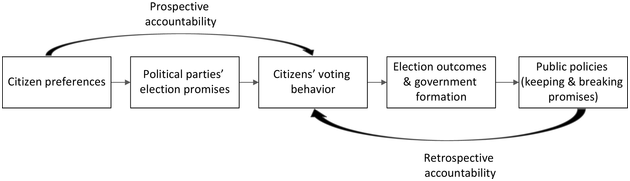
Figure 1.1 illustrates the chain of promissory representation. According to this popular understanding of how democracy works, political parties make promises to voters during election campaigns, including promises to enact specific policies or achieve particular outcomes, as well as more general promises to address certain problems or to act in the interests of their constituent groups. To the extent that promises are sufficiently clear and consistent, voters can assess the extent to which parties propose policies that align with their own policy preferences. Citizens vote for parties that promise to implement policies they support, rewarding those that align with their preferences and withholding support from those that do not. This link between campaign promises and voting behavior, which we call prospective accountability, ensures that political parties have incentives to represent their constituents by making promises that are in line with the policies these constituents want them to pursue if they get elected.
The chain of promissory representation
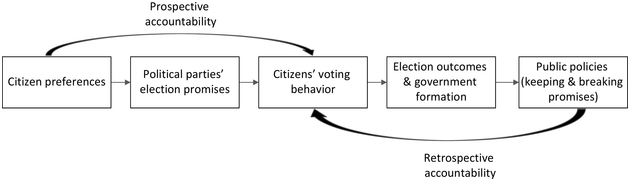
Figure 1.1 Long description
The steps are labeled as follows from left to right. Citizen preferences, political parties' election promises, citizens' voting behavior, election outcomes and government formation, and public policies as keeping and breaking promises. A left-to-right arrow above the boxes is labeled Prospective Accountability, spanning from citizen preferences and political parties' election promises to citizens' voting behavior. A right-to-left arrow below the boxes is labeled Retrospective Accountability, spanning from public policies as keeping and breaking promises and election outcomes and government formation to citizens' voting behavior.
Political parties that gain control over the levers of government after elections, primarily parties that hold executive power, are able to fulfill those promises or can at least attempt to do so. The extent to which parties make, break, and keep their campaign promises is a key characteristic of modern democratic representation in theory and practice. To the extent that promises are sufficiently clear and consistent, voters can use the information entailed in those promises to assess the governing party’s past performance. Voters can hold governments accountable by rewarding those parties that kept their promises, and punishing those that broke their promises. Of course, governing parties may break some promises for good reasons, but consistent promise breaking undermines parties’ reputations and the legitimacy of democracy. This form of retrospective accountability explains why political parties tend to work hard to keep their promises. It imposes political constraints by creating a common understanding of the policies that governments should pursue if conditions do not change in ways that make the implementation of the promises infeasible (Manin Reference Manin1997; Stokes Reference Stokes2001).
When prospective and retrospective accountability work, they provide strong linkages that enable parties to claim that keeping their promises is justifiable based on what citizens want. We argue that globalization impacts both the ability of parties to keep their campaign promises and the kinds of promises they make in the first place. Parties’ responses to these globalization pressures, in turn, undermine the ability of citizens to hold them democratically accountable, with deleterious effects on the quality of democratic representation.
Globalization has deleterious effects on the quality of promissory representation because it imposes constraints on political parties’ capacity to fulfill their campaign promises. Governing parties in countries that are highly internationalized face greater uncertainty about economic business cycles, and they are bound by international agreements that may make some promises hard to keep. Economic integration also strengthens the power of domestic and foreign economic actors who may lobby against the fulfillment of certain promises that threaten their interests. These constraints, combined with uncertainty about how intense they will be at the time of the election campaign, reduces the ability of governing parties to fulfill the promises they made during previous election campaigns. The effects are particularly pronounced for parties on the center-left of the left–right ideological spectrum, which make promises that are more in line with what voters in globalized contexts demand but are furthest away from the policies that market actors generally prefer. The constraining effect of globalization is costly for parties, because citizens retrospectively sanction parties for breaking their promises, making it less likely that parties can hold on to executive power after the next election.
Globalization also puts pressure on parties, particularly those on the center-right, to change the type of campaign promises they make. Voters, who are increasingly exposed to economic risks in a globalized world, demand that parties adopt policies that mitigate those risks. These voter expectations put right-of-center parties under pressure, because they historically relied on the support of coalitions of the relatively wealthy and economic elites, which are often the very actors that favor more open economies. If center-right parties move too far to the left to mitigate the risks globalization imposes on broader swaths of the population, they risk losing support from their primary support coalitions on the right. Center-right parties must delicately balance appeals to their traditional constituents, who continue to favor more open economies and deregulation, and appeals to voters who want protection from the risks and negative distributional effects of economic integration. While center-right parties are able (and willing) to respond to low- and middle-income voters’ economic plight to a limited extent only, they emphasize cultural (or value-based) issues to appeal to voters who are concerned about globalization. This means that many center-right parties are likely to resort to using populist rhetoric in their electoral appeals. In short, globalization encourages center-right parties to shift further to the center of the economic left–right spectrum, as well as to compete on conservative and populist values. This allows them to retain economic liberal positions, while at the same time attracting a sufficiently large voter base.
Parties fear the wrath of their core constituencies who hold them accountable both for the types of promises they make and for keeping or breaking those promises once in office. These pressures lead to a third important way in which globalization undermines promissory representation. Office-seeking parties naturally want to minimize electoral punishments from voters for the types of promises they make and for their failure to keep their promises. These electoral pressures of globalization, both prospective and retrospective, create strong incentives for parties to make more ambiguous campaign statements. The vaguer the campaign promises, so they hope, the more difficult it will become for voters to hold them accountable both for the contents of their promises and for breaking those promises after they are elected.
Parties’ use of vague language may bring short-term electoral gains, but it undermines democratic accountability. By making vague campaign statements that can be interpreted in multiple ways, parties can attract voters from different ideological backgrounds without alienating particular groups. However, as parties continue to employ less specific language, the traditional mechanism by which voters hold their representatives accountable – by assessing the contents of what parties promise and the past records of governing parties in relation to promise keeping – is weakened. Parties’ use of ambiguity may also make voters disillusioned, as they realize parties are avoiding making concrete commitments, further contributing to declining trust in political institutions. This erosion of accountability threatens to weaken the fundamental principles of democratic representation, where clear promises and subsequent fulfillment are essential for maintaining voter confidence and ensuring that elected officials remain responsive to public needs.
In sum, globalization has deleterious effects on the quality of democratic representation because it reduces the ability of parties to keep their promises and brings about strong pressures to make different types of promises, as well as pressures to pursue strategies that undermine democratic accountability. Ultimately, these shifts represent a significant transformation in how parties operate, influenced by the increasing complexity and unpredictability of the global political and economic landscape. This not only reshapes electoral dynamics but also poses a challenge to the very foundations of democratic governance, where accountability and transparency are critical to the health of representative institutions.
A Mixed-Methods Approach
We test our arguments on the effects of globalization on promissory representation using evidence amassed over the last five years and a mixed-methods approach that considers the entire chain of promissory representation, including party strategies and voter responses. We find robust evidence that effective promissory representation is one of the casualties of economic integration. Several core findings support this sobering conclusion.
First, using a large-n observational statistical analysis of the making and breaking of over 7,000 campaign promises made by prospective governing parties in twelve countries prior to the formation of fifty-seven governments, we find robust evidence that political parties are less likely to keep their campaign promises when their country is more deeply integrated into the international economy. The effect is substantively important; increasing economic integration puts serious constraints on political parties’ ability to fulfill a wide range of campaign promises. Supporting our expectations, these constraints are particularly large for promises in relation to economic policy and for parties on the center-left of the ideological spectrum. An in-depth case study of the UK Conservative Party’s now infamous promise in 2010 to cut net migration to the United Kingdom to under 100,000 lends support to the underlying mechanisms of our argument (and also demonstrates that center-right parties are not immune from the constraints of globalization). The case study draws on a range of secondary sources (including academic studies and newspaper articles), primary archival materials (such as election manifestos, consultation reports, and government communications), and interviews with political, administrative, and economic elites who were directly involved in the relevant debates. It provides strong evidence that globalization induces greater uncertainty about future policies and international legal constraints, and it shifts political power to market actors in a way that leads to more broken promises.
Second, in our analysis of ideological shifts along the left–right spectrum and the rise of populist rhetoric in electoral appeals of mainstream political parties across thirty-one countries from 1970 to 2020, we find that parties, particularly those on the right of the ideological center, have not only moderated their economic stances and moved toward the center ground on socioeconomic left–right issues, but they have also increasingly adopted populist rhetoric in their electoral appeals. This shift is particularly notable in how center-right parties, traditionally focused on free markets and limited government intervention, have embraced more interventionist and welfare-oriented promises. The large-n analysis of ideological shifts, combined with evidence showing that center-right parties are making more promises to expand government programs, underscores the pressures globalization has placed on parties to alter their promises in response to changing public demands. These pressures have presented a dilemma for center-right parties: while they must adapt to voter preferences for more economic protection and social support, they simultaneously risk alienating their traditional economic base. This tension helps explain the rise of populist rhetoric, particularly among mainstream center-right parties, as they seek to balance these competing demands in increasingly globalized political environments. The adoption of populist strategies thus reflects a broader response to the challenges globalization poses to traditional party platforms, particularly in maintaining electoral competitiveness while navigating complex economic realities.
Third, using a unique dataset that tracks the levels of ambiguity in 293 English-language party election programs across six countries from 1970 to 2019, we find a significant trend that political parties, regardless of their position on the ideological spectrum, are less inclined to make precise and concrete statements during election campaigns when they are more exposed to the global economy. Parties have shifted toward using more ambiguous, general language in their programs. This trend allows parties to remain flexible in their policy implementation and reduces the potential for being held strictly accountable for specific promises once in office. As a result, voters find it more challenging to evaluate the fulfillment of campaign promises when the next election cycle comes around. The move toward vagueness in election programs reflects a broader strategy of risk management in a politically volatile environment. Faced with the uncertainties brought about by globalization, economic shifts, and rapidly changing public opinion, parties may find it safer to avoid committing to clear policies that could become politically or economically untenable. This trend is not limited to a specific region or type of party; it is a strategy employed by both left-wing and right-wing parties, indicating a structural shift in how electoral competition is conducted.
The argument that parties have incentives to make vaguer promises rests on the assumption that voters punish them for breaking promises or making promises that are unpopular and that vague language helps parties avoid political costs. Testing these assumptions required a range of methods. A survey experiment demonstrates the negative electoral effects of promise breaking, even in the presence of what might be mitigating international economic constraints. We conducted a preregistered survey experiment among US citizens in Spring 2024. The survey experiment presents respondents with a hypothetical politician who made either clear, vague, or ambivalent statements about corporate tax policies, followed by a randomized voting outcome either keeping or breaking their promise. We also introduced a globalization shock condition for half of the respondents to test whether external economic factors influenced voters’ assessments of broken promises. Consistent with the existing literature, our results show strong evidence that voters punish politicians for breaking clear promises. This punishment is even stronger in globalized contexts where economic factors complicate promise keeping. This suggests that voters in internationalized settings are especially attuned to patterns of promise keeping when making their electoral choices.
Observational data from sixty-nine elections across fourteen Western democracies further support this finding. Government parties that break a greater share of their campaign promises tend to suffer electoral losses in subsequent elections. Consistent with our expectations, this sanctioning effect is significantly larger in countries that are more deeply integrated into the global economy. We further explored this statistical association with an in-depth case study of French citizens’ perspectives on the infamous broken promises of the Socialist government in the 1980s. The case study shows that promise breaking has corrosive effects even on citizens with a sophisticated understanding of international economic constraints and who maintain a strong degree of party loyalty; it is frequently associated with people becoming disaffected by politics.
Beyond demonstrating the adverse effects of promise breaking, the present experimental evidence reveals that parties can avoid electoral sanctions by using vague language. Voters inflict less punishment on politicians who make vague promises, even when those politicians’ subsequent actions contradict voters’ preferences. This suggests that ambiguity in campaign language provides a form of insulation, making it harder for voters to hold politicians accountable for policies they do not approve of. In highly globalized contexts, where policy outcomes are increasingly shaped by external forces, such ambiguity is a valuable tool for managing voter expectations and limiting electoral costs. While this may help parties survive in a challenging environment, it ultimately weakens political accountability and undermines the quality of democratic representation.
Core Contributions
The impact of economic globalization on the quality of democracy is a subject that has captivated the attention of political leaders, policymakers, and scholars alike, igniting strong and often clashing opinions. Everyone acknowledges that globalization and democracy are deeply intertwined, but the real battleground is whether this relationship is a blessing or a curse for democratic governance. The scholarly debate on this issue is marked by sharp theoretical divisions (Dahl Reference Dahl, Shapiro and Hacker-Cordon1999; Keohane, Macedo, and Moravcsik Reference Keohane, Macedo and Moravcsik2009; Levitsky and Way Reference Levitsky and Way2006; Mair Reference Mair2013; Mounk Reference Mounk2018, Reference Mounk2022; Rodrik Reference Rodrik2012; Sassen Reference Sassen1996; Stiglitz Reference Stiglitz2003, Reference Stiglitz2018), and empirical research has yielded inconsistent results (Acemoglu and Robinson Reference Acemoglu and Robinson2006; Cerny Reference Cerny1995; Eichengreen and Leblang Reference Eichengreen and Leblang2008; Gao Reference Gao2021; Gasiorowski Reference Gasiorowski1988; Hafner-Burton and Schneider Reference Hafner-Burton and Schneider2023; Hellwig and Samuels Reference Hellwig and Samuels2007; Li and Reuveny Reference Li and Reuveny2003; Mansfield and Pevehouse Reference Mansfield and Pevehouse2006, Reference Mansfield and Pevehouse2008; Meyerrose Reference Meyerrose2020, Reference Meyerrose2024; Milner Reference Milner2021a; Milner and Kubota Reference Milner and Kubota2005; Milner and Mukherjee Reference Milner and Mukherjee2009; Pevehouse Reference Pevehouse2002a, Reference Pevehouse2002b, Reference Pevehouse2005; Rudra Reference Rudra2005; Xie, Zhang, and Yang Reference Xie, Zhang and Yang2021). On one side, critics assert with compelling force that globalization is largely incompatible with meaningful national democracy. They argue that it erodes the sovereignty of democratically elected governments, stripping them of their ability to shape policy and leaving elections as hollow, performative rituals. On the other side, proponents of globalization counter with equal intensity, claiming that international economic integration fosters stronger democracies by increasing national wealth, which governments can use to meet the needs and expectations of their citizens. At first glance, if one considers only one side of the debate, it may appear that the effects of globalization on democracy are well understood and incontrovertible. Yet, when we stand back and examine both sides, the reality is that we know far less than we think, and the uncertainty surrounding this issue is profound.
We aim to move beyond the polarized debate on whether globalization is good or bad for democracy. The problem is partly that the two sides are largely talking past each other. One side says globalization is bad for a particular aspect of democracy, and then the other side says that globalization is good for another, quite different aspect of democracy. The debate is further muddled by the fact that some commentaries refer to the impact of globalization on democracy in developing countries, while others refer to established liberal democracies. The approach we propose is quite different in this respect. Our research joins an emerging body of work that highlights how globalization affects key mechanisms of democratic representation (Alonso and Ruiz-Rufino Reference Alonso and Ruiz-Rufino2018; Ezrow and Hellwig Reference Ezrow and Hellwig2014; Hellwig Reference Hellwig2015; Hellwig and Samuels Reference Hellwig and Samuels2007; Ruiz-Rufino Reference Ruiz-Rufino2025; Ruiz-Rufino and Alonso Reference Ruiz-Rufino and Alonso2017) and extends this work by considering the entire chain of promissory representation, including the effects of globalization on promise making, promise keeping, and voters’ capacity to sanction or reward parties at the ballot box. By empirically examining these interlinked mechanisms, our framework offers a comprehensive understanding of how democratic representation is being disrupted by deep economic integration. It reveals not only how parties adapt their strategies and how voters respond, but also how these dynamics accumulate to weaken democratic responsiveness and accountability. This holistic perspective enables us to assess more precisely when and how globalization undermines core democratic functions and, just as importantly, where opportunities for democratic resilience might still exist.
Our study also contributes to the literature on promissory representation, which emphasizes the importance of campaign promises in the theory and practice of democratic representation. Promissory representation is a key mechanism through which voters hold their representatives accountable, making it essential to the functioning of democracies. Comparative research has extensively documented and analyzed patterns of promise keeping with a range of different research approaches (Klingemann, Hofferbert, and Budge Reference Klingemann, Hofferbert and Budge1994; McDonald and Budge Reference McDonald and Budge2005; Naurin Reference Naurin2011, Reference Naurin2014; Naurin, Royed, and Thomson Reference Naurin, Royed and Thomson2019; Schneider and Thomson Reference Schneider2024; Stokes Reference Stokes2001; Thomson et al. Reference Thomson, Marsh, Farrell and McElroy2017). This body of research provides valuable insights into how domestic political institutions, such as electoral systems, coalition governments, and party competition, influence the extent to which parties fulfill their campaign promises. For instance, using a broad range of approaches to measuring parties’ election campaign appeals, these studies have demonstrated that the existence of power-sharing arrangements, such as the need to form coalition governments, are among the many factors that explain why some parties are better able to keep their promises than others.
While this body of research has significantly advanced our understanding of the domestic institutional factors that influence promise keeping, it has generally overlooked the broader context in which these political processes occur, particularly the growing influence of globalization. As countries become more deeply integrated into the global economy, the traditional frameworks used to explain the fulfillment of campaign promises may no longer be sufficient. Global economic forces, such as trade agreements, international financial markets, and multinational corporations, increasingly constrain the policy options available to national governments, even when they have a mandate from their electorate to implement specific promises. In this globalized context, governing parties may find it more difficult to fulfill their campaign promises, not due to domestic institutional constraints but because of the external pressures that limit their autonomy. By incorporating the role of economic integration, we provide a more comprehensive understanding of the challenges that governing parties face in delivering on their electoral commitments. We argue that globalization complicates the practice of promissory representation, as governments must navigate both domestic political institutions and the constraints imposed by their participation in the global economy. This broader perspective is essential for explaining why, despite the institutional capacity to deliver on promises, governing parties in highly globalized countries may still struggle to keep their commitments, ultimately affecting democratic accountability.
By examining the entire chain of promissory representation, our findings also contribute to the growing body of research on how promise keeping and breaking shape voters’ evaluations of governing parties, and ultimately influence their electoral fortunes (Böhmelt and Ezrow Reference Böhmelt and Ezrow2021; Bonilla Reference Bonilla2022; Born, Van Eck, and Johannesson Reference Born, Van Eck and Johannesson2018; Elinder, Jordahl, and Poutvaara Reference Elinder, Jordahl and Poutvaara2015; Matthieß Reference Matthieß2020; Naurin and Oscarsson Reference Naurin and Oscarsson2017; Simas, Milita, and Ryan Reference Simas, Milita and Ryan2021; Stokes Reference Stokes2001; Thomson Reference Thomson2011; Thomson and Brandenburg Reference Thomson and Brandenburg2019). Our observational and experimental work provides further evidence of the emerging wisdom that voters are not only able to identify party promises but hold their governments accountable for keeping their promises. In addition, our findings provide new insights into the conditions under which promise keeping is punished. Two of our central findings are that voters have become more likely to use promises as a benchmark for accountability as their countries have become more globalized. Furthermore, we find that politicians can successfully limit voters’ punishment for promise breaking if they make more ambiguous statements during election campaigns. Both findings have, as we show in our book, important implications for the promise keeping in globalized environments.
Our findings also emphasize the critical role of promise making in establishing democratic accountability. The act of making specific promises during election campaigns sets the expectations that allow voters to evaluate their representatives’ performance. Without clear promises, accountability becomes harder to measure. In this light, promise making is not only a precondition for democratic accountability but also shapes the nature of political competition. The literature examining the effects of globalization on the ideological shifts of political parties offers insights into how globalization creates both opportunities and constraints for political parties (Adam and Ftergioti Reference Adam and Ftergioti2019; Adams, Haupt, and Stoll Reference Adams, Haupt and Stoll2009; Haupt Reference Haupt2010; Kriesi et al. Reference Kriesi, Grande, Lachat, Dolezal, Bornschier and Frey2008, Reference Kriesi, Grande, Dolezal, Helbling, Höglinger, Hutter and Wüest2012; Milner and Judkins Reference Milner and Judkins2004; Mishra Reference Mishra2000; Sen and Barry Reference Sen and Barry2020; Steiner and Martin Reference Steiner and Martin2012; Ward, Ezrow, and Dorussen Reference Ward, Ezrow and Dorussen2011; Ward et al. Reference Ward, Kim, Graham and Tavits2015). However, much of this research has operated in isolation from studies of promissory representation, with limited integration between the two areas of inquiry. Our approach bridges this gap. By synthesizing findings from both literatures, we provide a more comprehensive understanding of how mainstream parties have responded to the pressures of globalization. This integrated perspective sheds light on why parties have shifted their positions not only along the economic left–right dimension, but also on the non-socioeconomic dimension that includes national cultural themes, while some parties have also adopted more populist rhetoric. These changes are connected parts of parties’ responses to the constraints of globalization.
Finally, our findings reveal insights into the effects of globalization on domestic economic and social governance, which centers on governments’ policy autonomy and ability to compensate the losers of globalization (Adsera and Boix Reference Adsera and Boix2002; Dreher, Gaston, and Martens Reference Dreher, Gaston and Martens2008; Garrett Reference Garrett1998; Iversen and Cusack Reference Iversen and Cusack2000; Mosley Reference Mosley2000; Swank Reference Swank2002). Considering the entire chain of promissory representation, our findings indicate that even if governments want to respond to public demands for compensation, in globalized contexts they are constrained in fulfilling the very promises that would be most responsive to these demands. This insight may explain why scholars find support for the microfoundations of the compensation hypothesis (Walter Reference Walter2010) but present more mixed evidence for the macro-relationship between globalization and welfare policies. The constraints that globalization places on promissory representation are particularly troubling when considering the recent globalization backlash.Footnote 6 Some scholars have suggested that governments should implement policies that would compensate citizens who are negatively affected by globalization (Goodman and Pepinsky Reference Goodman and Pepinsky2021; Mansfield and Rudra Reference Mansfield and Rudra2021; Ruggie Reference Ruggie1982). However, our research shows that these are the very policy measures that governing parties find most difficult to implement due to the constraints of globalization.
Outline of the Book
The remainder of the book closely follows the chain of promissory representation as presented in Figure 1.1. Rather than proceeding linearly from promise making to promise keeping, we begin at the end of the cycle, examining whether, and under what conditions, governing parties keep their promises once in office. We do so because promise keeping offers a clear illustration of the dilemmas parties face. The subsequent chapters turn to promise making and, more broadly, how parties formulate their electoral appeals and how these are shaped by globalization’s constraints. Finally, we examine how parties contend with the accountability pressures that globalization creates, particularly when promise breaking becomes more likely or more visible. In doing so, we engage the full cycle of promissory representation, with attention to how economic integration reshapes its core mechanisms: policy commitment, government action, and electoral sanctioning.
Chapter 2 introduces and elaborates the conceptual framework of promissory representation, arguing that it provides a powerful and analytically tractable lens for understanding democratic accountability under conditions of globalization. At its core, promissory representation views elections as instruments through which political parties seek power by making policy commitments, and voters hold them accountable based on their performance in fulfilling those commitments once in office. This framework places campaign promises at the center of democratic practice, linking preelectoral appeals with postelectoral behavior and allowing for a systematic evaluation of the degree to which governing parties deliver on their electoral mandates. The chapter also clarifies how promissory representation relates to broader concepts of democratic quality, including responsiveness and political accountability. While responsiveness generally captures the extent to which governments align with public preferences, promissory representation sharpens this concept by emphasizing the mechanisms through which preferences are articulated (via party promises) and enforced (through electoral sanctioning). Similarly, political accountability is not treated as a diffuse ideal, but as a structured process rooted in observable behavior: the making, keeping, and evaluation of promises. We also engage directly with key criticisms of the promissory model, including concerns about voter sophistication, the complexity of policy environments, the collective nature of governance, and the strategic ambiguity of party rhetoric. We argue that these criticisms underscore the need to examine how globalization alters the conditions under which promissory representation can function effectively. By embedding promissory representation within a broader theoretical and empirical analysis of global economic constraints, the chapter sets the stage for the rest of the book’s investigation into how democracy works when national policymaking is internationally entangled.
Chapter 3 provides the theoretical foundation for understanding how globalization constrains political parties when making and keeping promises. Building on the conceptual discussion of promissory representation in Chapter 2, we shift the focus to the macro-level institutional and structural conditions under which democratic accountability operates. While Chapter 2 outlines what promissory representation is and why it matters for democratic governance, Chapter 3 develops a theoretical framework on how globalization affects the very conditions that allow this model to function. This framework serves as the basis for both sets of empirical analyses that follow: the analysis of promise keeping in Part II of the book (especially Chapters 4 and 5) and the analysis of promise making in Part III of the book (Chapters 7 and 8).
We argue that four key features of globalization influence the making and keeping of campaign promises. The first and most tangible set of constraints stems from the international legal commitments that governments make to reap the benefits of international economic integration. Such agreements, especially when they contain provisions for monitoring and enforcement, impose constraints on both the making and fulfillment of campaign promises. The second constraint relates to the change in the composition of relevant actors who try to influence national governments and the preferences of those actors. These include national and international actors who gain from globalization. Many of these are market actors, such as national export-oriented firms that thrive on their ability to export their products and services to other countries. These actors pressure governments to implement policies that ensure their continued access to the benefits of globalization, even if it means that governing parties break campaign promises. The third globalization constraint consists of citizens whose interests and demands on government policies shift as a consequence of globalization. Often the interests of the wider population, which demands greater protections from the forces of globalization, clash with the demands of domestic and international market actors who prefer fewer restrictions and protections. Finally, the most pervasive constraint of globalization is uncertainty. Governing parties are limited in the extent to which they can calculate the precise implications of globalization for the feasibility of their campaign promises. These four constraints help understand why and how globalization negatively affects political parties’ ability to fulfill their promises, the focus of Part II of the book, and changes the types of promises they make, the concern of Part III of the book.
Chapter 4 integrates insights about how promissory representation works and how globalization constrains national governments’ room to maneuver by developing an argument about the implications of globalization for promise keeping. We argue that international economic integration reduces parties’ capacity to fulfill their campaign promises if they hold executive power after the elections. We use a data set of over 7,000 specific election pledges in twelve countries in a quantitative analysis of economic integration and its correlation with the promise keeping and breaking. We find that globalization has a strong and significant negative association with promise keeping. Governing parties that operate in countries that are deeply integrated in the global economy are significantly less likely to fulfill their campaign promises. In line with our expectations, we find that the constraining effect of globalization is particularly pronounced for governing parties on the center-left of the left–right ideological spectrum. Those parties’ promises are most likely to conflict with the demands imposed by globalization, making them more vulnerable to pressures to break them.
The analyses in Chapter 4 also show that political parties do not anticipate the constraints of globalization on promise keeping by making fewer election pledges. This nonfinding accords with previous analyses of the frequency of promise making, which concluded that parties make comparable numbers of promises, whether they be left-wing or right-wing parties, incumbents or challengers, or in systems where single-party governments or coalitions are the norm (Naurin, Royed, and Thomson Reference Naurin, Royed and Thomson2019). At the same time, we find evidence that parties have indeed responded to voters’ shifts in expectations. Parties, especially those on the center-right of the ideological spectrum, have become much more likely to make promises to expand social programs as their countries have become more integrated in the international economy. This finding foreshadows some of the arguments and analyses in Part III of the book, namely that globalization has shaped not only the ability of political parties to keep their promises but also the very content and characteristics of the promises they make to get into office.
Chapter 5 complements the quantitative findings from Chapter 4 with qualitative evidence from a case study. The case study approach reveals the mechanisms underlying the statistical association between international economic integration and national promise breaking. We examine the British Conservative Party’s failed promise to reduce net migration to below 100,000 during the 2010–2015 governing period when the party held executive office. Using primary and secondary data, including interviews with political elites, we trace the existence of globalization constraints in this case. The main factors in relation to the net-migration promise align with the mechanisms outlined in the theory. The formulation of the promise itself was in part driven by increasing voter concerns about migration and fueled by party competition and ideology. The rise of a right-wing, anti-immigration challenger party and public opinion that supported curbs on immigration put strong pressure on the party to take a tough stance on this issue. The breaking of the promise was caused by a combination of factors relating to global market movements, international commitments that conflicted with the promise, and effective lobbying by national and international market actors. Economic uncertainty, EU membership, and lobbying efforts by various market actors, both within and outside the United Kingdom, hampered the government’s ability to reduce immigration to a point that would have fulfilled its campaign promise.
Chapter 6 combines large-n observational, experimental data, and a case study to analyze the electoral consequences of promise breaking under globalization. Our analysis of electoral outcomes across a broad sample of Western countries shows that governing parties that fail to keep a large proportion of their campaign promises are likely to receive significantly lower vote shares than political parties that keep their promises. In addition, we find that promise keeping becomes more important with the onset of globalization. We then present the results of a preregistered survey experiment that we fielded in the United States. The survey experiment allows us to establish causality with greater certainty, thereby removing concerns that the observational results might be driven by other factors, such as partisanship. The results show that voters indeed punish politicians if they break their campaign promises, even in the presence of potentially mitigating reasons for promise breaking that stem from international constraints. The case study explores citizens’ perspectives on promise breaking with a series of in-depth interviews with French citizens who voted for a party that famously broke its promises in the 1980s. The qualitative evidence attests to the long-term adverse effects of promise breaking. Demonstrating that promise breaking has electoral consequences is crucial for our argument. We would not expect political parties to adapt to the constraints of globalization on promise keeping if they did not need to worry about being punished by voters for promise breaking.
Part III of the book shifts the focus to prospective accountability and looks at the impact of globalization on the contents of parties’ electoral appeals to voters, both in terms of their positioning on the traditional left–right ideological spectrum (Chapter 7) and in the use of populist rhetoric in their policy appeals (Chapter 8). Chapter 7 begins by examining how parties have shifted the left–right ideological positions they present to voters. We argue that these ideological shifts are part of parties’ response to changes in citizens’ expectations of their governments relating to the risks of globalization. The chapter discusses how ideology is affected by parties’ differential responses to citizens’ rising expectations that their governments protect them from the risks associated with globalization. We theorize that it is predominantly center-right parties that feel the pressure to moderate their traditionally free-market-oriented principles by moving to the center ground on many socioeconomic policy themes, thereby offering some solace to citizens who are negatively affected by globalization. By contrast, left of center parties are not compelled to shift their positions on socioeconomic issues, as their traditional principles already meet citizens’ elevated expectations that governments protect them from economic risks. In other words, we argue that it would be more costly for leftist parties to shift rightward than it would be for rightist parties to shift leftward.
Chapter 7 uses a combination of survey experimental evidence and observational analyses to test this argument. With the survey experiment, we compare citizens’ assessments of a politician who moved rightward, adopting a stance more favorable to big business than previously promised, with those of a politician who moved leftward, adopting a stance less favorable to big business than previously promised. Even after taking into account respondents’ own policy preferences, people liked the rightward-shifting politician a lot less than the leftward-shifting politician. We find the same tendency to punish rightward shifts more than leftward ones, even when there is a globalization shock that justifies the shift in position. The observational analyses also support our argument. We rely on large-n quantitative data on parties’ ideological positions on the left–right socioeconomic dimension to test this argument. The dataset consists of over 1,000 observations of shifts in mainstream parties’ positions from thirty-one liberal democracies between 1970 and 2020. We find that parties have indeed shifted their positions as a consequence of globalization. On the socioeconomic left–right dimension, mainstream parties of the center-right have moved to the center as their national economies have become more integrated. In addition, the chapter explores parties’ ideological positions on the nonsocioeconomic left–right dimension that includes nationalist and cultural themes. The findings suggest that many parties, of both left- and right-wing mainstream party families, have shifted rightward on this dimension, by devoting more attention to rightist themes associated with populist movements.
Chapter 8 examines how globalization affects the adoption of populist issue agendas and framings. We argue that center-right parties are confronted by a distinct dilemma. They face increasing pressure from voters’ heightened expectations that governments should shield them from the economic uncertainty generated by globalization. To address these concerns, many center-right parties moderate their positions on socioeconomic policy and move toward the political center. However, this strategy risks alienating their traditional base on the right, while often falling short of reassuring lower-income voters who bear the brunt of globalization’s dislocations. To solve this dilemma, center-right parties increasingly adopt populist appeals, emphasizing anti-elite, nation-first, or anti-globalist messages. By doing so, they seek to retain core supporters while broadening their appeal to economically anxious constituencies. Chapter 8 uses large-n quantitative analyses of populist rhetoric to show that as globalization has advanced, mainstream parties on the center-right have adopted more populist rhetoric.
Chapters 9 and 10 in Part IV consider mainstream parties’ attempts to avoid the accountability mechanisms of promissory representation. These chapters address the parties’ use of ambiguity in their electoral appeals in response to globalization. Whereas the changes in parties’ ideological positioning and even the use of populist language (Part III) may be understood within the framework of promissory representation, using ambiguous language is an attempt to avoid the risks of electoral punishment associated with making clear commitments that fail to meet citizens’ concerns or that cannot be fulfilled. Chapter 9 argues that both left-wing and right-wing mainstream parties have used ambiguity in their election appeals in response to the political challenges that globalization has presented them with. However, they have done so for different reasons. Parties on the left have found it more difficult to fulfill their campaign promises as economic globalization has deepened and have adopted vaguer language to avoid at least some of the negative electoral consequences of promise breaking. In general, globalization is less of an impediment to center-right parties fulfilling their campaign promises. However, it has been difficult for center-right parties to appeal to citizens’ heightened demands for protections from the risks associated with international economic integration. For right-wing parties, ambiguous language clouds policy stances that do not meet citizens’ concerns. Using data on the ambiguity of election manifestos, we provide comparative evidence that a broad range of mainstream parties in globalized contexts are significantly more likely to use vague language.
Chapter 10 explores the consequences of political ambiguity for democratic accountability. Using evidence from a preregistered experiment, we show that political ambiguity in promise making is an effective strategy to reduce the political consequences of promise breaking. Voters are significantly less likely to reduce their support for parties that break vague as opposed to concrete promises. The drawback is that concrete promises are crucial to allow voters to hold political parties accountable for keeping their promises. As political parties make more vague statements, they limit the ability of voters to hold them accountable. These developments have serious deleterious consequences for the quality of promissory representation.
In Chapter 11, we examine the future of democratic representation in the context of globalization. We argue that globalization has fundamentally weakened the traditional model of promissory representation, in which voters hold parties accountable based on their performance in fulfilling their campaign promises. As economic integration deepens, political parties face significant constraints in keeping their promises, leading to voter dissatisfaction and the rise of populism. We explore whether the recent trend toward selective deglobalization could alleviate some of these pressures, but we conclude that this trend is not far-reaching enough to reverse the effects that our analyses reveal. Instead, we argue that democratic representation needs to evolve, either by adopting new forms of accountability or finding ways to rebuild trust between voters and political parties in an era where fulfilling promises is becoming increasingly difficult. Without such adaptation, the future of democratic representation will remain at risk.

 Open access