





1. Introduction
Although the effects of global warming are being felt through all sectors of society, there is a growing awareness that its most severe effects on the greatest number of people will occur in cities – particularly cities in the Global South (Ansah et al., Reference Ansah, Amoadu, Obeng and Sarfo2024; Bai, Reference Bai2023). Because of this, research on urban resilience and urban adaptation has taken on increased importance. As planners, officials, and urban residents scramble to put urban climate change policies and practices into place, it is important that they draw on a wide range of scientific and scholarly research. Cities in the ancient world – as documented by history and archaeology – adapted to environmental, economic, and political changes, and they dealt with the effects of shocks. Might these settlements hold insights that can contribute to research on urban climate change adaptations today? My approach considers the effects of climate change as a type of shock to cities. Urban shocks in the past were not limited to climatic or environmental variables. I explore whether urban responses to a broad range of past shocks might allow inferences about the general role of climate shocks on cities and urban populations today.
I approach this question by outlining two distinct approaches to the historical and archaeological analysis of urban resilience in the distant past. The first approach focuses on shocks documented at specific past cities, using the example of earthquakes. The second approach focuses on the success and persistence of some cities – but not others – over the long run, acknowledging that they must have weathered a variety of shocks over their history. The nature of these two approaches is clarified by reference to the concepts of specified resilience and general resilience.
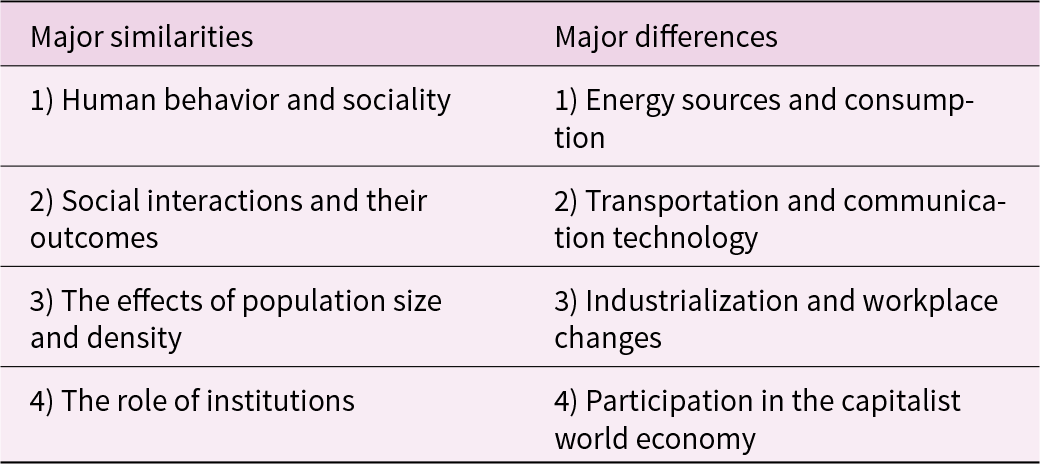
I begin by laying out the rationale for considering ancient cities relevant for advancing research on contemporary urban issues. Table 1 summarizes past research on the salient similarities and differences between ancient and contemporary cities (Fox & Wolf, Reference Fox and Wolf2024; Roberts et al., Reference Roberts, Carleton, Amano, Findley, Hamilton, Maezumi, Winkelmann, Laubichler and Renn2024; Smith et al., Reference Smith, Lobo, Peeples, York, Stanley, Crawford, Gauthier and Huster2021). Several types of evidence support the judgment of similarities in this table. The fact that neighborhoods are universal in cities throughout history (Smith, Reference Smith2023c, pp. 211–217) suggests the importance of basic sociality and institutions. The findings of settlement scaling research (Lobo et al., Reference Lobo, Bettencourt, Smith and Ortman2020) show that urban agglomeration effects – economic expansion based on the concentration of both population and economic activity in a location – have similar quantitative expressions in ancient and modern cities. The differences in Table 1 are easier to understand than the similarities; contemporary cities are radically different from early cities in energy, technology, size, and participation in the capitalist world economy. If the ways that cities today are impacted by (and recover from) shocks are determined by forces such as social interactions and institutions, then early cities may have lessons for cities today. On the other hand, if urban resilience to shocks is based more on energy sources and technology, or the capitalist world economy, then it will be more difficult to make useful inferences from the distant past.
Major similarities and differences between ancient and modern cities

Table 1 Long description
The table compares major similarities and differences between ancient and modern cities. Key similarities include human behavior, social interactions, population effects, and institutional roles. In contrast, major differences are found in energy sources, transportation and communication technology, industrialization, and participation in the capitalist economy. These differences highlight the evolution of cities in response to technological advancements and economic systems, while similarities emphasize enduring aspects of human society. Understanding these factors can provide insights into urban development and societal changes over time.
2. Urban resilience in the past
Past environments and their influences on (and from) people and society are now studied by a number of disciplines and subdisciplines, and much of this research is phrased in terms of resilience. A working definition of resilience is ‘the capacity to sustain a shock and continue to function and, more generally, cope with change’ (Anderies et al., Reference Anderies, Folke, Walker and Ostrom2013, p. 3). Resilience – particularly as used in the field of ecology – is an attribute of a complex adaptive system. In the words of Levin (Reference Levin1998, p. 431), ‘Ecosystems are prototypical examples of complex adaptive systems, in which patterns at higher levels emerge from localized interactions and selection processes acting at lower levels.’ In the literature on human ecology, complex adaptive systems are often called social–ecological systems. With respect to urban resilience, cities are analyzed as social–ecological systems, as are the regional networks in which individual cities are embedded (Alberti, Reference Alberti2023; Meerow et al., Reference Meerow, Newell and Stults2016). In this paper, I focus on the city or urban center as the focal social–ecological system.
Surprisingly, almost none of the research on past resilience focuses on cities; most of it addresses general resilience on a societal level. As such, its value for understanding past urban resilience is unclear. Major edited collections on human–environmental interaction in the past have little to say about urban issues, and, if they do include urban data, it is only to illuminate broader trends and not to understand the resilience of cities or settlements per se (Erdkamp et al., Reference Erdkamp, Manning and Verboven2021; Riede & Sheets, Reference Riede and Sheets2020). Archaeologists have made notable advances in research on ancient resilience for individual events and categories of events (Keenan-Jones et al., Reference Keenan-Jones, Serra-Llobet, He and Kondolf2025), and for demographic patterns over long periods (Riris & de Souza, Reference Riris and de Souza2021; Riris et al., Reference Riris, Silva, Crema, Palmisano, Robinson, Siegel, Ren, Jørgensen, Maezumi, Solheim, Bates, Davies, Oh and Ren2024), but this research avoids cities.
Archaeologists and historians specializing in early cities, on the other hand, rarely employ resilience or sustainability as central analytical concepts in their research; some exceptions include Roberts et al. (Reference Roberts, Carleton, Amano, Findley, Hamilton, Maezumi, Winkelmann, Laubichler and Renn2024) and Isendahl et al. (Reference Isendahl, Dunning, Grazioso, Hawken, Lentz and Scarborough2025). The avoidance of cities and urban themes in the literature on past environmental issues and resilience is illustrated by a list of nine high-profile comparative projects and research networks listed in Hoyer et al. (Reference Hoyer, Bennett, Reddish, Holder, Howard, Benam, Levine, Ludlow, Feinman and Turchin2023). These are projects ‘seeking to derive policy-relevant findings from surveys of how societies in the past fared when facing climate and especially ecological challenges’. None of these projects focuses on cities, and most do not even include cities or settlements as analytical units.
Yet cities, particularly those in the Global South, are the places where the destructive consequences of climate change are being felt most strongly (Ansah et al., Reference Ansah, Amoadu, Obeng and Sarfo2024; Bai, Reference Bai2023; IPCC, 2023; Prieur-Richard et al., Reference Prieur-Richard, Walsh, Craig, Melamed, Colbert, Pathak and Bulkeley2019). Because of this, cities – more than societies or polities – have become a priority for developing new knowledge about resilience and adaptation. Cities differ from polities and societies in a variety of ways. City can be defined as ‘a settlement where population and activities are concentrated in space’ (Smith, Reference Smith2023c, p. 4). Archaeologists tend to use one or both of two definitions of urbanism in their analysis of ancient settlements. The demographic definition (from sociology) identifies cities as large, dense, socially complex settlements, whereas the functional definition – which originated in economic geography – sees cities as places that concentrate activities and institutions that affect a broader hinterland; see Smith (Reference Smith2020) for discussion. With reference to shocks and resilience, some of the major differences between cities and societies are the place-based nature of cities, the importance of population and density in generating both positive and negative outcomes in urban settings, and the outsized role of neighborhoods in structuring urban life and organization. Because cities concentrate population, institutions, and activities in space, they are more directly affected (than their whole societies) by the many kinds of shocks that occur at specific locations.
These distinctive features of cities create conditions that can both promote and retard processes of adaptation and resilience. The fortunes of cities can change more quickly than those of whole societies, and this effect is greater for early cities. Today, institutions like the insurance industry and property rights in land have made cities ‘virtually indestructible’ (Campanella, Reference Campanella2006). While early empires did help some cities recover from shocks like earthquakes (Haldon et al., Reference Haldon, Eisenberg, Mordechai, Izdebski and White2020; Pickett, Reference Pickett and Smith2022), cities before the modern era were far less protected by polities and institutions. This made them more susceptible to decline, and in fact many early cities did rise and fall independently of the overall growth or collapse of society (Smith et al., Reference Smith, Lobo, Peeples, York, Stanley, Crawford, Gauthier and Huster2021).
Two kinds of epistemological problems affect research on past urban resilience. First, because resilience has been a popular concept in the historical sciences for two decades, it is now commonly used as a buzzword. The scientific problems with buzzwords include the fact that they are not explicitly defined, not formally operationalized, and not investigated through the testing of hypotheses. There are many works in archaeology and history that employ the term resilience in this way (e.g., Coningham & Lucero, Reference Coningham and Lucero2021; Schug et al., Reference Schug, Buikstra, DeWitte, Baker, Berger, Buzon, Davies-barrett, Goldstein, Grauer, Gregoricka, Halcrow, Knudson, Larsen, Martin, Nystrom, Perry, Roberts, Santos, Stojanowski and Zakrzewski2023). In other cases, a definition of resilience may be provided but not operationalized (e.g., Chase et al., Reference Chase, Lobo, Feinman, Carballo, Chase, Chase, Hutson, Ossa, Canuto, Stanton, Gorenflo, Pool, Arroyo, Liendo Stuardo and Nichols2023).
A second problem afflicting the literature on past resilience is a post hoc approach to explanation. ‘Post hoc’ refers to explanations applied after data are analyzed. Because they do not involve any testing of alternatives, the confidence that can be placed in a post hoc explanation is not high. It is easy to explain (or explain away) any phenomenon after the fact. Post hoc explanations are considered unscientific and even unethical in some disciplines (Kerr, Reference Kerr1998). Authors using post hoc explanations for past resilience present data analyses from a particular case and then declare that the city/neighborhood/society was resilient or sustainable, without any testing of alternatives (e.g., see Barthel & Isendahl, Reference Barthel and Isendahl2013; Blanke & Walmsley, Reference Blanke, Walmsley, Jiménez and Ottewill-Soulsby2022; Pickett, Reference Pickett and Smith2022). Post hoc accounts, in which an explanation is applied to already-analyzed data, are a particularly weak form of explanation (Smith, Reference Smith, González-Pérez, Martin-Rodilla and Pereira-Fariña2023b; van Bavel & Curtis, Reference van Bavel and Curtis2016, p. 161).
3. General and specified resilience
As an attribute of complex systems, or social–ecological systems, resilience can be examined at different societal levels and scales. To help understand how resilience can be operationalized for early cities, the distinction between specified and general resilience is helpful. Walker and Salt (Reference Walker and Salt2012, p. 18) defined these concepts as follows:
Specified resilience, as its name suggests, is the resilience of some specified part of the system to a specified shock—a particular kind of disturbance. General resilience is the capacity of a system that allows it to absorb disturbances of all kinds, including novel, unforeseen ones, so that all parts of the system keep functioning as they have in the past.
While these concepts are sometimes viewed as opposed to one another, it makes more sense to see them as alternative ways that resilience is addressed at different scales. Specified resilience is often described as resilience ‘for whom, what, when, where, and why’ (Carpenter et al., Reference Carpenter, Walker, Anderies and Abel2001; Meerow & Newell, Reference Meerow and Newell2019). It is an empirical phenomenon that looks at individual shocks to a system to evaluate their impact. Given the localized nature of both shocks and the archaeological record, specified resilience to shocks is a promising avenue for the analysis of past urban resilience. General resilience, on the other hand, is an abstract quality or characteristic of a system as a whole. It is understood ‘as some raw property; an unspecific ability of something to adapt’ … it is ‘seen as something like the “real” property’ of a system (Thorén, Reference Thorén, Burayidi, Allen, Twigg and Wamsler2019, p. 27). That is, general resilience describes the overall system, the city. When authors talk about societal or urban resilience without using the terms general or specified resilience, they typically mean general resilience.
A big question in resilience research on social–ecological systems is how to identify the traits that promote general resilience (Meerow et al., Reference Meerow, Newell and Stults2016; Walker et al., Reference Walker, Crépin, Nyström, Anderies, Andersson, Elmqvist, Queiroz, Barrett, Bennett, Cardenas, Carpenter, Chapin, de Zeeuw, Fischer, Folke, Levin, Nyborg, Polasky, Segerson and Vincent2023; Walker & Salt, Reference Walker and Salt2012). While propositions about specified resilience – e.g., did a drought lead to urban decline in a particular city – are often amenable to testing, the concept of general resilience – e.g., was that city resilient? – is more difficult to evaluate empirically. There is no end to books and papers that provide lists of the attributes or processes claimed to promote general resilience (Biggs et al., Reference Biggs, Schlüter and Schoon2015; Carpenter et al., Reference Carpenter, Arrow, Barrett, Biggs, Brock, Crépin, Engström, Folke, Hughes, Kautsky, Li, McCarney, Meng, Mäler, Polasky, Scheffer, Shogren, Sterner, Vincent and Zeeuw2012; Sterk et al., Reference Sterk, van de Leemput and Peeters2017). The problem is that these lists are quite divergent, with little agreement. Many of them represent individual opinions and speculation rather than strongly supported research findings. The most commonly listed attribute, and the attribute whose association with resilience has the most empirical support, is diversity. Various types of diversity have been shown to promote resilience in ecological and social–ecological systems (Walker et al., Reference Walker, Crépin, Nyström, Anderies, Andersson, Elmqvist, Queiroz, Barrett, Bennett, Cardenas, Carpenter, Chapin, de Zeeuw, Fischer, Folke, Levin, Nyborg, Polasky, Segerson and Vincent2023).
One reason for the difficulty in isolating the traits that promote general resilience is the lack of evidence to independently judge the level of resilience of a city or society. A widespread critique is that the general resilience concept is too abstract (Meerow & Newell, Reference Meerow and Newell2019; Thorén, Reference Thorén, Burayidi, Allen, Twigg and Wamsler2019). Holling’s (Reference Holling1973) adaptive cycle, for example, is an abstract model of general resilience. This model posits that through time, ecosystems (and, by extension, societies, cities, and other social–ecological systems) move through a repeating figure-8-shaped cycle with predetermined phases labeled growth, conservation, release, and reorganization. Some authors treat the adaptive cycle as an empirical summary of evidence on ecosystem transitions, while others treat it as a theoretical model that applies to all ecosystems and social–ecological systems. Scheffer (Reference Scheffer2009, p. 79), however, calls this a ‘heuristic model, obtained in an inductive way’ using ‘intuitive metaphors’. Many authors consider the adaptive cycle to be too abstract a concept to contribute to empirical analyses of resilience (Håkansson, Reference Håkansson2019; Thorén, Reference Thorén, Burayidi, Allen, Twigg and Wamsler2019; Turner, Reference Turner2010).
The adaptive cycle of general resilience has become a fad in archaeology, with many enthusiastic partisans (Daems & Vandam, Reference Daems and Vandam2024; Newhard & Cline, Reference Newhard, Cline, Izdebski, Haldon and Flipkowski2022). In a review of the resilience concept in archaeology, Bradtmöller et al. (Reference Bradtmöller, Grimm and Riel-Salvatore2017) praise the adaptive cycle model, yet admit that it cannot be tested or falsified. They note that ‘most archaeological case studies to date have used the adaptive cycle primarily to conceptualize observed patterns in the archaeological record’. In other words, it has been used almost entirely in post hoc arguments without any testing. However, there is a newer approach to general resilience in archaeology: the analysis of settlement persistence. Those cities and other settlements that lasted for many centuries must have had some level of general resilience, something that was lacking in those settlements that did not persist.
4. Cities and shocks
The response of cities to shocks is one way to measure specific urban resilience in the past. The environmental and social consequences of climate change today include many severe shocks. These, however, are a subset of the total range of shocks that affect cities in the past and present. While archaeologists and historians can identify environmental shocks – including those caused by climate change – in past times (Kaniewski et al., Reference Kaniewski, Marriner, Ilan, Morhange, Thareani and Van Campo2017; White et al., Reference White, Pei, Kleemann, Dolák, Huhtamaa and Camenisch2023), I focus on the broader range of urban shocks. My definition of shock is a blend of definitions in political science (Gordell, Reference Gordell2021), urban economics (Glaeser, Reference Glaeser2022; Kahn, Reference Kahn2010), and disturbance ecology (Nimmo et al., Reference Nimmo, MacNally, Cunningham, Haslem and Bennett2015). A shock to a city is an unanticipated event or process that generates a major disruption to a city by causing deaths, major migrations, or significant damage to buildings, infrastructure, or institutions. Whereas political scientists and economists usually limit shocks to sudden and rapid occurrences, disturbance ecologists also include shocks that occur more slowly, with gradually increasing impacts on an ecosystem (Nimmo et al., Reference Nimmo, MacNally, Cunningham, Haslem and Bennett2015). As a social–ecological system, a city is a system composed of many overlapping subsystems, and a given shock may affect small or large areas and limited or extensive societal domains.
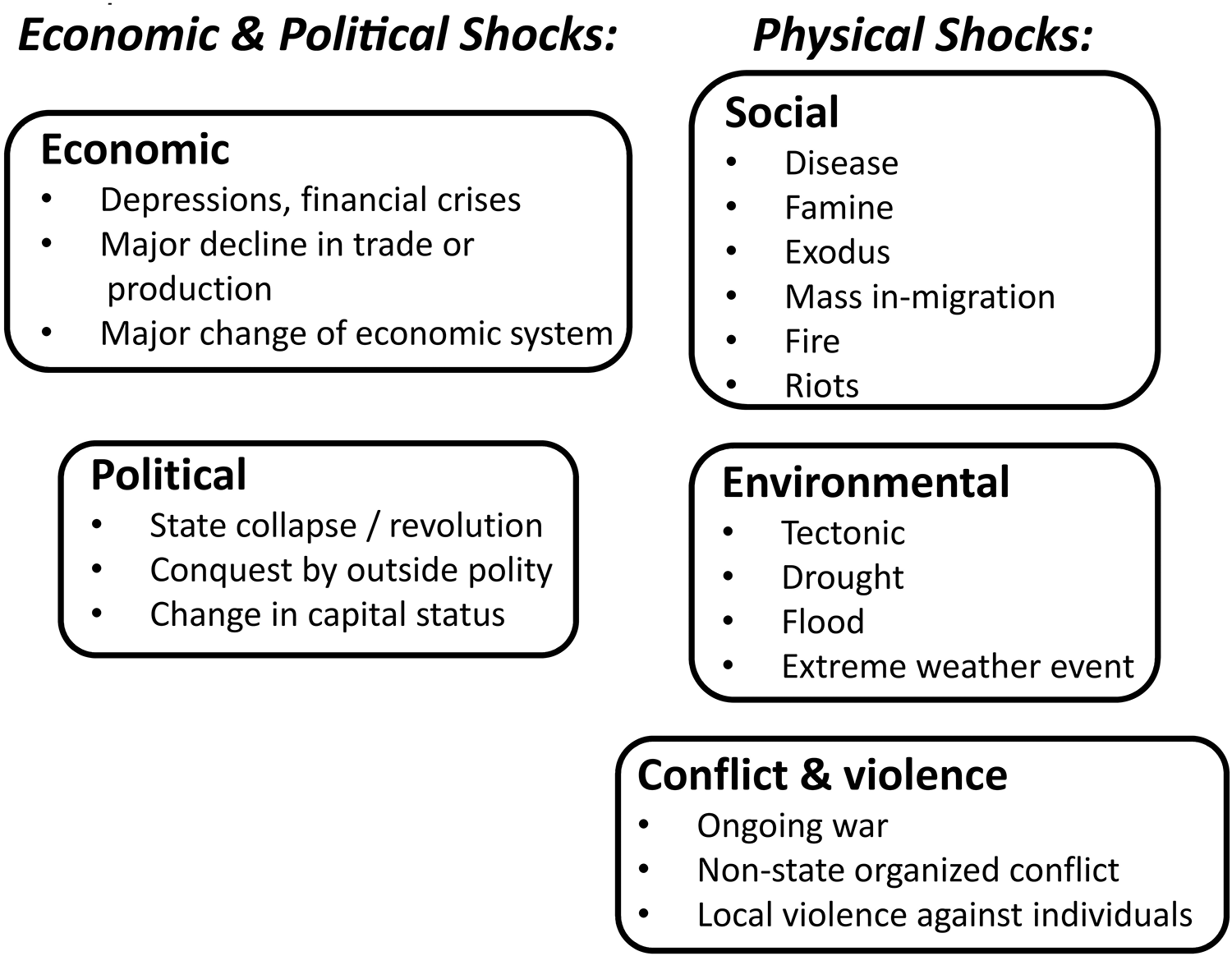
Edward Glaeser’s paper, ‘Urban resilience’ (Glaeser, Reference Glaeser2022), provides a framework for investigating the responses of early cities to shocks. His basic hypothesis is as follows: ‘The long view of urban resilience suggests that cities are far more vulnerable to economic and political dislocation than to earthquakes, wars and even pandemics’ (p. 4). He divides shocks into ‘physical shocks’ that destroy buildings and kill or harm people directly, and political/economic shocks that harm institutions. Glaeser presents several historical case studies in support of his hypothesis, but these accounts vary greatly in their contexts throughout recorded history. In Figure 1, I compile lists of shocks from several disciplines and categorize them in Glaeser’s terms. His emphasis only indirectly focuses on how shocks affect the lives of individuals; it is more concerned with how shocks affect cities and economies on a structural level.
Categorization of urban shocks.

Figure 1 Long description
The diagram categorizes urban shocks into two main types: (1) economic and political shocks and (2) physical shocks. Economic shocks include depressions, financial crises, major decline in trade or production and major change of economic system. Political shocks consist of state collapse or revolution, conquest by outside polity and change in capital status. Physical shocks are divided into social and environmental categories. Social shocks include disease, famine, exodus, mass in-migration, fire and riots. Environmental shocks encompass tectonic events, drought, flood and extreme weather events. Conflict and violence shocks include ongoing war, non-state organized conflict and local violence against individuals.
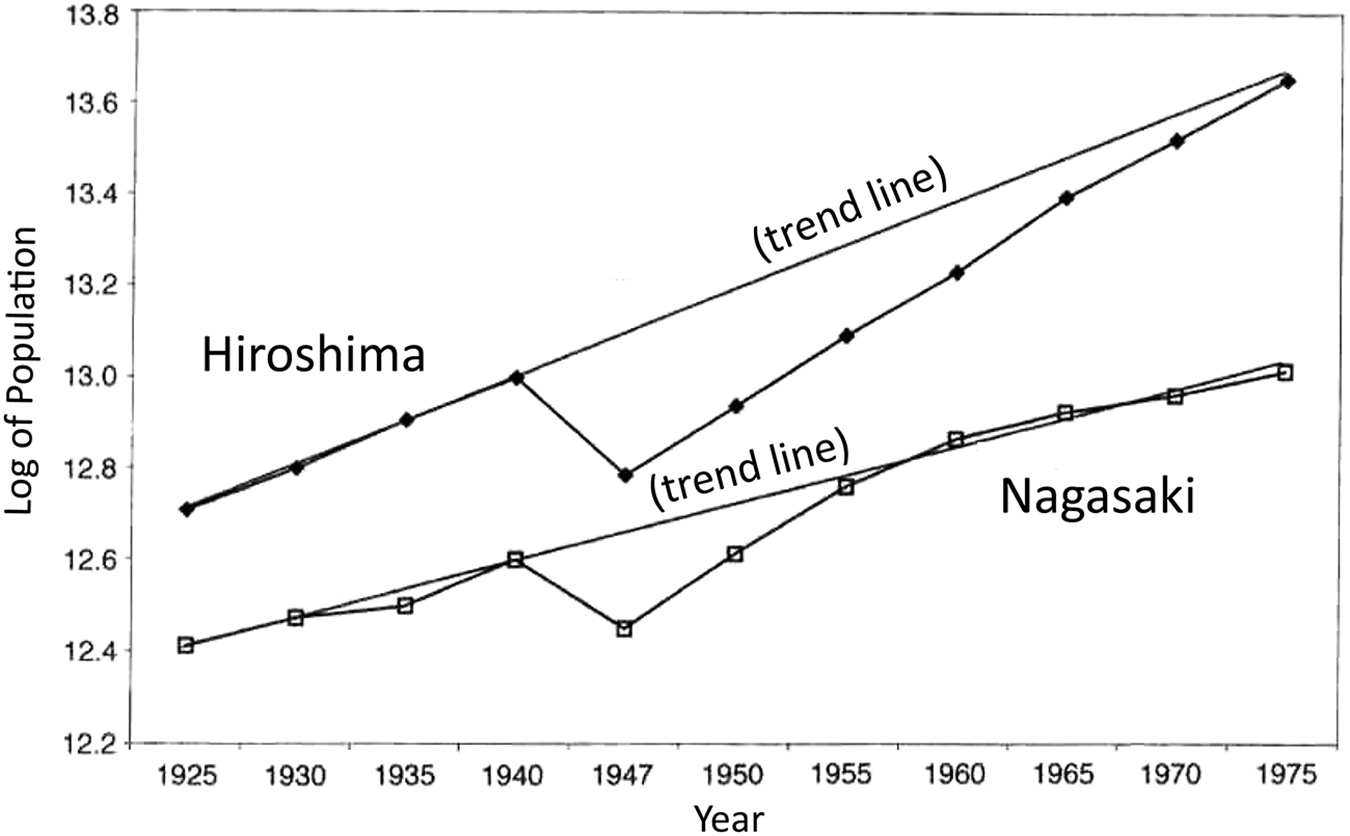
One of the most dramatic examples of the resilience of cities to serious physical shocks is the recovery of Hiroshima and Nagasaki after being largely destroyed by atomic bombs in 1945. Figure 2 is adapted from Davis and Weinstein’s (Reference Davis and Weinstein2002) classic study of this episode. Within a decade after the mass deaths of residents and extensive destruction of buildings, Nagasaki’s population had recovered to its pre-bombing trend, while Hiroshima’s recovery took longer. It is hard to think of a more serious physical shock. The rapid recovery of these cities is a measure of a remarkable level of specified resilience. Economists attribute this recovery to a combination of locational advantages (the cities were well located within their economy) and agglomeration effects (Davis & Weinstein, Reference Davis and Weinstein2002; Lin & Rauch, Reference Lin and Rauch2022).
Recovery of Hiroshima and Nagasaki after destruction by atomic bombs.

Figure 2 Long description
A line graph showing the population trends of Hiroshima and Nagasaki from 1925 to 1975. The x-axis is labeled 'Year' and ranges from 1925 to 1975. The y-axis is labeled 'Log of Population' and ranges from 12.2 to 13.8. Two trend lines are present: one for Hiroshima and one for Nagasaki. Hiroshima's trend line shows a steady increase from 1925, a sharp decline around 1945, followed by recovery and continued growth. Nagasaki's trend line also shows a decline around 1945, followed by recovery, but at a slower rate compared to Hiroshima. Both cities show recovery trends post-1945, indicating resilience after the atomic bombings.
Destruction and damage from earthquakes are one type of physical shock that archaeologists and historians have successfully documented. There is an extensive methodological literature (Sintubin et al., Reference Sintubin, Stewart, Niemi and Altunel2010) and a growing body of research on the consequences and responses to these disasters. The most common evidence for resilience is architectural rebuilding – particularly of civic buildings – after an earthquake. For example, Pompeii suffered a severe earthquake in 62 CE (17 years before the eruption of Mt. Vesuvius), and ‘inscriptions point toward the city’s resilience – the ability of citizenry and the state to organize and restore the city to its status quo – following the earthquake of 62 CE’ (Pickett, Reference Pickett and Smith2022). Such recovery is documented in a number of ancient cities in the Mediterranean active fault zone, and it is claimed that these settlements ‘demonstrated resilience to earthquakes at the city and state scales’ (Mordechai & Pickett, Reference Mordechai and Pickett2018).
While these interpretations of recovery may be correct, a rigorous judgment of resilience would require examining cases that did not recover or cases with varying degrees of recovery. These studies by historians employ post hoc explanations, and they are guilty of selection bias, or selecting on the dependent variable (Bueno de Mesquita & Fowler, Reference Bueno de Mesquita and Fowler2021: chapter 4). In the words of historical methodologists Bas van Bavel and Daniel Curtis (Reference van Bavel and Curtis2016, p. 161), this kind of disaster research ‘has the main weakness of not being placed with an adequate comparative framework, and thus we have nothing to judge the so-called “positive recovery” against’. A more extensive study comparing the nature and extent of recovery of a larger sample of cities hit by earthquakes compared with those spared by earthquakes would allow firmer conclusions, perhaps enabling researchers to identify contextual variables that promote or retard urban resilience after physical shocks.
Glaeser’s contention that cities are more seriously affected by economic and political shocks than by physical shocks is supported by a variety of anecdotal evidence. The Classic Maya collapse – a poorly understood failure of the state and society – brought about the abandonment of nearly all Maya cities in the central Maya lowlands (Turner & Sabloff, Reference Turner and Sabloff2012). The withdrawal of Roman troops from Britain in 409 CE resulted in the abandonment or ruralization of towns and cities (Speed, Reference Speed2014). The destruction of the Inka Empire by Pizarro led to the rapid abandonment of Inka imperial cities in the provinces (Morris, Reference Morris and Leone1972). However, counterexamples also abound. The city of Teotihuacan in central Mexico – contemporaneous with the Maya – also collapsed, yet this city remained a large urban center for several centuries (Cowgill, Reference Cowgill2015). Unlike Romano-British towns, French cities withstood the withdrawal of Rome and transitioned into post-Roman and then early medieval cities (Michaels & Rauch, Reference Michaels and Rauch2018). The point here is that the lessons of urban history will come less from the stories and anecdotes of individual cases and more from the assembly and analysis of systematic data on larger samples of cities (Roberts et al., Reference Roberts, Carleton, Amano, Findley, Hamilton, Maezumi, Winkelmann, Laubichler and Renn2024; Smith, Reference Smith2023a; van Bavel & Curtis, Reference van Bavel and Curtis2016; van Bavel et al., Reference van Bavel, Curtis, Dijkman, Hannaford, de Keyzer, van Onacker and Soens2020).
While the cases outlined above all suggest urban responses to physical and economic/political shocks in line with Glaeser’s hypothesis, the size of the sample is small and more research is needed. These cases do suggest that the investigation of shocks can be a productive approach to the analysis of ancient urban resilience. While the history and archaeology of disasters is a growing theme in scholarship on the past (Riede & Sheets, Reference Riede and Sheets2020; Stewart et al., Reference Stewart, Carleton and Groucutt2022; van Bavel et al., Reference van Bavel, Curtis, Dijkman, Hannaford, de Keyzer, van Onacker and Soens2020), what is lacking is the assembly of large samples of cities and shocks so that hypotheses – from Glaeser and others – can be tested adequately. Many environmentally oriented historians devote considerable effort to getting basic historiographical methods right in order to produce reliable evidence about the past (Degroot et al., Reference Degroot, Anchukaitis, Bauch, Burnham, Carnegy, Cui, de Luna, Guzowski, Hambrecht, Huhtamaa, Izdebski, Kleemann, Moesswilde, Neupane, Newfield, Pei, Xoplaki and Zappia2021; Roosen & Curtis, Reference Roosen and Curtis2018), but such methodological rigor needs to be matched by larger samples and better data analysis and argumentation (Smith, Reference Smith2023a). Concepts need to be operationalized, alternatives need to be tested, and the empirical adequacy of findings needs to be assessed frankly.
Although many historians take a particularistic approach to the past that discourages systematic comparative and quantitative analyses (Gordon, Reference Gordon2020), there is now a movement toward quantitative and comparative historical analysis of past environmental topics (Hoyer & Manning, Reference Hoyer and Manning2018; Turchin et al., Reference Turchin, Whitehouse, François, Hoyer, Alves, Baines, Baker, Bartkowiak, Bates, Bennett, Bidmead, Bol, Ceccarelli, Christakis, Christian, Covey, De Angelis, Earle, Edwards and Xie2019). Indeed, Van Bavel and Curtis (Reference van Bavel and Curtis2016, p. 151) urge historians to move beyond their intuitive arguments and work to elaborate them ‘more fully into testable hypotheses’ (see also Smith, Reference Smith2023a).
5. Settlement persistence
The long-term persistence of settlements is one of the few research themes that can provide a quantitative, empirical record of general resilience. The importance of persistence for sustainability has been recognized for some time. Costanza and Patten (Reference Costanza and Patten1995, p. 193) argued that, ‘The basic idea of sustainability is quite straightforward: a sustainable system is one which survives or persists.’ The rationale for using settlement persistence as a measure of general resilience lies in the notion that cities or settlements that lasted for a long time (on the scale of centuries, not years) must have overcome many shocks in order to survive. For most ancient settlements, however, we have only rare and fragmentary evidence on the specific shocks that might have impacted them over the centuries.
A recent discussion of the significance of settlement persistence for urban sustainability and resilience (Smith et al., Reference Smith, Lobo, Peeples, York, Stanley, Crawford, Gauthier and Huster2021) identified three potential drivers or determinants of persistence in early cities and settlements: geography (resources, productivity, amenities), settlement size (agglomeration effects), and institutions (see also Lin & Rauch, Reference Lin and Rauch2022). These drivers have yet to be tested empirically, though. Some time ago (Smith, Reference Smith2010), I identified two productive directions for archaeological research on settlement persistence: regional and site-focused. In the regional approach, archaeological survey data can reveal variation in persistence by examining large samples of sites in particular regions. A recent pilot study that examined seven archaeological surveys around the world for persistence illustrates this first direction (Crawford et al., Reference Crawford, Huster, Peeples, Gauthier, Smith, Lobo, York and Lawrence2023; see also Lawrence et al., Reference Lawrence, de Gruchy, Hinojosa-Baliño and Al-Hamdani2025).
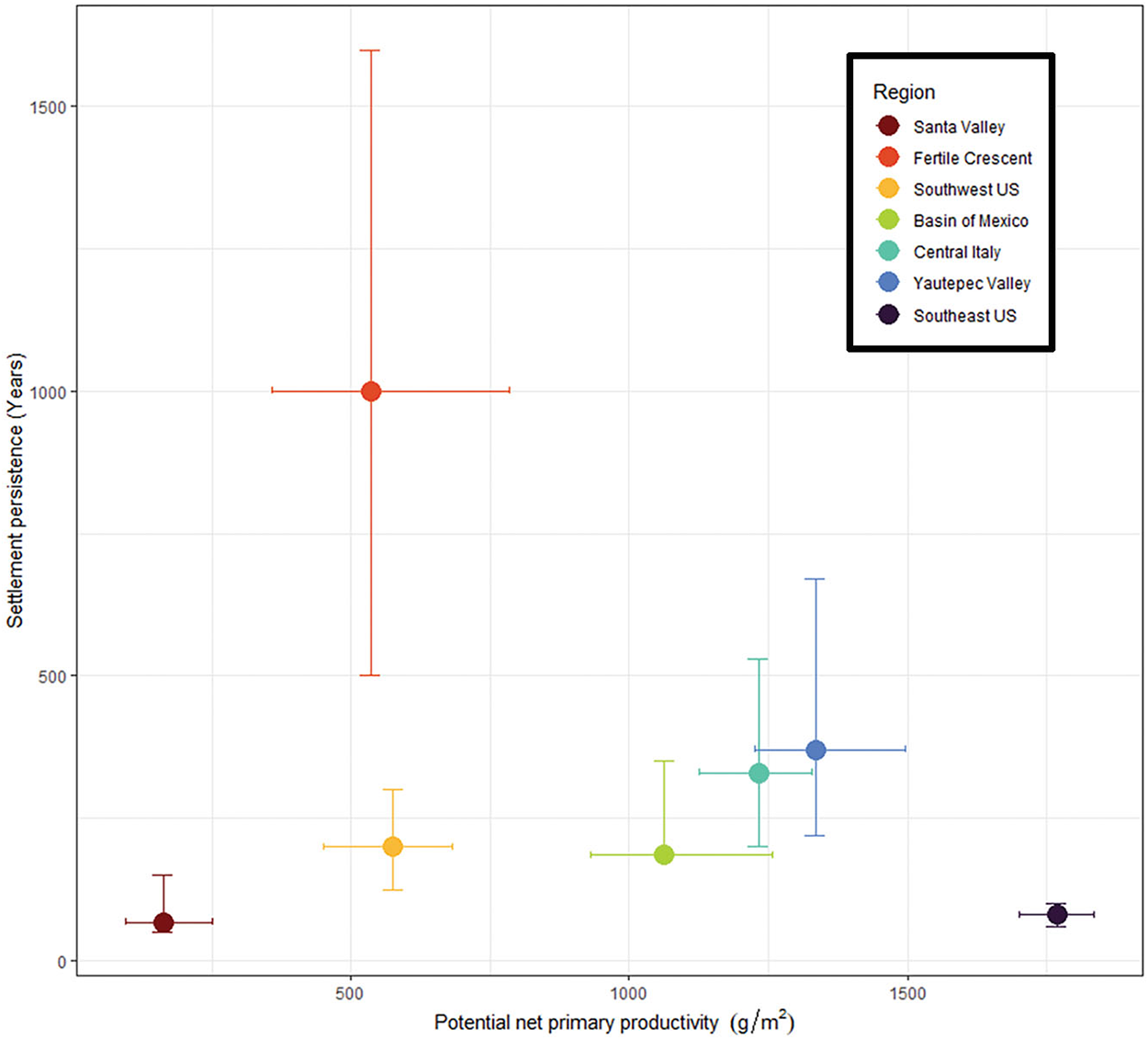
In each survey project, sites of all sizes were recorded for a sequence of chronological periods in a particular valley or region. The pilot study showed considerable variability in the number of years settlements were occupied (Crawford et al., Reference Crawford, Huster, Peeples, Gauthier, Smith, Lobo, York and Lawrence2023). The median persistence of settlements (of all sizes) in six archaeological surveys ranges from 67 years for the Santa Valley of coastal Peru to more than 1,000 years for Mesopotamia and the Near East, and persistence values varied considerably within each region. In Figure 3, the settlement persistence values are plotted against the net primary productivity of the natural environment. This is a measure of the amount of energy stored in plant biomass available to humans for food, fuel, and fiber consumption; see Tallavaara et al. (Reference Tallavaara, Eronen and Luoto2017). Not surprisingly, there is an overall positive association between productivity and persistence. The case of Mesopotamia is an outlier, and it is not yet clear why settlements in this region lasted so much longer than in other areas (Crawford et al., Reference Crawford, Huster, Peeples, Gauthier, Smith, Lobo, York and Lawrence2023; Lawrence et al., Reference Lawrence, de Gruchy, Hinojosa-Baliño and Al-Hamdani2025). Because survey data include most sites in a region, this kind of research provides good samples for quantitative analysis. An important drawback, however, is that there is little contextual information about each site.
Settlement persistence compared to environmental productivity for seven archaeological surveys (regional approach), showing interquartile error bars.

Figure 3 Long description
A scatter plot displays settlement persistence in years on the y-axis and potential net primary productivity in grams per square meter per year on the x-axis. Seven regions are represented: Santa Valley, Fertile Crescent, Southwest US, Basin of Mexico, Central Italy, Tehuacan Valley and Southeast US. Each region is marked with a distinct color and includes interquartile error bars. The Fertile Crescent shows the highest persistence, while the Southeast US has the lowest. The plot illustrates variability in settlement persistence across different regions relative to their environmental productivity.
The alternative site-focused approach to settlement persistence (Smith, Reference Smith2010) examines samples of cities with rich data: well-excavated archaeological sites and cities with a good documentary record. Because of the lack of existing databases with information on persistence and relevant contextual variables, scholars must assemble this information – and make it comparable – from scratch. In one such effort, Carballo et al. (Reference Carballo, Feinman and López Corral2025) devise numerical scales for a number of variables for a small sample of excavated ancient Mesoamerican cities. They report weak correlations (Pearson’s r) between settlement persistence and several variables, including the degree of collectivity of the polity (on a scale from collective to autocratic) and the presence of shared infrastructure within cities (e.g., boundary walls and canals). There is a new project that takes advantage of the recent explosion of urban archaeological projects around the world (Fernández-Götz & Smith, Reference Fernández-Götz and Smith2024) to establish a data platform and data file to assemble information on early cities. Called ‘URBank’, this effort will permit a wide variety of synthetic and quantitative analyses of early cities, including studies of shocks, persistence, and resilience (Carleton et al., Reference Carleton, Lawrence, Brotherson, Ebert, Lobo, Ortman, Smith, Tho, Romanowska, Klassen and Roberts2026).
Settlement persistence is only one proxy for general resilience over time. I have argued elsewhere (Smith, Reference Smith2023d) that early cities can be evaluated for their long-term success using three measures: persistence, population, and prosperity. Each measure captures something different about cities and their long-term trajectories. Persistence and population are the easiest to measure in large samples of premodern cities. Population is used as a measure of success or adaptation in both ecology and urban studies, and there are agreed-upon methods for measuring the populations of past settlements using archaeological data (Drennan et al., Reference Drennan, Berrey and Peterson2015). Prosperity – the third element of my model of urban success – is a more difficult concept to operationalize for the distant past. One approach would be to operationalize the City Prosperity Index (UN-Habitat, 2012) for use with archaeological data (Smith, Reference Smith2023d). The concepts of population and prosperity complement persistence as measures of long-term success for cities and settlements.
Given current discussion about whether sea-level rise due to climate change will require coastal cities to move (Siders et al., Reference Siders, Ajibade and Casagrande2021; Taylor Aiken & Mabon, Reference Taylor Aiken and Mabon2024), archaeologists have begun to examine urban relocation in the past as a type of adaptation to shocks and other forces. The wholesale movement of cities was relatively common in the ancient world. Most cases originated in decisions of kings and emperors to move their capitals (Smith, Reference Smith2024; Smith et al., Reference Smith, Birch, Carleton, Ebert, Hu, Lawrence and Romanowska2025). This line of research on persistence and urban relocation is ongoing, with one goal being to examine the differential social outcomes of forced moves vs. more voluntary changes in location.
6. Conclusions
If viable solutions to the problems of the resilience and adaptations of cities to climate change today come only from deliberate policy decisions based on technological advances, then knowledge of the deep urban past will have little to contribute to this effort. This notion, however, is increasingly challenged by research on climate change adaptation. There is a growing awareness of the value of adaptations that originate in local communities (Coger et al., Reference Coger, Dinshaw, Tye, Kratzer, Aung, Cunningham and Carthy2022; Lenton et al., Reference Lenton, Benson, Smith, Ewer, Lanel, Petykowski, Powell, Abrams, Blomsma and Sharpe2022), and many scholars are emphasizing the importance of change over long periods in creating transformative adaptations (Chhetri et al., Reference Chhetri, Stuhlmacher and Ishtiaque2019; Kates et al., Reference Kates, Travis and Wilbanks2012). Archaeologists and historians are working to overcome the limitations and biases of our data so that they can be arrayed in a form that is useful to scientists and practitioners of urban adaptations today.
These research emphases – the importance of local contexts and long time frames – open a path for the use of knowledge from former cities to inform contemporary scientific and policy research on urban resilience and adaptation to climate change (McPhearson et al., Reference McPhearson, Pickett, Grimm, Niemelä, Alberti, Elmqvist, Weber, Haase, Breuste and Qureshi2016; Schill et al., Reference Schill, Anderies, Lindahl, Folke, Polasky, Cárdenas, Crépin, Janssen, Norberg and Schlüter2019). Several productive directions for future research can be suggested. First, because historians and classicists have at their disposal a rich documentary record of past cities and shocks (Woolf, Reference Woolf2020), the systematic assembly of this information to test hypotheses from Glaeser (Reference Glaeser2022) and other sources holds great potential. Second, the establishment of settlement persistence as a more widespread concept and research direction in archaeology will produce new insights (Lawrence et al., Reference Lawrence, de Gruchy, Hinojosa-Baliño and Al-Hamdani2025; Smith et al., Reference Smith, Lobo, Peeples, York, Stanley, Crawford, Gauthier and Huster2021). Third, a reorientation of research on the societal impact of past environmental and climatic changes to focus on cities and settlements – and not just on societies, cultures, or large regions – will help bring urban archaeology and history into the realm of urban sustainability science. Finally, to realize this potential, archaeologists and historians will need to interact more directly with, and collaborate with, the community of scholars – and practitioners – working on urban adaptations today. The two empirical approaches outlined in this paper – (1) studies of specified resilience to specific shocks and (2) research on general resilience as revealed by long trajectories of occupation – can aid in these efforts to advance knowledge.
Acknowledgements
Versions of this paper were presented at the Max Planck Institute for Geoanthropology in Jena, Germany, and at the conference, ‘Resilience and Sustainability: Past Trajectories, contemporary Directions, Policy Relevance’ at Princeton University. I thank the organizers and audience at these events for hospitality and discussion. Marty Anderies, Christopher Carleton, Graeme Cumming, John Haldon, Patrick Roberts, and especially Christian Isendahl provided very helpful comments on earlier drafts of this paper, and several anonymous reviewers helped me clarify and sharpen the argument.
Author contributions
MES wrote the article.
Funding statement
This research received no specific grant from any funding agency, commercial or not-for-profit sectors.
Competing interests
Author declares none.
Data availability
This article contains no original data. All data mentioned are from the publications cited.

 Open access

