

I. INTRODUCTION
As Europe deals with a so-called ‘refugee crisis’, Australia's harsh border control policies have been touted as a possible model for Europe to emulate. Former Australian Prime Minister Tony Abbot has called upon European leaders to regain control of their borders by implementing elements of the military-led operation introduced in Australia under his leadership to prevent asylum seekers reaching Australia by boat.Footnote 1 Across Europe, and particularly in Germany, Austria and the United Kingdom, newspapers have carried stories asking whether Australia's tough border protection regime could serve as a model for Europe.Footnote 2
In this article, it is argued that such calls for the legal transfer of restrictive immigration policies are nothing new. It is contended that nations have monitored and emulated the laws and practices of comparator jurisdictions for as long as they have attempted to control their borders. This is demonstrated through an examination of attempts to introduce restrictive race-based immigration control measures in the United States and the Anglophone dominions of Canada, Australia, New Zealand and South Africa in the late nineteenth and early twentieth century.
It is argued that the existence of common external constraints limiting the policy options available to lawmakers wishing to restrict immigration into their territories can create fertile grounds for legal transfer. In regard to the transfer of race-based exclusion measures in the nineteenth and twentieth century, formal bilateral trade treaties and informal diplomatic considerations limited the ability of governments to enact overtly racially discriminatory immigration laws. When an innovation was found that could achieve the policy goal of race-based immigration restriction, while being couched in ostensibly non-discriminatory terms, it quickly spread across other jurisdictions operating in that paradigm.
Parallels can be drawn with the contemporary interjurisdictional transfers of restrictive immigration control measures. Today, the 1951 UN Convention relating to the Status of Refugees (‘Refugee Convention’)Footnote 3 and subsequent ProtocolFootnote 4 create limitations on the policy options available to governments wishing to restrict unauthorized immigration to their territories. These limitations fuel transfers in a similar manner to the external constraints imposed on lawmakers attempting to enact racially-based exclusion measures in the nineteenth and twentieth century.
Legal scholars examining the transfer of law across jurisdictions have given the process a number of different labels. It is beyond the scope of this study to engage with the subtle differences in the meanings and with the ongoing debate as to which metaphor/term best captures the characteristics of the transfer process. The term ‘transfer’ is adopted to describe the phenomenon because of its comparative simplicity and neutrality.
II. EXTERNAL CONSTRAINTS AS FACILITATORS OF LEGAL TRANSFER
Restrictions on immigration are a relatively recent invention. For most of human history, freedom of movement has been the norm. Immigration was not only permitted, but encouraged. It was viewed as a vehicle for strengthening the power of the host society, by increasing the population and growing the economy.Footnote 5 It was not until the late nineteenth century that this view began to change. In their bid to justify restrictive immigration measures of the sort examined in Part III and IV below, States began claiming a complete and unfettered sovereign right to control their borders. This right was legitimized by sympathetic judges. For example, in 1889, the US Supreme Court stated
That the government of the United States… can exclude aliens from its territories is a proposition which we do not think open to controversy. Jurisdiction over its own territory to that extent is an incident of every independent nation. It is part of its independence. If it could not exclude aliens, it would to that extent be subject to the control of another power.Footnote 6
In a similar a vein, in 1906 the Judicial Committee of Privy Council stated
one of the rights preserved by the supreme power in every State is the right to refuse to permit an alien to enter that State, to annex what conditions it pleases to the permission to enter it, and to expel or deport from the State, at pleasure even a friendly alien.Footnote 7
The legal foundations of this claimed unfettered right to exclude aliens has been the subject of much controversy.Footnote 8 Regardless of legal validity, the claim is also at odds with practical realities. The sovereign power to regulate immigration has always been restricted by numerous considerations. This is apparent when one examines the development and implementation of restrictive race-based immigration control measures in the late nineteenth and early twentieth century in self-governing settler societies in the United States, Canada, Australia, New Zealand and South Africa. Governments in these territories faced formal and informal constraints which limited them from enacting overtly racially discriminatory immigration laws.
In terms of formal legal constraints, bilateral trade treaties placed limitations on the sovereign power to limit immigration. In the United States, a treaty with China precluded explicit restrictions on Chinese immigration until it was revoked in 1882.Footnote 9 Treaties between Britain and China, and later Britain and Japan created similar restrictions for British colonies.Footnote 10 Constraints also arose out of diplomatic and foreign affairs considerations. As Christian Joppke observes, ‘the exigencies of state inter-dependence have always put the brakes on erratic expulsion or non-admittance practices because hostility against an alien might be interpreted as hostility against her state’.Footnote 11 Amongst the British colonies, an additional consideration was the desire of the Colonial Office to avoid the offence that explicitly discriminatory legislation may cause ‘non-white’ British subjects.Footnote 12 This reflects the broader limitations created as the result of different levels of government. The restrictionist goals of the self-governing colonies often clashed with the sensibilities and geopolitical goals of the colonial Government in Whitehall. In the US federal system, the desire of states such as California to restrict immigration did not always align with the views of the Federal Government, which had the final say on matters of immigration policy. A similar situation arose in Canada, with the Federal Government in Ottowa often vetoing immigration exclusion laws introduced by provincial legislatures.
The role of the Refugee Convention in influencing the legal transfer of restrictive immigration control measures is considered in detail elsewhere.Footnote 13 By becoming a party to the Refugee Convention, nations voluntarily limit their ability to exercise sovereignty over their territorial borders. The non-refoulement provision set out in Article 33(1) of the Convention states that contracting States ‘shall not expel or return (“refouler”) a refugee in any manner whatsoever to the frontiers of territories where his life or freedom would be threatened’ on account of one of the five enumerated grounds.Footnote 14 As Catherine Dauvergne observes, ‘[t]he non-refoulement provision translates into an effective right to remain in a host state’.Footnote 15 This is because States cannot return refugees back to their home countries to face persecution; nor is it usually possible to secure the agreement of any third countries to admit them.Footnote 16
In recent years, States have developed a number of measures to circumvent or mitigate this constraint on their sovereignty. When one jurisdiction devises an innovation that can maximize control over its borders, by sidestepping the provisions of the Refugee Convention, other jurisdictions are likely to pick up that innovation and implement it into their domestic law. This pattern of transfer can be seen in relation to the adoption of policies such as maritime interdiction, extraterritorial processing and mandatory long-term detention.Footnote 17
In the present article, I argue that a similar process of diffusion can be identified in relation to the transfer of race-based immigration exclusion measures in the late nineteenth and early twentieth centuries. Facing both formal and informal constraints to implementing overtly racist measures, States developed innovative exclusion measures which, while non-discriminatory at face value, achieved the underlying goal of excluding migrants of certain races. When an innovation was found that could achieve this policy goal and satisfy the external constraint, it quickly spread across all jurisdictions operating in that paradigm.
III. RACE-BASED EXCLUSION LAWS
In the late nineteenth and early twentieth century, governments in the United States and the self-governing anglophone dominions of Canada, Australia, New Zealand and South Africa introduced very similar mechanisms aimed at limiting the immigration of Chinese and later all ‘non-white’ persons. As Lake and Reynolds document, the policies were fuelled by a transnational movement promoting the superiority of the ‘white race’ and the need to maintain the racial purity of the new settler societies.Footnote 18 The present analysis begins with an examination of the spread of passenger-per-ship restrictions and landing taxes as a means of limiting Chinese immigration in the second half of the nineteenth century in California, Canada and the Australian and New Zealand colonies. Attention then turns to the transfer of literacy or language testing as a form of immigration exclusion in the late nineteenth and early twentieth century in the United States, Canada, Australia, New Zealand and South Africa. In each instance, it is argued that the common policy goal of excluding migrants of certain ethnicities, combined with shared formal and informal constraints on overtly racist exclusion measures, created a fertile environment for legal transfers.
A. Chinese Exclusion Laws: Passenger-Per-Ship Restrictions and Landing Taxes
In the second half of the nineteenth century, the white settler societies on both sides of the Pacific Ocean introduced measures aimed at restricting Chinese immigration. Comparatively mild exclusionary laws were introduced in the 1850s and early 1860s. A second phase of exclusion was initiated in the 1870s and culminated in an almost complete ban on Chinese immigration across the US, Canada and Australian colonies by the end of the nineteenth century. This exclusion was, in part, facilitated by the spread of two mechanisms across all these jurisdictions: (1) the landing tax; and (2) passenger-per-ship restrictions limiting the number of persons of Chinese origin who could be carried aboard any given vessel (see Table 1).
Landing tax and tonnage restrictions targeting Chinese arrivals (1852–1903)

The first government to introduce a landing tax in a bid to restrict Chinese immigration was the state legislature of California. In 1852, legislation was passed that required masters of vessels to pay a fee of $5 for the landing of each alien passenger.Footnote 19 In 1855, the legislature increased the landing tax to $50 for each person not eligible for naturalization.Footnote 20 This was an indirect way of targeting Chinese arrivals. Under the United States Naturalization Law of 1790 only ‘free white persons’ were eligible for naturalization. As ‘Asiatics’ were not considered white under Californian law, they were liable for the new landing tax. The 1855 law was declared unconstitutional by California's state Supreme Court as encroaching on the federal government's exclusive powers in matters of foreign commerce.Footnote 21 The Californian legislature then passed measures in 1858 and again in 1862 prohibiting any Chinese or Mongolian from entering the state, but these were again declared invalid by the state court.Footnote 22 The original law of 1852, levying a $5 tax on every alien passenger was not challenged and voided until 1872.Footnote 23
The British colonies in Australia and New Zealand did not face the same constitutional impediments that restricted the power of the state legislature in California to pass restrictive immigration control measures. Charles Price explains that the colonies were
comparatively free to introduce laws restricting coloured immigration … as long as [they] did not too drastically cut across Britain's notions of humane behavior, of proper relations between the white and coloured parts of the empire, and the proper interpretation of the treaties made with China, Japan or other Asian countries (especially those containing clauses about rights of mutual trade).Footnote 24
Three treaties between the colonial government and China are relevant during this period. The 1842 Treaty of Nanking,Footnote 25 the 1858 Treaty of TianjinFootnote 26 and the 1860 Convention of Peking.Footnote 27 These treaties primarily dealt with the right of British subjects to travel to and engage in trade in China. They did not create any express freedom of movement for Chinese subjects to travel to Britain or the British colonies.Footnote 28 Nevertheless, the colonial government was sensitive to the fact that expressly discriminatory immigration policies in the colonies could offend the Chinese Imperial Government and jeapordize the lucrative trade concessions.Footnote 29
In 1855, the legislature of Victoria became the first British colony to pass restrictive immigration measures targeting Chinese arrivals.Footnote 30 Legislators overtly drew on the Californian experience.Footnote 31 As well as adapting an arrival tax based on the Californian law (£10 on each Chinese arrival), the Victorians added a new passenger-per-ship restriction that limited the number of Chinese immigrants permitted to land to one for every ten tonnes of ship's burthen. The inspiration for the tonnage restriction came from a suggestion of the Colonial Office, which referred the Victorian legislature to the British Passenger Act. That Act included provisions, justified on health and safety grounds, limiting the number of passengers per vessel to one for every two tonnes of ship's burthen.Footnote 32 The effect was to adapt an existing non-discriminatory safety measure into a tool of immigration exclusion targeting the Chinese nationals.
The fact that the landing tax and passenger-per-ship restriction achieved the policy goal of restricting Chinese immigration, while satisfying the desire of the Colonial Office to avoid overtly discriminatory laws, made it the preferred means of Chinese exclusion throughout the anglophone dominions in Canada and Australia. Legislation modelled on the Victorian legislation was adopted by South Australia in 1857Footnote 33 and New South Wales in 1861.Footnote 34 A proposal for a landing tax targeting Chinese arrivals was considered, but not adopted, by the Assembly of Vancouver Island.Footnote 35 Following a relative lull in Chinese arrivals, Victoria and South Australia all repealed their landing tax and passenger-per-ship restriction laws in the 1860s.Footnote 36
Anti-Chinese sentiment resurfaced in the 1870s in the United States, Canada and the Australasian colonies, fuelled by a renewed upswing of Chinese arrivals and a newly powerful labour movement.Footnote 37 When the US Federal Government drafted a new bill to curb Chinese migration in 1879, they looked to the earlier Australian practice, passing a law limiting the number of Chinese arriving on any one ship to 15.Footnote 38 However, the bill was vetoed by Republican president Rutherford Hayes as it was seen as violating the Burlingame Treaty that the United States had signed with China in 1868.Footnote 39 This treaty, created express reciprocal right for freedom of movement for both Chinese and US citizens ‘for curiosity, trade or as permanent residents’.Footnote 40
Three years later in 1882, the US federal government finally bowed to domestic pressure (mostly from California) and abrogated the Burlingame Treaty. Freed from this formal external constraint, Congress passed the Chinese Exclusion Act which barred the immigration of Chinese ‘skilled and unskilled laborers and Chinese employed in mining’ for 10 years.Footnote 41 Successive pieces of legislation extended this bar all the way through to 1943.Footnote 42
During this second phase of exclusion, Queensland took the lead amongst the Australian colonies. In 1877, Queensland's legislature passed a law modelled on the 1855 Victorian legislation, charging an entry tax of £10 a head and forbidding any vessel to arrive with more than one Chinese immigrant for every ten tonnes of ship's tonnage.Footnote 43 At the Australasian Colonial Conference, held in December 1880 and January 1881, the Australian colonies agreed on a uniform law on Chinese immigration restriction, drafting model legislation which imposed a landing tax of £10 and passenger-per-ship restrictions.Footnote 44 By 1887, New South Wales,Footnote 45 Victoria,Footnote 46 South Australia,Footnote 47 Tasmania,Footnote 48 Queensland,Footnote 49 Western AustralianFootnote 50 and New ZealandFootnote 51 all had implemented laws based on the model legislation. All imposed a £10 landing tax and tonnage ratios ranging from one person per ten tonnes, through to one person per 100 tonnes of ship's burthen. Canada also followed suit in 1885, prescribing a ratio of one Chinese migrant per every 50 tonnes of ship burthen and establishing a $50 landing tax.Footnote 52 This measure was adopted on the recommendation of the 1884 report of the Royal Commission on Chinese Immigration that examined laws restricting Chinese immigration used in other jurisdictions.Footnote 53 The report concluded that the head tax and tonnage restriction model of the Australian colonies was more appropriate in the Canadian context than the US approach of wholesale exclusion.Footnote 54
The arrival in Australia of a number of boats carrying large numbers of Chinese immigrants from Hong Kong in April and May in 1888 triggered a large public backlash and provided the impetus for the introduction of even harsher restrictive immigration measures. At the Australasian Colonial Conference held in June 1888 in Sydney, colonial premiers agreed to introduce uniform legislation that would effectively ban all Chinese immigrants from entering Australia. At the behest of the Colonial Office, the entry tax was to be abandoned as a concession to protests from the Chinese government; but the tonnage restriction was to be increased to one passenger per 500 tonnes.Footnote 55 By 1889, Queensland,Footnote 56 VictoriaFootnote 57 and South AustraliaFootnote 58 had all implemented a bill along the lines agreed to in the 1888 Colonial Conference. New South Wales, which had introduced legislation increasing the tonnage restriction to 1/300 immediately before the conference,Footnote 59 undertook to amend it into conformity with the colonial bill, but never did so.
There is ample evidence that lawmakers in the United States, the Australian colonies, New Zealand and Canada were drawing lessons from developments in each other's jurisdictions throughout this period. Lawmakers in each jurisdiction were keeping a very close eye on developments abroad:
[c]ertainly they knew what others felt about the Asian immigration question and the various proposals for dealing with it. Thus Australians were looking at events in California in the 1850s and 1870s, British Columbians and New Zealanders were quoting the Australian experience in the 1860s, New Zealand was also aware of Californian and Australian activities in the 1870s.Footnote 60
Lessons were being drawn on two distinct levels. First, foreign experience was referred to in fear-mongering efforts to highlight the dangers of Chinese immigration and the ills that accompany it. In this regard
what the Australasian colonies were doing was to harken to the clamour in North America and transfer holus bolus the arguments used there to the somewhat different conditions of the South-western Pacific; or else to hold up the ‘terrible conditions’ of California as an example of what all costs they must themselves avoid … . In New Zealand, RHJ Reaves went so far as to word his 1878 resolution in favour of restricting Chinese immigration: ‘that taking into consideration the alarming position of the United States of America and the Australian colonies through the large influx of Chinese, and the probable influx of Chinese into the colony, this House is of the opinion that immediate legislation should take place’.Footnote 61
Second, lawmakers directly drew on the mechanisms used abroad to restrict Chinese immigration. For example, in California
Congressmen Horace Davis … a noted radical in politics, kept a scrapbook of newspaper cuttings about Australian developments and referred to colonial law as a guide to what could be achieved to restrict Chinese immigration to his own country … . It was the ‘Example and Experience of Australia’, however, ‘so nearly parallel to us’ in history and culture, that provided, its capitation taxes and tonnage restrictions recently introduced in new legislation in Queensland, an example of a solution to the Chinese question.Footnote 62
References to foreign practice when introducing and debating legislation restricting Chinese immigration became common practice across all the jurisdictions. The vices of San Francisco's Chinatown, described in the Californian Joint Congressional Committee Report of 1876 were referred to in the debates on the Queensland legislation in 1877,Footnote 63 as well as in the debates on the 1881 Victorian legislation.Footnote 64 In turn, Californian politicians and newspapers referred to the Queensland legislation to urge the introduction of [domestic] anti-Chinese laws.Footnote 65
Newspapers played an important role in disseminating information about developments abroad. Andrew Markus has shown that of 13 Sydney Morning Herald articles on Chinese immigration published between 1875 and 1877, ten of them referred specifically to the experience of California or the United States more generally.Footnote 66 The Sydney Morning Herald went as far as directly calling on the colonial governments to learn from the American experience, arguing that the Chinese problem was ‘being worked out in the United States, and the experience gained there should not be thrown away either upon the Home or the Colonial authorities’.Footnote 67
B. Literacy Tests
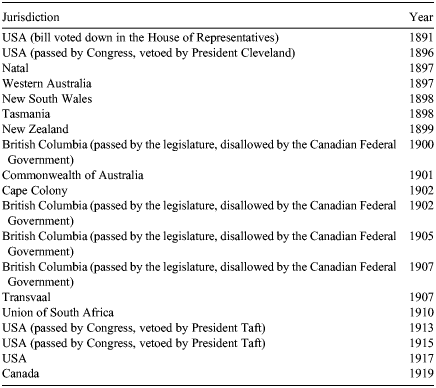
As the turn of the nineteenth century approached, lawmakers in the United States and Canada and the then current and former British colonies in Australasia and South Africa became interested in developing other flexible exclusion measures that, although not explicitly discriminatory, could be used to keep out immigrants from a variety of ‘non-white’ ethnicities. The literacy test was viewed as a compromise that would allow flexible exclusion, while not directly singling out and offending the sensibilities of specific races or nationalities. A chronology of legislative attempts to introduce the mechanism as a tool of immigration restriction is set out in Table 2. While varying in content and form, these tests generally required an immigrant to be able to fill out a form or read or write a passage in a prescribed language in order to be granted entry.
1. Origins of the literacy test
Although often credited as an innovation of Natal (and sometimes referred to as the ‘Natal Formula’), the origins of literacy testing as a tool of exclusion can be traced to measures aimed at disenfranchising black voters in the southern American states. Mississippi introduced a literacy test as a condition for the right to vote in 1891. Lake and Reynolds describe its genesis:
Prevented by the 14th and 15th Amendments from disenfranchising voters on the basis of colour or race, the Mississippi Constitutional Convention led the way in recommending the device of a literacy test, that specified that a person ‘should be able to sign his name and read any section of the Constitution, or be able to understand the same when read to him, or give a reasonable interpretation thereof’ to be registered as a voter.Footnote 68
Other states followed suit: South Carolina in 1895, Louisiana in 1898, North Carolina in 1900, Alabama in 1901, Virginia in 1901 and Georgia in 1908.Footnote 69 While not explicitly discriminating based on race, the discretionary nature of the tool provided wide scope for it to be applied in a discriminatory manner. As Gilbert Stephens observed in his 1910 study, Race Distinction in American Law:
registration officers may give a difficult passage of the Constitution to a Negro, and a very easy passage to a white person, or vice versa. He may permit a halting reading by one and require a fluent reading by the other. He may let illegible scratching on paper suffice for the signature of one and require of the other legible handwriting. But race discrimination in such cases rest with the officers, they do not have their basis in the law itself.Footnote 70
The utility of the measure as a tool for racially-based immigration exclusion was immediately recognized by immigration restrictionists in the United States. In 1891, the same year that Mississippi introduced its literacy test for suffrage, Henry Cabot Lodge, a Republican member of the House of Representatives, introduced an unsuccessful bid to institute a similar literacy test as a qualification for immigrant admission into the United States.Footnote 71 Lodge went on to become a key player in the Immigration Restriction League founded in 1894, which had the introduction of an immigration literacy test as its key lobbying goal. In 1896, an immigration bill containing a literacy test passed both the House and the Senate.Footnote 72 The relevant provisions prohibited the immigration of persons over the age of 16 ‘who cannot read and write the language of their native country or some other language’. The bill was ultimately vetoed by President Grover Cleveland, but not before the provisions relating to literacy testing were picked up by lawmakers in Natal.
2. Natal
The legislative process which led to the introduction of the literacy test in the self-governing British colonial territory of Natal was triggered by public discontent about the growing population of Indian migrants. The arrival of two ships, the SS Courtland and SS Naderi in Durban in December 1896, which between them carried more than 600 Indian passengers, provided the immediate catalyst for legislative change.Footnote 73 In the months leading up to this event, public pressure had been building for Natal to adopt an immigration restriction bill modelled on legislation recently passed in New South Wales. At a meeting of Australian colonial premiers in Sydney, in March 1896, it had been agreed that the different colonies would enact new immigration laws to extend earlier restrictions against Chinese to all ‘coloured’ races. The New South Wales parliament passed the Coloured Races Restriction and Regulation Bill in 1896. This extended the provisions of the Chinese Restriction and Regulation Act of 1888, including the 1/300 passenger-to-tonne restriction, to ‘all persons belonging to any coloured race inhabiting the Continent of Asia or the Continent of Africa, or any island adjacent thereto, or any island in the Pacific Ocean or the Indian Ocean’.Footnote 74 Similar legislation was also passed shortly afterwards in South Australia,Footnote 75 New ZealandFootnote 76 and Tasmania.Footnote 77
In September 1896, the European Protection Association was formed in Durban. One of its explicit objectives was ‘to endeavor to have the Australian laws on immigration made applicable to Natal’.Footnote 78 Newspapers also urged the government to ‘follow the course resolved upon by Australia’.Footnote 79 Two months before the arrival of the Courtland and Naderi, the colony's Attorney General, Henry Escombe had urged the Premier, John Robinson to consider adopting the New South Wales legislation.Footnote 80
The New South Wales legislation, along with the similar bills introduced in South Australia, New Zealand and Tasmania, had been reserved by the respective governors of each colony on the grounds that they discriminated on the basis of race or colour. The bills had accordingly been forwarded to the Colonial Office in London for a final decision. Fearing that a bill based on the New South Wales model would be disallowed, the legislature of Natal decided to instead opt for a less overtly discriminatory exclusion method. The centrepiece of the new measure was a literacy test. The bill proposed that any person ‘who when asked to do so by an officer appointed under this Act shall fail to himself write out and sign in the characters of any language of Europe an application to the Colonial Secretary’ be prohibited from entering the colony.Footnote 81 The discriminatory nature of the law was clear from the way it was to be implemented. Language ability had to be demonstrated ‘to the satisfaction of the Minister’. This made the judgement of language ability a matter of discretion on the part of the immigration officer, allowing them to ensure that the law would not operate against illiterate whites seeking entry.
When introducing the measure to the legislature in Natal, Escombe, who by then had become Premier of Natal, made no secret of the fact that the measures was inspired by the use of literacy testing in the United States:
the great Republic of America has found it necessary to have recourse to that restriction, and I may say generally that the Bill that I now have the honour to submit to this Assembly is found on the American Act.Footnote 82
When the Governor of Natal forwarded the Colonial Secretary a copy of the proposed legislation in February 1897, he explained that ‘[t]he Bill purports to prevent the introduction into Natal of “undesirable immigrants” and had I understand, been drawn on the lines of the United States legislation on that subject’.Footnote 83
The drafters of the Natal literacy test made one important innovation. The US immigration bill of 1896, which was aimed at excluding illiterate recent arrivals from Southern European countries such as Italy, Hungry and Poland, had required that a person be able to read or write in their native language, or any other language. The Natal test was much more restrictive in that it required prospective migrants to write out an application in ‘any language of Europe’. By not specifying the European language to be used, it conveniently left ‘the choice to the discretion of the immigration officials administering the test’.Footnote 84
Literacy testing as a tool of immigration restriction
3. Australia
The Colonial Office, seeing the value of flexible literacy requirements for immigration that made no explicit mention of race or colour, began promoting the ‘Natal Formula’ as a model for other British colonies wishing to implement immigration restriction measures. Joseph Chamberlain, Secretary of State for the Colonies, advocated this approach at a meeting of colonial leaders gathered in London for Queen Victoria's Diamond Jubilee in 1897. Addressing the premiers of New South Wales, Victoria, Tasmania, Western Australia, Queensland, South Australia, New Zealand, Canada, Newfoundland, Cape Colony and Natal, Chamberlain made it clear that the he did not want the colonies to enact racist laws that might provoke nationalist anger in British India and cause offence to rising Asian powers such as Japan.Footnote 85 Accordingly, he championed Natal's new Immigration Restriction Act as an example of the kind of legislation that could accomplish the colonies goal of immigration restriction without jeapordizing the interests of the British government. Chamberlain stated his case to the colonial leaders in the following manner:
The Colony of Natal has arrived at an arrangement which is absolutely satisfactory to them … . They have adopted legislation which they believe will give them all they want and to which the objection I have taken does not apply, and which does not come into conflict with these sentiments which I am sure you share with us; and I hope, therefore, that during your visit it may be possible for us to arrange a form of word which will avoid hurting the feelings of Her Majesty's subjects, while at the same time it would amply protect the Australian Colonies against the invasion of the class to which they would justly object.Footnote 86
Overtly racially discriminatory laws would not only offend the sensibilities of non-white British subjects, but would also contravene the 1894 Anglo-Japanese Treaty of Friendship and Commerce, which guaranteed free commerce and trade with Japan.Footnote 87 Japan had made it clear that it would consider any immigration restriction measures that did not apply equally to all foreigners as constituting a breach of the Treaty.Footnote 88
The Australia colonies heeded the suggestion of the Colonial Office and one-by-one abandoned their overtly discriminatory restriction measures in favour of the ‘Natal Formula’. Western Australia was the first to act, with its bill passing both houses by December 1897.Footnote 89 New South Wales followed shortly after, adopting a literacy test and abandoning its 1896 Coloured Races Restriction and Regulation Bill, which was still awaiting approval from the Colonial Office.Footnote 90 Tasmania passed a similar law in 1898Footnote 91 and New Zealand followed suit in 1899.Footnote 92 Robert Huttenback describes the common elements of these laws:
All required some sort of language test which varied from filling out an application to fifty words of dictation. New South Wales and Tasmania prescribed English, while New Zealand and Tasmania require some European language.Footnote 93
When the Australian colonial premiers assembled at a conference in Melbourne in 1898, they resolved ‘that the Colonies which have not already done so pass an Act on the lines of the Natal Act (on the understanding that the same shall be vigilantly enforced)’.Footnote 94
Upon federation in 1901, the ‘Natal Formula’ was adopted by the Australian Commonwealth government.Footnote 95 The act was very similar to the laws passed by the separate colonies after the 1897 conference in London. The key measure was Article 39(a), defining a prohibited migrant as: ‘any person who when asked to do so by an officer fails to write out at dictation and sign in the presence of the officer a passage of fifty words in length in an European language dictated by the officer’. In 1905, in a bid to appease the concerns of the Japanese government that the laws discriminated against their nationals, an amendment replaced the requirement for a test in a ‘European language’ with a test in any ‘prescribed language’. The effect of the amendment, however, was to give Australian officials even broader discretion in administering the dictation test.
4. South African colonies
When Natal decided to refine its literacy test in 1903, it took inspiration from Australia. The original 1897 law had required an immigrant to fill out a simple form in the characters of some European language. The 1903 reforms introduced a dictation test modelled on the Australian law which required immigrants to write out any application that the immigration officer might choose to dictate.Footnote 96 The literacy test also became the preferred tool for immigration exclusion in other South African colonies. The Cape Colony introduced a language test as a tool of immigration restriction in 1902.Footnote 97 A dictation test was implemented in Transvaal shortly after the territory was granted responsible government in 1907.Footnote 98 When the Union of South Africa was established in 1910, the literacy testing was adopted as the primary tool of immigration exclusion. The relevant legislative provision stipulated that a prohibited immigrant was ‘any person unable, by reason of deficient education, to read and write in any European language to the satisfaction of the [immigration appeal] board’.Footnote 99
5. United States and Canada
Immigration restrictionists in the United States kept a close eye on the development and implementation of the literacy testing measures in the British colonies and later the Commonwealth of Australia. The Secretary of the Immigration Restriction League, Prescott Hall, wrote to the Australian Prime Minister shortly after the passage of the Commonwealth's Immigration Restriction Act of 1901 to obtain copies of the Australian legislation.Footnote 100 In 1904, the Annals of American Academy of Political and Social Science published a special issue on immigration restriction that included an article on ‘Australasian Methods of Dealing with Immigration’.Footnote 101 However, numerous attempts at introducing similar literacy or dictation tests in the United States in this period did not come to fruition. As Roger Daniels notes:
[A] literacy test was nearly adopted in 1903 and 1907, recommended by the 1911 report of the United States Immigration Commission, passed by successive Congresses in 1913, 1915, and … vetoed by President William Howard Taft.Footnote 102
A literacy test was finally enacted in 1917 when Congress overruled President Wilson's veto of the measure.Footnote 103 While nativists had pushed for a more restrictive test requiring migrants to be literate in English, the version of the literacy test passed, defined literacy as being able to read any recognized language. In Canada, the legislature in British Columbia passed bills introducing literacy testing in 1900,Footnote 104 1902,Footnote 105 1905Footnote 106 and 1907Footnote 107 only to have each attempt disallowed by Ottawa. Aware of the need to appease the immigration restrictionist sentiment in the Pacific provinces, the Canadian federal government opted to increase the landing tax imposed on Chinese arrivals. The tax was raised to $100 in 1900 and $500 in 1903.Footnote 108 A literacy test was eventually introduced by the Canadian federal government in 1919. Its form was similar to that implemented in the United States, requiring immigrants to be literate in any language.Footnote 109 While universal immigrant literacy requirements have been abolished, language proficiency continues to be a requirement for certain immigrant visas for the United States, Canada, Australia and New Zealand.Footnote 110 In recent years, the mechanism has spread to numerous other jurisdictions, including the United Kingdom, the Netherlands and Germany, which now also use language testing into their immigrant selection procedures.Footnote 111 These modern language tests can be contrasted with the historic examples in that the broad discretion given to immigration officers has been removed. Instead, the tests are generally outsourced to private companies, which assess individuals with reference to objective criteria relating to language skills and competency.Footnote 112
IV. COMPETETIVE LEGAL TRANSFERS
The global nature of migration flows means that immigration policies are inherently interconnected. A more permissive policy in one State, may lead to a reduction of immigration flows in other States, while a more restrictive policy may increase the number of migrants seeking entry in other States.Footnote 113 This interdependence played a significant role in driving the legal transfer of restrictive race-based immigration laws in the late nineteenth and early twentieth century. The policy issue that politicians in the settler societies in North America, Australia, New Zealand and South Africa were attempting to address were not a purely domestic one. Changes in the immigration laws in one jurisdiction, could have major flow on affects for the other jurisdictions. In this context of ‘competitive interdependence’,Footnote 114 transfers were, at least in part, fuelled by a fear that unless politicians followed the restrictive tendencies employed in other jurisdictions, they would face an increase in unwanted immigration.
The competitive force driving transfers is apparent in a circular distributed to the Australian colonial governments by New South Wales Premier Henry Parkes in 1880, in which he warns that the pending anti-Chinese legislation in the United States and other countries would drive Chinese to Australia.Footnote 115 The New South Wales Chief Inspector of Police reflected a similar sentiment in a report prepared for Premier Parkes in 1881 where he attributes the rising number of Chinese arrivals in New South Wales to ‘the difficulty of obtaining employment of any kind in California at present, in consequence of the anti-Chinese agitation that has been going on there for some time’.Footnote 116 In a similar vein, historian Charles Price, in discussing the impetus for the introduction of further restrictive laws limiting Chinese exclusion in Australian colonies in 1888, observes that ‘Australians were well aware of American moves to erect further barriers against Chinese immigration and became quite alarmed at the prospect the Chinese tide being diverted to Australia.’Footnote 117
V. CONTEMPORARY PARALLELS
The introduction of similar restrictive race-based immigration laws in the self-governing settler societies in the United States, Canada, Australia, New Zealand and South Africa in the late nineteenth and early twentieth centuries can be explained through a process of legal transfer. From 1850s through to the 1890s, exclusion was achieved with recourse to landing taxes and tonnage restrictions limiting the number of passengers of certain nationalities to a proportion of ship's burthen. From the late 1890s onwards, literacy/language testing became the preferred tool of exclusion. These early examples of diffusion illustrate that the propensity to engage in transfers is strongest where jurisdictions face a common policy goal and a common external restraint to achieving that goal. Lawmakers across these societies sought to restrict the immigration of certain races. Their ability to do so was restrained by a variety of formal and informal constraints that precluded overtly racially discriminatory policies. When an innovation was found that could achieve the policy goal and satisfy the external constraints, it quickly spread across all jurisdictions operating in that paradigm. The transfer process was further fuelled by competitive tendencies. The adoption of restrictive measures in one jurisdiction, placed pressure on other comparator jurisdictions to follow suit, or risk being a target for unwanted immigration.
Clear parallels can be drawn with the contemporary diffusion of restrictive border control policies targeting asylum seekers and undocumented migrants more generally.Footnote 118 Many States share the policy objective of limiting undocumented migration into their territories. The policy responses available to them are limited by the non-refoulement obligations contained in the Refugee Convention. When one jurisdiction devises an innovation that can maximize control over domestic borders, while not falling foul of the requirements of the Refugee Convention, other jurisdictions working in a similar paradigm are likely to follow suit. This explains the spread of mandatory immigration detention laws across the United States, Australia, Canada and New Zealand.Footnote 119 While not directly subverting non-refoulement obligations, the automatic and often long-term detention of unauthorized arrivals allows governments to exert maximum control over asylum seekers while their status is being determined.
Maritime interdiction is another innovation which addresses this policy paradigm. In the context of boat migration, interdiction refers to any ‘action taken by states to prevent sea-borne migrants from reaching their intended destination’.Footnote 120 This can include turning boats around and returning migrants to their point of departure. By relying on a view that the Refugee Convention has no extraterritorial effect, its non-refoulement obligations are said not to apply.Footnote 121 As such, migrants are returned without being subject to any screening for asylum claims. Extraterritorial processing is another means of depriving asylum seekers access to a State's territory. Potential asylum seekers intercepted attempting to enter a State are transferred to external processing centres in third countries or external territoriesFootnote 122 to pursue their asylum claims. This approach can adhere to the letter (if not the spirit) of the non-refoulement obligations by providing mechanisms to identify persons who may be refugees and not returning such persons to a place where they may face harm on a convention ground.Footnote 123 At the same time, the policy ensures control over access to the territory of a State, with those recognized as refugees not automatically granted access to a State's territory, and instead often held for long periods of time awaiting resettlement.
The United States pioneered the use of maritime interdiction and extraterritorial processing policies. The US Coast Guard began interdicting asylum seeker vessels in 1981, and has at times adopted a policy of returning interdicted asylum seekers to their point of departure without any screening of asylum claims.Footnote 124 At other times, asylum seekers have been transferred to US-controlled territory of Guantanamo Bay in Cuba for the processing of their claims. Although better known in recent times as an exceptional space created to exclude enemy combatants from the protections of the US justice system,Footnote 125 Guantanamo was used first as a holding and processing centre to bar interdicted asylum seekers from accessing these same legal protections. These policies provided the blueprint for Australia's Pacific Solution, which operated from 2001 to 2007.Footnote 126 The Pacific Solution involved interception and push-back operations targeting boat arrivals, as well as the use of extraterritorial processing sites in Manus Island in Papua New Guinea and the tiny Pacific Island State of Nauru. Extraterritorial processing was reintroduced in 2012, and interdiction and push-back operations resumed in 2013. Both continue to be the central pillars of the government's current border control policy.
These mechanisms are now being considered, and in some instances, implemented in Europe. While individual European nations have proposed the introduction of extraterritorial processing centres as far back as 1986, the current refugee crisis has resulted in renewed calls for such a policy.Footnote 127 A number of different proposals which include extraterritorial processing components are currently on the table.Footnote 128 One of these has already begun to be implemented.
The EU–Turkey agreement announced in March 2016 contains an extraterritorial processing component.Footnote 129 The deal authorizes the return of certain asylum seekers and irregular migrants from Greece to Turkey. In return, the EU will resettle one Syrian refugee for every irregular migrant returned. The processing of these refugees will be carried out by the UNHCR in Turkey, which will make recommendations for resettlement. The implementation of this deal has also involved the use of mandatory detention. Once open reception centres in Greece have been turned into closed detention camps, with asylum seekers being detained against their will in order to facilitate their return to Turkey.Footnote 130
Calls for European Union leaders to copy the example of Australia to intercept and turn back boats are also gaining momentum. In the United Kingdom, the idea was first picked up by the UK Independence Party. In April 2015, the deputy leader of the party, Paul Nuttall, backed the use of gunboats to turn back asylum seekers in the Mediterranean, stating ‘Australia has got this right. 18 months ago they created a ring of steel around the country. Since then there have been no boats, no drownings and no deaths.’Footnote 131 The idea has now garnered more mainstream political support, with British Prime Minister David Cameron reportedly advocating the use of Navy vessels to push back boats to Libya at an EU summit in March 2016.Footnote 132
Putting the legal impediments to implementing such a plan to one side,Footnote 133 the competitive tendencies underlying the proposal are troubling. The assumption is that asylum seekers consider the stringency of border control measures and the generosity of reception services in destination and transit countries, when choosing where to travel. Just as a Chinese immigrant in the late nineteenth century had a choice between a boat journey to California, British Colombia or the British colonies in Australia and New Zealand, a Syrian asylum seeker could opt between a multitude of smuggling routes that would take them to numerous different possible destinations within Europe, North America (via Central America) or Australasia.Footnote 134 This has fostered a view in certain nations that unless they match or outdo deterrence measures in other comparable jurisdictions, they will be viewed as a ‘soft touch’ and experience an increase in asylum flows and irregular migration more broadly.
The effectiveness of deterrent measures in reducing undocumented migration flows is questionable.Footnote 135 However, this is a somewhat moot point for governments as the competition to appear tough on irregular arrivals is pitched as much to a domestic audience as it is to potential undocumented migrants. The arrival (or threat of arrival) of undocumented migrants can be damaging to the re-election prospects of governments. Proposals for and introduction of many so-called ‘deterrent’ measures have as much to do with reassuring the public that the government is doing something, than actually reducing the number of arrivals. When one State introduces a new deterrent measure, pressure mounts for other governments to do the same or risk being viewed as soft by their constituents.
The danger is that this competition can fuel the transfer of restrictive measures until the result is almost complete exclusion. This was the eventuality in relation to the transfer of Chinese exclusion laws across the United States, Canada and self-governing British colonies in Australia and New Zealand. Comparatively mild exclusion measures were introduced in the 1850s. After the number of Chinese arrivals dropped off, the restrictions were eased. Restrictions were again introduced in the late 1870s. The competitive nature of the transfers during this period of exclusion led to progressively more restrictive measures being introduced in each jurisdiction. The result was that by the late 1890s, Chinese immigrants were effectively barred, through direct and indirect means, from entering all these jurisdictions. In Australasia and South Africa, the literacy and dictation test extended this bar to all non-white immigration.
The risk is growing of a similar eventuality in relation to the transfer of restrictive asylum seeker policies. As more jurisdictions adopt measures like maritime interdiction, push-backs and extraterritorial processing, which act to block access of asylum seekers to their territories, the pressure mounts on other jurisdictions to do the same. If nations continue to participate in this ‘race to the bottom’, the result will be devastating for the institution of asylum and those in need of refuge.



