

Introduction
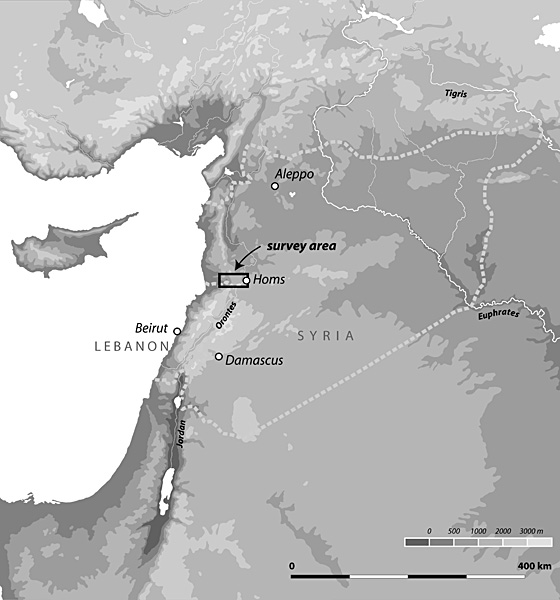
Jeftelik was found during the archaeological survey of the Homs Gap, carried out by a Syro-Lebanese-Spanish team, between 2004 and 2007 (Haïdar-Boustani et al. 2005, 2008, 2009; Ibáñez et al. 2008) (Figures 1a & b). The archaeological remains found on the surface, which can be attributed to the Natufian period, are various basalt grinding implements and numerous flint artefacts, an engraved pebble with a single line (Figure 2) and a shaped basalt stone that could be a schematic figurine (Figure 3). During the survey we also recovered other archaeological material dating to the Bronze Age and the Roman-Byzantine and Ottoman periods.
Map showing the location of the site in western Syria.

Map showing the location of the site in western Syria.

Engraved pebble with one single line.

Possible schematic figurine.

First results of the excavations
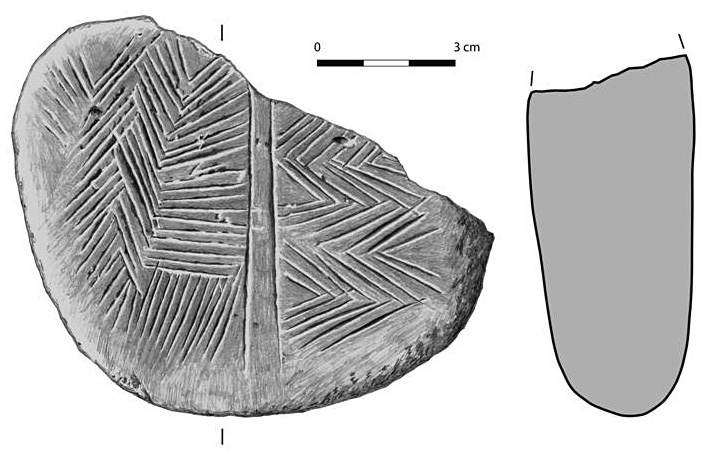
In the first season of excavation (2008) we worked on one of the highest terraces (Figure 4). Two test pits (DA 898 and DQ 913) revealed some Ottoman architectural structures which have been dated to 120±40 BP (Beta - 256206). The excavation of a third area (DF 908) exposed in situ Natufian levels, but also uncovered several pits from the Bronze Age, the late Roman or Byzantine and the Ottoman periods. Inside one of these pits we found a flat, polished pebble engraved with chevron patterns covering one of its faces (Figure 5). The decoration is arranged in two halves, separated by two central parallel lines, and most probably dates from the Natufian period.
Location of the three excavated areas.

Engraved pebble with chevron pattern.

The area unaffected by the pits contained a large number of lithic remains, a few fragmented and altered bone remains and some charcoal. A piece of charcoal belonging to Rosaceae tp. Prunus, found in situ in stratigraphic unit 24, has given a radiocarbon determination of 12 100±70 BP (Beta - 257748: at 2 sigma, 12 190-11 830 cal BC; 14 140-13 780 cal BP). Beneath SU 24 were found two lines of stones. Their size and shape suggest that they could be part of structures used for human habitation. Two of the pits mentioned above had cut through these lines (Figure 6).
Figure 6a.tone structures.

Stone structures.

The knapped stone tools are made mainly from local fine-grained flint. So far, only one obsidian bladelet has been found in situ, although more have been recovered from the superficial levels. The most common unipolar flint knapping was aimed at producing blades, bladelets and elongated flakes. At the same time, some flake cores display a different volumetric concept, with two opposing surfaces being exploited by centripetal extractions. Sometimes these flaking faces show a clear hierarchisation of surfaces, where one of them is preferential. The most abundant retouched artefacts are flakes with simple retouch and lunates (Figure 7). These have been made from bladelets or elongated flakes. Most of them are segments with simple bifacial retouch (22 out of 38), although other examples have simple unifacial retouch (9 out of 38) and to a lesser extent, steep retouch (7 out of 38). In addition, two microburins have been found, indicating the use of this technique to obtain this kind of microlith. They are followed in abundance by endscrapers (26), denticulates (25), steep retouched pieces (12), notches (6), borers (6) and burins (5). The presence of three elongated flakes with visible gloss should be noted.
Lunates (scale = 1cm).

Although no heavy basalt tools have been recovered in the excavation, a mortar and numerous querns and grinding stones have been found on the surface.
Discussion
The Natufian is a key cultural complex for understanding the processes that moved human beings to change from social relationships based on hunting and gathering to those appropriate for the production of food (Belfer-Cohen 1991; Bar-Yosef 1998).
Explanations about the origin and spread of the Natufian have varied from the first discoveries of Natufian sites in the 1920s and 30s to the present time (Garrod 1932; Delage 2001; Olszewski 2004). In the 1970s the concept of the Natufian core area was developed, fixing the geographical location of this culture in the surroundings of Mount Carmel, Galilee and the Upper Jordan Valley (Bar-Yosef 1970, 1975). In the 1980s, Natufian sites were discovered away from the original distribution area, from southern Jordan to northern Syria (Schroeder 1976, 1991; Cauvin 1991; Copeland 1991; Henry 1995; Garrard & Yazbeck 2004; Ibáñez 2008). In addition, the Harifian sites in the area of Sinai are clearly culturally related to the Natufian (Bar-Yosef 1998: 168).
In order to explain the distribution of sites outside the Natufian core area, a two-phase model has been proposed (Bar-Yosef 1998). The Natufian originated in the core area about 12 800-12 500 BP, in the Early Natufian, and spread to more northern and southern areas in the Final Natufian, about 11 000 BP. The dates of several sites outside the core area, such as Tell Mureybet (Stordeur & Evin 2008), Abu Hureyra (Moore et al. 2000), Baaz, Kaus Kozah (Conard 2002; Conard et al. 2006) and Dederiyeh (Nishiaki et al. 2006) would support this model.
Prospects
The results of the first fieldwork season in Jeftelik suggest that this is a Natufian site with a very rich lithic industry, some symbolic objects and architectural remains. If this is confirmed during the next campaigns, then Jeftelik could be classified within the group of base-camps (Belfer-Cohen & Bar-Yosef 2000).
Its location in a woodland area with a Mediterranean climate is similar to that of sites of the same kind in southern Levant. The early date of the site (12 000 cal BC), which is outside the Natufian homeland, could call the model of the spread of the Natufian beyond its core area into question. The data from Jeftelik seems to suggest that, either the time of the spread of the Natufian outside the core area should be put back to the Early Natufian, or the geographical area of the so-called Natufian homeland or core area should be enlarged towards the north. The research that will be carried out in coming years will enable us to complete the view we have of this period in an area so little known until now.
Acknowledgements
The project has been funded by the Spanish Institute of Cultural Heritage (Ministry of Culture); the Ministry of Science and Innovation, R+D Projects: BHA2003-09685-CO2-01, HUM2007-66128-C02-01, HUM2007-66128-C02-02; St Joseph University of Beirut (FLSH 45); and the Government of Catalonia, EXCAVA Programme. Project website: http://www.imf.csic.es/esp/dptos/proyectos/siria/index.htm.