


Psychiatrists need to maintain demonstrably good standards of practice. They are guided in this by clinical supervision and consultation, by Duties of a Doctor, (General Medical Council; GMC, (1995)) and by guidelines from the Royal College of Psychiatrists (Royal College of Psychiatrists, 1984). The ethical standards to which psychiatrists should adhere are made explicit in The Declaration of Madrid (World Psychiatric Association, 1997). Procedures exist to address poor practice and irresponsible conduct. It is important that psychiatrists actively support and participate in these.
Complaints procedures evolve. The right to have complaints investigated promptly was confirmed by the Patient's Charter (Department of Health, 1995). In 1996, a new NHS complaints procedure was introduced to provide the mechanism for this to happen. In 1997, the GMC brought in a new procedure to investigate and address deficiencies in doctors' professional practice (GMC, 1998).
Being complained against can be stressful. One of the sources of stress is lack of knowledge of what is involved in the investigation of a complaint and what the possible outcomes are. We believe that an understanding of complaints mechanisms and possible outcomes is useful for all psychiatrists. The main purpose of this paper is to inform psychiatrists about the ways in which dissatisfied patients may complain. In addition, we provide a list of accessible references.
The study
There are currently four main avenues through which patients may bring complaints against their psychiatrists: NHS complaints and disciplinary procedures, GMC procedures and the courts. We reviewed literature about NHS and GMC procedures and relevant aspects of English and European law.
NHS procedures
Complaints procedure
Changes within the NHS have resulted in a move towards patients being seen as consumers receiving a service.
Expected standards from the service were made explicit in the Patient's Charter (Department of Health, 1995). The right to complain if charter rights were not provided was emphasised. The NHS complaints procedure now in place was set up on 1 April 1996 and provided the mechanism for receiving and responding to complaints.
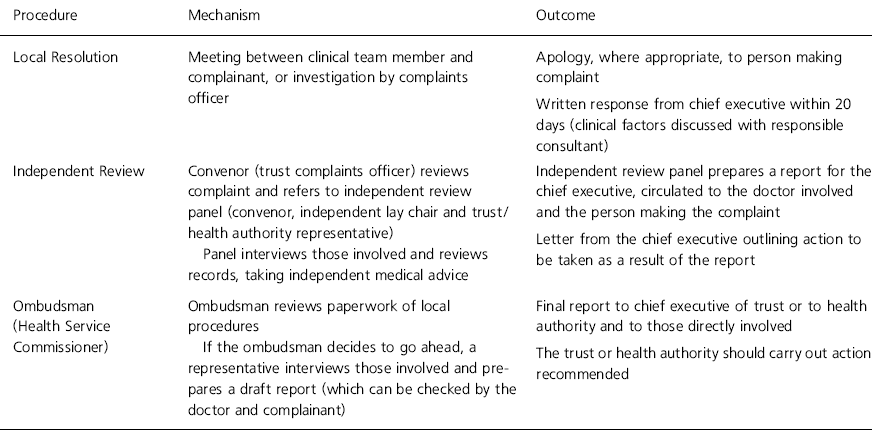
The purpose of the complaints procedure is to identify and address deficiencies in the service provided by the NHS. In this it is quite distinct from NHS or GMC disciplinary procedures, which aim to identify problematic behaviour or working practices in the individual clinician. There are three levels of investigating a complaint: local resolution, independent review and the ombudsman (Reference HoyteHoyte, 1996) (see Table 1).
NHS complaints procedures
| Procedure | Mechanism | Outcome |
|---|---|---|
| Local Resolution | Meeting between clinical team member and complainant, or investigation by complaints officer | Apology, where appropriate, to person making complaint |
| Written response from chief executive within 20 days (clinical factors discussed with responsible consultant) | ||
| Independent Review | Convenor (trust complaints officer) reviews complaint and refers to independent review panel (convenor, independent lay chair and trust/health authority representative) | Independent review panel prepares a report for the chief executive, circulated to the doctor involved and the person making the complaint |
| Panel interviews those involved and reviews records, taking independent medical advice | Letter from the chief executive outlining action to be taken as a result of the report | |
| Ombudsman (Health Service Commissioner) | Ombudsman reviews paperwork of local procedures | Final report to chief executive of trust or to health authority and to those directly involved |
| If the ombudsman decides to go ahead, a representative interviews those involved and prepares a draft report (which can be checked by the doctor and complainant) | The trust or health authority should carry out action recommended |
A complaint may be about any aspect of treatment or care. An example of a complaint settled at the local resolution stage is given below.
A 40-year-old man, with a history of insulin-dependent diabetes and recurrent depressive disorder, is followed up at monthly intervals in the out-patient psychiatric clinic. He complains that for the past three appointments (booked towards the end of busy clinics) he has been kept waiting to be seen for up to an hour. While waiting for the most recent appointment he felt light-headed. Recognising the signs of a hypoglycaemic attack he left the clinic to go to the hospital canteen for a snack. When he returned, the clinic had finished and the doctor due to see him was not available.
The complaint was dealt with by a meeting between the patient and the consultant in charge of his care. The patient expressed his anger about being kept ‘hanging around’, and threatened to write to his MP. The consultant accepted the criticism, apologised and discussed some of the factors which might have contributed (e.g. staff shortage due to sickness). An agreement was reached that the patient's future appointments would be at the start of the clinic, and that he could contact the clinic the day before the appointment to confirm that there were no anticipated problems with staff sickness.
Disciplinary procedures
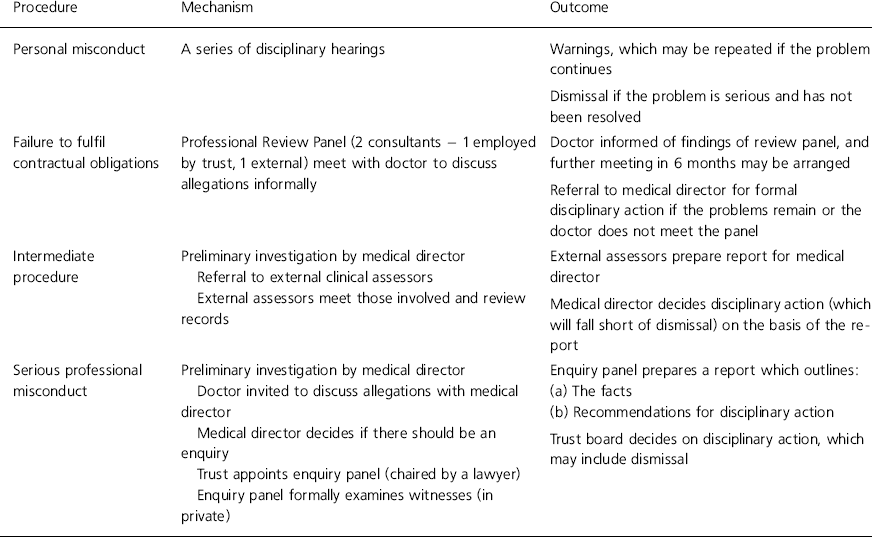
While the complaints procedures exist specifically to deal with service issues, the function of the disciplinary procedure is to address wrongdoing or unacceptable personal or professional standards in individual doctors. There are separate procedures to address personal misconduct, failure to fulfil contractual obligations, and serious and less serious cases of professional misconduct (see Table 2).
NHS disciplinary procedures
| Procedure | Mechanism | Outcome |
|---|---|---|
| Personal misconduct | A series of disciplinary hearings | Warnings, which may be repeated if the problem continues |
| Dismissal if the problem is serious and has not been resolved | ||
| Failure to fulfil contractual obligations | Professional Review Panel (2 consultants - 1 employed by trust, 1 external) meet with doctor to discuss allegations informally | Doctor informed of findings of review panel, and further meeting in 6 months may be arranged |
| Referral to medical director for formal disciplinary action if the problems remain or the doctor does not meet the panel | ||
| Intermediate procedure | Preliminary investigation by medical director | External assessors prepare report for medical director |
| Referral to external clinical assessors | ||
| External assessors meet those involved and review records | Medical director decides disciplinary action (which will fall short of dismissal) on the basis of the report | |
| Serious professional misconduct | Preliminary investigation by medical director | Enquiry panel prepares a report which outlines: |
| Doctor invited to discuss allegations with medical director |
|
|
| Medical director decides if there should be an enquiry | Trust board decides on disciplinary action, which may include dismissal | |
| Trust appoints enquiry panel (chaired by a lawyer) | ||
| Enquiry panel formally examines witnesses (in private) |
Personal misconduct refers to factors unrelated to medical skill. Examples include being rude to colleagues, stealing hospital property or assaulting another member of staff. Being unavailable when on call or not turning up for out-patient clinics could constitute failure to fulfil contractual obligations. Serious and less serious cases of professional misconduct relate directly to medical skills. Prescribing lethal doses of drugs clearly outside the British National Formulary guidelines, repeatedly failing to keep notes or not diagnosing an acute abdomen and referring appropriately could constitute serious professional misconduct. Less serious cases may include untidy record-keeping or poor prescribing habits (British Medical Association, 1997).
A nurse complained that, while on duty, she had received a number of sexually explicit telephone calls from a male junior doctor. Initially she had dealt with these nuisance calls by threatening the doctor that she would inform his consultant. For several weeks there were no further calls. One evening, around 11 pm, the doctor telephoned again, stating that he was standing at the window of his room, which overlooked the nursing office and that he was naked. A glance at the window confirmed that this was the case. The next morning the nurse lodged an official complaint.
A disciplinary hearing was held. Accounts were heard from the nurse and doctor in question. It emerged that there had been a brief sexual relationship between them, some months earlier, and that the doctor had been drinking on the night in question. The doctor was issued with a final written warning that if the behaviour continued he could face dismissal and that the GMC would be informed. To protect the nurse from further unwelcome contact, it was also arranged that the doctor would work at a different site.
General Medical Council procedures
In order to practise medicine in the UK, registration with the GMC is required. The GMC sets standards of practice and behaviour expected of registered doctors. If the GMC receives allegations that a doctor may be unfit to practise because of ill health, unprofessional behaviour or inadequate skills or knowledge, it will investigate these allegations. It may restrict, suspend or terminate the doctor's registration.
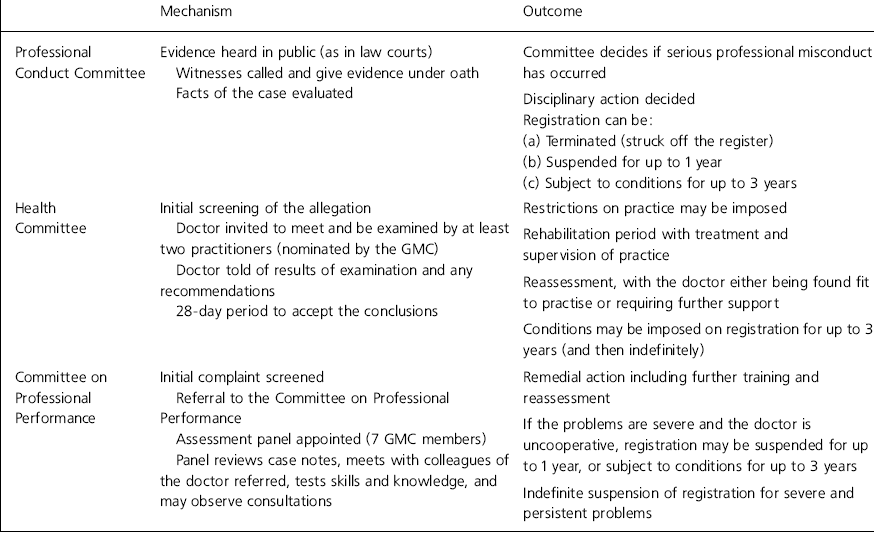
Referral to the GMC may be by several routes. Doctors convicted of serious criminal offences may be refferred directly by the courts. Colleagues may complain, as may patients. The GMC has three separate committees to investigate complaints: professional conduct, health and professional performance (see Table 3). The Preliminary Proceedings Committee initially screens complaints before referring them on to the appropriate committee.
General Medical Council procedures
| Mechanism | Outcome | |
|---|---|---|
| Professional Conduct Committee | Evidence heard in public (as in law courts) | Committee decides if serious professional misconduct has occurred |
| Witnesses called and give evidence under oath | ||
| Facts of the case evaluated | Disciplinary action decided | |
| Registration can be: | ||
|
||
| Health Committee | Initial screening of the allegation | Restrictions on practice may be imposed |
| Doctor invited to meet and be examined by at least two practitioners (nominated by the GMC) | Rehabilitation period with treatment and supervision of practice | |
| Doctor told of results of examination and any recommendations | Reassessment, with the doctor either being found fit to practise or requiring further support | |
| 28-day period to accept the conclusions | ||
| Conditions may be imposed on registration for up to 3 years (and then indefinitely) | ||
| Committee on Professional Performance | Initial complaint screened | Remedial action including further training and reassessment |
| Referral to the Committee on Professional Performance | ||
| If the problems are severe and the doctor is uncooperative, registration may be suspended for up to 1 year, or subject to conditions for up to 3 years | ||
| Assessment panel appointed (7 GMC members) | ||
| Panel reviews case notes, meets with colleagues of the doctor referred, tests skills and knowledge, and may observe consultations | ||
| Indefinite suspension of registration for severe and persistent problems |
A surgeon was referred to the GMC by an anaesthetist colleague, who was concerned that patients undergoing laparoscopic keyhole surgery for gallbladder resection were subject to a range of complications which were both unexpected and, in some cases, severe. He had taken the decision to inform the GMC after one patient, previously healthy apart from cholelithiasis, which had caused intermittent upper abdominal discomfort, developed peritonitis post-operatively and required an emergency laparotomy. At laparotomy, a perforation of the small intestine was identified, and a length of bowel was resected, as it appeared to be no longer viable.
The case was heard by the GMC Professional Performance Committee, which learned that the surgeon concerned had had only very limited training in the technique of laparoscopic surgery, some 10 years earlier. He was aware of the possible risks of the procedure but was not aware of recent developments in this form of surgery. The Professional Practice Committee ruled that the surgeon at present lacked the necessary skills and competence to carry out this form of surgery, and recommended that he should refrain from carrying out further similar procedures until he had undergone a further period of retraining. The surgeon had acknowledged his limitations at the hearing and agreed to process of monitoring by the GMC of his performance over the following year as a condition of continuing registration. He did not appeal against the ruling.
English and European law
The GMC monitors and imposes restriction on the practice of those doctors who are found unfit to practise. In some cases, however, the practice of the doctor may be so deficient that actual harm results, and legal action is brought. A very small number of doctors may exploit the special relationship they have with patients for fraudulent or criminal reasons. Cases may be referred to the courts by patients, relatives, colleagues or professional bodies.
In a paper such as this, it is impossible to provide an exhaustive review of the legal system, and interested readers are referred to Kennedy & Grubb (Reference Kennedy and Grubb1989). We confine our attention to aspects of most relevance to complaints, namely negligence, and actions arising as a result of examination or treatment without consent.
Negligence
Anyone providing a service or goods has an obligation to ensure that these are of a reasonable standard and safe. Someone receiving substandard goods or services, who suffers as a result, may bring a claim for recovery of damages, on the grounds of negligence.
In medical cases, the situation is complicated by the fact that patients will in general have been ill at the time of contact, or at any rate distressed and vulnerable. For psychiatrists, the situation is even more complicated, as psychiatric illness can both affect the mental capacity of the patient and impede full assessment of needs. Issues of psychiatric injury are also complex (Law Commission, 1995). To successfully litigate in a negligence claim against a psychiatrist, the patient or relative must prove three factors to the satisfaction of the court: duty of care, harm and the ‘but for’ test (see Table 4) (Reference KnightKnight, 1987).
Elements of negligence

| Factor | Explanation |
|---|---|
| Duty of care | The psychiatrist had some responsibility to the victim of the mishap |
| Standard of care | The care provided was below that expected by the law - acting in a manner acceptable to professional peers |
| Actual harm | Demonstrable harm must have occurred |
| “But for” test | If the care provided had not been unsatisfactory, the injury would not have occurred |
For claims brought against psychiatrists, the presence or absence of a duty of care is likely to be fairly clear. The other factors may be more difficult to prove. There is likely to be a variety of opinions among psychiatrist expert witnesses about acceptable treatments for any condition. To defend against a negligence action, one does not need to prove that one uses the most effective, safe or most desirable of the available options, but simply that practice conforms to a recognised body of medical opinion (the Bolam defence).
The direct causation of injury may also be difficult to prove. For example, a patient who suffers from schizophrenia would find it easier to prove negligence if he or she sustained a fracture as a result of dangerous restraint and enforced medication than to prove that anxiety symptoms were caused by post-traumatic stress disorder arising from similar circumstances, without actual physical injury.
Criminal negligence
Many cases brought before the courts for recovery of damages for negligence will be relatively trivial. However, in some circumstances, the harm which occurs will be so severe, or the standard of practice so transparently dangerous that there are grounds for criminal prosecution. An example is a case of a patient dying as a result of a drug being given by an incorrect route. In such cases, manslaughter charges have been brought. At present there is no clear guidance as to which cases demand punishment by the courts, the House of Lords having ruled that cases should essentially be decided on a case by case basis by the jury. In practice, however, certain factors are likely to influence the jury's decision. These include obvious indifference to risks, being aware of a risk but deciding to run it nevertheless, grossly negligent attempts to avoid a known risk and inattention or a failure to admit to a known risk that go beyond inadvertence.
For psychiatrists, the situation can be significantly more complex than for other medical specialists. Often risks are unclear, or are influenced by voluntary acts (e.g. drug misuse) beyond the control of the psychiatrist.
Consent
Informed consent is a cornerstone of good medical practice and its importance has been emphasised in the GMC guide Seeking Patients Consent: The Ethical Considerations. A doctor performing a procedure without the patient's consent runs the risk of being sued for trespass or criminal prosecution for assault. The three requirements for informed consent are: the capacity to retain and evaluate information relevant to the decision in question, the provision of sufficient information in an appropriate form to enable the patient to evaluate the benefits and likely risks of agreeing to or declining the proposed procedure, and a lack of coercion in the exercise of choice in this matter.
It is important to realise that capacity to consent is not an all or nothing matter, but refers to specific interventions. It may be present to a greater or lesser degree in relation to different medical procedures. It is possible that a patient suffering from mild dementia may understand the purpose of, and general risks involved in, a tooth extraction, but be unable to retain information about, and weight the risks involved in, the resection of an asymptomatic abdominal aortic aneurysm.
Mental illness can certainly impair capacity to grant or withhold consent, but it should not be taken as given that a patient suffering from even the most severe mental illness is unable to consent to all procedures.
European law
The European Convention of Human Rights is a wide-ranging document, which establishes certain fundamental rights for all European citizens (Reference GostinGostin, 1986). The most relevant clauses with regard to psychiatric treatment are:
-
(a) Article 3 - protection from inhuman or degrading treatment.
-
(b) Article 5 - protection of liberty.
To date, no case has been won in the European Court on the grounds of inhuman or degrading treatment by a patient receiving psychiatric care in the UK. Proposed changes to English mental health legislation, which would increase powers to enforce treatment in the community would certainly be open to challenge on the grounds of infringement of liberty and privacy (Reference GostinGostin, 1986).
Article 5 states that where mental disorder is the basis of detention, detention should be for the purpose of treatment, and that there should be some reciprocity between the power of the state to detain and the standard of treatment available. Clearly detaining a patient with an untreatable dissocial personality disorder, on the grounds alone that they may be dangerous contravenes both these principles. If such cases are eventually brought to the European Court, the English law may need to be amended.
Right to representation and appeal
Doctors are not obliged to be members of any medical defence or professional organisation. However, there are benefits in being a member of such an organisation, in particular where there is a difference of interests between the doctor and his or her employer. For doctors involved in any of the procedures outlined above, we would recommend seeking external advice. For the procedures with more serious outcomes, for example, NHS disciplinary proceedings for serious professional misconduct, GMC procedures and cases heard in the courts, a lawyer may represent the doctor. For the less serious procedures, advice, for example about the response to draft reports can be sought.
It is beyond the scope of this document to discuss in detail the appeals procedures for each class of complaint. In general, however, there is a correspondence between the sanctions arising from each procedure and the right to appeal. The more informal and locally mediated procedures (local resolution of complaints and the initial stages of investigation of failure to fulfil contractual obligations) lack an appeals procedure. Other local NHS disciplinary procedures allow the doctor to appeal to a specially appointed appeals panel, which has external medical representation. Doctors dismissed for serious professional misconduct can in certain circumstances appeal to the Secretary of State. There are also formal appeal mechanisms against GMC rulings, which are dealt with by the Judicial Committee of the Privy Council. If a doctor is suspended by the GMC, pending investigation, an appeal can be lodged with the High Court. For civil or criminal rulings, appeals can be made to a higher court.
Comment
There may be considerable overlap between the various complaint procedures. Information revealed in NHS disciplinary hearings may be submitted as evidence in court and the outcome of NHS disciplinary procedures may be referral to the GMC. It is important for this reason that all complaints should be taken seriously.
There are potential conflicts of interests between psychiatrists and their employers in the resolution of complaints. It is recommended that psychiatrists should have membership of both the British Medical Association and a defence organisation. These organisations should be consulted at an early stage for advice if a complaint has been brought.
All psychiatric trainees would benefit from an understanding of these issues. We would suggest that an in-depth knowledge of the various opportunities patients have to complain about psychiatrists is an important part of the management component of specialist registrar training. Consultants need to be fully informed on these issues, both because of liabilities arising out of their own practice and, also, because of the managerial, and therefore supportive and disciplinary, role they have in relation to their junior medical staff. The following references are recommended as providing further information about the various procedures and the circumstances in which they may be used.
In a further paper, we explore factors unique to the treatment of psychiatric patients, which may lead to inefficient use of the various complaints procedures (Reference Ikkos and BarbenelIkkos & Barbenel, 2000).


 Open access


eLetters
No eLetters have been published for this article.