


Introduction
Childhood maltreatment has been shown to be a longitudinal risk factor for personality disorder (PD) in young adulthood (Johnson et al. Reference Johnson, Cohen, Brown, Smailes and Bernstein1999; Widom et al. Reference Widom, Czaja and Paris2009). Moreover, childhood sexual abuse (CSA), physical abuse and neglect might be differentially associated with PDs. There is evidence to suggest that an independent longitudinal association exists between CSA and PD (Johnson et al. Reference Johnson, Cohen, Brown, Smailes and Bernstein1999; Spataro et al. Reference Spataro, Mullen, Burgess, Wells and Moss2004). However, previous studies have not used standard assessments for PD, thus limiting the generalizability of their findings. In addition, the effect of CSA on personality dimensions has not been rigorously researched. This is important for two reasons. First, PD represents the extreme end of personality disturbance and the broader effects of CSA on adult personality are unclear. Second, it is likely that a dimensional approach will be introduced to the classification of abnormal personality in the DSM-V (Skodol & Bender, Reference Skodol and Bender2009). However, we do not know whether associations between childhood risk factors and categorically defined PD are accompanied by meaningful associations between the same risk factors and dimensional measures of personality.
With these issues in mind, we set out to examine associations between CSA and abnormal personality as measured both categorically and dimensionally, in a large nationally representative sample of young adults. We wanted to test the hypothesis that if categorical associations were detected, they would be paralleled by associations between CSA and agreeableness and neuroticism, the two personality dimensions that typify all PDs (Saulsman & Page, Reference Saulsman and Page2004).
Method
Design and sample
Between 1992 and 2003, an eight-wave cohort study of adolescent and young adult health in the state of Victoria, Australia was carried out. This report concerns data collected in the eighth wave (average age 24 years). The details of this study have been described previously (Patton et al. Reference Patton, Carlin, Coffey, Wolfe, Hibbert and Bowes1998). We followed standard data collection protocols approved by the internal review boards of Victoria's Royal Children's Hospital's Ethics in Human Research Committee. Active written parental consent for participation was required at the study outset and verbal assent was also required from each participant.
The cohort was defined in a two-stage cluster sample, in which two classes were randomly selected from each of 44 schools drawn from a stratified frame of schools (total number of students 60 905). One class from each school entered the cohort in the latter part of the ninth school year, corresponding to age 14–15 years (wave 1) and the second class 6 months later, early in the tenth school year, corresponding to age 15–16 years (wave 2). Participants were subsequently reviewed at a further four 6-month intervals during the teens (waves 3–6), with two follow-up waves in young adulthood at the ages of 20–21 years (wave 7) and 24–25 years (wave 8). In wave 8, from a total sample of 1943 students interviewed at previous waves, 1520 young adults (78%) were interviewed. Interviewing took place between May 2001 and March 2003. Reasons for non-completion at wave 8 were refusal (n=269), not contactable (n=150) and death (n=4).
Measures
The following covariates were measured: incomplete secondary schooling, that is having left school before the final possible year (year 12); attendance at a rural school at study inception; born in a country other than Australia; parental divorce or separation by wave 6; parental educational status; and parental cigarette smoking. Symptoms of depression and anxiety were assessed from waves 1 to 7 using the computerized revised Clinical Interview Schedule (CIS-R; Lewis et al. Reference Lewis, Pelosi, Araya and Dunn1992). Total scores on the CIS-R were dichotomized, with scores >11 delineating a mixed depression-anxiety state at a lower threshold than syndromes of major depression and anxiety disorder, but where clinical intervention would be appropriate.
CSA was measured retrospectively at 24 years (wave 8). We measured sexual abuse at this age because the state of Victoria has a statutory requirement to report all abuse in children aged below 17 years to government services. To have informed parents and participants of this at the time carried a risk of selective refusal for those with abuse histories. Furthermore, participation in waves 1–6 required parental and school consent and inclusion of questions about sexual abuse might have reduced our response. By age 24, we felt participants would be sufficiently comfortable to encounter these questions, yet not as remote from the experience as to limit recall. We administered six items developed by Martin et al. (Reference Martin, Anderson, Romans, Mullen and O'Shea1993). Participants were asked: ‘before you were 16, did any adult or older person involve you in any unwanted incidents like: (i) inviting or requesting you to do something sexual; (ii) kissing or hugging you in a sexual way; (iii) touching or fondling your private parts; (iv) showing their sex organs to you; (v) making them touch you in a sexual way; (vi) attempting or having sexual intercourse’. The response set was ‘never’, ‘once’, and ‘more than once’. CSA was classified according to the individual's most severe response to all abuse questions.
PD was assessed using the Standardised Assessment of Personality (SAP; Pilgrim et al. Reference Pilgrim, Mellers, Boothby and Mann1993). This is a semi-structured interview conducted with an informant, either face-to-face or by telephone, and assesses for the presence of all categories of DSM-IV PD. Patients and informants differ in their descriptions of patients' usual personality. However, both self-report personality inventories and semi-structured interviews can be biased by the patient's acute state (Zimmerman, Reference Zimmerman1994) and we therefore chose to use an informant-based method. The overall level of inter-rater agreement for the presence of PD on the SAP is excellent (κ=0.76), with a range between 0.60 and 0.82 for individual categories of PD (Pilgrim et al. Reference Pilgrim, Mellers, Boothby and Mann1993). All wave-8 participants were asked to nominate a friend with whom a telephone interview could be conducted, to assess the participant for the presence of PD. If the friend was unavailable or unable to be contacted, participants were reapproached for an alternative person. For the 1520 participants at wave 8, a total of 1145 (75%) informant interviews were conducted. Three hundred and four participants refused to nominate a friend. In the case of 45 participants, the informant refused or was non-contactable, and in the case of 26 participants, friends were located but did not respond to requests to be interviewed. The informants were friends or partners (n=872, 76%), relations (n=253, 22%) or spouses (n=20, 2%).
Personality dimensions were assessed using the NEO-Five Factor Inventory (NEO-FFI; Costa & McCrae, Reference Costa and McCrae1992), which is a 60-item measure of the five domains of adult personality: openness to experience, conscientiousness, extraversion, agreeableness and neuroticism. Participants were sent a paper version of the NEO-FFI with instructions on how to complete and return it. Those failing to do this were asked to complete the NEO-FFI during an interviewer-administered telephone interview. NEO-FFI data were obtained on 1469 participants (97% of wave-8 participants); 638 participants complied with the postal survey and 831 participants completed the telephone interview. Administration of the NEO-FFI by telephone did not adversely affect the internal consistency of the instrument; all five higher domains of the NEO-FFI showed good internal consistency, with Cronbach's α>0.70.
Statistical analyses
Data analysis was undertaken using Stata 10 (StataCorp, 2008). We assessed associations between sexual abuse and background factors and personality measures using simple 2×3 χ2 tests with 2 degrees of freedom. Influential background factors were included as possible confounders in explanatory models for PD and NEO-FFI scores. Logistic regression models were used to assess the association between sexual abuse and PD. Differences in mean NEO-FFI dimension scores according to sexual abuse status were estimated using linear regression models.
Because of the computer-based data collection, there were few missing data for individuals within waves. However, 36% of respondents missed at least one wave of data collection in the adolescent phase (waves 1–6), leading to a potential bias in summary measures calculated from these data. Of particular relevance to this analysis, only 11 participants in wave 8 were missing on the measure of CSA, but, because of the complex nature of the data collection, 51 were missing on the NEO-FFI and 375 on the SAP. Overall, all three measures were available for 1116 (73% of wave 8) participants. To address this, we used the method of multiple imputation, with five complete datasets created by imputation under a multivariable normal model. This model incorporated all the outcome and exposure variables of interest, along with the fixed covariates of sex, age, rural/urban residence, parental education and parental divorce/separation, using adaptive rounding for binary measures. Estimates of prevalence and (log) odds ratios (ORs) were obtained within the multiple imputation framework by averaging across the imputed datasets with Wald-type confidence intervals (CIs) obtained using Rubin's combination rules (Carlin et al. Reference Carlin, Galati and Royston2008). Linear trends were assessed by entering the three-level sexual abuse variable (0, 1, 2) in logistic (for the PD outcomes) and linear (for NEO-FFI outcomes) regression models as an interval variable. Effect modification between the ordinal sexual abuse exposure and sex was assessed using the interaction effect Wald p value. All CIs use the 95% level.
Results
The mean age of participants at wave 8 was 24.1 years (s.d.=0.61). Fifty-one per cent (n=1000) of the sample were female and 14% (n=264) were of non-Australian birth. The overall prevalence of DSM-IV PDs was 18.6% (CI 16.5–20.7). The prevalence of DSM-IV PD was 8.3% (CI 7.0–9.6) for Cluster A, 8.1% (CI 6.8–9.4) for Cluster B and 9.8% (CI 8.3–11.3) for Cluster C PD. Multiple PDs were common, with 56, 57 and 45% of those with Cluster A, B and C respectively also being classified with at least one other PD from another cluster. Eighty-eight per cent (CI 87–90) of the sample reported no CSA. The prevalence of one reported episode of CSA was 5.7% (CI 4.6–7.0), and of more than one reported episode 6.1% (CI 5.0–7.4).
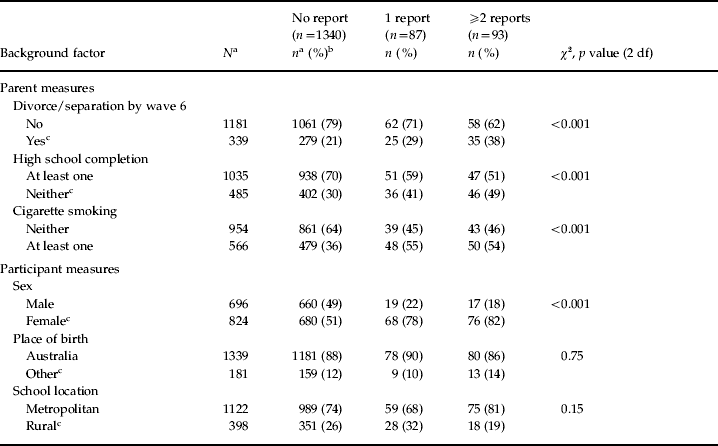
Associations of background factors with CSA are presented in Table 1. Reporting of CSA was significantly more common among females, the association being stronger for more than one report of abuse (OR 4.4, CI 2.5–7.5). CSA was also associated with parental failure to complete high school education, parental cigarette smoking and parental divorce/separation by wave 6 (when participants were aged 17 years).
Parental background factors and participant background factors by the number of reported episodes of childhood sexual abuse (CSA) in 1520 cohort participants
df, Degrees of freedom.
a Frequencies obtained by averaging across the five imputed datasets.
b Percentage of CSA category with background category.
c Risk category of explanatory variable.
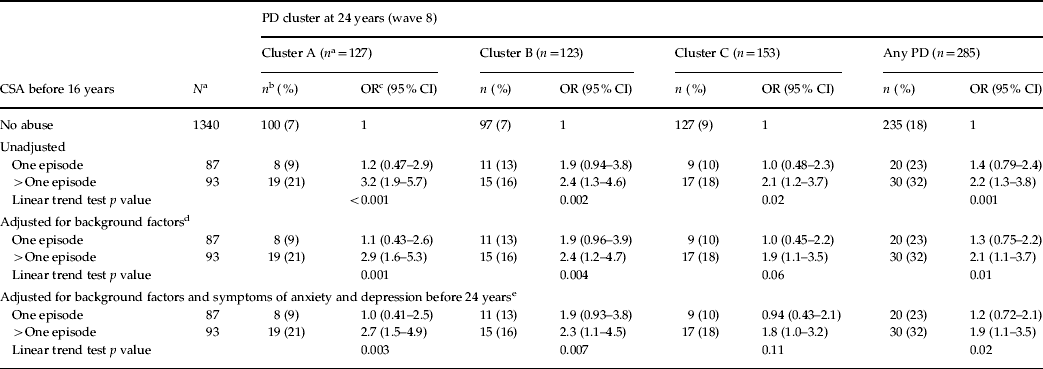
Associations between sexual abuse before age 16 and PD are presented in Table 2. CSA was associated with having any PD (from Cluster A, B or C), with reports of repeated episodes of abuse resulting in at least a twofold increased odds of both any PD and all three individual Cluster PDs. Adjustment for sex, parental education, divorce/separation, smoking status and earlier symptoms of anxiety and depression had little impact on the strength of these associations. There was no evidence of a first-order interaction of CSA with sex with any of the PD outcomes (minimum Wald interaction p value 0.47).
Association between childhood sexual abuse (CSA) before 16 years and personality disorder (PD) measured at 24 years (wave 8, n=1520)
OR, Odds ratio; CI, confidence interval.
a Frequencies and percentages obtained by averaging across the imputed datasets.
b Frequency (percentage) of each exposure category with PD cluster.
c ORs from logistic regression models.
d Adjusted for background factors: sex, parental education, parental divorce/separation and parental smoking.
e Adjusted for background factors (sex, parental education, parental divorce/separation and parental smoking) and any earlier revised Clinical Interview Schedule (CIS-R) score >11 (waves 1–7).
Associations between CSA and the five NEO-FFI personality dimensions are presented in Table 3. CSA was associated with higher neuroticism and lower agreeableness, with the association more evident with repeated episodes of abuse. Adjustment for sex, parental education, divorce/separation, smoking status and earlier symptoms of anxiety and depression had little impact on the differences in mean dimensional scores. Evidence of an association between CSA and openness was inconsistent as it was only apparent with single episodes and not with repeated episodes of abuse. There was some evidence for an interaction between CSA and sex for the outcomes extraversion and neuroticism (both Wald p values 0.05) but not for agreeableness, conscientiousness and openness (Wald p values 0.37, 0.45 and 0.96 respectively). With both extraversion and neuroticism, the interaction effect pointed to more pronounced differences with increasing reports of abuse in males.
Association between childhood sexual abuse (CSA) before 16 years and NEO-FFI scores measured at 24 years (wave 8, n=1520)

Values given as mean (95% confidence interval), where means are obtained by averaging NEO-Five Factor Inventory (NEO-FFI) scores across the imputed datasets.
a p value from regression models with NEO-FFI scores as outcome and CSA as explanatory variable.
b Adjusted for background factors: sex, parental education, parental divorce/separation and parental smoking.
c Adjusted for background factors (sex, parental education, parental divorce/separation and parental smoking) and any earlier revised Clinical Interview Schedule (CIS-R) score >11 (waves 1–7).
All models reported in Tables 1–3 were repeated using only complete data and the general pattern of estimates was similar to those obtained by using imputed data.
Discussion
In this large nationally representative sample of young adults, repeated CSA was associated with a twofold increase in the odds for categorically defined PD and this association held for each PD cluster. There was clear evidence of a trend to higher risk of PD with increasing reports of sexual abuse. Those experiencing multiple episodes of abuse also differed substantially from those with no history of abuse, on agreeableness and neuroticism, the two personality dimensions usually linked to the various PDs (Saulsman & Page, Reference Saulsman and Page2004; Moran et al. Reference Moran, Coffey, Mann, Carlin and Patton2006). Adjustment for background sociodemographic factors and for earlier symptoms of anxiety and depression had little effect on the strength of the detected associations. Associations between PD or personality dimensions with report of a single episode of abuse were less consistent.
Approximately 12% of our sample reported one or more episodes of sexual abuse prior to the age of 16 years, with 6% of the sample reporting more than one episode. Females reported abuse more often than males (17% and 5% respectively). These findings are consistent with previously published research into the community prevalence of CSA. A recent meta-analysis of the prevalence of CSA in community samples reported that, across 22 countries, approximately 7% of men and 19% of women had suffered some form of sexual abuse before the age of 18 years (Pereda et al. Reference Pereda, Guilera, Forns and Gomez-Benito2009). Consistent with the previous literature, we found an excess prevalence of sexual abuse among female participants, and also identified parental correlates of CSA. The parents of those participants with more than one report of sexual abuse were more likely to be divorced or separated by the time the participant was 17 years, failed to complete their high school education and/or were cigarette smokers. Previous epidemiological research has failed to identify consistent sociodemographic correlates of CSA (Pereda et al. Reference Pereda, Guilera, Forns and Gomez-Benito2009) and, to our knowledge, these associations have not been reported previously, although they were not central to our area of enquiry. Nonetheless, these additional associations might indicate important confounding variables of the associations that we detected, and we therefore adjusted for these variables in the final models.
Several mechanisms might explain the association between CSA and personality abnormality. First, CSA often emerges from a ‘nexus of adversity’ (Mullen et al. Reference Mullen, Martin, Anderson, Romans and Herbison1996; Spataro et al. Reference Spataro, Mullen, Burgess, Wells and Moss2004) and hence the detected associations might be confounded by other harmful exposures, such as low parental nurturing and physical abuse (Johnson et al. Reference Johnson, Cohen, Chen, Kasen and Brook2006). Although we addressed the possibility of confounding by background demographic factors, we did not measure other forms of maltreatment and so cannot exclude these as possible confounders. Second, PD is associated with maladaptive parenting (Johnson et al. Reference Johnson, Cohen, Kasen, Smailes and Brook2001; Conroy et al. Reference Conroy, Marks, Schacht, Davies and Moran2010) and, in children whose biological parents were abusers, the association might reflect a genetic predisposition to personality abnormality. We did not measure parental mental disorder and were unable to distinguish (biological) parental abuse from non-parental abuse, and therefore cannot exclude this possibility. Third, people with PD might report sexual abuse more readily. Fourth, CSA is also a risk factor for common mental disorder (Spataro et al. Reference Spataro, Mullen, Burgess, Wells and Moss2004) and the detected associations might reflect underlying co-morbidity. However, adjustment for earlier symptoms of depression and anxiety had little impact on the strength of the associations and so we consider that this is therefore an unlikely explanation.
Our study has several methodological strengths. First, we used a large sample that was representative of the general population, thus increasing the generalizability of our findings. Second, previous research in this area has relied on hospital records for case ascertainment (Spataro et al. Reference Spataro, Mullen, Burgess, Wells and Moss2004), or a non-standard rating of DSM-IV PD symptoms (Johnson et al. Reference Johnson, Cohen, Brown, Smailes and Bernstein1999). In this study we used a reliable structured assessment of PD, which uses information derived from an informant. Hence, the observed associations are unlikely to reflect information bias. We also measured personality using two different methods (self-report and informant), with consistent findings across both methods. Finally, we were able to minimize the effects of missing data by using multiple imputation.
Our findings need to be considered in the light of several limitations. First, we assessed CSA retrospectively at 24 years. As outlined in the Method section, this data collection procedure was in response to the need to balance ethical and practical considerations. Retrospective assessment is common in studies of sexual abuse and has been shown to have a high specificity (Everson & Boat, Reference Everson and Boat1989). Moreover, there is evidence for substantial under-reporting by sexually abused respondents (Hardt & Rutter, Reference Hardt and Rutter2004) and support for the construct validity of retrospective self-report measures of sexual abuse (Widom & Morris, Reference Widom and Morris1997). Second, we only recorded frequency of sexual abuse and did not measure the nature or severity of abuse, or other forms of physical and emotional abuse, all of which are likely to have an impact on the outcome. Third, the five-factor model of personality (Digman, Reference Digman1990) is likely to have floor and ceiling effects for some clinically salient traits and lacks other clinically relevant traits (e.g. peculiarity and compulsivity), which might lead to underestimation of personality pathology. Fourth, although we gathered data on several parental characteristics, we did not measure parental psychopathology and were therefore unable to examine the potential effects of this on the detected associations. Finally, the prevalence of PD in our sample was higher than that reported in previous community surveys of all adults. However, it is consistent with the observation that PD prevalence declines with age (Samuels et al. Reference Samuels, Eaton, Bienvenu, Brown, Costa and Nestadt2002; Ullrich & Coid, Reference Ullrich and Coid2009).
Despite being familiar to clinicians, the categorical approach to classifying PD has major limitations. These include an inadequate scientific basis, excessive diagnostic co-occurrence and inadequate coverage of the range of personality pathology (Widiger & Simonsen, Reference Widiger and Simonsen2005). Taken together, our findings support the longitudinal association of multiple episodes of CSA with abnormal personality, whether measured categorically by informant or dimensionally by self-report. Our findings also suggest that if a dimensional model for PDs is adopted in future classification systems, there might be meaningful continuity with previous risk factor research conducted using the current categorical system.
Acknowledgements
The Victoria Adolescent Health Cohort Study is supported by grants from the National Health Medical Research Council, the Victorian Health Promotion Foundation, the Murdoch Children's Research Institute and the Australian Rotary Health Research Fund.
Declaration of Interest
None.


 Open access

