

INTRODUCTION
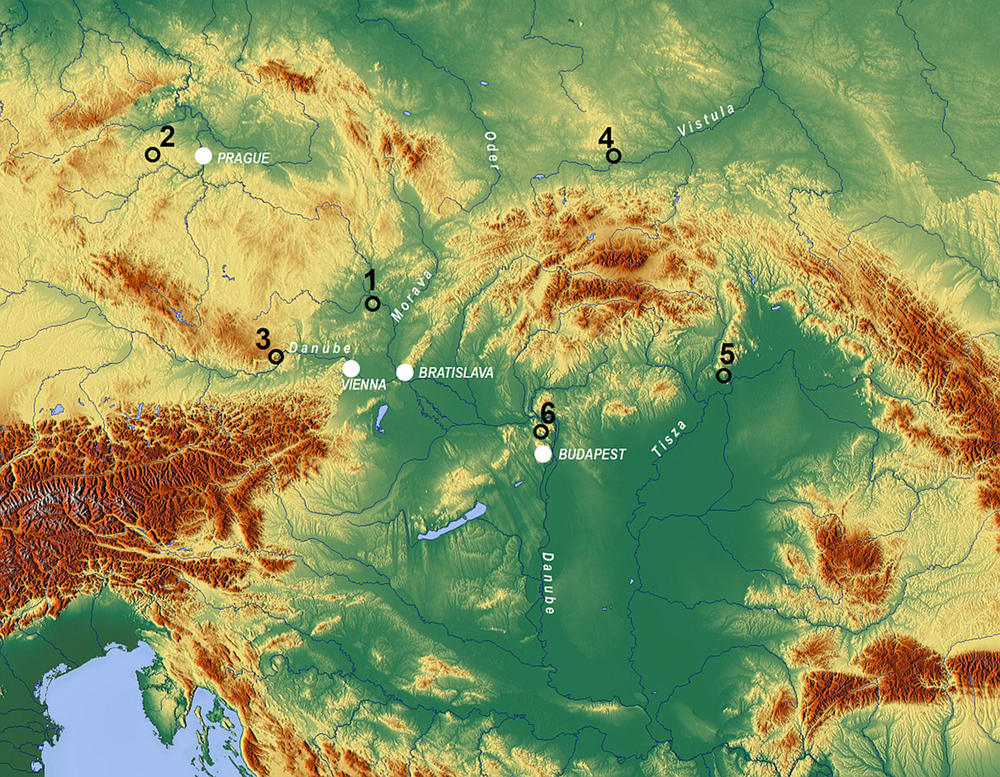
This report presents new accelerator mass spectrometry radiocarbon (AMS 14C) dates from six Late Gravettian sites (Figure 1). The Late Gravettian (∼29–24 ka cal BP), formerly often called Willendorf–Kostenkian, is a phase of the Gravettian culture in Eastern Central Europe (ECE), which is roughly dated to between 34 and 24 ka cal BP. The Gravettian chronology begins with the Early Gravettian (∼34–30 ka cal BP) and its second phase is the Pavlovian (∼31–29 ka cal BP) that directly precedes the Late Gravettian (Moreau Reference Moreau2009; Svoboda Reference Svoboda2007, Reference Svoboda and Svoboda2016). The Late Gravettian ends when the terrestrial ice sheet covering Europe in the last glacial Weichselian period reached its maximum extent at the Last Glacial Maximum (LGM) (Lengyel and Wilczyński Reference Lengyel and Wilczyński2018).
Location of the sites dated. 1 – Milovice I, 2 – Lubná VI, 3 – Willendorf II, 4 – Kraków Spadzista, 5 – Bodrogkeresztúr, 6 – Pilisszántó I.
Early Gravettian sites are rare in ECE. The only clear example of this phase was found at Willendorf II layer 5, Wachau, Lower Austria (Moreau Reference Moreau2012). Another site, Dolní Věstonice IIa, Moravia (Czech Republic), produced material dated to the time of Early Gravettian (33–32 ka cal BP) (Svoboda Reference Svoboda and Svoboda2016), but the lithic tools are typologically undiagnostic for Early Gravettian (Novák Reference Novák and Svoboda2016). Other sites of this phase are found elsewhere in the Upper Danube basin and the Swabian Alps in western Central Europe (Moreau Reference Moreau2009).
Pavlovian sites have been recorded only in Lower Austria and Moravia (Czech Republic) (Oliva Reference Oliva2007; Svoboda Reference Svoboda2007; Händel Reference Händel2017), on the western margin of ECE. They occur much more frequently than sites of the preceding Early Gravettian in ECE. Most of the known locations are found in southern Moravia, especially on the northern slopes of the Pavlov Hills.
In contrast to the Early Gravettian and the Pavlovian, Late Gravettian occupations have been found all over ECE, which has yielded the most plentiful archaeological record of the Middle Upper Palaeolithic (MUP) (Kozłowski Reference Kozłowski and Mester2013; Lengyel Reference Lengyel2016; Lengyel and Wilczyński Reference Lengyel and Wilczyński2018). Because of varying degrees of site preservation, the radiocarbon dates from all Late Gravettian sites tend to span a wider temporal period between ∼29 and 24 ka cal BP. In the existing MUP radiocarbon dataset, the end of the Pavlovian overlaps the beginning of the Late Gravettian. While almost all the Pavlovian sites are finely dated (Svoboda Reference Svoboda and Svoboda2016), there are still inconsistencies in the chronology of the Late Gravettian (Lengyel 2008–Reference Lengyel2009; Oliva Reference Oliva2009) even at sites dated by a number of radiocarbon measurements (Wilczyński et al. Reference Wilczyński, Wojtal and Sobczyk2012). Another problem is a lack of age determinations for some occupations. Therefore, efforts to refine the radiocarbon chronology for Late Gravettian occupations are particularly important, especially because of temporal overlap with the Pavlovian.
METHODS
All the dated samples reported here come from archeological occupations. We selected animal bones with taxonomic identification, unambiguous context, and modifications indicating actions by humans, such as stone tool cut marks and fresh bone breakage (green breaks). While animal bones in open-air sites associated with lithic artifacts are generally considered to be the results of human activity, accumulations of Mammuthus primigenius subfossil skeletal parts in Central and eastern Europe sometimes have been interpreted as collections made from naturally deceased animals (e.g., Steenstrup Reference Steenstrup1889; Wankel Reference Wankel1890; Absolon Reference Absolon1945; Kozłowski et al. Reference Kozłowski, van Vliet, Sachse-Kozłowska, Kubiak and Zakrzewska1974; Klima Reference Klíma1963; Haynes Reference Haynes1991; Soffer Reference Soffer, Soffer and Praslov1993; Svoboda et al. Reference Svoboda, Péan and Wojtal2005; Wojtal and Sobczyk Reference Wojtal and Sobczyk2005; Oliva Reference Oliva2009). No consensus has been reached about the origins of sites yielding large amount of mammoth bones, but recent evidence strongly suggests that Gravettian hunters were able to kill mammoths with stone-tipped weapons (Kufel-Diakowska et al. Reference Kufel-Diakowska, Wilczyński, Wojtal and Sobczyk2016; Nuzhnyi et al. Reference Nuzhnyi, Praslov and Sablin2016; Sinitsyn et al. Reference Sinitsyn, Stepanova and Petrova2019; Wojtal et al. Reference Wojtal, Haynes, Klimowicz, Sobczyk, Tarasiuk, Wroński and Wilczyński2019). Mammoth bone accumulations that have been taphonomically analyzed allow reconstruction of butchering activity based on cut marks and green-bone breaks. One of the seven sites examined here is a rock shelter, Pilisszántó I Rockshelter, where the animal bone assemblage could have been accumulated during both human occupations and denning by carnivores.
AMS 14C dating was performed at Poznań Radiocarbon Laboratory. All samples are from faunal remains. Collagen extraction was performed using the procedures described by Longin (Reference Longin1971) with further modifications (Piotrowska and Goslar Reference Piotrowska and Goslar2002). Before extraction, the degree of collagen degradation was preliminarily checked by measuring content of N and C in bone using analyzer Flash EA 1112 Series. Usually the samples were forwarded for collagen extraction if N content in bone was not lower than 0.3%. The bones were crushed mechanically to granulation <0.3 mm. The bone powder was treated with 2M HCl at room temperature for 20 minutes, and 0.1M NaOH at room temperature for 1 hour. After each step of treatment, the sample was centrifuged and the residuum was collected. Extraction of collagen was processed in HCl (pH=3, 80°C, 10 hr), and after centrifugation the residuum was removed. The extracted collagen was ultrafiltered on pre-cleaned Vivaspin 15 MWCO 30 kD filters (Bronk Ramsey et al. Reference Bronk Ramsey, Higham, Bowles and Hedges2004). Collagen quality was ultimately assessed by C/N atomic ratio with interval of acceptance between 2.9 and 3.5 (van Klinken Reference van Klinken1999). The obtained collagens were combusted in closed quartz tubes under vacuum together with CuO and Ag wool under 900°C over 10 hours. The obtained gas (CO2 + water vapor) was then dried in a vacuum line and reduced with H2 using 2 mg of Fe powder as a catalyst.
Bones charred to black included low nitrogen content and their C/N ratio was over the limit of acceptance. These bones were pretreated using classical AAA method (Brock et al. Reference Brock, Higham, Ditchfield and Bronk Ramsey2010), and then combusted and processed further in the same way as the collagens.
The content of 14C was measured using the NEC-produced “Compact Carbon AMS” (Goslar et al. Reference Goslar, Czernik and Goslar2004), by comparing intensities of ionic beams of 14C, 13C, and 12C measured for each sample and for standard samples (modern standard: “Oxalic Acid II” and 14C-free carbon: “background”).
The conventional 14C age was calculated using correction for isotopic fractionation (Stuiver and Polach Reference Stuiver and Polach1977), basing on 13C/12C measured in the AMS spectrometer simultaneously with the 14C/12C. Uncertainty of calculated 14C age was determined using uncertainty implied from counting statistics, and also standard deviation of partial 14C/12C results, whichever was bigger. Uncertainties of 14C/12C ratios measured on standard and background samples were additionally taken into account. Calibration of 14C age was performed against IntCal13 (Reimer et al. Reference Reimer, Bard, Bayliss, Beck, Blackwell, Bronk Ramsey, Buck, Cheng, Edwards, Friedrich, Grootes, Guilderson, Haflidason, Hajdas, Hatté, Heaton, Hoffman, Hogg, Hughen, Kaiser, Kromer, Manning, Niu, Reimer, Richards, Scott, Southon, Staff, Turney and van der Plicht2013) with OxCal ver. 4.3.2 (Bronk Ramsey and Lee Reference Bronk Ramsey and Lee2013). We used the outlier analysis function of OxCal 4.3.2 (Bronk Ramsey Reference Bronk Ramsey2009) to determine the most probable age of the human occupation. This dating procedure was based on the Oxford Radiocarbon Accelerator Unit methodology.
MATERIALS
Milovice I Sector G
Located in Moravia, Czech Republic (48º50′36″N; 16º41′21″E), Milovice I is a Late Gravettian mammoth hunter camp near Dolní Věstonice (Oliva Reference Oliva2009). The best conserved part of the human occupation was located in excavation sector G, which yielded a typical set of Late Gravettian tool types. The archeological layer in sector G was found in a sequence of loess. This was dated formerly on charcoals (species unidentified) to between 21.2 and 25.5 ka BP, and one date was obtained on bone (species unidentified) to 24.1 ka BP. All these dates were made with decay counting method.
Milovice I sector G yielded body parts of mammoth skeletons belonging to a minimum of 21 individuals (Oliva Reference Oliva2009). To ensure we dated different mammoth individuals, we selected only comparable mammoth molars from the collection stored at the Moravské zemské Museum, Brno (Table 1).
Samples from Milovice I sector G.

Lubná VI
Lubná yielded the first ever excavated paleolithic site in Bohemia (Czech Republic), dated to the Late Gravettian period (Verpoorte Reference Verpoorte2003; Šída Reference Šída2016). There are eight sites identified to date at the outer periphery of the village Lubná. Lubná VI, located 48 km west of Prague (50º04′52″N; 13º42′04″E), was discovered in 2006. It yielded hearths, lithics, and abundant faunal remains. The archaeological layer is embedded in loess, nearly 1.9 m below the recent ground surface. The archaeological bed is very distinct, up to a few cm in thickness, marked by a thin layer of stones, combustion features, faunal remains, and lithic tools. Reindeer bone fragments retrieved from the archaeological layer in the 2006 excavation at Lubná VI had earlier yielded three radiocarbon dates obtained by the Center for Isotope Research (University of Groningen, the Netherlands): 23,200 ± 120 (GrA-57035), 23,070 ± 120 (GrA-57037) and 23,150 ± 110 (GrA-57076). The samples produced C/N atomic ratios 4.16, 3.92 and 3.71, respectively, all of which exceeded the limit of acceptance 3.5 (van Klinken Reference van Klinken1999). Values of δ15N (1.94, 2.0 and 3.0, respectively) were low indicating degradation of bone collagen.
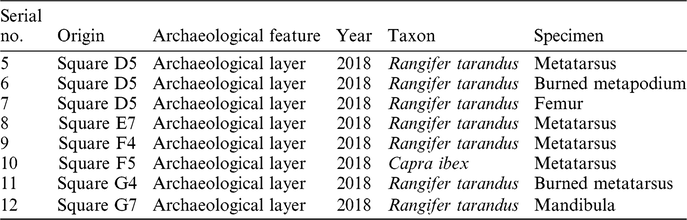
The new radiocarbon dates presented here were obtained from eight samples from the Lubná VI excavation in 2018 that continued recovering the layer found in 2006 (Table 2). The samples were reindeer remains and a single Capra ibex metatarsal bone fragment from the archaeological layer.
Samples from Lubná VI.
Willendorf II Layer 9
The site Willendorf II, located in Lower Austria (48º19′23″N; 15º24′15″E), yielded the longest Upper Paleolithic archeological sequence in Central Europe, dated between 42.5 and 27.2 ka cal BP (Haesaerts et al. Reference Haesaerts, Damblon, Bachner and Trnka1996; Nigst et al. Reference Nigst, Haesaerts, Damblon, Frank-Fellner, Mallol, Viola, Götzinger, Niven, Trnka and Hublin2014). Layer 9 is the uppermost in the series of the layers numbered from bottom to top. Previous radiocarbon dates on bones are between 29.3 and 27.2 ka cal BP from the 1920s excavations. This layer is the westernmost archaeological record of the Late Gravettian that contains shouldered points, marking a sub-phase called Willendorf-Kostenkian (Kozłowski Reference Kozłowski and Svoboda2008), which yielded the famous Venus of Willendorf carved out of limestone (Antl-Weiser Reference Antl-Weiser2009).
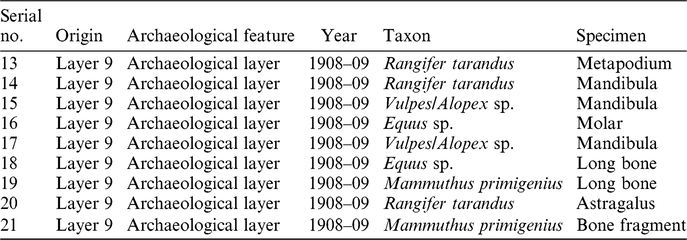
Nine samples were selected from the bones of the 1908–1909 excavation stored at the Natural History Museum, Vienna (Table 3). The sampled species are mammoth, reindeer, fox, and horse. The bones were heavily impregnated with organic glue.
Samples from Willendorf II layer 9.
Kraków Spadzista Layer 6
The site has long been known as a mammoth hunting site (Kozłowski et al. Reference Kozłowski, van Vliet, Sachse-Kozłowska, Kubiak and Zakrzewska1974; Wojtal and Sobczyk Reference Wojtal and Sobczyk2005; Wilczyński et al. Reference Wilczyński, Wojtal and Sobczyk2012), located in the city of Kraków, Lesser Poland (50º03′22″N; 19º53′50″E). The archaeological sequence includes Aurignacian, Late Gravettian, and Epigravettian occupations (Wilczyński Reference Wilczyński2007). Most abundant is the Late Gravettian in layer 6. The layer was severely disturbed by periglacial events. Former radiocarbon dates (n=26) for the Late Gravettian occupation range between 30.3 and 24.5 ka cal BP (Wojtal et al. Reference Wojtal, Sobczyk, Wilczyński, Sázelová, Novák and Mizerová2015; Wilczyński et al. Reference Wilczyński, Wojtal, Sobieraj and Sobczyk2015).
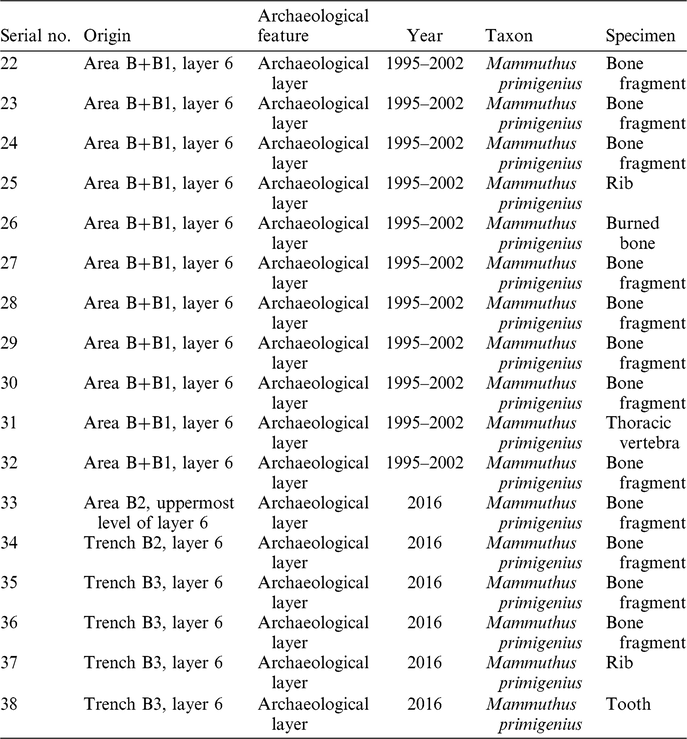
The 18 samples dated here are all of mammoth material derived from B+B1, B2 and B3 trenches located in the northern part of the site, where a large accumulation of bones was discovered (Kozłowski et al. Reference Kozłowski, van Vliet, Sachse-Kozłowska, Kubiak and Zakrzewska1974; Wojtal and Sobczyk Reference Wojtal and Sobczyk2005) (Table 4). The bones are stored at the Institute of Systematics and Evolution of Animals, Polish Academy of Sciences, Kraków.
Samples from Kraków Spadzista layer 6.
Bodrogkeresztúr
The site is located in northeast Hungary (48º09′05″N; 21º20′49″E), on a small hill called Henye, situated east of the village Bodrogkeresztúr. Two excavations were carried out at the site, one in 1963 (Vértes Reference Vértes1966) and another in 1982 (Dobosi Reference Dobosi2000). The archaeological layer was embedded in loess (Dobosi Reference Dobosi2000). A paleosol was noticed at the site, but the relation to the archaeological layer is controversial (Vértes Reference Vértes1966 vs. Dobosi Reference Dobosi2000). There are four unreliable radiocarbon dates from the site (Lengyel 2008–Reference Lengyel2009). The one which is most often cited is 28,700 ± 3,000 (GXO–195) with a very large standard deviation. Another date, 26.3 ka BP (Deb–2555), was obtained from a bulk charcoal sample retrieved from a 5 kg sample of the paleosol. Two dates on bone samples, 18.5 ka BP (Deb–3381) and 10.6 ka BP (Hv–12986), possibly were obtained from contaminated samples (Dobosi Reference Dobosi2000; Dobosi and Szántó Reference Dobosi and Szántó2003). The site has been re-attributed to the Late Gravettian period on the basis of lithic tool typology (Lengyel Reference Lengyel2015).
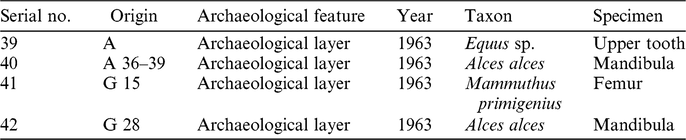
The four samples dated here derive from three species of the faunal collection of the 1963 excavation: mammoth, European elk, and horse (Table 5). The bones were stored at the Mining and Geological Survey of Hungary (formerly Institute of Geophysics and Geology of Hungary).
Samples from Bodrogkeresztúr.
Pilisszántó I Rockshelter
The site is located in the Pilis Mountains, northern Hungary (47º40′43″N; 18º52′52″E). The site was extensively excavated in 1914–1915 (Kormos and Lambrecht Reference Kormos and Lambrecht1915), then the rest of the sediment was removed in 1951 (Gábori Reference Gábori1954). The archaeological material is sparse but consists almost entirely of lithic hunting tools (Dobosi and Vörös Reference Dobosi and Vörös1987). According to the lithic tool typology the lower layer complex can be attributed to the Late Gravettian (Lengyel Reference Lengyel2016). The middle and upper layer complexes contained culturally undiagnostic lithic tool types.
The site yielded abundant remains of reindeer (Kormos and Lambrecht Reference Kormos and Lambrecht1915). The stratigraphy included seven “diluvial” (i.e. Pleistocene) layers grouped into three units: upper layer complex (D1-2), middle layer complex (D3-5) and lower layer complex (D6-7). The exact ages of the human occupations have been unknown and the chronology of the layers was estimated on the basis of the biostratigraphy. The upper and the middle layer complexes were dated to the “Pilisszántó faunal phase” approximately between 22 and 16 ka BP, the Würm III cold maximum (LLGM) which preceded the “Bajót faunal phase” 16–13 ka BP (Dobosi and Vörös Reference Dobosi and Vörös1987). The lower layer complex does not correspond to any of the known faunal phases (unnamed faunal phase in Dobosi and Vörös Reference Dobosi and Vörös1987). Later it was merged into the preceding Istállóskő faunal phase equal to the Upper Würm that immediately followed MIS3 (Vörös Reference Vörös and Dobosi2000). This revision unseparated the Pilisszántó faunal phase from the Bajót faunal phase, and the middle and upper layer complexes were dated to the Pilisszántó–Bajót faunal phase (Vörös Reference Vörös and Dobosi2000). This division however was not used consistently. The age of the lower layer complex was also estimated to be as old as 23 ka BP, the middle layer 21 ka BP; the upper layer remained unclassified (Dobosi and Szántó Reference Dobosi and Szántó2003).
The two samples dated here are a reindeer mandible (Kormos and Lambrecht Reference Kormos and Lambrecht1915: Figure 44) and a reindeer phalanx from the lower layer complex (Table 6).
Samples from Pilisszántó I rockshelter.

RESULTS
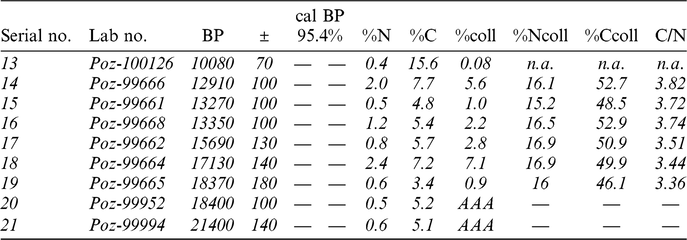
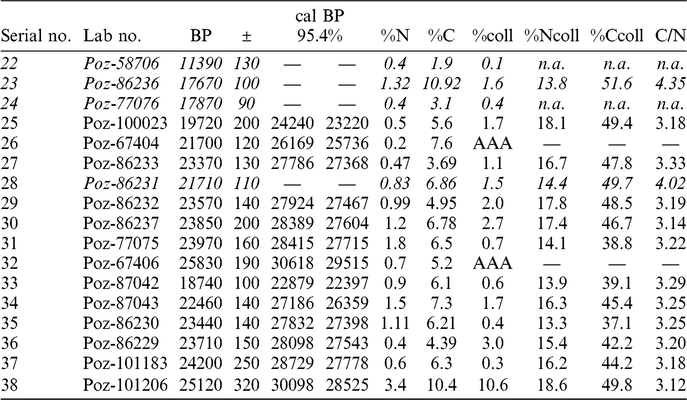
The dating results are listed in Tables 7–12. Dates obtained on collagen of poor or not checked (n.a.) quality (displayed in italics) have been left uncalibrated and ignored from discussion. Charred bones from which collagen was not extracted are denoted with “AAA” in the “%coll” column. The serial numbers identify the samples listed in Tables 1–6.
Milovice I sector G radiocarbon dates.
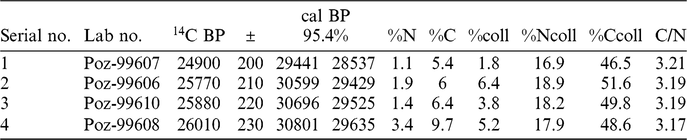
Lubná VI radiocarbon dates.
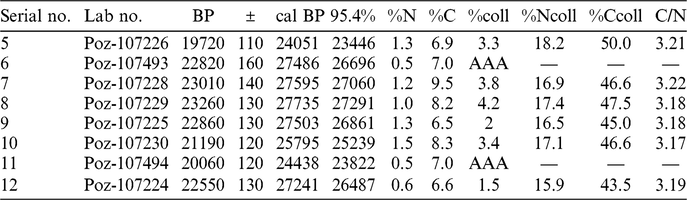
Willendorf II layer 9 radiocarbon dates.
Kraków Spadzista layer 6 radiocarbon dates.
Bodrogkeresztúr radiocarbon dates.

Pilisszántó I rockshelter lower layer complex dates.

Milovice I Sector G
Milovice I sector G dates (Table 7) correspond with what was obtained earlier from the site (Oliva Reference Oliva2009). The new dates between 30.8 and 28.5 ka cal BP are contemporaneous with the Pavlovian, although the lithic assemblage of Milovice I sector G is clearly associated with the Late Gravettian. The formerly obtained 22–21 ka BP ages on unknown species of wood charcoals (ISGS-1691 and ISGS-1690) (Oliva Reference Oliva2009) seem too young for the Milovice I Late Gravettian occupation.
A taphonomic analysis of clustered mammoth bones concluded that the bone accumulation was fairly rapid, encompassing no more than few hundred years (Brugère and Fontana Reference Brugère, Fontana and Oliva2009). To reconcile this brief time span with our dating results, we tried to combine (Figure 2) probability distributions of calibrated dates, blurred by adding uniform distributions in 500 year intervals (U(-250,250)). The process of combining generally assumes calendar dates of all samples to be the same. Using blurred distributions allows the differing of combined actual dates from one another (here, the maximum allowed difference is set at 500 yr).
Upper part: combined calibrated 14C dates from Milovice I sector G, blurred by adding uniform probability distributions 500 years wide (b1 = U(–250,250)). Lower part: same as above, but with Poz-99607 treated as an outlier of the phase.
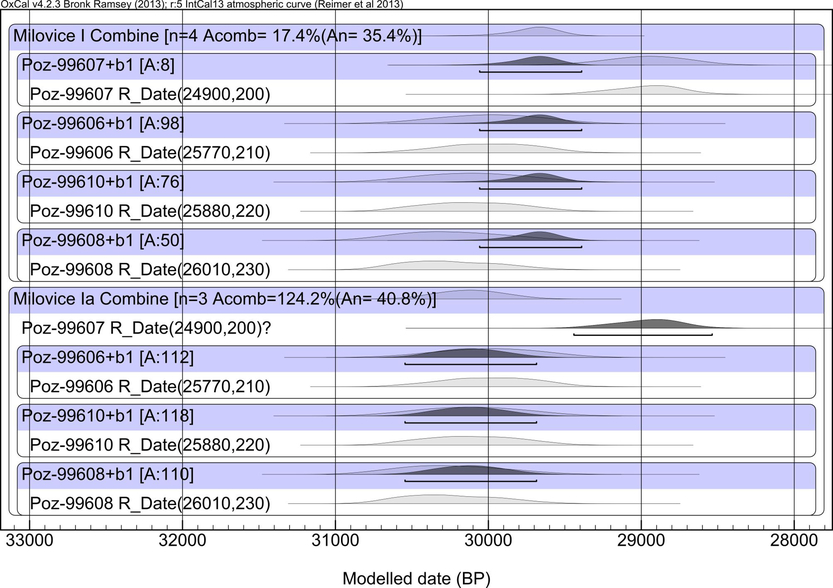
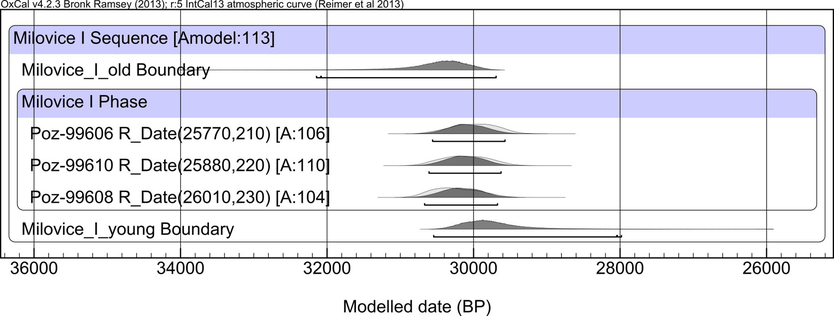
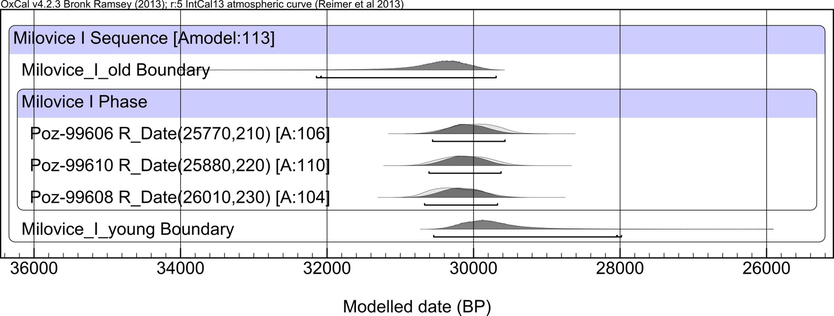
The trial to combine all 4 dates (Figure 2, upper part) was unsuccessful, as indicated by low value of Agreement index (Acomb=17.4%). A fully acceptable agreement index (Acomb=124.2%) was obtained in the second trial, and the most offsetting date (Poz-99607) was declared as outlier (Figure 2, lower part). We therefore posit that the bones in the human occupation were accumulated probably 30.4 and 29.8 ka cal BP (Figure 3).
Bayesian modeling of phase encompassing dates of 3 bones from Milovice I sector G.
Lubná VI
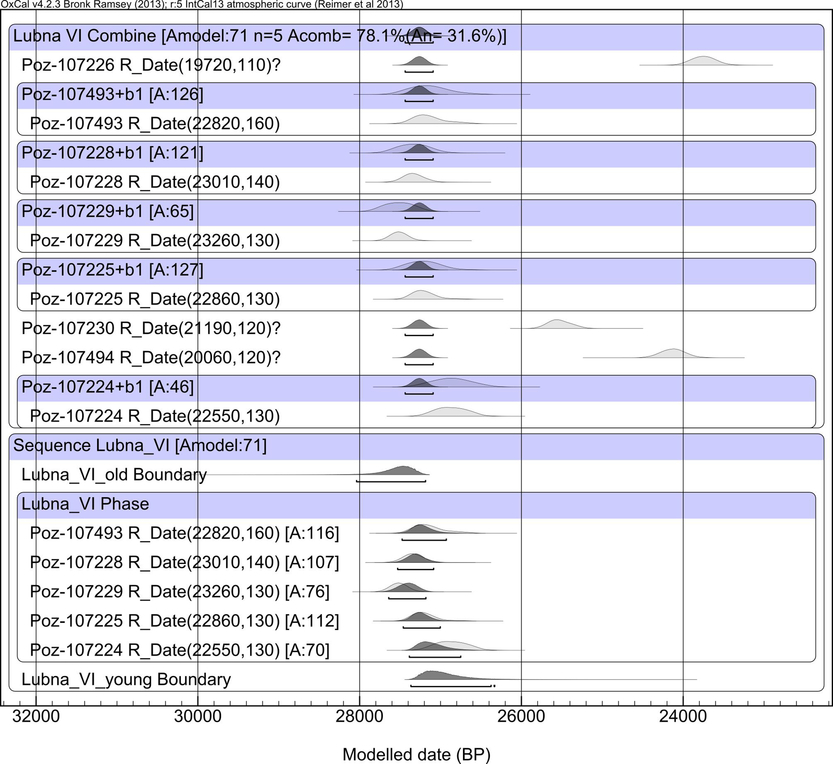
A small excavated area of the site (a dozen square meters) encompasses two hearths with numerous animal remains and stone artifacts, suggesting a brief period of human occupation. Indeed, four of eight analyzed bones (Table 8) have 14C ages close to one another, and five of eight samples (Figure 4, upper part) appeared to derive from a phase not longer than 500 years (as demonstrated in a way similar to that applied to Milovice I), most probably dated between 27.5 and 27.1 ka cal BP (Figure 4, lower part). Three other bones retrieved (Poz-107226, Poz-107230, and Poz-107494) are distinctly younger; however, only one date (Poz-107226) falls out of the expected Late Gravettian time interval. We point out that the cluster of our dates perfectly corresponds with the Groningen AMS dates obtained in 2006 from the same archaeological layer, although the quality of collagens which were 14C-analyzed in 2006 was distinctly poorer, as indicated by high C/N ratios. Diverging radiocarbon dating results also might reflect repeated occupations at the same location over time (Kuzmin and Keates Reference Kuzmin and Keates2005); however, finds at Lubná VI solely were found in a very distinct single archaeological layer, below and above which no traces of human occupations occurred in the loess. Therefore, the reason for radiometric ages which are 2–3 millennia later than expected must stem from another yet-unrevealed source.
Upper part: combined calibrated 14C dates from Lubná VI, blurred by adding uniform probability distributions 500 years wide (b1 = U(–250,250)). Three of eight dates which are clearly younger were declared outliers of the phase. Lower part: Bayesian modeling of phase encompassing dates of 5 bones.
Willendorf II Layer 9
Eight of the nine Willendorf II layer 9 dates are not within the expected time range of the Late Gravettian archaeological period (Table 9); only one date obtained from a burnt mammoth bone fragment (Poz-99994) is within the range. The C/N atomic ratios of four samples are over the 3.5 limit of acceptance, and although two other samples (Poz-99662 and Poz-99664) yielded C/N ratios within the limit of acceptance, 3.44 and 3.36, respectively, these are clearly higher than C/N ratios of most other collagens dated in this work. In one sample (Poz-100126), the low amount of extracted collagen did not allow for C/N analysis, and two remaining dates were obtained on charred bones. It is probable that the glue impregnation of the bones in the early 20th century caused the erratic dating results. The glue was likely applied on most of the faunal assemblage, since the young dates were obtained from different species (horse, reindeer, fox, and the mammoth). The same issue emerged in the 1990s during attempts to date this layer (Haesaerts et al. Reference Haesaerts, Damblon, Bachner and Trnka1996). The only date close to the expected archaeological age is 21.4 ka BP (Poz-99994), made on an unimpregnated burnt mammoth bone stored in the archaeological collection. Still, this date when calibrated with 95.4% probability (25,980–25,430 cal BP) does not overlap the period marked by the formerly obtained four radiocarbon dates (29,360–27,240 cal BP) (Haesaerts et al. Reference Haesaerts, Damblon, Bachner and Trnka1996).
Kraków Spadzista Layer 6
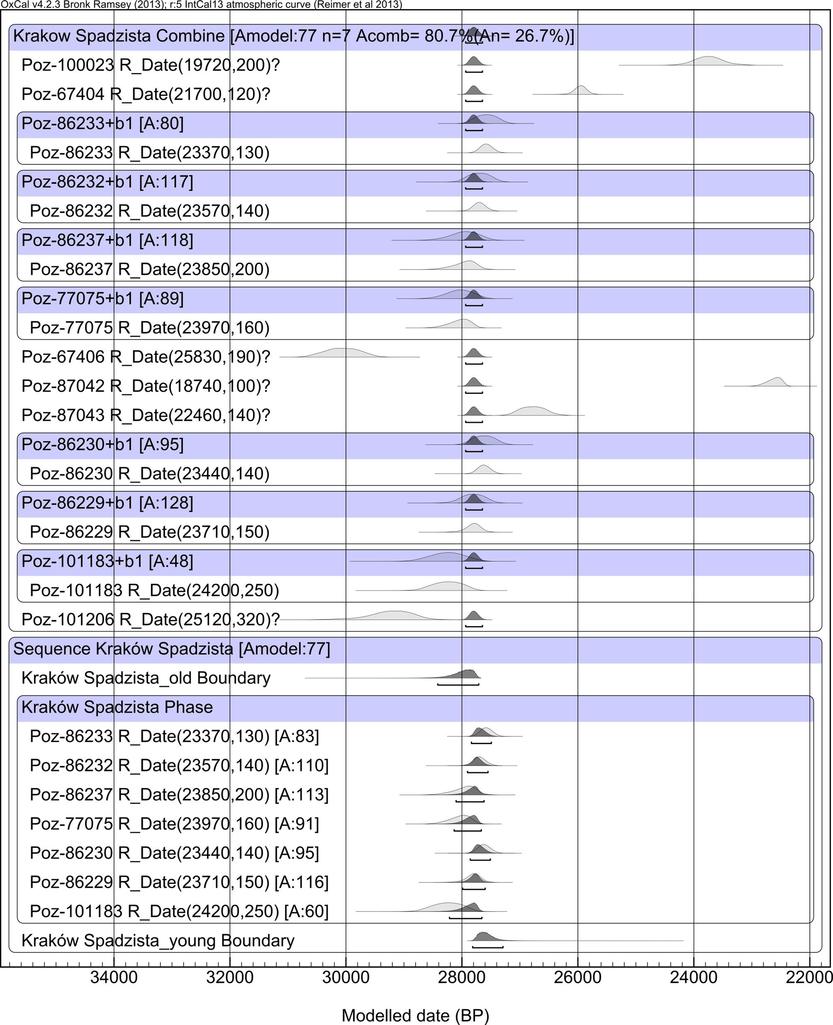
Kraków Spadzista layer 6 yielded the most dates for a Late Gravettian occupation in ECE (Table 10). The dense clustering of mammoth bones in the excavated site is similar to that found in Milovice I, although on a larger scale, again suggesting a rather short interval of human activity consisting of repeated events of mammoth exploitation in a single locus. Indeed, seven of 13 calibrated dates (Figure 5, upper part) are concordant with this suggestion, and situate this phase (Figure 5, lower part) most probably between 27.9 and 27.6 ka cal BP, supporting suggestions from an earlier study of mammoth taphonomy and the mortality profile (Haynes and Klimowicz Reference Haynes, Klimowicz, Wojtal, Wilczyński and Haynes2015). Dates of the other samples (outlying the major phase) are difficult to interpret; they may reflect sporadic hunting events, or some may be from contaminated material (although the acceptable values of C/N ratio do not indicate significant contamination).
Upper part: combined calibrated 14C dates from Kraków Spadzista, blurred by adding uniform probability distributions 500 years wide (b1 = U(–250,250)). Six of 13 dates were declared as outliers of the phase. Lower part: Bayesian modeling of phase encompassing dates of seven bones.
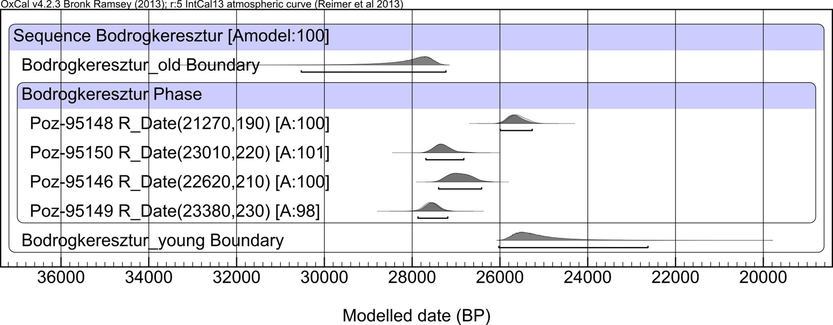
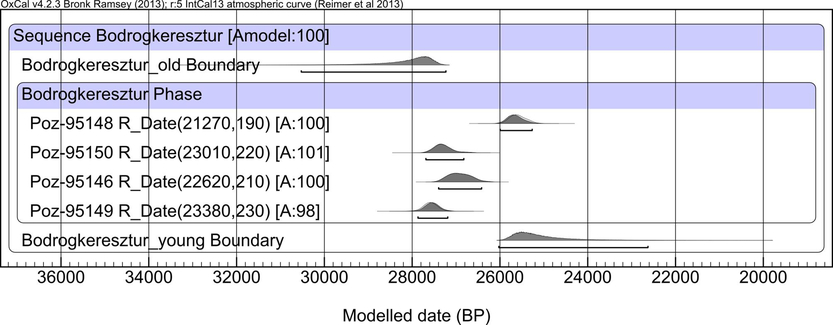
Bayesian modeling of phase encompassing dates of bones from Bodrogkeresztúr.
Bodrogkeresztúr
The results from Bodrogkeresztúr are the first acceptable radiocarbon dates for the Upper Palaeolithic human occupation (Table 11). Three of the four samples are dated in a narrow range, between 27.9 and 26.4 ka cal BP. The first date in Table 13 (Poz-95148) is distinctly younger and difficult to interpret, since despite the low collagen extraction yield, the C/N atomic ratio in collagen did not indicate its contamination with ambient carbon. If this date is correct, the time interval encompassing all four dates still corresponds with the Late Gravettian age, which was estimated based on lithic tool typology (Lengyel Reference Lengyel2015) (Figure 6).
Pilisszántó I
The dates for Pilisszántó I Rockshelter lower layer complex are the first radiocarbon results for this site (Table 12). The dates from the lower layer complex, between 30.0 and 28.5 ka cal BP, are older than the age estimated by the biostratigraphy (Dobosi and Vörös Reference Dobosi and Vörös1987; Dobosi and Szántó Reference Dobosi and Szántó2003). These ages are in agreement with the Late Gravettian cultural affiliation (Lengyel Reference Lengyel2016).
DISCUSSION AND CONCLUSION
Radiocarbon chronology for the MUP in ECE seems to show that the region’s earliest Late Gravettian dates at Milovice I (30.8 ka cal BP) are contemporaneous with the Pavlovian at least over 1.8 ka years. For instance, Dolní Věstonice I site yielded an abundant inventory of Pavlovian culture (Oliva Reference Oliva2014), including 11 radiocarbon dates obtained with decay counting method except for the only bone date in the series, run on a human femoral diaphysis (Svoboda et al. Reference Svoboda, Novák, Sázelová, Hladilová and Škrdla2018). The human bone date is the youngest, 22.8 ka BP, while all the others, mainly charcoals associated with the lithic artifacts, are significantly older, 25.7 and 25.9 ka BP. There are three more dates on mammoth molars from the 1924–1925 excavation, 20.4, 24.1 and 25.5 ka BP, which are also somewhat younger than other 14C dates from the site (Nadachowski et al. Reference Nadachowski, Lipecki, Baca, Żmihorski and Wilczyński2018).
For the moment this chronological overlap is difficult to explain. We suggest three possible explanations: (1) the Pavlovian did overlap the beginning of the Late Gravettian; or (2) the Dolní Věstonice I human occupation recovered in the early- and mid-20th century was a palimpsest deposit that included both Pavlovian and Late Gravettian remains; or (3) the Pavlovian occupations were finely stratified, as shown by the new excavations (Svoboda Reference Svoboda and Svoboda2016), and the resolution of the field methods of the early- and mid-20th century was unable to notice tiny archaeological layers. An admixture of Late Gravettian and Pavlovian was noted earlier regarding the Pavlov I site (Verpoorte Reference Verpoorte and Svoboda2005).
The results reported here suggest that Late Gravettian occupation in ECE occurred between 30 and 26 ka cal BP. We do not find an admixture of bone materials from several occupational periods at the Late Gravettian sites except Kraków Spadzista where solifluction disturbed the archaeological layer.
Radiocarbon dates of Late Gravettian younger than 22 ka BP most probably are too late to represent the end of that culture. Currently we cannot explain why a few dates are outliers from the archaeological chronology; for instance the radiocarbon ages 19 and 20 ka BP for Lubná VI Late Gravettian assemblage are too young and correspond with the Epigravettian (Lengyel and Wilczyński Reference Lengyel and Wilczyński2018).
The new dates reported here place the beginning of the Late Gravettian one millennium earlier and its end two millennia earlier than currently assumed in the literature. Unfortunately, the chronological overlap between the end of the Pavlovian and the beginning of the Late Gravettian has not been resolved.
ACKNOWLEDGMENTS
J. Wilczyński’s studies were supported by the National Science Centre, Poland, agreement No. UMO-2015/18/E/HS3/00178. P. Wojtal’s studies were supported by the National Science Centre, Poland, agreement No. UMO-2015/17/B/HS3/00165. G. Lengyel’s studies were supported by the National Science Centre, Poland, agreement No. UMO-2016/23/P/HS3/04034. This project has received funding from the European Union’s Horizon 2020 research and innovation programme under the Marie Skłodowska-Curie grant agreement No 665778. We are grateful to Klára Palotás and László Makádi of the Mining and Geological Survey of Hungary for helping to sample Bodrogkeresztúr and Pilisszántó I rockshelter faunal material. We would like to thank G. Haynes, University of Nevada, for correcting the English text.





 Open access

