

1. Introduction
As environmental degradation transitions from a public issue to a political concern, Chinese environmental governance has increasingly embraced the “rule of law,” promoting “ecological civilization (Shengtai wenming)” under President Xi administration since 2017 (Shapiro, Reference Shapiro2023, pp. 2–15). This legalistic momentum has given rise to an emerging domain of Chinese environmental justice (CEJ),Footnote 1 where legal authority in environmental governance is devolved to local communities (Tilt, Reference Tilt2010, p. 23). Citizens are empowered to use legal strategies and engage in litigation to address environmental grievances (Wang and Xia, Reference Wang and Xia2023b; Zhai and Chang, Reference Zhai and Chang2018). Scholarship has documented how environmental legal cases are managed by the Chinese legal system, their impact on victims and communities, and how they reflect justice in China (i.e., Jiang and Chen, Reference Jiang and Chen2023; Stern, Reference Stern2010). Research also highlights the persistent role of the Chinese state authority and political ideologies in shaping environmental justice practices (Stern, Reference Stern2013, pp. 97–112).
Yet few studies have examined the dynamic relationship between the Chinese state and the changing society, particularly civil and community-based organisations, in defining and achieving environmental justice in a rapidly modernising China (Hou, Reference Hou2016). Rather than merely serving as tools for state management of environmental risks or being under strict state control, community organisations, empowered by emerging legal frameworks, exhibit agency and employ diverse interactive strategies with the Chinese state (Unger, Reference Unger2008, pp. 3–16). These organisations may influence the definition of environmental problems, the deployment of political resources, and the negotiation and settlement of legal solutions (Han, Reference Han2016). The varying relationships between the state and civil organisations can impact how environmental justice is contested, mediated, and implemented.
Moreover, while recent scholarship on welfare policy and urban governance has examined the significance of community organisations in the process of judicial decision-making and policy implementation (e.g., Brodkin, Reference Brodkin, Brodkin and Martson2013; Goddard, Reference Goddard2012; Kaufman, Reference Kaufman2015; Marwell, Marantz and Baldassarri, Reference Marwell, Marantz and Baldassarri2020; Tomczak and Thompson, Reference Tomczak and Thompson2019), less attention has been paid to the recently constituted CEJ and the role that community organisations have played in its legal processes. To advance understanding of China’s approach to the governance of environmental justice, this study focuses on its organisational dynamics and the ensuing and manifest ties it has forged with the government (including the judiciary). It examines the multiple, contingent connections between community-based organisations and the Chinese state during the CEJ’s operational process. Drawing on multiple sources of qualitative data, the analysis reveals how these NGOs strategically formulate various ties with the state during the legal mobilisation processes (Chua, Reference Chua2019), even as the nature and pattern of their ties are subjected to the state’s governance goals and policy priorities. By unpacking various state–society relations stemming from the emerging dynamics of environmental litigation, we contend that the CEJ field does not represent a uniform, top-down institutional structure, but rather a complex and socially constructed set of ideals, discourses, practices, and experiences that are simultaneously reconfiguring Chinese state power and its capacity to govern in a rapidly modernising (and often risky and uncertain) society.
To bridge the literature gap, this study draws on qualitative data to document the diverse and dynamic relationships that NGOs have forged with the Chinese state, while also analysing what such relationships articulate about the character and function of the CEJ. In what follows, it begins with a critical review of the recent emergence and development of the CEJ field and its operational features, calling for a political–organisational approach to understanding the practical workings of Chinese legal governance of environmental problems. Following a brief description of research methods and design, the dynamic relationships between community organisations/organising and the Chinese state are examined through both vertical and horizontal dimensions, and illustrative cases are presented. It concludes by discussing research and policy implications for environmental justice and governance in a rapidly modernising and increasingly complex Chinese society.
2. The juridical turn, and the rise of community engagement, in Chinese environmental governance
Environmental issues have recently become central to political debate, public awareness, and state efforts to reduce degradation (Walters, Westerhuis and Wyatt, Reference Walters, Westerhuis and Wyatt2013, pp. 3–20). Guided by the ideologies of “the rule of law” and “ecological civilization” set by state elites, a CEJ field has emerged to address citizen grievances. Consequently, environmental problems are judicialised, with legal solutions encouraged (Wang and Xia, Reference Wang and Xia2023b). Citizens are increasingly mobilising legal litigation to address environmental hazards, advocate for justice, and seek well-being (Jiang and Chen, Reference Jiang and Chen2023; White, Reference White, Wilson and Ross2015).
As an emergent mode for governing environmental problems, the establishment of the current CEJ realm marks a sort of reconfiguring the field that alters from the monopoly of the authoritarian state over environmental affairs to a socio-legal structure incorporating civil society to the legal process. As official documents explicitly stipulate, contemporary environmental justice processes have emphasised facilitating so-called “social forces (Shehui liliang)” to participate in the legal arena (Schwartz, Reference Schwartz2004) and incorporating environmental protection as the integral component of China’s social development.Footnote 2 Community members and organisations are now enabled and encouraged to deploy legal weapons to address their environment-relevant grievances and demands, and the government has also enacted a set of rules and procedures to guarantee their mobilisation and protect their environmental (or ecological) rights.Footnote 3 As a result, the CEJ field has evolved into a performance stage where the state is no longer the solo actor, and increasingly diverse forms of actors (individuals or organisations) are involved in environmental legal proceedings assuming different roles (see He and Warren [Reference He and Warren2011]). Upon this transformation to “regulatory pluralism” (van Rooij, Stern and Furst, Reference Van Rooij, Stern and Furst2016), this field is proclaimed to fashion a structure of the Chinese state’s sharing, co-governance, and co-construction (Gongxiang, gongzhi, gongjian) with the civil society in accomplishing environmental justice.Footnote 4
The socio-legal structure for environmental justice innovatively empowers community organisations, or environmental NGOs (ENGOs), to mobilise public interest litigation (Buntaine et al., Reference Buntaine, Greenstone, He, Liu, Wang and Zhang2024). Citizens can now form associations to sue private entities and government agencies for actions harming the public interest, such as ecological destruction and resource damage (Zhai and Chang, Reference Zhai and Chang2018).Footnote 5 This authorised participation of community-based organisations in CEJ reflects a legal responsiveness to community environmental demands and demonstrates the state’s efforts to adapt the legal system to modernisation (Jiang and Chen, Reference Jiang and Chen2023). Research indicates that ENGOs’ legal mobilisation enhances trust between citizens and the government and improves the state’s environmental management capacity (Yang, Reference Yang2005).
Concerns and controversies surrounding expanded community participation in CEJ in general, and its implementation through the legal form of public interest litigation, are threefold. First, the recently created laws and procedures introduce ambiguity regarding the standing of organisations in CEJ (Zhai and Chang, Reference Zhai and Chang2018), as well as the conditions under which citizens can initiate and participate in organisational dynamics for environmental justice. In particular, the legal notion of “national and public interests” remains open to interpretation by legal actors, and thus subject to how legal actors exercise their discretionary power. Research has shown that this ambiguity has often led to perplexity, frustration, and disillusionment with the supposed rights that NGOs enjoy for mobilising and engaging in environmental justice (Cooper, Reference Cooper2006).
Second, in China, due to the state’s ultimate authority and coercive power in environmental justice, community participation is largely nominal and bureaucratic (Kostka, Reference Kostka2016). Citizens’ grievances are often neutralised or marginalised when officials view their actions as threats to state legitimacy and social stability. The subordination of citizens’ genuine environmental demands to state interests undermines the intended goal of environmental justice for community well-being. Although community organisations are permitted to participate in lawsuits, their legal activities are heavily monitored and stringently controlled by the state (Jiang and Chen, Reference Jiang and Chen2024).
Finally, several practical barriers have been identified that discourage or prevent environmental NGOs or grouped citizens from using legal mechanisms to address their environmental concerns, thus negatively affecting their satisfaction with justice. Potential limitations include complex bureaucratic review procedures, burdensome processes for gathering evidence to prove environmental harm, time constraints and strained financial resources for organisational participation, and low levels of trust and active interest among organisational members (see Ding [Reference Ding2022]).Footnote 6
2.1. The current study: Mapping out diverse political–organisational relations in CEJ
Previous research has explored the status, role, and impact of community-based organisations in CEJ, and how CEJ’s organisational and legal dynamics may challenge state power and potentially reshape institutional priorities, creating tension with the state. However, there has been fairly limited understanding of the dynamic, fluid, and complex relationships between the state and social organisations within CEJ. Most studies portray community-based organisations as passive subjects of state-imposed environmental justice policies, downplaying their agentic capacity and multiple roles in configuring and meaning production related to CEJ (Mills, Meek and Gojkovic, Reference Mills, Meek and Gojkovic2011). We contend that these organisations’ agency diversifies state–community–organisation relations in contemporary China (Ji, Reference Ji2016). Instead of viewing CEJ as a uniform form of governance, we see it as a diverse, dynamic, and contingent set of forces, processes, and logics.
This study addresses these dynamic, diverse relationships by drawing on the perspectives and practices of a wide range of CEJ actors, including community members and environmental NGOs, judicial personnel, and government officials. The analysis reveals a set of strategic actions and pragmatic relationships that organisational actors develop as they interact with the state in various environmental justice processes, including the initial decision to litigate, through their participation in legal proceedings, and after case disposition. Before presenting findings on these relationships and their characteristics in the Chinese context, this article describes the empirical methods of the current study.
3. Empirical strategy
To unravel the complex, multiple, and contingent linkages between NGOs and the state in the CEJ, we adopted a unique approach that integrated multiple data sources, including: (1) participatory observations in several NGOs and environmental courts in local jurisdictions in three cities, (2) in-depth case studies based on environmental justice reports published by the Supreme Court of the People’s Republic of China, and (3) 21 semi-structured qualitative interviews with NGO leaders or programme managers and judicial personnel working on environmental issues.
From Summer 2018 to Fall 2021, we conducted a project on the emerging field of CEJ, focusing on its impact on court practices and relationships with community organisations. Leveraging personal connections with environmental justice authorities, we accessed various courts and obtained consent from administrators to observe judges’ handling of environmental cases and community organisations’ participation in litigation.Footnote 7 We documented how court administrators and judges perceived and defined the role of organisations representing environmental interests or seeking legal remedies. Special attention was given to the interactions between judicial officials and organisation leaders or representatives.
We further conducted in-depth interviews with key actors in CEJ, including litigants, victims, organisational leaders, judicial staff, lawyers, and local environmental agency officials.Footnote 8 As direct participants or relevant stakeholders, they provided insights and perspectives on the practical workings of environmental justice and its impact. Our primary focus was on the effects of environmental case outcomes on community perceptions of legal legitimacy and the roles of community organisations in justice-seeking processes. The interviews helped us understand the dynamic relations between NGOs and the state, as reflected in discourses and practices during environmental litigation and other justice processes. The largely semi-structured interviews featured open-ended questions about the organisations’ involvement in environmental justice and their interactions with the court and other state agencies. These interviews were recorded and transcribed, and form part of our qualitative data.
The source of our data was supplemented by several significant environmental cases, which we searched and then analysed in depth to deepen our understanding of the dynamic relationship between NGOs and the state. These selected cases were valuable to our study because they had either been published by China’s highest judicial authority as guidelines for local adjudication or had attracted widespread public attention.
We coded the data using an “analytical abduction” approach (Tavory and Timmermans, Reference Tavory and Timmermans2014), seeking to identify common patterns and categorise the ties between NGOs and the Chinese state in different contexts through multiple logics. We developed our thematic tree under the guidance of vertical linkages and horizontal interactions, guided by and building on previous Chinese studies of social organisations and the state. Our emergent analysis of NGOs’ dynamic relations with the state in China focused specifically on the ways in which NGOs mobilise legal processes as approaches to address their environmental grievances, judges understand and respond to their concerns and demands, and court rulings affect understandings of their positions and roles in CEJ.
In sum, the set of data indicates that NGOs actively forge strategic relationships with the state, rather than just implementing environmental justice policies. Yet, these strategies and resulting relationships typically acknowledge state authority without challenging the political legitimacy and undermining the state authority. The next empirical section explores the evolving dynamics between NGOs and the Chinese state in the CEJ field. Pseudonyms are used throughout to ensure confidentiality.
4. Findings
The findings below are divided into two sections that address surfacing modalities of political–organisational relations within the CEJ and their operative nature in contemporary China. First, we elaborate on four models based on and extracted from our inductive analysis of the data. Based on the organisation’s agentic capacity to mobilise the law and deploy legal weapons, as well as its exercise of bargaining power in the legal process, four distinct relationships between community organisations and the state are strategically forged to address a range of legal, political, and social dilemmas faced by key stakeholders or actors in CEJ. These interactive patterns result not only from the state’s reaching out to organisations for a “collaborative” model of CEJ, but also from the growing rights consciousness of organisational actors and its translation into legal practices in China (Gallagher, Reference Gallagher2006).
Second, zooming in on the meanings and functions of these forged relationships, we show that while community organisations are now formally authorised as an “independent” party to use, challenge, and even contest the law, the practical ways in which they could exercise their agentic power are heavily monitored by the state and ideologically crafted. The space in which they could act and represent is politically constrained, the venues through which they come to mobilise the law are politically determined, and the legal consequences and judicial outcomes they pursue are politically approved. In the entrenched shadow of the state, organisational interests are often subordinated to political priority and ideological conformity.
Taken together, these findings underscore the importance of a more nuanced understanding of the complex relationships between emerging and increasingly empowered civic forces and the state, which faces intersecting predicaments of economic development, social stability, and political legitimacy.
4.1. Four modalities of the relationship between community organisations and the state
Environmental litigation has increased dramatically following a series of legal reforms that empower community organisations to initiate litigation to address environmental grievances (Lv and Zhang, Reference Lv and Zhang2020). Admittedly, the complexity of environmental problems themselves, the differentiation of the actors involved in environmental justice (state and non-state actors), and the diversification of the Chinese state’s governance objectives rarely make approaches to environmental litigation and the resulting political–organisational relationships monolithic. As a result, diverse relationships between community organisations and the state emerge when organisations engage in environmental litigation or pursue environmental justice as a mechanism for social change.
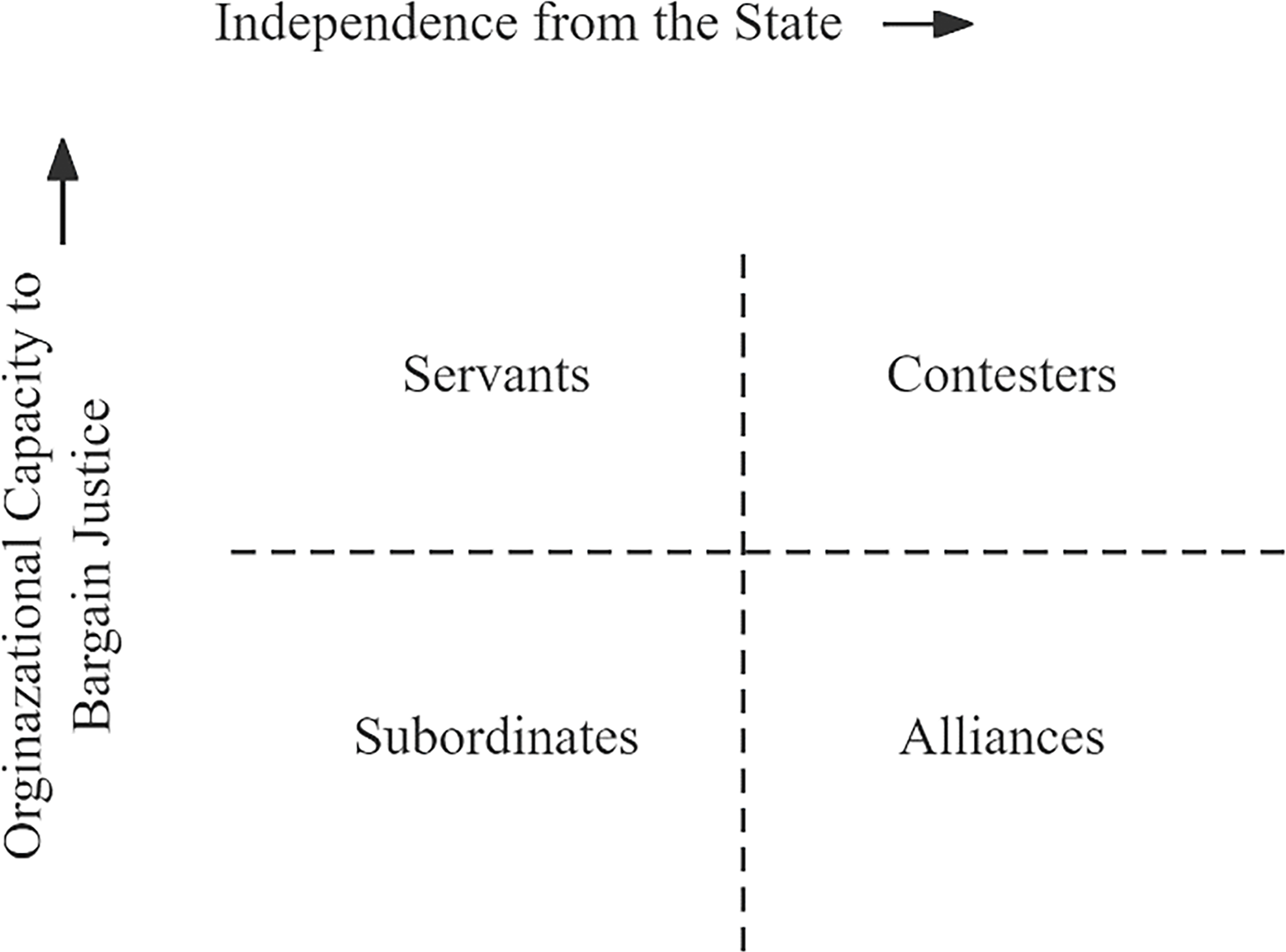
Derived from the empirical analysis, four modalities of political–organisational relations, illustrated visually in Figure 1, are categorised according to the degree of perceived autonomy of organisations, the activities they have engaged in with the state in practice, and their role in shaping patterns of environmental legal dynamics.Footnote 9 The four types are organised around two dimensions that both constitute and configure organisational relations with the Chinese state: (a) organisational independence from the state in formation and operation, and (b) organisational capacity to bargain with the state and affect justice outcomes. The direction of the arrow represents a heightened degree of organisational autonomy or organising capacity to negotiate justice with the state. A conceptual description of each modality is introduced before illustrative examples and supporting evidence are presented below.
Modalities of organisation–state interactions
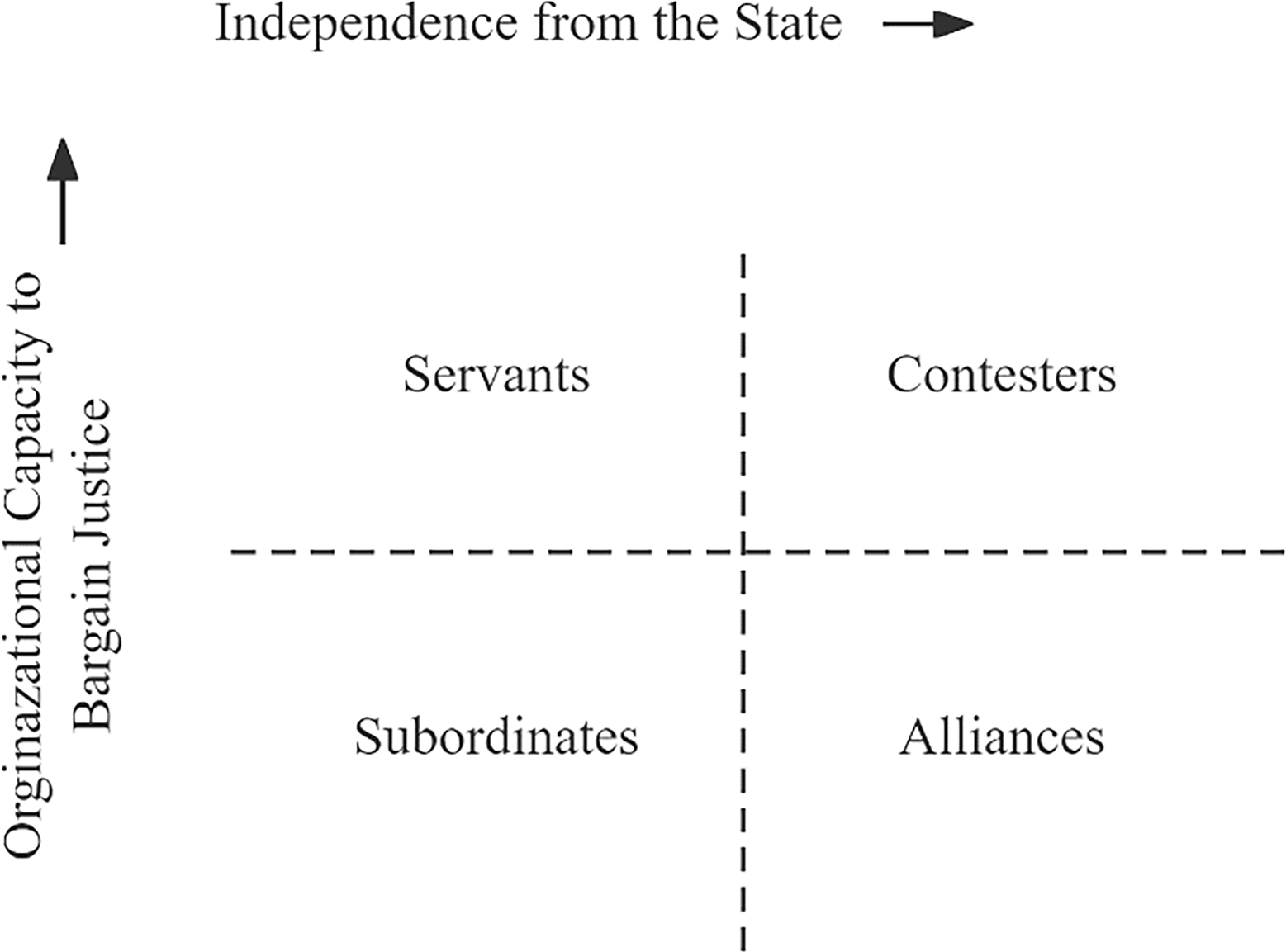
4.1.1. The state’s contesters
Despite growing in a political environment where the state has ultimate and supreme power over social and legal affairs, the environmental NGOs in our study took proactive initiatives to challenge corporate polluting behaviour through legal means, even though the pollution was tolerated by the local government, which viewed large corporations as the main engine of the local economy. Firmly committed to economic sustainability and ecological well-being, some ENGOs sought to actively consolidate and mobilise legal resources, forming broad social networks to shape legal outcomes in their best interests. Because of their relative “independence” from the state and the degree of autonomy they enjoy in Chinese society, they often act as the state’s contester, challenging and suing local governments or corporations for environmentally destructive behaviours by activating and participating in legal proceedings. Acting as the state’s contester does not necessarily lead to a triumphant outcome of environmental justice in favour of the organisational actors, but the contestation activities have gradually cultivated their sense of “ownership” of environmental problems (interview 202006). Organisational actors increasingly recognised that law existed “out there” and could be invoked by them to address environmental harms (interview 202012; see also Ewick and Silbey [Reference Ewick and Silbey1998], pp. 2–10).
In several local communities where we conducted our fieldwork, economic development and job security were explicitly prioritised over environmental sustainability and clean communities, despite the existence of established environmental monitoring and oversight within these jurisdictions. Nevertheless, the deteriorating ecological conditions and increasingly polluted environment often led to dissatisfaction and even despair among community residents, who mostly felt powerless to use legal means to alleviate their plight. Knowing the desperate situation of residents in polluted communities, ENGO leaders began to actively engage with them, conduct in-depth research on how corporate polluting practices affect their health, and develop legal plans to seek redress. One ENGO leader shared with us a story of how they organised residents to make a concerted effort and ultimately won the legal case against a powerful corporate polluter:
The local government signed a contract with a paper company that allowed the company to cut down trees and make paper. This paper company was supported by the government because it was a pillar of the local economy. However, as the company cut down more of the forest and produced more paper for profit, the residents of the community felt their air quality deteriorate and the sky become darker. Many of them complained that their environmental interests were being harmed, but they had no idea how to solve the problem. Me and my team members received a call from them and came immediately to see what was happening to them. After collecting a lot of information about the pollution incident and gathering enough evidence, we decided to help the residents file a lawsuit against the paper company. Eventually, we won the case, and the court ruled that the paper company should pay compensation to the government and compensation to our community committee, while also being required to replant trees in the damaged areas and clean up the water as punishment. Through this case, we feel that we have been able to defend our environmental interests by resisting the harmful behavior of these powerful entities [corporations and their supporting government agencies].
Several organisational leaders discussed how their involvement in litigation activities cultivated a heightened sense of legal awareness, while also giving them hope that the law could be effective in achieving their environmental justice goals if their voices could be heard by legal authorities (interviews 202001; 202007; 202105). Presenting their claims and participating in legal proceedings helped to foster a sense of empowerment among organisational actors and community residents. This is illustrated by one community resident who had long endured the pollution from the chemical factory, who said:
Before we knew and tried the legal means to solve our difficulties, we usually gathered community members and forged an organizational force to file a petition against the company with local bureaus. But we were afraid that we would be rejected or dismissed. Now we can immediately contact all the organizations we know for help and justice and form a team with them to file an environmental lawsuit. We have more options and are exposed to a new door to get things done. Our sense of insecurity or fear is relatively reduced.
Of course, the NGOs’ legal mobilisation does not always lead to successful or satisfying results. Their frequent or long-term challenges to corporate polluting behaviour have often encountered a variety of hurdles or pushback from both government and corporations in the process of pursuing environmental justice. One senior ENGO leader told us about his long-term struggle with government officials who tried to stifle his efforts to mobilise a public interest lawsuit against a local polluting company (interviews 202011; 202016; 202019). He said:
We were summoned to their office [the local office] and told that it was not good for them to see our fierce competition against the big company because its [the company’s] existence and operation were good for our economy and the development of the city. They hoped that we would stop the lawsuit against the company and help us get some compensation. But I insisted on doing so, and then they came to discourage us from continuing this litigation by calling us to their office more frequently and discouraging our ongoing plan. Sometimes I felt tired and even threatened if we decided to keep our jobs. I must make a compromise and accept the government’s proposal.
In addition, ENGO leaders and managers can sometimes face challenges from corporate managers or lawyers who come to negotiate or seek reconciliation with disputing community members or ENGOs. Organisational managers mentioned that they were likely to be suggested to settle their cases out of court if they demonstrated their aspirational commitment to environmental remediation (interviews 202001; 202012; 202104). They explained that corporations were willing to “pre-empt” their legal mobilisation because corporate elites feared that organisational insistence on environmental litigation could be harmful or detrimental to corporate reputation (interview 202106). In the eyes of corporations, efforts to negotiate with these ENGOs to gain their compromise, or attempts to prevent their further (progressive) legal mobilisation, can help save corporate reputation, stop their losses, and possibly avert an administrative penalty.
In summary, aspirational organisations with values of environmental protection, community well-being, and social justice are actively engaged in mobilising legal processes to redress their environmental grievances. Despite the legal empowerment provided by environmental justice law reform, their decisions to engage in the legal process and participate in the enforcement of rights are not without risk, as they often come into friction with political and economic interests and become challengers to the state. While sometimes intimidated by the coercive or repressive measures of the state or the persuasion of corporations to settle out of court, as the analysis suggests, they remain courageous and ambitious in seeking what they perceive to be legitimate and just and in obtaining legal outcomes in their favour. Organisational leaders and community members, through their confrontation with the state, have a growing awareness of their rights and a sense that legal mobilisation can improve their situation. In this sense, our observations challenge the notion that community organisations serve merely as “handmaidens” of the state or as objects to be manipulated entirely by state power. Instead, the data reveal the space of agentic capacity through which community organisations pursue justice in accordance with their understandings and expectations.
4.1.2. The state’s alliances
While ENGOs’ litigation activities and legal demands may challenge local government policy priorities or interests, they can also be deployed as “useful helpers” or “helpful aids” for the government to solve pressing governance problems of various kinds and causes (interviews 202104; 202111). By aligning themselves with the state and facilitating the resolution of state concerns, ENGOs become reliable allies of the state. The state agencies deploy and sometimes rely on community organisations for their knowledge, resources, and participation in resolving environmental justice tensions or crises (interviews 202011; 202104; 202109). By developing an allied relationship with the state, ENGOs can have opportunities to participate in environmental governance. Their participation helps to improve their credibility with the state and increase their legitimacy in the eyes of the Chinese state.
Our identification of community organisations as allies of the state is based on our observation of how local environmental protection bureaus have recruited ENGOs to resist environmental policies enacted by higher authorities. For instance, the National Development and Reform Commission presided over the review of the planning report for the Middle and Lower Reaches of the Nujiang River Hydropower Project in Beijing, but officials from the local environmental protection bureau, a key stakeholder in the project, felt it was necessary to review the planning environmental impact assessment before the project was implemented and then refused to sign the report. Because of considerable potential economic benefits, local governments and central economic departments joined forces to pressure this local environmental agency to accept the project. At that moment, the agency was in a seriously disadvantageous position in the bargaining process. However, the agency administrators contacted the volunteer leader of an ENGO—Green Earth Volunteers (Lü jiayuan)—and told her about this environmentally unfriendly national project. Upon receiving the local government’s request, the ENGO leader acted quickly to contact someone who was familiar with the Nujiang River and brought together a team of experts, scientists, and scholars who were able to demonstrate the detrimental effects of this hydropower project on the local ecological system and the well-being of neighbourhood residents. Through the leader’s constant efforts to form a coalition of various sectors of the local community, while also receiving support from the local environmental protection bureau, this national project was finally stalled and failed to pass.
Many organisational leaders and programme managers reported their enthusiasm and willingness to engage in environmental justice and become allied partners with the state in delivering environmental welfare to local communities. They understood that in the Chinese authoritarian context, the state owns and manages almost the entire process of environmental justice, in both material and symbolic dimensions, and their true effectiveness in promoting environmental justice must be supported by, or at least have something to do with, the appeal of the state. As a result, community organisations can potentially gain the support of the state, have the platform provided by the state to achieve their organisational goals, and enhance their capacity to shape policy in the field of CEJ. As one organisational leader pointed out:
In this country our work cannot be done without political support. The completion of our task depends greatly on the recognition of the Party and the support of the local government. In this way, the court could hear our cases and consider our legal demands. That’s why I want to cooperate with the government officials and win their support. I think it is necessary to form an allied connection with the government and the judiciary in order to obtain legal results favorable to my organization.
In this kind of relationship with the state, organisational actors develop a greater sense of capacity and value. Many ENGO leaders also noted that their alliance with the state can help them learn about or become familiar with the preferences of local officials and the legal culture, which they can rest upon to better strategically play the environmental justice game (interviews 202016; 202102; 202114).
Government officials interviewed, including justice officers, confirmed the symbiotic relationship between community organisations and the state (interviews 202116; 202121; see also Spires [Reference Spires2011]). Justice officials began to recognise the complexity of environmental problems and remediation of ecological damage, as well as the limits of the law and the state’s capacity to solve complex environmental problems. For them, working with local organisations helps to broaden the horizons of state actors, formulate more effective legal solutions, and fulfil the socialist obligation to “serve the People’s needs” (interview 202113). One senior environmental administrator observed:
We often seek the opinion and input of ENGOs and local community members for solutions. They have a clear understanding of how this problem was created and what tools have been effective. As they often advise, justice practices should be evidence-based. We cannot think about and address these issues in our closed offices. Things are often complex, sometimes beyond our expectations, and their input can ease our burden and improve our ability to respond. Our association is truly good for our state, its ability to govern, and for the whole society. After all, we hope to live in a clean and orderly community.
The preceding sections demonstrate the almost “horizontal” relationships that community organisations develop with the Chinese state in the environmental justice dynamic. The two ideal types are referred to as “horizontal” forms because of the relative autonomy of organisational decision-making and the ability to shape government action or inaction in the Chinese authoritarian context. The interactive processes and resultant relationships revealed above demonstrate the vibrant agency of community organisations and their impact on the administration of environmental justice in China, albeit circumscribed within a limited space demarcated and directed by the state and often with mixed results.
The following two sections are designed to show the rather limited agentic capacity of community organisations in the environmental justice process, in which they act as servants or subordinates of the state. Taken together, these two types of relationships represent the “vertical” ties that are formed between community organisations and the Chinese state, which typically manifest the political embeddedness and the state supremacy within the CEJ. Despite their shared hierarchical ties to the state, they still differ in their relative degree of autonomy and distance from state influence: environmental NGOs tend to enjoy more organisational power to determine their legal outcomes when acting as servants of the state than when acting as subordinates of the state.
4.1.3. The state’s servants
Although community organisations have increased agentic capacity due to recent legal empowerment, their legal activities are still “quarantined” in accordance with the interests of the state and its overarching policy goals (Wang and Xia, Reference Wang and Xia2023a). In the authoritarian context, where the state enjoys unchallengeable and comprehensive power over social affairs, social organisations function as the state’s instruments of governance, which have considerable resources and unmatched capacity to steer the field of environmental justice. Organisational formation and action are highly subject to the affirmation and control of the state. Their environmental justice organising must align with state goals and priorities, as well as institutional requirements and bureaucratic structures. Organisational actors can experience fear, confusion, and uncertainty when confronting a state-directed justice system and practicing state-sponsored, rights-based empowerment. One organisational leader shared with us his experience building the environmental service organisation and leading community residents to litigate a corporate pollution case:
When applying to start an environmental business organization, I was required to demonstrate how my long-term projects aligned with the state’s environmental policy goals, or my application might be rejected. After establishing the organization, I collaborated with community residents on public interest litigation. The legal jargon and processes intimidated me, and the paperwork was complex. I constantly worried about inconveniencing or annoying state actors and tried not to make mistakes, especially avoiding the “red line [Hongxian].” Gradually, I felt that the law served its own needs rather than ours.
In addition, while having a kind of “dependency” and owning some resources, community organisations that function as servants of the state are mostly dependent on the state-based resources and recognition for survival and prosperity. To expand their sustainable development, leaders of these organisations usually play a proactive role in analysing the state’s needs and formulating strategies to meet those needs in most of their efforts. One ENGO leader who is locally known in the community illustrated this point:
Although we are dedicated to advocating for our community members and are often in a seemingly adversarial position with large corporations or the government, our survival and development cannot be separated from the approval and support of the state. We need to develop a close relationship with the state and let state actors know that we are useful to their environmental protection goal and policy implementation. We need to smell the policy direction so that we can think about doing something for them or contributing to their work. Sometimes our organizational members help government officials to spread knowledge about China’s environmental and ecological system, hoping to raise public awareness about environmental protection or greening our country. I think it is good for us to be recognized by the government.
Not only the basic status of community organisations in the Chinese political hierarchy, but also their internal structure and size pave the way for them to become servants of the state. Some organisational members explained that they chose to actively seek opportunities to cooperate with state agencies and help solve their problems because of their organisational size and degree of cohesion (interviews 202015; 202019; 202104). These environmental NGOs are relatively small and less stably organised, often facing problems of precarious financial resources, changing leadership, and volatile membership.
4.1.4. The state’s subordinates
The foregoing three types of relationships of community organisations with the Chinese state suggest that these organisations assume at least apparent agency, or the ability to make decisions and direct their practices, when they engage in environmental justice. The final category of relationship, referred to as subordination to the state, indicates the oppressive dynamics and coercive processes through which organisational actors interact with the state. Their justice-seeking actions are typically obstructed by state authority, and their organisational processes are blocked or interfered with by the coercive power of the state when the advancement of the organisational goal of justice is perceived by state actors as threatening or challenging the political order.
An organisational leader focused on environmental justice recounted facing oppression from local authorities for pursuing his organisation’s objectives (interview 202120). Dedicated to maintaining a clean environment in his north-western Chinese hometown, he founded an organisation to protect the Changjiang River’s water and local wildlife. The organisation frequently represented residents in lawsuits against animal killing, rare animal trade, and water pollution. Due to its commitment to community welfare and environmental well-being, the organisation often won legal battles, earning a strong reputation. It expanded its influence with the slogan “Protecting the Water and Loving Nature,” and branded as “Friends of Nature,” leaders successfully raised significant funds. They pressured legal institutions and state actors to consider community environmental demands by forming coalitions and encouraging community engagement in environmental justice movements. In response to the organisation’s growing power, the state warned that their actions might become radical and threaten social order, ordering them to cease legal activities. Consequently, the local government created a new environmental agency unit to take over the organisation’s functions, leading to its decline and transfer of duties to the government.
This example illustrates the contingency under which community organisations that emerge as environmental activists practicing legal empowerment and that originally worked as challengers to the Party-state can be transformed into subordinates of the state, the main actor directing and even determining the creation and operation of organisations in the authoritarian context. That is, no matter how organisations deploy legal tactics and mobilise legal resources, their activities and claims should not challenge the authority of the state, emphasise the performance of state actors as principals in the field, or exceed the scope of the state’s power and administrative capacity.
4.2. Dancing in fetters: The political embeddedness of such relationships
While the legally authorised agentic capacity gives rise to the four modes of political–organisational relations outlined above, they all depend on how the state perceives and interprets their underlying motives for initiating litigation, and what broader consequences their legal mobilisation may produce or diffuse in society. Regardless of the nature of the relationship, the goal is to satisfy the need for political legitimacy and to maintain Party-state supremacy.
Most organisational leaders noted that the success of their legal mobilisation depends largely on how their claims represent the legal terminology of “public interest” awaiting interpretation by judicial actors. Although judicial personnel consider several quantitative factors to determine the legal criterion, such as the economic or material loss caused by this pollution, the number of deaths in the case, and the prevalence of environmental damage in the community, the societal impact and its political significance are often the priority of legal actors’ decision-making (interviews 202104; 202108). A leader of an environmental organisation who is also an environmental activist said:
If pursuing our legal claims for environmental redress may have socially destabilizing consequences and threaten political legitimacy, we may be advised not to solve our problems through legal means. For justice personnel, political order and social stability always come first. However, if the case has been widely publicized and hotly discussed, such as on the Weibo [Chinese version of Twitter] platform, and the pattern of public opinion has been formed to support our victims, the government actors and judicial personnel may eagerly accept our legal request and attend to our legal demands and environmental needs.
In seeking to establish relations with the state in their interactions with the law, organisational actors gradually become what they call “state-wise”Footnote 10 in a context where political order and the legitimacy of the ruling party are weighed more heavily and even centred on the justice agenda. In the course of legal mobilisation, organisational actors should not give any indication that their claims are likely to incite rebellion against the state and result in societal unrest. They gradually develop a solid conviction that their claims and demands should not overstep the boundaries of the state’s will and authority, and that political correctness should be upheld in the pursuit of environmental justice in China (interview 202011).
5. Discussion and conclusion
This study extends beyond the primarily political views of the authoritarian dilemma common in existing research (i.e. Buesgen, Reference Buesgen2008; Hsu, Reference Hsu2010; Lin, Reference Lin2018; Stern, Reference Stern2013) to explore the complex relationship between the Chinese state and community organisations within the dynamic field of CEJ. We examine the organisational aspect of “rights at work” (McCann, Reference McCann1994, pp. 4–7) in legal processes related to China’s environmental justice, where local community members are legally empowered, and NGOs are accorded with the right to litigate for collective environmental well-being. Using a bottom-up approach focused on the narratives, understandings, and experiences of community organisations in environmental justice (Merry, Reference Merry1990, pp. 3–11), we emphasise the nuanced ways civic organisations exercise their agency and build strategic ties with the state in an authoritarian context (Han, Reference Han2016; Jiang, Reference Jiang2025; Majic, Reference Majic2011).
To achieve environmental justice, organisations, whether representing victims or pursuing their own goals, now utilise or uncover legal resources to obtain optimal outcomes (Owen, Reference Owen2023). They form diverse relationships with the state based on their size, capacity, and objectives in their legal mobilisation. Leaders often position their organisations as challengers to the state, defending community interests and environmental well-being despite threats from authoritarian regimes. By defending perceived legitimate environmental interests, these organisations can catalyse environmental justice, foster a sense of rights, and promote the legal resolution of disputes, reducing direct citizen confrontation with the state.
Community-based organisations have the capacity to form collaborative relationships with the Chinese state when the state’s capacity to address certain environmental issues is visibly and practically limited. These political–organisational partnerships, or “their growing symbiosis” (Li and Jiang, Reference Li and Jiang2024), can serve to complement or extend the state’s ability to accomplish environmental justice goals. The contractual relationship with the state has been vital for organisational survival and growth, enabling them to build political capital, acquire community resources, and gain social legitimacy with state support.
In addition, organisations often become subordinate to the state when their demands are suppressed or ignored, sometimes even facing orders for dismantlement. This occurs because they lack resources or do not align with state expectations. The state actors may feel fragile and weak when facing coalitions of organisations and community residents, perceiving these groups or collective forms as threats to social stability and state legitimacy. To counter these threats and maintain power, the state uses coercive and repressive measures. Consequently, community organisations prioritise state interests over their progressive rights when their legal actions and justice-seeking behaviours are seen as threats to state legitimacy and political order.
The findings affirm the persistence of state supremacy principles and structural pressures limiting organisations’ ability to achieve environmental justice aspirations (Corcoran, Reference Corcoran2010). Environmental justice organisations must not challenge the state’s authority and political legitimacy and align their formation, activities, and goals with state interests. With the state monopolising resources and discourses on environmental justice, these organisations remain subordinate to state control. This political hierarchy and scarcity of resources weaken the legal empowerment of local organisations, creating a gap between legal practices and the promulgated the “People-centeredness” ideal of environmental justice (Jiang and Chen, Reference Jiang and Chen2023).
The legal empowerment of local organisations marks a significant stride in CEJ by addressing communities’ environment-related concerns through legalistic approaches (Tilt, Reference Tilt2010). Findings indicate that community members actively utilise legal means to resolve environmental grievances and seek justice via organisations. These organisations empower victims of environmental harm, supplying new avenues for assistance and justice. The data show that seeking environmental justice through community organisations has increased victims’ resilience, strengthened their belief in the legal system, and fostered the perception of organisations as allies. Thus, the growth of community organisations in China’s environmental justice sphere may strategically mitigate social conflicts from environmental harms, supporting the state’s goal of social harmony and stability (see also Jiang [Reference Jiang2025]).
This study highlights the mediating role of community-based organisations in environmental justice (Clemens and Guthrie, Reference Clemens and Guthrie2010, pp. 1–22). Organisational leaders must balance their interests and future development when representing community members who trust them for redress. Consequently, litigants’ concerns may become increasingly dependent on organisational processes, subordinating genuine voices to these considerations and impacting collective community interests and environmental well-being. This underscores the need for guaranteed participatory mechanisms for community members directly involved in environmental justice, beyond organisational processes and representation.
The legal empowerment of local social organisations and the devolution of governmental authority to local communities in environmental justice strengthens, rather than weakens, state power in a centralised polity. As environmental crises grow more complex and pressing, the state’s reliance on mandates and universal tools proves less effective. The rapid differentiation and fragmentation of Chinese society due to modernity and globalisation pose significant governance challenges. Involving community organisations in environmental justice has transformed state governance, exposing state actors to victim concerns and enabling governance from a distance. By emphasising organisational mobilisation while maintaining control, the Chinese state exercises authority in a new form: its presence diminishes, but its surveillance intensifies.
The analysis underscores that beyond legal reform, empowering community organisations is essential for environmental justice in China. Legislative changes, like granting rights to environmental litigation, are inadequate to counter the entrenched political culture and authority under authoritarianism. These reforms do not address the vulnerabilities arising from new legal empowerment and increased legal mobilisation. Despite their ostensibly improved status, NGOs may face heightened surveillance due to state fears of threats to its authority. Their legal efforts for environmental justice may inadvertently lead to further state control, reinforcing state power over society, including community organisations. Genuine legal empowerment for civil organisations requires institutional support for resources, autonomy, and sustainability. Furthermore, institutional practices for environmental justice should prioritise the environmental interests of community members, ensuring their voices are heard, concerns addressed, and well-being safeguarded.
In closing, this study explores the complex, dynamic connections between community organisations and the state in the emerging field of CEJ. As environmental issues become legal matters and social forces are deployed or urged to address environmental grievances, a more thorough analysis of political–organisational relations in CEJ and environmental governance is necessary. This includes examining the stages of case adjudication and the various government agencies involved. Future studies should use larger and more diverse samples and conduct cross-jurisdictional comparative work in China to highlight the challenges community organisations face in pursuing environmental justice in the distinct Chinese context. Additionally, it is important to investigate how these organisations navigate environmental justice through law, considering competing cultural norms and institutional demands.
Funding
This research was supported by the Humanities and Social Science Fund of the Ministry of Education of China (Award No.: 24YJC840014).

 Open access

