




Introduction
Starting from 2014, when Russia annexed Crimea and gave support to separatists in the Donetsk and Luhansk regions of eastern Ukraine, Russia’s official narrative consistently denied the presence of Russian troops there, despite substantial evidence to the contrary.Footnote 1 This discrepancy between state rhetoric and on-the-ground realities fuelled the proliferation of satirical memes, which mocked the obvious presence of Russian military forces and volunteers in large numbers along the frontlines. It started with the catchphrase ikhtamnet (the words “they are not there” written together) referring to Vladimir Putin’s answer to the questions about the topic (Troitskii et al. Reference Troitskii, Castañar, Laineste and Fiadotava2024, 179), which later turned into a new word, a noun meaning Russian shadow forces, or Russian officials denying their presence in Ukraine. These transformed words served as a form of indirect dissent, highlighting the absurdity of the Kremlin’s disinformation campaign while reinforcing the visibility of Russian military involvement in the conflict.
Memes and ironically transformed catchphrases, as is evident from this example, may play a significant role in opposing the official narrative, expressing disagreement in a more subtle way than a direct political statement. Certainly, making jokes, including ironic repurposing of the opponent’s words, is not a new technique in political debates (Haiman Reference Haiman1998; Speier Reference Speier1998); however, digital technologies created a new environment favouring its use as a discussion tool. Online communication and consumption of social media content as an everyday practice significantly changed the process of formation, transmittance, and transformation of any messages, including political and ideological ones. Whereas in the modern era, state, business, NGO, and individual actors had to rely mostly on media and journalists as translators of necessary meanings and shaping public discourse, nowadays they have limitless options presented both by digitally transformed media and by social networks and applications. Comparing disinformation strategies that Soviet operatives used, spreading conspiracy theories about AIDS being the result of experiments conducted by the US government, to recent cases of manipulation of public beliefs, Bradshaw states: “Today, unlike in the past, when disinformation campaigns were slow, expensive and data-poor, social media provides a plethora of actors with a quick, cheap and data-rich medium to use to inject disinformation into civic conversations” (Bradshaw Reference Bradshaw2020, 42). What is more, because of the traditional division between vertical-agitational, mobilizing against a portrayed enemy, and horizontal-integrational, “stabilizing the social body” (Ellul Reference Ellul1965, 75), propaganda is becoming diffused: in digital spaces, propaganda can derive from a multitude of sources (Farkas and Neumayer Reference Farkas, Neumayer, Hunsinger, Allen and Klastrup2020).
However, the explosive increase in the number and diversity of information sources has led to a decrease in the importance and influence of each specific one, which may result in lower efficiency and even in the unpredictability of the effect the initial message may have on the target audience. Limited individual attention, coupled with information overload, allows low-quality information to achieve widespread dissemination online (Qiu et al. Reference Qiu, Oliveira, Shirazi, Flammini and Menczer2017). At the same time, users tend to select information aligning with their beliefs, forming polarized groups or “echo chambers.” Within these chambers, emotional contagion can lead to group polarization, where collective opinions become more extreme and less predictable in response to external messages, such as propaganda (Del Vicario et al. Reference Del Vicario, Vivaldo, Bessi, Zollo, Scala, Caldarelli and Quattrociocchi2016). As a result, “most people’s existing political views are merely reinforced after spending time online” (Chayko 2017, 171). Moreover, regular contacts with people with similar interests and political orientations who, at the same time, are not friends or colleagues but rather total strangers to each other, lead to the formation of new forms of Anderson’s (Reference Anderson1983) imagined communities, where like-minded individuals can realize their need for social inclusion, especially if they lack it in real life (Gruzd et al. Reference Gruzd, Wellman and Takhteyev2011).
Verbal formulas and catchphrases play a significant role in online communication when people tend to react fast and need to understand the interlocutor’s position on the basis of limited information, without sharing an immediate context and in the absence of non-verbal cues available in face-to-face oral communication (Walther et al. Reference Walther, Van Der Heide, Ramirez, Burgoon and Peña2015). Online communication, however, provides many more opportunities for juxtaposition, “a key rhetorical method for remix production” (Eyman Reference Eyman2015, 70): it is easy to copy-paste, share a link, a text, an image, an audio or video file, but also to omit, rearrange, or reframe some parts or details. Additionally, online conversations on public platforms involve not only individuals themselves but also are aimed at other users, which may explain the widespread use of wordplay as a “ludic” form of communication (Reyes, Rosso, and Veale Reference Reyes, Rosso and Veale2013; Danesi Reference Danesi2020, 151–2). When commenting on a post on Facebook or replying to a celebrity’s tweet, a person performs an act on the public stage in the presence of the audience whose reaction, in the form of likes, replies, and reposts, may be, in fact, much more important than exchanging remarks with the immediate addressee.
What happens then with political slogans and other propaganda messages when they enter the aforementioned “echo chambers” and are challenged by diametrically opposed political views? Or, specifically in the Russian context, how popular phrases, such as Krym nash! [Crimea is ours!], referring to the annexation of Crimea in 2014, or Spasibo dedu za Pobedu! [Thanks to grandfather for the Victory!], exploiting the image of WWII Soviet veterans, can be transformed and repurposed, becoming another form to express verbal aggression? And how do these mechanisms work in the case of minoritized groups, such as Russian-speakers in post-Soviet countries? Quite often, they are viewed and represented in the public opinion of their countries of residence as passive recipients of the Kremlin’s propaganda, but can it be an oversimplification? After all, according to the reviews prepared by the Estonian Internal Security Service, the role of Russian TV channels as a news source for Estonian Russian speakers had been rapidly decreasing even before 2022, when they were banned in Estonia, while the most popular sources were Estonian news portals, social media, and Estonian Russian-language TV channels (Annual review 2023).
In this article, we reveal how catchphrases, used to transmit political messages, acquire new meanings and applications in online communication. First, we focus on the notion of verbal formulas forming the basis for political catchphrases, and describe several typical examples of ironic transformations of ideological catchphrases in Russian public discourse; then we will present our data collected in seven Estonian Russian-speaking Facebook public groups over the period of 2021–2025 through ethnographic online observation and will describe the studied groups in general; we will also outline our research methodology based on conversational analysis of online data (Giles, Stommel, and Paulus Reference Giles, Stommel and Paulus2017; Farina Reference Farina2018), critical discourse analysis (Fairclough Reference Fairclough2001; Farelly Reference Farrelly2020) and studies on irony and sarcasm in linguistic pragmatics and in political discourse (Holdcroft Reference Holdcroft1983; Opitz Reference Opitz2012); in the following sections we will analyze different cases of local catchphrases and their use in in-group communication; finally, we will formulate main principles of this type of language use and connect it with social processes relevant for minoritized ethnic groups struggling with accepting their new position and separated from the homeland but not necessary from its political discourse. We will show that ironic repurposing of political messages in online interaction plays an important role in shaping group identity and solidarizing with certain political values while, at the same time, building a discourse of their own, not merely transmitting external propaganda.
Research background
Catchphrases in political discourse
Political catchphrases are employed by politicians and political movements to quickly communicate a message, value, or slogan; they are aimed to stick in people’s minds and simplify a complex idea into something easy to repeat. In linguistic terms, they are verbal formulas, or clichéd phrases, the full meanings of which cannot be comprehended by simply putting together the meanings of their components; knowing the socio-political context is crucial for getting the message.
As a form of psychological stereotype manifested through lexical means, clichéd phrases reflect an “ordered” worldview ingrained in both collective and individual consciousness (Miller and Villarreal Reference Miller and Villarreal1945). In a broader sense, the term “cliché” can be applied to any form of human behaviour, including non-verbal ones, and resulting artefacts, if they are not unique and created on the spot but follow established routine and provide “quick, reproducible shortcuts” to certain effects (Grimwood Reference Grimwood2016: 106). As Zijderveld (Reference Zijderveld1978, 17) pointed out, “we could view clichés as micro-institutions, while the institutions of modernized society tend to grow into macro-clichés.” Since deeply rooted stereotypes often influence human behavior, stereotyping frequently serves as an instrument of state propaganda across various nations (Quaranto and Stanley Reference Quaranto, Stanley, Khoo and Sterken2021).
Speech patterns play a crucial role in shaping linguistic stereotypes, including catchphrases. As verbal stereotypes, they act as a cognitive mirror, reflecting societal perceptions within the mind of a language user (Berio and Musholt Reference Berio and Musholt2023). Furthermore, since catchphrases facilitate the expression of thoughts and emotions, they also function as a communicative tool. In most cases, the initiators (senders) of political and ideological catchphrases are state-run propaganda institutions and high-ranking officials, who disseminate specific narratives to shape public discourse (Lock and Ludolph Reference Lock and Ludolph2020). All catchphrases depend on a shared cultural background between their creators and audience to be intelligible and achieve widespread dissemination; they are a “generational phenomenon” (Olson Reference Olson1982, 193). This cultural common ground ensures that the intended humour, irony, or critique is effectively decoded by communicators, allowing the catchphrase to resonate and propagate. Without a shared understanding, the subversive meaning behind the phrase would be lost, limiting its reach and impact. Consequently, as scholars interested in the literary use of clichéd phrases noted, in other circumstances, they can experience “rebirth, because of different historical content” (Robinson Reference Robinson1989, 20). However, the same may, and does happen not only in history but also, as we will show, when a certain catchphrase is juxtaposed, ironically appropriated by new speakers who distrust the original sender, or mediator.
This phenomenon aligns with broader theories of internet culture, where virality is contingent not just on content but on the audience’s ability to interpret contextual cues, inside jokes, and implicit critiques. Thus, the spread of such catchphrases functions as both a cultural inside joke and a form of counter-discourse, reinforcing alternative narratives in the face of state propaganda (Schwarzenegger and Wagner Reference Schwarzenegger and Wagner2018).
Catchphrases in political conflicts in Russia
In Putin’s Russia, political propaganda traditionally places particular emphasis on slogans and clichéd phrases such as vertikal’ vlasti [vertical power] or suverennaya demokratiya [sovereign democracy] (Belousov Reference Belousov2012). Unsurprisingly, oppositional counter-discourse, in its turn, found new applications for such verbal formulas. While the ikhtamnet [they are not there] catchphrase, mentioned in the very beginning of this article, was a case of creative use of the words that had been not a propaganda slogan but an actual phrase, even if not pronounced in exactly that way, another famous case, krymnash , which even has its own entry in Wikipedia (in Russian, Ukrainian, and Belarusian), inverted and transformed what used to be a slogan on its own. The exclamation Krym nash! [Crimea is ours!], celebrating the annexation of Crimea, was actively promoted by the Russian state propaganda and was even selected as a word of the year in Russia in 2014 (Issers Reference Issers2015). However, among those who opposed the official narrative, this exclamation turned into a symbol of imperialist ideology and unconditional support of the Russian state’s policy. This difference in attitudes was signalled by separate or fused spelling of the phrase: disapproval of annexation was expressed by transforming the slogan into a single word spelled without a space and exclamation mark, and often in small letters. Such use is an evident case of what could be called “hashtagization” – fused spelling of words as in hashtags originally introduced by Twitter in the mid-2000s and widely used nowadays in most social media to make it easy to find messages with specific content; the ability to use hashtags properly can be seen as a part of modern digital literacy (Gleason Reference Gleason2018).
Fused spelling becomes a means to create a new idiom with a significant, often even a polar, semantic shift (Tomášková Reference Tomášková2017); this “sarcastic agglutination” (Suslov Reference Suslov2014, 600) helps to discredit the original phrase and its alleged sender. Interestingly, though, the process does not stop there. In many cases, new lexicalized words get a life of their own and even start the derivation process. Thus, krymnash may refer both to an ideological position: U nee v golove takoi krymnash [She has such a krymnash in her head], and a person who holds such views: Krymnashi dumaiut, chto… [ Krymnash es think that …]. Moreover, there are nouns krymnashizm for the former meaning and krymnashist for the latter, created by using the suffixes -izm and -ist, respectively (cf. fashizm [fascism], and fashist [fascist]). An adjective krymnashistskii presents further development of this word-formation nest.
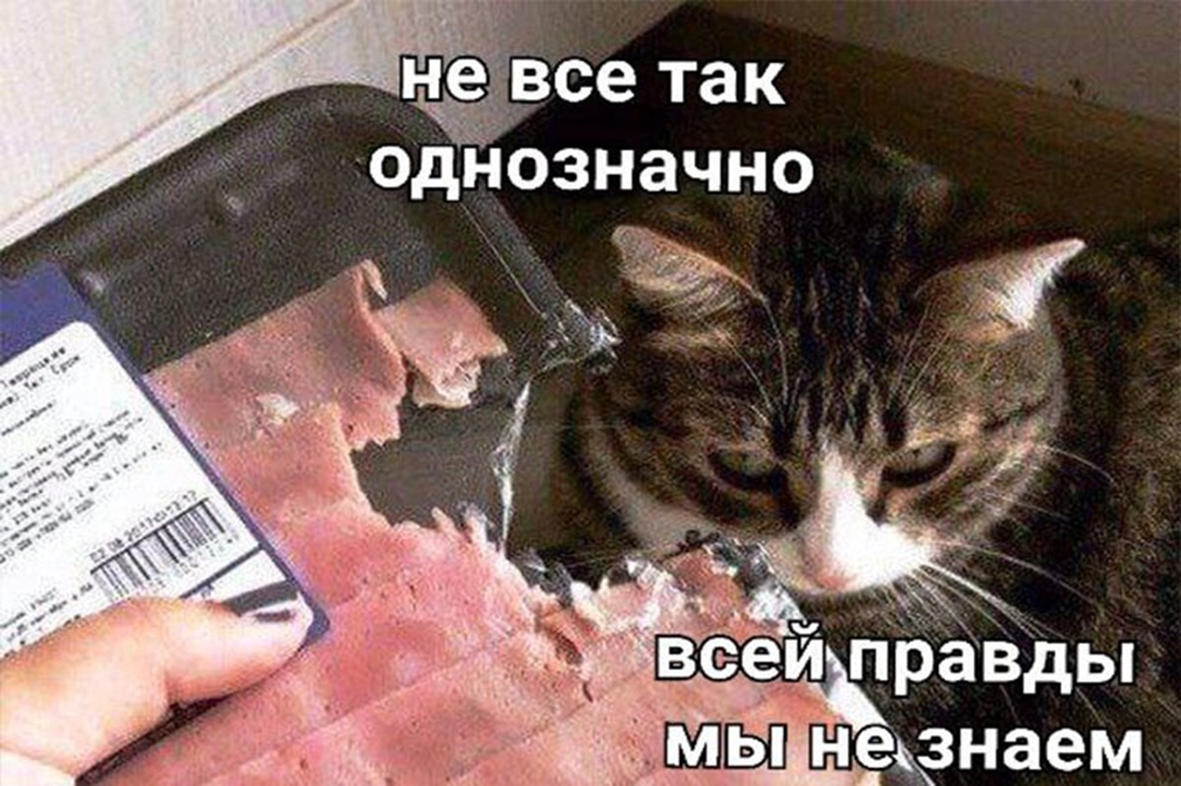
Another interesting example of lexicalization and derivation is the case of Ne vse tak odnoznacho [Not everything is so unambiguous] or Vse neodnoznachno [Everything is ambiguous] — the phrases initially used by those who claimed that the situation is complex, and different opinions should be taken into account, but interpreted as an attempt to justify something unequivocally bad, such as Putin’s crimes in Ukraine. People supporting the Russian state without claiming to do so openly can be called neodnoznachniki , or nevsetakodnoznachniki , with the help of the suffix -nik added to the phrases. The phrases also became popular memes: they are added to the pictures of some evident crimes, such as, for example, those presented in Figure 1.
An example of Ne vse tak odnoznacho meme. The text reads: Not everything is so unambiguous. We don’t know the whole truth.
The source: https://vk.com/@servingmemes-ne-vse-tak-odnoznachno1
Lexicalization of phrases, therefore, makes it possible to create new words with very specific ideological meaning and complex semantic connotations; their use in political or ideological discussions immediately marks not only the referred phenomenon but also the speakers themselves through their negative attitudes to it. Very revealing examples can be found in Russian online discussions on gender and family roles. Thus, iazhemat’ ( iazhemateri in plural) from the phrase Ia zhe mat’! , “I am a mother!” became a nomination for a woman who sees herself entitled to privileges on the basis of being a mother and prioritizes her child’s needs over everyone else’s comfort. Using the word as a pejorative signals misogynistic attitudes on the part of the speaker. On the contrary, feminists derived the word netakusik (or nitakusik , or nitakusia ) from the phrase Ne vse muzhchiny takie , “Not all men are like this,” to refer to the men who criticize feminism for misandry and try to defend men against accusations of violence and misogynistic prejudices.
However, hashtagization is not a necessary condition for ideological reframing of catchphrases. The verbal formulas can keep their initial form but still be used in a new, opposite meaning. In some cases, their “quotational” nature is expressed through keeping the original misspelling, as in the case of the phrase Poprobovali by oni sdelat’ eto v micheti . [They should try to do this in a mosque!], where in the word mechet’ , “mosque,” the first letter “e” is substituted with “i”: the phrase was written in this way by one of the Russian pop-singers, negatively reacting in her social media account to Pussy Riot’s anti-Putin performance in the Cathedral of Christ the Saviour in Moscow in 2012.
In most cases, though, no special markers are necessary for such catchphrases since the audience immediately recognizes them as such due to deep background knowledge. Typical examples here include Vy ne ponimaete, eto drugoe [You don’t understand, this is different], referring to hypocrites, and Gde vy byli vosem’ let? [Where have you been for eight years?] initially addressed to defenders of Ukraine by Putin supporters. The phrase referred to the alleged crimes of the Ukrainian government and army against the Russian-speaking population of Donbas and Luhansk in 2014–2022 (the so-called rhetoric of genocide, Dudko Reference Dudko2022), discrediting the position of those who were against Russia’s full-scale invasion of Ukraine in 2022 but had been keeping silent about the sufferings of Ukrainian Russian speakers. In inverted ironic meaning, nowadays it is used as a sarcastic comment showing that the speaker sees their opponent as a Putin supporter, mindlessly repeating Russian propaganda.
We can see, therefore, that ironic re-interpretation of quotes, real and constructed ideological statements, has an important communicative potential in discourse. It creates complex indexical signs used in ideological debates. However, as we will try to show on our own data, the functions of such inverted catchphrases are not limited to rhetorical use, and they can help to analyse the attitudes and political positions of groups using them.
Research Data: Russian-Speaking Online Communities in the Baltic States
Socio-historical background
Following Soviet annexation, occupation, and colonization, Estonia, Latvia, and Lithuania regained independence in 1991, leaving behind significant Russian-speaking minorities that today constitute approximately 25 percent of the population in Estonia and Latvia, but only 5 percent in Lithuania. These communities remain a source of political and social tension due to historical grievances stemming from Soviet rule, with key issues revolving around their legal status – particularly citizenship rights – and state policies regulating minority language use in education and public life. Unlike other post-Soviet states, the Baltic countries restored their independence on the principle of legal continuity with their pre-1940 republics, resulting in restrictive citizenship policies in Estonia and Latvia, where only those with pre-Soviet ancestral ties were automatically recognized as citizens. This left Soviet-era migrants and their descendants stateless unless they underwent naturalization, which required proficiency in the state language, knowledge of national history and the constitution, and renunciation of other citizenships. Lithuania, by contrast, granted citizenship to all permanent residents at independence, contributing to the smoother integration of its smaller Russian minority (5.1 percent of the population) (Muiznieks, Rozenvalds, Birka Reference Muiznieks, Rozenvalds and Birka2013). While naturalization has gradually reduced non-citizen numbers, the statistics show that Latvia still had 175,401 non-citizens (9.3 percent of the population) and Estonia 64297 residents with undetermined status (5 percent) in recent counts.
Sociological studies on integration of Russian speakers in the Baltic countries and the patterns of their media consumption show that while they have increasingly developed a shared linguistic and cultural identity (Laitin Reference Laitin1998), this has not translated into strong political identification with Russia, nor into full identificational integration with the titular nations; instead, many pursue “competitive integration,” learning the state language and participating structurally while maintaining distinct cultural practices (Cheskin Reference Cheskin2015). Media consumption plays a central role in this balancing act: until February 2022, most Russian speakers regularly combined Russian state media with local Russian-language and, to a lesser degree, Western sources, forming transnational media repertoires rather than relying solely on Kremlin narratives (Vihalemm, Juzefovičs, and Leppik Reference Vihalemm, Juzefovičs and Leppik2019). During geopolitical crises, such as the annexation of Crimea and conflict in Ukraine in 2014, this mixed media use led not to simple susceptibility to propaganda but to complex sense-making strategies of comparing sources, expressing mistrust of all media, and drawing on personal networks and cultural heuristics (Vihalemm and Juzefovičs Reference Vihalemm and Juzefovičs2021, Reference Vihalemm and Juzefovičs2023). Overall, earlier studies depict Russian speakers in the Baltic states as neither fully integrated nor externally mobilized, but as transnational audiences negotiating identity and information amid competing nationalizing pressures and conflicting media spheres.
After February 2022, though, this fragile balance was disturbed, as Russian-speaking minorities in the Baltic states started to be treated as a potential threat to national security (Belo Reference Belo2024; Schulze and Pupcenoks Reference Schulze and Pupcenoks2025), and various changes in language policies were implemented (Tšuikina, Fedorova, and Batrakova Reference Tšuikina, Fedorova and Batrakovaforthcoming). This inevitably affected Russian speakers and radicalized those more critical towards their home countries; sharing political views and complaining about discriminatory practices became common practices in online communication, which is the focus of this study.
Russian-medium Facebook groups and everyday online communication in the Baltic countries
Unlike most previous media studies mentioned above (see also Juzefovičs and Vihalemm Reference Juzefovičs and Vihalemm2020), we focus not on social media posts (and comments to them) of prominent political and cultural figures triggered by some events, but on routine everyday interaction between hundreds and thousands of members of local online communities. Mainly, we investigated Russian-speaking Facebook groups in Estonia, paying special attention to their linguistic practices – particularly the use of catchphrases, clichés, and formulaic expressions – that serve as ideological markers. However, in order to identify general trends, linguistic patterns, and key ideological frameworks influencing the collective and personal identities of Russian-speaking communities, we gathered and examined data from local online groups in all three Baltic states – primarily or exclusively Russian-speaking – over a four-year period (2021–2025). Our study, reported in (AUTHORS 2023, AUTHORS 2024), tracked 19 groups in total: 7 based in Estonia, 4 in Latvia, and 8 in Lithuania. These groups varied considerably in size, privacy settings (open or closed to non-members), levels of engagement, and geographical focus, whole countries (Estonia, Latvia, Lithuania), or cities (Tallinn, Riga, Vilnius). In reality, some group members reside elsewhere, but use the groups to communicate in Russian, so that these spaces unite Russian speakers beyond local borders. In terms of content, discussions in “city groups” frequently extend beyond local issues, and the same media publications are commonly reposted across multiple groups.
The studied groups also vary ethnically — some specify identities like Ukraintsy v Rige [Ukrainians in Riga], while others, like Russkoiazychnaia Estoniia [Russian-speaking Estonia], emphasize language over ethnicity. Linguistically labelled groups (for example, Russkoiazychnyi Vilnius [Russian-speaking Vilnius]) are far larger than ethnically named ones (for example, Russkii Vilnius [Russian Vilnius]), suggesting that russkoiazychnyi (Russian-speaking) serves as a broader identity marker in the Baltics.
The linguistic dynamics of the studied groups are far from straightforward: some are officially multilingual (for example, Ukraintsy v Rige ) while others, despite being labelled “Russian-speaking,” exhibit fluid language use. Members frequently switch between Russian and other local languages, integrating local terms and even replying in a commenter’s native language as a polite gesture. This challenges the expectation of strict monolingualism in Russian-speaking spaces, highlighting adaptability and multilingual competence.
While Ukrainian/Lithuanian groups focus primarily on practical issues (renting apartments, buying or selling goods and services, etc.), Estonian/Latvian forums often host negative, politicized discussions (Fedorova and Tšuikina Reference Fedorova and Tšuikina2024). Their members reinforce identity boundaries by contrasting “us” (Russian speakers) with a vaguely defined “them” – the ethnic majority, depicted as inherently Russophobic and linguistically rigid. Alienation is achieved through pronoun use (“they”) or terms like titul’nye [titular nation], avoiding direct naming. Another “significant other,” the West — NATO, Americans, and Europeans — is seen as a hidden ruling force behind Baltic governments, imposing values like the LGBTIQ+ agenda. This narrative, echoing Russian propaganda, portrays the Baltic states as passive victims or occupied territories. The favorable image of Russia as a stronghold of traditional values and as a place where people can enjoy a higher quality of life is very common. At the same time, Baltic Russian-speakers tend to express rather strong national belonging to the countries of their residence: they claim to be patriots of Estonia or Latvia, not Russia, and defend their right to be part of these countries, despite the supposed rejection from the side of national majorities.
After Russia’s 2022 full-scale invasion of Ukraine, there has been a rise in critical comments and posts targeting Ukrainians in Facebook groups. Refugees are seen as ungrateful occupiers, and local governments are criticized for supporting them rather than solving domestic issues. The frequent display of the Ukrainian flag in the Baltic states is viewed as a symbol of this perceived takeover (see examples in Fedorova and Tšuikina Reference Fedorova and Tšuikina2024). Over time, resentment toward Ukrainians has merged with broader fears of cultural and political displacement. Certainly, the predominant discourse represented in Russian-speaking Facebook groups does not reflect the political positions of all, or even a majority of Russian speakers in Estonia and their lack of loyalty to their country of residence (Voog et al. Reference Voog, Hämmal, Esko, Seppel, Lauristin, Karu and Vihalemm2023; DV.EE 2024). It is created by the most active and vocal opponents of local political authorities. In fact, it is a clear case of the “echo chambers” mentioned above, where individuals with certain political views can find like-minded people and reinforce each other’s positions through repeating and echoing the same claims over and over. The nature of our data, therefore, limits our representation of Baltic Russian speakers to one of the most politically homogeneous groups, which, in the eyes of the majority, may turn into a stereotypical image applied to all Baltic Russians. At the same time, even in our data, some dissident voices can be found, and, as we will show, they resort to similar discourse mechanisms of ironic repurposing of catchphrases, which shows that these mechanisms are very important for political positioning in highly conflictual contexts.
Research methodology
This generalized overview helps us place the material on politically loaded catchphrases specifically researched within Estonian Russian-speaking groups in a broader context. It provides a framework for understanding how local narratives are shaped by larger ideological patterns — linking attitudes toward the Estonian government, West, Russia, and Ukrainians to commonly shared discourses rooted in post-Soviet identity struggles and geopolitical tensions. This context allows for a deeper interpretation of the local expressions of resentment, irony, and perceived cultural displacement observed in Estonian online communities.
In what follows, we will present several cases of ironic inversion and creation of new catchphrases in Estonian Russian-speaking Facebook groups, which serve as in-group code helping to reconfirm belonging to the same ideological stance among group members. We analyzed comment threads dealing with political issues applying methods of conversational analysis of online communication (Giles, Stommel, and Paulus Reference Giles, Stommel and Paulus2017; Farina Reference Farina2018). Conversational analysis in general treats all forms of communication as instances of social interaction organized according to “an institutionalized substratum of interactional rules, procedures, and conventions” (Goodwin and Heritage 1991, 283). Social media platforms such as Facebook create new modes of structuring interaction: online communication is initiated by “posts” (or status updates) and is continued by “comments” organized in threads, that is, sequential and parallel dialogues, which potentially may involve an unlimited number of participants. In addition to verbal interaction, “reactions” (various forms of “likes”), multimodal messages (pictures, videoclips, audiofiles), and intertextual elements (hyperlinks) create an even more complex conversational system. In the same way as in traditional conversational analysis, any verbal or non-verbal turn is a part of interaction and cannot be interpreted in isolation. In online communication, each component (post, comment, reaction, but also the fact of editing or deleting them, or blocking another user) is an action integrated into systemic interaction and should be analysed as such.
In our analysis, we were interested in the ways mutual understanding between Facebook groups’ members was achieved by using certain ironically transformed phrases as indirect means of conveying political messages. For this study, we selected interaction examples from the dataset collected during four years (2021–2025) of ethnographic online observation in the Estonian Facebook groups described above. Ethnography as a method for studying online communication and communities of practices (Coleman Reference Coleman2010; Hampton Reference Hampton2017) enables researchers “to develop an understanding from the inside” and get “a direct, embodied experience of the field” (Hine Reference Hine2015, 19), which, in particular, means that collecting and analysing data is an integrated process rather than separated stages, and the researchers’ perception and procession of the data is also an instrument of the study. We conducted our research by regularly monitoring the studied groups, selecting and thematically grouping the most popular posts (that is, those with the highest number of comments and reactions), saving different examples of specific communication patterns and discussing them between ourselves and with other researchers following the same groups for different reasons. At the same time, we kept our observation “silent,” not engaging in discussions and not trying to provoke group members. Such longitudinal observation provided us with an interiorized knowledge of in-group communication codes, similar to the knowledge acquired by field ethnographers creating “thick description,” in Geertz’s (Reference Geertz1973) terms, of a local culture.
This internal knowledge, an ability to understand the code aimed for communication with the members of the same community, is especially important for the current study as it deals with the messages loaded with extra meaning through the use of verbal irony and sarcasm, its radical and intentionally aggressive form. By its very nature, sarcasm creates semantic inversion: the statement is turned into its opposite as it contains the metamessage “I don’t mean this” “primarily expressed by intonational or even paralinguistic means” (Haiman Reference Haiman1998, 28). In online communication, no intonational or facial cues are available; instead, other means are used, such as emoticons, quotation marks, change of script, spelling deviations, and so on. In many cases, however, there is no explicit expression of ironic meaning, and participants have to rely on their shared knowledge and beliefs to avoid interpretation errors. In the communities we studied, the ironic mode plays such an important role that, as we will show, in the discussion of some habitual topics, it may prevail over a direct mode, and no special markers are necessary for highly engaged group members.
When talking about sarcastic remarks, it is also important to distinguish between their target and audience: although they can coincide, in some cases, the target of sarcasm is not part of the audience and is absent from communication; speakers (the sender of the message and its addressee) mutually believe that this target would take the message literally, while they have “no difficulty in discerning the critical intent of S[ender]’s juxtaposition of DR [direct reading] and IR [ironical reading]” (Holdcroft Reference Holdcroft1983, 496). Sarcasm, in this case, is not used as a polemic tool directed at an opponent in dispute but rather a means to achieve understanding and strengthen group ties through joint targeting of an absent enemy. In this sense, irony has an “ability to create community — to unite readers and writers willing to covertly speak truth to power and poke fun at established conventions” (Opitz Reference Opitz2012, 274).
Our interpretation of the analyzed interactions as ironic, therefore, is based both on special conversational markers and communication outcomes (including lack of evidence of misunderstanding) and on our own acquired ethnographic knowledge. It is important to add some considerations on the authors’ positionality regarding this research and the studied communities. Both authors are Soviet-born native Russian speakers and reside in Estonia; however, their life and career trajectories are different: one spent most of her life in Russia and moved to Estonia in 2020, while the other has been building her academic career in Estonia. This dual perspective and combination of insider/outsider approach allow for a more profound and consistent interpretation of data through higher sensitivity to different contexts and clarification and verification of understanding through dialogue between researchers. At the same time, we have to admit that our background and especially our own political position, which is in many ways the opposite of that expressed in most of the statements we are studying, may result in certain interpretive biases. We try to overcome that through explicit reflexivity, systematically checking and discussing our assumptions, and comparing our findings with those of researchers with different backgrounds.
Some notes are also necessary on ethical and methodological approaches to online data. Communication in public Facebook groups can be viewed as semi-public: authors of posts and comments are engaged in exchange not just with individuals but also with broader audiences, such as all group members, and even an unlimited number of viewers if a certain post is shared in some other groups or pages. Indeed, already back in the early days of the internet, Rheingold (Reference Rheingold1993) suggested that online communities are new places for public social interaction, replacing such traditional public spaces as pubs, cafés, and town squares. In this sense, the data collected through “invisible online observation” (Carvalho Reference Carvalho, Günther and Pfeifer2020, 75) can be treated as an open source. At the same time, it is impossible to be sure that every person posting or leaving comments on public pages is aware of acting in public space and is ready to take responsibility for such actions; in online communication, “there is no bright line distinguishing between ‘public’ and ‘private’ discourse” (McKee and Porter Reference McKee and Porter2008, 731). Being unable to receive any form of consent for quoting and making their statements public from the authors themselves, we opted for not revealing their identities in any way; that is why we quote all our examples as anonymous and without links to the original posts and comments, mentioning only the group name and, whenever it is relevant, the publication month and year. All quotations are given in their original language (transliterated) and accompanied by our translations into English.
Data analysis
First of all, it should be mentioned that most inverted catchphrases popular in Russia’s online political discourse, such as the above-discussed krymnash or ikhtamnet , do not play any significant role in communication in Estonian Russian-speaking Facebook groups. To explain this, we should consider the fact that most such verbal formulas were created as an opposition to the Russian state’s propaganda, which does not find much resonance among the group members, for whom confrontation with local states and political authorities is much more relevant. Instead, they create their own ways of ironic reuse of the official narrative, thus turning the same weapon against another “enemy” — the Estonian government. The most striking example here is the use of the word okkupatsiia [occupation] and such typical expressions as uzhasy okkupatsii [terrors of occupation].
‘Occupation’ discourse
The Soviet Union occupied Estonia, Latvia, and Lithuania in 1940 following the secret protocols of the 1939 Molotov-Ribbentrop Pact, forcibly incorporating them as Soviet republics after staged elections. After a brief Nazi German occupation during World War II, the USSR reoccupied the Baltic states in 1944–1945, leading to decades of repression, mass deportations, and Russification (Misiunas and Taagepera Reference Misiunas and Taagepera1993). The sensitivity around the word “occupation” in the Estonian context reflects how language becomes a battleground for historical interpretation and identity. The term itself carries heavy symbolic weight — it is not just a descriptor but also a moral and political judgment. Debates over whether to label the Soviet period as “occupation,” “annexation,” “colonization,” or “free-will incorporation” (see, for example, Annus Reference Annus2012) are not just semantic; they represent deeply conflicting worldviews. For many Estonians, occupation affirms a narrative of victimhood and resistance. For some Russian speakers, however, it feels accusatory and delegitimizing, especially if they or their families migrated during that period. The fact that discussions often revolve around the term itself shows how unresolved these historical tensions still are. It is not just about past events — it is about how people situate themselves within national memory, and whether they feel included or excluded from the dominant historical narrative. Let us see how the attitude towards the term transfers into the ironic catchphrase.
One typical reaction can be seen in the comments under a post featuring a photo of a typical Soviet family apartment, shared in the Facebook group Sovetskaia Estoniia — Eesti NSV [Soviet Estonia (in Russian) — Estonian SSR (in Estonian)] (December 2024). The story describes how the Juhanson family received a new four-room flat. The comments on the post were extensive, 73 in total. Some were quite trivial, consisting only of the word occupation in quotation marks or accompanied by emotional phrases, such as the expression zlobnaia okkupatsiia [fierce occupation]. Alongside these, there were also lengthy excerpts filled with sarcasm:
Vy eto nazyvaete okkupatsiei? [Do you call it occupation?], Konechno v mirovoi istorii, takoi “okkupatsii,” nigde ne bylo, komu ne skazhi, tol’ko v Estonii… Russkie stroiat, estontsy zhivut … nespravedlivo! [Sure, in world history there was no such “occupation”, tell anybody, only in Estonia … Russians build, Estonians live … it’s unfair!].
Evidently, sarcasm here is related to the more general discussion about the Soviet past: the official Estonian discourse presents it as a dark period in history, while the pro-Soviet view typical for many Russian speakers of older generations stresses the fast development of industry and construction in Soviet Estonia (Wulf and Grönholm Reference Wulf and Grönholm2010; Tammpuu, Juzefovičs, and Seppel Reference Tammpuu, Juzefovičs and Seppel2020). Strictly speaking, economic development and political occupation are two different things, and one does not exclude the other. However, the word “occupation” in such online exchanges is used not as a political term but as a broad negative characteristic, something completely awful, a time period when nothing good could ever happen.
Another revealing example is a shared photo of an Estonian actress in the 1960s leaning on the railing of the Old Town viewing platform in Tallinn. A sarcastic comment reads: … propaganda, okkupatsionnoe vremia bylo, ne mogla ona tak vygliadet’ [… propaganda. It was during the occupation — she couldn’t have looked like that] (Russkoiazychnaia Estoniia, December 2024); it is concluded by three laughing emojis. “Occupation,” therefore, excludes any positive images, such as beauty and fashion; providing evidence of their existence, commentators refute the reality of the occupation and present it as a false narrative.
There is also a post with a photo showing a house in an area that used to be a village but is now incorporated into modern Tallinn. While some commenters reminisce about visiting their grandparents’ houses and fruit-filled gardens, others leave sarcastic remarks, such as: Okh uzh eti okkupanty. Isportili takuiu krasivuiu, tikhuiu dereven’ku. ))))) [Oh, those occupants. They have destroyed such a nice, quiet village.)))))] (Sovetskaia Estoniia — Eesti NSV, January 2025). Here again, economic development, which is evident to the members of the group, is equivalent to the goodwill of the Soviet power, while the position of Estonians who would associate the picture with the good old times of independence is reconstructed as absurdly misrepresenting it as an absolute evil.
However, the strongest feelings expressed in the ironic repositioning of the word “occupation” by members of Russian-speaking groups are related to the language and cultural policies of the Soviet period and of modern Estonia. Our long-term observation of Russian-speaking online communities shows, that there is a generally shared point of view, supported by common pro-Soviet discourse: during the Soviet rule, Estonians enjoyed freedom to keep their national language and traditions, as there were Estonian-medium schools and university study programs, documents and public signs were bilingual, and folk festivals were organized (see also Tammpuu, Juzefovičs, and Seppel Reference Tammpuu, Juzefovičs and Seppel2020). On the contrary, in modern-day Estonia, according to this discourse, Russian speakers are oppressed, and their linguistic rights are abused. Consequently, in this logic, Estonians’ claims about occupation and Russification are totally false and deserve to be ridiculed.
Thus, a post discussing a 1967 book about teenagers having adventures in what the author of the post provocatively called “occupied Estonia,” referring to the period when Estonia was part of the Soviet Union, along with its 1974 adaptation by Tallinnfilm, sparked the comment: Chto udivitel’no, na estonskom, v period okkupatsii. Neveroiatno [Strangely, written in Estonian — during the occupation. Unbelievable] (Sovetskaia Estoniia — Eesti NSV, January 2025), highlighting the fact that both the book and the film were produced in Estonian. The use of the term “occupied,” placed in quotation marks both in the post and the comment, reflects the shared irony of the Facebook group members, who reject the view — commonly held by many Estonians — that the Soviet era was a time of foreign occupation. To them, it seems contradictory that, during what is labelled an occupation, the Estonian language and national traditions were not only maintained but openly used — something they argue would be unlikely under true occupation.
A picture of an academic certificate issued in the Estonian language prompted comments Ne mozhet byt’, chtob pri okkupatsii takoe proiskhodilo [Hard to believe something like this could have happened during the occupation] with a laughing emoji and supporting the general beliefs of the group. Another commentator directly challenges the term “occupation,” arguing that for them, it does not represent a period of repression, but rather one that provided the means for a normal life to thrive:
okkupatsiia… kotoraia postroila infrastrukturu strany, dorogi, doma i rabochie mesta…. vsegda bylo obuchenie na estonskom i na russkom, 2 iazyka i pisalos’ na 2 iazykah. Seichas khren’ prepodaiut vsiakuiu. Byli rabochie mesta, besplatnaia meditsina, obuchenie i kvartiry, obschagi davali besplatno. kakie plokhie okkupanty! [occupation… which built the country’s infrastructure, roads, homes, and jobs … there was always education in both Estonian and Russian, two languages, and things were written in both languages. Now, they teach only bullshit. There were jobs, free healthcare, education, and apartments, dormitories were given for free. Such bad occupiers!] (Sovetskaia Estoniia – Eesti NSV, February 2025).
Some also argue that the official bilingualism of Soviet Estonia has been deliberately misrepresented in modern history textbooks: A v uchebnikakh po istorii, takogo ne bylo. Estoniia byla akkupirovana i nesvobodna)))))))))))))) [In history textbooks, there was no such thing. Estonia was occupied and unfree] (Sovetskaia Estoniia — Eesti NSV, February 2025). The word “occupied” is, from our point of view, intentionally, misspelled (“a” instead of “o” which is the most typical and therefore stereotypical orthographic mistake in Russian) to stress its ironic nature, and the word “unfree” is accompanied by 14 bracket signs used as smiles in Russian-speaking digital communication, which means a very loud, even homeric laughter as a sign severe sarcasm. Notably, the emotional tone of the comment — especially striking given the user’s usual avoidance of emojis or expressive punctuation in other comments and posts — suggests a deliberate and emphatic rejection of the occupation narrative.
Figure 2 features two young women in national costumes, likely participants in the Estonian National Song Festival, in a photo posted to the group Sovetskaia Estoniia — Eesti NSV in June 2023. Though seemingly innocent at first glance, the image sparked a lengthy comment thread on the topic of occupation, filled with sarcasm:
Na ikh litsakh ia vizhu grimasy uzhasa ot Sovetskoi okkupatsii… [I see the grimaces of horror from the Soviet occupation on their faces…];
Comments to the post in the Facebook group Sovetskaia Estoniia — Eesti NSV (June 2023)
The source: screenshots made by the authors.
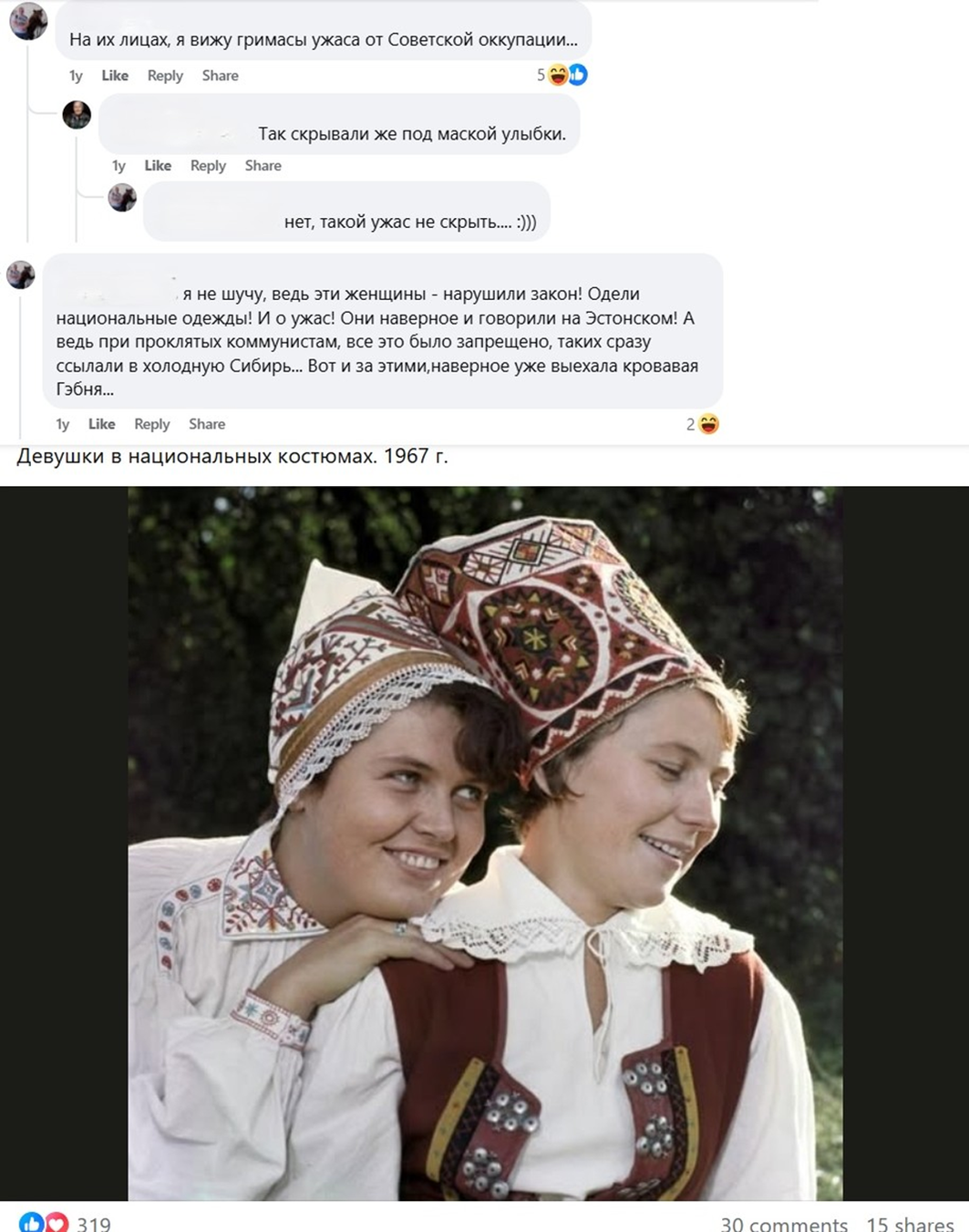
Figure 2. Long description
The image is a composite screenshot from a Facebook group.
At the top is a comment thread in Russian. The first comment reads ‘On their faces, I see grimaces of horror from the Soviet occupation.’ A reply states ‘But they hid it under a mask of a smile.’ A third reply says ‘no, such horror cannot be hidden.’ Below this, a longer sarcastic comment claims the women broke the law by wearing national clothes and probably speaking Estonian, suggesting the ‘bloody G B N’ (K G B) is coming for them.
Below the text is a color photograph from 1967. It shows two young women smiling and leaning toward each other. They wear traditional Estonian folk costumes, including white embroidered blouses and tall, patterned headpieces with geometric embroidery. The woman on the left rests her hand on the other's shoulder.
At the very bottom, the Facebook interface shows 319 reactions, 30 comments, and 15 shares.
Tak skryvali zh pod maskoi ulybki [They were hiding it under the mask of a smile];
net, takoi uzhas ne skryt’ …;))) [No, you can’t hide such horror… ;)))];
ia ne shuchu, ved’ eti zhenschiny – narushili zakon! Odeli natsional’nye odezhdy! I o uzhas! Oni navernoe i govorili na Estonskom! A ved’ pri prokliatykh kommunistam, vse eto bylo zaprescheno, takikh srazu ssylali v kholodnuiu Sibir’… Vot i za etimi uzhe, navernoe vyekhala krovavaia Gebnia… [I’m not joking, after all, these women broke the law! They wore national costumes! And oh, the horror! They probably even spoke Estonian! And under the cursed communists, all of that was forbidden – they would have been immediately exiled to cold Siberia… So, the bloody Secret Police probably already came for these ones too…]
By using the word “occupation” as an ironically twisted term, therefore, Russian-speaking Facebook group members aim to discredit the official state discourse and present the Estonian state and Estonians as hypocrites who revel in imaginary suffering, while making suffer “true victims” — the Russian-speaking minority. As Figure 3 shows, under the picture of the Soviet postal stamp depicting Estonian folk costumes, the comments read:
I nadpis’ na dvukh iazykakh nikomu ne meshala [And the inscription in two languages didn’t bother anyone];
Post and comments in the Facebook group Russkoiazychnaia Estoniia (December 2023).
The source: screenshots made by the authors.
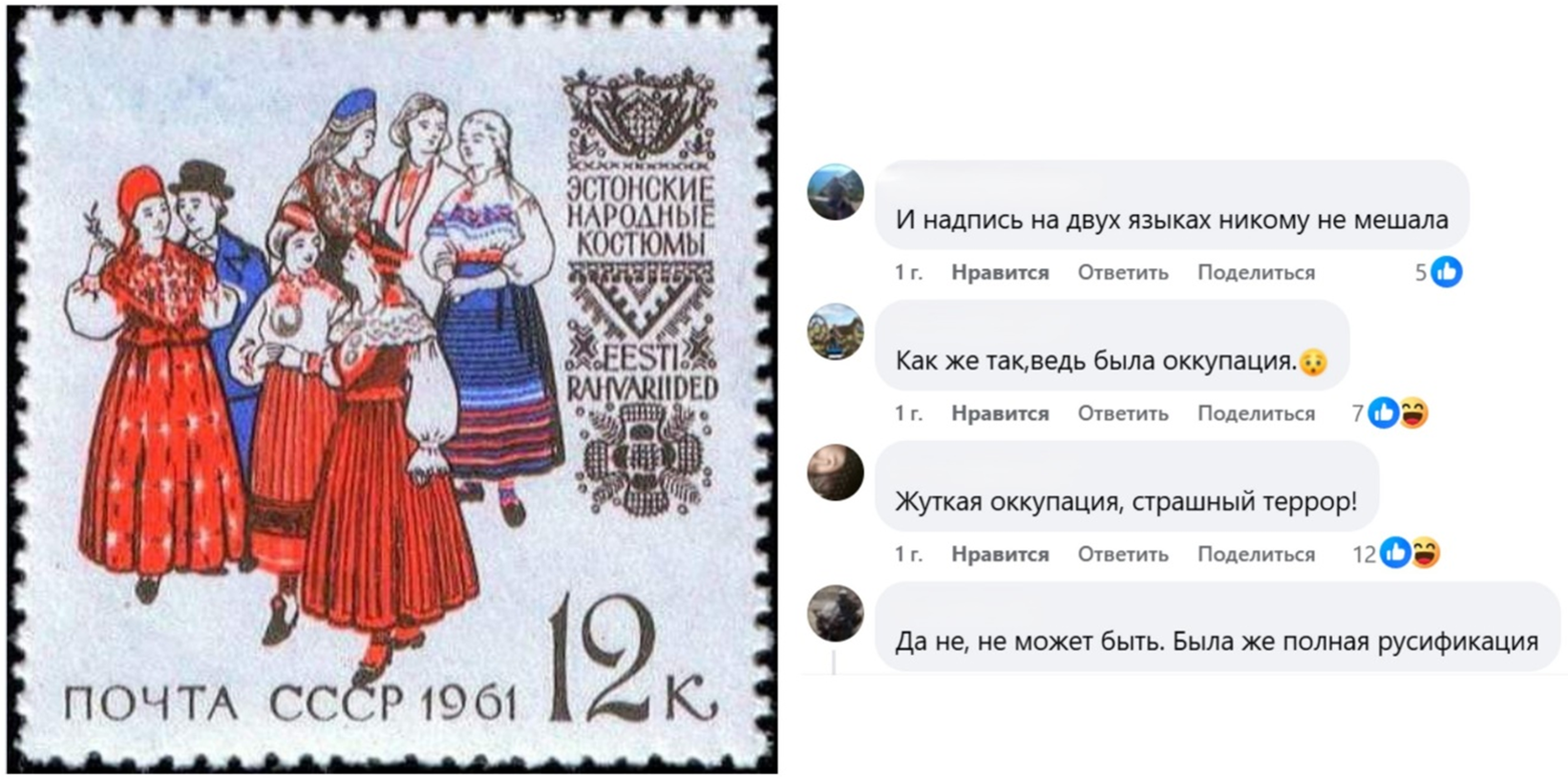
Kak zhe tak,ved’ byla okkupatsiia [How come, there was occupation];
Zhutkaia okkupatsiia, strashnyi terror! [Terrible occupation, awful terror!];
Da ne, ne mozhet byt’. Byla zhe polnaia rusifikatsiia [No, it can’t be. There was complete Russification].
Russification, therefore, is presented in these comments as the same “absurd myth” as the occupation. It is no coincidence that both of these words are close together and used in similar ways in many comments ( Russkoiazychnaia Estoniia , December 2023).
The analysis of different posts proves that this exchange of similar comments turns in most cases into a unified choir; the unanimity is further strengthened by likes and smiles expressing mutual support. Group members demonstrate full agreement with each other through ironically twisted terms appropriated from the official Estonian discourse.
Another example of such “semantic annihilation” of the official term, that is, conscious destruction of its direct meaning, is the ironic use of the word “integration.” The term itself is very important for the governmental policy towards the Russian-speaking population of Estonia. Since 2000, the Estonian government has published several strategic documents on integration (Jakobson Reference Jakobson2014), established the Settle in Estonia programme financed by the Estonian Ministry of the Interior and by the European Union through the European Social Fund, and initiated other activities focused on integration (Feldman Reference Feldman2005). However, for some Russian-speaking commenters in Facebook groups, “integration” has a meaning different from the official term, as the following examples show:
Integratsiia? Vse eto chush’. Kazhdyi dolzhen byt’ tem, kto on est’. Vse raznye [Integration? It is all bullshit. Everyone should be who they are. All are different] (Russkoiazychnaia Estoniia, October 2024);
Nikogda u nikh siloi ne poluchitsia nas integrirovat’. Nastoiaschego russkogo ni-ko-gda! [They will never manage to integrate us by force. Real Russian ne-ver (can be integrated)]
(Russkoiazychnaia Estoniia, February 2024).The first comment, liked by six other members of the group Russkoiazychnaia Estoniia, was written as a response to the interview of an Estonian teacher who expressed surprise at how little her Russian-speaking students know about Estonian culture and how she tries to integrate them by introducing them to Estonian books, music, and TV programmes. The second was among many critical reactions to the media publication claiming that many Russian speakers in Estonia, after Russia’s invasion of Ukraine, prefer not to call themselves Russians. Evidently, in both cases, commentators understand integration as assimilation because they oppose the word “integration” to diversity (“all are different”) and keeping one’s “true” ethnic self (“real Russian”). As a result, the politics of integration is seen as a malicious attempt to deprive Russians of their identity.
Even more often, integration discourse is seen by the Facebook group members as a hypocrisy, a facade behind which politicians get their own benefits while in fact trying to marginalize Russian speakers. For example, when in March 2025 the Estonian Parliament implemented changes to the constitution that deprived Russian citizens of the right to vote in local elections, one of the Russkoiazychnaia Estoniia group’s members wrote: Da zdravstvuet integratsiia! Ura! [Long live integration! Hurray!]. Another reason to express scepticism about integration was an appeal by several Estonian parents to parliament demanding that Russian-speaking children not be allowed to study together with Estonian children since their poor language skills hinder the study process and deprive Estonian speakers of quality education (Tšuikina, Fedorova, and Batrakova Reference Tšuikina, Fedorova and Batrakovaforthcoming). One of the comments beneath the repost of the article on the matter reads: Vot ona — integratsiia! [Here it is — integration!] and includes a laughing smile.
Here again, ironic repositioning of the “enemy’s words” serves as a means to discredit them and, at the same time, to stress the unanimity and like-mindedness of the group members, strengthening group ties and common values. Such politically loaded words as “occupation,” “Russification,” and “integration” in in-group discourse demonstrate changes of polarity — from negative to positive meaning, and vice versa — helping to maintain the border between “them,” the Estonian government, or Estonians in general, and “us,” presented as wrongly accused and mistreated.
Although one can argue that members of Estonian Russian-speaking groups in general share their ideological position with Russian state propaganda channels (“The USSR was good,” “West is bad and full of Russophobia”), it is evident that they create their own in-group code based on local realities and specific ironical catchphrases, which cannot be understood outside of this local context. And even in the sphere where Russian propaganda’s influence seems to be very powerful — attitudes toward everything associated with Ukraine — local context again plays a significant role. The following examples will serve to illustrate this point.
Ukrainian theme
It is not always easy to isolate specific expressions directly tied to the Ukrainian theme, but it is clear that users frequently employ certain reference words or phrases that carry broader connotations. These expressions often imply a shared context or meaning without explicitly stating it. For instance, comments like Tarasiki uzhe dostali [Fed up with the little Tarases] (Russkoiazychnaia Estoniia, January 2025) use a diminutive form of a stereotypically Ukrainian name to convey irritation and sarcasm addressed to Ukrainians. Similarly, phrases like ukrainskii govor [Ukrainian vernacular] draw attention to the fricative pronunciation of the sound/letter G, which marks a phonetic distinction between Ukrainian and standard Russian and often is used mockingly by Russian speakers. Another common example is Nu a sho? [So what?] — with sho standing in for the Russian chto or chё [what] — hinting at Ukrainian vernacular. These subtle linguistic cues referring to Ukrainians simultaneously serve as markers of contrastive identity and often carry a layer of irony, mockery, and group positioning.
The sounds of Ukrainian, therefore, are presented as a sign of alienation. Commenters responding to the post about the presence of Ukrainian-medium radio shows in Estonia emphasized their involuntary reactions — a kind of sensory and psychological dissonance that arises when encountering something unfamiliar. One user summed it up with the phrase mne ukr iazyk ushi rezhet [The Ukr[ainian] language hurts my ears] (Tallinntsy, December 2024). Another added:
ia ne protiv etogo, no radio na ukrainskom prosto ubilo. Chut’ krov’ iz ushei ne poshla. Estonskii i russkii – eto obydennaia vesch’ s detstva, a eto, chto-to chuzherodnoe, ne privychnoe [I’m not against it, but the radio in Ukrainian just killed me. I almost had blood coming out of my ears. Estonian and Russian are everyday things since childhood, but this is something foreign, unfamiliar] (Tallinntsy, December 2024).
At the same time, commenters often mock the fact that some Ukrainian refugees may not actually speak Ukrainian, as many of them are Russian-speaking Ukrainians. For example, one remark reads: Predpolagaiu, chto primerno 90% iz nikh rozumiiut’ lish’ rossiisku movu [I assume that about 90 percent of them only understand the Russian language] (Tallinntsy, December 2024). This kind of comment, with the last four words written in Ukrainian (or rather what the commenter believes to be Ukrainian, the words are misspelled), subtly questions the authenticity of these individuals as “real” Ukrainians, implying that language determines national identity. Such attitudes feed into a broader narrative that denies Ukraine’s legitimacy as a state and views Ukrainian not as a distinct language, but merely as a dialect of Russian (Bureiko and Moga Reference Bureiko, Moga, Cheskin and Kachuyevski2021). In a wider sense, this perspective reflects an underlying standard language ideology (Milroy Reference Milroy2001): that only standardized and perceived as “legitimate” languages are worthy of use or study, while dialects or minority languages are seen as inferior — something to be hidden or even ridiculed. This linguistic prejudice often reveals deeper social and political biases tied to identity, belonging, and cultural dominance.
At times, this attitude borders on obsession: even entirely neutral posts can unexpectedly trigger discussions centred around Ukraine or the Ukrainian language, as illustrated by the example in Figure 4 from the Facebook group Tallinntsy. The inappropriateness of such comments is underscored by the fact that they were eventually removed, probably by the group administrator, suggesting that even within these online spaces, there are limits to what is considered acceptable discourse. The post reads:
Iest’ mnenie, v kommentariiakh slovila, tallinntsy zhivut slozhno, na grani vyzhivaniia. A na cho konkretno nemnozhko ne khvataet deneg? Nu, chtoby vyzhit’)) Mini sots opros) ne provokatsiia) [There’s an opinion I came across in the comments – people in Tallinn are living tough, on the edge of survival. So what exactly is it that you’re just a little short on money for? You know, just to survive)) Mini social poll) not a provocation)] (Tallinntsy, January, 2025).
Post and comments in the Facebook group Tallinntsy (January-February 2025).
The source: screenshots made by the authors.
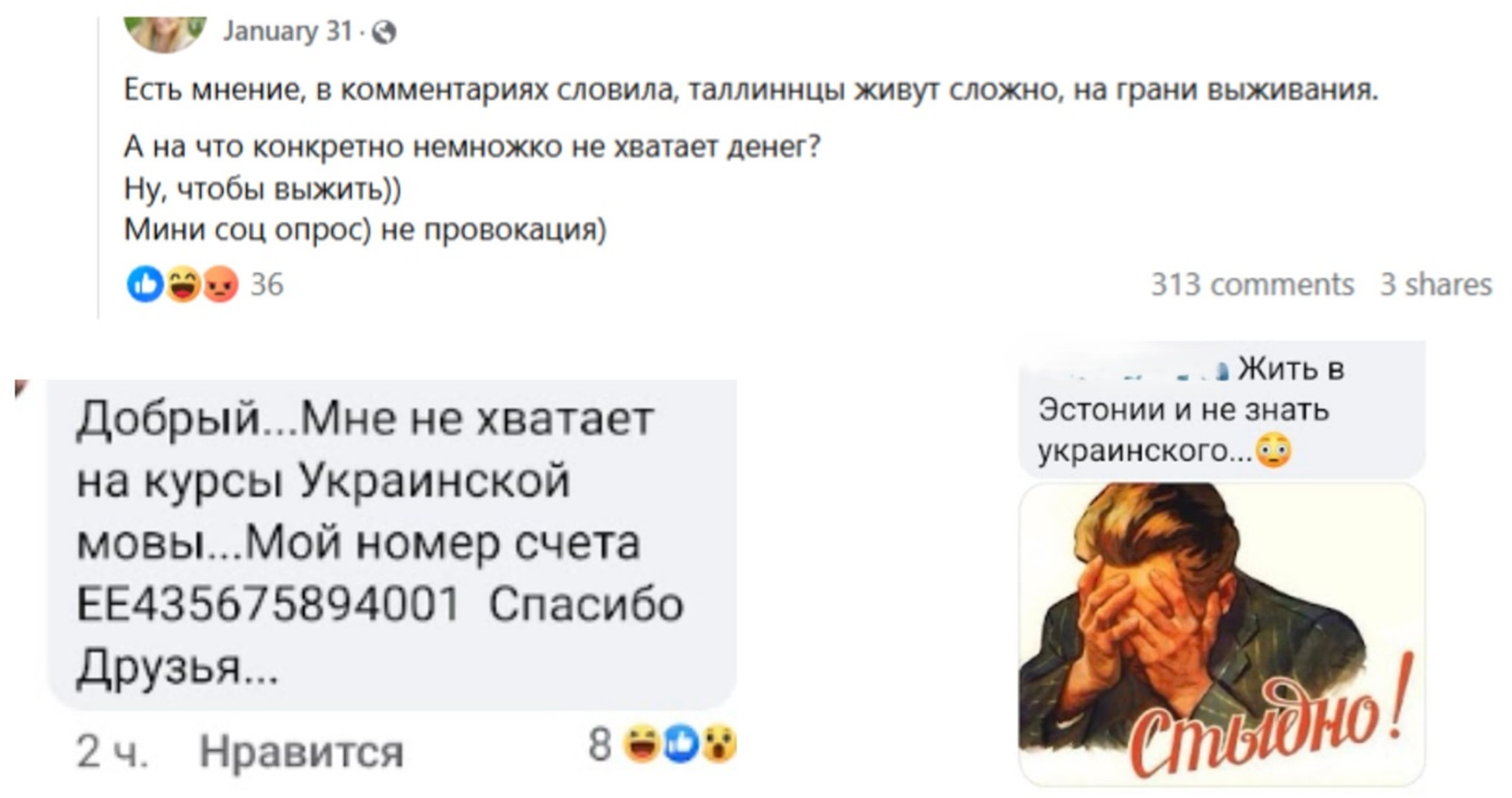
Figure 4. Long description
The composite consists of three distinct panels.
* Top panel: A Facebook post dated January 31. The text in Russian asks what specifically people in Tallinn lack money for to survive, framing it as a mini social survey. It shows 36 reactions, 313 comments, and 3 shares.
* Bottom-left panel: A comment screenshot where a user writes in Russian that they lack money for Ukrainian language courses. They provide an Estonian bank account number E E 4 3 5 6 7 5 8 9 4 0 0 1 and end with ‘Thank you friends’. It has 8 reactions.
* Bottom-right panel: A comment screenshot featuring a user's text stating ‘To live in Estonia and not know Ukrainian...’ followed by a flushed face emoji. Below the text is an illustration of a man in a suit covering his face with his hands in shame, with the word ‘Shameful!’ written in stylized red Russian script across the bottom.
Besides comments describing the authors’ money problems, there was one evidently aimed as comical: Dobryi … Mne ne khvataet na kursy Ukrainskoi movy … Moi nomer scheta <…> Spasibo Druz’ia… [Good day… I can’t afford Ukrainian language courses… My account number is <…> Thank you, friends…] (Tallinntsy, February 2025). The comment received 16 reactions and a reply by another user further developing the mockery: Zhit’ v Estonii i ne znat’ ukrainskogo … [To live in Estonia without knowing Ukrainian…] accompanied by a surprised emoji and a popular meme depicting a man covering his face with his hand and the exclamation Stydno! [What a shame!] (Tallinntsy, February 2025).
If we try to reconstruct the ideological statements behind this comment exchange, we should take into account both anti-Ukrainian and anti-governmental sentiments. On the one hand, Russian speakers are regularly criticized for their alleged unwillingness to study Estonian (Leppik and Vihalemm Reference Leppik and Vihalemm2015), and claims like “To live in Estonia without knowing Estonian is shameful” sound like a cliché. However, the joke hints at the so-called “Ukrainian occupation” of Estonia, often mentioned in the studied groups (both Estonian and Latvian) with respect to public demonstrations of the Ukrainian flag alongside the national ones and spending resources on supporting Ukrainian refugees (Fedorova and Tšuikina Reference Fedorova and Tšuikina2024). In this case, Ukrainian is presented as a new state language which everyone should learn and which is substituting Estonian as the most important language of the country.
The use of the Ukrainian word mova instead of Russian iazyk [language] in such comments is rather typical. Mova refers specifically to Ukrainian; however, it is not a neutral term. In most cases, its use expresses negative attitudes. In this sense, mova is also a sarcastic verbal sign, which makes use of the way Ukrainians themselves call their language but hints at its inferiority and, in a broader sense, at the inappropriateness of the support given to Ukrainians by the Estonian government, in contrast to its alleged Russophobia. The following comment, answering the question “Why Russians do not want to learn Estonian,” sums up this perspective: Potomu chto ia okkupant, zhivu v russkom getto i znaniia “mine perse” mne dostatochno. Nekhai vse vchat’ movu [Because I’m an occupant, I live in a Russian ghetto, and it is enough for me to know “Fuck off” [in Estonian but written in Cyrillic letters]. Let everyone learn Ukrainian [in Ukrainian]. By calling themselves “an occupant living in a Russian ghetto,” the author ironically quotes stereotypical Russophobic Estonians, and by adding advice to learn Ukrainian, expresses in a veiled form their dissatisfaction with the state policy. The multilingualism of the comment, easily combining three languages, further stresses the absurdity of the initial claim that Russians will not use any language other than Russian.
“Sour cream with sugar” as a local catchphrase
Probably, the most revealing case of creating a totally local, unknown, and incomprehensible outside the group, politically loaded catchphrase by Estonian Russians is the phrase smetana s sakharom [sour cream with sugar]. Its metaphorical meaning is unknown not only outside of Estonia but also to most Estonian-speaking residents of the country. It is associated with the figure of Kaja Kallas, former Prime Minister of Estonia, who on December 1, 2024, assumed the role of High Representative of the European Union for Foreign Affairs and Security Policy and Vice-President of the European Commission. In her interview published by the Financial Times on February 18, 2022, she said, talking about the hardships of her Soviet childhood: “We had a time when we didn’t have any candies in the shop. We ate sour cream with sugar. That was the sweetest thing that we could get, so I remember those days” (Milne Reference Milne2022). The interview was never translated into Estonian, but the Russian translation of this quote was posted on Facebook by the Estonian politician and journalist Aleksandr Chaplygin, who is a current member of the Riigikogu (Estonian Parliament) representing the opposition Centre Party. Of Russian descent, he has a background in Russian-language media and is known for his advocacy on issues affecting Estonia’s Russian-speaking minority. Chaplygin often engages in debates on historical memory, language policy, and integration, sometimes challenging mainstream Estonian perspectives on the Soviet era. His post on February 19, 2022, alone generated 421 comments unanimously accusing the then Prime Minister of hypocrisy (as a daughter of a highly ranked Soviet official, she could hardly experience any food shortages) and slander against the Soviet past. Chaplygin’s postFootnote 2 was reposted 181 times; many other bloggers and journalists also wrote about the interview and those words, and as a result, the phrase smetana s sakharom immediately became viral. Even at the end of 2023, when the group Russkoiazychnaia Estoniia initiated voting for the best phrases of the year, this quotation from Kaja Kallas was ranked third, although it appeared in early 2022.
What began as a critique quickly turned into a full-blown meme session, with the phrase “sour cream with sugar” morphing into a satirical symbol — a mix of nostalgia, absurdity, and political mockery. Now, more than three years after its first appearance in the public discourse of Russian speakers in Estonia, the catchphrase still thrives. Even generally neutral posts can trigger the recurring smetana s sakharom phrase. For instance, a nostalgic post in Sovetskaia Estoniia — Eesti NSV featuring photos of a Soviet-era apartment prompted a comment dripping with irony:
Plokho zhili, v barakakh po 8 semei. Bez televizorov. Vmesto radio tol’ko rupor na ploschadi. Bez kolbasy, syra, khleba … Tol’ko vodka i smetana, s sakharom … [We lived terribly – eight families in a barrack. No televisions. Instead of a radio, just a loudspeaker on the square. No sausage, no cheese, no bread … Only vodka and sour cream, with sugar…] ( Sovetskaia Estoniia – Eesti
NSV, December 2024).Another example comes from a post in Russkoiazychnaya Estonia, where a user posed a seemingly innocent question: why was Soviet-era sour cream so thick that a spoon could stand upright in it? For us who have followed these groups over time, the anticipation of a response invoking the now-familiar catchphrase was inevitable — and it did not take long to appear: Kaika s’ela vsiu smetanku, v kotoroi lozhka stoiala [Kaika [Russified diminutive form of the name Kaja] ate all the sour cream — the one thick enough for a spoon to stand in] (Russkoiazychnaya Estonia, December 2024). The comment not only reinforces the enduring sour cream motif but also personalizes the sarcasm, subtly linking Kaja Kallas (via the diminutive “Kaika”) to the consumption — or appropriation — of a symbolically “better” past. Here, the catchphrase serves as both cultural shorthand and political innuendo.
Kaja Kallas appears to be one of the most thoroughly scrutinized political figures within these Facebook groups — a fact made evident by how easily commenters manage to throw multiple grievances at her in a single stroke. Take, for example, the sarcastic remark: ocherednye molekuly s sakharom???????? [Yet more sugar molecules???] (Russkoiazychnaya Estonia, February 2025). This jab not only extends the ongoing sour cream with sugar metaphor but also references a separate political blunder: Kallas’s much-ridiculed explanation from September 26, 2022, in Riigikogu (Estonian Parliament), in which she attempted to address Estonia’s electricity shortages by referring to “electrical molecules.” The layered sarcasm reveals both linguistic creativity and a long memory for political missteps.
One of the posts in the group Russkoiazychnaia Estoniia in March 2025, sparked an especially creative — and simultaneously mocking — wave of comments, all revolving around the phrase smetana s sakharom . The spark came from news that Kaja Kallas had stated that the EU’s strategic victory was aimed not only at Russia, but also at China. This triggered a flurry of sardonic reactions (see figure 5), including the following: Uti puti, hapukoor ochka nasha sukhkruga … [Oh how sweet, our little sour cream with sugar …]. It is worth noting here that the phrase “hapukoorochka sukhkruga” is a playful linguistic blend — drawing from the Estonian words hapukoor [sour cream] and suhkruga [with sugar], but wrapped in a Russian diminutive form and written in Cyrillic letters. This kind of wordplay is highly localized, reflecting the unique cultural-linguistic mix typical of Estonian-Russian online space, where sarcasm often lives in code-switching and complex metaphors. Other commentators even expanded on the metaphor by playing with qualities typically associated with dairy products: Smetana s sakharom, v detstve kak zabrodila, tak i do sikh por … [Sour cream with sugar — it started fermenting in childhood and still hasn’t stopped…] (Russkoiazychnaia Estoniia, March 2025).
Comments containing the “sour cream with sugar” catchphrase. Translation of the post: “The head of the EU’s foreign policy department, Estonian Kaja Kallas, said that among the EU’s goals is victory not only over Russia, but also over China? From [the] 1:10 minute mark, channel — Pravda UK [link], I believe that the government of Aldebaran will support this initiative! Kaja, well done!! The most important thing is that everyone knows you’re from Estonia — from a great and proud country!” Translation of the comments: “Oh how sweet, our little sour cream with sugar …”; “No, that’s just the sugar-loaded sour cream hitting hard!”; “They say sugar boosts cognitive abilities. In her case, nothing will help. All the sour cream went straight into her skull – the one she was eating out of – and replaced her brain. The sugar was eaten in vain. What a waste of good food!” ( Russkoiazychnaia Estoniia , March 2025).
The source: screenshots made by the authors.
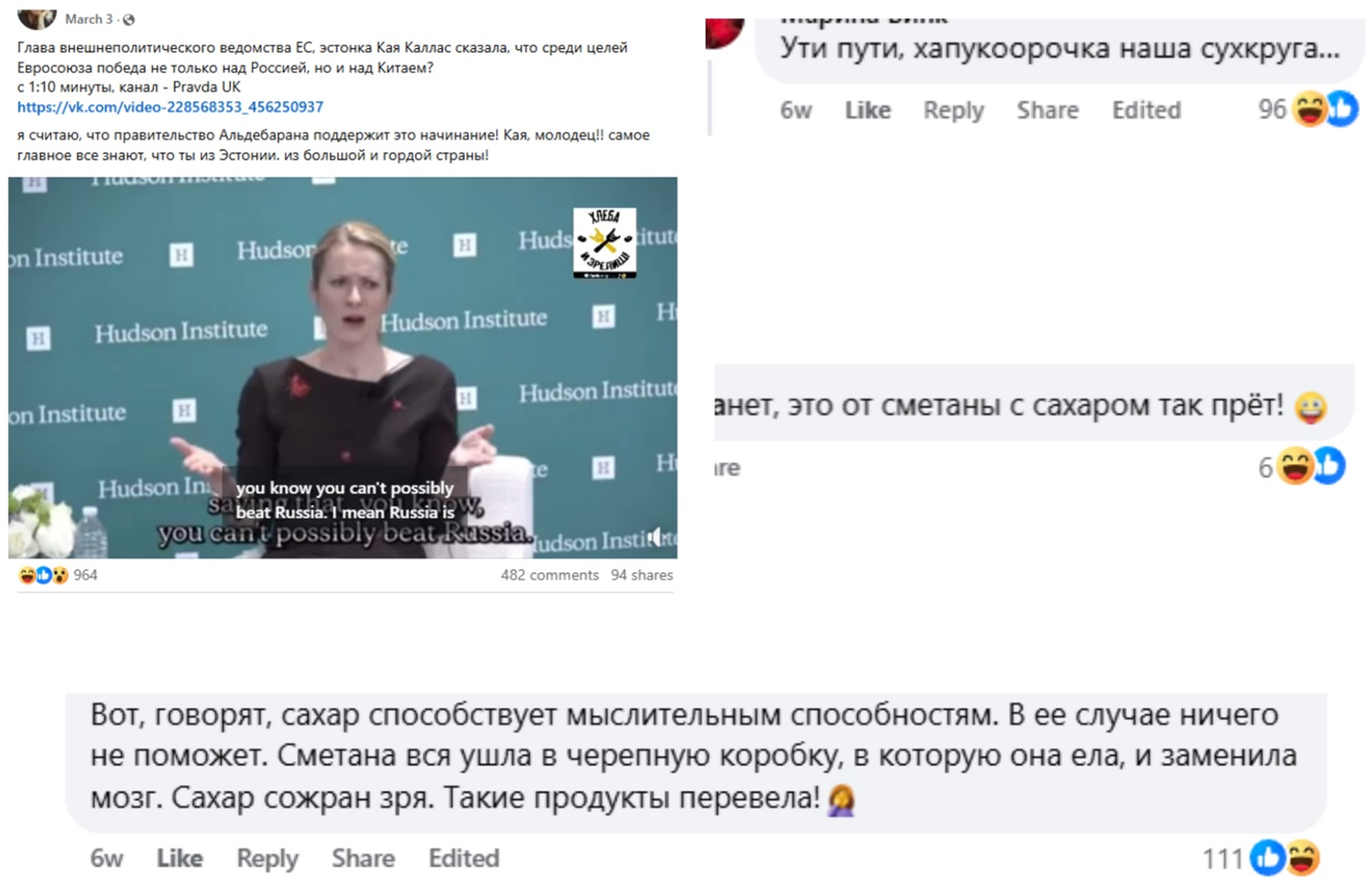
Figure 5. Long description
The collage consists of four distinct panels.
1. Top-left panel: A Facebook post in Russian featuring a video of Kaja Kallas speaking at the Hudson Institute. The video has English subtitles that read, you know you can't possibly beat Russia. I mean Russia is. The post text mentions the E U foreign policy goals and includes a link to a V K dot com video.
2. Top-right panel: A cropped screenshot of a comment in Russian that translates to, Oh how sweet, our little sour cream with sugar. It shows 96 reactions including likes and laughing emojis.
3. Middle-right panel: A cropped screenshot of a second comment in Russian translating to, No, that's just the sugar-loaded sour cream hitting hard! It shows 6 reactions.
4. Bottom panel: A wider screenshot of a third comment in Russian. The text translates to, They say sugar boosts cognitive abilities. In her case, nothing will help. All the sour cream went straight into her skull, the one she was eating out of, and replaced her brain. The sugar was eaten in vain. What a waste of good food! This comment has 111 reactions and a face-palm emoji.
The commentators in the same group show a clear interest in the political developments across various countries — especially those unfolding against the backdrop of Russia’s full-scale invasion of Ukraine. Russian-speaking users, in particular, mockingly “remind” Kaja Kallas of her failed attempt to meet with Marco Rubio on her visit to Washington on February 26, 2025, using biting sarcasm: U Rubio ne nashlos’ smetany s sakharom podderzhat’ gemoglobin ogolodavshei, letevshei k nemu na kryl’iakh schast’ia glavy evronedodiplomatii [Rubio couldn’t find any sour cream with sugar to boost the hemoglobin of the famished soul soaring toward him on the wings of joy — the head of Euro-non-diplomacy] ( Russkoiazychnaia Estoniia , February 2025).
However, the use of the said catchphrase is not limited to personal attacks on Kaja Kallas. Quite often, smetana s sakharom means more or less the same as “occupation” and “Russification” — false claims of Estonian propaganda about the Soviet past, attempts to paint it in all black, while in reality it was a prosperous time for Estonians. For example, under the same post with the Soviet postal stamp represented in figure 3, there was the following comment supported by 11 reactions: I tol’ko smetana i sakhar [And only sour cream and sugar]. Or, when discussing Estonian-Russian medium TV channel ETV+ as a governmental propaganda mouthpiece, the commentator added: Nichego novogo. Vse ta zhe smetana s sakharom [Nothing new. One and the same sour cream with sugar] (Russkoiazychnaia Estoniia, December 2023).
What is more, sometimes people may get confused and try to connect smetana with other politicians. For example, one user commenting on a publication in Russkoiazychnaia Estoniia about Yana Toom, European Parliament member, wrote: Vy eshche verite etoi balabolki? Vam podkidyvaiut smetanu so slivkami v vide prosloikami v korzhakh? [Do you still believe this chatterbox? You are given sour cream with cream as a layer in cakes]. Cake reference can be explained by the fact that several years ago, Toom, advocating for equal rights for Russian speakers, published on her Facebook a photo of a cake in the form of a so-called “grey passport,” a document of those who have no citizenship, and promised to eat it, thus ritually destroying this symbol of inequality. Expressing distrust of the politician, the commentator evidently mixed up this case and the “sour cream” metaphor; later, they realized their mistake, deleted the comment, and added another with similar meaning but not mentioning sour cream. What is interesting here is the fact that for this user, there was a strong association between smetana s sakharom catchphrase and political hypocrisy, not necessarily inherent in Estonians. The formula, therefore, has a complex meaning: it refers to the politicians pursuing “anti-Russian” policies, “anti-Soviet propaganda,” but also may, as an antithesis, carry nostalgic associations with the happy past: in yet another comment, the author mentions te, smetannosakharnye vremena [those sour-cream-with-sugar times] ( Russkoiazychnaia Estoniia , March 2024).
Such derivatives as hapukoorochka and smetannosakharnye closely resemble the examples of krymnashistskii and neodnoznachnik found in Russia’s opposition political discourse. Russian speakers in Estonia use the same mechanism of forming re-purposed catchphrases ironically, but take as their source their own local political context and build around it their own ethnic, linguistic, and political group identity.
Conclusions
Let us now try to sum up the mechanism of creating the ideologically weaponized catchphrases we analyzed in the article.
For a word or a phrase to become such an ironic ideological catchphrase:
-
(1) This word or phrase should be perceived as a quote from someone’s discourse (either intentionally loaded with propaganda, as in the case of Crimea is ours! slogan, or a casual remark interpreted in a particular way, as happened with Kaja Kallas’s reminiscence about eating sour cream with sugar);
-
(2) This someone should represent a special group or a specific type of person (Putin supporters, the Estonian government, hypocritical politicians, Ukrainians, and so on);
-
(3) This person or group should have an ideological position opposite to those who use the said phrase (“pro-Russian” and imperialistic, or, vice versa, nationalistic and “Russophobic,” if they are weaponized by the Russian political opposition and Russian-speaking minorities in the Baltic countries, respectively);
-
(4) The use of the catchphrase should serve the purpose of derogating and ridiculing this ideological position, presenting it as going against the core values, be it the freedom of speech, or loyalty to one’s own language and culture;
-
(5) The audience should share the background knowledge and be able to detect the irony, correctly ascribe the quote to its alleged sender(s), and connect them with a certain ideological position. In this sense, ironic catchphrases form an in-group code not known by outsiders who may fail to decode the message completely (for example, not understanding what sour cream has to do with the topic) or interpret it in the wrong way (for example, deciding that the commenters in all seriousness call the Soviet rule in the Baltics an occupation).
On becoming such a catchphrase, the word or phrase may undergo further transformations, becoming an object of a language game. The words may become phonetically or graphically distorted, blended together into one word through hashtagization, giving rise to new derivative words, translated, or even translated back, as the example of hapukoorochka shows. Their use not only helps to express complex ideas in a condensed, economical form and to assert one’s ideological superiority over a real or imaginary enemy, but they maintain the sense of belonging to the community sharing the same beliefs and understanding the hidden meaning of in-group jokes and indirect messages. In this sense, the mechanisms uncovered in our material can be viewed as a contemporary enactment of Bakhtin’s dialogistic principles (Bakhtin Reference Bakhtin and Holquist1981), showing that politically weaponized catchphrases thrive precisely because they operate as double-voiced utterances embedded in a field of ideological tension. Bakhtin’s emphasis on heteroglossia and re-accentuation helps illuminate why these phrases are so effective: by preserving the recognizable voice of an ideological Other while simultaneously subverting its evaluative accent, speakers compress complex social conflicts into a single linguistic gesture. Moreover, the requirement of shared background knowledge and in-group decoding aligns with Bakhtin’s notion of addressivity, highlighting that these catchphrases function not merely as humorous linguistic artifacts but as markers of communal identity and ideological alignment.
Another interesting feature of this polemical technique is that it may be called a weapon of the weak: those who feel the lack of real discursive power in society tend to compensate for their dissatisfaction with their status through mocking and twisting official narratives and reclaiming power in discussions among like-minded group members. In this sense, vertical propaganda is repositioned, inverted, and turned horizontal, uniting the community; this unification, however, is based on attacks on common enemies rather than on positive values. This “underdog” quality of the described phenomenon is revealed by the fact that the same strategy is used by groups’ dissidents to attack their mainstream discourse. As mentioned above, in reality, the predominant political narrative represented in popular Estonian Russian-speaking Facebook groups does not reflect the positions of all Russian speakers, or even of their most significant part, or of all members of these groups. There are many people (some of them are well-known public figures) who follow the groups but express their disagreement with the statements promoted by their political narrative, “happy Soviet past,” “false claims” of Estonian speakers about it, “Ukrainian occupation” of Estonia, “Russophobic policies” of the Estonian government, and so on. When doing so, they sometimes employ the same strategy of ironically inverting catchphrases. For example, one such person tends to comment nostalgic posts about the good life in the USSR with the stereotypical phrase Kakaia strana byla! (What a country it was!). This phrase has long turned into a cliché, which is used in honesty by many group members (see Fedorova and Tšuikina Reference Fedorova and Tšuikina2023). However, in the mouth of a famous critic of the Soviet past and modern Russian state, this cliché receives an opposite meaning: it is a sarcastic pseudo-quotation, aiming at parodying and mocking those who truly believe in the glorious past.
We can see, therefore, that ironic political catchphrases, with their densely packed multi-layered meaning, as a means of political debate, are not necessarily connected with one particular ideology or social group. In political discourse studies, there is a tradition to connect irony as a polemical tool with left-liberal intellectual humour (Young et al. Reference Young, Bagozzi, Goldring, Poulsen and Drouin2019): “Scholarly consensus holds that conservatism and satiric irony do not mix,” a misconception that recent research is beginning to dispel (Sienkiewicz and Marx Reference Sienkiewicz and Marx2021, 85). The appropriating of irony by conservative comedy in the US after the first Trump’s presidency reported in that study may be related to perceived hegemony of the liberal discourse in Hollywood and American mainstream media, and our research confirms the conclusion by Sienkiewicz and Marx (Reference Sienkiewicz and Marx2021, 107): “the power of irony is fully available to actors across the ideological spectrum.” In the same way, inversion of political catchphrases may be employed not only by Putin’s opponents but also by those who look more like his supporters if they are not dominating in their own social, ethnic, and linguistic environment.
At the same time, Russian speakers actively engaged in political discussions in the studied Facebook communities, although being definitely disempowered, have an important source of empowerment. They associate themselves with the “great Russian culture” and the “great and mighty” Russian language, opposing them to “peasant,” “farmstead” Estonian/Latvian cultures (Fedorova and Tšuikina Reference Fedorova and Tšuikina2024) and their “small and weak,” and even “dying out” languages (Fedorova and Tšuikina Reference Fedorova and Tšuikinaforthcoming). “Glorious Soviet past” also contributes to this discourse; Relying on these empowering forces, group members use online spaces as a “‘safe’ environment for performing citizenship and demonstrating political dissent” (Tammpuu, Juzefovičs, and Seppel Reference Tammpuu, Juzefovičs and Seppel2020, 255).
Our analysis highlights interactions between global and local contexts, and the semantic ambiguity that enables ironic twists, turning once-neutral words into double-edged political tools. When adopted by ethnic minorities separated from the “mainland,” these strategies of resistance acquire an ethnic dimension, reflecting conflicts between ethnic diaspora groups and the national state, and between subalterns and those in power. The findings contribute to understanding how new forms of communication and identity construction develop, in a complex ethno-political situation, where the EU logic of diversity, national unity and integration is challenged by the logic of nationalism and ethno-linguistic separatism; how they interact with propaganda narratives making them more potent or prone to failure; and how they are countered and deconstructed in in-group ironic communication, strengthening community ties and helping to build even more sound-proof echo chambers.
It is important to underline, however, that Russian speakers in the Baltic countries, even if the opinions and narratives circulating within their online echo chambers are in line with Kremlin propaganda, are not merely passive repeaters of externally produced messages. They articulate their own agendas and develop discourse strategies that are specific to their sociolinguistic environment; their in-group linguistic code is distinct and deeply rooted in their lived experience. Feeling marginalized and suppressed, they turn to the ironic repurposing of their opponents’ words as a way to reclaim discursive agency, to reaffirm solidarity within their community, and to derive consolation from a shared sense of resistance and the hope of prevailing, if only symbolically and in their own eyes, in this political struggle.
Acknowledgments
We would like to thank our colleagues Vera Zvereva and Tatiana Romashko (University of Jyväskylä), Michael S. Gorham (University of Florida), Maksim Markelov (University of Manchester), and others with whom we discussed our study during panels at the BASEES and ASEEES conferences in 2024; their questions and comments helped a lot in shaping our approach and interpreting the data. We also would like to express our deep gratitude to our reviewers, whose comments and suggestions helped us enormously.
Financial support
This work was supported by the Tallinn University Research Fund grant “Multilingual virtual space of Estonia” (TF924).
Disclosure
None.
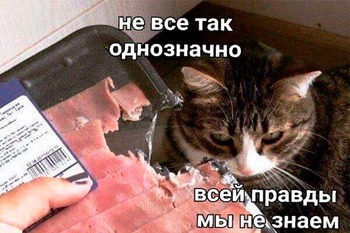
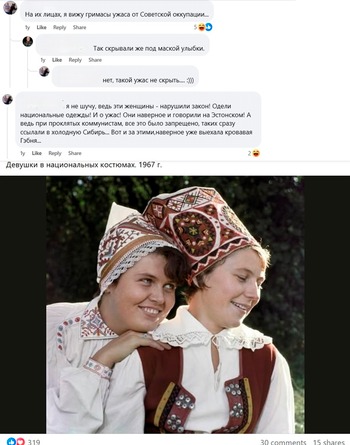
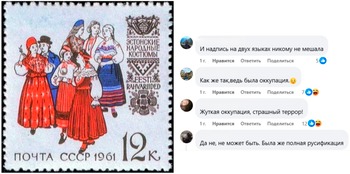

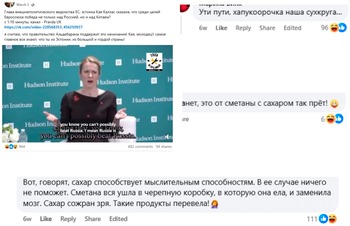

 Open access

