

The unprecedented Ebola Virus Disease (EVD) outbreak in West Africa, with its first cases documented in March 2014, has claimed the lives of thousands of people, and it has devastated the health care infrastructure and workforce in affected countries. Throughout this outbreak, there has been a critical lack of health care workers (HCW), including physicians, nurses, and other essential non-clinical staff, who have been needed, in most of the affected countries, to support the medical response to EVD, to attend to the health care needs of the population overall, and to be trained effectively in infection protection and control. This lack of sufficient and qualified HCW is due in large part to three factors: 1) limited HCW staff prior to the outbreak, 2) disproportionate illness and death among HCWs caused by EVD directly, and 3) valid concerns about personal safety among international HCWs who are considering responding to the affected areas.
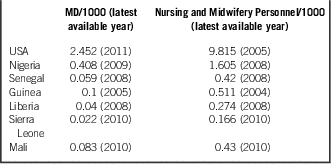
To the first point, there are more than 90% fewer physicians per 1000 persons in affected West African nations than there are in the United States, and there are also insufficient numbers of nurses, even when compared to the critical threshold for resource poor settings which is 2.3 doctors, nurses and midwives per 1000 population. 1 These numbers are not met in the nations hardest hit by EVD (Table 1). 2
Numbers of HCWs per 1000 Population in EVD Affected Countries in West AfricaFootnote a

a Abbreviations: EVD, Ebola virus disease; HCW, health care worker; MD, medical doctor.
To the second point, during the Ebola Crisis, HCWs have exhibited the highest levels of crude fatality rates (CFR),Reference Majumder 3 Footnote † 59% (488 deaths out of 830 cases of recorded Ebola illnesses in HCW thus far), as compared with a CFR of 40% for the population overall 4 (9380 deaths for 23253 cases overall thus far). Even more concerning is the fact that the two fatality rates appear to be diverging over time in a statistically significant manner.Reference Linshi 5 While no definitive studies or data are yet available, the very high CFR for national HCW staff may possibly be due, in part, to excessively long hours, inadequate working conditions especially in poorer clinics that may have increased the chances for greater exposure to and inoculation with the virus, lack of access to simple personal protective equipment like gloves and masks, minimal medical supplies, lack of appropriate medications or isolation facilities, and insufficient education and training in standard infection, protection and control measures.
Lastly, while the mobilization of adequate numbers of well-trained and well-equipped international HCWs to assist the West African HCWs in both preparedness and response has been said to be essential to the response to the current Ebola epidemic, and to prevent its ultimate spread beyond existing national borders within the continent and around the world, there have been relatively few international medical workers responding to the EVD outbreak. Prior studies have asserted that Academic Medical Centers (AMCs) and Institutions worldwide may have a unique and essential role to play in response to public health and humanitarian crises.Reference Burkle 6 - Reference Burkle, Walls and Heck 8 However, as has been clear during the EVD outbreak, responding to this challenge is not without significant risk to both the HCW and to their sponsoring institution in their home country. Both individual medical responders and the AMCs they work for need to carefully and honestly consider the risks to personal health and safety while deployed, potential risks to the patients cared for at home after deployment, costs that will and may be incurred, continuity of staffing at home while an individual is deployed overseas, the credibility and capabilities of the organizations with whom they will deploy overseas, and other unique social and political considerations that may become relevant for the individual and/or the organization.
To date, although there has been some guidance for individuals to assist with this decision-making process, such as the advice provided in the CDC’s Advice for Humanitarian Aid Workers and in other Guideline Statements, there has not been published guidance designed to assist both the individual and their sponsoring AMCs or other affiliated institutions with the decision-making-process when individuals wish to deploy to humanitarian crises. 9 - Reference Wildes, Kayden and Goralnick 11 Consequently, it is not uncommon that personal and institutional decisions and arrangements have been ad hoc and inconsistent in the heat of responding to crisis, even within the same institutions, which can frustrate and hinder potential volunteers.Reference Rosenbaum 12 The guidelines below were developed by the Global Ebola Task Force Working Group (GETF), at the request of Partners HealthCare, a non-profit organization that owns several hospitals in Massachusetts and has over 60,000 employees, for institutions in their management and support of individual employees considering deployment to the Ebola response in West Africa and to future deployments. These guidelines have been developed to assist individuals, their home institutions, and the host aid organizations with whom they affiliate to better understand how to deploy domestic HCWs to international humanitarian crises and support their safe return to their place of work with full recovery, respect, and dignity.
The decision to volunteer is an entirely personal one, but the individual’s home and host institutions hold a significant role, influence and crucial support in this process. The vital roles for institutional staff include:
-
∙ supporting individuals in making informed decisions on their readiness for deployment and on their choice of aid organization,
-
∙ potentially placing restrictions on institutional trainees (defined as those in medical school, internships and residencies),
-
∙ negotiating leave provisions and staffing coverage,
-
∙ supporting gaps in medical and benefit coverage for the individual and their beneficiaries,
-
∙ mitigating impacts on and concerns of other staff members in their units or departments,
-
∙ acknowledging limitations on ability and obligations in assisting the individual while on deployment, and
-
∙ determining the role of the institution’s Occupational Health Services in post-deployment health screening and monitoring.
Framework Guideline
Pre-Deployment Evaluation and Registration
The home institution should assist the individual in their own personal decision-making process by ensuring that their decision is fully considered and informed. The CDC’s Advice for Humanitarian Aid WorkersReference Johnson, Idzerda and Baras 7 provides a checklist, but three considerations are key:
-
(1) Personal and professional readiness for deployment: Individuals must honestly assess their own knowledge, skills and experiences, not only in the clinical competencies required for their expected role in West Africa, but also in the personal capacities for coping with the stressors, unfamiliar environments, and basic living conditions likely to be faced on deployment. From the perspective of professional readiness, trainees (including medical students, residents and fellows) by default should not volunteer. This is due to the lack of necessary supervision in such contexts, lack of full medical licensing to practice independently, and limits on liability protection from their insurance carriers. This position intends not only to protect the professional well being of trainees, but also to uphold the same standard of care in medical humanitarian aid as that expected in any developed country. Understandably, there are exceptions due to specific skill-sets, experience, language, or subject matter expertise. 4 However, these must be considered on a case-by-case basis with explicit permission from the relevant director of training.
-
(2) Personal health status: Individuals must consider their personal physical and mental health status, and obtain and complete a Travel Health Assessment, including relevant vaccinations and prophylactic medications, from their primary care physician or travel medicine specialist.
-
(3) Risks to personal health and safety: Individuals must assess, understand and accept the risks associated with deployment. This must be coupled with the understanding that the home institution’s ability to assist in issues during deployment, including medical assistance and evacuation, is often extremely limited and cannot be guaranteed. The aid organization with which the individual deploys remains entirely responsible for that individual’s health, safety and security. Therefore, knowing the capabilities and medical contingency plans of the aid organization is an essential component of the individual’s assessment and decision-making process.
In addition to these personal considerations, and before any decisions for deployment are made, individuals must have an explicit discussion with their unit manager or department chief, with specific coverage of the following four points: (1) anticipated duration of deployment, (2) possibility of a mandated 21-day personal quarantine on return, (3) implications on leave allowances, pay and benefits, and (4) available logistical support, if any, for the individual during deployment.
Once the decision for deployment is confirmed, the individual must register their intended deployment with the institution’s travel risk management service, or equivalent, and submit relevant documents, such as travel itinerary, copy of passport biographical page, and “in case of emergency” form. Tracking of travellers is critical to enable travel risk management, especially for purposes of repatriation and return to work. It also enables the traveller to benefit from automated travel safety and security alerts during the course of their trip.
Finally, a pre-deployment briefing should be conducted by the institution’s designated Point of Contact for humanitarian response volunteers. The purpose of the briefing is to (1) review assessment of readiness and risk, (2) discuss relevant critical issues with representatives from Occupational Health Services, Employee Assistance Program, Public Relations, and Finance and Administration, and (3) plan for repatriation, including reiterating the likelihood of a 21-day Personal Quarantine after responding to a country with known EVD (also known as home quarantine or self-quarantine) and/or active fever and symptom watch, also known as active monitoring, or direct active monitoring, the latter means that at least one visit a day from a public health professional. Individuals should familiarize themselves with their potential exposure risk category, and associated monitoring and movement restrictions on return as per current CDC guidelines. 1
Pre-Return In-Country Screening
Prior to departure from the affected country, individuals should have a check-in meeting with their Point of Contact. The purpose of this is to assess their exposure risk category, to discuss anticipated monitoring and movement restrictions on return, and to plan for any contingencies that may arise en route. Potential contingencies include being barred from travel by commercial conveyance, getting legally quarantined at border crossings, or developing symptoms en route. The aid organization with which the individual deployed remains the primary contact should any contingencies arise, although the home institution may be able to offer secondary support, depending on capabilities, such as communications with their family.
Post-Deployment Monitoring and Return to Work
The relevant public health authority will conduct post-arrival procedures, including screening, assessment of risk, assignment of public health officer, and determination of required public health actions. A 21-day active monitoring period is the likely minimum when returning from a country afflicted with EVD. For clinicians involved in frontline care of Ebola patients, a 21-day personal quarantine and active fever/symptom watch will be required before returning to work. Individuals must also be aware that personal and travel restrictions for returning volunteers also depend on the city and/or State, which may be more stringent than the CDC guidelines.
Individuals must contact their institution’s Occupational Health Service to discuss risk category, required public health actions, any delay period before returning to work (which will be communicated to their unit manager) and their action plan should symptoms develop. The Occupational Health Service may be delegated with the responsibility for active monitoring of the individual by the public health authority. However, regardless of delegated responsibility, the Occupational Health Service will be the authority to provide written clearance allowing an individual to return to the workplace.
The individual should have a clear, pre-determined action plan in case symptoms develop. This will include direct communication with the Occupational Health Service. The home institution should have a designated person responsible for contacting and liaising with the relevant public health authorities and the individual’s aid organization to determine arrangements for clinical evaluation, disease testing, and isolation, if required.
Finally, routine Occupational Health screening (including advice on completion of prophylactic medications and considerations for tuberculosis testing), and a post-deployment de-briefing with the Point of Contact should be conducted. The purpose of the debrief is to (1) address the individual’s experience with the aid organization, which may be used to inform future volunteers, (2) review and offer available resources such as the Employee Assistance Program, mental health counselling, public relations advice, and financial and administrative supports, and lastly, (3) plan for re-entry into the workforce.
Limitations and Conclusion
These Guidelines were developed out of an internal Institutional need to provide guidance, structure, and process for home institutions to adequately respond to and manage individual employees requesting deployment to the Ebola response in West Africa, but it can easily be expanded for future crises responses for institutions. These Guidelines must be interpreted in and applied with consideration for the internal policies and capabilities of each individual institution or employer. However, these Guidelines are also considered to have broad scope with adaptability to other types of institutions, programs and corporations, and to future occurrences of other local, regional or international outbreaks, epidemics or pandemics of emerging infectious diseases of concern.
These Guidelines represent our current Institutional best practice, and have been informed by prior experience with response to outbreaks and incidents including SARS (Severe Acute Respiratory Syndrome), Middle East Respiratory Syndrome (MERS), and Viral Hemorrhagic Fevers, including EVD, Lassa Fever, and Marburg Fever. However, there will likely be amendments and additions required as the current situation evolves and new information comes to hand. Regardless, the Guidelines provide a framework to understand the essential issues, structures, and processes that should be considered by institutions that employ individuals requesting deployment to the Ebola or other humanitarian aid response. Overall, these Guidelines aim to optimize Institutions’ capabilities in their three broad roles within this process: (1) to protect their patients, services and staff, (2) to support those employees who seek to answer the call for help, and (3) to contribute to the quality, safety, and professionalism of international humanitarian aid.
Acknowledgments
The authors acknowledge the following for their contributions to prior versions of the guidelines for Partners HealthCare System: Eric Goralnick, MD, MS, Medical Director of Emergency Preparedness, Brigham and Women’s Healthcare; Tim Murray MS, MBA, ARM, AIS, CPHRM, RF, Director of Risk Management and Insurance, Partners Risk and Insurance Services; Gregg Meyer, MD, Chief Clinical Officers, Partners HealthCare, Inc; Andrew Gottlieb, MGH; Joanna Krasinski, BWH of PHS Occupational Health; Dean Hashimoto, MD, Chief of Occupational and Environmental Medicine, Partners Human Resources.