





Introduction
The new coronavirus disease (COVID-19), which is caused by infection with the severe acute respiratory syndrome coronavirus 2 (SARS-CoV-2), emerged with an outbreak in Wuhan, Hubei, China in early 2020 (Velavan & Meyer, Reference Velavan and Meyer2020). By 11th March, the World Health Organization declared a pandemic as the disease had spread to 114 countries and led to a substantial number of cases and deaths worldwide (WHO finally declares COVID-19 a ‘pandemic’ | Live Science, n.d.). According to the National Health Commission, as of the 15th April, there were 1 902 148 confirmed COVID-19 cases globally, including 83 745 in China and 1 818 403 in other countries, and a total of 123 261 deaths related to COVID-19. Although many infected patients experienced only mild symptoms, COVID-19 was generating severe emotional reactions in the population (Li et al., Reference Li, Wang, Jiang, Valdimarsdóttir, Fall, Fang and Zhang2020; Pfefferbaum & North, Reference Pfefferbaum and North2020; World Health Organization, 2020). Stressful experiences included witnessing the rapid spread of the disease (i.e. the increasing numbers of confirmed cases and deaths), information about healthcare systems being overwhelmed, and concerns about becoming infected with the virus and or spreading COVID-19 to others. Assessing the public's awareness of, and emotional reactions to, a sudden event at the population level is challenging, especially as it is difficult to reach a large number of people in a timely way using traditional methods (e.g. survey questionnaires). Moreover, a survey snapshot cannot monitor the dynamic changes in emotional reactions to a lasting event, such as the COVID-19 outbreak. Taking advantage of the wide accessibility of the internet and the use of social media platforms (Eysenbach, Reference Eysenbach2009; Salathé, Bengtsson, Bodnar, Brewer, & Brownstein, Reference Salathé, Bengtsson, Bodnar, Brewer and Brownstein2012), digital epidemiology has been able to monitor real-time mental health data on the public (Brownstein, Freifeld, & Madoff, Reference Brownstein, Freifeld and Madoff2009). For example, data from Twitter have previously been used to measure rapidly evolving public concerns related to the H1N1 influenza during its pandemic (Chew & Eysenbach, Reference Chew and Eysenbach2010; Signorini, Segre, & Polgreen, Reference Signorini, Segre and Polgreen2011), as well as public anxiety related to changes in stock market prices (Giles, Reference Giles2010).
One critical measure for the prevention and control of communicable diseases is to limit human mobility. In the wake of the COVID-19 outbreak, Wuhan, the first epicenter, and other cities in Hubei Province, were placed in lockdown on 23rd January 2020. Later, all the cities in China implemented regulations to limit the spread of COVID-19, including quarantines, travel restrictions, and a ban on gatherings (Gostin & Wiley, Reference Gostin and Wiley2020). These social distancing measures, which reduce social contact, might further increase the psychological burden on the public, above that resulting from COVID-19-related stressful experiences (Adhikari et al., Reference Adhikari, Meng, Wu, Mao, Ye, Wang and Zhou2020; Pan et al., Reference Pan, Liu, Wang, Guo, Hao, Wang and Wu2020). In addition, although long-distance mobility can be easily affected by these specific measures, we only have limited knowledge, to date, about effective approaches to restrict short-distance mobility, which is a behavior that requires self-motivation.
In the current study, we aimed to describe dynamic changes in the public's emotional reactions and daily mobility patterns, especially self-limiting mobility patterns, in the Chinese population during the outbreak period of COVID-19 in China. Furthermore, we aimed to examine whether there was a relationship between emotional reactions and mobility.
Materials and methods
Data collection
We collected national data on public expression of awareness of, and emotional reactions to, COVID-19 through Weibo (also named ‘Sina Microblogs’), the Chinese Twitter, using methods that have been described previously (Fu & Chau, Reference Fu and Chau2013). We created an indexing application programing system database of microblogs through the Application Programing Interface function provided by Weibo (Fung et al., Reference Fung, Fu, Ying, Schaible, Hao, Chan and Tse2013). In keeping with the timeline of the outbreak, we obtained information on COVID-19-related posts by web crawling (PyCharm and Python 3.7) from 1st January to 31st March 2020. COVID-19-related news and messages were identified using a set of search terms in Chinese, including coronavirus/COVID/SARS-CoV-2, pneumonia, epidemic, prevention and control, infect/infection, hospital, confirmed cases/patients, new diagnosed cases/patients, Wuhan/Hubei, discharge, death, close contact, and facemask. As news and messages from government official microblogs or high-profile users are believed to be more authentic and influential (Yu, Asur, & Huberman, Reference Yu, Asur and Huberman2012), we concentrated on posts from 10 reliable news outlets (see the list of news outlets in online Supplementary Table S1).
To assess the public's interest in and reaction to each post from all Weibo users, we extracted the content of the post, as well as the quantity of reposts and comments. In addition, to track rapidly evolving emotional reactions, we studied internet Emojis from all comments under each post:  (anger),
  (crying),
  (tears), and similar ones that were interpreted as expressing anger or sadness, and we classified them all as negative emotions. Expressions, such as
  (Chinese praise),
  (cheering up), and the special
  (Wuhan cheering up), were interpreted as cheering up, encouragement, or delight, and classified as positive emotions. Other categories were ‘mixed/unclear emotions’ and ‘neutrality’; an Emoji that was not related to emotional expression was classified as ‘others’ (see details in online Supplementary Table S2).
The use of anonymized and aggregated location information from mobile operators and the Tencent mobility database has been authorized for use by the public health sector solely for epidemic prevention and control and related research. We analyzed the mobility data of 70 million people (approximately 90% of the total population) in Sichuan Province between 1st January and 31st March 2020. As the location data were from anonymous mobile users, we assumed that mobile phone movement was representative of the movement of the index user. The daily mobility distance was defined as the crowd distance (in meters) between the two farthest locations of an individual within 1 day. Individuals with only one piece of location information per day were excluded from the analysis (ranging from 5% to 10% for different dates). We categorized the mobility pattern into six groups: <500 m, 500 m to <1 km, 1 km to <5 km, 5 km to <10 km, 10 km to <100 km, and >100 km. We especially focused on individuals with a mobility <500 m, as we assumed this was a self-motivated mobility mode, which might effectively limit the spread of COVID-19. To eliminate seasonal variation in mobility patterns (e.g. the Chinese Spring Festival), we used the daily mobility pattern of the Chinese calendar period 1 year earlier as the reference.
To protect the privacy of the data, the data provider computed the mobility distance and did the classification. Only aggregated data (i.e. summary reports of mobility patterns at the population level) were provided to the research team. This study was approved by the West China Hospital Ethics Committee.
Statistical analysis
First, we summarized the daily numbers of COVID-19-related posts in Weibo during the study period as an index of social media attention. Second, we summarized the dynamic change of public awareness about COVID-19 as the daily number of reposts and comments per post. Third, based on the daily comments identified in the prior step and emotional analyses of the comments with an Emoji, we estimated the number of negative comments per post as an index of negative emotion at the population level. Finally, we visualized the daily mobility pattern in Sichuan Province by comparing the distributions of people with different mobility patterns during the study period with the mobility patterns during the same calendar period 1 year earlier. The difference in the mobility patterns between these two periods was compared using the t statistic.
To explore the potential association between emotion and mobility, we jointly plotted the number of negative comments per post and the self-limiting mobility pattern (<500 m). We also added the daily numbers of newly confirmed COVID-19 cases to this graph to show the correlations between the actual burden of COVID-19 and the main endpoints (as defined above). Because the total number of new cases was always announced on the morning of the next day, there was a 1-day lag in this number. We further defined the distinct phases of the COVID-19 outbreak according to major tightening or loosening of restrictions on mobility, and fitted a simple linear regression model for each studied factor (i.e. time as the independent variable and each of the studied factors at, separately, as the dependent variable) to calculate the change rate and its 95% confidence interval (CI) by phase. Potential events or news that might have influenced these measurements were marked along the timeline, including the government's mitigating measures to respond to and control the outbreak. Data extraction and analysis were performed using Microsoft Excel, Python, and R 3.61.
Results
Public awareness and emotional reactions to the COVID-19 outbreak
Figure 1a shows the daily numbers of COVID-19-related Weibo posts and Fig. 1b shows the daily numbers of reposts and comments per post, during the study period. In brief, before 19th January 2020, there was little online information about COVID-19. Then, together with a rapid increase in news releases about COVID-19, there was an exponential growth in the daily numbers of reposts and comments per post, with a peak between 19th and 26th January. Despite small variations, the daily numbers of posts, reposts, and comments remained stable thereafter. Figure 1c illustrates the level of negative emotion of the pubic during the COVID-19 outbreak period, as the daily number of negative comments per post. Similarly, the level of negative emotion was highest during the initial period (19th–26th January) and then showed a decreasing trend.
Social media attention (a, indicated by number of COVID-19-related posts), public awareness (b, indicated by number of reposts and comments per post), and the negative emotions of the public (C*, *Number of negative comments per each COVID-19 related post during January 1st -January 18th was too few to be calculated).

We also summarized the daily distribution of Emojis with different emotional components by day (online Supplementary Fig. S1). Notably, the negative emotions were predominately sadness in January (on average, 75.2% of negative emotions) and February (71.4%), whereas we observed similar magnitudes of anger (45.5%) and sadness (54.5%) in March.
Daily mobility patterns
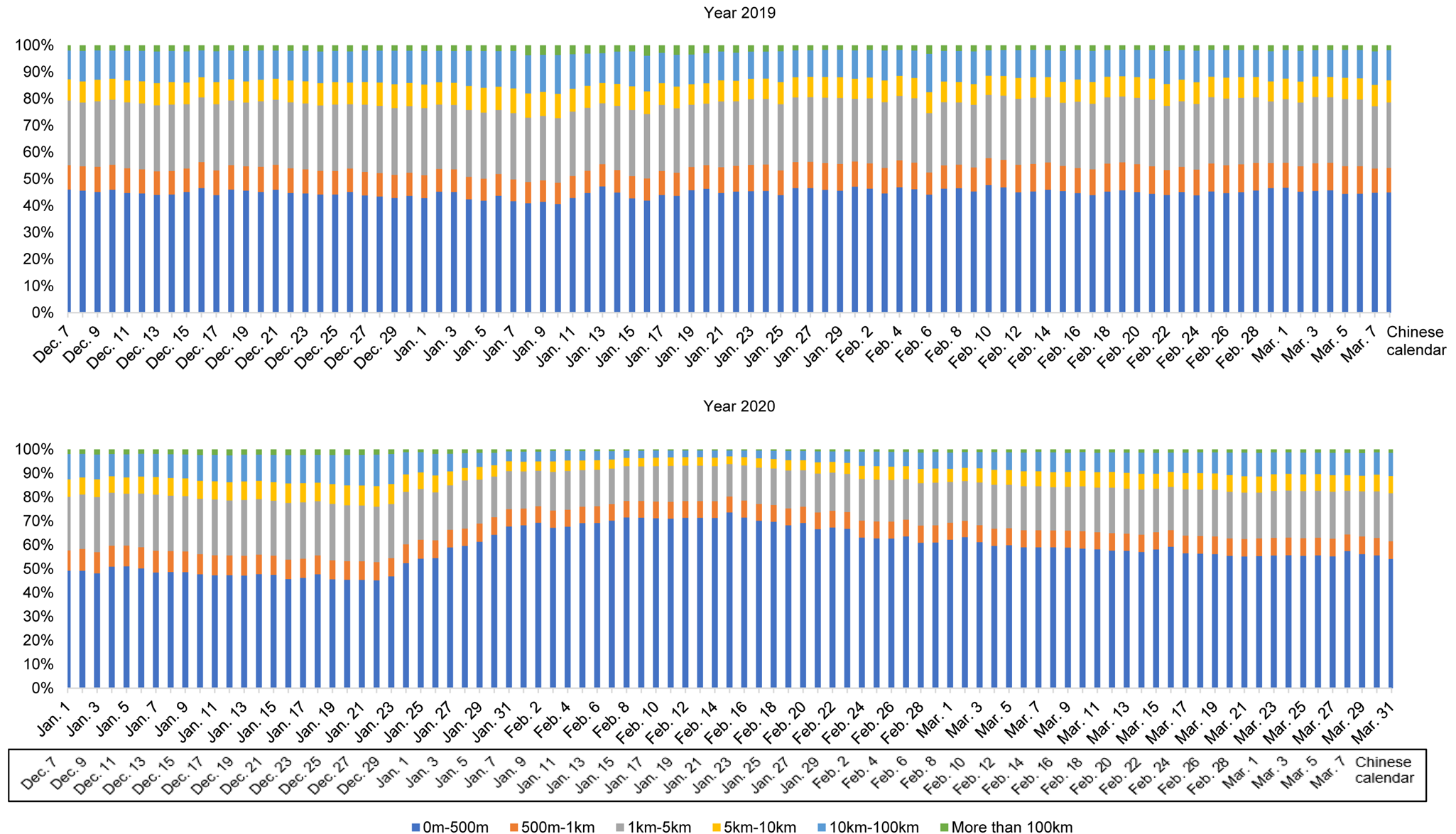
We observed a change in daily mobility patterns during the outbreak period in Sichuan Province compared with the same period 1 year earlier (Fig. 2). The change started on 19th January and continued throughout the entire study period, characterized by a substantially increased proportion of people in the self-limiting mobility group (online Supplementary Table S3; the proportion increased from 44.9% in 2019 to 58.6% in 2020, mean difference = 13.7%, 95% CI 11.9%–15.4%), together with a general decrease in all medium- and long-distance activity modes.
Daily mobility patterns during the COVID-19 outbreak, compared with the same calendar period 1 year earlier (according to Chinese calendar).
Emotional reactions and mobility patterns in relation to the COVID-19 outbreak
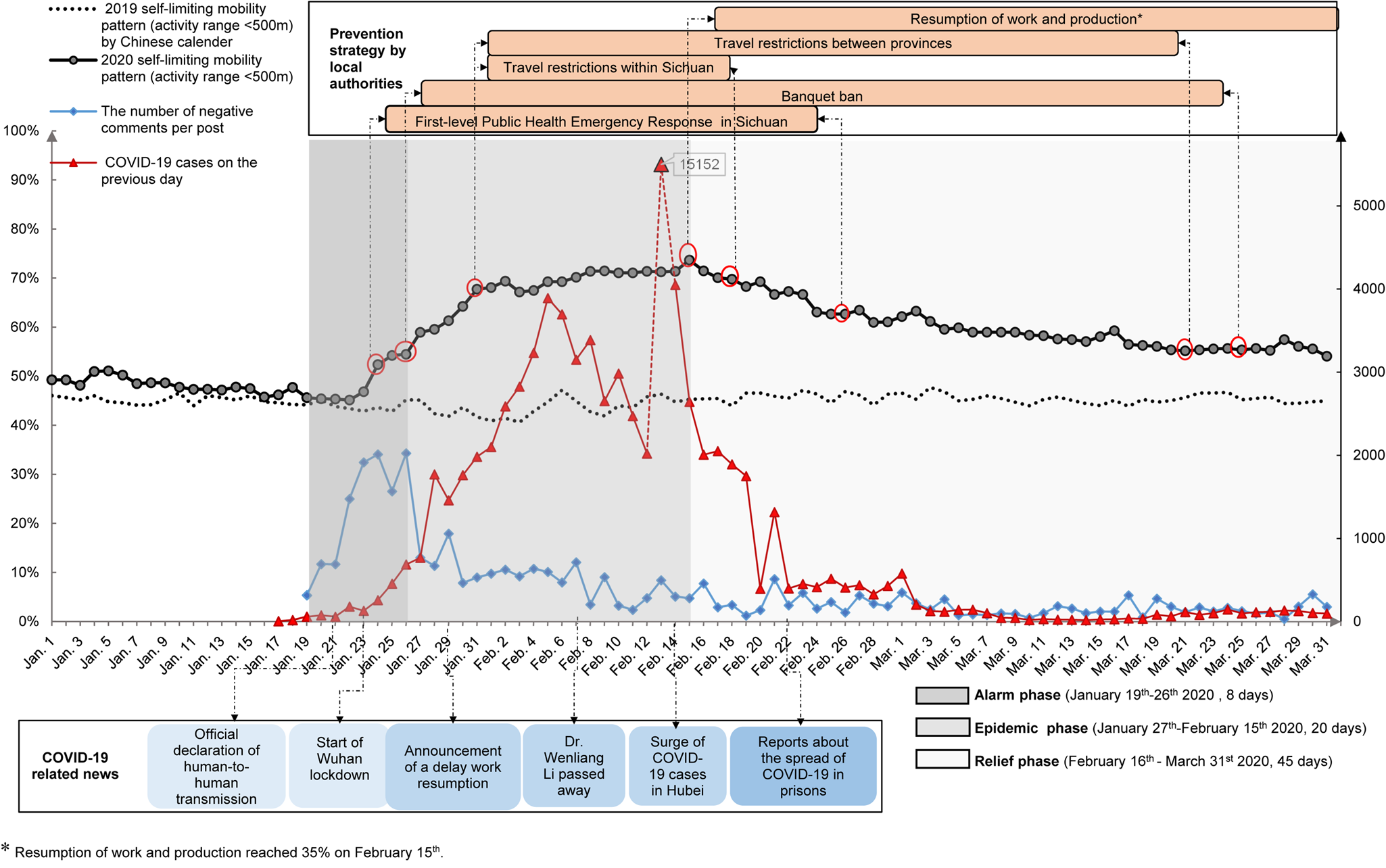
Figure 3 and Tables 1 and 2 describe the relationship between public emotional reactions and mobility patterns. Based on previous results, we focused on the number of negative comments per post and the percentage of people in the self-limiting mobility pattern in this analysis. Altogether, our summary of the changes in public emotional reactions and individual mobility patterns indicated there were three distinct phases of the COVID-19 outbreak.
Changes in the negative emotion, the self-limiting mobility pattern, and new daily cases during the COVID-19 outbreak.
Changes in the negative emotions of the public and the self-limiting mobility pattern during the COVID-19 epidemic, by phase
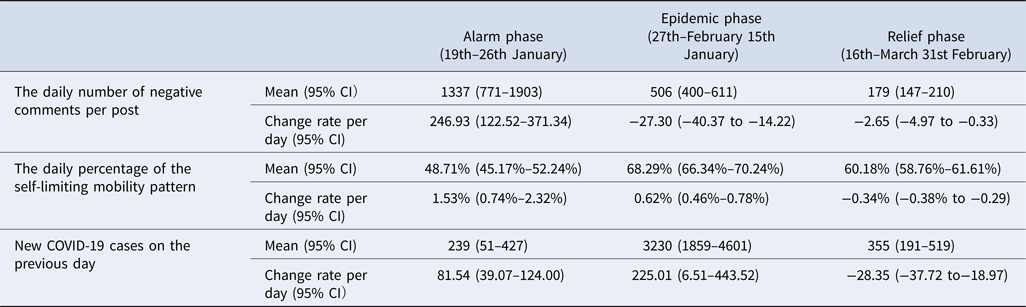
CI, confidence interval.
Correlations between negative emotions, the self-limiting mobility pattern, and the daily number of new COVID-19 cases, by phase
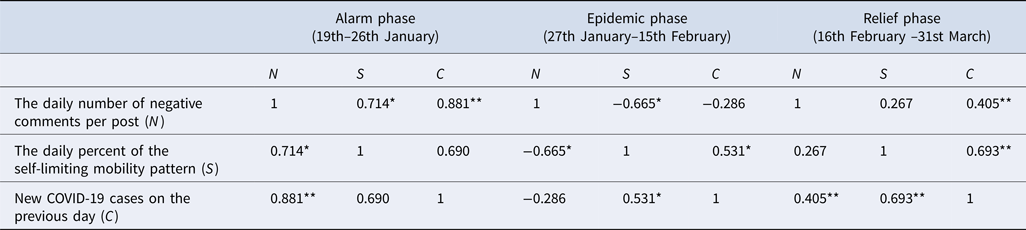
*The correlation was significant at 0.05.
**The correlation was significant at 0.01.
The alarm phase (19th–26th January 2020, 8 days) was the immediate period following the emergence of COVID-19, during which no restrictions on movement were imposed by the local government. It was characterized by low numbers of new cases reported daily (Table 1: the new cases increased by 82 cases per day, 95% CI 39–124), but a large amount of public attention and negative emotions (the number of negative comments per post increased by 246.9 per day, 95% CI 122.5–371.3). Importantly, we observed a substantial increase in the proportion of people in the self-limiting mobility pattern (from 45.6% to 54.5%, changing by 1.5% per day, 95% CI 0.7%–2.3%) during this restriction-free period, especially after the release of some key news (e.g. the official declaration of human-to-human transmission on 20th January). The correlation coefficient was 0.71 (p < 0.05) between the percentage of negative emotions and the percentage of people in the self-limiting mobility pattern (Table 2). The epidemic phase (27th January–15th February, 20 days) was a period during which strict mobility restrictions were constant. In this period, we observed an exponential increase in the daily numbers of new cases, representing the widespread COVID-19 outbreak in China (daily new cases increased by 225 per day, 95% CI 7–444), in contrast to a slightly decreased level of public negative emotions (the number of negative comments per post decreased by 27.3 per day, 95% CI −40.4 to −14.2), and a stabilized level of self-limiting mobility. The correlation coefficient was −0.29 (p > 0.05) between the percentage of negative emotions and number of new cases of COVID-19 on the previous day. The relief phase (16th February−31st March, 45 days) was a period when many people started to resume work, which was characterized by steady correlated declines in the daily number of new cases and decreasing levels of public negative emotions and self-limiting mobility.
In addition, during the whole study period, we found that the fluctuation of negative emotions was associated with the release of important negative news related to COVID-19, such as the lockdown of Wuhan (on 23rd January), the announcement that work resumption was delayed (on 30th January), and the surge of COVID-19 cases in Hubei (on 14th February).
Discussion
To the best of our knowledge, this is the first study to document public awareness of and emotional responses to COVID-19, as measured by social media data and mobility patterns, throughout the duration of the COVID-19 outbreak in China. Our results indicate that the emotional and behavioral reactions of the Chinese population to COVID-19 had three distinct phases, which were already set in place before government restrictions.
Previous research has revealed a profound and wide range of psychosocial reactions in the population during outbreaks of infectious diseases (Qiu et al., Reference Qiu, Shen, Zhao, Wang, Xie and Xu2020). Similarly, a high prevalence of severe stress reactions has been reported in various populations, e.g. healthcare workers (Lai et al., Reference Lai, Ma, Wang, Cai, Hu, Wei and Hu2020), the general public (Wang et al., Reference Wang, Pan, Wan, Tan, Xu, Ho and Ho2020), and adolescents (Wang, Zhang, Zhao, Zhang, & Jiang, Reference Wang, Zhang, Zhao, Zhang and Jiang2020) after suffering from the unprecedented public health crisis of COVID-19. Nevertheless, most of these investigations provided only suggestive evidence because their study samples were not representative. This study measured public awareness of COVID-19 and negative emotions to it in real-time during the entire period of the epidemic in China using Weibo, a social media network (Tong & Zuo, Reference Tong and Zuo2014). Interestingly, we found the changing pattern of expressed negative emotions did not always parallel the state of the epidemic, with the strongest public interest and negative emotions appearing immediately after the confirmation of the human-to-human transmission of COVID-19, i.e. before the exponential rise of the outbreak. Besides possible fear of an unknown disease, this unexpected news might have been considered as a big setback for planned home trips or family celebrations for the Chinese Spring Festival, which is very important for most Chinese people. Then, the emotional reaction became attenuated, with a continuous decrease in the number of negative comments per post per day during the epidemic period, despite the rapid increase of daily COVID-19 cases during this period.
Although the underlying mechanism remains unclear, our finding that the altered mobility pattern may partially be driven by emotional reactions, independent of governmental social distancing regulations, has support from prior studies indicating that increased awareness of or worry (i.e. fear) about a contagious disease can lead to spontaneous behavior to reduce the risk of being infected, such as wearing a mask and self-quarantining (Funk, Gilad, Watkins, & Jansen, Reference Funk, Gilad, Watkins and Jansenn.d.). Moreover, contrary to the opinion that the feelings of sadness and anxiety that emerged during the COVID-19 outbreak were merely transient, normal reactions to such difficult circumstances (Rose et al., Reference Rose, Manning, Bentall, Bhui, Burgess, Carr and Sheard2020), other studies have observed an increased incidence of various severe psychiatric conditions (e.g. depression, anxiety, psychological distress, and insomnia) among the general population, even months after exposure to the COVID-19 outbreak (Rehman et al., Reference Rehman, Shahnawaz, Khan, Kharshiing, Khursheed, Gupta and Uniyal2020; Vindegaard & Eriksen Benros, Reference Vindegaard and Eriksen Benros2020; World Health Organization, 2020). Post-traumatic stress disorder (PTSD) was observed less, however, as the COVID-19 outbreak is considered to be different from ‘conventional’ trauma (e.g. a natural disaster or accident), and, therefore, it does not meet the current criteria for trauma required for a PTSD diagnosis (Pfefferbaum & North, Reference Pfefferbaum and North2020). As reduced mobility has been reported among individuals with depression (Roshanaei-Moghaddam, Katon, & Russo, Reference Roshanaei-Moghaddam, Katon and Russo2009), which has been interpreted as a coping strategy to avoid interpersonal contact, it is plausible that the enhanced public awareness and negative emotions during the initial phase of the COVID-19 outbreak contributed to a timely reduction in mobility. Our results indicate emotional reactions can limit people's mobility to an extent (i.e. a daily activity range <500 m, which might reflect self-motivated home quarantine), which is critical for the control of the COVID-19 infection, and it is at least as influential as government-enforced disease prevention through mandatory social distancing. This result implies there is a need to improve public awareness of severe epidemics.
Intriguingly, although all control measures had been removed by the end of our study (31 March), the self-limiting mobility pattern of people somehow remained. This confirms speculation that the general public may not return to a normal level soon after a crisis, or that there will be a new level normal.
The major contribution of our study is its integrative use of online data and location data to provide a complete picture of emotional and behavioral reactions at the population level during the whole COVID-19 outbreak, from the pre-epidemic to the post-epidemic period. Moreover, since few new locally transmitted COVID-19 cases were reported in China at the time of the analysis, our research enables complete tracking of the dynamic changes in the factors we studied during the entire period of the outbreak. In addition, when studying the mobility patterns, we took into account factors other than COVID-19, such as the traditional Chinese Spring Festival (by comparing the same period during the prior year according to the Chinese calendar) and the restrictions on movement that were implemented by local authorities.
Our study has several limitations. First, since Weibo was the only data source for the awareness and emotion analyze, we were not able to include the whole Chinese population. According to previous reports (Cyberspace Administration of China, 2019), approximately 43% of the Chinese population have a Weibo account, and Weibo users are more likely to be male, under 40 years old, and live in regions that are more economically developed (IResearch, 2011; Fu & Chau, Reference Fu and Chau2013). Second, the lack of validity of the search terms used for searching COVID-19-related posts may be a concern. However, we used a broad range of search terms to ensure the inclusion of all relevant posts, which were then screened manually for accuracy. This method was not efficient, but it enabled the assessment of the population's emotional reactions to the COVID-19 outbreak in a timely manner. Third, although Emojis are widely used for sentiment analyses (Ai et al., 2017), Emoji-based emotional assessment may not be representative of the entire sample as not all posted comments have an Emoji. Thus, more advanced methods (e.g. a combination of Emoji analysis and analysis of key words in the comments based on natural language processing techniques) need to be developed to confirm our findings in the future. Fourth, the mobility pattern was summarized solely based on the location data of the Sichuan population, as the data from other provinces were not available. However, given the strict disease prevention strategies, such as home or centralized isolation for close contacts and the compulsory stay-at-home policy for all residents, the self-motivated mobility pattern in Hubei was difficult to study. Instead, all provinces other than Hubei were universally impacted by imported cases and they applied similar responses and control measures. Therefore, the change of mobility patterns should be comparable between Sichuan and other major provinces. Fifth, we defined the mobility patterns according to the crowd distance between the two farthest positioning points, which might not accurately reflect the real distance that an individual moved. Sixth, the three distinct phases in the current analyses were defined by the investigator's use of key events that were relevant to mobility patterns. Alternative methods, such as a data-driven approach, should be used in future studies to optimize the phase definition (e.g. by changes in the correlations between the studied factors). Finally, as this is an ecological study, it only used aggregated data; thus, caution is needed when applying grouped findings to the individual level.
In conclusion, during the COVID-19 outbreak in China, the public's emotional reaction was strongest before the exponential rise of COVID-19 cases and declined thereafter. The change in human mobility patterns occurred before the implementation of government restrictions, suggesting possible links among emotion, awareness, and reduced population mobility.
Supplementary material
The supplementary material for this article can be found at https://doi.org/10.1017/S003329172000375X
Data
Weibo data are available at https://weibo.com/. For mobility data, our collaboration agreement with the data provider prohibits us from sharing these data with third parties, but interested parties can request the data at https://heat.qq.com/.
Acknowledgements
We thank the team members involved in West China Biomedical Big Data Center for Disease Control and Prevention for their support. Huan Song had full access to all the data in the study and takes responsibility for the integrity of the data and the accuracy of the data analysis.
Author contributions
HS (songhuan@wchscu.cn) and WZ (weizhanghx@163.com) are the guarantors. HS and WZ were responsible for the study concept and design. HS, YZ, YL, GL, HY, ZY, YH, JQ, and CZ performed the data collection and data analysis. HS, YL, YZ, GL, and WZ interpreted the data. YL, YZ, HS, UAV, FF, and DL drafted the manuscript. All authors approved the final manuscript as submitted and agree to be accountable for all aspects of the work.
Financial support
This work is supported by the West China Hospital COVID-19 Epidemic Science and Technology Project (No. HX-2019-nCoV-014 to Dr Song, No. HX-2019-nCoV-019 to Dr Zhang), Sichuan University Emergency Grant (No. 2020scunCoVyingji1002 to Dr Song, No. 2020scunCoVyingji1005 to Dr Zhang), and Emergency Grant form Science & Technology Department of Sichuan Providence (No. 2020YFS0007 to Dr Zhang).
Role of funder or sponsor
The sponsors had no role in the design and conduct of the study; collection, management, analysis, and interpretation of the data; preparation, review, or approval of the manuscript; and decision to submit the manuscript for publication.
Conflict of interest
The authors declare no competing interests.


 Open access

