





Introduction
As many countries transition from fossil fuels to renewable energy sources to combat climate change (IPCC 2014), expansion of overhead power-line distribution is forecast to increase substantially, especially in developing countries. However, this anticipated growth poses pressing challenges for wildlife conservation efforts (see Dwyer et al. Reference Dwyer, Harness and Donohue2014, Smith & Dwyer Reference Smith and Dwyer2016, Bernardino et al. Reference Bernardino, Bevanger, Barrientos, Dwyer, Marques and Martins2018). As power-line networks expand, so too do the risks of electrocution and collision incidents for avian species (Biasotto et al. Reference Biasotto, Moreira, Bencke, D’Amico, Kindel and Ascensão2022, Guil & Pérez-García Reference Guil and Pérez-García2022). Integrating measures to address these threats into wildlife protection policies is imperative to ensure the conservation of avian populations (Antal Reference Antal2010, Prinsen et al. Reference Prinsen, Smallie, Boere and Píres2012, Smeraldo et al. Reference Smeraldo, Bosso, Fraissinet, Bordignon, Brunelli, Ancillotto and Russo2020, Therkildsen et al. Reference Therkildsen, Balsby, Kjeldsen, Nielsen, Bladt and Fox2021).
Overhead power lines significantly impact bird life, with the level of collision risk influenced by factors such as avian diversity, weather conditions, visibility and location of power-line sections relative to important bird habitats and migration routes (APLIC 2006). Furthermore, the specific design of power lines plays a crucial role, particularly in instances of electrocution (Bevanger Reference Bevanger1998). Above-ground power lines pose three primary risks to birds. Birds perching on power poles or cables can be electrocuted if they cause short circuits, either between phases or to the ground. In flight, birds may collide with power-line cables, which are often difficult for them to perceive as obstacles; such collisions can result in immediate death or fatal injuries. Above-ground power lines cutting across open landscapes and vital bird habitats, such as wetlands and steppes, can also degrade habitat quality and fragment important feeding, breeding or hibernating areas, leading to avoidance by sensitive bird species (Northrup & Wittemyer Reference Northrup and Wittemyer2013, Ngila et al. Reference Ngila, Chiawo, Owuor, Wasonga, Ellwood and Mugo2024).
Threats of electrocution and collision to avian species are increasingly pertinent in Kenya, as the species intersect with both infrastructural energy development and conservation initiatives aimed at preserving declining avian populations (Jon Smallie & Virani Reference Smallie and Virani2010). Placement of these power lines may coincide with areas suitable for avian species, resulting in fatalities due to electrocution, collision or habitat fragmentation (Bevanger Reference Bevanger1994, Harness & Wilson Reference Harness and Wilson2001, Eccleston & Harness Reference Eccleston, Harness, Sarasola, Grande and Negro2018, Dwyer et al. Reference Dwyer, Karyakin, López and Nikolenko2022). These incidents not only pose risks to avian populations but can also lead to power outages, resulting in significant financial losses for electricity provider and distributor companies (Biasotto et al. Reference Biasotto, Moreira, Bencke, D’Amico, Kindel and Ascensão2022). Particularly in avian species with slow reproductive rates such as raptors, these incidents have profound implications for population declines (Lehman Reference Lehman2001, Eccleston & Harness Reference Eccleston, Harness, Sarasola, Grande and Negro2018).
In Africa, electrocution and collision incidents resulting from power lines and wind turbines increasingly impact avian species such as raptors, bustards, cranes and flamingos (Jenkins et al. Reference Jenkins, Smallie and Diamond2010, Shaw et al. Reference Shaw, Jenkins, Ryan and Smallie2010, Smallie & Virani Reference Smallie and Virani2010, Prinsen et al. Reference Prinsen, Boere, Píres and Smallie2011, Smallie & Strugnell Reference Smallie and Strugnell2011, Angelov et al. Reference Angelov, Hashim and Oppel2013). While international policy debates have highlighted these issues (e.g., Prinsen et al. Reference Prinsen, Boere, Píres and Smallie2011, Loss et al. Reference Loss, Will and Marra2014, Reference Loss, Will and Marra2015, Bernardino et al. Reference Bernardino, Bevanger, Barrientos, Dwyer, Marques and Martins2018), their incorporation into key policy documents related to energy and wildlife conservation in Africa remains limited. Kenya’s rapid electrical infrastructure growth compared to other East African countries in the last decade makes it a critical case study for understanding the broader implications of infrastructure expansion on wildlife conservation. Its expansion through Kenya Power and Lighting Company (KPLC) has more than doubled electricity access from 26% in 2013 to 77% in 2018. In its 2023–2042 Master Plan, Kenya Electricity Transmission Company (KETRACO) underscores Kenya’s commitment to sustainable energy but also highlights the need for integrated conservation strategies to mitigate biodiversity impacts (USAID 2016).
The present assessment aligns with global conservation goals such as those of the Global Biodiversity Framework (GBF) and the International Union for Conservation of Nature (IUCN). The GBF aims to address drivers of biodiversity loss and improve the status of ecosystems and species, emphasizing the need for development practices that reduce negative impacts on wildlife (SCBD 2014). Similarly, the IUCN’s mission to conserve biodiversity and ensure that natural resources are used sustainably underscores the importance of mitigating risks to avian species from energy infrastructure. By examining Kenya’s policy approaches to avian conservation in the context of expanding power-line networks, this study contributes to the broader objectives of these global frameworks, advocating for integrated conservation strategies that balance infrastructural development with biodiversity protection.
This study hypothesizes that current wildlife protection policies in Kenya lack specific provisions addressing the impacts of power lines on avian species, with three main predictions. First, existing policies probably emphasize general wildlife protection but inadequately address infrastructure-related risks such as electrocution and collision. Second, policy gaps may indicate a need for targeted regulations or amendments to integrate avian-specific concerns within infrastructure frameworks. Third, a comprehensive policy review will reveal opportunities to enhance collaboration between conservation and energy sectors to mitigate these risks. The present study will: (1) identify existing policies concerning wildlife protection in Kenya; (2) assess their effectiveness and highlight infrastructure-related deficiencies; and (3) examine how avian threats are addressed within current policy frameworks.
Methods
Source documents
Our analysis focuses on publicly available policy documents (Table 1) and does not encompass the policy formulation process itself. While recognizing that policies often extend beyond what is explicitly stated in written texts, we consider these documents as indicative of a governing body’s stance on specific issues. To achieve a systematic review, we conducted a thorough search for relevant documents across Google, Google Scholar and Scopus. We specifically targeted government-published reports and official documents pertaining to the issues mentioned. Our search strategy involved using a combination of specific search terms restricted to Kenya’s jurisdiction. The key terms used were ‘wildlife policy’, ‘energy policy’, ‘wildlife act’, ‘energy act’, ‘wildlife strategy’, ‘environment act’ and ‘climate change act’.
Source documents.

Policy analysis
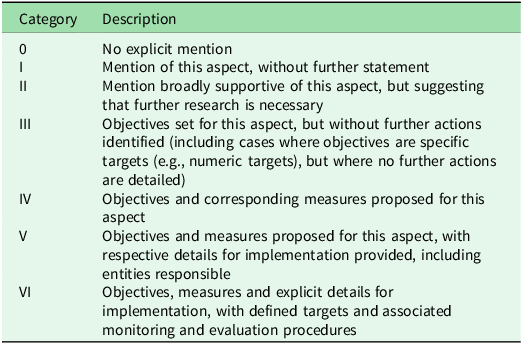
We used content analysis (Crona & Rosendo Reference Crona and Rosendo2011) to analyse 11 policy documents (Table 1). We recorded any prescriptive statements and provisions, along with guiding principles, related to the conservation of avian species. Specifically, we focused on the impact of infrastructural development, the importance of conservation areas and the protection of migratory birds. We then classified the statements and provisions addressing these themes in each analysed policy instrument according to their placement along a policy action gradient, ranging from the lowest category, where there is no explicit mention, to the highest category, where objectives, measures, details for implementation and monitoring and evaluation procedures are defined (Table 2).
Description of the categories used to classify provisions and statements in the surveyed policy documents.
Results
Integration of electrocution and collision threats into wildlife policy frameworks
Only four of the documents we analysed recognized the importance of protecting migratory species by preserving wildlife buffer zones, migratory routes, corridors, dispersal areas and habitats while also addressing human–wildlife conflict (HWC). The 2003 African Convention on the Conservation of Nature and Natural Resources (ACCNNR) emphasized monitoring species, including migratory species, and provided appropriate protection. However, the potential challenges posed by infrastructure development, such as power lines or wind turbines, were not adequately addressed in the avian and wildlife conservation documents.
Most policy and strategy documents (Table 3) consistently identified HWC as a prominent issue, often focusing on mitigation through community wildlife associations. These documents frequently criticized protected areas for their policy weaknesses, institutional challenges, financial limitations and struggles within the tourism sector. Calls to bridge biodiversity research gaps and involve local communities in wildlife management were common themes. The documents emphasized biodiversity conservation across diverse habitats and recognized the importance of national parks, reserves, wildlife sanctuaries and protected areas. Kenya’s commitment to international agreements, such as the Convention on the Conservation of Migratory Species, was consistently mentioned.
Summary of provisions and statements in the surveyed policy documents.

CMS = Convention on the Conservation of Migratory Species; HWC = human–wildlife conflict.
While most documents acknowledged threats such as HWC, pollution, climate change, habitat degradation, overexploitation, poaching, illegal trade and invasive species, they rarely addressed the impacts of infrastructure on wildlife. Only the 2020 Wildlife Strategy discussed how unplanned infrastructure can destroy habitats, fragment landscapes and hinder wildlife movement, albeit without a specific focus on threats such as power lines or wind turbines. Discussions on electrocution or collision threats to wildlife are absent in documents such as the National Energy Policy, the Energy Act, the Climate Change Act and the Environmental Management and Coordination Act (Table 3).
Wildlife conflict mitigation measures
The Wildlife Conservation and Management Act, the Wildlife Policy, the Wildlife Strategy, the Wetlands Policy, the Kenya Climate Change Act, the National Biodiversity Strategy and Action Plan (NBSAP) and the National Environmental Policy proposed diverse strategies, including reducing poaching, mitigating HWC, conserving priority species and adopting climate change measures. The Wildlife Strategy suggested developing an Endangered Species Act to mobilize public support and coordinate cross-sectoral conservation efforts for endangered species, aiming to create a legal framework for their protection.
The NBSAP emphasized using economic instruments to promote biodiversity conservation, including incentives to encourage conservation over habitat degradation. It outlined strategies for restoring degraded ecosystems, establishing protected areas for threatened ecosystems and increasing awareness among local communities and decision-makers. It also called for strengthening national capacities for technology transfer and promoting international collaboration to implement wildlife conservation policies. The ACCNNR highlighted the need for legislation to protect species, identifying and eliminating factors causing species depletion and establishing protected areas and forest reserves. It emphasized the responsibility of Parties to protect species unique to their jurisdictions.
Despite comprehensive strategies to mitigate threats such as habitat degradation, poaching and HWC, none of these documents explicitly addressed the significant threats posed by electrocution and collision incidents from power lines and wind turbines.
Discussion
The impacts of power lines on avian species were largely absent from Kenya’s policy documents, despite the potential to contribute to species conservation and reduce financial losses from bird-related power outages (Antal Reference Antal2010). This invisibility may have stemmed from several factors. There may be a lack of awareness or understanding among policymakers about the issue’s severity. Competing priorities and resource constraints might have led to deprioritizing wildlife conservation, especially that related to infrastructure development. The complexity of addressing electrocution and collision threats may complicate policy interventions. Additionally, the absence of robust data on power lines’ impacts on avian species in developing countries may hinder evidence-based policy formulation (Martín et al. Reference Martín, Rafael, López, Sousa and Barrios2022). Vested interests or lobbying efforts from infrastructure industries may have also influenced policy agendas.
The limited consideration of electrocution and collision impacts from power lines and wind turbines may have substantial implications for avian species conservation. It may undermine the ability of conservation biologists and land managers to effectively combat or accommodate future environmental changes. As developing countries, including Kenya, transition to renewable energy sources amidst climate change predictions (REN21 2014), the lack of mitigation measures for avian mortality poses a challenge. Kenya’s NBSAP submitted in 1999 lacks representation of electrocution and collision issues, indicating a need for revision. There is also no mention of the impact of such infrastructures on wildlife within the NBSAP. This oversight is concerning given the expanding power transmission network in Kenya and planned connections with Ethiopia, Uganda and Tanzania (Republic of Kenya 2018).
There is inadequate recognition and discussion of bird electrocution and collision in key policy documents not only in Kenya but also in other countries in Africa (e.g., Sudan and Ethiopia; Angelov et al. Reference Angelov, Hashim and Oppel2013, Bakari et al. Reference Bakari, Mengistu, Tesfaye, Ruffo, Oppel, Arkumarev and Nikolov2020, BirdLife International 2021). Without a comprehensive study of the policy process, it is challenging to determine why electrocution and collision impacts on wildlife are absent from these policies and frameworks. Two factors may have contributed to this oversight. First, Kenya’s transition from a Least Developed Country to lower-middle-income status suggests a shift in development priorities. Electrocution and collision may not have been significant concerns for conservationists and decision-makers until recently, as evidenced by the limited number of studies on these issues in Kenya (Smallie & Virani Reference Smallie and Virani2010, Ngila et al. Reference Ngila, Chiawo, Owuor, Wasonga, Ellwood and Mugo2023, Reference Ngila, Chiawo, Owuor, Wasonga, Ellwood and Mugo2024). Second, a lack of awareness or understanding of the extent of these impacts on wildlife may have further contributed to their omission from policy discussions. Further research is needed to understand the factors influencing this gap in conservation policymaking and decision-making processes.
Conclusion
The absence of robust policies and legal frameworks addressing avian mortality from electrocution and collision with power lines reveals an oversight in conservation policy. This gap not only limits the accountability of energy institutions but also leaves conservationists without the necessary legal backing to advocate for effective mitigation measures. As biodiversity continues to decline due to threats such as climate change and habitat loss, the conservation and energy sectors need to work together to address these challenges. Conservation scientists must also play an active role in translating their research into actionable policy recommendations. The urgency of the current biodiversity crisis demands that scientists move beyond mere documentation of species declines and actively engage with policymakers to influence conservation legislation. By integrating data-driven decision-making and adaptive management strategies, conservation policies can be strengthened to address infrastructure-related risks more effectively.
Acknowledgements
We are grateful to the two reviewers and editor for their valuable comments on the manuscript.
Financial support
None.
Competing interests
The authors declare none.
Ethical standards
None.


 Open access

