

Introduction
In the previous chapter, the capability approach (CA) formulated by Amartya Sen is presented. This chapter focuses on the application of the CA, with a particular emphasis on sustainable employability (SE). In this context, the emphasis in discussing the CA is on its relevance to the well-being of individuals in their living and working environments and the broader social and societal context [Reference Sen1, Reference Sen2, Reference Sen, Nussbaum and Sen3]. The CA offers a promising and innovative framework for thinking about sustainability, encompassing well-being and flourishing at work, with a focus on the person and the work context.
The CA was originally a theory focused on social justice. A just society offers all people the opportunity to live a good life, that is, a life they value. This implies that they have the freedom or opportunity (capability) to do what they want to do (doings) and to be who they want to be (beings), which contributes to their well-being and quality of life: “beings and doings people have reason to value” [Reference Sen4, Reference Sen5)]. The CA was used to develop a model and operationalisation of SE [Reference Abma, Brouwer, De Vries, Arends, Robroek and Cuijpers6, Reference Van der Klink, Bültmann, Burdorf, Schaufeli, Zijlstra and Abma7]. The idea behind this concept of SE is that people can work throughout their lifetime while safeguarding their health and well-being. Being able to do the things people value in life is important; also, in work settings, people want to add value (for some people’s financial value) to themselves and to society. This was considered a crucial element by the consortium of authors of this chapter when providing a definition and model of SE (see [Reference Van der Klink, Bültmann, Burdorf, Schaufeli, Zijlstra and Abma7]).
The original articles were the first to operationalise capabilities within work in the form of a set of work values/capabilities. Until then, work was seen as an important capability that contributed to well-being. Our article introduces the innovative perspective that distinct characteristics of the job could also be seen as representing values and capabilities. ‘Work’, as a general capability, is thus divided into a number of more specific (value) aspects that can be points of action to improve the quality of work.
If people can realise these more specific value aspects in their work, their contribution will be experienced as more valuable by the work environment and by themselves, resulting in a stronger bond between work and employees and hence more SE.
Referring back to the anecdote with which this book began, a ‘cathedral builder’ is more sustainable and happier in his work than a ‘stonecutter’. Our ambition is that all stonecutters will become cathedral builders (see Chapter 1). The objective of this chapter is to present the views and comments from the academic community on the relevance and feasibility of the model and the definition of SE provided by the consortium, which is presented later.
We report on a Delphi study conducted among international experts from various fields, including capability experts, occupational health psychology experts, and disability studies experts. We invited them shortly after the publication of our articles to evaluate the scientific and practical possibilities of the products described later (the definition, the model, and the work capability set) and to provide recommendations for further research.
After presenting this unpublished Delphi study, we discuss two recent articles that comment on our approach. In the following subsection, we indicate the extent to which theory formation and further research have actually taken place, providing an answer to the formulated recommendations and points of criticism. Finally, we discuss the current state of affairs and provide recommendations for future research.
In addition to the scientific developments described in this chapter, there is an impressive application of the work capability set in practice. It has been used by many professionals, such as occupational physicians, occupational psychologists, occupational nurses, labour experts, and human resource management (HRM) professionals. In Chapter 10, examples of practical applications are described.
A Capability-Based Definition, Model, and Questionnaire of Sustainable Employability
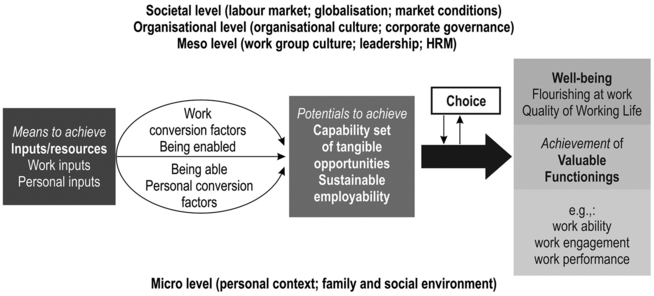
As indicated in Chapter 1 and earlier in this chapter, we formulate a definition of SE based on the capability model (Box 2.1), design a model based on capability models by Sen, Morris, Robeyns, and Welch Saleeby (Figure 2.1), and develop a questionnaire to operationalise values and capabilities at work (Box 2.2; see also Appendix 2.1).
“Sustainable employability (SE) means that throughout their working lives, workers can achieve tangible opportunities in the form of a set of capabilities. They also enjoy the necessary conditions that allow them to make a valuable contribution through their work, now and in the future while safeguarding their health and welfare. This requires, on the one hand, a work context that facilitates this for them and, on the other, the attitude and motivation to exploit these opportunities.”

Figure 2.1 Long description
The means to achieve inputs or resources include work and personal inputs. These inputs are then processed through Work conversion factors being enabled and Personal conversion factors being able to achieve capability set of tangible opportunities for sustainable employability. A Choice element acts as a mediator before reaching final outcomes which include well-being like flourishing at work and maintaining quality of working life and specific achievements of valuable functionings like work ability, engagement, and performance. The societal context includes the labour market, globalisation, and market conditions. The organisational context includes culture and corporate governance. The meso-level covers the work group culture, leadership, and H R M. The micro level includes the personal context, family, and social environment.
1. Using knowledge and skills
2. Developing knowledge and skills
3. Participation in decision-making
4. Developing and maintaining meaningful contacts at work
5. Setting personal goals
6. Having a fair income
7. Contributing to a greater, valuable good
In accordance with this definition and based on the previously mentioned models by Sen and others, we developed the following model for sustainable employment. This model is a slightly modified version of the model in Van der Klink et al. [Reference Van der Klink, Bültmann, Burdorf, Schaufeli, Zijlstra and Abma7].
Based on the definition and model, seven work values were identified [Reference Abma, Brouwer, De Vries, Arends, Robroek and Cuijpers6, Reference Van der Klink, Bültmann, Burdorf, Schaufeli, Zijlstra and Abma7] [see Box 2.2]. To identify this work capability set (i.e., aspects that people value at work), a qualitative study was conducted, consisting of interviews with employees and expert meetings, in addition to a literature review. The interviewees represented as much as possible a cross-section of the Dutch working population in terms of professions and sectors. According to Sen’s assumption, it is important to ask the target group what is important to them and what they value. Such valued aspects can be considered to be a (work) capability for a person if (a) it is an important value for this person in their particular work situation; (b) theyFootnote 1 are enabled by the work context (e.g., an adequate HRM policy; see Chapter 8); and (c) they are able to achieve it. These three elements (a, b, c) are rated on a five-point scale. If a person indicates that they regard a value important and feel enabled and able to realise it, that value is considered to be part of the work capability set. After all, a capability is a value that one deems important and can realise.
The focus on the specific work situation of an individual implies that the actual work capability set is context-dependent, even though most people value similar things. Therefore, in one-on-one situations, such as consultation contacts (with one of the professionals mentioned earlier), one should realise that the work capability set can differ per person and per job. In such practical situations, it is therefore advisable to ask whether there are other important values. Once what people value in their work (or a particular job) has been established, they should be asked to rate the various aspects of the work capability set.
In the next step, the list was validated in a representative sample of 1,100 Dutch employees. Correlation and regression analyses were performed to determine the statistical relationship between items of the potential value set and the indicators of SE. Based on these analyses, a group of experts established the final set of seven key work values (see Box 2.2).
The list of resulting capabilities (which we refer to as the ‘work capability set‘), identified in working people according to the Sen method, features characteristics of work that can also be found in major theories in work and organisational psychology and occupational health models, such as the manifest and psychological needs of Jahoda [Reference Jahoda8], the job characteristics models of Hackman and Oldham [Reference Hackman and Oldham9], and the ‘work vitamins’ of Warr [Reference Warr10]. These theories have been developed, using different perspectives, and have incorporated approximately the same features. This indicates the robustness of our list of work values.
In Appendix 2.1, you will find an English version of the work capability set. It has been translated from Dutch according to the standards of scientific translations (forward and backwards translations).
Consultation of Experts
To gain clarity on how experts assess the scientific and practical possibilities of the definition, model, and work capability set, Meerman conducted a two-round Delphi study on behalf of the consortium. A group of eighteen international experts, nine of whom responded to the second round and thus to both rounds, with backgrounds in occupational health and occupational psychology, disability studies, and the CA, were invited to take part. They were asked to reflect on the following topics: 1) the need for this research and its products; 2) comments on the products; and 3) follow-up research.
Most experts who have observed rapid changes, including new working patterns in developing countries, the ageing of societies, and the introduction of technologies, digitalisation, and globalisation, saw the necessity of a paradigm shift in terms of capabilities. The work capability set was generally well appreciated as operationalising the capability concept in the domain of work and health. Most experts agreed with the procedure for developing the ‘capability set for work’, which uses a combination of qualitative and quantitative methods.
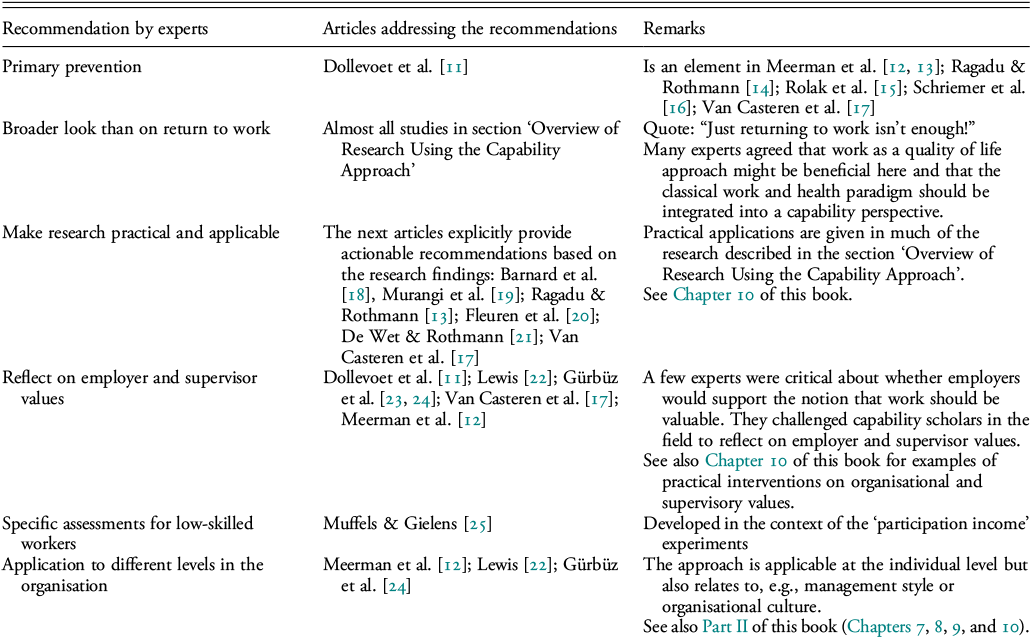
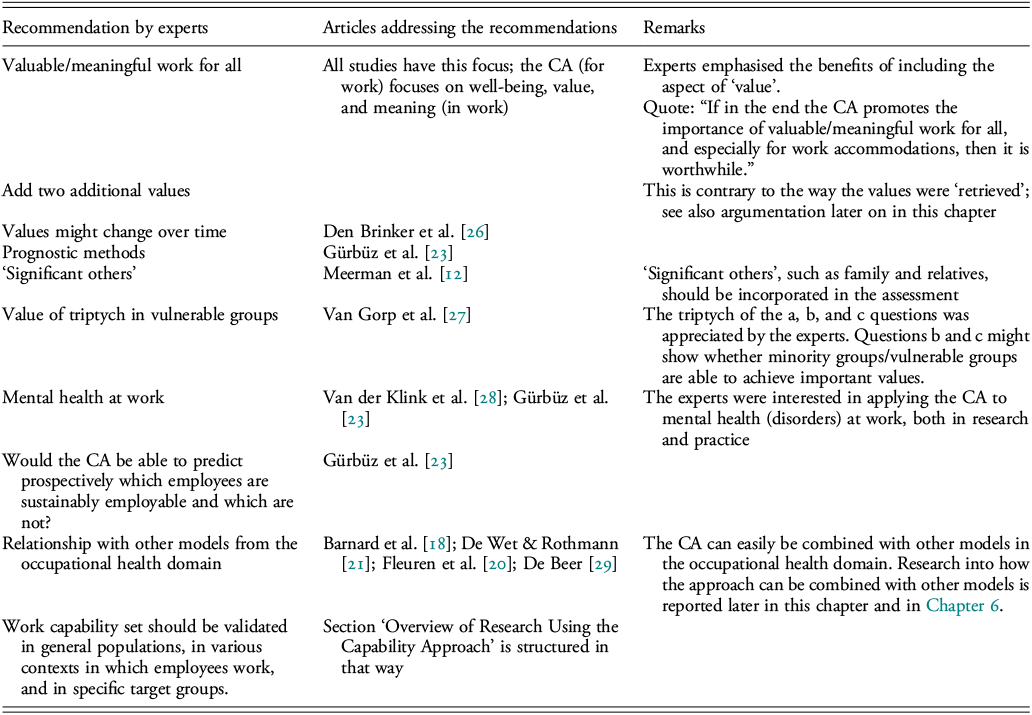
Table 2.1 shows the experts’ recommendations for follow-up research, indicating which studies have been addressed since then. Most recommendations have been researched in several studies; in the third column, we provide some general remarks or comments from the experts.

Table 2.1(a) Long description
The table has 3 columns. The first column lists the experts’ recommendations, followed by Articles addressing the recommendations and remarks in the second and third columns respectively.
The data included in the page are as follows.
Primary prevention. It is specifically addressed in the work of Dollevoet et al. (2022). According to the remarks, primary prevention is an element cited in studies by Meerman et al., Ragadu et al., Rolak et al., Schriemer et al., and Van Casteren et al.
Broader look than on return to work. It is specifically addressed in almost all studies in section “Overview of research using the Capability Approach”. The recommendation is encapsulated by a quote that reads, “Just returning to work isn’t enough!” Many experts agreed that work as a quality of life approach might be beneficial here and that the classical work and health paradigm should be integrated into a capability perspective.
Make research practical and applicable. It is specifically addressed in the next articles explicitly providing actionable recommendations based on the research findings, such as Barnard et al., (Murangi et al., Ragadu and Rothmann, Fleuren et al., De Wet et al., and Van Casteren et al. According to the remarks, practical applications are given in much of the research described in the section “Overview of research using the CA”, chapter 10 of this book.
Reflect on employer and supervisor values. It is specifically addressed in the work of Dollevoet et al, Lewis, Gürbüz et al., Van Casteren et al., and Meerman et al. According to the remarks, a few experts were critical about whether employers would support the notion that work should be valuable. They challenged capability scholars in the field to reflect on employer and supervisor values. See also Chapter 10 of this book for examples of practical interventions on organisational and supervisory values.
Specific assessments for low skilled workers. It is specifically addressed in the work of Muffels and Gielens. According to the remarks, it is developed in the context of the ‘Participation Income’ experiments’.
Application to different levels in the organisation. It is specifically addressed in the work of Meerman et al., Lewis, and Gürbüz et al. According to the remarks, the approach is applicable at the individual level but also relates to, such as management style or organisational culture. See also part 2 of this book (Chapters 7, 8, 9 and 10).

Table 2.1(b) Long description
The data included in the page are as follows.
Valuable slash meaningful work for all. All studies have this focus, the C A for work focuses on well-being, value and meaning in work. According to the remarks, experts emphasised the benefits of including the aspect of ‘value’ with a quote that reads as follows. “If in the end the C A promotes the importance of valuable slash meaningful work for all, and especially for work accommodations, then it is worthwhile”.
Add two additional values. According to the remarks, this is contrary to the way the values were ‘retrieved’.
Values might change over time. It is specifically addressed in the work of Den Brinker.
Prognostic methods. It is specifically addressed in the work of Gürbüz et al.
Significant others. It is specifically addressed in the work of Meerman et al. According to the remarks, Significant others’, such as family and relatives, should be incorporated in the assessment.
Value of triptych in vulnerable groups. It is specifically addressed in the work of Van Gorp et al. According to the remarks, the triptych of the a, b and c questions was appreciated by the experts. Questions b and c might show whether minority groups/vulnerable groups are able to achieve important values.
Mental Health at work. It is specifically addressed in the work of Van der Klink et al. and Gürbüz et al. According to the remarks, the experts were interested in applying the C A to mental health disorders at work, both in research and practice.
Would the C A be able to predict prospectively which employees are sustainably employable and which are not? It is specifically addressed in the work of Gürbüz et al.
Relationship with other models from the Occupational Health domain. It is specifically addressed in the work of Barnard et al., De Wet and Rothmann, Fleuren et al., and De Beer et al. According to the remarks, the C A can easily be combined with other models in the Occupational Health domain. Research into how the approach can be combined with other models is reported below and in Chapter 6.
Work capability set should be validated in general populations, in various context in which employees work and in specific target groups. It is specifically addressed in the section ‘Overview of research using the CA’ is structured in that way.
The experts considered the work capability set promising but also noted that it needs further validation, both psychometrically and in different specific target groups and contexts.
Later, we first discuss the recommendations of the experts, followed by a discussion of some published critical remarks. In the section ‘Overview of Research Using the Capability Approach’, we summarise the research that has been conducted since the experts’ recommendation, following their suggestion for a classification in psychometrics, specific target groups, and specific contexts.
Discussion of the Recommendations of the Experts
Since the expert consultation, the approach has been scientifically investigated at relevant levels in the organisation (see Chapters 7, 8, and 9) and has also been put into practice at these levels (see Chapter 10).
Adding values, as suggested by the experts, is not in accordance with the Sen method we followed, in which values are mainly ‘collected’ from the target group (in our case, by means of interviews; Sen leaves room for expert opinion, and we have applied that). Furthermore, in the meantime, the list has proven its worth. Moreover, ‘the ability to achieve goals’ (as suggested by the experts) is not a value (but a conversion factor in capability terms).
In our 2016 articles [Reference Abma, Brouwer, De Vries, Arends, Robroek and Cuijpers6, Reference Van der Klink, Bültmann, Burdorf, Schaufeli, Zijlstra and Abma7], we argued (and found associations) that the sustainability of work is strongly dependent on the value(s) that employees can realise in their work. We therefore interpreted the experts’ recommendation to research prognostics as a recommendation for research on how values can change over time. Research in this area is still ongoing.
Conceptual and Methodological Comments and Suggestions
In this subsection, we report on comments published by an interdisciplinary group of colleagues. Their comments were published in two papers and are conceptual and methodological in nature [Reference Fleuren, Grip, Jansen, Kant and Zijlstra30, Reference Fleuren, Grip, Jansen, Kant and Zijlstra31]. They note a number of merits but also problems, as they see them, of our approach, which has helped us to sharpen and improve our conceptualisation.
First, Fleuren et al. agree that SE is a multidimensional construct encompassing an individual’s health and well-being, attitudes, and motivation. Second, they agree that SE results from the interaction of individual and work context characteristics and that both employees and employers are responsible for maintaining an individual’s ability to work. Third, they agree that SE is a longitudinal construct, as it refers to ‘throughout a person’s working life’.
They also raise some conceptual issues, such as that it is conceptually problematic that in the CA, SE is a characteristic of both the individual and the job. In their view, employability should be seen as a characteristic of the individual, whereas work characteristics and work contextual factors should be considered facilitators or predictors. SE is the outcome of an interaction between individual, work, and work-context characteristics. In their view, the relationship needs to be better disentangled.
Another point is that, from the CA perspective, achieving value in one’s work predicts SE, and consequently, SE is conceptualised as achieving value in work. However, before such a claim can be made, one should first check if there are statistical relationships between ‘achieving value in work’ and SE, but this is difficult, as SE is seemingly equated with its predictor(s). This reiterates the previous comment, which states that causes and effects need to be more clearly disentangled.
In our view, these points of criticism are rooted in a difference in (scientific) perspective: our CA-based view of SE essentially represents an ideographic perspective, whereas Fleuren et al., in their view, adopt a nomothetic perspective.
Both perspectives were introduced in Chapter 1: ideographic research attempts to understand the depth and complexity of a case in its unique context, which is directly applicable in a specific practice, whereas nomothetic research strives for generalisable knowledge by investigating broad patterns via systematic and standardised methods. This distinction is relevant because it directs the type of questions asked and the way in which results are interpreted.
In our normative, ideographic view, a conception of SE must be action-oriented, with a focus on improving practice (flourishing work and a sustainable working life). It is not primarily about underlying mechanisms and pathways between concepts and constructs, as from a nomothetic perspective from which the criticism arises that it conflates causes and effects. In our ideographic view, there is less need for an exact, fixed positioning of constructs in the model, but for a flexible and realistic, changeable position, depending on the specific situation. Health (important for SE), for example, can be a resource (good health is a valuable resource), a capability (an achievable value), or a meta-capability (a condition for realising other values). Additionally, health can be a realised outcome. This example illustrates that, rather than a fixed a priori position, the position of a particular construct is flexible in our model and is determined a posteriori, depending on the individual’s actual situation.
Fleuren et al. argued that SE, like employability, is an individual characteristic related to health constitution, skills, and competences. We, however, base ourselves on an interactive theory of employability, in which SE is determined by both individual and organisational factors that promote value realisation.
The CA is better suited for developing interventions in individual work situations, whereas the Fleuren et al. approach is better suited for developing generic products, such as professional guidelines. However, the division between the ideographic and nomothetic perspectives is not as sharp as it is suggested here for the sake of argument. In fact, they can complement each other if the strengths of each perspective are used.
In conclusion, both approaches have their own merits and several similarities. For research purposes and for building a scientific model for SE, it is important to know precisely which factors contribute to explaining (or predicting) SE. On the other hand, to develop interventions, it is necessary to know which aspects an individual values in their job.
Overview of Research Using the Capability Approach
In our initial articles, we argued that the CA challenges researchers and practitioners in looking at what people value in their work and whether they are enabled to achieve these values, emphasising both individual and contextual factors [Reference Abma, Brouwer, De Vries, Arends, Robroek and Cuijpers6, Reference Van der Klink, Bültmann, Burdorf, Schaufeli, Zijlstra and Abma7]. The Capability Set for Work Questionnaire (CSWQ), developed for this purpose, uniquely incorporates aspects of work that employees value and includes questions assessing employees’ ability to achieve these values and the extent to which their work environment enables this.
In this section, we present an overview of the research following our initial articles. We focus on three themes: 1) the scientific validity and usability of the CA and the CSWQ; 2) application and validation in specific target groups; and 3) application and validation in specific situations or contexts. This thematic categorisation differs slightly from the issues raised by the experts, as shown in Table 2.1. Both categories are largely covered by the same articles.
Conclusions of the Research Overview
The studies discussed in this overview demonstrate that, in all areas advised by the experts, research has been conducted: longitudinal research for predictive validity [Reference Gürbüz, Bakker, Joosen, Noordik, Kok and Penders23, Reference Gürbüz, Bakker, Demerouti and Brouwers33], research with specific target groups in which significant others were also involved [Reference Meerman, Dewinter, Klink and Glas13], and research in specific contexts, including other cultures and an intergenerational perspective [Reference Lewis22]. The scientific validity and usability of the CA and the CSWQ were demonstrated, not only in Theme 2.1, where it is the subject but also in Theme 2.2 (the studies of Van Gorp [Reference Van Gorp, Van der Klink, Abma, Jongen, Van Lieshout and Arnoldus27] and Vossenaar [Reference Van der Klink, Kooij and Vossenaar28]) and Theme 2.3 (the studies of Ragadu [Reference Ragadu and Rothmann14] and Lewis [Reference Lewis22]). In the other articles within this theme, the CA and/or the capability set was used to answer the research questions. The usability in practice is discussed in Chapter 10.
The summary hereunder describes follow-up research published by Gürbüz et al. in four articles investigating methodological issues.
Measuring Sustainable Employability: Psychometric Properties and Validity
Gürbüz et al. examined the psychometric properties of the CSWQ, confirming its reliability and validity across various organisational contexts [Reference Gürbüz, Joosen, Kooij, Bakker, Van der Klink and Brouwers32]. Their study demonstrated that the CSWQ has predictive power for key work outcomes, including work ability, job satisfaction, and task performance. Furthermore, they emphasised the importance of the capability set as a tool for assessing how individuals realise valued work goals within their work environment.
Inclusive Leadership and Human Resource Management Practices
This study explored the impact of inclusive leadership and human resource management practices on SE [Reference Gürbüz, Van Woerkom, Kooij, Demerouti, Van der Klink and Brouwers24]. The findings indicated that leaders who foster inclusivity and support individual strengths significantly enhance employees’ capability sets. Moreover, HRM practices that promote development opportunities and strengths-based work positively influence SE, underscoring the organisational role in supporting employees throughout their careers.
Longitudinal Associations with Work Outcomes
In a three-wave longitudinal study, Gürbüz et al. investigated the relationship between SE and work engagement [Reference Gürbüz, Bakker, Demerouti and Brouwers33]. The results revealed that employees with a robust capability set demonstrated higher levels of work engagement over time. Additionally, work engagement was identified as a key mediating factor linking SE with work performance, reinforcing the idea that strengthening employees’ capability sets fosters sustained motivation and productivity.
Prospective Analysis of Work Outcomes
In a prospective study, Gürbüz et al. examined the long-term effects of work capabilities on work and well-being outcomes, including work ability, task performance, organisational commitment, and burnout symptoms [Reference Gürbüz, Bakker, Joosen, Noordik, Kok and Penders23]. Their findings highlighted that employees valued a diverse range of work capabilities but faced challenges in realising them. Crucially, the capability set was positively associated with desirable outcomes and a reduction in burnout over two years, underscoring the long-term benefits of supporting employees in achieving their valued work capabilities.
The summary hereunder describes follow-up research investigating the validation and application of the CSWQ in specific target populations.
Workers with Multiple Sclerosis
Van Gorp et al. examined the relationships of the CSWQ with the work and health outcomes of individuals with multiple sclerosis (MS) [Reference Van Gorp, Van der Klink, Abma, Jongen, Van Lieshout and Arnoldus27]. The study revealed that, despite the progressive nature of MS, workers reported a larger capability set and better health outcomes than did the general population. This was possibly due to a reorientation towards wellness rather than illness, the ‘healthy worker effect’, or the positive impact of workplace adjustments. The participants felt more enabled than able, highlighting the need for personalised support that enhances autonomy and mitigates health-related limitations.
Gifted Workers
Van Casteren et al. explored the value orientations, work experiences, and support needs of gifted workers [Reference Van Casteren, Meerman, Brouwers, Van Dam and Van der Klink17]. The study revealed that unmet needs for autonomy, skill development, and ethical integrity often result in frustration, boredom, and disengagement. The findings highlight the importance of organisational awareness, self-knowledge, and adaptability, alongside supportive leadership and access to intellectual peers. Coaching and facilitative leadership styles were suggested to enhance SE in this group. The CSWQ is a valuable communication tool.
Individuals with Spinal Cord Injury
Ferdiana examined quality of life, work participation, and social inclusion among individuals with spinal cord injuries [Reference Ferdiana34]. The study confirmed the CA point of view that disability is not solely a medical issue but results from an interaction between personal factors, available resources, and environmental conditions. The findings highlight the need for employers to identify and leverage employees’ capability sets to create optimal working conditions.
Workers with Depression
Vossenaar et al. investigated the CSWQ and workplace stigma and productivity of workers with a history of depression [Reference Van der Klink, Kooij and Vossenaar28]. The study confirmed that these individuals had a smaller capability set than did the general workforce and encountered more restrictive conversion factors in paid work than in voluntary work. The findings highlight the potential of volunteering as a reintegration strategy and underline the importance of open communication and psychological safety for maintaining employability and engagement.
Young Adults with Autism
Meerman et al. explored the capabilities of young adults with autism and the conditions required for capability realisation [Reference Meerman, Dewinter, Klink and Glas13]. A qualitative study with fourteen participants and their significant others identified eight key themes, including autonomy, psychological growth, and meaningfulness. The findings highlight that capability thinking offers valuable insights beyond therapeutic approaches and supports dialogue between young adults, their families, and professionals.
Workers with Dyslexia
De Beer examined how workers with developmental dyslexia achieve and maintain work participation through a synthesis of lines-of-arguments [Reference De Beer29]. Their findings, translated into the CA framework, identified key work resources (e.g., supervisor and colleague support) and personal resources (e.g., self-perception and coping strategies). The study also highlighted work (workplace awareness, social attitudes), personal (coping, disclosure), and social (disability legislation) conversion factors in shaping employability outcomes (work participation and vocational well-being).
This section summarises studies that examine SE within diverse contexts, highlighting how different conditions shape work capabilities. A number of studies [Reference Sen1, Reference Sen4, and Reference Hackman and Oldham9] also seem to fit into Theme 2.2, but because context is the starting point, they are included in Theme 2.3.
Social Inclusion of Disabled Women and Children in Ethiopia
Nidaw examined the social inclusion of women and children with disabilities, focusing on access to education, employment, and motherhood opportunities [Reference Nidaw35]. The study highlighted that fulfilling basic needs is foundational for broader capabilities and that justice in the CA requires additional support for those facing conversion barriers. Nidaw identified several paradoxes. One of them is that for disabled women, the traditional role of entering into a married life is often not achievable. However, this creates opportunities for some of them to receive an education, find employment, and lead an active and fulfilling life. Moreover, difficult life experiences can be challenging and contribute to the resilience of disabled women in their working lives.
Organisational and Individual Conversion Factors in Dutch Workplaces
Meerman et al. identified conversion factors affecting SE at three levels: organisational (supportive leadership, flexible policies, high levels of experienced autonomy and inclusive culture), work-related (social connections, manageable workload), and personal (resilience, adaptability) [Reference Meerman, Casteren, Brouwers, Dam and Klink12]. Social contacts emerged as a ‘meta-capability’ – essential for value realisation at multiple levels. The study underscored the necessity of tailored interventions addressing these conversion factors to enhance SE.
Hearing Loss in an Educational Context
Schriemer et al. investigated how hearing-impaired educators manage workplace challenges [Reference Schriemer, Roelen, Abma, Rhenen, Klink and Bültmann16]. The study applied the capability framework to explore how tailor-made accommodations, such as assistive technologies and supportive leadership, enhance teachers’ work capability sets. The findings underscore the importance of inclusive practices in fostering SE among workers with disabilities. Effective interventions include enhancing awareness, fostering an inclusive culture, and adapting technology. This underscores the need for systemic changes to ensure equitable access to valued work opportunities.
Sustainable Employability of Teachers in South Africa
Using the CSWQ, De Wet and Rothmann explored SE among secondary school teachers in South Africa [Reference De Wet and Rothmann21]. They found that capabilities related to autonomy, participation in decision-making, and opportunities for professional development were crucial for enhancing teachers’ SE. Teachers thrive in environments offering autonomy, recognition, and growth opportunities. The study underscores the need for organisational policies aimed at supportive work environments that promote the ability to retain and motivate educators.
Special Education Teachers in Namibia
Murangi et al. examined the capabilities and work functioning of Namibian special education teachers [Reference Murangi, Rothmann and Nel19, Reference Murangi, Rothmann and Nel36]. The CSWQ revealed professional development, leadership support, and adequate resources as critical capabilities. Limited resources and societal attitudes were major barriers. The findings underscore the importance of capability-building initiatives to enhance job satisfaction and performance.
Burnout in the Context of Emergency Nurses in South Africa
Barnard et al. investigated the role of job demands, resources, and capabilities in burnout among South African emergency nurses [Reference Barnard, Rothmann, De Beer and Lubbe37]. Using the CSWQ, they discovered that high job demands coupled with limited resources negatively affected nurses’ capabilities, leading to increased burnout. Enhancing capabilities such as autonomy, skill utilisation, adaptability, problem-solving, and supportive relationships, and conversion factors such as training and peer support, mitigate stress and burnout and promote well-being. Addressing systemic challenges and enhancing work environments are critical to preserving SE in high-stress professions.
Decent and Flourishing Work in South Africa
Ragadu and Rothmann examined the relationships among decent work, capabilities, and flourishing at work of early childhood development practitioners [Reference Ragadu and Rothmann14]. Supportive leadership, equitable policies, self-efficacy, and an inclusive organisational culture were key conversion factors. Work environments that support the development of capabilities and systemic enablers foster workplace flourishing, employee well-being, and productivity.
Sustainable Employability in Jamaica’s Service Sector: A Generational Perspective
Lewis explored SE among Jamaican hotel workers across generational cohorts [Reference Lewis22]. Three studies examined work capabilities, job performance, and mental health. The first study revealed different value patterns across generations. The second study identified four capability classes; 35.5 per cent of workers demonstrated a robust work capability set, which is correlated with enhanced well-being, stressing the need for generationally tailored strategies to foster employability. The third study explored the link between work capabilities and mental health. Broader work capability sets were associated with better well-being.
Dyslexia in a Higher Education Context
A study by Rolak et al. focused on capability-enabling factors, such as access to learning tools and supportive policies in higher education, aimed at tailored accommodations and inclusive pedagogy [Reference Rolak, Heerkens, Bakel and Klink15]. This highlights the role of self-advocacy personal resilience and social networks in fostering belonging and engagement. The findings stress the role of conversion factors – educational resources, teaching methods, and peer networks – for equitable academic outcomes for students with disabilities.
Balancing Work and Family: Fathers’ Perspectives
Den Brinker et al. explored how Dutch dual-earner fathers balance paid and unpaid work [Reference Den Brinker, Kooij, Van Engen, Peters and Van der Klink26]. Work-oriented fathers primarily valued income provision and received substantial partner support in caregiving and housework. Work-family fathers valued gender equality in the division of labour sharing with their partners in terms of both earnings and caregiving. The study showed how career decisions were shaped by values, gender norms, and partner support, with implications for work-family policies, and that fathers’ values shaped their time allocation in paid and unpaid work.
Capabilities in Medical Assistants’ Work Contexts
Fleuren et al. examined the factors affecting SE among US medical assistants [Reference Fleuren, Lai and Gruenewald-Schmitz20]. Utilising the CSWQ, they reported that capabilities such as earning a good income, developing knowledge and skills, and fostering meaningful workplace relationships significantly impact outcomes such as job satisfaction and perceived meaningfulness of work, and vice versa, with burnout and the intention to quit. Notably, meaningful relationships were a stronger predictor of retention than salary was, highlighting the importance of social connections in the workplace.
These studies collectively demonstrate the versatility and applicability of the CSWQ in assessing and enhancing SE across various target groups, professions, and cultural contexts. The robustness of the work capability set in different cultures and contexts is remarkable. It has been used in Indonesia, Ethiopia, South Africa, and Jamaica, among other countries, and in different contexts. One would expect it to be adapted and/or supplemented in other contexts and cultures. However, the list was almost universally satisfactory in its original form or with few additions. The questions are apparently so comprehensive and generally valid that they are also valid in other cultures and contexts. However, we do find differences in interpretation. The value of ‘having or building meaningful working relationships with others’ is considered important everywhere. It can differ between (sub)cultures and contexts whether meaning is interpreted as meaningful for someone themself or meaningful for the other. The latter interpretation emerged, among other things, in the interviews conducted in Indonesia by Ferdiana [Reference Ferdiana34]. This interpretation is also observed in professional non-profit contexts, such as healthcare or education.
These studies collectively emphasise the CSWQ as a robust and comprehensive tool for assessing and fostering SE. They highlight the importance of creating environments where employees can achieve valued work outcomes, such as engagement, performance, and well-being. Key factors include inclusive leadership and supportive HRM practices that enable employees to develop and utilise their strengths effectively. SE, grounded in the CA, extends beyond work readiness to ensure long-term workforce participation and meaningful career achievements. These findings provide actionable insights and a solid methodological foundation for assessing SE, well-being at work, and a facilitating work context across diverse populations.
The studies in Theme 2.1 underscore the importance of a work environment that actively supports employees in achieving their valued work goals. The studies in Theme 2.2 demonstrate that work capabilities and their realisation depend on both individual and contextual conversion factors, such as managerial support, workplace adjustments, and social inclusion. This finding reinforces the argument that SE is not solely an individual responsibility but is significantly influenced by the availability and accessibility of resources and opportunities. Additionally, the studies in Theme 2.3 show that systemic changes, such as flexible policies and accessible technologies, can contribute to a more inclusive and equitable labour market.
In summary, the research demonstrates that the CA and the CSWQ provide valuable frameworks for understanding and improving sustainable employability and highlights the need for a holistic approach in which individuals, organisations, and policymakers collaborate to increase work capabilities and reduce conversion barriers. This contributes not only to work performance and well-being but also to a more inclusive and resilient labour market.
This section primarily discusses the scientific spin-off. This is consistent with the fact that the CSWQ was initially developed primarily as a research instrument.
With the conversation guide described in Appendix 2.2, the CSWQ proves to be very suitable for use with individual employees to discuss their capabilities regarding the work they perform and the context in which they do so, with an emphasis on practical implications. The initial development of this conversation guide took place at the Netherlands School of Public and Occupational Health (internal document). This version was further developed for the Knowledge Centre for Labor Expertise [38].
In addition to this practical spin-off, there are other important practical applications. These are discussed in detail in Chapter 10 and concern, in particular, the application of the CA in relation to work and the CSWQ by professionals in the field of work and health.
Discussion
The findings presented in this chapter underscore the importance of adopting CA in the context of SE. The integration of work capabilities as a conceptual framework allows for a comprehensive understanding of how individuals achieve valued work outcomes within specific organisational and socio-economic contexts. Empirical research has demonstrated that the CSWQ is a robust and valid instrument that captures the multifaceted nature of values within work across diverse populations and professional settings.
The expert consultation confirmed the necessity of a paradigm shift in how SE is conceptualised and assessed, acknowledging the interplay between individual, organisational, and contextual factors. The experts were generally very positive about how to conceptualise and operationalise. The research they recommended has largely been carried out. The studies reviewed highlight the importance of enabling work environments, inclusive leadership, and adaptive HR practices in facilitating employees’ ability to achieve work values that are meaningful to them. Furthermore, the application of the CSWQ in various cultural and occupational settings has demonstrated its broad applicability, reinforcing its potential as a global framework for assessing and improving SE.
Despite these promising findings, some conceptual and methodological challenges remain. Notably, the distinction between SE as an individual characteristic and as an outcome of interaction between personal and work-related factors warrants further examination. The research reviewed here suggests that SE is best understood as an interactive construct rather than a static attribute of an individual or workplace. This aligns with the argument that SE should be viewed through a dynamic lens, incorporating longitudinal perspectives to better understand changes over time.
Moreover, the critical perspectives on the CA interpretation of SE suggest that further theoretical refinement is desirable and that it is possible to clarify the relationships among work capabilities, well-being, and job performance. While the CA adopts an ideographic perspective, which allows for a flexible, context-sensitive approach, it is interesting to explore where a complementary nomothetic perspective is possible. It may be valuable to identify generalisable patterns that can influence policy and organisational practices.
A chosen limitation of this article is that we confined ourselves to studies that took our original articles from 2016 as a starting point. Of course, much has been published in parallel with value-giving work (see, e.g., Chapter 9). Notably, Gloss et al. discussed the CA in relation to work [Reference Gloss, Carr, Reichman, Abdul-Nasiru and Oestereich39]. This article is discussed extensively (and referred to) in Chapter 1.
Recommendations for Further Research
Given the complexities of SE in relation to the CA and the evolving nature of work environments, several avenues for future research emerge. First, further validation studies are needed to assess the applicability of the CSWQ across different cultural and economic contexts. While the instrument has demonstrated robustness in various settings, additional studies should explore its sensitivity to diverse work arrangements, including remote and gig economy employment. Second, additional longitudinal studies are needed to investigate how work capabilities evolve over time and their long-term impact on work engagement, health, and career progression. Third, more research should be conducted on the role of conversion factors – both at the individual and organisational levels – that enable or constrain the realisation of work values. This includes examining the influence of digitalisation, workplace automation, and shifting labour market dynamics on SE (see also the chapters in Part III of this book). Fourth, interdisciplinary research should explore the integration of the CA with other occupational health models to provide a more holistic understanding of SE (see Chapter 6). Finally, future research should focus on combining the ideographic and nomothetic perspectives to create a comprehensive framework that is both theoretically rigorous and practically applicable.
Addressing these research gaps contributes to the development of more inclusive and sustainable work environments that enhance well-being and long-term employability.

 Open access