




Introduction
For over six hundred years, Tatars residing within the territories of modern-day Lithuania, Belarus, and Poland have continuously lived in the same historical region that used to be part of the Grand Duchy of Lithuania (GDL) and the Polish-Lithuanian Commonwealth (PLC). Following Konopacki, Kulwicka-Kamińska, and Łapicz (Reference Konopacki, Kulwicka-Kamińska, Łapicz, Czerwiński and Konopacki2017, 305), we refer to this community as Lithuanian-Polish Tatars throughout the text. However, they are also known as Lithuanian Tatars, Polish Tatars, or as Lipka Tatars/Lipkowie — Lipka being a Turkic-Tatar name for Lithuania.
Lithuanian-Polish Tatars are the only such Muslim community that survived under Western Christian rule in Europe from the late 14th century to the present. The unique history of this community is a social scientific puzzle of world-historical significance. As Benjamin Kaplan (Reference Kaplan2007, 307–308) notes, “this population [Tatars of Lithuania] had no counterpart in central or western Europe, where in the early modern period there were only two types of Muslim community; slaves and, until their expulsion, Moriscos [Muslim-origin converts to Catholic Christianity].” Everywhere else, including in France (Wenner Reference Wenner1980), Hungary (Berend Reference Berend2001), Italy (Metcalfe Reference Metcalfe2009), Portugal (Soyer Reference Soyer2007), and Spain (Carr Reference Carr2009), Catholic rulers eradicated local Muslims through expulsion, forced conversion to Christianity, or mass killing (Aktürk Reference Aktürk2024). By addressing this puzzle, our article contributes to understanding the dynamics of religious persecution and toleration in late medieval and early modern Europe.
Lithuanian-Polish Tatars’ status as the only Muslim community that survived under Catholic rule since the Middle Ages is intricately related to the greater puzzle of the Polish-Lithuanian polity as the home of the most significant non-Catholic populations (Orthodox Christians, Jews, Muslims, and Protestants) under Catholic rule in Europe. This article situates the case of Lithuanian-Polish Tatars within the contexts of the Lithuanian and Polish-Lithuanian polities, as a “national” puzzle; within the Catholic European context, as a puzzle of European “Christendom”; and within the study of religious toleration worldwide, as a puzzle of global history. The emphatic inclusion of Tatars as patriotic members of the Polish nation in official and even nationalistic discourses is indicative of a potentially multicultural dimension that is often overlooked in discussions of Polish and European identity in relation to Muslims (Jaskulowski Reference Jaskulowski2021; König Reference König2024). However, Tatars’ existence is both treated explicitly as an indication or proof of tolerance by the host societies of Belarus, Lithuania, and Poland, and their inclusion is also conditional upon their status as loyal, patriotic, “model minorities” (Talal Reference Talal2025) implicitly contrasted with other, less patriotic, if not outright seditious, minorities.
In this article, we present a comparative political historical analysis (Mahoney and Rueschemeyer Reference Mahoney and Rueschemeyer2007) of Lithuanian-Polish Tatars, in which we investigate factors and conditions that helped their survival in the region for the first four centuries from their arrival in Lithuania in 1397 until the third and final partition of Poland in 1795. Because of the unique history of this community, our analysis most closely resembles a deviant case study. In such a study, “[t]he most general kind of finding from a deviant case is the specification of a new concept, variable, or theory regarding a causal mechanism that affects more than one type of case and possibly even all instances of a phenomenon” (George and Bennett Reference George and Bennett2005, 114). Moreover, “[w]hen a deviant case leads to the specification of a new theory, the researcher may be able to generalize about how the newly identified mechanism may play out in different contexts, or he or she may only be able to suggest that it should be widely relevant” (George and Bennett Reference George and Bennett2005, 115). Thus, our article focuses on those features of local political and religious environments that favored the toleration of Tatars first in the Grand Duchy of Lithuania and later in the Polish-Lithuanian Commonwealth.
We argue that two factors were particularly prominent in the formation of this unique environment. The first factor is that local monarchs could never concentrate absolutist powers in their hands. Instead, they had to share it with a strong and, even more significantly, religiously diverse class of nobles. The nobility strengthened over time to such a degree that the political system of the Polish-Lithuanian Commonwealth, conceptualized by contemporary Polish theoreticians of the state as “monarchia mixta” (Grześkowiak-Krwawicz Reference Grześkowiak-Krwawicz2021, 28), has been sometimes described as “a republic of nobles” (Fedorowicz, Bogucka, and Samsonowicz Reference Fedorowicz, Bogucka and Samsonowicz1982). The second factor is that, first, the Grand Duchy and later the Commonwealth, despite the Catholic character of the monarchy, harbored persistent divisions among local Catholics, Orthodox Christians, and, later, also Protestants. Such long-lasting sectarian cleavages, compounded and reinforced by other political divisions and centrifugal forces, prevented the emergence of strong and centralized political authority and helped create an environment that made possible the survival of Lithuanian-Polish Tatars. These findings, which partially agree with other studies on the role of domestic cleavages in limiting the persecution of minorities, such as Bulutgil (Reference Bulutgil2016) and Kaplan (Reference Kaplan2007), have broader applicability in shedding light on the causes of religious toleration and persecution.
Our article begins with a summary of scholarly discussions on religious persecution and tolerance, followed by an overview of the selected chronological, geographic, demographic, and social aspects of Lithuanian-Polish Tatars’ history. Next, we critically evaluate different chronological, demographic, ideational, and geopolitical factors that could explain the community’s survival. We demonstrate that those factors cannot fully account for the Tatars’ survival. We then explicate our argument in detail by reviewing the major periods of Polish-Lithuanian history and focusing on several critical junctures (Capoccia and Kelemen Reference Capoccia and Kelemen2007) when groups that advocated mass conversion or eradication of Muslim Tatars had a realistic chance of success. What some scholars identify as the period of persecution of Muslim Tatars during the 17th century, which included instances of societal, political, and legal discrimination, is the most important such juncture. This juncture highlights the prominent role of domestic political factors in the rise and decline of intolerance, providing support for our argument.
The study of religious persecution and toleration in Europe
Religious persecution and toleration have been enduring puzzles of social science scholarship in the West. Robert Ian Moore (Reference Moore2007) famously argued that the rising persecution of alleged heretics, Jews, lepers, and homosexuals in the 13th century was indicative of critical changes in the majority (Catholic) religious elites’ techniques of governing society rather than being a response to an extraordinary outburst of heresy, leprosy, or homosexuality. Rephrasing our main research question in terms of Moore’s memorable thesis, we investigate how Lithuanian-Polish Tatars, particularly, or the Grand Duchy of Lithuania and the Commonwealth more generally, escaped the pernicious impact of “a persecuting society” that was fatal for Muslim communities elsewhere in Western/Catholic Christendom (Aktürk Reference Aktürk2024; Moore Reference Moore2007). Our current study contributes to the debates on religious persecution by examining the only case of a Muslim community under Catholic rule in Europe that survived from the late medieval period to the present. We pay particular attention to the conflict and cooperation between different types of elites, such as the monarchs, the clerics, and the nobility of different confessions, as well as geopolitical actors acting in the name of different religious sectarian groups (for example, the Papacy, Teutonic Knights, Prussia, Russia, Sweden), to explain the survival of Lithuanian-Polish Tatars.
Religious toleration is often associated with the development of liberalism, such that some regard it as the primary liberal value (Zagorin Reference Zagorin2003, 5), which may explain in part its enduring popularity in Western scholarship. In the current article, we are not concerned with the idea of religious tolerance as an intellectual development. Instead, we explicitly study the causes and consequences of the practice of “religious toleration, [which] required no ‘principle of mutual acceptance,’ much less an embrace of diversity for its own sake, as our modern concept of tolerance presumes” (Kaplan Reference Kaplan2007, 8) as we agree that “there was no ideal of tolerance before the rise of Enlightenment discourse, but only a practice of toleration out of various political or economic reasons” (Kleinmann Reference Kleinmann, Chwalba and Zamorski2021, 215). Furthermore, Lithuanian-Polish Tatars were always openly Muslim in public and recognized as Muslims in their official (for example, military) functions, and as such, rather than more clandestine and local “mechanisms in the ‘survival’ of religious diversity” such as “secrecy,” “dissimulation,” “indifference,” or “connivance,” the Tatar case is clearly one of religious “toleration” (Te Brake Reference Te Brake2017, 86), which requires an explanation that takes into account the highest-level political and even geopolitical actors, thus making it a particularly suitable puzzle for political science and international relations.
Given the community’s unique history, it is surprising that the survival of Lithuanian-Polish Tatars has yet to be systematically examined. Studies of religious persecution, toleration, and accommodation in early modern Europe often focus on Catholic and Protestant actors, communities, and polities in Western and Central Europe (Kaplan Reference Kaplan2002, Reference Kaplan2007; Te Brake Reference Te Brake2017). When there is an effort at a broader comparative analysis, non-Christian polities, such as the Ottoman Empire, are juxtaposed to Western Christian polities (Parker Reference Parker2006). To the best of our knowledge, Lithuanian-Polish Tatars do not appear as a case study in any comparative theoretical work on the history of religious toleration and persecution. We regard this as a major empirical lacuna with significant theoretical ramifications, which we address in this article by focusing on this community, located at the periphery of what has been called “Western Christendom,” as a critical case for understanding the general dynamics of religious persecution and toleration, including in the core countries of “the West.”
Lithuanian-Polish Tatars: A brief historical overview of the community
The Tatars of the region make up a single historical community, united by religious, cultural, and family ties (Garaiev and Badretdin Reference Garaiev and Badretdin2011), even though they currently reside on the territory of three separate independent states — Belarus, Lithuania, and Poland. For most of their history, Tatar settlements remained within the borders of a single political entity: the Grand Duchy of Lithuania until 1569, which became part of the Polish-Lithuanian Commonwealth between 1569 and 1795, and the Russian Empire from 1795 until 1918. From 1918 until 1939, most Tatar settlements remained within the borders of interwar Poland. After World War II, only about 10 percent of the traditional Tatar settlements remained on the Polish People’s Republic territory, while the rest were in the Soviet Union’s Lithuanian and Byelorussian Soviet Socialist Republics (Pędziwiatr Reference Pędziwiatr and Górak-Sosnowska2011, 172). Based on the most recent available data, there are approximately 16 thousandFootnote 1 Tatars currently residing in the region: 2142 in Lithuania (Tautinių mažumų departamentas prie Lietuvos Respublikos Vyriausybės 2024), 8445 in Belarus (National Statistical Committee of the Republic of Belarus 2021), and 5295 in Poland (Główny Urząd Statystyczny 2024).
Tatar Muslims arrived in the Grand Duchy of Lithuania sometime in the late 14th century. Although Maciej Stryjkowski’s chronicle mentions that Grand Duke GediminasFootnote 2 employed the Tatar military against the Teutonic knights as early as 1319 (Grygajtis Reference Grygajtis2003, 107), this record is not cross-referenced by other chronicles. The Annals of Franciscans mention the presence of Scythian fire-worshippers speaking an Asiatic language on the territory of the Grand Duchy already in 1324 (Borawski Reference Borawski1988, 119). Those were pagan Tatars that most likely had escaped from the Islamization of the Golden Horde, and not the Tatar Muslims that we focus on (Lederer Reference Lederer1995, 429). Some alternative dates for the permanent settlement of Muslim Tatars in Lithuania include 1380 and 1395 (Grygajtis Reference Grygajtis2003, 106), or 1391 (Bohdanowicz Reference Bohdanowicz1944, 116). Among those, Grand Duke Vytautas’s military expedition to the Golden Horde in 1397 is the most widely accepted year of the beginning of Tatar Muslim settlement in Lithuania (Konopacki Reference Konopacki2010, 26). The earliest Tatar settlers were either captives or political refugees and mercenaries who joined Grand Duke Vytautas during his expedition (Borawski Reference Borawski1988, 120; Dziekan Reference Dziekan and Górak-Sosnowska2011, 27; Kanapatski Reference Kanapatski2018; Račius Reference Račius2002, 178). The year of the expedition is commonly used as a symbolic starting point in the history of Lithuanian-Polish Tatars (Dziekan Reference Dziekan and Górak-Sosnowska2011, 27). For example, in 2022, the Tatars of Belarus held official celebrations on the 625th anniversary of their settlement in the country (Vasilievskaia Reference Vasilievskaia2022).
Tatars famously fought on Lithuania’s side against the Teutonic Order in the Battle of Grunwald in 1410, which is considered a key turning point in medieval history and the national historiographies in the region, and thus has been a very significant symbol of local Tatars’ patriotic identification with Polish-Lithuanian statehood since their arrival six centuries ago (Kanapatski Reference Kanapatski2018). German chronicles suggest that the number of Tatar troops was as high as 40 thousand, while Jan Długosz’s chronicle provides the number of just 300 (Kanapatski Reference Kanapatski2018). The Burgundian knight Gilbert de Lannoy’s description of a journey to Trakai in 1414 mentions Tatars in great numbers in the city and surrounding villages, which indicates that Tatars had already established themselves in the Grand Duchy by that time (Borawski Reference Borawski1988, 120). The number of Tatars that arrived at the end of the 14th century is estimated to be less than 7000 (Warmińska Reference Warmińska, Govers and Vermeulen1997, 344). It significantly increased throughout the 15th and 16th centuries due to continuing migration. According to various estimates, the Tatar population reached 25 thousand (Nalborczyk and Borecki Reference Nalborczyk and Borecki2011, 344) or was as high as 100 thousand (Warmińska Reference Warmińska, Govers and Vermeulen1997, 344) in the 16th and 17th centuries. Emigration during the periods of relative repression and economic difficulties (17th–18th centuries), high mortality rates in conflicts, and assimilation through marriage all contributed to a subsequent decrease in the Tatar population in the following centuries. The number of Tatars on the eve of World War I is estimated to be 25 thousand (Bohdanowicz Reference Bohdanowicz1944, 118) or 14 thousand (Kanapatski Reference Kanapatski2018), which is comparable to their current population.
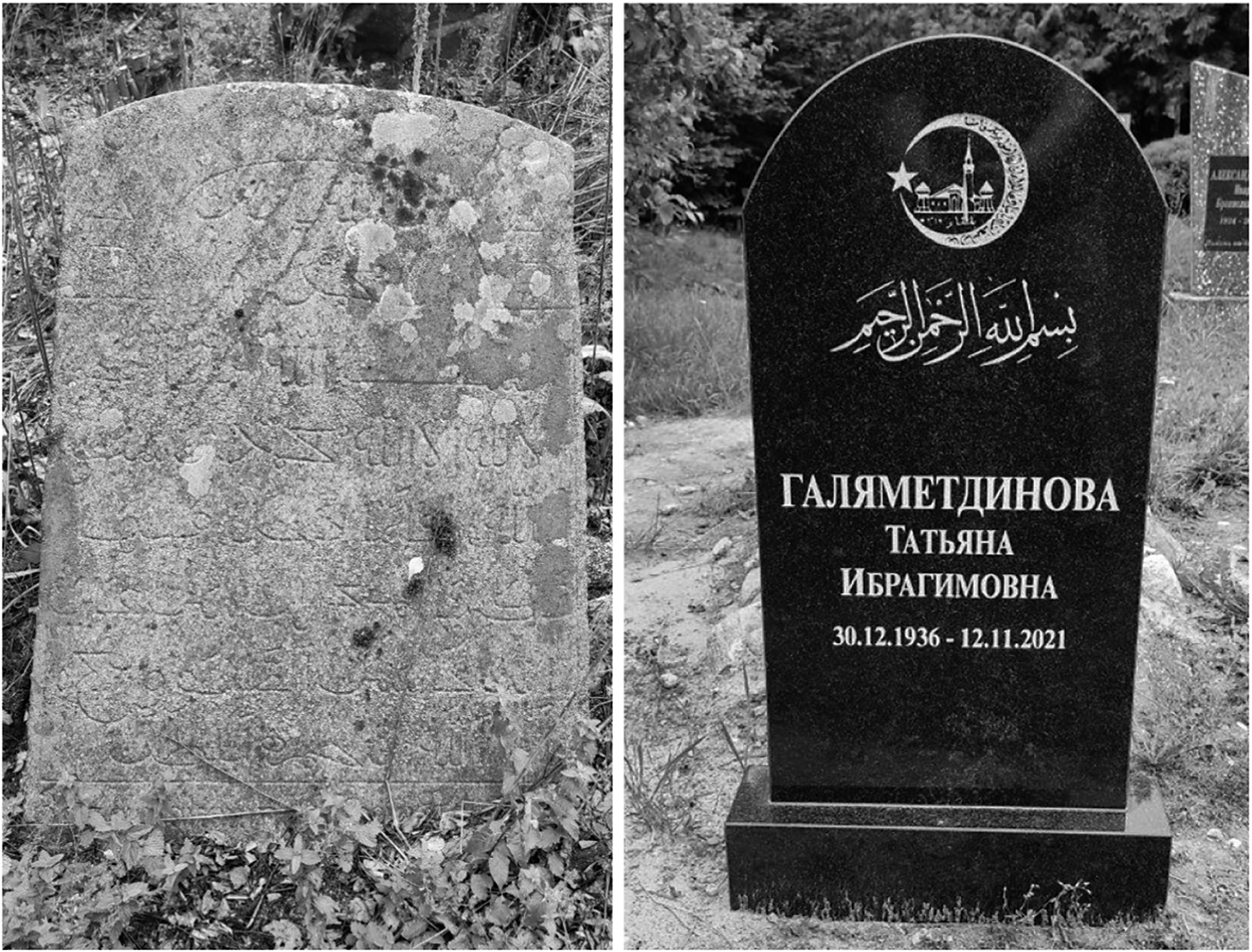
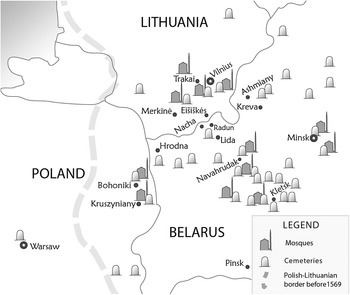
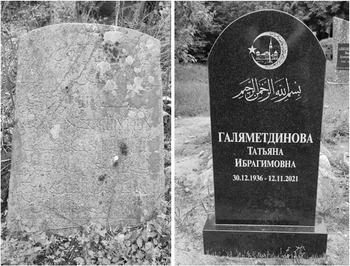
Initially, Tatars were settled in the Lithuanian-Teutonic borderland, around the capital, next to major castles and river crossings, and at borders between the Baltic and newly acquired Slavic lands of the Duchy. The cities and towns that Tatars settled include Vilnius,Footnote 3 Trakai, Ashmiany, Eišiškės, Hrodna, Kletsk, Kreva, Lida, Lutsk, Merkinė, Minsk, Nacha, Navahrudak, Pinsk, Radun, and Tykocin, among others (Grygajtis Reference Grygajtis2003, 146; Kanapatski Reference Kanapatski2018; Tyszkiewicz Reference Tyszkiewicz2000, 38). Vilnius was the center of multiple cultural, educational, and religious organizations of Lithuanian-Polish Tatars in the early 20th century (Dziekan Reference Dziekan and Górak-Sosnowska2011, 28). Even in the 21st century, the region still harbors various material marks of Tatar presence, such as mosques and cemeteries, or mizars (Nalborczyk Reference Nalborczyk and Drayson2023, 109), (Figure 2), in addition to many Turkic-origin family names and a handful of Turkic toponyms. Our map (Figure 1) depicts such earlier destinations for Tatar settlers as well as Tatar cemeteries and mosques.
Map of the Lithuanian-Polish Tatars’ Historical Region. Sources: Globus Belarusi Reference Belarusi2024; Grygajtis Reference Grygajtis2003; Kanapatski Reference Kanapatski2018; Nalborczyk Reference Nalborczyk and Górak-Sosnowska2011 and 2023; Norris Reference Norris2009; Račius Reference Račius2002; Rūkienė Reference Rūkienėn.d.; Tyszkiewicz Reference Tyszkiewicz2000.
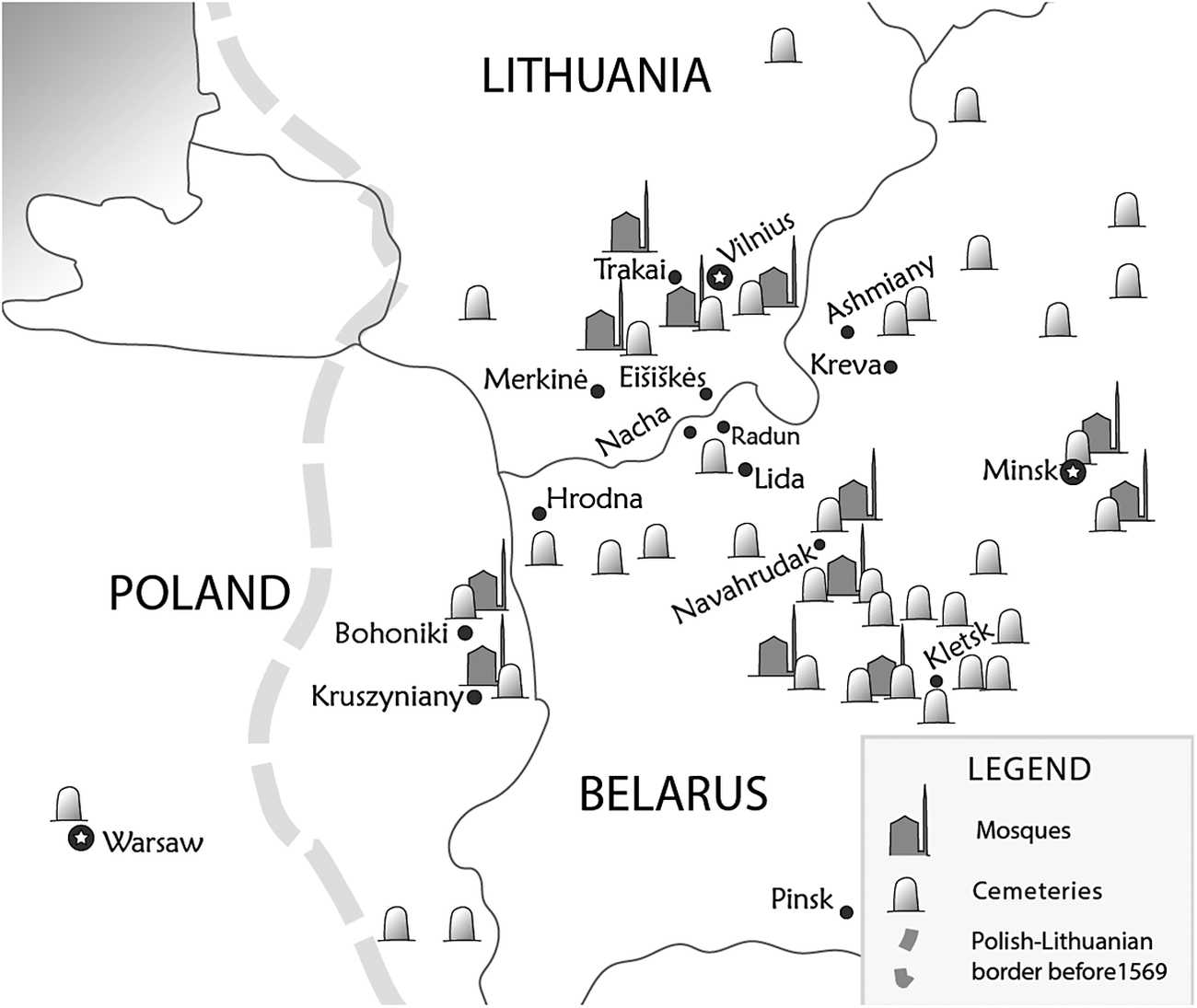
Figure 1. Long description
A grayscale map depicting the historical region of the Lithuanian-Polish Tatars. A thick dashed line running North to South represents the Polish-Lithuanian border before 1569.
In the North (Lithuania), the capital Vilnius is marked with a star and contains a mosque and cemetery. Nearby to the West are Trakai, Merkinė, and Eišiškės, featuring a high density of mosque and cemetery icons.
In the central and Eastern region (Belarus), Minsk is marked with a star and contains a mosque and cemetery. To the West of Minsk, a dense cluster of mosques and cemeteries is located around Navahrudak and Kletsk. Other marked locations in Belarus include Ashmiany, Kreva, Nacha, Radun, Lida, Hrodna, and Pinsk in the far South.
In the West (Poland), Bohoniki and Kruszyniany are located near the historical border, each marked with mosque and cemetery icons. Warsaw is located in the Southwest with a star and a cemetery icon.
The legend in the bottom right corner identifies three symbols: a building with a minaret for Mosques, a rounded headstone for Cemeteries, and a thick dashed line for the Polish-Lithuanian border before 1569.
Old and new tombstones at a Tatar Muslim cemetery near the village of Hiryny, Northwest Belarus. Source: original images taken by the authors.
Grand Duke Vytautas granted lands to Tatar settlers in exchange for their military service, allowing them to maintain their religion and marry local women (Lederer Reference Lederer1995, 430). The rights and obligations of Tatar settlers were to be regulated directly by grand dukes and later by Polish kings. In the royal army, Tatars formed separate military units headed by commanders from within their ranks (Borawski Reference Borawski1988, 120), which did not fall under the jurisdiction of the general administration of the territories in which they resided (Nalborczyk and Borecki Reference Nalborczyk and Borecki2011, 344). Despite legal guarantees and privileges, many of which were recognized in the statutes (legal codes) of the Grand Duchy of Lithuania compiled throughout the 16th century (Kanapatskaya Reference Kanapatskaya2008), Tatars did not possess political rights and could not participate in elections to the General Diet or the Provincial Diets (Borawski Reference Borawski1988, 120). Only the constitution of 1791 provided a complete equalization of the rights of local Tatars with the rights of Catholic nobility (Nalborczyk and Borecki Reference Nalborczyk and Borecki2011, 345), a few years before the final partition of Poland. After the partition of the Polish-Lithuanian Commonwealth, the legal status of local Tatars was also recognized in the Russian Empire, as Catherine the Great confirmed in 1794 all the privileges that Tatar nobility had acquired by that time (Nalborczyk and Borecki Reference Nalborczyk and Borecki2011, 345).
Those Tatars who were not part of military regiments did not enjoy the same privileges and rights as their noble counterparts but remained integrated into the economic and social life of the Grand Duchy. Tatar commoners usually settled in districts on the outskirts of the region’s towns. They specialized in several crafts and professions, such as merchantry, tanning, and coachmanship (Rykała Reference Rykała2007, 44). Vegetable gardening was another occupation closely associated with the minority. A dedicated Tatar district, Tatar Sloboda, and a neighboring area, referred to as “Tatar vegetable gardens” ( tatarskiie ogorody ), disappeared from the city map of Minsk only in the second half of the 20th century, when the post-war reconstruction and rapid urbanization of the 1950s and 1960s dramatically transformed the city’s landscape (Volozhinskii Reference Volozhinskii2012). Even in the 21st century, vegetable gardening is still considered a traditional occupation of Belarusian Tatars (Charovskaia Reference Charovskaia2022).
Tatars initially spoke a variety of Turkic vernaculars. However, they underwent linguistic assimilation and completely switched to the Slavic vernaculars of the region at the latest by the end of the 17th century (Dziekan Reference Dziekan and Górak-Sosnowska2011). Language shift was conducive to the emergence of the minority’s unique literary heritage, made up of kitabs (Figure 3), books written in Slavic languages in the Arabic script (Akiner Reference Akiner2009).
Kitabs — mostly Slavic-language texts written in the Arabic script. Source: Istoricheskii fakultet BGPU 2020.
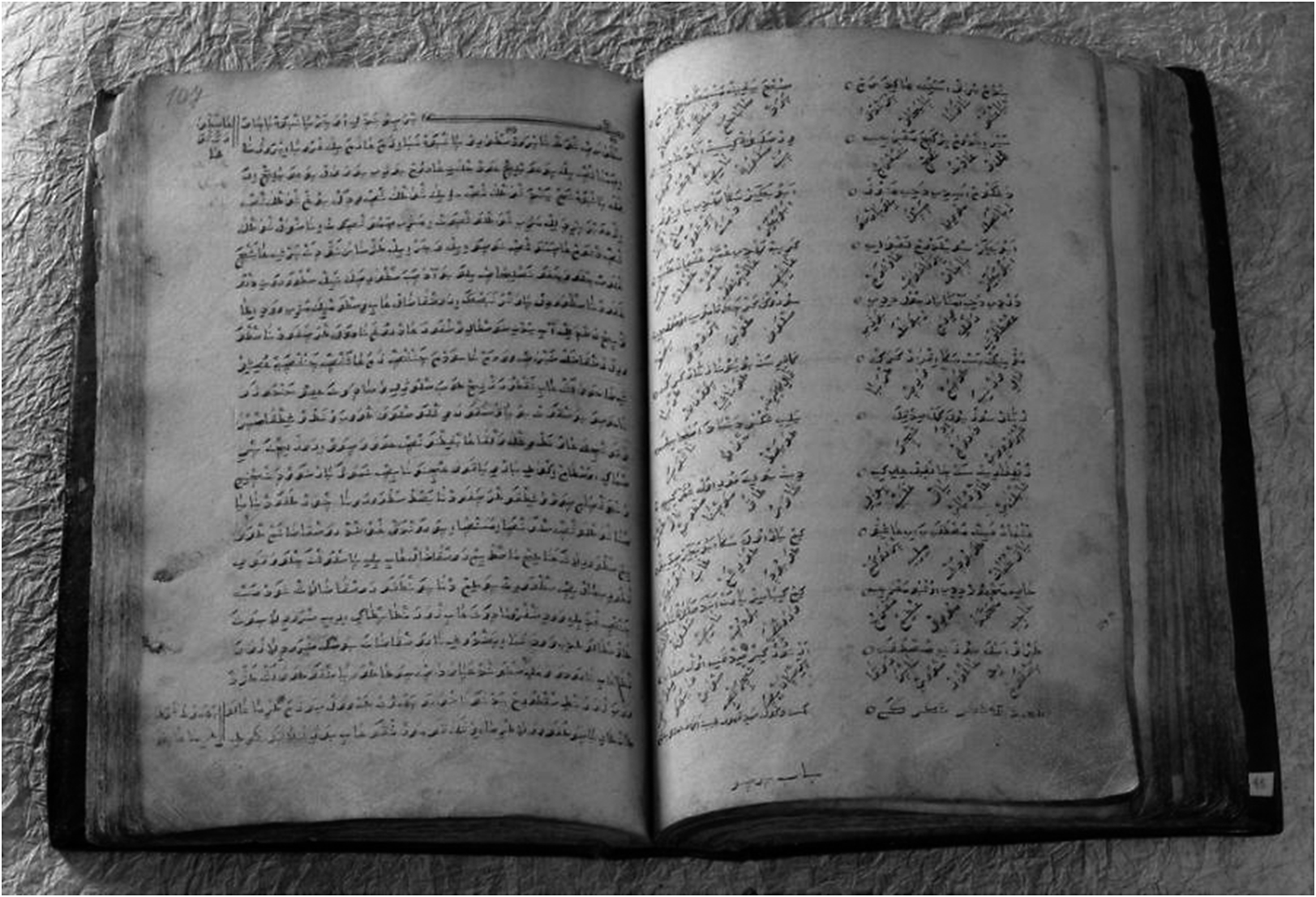
Figure 3. Long description
The photo shows an open book with two visible pages.
On the left page, the text is arranged in dense, horizontal lines of Arabic script that fill the majority of the page from top to bottom. The ink appears dark against the light, weathered paper. In the top left corner, the number 104 is handwritten.
On the right page, the layout is different. The text is organized into two distinct columns. The script in these columns is written at a diagonal angle, slanting upwards from right to left.
The paper shows signs of age, including visible texture, slight creasing, and darkening at the edges. The book is set against a neutral, textured background.
Lithuanian-Polish Tatars followed the Sunni Hanafi school of Islam but maintained some pre-Islamic Turkic traditions. They did not widely practice the veiling of women and polygamy. Tatars were allowed to construct wooden mosques in their settlements since their arrival. The only documented case of the destruction of a Tatar Mosque occurred in 1609 when a Catholic mob ruined one in Trakai (Borawski Reference Borawski1988, 123). In 1668, a legal prohibition on constructing new mosques in areas where there had been none was introduced (Nalborczyk Reference Nalborczyk and Górak-Sosnowska2011, 184). The restriction was clearly not consistently implemented since two new mosques were built in Kruszyniany and Bohoniki in 1679 (Nalborczyk Reference Nalborczyk and Górak-Sosnowska2011, 184). There were up to two dozen mosques in the region in the 16th–18th centuries and twenty-three mosques before 1795 (Nalborczyk Reference Nalborczyk and Górak-Sosnowska2011, 184). Seventeen mosques survived into the 19th century, while ten new mosques were constructed during the same period (Norris Reference Norris2009, 50). Until Poland’s partition, local Tatars did not have a separate institution of spiritual leadership. In the 19th century, they fell under the jurisdiction of the Taurida Muftiate of the Russian Empire, with its center in Simferopol, Crimea (Nalborczyk and Borecki Reference Nalborczyk and Borecki2011, 345). In 1925, the city of Vilnius, as part of interwar Poland, became the seat of the mufti of local Tatars (Nalborczyk and Borecki Reference Nalborczyk and Borecki2011, 347). Currently, Tatars have separate muftiates in Poland (in Białystok),Footnote 4 Lithuania (in Vilnius), and Belarus (in Minsk).
All three countries highlight the history and cultural heritage of their Tatar communities. The fact that this ethnoreligious minority has managed to survive in the region for such a long time is frequently treated as a symbolic badge of honor that reflects the uniquely tolerant character of local societies or as a defensive argument against criticisms about the lack of commitment to multiculturalism and ethnoreligious diversity in the public discourses of these countries. On November 25, 2010, President of Poland, Bronisław Komorowski, in a ceremony attended by Tatar representatives in Poland as well as the President of Tatarstan, Rustem Minnikhanov, and the leader of Crimean Tatars and a member of the Ukrainian Parliament, Mustafa Djemilev, unveiled a monument to a Polish Tatar ( Pomnik Tatara Polskiego ) in Gdansk, Poland’s major port city (Szczepuła Reference Szczepuła2010). In his ceremonial speech, President Komorowski said that “Tatars shed their blood in all national independence uprisings. Their blood seeped into the foundations of the reborn Polish Republic” (Warżawa Reference Warżawa2010). Likewise, on May 20, 2025, President Andrzej Duda, while participating in an official ceremony for the 100th anniversary of the establishment of the Muslim Religious Union in Poland, noted that “when you visit the cemeteries of those who died defending Poland in 1920, you will come across a Muslim symbol, a crescent, on many graves. This symbol indicates that in the grave rests a Polish soldier of the Muslim faith, a Polish Tatar who died for his country, for Poland” (Duda Reference Duda2025). This remark is likely in reference to the Ulan Tatar Regiment, founded in 1919, which participated in the Polish-Soviet War of 1919–1920 (Miśkiewicz Reference Miśkiewicz, Pawlic-Miśkiewicz and Czachorowski2018, 16–18).
Such a national and even fervently nationalistic framing of an indigenous Muslim community as particularly patriotic is unique and unprecedented when compared to other Western Christian-heritage (Catholic or Protestant) societies of Europe, where Muslims are almost exclusively framed as immigrant newcomers supported by multiculturalist policies against the popularly hegemonic discourse of a Christian national past free of Muslims.
Alternative explanations for Tatars’ survival: Chronology and demography, a unique tradition of religious toleration, or a special status of the minority?
Multiple authors who have written about Lithuanian-Polish Tatars highlight the lack of systematic attempts at religious persecution or forced conversion of the minority, but there is no theoretical argument explaining the root causes of this somewhat exceptional situation in extant scholarship. We identified some of the more readily available factors that could potentially explain the survival of Lithuanian-Polish Tatars. These include Lithuania’s exceptionally late conversion to Christianity and the absence of a Catholic majority in the following centuries, the existence of an official discourse on religious diversity and toleration, promoted by the state and church officials, and the unique status of the Tatar community as mercenaries and military allies of Polish-Lithuanian monarchs.
Lithuania’s late conversion and the absence of a Catholic majority
Treatises on religion in Lithuania emphasize that it was Europe’s last pagan state (or “nation,” as some anachronistically suggest), which joined the circle of Catholic monarchies extremely late. At the time of Vytautas’s reign (1392–1430), “[t]he state’s ethnic ‘Catholic’ nucleus covered just 10 percent of the territory and encompassed only 20 percent of the population.” (Eidintas et al. Reference Eidintas, Bumblauskas, Kulakauskas and Tamošaitis2013, 49). Until the Grand Duchy of Lithuania established a formal union with the Polish Kingdom in 1569, the Duchy’s population likely remained majority non-Catholic (Kempa Reference Kempa2010, 32). Could it be then that Lithuania was simply not sufficiently Catholic to undertake a coercive conversion and religious persecution of its Tatar Muslim minority?
Many European monarchies that converted to Catholic Christianity initially ruled over a non-Christian and non-Catholic majority society. Still, they eventually achieved very high levels of religious sectarian homogeneity and eradicated their Muslim minorities. Moreover, “[b]y the mid-18th century, about five-sixths of the [Polish-Lithuanian] Commonwealth’s population, the vast majority of the noble citizenry, and the entire legislature were Catholic” (Butterwick Reference Butterwick2010, 123). The religious composition of the Commonwealth is estimated to be 43 percent Catholic, 33 percent Uniate, 10 percent Orthodox, and 9 percent Jewish in 1772, at the time of the country’s first partition by Austria, Prussia, and Russia (Davies Reference Davies2005, 127). Therefore, Catholics and Uniates together comprised 76 percent of its population. If demography was the primary obstacle preventing the persecution of Muslim Tatars, that obstacle was removed by the 18th century at the latest, yet Tatars survived for centuries afterward. Imperial Russia, the Orthodox Christian neighbor of the Polish-Lithuanian Commonwealth, which is regarded as being more religiously tolerant compared to most Catholic European states (Crews Reference Crews2003), resorted to the violent mass conversion of the Volga peoples, which included Volga Tatars, as late as 1740–1755 (Werth Reference Werth2000, Reference Werth2003). Thus, even the 18th century was not too late for a forced mass conversion of Muslims. Moreover, the Grand Duchy of Lithuania and the Polish-Lithuanian Commonwealth also had a history of expelling other religious minorities, such as Jews (Kiaupa Reference Kiaupa2002, 118; Šiaučiūnaitė-Verbickienė Reference Šiaučiūnaitė-Verbickienė, Chwalba and Zamorski2021) and Protestants (Górski Reference Górski1931, 602), but never to the point of their total eradication. Thus, Catholicism’s late arrival in the region would not be sufficiently convincing as the primary explanation for the Tatars’ survival.
Distinctive public discourse of religious toleration
A distinctive public discourse of religious toleration indeed existed in the Polish-Lithuanian Commonwealth. The general practice of toleration towards religious minorities was included in the arguments of the Polish delegation already during the Council of Constance, an ecumenical council of the Catholic Church held from 1414 to 1418. Włodkowic, King Jogaila’s envoy, who was a trained canon lawyer, was a member of the Polish delegation to the council. At the council, Włodkowic presented his treatises, criticizing the Church’s misguided policies towards non-Christian communities, such as Jews and Muslims. The Polish delegation shared its criticism against the Teutonic Order’s cruelty and brutal attitude towards pagans, which was incompatible, in the delegation’s opinion, with the Christian doctrine and undermined the mission of spreading Christianity (Frost Reference Frost2015, 124).
One could probably agree with the Polish delegation that both doctrinal and political arguments should incentivize monarchs to tolerate religious diversity. However, that was not the case in medieval Europe, where the “persecuting society,” as Moore (Reference Moore2007) famously argued, was the prevailing norm. Importantly, the historical examples of persecution against various religious groups in the Polish-Lithuanian Commonwealth pose a challenge to the proposition that public discourse of toleration alone had been sufficient to maintain an environment in which the religious minorities could survive.
The public discourses of religious chosenness or uniqueness, which often provided a backdrop for religious sectarian persecution elsewhere, were not in short supply in the Polish-Lithuanian Commonwealth, at least in the 17th century. Such discourses appealed to Poland’s unique position as the “bastion or fortress of Christianity” or “the last outpost of Christendom.” In 1633, Jerzy Ossoliński, Emissary of King Władysław IV Vasa, during his visit to the Holy See, boasted “that for centuries Poland had protected Europe against ‘wild and terrible enemies of Christ’” (Ramet Reference Ramet2017, 25), including Ottomans, Muscovites, and Tatars. Similarly, Polish King Jan Sobieski’s letter to Pope Innocent XI emphasized his “unextinguished zeal in propagating the Christian faith” (John III, and Krzyżanowski Reference John and Krzyżanowski1983, 3). Sobieski “viewed himself as the saviour of Christianity, and rightfully so” (Baer Reference Baer1983, 8), according to the papal legate Buonvisi. Yet these discourses did not lead to a systematic, long-term, and successful campaign for religious sectarian homogenization. Instead, we witness sporadic episodes of persecution that never led to the eradication of religious diversity in the kingdom.
Such episodes of persecution were not distributed evenly across time but concentrated in particular during the long reign of Sigismund III Vasa (1587–1632). Prominent examples of intolerance and persecution specifically against Tatars at that time included the destruction of a mosque in Trakai by a Catholic mob in 1609 and the publication and circulation of an infamous anti-Tatar pamphlet, which called for the eradication of local Muslims, in 1617. Such uneven concentration of persecution further illustrates the importance of historical changes and continuity regarding domestic political factors when looking into the causes of religious toleration in the Polish-Lithuanian Commonwealth, which we discuss further below.
Unique position of Muslim Tatars as military allies and their exceptional loyalty
Could it be the case then that the survival of Lithuanian-Polish Tatars was linked to their special status as the monarchy’s military allies or to their exceptional loyalty to Polish-Lithuanian rulers as a kind of “model minority” (Talal Reference Talal2025)? It is true that Muslim Tatar regiments fought in wars between the Grand Duchy of Lithuania and the Orthodox Muscovy, the Catholic Teutonic Order, and later Protestant Sweden on multiple occasions. Perhaps more strikingly, Tatar military units also fought on the side of the Grand Duchy against multiple Muslim adversaries. Even the first Tatar settlers were the allies of the Grand Duchy of Lithuania when it became involved in an otherwise intra-Muslim conflict between Tatar khans. Numerous hostilities that pitted the Grand Duchy and later the Polish-Lithuanian Commonwealth against Muslim enemies included the Battle of the Vorskla River against the Golden Horde in 1399 (Kiaupa, Kiaupienė, and Kuncevičius Reference Kiaupa, Kiaupienė and Kuncevičius2000, 135), Crimean Tatar warriors’ devastating raids on southern and central Lithuanian lands, such as the destruction of Kyiv in 1482 (Kiaupa Reference Kiaupa2002, 115), Siege of Slutsk in 1505, the Battle of Kletsk in 1506 (Kiaupa Reference Kiaupa2002, 118), and a Crimean Tatar invasion culminating in the Battle of Olshanica in 1527 (Kiaupa Reference Kiaupa2002, 124). Military hostilities between Crimean Tatars and Lithuania were so frequent and intense that “[b]etween 1505 and 1522 extra fortifications were built around Vilnius to ward off Tatar attacks” (Norris Reference Norris2009, 29). The Golden Horde and the Crimean Khanate were not the only Muslim foes of Lithuania and Poland, either. Many hostilities between Poland and the Ottoman Empire include but are not limited to the following: Battle of Varna in 1444 (Frost Reference Frost2015, 184); Polish-Ottoman conflict over Moldova in 1497 (Stone Reference Stone2001, 33); military aid to Hungary in its war against the Ottomans in 1521 (Frost Reference Frost2015, 281); Khotyn (Chocim) campaign in 1621 (Stone Reference Stone2001, 135); and multiple military confrontations between 1672 and 1699, including the victory of the Ottomans in the Polish Campaign of 1672 and the resulting Ottoman capture of Podolia between 1672 and 1699 (Stone Reference Stone2001, 237–8). The most famous among them is the Battle of Vienna (1683), where the Polish king Jan Sobieski saved the city and arguably Catholic Christendom from the Ottomans, in great part thanks to the Tatar cavalry, as Timothy Snyder (Reference Snyder2011) argued.
Tatars’ military valor in defense of the Polish-Lithuanian realm has been part of their self-identification as found in one of the oldest works ever written by a Lithuanian-Polish Tatar in 1557 on his way to pilgrimage to Mecca and presented to the Ottoman grand vizier Rustem Pasha and Sultan Suleiman the Magnificent in Istanbul ( Risale-i Tatar-ı Leh [1557] 2022, 37). Could this instrumental value in various military conflicts be the primary reason for religious toleration? Such a situation was not unique to the Polish-Lithuanian Commonwealth. Muslim soldiers were employed by many Catholic rulers across Europe both as long-term mercenaries (Catlos Reference Catlos2014; Taylor Reference Taylor2003) and as tactical allies (Almond Reference Almond2009). Yet, the use of Muslim mercenaries by Catholic rulers in southwestern Europe historically did not lead to the survival of medieval Muslim communities in present-day Italy and Spain. Alternatively, could Lithuanian-Polish Tatars’ extraordinary loyalty explain their survival? Did Lithuanian-Polish Tatar regiments never rebel, switch sides, or “betray” the Polish Crown such that the community has never been portrayed as a “fifth column”? After all, real or alleged betrayals were commonly used throughout history for demonizing and eradicating ethnoreligious minorities as “fifth columns” (Mylonas and Radnitz Reference Mylonas and Radnitz2022). However, there were episodes when some Tatars rebelled against or “betrayed” the Polish Crown, the most obvious example of which is the Tatar rebellion of 1672 (Borawski Reference Borawski1988, 126). Many Tatar soldiers not only rebelled but also sought refuge in the Ottoman Empire at that time, an immediate Muslim neighbor that Poland fought against. Similarly, when the Swedish invasion in 1702 led to a civil war among the nobility, many Tatars fought on the side of Stanisław (Stanislaus) I Leszczyński, who was supported by Sweden and who eventually lost the civil war. This led to the destruction of many Tatar settlements in retaliation and to the proposal of a resolution in the Polish parliament seeking far more severe punishment for Tatars, but the resolution was not passed (Borawski Reference Borawski1988, 127). Thus, the minority could have been targeted and eradicated as a “fifth column.” Yet such alleged betrayals did not culminate in mass expulsion or forced conversion. Therefore, we argue that it was not their instrumental value on the battlefield or exceptional loyalty to the polity at large, but their status as mercenaries closely identified with the monarch in the extremely competitive political environment of the Polish-Lithuanian Commonwealth that helped the Tatars’ survival in the face of potential and actual persecution. Muslim minorities’ identification and alliance with monarchs against papal-clerical actors was a pattern observable across medieval Catholic Europe (Aktürk Reference Aktürk2024), but it did not save Muslim minorities from eradication beyond the Polish-Lithuanian Commonwealth.
Thus, we conclude that many potential interpretations of the history of Lithuanian-Polish Tatars fail to fully capture the peculiar dynamics and constellation of factors that made the community’s survival possible in the long run. We observe instead that the survival of Tatars was related to the religious diversity that had always been backed and reinforced by the pluralism of political centers and powerful actors, a diversity within military-political structures, which persisted in the Grand Duchy and the Polish-Lithuanian Commonwealth throughout history.
Our argument: Lithuanian-Polish Tatars’ survival in the struggle between the monarch, papal allies, the Catholic nobility, and non-Catholics without a hegemonic faction
We argue that Lithuanian-Polish Tatars’ survival under Catholic rule was based on two distinct configurations of power pertaining to interstateFootnote 5 and domestic politics. Whereas interstate power dynamics were later eclipsed by domestic power dynamics as the main factor explaining the preservation of religious diversity, the two are directly linked. The fact that Lithuanian rulers successfully resisted forced conversion and eventually adopted Christianity on their own terms allowed for the preservation and perpetuation of religious sectarian diversity, backed up by multiple political stakeholders, including local Tatars, who forged a particularly strong bond with the monarch. For example, what is probably the oldest treatise on the community by a Lithuanian-Polish Tatar, Risale-i Tatar-ı Leh ([1557] 2022, 23, 31, 37, 47) although written for and presented to the Ottoman Sultan at the time, is saturated with effusive praise for the Polish monarchs’ love and patronage of Tatars that allegedly triggered the jealousy of other Polish subjects including the Polish nobility.Footnote 6 These factors contributed to the survival of the Tatar community even at times of increased intolerance.
At the interstate level, the papacy could not prevail over the Grand Duchy of Lithuania in ways that it could over many other European polities. This may have been due to a combination of relative distance, since Lithuania was far from Rome, and relative state strength, since Lithuania was much larger and more powerful than most other European polities at the time. The papacy enjoyed many direct, indirect, and socializing powers that it used to discipline and punish monarchs across Western and Central Europe during the Middle Ages (Aktürk Reference Aktürk2024). It had much less success in exerting these forms of power and influence over Lithuania since it was the last European polity to convert to Christianity, almost at the end of the 14th century, which coincided with a precipitous decline in papal powers during the Avignon Papacy and the Western Schism. Moreover, Lithuania, unlike many Western and Central European states, was not socialized in a competitively Catholic geopolitical neighborhood as in Western Europe, due to Lithuania’s Orthodox (Muscovy), Muslim (Crimean Khanate, Ottomans), and later Protestant (Sweden) neighbors. Interstate power dynamics alone could probably not suffice for the long-term survival of Tatars, but they contributed to very favorable initial conditions for the preservation of religious diversity.
Equally importantly, in the domestic struggle between the monarch, papal allies, the Catholic nobility, and non-Catholics, none of the religious sectarian factions could achieve a hegemonic majority, let alone monopolistic control of political and military levers of power. The existence of non-Roman Catholic stakeholders with political and military power (including Tatars) served as a brake against efforts at creating a religiously homogeneous polity. This second claim is not a tautological assertion that religious diversity sustains religious diversity, but rather, religious diversity in the military-political power structures sustains religious diversity at the societal level. Counterfactually, if Roman Catholics alone monopolized military-political power, such an exclusively Catholic elite could have successfully eradicated Jewish, Muslim, Orthodox, and Protestant inhabitants, as it happened in several European polities during the Middle Ages as well as during the Counter-Reformation.
These multiple intra-Christian cleavages and increasing decentralization of power created a favorable political environment for the survival of Lithuanian-Polish Tatars as Catholic Europe’s only Muslim minority in the long term. Political cleavages between Catholic and Orthodox nobility, between the adherents of the Latin rite and Uniates, between Catholics and Protestants, between the monarch and the parliament, as well as between different factions in a parliament with liberum veto , as we discuss further below, were crucial for the societal configuration of power and competing local interests that the practice of religious toleration hinged on. In short, we argue that both interstate and domestic constellations of powers favored the perpetuation of religious diversity and toleration of minorities first in the Grand Duchy of Lithuania and later in the Polish-Lithuanian Commonwealth, which explains the survival of Lithuanian-Polish Tatars in the region.
The formation of a political environment conducive to perpetuating religious diversity
Starting with Lithuania’s attempted conversion to Catholic Christianity in the mid-13th century and the arrival of Tatars in the late 14th century, we identify three periods — prior to 1397, from 1397 to 1569, and from 1569 to 1795 — when different constellations of power and local interests between proponents and opponents of religious sectarian homogenization allowed the formation of a political environment conducive to Lithuanian-Polish Tatars’ survival under non-Muslim rule for many centuries. First, the supranational and external proponents of Catholic homogeneity — the papacy and the Teutonic Order — failed to conquer and convert pagan Lithuania by military force. Instead, when the Lithuanian monarchy eventually adopted Christianity, it happened on Lithuania’s terms: through marriage and a dynastic union with the Polish Kingdom. This mode of conversion allowed for the preservation of Lithuania’s non-Catholic nobility. The Catholic nobility and the Jesuits gradually emerged as proponents of Catholic homogeneity, but they were successfully countered by a variety of opponents, such as the Orthodox and the Protestant nobility, and most of the Polish-Lithuanian monarchs. Finally, with the 1795 partition of the Polish-Lithuanian Commonwealth, the region’s diverse ethnoreligious landscape became part of another multi-confessional monarchy — the Russian Empire.
Until 1386, the Grand Duchy of Lithuania remained the last European polity still ruled by a pagan dynasty. Therefore, it became a target for the so-called Northern Crusades, endorsed by the Papacy in 1236 (Kiaupa Reference Kiaupa2002, 34). In the 13th century, the biggest threat to Lithuania came from the Livonian Order, established by German knights on the territory of modern-day Latvia. Lithuanian Duke Mindaugas agreed to convert to Christianity in 1257 to put an end to the threat of conversion by conquest. This first Christianization of Lithuania proved to be short-lived. Shortly after his conversion, Mindaugas entered a military alliance with the pagan tribes of Samogitia (or Žemaitija — a cultural region in modern-day Northwestern Lithuania) and resumed warfare against the Livonian Order. Mindaugas’s successors remained pagan for another 130 years. By the beginning of the 14th century, the Teutonic Order replaced the Livonian Order as the main external threat to Lithuania (Kiaupa Reference Kiaupa2002, 58). In its virtually annual campaigns, the Order was aided by the knighthood from all over Catholic Europe (Kiaupa Reference Kiaupa2002, 59). Teutonic knights were unable to defeat Lithuania and finally lost most of their ideological and theological support after Lithuania adopted Catholicism through the marriage of the Lithuanian grand duke Jogaila and the Polish queen Jadwiga in 1386 (Dziekan Reference Dziekan and Górak-Sosnowska2011, 27). The only remaining “pagan” territory was the disputed Samogitia (Christiansen Reference Christiansen1980, 169–70), which was baptized separately in 1413 (Kiaupa Reference Kiaupa2002, 90).
Lithuania’s acceptance of Catholicism through marriage had important implications. First, it significantly weakened the justification for the Teutonic Order’s military conquest of the country. Despite Lithuania’s baptism, the Teutonic Order was reluctant to accept Lithuania’s recognition as a Christian polity by Pope Urban VI and did not give up on crusading. It was not until 1403 that Pope Boniface IX forbade the Teutonic Order from fighting Lithuania. The Order eventually suffered a decisive defeat in the Battle of Grunwald in 1410 against the joint Polish-Lithuanian army, which included Muslim Tatar units. The Order explicitly emphasized the existence of Muslim Tatars in their anti-Lithuanian propaganda (Dziekan Reference Dziekan and Górak-Sosnowska2011, 28) as an indication of Lithuania not being genuinely Catholic. Second, baptism through marriage allowed for the preservation of religious heterogeneity through exemptions granted to the Orthodox population, and later through tolerating other ethnoreligious minorities, such as Jews and Muslim Tatars. Third, it diminished the influence of the papacy and the Catholic Church in disputes with monarchs.
During the same period, through a combination of political alliances, dynastic unions, and military force, Lithuania was expanding its rule over multiple Orthodox principalities in the east. By 1385, the territory of present-day Belarus, northern and central Ukraine, and the westernmost parts of Russia all fell under the control of the Duchy (Frost Reference Frost2015, 20). This process led to the increasing fusion of pagan and Orthodox cultures in the Grand Duchy. Lithuanian rulers also tolerated the migration of Catholic merchants and peasants from Western and Central Europe to their territory, as letters by Grand Duke Gediminas indicate (Baronas Reference Baronas2014, 60). Lithuania’s pagan nucleus was preserved up until the 1386 dynastic conversion, while the country’s overall religious and political heterogeneity increased in that period.
Regarding bottom-up multireligious coexistence in this first period, leading up to the Tatars’ settlement in Lithuania in 1397, it is significant that Lithuanians were described as “Saracens of the North” (Briedis Reference Briedis2016, 30) by the crusaders. One such crusader, Gilbert de Lannoy, writing about the Lithuanian monarch Vytautas, “commented on his laxity in spiritual matters, finding him dining together with the ‘Saracen infidels,’ with both fish and meat served on Fridays. As a sign of the ruler’s pagan upbringing, Lannoy pointed out Vytautas’s enthusiastic support of the Hussites, the excommunicated heretics of Bohemia and sworn enemies of the papacy” (Briedis Reference Briedis2016, 32). Prior to Vytautas, Lithuanian monarch Gediminas “explained his rejection of the Catholic faith by invoking the idea of religious tolerance and equality. In Lithuania, proudly declared its ruler, all creeds are accepted: the Poles, Germans, and other Catholics worship in the Latin manner; the Russians follow their unique Orthodox traditions; and ‘we, the pagans, venerate god according to our ancient rituals’.” (Briedis Reference Briedis2016, 27) This history of religious toleration shaped the very character of Vilnius, which was made the capital of Lithuania: “Vilnius was different—autochthonous, pagan and unconquered … if pagan spirituality was the godmother of Vilnius, then the long and exhausting war with the Catholic world was its godfather” (Briedis Reference Briedis2016, 23). Tatars were settled in Lithuania by the pagan-born monarch Vytautas at a time when Lithuania was shaped by its struggle against the Catholic crusaders, even as the dynasty eventually converted to Catholicism. Depictions of multireligious coexistence often invoke “dining together” and other forms of socializing, such as trading, where pagans, Muslim Tatars, Orthodox, and Catholics shared the same social spaces.
Upon Jogaila’s return to Lithuania in 1387 and the subsequent baptism of the country, the Orthodox population was exempted from conversion to Catholicism. The Lithuanian rulers reaffirmed this exemption in 1417 at the Council of Constance (Rowell Reference Rowell2013, 51). Nevertheless, compared to their Orthodox counterparts, the Catholic nobility was granted major political and legal privileges (Kiaupa Reference Kiaupa2002, 78). The Union Act of Horodło of 1413 brought political restrictions on non-Catholic subjects and imposed limitations on the activities of the Orthodox Church, such as bans on interconfessional marriages and construction of new churches in previously pagan territories, but such restrictions and limitations had been progressively loosened throughout the 15th century (Kempa Reference Kempa2010, 34). The marriage, in 1494, of Grand Duke Alexander with Helena, the daughter of the Moscow Prince Ivan and a pious adherent of the Orthodox Church, is a vivid example of the lack of enforcement of such restrictions (Frost Reference Frost2015, 309–10). Orthodox nobility remained included in the local political power dynamics and proved to be an important political force to be reckoned with during the Lithuanian civil war and struggle for the throne in 1432–1440 (Kiaupa Reference Kiaupa2002, 101–02). The percentage of Orthodox Christians among the highest strata of political elites increased about tenfold during that period, from 3.4 to 37 percent (Frost Reference Frost2015, 316). Moreover, in 1434, “Catholic and Orthodox boyars [nobility] were granted equal rights, and the only difference between the two groups was that the Orthodox were prohibited from holding the four highest offices in the country” (Kempa Reference Kempa, Chwalba and Zamorski2021, 138).
In the second period (1397–1569), the initial exemption of the Orthodox nobility and population at large from conversion and the reaffirmation of this exemption in 1417 may have been the critical juncture that reinforced Lithuania’s path of religious toleration that diverged from the “formation of a persecuting society” (Moore Reference Moore2007) in the rest of Catholic Europe. However, this outcome was not overdetermined but rather contingent since there were numerous attempts to eradicate the Orthodox population. For example, in the 1520s, “Ferreri, a fanatical Catholic … ignited a fiery campaign against Orthodox believers, which included a majority of Lithuania’s population” (Briedis Reference Briedis2016, 34), but “in 1563, amidst the brutal religious conflicts in Europe, a law guaranteeing religious freedom in Lithuania was passed by an assembly of nobles in Lithuania” (Briedis Reference Briedis2016, 43). As such, during this second period, too, “Lithuania, a predominantly Orthodox country ruled by a Catholic royal family, was unique in its position as a mediator between the two religious camps” (Briedis Reference Briedis2016, 44).
An alternative outcome for the “Investiture Controversy”
The mode of conversion seems to have affected the relatively lower institutional autonomy of the local Catholic Church, which allowed for monarchs’ greater influence in domestic ecclesiastic matters and in negotiations with the papal authority. The church’s reach to the masses of peasantry, and even to parts of the gentry, was limited, and Catholicism remained predominantly an urban religion for an extended period after formal Christianization (Urban Reference Urban1987). A major conflict between the papacy and Casimir IV, Lithuania’s Grand Duke (1440–1492) and Polish King (since 1447–1492), took place in the middle of the 15th century over the desire of the latter to maintain control over ecclesiastical appointments, and the monarch won this struggle and appointed his own bishops (Stone Reference Stone2001, 26–7). Casimir IV also achieved significant success in moving the local Catholic Church outside of the Papacy’s extraterritorial continental jurisdiction (Frost Reference Frost2015, 273). In other words, the famous “Investiture Controversy,” a central theme of medieval European history, was resolved in favor of the Polish monarch against the pope, unlike in Western Europe. Thus, the second period in our historical evaluation was characterized by a pragmatic approach to ecclesiastic matters and preservation of religious diversity, along with the relative weakness of potential advocates for religious homogeneity vis-à-vis monarchs. Even the infamous temporary expulsion of Lithuanian Jews by Grand Duke Alexander in 1495–1503 (Šiaučiūnaitė-Verbickienė Reference Šiaučiūnaitė-Verbickienė, Chwalba and Zamorski2021, 195) seems to be driven by his political and economic miscalculations (Kiaupa Reference Kiaupa2002, 118), as the non-violent character and the relatively quick reversal of the expulsion suggest.
The beginning of the third historical period (1569–1795) coincided with the height of the Reformation and the spread of Protestantism in Poland and Lithuania, followed by the Counter-Reformation, which provided the background for the developments of the 17th century affecting religious minorities. In 1569, the Union of Lublin merged the Polish Kingdom and the Grand Duchy of Lithuania into a single country with a joint parliament and shared elected king, while reserving substantial autonomy for the two entities over their domestic matters. The transformation of Lithuania’s political system according to the Polish model opened doors for the local nobility ( bajorai ) to join the Polish szlachta and gain even greater political privileges as individual actors, in contrast to an increase in the collective strength of nobility as a unified political institution. Catholic-Protestant, Catholic-Uniate (since the Union of Brest in 1596), and Catholic-Uniate-Orthodox cleavages all persisted throughout this period. The Polish-Lithuanian szlachta was becoming increasingly Catholic, but this development went hand in hand with the increasing decentralization of the state and diminishing state capacities. Multiple instances of intolerance towards various groups, including against Tatars, did not turn into state-coordinated and systematically implemented policies. Domestic political conditions and multiple social cleavages prevented the rise of a strong and powerful force of homogenization. Tatars’ relative numerical insignificance, compared to other religious and sectarian groups, and their continuing attachment to the monarch played an additional role in shielding them from systematic persecution.
The ideas of the Reformation flourished in the country since the 1520s and found influential supporters and patrons. The Lithuanian grand dukes Sigismund the Old (1506–1548) and Sigismund August (1548–1572) followed moderate policies on this issue and employed Protestants as important state officials (Kiaupa, Kiaupienė, and Kuncevičius Reference Kiaupa, Kiaupienė and Kuncevičius2000, 184–6). There were legal restrictions on the activities of Protestant denominations, but they were rarely enforced. Despite the concerns of the Catholic clergy, proponents of religious toleration seemed to be winning politically in this period when “[a]t the election Diet [Sejm] of Warsaw in 1573, a resolution was carried to the effect that no one should be injured or persecuted on account of religion” (Pollard Reference Pollard1892, 23). The principles of religious toleration were incorporated in the Third Lithuanian Statute, the legal code of the Grand Duchy of Lithuania, in 1588 (Stone Reference Stone2001, 216).
The Society of Jesus, known as the Jesuits, was invited in 1564 to help combat the spread of the Reformation and fight against religious dissent (Ramet Reference Ramet2017, 31). The number of Jesuits increased from 466 in 1600 to more than 1700 by the end of Sobieski’s reign. This number and the high ratio of Jesuits to the general population arguably explain their disproportionate influence on the political, religious, and social life of the country (Pollard Reference Pollard1892, 89). The Jesuits’ numbers and prominence varied depending on the Society’s relations with the monarch. Stephan Bathory (1576–1586), originally a Protestant from Transylvania, was elected king in 1576 and converted to Catholicism. He was described as “a great patron of the Jesuits” (Pollard Reference Pollard1892, 26). Under Bathory’s rule, the Society established itself in numerous locations in Lithuania and rapidly increased its numbers to over 360 (Pollard Reference Pollard1892, 27). The activities of Jesuits in education were accompanied by proselytizing that targeted non-Catholic populations, including at least one failed attempt at proselytizing Lithuanian-Polish Tatars (Borawski Reference Borawski1988, 123).
King Stephan Bathory, while encouraging the educational activities of the Jesuits, was able to check their attempts to persecute religious minorities. The situation changed with Sigismund III Vasa (1587–1632), mentioned in the records as “king of the Jesuits,” who “did everything according to their [Jesuits’] counsel, and the hopes and cares of courtiers had no weight except by their favour” (Pollard Reference Pollard1892, 31). During Sigismund’s rule, “[t]he number of Jesuit priests increased from 500 in 1608 to 1000 in 1626. There were 25 Jesuit colleges in 1608 and forty-two in 1634” (Stone Reference Stone2001, 137). Sigismund’s long reign was characterized by the rapid expansion of Jesuits’ activities, the decline in the power of the Protestant nobility, and episodes of religious intolerance. Sigismund “tolerated mob attacks on Protestant minorities in royal cities such as Cracow (1591), Poznan (1606 and 1616), Lublin (1627), and Vilnius (at several different times), which destroyed Protestant churches, prevented religious services in private homes, and desecrated cemeteries” (Stone Reference Stone2001, 137). The Jesuits also took over education and exerted great influence over local nobility (Pollard Reference Pollard1892, 33).
Sigismund’s tolerance of intolerance contributed to the outbreak of Zebrzydowski’s rebellion of 1606–1607. An armed confederation was formed in 1607 in opposition to the king. It included “a large number of petty nobles fearful of their privileges, of Protestants, alarmed by mounting Catholic oppression, and of Orthodox resentful of the recent Church Union” (Davies Reference Davies2005, 261). The influence of the Jesuits on the king and the lack of toleration for religious dissent were listed among complaints in the Act of Confederation. The following excerpt from the Act illustrates this: “Our ancestors … knew that they were born nobles rather than Catholics, that they were not descended from Levi, and that Poland is a political kingdom, not a clerical one” (Davies Reference Davies2005, 261). Moreover, “the gentry called for the expulsion of foreign Jesuits” (Kaplan, Reference Kaplan2007, 112).
The king’s forces prevailed militarily, although the victory was hardly decisive. “Poland’s unique politics,” as Benjamin Kaplan (Reference Kaplan2007, 112) observes, gave a “unique ending” to the otherwise familiar struggle between a Catholic monarchy and non-Catholic dissidents: “the Counter-Reformation lost its association with ‘tyranny’ (never very convincing to begin with, given the weakness of the crown) and proceeded with the support of most nobles.” Thus, the nobility, rather than the monarch, emerged as a major proponent of Catholicization. From then on, the country witnessed multiple instances of religious intolerance and discriminatory legislation, but none led to a coherent policy (Davies Reference Davies2005, 330).
The severity of interreligious cleavages varied depending on the stance of a particular king. King Władysław (Ladislaus) IV (1632–1648) “was averse to persecution, and refused to tolerate the Jesuits at his court” (Pollard Reference Pollard1892, 85). He had a tolerant approach towards religious diversity both out of personal commitments and out of political necessity, since he relied on the support of Orthodox and Protestant nobles during his election and rule (Stone Reference Stone2001, 156), yet another key observation in support of our argument. By contrast, John II Casimir (1649–1668), who himself was a Jesuit cardinal (Pollard Reference Pollard1892, 87), albeit briefly and without assuming priestly duties, was much less successful at maintaining interconfessional alliances since “[h]is Catholic piety and numerous pilgrimages alienated Protestants and Orthodox nobles” (Stone Reference Stone2001, 163). The reign of Jan (John) III Sobieski (1674–1696) witnessed the continuing deterioration of state capacities. Despite his aversion to persecution, he failed to check the Jesuits’ intolerant activities and to enforce laws protecting religious freedoms. For example, he was not able to prevent a mob led by Jesuits from attacking a Protestant church in 1682 (Pollard Reference Pollard1892, 88). Sobieski struggled with nobles who grew suspicious about the possibility of the Commonwealth becoming an absolutist monarchy (Stone Reference Stone2001, 241).
The unprecedented growth in the power of the parliament was probably one of the most critical political developments throughout the 16th, 17th, and 18th centuries. In the mid-16th century, the parliament achieved parity with the king (Stone Reference Stone2001, 178–9) and since then only gained strength, such as the exclusive right to pass new legislation (Stone Reference Stone2001, 179). However, the growth of parliamentary powers was coupled with the increasing power of its individual members. Already by the middle of the 15th century, the Polish parliament developed the principle of unanimity in decision-making (Stone Reference Stone2001, 181), which was inherited by the joint parliament of the Commonwealth. In the mid-17th century, this principle evolved into liberum veto , a practice meaning that “all the accomplishments of an entire parliamentary session were wiped out by a single protest on a single issue” (Stone Reference Stone2001, 183). Liberum veto further damaged parliamentary decision-making capacities, such that “[f]rom 1573 to 1763, approximately one-third (53) of all parliamentary sessions failed to pass a single law, mostly after 1650” (Stone Reference Stone2001, 183). Therefore, although Catholic nobility as a group grew numerically stronger from the 16th century to the 17th century, this process was countered by conditions that prevented unchallenged dominance by any political group, institution, or sectarian faction.
Implications for the Tatar community
Jesuits were the agents of persecution primarily against the Orthodox and Protestant groups (Lederer Reference Lederer1995, 430). This reflects the significance of intra-Christian cleavages in the Polish-Lithuanian Commonwealth, which prevented the consolidation of a Catholic monopoly and benefited the much smaller Tatar community. Jesuits explicitly stated that Jews and Tatars were less of a concern for them in their struggle with religious dissent since they were not numerous and did not pose a severe threat on doctrinal grounds (Khauratovich Reference Khauratovich1993, 7).
The age of persecution coincided with the Counter-Reformation and had an adverse impact on Tatars, which demonstrates the utility of examining the community’s travails as symptomatic of the general dynamics of religious toleration. Certain religious and social rights of the community, such as the right to build or repair mosques, to marry Christian women, to have Christian maids and serfs, and to proselytize, were gradually taken away (Lederer Reference Lederer1995, 430). Previously existing limitations were more frequently enforced (Khauratovich Reference Khauratovich1993, 7). Tatars’ economic rights and privileges, such as trade monopolies, were also restricted (Tyszkiewicz Reference Tyszkiewicz2000, 47–8). Rising discrimination and intolerance were not a one-time anomaly either. Rescinding of Tatars’ religious and social rights coincided with the destruction of the Trakai mosque by a Catholic mob in 1609, which is usually portrayed as a singular event and an aberration in the community’s history, whereas it could also be interpreted as a more visible manifestation of the rising tide of persecution that also affected this unique Muslim minority.
The publication of the infamous anti-Islamic pamphlet A Real Alfurkan Divided into Forty Parts in 1616 is more clearly indicative of a programmatic interest in the eradication of local Tatars among some clerical actors (Lederer Reference Lederer1995, 430). David Frick (Reference Frick2013, 104) maintains that “[t]he fact that the work was printed by Józef Karcan argues at the least for a connection with Wilno Catholic and probably with Wilno Jesuit circles.” Among other things, Tatars were accused of “convert[ing] their Christian wives, children, and wet nurses to Islam” (Frick Reference Frick2013, 105). The author of the pamphlet, Czyżewski (a pseudonym), proposed “the Spanish model” of eradication as the solution to “the Tatar problem” with a ten-point program, and the pamphlet ended “with a call for the removal of the Tatars from the city of Wilno” (Frick Reference Frick2013, 105). While the Spanish model was being proposed by some clerical actors in the early 17th century, its failure to trigger the policy it demanded demonstrates that the factors that sustained Tatars’ survival were still effective.
The Tatar cavalry revolt of 1672, in addition to the government’s failure to meet its financial obligations, was also a reaction to mounting infringements upon the community’s rights and freedoms and was “provoked, among other things, by the prohibition to restore old mosques” (Lederer Reference Lederer1995, 431). This uprising erupted against the backdrop of the Polish-Ottoman war over Podolia. The terms of the Treaty of Żurawno (İzvança), concluded in 1676, recognized the right of Tatars to migrate to the Ottoman Empire, contributing to Tatar migrations there observed in the 17th and 18th centuries (Topaktaş Reference Topaktaş2016).
Despite increasing intolerance toward the end of the 16th century and throughout the 17th century, during this period, too, Polish-Lithuanian monarchs were almost always identified as the defenders of local Tatars’ rights against their critics among the Jesuits, the clergy, and the nobility, as also noted in a rare Ottoman treatise discussing Lithuanian-Polish Tatars at the time (Peçevi Reference Peçevi1981, 333). Similarly, the famous Treatise on the Polish Tatars presented to the Ottoman Sultan Suleiman the Magnificent by a Lithuanian-Polish Tatar on his way to Mecca for pilgrimage in 1557, claims that local Tatars annually commemorate and pray for Grand Duke Vytautas, who originally welcomed them to Lithuania, and emphasizes that the contemporary king (Sigismund II) also praises Tatars and their religion such that the king’s praise displeases the Polish notables ( Risale-i Tatar-ı Leh [1557] 2022, 31). In contrast, the nobility was becoming increasingly Catholic and jealously protective of their privileges. King Jan Sobieski “actually restored, in 1677, their [Tatars’] earlier rights and privileges, at least those of the soldiers among them, except for the right to marry Christian women… the prohibition to restore old mosques [was] withdrawn a few years later by Sobieski” (Lederer Reference Lederer1995, 431). As discussed earlier, Sigismund III Vasa, who is identified as a major supporter of the Jesuits, remains the only major exception to this pattern of monarchical patronage.
Bottom-up dynamics of multireligious coexistence in the third period (1569-1795) were characterized by the integration of Tatars into broader Polish-Lithuanian society, albeit in a differentiated, hierarchical, and partially segregated manner, while retaining their religious distinctiveness. Vilnius in the 17th century was unique among major Catholic cities of Europe in having a Tatar Street with a Tatar Gate leading to a Muslim settlement, Lukiszki suburb, with a mosque (Frick Reference Frick2013, 42). Although Muslims were formally not permitted to reside within the city walls, indicative of the hierarchical segregation within early modern Polish-Lithuanian society, “in the side street by the wall at the Troki Gate … a house owned by a mysterious ‘Obdula,’ suggest[s] the presence of at least one non-baptized Tatar (Abdullah)—and within the walls, if only barely” (Frick Reference Frick2013, 45).
In terms of their occupation, “the main occupation for Polish Tatars was military service,” and Lithuanian-Polish Tatars fought in the Kosciuszko Uprising in 1794, and they had their own separate military units in the Polish army since the Battle of Grunwald (1410) until World War II (Dziekan Reference Dziekan and Górak-Sosnowska2011, 28). However, Jews and Tatar Muslims were among the groups most often excluded from the guild system to limit competition (Frick Reference Frick2013, 256).
In terms of their religious life, a hierarchical toleration was observable. The sight and sound of church towers and bells, respectively, “gave churches a powerful presence in the public sphere” in Christian cities, including in the Lithuanian capital Vilnius, as Benjamin Kaplan (Reference Kaplan2007, 210) notes. In 17th-century Vilnius, however, “[i]n addition to the bells of the Christian churches, there were the appointed ‘criers’ who called Tatars and Jews to their places of worship” (Frick Reference Frick2013, 97), instead of calls to prayer from minarets that are typical in Muslim-majority settlements.
Thus, throughout the 17th century, we observed multiple episodes of religious intolerance and acts of persecution under declining central authority, and some of those episodes adversely affected Tatars. While the increasing deterioration of central political control created opportunities for localized discrimination, it also made it difficult to pursue systematic and effective persecution against religious groups that were far more numerous than Muslims (Davies Reference Davies2005, 155). This remained true for the 18th century, when decentralization and deterioration of state capacities continued. Throughout the 18th century, Poland suffered from its involvement in the Great Northern War between Sweden and Russia and later from successive defeats against Russia. At the end of the century, Poland disappeared from European political maps, as it was partitioned by its neighbors.
Conclusion
What conclusions can be drawn from studying the survival of Tatars in the Grand Duchy of Lithuania and the Polish-Lithuanian Commonwealth? We observe that the existence of non-Catholic parties with political and military power served as a brake against efforts to achieve religious homogeneity. Political cleavages between Catholic and Orthodox nobility, between the adherents of the Latin rite and Uniates, between Catholics and Protestants, and between the monarch and the parliament, as well as between different factions in the parliament, were crucial for the societal configuration of powers, on which the practice of religious toleration hinged. The strong identification of local Tatars with the monarchs was also an important factor in these factional struggles. These domestic developments underpinned the survival of the Tatar minority from their arrival in Lithuania in the late 14th century until the final partition of the Polish-Lithuanian Commonwealth in the late 18th century.
Equally importantly, at the interstate level, the most consequential actors of religious persecution in Western Europe, such as the crusaders, were either defeated (for example, Livonian and Teutonic crusaders) or could never reach the Grand Duchy of Lithuania. Thus, a scenario similar to that of the Albigensian Crusade or the Spanish Reconquista did not play out in the Polish-Lithuanian Commonwealth, although there were some actors, such as the Jesuits, who proposed “the Spanish solution” to “the Tatar problem.”
In accounting for the origins and the persistence of the societal configuration of power that sustained religious diversity and allowed for Tatars’ survival, chronology and geography played a more significant role than theology or mere demography. Chronologically, Lithuania’s very late conversion to Catholic Christianity near the end of the 14th century shielded Lithuania in general and Muslim Tatars in particular from the wave of religious persecution that swept across Catholic Europe as epitomized in the Albigensian Crusade (Moore Reference Moore2007) and the first mass expulsions of Jews (from England, Anjou, and Maine) and Muslims (from Sicily) in the 13th century (Aktürk Reference Aktürk2024). Geographically, the relative distance between papal centers of power and Lithuania, located in the northeastern frontiers of Catholic Europe, made it more difficult for the crusaders, mendicant orders such as the Dominicans and the Franciscans (Cohen Reference Cohen1982), and other papal agents to reach and impose their agenda of religious homogeneity as they could in much closer France, Italy, or Spain. It is a series of contingent historical developments, including chronological and geographical coincidences and agentic choices, that explain the puzzle of Lithuanian-Polish Tatars as the only Muslim community that survived under Catholic rule from the Middle Ages to the present.
Acknowledgments
We thank David Alexander Bateman and Shamira Gelbman, who provided comments on an earlier version of this manuscript presented at the Midwest Political Science Association conference in Chicago on April 7, 2019, as well as six anonymous reviewers for the American Historical Review and three anonymous reviewers for the Comparative Studies in Society and History, who provided detailed comments on previous versions of this manuscript since then.
Disclosure
None.


 Open access

