


1. Introduction
Businesses and corporations account for an overwhelming share of global greenhouse gas (GHG) emissions in comparison with governments and households. Any plausible effort to mitigate climate change will require significant regulatory burdens, transition expenses, and investment costs for private companies. A large body of literature has examined how variation in regulatory impacts across companies affects their support or opposition for climate policies. But how does the distribution of the costs and benefits of climate policy across businesses impact the public’s views of climate policy? Answering this question is critical because alternative accounts of climate regulation’s effects play a prominent role in public discourse and implicate core moral and material concerns of voters.
To address this, we begin with two leading accounts of climate change policy’s regulatory impacts: on emissions intensity and firm size. It is commonly argued that heavily emitting firms face the greatest regulatory burden from effective climate change mitigation.Footnote 1 However, various theories of regulatory incidence share in common a division between larger firms, who find it easier to adjust to climate regulations, and smaller firms, who find it harder. These theories include arguments on fixed and variable costs of regulation (Gulotty, Reference Gulotty2020), access to financial and political capital (Drope and Hansen, Reference Drope and Hansen2006; Kennard, Reference Kennard2020), ability to offshore pollution (Kolcava et al., Reference Kolcava, Nguyen and Bernauer2019), and ability to garner publicbenefits from costly investments. These accounts are not just present in the academic literature, but form contending framings of the effects of climate regulation used by politicians and interest groups. Understanding their relative effects on public opinion is therefore an important empirical question about contemporary climate debates.
We theorize that voters will have normative reactions to these different framings of regulation’s effects as a result of their affect toward the impacted companies. We call this a concern for “redistributive rightness.” In particular, overwhelming majorities of Americans hold negative views of large corporations and highly positive views of small businesses. They may view heavily emitting firms as deserving of bearing regulatory costs, while small firms are undeserving. Thus, we expect people to be less supportive of climate action when exposed to the firm size account in comparison with the emissions intensity account. We also consider whether these competing narratives impact the public’s climate preferences in light of more narrowly materialistic employment concerns (Aklin et al., Reference Aklin, Bayer, Harish and Urpelainen2013; Bayer and Genovese, Reference Bayer and Genovese2020; Gaikwad et al., Reference Gaikwad, Genovese and Tingley2022).
To test this theory, we first run a nationally representative observational survey where we ask American adults which businesses they think will find it easy or hard to comply with climate regulations. We show that many people hold beliefs in line with both the emissions intensity account and the firm size account. We then show that a belief that large firms find it easy to comply with climate regulations (and small firms find it hard) is linked to more negative attitudes toward climate regulation even conditional on alternative explanations.
We then turn to a nationally representative survey experiment, where we treat some respondents with the firm size account of regulatory impacts and others with the emissions intensity account. People given the firm size account have significantly lower support for climate change-mitigating regulation relative to both the emissions intensity account and a neutral control. We investigate whether an essentially moral reaction to distributive consequences or an employment-based mechanism drives our findings. We do so using subset analyses based on measures of attitudes toward large corporations and polluting industries, and measures of employer size and emittingness. We complement this with analysis of intermediate outcomes: beliefs about regulation’s unfairness or harms in society and a measure of job concern. We find stronger evidence for the moral-normative model of preference formation; however, some of our results align with the employment-based account.
Our theory and findings connect with three literatures. First, our focus on normative reactions to regulatory incidence for businesses provides a new model of the determinants of climate policy preferences, which complements existing work on inequality and fairness among workers and across countries.Footnote 2 Second, our story connects to the literature on economic populism and hostility to big business, as well as more recent innovations in political economy which emphasize the distinct preferences and political advantages of large firms (Kim and Osgood, Reference Kim and Osgood2019; Saad, Reference Saad2019; Menon and Osgood, Reference Menon and Osgood2024). Our findings also suggest an extra consideration for the literature on firms’ competitive advantages in corporate social responsibility (McWilliams and Siegel, Reference McWilliams and Siegel2011): those advantages may provoke public hostility where they are concentrated among big companies. Third, our account taps into a fundamental question over the relative weight of material and non-material factors in attitude formation. The distributive stakes of climate policy, which implicate both pocketbook concerns for workers and normative concerns for all citizens, are a useful proving ground for comparing these ideas.
What do our findings mean for the future of climate policy? Our argument suggests that some commonly held views of climate regulation’s impacts corrode support for climate action. Green politicians and activists might therefore consider how to design regulation with more equitable impacts on businesses. It is equally imperative to communicate that climate regulations will not harm small businesses and that appropriate protections for small businesses are in place. Views that large firms might easily surmount or evade climate regulation may feed off anti-elite sentiment, making it harder to achieve climate progress. This is especially so in countries with populist right-wing or anti-corporate left-wing politicians or parties. Designing and promoting global climate cooperation that does not harm the “wrong” targets will be especially important in these cases.
2. Theory
2.1. Firms and the regulatory costs of climate change mitigation
Private businesses are among the most important contributors to climate change and emit far more GHGs than households, governments, and other institutions.Footnote 3 Sufficiently reducing GHG emissions to mitigate climate change will require significant changes in behavior among business, in part achieved through government regulations limiting direct emissions and energy consumption. A key question in the study of climate policy and politics is how the costs or incidence of climate regulation will be distributed across firms. Which firms find it relatively easy to adapt to a world of reduced GHG emissions and might even benefit? Which firms find it costly or impossible to adapt to changing rules and regulations?
The leading approach holds that firms in heavily GHG-emitting and energy-consuming industries struggle with new regulations, while firms in low-emitting industries, or industries that consume less energy, have a much easier time adapting to new regulatory standards.Footnote 4 The exposure of GHG- or carbon-intensive industries to climate change-mitigating regulation may be particularly concerning if competitors producing substitute goods or services are relatively less emissions-intensive (Genovese and Tvinnereim, Reference Genovese and Tvinnereim2019; Genovese, Reference Genovese2019; Kennard, Reference Kennard2020). Firms that produce low-emission substitutes will then benefit from climate regulation (Svendsen, Reference Svendsen2011). All these ideas can be extended to consider the upstream and downstream linkages of firms to heavily emitting (or green) suppliers and customers (Cory et al., Reference Cory, Lerner and Osgood2021).
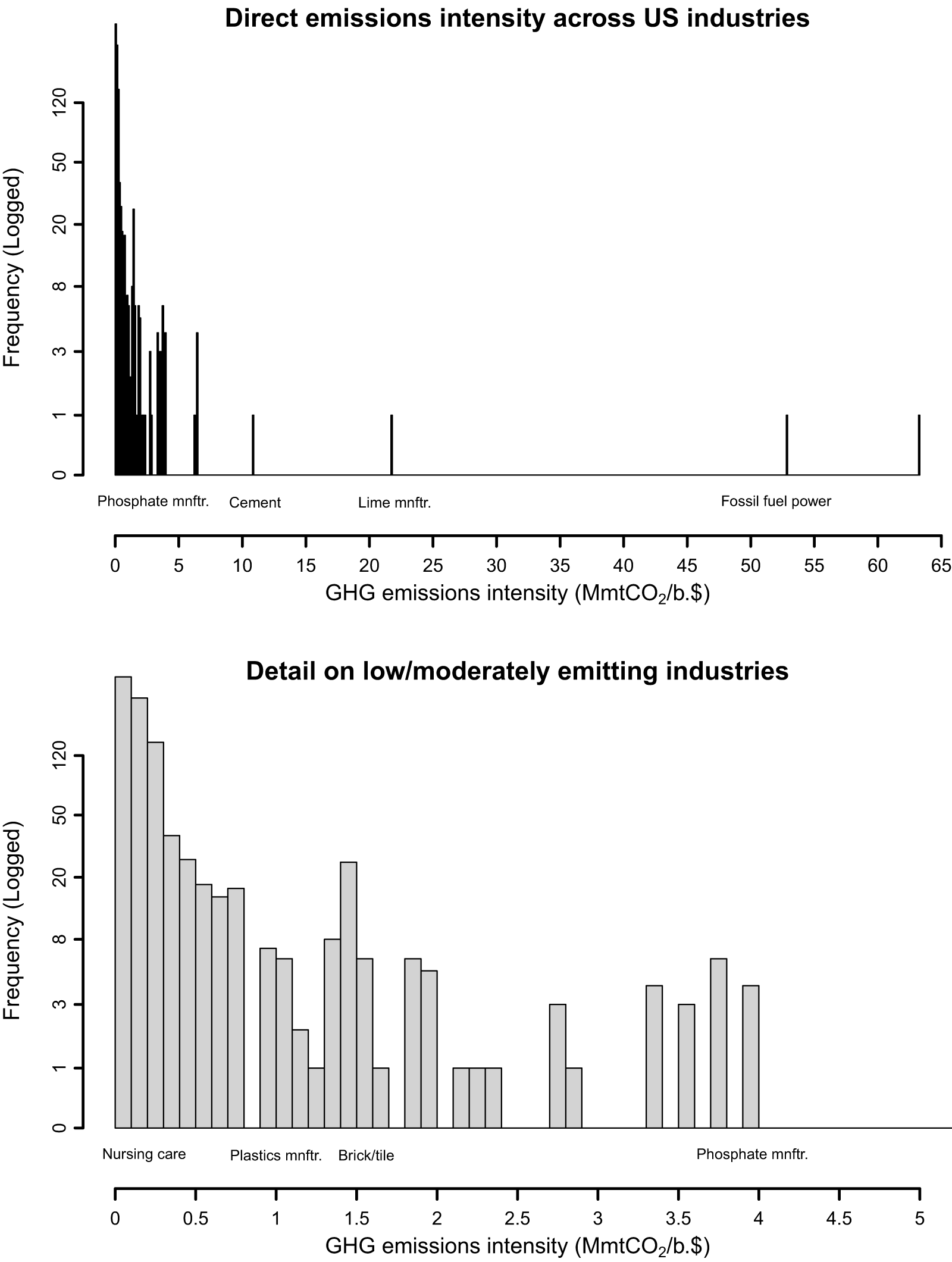
Emissions intensity is often thought of as an industry-wide feature. The variation across industries in emissions is indeed stark, although emissions can also vary among firms within an industry. We illustrate inter-industry variation in emissions intensity in Figure 1, using data from Henry et al. Reference Henry, Khan and Cooke-Hull(2010).Footnote 5 Industry emissions intensity is measured as GHG emissions per unit revenue.Footnote 6 As seen in the top figure, coal and gas electric power generation has one of the highest emission intensities, although lime and cement manufacturing are very high, too. The lower half of the figure provides details on low to moderately emitting industries, which we illustrate with nursing care at the low end and phosphate manufacturing at the high end. We refer to theories focused on the GHG emissions of firms and industries as the emissions intensity account of climate regulation’s effects on business. These theories strongly emphasize, and so trigger thoughts about, firm pollutingness as a factor driving regulatory exposure.
GHG emissions intensities across US industries (6-digit NAICS codes in 2006) measured in million of metric tons of CO2 equivalents per billion dollars of revenue. Source: Henry et al. Reference Henry, Khan and Cooke-Hull(2010).

A series of seemingly disparate theories have also been offered, which emphasize a different factor driving regulatory exposure: firm size. We highlight five of the most prominent among these and argue that a core element of each is a cleavage in regulatory costs between larger firms (which find it easier to navigate climate regulation) and smaller firms (which find it harder).
First, a generic argument in the literature is that some regulatory compliance costs are fixed, i.e., do not depend on firm size (Gulotty, Reference Gulotty2020). For example, implementing a new set of regulations may incur learning costs, expenditures on consultants or lawyers, or capital investments that do not scale one-to-one with firm size. Larger firms find it easier to absorb fixed costs because they can spread out these costs across greater sales volumes (Kitching et al., Reference Kitching, Hart and Wilson2015). Thus, climate regulation may impose a greater relative burden on small firms. A related idea is that more productive firms can better withstand variable costs of production (i.e., costs that scale with the size of the firm) because they have larger profit margins per unit produced (Michaelis, Reference Michaelis1994; Osgood, Reference Osgood2016). Because productive firms are generally larger, this again suggests that larger firms are better able to withstand climate regulation. Note that while both arguments stress that big firms still face cost increases, they benefit on net from climate regulation that harms their rivals more (Meckling, Reference Meckling2015; Kennard, Reference Kennard2020).
Second, larger or more productive firms have greater access to financial capital, which makes compliance with new regulations that require investments easier (González and González, Reference González and González2012). More productive firms are more profitable and so can self-finance capital investments (Backman et al., Reference Backman, Verbeke and Schulz2017). Larger firms also tend to have well-established relationships with bank lenders and better non-bank funding streams, especially bond and equity markets. Larger firms may also have advantages in innovation which enable nimbler and more proactive adaptation to new regulation (Christmann, Reference Christmann2000).Footnote 7
Third, larger and more productive firms are much more likely to trade, to offshore-outsource production, and to establish foreign plants (Bernard et al., Reference Bernard, Bradford Jensen, Redding and Schott2012). This makes it easier to move polluting activities that are not compliant with regulations to other markets (Kolcava et al., Reference Kolcava, Nguyen and Bernauer2019).
Fourth, bigger firms generally are more politically adept and more engaged in political activities like lobbying, campaign contributions, and outreach (Drope and Hansen, Reference Drope and Hansen2006; Osgood, Reference Osgood2021). This political capital gives larger firms a greater say in shaping the fine-grained details of regulation (Hansen et al., Reference Hansen, Mitchell and Drope2004). For this reason, larger, politically adroit firms may face fewer costs from regulation than smaller, inexperienced ones.
Finally, even if big firms face identical costs from climate regulation, they may be more able to secure partially compensating public benefits. Big firms are better at advertising their green policies to employees and customers (Bull, Reference Bull2012; Kumar et al., Reference Kumar, Cantor, Grimm and Hofer2017). Their greater experience with marketing may help them to benefit more from the exact same green initiatives undertaken by smaller firms. CSR and environmental, social, and governance initiatives around climate change are a potential competitive advantage for large firms (McWilliams and Siegel, Reference McWilliams and Siegel2011).
While distinct in their underlying mechanisms, we highlight again that each of these five theories suggests that a relevant cleavage over climate mitigation policy lies between larger firms and smaller firms. We refer to these ideas as the firm size account of climate regulation’s effects on business. These theories strongly emphasize, and so trigger thoughts about, firm scale as a factor driving regulatory exposure.
The firm size and emittingness accounts are different, but also interact and overlap in various ways.Footnote 8 Rather than identifying comprehensive or totally distinct theoretical logics, the emittingness and firm size accounts should instead be thought of as staking out different points of emphasis—pollutingness and firm scale—that may be more or less relevant depending on the industrial, competitive, and regulatory context. Our objective in this paper is to see whether these different points of emphasis are important in public rhetoric and public opinion.
2.2. The two accounts of regulatory costs in public discourse and public opinion
Before theorizing the effects of the emittingness and firm size accounts on public opinion, we address two critical questions. Are these two accounts of climate change regulation’s effects on firms a part of public discourse around climate change? And do significant shares of the public believe in these two accounts (and is there variation in which account they find most plausible)?
To assess the first question, we searched for examples of each theory across four domains: non-editorial news, editorial news, statements by interest groups within news media, and statements by politicians. We focused on US sources. We found a rich set of examples of both the emissions intensity account and the firm size account. These accounts appear as both sincere interpretations or models of the world (e.g., describing climate regulation as a challenge to fossil fuel companies or small companies) and as deeply politicized arguments (e.g., describing climate subsidies as handouts to wealthy corporations and climate regulations as mortal threats to small businesses). We also see many examples where arguments from the academic literature are echoed in public discourse, for example, on large firms’ greater ability to shape regulation or on small firms’ inability to absorb compliance costs. We supply these examples in Appendix A (“Two accounts of regulatory effects for business in public discourse”).
Our second key question is whether the public believes in these alternative accounts of the effects of climate regulation. In particular, it would be useful to know whether some significant share of the public has beliefs in line with the emissions intensity account, while another share has beliefs in line with the firm size account. If that were so, then that would further justify examining the relative impacts of the two accounts on public opinion. We found no existing literature which examines this question, and so we redress that gap within our observational study below. To preview, we ask our respondents about six possible theories of the firms that will be most harmed, or that will most benefit, from climate regulations. We find significant shares of the public that adopt beliefs in line with both the emissions intensity account and the firm size account.
These points—the firm size and emittingness accounts are strategically deployed frames used in the discourse both of which the public has readily adopted in their own beliefs of the effects of climate change regulation—lead us to an important empirical question: what are relative effects of the two accounts on public opinion? One way of thinking about this question is about assessing the effects of framings in media or speech by political entrepreneurs: would one message or another sway public opinion more strongly in favor of, or against, effective climate regulation? Another way to think about the question is about more durable understandings of climate regulation’s impacts on businesses: if a person has absorbed one view of regulation’s effects more than another, does that shape their views of climate regulation over the longer term?
2.3. How the public reacts to regulation of firms
To answer these questions, we develop two theoretical models of the impact of beliefs about climate regulation’s effects on public opinion over climate regulation. We call our main theoretical contribution a “redistributive rightness” model since it emphasizes whether the winners and losers from regulation are deserving or good. Though not our main original contribution, we also investigate an employment-based model which builds off of the literature’s long-running interest in the effects of climate regulation on companies and how that impacts their employees.Footnote 9
2.3.1. Redistributive rightness model
The public’s response to the effects of policy are importantly driven by broadly moral evaluations of the effects of those policies on groups in society (Hammar and Jagers, Reference Hammar and Jagers2007; Drews and van den Bergh, Reference Drews and van den Bergh2016; Bechtel et al., Reference Bechtel, Genovese and Scheve2019). Are the winners of some policy change good or bad, deserving or undeserving? Are the losers of a policy change sympathetic or unsympathetic? These affective forms of evaluation might prevail when the direct material effects of policies are distant or hard to parse, allowing intuitive moral-emotional reactions to others’ successes or misfortunes to supersede detailed evaluation or rational self-interest. But even absent these conditions, political attitudes are always strongly shaped by relative status and moral evaluations of other groups in society. This is particularly so when the public has strong feelings, positive or negative, about those groups.
What does this “redistributive rightness” model of attitude formation mean for public views of climate regulation? The answer to this question depends importantly on whether the public believes the emissions intensity account or the firm size account.
If a person has internalized the emissions intensity account and acts in line with the redistributive rightness model, we expect that they will be more supportive of climate regulations. First, the fossil fuel industry and energy generation industries are generally not sympathetic and many people do not hold positive views of the industry (Leiserowitz, Reference Leiserowitz2019).Footnote 10 Second, we suspect that most people would view heavy emitters as being the “correct” targets of regulation (Leiserowitz, Reference Leiserowitz2019). It would only make sense that those who emit the most GHGs should bear the greatest burden of reducing GHG emissions.
If a person has internalized the firm size account, we expect that they will be more opposed to climate regulation. First, the vast majority of the public views large corporations negatively (Newman and Kane, Reference Newman and Kane2014; Gallup, 2022), so any policy that is seen as going easy on bigger companies will provoke a negative reaction (Saad, Reference Saad2019). Small businesses are generally seen in sympathetic terms and are viewed as making important social contributions, almost universally (Newport, Reference Newport2017).Footnote 11 Second, most people will not view smaller firms as being the proper targets of regulation, and a heavier burden on small firms may be viewed as evidence that regulation is ill-designed (Kitching et al., Reference Kitching, Hart and Wilson2015).
This argument leads to our main claim: individuals who believe or are exposed to the firm size account of climate regulation will hold more negative views of climate regulation than individuals who believe or are exposed to the emittingness account. Our argument also suggests mechanism tests which we describe in terms of moderators (or heterogeneous effects) and mediating outcomes. First, if the redistributive rightness account is correct, then negative attitudes toward big business are an important underlying disposition that shapes evaluation of the distributive stakes. Thus, we expect that opposition to climate regulation among people who have internalized the firm size account should increase with their hostility toward big business. In a similar fashion, we expect that support for climate regulation among people who have internalized the emissions intensity account should increase with their hostility toward the fossil fuel industry and other heavy emitters. The “redistributive rightness” model also suggests a distinct moral-normative causal mechanism behind the negative effect of the firm size account on climate policy attitudes. One potential channel for this is a belief that regulation is harming the wrong targets, and so we should see this belief mediate the effect of the firm size account on climate attitudes. Another potential channel is a belief that regulation harms businesses that are valuable to society, i.e., small businesses.
2.3.2. Employment-based model
The standard political economy approach is that attitudes toward economic policy are mainly materialistic and egoistic. In this view, the mass public mainly reacts to industrial regulation in their capacity as workers or as relatives or as neighbors of workers (Tvinnereim and Ivarsflaten, Reference Tvinnereim and Ivarsflaten2016; Gazmararian and Tingley, Reference Gazmararian and Tingley2023). Climate regulation that harms businesses or industries on which workers (or their family or town) depend for employment will be viewed negatively (Bechtel et al., Reference Bechtel, Genovese and Scheve2019).
What does this employment-based model mean for attitudes about increasing the stringency of climate regulation? The answer to this question again depends importantly on whether a person believes the emissions intensity account of distributive stakes or the firm size account.
If a person has internalized the emissions intensity account and acts in line with the employment-based model, we expect that they will be more opposed to climate regulation if they work in an emissions-intensive industry (or in an industry that strongly depends on energy consumption, inputs from GHG-intensive industries, or sales to GHG-intensive industries). If they do not work in such an industry, we expect that they will be relatively more supportive of climate regulation than the former group. If on the other hand, a person has internalized the firm size account (but still acts in line with the employment-based model), we expect that they will be more opposed to climate regulation if they work at a small company or small business. If they work at a large company, we expect them to be more positive on climate regulation.
Both these arguments describe an interaction between beliefs (about the distributive consequences of regulation) and employer characteristics (emitting or non-emitting, big or small). Put another way, the employment-based model mainly suggests conditional effects of beliefs about climate policies’ consequences.Footnote 12 We test these ideas below by examining the interaction of our treatments with measures of firm size and employment in heavily emitting industries. We note that the employment-based approach emphasizes a particular causal mechanism: job concern. If the employment-based approach is true, elevated worry about employment should therefore mediate any negative impact of the firm size account on climate policy attitudes.
3. Observational survey-based study
3.1. Observational hypotheses, design, and data
We translate our theory from above into two symmetric hypotheses tailored to an observational study. Both hypotheses primarily build off of the redistributive rightness account of preference formation. We reserve tests of moderators and mediators to our experimental setting.
Hypothesis 1a.
Respondents who believe that large and very large firms find it easiest to comply with climate regulations support those regulations (and international climate cooperation) less than respondents who think that non-emitting firms find it easiest to comply.
Hypothesis 1b.
Respondents who believe that small- and medium-sized firms find it hardest to comply with climate regulations support those regulations (and international climate cooperation) less than respondents who think that heavily emitting firms find it hardest to comply.
To test these hypotheses, we commissioned an original survey of 2000 Americans fielded by YouGov Omnibus from February 16–28, 2023. Our hypotheses, coding decisions, and analyses were preregistered. The sample was generated via stratified random sampling of the YouGov Omnibus panel on age, education, gender, and race. YouGov provides poststratification weights, so the sample is nationally representative on these variables, as well as on presidential vote in 2016 and 2020. We use weighted means or weighted least square (WLS) regression models in all instances.
We ask the following two questions to get at respondents’ pre-existing beliefs about which firms they believe will find it easier or harder to handle climate-related regulations.
Many countries are working on rules to make companies reduce greenhouse gas emissions and cut energy usage and fuel consumption. These rules may slow down climate change. However, new rules will also create costs for companies which may hurt their productivity or sales.
Which companies do you think will find it easiest to comply with these new environmental rules? In other words, which companies do you think will be able to follow new environmental rules without seriously affecting their business or profitability?
— Large and very large companies
— Small and medium-sized companies
— Companies in industries that heavily emit greenhouse gases or consume energy
— Companies in industries that do not heavily emit greenhouse gases or consume energy
— All companies will find it easy to comply
— No companies will find it easy to comply
Which companies do you think will find it hardest to comply with these new environmental rules? In other words, which companies do you think will face the greatest damage to their business or profitability as a result of new environmental rules?
The second question has the same answers, except that answers 5 and 6 are changed to “All companies will find it hard to comply” and “No companies will find it hard to comply.”
Support or opposition to climate action is the outcome of interest for Hypotheses 1a and 1b. We measure support for regulation with the following question:
To what extent would you support new regulations on businesses’ greenhouse gas emissions and energy consumption to reduce climate change?
The potential answers are Totally oppose, Mostly oppose, Somewhat oppose, Neither favor nor oppose, Somewhat Favor, Mostly Favor, and Totally favor. This question directly connects to respondents views about climate-related regulations.
We also ask an additional outcome question on international climate cooperation.
To what extent do you support the United States participating in the Paris Climate Agreement, an international treaty which commits countries to domestic efforts to slow down climate change?
This uses the same answer scale as above. This additional question serves three purposes. First, it uses a different face of climate change policy to show that our theory applies across different types of policymaking (Bechtel et al., Reference Bechtel, Genovese and Scheve2019; Tingley and Tomz, Reference Tingley and Tomz2020). Second, the question implies, but does not directly say, that the Paris Climate Agreement will lead to more stringent regulation. It is valuable to show that our respondents can connect their own beliefs about regulatory effects to policy questions that implicate, but are not directly phrased as, regulatory tightening. Third, the question serves as a simple robustness check that our findings aren’t driven by some peculiarity of our first outcome question. Of course, the Paris Agreement question might activate more complicated considerations around reciprocity (Tingley and Tomz, Reference Tingley and Tomz2014; Reference Tingley and Tomz2022; Mildenberger and Tingley, Reference Mildenberger and Tingley2019) or distributive effects among nations (Bechtel and Scheve, Reference Bechtel and Scheve2013; Bayer and Genovese, Reference Bayer and Genovese2020). For these reasons, we view the treaty outcome question as valuable but secondary to the direct question on regulation.
To test Hypothesis 1a, we first report that the difference in means for the climate regulation question for respondents answering “Large and very large companies” will easily adjust versus respondents answering “Companies in industries that do not heavily emit greenhouse gasses or consume energy”. (Results on the climate treaty question are included in the appendix.) This is followed by models which sequentially introduce controls: birth year, gender, and race; a college dummy, family income, and employment dummies; indices for partisanship and political ideology;Footnote 13 and two measures of material threats based on whether the respondent works in a heavily emitting industryFootnote 14 and exposure to climatic risk.Footnote 15 Coding decisions on controls are provided in the Appendix. A significant number of respondents (491) did not provide answers to at least one demographic question asked by YouGov (usually income, ideology, or party), and a very small (5) number of respondents did not answer some of our questions. We use multiple imputation on the cleaned analysis dataset so that we may analyze the entire sample in models that include covariates.Footnote 16 Estimates and models with imputed covariates are based off of 10 multiply imputed datasets generated using the Amelia software package (Honaker et al., Reference Honaker, King and Blackwell2011). The imputation models in both the observational and experimental data include all analysis variables except for the survey weights.
To test Hypothesis 1b, we use the same steps as above but replace responses to the “Easiest to comply” question with responses to the “Hardest to comply” question. Specifically, we will focus on comparing respondents who answer “Small and medium-sized companies” with respondents answering “Companies in industries that heavily emit GHGs or consume energy.”
3.2. Observational results
3.2.1. Beliefs about costs of compliance
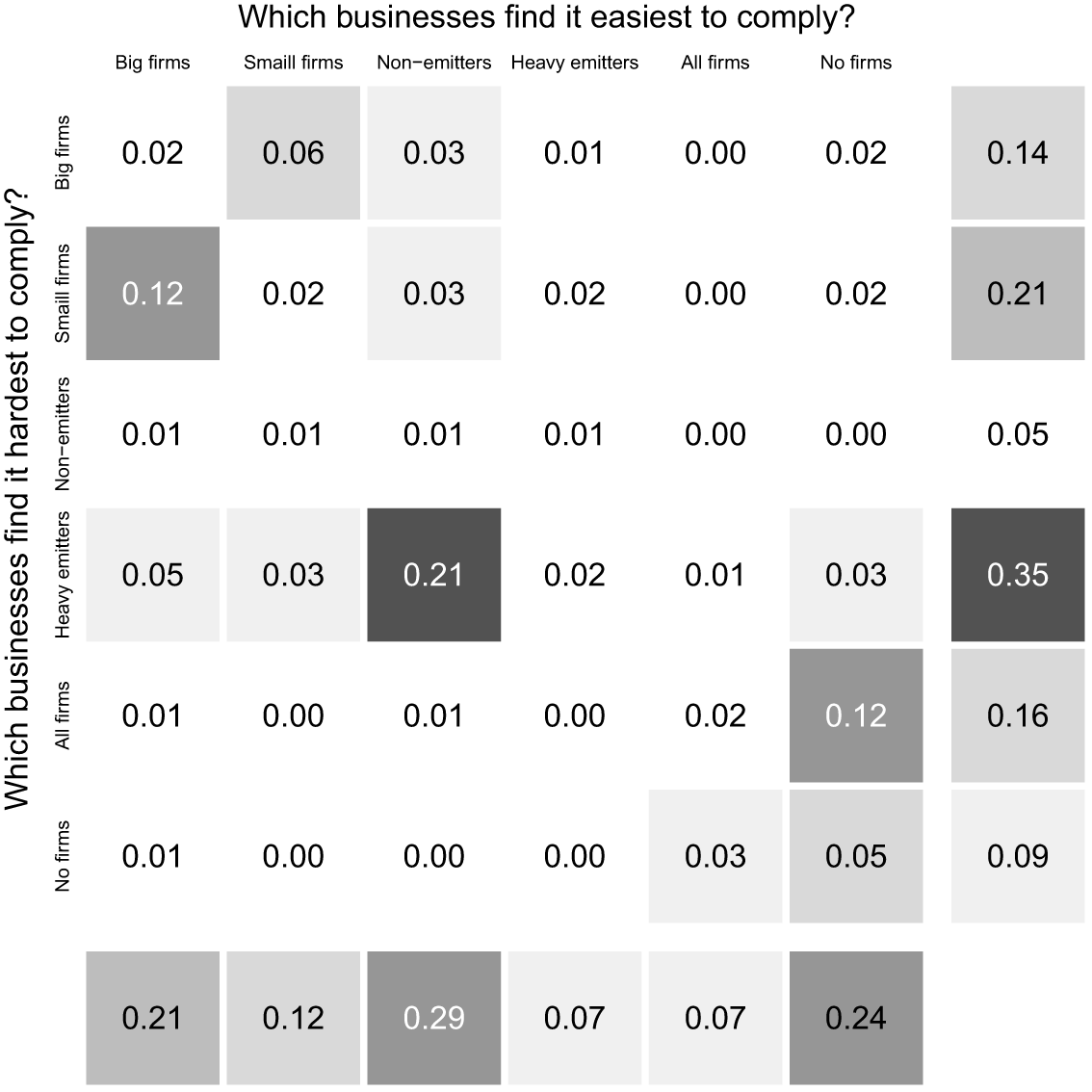
We begin by presenting in Figure 2 a cross-tabulation of results to the questions about which firms respondents think will find it easiest or hardest to comply with climate regulations. The joint distribution is presented in the central square; the marginal distributions are in the rightmost column and bottom row.
Cross-tabulation and marginal proportions for responses on which business will find it easiest and hardest to comply with climate regulations.

Respondents most commonly answer that non-emitters will find it easiest to comply with climate regulations (29%) although quite a few also answer big firms (21%) and no firms (24%). The first and second of these answers are consistent with the standard accounts in the literature. The third of these may be a “protest vote” to express hostility toward climate action or just pessimism about the difficulties of decarbonization. The answers provided on which firms will find it hard to comply with climate regulations mirror these, with “heavy emitters” the clear front-runner (35%), but quite a few respondents answering “small firms” (21%) or “all firms” (14%).
Looking at the joint distributions, we see that by far the most common responses are that “non-emitters will find it easy to comply, heavy emitters will find it hard to comply” in line with the emissions intensity account. We also find it striking the number of respondents who pair “big firms find it easy to comply, small firms find it hard to comply,” consistent with the firm size account.
3.2.2. Costs of compliance and attitudes toward climate regulation
In the top half of Table 1, we provide the results of our testing of Hypothesis 1a. This hypothesis predicts significantly more negative attitudes toward climate regulation among people who believe that large firms will easily adjust, even conditional on our controls. That is the case across all our models, although the effect of the “Large firms easily adjust” belief is blunted somewhat by the inclusion of political/ideological controls. We see very similar effects in the online Appendix where we examine support for climate treaties (Table A3). In the bottom half of Table 1, we examine the effects of respondents’ beliefs about which firms will struggle to adapt to climate regulation. In line with Hypothesis 1b, those who believe that small firms will find it hard to adjust are much more negative on climate regulation than those who think that heavily emitting firms will find it hard. We see similar results using the treaty outcome variable (Table A4).
Support for climate regulations and attitudes based on which businesses find it easy or hard to adjust to climate regulations

Notes: *p < 0.05, **p < 0.01, ***p < 0.001. All models are weighted least square (WLS) with WLS standard errors. In the top half, “Large firms easily adjust” is compared relative to “Non-emitting firms easily adjust.” In the bottom half, “Small firms hard to adjust” is compared relative to “Heavily emitting firms hard to adjust.” Controls introduced sequentially: Model 1 is bivariate; 2 introduces age/gender/race; 3 introduces education, employment, and income; 4 party and ideology; and 5 industry emittingness and climate change exposure.
Overall, the results of our observational survey suggest significant variation among the public in their beliefs about climate regulation’s effects on business and a robust conditional correlation between those beliefs and support for climate regulation. We now turn to demonstrating the causal impact of those beliefs.
4. Experimental study
4.1. Experimental hypotheses
Our theory suggests a main testable hypothesis about an average treatment effect:
Hypothesis 2.
Respondents exposed to a treatment emphasizing large companies’ ease and small companies’ difficulty with climate regulations will be more opposed to climate regulations (and international climate cooperation) than respondents exposed to a treatment emphasizing heavily emitting industries’ difficulty and non-emitting industries’ ease.
Note again that the firm size account is our first treatment and the emissions-focused account is our second treatment (or reference frame), so we expect a negative treatment effect. We report treatment effects relative to a neutral control in the appendix.
The redistributive rightness theory and the employment-based theory also suggest mechanism tests which we can conduct with appropriate moderators and mediating outcomes. We discuss the moderators first and then mediation.
Within the “redistributive rightness” account, the primary mechanism is moral or normative: respondents’ attitudes toward big business, on the one hand, and the fossil fuel industry, on the other, drive the impacts of their understandings of redistributive effects on the climate policy regulation views. This suggests the following hypothesis:
Hypothesis 3a.
Respondents with less negative attitudes toward larger companies should have a less negative treatment effect. Respondents with more positive attitudes toward fossil fuel industries should have a less negative treatment effect.
To understand these predictions, consider the first sentence. For respondents with strong negative views of big companies, the firm size treatment should induce very negative feelings toward climate regulations. The emittingness frame, on the other hand, should have no particular effect. For respondents with less negative, or even positive, affect toward big businesses, this difference will be more muted, since finding out that big businesses can handle regulation more easily will not spark such a negative reaction. Thus, we expect the treatment effect, defined in terms of the firm size treatment relative to the emittingness reference frame, to be less negative among respondents who are not as hostile to big companies.
Now consider the second prediction. We expect the firm size treatment to have little particular effect on those with negative attitudes toward the fossil fuel industry versus those with positive attitudes. In sharp contrast, the emittingness frame should induce strongly negative attitudes toward climate regulation among supporters of the fossil fuel industries and positive attitudes among those who oppose the industry. Thus, we expect the overall treatment effect, defined in terms of the firm size treatment relative to the emittingness reference frame, to be less negative (or even positive) among respondents who are more favorable to the fossil fuel industries.
In order to test the employment-based account, we consider employer size and emittingness:
Hypothesis 3b.
Respondents employed at relatively larger employers should have a less negative treatment effect. Respondents employed in heavily emitting industries should have a less negative treatment effect.
The reasoning for these two predictions is similar to that outlined for Hypothesis 3a, but instead of attitudinal moderators (feelings toward big companies and feelings toward the fossil fuel industries) we have employment-based mechanisms (working at a large firm, working at a heavy emitter).
We test three further hypotheses about causal mechanisms by examining mediating outcomes that lie between our treatment and attitudes toward climate regulation. The first two relate to the redistributive rightness channel, where we divide up the normative evaluation mechanism into a channel emphasizing deservingness of regulation-induced costs and a channel emphasizing bad consequences from harm to regulated businesses. The third relates to the employment channel.
Hypothesis 4a.
Opposition to climate regulation/cooperation generated by the firm size treatment will occur due to a heightened feeling that climate regulations unfairly harm some businesses.
Hypothesis 4b.
Opposition to climate regulation/cooperated generated by the firm size treatment will occur due to a heightened feeling that climate regulations harm businesses that are valuable to society.
Hypothesis 4c.
Opposition to climate regulation/cooperation generated by the firm size treatment will occur due to a heightened feeling that climate regulations increase personal job insecurity.
4.2. Experimental design and data
To examine these hypotheses, we again commissioned an original survey of 2000 Americans fielded by YouGov Omnibus from February 16–28, 2023. The sample was generated in the same fashion as the observational survey. Note that, by design, this survey had no overlapping respondents with our observational survey. Our hypotheses, coding decisions, and analyses were preregistered.
Our survey experiment is designed to gauge the effect of priming individuals about the firm size account of climate regulation’s distributive consequences relative to the emissions intensity account. To do so, we randomly assigned the following treatment texts to our respondents, as well as a no-text control condition:
[Treatment I:] The USA is working on rules to limit companies’ greenhouse gas emissions and energy usage. These rules not only may slow down climate change but will also create costs for companies.
New regulations will be especially costly for small and medium-sized companies, who will find it challenging to lower their emissions and use less energy. Some small businesses may even shut down. New regulations will have fewer negative effects on large and very large companies.
[Treatment II:] The USA is working on rules to limit companies’ greenhouse gas emissions and energy usage. These rules not only may slow down climate change but will also create costs for companies.
New regulations will be especially costly for companies that heavily emit greenhouse gases or consume energy, who will find it challenging to lower their emissions and use less energy. Some heavily emitting businesses may even shut down. New regulations will have fewer negative effects on companies that do not heavily emit greenhouse gases or consume energy.
The treatment text was immediately followed on the same page by the two climate policy attitude questions used as dependent variables in the observational study above. The no-text control condition included only the climate policy attitude questions without any preceding text. We randomized treatments I and II to 800 respondents each and the no-text control to 400 respondents.
We initially report a difference in means (for both outcomes) between the two treatment conditions. To guard against post-randomization covariate imbalance and to potentially tighten the confidence intervals, we then sequentially introduce the same controls as in the observational study. We examine the difference between the treatments and the control in the Appendix.
To identify individuals who hold negative sentiments toward big businesses and fossil fuel companies, we use the answers on the second and fourth items in the following multi-item feeling thermometer question (asked before the experiment):
We would like to learn about your feelings toward different groups listed below. Please position each one on a feeling scale/thermometer. The higher the number, the warmer feelings you have toward this group. For instance, a ranking of 0–49 means that you feel negative/cold feelings toward the group. A ranking of 51–100 means that you feel positive feelings toward the group. If your feelings are neutral, please select exactly 50.
- The US Congress (Senate and House of Representatives)
- Corporate America (aka “Big Business” or the Fortune 500)
- The Entertainment Industry (aka “Hollywood”)
- Oil and gas companies (aka the Fossil Fuel industry)
- The Catholic Church
- The National Football League.
We split the responses on the thermometers at their medians to create two dichotomous variables called “Positive view of corporations” and “Positive view of fossil fuel industries.” To examine the heterogeneous effects, we interact “Positive view of corporations” and “Positive view of fossil fuel industries” with the treatment indicator in separate regression models without covariates. We again include the models for the climate regulations outcome in the main text and place the models for the climate treaty outcome in the online Appendix.
To examine whether treatment effects might be driven by feelings of job insecurity resulting from the size of the firm an individual works at, we ask respondents to report their firm’s size:
Roughly how many employees would you say work at the company, business, or organization where you are currently employed? If you work at a company with more than one location or branch, please try to answer for the company as a whole, not just your location or branch. If you work at multiple companies, please answer for the company that is your main source of income.
Respondents were given seven options that increased the number of employees exponentially (e.g., 1–5, 6–19, 20–49, 50–199, etc.). For respondents who previously answered that they were not employed, we provide a reworded question asking them to answer the above for the last place where they worked and providing an additional response: “I have never been employed.” We dichotomize the resulting measure of employer size in a variable called “Large employer.” Respondents at or below the median response (which was 50–199) were coded as a 0 for this variable; respondents above the median response were coded as a 1.Footnote 17 Respondents who have never been employed are dropped from the analysis when this variable is used.
We also use the employment in highly emitting industries measure (described in detail in the Appendix) to examine employment in those industries as a moderator of the treatment effect.Footnote 18 To examine the heterogeneous effects, we interact “Large employer” and “Highly emitting” with the treatment indicator in separate regression models both without and with the complete covariate vectors used previously. We include the models for the climate regulations outcome in the main text and place the models for the climate treaty outcome in the Appendix.
Finally, we use the following question to measure mediators:
To what extent do you agree or disagree with the following statements about efforts to regulate greenhouse gas emissions in order to limit climate change:
- “Climate-related regulations may harm some businesses that haven’t done anything wrong.”
- “Climate-related regulations will harm companies that make important contributions to the economy and society.”
- “Climate-related regulations could endanger the jobs of people like me.”
Individuals can provide one of five responses: strongly disagree, somewhat disagree, neither agree nor disagree, somewhat agree, and strongly agree.
We use WLS for the mediator models and include the complete set of demographic, education/ employment, party/ideology, and climate attitude controls. We use WLS for the outcome models which again include all the controls. We report treatment effects on the mediating variables, average causal mediation effects, and average direct effects.
4.3. Experimental results
4.3.1. Main results
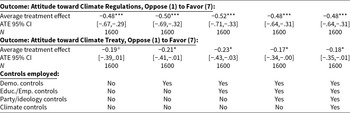
Table 2 provides the results of our main tests of Hypothesis 2. Recall that the estimand is the average difference in the climate attitude outcomes between respondents receiving a treatment that emphasizes big firms’ ease and small firms’ difficulty with climate regulations and a treatment describing non-emitting firms’ ease and heavily emitting firms’ difficulty. We expect the former treatment to provoke a negative response relative to the latter, and that is what we see in the average treatment effects in Table 2. The first column of the table shows the simple difference in means, and the subsequent columns include additional covariates. The top half of the table examines the climate regulation attitudes outcome, while the bottom half of the table examines the climate treaty outcome. We see similar negative effects across both outcomes.Footnote 19
Effect of priming firm size account of climate regulation adjustment costs versus emissions intensity account on support for climate regulation and a climate treaty

Notes: +p < 0.10, *p < 0.05, **p < 0.01, ***p < 0.001. All models are WLS with WLS standard errors. Treated = 1 for large firms find it easy/small firms find it hard; Treated = 0 for firms in non-emitting industries find it easy/firms in heavily emitting industries find it hard.
We examine in the Appendix the difference between our treatments and the control condition (Tables A3 and A4). We find that the firm size treatment provokes a large, negative, and statistically significant treatment effect relative to control for the regulation question and a moderate, negative, and not significant treatment effect for the treaty question. The emittingness frame generally provokes a very modest, positive, and insignificant treatment effect relative to control. This non-effect of the emittingness frame relative to control may reflect the fact that the emittingness frame is already widely understood by survey respondents.
We note one additional interpretive point on these tests. We wrote our second treatment on emittingness to be inclusive of different types of industries with a big carbon footprint due to emissions or energy consumption, from mining and gas, power generation, agriculture, certain heavy manufacturing, construction, and transportation. However, it is possible that respondents given text saying “companies that heavily emit greenhouse gases or consume energy” will think only of the very large oil companies that comprise “big oil,” since these companies are so prominent in climate discourse. Since the most prominent companies in the industry are big, the emittingness treatment might spark thoughts about big companies. Such an effect could tend to suppress any differential effect of the two treatments. As such, the large negative treatment effect between the two framings suggests that respondents were able to distinguish the two frames.
4.3.2. Treatment effect heterogeneity
Table 3 provides the results of our models concerning treatment effect heterogeneity, with the redistributive rightness model of Hypothesis 3a in columns 1 and 2, and then the employment-based model of Hypothesis 3b in columns 3 and 4.
Treatment effect heterogeneity

Notes: *p < 0.05, **p < 0.01, ***p < 0.001. All models are WLS with WLS standard errors. Treated = 1 for large firms that find it easy/small firms find it hard; Treated = 0 for firms in non-emitting industries that find it easy/firms in heavily emitting industries find it hard.
Hypothesis 3a predicts that respondents with positive attitudes toward big corporations or positive attitudes toward the fossil fuel industry will have less negative treatment effects. We see some evidence in favor of the first interaction effect, with an interaction term between the treatment indicator and the positive view of corporations variable of .26 (without controls) and .39 (with controls). In the former case, this means that the treatment effect among those with a negative view of big corporations is −.57, but among those with a positive view of corporations, it is −.31. While the size of this difference is noticeable, it is not statistically significant at conventional levels. The difference is significant, however, in the models with controls.
A positive view of the fossil fuel industries also moderates the treatment effect in a statistically significant fashion both with and without controls; the overall interaction effect is quite large, too. Without controls, for example, the firm size treatment effect among people with a negative view of the fossil fuel industry is −.74; among people with a positive view of the fossil fuel industry, the treatment effect is substantially reduced, to  $-.74+.57=-.17$. For both the big business and fossil fuel moderators, we see very similar sizes and signs of effects when we examine the treaty outcome (Table A5) and when we use a continuous thermometer score (Tables A11 and A12). Overall, the heterogeneous treatment effects results are supportive of the redistributive rightness theory.
Hypothesis 3b predicts a positive and significant interaction term between the large employer dummy and the treatment indicator. Looking at the models without controls in the top half of Table 3, we do not see this and the overall size of the coefficient is modest. Likewise, Hypothesis 3b also predicts a positive sign on the interaction between the heavily emitting industry dummy and the treatment indicator. We do see a positive coefficient, and one that is somewhat larger in size, but it is again not significant at the 5% level. Our findings are substantively similar when we include the full battery of controls in the lower half of Table 3. We also examine in the Appendix multiple alternative operationalizations of the large employer and heavily emitting dummy variables and find similar null effects (Tables A9 and A10). Thus, we see little support within the heterogeneous treatment effects for the employment channel.
4.3.3. Mediation
Our final set of hypotheses concern mediation effects. The results of these models, examining both the climate regulation and climate treaty outcome, are presented in Table 4.
Mediation analysis of climate attitudes and beliefs about regulation’s distributive effects

Notes: *p < 0.05, **p < 0.01, ***p < 0.001. All mediator models are WLS regression with a treatment dummy and the following controls: age, gender, race, college, income, employed, unemployed, party, ideology, climate exposure, and heavily emitting. All outcome models are WLS. Treated = 1 for large firms that find it easy/small firms that find it hard; Treated = 0 for firms in non-emitting industries that find it easy/firms in heavily emitting industries that find it hard.
Causal mediation effects are identified under stringent assumptions (Imai et al., Reference Imai, Keele, Tingley and Yamamoto2011),Footnote 20 so we start with an intermediate outcome that is well-identified without strong assumptions: what are the effects of the different treatments on our mediators? First, the firm size treatment has a positive and significant effect on the “regulatory fairness” mediator. The firm size treatment increases concern about the unfairness of climate regulations’ effects by 0.16 points on the 5-point scale, which is 13% of a standard deviation. Second, the firm size treatment has a smaller, positive, but insignificant effect on the “harmful consequences” mediator. Third, the firm size treatment has a positive and significant treatment effect on the “job concern” mediator relative to the emissions treatment. On average, the firm size treatment increases job concern by .16 points on the 5-point scale, which is about 12% of a standard deviation. Overall then, our treatment seems to be provoking concern about the fairness of regulation—consistent with the redistributive rightness model—and job concern—consistent with the employment channel.
Moving on to the causal mediation effects, we find that the effect of the treatments on climate attitudes are mediated by both “regulatory fairness” and “job concern” but not by concerns over “harmful consequences” to valuable businesses.Footnote 21 The scale of the causal mediation effects is significant, accounting for roughly 20% of the total causal effect for the climate regulation outcome and 50% of the total causal effect for the treaty outcome. However, these causal mediation effects rely on a very strong sequential ignorability assumption, and the proximity of the top end of the confidence intervals to zero suggests that modest amounts of unmeasured confounding might upend this conclusion. So we are cautious in interpreting these numbers. Overall, the results provide partial support for both the redistributive rightness channel and the the employment channel.
5. Conclusion
We suggest three future directions for research and then consider broader implications of our findings. First, we have focused on regulatory costs associated with effective climate regulation but have not considered competing stories about which firms will benefit from a green transition. It would be interesting to follow up on competing frames around this topic on firm size, industrial characteristics, worker characteristics, and nationality. Second, we found little support for the employment-based model: neither firm size nor industry emittingness moderate the treatment effect in any consistent or significant fashion. It would be valuable to follow up on with a more concentrated sample of workers in heavily emitting industries (Gaikwad et al., Reference Gaikwad, Genovese and Tingley2022). Third, it would be worthwhile to examine our approach outside the United States.
What do our findings imply for the design and prospects of effective climate policy? First, our findings reinforce the importance of designing climate regulation that does not place disproportionate burdens on smaller enterprises. For policymakers, achieving this end is complicated by several factors. Regulations that are prima facie equal regardless of firm size may disproportionately harm small businesses because of their smaller scale and more limited resources. Yet avoiding harms on small businesses may undermine the efficacy of climate regulations, since reducing small and medium-sized enterprises’ emissions is critical to stabilizing the climate. Nonetheless, our findings strongly suggest that earning small business buy-in, and heading off any plausible claim that small businesses will be harmed, is important to secure public support for climate action.
Second, our findings point to the importance of messaging around “just incidence” when introducing new regulations, especially regulations as important and impactful as those that have been developed to mitigate climate change. Designing policy in the “right way” may have limited impact if political entrepreneurs, opposing politicians, and the media frame the issue in unfavorable terms. Our anecdotal evidence on framing climate regulations as a question of firm size suggests that this is a recurring tactic for groups opposed to climate action, and our experimental findings suggest that it is an impactful frame, too. Careful marketing may be just as important as policy design in the battle for public support for effective climate action.
Third, large corporations are generally not popular as a class and populists on both the left and right have demonized big business as part of their appeals. For the populist American right, criticizing large corporations and hostility toward climate action are a fine match, and in that way, our findings may shed light on an underexplored facet of the recent rise of right-wing populism: hostility to elites (including elite corporations) fits hand-in-glove with hostility to effective climate change mitigation efforts. For the progressive American left, however, demonizing large corporations may be in tension with support for climate change mitigation. Large corporations are often leaders in supporting public and private climate governance. Demonizing large corporations may reduce mass support for climate action to the extent that the public has intuitions in line with the firm size account of climate regulation’s effects. Broad brush condemnation of big business may not serve the left’s environmental goals. Ensuring that small and medium-sized firms are able to confidently respond to climate regulations may be a more fruitful avenue for sustaining support for climate action among both special interests and the public.
Supplementary material
The supplementary material for this article can be found at https://doi.org/10.1017/psrm.2025.11. To obtain replication material for this article, please visit https://doi.org/10.7910/DVN/NS8GWL.
Acknowledgements
The authors gratefully acknowledge research support from the University of Michigan’s Department of Political Science, College of Literature, Arts, and the Sciences, and Office of Vice President for Research. The authors wish to thank Nancy Burns, Joe Johnson, Michael Lerner, Clara Park, and participants in the University of Colorado Boulder’s departmental seminar and Columbia University’s International Politics Seminar.



 Open access

