


Everywhere you go, always take the weather with you.
—Crowded House, “Weather with You”I.
Picture it: Bilignin, 1936. The country home of Gertrude Stein and Alice B. Toklas in southeastern France. It is September. For six months Stein has been writing Everybody's Autobiography (1937), a sequel to the enormously successful The Autobiography of Alice B. Toklas (1933), which garnered Stein fame in the United States and cemented her appraisal of herself as one of the most important minds of the twentieth century. As she takes up her pen to begin the always-beginning-again task of writing, Stein dedicates a few lines to a remark on the weather:
This year it is the end of September and there is snow everywhere and this has never happened before not ever before the end of November. And in these days when they are all so troubled and so certain that everything is going so badly nobody not even the most simple-minded of them think that the strange weather has anything to do with the matter. (128)
Strange weather. Everything going badly. One might not be faulted for thinking this an account of more recent years. While it is now perhaps taken for granted that global calamities and “strange weather” are tragically interdependent, this would not have been the case in the 1930s. The scientific consensus about extreme weather due to the anthropogenic buildup of greenhouse gases was still decades off. What are the implications, then, of Stein's uncanny report of unusual autumn snow in 1936 and her speculation that it might have something to do with the fact that “everything is going so badly”? Might Stein have left a trace of global warming's early impact on the climate and on the literary and cultural imagination of the West?
In what follows, I make the case that Stein's weather report from the third chapter of Everybody's Autobiography represents an anticipatory consciousness about the reality of industrialization's impact on the weather. While prediction and the weather have a richly entangled history, I do not intend to portray Stein as a meteorological Saint Odile (whose prognosticating talents Stein explores in her 1944 memoir Wars I Have Seen). I argue, however, that Stein exhibits what Raymond Williams calls “the articulation and formation of latent, momentary, and newly possible consciousness” (qtd. in Newman 16). Stein's writing from this decade reflects the general fact of an altered climate in which unseasonable and extreme weather was becoming something of a norm. As Stein casually observes in A Geographical History of America—written between 1934 and 1935, just before Everybody's Autobiography—“Autumn can come in June but very soon it mostly can come in July” (Gertrude Stein 442).
In Everybody's Autobiography, Stein offers a detailed, comparative chronicle of daily weather. Written between two springs, from March 1936 to April 1937, the second autobiography—like its predecessor—unfolds during a time when signs of extreme weather due to global warming were emerging around the globe. Stein leaves literary traces of these events while evincing a consciousness that her own life and writing are imbricated in vast social, industrial, and ecological systems, as well as an awareness that those systems are in flux and changing in “unusual” and “strange” ways. “In short floods or no floods,” Stein writes on the first page of the first chapter of this work, “things pretty much do happen and they used to say it will be all the same a hundred years hence but really it will not” (9). Stein's assertion that the periodic flooding that comes and goes with the seasons will not be the same in a hundred years is but one of many examples of her meteorological prescience. By taking stock of Stein's reflections on the altered climate of the 1930s, I hope to address some of the questions about the history of global warming and literary representation that have confronted scholars engaged in ecocriticism and literary environmental studies. In particular, I hope to inspire scholars to take a closer look at the modernist literary archive for traces of the effects of anthropogenic climate change on early-twentieth-century life and thought.
II.
In the posthumously published “The Weather in Proust,” to which the present essay owes its title, Eve Kosofsky Sedgwick turns to literary representations of the weather to see what they might reveal about the relationship between truth and reality, or about our affective and psychological adjustment to what is real in our environment. Sedgwick views the unpredictable nature of the weather as central to our ability to stay in touch with reality. The “surprise” of the weather, for Sedgwick, “is the mark of reality, insofar as what is real—what surrounds the subject, the weather of the world—has to exceed the will of the subject” (34). As Jonathan Goldberg has noted, Sedgwick's interest in the weather was part of a broader “engagement with the resistance of matter to human designs upon it” (375). The weather's indifference to human desires, one might say, helps us develop a sense of the real limits of our ability to assert control over an out-of-control world. Though not strictly a work of literary ecocriticism, Sedgwick's essay speaks to the ecocritical project of locating the reality of anthropogenic global warming in literature. In particular, in highlighting the epistemological significance of the weather's relation to the subject, Sedgwick lends conceptual resources for overcoming the “crisis of imagination” that has long frustrated scholars combing the literary canon for signs of global warming's impact on writers (Newman 7). Lawrence Buell, Lance Newman, and Kathryn Yusoff and Jennifer Gabrys have all contended, in various ways, that “issues of vision, value, culture, and imagination” play as much of a role in defining and addressing environmental crises as the economic and political forces that fuel them (Buell 5).
In his much discussed book The Great Derangement: Climate Change and the Unthinkable, Amitav Ghosh offers his own notion of imaginative crisis in relation to literature.Footnote 1 Ghosh attributes the dearth of representations of the effects of global warming in anglophone literature to what he calls a conceptual “derangement” that inheres in literary realism's need to represent the probable. For Ghosh, conventional literary narration cannot represent something as improbable or “unthinkable” as human-caused climatic disaster because “the very gestures with which it conjures up reality are actually a concealment of the real” (23). Put another way, the necessity that realist narrative fiction be plausible works to prevent the reality of human impact on the weather from being represented.
While Ghosh's purview of “modern” novels is broad, spanning nineteenth-century to contemporary English-language fiction, his claim that “signs of a changing climate date back to the 1930s” places the era of literary modernism under acute pressure to turn up evidence of such changes (91).Footnote 2 Climate research from the last two decades supports the view of the 1930s as a decade in which extreme weather due to anthropogenic climate change was beginning to happen. Scientists have attributed disruptions in global weather patterns in the 1930s in part to an accelerated warming of the arctic region, beginning in the late 1890s and lasting through the first few decades of the twentieth century (Alley et al.; McLeman et al.; Ballesteros-Cánovas et al.; Hegerl et al.). This event, called the Early-Twentieth-Century Warming, was caused in part by the anthropogenic buildup of greenhouse gases and is thought to have influenced a spate of extreme weather and abrupt climate changes across the planet, including monsoon failures and subsequent droughts in India at the turn of the twentieth century (Hegerl et al. 10–11).Footnote 3 Devastating droughts also occurred across parts of North America, Australia, and Europe in the 1930s and 1940s alongside unprecedented wintertime flooding and record-setting heat waves (Hegerl et al.; Ballesteros-Cánavos et al.).
The periodization of global warming—not to mention of modernism—certainly exceeds the confines of the 1930s (Chakrabarty). Studies of the origins of anthropogenic climate change should not, therefore, be restricted to a narrow focus on the early twentieth century. Nor should extreme weather events be taken as the sole measure of global warming; global warming is happening whether or not the weather is observably in crisis. But scientific and environmental humanities research should turn a spotlight on writers associated with the high point of literary modernism. If modernists were writing during a time of unprecedented atmospheric upheaval, surely they can be expected to have noticed.
Ecocritical explorations of the modernist era, however, have been slow going. As Anne Raine, among others, has argued, ecocriticism's early emphasis on nineteenth-century nature writing, which has served as a kind of urtext for environmentalist criticism, has sometimes left the modernist era as an afterthought within the field (see also Myers; Schuster). Another reason environmental critics have been slow to take up modernist writing has to do with how modernists occasionally celebrate some of the most environmentally damaging aspects of modernity. The embrace of automobiles, industry, and urbanization among modernists has perhaps diverted attention from an otherwise rich repository of modernization's impact on early-twentieth-century expressive culture (Raine; Schuster; Scott).
The ecocritical turn in modernist studies has made important strides in reversing this trend. Scholars have examined environmental themes in some of the most canonized writers of the period, including Virginia Woolf, Wyndham Lewis, D. H. Lawrence, and T. S. Eliot (Raine; Adkins). Stein, previously all but ignored by environmental critics, has in recent years received close attention from scholars of modernism who have found her writing a useful resource for rethinking the relationship between formal experimentation and environmental responsiveness (Raine; Schuster; Woods). For instance, Joshua Schuster provocatively argues that modernist experimentation such as Stein's provided “a rigorous conceptual and aesthetic basis for the ecological movement” of the mid to late twentieth century (161). Yet he ultimately views this aesthetic experimentalism as a limit that prevented Stein and other modernists from “tarrying with environmental crises” (160). Maxwell Woods, viewing Stein's interest in “landscape” as supporting an “alternative environmentalism” (182) that displaces “place” as a frame for environmentalist response, nevertheless concludes that “ecology is utterly absent from Stein's writing” (185).Footnote 4 And while scholars of Stein sometimes acknowledge her frequent comments on the weather (Retallack; Schuster; Scott), such observations have not led to studies of Stein's texts for signs of a changing climate.Footnote 5
Indeed, there remain limits to the extent to which modernists—including Stein—can be redeemed for ecocriticism. Scholars have been pressed to find a shared ecological consciousness among modernists. And even where there are traces of a concern for a natural environment threatened by modernization, a desire to collectively address the problem seems never to have come about. Summarizing this impasse in The Ecology of Modernism, Schuster argues that while modernists were “keenly attentive to environs,” they remained stubbornly “ambivalent about environmentalism” (3).
In what follows, I hope to intervene in the budding consensus that Stein was one of the modernists who either tuned out the environmental upheavals wrought by industrial modernity or lacked the aesthetic resources for representing them. If Timothy Clark is correct in claiming that “[e]xperimentation with genre characterises environmental writing” as such (36), then Stein's experimentalism might be understood not as a limit to ecological consciousness but as an expression of it. I wish, then, to read the weather in Stein by taking stock of Stein's atmospheric imaginary in Everybody's Autobiography while dipping occasionally into some of her other experimental works. Reading the weather in Stein might provide a literary buttress for new scientific research on global warming in the early part of the twentieth century. It might also encourage an environmentalism that places a heightened value on everyday experiences of climate alteration, lending credence to human observation of the weather and literary imagination as important forms of critical knowledge about environmental history.
III.
Every time I go out I meet some one and we talk together of revolutions and the weather.
—Gertrude Stein, Everybody's AutobiographyFrom the first page to the last, Everybody's Autobiography reports on floods, snowstorms, hurricanes, fog, and rain, among other weather phenomena. The weather appears so frequently in this work in part because Stein uses the seasons of the temperate Northern Hemisphere as a mnemonic device. Seasonal shifts leave orienting traces that help Stein remember important details, such as the “unusually dry” yet “beautiful autumn in Bilignin” that allowed Stein to write The Autobiography of Alice B. Toklas (9, 41). The financial success of the first autobiography coincided with the changing seasons: “So the winter was over, the winter of the beginning of making money and the summer came” (51). Stein devotes the book's second and third chapters to a digressive recollection of this “queer summer,” which led up to her departure for the United States in 1934 (56).
Stein's mnemonic seasonal references also evince her understanding of the weather's elemental and shape-giving power over human life. In the autobiography she considered to be “everybody's,” Stein summarizes this view with a passing comment: “everybody is as their air and land is everybody is as their food and weather is” (204). While this aperçu has been interpreted as evidence of Stein's environmental determinism, I read it, instead, as Stein's recognition that who or what we are cannot escape a relation to the where and what of habitat and climate.Footnote 6 Stein acknowledged that the weather—and the natural elements that make up the weather (air, earth, water)—holds sway over how human societies and individuals evolve over time and that one cannot discuss historical events without also discussing the weather. Stein thus understood that revolutions and the weather walk hand in hand. The historical anecdote Stein conveys in the opening sentence of the first chapter of Everybody's Autobiography reaffirms this view: “I always remembered that Victor Hugo said that if it had not rained on the night of the 17th of June, 1815, the fate of Europe would have been changed” (9). Stein is referring to the Battle of Waterloo, where inclement weather is thought to have helped British-led forces defeat Napoleon Bonaparte, ending his dictatorial reign (Alfrey 413). For Stein, the way we do things, such as eat and drink, read and write, even wage war, cannot be disentangled from the environments in which we do them. Nor can the history of humanity be thought of as isolated from the geological past and the history of nonhuman life.
Likewise, Stein's writing evinces an attunement to the weather's impact on the everyday—that is, the way day-to-day changes in the weather affect human endeavors. Stein's daily reading of the international edition of the New York Herald Tribune appears to have prompted reflections not only on the environment but on the way environment affects the slow germination of writerly genres. Referred to as the Paris Herald by the numerous Americans who relied on the newspaper to keep abreast of events back at home (Robertson), the paper served as Stein's daily source of information about the world and the weather. “I read it in bed,” Stein writes in the fourth chapter of Everybody's Autobiography, “and I know where everything is in its pages and there is just enough there so that a war or a revolution or a flood or a crime if it is a very important one . . . does not escape one” (190–91). Indeed, wars, revolutions, and floods did not escape Stein's account of her rise to fame. In fact, considerations of climatic and political crises continually thwart the second autobiography's attempt to center Stein as its subject, causing Stein—time and again—to steer the narrative back on track with phrases like “well anyway” and “however to come back to my agent and to my success” (70, 45). These formal and topical digressions show Stein linking her daily reading of the newspapers to her own experimental exploration of autobiography as a genre.
Stein's reading of newspapers might also be considered in order to gauge what Stein could have known about extreme weather during her lifetime. In fact, the front pages of the Paris Herald during the years Stein worked on Everybody's Autobiography were plastered with gripping headlines that pointed to the interconnectedness of the global conflicts and major climatic and ecological disasters of which she would leave traces in her writing. The composition of Everybody's Autobiography followed on the heels of Stein's own rise in celebrity that came with the publication of The Autobiography of Alice B. Toklas and her 1934–35 tour of the United States. Between the springs of 1936 and 1937, Stein would have read about herself in the pages of the Paris Herald alongside reports of dramatically anomalous weather; that is, Stein became famous during a decade that was itself famous for weather extremes.
One of the most well-known climatic anomalies of the 1930s covered by the Paris Herald was the American Dust Bowl, a ten-year drought during which the Great Plains of North America, from Texas to Canada, abruptly changed from a grassy and variably moist region to an arid and life-threatening dustscape. The Dust Bowl wreaked havoc on human and nonhuman life, as well as on the US economy, overlapping, as it did, with the Great Depression (Holleman; Hornbeck; McLeman et al.). The dramatic events of the Dust Bowl made national and international headlines and inspired a contemporaneous cultural efflorescence in which American musicians, photographers, and novelists documented the damage, poverty, sickness, and forced migration that ensued from the ecological disaster and at the same time was widely understood to be caused in part by industrialization.Footnote 7
In Everybody's Autobiography, Stein leaves a firsthand account of the Dust Bowl. Recalling her brief visit to Oklahoma during the 1935 leg of the American tour, Stein remembers flying out of Oklahoma City “in a dust storm” (285). Not just any dust storm—“a real one.” “The airplane went right up through one and came out on top,” Stein writes, observing that “it was like we were above the clouds only such dirty ones” (285–86). Stein's description of the clouds as “dirty” evokes the common characterization of the decade in which she was writing as the “dirty thirties.” Stein's comment that the dust storm was “a real one” also suggests that Stein had been reading about them in the news. The dust storms, like the celebrities Stein would meet on the American tour, were famous, and Stein would likely have read about them long before she had flown through one. Two years later, while Stein was writing Everybody's Autobiography, the Dust Bowl saw some of the worst years of the drought and some of the most dramatic and damaging storms of the decade (Hornbeck 1479). Stein's memory of flying through a dust storm would have been revived, time and again, just by picking up the Paris Herald.
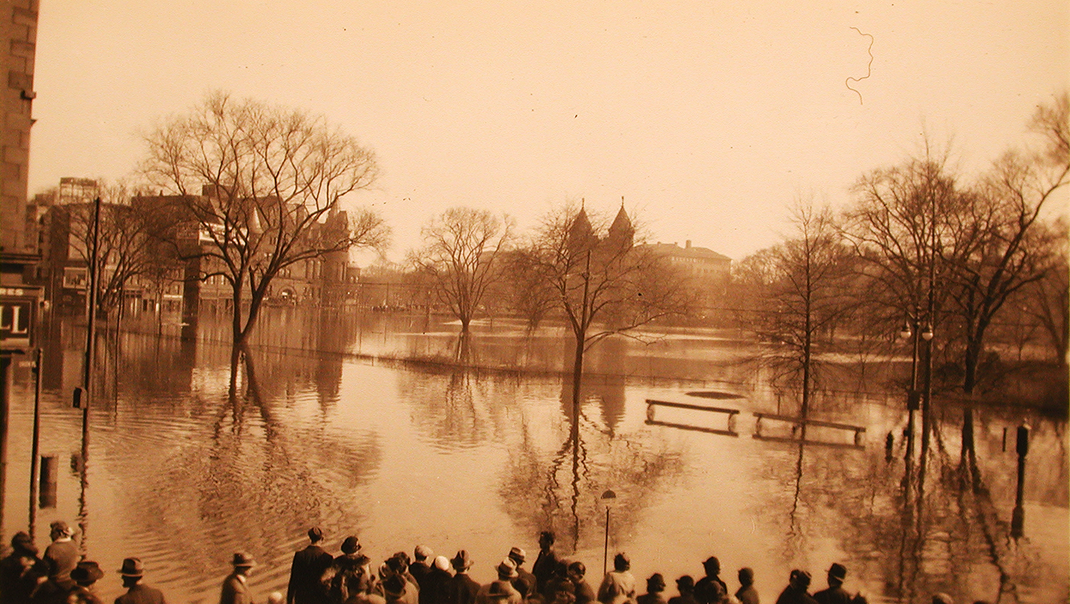
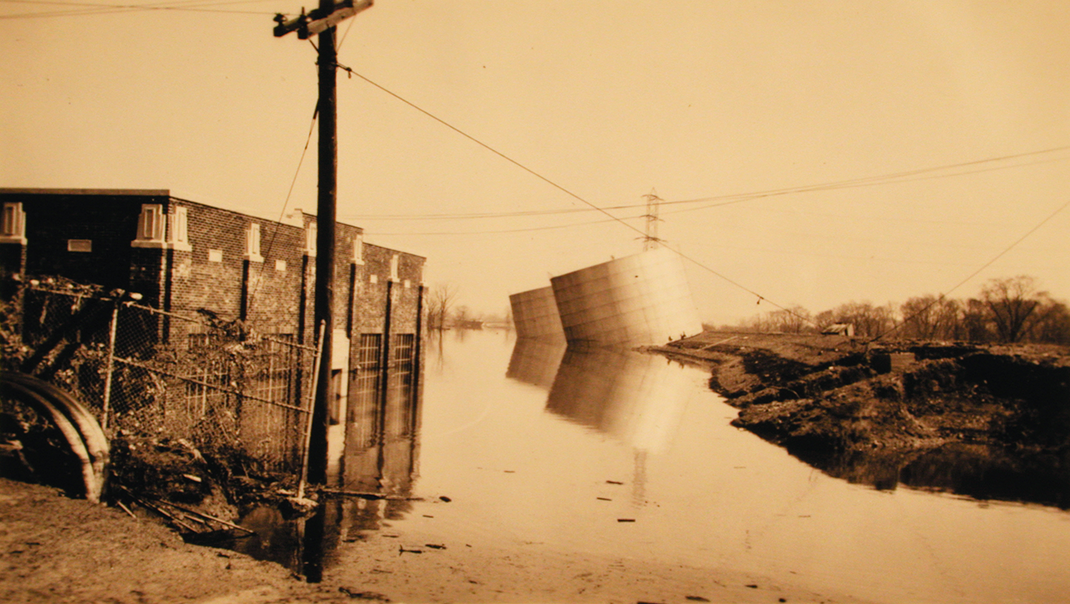
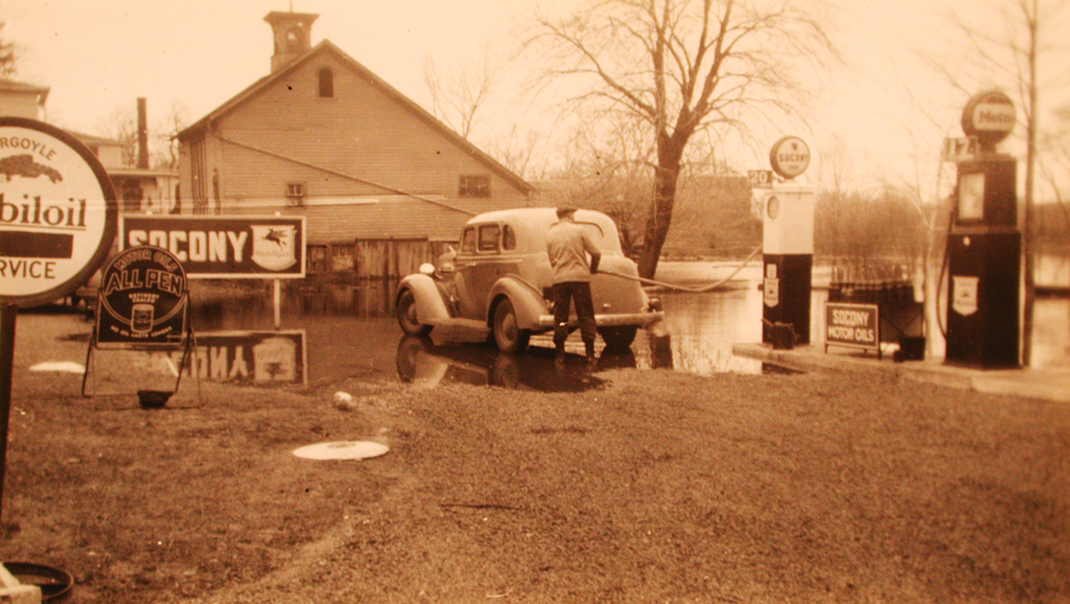
Another spectacular instance of climate destabilization, the record-breaking floods that swept across the northeastern United States, occurred during the time of the Dust Bowl. In the winter of 1935–36, the Eastern Seaboard of North America, as well as parts of Western and Southern Europe, including France, were visited by unprecedented floods, some of which left high-water marks that stand to this day. The state of Connecticut was hit particularly hard when, in early March 1936, unseasonably warm rains began to rapidly melt a heavy winter snowpack. The resulting melt-off forced rivers over their banks and sent ice boulders careening down the Connecticut River basin, drawing international headlines and crowds of tourists eager to witness the damage (Levy; “Flood”; see figs. 1–3). The historic flooding of 1936 remains the costliest natural disaster in the state's history.
Photograph of onlookers observing the floodwaters in Hartford's Bushnell Park, taken by Thomas F. Oakes in March 1936. Connecticut Museum of Culture and History, accession no. 2001.21.1.
Photograph of oil tanks tilted by floodwaters near a commercial building in Hartford, taken by Thomas F. Oakes in March 1936. Connecticut Museum of Culture and History, accession no. 2001.21.12.
Photograph of a man filling his car with gas at a flooded filling station in the Hartford area, taken by John Thibault in March 1936. Connecticut Museum of Culture and History, accession no. 2001.137.29.
Stein left a secondhand record of the Connecticut floods in Everybody's Autobiography.Footnote 8 Early in the work, Stein reminds the reader that she is writing in “March nineteen thirty-six” (11). While recalling the preparations she and Alice were making for the American tour, Stein pauses to caution the reader against the perils of overplanning. “[T]here is no use in being too forethoughtful,” Stein writes: “We might have decided to live in the Connecticut valley and now it is all flooded or so the newspapers say” (12). Connecticut held personal meaning for Stein because of her connections to Yale University and the state capital, Hartford, where Four Saints in Three Acts had premiered two years before. The Connecticut floods made daily front-page headlines in the Paris Herald, which reported on apocalyptic scenarios including death, destruction, plague, mass homelessness, and martial law. Though Stein's mention of the floods is characteristically dry, she nevertheless seems to have been aware of the extremity of the situation. She also would likely have been aware of the contemporaneous winter flooding of several French rivers (Ballesteros-Cánovas et al. 210). From November 1935 through February 1936, the Paris Herald ran numerous reports of historic flooding across France. It is no wonder that of all the weather phenomena that appear in Everybody's Autobiography flooding is the most frequently mentioned.
IV.
Stein was writing Everybody's Autobiography during a decade referred to by science historians as the “terrible and dirty thirties” (Simões and Sánchez 7). The 1930s were remarkable for the multiple intersecting crises that soiled the decade's reputation, including the rise of fascism in Europe, the increase in military tensions among global powers, the Great Depression, and various ecological crises that contributed to social and political destabilization (Simões and Sánchez). But the 1930s were also a decade known for pathbreaking ideas and debates in science and technology. According to Ana Simões and Antonio Sánchez, this decade saw “the relationship between science, technology and society” become increasingly coordinated within and among Western nations (2). More specifically, the modern field of climate science has important roots in this decade. The 1930s and the years that followed witnessed the field of climate science in the United States coalesce from “a dispersed array of individuals with no organizational center” to a defined field institutionalized in universities and tied to state interests (Baker 866).
One factor that helped define the early field of climate science was the promise research into the atmospheric environment held, not only for predicting the weather but also for controlling it. Modern climate science began to develop in the nineteenth century, in large part through scientific inquiry into the geological history of ice ages (Anderson et al.; Rodhe et al.; Weart). Scientists who made some of the earliest breakthroughs in understanding the way heat can be trapped in the atmosphere by carbon dioxide thought that their discoveries might help prevent the onset of another ice age. Moreover, as the militarization and commercialization of the Atlantic Ocean increased during the first decades of the twentieth century, the sudden rash of extreme weather events placed pressure on governments to come up with responses to atmospheric instability. This pressure intensified political interest in the burgeoning field's promise that comprehensive scientific knowledge about the atmosphere could be used to intervene in the weather. As Zeke Baker has argued, “weather control” was so integral to the field formation of climate science that by the 1960s it had become “a central component of the discipline of meteorology” (871). Thus, the crucial question that was developing among scientists and political actors during Stein's lifetime was not if human beings could alter the weather, but how.
I have suggested that Stein's daily reading of the Paris Herald had a profound influence on her writing. Though often considered a less serious paper than its New York parent, the Herald nevertheless disseminated new scientific research to its readers. The international edition was itself made possible by wireless technologies that helped transmit news cables across the Atlantic (Robertson 133). During Germany's occupation of France in the Second World War, Stein and Toklas would rely on “wireless” transmissions for vital information about the conflict (Wars 156, 187). Advances in wireless communication were also enlisted to make weather predictions for commercial and passenger ships making transatlantic crossings, such as the trips Stein and Toklas would make in 1934 and 1935. On 19 June 1920, the Herald ran the self-promoting article “Weather by Wireless,” which credits the newspaper with laying the groundwork for major advances in weather prediction. The article also reports that ships crossing the Atlantic were beginning to use wireless triangulation to share information about oceanic storms. “Next to controlling the weather,” the author reflects, “humanity is served by such knowledge.”
As a hub for scientific research, Paris in the first decades of the twentieth century attracted some of the major actors in the field of early climate science, whose names and images often appeared in the pages of the Herald. The Nobel Prize–winning Swedish chemist Svante Arrhenius, who predicted in a landmark 1896 paper that the industrialized burning of coal would lead to a steady rise in global average temperatures (Anderson et al.; Rodhe; Uppenbrink), gave a series of public lectures at the Sorbonne in 1911 while Stein was living in Paris (“Personal Intelligence”). Charles Greeley Abbot, the director of the Smithsonian Astrophysical Observatory, who aggressively promoted his much contested work on sunspots, is listed as an attendee of the International Congress on Geography that took place in Paris in 1931 (“Geographers”).Footnote 9 The congress met with the express purpose of discussing the study of regional climates. Given that geography often housed meteorological research during the 1930s and 1940s (Weart 10), scholars might want to rethink the theme of geography across Stein's oeuvre for the way it presupposes a historical and scientific thinking of the weather.Footnote 10 The chief of the US Weather Bureau, Richard Kimball, received the French Legion of Honor in January 1934 (albeit remotely from New York) for his work predicting weather for world-famous American and French transatlantic sport fliers, such as the Frenchman Armand Lotti and the Americans Amelia Earhart and Charles Lindbergh (“‘Weather Man’ Kimball”).Footnote 11
The Paris Herald assiduously covered the warming trends and inexplicable weather that scientists were scrambling to make sense of in the 1930s. On 23 February 1934, the Herald ran a short weather editorial with the sassy headline “The Arctic Gets Gay.” This article offers a concise overview of climatology in the 1930s. “The weather is again under critical survey,” the article reports, because a “winter of unusual severity in the United States has ravaged the countryside. Europe, early in the year, had a short, sharp reminder of its formal glacial existence.” The glacially cold weather provokes the author to wonder if the world is not headed for another ice age:
Is the ice age . . . returning instead of keeping up its retreat? There is nothing yet to indicate it, according to the experts, the majority of whom still contend this good old earth, if anything, is getting warmer, just as it has been doing for some 10,000 or 20,000 years. What has happened in America, and, to a smaller extent, in Europe, has been due to some freakish aerial dynamics, the result of the Arctic getting a bit gay.
This editorial illustrates several important aspects of climatological knowledge in the 1930s. First, the erratic weather of the decade was widely thought of as unusual, “freakish” or “gay,” and worth scientific scrutiny.Footnote 12 Second, the editorial places the reporting on the cold spell within the broader historical context of the geological study of the ice ages, which, as the article's author writes, “if anything,” confirmed that the earth's atmosphere was getting warmer. Lastly, the article illustrates how climate scientists, at the time, did not view the warming trend as particularly alarming. In fact, most viewed a warmer planet as a good thing, since warmer temperatures might lead to milder living conditions and better development of agriculture, while possibly staving off another ice age (Anderson et al.; Uppenbrink; Weart). Alarm about the climatic impacts of global warming would not come to characterize the field of climate science until the 1970s.
The article goes on to speculate that sunspot activity, whose roughly eleven-year cycle was thought to temporarily increase temperatures on the earth, is the likely culprit of the arctic's “gay” behavior. This is one of at least a dozen articles run by the Herald between 1920 and 1940 that promoted Abbot's theories. In the numerous editorials that report on everyday complaints about the unusual weather during these decades, the author almost always dismisses these complaints as just that—complaints—turning instead to Abbot's theory of sunspot warming as consoling evidence that the unusual weather could be chalked up to a fairly predictable period of solar irregularity that people should endure, as one editorial recommends, with “dignified” “stoicism” and brave defiance (“Weather Vagaries”). In other words, if one had read the Paris Herald for scientific explanations of the strange weather, one would likely have believed that it was caused by the periodic fluctuation of the sun's intensities. Moreover, one would have been encouraged to get over it.
Abbot's sunspot theory exemplifies the degree to which extreme weather and observed planetary warming as a result of carbon-based emissions were dissociated in scientific inquiry during the developmental years of climate science. Even Guy Stewart Callendar's influential paper, “The Artificial Production of Carbon Dioxide and Its Influence on Temperature”—published in 1938, the year after Everybody's Autobiography—did not sound environmentalist alarms. Nor did it warn of the folly of fossil fuel consumption (Anderson et al.). Yet, during the first decades of the twentieth century, fossil fuels were often in the media spotlight alongside reports of extreme weather. For one thing, floods, snowstorms, and dust storms could cut people off from much-needed fuel deliveries. Extreme cold weather could also increase the domestic and commercial burning of coal beyond what supply chains could support. A Paris Herald article from February 1936 cites an “actual fuel famine” that occurred when subzero temperatures bore down on the American Midwest (“Cold”).
Growing concerns about the world's fuel supply also took center stage in the first decades of the twentieth century. Throughout the 1920s and 1930s, the New York Herald and its Parisian offspring reported on the dawning consciousness among world leaders that the global supply of fossil fuels was running out. The rush to find new fossil fuel deposits, as well as the urgent need to develop alternatives to carbon-based energy, became headline-grabbing news. Hydroelectric power, solar power, thermal power (harnessed from the earth's internal heat), and the rapidly developing prospect of nuclear power were all on the slate as possible replacements for coal and gasoline during the 1930s. The need to address the fuel crisis was so great that in September 1936, while Stein was at work on Everybody's Autobiography, the Third World Power Conference took place over the course of five days in Washington, DC. The conference, whose proceedings were covered in both editions of the Herald Tribune, attracted thousands of scientists and dignitaries from industrialized nations who were tasked with facing “the dissipation of the world's supply of natural fuel and power” (“Fuel and Power Conservation”). Franklin Delano Roosevelt spoke at the conference, promoting energy conservation and endorsing the expansion and development of electricity as a “flexible” energy source (“Text”).
Taken as a whole, the geological, political, scientific, and media environments in which Stein was writing Everybody's Autobiography constituted a crucible for early climate knowledge. It was out of this crucible that Stein wrote a sustained reflection on the weather and the changes, both spectacular and mundane, that were coming on the air.
V.
I would like to return to the scene of Bilignin, 1936, when, according to Stein, unseasonable snow fell “everywhere.” Though reported in the Paris Herald with little heraldry, the event was “strange” enough to elicit from Stein an impromptu theory about the relationship between the weather, the world, and epistemology.Footnote 13 Here is the passage given above, along with the sentence that follows it:
This year it is the end of September and there is snow everywhere and this has never happened before not ever before the end of November. And in these days when they are all so troubled and so certain that everything is going so badly nobody not even the most simple-minded of them think that the strange weather has anything to do with the matter. Things are not that way any more and nobody feels that way just the same way as dogs no longer bark at the moon because there are always even in the most far away places lights that are so much brighter. (128)
Stein's use of emphasis (“this has never happened before not ever”), along with the numerous negative constructions, produces a distinct tonality of concern about the anomalous (“strange”) weather event and the state of affairs in which it has occurred. And Stein conceptually links the “strange weather” to “everything . . . going so badly.” This is a significant observation. While scientists knew human industry could affect global temperatures, they did not—by 1936—believe that a warmer planet would lead to extreme or “strange” weather. Yet the unprecedented snow Stein observes in Bilignin in September 1936 worries Stein and prompts her to consider other things that are also “going so badly.” Importantly, Stein does not blame the strange weather on sunspots. Rather, she speculates that anomalous weather and “everything . . . going so badly”—world wars, civil wars, economic depression, and the rise of fascism are among the bad world events Stein addresses in Everybody's Autobiography—are related phenomena, a position that was virtually unheard of in the media environment in which Stein was writing.
Stein then outlines an analogue of Ghosh's notion of derangement, or the West's chronic epistemological dissociation of everyday life and the weather. In 1936, “nobody” seems to feel that the going badly of the weather and the going badly of the world have much to do with one another. But, according to Stein—repeating ideas she attributes to her Vietnamese servant Trac—this has not always been the case.Footnote 14 People used to feel a natural connection between the going badly of the weather and that of the world. In Shakespeare's The Tempest, for example, ominous weather could be taken as an omen of a world gone wrong; in the Abrahamic tradition flooding is a consequence of human sin. But modern humans have changed, dissociating the events of the world from the weather just like (following Stein's—or rather, Trac's—analogy) dogs who have stopped barking at the moon.
I argue that Stein offers here a solution to the crisis of imagination associated with the difficulty of representing global warming in narrative. As Yusoff and Gabrys have argued, “Representing climate change is an imaginative and creative act that joins the sciences, social sciences and humanities” (519). Remarks about the weather that might seem like asides, digressions, or interruptions of more scientific and historical matters in Stein's narrative might be read as Stein's performative undoing of the Western epistemology of climate and its constitutive dissociation of weather and world. In addition to being a representational, symptomatic archive of anthropogenic climate change, Stein's experimental autobiography registers in nonrepresentational ways the interdependent and interrupting processes that underlie such changes. The delayed temporality of autobiographical writing and the serial interruptions that Stein welcomes into the closure of the autos (or the “self” who is the ostensible subject and source of autobiography) decenter Western epistemological frames that assume concrete divisions between self and environment, world and nature, historical time and the time of the everyday. To de-derange the West's literary imagination, Stein allows the weather to interrupt her narrative so that the weather and revolutions can resume their walk together as interdigitating phenomena. Stein's experimentalism in Everybody's Autobiography (not quite a novel, but not exactly a conventional memoir) offers an imaginative blueprint—decades before Ghosh identifies this problem—for how to represent the unrepresentable nature of anthropogenic climate change.Footnote 15
To be fair to Stein's critics, her attentiveness to the imbrication of ecological and human systems seems not to have led Stein to endorse or participate in organized resistance to environmental degradation. Yet, in Everybody's Autobiography, Stein offers clues that might shed light on what Schuster identifies as her ambivalence about environmentalism. Later in the book, Stein evokes the weather as a crucial limit to the procedures of representative democracy that “manage” or “decide” the world through electoral politics. For Stein, subjecting the weather to a vote would spell imminent catastrophe. Recounting one of the conversations that she has had about revolutions and the weather, Stein recalls running into a man who indulged her in discussing the trouble with voting:
It is funny I said they manage everything but the weather it is funny that they have never invented anything that does decide the weather. Oh said he you know I often think about that, I look down on the village down there and I think suppose every day we could vote what weather we were to have tomorrow. What fighting there would be what killing of one neighbor by another, we all do our work in our way, and we do not want the same weather, most things that we vote for do not really matter . . . but the weather oh dear he said that would be disaster. (318)
Stein's digression speaks to the way modern climatology developed in part as a science that promised state leaders it could bring the weather under human control. But such deciding of the weather, according to Stein and her interlocutor, would pose an existential threat to humankind by creating one more thing for us to kill one another over.
Here Stein comes closest to Sedgwick's view that the weather does, and should, “exceed the will of the subject” (34). As Goldberg has it, Sedgwick views external reality—of which the weather is a prime example—as a kind of environmental “reality” check that “chastens . . . fantasies of omnipotence” insofar as reality “resists our attempts to reduce or refuse it” (375). Stein's skepticism about liberal democracy's promise of unlimited progress and control over the natural world might be read as an appeal to acknowledge the weather's hold over the reality in which political desires unfold, much like Sedgwick's appeal for a “Proustian” or noncontrolling “relation to self and the world” (4). At a time when the field of climate science was solidifying around the fantasy of using advanced climate knowledge and engineering to “decide” the weather, Stein thought against these currents, portraying the notion of weather control as worryingly out of touch with reality.
VI.
By reading the Paris Herald, Stein would have been exposed to many of the political debates and ecological crises that supported the development of climate science as we know it today, including the then dissociated—perhaps deranged—parallel discourses on life-threatening extreme weather and the fossil fuel crisis. Stein's writing in the 1930s reflects this side-by-side thinking of weather and carbon-based fuel.
Gasoline and oil derivatives occupy a prominent place in Stein's autobiographical accounts of living in a modernized world. Among other instances in which Stein demonstrates consciousness of a carbon-dependent modernity, a passage from Everybody's Autobiography in which Stein recalls visiting “oil country” is instructive (285). In her travels through Oklahoma and California, Stein witnessed first-hand the sprawling infrastructure of America's expanding petroleum industry. With a mix of excitement and admiration, Stein recalls seeing oil wells and pumps cropping up out of the American landscape. The sight of machines pumping crude oil from the earth inspires Stein to tell an anecdote about how Alice's father “once almost had an oil well they dug and dug but naturally the oil did not gush” (285). Stein might rightly be read here as idealizing practices of extractive capitalism that lead to ecological ruination. But these moments can also be appreciated as important traces of the desperate search for fossil fuels that political leaders, capitalist speculators, and everyday people were fretting over during the 1920s and 1930s.Footnote 16
Stein believed that “roads are the important thing and what is on them” (240). And what was on them, by the mid 1930s, was a cavalry of gasoline-powered mass-produced automobiles. While scholars have addressed Stein's keen interest in cars (Chow; Conrad; Retallack; Tracy; Woods), her frustration with the way cars kept running out of gas has drawn less attention. Stein's account of driving around the French countryside during the First World War in The Autobiography of Alice B. Toklas circles around the search for gasoline. As proud as Stein was of having bought her first Ford ambulance, the “Auntie,” she found herself disappointed when, on its second outing, its tank went empty, stopping “dead” in the middle of the Champs-Élysées (172–73). More than the look or feel of the automobile, the fact that automobiles kept burning through their fuel seems to have been, for Stein, one of their signature features. Stein sums up the constant search for fuel as “the eternal gasoline question” (181). Even if Stein loved cars, she was worried by their short-term dependence on gasoline fuel, which she knew to be a question that would eternally need answering.
Stein carries her thinking about the eternal gasoline question over to her writing in Everybody's Autobiography, where she offers a critique of the shortsightedness of powering the modern world with fossil fuels. Like everybody's, Stein's own life was subject to the material upheavals that go along with shifts in available forms of power. Throughout the 1920s and 1930s, electric power was becoming more popular in Europe in part because of the difficulty of finding coal and gasoline—a problem Stein attests to again and again. While Stein was working on the manuscript of the second autobiography, she and Alice were modernizing their country home in Bilignin by having an electric stove installed, an event that induced Stein to offer a reflection on forms of energy:
We are just now putting in an electric stove but that is because it is difficult if not impossible to get coal that will burn. . . . To be sure cooking with coal is like lighting with gas it is an intermediate stage which is a mistake. It would seem that cooking should be done with wood, charcoal or electricity and I guess they are right, just as lighting should be done by candles or electricity, coal and gas are a mistake, like railroad trains, it should be horses or automobiles or airplanes, coal, gas and railroads are a mistake and that has perhaps a great deal to do with politics and government and the nineteenth century and everything however to come back to my agent and to my success. (45; emphases mine)
Coal and gas are a mistake. Here Stein is echoing the quest for fuel alternatives being reported in the newspapers. Her use of the colloquialism “I guess they are right” rings of the way we still attribute scientific knowledge reported in the media to an ambiguous plural “they.”
They may also refer to political authorities, such as Roosevelt, who were promoting electricity as the best chance for ameliorating the Industrial Revolution's establishment of coal as the primary source of industrial and domestic power. Before returning to the topic of her “success,” Stein pauses to remind the reader that the “mistake” of coal and gas as sources of fuel had “a great deal to do with politics and government and the nineteenth century and everything.” Though Stein's proposed alternatives to fossil fuels map chronological stages in fuel development (wood, charcoal, electricity), her endorsement of cars and planes over trains has already been the subject of ecocritical intervention.Footnote 17 But given Stein's thinking of “the eternal gasoline question” in the previous autobiography, her awareness of energy shortage as a crisis being addressed by scientists, world leaders, and laypeople alike, and her descriptions of coal and gas as an “intermediate” “mistake,” the question of renewability seems the most relevant (if not the organizing) implication of Stein's recommendation of wood, charcoal, electricity, candles, even horses. Granted, Stein does not make a direct link between her thinking of fuel renewability and the strange weather that also worries her. In this sense, Stein is thinking with her time. Nevertheless, Stein directs her critical acumen to a problem that continues to challenge environmentalist critique—how to continue powering an already modernized world—while historicizing that problem as a legacy of the nineteenth century.
VII.
We are no longer young in weather.
—Gertrude Stein, “History or Messages from History”Stein's commentary on the weather of the world in Everybody's Autobiography exhibits a newly possible consciousness about anthropogenic climatic change that emerged in the 1930s. Stein was an astute observer of modernity and the energy crisis that continues to sustain and destabilize it. Her explicit reflections on not only the difficulties of procuring gasoline and coal but their status as a short-term, “intermediate” solution to an eternal problem show Stein to be informed by the scientific and political ideas of her time. Stein observed and read about both mundane and extreme ecological and atmospheric alterations, and she found ways of narratively tethering them to world events. Lastly, Stein warned of limits to modern climate politics, particularly as it pertained to the desire for environmental control. That all of these appear in a single text of Stein's from the 1930s is one of the more impressive literary-ecological events of the modernist era.
I conclude with a note on Stein's introduction to Everybody's Autobiography where thoughts of weather displace the course of Stein's narrative from the outset. Before Stein can even begin telling how she and Alice found themselves embarking on a transatlantic tour of the United States, she stops to let the reader know of a curiosity—a wooden umbrella that is never mentioned by Stein again:
I want to say that just today I met Miss Hennessy and she was carrying, she did not have it with her, but she usually carried a wooden umbrella. This wooden umbrella is carved out of wood and looks exactly like a real one even to the little button and the rubber string that holds it together. It is all right except when it rains. When it rains it does not open and so Miss Hennessy looks a little foolish but she does not mind because after all it is the only wooden umbrella in Paris. And even if there were lots of others it would not make any difference. (1–2)
Stein's image-in-negative of Miss Hennessy standing in a deluge armed with an aesthetic replica of an umbrella presciently figures the crisis of imagination that dissociates the West from its experience of the terrible weather that it has itself produced. A wooden umbrella that does not open and cannot be used to protect oneself from the rain or the burning sun (and that one might not even have) might be the most potent signifier for climate derangement that Stein left behind in the pages of Everybody's Autobiography.
Given the global reach of the effects of climate change, however unevenly distributed, and the urgency with which it needs to be addressed on a planetary scale (as Stein might have said, the weather is not getting any younger), perhaps Stein's second autobiography, so attuned to humanity's constitutive dependence on the weather, should be read today as exactly what Stein always believed it to be. Everybody's.



