


1. Introduction
The infrared and Raman spectra of highly disordered solids are frequently discussed using the spectrum of a related crystalline phase, and treating the disorder as a perturbation. Frequently several crystalline phases can be used and the different phases may shed light on different aspects of the spectra. The purpose of this paper is to discuss the spectrum ?f the translational vibrations of ice from a point of view different from that originally (Bertie and Whalley, 1967) adopted. The discussion indicates the origin of major features that have not previously been understood. A similar point of view has recently (Whalley, 1977) been used to discuss the O–H stretching vibrations of ice.
The translational vibrations of the molecules in ice occupy the range 0–318 cm-1 and their infrared and Raman spectra are plotted in Figure 1 (Bertie and Whalley, 1967; Wong and Whalley, 1976[a]). Up to about 245 cm-1, the vibrations are understood in some detail by relating them to the vibrations expected for the hypothetical structure that has the diffraction symmetry of ice, namely P63/mmc for ice Ih and Fd 3 m for ice Ic. In these structures the hydrogen atoms are at the centers of the O—O bonds. None of the vibrations is infrared active, and only one in ice Ic and two in ice Ih are Raman active. When the structures are perturbed to form the actual disordered crystals by moving the hydrogen atoms off the bond centers in accordance with the ice rules, all the vibrations become both infrared and Raman active, and the vibrations below about 245 cm-1 can be understood as the vibrations of the P63/mmc and Fd 3 m crystals made active by the disorder, but not otherwise greatly perturbed.
There is however both infrared absorption and Raman scattering up to c. 318 cm-1, and the corresponding vibrations have also been detected by inelastic neutron scattering (Renker, 1973). The origin of these high-frequency vibrations has been discussed several times. It was originally suggested (Bertie and Whalley, 1967) that they could be explained only if long-range forces, of unspecified but presumably electrostatic origin, were introduced.
Infrared (upper frame) and Raman (lower frame) spectrum of the translational vibrations of ice Ih.

Several more or less detailed explanations have since been proposed, but none withstands a detailed examination. Faure and Kahane ([ c 1971]) and Faure and Chosson ([ c 1971]) have discussed a model of ice Ih in which all the O–H bonds parallel to the c-axis have the same orientation, but the hydrogen atoms in the O–H bonds that are inclined to the c-axis are disordered and conform to the ice rules. They have now replaced it with a model in which alternate molecules carry equal but opposite permanent charges (Faure and Chosson, 1978). It has also been tentatively suggested that the O—O bonds parallel to the c-axis are much stiffer than the others (Renker, 1973). This suggestion can also be dismissed, as supporting evidence is lacking.
Prask and others (1972) and Bosi and others (1973) have attempted to explain the vibrations up to c. 318 cm-1 by valence force fields without taking account of the long-range electrical forces. However, both are inconsistent with other data; Bosi and others’ force field predicts a compressibility about 0.4 of the actual value (unpublished calculations by the present authors) and Prask and others’ force field includes hydrogen–hydrogen repulsions at distances at which hydrogen atoms normally attract one another (Wu and others, 1971), and bending force constants which yield transverse acoustic boundary frequencies 20% higher than measured.
The Lyddane–Sachs–Teller relation, which was originally proved for harmonic oscillators of a cubic crystal (Lyddane and others, 1941) can be generalized to damped oscillators, and is then independent of the degree of order of the systems and is valid for disordered solids, liquids, and gases (Barker, 1975). An opinion to the contrary (Wong and Whalley, 1976[a] is therefore invalid, and is withdrawn. It follows that the strong infrared vibrations at 229 cm-1 have corresponding longitudinal vibrations. The approximate validity of the Lyddane–Sachs–Teller relation,
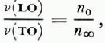
where v(LO) and v(TO) are the longitudinal and transverse optic frequencies and n 0 and n ∞ the limiting low- and high-frequency refractive indices of the translational band (Wong and Whalley, 1976[a]), is therefore not surprising, and strongly suggests that the absorption up to c. 318 cm-1 is due to LO vibrations. The existence of LO vibrations in disordered solids and liquids is well established empirically. It has been observed in liquid carbon tetrafluoride (Fournier and others, 1968; Gilbert and Drifford, 1977), silicon tetrafluoride (Bessette and others, 1970; Gilbert and Drifford, 1977), some molten salts (Devlin and others, 1970), vitreous silica and germania (Galeener and Lucovsky, 1976), and the O–H stretching vibrations of ice (Whalley, 1977).
This interpretation is purely phenomenological, and is independent of the origin of the 229 cm-1 band. It would be worth while to have a more detailed molecular interpretation, and the purpose of this paper is to provide one. The approach adopted is to discuss the LO and TO spectra expected for a related ordered crystal, and to discuss how these spectra are related to the spectrum of real ice.
In an earlier discussion (Bertie and Whalley, 1967) based on hypothetical structures that have the observed diffraction symmetries, the perturbation by which the infrared intensity was introduced also changes the density of states in a major way. It docs this by means of the long-range electrical forces that necessarily accompany infrared activity and that in an ordered crystal give rise to the longitudinal–transverse splitting of the optic vibrations. This can readily be appreciated by considering the perturbation that takes the Fd 3 m ice Ic structure into the hypothetical ordered ice Ic structure in space group No. 109, I41 md, C 4v 11 with two molecules in the primitive cell. Two vibrations become infrared-active, the A 1 and E, and both will be split by the long-range field. Consequently, the cubic and hexagonal structures having the hydrogen atoms at the mid-points of the O—O bonds are not the most appropriate starting points for studying the details of the spectra that are caused by the long-range fields.
An unperturbed structure in which the infrared intensity is present and already causes an LO–TO splitting would be an easier starting point than the P63/mmc and Fd 3 m structures. The simplest suitable structures are the hypothetical ordered ice Ic in space group I41 md and the hypothetical ordered ice Ih in space group No. 26, Pmc21, C 2v 2 having four molecules in the unit cell. Neither structure is known to exist, but two of the ordered cubic ice structures oriented antiparallel to one another and interpenetrating one another form ice VIII (Kamb, 1969[a], [b]). The Raman spectrum of ice VIII is known (Wong and Whalley, 1976[b]) and can be used as a basis for predicting the spectrum of ordered ice Ic. These principles have already been applied to the assignment of the O–H stretching vibrations (Whalley, 1977).
2. Ice IC
2.1. Ordered ice Ic
The structure of ordered ice Ic in the four-molecule body-centered cell in space group No. 109, ?41 md, C 4v 11 is illustrated in Figure 2. There are two molecules in the primitive cell on sites of C 2v symmetry. There are three translational lattice vibrations belonging to the representations A 1 and E, and both are infrared and Raman active. They correlate with the F 1g translational vibration of the hypothetical structure with centrosymmetric hydrogen bonds. The force constant for O—O stretching vibrations is presumably not greatly dependent on which end the hydrogen is at, and so a model of ordered cubic ice with only an O—O stretching constant should have A 1 and E vibrations that are equal in frequency. This supposition is supported by the corresponding bands of ice VIII, in which the two structures are vibrating in the gerade form and are Raman active. They belong to species B 1g and E g , and appear to have frequencies that are indistinguishably different from one another (Wong and Whalley, 1976[b]). The vibrations of the two structures against one another belong to the species B 1g and E g , and have frequencies differing by only 2.8 cm-1. It seems likely therefore that the ? 1 and E translational vibrations of ordered ice Ic will be nearly degenerate. A model (Wong and Whalley, 1976[a]) which suggested that the coupling constants between neighboring O—O bonds due to the transition moments could cause a splitting of 91 cm-1 may be too crude.
Structure of an ordered form of ice Ic.

Both the A 1 and E bands have a longitudinal optic component having a higher frequency, and their values are given (Lyddane and others, 1941; Cochran and Cowley 1962) by
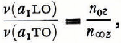

where n oz and n ∞z , etc., are the limiting low- and high-frequency refractive indexes for waves propagating in the z, etc., directions. If both n 0 and n ∞ were isotropic, each vibration would have the same splitting. Experimentally, however, there are bands at 305 and 275 cm-1, and these can be explained as LO vibrations only if the refractive index is anisotropic. Two assignments of the bands are possible, that v(a 1LO) is at 305 cm-1 and v(e LO) is at 275 cm-1, and the reverse.
If v(a 1LO) is at 305 cm-1, then

where

The change of refractive index across the translational band in ice Ih is 0.347 (Bertie and others, 1969) and the same value will be assumed for ordered ice Ic because the structures and spectral shapes (Bertie and Whalley, 1967) are similar. It follows from this value and Equation (3) that

The anisotropy of n ∞ of ordered ice Ic is not known. If it is assumed to be zero, Equation (5) implies that

The high-frequency refractive index of disordered ice Ih, which is obtained by adding the contributions of the O–H stretching and the rotational vibrations to the optical refractive index (Bertie and others, 1967) is 1.41, and because the densities of disordered ice Ih and Ic are the same within experimental uncertainty (Rabideau and others, 1968), the optical refractive indexes should be the same. The similarity of n ∞ for ordered ice Ic, calculated from the TO–LO splittings and assuming the optical refractive index is isotropic, with that of disordered ice Ih strongly supports the assignment of the spectrum. It is of course quite possible that the optical refractive index of ordered ice Ic is anisotropic consistent with Equation (5).
A similar treatment of the reverse assignment, that v(a 1LO) = 275 cm-1 and v(eLO) = 306 cm-1 gives much too small a value of n ∞, and can be rejected.
This assignment implies that the microwave refractive index of ordered ice Ic is significantly anisotropic, and that the integrated intensities of the A l and E bands are significantly different. The two vibrations are illustrated in Figure 3. If only the hydrogen-bond stretching contributes to the dipole-moment derivative, and if the change of dipole moment when a bond stretches is at an angle φ to the crystal axis as shown in Figure 4, then the ratio of integrated intensities A is

According to the Kramers–Kronig integral for the increment of refractive index,

A1 and E vibrations of ordered ice Ic.

Illustration of the angle φ between the crystal axis and μ/μr. μ/μr is assumed to lie in the plane of the three oxygen atoms, which are represented by large circles, θ T is the tetrahedral angle.

where K is the absorptivity per unit length at wavenumber v. If the absorptivities K(a 1) and K(e) of the A 1 and E bands are approximated as delta functions at 229 cm-1, then

Consequently, from Equations (6) and (8) φ = 48°, and, if the coordination is exactly tetrahedral, the dipole-moment-derivative vector makes an angle of 7 ° to the bond, as is illustrated in Figure 4. This can be compared with an angle of 9±5° between ?μ/?r and the Cl–H—Cl bond in the low-temperature phase of HC1 obtained from a similar analysis (Carlson and Friedrich, 1971).
2.2. Disordered ice Ic
When ordered ice Ic becomes disordered, the normal vibrations change and the absorption bands broaden, but probably only minor changes will occur in the density of states and in the total absorption intensity. Consequently, the LO–TO splitting is expected to persist in the disordered phase, perhaps modified somewhat from the crystal, and the assignment of the infrared spectrum of disordered ice Ic can be made by analogy with that of ordered ice Ic. Hence the 305 cm-1 band is what remains of v(a 1LO) and the 275 cm-1 band is what remains of r(eLO) of ordered cubic ice when it is disordered.
3. Ice Ih
3.1. Ordered ice Ih
There are two ordered ice Ih structures with a four-molecule unit cell, and the more symmetrical one is illustrated in Figure 5. It belongs to the space group No. 26, Pmc21, C 2v 2 and the translational vibrations form the representation 3A 1 + 3A 2 + 2B 1 + 2B 2. If the inter-molecular force field contained only one O—O stretching and one O—O—O bending force constant, the frequencies in ice Ih and Ic would be similar. The zone-center frequencies of ice Ih would be the same as the zone-center and some of the zone-boundary vibrations of ordered ice Ic if the potential with two force constants were used. In Table I the relative intensities of C 2v 2 ice Ih for a simple O—O bond stretching model are listed along with the polarizations and the correlations of the symmetries with those of a hypothetical ice Ih having the hydrogen atoms midway between the oxygen atoms. The contribution of the translational vibrations to the refractive index was assumed to be the same in the ordered and disordered ice Ih and was distributed in proportion to the calculated intensity divided by the frequency squared. The calculated frequencies of the LO components of the infrared bands, using these contributions to the refractive index, are listed in Table I.
Structure of an ordered form of ice Ih.

Predicted Frequencies and Relative Intensities of Ordered Ice Ih

When two bands have a resultant polarization in the same direction, i, the generalized Lyddane–Sachs–Teller relation (Cochran and Cowley, 1962)

and the sum rule (Kurosawa, 1961)

where Δε i is the dielectric permittivity increment corresponding to Δn i , were used to obtain the LO frequencies v(LO1) and v(LO2) from the corresponding TO frequencies v(TO1) and v(TO2).
3.2. Disordered ice Ih
When ice I h is disordered, as with ice Ic, the LO–TO splitting is not expected to change greatly. Both the B 2 and A 1 bands have their TO components at 229 cm-1, which is predicted to be the strongest band in both ordered and disordered ice Ih. Consequently the 305 cm-1 band is assigned to the LO component of the most intense B 2 band, as modified by the disorder and the 275 cm-1 band to the LO component of the A 1 band. The bands in the disordered forms of ice would of course be broader due to increased damping.
4. Summary
The infrared and Raman spectra of ice Ih and Ic arising from translational vibrations in the region above 229 cm-1 are due to LO vibrations corresponding to TO vibrations at c. 229 cm-1. This has been established by predicting the TO–LO splitting in hypothetical ordered phases of both ice Ih and 1c and predicting the effects of disordering them.
Discussion
B. KAMB : Could you explain the intermolecular force model that you used in your calculations for ice Ic, and could you explain the source of the forces (if any) that lead to the increase in frequency from 225 cm-1 to about 305 cm-1 that occurs in the LO–TO splitting?
D. D. KLUG: The force field we use contains two short-range valence-force constants, one for O—H–O bond stretching and one for O—O—O bending. The appearance of absorption up to 305 cm-1 is due to the high effective charges (dipole-moment derivatives) which we know are present from the infrared interaction. The presence of high intensity at 229 cm-1 requires that this band have a longitudinal optic component at 305 cm-1 as given by the Lyddane–Sachs–Teller relation.
J. BERTIE: This is more a comment than a question. I feel that a difficulty is arising because you are using the terms “LO” and “TO” modes. Your basis for this is the macroscopic definition of LO and TO modes in terms of properties of the dielectric constant. But the microscopic understanding of TO and LO modes is based on wave motion with a well-defined periodicity, and this cannot exist in very disordered solids. You make the point that in disordered solids one has absorption at about the frequencies of the TO and LO modes of the corresponding ordered solids, which is an extremely interesting result, but I do think it will be advantageous to use an alternative description to that used for ordered crystals.
KLUG: 1 think that the best response is to refer to the literature where a detailed discussion of this point is given (Barker, 1975). The existe nee of LO—TO splitting is a general result for solids, liquids, or gases. Perfect crystals are not required and a microscopic description using force constants and effective charges is unnecessary to prove the existence of LO and TO modes. A simple physical picture is as follows: Λ peak in ε″ in any material must indicate a transverse polarization wave since this is where there is maximum interaction between the polarization wave and the probing field (also a transverse wave). Application of the Kramers–Kronig relations then yields the LO frequency where ε = 0.



