


Introduction
The good governance of corporations is a topic of ongoing debate. For instance, the dominance of tech giants has increased tremendously in the midst of disruption and uncertainty, which raises concerns about how these corporations are governed. Moreover, disruptive technologies, for example artificial intelligence, may fundamentally affect the nature of production, communication, and interaction in society but also decrease the stability of interdependent value chains, systems, and processes. In addition, global environmental degradation creates concerns about the purpose of value creation in all corporations. Global challenges may reflect tipping points that threaten the sustainability of society and raise questions related to the legitimacy and trustworthiness of corporations and their systems of governance and control. The decline in public trust in corporations is further fuelled, for example, by fraud and accounting scandals in banks, automobile companies, the clothing industry, energy, food, and pharmaceuticals. Principles of good governance, appropriate checks and balances, business ethics, accountability to multiple stakeholders, and separation of ownership and control seem to be too ambiguous characteristics of the governance of modern corporations. Corporations worldwide are grappling with their relationships with stakeholders and society, as well as their legitimate purpose and identity. Thus, today’s reality suggests the need to arrive at new, feasible, and effective corporate governance solutions.
Corporate governance addresses two related questions. The first is for whom does the organisation create value, and the second is who holds the ultimate decision rights. The allocation of discretionary decision rights to individuals in organisations directly connects corporate governance with principles of justice and fairness. The dominant agency perspective in corporate governance identifies shareholders as residual claimholders and assigns them ultimate decision authority to ensure that they receive a fair return on their investments, particularly in view of the opportunistic behaviour of more knowledgeable managers [Reference Jensen and Meckling1, Reference Shleifer2]. However, companies currently have both multiple residual stakeholders and multiple beneficiaries outside the company, representing both private and public interests. Fia and Sacconi argue that in the case of multiple interdependent specific investments, shareholder primacy enables the risk of ‘abuse of authority’ and hence injustice [Reference Fia and Sacconi3]. The argument is that multiple incomplete contracts make the decision-making on dilemmas related to, for example, the distributive effects on value, self-respect, power, and other important goods dependent on personal (moral) judgement. As a result, problems of unfairness and abuse of authority easily arise, which threaten the legitimacy of corporate governance [Reference Sacconi4]. More generally, given multiple incomplete contracts, the legitimate criterion for the allocation of returns to multiple residual claimholders becomes fairness, rather than efficiency, to address dilemmas among comparable multiple residual claimholders effectively. With personal judgement and fairness being important in corporate decision-making, the need for objectivity emerges. Justice does fulfil this need, which is essential for good corporate governance, as it ensures objectivity in personal decision-making.
Theories of organisational justice have long been derived from theories of social justice. However, introducing justice in corporate governance is challenging. The following questions arise: what is justice, and what may be the foundation of justice within corporate governance? “Justice is an essentially contested concept: there is no generally accepted definition of justice” [Reference Robeyns5, p. 148]. In this chapter, we follow Kulkarni in his conception of justice as the equality of freedom of capabilities [Reference Kulkarni6]. Kulkarni takes Amartya Sen’s notion of ‘justice as freedom’ as the normative foundation of justice. The capability approach (CA) of Amartya Sen entails two fundamental normative claims: first, the claim that individual freedom to achieve well-being is of primary moral importance; second, well-being should be understood in terms of people’s capabilities to achieve well-being. Adopting CA in the context of organisations thus requires these normative claims to lead the decision-making of and within organisations [Reference Kulkarni6]. Whereas Kulkarni [Reference Kulkarni6] explores the normative core of a firm’s enterprise strategy, where the enterprise strategy links ethics and strategy [Reference Freeman7], we seek to apply Kulkarni’s approach to introduce justice in corporate governance.
Justice applied to the organisational context can thus be defined as equal freedom of capabilities for all stakeholders in the organisation. Note that equal freedom of capabilities for all stakeholders does not imply the same or equal capabilities, as stakeholders are heterogeneous. Furthermore, the notion of freedom equality implies that the freedom of stakeholders is bounded by the freedom of other stakeholders. Therefore, shaping the boundaries of the freedom of capabilities of heterogeneous stakeholders in a just way through the allocation of decision rights among stakeholders and beneficiaries can be considered the fundamental problem of corporate governance in the presence of multiple residual stakeholders and beneficiaries. The boundaries in the CA framework are defined in terms of entitlements of stakeholders (and beneficiaries), which, in corporate governance, shape the rules and practices that direct and control the decision-making on these entitlements. In this chapter, we argue that only decision-making on the entitlements of stakeholders needs to build on the contribution of stakeholders to the corporation, which is captured by a conceptualisation of justice in terms of contributive justice (see Chapter 3). Therefore, in the framework of the CA, the normative core of the governance of the corporation is concerned with the allocation of entitlements, where the objective foundation of that allocation is found in the idea of contributive justice. In the next sections, we elaborate in more detail on the CA and the notion of contributive justice in the context of the CA.
Justice as Freedom
Sen’s capability framework entails the normative claims that the freedom to achieve well-being is of primary moral importance and that well-being should be understood in terms of people’s capabilities, functionings, and entitlements. The framework explicitly focuses on how resources are or can be used or converted by individuals to achieve capabilities. Capabilities are the doings and beings that people can achieve if they choose and include both individual access and the use of resources. Functionings reflect how well individuals succeed in achieving ‘beings or doings they have reason to value’, thus converting resources via individual capabilities into valuable characteristics according to one’s own needs and preferences. There is a choice because one usually cannot realise all capabilities within a specific context. Sometimes, this choice is restricted by the context, for example, within the context of organisations. In the CA, one should strive for unrestricted choices leading to unrestricted functionings that establish “the quality of a person’s being” [Reference Sen8]. Finally, entitlements are the set of alternative commodity bundles that a person can command in a society using the totality of rights and opportunities that theyFootnote 1 face [Reference Sen9].
When Kulkarni defines “justice” in terms of “equal freedom”, he explicitly uses Sen’s notion of freedom and advocates the equality of individual freedom to capabilities [Reference Kulkarni6]. In this respect, freedom not only involves the absence of external constraints but also encompasses the ability of individuals to make choices and pursue lives they have reason to value. As this valuation may also reflect a person’s sense of rightness and wrongness or what ‘ought’ to be, deontological requirements (e.g., the person’s obligations to others) also enter the valuation exercise [Reference Sen8, Reference Sen9]. The fact that value may also include subjective moral considerations regarding the achievement of functionings is reflected in the principle of ‘bounded self-interest’, that is, “people care about being treated fairly and want to treat others fairly if those others are themselves behaving fairly” [Reference Sen10, p. 30].
The individual is the fundamental unit of analysis in the CA; however, in the CA, contextuality is a key feature. This allows us to consider the possibility of an organisational context. Although most CA theories focus on the societal level, it can be argued that the emphasis on freedom in the CA can also be applied for the analysis of how different stakeholders (e.g., workers, shareholders) voluntarily choose to align interest, preferences, and needs in the context of organisations [Reference Shrivastava, Jones, Selvarajah and Gramberg11].
Types of Justice: Contributive Justice as a Framework for Distributive Justice, Procedural Justice, and Interactional Justice
Shrivastava et al. argue that Amartya Sen’s The Idea of Justice provides a perspective on organisational justice that resolves several issues within the field [Reference Shrivastava, Jones, Selvarajah and Gramberg11]. It is stated that Sen’s Idea of Justice offers an integration of the three important aspects of justice in the organisation: distributive justice, procedural justice, and interactional justice. Whereas distributive justice focuses on the distribution of resources and outcomes, procedural justice emphasises the fairness of decision-making processes. Interactional justice focuses on the quality of the interpersonal treatment that individuals receive in decision-making processes. For the integration of the types, the concept of comprehensive justice is developed. In our view, as set out in Chapter 3, a combination of the CA with contributive justice can be an alternative to the concept of comprehensiveness, providing not only a framework within which distributive justice, procedural justice, and interactional justice are integrated but also an alternative perspective that gives these concepts a different meaning. This is elaborated in Chapter 3 for distributive justice, which is based on Sen’s parable ‘three children and a flute’. A focus on contribution provides an alternative framework for how resources can be distributed, processed, and communicated, where the emphasis is not on the ownership of the resource and the associated choices but on the use of the resource to optimise the well-being of all participants. Therefore, it is not about what divides and separates but what unites. In Chapter 3, contributive justice was discussed extensively. Later, we repeat this process enough to enable this chapter to be read independently.
Zamagni (cited by Etmanski) defines contributive justice as “the responsibility each of us has to contribute to civil society, and to our collective well-being. Contributive justice matches a person’s obligations with his or her capabilities and role in society” [Reference Etmanski12]. In addition, Gomberg argues that contributive justice proposes that each flourishes by advancing the flourishing of others and that it is one’s duty to do one’s share according to one’s abilities [Reference Gomberg13]. Sayer indicates that participation is at least as important as distribution: “what we do in life has at least as much influence on who we become and the quality of our lives, as does what we get” [Reference Sayer14, p. 1]. Contributive justice goes beyond compliance with procedures but requires a more proactive view of justice in terms of personal agency and the meaningful contribution of actors. The emphasis on the contribution does imply that the (intrinsic) reward to proactive social behaviour is in the act of collaboration itself, in terms of self-esteem and recognition. This is in contrast to reactive social behaviour, where justice is found in the fair distribution of outcomes. Finally, several authors on contributive justice (e.g., Dempsey and Gomberg) identify an encompassing relationship between the more general concept of ‘contributive justice’ and the more narrow, particular concept of ‘distributive justice’, often related to fairness [Reference Rawls and Kelly15]. This encompassing relationship is consistent with the integrative function we see for contributive justice. Contributive justice integrates distributive, procedural, and interactional justice into a common framework. In this integration, the emphasis on contribution provides a different perspective than the usual emphasis on distribution: procedures are then focused on fair contribution rather than fair distribution, and interaction is focused on each person’s contribution rather than on each person’s claim. Contributive justice does not replace distributive, procedural, and interactive justice but rather provides a different perspective for these types of justice.
Timmermann offers an extensive and nuanced discussion of the ‘duty to do one’s share according to one’s capacities’, which he considers to be one of the key issues of contributive justice [Reference Timmermann16]. In summary, he argues that it may be inconsistent with liberal values if someone is ‘forced’ to express skills that are profitable to the community but may conflict with one’s own preferences. This argument applies at the community level, where there is less or no navigational agency (see later), and is consistent with a core principle of the CA, which is that the expression of one’s capabilities must be a free choice.
For contexts in which it is, in principle, a voluntary choice to participate, such as organisations, the argument is less valid. One of the presuppositions for joining a firm is that one is willing to perform the tasks required by the firm. We conclude that Timmermann’s argument does not hold for contexts with sufficient navigational agency and that contributive justice is appropriate for firms in all its aspects [Reference Timmermann16].
Thus, contributive justice is an appropriate form of justice for organisations, with its focus on participation. The focus is not only on who we are, with the associated (distributive) rights to what we have created but also on who we want to become, with the associated rights and obligations to belong and participate, and the ability to align one’s particular moral compass with the ethical system of the organisation in which one wishes to participate. Contributive justice shapes proactive rights and duty-full (or virtuous) behaviour in context (e.g., in an organisation), aligning stakeholder personal needs and preferences with organisational roles and the organisational purposes. Timmermann argues that a fair distribution of what is already present, that is, resources or outcomes, can be denoted a reactive approach [Reference Timmermann16]. In contrast, the proactive approach focuses on creating opportunities and shaping a context within which fair distributions can occur. In other words, contributive justice shapes justice ex ante. The emphasis is on just participation in an organisation for which one chooses, with associated rights and obligations, towards oneself and the organisation. This combination of rights and obligations implies that stakeholders should be able to shape their participation or contribution accordingly and move autonomously and freely in and between social practices. A social practice is defined by Claassen as a structure of actions held together by a set of common institutions, in which several agents cooperate to reach their ends [Reference Claassen17]. This refers to both forms of agency that Claassen describes: participation agency and navigational agency [Reference Claassen17]. In these terms, we can be agents by participating as members of social practices, or we can be agents in a stronger sense by being able to navigate between social practices and to choose for ourselves which social practices we want to participate in. Claassen argues that justice should be understood in terms of (capabilities for) navigational agency. For a move to be just, navigational agency equality between agents is a demand [Reference Claassen17]. Thus, navigational agency operates within the constraints of a context, for example, as defined by a role within an organisation. Within such a role context, for example, navigational agency manifests itself as autonomous decision-making within role boundaries, role crafting, role boundary negotiation, or ultimately exit, that is, abandoning the role. Many of these mentioned activities relate to the nature of the contribution of the agent in a specifically assigned role to a larger whole. The contextually bounded freedom and autonomy to participate and contribute is also a central aspect of contributive justice. It can therefore be concluded that Claassen’s conception of justice is compatible with contributive justice and with our slightly adapted version of Kulkarni’s definition (see later). From an integrative perspective, we can say that the freedom to acquire capabilities or values is better shaped by contributing to and participating in society, community, or organisation than by distributing, in what unites us rather than in what divides us. To emphasise this, we adapt Kulkarni’s definition of justice as ‘equal freedom of capabilities’ to ‘equal freedom of capabilities in contribution’ (see Chapter 3).
Justice Applied to Organisations
Corporations are organisational systems referring to the structure or arrangement of elements within an organisation. This encompasses how tasks, roles, and responsibilities are defined and coordinated to achieve the organisation’s goals and includes the definition of all business divisions and sectors, the communication flow, and the reporting hierarchy. The organisational system is put in place to define how each role in the business functions. Organisations define the roles of stakeholders in terms of the rights and duties they have to follow to be able to participate in the practice. All of this serves the purpose of allowing stakeholders to pursue certain ends. These concepts – institutions, roles, rights and duties, and ends – are the crucial components of a practice. Practices are cooperative structures in which stakeholders pursue their ends, subject to the constraints presented by the organisation. Following Sen, ‘justice’ within the organisation can be defined as the equality of freedoms of individual capabilities to achieve well-being in fulfilling respective roles in the organisation. This normative foundation reflects the requirement for a firm to adopt an action (e.g., a strategy) because it is morally the right thing to do, that is, motivated by the norm to provide stakeholders equal freedom of achieving well-being. There are several reasons for the application of capability theory of justice as equal freedom of capabilities to contribute to the organisation: 1) the organisation is often viewed as a political system, where issues such as resource allocation, preference ordering, and conflict resolution are important; 2) value consistency between the political and organisational systems is desirable; and 3) ethical principles are not limited only to societies at large but are also important for organisations. Therefore, the opportunities to achieve individual well-being in a society can be extended to a concern for freedom to achieve stakeholder well-being within an organisation.
In the organisation, stakeholder capabilities are embedded in the firm. Many of these capabilities are tacit and it can be considered, in particular, the ability of leaders to evaluate stakeholder capabilities and provide justice to stakeholders. Focusing on justice within organisations, Dempsey claims that “every businessman in practice admits and defends the importance of distributive justice; within his own company (s)he tries to practice it, for instance, in planning vacation schedules or in designing a bonus or retirement programme” [Reference Dempsey18, p. 395]. In addition, Dempsey emphasises contributive justice as “the fundamental right and obligation of any member of the community to contribute to the common good”, where the right comes from “the genuine recognition by the leader that each member of his organization has something to contribute and needs to be given the opportunity to do so” [Reference Dempsey18, p. 396].
The following elements of the CA stand out in the development of a conceptualisation of contributive justice within organisations. First, the CA builds upon the notion of heterogeneity of individuals, which applies in particular to the notion of the corporation as a collective of diverse stakeholders and beneficiaries. In this respect, heterogeneity applies to actor motivation and needs, preferences, and abilities. In the CA, the prosocial behaviour of agents is not ruled out by assumption, and stakeholders can also be driven to different degrees by self-interest and more prosocial motives. This heterogeneity may help corporations explore different best practices in processes of direction and control, recruiting and combining stakeholders to realise organisational goals. A second fundamental element reflects the emphasis on capabilities as opposed to (distribution of) resources. Sen explicitly acknowledges the creation of new capabilities in addition to existing capabilities. Creating new capabilities through experimentation, innovation, and business development allows for the processing of freedoms and provides opportunities for involving newly created capabilities in the creation and distribution of value. A third element concerns the emphasis on (best) practice rather than abstract theorising. The CA combines pragmatism with a focus on creating just practices within the given context of corporations. Justice within the organisation is thus partly determined during operation, process-wise, as inspired by the corporate purpose, that is, the identity of the organisation. The challenge for corporate governance is then to institutionalise the boundaries of the freedom of capabilities of heterogeneous stakeholders in a just way through the allocation of decision rights among multiple residual stakeholders and beneficiaries to align the corporate purpose with heterogeneous stakeholder needs. It is the collective responsibility of corporate stakeholders to make such decision-making inclusive, and it is the individual stakeholder’s responsibility to act loyally to the collective of stakeholders.
Incorporating Justice within Corporate Governance
Within organisations, residual claims by multiple stakeholders result from processes of asset specialisation and combination. In those processes, the allocation of decision rights may be problematic. Opportunistic self-serving behaviour may hamper collaboration [Reference Bridoux and Stoelhorst19]. Mainstream corporate governance has addressed such conflicts of interest from an individual (atomistic) perspective to the detriment of a more interdependent, holistic, and collective perspective. However, within organisations, collective well-being, defined by the corporate purpose, is the firm’s reason for its existence. Bartlett and Ghoshal define purpose as “the statement of a company’s moral response to its broadly defined responsibilities, not an amoral plan for exploiting commercial opportunity” [Reference Bartlett and Ghoshal20, p. 88]. Corporate purpose reflects shared stakeholder beliefs about the meaning of a firm’s activities beyond measures of performance [Reference Gartenberg, Prat and Serafeim21]. Thus, in addition to stakeholder needs, the collectively (pre)determined corporate purpose serves to attract and hold stakeholders and foster stakeholder commitment. Purpose gives meaning to their contributions, establishes collective well-being, and serves to identify with the organisation.
Within purpose-driven organisations, effective corporate governance aligns stakeholder engagement with the corporate purpose in a way that prioritises for stakeholders the corporate purpose over individual needs and capabilities on the one hand and safeguards the potential for realising individual capabilities within the confines of the corporate purpose on the other hand. Similarly, stewardship theory assumes that collectivistic behaviour, oriented toward the collective, has greater utility than does individualistic behaviour. Originally, stewardship theory was developed as an alternative to principal-agent theory with a focus on the prosocial behaviour of the agent, that is, the manager [Reference Davis, Schoorman and Donaldson22]. In this chapter, we generalise stewardship to all stakeholders, that is, all principals, and claim that steward principals identify themselves with the purpose of the organisation and, as a result, align their needs and preferences with the purpose of their organisation [Reference Francoeur, Melis, Gaia and Aresu23]. Such stewardship is intrinsically motivated and non-opportunistic [Reference Francoeur, Melis, Gaia and Aresu23]. The resulting behaviour to undertake tasks within and for the organisation is also intrinsically motivated [Reference Davis, Schoorman and Donaldson22]. It is this behaviour that creates trust within the organisation. Stewardship entails giving priority to the long-term interests of a group over individual objectives [Reference Hernandez24]. Ultimately, feelings of autonomy and responsibility drive stakeholders’ motivation to perform. According to stewardship theory, individuals hold a covenantal relationship with their organisation as a moral commitment that binds parties to work towards a common goal without taking advantage of each other. Such psychological contracting is economic (transactional), socio-emotional, and ideological (both transformational). Moreover, the covenantal relationship implies reciprocity: stakeholders do not view other stakeholders merely as means to an end but always also as an end in themselves [Reference Freeman7].
Stewardship theory involves a model of governance that orients stakeholders towards advancing collective benefit. Stewardship behaviours are influenced by a cognitive and affective process that frames their decisions in terms of 1) collective and other-regarding and 2) long-term benefits. Stewardship thus includes an ethic of contribution. Defining stewardship as an ethic of just contribution requires an inquiry into the conditions under which stakeholders are prepared to contribute. First, stewardship requires stakeholders to identify with the purpose of the corporation and to prioritise purpose over personal needs and preferences. Second, stewardship implies transferring ultimate rights of control to the corporation, that is, to those that represent the corporation in transactions and exchanges. Third, the transfer of ultimate control rights is an act of trust, that is, an act without compensating for rewards. Fourth, stakeholder trust is founded on a principle of reciprocity and institutional trust, assuming full respect for the well-being of stakeholders at all levels of the organisation. Given the corporate purpose, choices within and by the organisation are just subject to the same moral principles that determine all the activities of the organisation. Stewardship is granted as a moral duty of stakeholders on the basis of their alignment with the corporation’s purpose within the broader society. Discretionary decision rights reside within the corporation and are allocated as an act of trust, without expectations of a return. Those that are given discretionary decision rights are accountable to all stakeholders and to society as a whole for the realisation of the purpose. Problems of alignment are addressed through deliberative practices built upon the same moral principles that (re)define stewardship.
Corporate governance serves to direct and control the corporate purpose (a), the principles of stewardship and the conditions under which stakeholders are willing to contribute as stewards of the corporation (b) and the mutual acceptance of contributing as stewards of the corporation (c). Building in this respect on the CA to justice thus requires emphasis on securing and deliberating corporate purpose among stakeholders, allowing corporate stakeholders to actively pursue their opportunities to contribute to the corporate purpose and reconcile their contribution with the individual capabilities of stakeholders within the corporation.
The emphasis on stakeholder engagement (stewardship) suggests that collaboration, rather than opportunism and conflict, should be the primary corporate mindset and normative perspective. Nevertheless, stakeholder collaboration cannot be assumed beforehand and in all circumstances. Therefore, corporate governance is also a political system within the corporation that directs and controls how power is exercised and allocated within the corporation. Within corporate governance, principles of contributive justice shape the proactive, duty-ethical behaviour of stakeholders through direction and control, balancing individual needs and preferences against each other and against the organisation’s purpose. We can now deduce the elements for recognising contributive justice in the context of organisations. First, contributive justice implies that stakeholders have the opportunity to achieve not only the internal goods of participation but also the external goods of recognition and appreciation of that participation. This means that stakeholders are entitled to opportunities to develop and exercise capabilities and are able to actively participate in decision-making related to their own activities. Evaluating this ‘capability of having a voice’ includes entitlements of at least three different aspects [Reference Bohman25]: 1) freedom in stakeholder access to the decision-making process; 2) transparency of the deliberation process to avoid the abuse of decision-making power; and 3) freedom of speech and a guarantee that there will not be any sanctions against those who express their thoughts freely. Furthermore, the capability to have a voice may be dependent on other capabilities, such as the ability to obtain education and the ability to discriminate among choices, in which case, those underlying capabilities need to be considered as well.
Second, given contributive justice, stakeholders not only have entitlements but also responsibilities and obligations to the firm and other stakeholders. Justice requires that stakeholders be held accountable for their active contribution to the common objective and the needs of other stakeholders. In this respect, the stewardship approach to corporate governance emphasises not only transparency and ex post accountability on the distribution of resources and outcomes but also process accountability and integrity, that is, just behaviour in using resources to create outcomes with an eye to the interests of others. There is a moral obligation for stakeholders to contribute to the organisational objective and to ensure that others can contribute similarly. The focal point is the managerial capability to evaluate and direct stakeholder capabilities. This involves top managers (directors) using their knowledge of stakeholder capabilities. In the CA language, this can be denoted in terms of conversion factors. Managerial capabilities such as the ability to use superior (especially tacit) knowledge of stakeholder capabilities are embedded in the firm and reflect that the managers’ knowledge regarding stakeholder capabilities that is acquired through ‘learning by doing’ is immobile and cannot be obtained or traded easily in the market. The focus on management capabilities is consistent with the fact that stewardship theory is essentially managerial in nature in that it reflects and directs how managers operate. Managers are entrusted with crucial responsibilities, such as formulating the corporate strategy, guarding the resources, performing general overhead functions, and setting up the administrative context for strategy implementation [Reference Collis and Montgomery26]. In addition, directors monitor and provide advice on how to provide justice in accomplishing purpose and stakeholder capability development.
A Contributive Corporate Governance Configuration
The previous paragraphs indicate that actors are individuals with individual needs and stewards who subjugate their needs to the purpose of the organisation. Participation and deliberation are essential in aligning individual needs and collective well-being. Responsible stakeholders do this in deliberation with other stakeholders within the context of corporate governance. This approach resembles Sen’s perspective that morally just behaviour cannot be determined independent of the context and the participating human beings themselves. Introducing contributive justice in addition to distributive justice implies multistakeholder participation in corporate governance. Conversely, contributive justice implies the stewardship of stakeholders with a commitment to the organisation.
Sen defines justice as equal freedom of individual capabilities. Thus, achieving contributive justice in the organisation requires equal freedom of capabilities to contribute to the organisation. An essential capability to achieve contributive justice in the organisation is the capability of voice defined by Kulkarni as the process that allows stakeholders “to be influential while remaining deferential”, which refers to the capabilities for dialogue, dissent, and critique [Reference Hirschman27, p. 16].
Furthermore, to allow stakeholders to convert their resources into equal freedom of capabilities to contribute, managerial capabilities are crucial. Managerial capabilities fall apart in the objective knowledge of the stakeholders’ capacities (internal capabilities) that contribute to stakeholder voice and in the tacit knowledge of the impediments and benefits in processes that facilitate stakeholder voice. The impediments include, for example, difficulties in deciding which stakeholders are going to participate in decision-making, what should be their level of involvement, the extent to which stakeholders can contest the processes, and the mechanisms through which stakeholders can contest certain decisions [Reference Bonvin and Thelen28]. Managerial ‘knowledge’ includes both the explicit element or ‘knowing about’ stakeholder capabilities and the tacit element or ‘knowing how’ to transfer knowledge across stakeholders, space, and time.
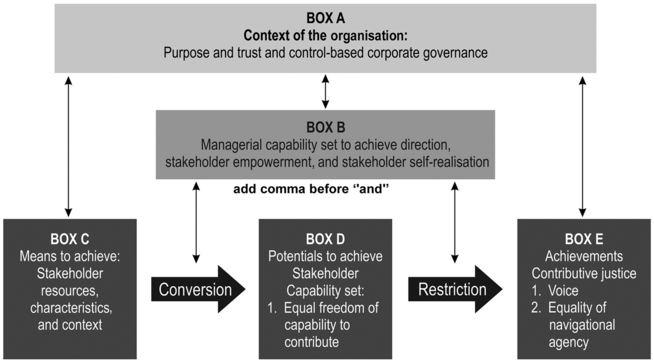
In Figure 7.1, we outline the stakeholder process towards achieving contributive justice as far as determined by the patterns of corporate governance of the organisation.
Contributive justice within corporate governance.
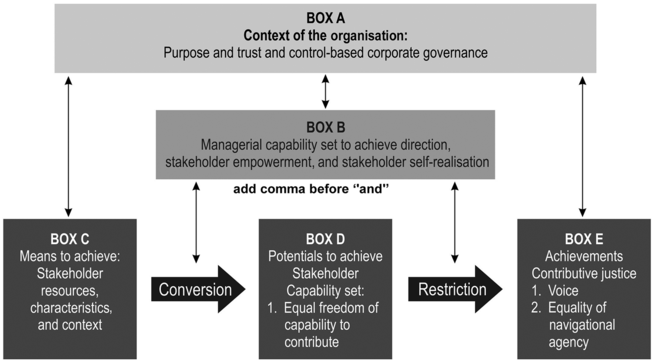
First, contributive justice takes shape through free and autonomous moves of stakeholders that convert resources (Box C) to capabilities (Box D) to choose achievements (Box E). Contribution can be regarded as an autonomous move in (and between) the bundle of social practices within the organisation. For that move to be just, navigational agency equality between stakeholders is a demand [Reference Claassen17]. This implies that within organisations, stakeholders are entitled to the abilities of exit/access, voice, conflict resolution, reform, and creation; however, these abilities are not necessarily distributed in strictly equal portions. The corporate governance context determines the actual distribution of these entitlements. In particular, this applies to the corporate purpose and corporate governance context (Box A) and the managerial capability set (Box B). For example, in Box A, the corporate purpose reflects the identity of the corporation, which serves as the guiding principle for the participation of stakeholders. Similarly, in Box A, the structure of corporate governance arranges the stakeholder entitlements of direction and control at the level of the organisation itself. To illustrate, the structure of corporate governance is usually a blend of two archetypes: (i) trust-based governance and (ii) control-based corporate governance. Trust-based governance structures (i) provide (a) arenas for dialogue, debate, and deliberation, which are crucial for the achievement of voice and contribution. These spaces are institutionalised spaces that create equity among stakeholders and provide a setting for organisational alignment and cohesion. Trust-based structures reflect decentralised decision-making and express organisational trust. Control-based governance structures (ii) seek to reduce defection functioning through (a) formalised protocols, rules, rights, and plans; (b) monitoring and reporting structures; and (c) rewards and incentive structures. In combination, they facilitate capability development for stakeholders to build the capacity and opportunity to contribute to organisational decision-making.
In the context of corporate governance (Box A), directors use their capabilities to enable and direct the choices underlying the transformation of stakeholder resources into capabilities and achievements (Box B). In particular, the following three managerial capabilities are used: (i) directive work; (ii) facilitating work; and (iii) participation work. Directive work gives primacy to organisational objectives and goals to guide stakeholders in making choices within the organisation. Facilitating work (ii) contributes to the participative agency of stakeholders by empowering them to develop and realise the capability to contribute to the organisation. Finally, (iii) participation in work contributes to the navigational agency of the stakeholders of an organisation, creating alignment and a shared understanding of the identity of the organisation, and nurturing intra-organisational relationships. Managerial capabilities guide the complete conversion process, that is, from resources (Box C) to capabilities (Box D) and from capabilities to achievements (Box E), and guarantee the freedom of the process given that stakeholders have already decided to participate in the organisation. Ultimately, the conversion process achieves the outcome of contributive justice.
Discussion and Conclusion
The legitimacy of corporate governance has been a topic of debate for decades. Among other things, owing to multiple incomplete contracts, the view that the legitimate criterion for the allocation of returns to multiple residual claimholders is fairness has been gaining ground. With fairness being important in corporate decision-making, the need for objectivity emerges. It is argued that a more prominent place for justice fulfils this need, as justice may ensure objectivity in personal decision-making. In this chapter, we introduce contributive justice to arrive at a just corporate governance and explore the implications for corporate governance.
Within purpose-driven organisations, effective corporate governance aligns stakeholder engagement with the corporate purpose. Stakeholders contribute to corporate purpose by willingly prioritising the corporate purpose over individual needs and capabilities. Organisations safeguard the potential for realising stakeholder capabilities within the confines of the corporate purpose. Following Claassen [Reference Claassen17], it is argued that for a stakeholder contribution to be just, in particular, navigational agency equality between stakeholders is needed, implying that within purpose-driven organisations, stakeholders are entitled to the capabilities of exit/access, voice, conflict resolution, reform, and creation; however, these capabilities are not necessarily distributed in strictly equal portions. It explores how corporate governance structures of trust and control, as well as processes of managerial capabilities [Reference Kulkarni6], affect the capabilities of, for example, exit/access, voice, conflict resolution, reform, and creation, ultimately achieving contributive justice.
This chapter represents the first exploration of the introduction of contributive justice within corporate governance. Thus, there remain fundamental questions and areas for subsequent research that need to be addressed.
The first question refers to the exact requirements of a corporate governance configuration that can be denoted as contributively just. While this chapter provides initial ideas, the actual translation of contributive justice into concrete principles and practices of corporate governance represents an interesting area for future research.
The second question refers to the stakeholders who need to have the possibility to participate in the decision-making of the corporation to denote the governance configuration as contributively just. The problem here is fundamentally a problem of infinite regress. Recalling Freeman’s definition that stakeholders are all those individuals or groups who can affect and are affected by the organisational objectives of the firm and that the behaviour of every stakeholder also affects the behaviour of other stakeholders, the inclusion of every stakeholder in corporate decision-making will create new stakeholders that are affected by the firm ad infinitum. Thus, the question of where and how to distinguish between stakeholders and non-stakeholders is important.
Third, even though stakeholders may have intrinsic motives for their contributions, this does not mean that their actions will automatically or inherently align with the collective objective in the absence of direction and feedback. Therefore, in the context of stewardship and contributive justice, understanding how stakeholders can be motivated to effectively contribute to the achievement of the collective well-being of the organisation is relevant. This is a question that particularly addresses the managerial capabilities within the organisation in dealing with and assuring effective contributions and distributions of exit/access, voice, conflict resolution, reform, and creation, that is, navigational agency among stakeholders.
Fourth, collective well-being may not always be aligned and must be deliberated.
Fifth, why and how stakeholders align themselves with collective goals or purposes if such goals and purposes are a form of control, and control can be demotivating.
Sixth, stakeholders are subject to bounded rationality and information asymmetry, which may influence their understanding of collective goals. To be able to contribute, stakeholders must also understand other stakeholders and their contributions. To recognise the needs of other stakeholders without assuming homogeneity, one must understand the willingness to understand the needs of the other. Problems of moral hazard and adverse selection also exist among stewards. All these observations illustrate that developing a framework of contributive justice in the context of corporate governance calls for important future research. For the design of such corporate governance, the key challenge remains balancing (interdependent) stakeholders’ needs and obligations against each other and against the need to serve the collective. To do this, there are probably no standard best practices. Thus, the challenge is not to find the practices that will be applicable in most situations.

 Open access