


Across most of the world, public officials often use their positions to extract illicit payments from some of their fellow citizens and to grant unfair advantages and privileges to others. The incidence and cost of these illicit payments seem to vary across citizens and geographical locations. The social context in which interactions between public officials and citizens take place plays a crucial role in determining whether extralegal exchanges can occur. Social ties provide a mechanism of enforcement for these exchanges which is often overlooked in empirical work on bribery in the context of public service delivery (Rose-Ackerman Reference Rose-Ackerman, Ben-Ner and Putterman1998). A proper understanding of the terms in which citizens interact with public officials, and in particular, of how social ties contribute to sustaining extralegal exchanges, has far-reaching implications for the quality of public goods and local governance, and the success of anti-corruption programs (Tellez et al. Reference Tellez, Wibbels and Krishna2020; Bauhr Reference Bauhr2017).
In this paper, I offer an explanation for why some citizens engage in collusive forms of petty corruption in the context of public service delivery, based on the social context in which interactions between citizens and public officials take place. I focus on two forms of collusive corruption: bribery and implicit favor exchanges. Both can be understood as types of favor exchanges among socially connected individuals. When a favor exchange involves a citizen and a public official, the latter grants a privilege or advantage to the citizen which she is not legally entitled to, such as speeding up bureaucratic procedures, skipping red tape or obtaining unlawful special treatment. The citizen, in turn, may provide a monetary payment or the promise of reciprocating the favor in a different context and at a later time. The former constitutes bribery, while the latter entails an implicit favor exchange. I argue that a citizen’s relative position vis-à-vis a public official, within their community or town’s social network, determines whether an extralegal exchange may go ahead. This relative position is a function of two elements. First, the social distance between a citizen and a public official, which determines how strong their relation is. Lower social distance between two individuals increases the value of their relationship, thereby ensuring that norms of reciprocity apply between them. Second, the citizen’s centrality within the community or town’s social network. Socially central individuals are, by virtue of their position within their community’s network, more capable of influencing the behavior and opinions of others, which increases their capacity to exact retribution when aggrieved. Thus, individuals with stronger connections (i.e., lower social distance) to public officials, as well as those who are socially central, are more likely to engage in collusive forms of corruption when dealing with public officials. I argue that these enforcement mechanisms, rather than access to superior information regarding the state of the bribery market, account for a higher exposure to corruption among well connected individuals.
The existing research on corruption in the context of public service delivery focuses, more often than not, on a predatory class of exchanges which Lambsdorf (Reference Lambsdorff2007) appropriately defines as “extortion,” whereby a public official conditions the delivery of a legally-obligated public service on a payment from the citizen (Fried et al. Reference Fried, Lagunes and Venkataramani2010; Lupu Reference Lupu, Cohen, Lupu and Elizabeth2017; Robinson and Seim Reference Robinson and Seim2018). Additionally, it tends to overlook the social context in which transactions between citizens and public officials take place. Researchers have hitherto dealt with the question of why the incidence of illicit payments in exchange for public services varies across individual transactions by focusing on issues of bureaucratic organization (Becker and Stigler Reference Becker and Stigler1974; Shleifer and Vishny Reference Shleifer and Vishny1993), a state’s capacity to monitor its workers (Di Tella and Schargrodsky Reference Di Tella and Schargrodsky2003; Olken Reference Olken2007), the ability of public officials to engage in price discrimination based on observable characteristics (Fried et al. Reference Fried, Lagunes and Venkataramani2010; Olken and Barron Reference Olken and Barron2009; Robinson and Seim Reference Robinson and Seim2018), or the role of expectations in fostering corruption (Corbacho et al. Reference Corbacho, Gingerich, Oliveros and Ruiz-Vega2016). The prevailing approach has been to model transactions between citizens and public officials, as potentially corrupt agents of the state, while assuming that there is no social link between them (Banerjee Reference Banerjee1997; Cadot Reference Cadot1987; Manion Reference Manion1996; Shleifer and Vishny Reference Shleifer and Vishny1993). As a result, thy dynamics of favor exchanges between citizens and public officials, and forms of non-pecuniary corruption—exchanges that do not require a monetary payment—have gone largely understudied.Footnote 1 Therefore, this paper makes a theoretical contribution to the literature on petty corruption by focusing on these largely overlooked collusive exchanges.
This paper contributes to the understanding of how preexisting social relations enable extra-legal exchanges in three important ways. First, it posits that bribery is a favor exchange with money as repayment, and therefore, depends on the same enforcement mechanisms that sustain implicit favor exchanges among socially connected individuals. Thus, it builds upon and complements existing studies that recognize the importance of norms, trust, reciprocity and repeated interactions to sustain contracts in the absence of third-party enforcement (Abbink Reference Abbink2004; Barr and Serra Reference Barr and Serra2010; Chandrasekhar et al. Reference Chandrasekhar, Kinnan and Larreguy2018; Fehr et al. Reference Fehr, Gächter and Kirchsteiger1997; Ferrali Reference Ferrali2020; Rose-Ackerman Reference Rose-Ackerman, Ben-Ner and Putterman1998). Second, it argues that individual citizens take advantage of their personal connections in the context of public service delivery, just as firms may do when obtaining permits or competing for public contracts. There is a wealth of recent studies emphasizing the importance of firms’ relations with bureaucrats and politicians to obtain favorable treatment in exchange for bribes, especially to secure procurement contracts (De Jong et al. Reference De Jong, Anh Tu and van Ees2015; Lehne et al. Reference Lehne, Shapiro and Vanden Eynde2018; Broms et al. Reference Broms, Dahlström and Fazekas2019; Romero Reference Romero2024). Third, by focusing on interactions between socially connected individuals, this paper complements a growing body of work on ethnic favoritism and corruption in service delivery (Isaksson Reference Isaksson2015; Seim and Robinson Reference Seim and Lea Robinson2020), local governance (Bhavnani and Lee Reference Bhavnani and Lee2018), and anthropological studies of informal payments and gifts (Polese Reference Polese2014). Finally, this paper conceptually distinguishes favor exchanges from clientelistic exchanges and relates to the extensive clientelism literature, which shows the importance of preexisting networks (e.g., based on kinship or problem-solving networks) in the selection of political candidates, the construction of networks of brokers, and the development of strategies to target voters (Hicken Reference Hicken2011; Szwarcberg Reference Szwarcberg2012; Stokes et al. Reference Stokes, Dunning and Nazareno2013; Cruz Reference Cruz2019, Ravanilla and Hicken Reference Ravanilla and Hicken2021; Hicken et al. Reference Hicken, Aspinall, Weiss and Muhtadi2022).
I rely on an original dataset gathered through two modules included in a household survey with 18,715 respondents that was conducted in Guatemala in 2019. An important aspect of this data collection effort sets my study apart from previous work: implicit favor exchanges and bribery are measured separately from extortion, taking steps to mitigate concerns regarding underreporting due to social desirability bias. To test whether such concerns were indeed mitigated, the survey also measured the incidence of favor exchanges, bribery and extortion employing list experiments. The findings suggest that respondents who are socially proximate to public officials are more likely to engage in implicit favor exchanges and bribery. There is also tentative evidence that social centrality increases the likelihood of engaging in bribery. While these results cannot be taken as evidence of a causal relation, I do control for key potential confounders which may determine the likelihood of engaging in collusive forms of petty corruption. Taken together, these findings suggest that social proximity and centrality, by providing enforcement mechanisms that sustain corrupt transactions, allow citizens to obtain illegal advantages through implicit favor exchanges and bribery. These findings go beyond simply increasing the frequency of contact with public officials and are not driven by better information about the bribery market (Abbink Reference Abbink2004; Rose and Peifer Reference Rose and Peiffer2015).
2. The Argument
The most commonly accepted definition of corruption is “the abuse of entrusted power for private gain which harms the public interest, typically by breaching laws, regulations and/or integrity standards” (Barrington et al. Reference Barrington, David-Barrett, Dobson Phillips and Garrod2024, p. 88). In line with this definition, corruption in public service delivery presents itself in two ways. First, it may take the form of extortion, where the public official uses its power over access to a given public good or service to extract an extra payment from the citizen (Lambsdorf Reference Lambsdorff2007). Extortion has been the focus of the majority of studies of petty corruption in public service delivery (Bohn Reference Bohn2012; Fried et al. Reference Fried, Lagunes and Venkataramani2010; Robinson and Seim Reference Robinson and Seim2018). Alternatively, it may take the form of collusion between a citizen and a public official that materializes as an exchange of favors. A favor exchange between a citizen and a public official necessarily involves a transaction over essentially two different services; the public service that originated the contact, and a privilege or advantage the citizen is not legally entitled to, which is the favor to be exchanged. The public official and the citizen engage in an implicit favor exchange when the former receives from the latter either a promise or the realization of a favor or gift in a different context as payment for the advantage granted. This favor or gift may vary depending on the context and the kind of advantage granted: food, mediation on a business deal, help securing a private sector job for a family member, etc. In contrast, bribery occurs as a type of favor exchange in which money is exchanged for access to illegal advantages (Lambsdorf Reference Lambsdorff2007).
In the surface, implicit favor exchanges may appear to be instances of clientelistic exchanges. The key distinction lies in the currency of the exchange. According to Hicken (Reference Hicken2011), while there is no generally accepted definition of clientelism, all definitions have one element in common: contingency. Patrons (politicians) deliver a benefit or the promise of a benefit to a client (voter), usually through a network of brokers, in exchange for the client’s electoral support (Stokes et al. Reference Stokes, Dunning and Nazareno2013). Importantly, while the benefits granted by the patron may range from public sector jobs (Robinson and Verdier Reference Robinson and Verdier2013; Van de Walle Reference Van de Walle, Kitschelt and Steven2007) to requests for help in times of vulnerability (Nichter Reference Nichter2018; Rains and Wibbels Reference Rains and Wibbels2023), the client’s end of the bargain always consists of the same, namely, a display, declaration, or promise of electoral support. In other words, “The delivery of a purely private good by a politician to an individual would not be considered clientelism if it came without electoral strings attached.” (Hicken Reference Hicken2011, p. 294). In contrast, in implicit favor exchanges as in other forms of corruption more generally, the public official abuses their office for private gain rather than in exchange for demonstrations of electoral support.
The challenge for collusive corruption to be sustained is the absence of legal recourse when one of the parties to the exchange decides to defect. The literature presents us with at least 3 potential sources of enforcement for collusive corruption. First, there is the view that collusive corrupt exchanges are self-sustaining as long as the expected benefits from the exchange are greater than the potential costs associated with defection and detection by anti-graft authorities for both parties to the exchange. This logic was first articulated by Becker and Stigler (Reference Becker and Stigler1974), and it is at the core of rational choice models of corruption.Footnote 2 The second source of enforcement for collusive corruption is repeated interactions between the same actors in the same context. Repeated interactions generate predictability and mutual trust, and lower the costs associated with the risk of defection (Abbink Reference Abbink2004; Pechlivanos Reference Pechlivanos1998; De Jong et al. Reference De Jong, Anh Tu and van Ees2015; Rose and Peifer Reference Rose and Peiffer2015; Hunt Reference Hunt2004).Footnote 3 A third source of enforcement can be found in the identity of the actors involved. Previous research shows that in places where ethnicity is salient, altruism and norms of reciprocity among co-ethnics may foster illegal exchanges (Seim and Robinson Reference Seim and Lea Robinson2020). Alternatively, pre-existing relations can help originate and sustain collusive corruption through relational contracting and reputation (in the case of ongoing business relations), trust, kin altruism, and reciprocity (Lambsdorf Reference Lambsdorff2007; Rose-Ackerman Reference Rose-Ackerman, Ben-Ner and Putterman1998; Rose-Ackerman and Palifka Reference Rose-Ackerman and Palifka2016).
This paper builds on this latter research agenda and argues that a citizen’s relative position vis-à-vis a public official, within their community or town’s social network, provides the necessary enforcement mechanisms to sustain collusive extra-legal exchanges such as bribery and implicit favor exchanges. A citizen’s position in the network, with respect to the public official, is determined by two characteristics: the social distance between the citizen and the public official, and the citizen’s centrality within the town’s social network. These are attributes which are typically known to the public official or can be signaled by the citizen at the moment when the exchange takes place. In general, individuals with stronger (direct or indirect) connections to public officials, as well as those who are socially central, are more likely to have access to favor exchanges in dealings with public officials. It has previously been observed that frequent interactions with public officials increase the likelihood of bribery (Abbink Reference Abbink2004; De Jong et al. Reference De Jong, Anh Tu and van Ees2015; Rose and Peifer Reference Rose and Peiffer2015).Footnote 4 Instead, I argue that social distance and centrality provide two important mechanisms of enforcement of extralegal exchanges in addition to increasing the frequency of interactions between citizens and public officials, which they also do. These are reciprocity and the capacity to influence the behavior of others, respectively.
The concept of social distance between a citizen and a public official refers to how strong and how mediated their relationship is. A citizen with a direct tie to a public official, based on friendship or family ties, is more proximate to them than a citizen who lacks a direct bond. Since the tie is direct, their relation is not mediated by any other tie. Moreover, the strength of that direct tie depends on the nature of tie (e.g., relatives versus acquaintances). Similarly, a citizen who has a direct tie to a public official is likely to be more socially proximate to other public officials that work in the same agency. In this case, the relation between the citizen and the other public officials will be mediated by the relation that exists between the citizen’s direct tie and the other public officials. Formally, social distance may be defined as the sum of the inverse weights of each of the ties in the shortest path between the two individuals, multiplied by the length of the shortest path. The weights assigned to each tie give a sense of the strength of the direct relationship; higher weights represent stronger relationships.
Reciprocal behavior, whereby individuals reward kind gestures and punish unfair treatment, allows for the enforcement of transactions absent an external enforcer (Fehr et al. Reference Fehr, Gächter and Kirchsteiger1997). Social distance affects the likelihood of reciprocity and trust between individuals. The number of interactions between any two individuals, and the number of different contexts in which those interactions take place, increases as the social distance between them decreases (Chandrasekhar et al. Reference Chandrasekhar, Kinnan and Larreguy2018). Furthermore, as the strength of the relationship between two individuals increases, so does the number of common connections they have. Thus, a stronger bond places both individuals in a situation where norms of reciprocity in multiplex relations, similar to those described by Ellickson (Reference Ellickson1991), regulate their interactions. The reciprocity that stronger and less mediated relations fosters, entails that as the social distance between a citizen and a public official decreases, the latter can be sure that taking the gamble of participating in corrupt behavior will pay off. This is so because the citizen will surely return the favor in future interactions or immediately with a monetary payment and can be trusted with maintaining the secrecy of the exchange.Footnote 5 Thus, citizens that are socially proximate to public officials are more likely to participate with them in bribery and implicit favor exchanges, where repayment takes the form of a favor.Footnote 6 Additionally, absent any connection, the bribe required to sustain an illegal exchange would be large. Therefore, favor exchanges of this sort can seldom take place when a citizen and a public official have no network connection whatsoever. The following testable hypothesis derives from the preceding argument:
H1: A citizen that is socially proximate to public officials is more likely to participate in favor exchanges (both implicit favor exchanges and bribery) with public officials.
On the other hand, centrality—particularly closeness centrality—is a concept that captures the importance of a given individual within a network (Chandrasekhar et al. Reference Chandrasekhar, Kinnan and Larreguy2018).Footnote 7 Socially central individuals are in a better position to receive and disseminate information and influence other people within the network (Cruz et al. Reference Cruz, Labonne and Querubin2017). Furthermore, the social distance between a central individual and a public official is likely to be low, assuming that a path between the two exists, which is not always guaranteed.Footnote 8
By virtue of their position within the network, socially central citizens can more easily spread information and influence the behavior of others. Local notables, community leaders and organizers are able to provide a more valuable repayment to the public official in exchange for an illegal privilege (e.g., by granting them access to new and potentially lucrative connections outside of the public sector). The value of the potential repayment stems not from these individuals’ wealth but from how well-connected they are to the rest of the people in their town. Thus, it is important not to confuse the local importance social centrality entails with wealth as a proxy for social stature.Footnote 9 Additionally, Chandrasekhar et al. (Reference Chandrasekhar, Kinnan and Larreguy2018) argue that socially central individuals can compel others to cooperate through the threat of large reputational punishments facilitated by their capacity to spread information within the network (e.g., the threat of losing access to networks of mutual exchange (Kranton Reference Kranton1996; Rose-Ackerman Reference Rose-Ackerman, Ben-Ner and Putterman1998). Socially central individuals may, for example, influence hiring, firing and promotion decisions, even if they do not hold any position in local government themselves. Thus, either by the promise of great rewards or fear of reputational punishments, it should be expected that socially central individuals are more likely to have access to favor exchanges.Footnote 10
H2: A citizen who is central within their town’s social network is more likely to participate in favor exchanges (both implicit favor exchanges and bribery) with public officials.
The argument presented thus far holds under three specific conditions. First, it applies to states with patrimonial bureaucracies, where the boundaries between private and public spheres are blurred (Rose-Ackerman and Palifka Reference Rose-Ackerman and Palifka2016). Previous research shows that in those contexts people seek to leverage their connections to access state resources (Jancsics Reference Jancsics2013; De Jong et al. Reference De Jong, Anh Tu and van Ees2015; Nystrand Reference Nystrand, Lindberg and Orjuela2017; Smith Reference Smith, Lindberg and Orjuela2017). Second, the argument pertains to appointed rather than elected public officials, particularly those with discretionary power over the delivery of public services (e.g., determining eligibility or deciding how a service will be provided) (Cadot Reference Cadot1987; Klitgaard Reference Klitgaard1988; Shleifer and Vishny Reference Shleifer and Vishny1993; Banerjee Reference Banerjee1997). Third, the argument applies in both one-off as well as repeated interactions between citizens and public officials in the context of public service delivery. For norms of reciprocity to bind repeated exchanges in different contexts are necessary (i.e., in contexts beyond those in which the public official acts in that capacity) (Ellickson Reference Ellickson1991).
3. Empirical Context: Petty Corruption Across Guatemala
To test the argument developed thus far I focus on the case of Guatemala. Latin America in general, and Guatemala in particular, are fertile grounds for the study of corruption. Transparency International places Guatemala as the fourth most corrupt country in the region, with a progressively deteriorating score of 23 out of 100 points on its expert survey-based Corruption Perception IndexFootnote 11. There are two reasons behind selecting Guatemala as the empirical case: (a) the importance of social networks as substitutes for a functioning welfare state in the country, and (b) the patrimonial structure of the country’s bureaucracy and the opportunities for collusive corruption that these generate.
Guatemala is a young democracy with the least institutionalized political party system in Latin America (Mainwaring Reference Mainwaring and Mainwaring2018, Sanchez Reference Sanchez2009, Sánchez-Sibony Reference Sánchez-Sibony2016), and a large informal sector which employs 70.2 percent of the country’s workforce (INE 2019), which came out of a 36-year long civil war only 27 years ago. In contexts like this, social networks and connections to public officials play a key role in citizens’ relation to the state. Networks based on kinship or affiliation to a group play a key role in risk-sharing arrangements, access to financial resources and jobs in developing countries with large informal sectors (Fafchamps Reference Fafchamps1992; Fafchamps and Lund Reference Fafchamps and Lund2003; Wydick et al. Reference Wydick, Karp Hayes and Hilliker Kempf2011; Kranton Reference Kranton1996). More generally, connections to public officials are an important asset to citizens in a variety of institutional environments, from Italy to Vietnam (Cingano and Pinotti Reference Cingano and Pinotti2013; De Jong et al. Reference De Jong, Anh Tu and van Ees2015). These connections are particularly useful in weak institutional environments where the lines between duties to one’s family and the responsibilities of public office are blurred (Rose-Ackerman and Palifka Reference Rose-Ackerman and Palifka2016). In particular, previous research shows that petty corruption is rampant in post-conflict societies, and that connections with public officials are useful to guarantee access to scarce resources through collusive corruption (Rose-Ackerman Reference Rose-Ackerman2008; Smith Reference Smith, Lindberg and Orjuela2017, Nystrand Reference Nystrand, Lindberg and Orjuela2017).
Public employment is often used by candidates to national and municipal office as a tool to increase political and financial support, and the public office itself, as a platform to benefit one’s circle (CICIG 2019). In fact, incumbents use their office to appoint, hire and promote loyalists, even through the creation of fake positions (Castillo Zamora Reference Zamora and Manuel2022). As such, Guatemalan bureaucracies—specially at the municipal level—can be described as patrimonial.Footnote 12 In this context favor exchanges are not uncommon transactions between citizens and public officials. According to the 2016-17 wave of the Latin American Public Opinion Project (LAPOP) survey, which among other things, measures corruption victimization in seven public services, around 20.6 percent of respondents in the region reported having been asked to pay a “bribe” (translated as “mordida” in Guatemala) by a public official. In comparison, 25.1 percent of Guatemalan respondents made one such illicit payment in the same period (Lupu Reference Lupu, Cohen, Lupu and Elizabeth2017).
Therefore, Guatemala presents an ideal empirical setting to study how citizens use their personal connections to obtain preferential treatment through bribery and implicit favor exchanges in the context of public service provision.
4. Data
This study relies on an original dataset gathered through 2 modules included in a household survey with 18,715 respondents. The survey was conducted in the summer of 2019, in 64 municipalities of 14 of the 22 departments of Guatemala. The survey was primarily designed to study the impact of the Model Police Precinct (MPP) project, which was implemented by RTI InternationalFootnote 13 between June 2016 and June 2019 with funding from the United States Department of State’s Bureau of International Narcotics and Law Enforcement. At its core, the MPP project was a capacity-building program. Its primary objective was to strengthen coordination and collaboration between municipal governments and the National Civil Police (PNC). Therefore, there is a possibility that the interventions associated with the MPP project might have contributed to lower the incidence of collusive corruption in these municipalities.Footnote 14
The dataset contains representative samples of the adult population of each municipality included.Footnote 15 Although the sample of municipalities is not random because inclusion in the sample is predicated on participation in the MPP project, the sample of respondents does resemble the Guatemalan population as a whole.Footnote 16 According to the 2018 Census, the average age of the adult Guatemalan population is around 37 years, 52 percent of the population is female, and 41.7 percent identify as Maya and speak a Maya language.Footnote 17 In comparison, the average age of a survey respondent is 41, 54 percent of respondents are women, and for 36 percent of respondents said Spanish is not their mother tongue. Moreover, municipalities included in the survey are similar to those excluded in measures such as levels of poverty, inequality and insecurity, access to internet (very low across the board) and sanitation, urbanization and the average size of the municipal economy (see Appendix Table A1). Municipalities in the sample, however, have a higher average population and a slightly lower electrification rate.
4.1 Survey-Based Measures of Social Distance and Centrality
To measure the distance between citizens and public officials, respondents were asked whether they personally knew anyone who worked as an agent of the municipal police, an agent of the national civil police (PNC), and a municipal worker, as well as the nature or strength of their relationship to them.Footnote 18 Note, however, that without a network census of each populated place, it is only possible to measure the strength or weight of the direct tie between the respondent and each of the public officials, rather than the full social distance based on weighted shortest paths. Therefore, I employ an average measure of the strength of the respondent’s direct ties to public officials as a proxy for their social distance with respect to public officials. I will refer to this measure hereafter as proximity, which is based on the question “what is your relationship with the municipal worker/agent or officer of the national police/agent or officer of the municipal police?” The answers correspond to “1” for an acquaintance, “2” for a friend, and “3” for a relative. Thus, the higher the value of the variable, the stronger the bond between the public official and the individual (i.e., the higher the weight of the direct tie), and the less social distance there is between them.Footnote 19
This measure of social proximity is based on the assumption that kinship produces stronger bonds than friendship or acquaintances. This assumption is justified in so far as kinship and extended family networks have been shown to play an important role in risk-sharing arrangements and access to financial resources and jobs in developing countries (Fafchamps Reference Fafchamps1992; Fafchamps and Lund Reference Fafchamps and Lund2003). Moreover, this measure is also informative of the respondent’s social proximity to the other public officials within the same agencies, since respondents who has a direct tie to a public official are likely to be more socially proximate to other public officials that work in the same agency. My approach allows for measuring existing relationships, as opposed to perceptions of the quality of personal interactions with public officials (De Jong et al. Reference De Jong, Anh Tu and van Ees2015). It also provides an improvement over binary measures of connections based on common belonging to a pre-defined network with regards to education, business, or employment, and over measures of embeddedness based on place of origin or ethnicity (e.g., Lehne et al. Reference Lehne, Shapiro and Vanden Eynde2018; Schoenherr Reference Schoenherr2019).
About 55% of respondents reported having a personal connection with a municipal worker (excluding municipal police agents), far more than those who reported a personal connection with an agent of the municipal police (21.2%) or national police agent who is active in their municipality (19.4%). The estimates presented in Table 1 show that, while fewer people reported to have a connection with police agents than with municipal workers, those relations are more likely to be based on friendship or family.Footnote 20
Connections with Public Officials

Absent data on the full network of each populated place, it is impossible to obtain a precise measure of social centrality for each individual surveyed. In light of this, I employ three similar but distinct measures to proxy for social centrality. The main measure of centrality, centrality, is based on answers to the question: “how often do people from your neighborhood come to you for help or advice to solve problems?” This question was designed to capture the capacity of individuals to spread information through their network and influence others’ behavior, and thus, to map as directly as possible to the definition of centrality presented earlier. The first alternative measure of centrality, leadership, is based on whether an individual reports having (or having recently had) a leadership role in any of the organizations they belong to. This measure captures individuals’ (self-reported) standing withing the community. The second alternative measure of centrality, community engagement, was computed using item response theory to estimate a latent trait. This was based on the responses to the two questions employed as the main measure and the first alternative measure of centrality, and an additional one: “There are many ways of getting involved in one’s community. Do you think you will attend a community meeting in the coming year?” Results using these alternative measures of centrality are presented in the Appendix.Footnote 21
4.2 Measuring Favor Exchanges
This paper examines exchanges between citizens and public officials within the context of public service delivery. Specifically, it focuses on interactions involving municipal workers and agents from both the municipal and national police. The relevant services are, therefore, those directly provided by municipal governments, such as water, sanitation, garbage collection, and construction permits. It also addresses services managed by the police, including parking permits issued by the municipal police and public safety and police records handled by the national police.
Favor exchanges, both implicit favor exchanges and bribery, were measured in two different ways, employing direct questions. These questions were designed to assuage concerns of underreporting due to social desirability bias, and to correctly distinguish bribery from instances of extortion. The word bribe, translated as “soborno” or “mordida” (the culturally relevant terms in Guatemala) is absent from the wording of these questions, because people use the same word to describe instances of bribery and extortion as defined in this paper. Instead, I use simple descriptions of what the act of exchanging favors (either for favors or money) entails. In this context, “favors” are understood as speeding up bureaucratic procedures, skipping red tape or obtaining unlawful special treatment. The first set of direct questions, which shall be referred to as “Direct Questions 1,” began with a short sentence intended to soften the question that followed.Footnote 22 A randomly selected third of respondents in the sample saw one of the following questions:Footnote 23
-
1. Sometimes people receive free favors from public officials (such as a municipal employee or a police officer). When interacting with a public official in the last year, have you received a free favor?
-
2. Sometimes people pay money to obtain favors from public officials (such as a municipal employee or a police officer). When interacting with a public official in the last year, have you paid money in order to obtain a favor?
Additionally, a randomly selected half of the sample received a set of questions regarding interactions with public officials (police and municipal workers).Footnote 24 Only those who reported an interaction were then asked the following direct questions (“Direct Questions 2”) without any priming:
-
1. Did you receive a favor from the municipal worker (e.g. obtaining a permit or accelerating a process)/police agent (e.g. avoiding a penalty or accelerating a process)?
-
2. (If respondent did receive a favor) Did you give a monetary payment to the municipal worker/police agent for that favor?
Using Direct Questions 2, I create two dichotomous variables to measure whether a respondent engaged in at least one implicit favor exchange, and one act of bribery, respectively.
In order to test whether the wording of the direct questions actually lessened underreporting due to social desirability bias, the direct question (“Direct Questions 1”) that an individual was assigned to was paired with a list experiment, so that the sensitive item of the experiment employed the same wording as the direct question. List experiments have been used for measuring the incidence of sensitive believes and behaviors (e.g., vote buying in Nicaragua (Gonzalez-Ocantos et al. Reference Gonzalez-Ocantos, Meléndez, Osorio and Nickerson2012), or bribing among foreign firms in Vietnam (Malesky et al. Reference Malesky, Gueorguiev and Jensen2015)).
A third of respondents in the sample were randomly assigned to a “control” and a “treatment” group in order to conduct the list experiment to measure the incidence of implicit favor exchanges and bribery. The remaining third received a list experiment to measure the incidence of extortion. The prompt and the innocuous items were the same across all list experiments and across treatment assignment:
I will read you a list of things people commonly do when interacting with a public official (such as a municipal employee or a police officer). After I read all of them, tell me HOW MANY of these you have done when interacting with a public official in the last year.
-
• Address the public official respectfully.
-
• Chat with the public official about sports.
-
• Interrupt the public official when he/she is explaining a procedure.
Respondents assigned to the “treatment” group saw an additional, potentially sensitive item, depending on whether the objective was to measure the incidence of implicit favor exchanges (Received a favor from the public official) or bribery (Paid the public official to obtain a favor). Appendix B presents balance tables and diagnostics for the list experiments employed.
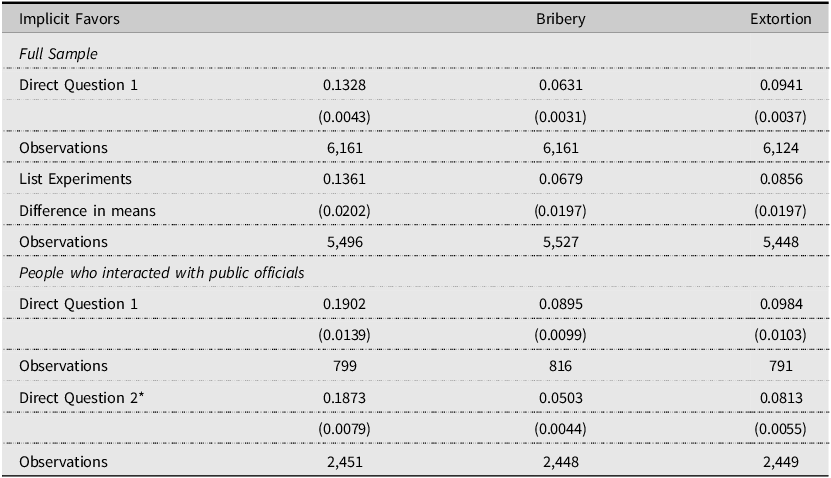
Table 2 presents estimates of the incidence of implicit favor exchanges and bribery using the different questioning methods described. Comparing the estimates obtained through direct questioning, and those generated using list experiments embedded in the survey, shows that the precautions taken in choosing the wording of the direct questions sufficed to prevent underreporting; estimates of implicit favor exchanges and bribery are essentially identical across the two methods. In light of this finding, the list experiment measures will not be used in the main analysis presented on the next section. Multivariate regression estimators for list experiments are available, but they tend to be inefficient (Imai Reference Imai2011; Blair and Imai Reference Blair and Imai2012).
Estimates of Favor Exchanges and Extortion
* These were only asked to people who had interacted with a public official in the last year
Standard errors clustered at the Municipality level in parenthesis.
Overall, 13.3 percent of the respondents reported, through direct questioning, that they had engaged in implicit favor exchanges in their dealings with public officials within the past 12 months, and 6.3 percent reported having been engaged in acts of bribery. Among those who reported having an interaction with at least one public official within the last 12 months, prior to being asked about favor exchanges, the estimate of bribery increases slightly, while the estimate of implicit favor exchanges increases by 5.7 percentage points. Estimates of implicit favor exchanges and bribery obtained by directly asking about interactions with police agents and municipal workers (Direct Questions 2) are fairly similar, though always lower than those obtained through direct questions about exchanges with public officials in general, as Table 2 shows. About 9% of respondents reported having been a victim of extortion by public officials. Importantly, the combined incidence of implicit favor exchanges and bribery is significantly higher than that of extortion in the sample.
5. Methods
Multivariate regression analysis for the previously described dependent variables, which measure implicit favor exchanges and bribery, relies on the following logistic regression model:
 $${V_{im}} = logi{t^{ - 1}}\left( {{\beta _0} + {\beta _1}Proximit{y_{im}} + {\beta _2}Centralit{y_{im}} + \lambda {X_{im}} + {\phi _m} + {\varepsilon _{im}}} \right)$$
Where ${V_{im}}$
is a binary indicator of whether a respondent participated in at least one implicit favor exchange or received a favor in exchange for a monetary payment (bribe) in her dealings with a series of public officials.
${V_{im}}$
is a binary indicator of whether a respondent participated in at least one implicit favor exchange or received a favor in exchange for a monetary payment (bribe) in her dealings with a series of public officials. ${X_{im}}\;$
contains variables that measure individual characteristics, which may confound the relation between the proximity, centrality and participation in collusive exchanges (household size, employment status, gender, age, native language, educational attainment, physical distance to the administrative center of the municipality,Footnote 25 and capacity to pay bribes, measured as income and wealth). I also include a second battery of civic engagement controls (reported likelihood of attending community meetings, volunteering at a local organization, protesting and affiliating with a political party) which may determine social proximity, centrality and participation in bribery and implicit favor exchanges, but may also be affected by participation in such exchanges. Finally,
${X_{im}}\;$
contains variables that measure individual characteristics, which may confound the relation between the proximity, centrality and participation in collusive exchanges (household size, employment status, gender, age, native language, educational attainment, physical distance to the administrative center of the municipality,Footnote 25 and capacity to pay bribes, measured as income and wealth). I also include a second battery of civic engagement controls (reported likelihood of attending community meetings, volunteering at a local organization, protesting and affiliating with a political party) which may determine social proximity, centrality and participation in bribery and implicit favor exchanges, but may also be affected by participation in such exchanges. Finally, ${\phi _m}$
stands for municipality fixed effects, which controls for time-invariant differences between municipalities.Footnote 26
${\phi _m}$
stands for municipality fixed effects, which controls for time-invariant differences between municipalities.Footnote 26
6. Results
Appendix Table A2 displays summary statistics for all variables used in the analysis. Appendix Tables A4 through A6 show summary statistics for the randomly selected subsamples that received questions on bribery and implicit favor exchanges (from Direct Questions 1), as well as for the subsample that received Direct Questions 2.
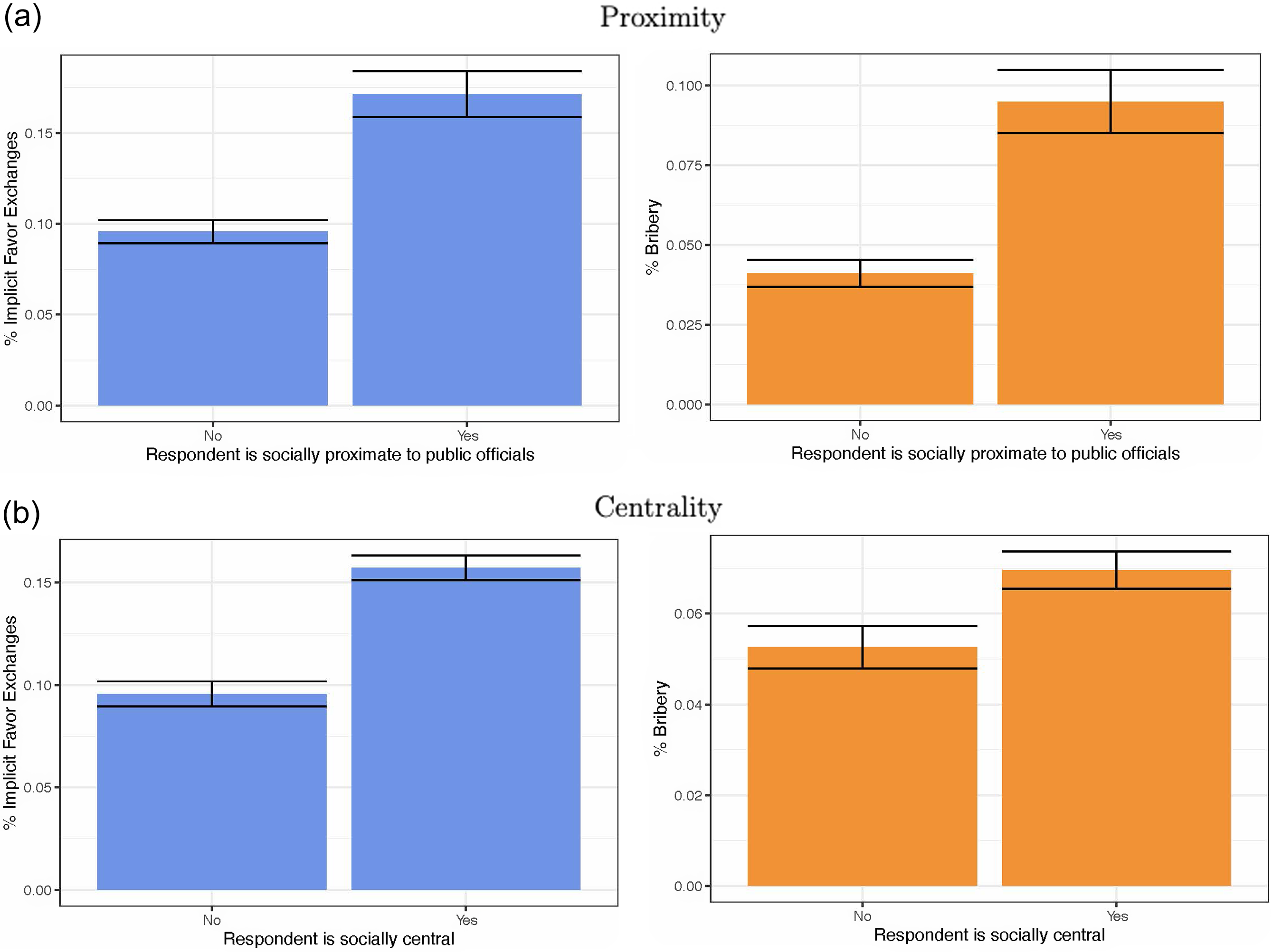
We begin this section by exploring the question who engages in favor exchanges? Figure 1 shows the percentage of respondents who report having had engaged in implicit favor exchanges and bribery according to weather they are socially proximate to public officials (i.e., individuals with a proximity score above the mean), or socially central within their communities (i.e., individuals with a centrality score above the mean). We can see that individuals with stronger social ties to public officials and socially central individuals are more likely to report participating in implicit favor exchanges and bribery. Appendix Figure A4 shows that the same holds true for wealthier and more educated individuals. On the other hand, women are less likely to report engaging in bribery and respondents of Maya descent are less likely to report engaging implicit favor exchanges (see Appendix Figure A5).
Who Engages in Favor Exchanges.
6.1 Social Distance, Centrality, and Interactions with Public Officials
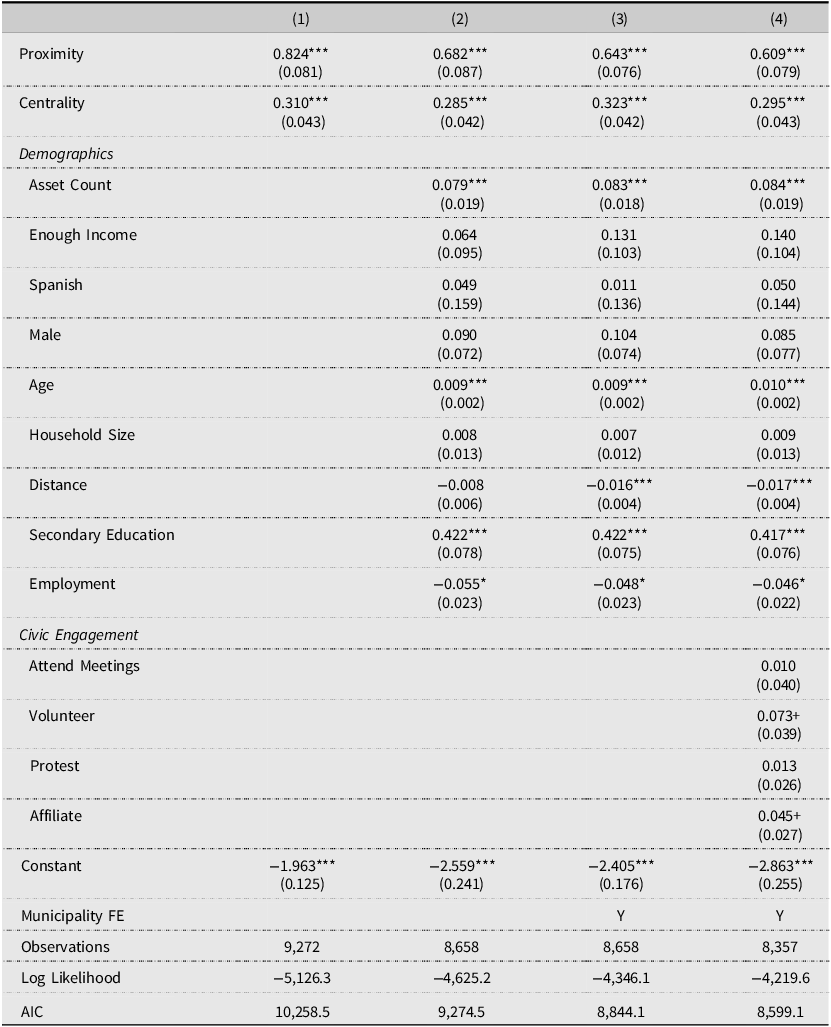
The argument developed so far refers to how social proximity and centrality provide a mechanism to sustain favor exchanges (both implicit favor exchanges and bribery), taking interaction as given. Previous research has alluded to the fact that socially proximate citizens should be more likely to interact with public officials in the context of public service delivery simply because of the nature of their relation (Rose and Peifer Reference Rose and Peiffer2015). Moreover, central individuals, by virtue of their position within their town’s social network, may seek public services at a higher rate.Footnote 27 Therefore, before testing the argument, I first assess whether social proximity and centrality are associated with an increase in the likelihood of interaction in the context of public service delivery. I regress an indicator for whether an individual interacted with a public official within the last 12 months on the measures of proximity and centrality. Table 3 displays these results. The coefficients of the two variables of interest are positive and statistically significant (at the 0.1 percent level) across all specifications. In the fully specified model (Column 3), which includes a municipality fixed effects and a set of controls for individual characteristics that may confound the relation between the proximity, centrality, and interactions with public officials, an increase of one standard deviation above the mean in the measure of social proximity is associated with a 5.1 percentage point increase in the predicted probability of interacting with a public official, holding all other variables constant. Similarly, for an increase of one standard deviation above the mean in the measure of centrality, we expect a 3.9 percentage point increase in the predicted probability of interacting with a public official, holding all other variables constant. The results remain largely unchanged when using the alternative measures of centrality described above, and when using a count of the number of reported relationships with public officials as the measure of social proximity.Footnote 28
Proximity, Centrality and Interactions with Public Officials Interacted with a Public Official
Standard errors clustered at the Municipality level. Coefficients are in log-odds.
* p < 0.05, ** p < 0.01, ***
6.2 Social Distance, Centrality, and Favor Exchanges
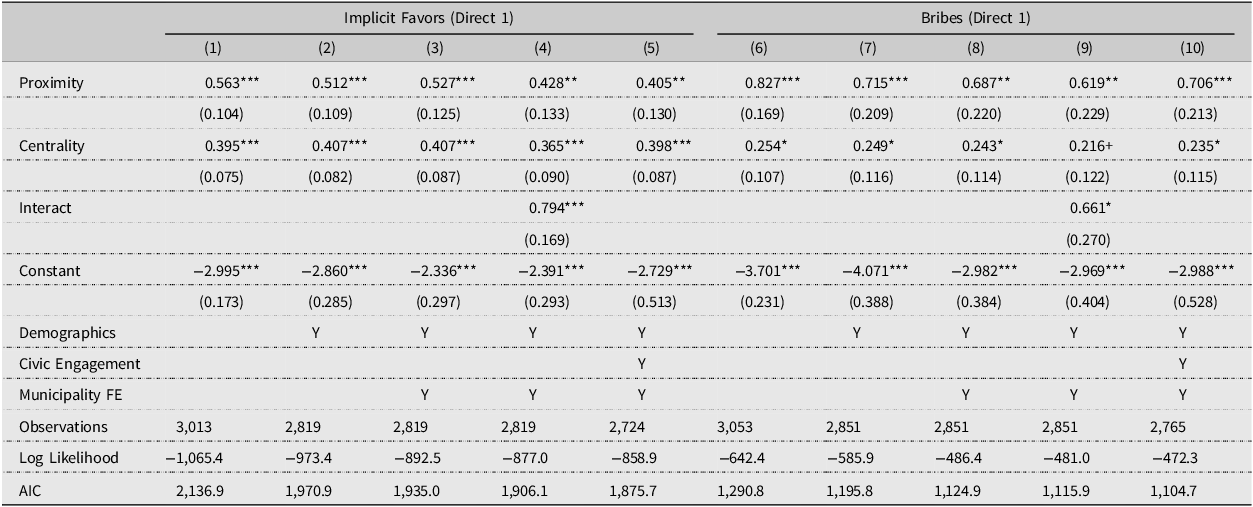
Figure 1 provides descriptive evidence of the importance of proximity and centrality on collusive petty corruption. To test the hypotheses developed in this paper, I now estimate equation 1, making use of the binary measures of implicit favor exchanges and bribery obtained via direct questions since underreporting is of no concern.Footnote 29 First, I regress the binary measures of implicit favor exchanges and bribery generated using Direct Questions 1, on the measures of social proximity and centrality. The fully specified models include all control variables listed above. Table 4 presents these results, and Appendix Figure A2 plots the predicted marginal effects of the variables of interest.Footnote 30
Proximity, Centrality and Favors Exchanges I
Standard errors clustered at the Municipality level. Coefficients are in log-odds.
* p < 0.05, ** p < 0.01, *** p < 0.001
According to H1, social proximity is expected to be positively associated with the likelihood of participating in implicit favor exchanges and bribery. The results in Table 4 support this expectation. Respondents with stronger ties to public officials are more likely to participate in both kinds of favor exchanges. Let us first focus on implicit favor exchanges—those in which the public official grants access to an illicit advantage in exchange for a future favor from the citizen. Note that proximity is positively associated (significant at the 0.1 percent level) with the likelihood of engaging in implicit favor exchanges in the most parsimonious model (Column 1), as well as in the fully specified model in Column 3. Focusing on the latter model, an increase of one standard deviation from the mean in the social proximity measure is associated with a 2.37 percentage point increase in the predicted probability of engaging in implicit favor exchanges with a public official at least once within the past 12 months, holding all other variables constant. Next, we focus on bribery, a class of favor exchanges where the citizen makes a payment to obtain an illicit advantage. Proximity is positively associated with the likelihood of engaging in bribery across all specifications presented in Columns 6 through 10 of Table 4. As Column 8 shows, an increase of one standard deviation from the mean in the measure of social proximity is associated with a 1.51 percentage point increase in the predicted probability of bribing a public official, holding all other variables constant (significant at the 5 percent level).
Centrality is positively associated (significant at the 0.1 percent level) with the likelihood of participating in implicit favor exchanges with public officials, and with the likelihood of participating in bribery (significant at the 5 percent level). Taken together, these results provide evidence in support of H2. The results in Column 3 of 4 imply that an increase of one standard deviation from the mean in the measure of centrality is associated with a 2.84 percentage point increase in the predicted probability of participating in implicit favor exchanges with a public official at least once within the past 12 months, holding all other variables constant. Similarly, the results in Column 8 of 4 imply that the same increase in the measure of centrality is associated with a 0.83 percentage points increase in the predicted probability of engaging in bribery. An important concern in the Guatemalan context may be that respondents who reported occupying positions of leadership or high importance within their communities but outside local government, may in fact be antagonized by local public service providers in some municipalities. This may be especially problematic in the case of environmental or indigenous rights activists. To ease these concerns, models in Columns 5 and 10 also include controls for different types of civic engagement, including participating in protests and volunteering.
In order to probe whether social proximity and centrality are positively associated with the likelihood of engaging in favor exchanges—beyond simply increasing contact with service providers, as Table 3 shows—I first estimate the fully specified model once again, including a binary variable for whether the respondent has been in contact with a public official in the context of public service delivery within the past 12 months as an additional control. Results in Table 4, columns 4 and 9, show that including this control decreases the magnitude of the coefficients on proximity and centrality, although they remain statistically significant at conventional levels.
As a second step, I now restrict analysis to the sample of individuals who reported at least one interaction with a public official within the past 12 months. The measures of implicit favor exchanges and bribes now come from the second set of direct questions, Direct Questions 2. Table 5 displays the results, and Appendix Figure A3 plots the predicted marginal effects of the variables of interest.Footnote 31
Proximity, Centrality and Favor Exchanges II
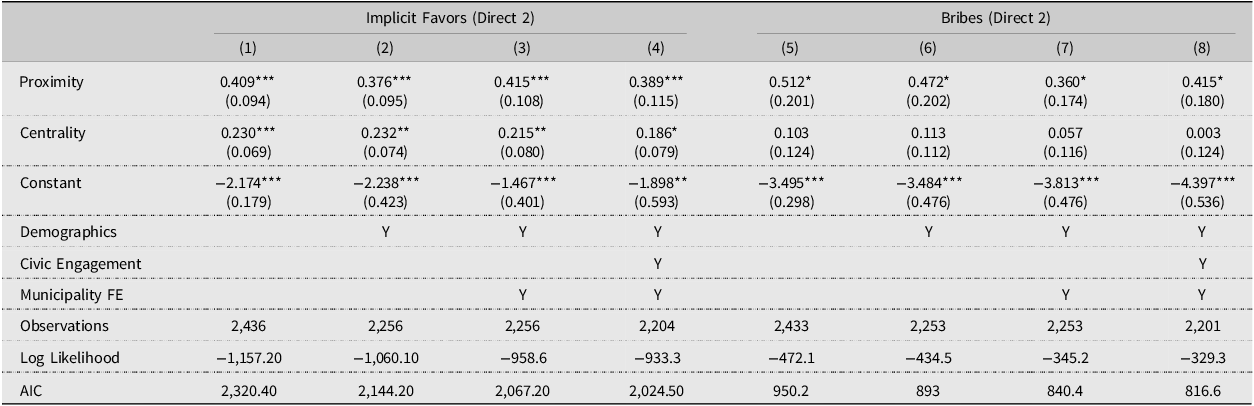
Standard errors clustered at the Municipality level. Coefficients are in log-odds.
* p < 0.05, ** p < 0.01, *** p< 0.001
Once again, there is clear evidence in support of H1. Among respondents who reported at least one interaction with a public official in the last 12 months, those with stronger ties to public officials were more likely to participate in favor exchanges. Column 3 of Table 5, which displays results from the fully specified model, shows that proximity is positively associated (significant at the 0.1 percent level) with the engaging in implicit favor exchanges. Thus, an increase of one standard deviation from the mean in the measure of social proximity is associated with a 2.68 percentage point increase in the predicted probability of participating in implicit favor exchanges with a public official, holding all other variables constant. The results displayed in Column 7 of Table 5 show that proximity is positively associated (significant at the 5 percent level) with engaging in bribery. Specifically, an increase of one standard deviation from the mean in the measure of social proximity is associated with a 0.71 percentage point increase in the predicted probability of engaging in bribery, ceteris paribus.Footnote 32
Evidence in support of H 2 is rather mixed. First, among respondents who reported at least one interaction with a public official in the last 12 months, the measure of centrality is positively associated (significant at the 5 percent level) with participation in implicit favor exchanges with public officials. According to the fully specified model in Column 3 of Table 5, a one standard deviation increase from the mean in the measure of centrality is associated with an increase of 2.16 percentage points on the predicted probability of implicit favor exchanges, holding all other variables constant. In contrast, the coefficient of centrality cannot be distinguished from zero across the three specifications (Columns 5 to 8) presented in Table 5. Therefore, while social centrality plays a key role in securing access to implicit favor exchanges, the present analysis cannot decisively conclude that it plays a role in obtaining access to illegal advantages through bribery, beyond its correlation with an increase in interactions with public officials in the context of public service delivery. These null finding may be a product of measurement error. Depending on the context, certain individuals, from activists to local organized crime bosses, may have incentives to not truthfully report the degree to which they are important within their community (e.g., through their counseling and support to other members of the community) in the context of a survey.Footnote 33
The results presented thus far hold when employing a count of relationships with public officials as the measure of social proximity, instead of the average strength of the reported connections (Appendix Tables A9 and A10). The results remain largely unchanged when employing two alternative measures of centrality as well (Appendix Tables A11 and A12). The main measure of social proximity may suffer from reverse causality, since the reported friendship between a respondent and a public official could be the result of previous exchanges. To test whether this is the case, I repeat the analysis, dropping all individuals who reported being friends with any public officials and calculating proximity by only taking into account family and acquaintance. Results in Appendix Table A19 lend support to the findings regarding social proximity. Further analysis also shows that social proximity and centrality do not affect the likelihood of extortion (Appendix Table A14). These results highlight how problematic it is to reach conclusions regarding bribery and its correlates while only relying on survey data that does not appropriately distinguish bribery from instances of extortion. Finally, the main results hold when estimated using a mixed effects logistic regression which includes population size (Appendix Table A21).
6.3 Alternative Arguments
There are three alternative arguments that may explain the results presented thus far. The first one is altruism towards one’s own kin. Public officials may be more willing to favor family members and would grant them favors with no expectation of reciprocation. Kin altruism is particularly prevalent in situations when helping is costly, such as in the case of instances of petty corruption (Stewart-Williams Reference Stewart-Williams2007). If kin altruism is at play, we should expect respondents with personal ties based on family to be less likely to engage in bribery than those whose ties are based only on friendship or acquaintance and those with no ties at all. We should expect individuals whose ties are based only on friendship or acquaintance to be less likely than does with family ties to report having received a favor in exchange for no money. Furthermore, we should expect respondents with ties based on family to be less likely to engage in gift giving in exchange for favors. This is so, because family members—those who benefit from the public official’s altruism—would not be required to reciprocate or pay for the favor received. To test whether kin altruism is the relevant mechanism I first replace the measure of proximity with three binary variables, one for respondents whose ties are only based on kin, friendship or acquaintance, respectively, and regress these measures and a full set of controls on the binary measures of favor exchanges used thus far. Results in Appendix Table A15 show that the expectations described are not necessarily met. The coefficient of family ties on implicit favor exchanges is positive but it is not statistically significant. However, the coefficient of friendship ties is positively and significantly associated with bribery. For the second test I rely on data from the exploratory study conducted before the survey that produced the data employed so far, and estimate equation 1 using a binary variable indicating whether the respondent engaged in gift giving in exchange for favors as the outcome of interest. The measures of proximity and centrality included are analogous to those described earlier.Footnote 34 I find that proximity—and centrality—has a positive and significant effect on the likelihood of engaging in gift giving in exchange for favors (see Appendix Table A16). Although this evidence suggests that kin altruism may not be the mechanism behind the results presented in the previous section, it cannot be fully ruled out.
A related alternative argument is that bribery is the product of weak ties. As such, we should expect there to be an inverted U-shaped relation between bribery and social proximity. First, a monetary exchange should not be required when ties between two individuals are sufficiently strong (i.e., family members should not pay bribes). However, when the social distance between the citizen and the public official is high enough, we should also expect the likelihood of bribery to decrease, since the enforcement mechanism provided by social proximity dissipates. I test this argument by including the squared term of proximity in equation 1. Results in Appendix Table A17 show that this is not the case: Columns 1 and 2 provide no evidence in support of an inverted U-shaped relation between bribery and social proximity.
Finally, according to the third argument, citizens, by virtue of their direct connections with public officials, or their privileged positions within their community’s social network, may be privy to important information about the bribing market in their towns. One version of this argument, which focuses on access to accurate information about how much to bribe specific public officials, rests on the assumption that there is a market-clearing price for each illegal advantage a citizen may purchase from a public official. To test this alternative explanation, I rely on data generated by a question regarding the size of the bribe needed to avoid the consequences of a traffic violation.Footnote 35 Respondents were asked the following question: “Sometimes people offer money to the police to avoid a traffic fine. How much do you think a person in your community would have to give a policeman to avoid a traffic fine?” For each individual who provided an estimate for the bribe, I construct a measure of estimate inaccuracy by calculating the absolute difference between that estimate and the median bribe estimate in their municipality and community,Footnote 36 and then take the natural logarithm of this amount. Appendix Table A18 contains the results of regressing the measure of inaccuracy on proximity, centrality and a full battery of controls. Those results suggest that proximity and centrality have no effect on bribe estimate inaccuracy. Thus, we cannot conclude that the relevant mechanism is, in fact, better access to accurate information regarding how and how much to bribe.Footnote 37
Finally, according to an alternative and more general version of this argument, citizens with a direct connection to public officials may be more likely to learn about the potential for using collusive corruption to obtain illicit advantages when accessing public services. While I lack the appropriate data to rule out this alternative mechanism, it is important to note that for such knowledge to transform into favor exchanges, an enforcement mechanism may still be required to protect the secrecy of the exchange and ensure repayment.
7. Conclusion
This paper has shown that an individual’s social proximity to public officials, and her centrality within their town’s social network predicts engagement in collusive forms of petty corruption, namely implicit favor exchanges and bribery. While doing so, it contributes to the literature on petty corruption in at least two substantive ways. First, it builds on previous work on the importance of social networks to sustain exchanges in the absence of a third party to enforce agreements (Chandrasekhar et al. Reference Chandrasekhar, Kinnan and Larreguy2018; Fehr et al. Reference Fehr, Gächter and Kirchsteiger1997; Ferrali Reference Ferrali2020; Rose-Ackerman Reference Rose-Ackerman, Ben-Ner and Putterman1998) to show how social proximity and centrality provide enforcement mechanisms that sustain extralegal exchanges and allow citizens to obtain advantages through implicit favor exchanges and bribery, in the context of public service delivery. Social proximity enables rules of reciprocity that bind among friends and family members, and which are particularly important in weak institutional environments. Centrality embodies the proverbial carrot and stick in the form of potentially large rewards for a public official that grants extralegal advantages to a socially central citizen, and equally large punishments for a public official that cheats on such a citizen. Therefore, this paper contributes to our understanding of the role of preexisting social relations, whether based on kin, ethnicity or business networks in sustaining corrupt exchanges more generally (De Jong et al. Reference De Jong, Anh Tu and van Ees2015; Isaksson Reference Isaksson2015; Lehne et al. Reference Lehne, Shapiro and Vanden Eynde2018; Seim and Robinson Reference Seim and Lea Robinson2020; Schoenherr Reference Schoenherr2019). The findings presented here also relate to previous research on how preexisting networks (e.g., based on kinship) provide a structure through which clientelistic exchanges may take place (Stokes et al. Reference Stokes, Dunning and Nazareno2013; Cruz et al. Reference Cruz, Labonne and Querubin2017; Cruz Reference Cruz2019; Ravanilla and Hicken Reference Ravanilla and Hicken2021; Hicken et al. Reference Hicken, Aspinall, Weiss and Muhtadi2022).
The second contribution is both conceptual and empirical. My argument situates bribery within the broader context of favor exchanges among individuals connected through social networks, clearly differentiating it from instances of extortion by public officials. Additionally, I distinguish these exchanges from clientelistic ones based on the nature of the currency involved: while clientelism seeks displays of political support from citizens, these favor exchanges are aimed only at securing private gains for the public official and the citizen involved (Hicken Reference Hicken2011). Since bribery is a favor exchange between a citizen and a public official, it depends on the same enforcement mechanisms that sustain implicit favor exchanges among socially connected individuals. Consequentially, the analysis employs direct measures of implicit favor exchanges and bribery that are clearly distinguishable from extortion and mitigate concerns of underreporting due to social desirability bias—a claim which I test using list experiments. In contrast, traditional survey measures of “bribery” do not allow for a distinction between payments that are made in exchange for illegal advantages (i.e., collusive forms of petty corruption) and payments that are made to access legally entitled services.
The findings with regards to social proximity also have important implications for the implementation of anti-corruption programs at a local level. Private citizens, this paper suggests, make use of their relationships with public officials in much the same way that firms use their political and bureaucratic connections to obtain illegal advantages in licensing, access to loans, and procurement contracts (Khwaja and Mian Reference Khwaja and Mian2005; De Jong et al. Reference De Jong, Anh Tu and van Ees2015; Lehne et al. Reference Lehne, Shapiro and Vanden Eynde2018; Broms et al. Reference Broms, Dahlström and Fazekas2019; Romero Reference Romero2024). While efforts to combat extortion should be expected to garner support from aggrieved citizens, as Bauhr (Reference Bauhr2017) suggests, addressing collusive forms of corruption, particularly bribery and favor exchanges, presents a more complex challenge. These exchanges create a constituency that benefits from and supports the status quo, where unfair advantages can be traded. Tackling bribery may require individuals to betray the trust of relatives and friends. Thus, policymakers must carefully consider the existing relationships between citizens and public officials when designing anti-corruption policies.
Supplementary material
To view supplementary material for this article, please visit https://doi.org/10.1017/lap.2024.50
Acknowledgments
I would like to thank Erik Wibbels, Pablo Beramendi, Livia Schubiger, Scott de Marchi, Edmund Malesky, Herbert Kitschelt, Evelyne Huber, Jonathan Hartlyn, Cecilia Martinez-Gallardo, Serkant Adiguzel, Mateo Villamizar-Chaparro, Ngoc Phan, Dean Dulay, Marco Morucci, Paweł Charasz, Rasmus Broms and Jeremy Springman for their feedback at various stages of this project. I would also like to thank the members of 2020-2021 Quality of Government Best Paper Award, Marcia Grimes, Lena Wängnerud, Georgios Xezonakis, and Stephen Dawson, and the members of the Quality of Government Institute for their encouragement, comments and suggestions.
Competing of interest declaration
I have no conflict of interest to declare.
Funding declaration
This research benefit from financial support from the Molano Endowment Research Award Grant, The Center for Latin American and Caribbean Studies’ Graduate Student Field Research Grant, and the Center for International and Global Studies’ Graduate Research & Training Grant, all from Duke University.


 Open access

