





Introduction
In many countries, voters are occasionally asked to directly decide whether a given political proposal should be enacted. As direct democracy arrangements delegate the decision-making task to voters, it has been widely discussed whether citizens are competent at handling this task (Cronin Reference Cronin1989; Bowler and Donovan Reference Bowler and Donovan1998; Kriesi Reference Kriesi2002; Hobolt Reference Hobolt2007; Colombo Reference Colombo2018). At the core of the debate is the educative potential of direct democracy. Proponents argue that this key institution – such as referendums and ballot initiatives – enlightens voters with facts about politics (eg Mendelsohn and Cutler Reference Mendelsohn and Cutler2000; Smith Reference Smith2002; Smith and Tolbert Reference Smith and Tolbert2004). This perspective is largely based on the idea that the direct participatory element enhances political efficacy and fosters increased media coverage of politics associated with more issue salience and a richer information environment.
However, several more recent studies have questioned if this is the case, with empirical findings suggesting that direct democracy does not, or only under very specific circumstances, foster political knowledge (Schlozman and Yohai Reference Schlozman and Yohai2008; Biggers Reference Biggers2012; Seabrook et al. Reference Seabrook, Dyck and Lascher2015). These findings are in line with the broader ‘minimalistic’ view on voters, stating that political ignorance and inattentiveness are widespread (Converse Reference Converse and Apter1964; Delli Carpini and Keeter Reference Delli Carpini and Keeter1996; Kinder Reference Kinder, Gilbert and Fiske1998).
Even though scholars on both sides have advanced and nuanced the debate about the educative potential of direct democracy, the measures commonly used to capture political knowledge are not the most appropriate indicator of voter competence in the context of direct democracy (Biggers Reference Biggers2012: 1007–1008; Colombo Reference Colombo2018: 789). Researchers have almost exclusively relied on outcome measures of general political knowledge regarding overall aspects of national politics, even though referendums and ballot initiatives are, by design, policy-specific, as citizens vote on particular proposals.Footnote 1 This discrepancy is unfortunate for two related reasons.Footnote 2
First, the instrumental value of general political information is far from obvious (Lupia Reference Lupia2006; Lavine et al. Reference Lavine, Johnston and Steenbergen2012). In contrast, policy-specific facts are more likely to inform citizens’ political preferences (Gilens Reference Gilens2001; Boudreau and Mackenzie Reference Boudreau and MacKenzie2014).
Second, although one might expect general and policy-specific knowledge to mirror each other, the two do not go hand in hand. Citizens can be well informed about politics in general but still lack factual understandings of issue-specific facts (Kuklinski et al. Reference Kuklinski, Quirk, Schwieder and Rich1998; Gilens Reference Gilens2001), and scholars have argued that the two should be viewed as conceptually distinct (Barabas et al. Reference Barabas, Jerit, Pollock and Rainey2014).
In this research note, I address the shortcomings in the literature by examining voter competence in direct democracy settings according to the more relevant of the two standards: citizens’ acquisition of domain-specific facts related to the referendum issue they vote on. Importantly, knowledge of such policy-specific facts is not directly equal to ‘competence’, especially in the context of direct democracy, where citizens may emulate informed decision-making by relying on a few information cues to compensate for the complexity that is often entailed with referendum proposals (Lupia Reference Lupia1994). Nevertheless, familiarity with policy-specific information is essential if voters are to comprehend the campaign debate related to the referendum issue. This relates to understanding the implications of adopting (or failing to adopt) the referendum proposal and thereby recognising central policy-related arguments for voting ‘yes’ or ‘no’ (Colombo and Kriesi Reference Colombo and Kriesi2017) but also to voters’ ability to decide on a ballot proposition based on their underlying preferences (Hobolt Reference Hobolt2007: 158). Moreover, to effectively rely on cues, citizens must still be acquainted with a minimum amount of information, and this may exactly be the partial information that domain-specific facts offer (Delli Carpini and Keeter Reference Delli Carpini and Keeter1996: 52). By focusing on the criterion of policy-specific knowledge, I thus pose a simple, yet fundamental question: When voters are granted full control of political decisions, do they become more knowledgeable about the issue-specific facts that make them better equipped to make informed choices?
To examine this, I take advantage of four European Union (EU) referendums in Denmark in which panel survey data was collected before and after the elections, which uniquely included multiple repeated measures of voters’ policy-specific knowledge. Specifically, I analyse the extent to which voters learned facts about the respective referendum issue during the campaigns. To understand the learning dynamics, I combine the knowledge batteries in each panel survey with an original content analysis of the same topics in the national news media. This allows me to examine whether the learning of issue-specific facts is driven by opportunities provided by the media information environment and compare with other factors important for gaining political knowledge, namely, individual ability and motivation (Delli Carpini and Keeter Reference Delli Carpini and Keeter1996; Jerit et al. Reference Jerit, Barabas and Bolsen2006; Barabas et al. Reference Barabas, Jerit, Pollock and Rainey2014).
Across all four referendums, I first find that voters’ knowledge of policy-specific information increased substantially by around 10–19 percentage points on average during the referendum campaigns. Second, the results show that the learning of issue-specific facts is not driven by individual ability or motivation as measured by citizens’ educational level and interest in EU politics. Instead, the acquisition of policy-specific information seems to be associated with the opportunities provided by the information environment as learning is more prevalent for the issue-specific topics that received higher media coverage compared to the topics that received lower media coverage.
These descriptive findings suggest that a significant and diverse share of voters familiarise themselves with policy-oriented facts that help them make informed and considered choices in direct democracy settings. This implies that we should not be too sceptical about the competence of the average voter when political institutions grant citizens full control of political decisions. Importantly, factual learning seems to be facilitated by the opportunities provided by the news media, meaning that the potential for enlightenment during direct democracy is enhanced by a vibrant information environment.
Case selection and data
To explore whether citizens learn issue-specific information when engaging with direct democracy, I utilise a range of two-wave panel survey data, tracking Danish citizens before and after four different referendums in which they voted on a political proposal concerning their country’s relationship to the EU. The four cases include the 1972 membership referendum, the 2014 Unified Patent Court referendum, the 2015 Justice and Home Affairs opt-out referendum, and the 2022 defence opt-out referendum (in Online Appendix A, I provide a short description of each of the referendums).Footnote 3 The selection criteria were that these cases were the only ones I was able to locate where panel data had been collected, which included repeated measures of the same respondents’ issue-specific knowledge both before and after the referendum campaigns. The survey data from all four studies is of high quality and approximately representative of the Danish population on key sociodemographic descriptives (see Online Appendix C for sample descriptives and panel attrition).Footnote 4
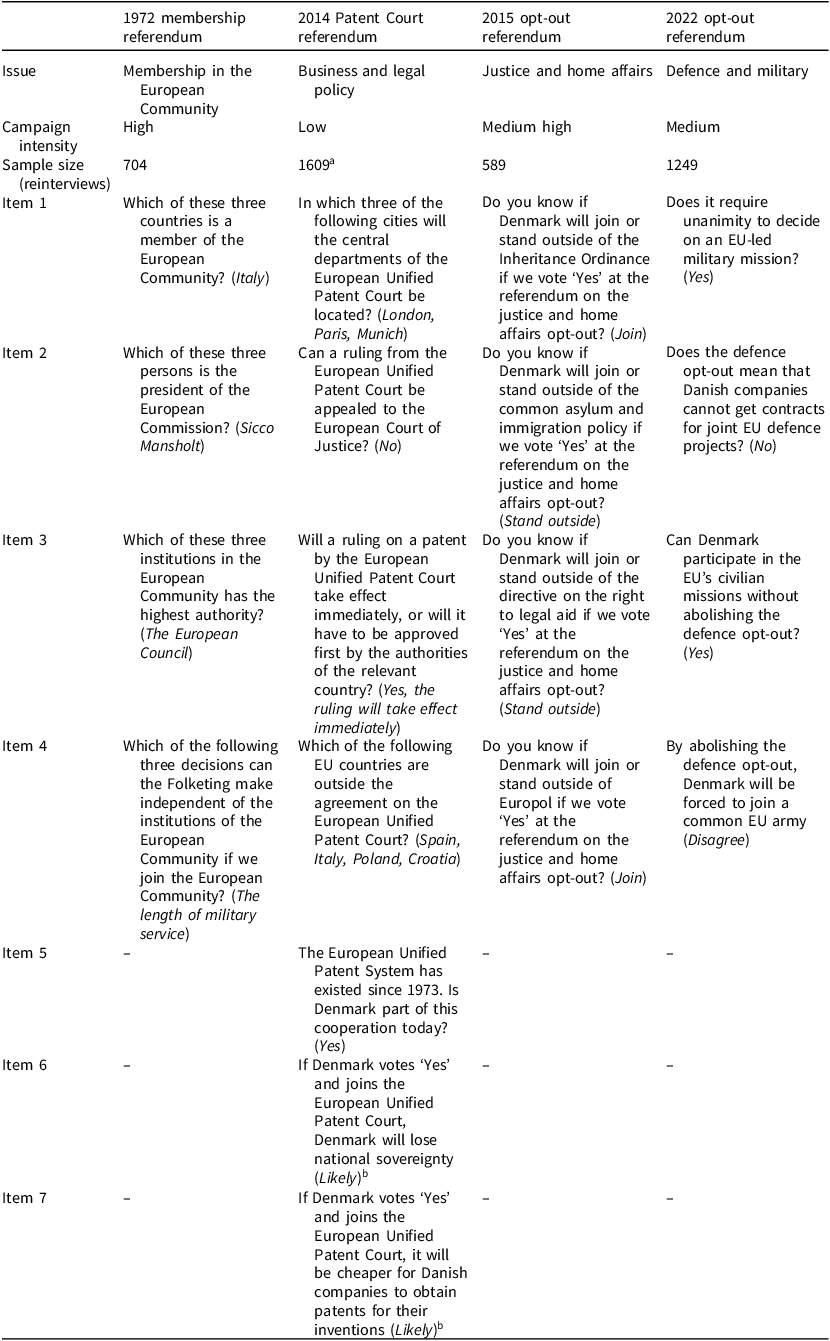
Aside from the fact that all referendums are from Denmark, the cases vary on important aspects (see Table 1) such as (i) time, (ii) the political issue of the referendum proposal, and (iii) the intensity of the referendum campaign. The diverse set of cases allows me to broaden the scope of the findings by examining voter competence in direct democracy more consistently and across different contexts. This way, I mitigate the risk that the results are driven by any idiosyncratic circumstances in a single referendum, which would make generalisations of the findings more difficult.
Overview of cases and data

Note: See SI Appendices A–C for more details on the cases and data. The parentheses show the correct answers.
a The original number of reinterviews was 4913, but only a third were reinterviewed at the end of the referendum campaign.
b Out of the 1,609 participants, a random group of respondents were exposed to the policy-specific information related to items 6 (n = 280) and 7 (n = 264) in the second wave of the 2014 referendum survey. These respondents were excluded from the analysis, where the items make up (part of) the outcome measure.
Denmark provides a useful national setting for studying voter competence in the context of direct democracy. The country has frequently made use of referendums. Since 1990, Denmark has held eight referendums at the national level. Seven of these have been related to the EU and the Danish opt-outs, following the ‘No’ to the Maastricht Treaty in 1992 and the subsequent ‘National Compromise’ the year after (Svensson Reference Svensson2002). Moreover, Denmark is characterised by a public service media system that ensures wide access to balanced and unbiased news coverage (Hallin and Mancini Reference Hallin and Mancini2004). Finally, while comparative data on the level of political knowledge across countries is sparse, Danish citizens are often presumed to be well informed about politics (Curran et al. Reference Curran, Iyengar, Brink Lund and Salovaara-Moring2009; Hansen and Pedersen Reference Hansen and Pedersen2014). Given that I focus on changes in issue-specific knowledge over time (rather than levels), these features of the Danish national setting provide a more critical test of voter competence.
Survey measures
To analyse the four cases, I use the panel data to construct measures of three of the four key variables, which include citizens’ issue-specific knowledge, the ability to learn, and their motivation to learn.
Issue-specific knowledge
Using the panel surveys, I identified four to seven items within each of the four referendum studies that were measured in both the pre-referendum and post-referendum panel waves through identical question wordings.Footnote 5 These items captured domain-specific knowledge related to the respective referendum issue. Table 1 provides an overview of all items (the full question wordings and answer categories for all measures can be found in Online Appendix B). All items were closed-ended questions and included a ‘Don’t know’ option in the response categories. For all items, respondents were coded 1 if they answered correctly and 0 if they did not know or answered incorrectly. In the analysis, I probe the learning of each policy-specific fact separately, but I also combine all items – within each referendum survey – into an additive index, which I subsequently rescaled from 0 to 1, with higher values denoting more issue-specific knowledge.
Ability to learn
To capture the ability to learn, I rely on respondents’ self-reported educational level, which is in line with other studies (Delli Carpini and Keeter Reference Delli Carpini and Keeter1996; Barabas et al. Reference Barabas, Jerit, Pollock and Rainey2014). The underlying premise is that highly educated people possess more cognitive skills, enabling them to understand political information. I utilise a question of educational attainment asked in the first survey wave(s) to construct a binary indicator, coded 1 if respondents have obtained a higher educational level and 0 if not.
Motivation to learn
I operationalise the motivation to learn based on a measure of respondents’ interest in EU politics. This measurement choice is inspired by seminal work on political knowledge (eg Luskin Reference Luskin1990; Delli Carpini and Keeter Reference Delli Carpini and Keeter1996) and rests on the grounds that those interested in politics should be more eager to seek out political information and pay attention to it. For the 2015 and 2022 referendum surveys, I use responses to the following question in the first survey wave: ‘How interested are you in politics regarding the EU?’ Answers were measured on a fully labelled five-point scale ranging from ‘Not at all interested’ to ‘Very interested’. The items I use from the remaining two referendum studies are fairly similar (see Online Appendix B). I use the responses to construct an ordinal measure of motivation to learn that was coded ‘Low’ if respondents reported less interest in EU politics, ‘Medium’ if they reported being neither interested nor uninterested in EU politics, and ‘High’ if they expressed being somewhat or very interested.
Media coverage of issue-specific information
I combine the knowledge batteries in each referendum survey with an original content analysis of the same topics in the national news. Specifically, three human coders were trained to retrieve and analyse a random sample of news articles about the referendums, covered by five major national newspapers during the six weeks prior to the election.Footnote 6 While I do not claim that the survey participants are necessarily receiving their news from these particular sources, I simply assert that this wide set of major newspapers provides a fairly broad and representative view of the referendums’ issues that appeared on the news in general in Denmark.
After identifying the relevant sample of articles in all newspapers, each article was separately coded based on whether it covered each of the domain-specific facts within the referendum issue that appeared in the respective panel survey (see Barabas and Jerit Reference Barabas and Jerit2009 for a similar approach). This allowed me to tally the total number of articles providing the issue-specific information for each of the subtopics (items) in the surveys (see Online Appendix D for a full overview of the content analysis). Based on these story counts and the relative differences between them, the items were categorised into conditions of either lower or higher media coverage.Footnote 7
Results
Do citizens become more knowledgeable about policy-specific facts relevant to the issue they vote on during the referendum campaigns? Figure 1 displays the average knowledge level of issue-specific facts over time before and after the respective referendum campaigns across the different items. Several important conclusions can be derived from the figure. Overall, it demonstrates that voters’ knowledge of issue-specific information was significantly higher after the referendum campaigns than before. Put differently, the familiarity with issue-specific information markedly increased during the campaigns.Footnote 8
Issue-specific knowledge before and after referendums campaigns.
Note: The figure shows the proportion of voters who know the issue-specific facts over time before and after the referendum campaigns. Error bars represent 95% confidence intervals. ***p < 0.001, *p < 0.05.

The proportion acquainted with the correct information improved by 10–19 percentage points (p < 0.001) across the different referendums when the knowledge batteries were combined into an additive index, as indicated by the lower brackets.Footnote 9 The magnitude of learning is quite substantial, especially considering that the overall baseline level of the domain-specific knowledge was below 50 per cent within all four referendums. Thus, in relative terms, the learning of policy-specific information corresponds to an increase by 29, 58, 61, and 30 per cent on aggregate across the four cases. Both in absolute and relative terms, the knowledge gain is on par with or exceeds the increase during deliberative forums or general election campaigns found in other studies (eg Luskin et al. Reference Luskin, Fishkin and Jowell2002; Andersen and Hansen Reference Andersen and Hansen2007; Farrar et al. Reference Farrar, Fishkin, Green, List, Luskin and Paluck2010; Hansen and Pedersen Reference Hansen and Pedersen2014). While the learning is clearly stronger on some topics than others, the information gain is statistically significant in 16 out of 19 instances (with two of the three remaining being significant at the 0.1 level), and a majority of the estimates are above 10 percentage points. In other words, rather than just learning a single fact, citizens became substantially more knowledgeable about a broader range of issue-specific information during the referendum settings.
However, several researchers have pointed to systematic tendencies in the acquisition of political knowledge across individuals (eg Delli Carpini and Keeter Reference Delli Carpini and Keeter1996; Barabas et al. Reference Barabas, Jerit, Pollock and Rainey2014). Consequently, the overall learning patterns could be driven by individuals with a high ability or motivation to retain the policy-specific facts. Figure 2 shows the overall change in issue-specific knowledge across individual educational level and interest in EU politics. Somewhat surprisingly, the figure shows no clear patterns of learning being concentrated among those with a high educational level or profound interest in EU politics.Footnote 10 While these groups have a higher baseline level of policy-specific knowledge compared to those with lower educational levels and less interest in EU politics, they display about the same change in (learning of) the policy-specific knowledge over time during the campaigns.Footnote 11 As such, the knowledge gain is rather homogeneous across individual differences in these factors. Put differently, even individuals with weaker prerequisites for learning acquire issue-specific information during the direct democracy settings, and they do so to about the same extent as those who have stronger prerequisites to learn. The magnitude of the learning among those with lower educational levels and less interest in EU politics is substantial, given that they reach the same level of policy-specific knowledge that more educated and interested voters had prior to the referendum in many cases.
Learning across educational level, interest in EU politics, and media coverage.
Note: The figure shows the proportion of voters over time who know the issue-specific facts (measured by the additive index) across differences in individual educational level, interest in EU politics, and different contexts of media coverage. Error bars represent 95% confidence intervals. ***p < 0.001.
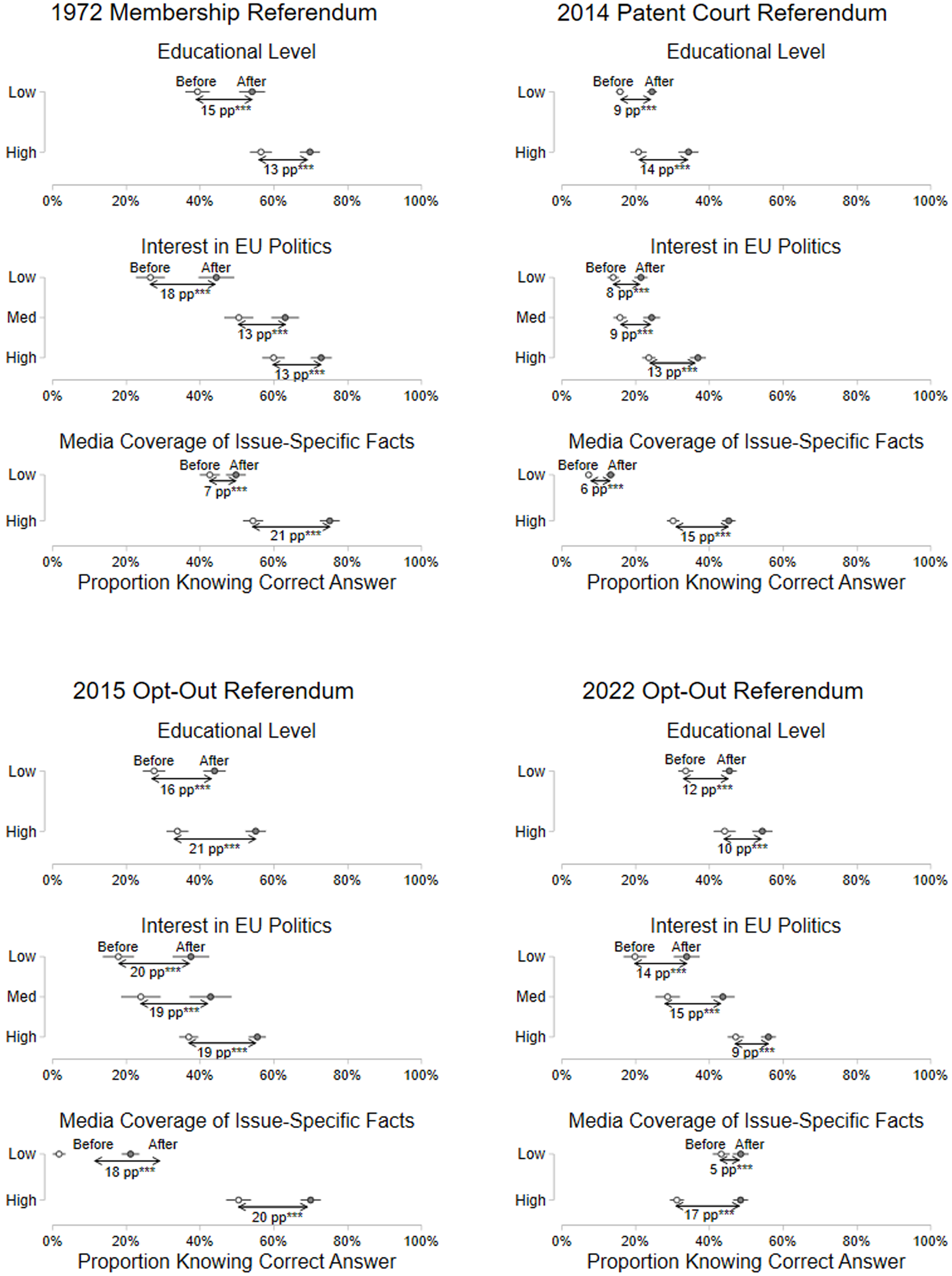
While the individual factors fail to explain the knowledge gains, the lower parts of each panel in Figure 2 show that the acquisition of policy-specific facts is related to the amount of media coverage. In all four referendums, the figure reveals that the learning is more pronounced on the issue-specific topics that received a higher share of news coverage relative to topics that received lower coverage. Besides the 2015 campaign, the learning is about 10 percentage points higher on topics that received a higher share of news coverage relative to those that received lower coverage. That is, in three out of four cases, the acquisition of issue-specific facts is clearly connected to the level of media coverage.
Overall, these findings suggest that voters become substantially more knowledgeable about policy-specific information related to the referendum issues during the direct democracy campaigns and that the learning is linked to the opportunities provided by the media information environment more than individual ability and motivation.
Conclusion and discussion
Do voters become more knowledgeable about policy-specific facts when granted full control of political decisions? I have provided unique direct panel evidence on this question and show that citizens significantly learn policy-specific information during referendum campaigns. These descriptive findings suggest that the sceptical view on voter competence in the context of direct democracy should be reconsidered, at least when assessing political knowledge from a dynamic and issue-specific perspective.
This research note thereby sheds nuance and helps reconcile the scholarly debate about the educative potential of direct democracy (Cronin Reference Cronin1989; Bowler and Donovan Reference Bowler and Donovan1998; Smith and Tolbert Reference Smith and Tolbert2004). While extant studies report mixed findings regarding increases in general political knowledge – which is arguably less relevant and available in contexts of direct democracy – I find evidence of substantial learning of issue-specific facts across four different referendums. This implies that voters, during referendum campaigns, become more knowledgeable about the facts related to the issue that can potentially help them inform their political decision-making. This not only goes for citizens with the resources and motivation to learn but also for those with fewer prerequisites.
While the referendums I have examined varied on important aspects such as timing, issue type, and campaign intensity, some reservations are in order regarding the generalisability of the findings. For starters, all the analysed referendums concerned the relationship between Denmark and the EU, which is a politicised and recurrent issue in Danish politics (Hobolt Reference Hobolt2009). Obviously, the magnitude of campaign learning may be weaker for less salient referendum issues or when issues are highly technical or bundled together in broader reforms such as constitutional referendums (Elkins and Hudson Reference Elkins, Hudson, Landau and Lerner2019; Cozza et al. Reference Cozza, Elkins and Hudson2021). Moreover, the institutional context may shape the extent to which voters learn policy-specific facts during referendums. Knowledge gains may be attenuated when referendums coincide with general elections or when multiple propositions are on the ballot simultaneously, as voters’ attention and media coverage are split (Nicholson Reference Nicholson2003). Similarly, in settings where direct democracy is more frequent (such as Switzerland or many US states), learning may be influenced by the fact that voters are more accustomed to these situations, making direct democracy a more normalised form of political engagement. More studies are thus needed to pin down the exact scope of the article’s findings.
My results also contribute to our understanding of the role of mass media in democratic politics. I find that the learning of issue-specific information is more prevalent on the topics that received higher media coverage compared to the topics that received lower coverage. This is in line with previous findings (eg Barabas and Jerit Reference Barabas and Jerit2009; Barabas et al. Reference Barabas, Jerit, Pollock and Rainey2014) and suggests that the acquisition of policy-specific facts is associated with opportunities to learn provided by the media information environment. This way, the interplay between two institutions – direct democracy and the news media – shows an important potential of enlightening citizens about issue-oriented information.
Taken together, this study supports the notion that voters display competence in the context of direct democracy and become better equipped to decide on the political decisions they have been imposed to make.
Supplementary material
The supplementary material for this article can be found at https://doi.org/10.1017/S1475676526100826.
Data availability statement
Data and replication code are available at https://osf.io/u8k76/overview?view_only=cb6ad12fa2784065bee53d8618adcece.
Acknowledgements
For valuable feedback, the author would like to thank Martin Vinæs Larsen, Lene Aarøe, Jennifer Jerit, and three anonymous reviewers. The author would also like to thank Anna Elbæk Holmer, Katrine Skovlund Sørig, and Signe Juul Nørgaard for excellent student assistance. Finally, the author is grateful to Rune Slothuus and Derek Beach for generously giving access to much of the data on which the article draws.
Funding statement
This research was funded by the Independent Research Fund Denmark (no. 2033-00240B).
Competing interests
The author reports there are no competing interests to declare.
Ethics statement
As stated in the manuscript, none of the four studies raise ethical concerns. They comply with national regulations and professional guidelines for studying human subjects and follow data protection regulations. According to Danish national regulations, all studies were exempt from formal IRB review (see Online Appendix F for information about ethical considerations).



 Open access

