




Although you wouldn’t know it from reading the historiography, dredges played an essential role in expanding and retaining the American empire in the Pacific. Dredges built a string of ports on the Pacific Coast, from Seattle, WA to San Diego, CA. Dredges constructed seaports in Honolulu and Pearl Harbor in Hawai’i and Manila Bay in the Philippines. Dredges turned atolls and desert isles, such as Midway, Guam, and Wake, into a constellation of harbors for ships and seaplanes. In short, dredges literally built the infrastructure of the empire.Footnote 1
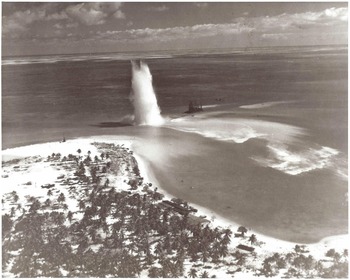
Historians have traditionally told the story of the American empire from the perspective of decision makers in the seats of power in Washington, DC, or on the decks of the destroyers, battleships, and aircraft carriers that traversed the globe and waged the wars that gained and retained overseas territory. Empire building looks different from the deck of a dredge. You see a lot of water, of course, but you also see obstacles. All those islands and atolls did not come ready made for commercial and military interests. Coral had to be blasted and removed, sand bars had to be punctured, and channels had to be dug into the shallow waters of bays and inlets (Figure 1). From the bridge of a destroyer, the Pacific Ocean may appear dotted with opportunities, the steppingstones that lead to victory; from the bridge of a dredge, the Pacific is dotted with challenges, the actual contours and motions of the natural world. In building its empire, the United States would remake the map of the Pacific, not just in a geopolitical sense, but in a geophysical one too. Dredges, in other words, were among the tools that redefined the American relationship to water. The modern relationship with oceans, islands, and water itself would be mediated by technologies of manipulation so commonplace that their work has often gone unnoticed. Rather than simply conquering territory, the United States was actively remaking the hydrological foundations of empire—transforming water from obstacle into infrastructure, turning coral reefs and shallow bays into the sinews of imperial power.
Dredges used dynamite to break through coral reefs while creating ports on islands across the Pacific, including on Kiritimati (known as Christmas Island), pictured here in 1942. Source: image courtesy of Dutra Museum Foundation, Rio Vista, CA.

The literature on the extracontinental American Empire is expansive. From it we learn about Admiral George Dewey’s victory at Manila Bay in early 1898, and the decision to retain the Philippines and Guam after the defeat of Spain, a decision that turned the United States into a great imperial power. The annexation of Hawaiʻi came months later, a critical step in protecting the new possessions. Then the United States acquired the Canal Zone and built the Panama Canal, giving commercial and military fleets a shortcut between the two American oceans. These stories are essential to understanding how the United States built its Pacific.Footnote 2
In all of this, water plays a central role, particularly in the description of coaling stations and safe harbors dotting the Pacific. Curiously, the creation of those harbors has received very little attention. Paul Kennedy’s magisterial Victory at Sea: Naval Power and the Transformation of the Global Order in World War II (2022) describes the importance of investing in destroyers but not dredges, which earn no mention, as is typical. This oversight has consequences, for when dredges enter the stage, we see clearly how the struggle between nations is complicated by the struggle between humans and nature.Footnote 3
Dredging is an ancient practice, but not until the 1800s did innovation dramatically expand the capabilities of the technology. Steam power meant machines could move more sand, silt, mud, and rock more efficiently and more frequently. Dredges adapted to the environments they worked: chain-driven ladder dredges worked rivers with soft, sandy bottoms; clamshell and dipper dredges moved the stubborn muck of muddy estuaries.Footnote 4 Hydraulic dredges used a suction tube, typically equipped with a rotating “cutter” head at its mouth, to lift material and transfer it over increasingly long distances. These suction dredges made the rapid movement of large quantities of material over substantial distances feasible and affordable. Investments in dredging technology among imperial powers—the Dutch, the British, the French, and the Americans most importantly—resulted from the commercial competition among nations and individual ports particularly. As ports grew exponentially, however, ships of commerce and war grew to meet the available space.Footnote 5
After the United States took possession of the Philippines, the Insular Government hired the dredging firm Atlantic, Gulf and Pacific (AG&P) to rebuild Manila Harbor. AG&P imported the hydraulic dredge Manila, named, as was common, for the place it was intended to work. One of the largest dredges in the world, Manila was capable of moving nearly 30,000 cubic yards of mud per day. By 1904, AG&P had built a new breakwater, created an impoundment, and pumped 6 million cubic yards of mud from the harbor to make new land.Footnote 6
By 1909, the War Department counted seven dredges working in the port and at various places along the Pasig River and connecting rivers and canals. Despite the challenges of the work, Director of Navigation Frank Helm determined that the “policy of promoting trade and commerce by expending large sums” on port development, especially dredging and dock construction, would bear fruit through increased efficiency. In the process, the riverine and estuarine ecologies of Luzon would be remade in service of the American empire.Footnote 7
If the Philippines and Guam were to remain U.S. possessions, Hawaiʻi would have to change. Just months after Hawaiʻi’s annexation, Congress appropriated funds to build a new port at Pearl Harbor. Honolulu had a port, which the Republic of Hawaiʻi had dredged years earlier to create “Navy Row” in anticipation of the arrival of an American battleship, but military men thought it too exposed to enemy ships. A port dug deep into Pearl Harbor could be protected by large guns at the harbor mouth—or so the thinking went in the era before bombers.Footnote 8
In 1901, the Army Corps hired a Stockton, California company to open the bar at the mouth of Pearl Harbor. The company had the dredge equipment shipped from California, including a huge clamshell, which was typical of the dredges used in California’s Central Valley. The dredge made slow progress; the soft sand, unlike the muck of California, sifted through the clamshell’s teeth, decreasing its effectiveness. In 1902, the Army Corps hired another contractor with additional equipment, two large suction dredges.Footnote 9
With the bar finally breached, the Army Corps began creating a range of facilities in the harbor. The San Francisco Bridge Company won the contract to dredge inside Pearl Harbor in 1905. It too brought a dredge from California, along with the men to run it.Footnote 10 The first task was to blast a wider channel through the coral reef. By 1914, the local Hawaiian Dredging Company was also operating a suction dredge and other equipment, and Pearl Harbor continued to expand. It could accommodate at least 130 vessels, including nine battleships, by December 7, 1941.Footnote 11
That was the day Japan attacked Pearl Harbor, of course, followed hours later by attacks on Midway, Manila, Wake Island, and Guam. Just eight days later, reporter Edgar Mowrer warned that Guam was likely to fall. In fact, “Guam never had a chance,” he wrote, not just because of its proximity to Japan and its great strategic value, but because it had just one shallow harbor impinged by coral reefs.Footnote 12 The only dredge in Guam was owned by a German, and U.S. law prohibited non-citizens from receiving dredging contracts. This predicament delayed dredging until just two months before the arrival of the Japanese. Congress had also been slow to appropriate funds to dredge on Guam and Wake Island, both of which were expected to be important stops for trans-Pacific flights. Indeed, in 1939, Congress struck $5 million from a spending bill that would have paid for the dredging of Guam harbor, where coral would have to be removed to allow seaplanes to land. (In spring 1942, with the United States stung by the loss of territory, a minor controversy erupted in newspapers around the country: who was to blame for the lack of dredging in Guam?Footnote 13)
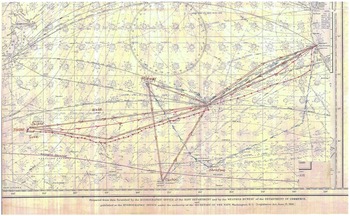
Only belatedly did Congress act to protect its overseas possessions, allocating $40 million in 1940 to build new harbors on American islands in the Pacific. With the funding hurdle cleared, the Army Corps worked to clear the second hurdle: getting dredges to remote islands and supplying them for the work ahead. In the summer of 1940, it sent “seagoing” dredges operating under their own steam across the open waters of the Pacific. The large hopper dredge Mackenzie departed from Portland to create a seaplane harbor at Midway, a U.S. possession since 1867. It took Mackenzie two weeks to make the trip, including the necessary stop in Honolulu. By early fall, the Mackenzie, with a crew of sixty men, was working day and night to clear sand (Figure 2).Footnote 14
By the end of World War II, the Army Corps had requisitioned dozens of private dredges, including three Olympian Dredge Company dredges, which traveled to distant Pacific islands, including Tinian, Saipan, and Midway. All three dredges, based in Rio Vista, California, left San Francisco Bay and stopped in Honolulu. Source: image courtesy of Dutra Museum Foundation.

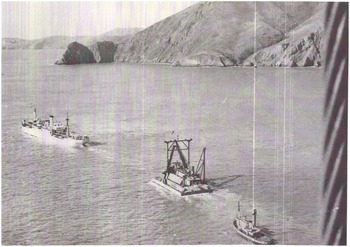
The Mackenzie was not the first dredge to arrive at Midway. It joined Hell Gate, a dipper dredge that had traversed the Pacific in the more typical way, since most dredges could not steam across open water. Hell Gate had been towed from New York City (hence the name Hell Gate) to Pearl Harbor in 1937, a forty-seven-day trip even with the Panama Canal shortcut, and then, after repurposing for open-water work, it was towed the next summer to Midway, where it cleared coral, work for which a suction dredge was ill suited. The next summer, the Navy also towed the Army-owned cutterhead suction dredge Sacramento from Oakland to Midway to speed the work. In January 1940, the Navy transport Sirius towed the dredge Holland for twenty-eight days so that it could work at Midway (Figure 3). Sirius also carried tons of dynamite and equipment that would be used to build the breakwater, channel, and seaplane basin. In other words, with the arrival of the Mackenzie in 1940, the Army Corps had assembled a small fleet of dredges 3,000 miles from the Pacific Coast.Footnote 15 Two years after the Mackenzie began its work, the United States successfully defended Midway, ending the Japanese advance across the Pacific.Footnote 16
The naval ship Sirius towed the dredge Holland out of San Francisco Bay after it had been made ready for open-water transport. The Holland stopped first in Honolulu and then arrived in Midway in early 1940. Source: image courtesy of Dutra Museum Foundation.

Pulling flat-bottomed dredges across the ocean and between far-flung islands was not as easy as just chaining the boats to Navy ships. The dredges needed to be outfitted for open water. For example, the suction dredge Columbia left Portland, OR in April 1941, towed by the Navy tug Seminole, on its way to Wake Island via Pearl Harbor. One of the most remote islands on the globe, Wake was over 4,000 miles from Portland. To prepare, the dredge was put in drydock to be outfitted for saltwater work and then clad with a wooden sheathing to protect it from heavy seas while being towed. Columbia also gained a false bow to push aside the swells. Many of the men who worked on the dredge in Portland went along. Unfortunately, the Japanese captured the dredge and its crew shortly after the bombing of Pearl Harbor. Many of those men did not make it home after the war. Apparently, neither did the dredge.Footnote 17
As the war turned in favor of the United States, the Navy acquired a small fleet of its own dredges, creating a battalion to clear sunken ships and other debris from recaptured harbors. They worked on a series of islands, including Saipan, where the harbor “was a forest of sunken ships.” While on Saipan, American sailors commandeered a Japanese dredge and put it to work. The Navy also transported its own dredges across the Pacific, including the suction dredge Tualatin. Renamed Y-19, it was the first dredge to arrive at the retaken Guam in the summer of 1944. It used dredged sand to create a new “supply island,” which would hold an ever-increasing pile of war materiel for the anticipated invasion of Japan. Y-19 was joined by additional Navy dredges and others from the Army Corps, altogether a formidable fleet of dredges that performed essential work to rebuild the American empire.Footnote 18
Dredges remained essential after the war, as the United States continued to build and expand ports at home and abroad. They were at the cutting edge of the nation’s technological empire, leading the country’s struggle against the natural forces that would silt in safe harbors and occlude rivers with sand bars. In the end, the American empire in the Pacific was as much a product of hydraulic engineering as naval strategy—a reminder that imperial power required not just the projection of force across water, but the fundamental remaking of water itself. From Pearl Harbor to contemporary port expansions, dredges have continuously reshaped both coastlines and coral reefs, transforming marine ecologies in service of American power. Yet this massive, ongoing project of hydraulic engineering remains largely invisible in our histories—a hidden foundation of empire in which dredges continue to shape American global commercial and military relationships.


 Open access

